Downloaded 14 times
![World Academy of Science, Engineering and Technology
International Journal of Electrical, Electronic Science and Engineering Vol:4 No:3, 2010
UPFC Supplementary Controller Design Using
Real-Coded Genetic Algorithm for Damping
Low Frequency Oscillations in Power Systems
A.K. Baliarsingh, S. Panda, A.K. Mohanty, C. Ardil
International Science Index 39, 2010 waset.org/publications/11352
Abstract—This paper presents a systematic approach for
designing Unified Power Flow Controller (UPFC) based
supplementary damping controllers for damping low frequency
oscillations in a single-machine infinite-bus power system. Detailed
investigations have been carried out considering the four alternatives
UPFC based damping controller namely modulating index of series
inverter (mB), modulating index of shunt inverter (mE), phase angle of
series inverter (δB ) and phase angle of the shunt inverter (δE ). The
design problem of the proposed controllers is formulated as an
optimization problem and Real- Coded Genetic Algorithm (RCGA)
is employed to optimize damping controller parameters. Simulation
results are presented and compared with a conventional method of
tuning the damping controller parameters to show the effectiveness
and robustness of the proposed design approach.
Keywords—Power System Oscillations, Real-Coded Genetic
Algorithm (RCGA), Flexible AC Transmission Systems (FACTS),
Unified Power Flow Controller (UPFC), Damping Controller.
I. INTRODUCTION
T
HE main causes of the power systems to be operated near
their stability limits is due to the fact that power systems
are today much more loaded than before as power demand
grows rapidly and expansion in transmission and generation is
restricted with the limited availability of resources and the
strict environmental constraints. In few occasions
interconnection between remotely located power systems
gives rise to low frequency oscillations in the range of 0.2-3.0
Hz. These low frequency oscillations are also observed when
large power systems are interconnected by relatively weak tie
lines. If the system is not well damped, these oscillations may
keep increasing in magnitude until loss of synchronism results
[1]. The installation of Power System Stabilizer (PSS) is both
economical and effective; in order to damp these power
system oscillations and increase system oscillations stability.
_____________________________________________
A.K. Baliarsingh is Research Scholar in the Electrical Engineering
Department, School of Technology, KIIT University, Bhubaneswar, Orissa,
India (e-mail: asinibaliarsingh@yahoo.co.in).
S. Panda is working as Professor in the Department of Electrical and
Electronics Engineering, NIST, Berhampur, Orissa, India, Pin: 761008.
(e-mail: panda_sidhartha@rediffmail.com ).
A.K. Mohanty is working as Professor Emeritus in the Electrical
Engineering Department, School of Technology, KIIT University,
Bhubaneswar, Orissa, India, (e-mail: dhisi1@rediffmail.com).
C. Ardil is with National Academy of Aviation, AZ1045, Baku,
Azerbaijan, Bina, 25th km, NAA (e-mail: cemalardil@gmail.com).
During the last decade, continuous and fast improvement of
power electronics technology has made Flexible AC
Transmission Systems (FACTS) a promising concept for
power system applications [2-4]. With the application of
FACTS technology, power flow along transmission lines can
be more flexibly controlled. Due to the fact of the extremely
fast control action is associated with FACTS-device
operations, they have been very promising candidates for
utilization in power system damping enhancement. The
Unified Power Flow Controller (UPFC) is regarded as one of
the most versatile devices in the FACTS device family [5-6]
which has the capability to control of the power flow in the
transmission line, improve the transient stability, alleviate
system oscillation and offer voltage support. UPFC can
provide simultaneous and independent control of important
power system parameters: line active power flow, line reactive
power flow, impedance; and voltage. In that way, it offers the
essential functional flexibility for the collective application of
phase angle control with controlled series and shunt
compensation [2].
A conventional lead-lag controller structure is preferred by
the power system utilities because of the ease of on-line tuning
and also lack of assurance of the stability by some adaptive or
variable structure techniques [7-10]. Traditionally, for the
small signal stability studies of a power system, the linear
model of Phillips-Heffron has been used for years, providing
reliable results [1]. Although the model is a linear model, it is
quite accurate for studying low frequency oscillations and
stability of power systems [11-12]. The problem of UPFC
damping controller parameter tuning is a complex exercise. A
number of conventional techniques have been reported in the
literature pertaining to design problems of conventional power
system stabilizers namely the pole placement technique [13],
phase compensation/root locus technique [14-15], residue
compensation [16], and also the modern control theory.
Unfortunately, the conventional techniques are time
consuming as they are iterative and require heavy computation
burden and slow convergence. In addition, the search process
is susceptible to be trapped in local minima and the solution
obtained may not be optimal. Also, the designed controller
should provide some degree of robustness to the variations
loading conditions, and configurations as the machine
parameters change with operating conditions. A set of
controller parameters which stabilise the system under a
certain operating condition may no longer yield satisfactory
results when there is a drastic change in power system
16](https://image.slidesharecdn.com/upfc-supplementary-controller-design-using-real-coded-genetic-algorithm-for-damping-low-frequency-os-140127055831-phpapp02/85/Upfc-supplementary-controller-design-using-real-coded-genetic-algorithm-for-damping-low-frequency-oscillations-in-power-systems-1-320.jpg)
![World Academy of Science, Engineering and Technology
International Journal of Electrical, Electronic Science and Engineering Vol:4 No:3, 2010
UPFC Supplementary Controller Design Using
Real-Coded Genetic Algorithm for Damping
Low Frequency Oscillations in Power Systems
A.K. Baliarsingh, S. Panda, A.K. Mohanty, C. Ardil
International Science Index 39, 2010 waset.org/publications/11352
Abstract—This paper presents a systematic approach for
designing Unified Power Flow Controller (UPFC) based
supplementary damping controllers for damping low frequency
oscillations in a single-machine infinite-bus power system. Detailed
investigations have been carried out considering the four alternatives
UPFC based damping controller namely modulating index of series
inverter (mB), modulating index of shunt inverter (mE), phase angle of
series inverter (δB ) and phase angle of the shunt inverter (δE ). The
design problem of the proposed controllers is formulated as an
optimization problem and Real- Coded Genetic Algorithm (RCGA)
is employed to optimize damping controller parameters. Simulation
results are presented and compared with a conventional method of
tuning the damping controller parameters to show the effectiveness
and robustness of the proposed design approach.
Keywords—Power System Oscillations, Real-Coded Genetic
Algorithm (RCGA), Flexible AC Transmission Systems (FACTS),
Unified Power Flow Controller (UPFC), Damping Controller.
I. INTRODUCTION
T
HE main causes of the power systems to be operated near
their stability limits is due to the fact that power systems
are today much more loaded than before as power demand
grows rapidly and expansion in transmission and generation is
restricted with the limited availability of resources and the
strict environmental constraints. In few occasions
interconnection between remotely located power systems
gives rise to low frequency oscillations in the range of 0.2-3.0
Hz. These low frequency oscillations are also observed when
large power systems are interconnected by relatively weak tie
lines. If the system is not well damped, these oscillations may
keep increasing in magnitude until loss of synchronism results
[1]. The installation of Power System Stabilizer (PSS) is both
economical and effective; in order to damp these power
system oscillations and increase system oscillations stability.
_____________________________________________
A.K. Baliarsingh is Research Scholar in the Electrical Engineering
Department, School of Technology, KIIT University, Bhubaneswar, Orissa,
India (e-mail: asinibaliarsingh@yahoo.co.in).
S. Panda is working as Professor in the Department of Electrical and
Electronics Engineering, NIST, Berhampur, Orissa, India, Pin: 761008.
(e-mail: panda_sidhartha@rediffmail.com ).
A.K. Mohanty is working as Professor Emeritus in the Electrical
Engineering Department, School of Technology, KIIT University,
Bhubaneswar, Orissa, India, (e-mail: dhisi1@rediffmail.com).
C. Ardil is with National Academy of Aviation, AZ1045, Baku,
Azerbaijan, Bina, 25th km, NAA (e-mail: cemalardil@gmail.com).
During the last decade, continuous and fast improvement of
power electronics technology has made Flexible AC
Transmission Systems (FACTS) a promising concept for
power system applications [2-4]. With the application of
FACTS technology, power flow along transmission lines can
be more flexibly controlled. Due to the fact of the extremely
fast control action is associated with FACTS-device
operations, they have been very promising candidates for
utilization in power system damping enhancement. The
Unified Power Flow Controller (UPFC) is regarded as one of
the most versatile devices in the FACTS device family [5-6]
which has the capability to control of the power flow in the
transmission line, improve the transient stability, alleviate
system oscillation and offer voltage support. UPFC can
provide simultaneous and independent control of important
power system parameters: line active power flow, line reactive
power flow, impedance; and voltage. In that way, it offers the
essential functional flexibility for the collective application of
phase angle control with controlled series and shunt
compensation [2].
A conventional lead-lag controller structure is preferred by
the power system utilities because of the ease of on-line tuning
and also lack of assurance of the stability by some adaptive or
variable structure techniques [7-10]. Traditionally, for the
small signal stability studies of a power system, the linear
model of Phillips-Heffron has been used for years, providing
reliable results [1]. Although the model is a linear model, it is
quite accurate for studying low frequency oscillations and
stability of power systems [11-12]. The problem of UPFC
damping controller parameter tuning is a complex exercise. A
number of conventional techniques have been reported in the
literature pertaining to design problems of conventional power
system stabilizers namely the pole placement technique [13],
phase compensation/root locus technique [14-15], residue
compensation [16], and also the modern control theory.
Unfortunately, the conventional techniques are time
consuming as they are iterative and require heavy computation
burden and slow convergence. In addition, the search process
is susceptible to be trapped in local minima and the solution
obtained may not be optimal. Also, the designed controller
should provide some degree of robustness to the variations
loading conditions, and configurations as the machine
parameters change with operating conditions. A set of
controller parameters which stabilise the system under a
certain operating condition may no longer yield satisfactory
results when there is a drastic change in power system
16](https://image.slidesharecdn.com/upfc-supplementary-controller-design-using-real-coded-genetic-algorithm-for-damping-low-frequency-os-140127055831-phpapp02/75/Upfc-supplementary-controller-design-using-real-coded-genetic-algorithm-for-damping-low-frequency-oscillations-in-power-systems-1-2048.jpg)
![International Science Index 39, 2010 waset.org/publications/11352
World Academy of Science, Engineering and Technology
International Journal of Electrical, Electronic Science and Engineering Vol:4 No:3, 2010
connected power system with different disturbances with
parameter variations. Simulation results are presented and
compared with a conventional tuning technique to show the
effectiveness and robustness of the proposed approach.
The reminder of the paper is organized in five major
sections. Power system modeling with the proposed UPFCbased supplementary damping controller is presented in
Section II. The design problem and the objective function are
presented in section III. In Section IV, an overview of RCGA
is presented. The results are presented and discussed
in Section V. Finally, in Section VI conclusions are given.
operating conditions and configurations [12].
In recent years, one of the most promising research fields
has been “Evolutionary Techniques”, an area utilizing
analogies with nature or social systems. These techniques
constitute an approach to search for the optimum solutions via
some form of directed random search process. Evolutionary
techniques are finding popularity within research community
as design tools and problem solvers because of their versatility
and ability to optimize in complex multimodal search spaces
applied to non-differentiable objective functions.
Recently, Genetic Algorithm (GA) appeared as a promising
evolutionary technique for handling the optimization problems
[17]. GA has been popular in academia and the industry
mainly because of its intuitiveness, ease of implementation,
and the ability to effectively solve highly nonlinear, mixed
integer optimisation problems that are typical of complex
engineering systems. It has been reported in the literature that
Real-Coded Genetic Algorithm (RCGA) is more efficient in
terms of CPU time and offers higher precision with more
consistent results [8, 18-21]. In view of the above, this paper
proposes to use RCGA optimization technique for the
damping controller design. For the proposed controller design,
a time-domain based employing integral of time multiplied by
speed deviation error has been employed. The optimal UPFC
controller parameters are obtained employing RCGA. The
proposed damping controllers are tested on a weakly
Vt
It
Vo
II. MODELING THE POWER SYSTEM WITH UPFC DAMPING
CONTROLLER
The single-machine infinite-bus (SMIB) power system
installed with a UPFC as shown in Fig. 1 is considered in this
study. The UPFC is installed in one of the two parallel
transmission lines. This arrangement, comprising two parallel
transmission lines, permits the control of real and reactive
power flow through a line. The static excitation system, model
type IEEE-STIA, has been considered. The UPFC is assumed
to be based, on pulse width modulation (PWM) converters.
The nominal loading condition and system parameters are
even in Appendix 1.
xT
itl
Vb
iB
x tE
VB
Generator
xB
iE
x BV
Infinite − bus
VDC
UPFC
xE
VSC − E
VSC − B
mE δ E
mB δ B
Fig. 1. Single-machine infinite-bus power system with UPFC
A. Non-Linear Equations
The non-linear differential equations of the SMIB system
with UPFC is obtained by neglecting the resistances of the
components of the system (i.e. generator, transformer,
transmission lines, and shunt and series converter
transformers) and the transient associated with the stator of the
synchronous generator, transmission lines and transformers of
the UPFC. The nonlinear dynamic model of the system with
UPFC is given below [22-23]:
•
(1)
δ = ωo (ω − 1)
17](https://image.slidesharecdn.com/upfc-supplementary-controller-design-using-real-coded-genetic-algorithm-for-damping-low-frequency-os-140127055831-phpapp02/85/Upfc-supplementary-controller-design-using-real-coded-genetic-algorithm-for-damping-low-frequency-oscillations-in-power-systems-2-320.jpg)
![World Academy of Science, Engineering and Technology
International Journal of Electrical, Electronic Science and Engineering Vol:4 No:3, 2010
•
( − − DΔ ω )
ω = Pm Pe
(2)
M
•
E 'q =
E'
1
T ' do
I Eq =
[− E q + E fd ]
=
fd
(
)
(
3m B
I Bd Sinδ B + I Bq Cosδ B
4Cdc
+
)
X qT m BVdc
Sinδ B
X qE
2
)
(
(7)
Vt = Vtd + jVtq
(8)
Vt = X q I tq
(9)
Vtq = E q ′ − X d ′ I td
(11)
XE
1 m E Vdc
I Ed +
Cosδ E
XT
XT
2
1
Vb Cosδ
−
XT
XE
1 m E Vdc
I Eq −
Sinδ E
XT
XT
2
+
I Ed =
1
Vb Sinδ
XT
( X dT
−
+
(12)
X a1 =
(X
X a3 = −
qs
X qT
(13)
)
(17)
XT
;
X b1 =
; X a2 = 1 +
( X ds X T
X qT
XT
;
+ X dT X E )
;
XT
X dT
X dT
; X b3 =
XT
XT
The equation for the real power balance between the series
and shunt converters is
(14)
X
m V
X BB
E q ′ − dT B dc Cosδ B
2
X dE
X dE
Re V B I B ∗ + V E I E ∗ = 0
X T + X qT X E )
XT
X b2 = 1 +
+ X BB X b 2 ) m E Vdc
Cosδ E
2
X dE
)
E q ′ + ( X b1 − X E X b 2 )
X qs = X q + X tE + X E ;
+ X BB X b3 )
Vb Cosδ
X dE
( X dT
E
X qT = X q + X tE ; X ds = X tE + X d ′ + X E ;
I tld =
I tlq =
X dE
(X
The variables used in the above equations are defined as:
(10)
I td = I tld + I Ed + I Bd
1
⎛
⎞
⎜ ( X a1 − X E X a 2 ) m E Vdc Sinδ E ⎟
⎜
⎟
2
⎜ (X X − X )
⎟
1
a1
⎜ + a3 E
⎟
I Bq =
Vb Sinδ
X qE ⎜
X qE
⎟
⎜
⎟
⎜ + X m BVdc Sinδ
⎟
⎜
⎟
a1
B
2
⎝
⎠
(6)
E q = E q ′ + X d − X d ′ I td
(15)
Sinδ E
( X X − X b1 )
m E Vdc
Cosδ E + b3 E
Vb Cosδ (16)
X qE
2
m V
+ X b1 B dc Cosδ B
2
(5)
where,
Pe = Vtd I td + Vtq I tq
2
X qE
(4)
I Bd =
Vb Sinδ
(X qT + X BB X a2 ) m EVdc
−
(3)
KA
[Vref − Vt ]
1 + sT A
3mE
Vdc =
I Ed Sinδ E + I Eq Cosδ E
4Cdc
International Science Index 39, 2010 waset.org/publications/11352
X qE
−
•
(
(X qT + X BB X a3 )
(18)
18](https://image.slidesharecdn.com/upfc-supplementary-controller-design-using-real-coded-genetic-algorithm-for-damping-low-frequency-os-140127055831-phpapp02/85/Upfc-supplementary-controller-design-using-real-coded-genetic-algorithm-for-damping-low-frequency-oscillations-in-power-systems-3-320.jpg)
![World Academy of Science, Engineering and Technology
International Journal of Electrical, Electronic Science and Engineering Vol:4 No:3, 2010
B. Linearized Equations
In the design of electromechanical mode damping stabilizer,
a linearized incremental model around an operating point is
usually employed. The Phillips-Heffron model of the power
system with FACTS devices is obtained by linearizing the set
of equations (1) around an operating condition of the power
system. The linearized expressions are as follows [22-23]:
•
(19)
Δδ = ω 0 Δω
Δω • =
•
International Science Index 39, 2010 waset.org/publications/11352
Δ E fd =
)
(
− ΔE fd + K A ΔVref − ΔVt
TA
[ K pu ] = [ K pc
)
K pb
K pδb ]
K qδe
K qb
K qδb ]
K vδe
K vb
K vδb ]
(26)
[ K cu ] = [ K ce
(21)
K pδe
[ K qu ] = [ K qe
(20)
M
(
[ K cu ] are defined as:
[ K vu ] = [ K ve
(ΔPm − ΔP e − DΔω )
•
− ΔE q + ΔE fd
Δ E' =
Tdo '
controlled in a coordinated manner to ensure real power output
of the shunt converter is equal to the real power input to the
series converter. The constancy of the DC voltage ensures that
this equality is maintained.
In Fig 2, the row vectors [ K pu ] , [ K qu ] , [ K vu ] and
K cδe
K cb
K cδb ]
(27)
The control vector
follows:
[Δu ] = [Δm E
(22)
(24)
(25)
[Δu ] is the column vector defined as
Δδ E
Δm B
Δδ B ]T
where,
•
'
ΔVdc = K 7 Δδ + K 8 ΔE q − K 9 ΔVdc
Δm B - Deviation in modulation index m B of series
converter.
+ K ce Δm E + K cδe Δδ E + K cb Δm B + K cδb Δδ B
Δδ B - Deviation in phase angle of the injected voltage.
(23)
where,
Δm E - Deviation in modulation index m E of shunt
converter.
'
+ K 2 ΔE q + K pe Δm E
ΔPe = K1Δδ
+ K pδe Δδ E + K pb Δm B + K pδb Δδ B + K pd ΔVdc
Δδ E - Deviation in phase angle of the shunt converter
voltage.
'
ΔEq = K 4 Δδ + K 3ΔEq + K qe ΔmE
+ K qδe Δδ E + K qb ΔmB + K qδb Δδ B + K qd ΔVdc
'
ΔVt = K 5Δδ + K 6 ΔEq + K ve ΔmE
+ K vδe Δδ E + K vb ΔmB + K vδb Δδ B + K vd ΔVdc
The modified Phillips-Heffron model of the single-machine
infinite-bus (SMIB) power system with UPFC-based damping
controller is obtained using linearized equation set (2). The
corresponding block diagram model is shown in Fig. 2. The
modified Heffron-Phillips model has 28constants as compared
to 6 constants in the original Heffron-Phillips model of the
SMIB system. These constants are functions of the system
parameters and initial operating condition.
By controlling mB , the magnitude of series injected voltage
can be controlled, by controlling δ B , the phase angle of series
III. THE PROPOSED APPROACH
A. Structure of UPFC-based Damping Controller
The commonly used lead–lag structure is chosen in this
study as UPFC-based supplementary damping controller as
shown in Fig. 3. The structure consists of a gain block; a
signal washout block and two-stage phase compensation
block. The phase compensation block provides the appropriate
phase-lead characteristics to compensate for the phase lag
between input and the output signals. The signal washout
block serves as a high-pass filter which allows signals
associated with oscillations in input signal to pass unchanged.
Without it steady changes in input would modify the output.
The input signal of the proposed UPFC-based controller is the
speed deviation Δω and the output is the change in control
vector [ Δu ] . From the viewpoint of the washout function the
value of washout time constant is not critical in lead-lag
structured controllers and may be in the range 1 to 20 seconds
[1].
injected voltage can be controlled, by controlling m E , the
output voltage of the shunt converter can be controlled and by
controlling δ E , the phase angle of output voltage of the shunt
converter can be controlled. The series and shunt converter are
19](https://image.slidesharecdn.com/upfc-supplementary-controller-design-using-real-coded-genetic-algorithm-for-damping-low-frequency-os-140127055831-phpapp02/85/Upfc-supplementary-controller-design-using-real-coded-genetic-algorithm-for-damping-low-frequency-oscillations-in-power-systems-4-320.jpg)
![World Academy of Science, Engineering and Technology
International Journal of Electrical, Electronic Science and Engineering Vol:4 No:3, 2010
+
+
∑
+
ΔPe
_
K1
ΔPm
+
Δω ω
1
0
Ms + D
s
∑
+
[ K pu ]
K6
K2
K4
_
1
ΔE 'q
K3 + sT 'do
International Science Index 39, 2010 waset.org/publications/11352
[Δu ]
[ K cu ]
+
∑
_
+
_
[ K qu ]
K8
+
1
s + K9
∑
+
Δδ
K qd
KA
1 + sTA
K5
_
_
_
[ K vu ]
K pd
ΔVref
∑ +
_
K vd
ΔVDC
K7
Fig. 2 Modified Heffron-Phillips model of SMIB system with UPFC
Δω
Input
KT
Gain
Block
sT
WT
1+ sT
WT
Washout
Block
1 + sT1
1 + sT2
1 + sT3
1 + sT4
[Δu]
Output
Two stage
lead-lag Block
Fig. 3. Structure of the UPFC-based damping controller
From the viewpoint of the washout function the value of
washout time constant is not critical in lead-lag structured
controllers and may be in the range 1 to 20 seconds [1]. In the
present study, a washout time constant of KWT = 10 s is used.
The controller gains K T ; and the time constants T1 , T2 ,
T3 and T4 are to be determined.
(minimize/maximize) an objective function or fitness function
satisfying the constraints of either state or control variable or
both depending upon the requirement. It is worth mentioning
that the UPFC-based controllers are designed to minimize the
power system oscillations after a disturbance so as to improve
the stability. These oscillations are reflected in the deviation in
the generator rotor speed ( Δω ). In the present study, an
integral time absolute error of the speed deviations is taken as
the objective function J, expressed as:
t1
(28)
J = ∫ t | e (t )| dt
0
Where, ‘e’ is the error signal ( Δω ) and t1 is the time range
of simulation. The parameters of the damping controller are
obtained using RCGA. A brief overview of RCGA is
presented in the next section.
IV. OVERVIEW OF REAL-CODED GENETIC ALGORITHM
B. Objective Function
Tuning a controller parameter can be viewed as an
optimization problem in multi-modal space as many settings
of the controller could be yielding good performance.
Traditional method of tuning doesn’t guarantee optimal
parameters and in most cases the tuned parameters need
improvement through trial and error. The aim of any
evolutionary optimization technique is basically to optimize
Genetic Algorithm (GA) can be viewed as a generalpurpose search method, an optimization method, or a learning
mechanism, based loosely on Darwinian principles of
biological evolution, reproduction and “the survival of the
fittest.” GA maintains a set of candidate solutions called
population and repeatedly modifies them. At each step, the
GA selects individuals at random from the current population
20](https://image.slidesharecdn.com/upfc-supplementary-controller-design-using-real-coded-genetic-algorithm-for-damping-low-frequency-os-140127055831-phpapp02/85/Upfc-supplementary-controller-design-using-real-coded-genetic-algorithm-for-damping-low-frequency-oscillations-in-power-systems-5-320.jpg)
![International Science Index 39, 2010 waset.org/publications/11352
World Academy of Science, Engineering and Technology
International Journal of Electrical, Electronic Science and Engineering Vol:4 No:3, 2010
to be parents and uses them to produce the children for the
next generation. Candidate solutions are usually represented as
strings of fixed length, called chromosomes.
Given a random initial population GA operates in cycles
called generations, as follows [13]:
• Each member of the population is evaluated using an
objective function or fitness function.
• The population undergoes reproduction in a number
of iterations. One or more parents are chosen
stochastically, but strings with higher fitness values
have higher probability of contributing an offspring.
• Genetic operators, such as crossover and mutation,
are applied to parents to produce offspring.
• The offspring are inserted into the population and the
process is repeated.
Over successive generations, the population “evolves”
toward an optimal solution. GA can be applied to solve a
variety of optimization problems that are not well suited for
standard optimization algorithms, including problems in which
the objective function is discontinuous, nondifferentiable,
stochastic, or highly nonlinear. GA has been used to solve
difficult engineering problems that are complex and difficult
to solve by conventional optimization methods.
Implementation of GA requires the determination of six
fundamental issues: chromosome representation, selection
function, the genetic operators, initialization, termination and
evaluation function. Brief descriptions about these issues are
provided in the following sections [8, 18-21].
Pi = q ' (1 − q )r −1
q
q' =
1 − (1 − q ) P
r = rank of the individual (with best equals 1)
P = population size
C. Genetic operators
The basic search mechanism of the GA is provided by the
genetic operators. There are two basic types of operators:
crossover and mutation. These operators are used to produce
new solutions based on existing solutions in the population.
Crossover takes two individuals to be parents and produces
two new individuals while mutation alters one individual to
produce a single new solution. The following genetic
operators are usually employed: simple crossover, arithmetic
crossover and heuristic crossover as crossover operator and
uniform mutation, non-uniform mutation, multi-non-uniform
mutation, boundary mutation as mutation operator. Arithmetic
crossover and non-uniform mutation are employed in the
present study as genetic operators. Crossover generates a
random number r from a uniform distribution from 1 to m and
creates two new individuals by using equations:
⎧ x i , if i < r ⎫
x i' = ⎨
⎬
⎩ y i otherwise⎭
⎧ y i , if i < r ⎫
y i' = ⎨
⎬
⎩ x i otherwise ⎭
(31)
(32)
Arithmetic crossover produces two complimentary linear
combinations of the parents, where r = U (0, 1):
−
−
−
X ' = r X + (1 − r ) Y
−
B. Selection function
To produce successive generations, selection of individuals
plays a very significant role in a genetic algorithm. The
selection function determines which of the individuals will
survive and move on to the next generation. A probabilistic
selection is performed based upon the individual’s fitness such
that the superior individuals have more chance of being
selected. There are several schemes for the selection process:
roulette wheel selection and its extensions, scaling techniques,
tournament, normal geometric, elitist models and ranking
methods.
The selection approach assigns a probability of selection Pj
to each individuals based on its fitness value. In the present
study, normalized geometric selection function has been used.
In normalized geometric ranking, the probability of selecting
an individual Pi is defined as:
(30)
where,
q = probability of selecting the best individual
A. Chromosome representation
Chromosome representation scheme determines how the
problem is structured in the GA and also determines the
genetic operators that are used. Each individual or
chromosome is made up of a sequence of genes. Various types
of representations of an individual or chromosome are: binary
digits, floating point numbers, integers, real values, matrices,
etc. Generally natural representations are more efficient and
produce better solutions. Real-coded representation is more
efficient in terms of CPU time and offers higher precision with
more consistent results.
(29)
−
(33)
−
Y ' = r Y + (1 − r ) X
(34)
Non-uniform mutation randomly selects one variable j and
sets it equal to a non-uniform random number.
⎧ x i + (bi − x i ) f (G ) if r1 < 0.5, ⎫
⎪
⎪
x i ' = ⎨ x i + ( x i + a i ) f (G ) if r1 ≥ 0.5,⎬
⎪ x,
⎪
otherwise
i
⎩
⎭
(35)
where,
f (G ) = (r2 (1 −
G
)) b
G max
r1, r2 = uniform random nos. between 0 to 1.
21
(36)](https://image.slidesharecdn.com/upfc-supplementary-controller-design-using-real-coded-genetic-algorithm-for-damping-low-frequency-os-140127055831-phpapp02/85/Upfc-supplementary-controller-design-using-real-coded-genetic-algorithm-for-damping-low-frequency-oscillations-in-power-systems-6-320.jpg)
![World Academy of Science, Engineering and Technology
International Journal of Electrical, Electronic Science and Engineering Vol:4 No:3, 2010
G = current generation.
Gmax = maximum no. of generations.
b = shape parameter.
the total number of generations set to 100. The optimization
processes is run 20 times for both the control signals and best
among the 20 runs are provided in the Table II.
D. Initialization, termination and evaluation function
Start
An initial population is needed to start the genetic algorithm
procedure. The initial population can be randomly generated
or can be taken from other methods.
GA moves from generation to generation until a stopping
criterion is met. The stopping criterion could be maximum
number of generations, population convergence criteria, lack
of improvement in the best solution over a specified number
of generations or target value for the objective function.
Evaluation functions or objective functions of many forms
can be used in a GA so that the function can map the
population into a partially ordered set.
Specify the parameters for
RCGA
Generate initial population
Gen.=1
Time-domain simulation of
power system model
Find the fitness of each
individual in the current
population
V. RESULTS AND DISCUSSIONS
International Science Index 39, 2010 waset.org/publications/11352
A. Application of RCGA
The optimization of the proposed UPFC-based
supplementary damping controller parameters is carried out by
minimizing the fitness given in equation (28) employing
RCGA. For the implementation of RCGA normal geometric
selection is employed which is a ranking selection function
based on the normalized geometric distribution. Arithmetic
crossover takes two parents and performs an interpolation
along the line formed by the two parents. Non uniform
mutation changes one of the parameters of the parent based on
a non-uniform probability distribution. This Gaussian
distribution starts wide, and narrows to a point distribution as
the current generation approaches the maximum generation.
The model of the system under study has been developed
in MATLAB/SIMULINK environment and RCGA
programme has been written (in .mfile). For objective function
calculation, the developed model is simulated in a separate
programme (by .m file using initial population/controller
parameters) considering a severe disturbance. Form the
SIMULINK model the objective function value is evaluated
and moved to workspace. The process is repeated for each
individual in the population. For objective function
calculation, a 10% increase in mechanical power input is
considered. Using the objective function values, the
population is modified by RCGA for the next generation. The
flow chart of proposed optimization algorithm is shown in Fig.
4.
For different problems, it is possible that the same
parameters for GA do not give the best solution and so these
can be changed according to the situation. One more important
point that affects the optimal solution more or less is the range
for unknowns. For the very first execution of the program,
more wide solution space can be given and after getting the
solution one can shorten the solution space nearer to the
values obtained in the previous iteration. The parameters
employed for the implementations of RCGA in the present
study are given in Table I. Optimization were performed with
Gen.=Gen.+1
Yes
Gen. > Max. Gen.?
Stop
No
Apply GA operators:
selection,crossover and
mutation
Fig. 4 Flowchart of RCGA optimization process to optimally tune the
controller parameters
TABLE I PARAMETERS USED IN RCGA
Parameter
Value/Type
Maximum generations
100
Population size
50
Type of selection
Normal geometric [0 0.08]
Type of crossover
Arithmetic [2]
Type of mutation
Nonuniform [2 100 3]
Termination method
Maximum generation
TABLE II OPTIMIZED UPFC-BASED DAMPING CONTROLLER PARAMETERS
Damping
controller
KT
T1
T2
T3
T4
mB
89.3312
0.2774
0.3217
0.3294
0.3538
δB
- based
34.1934
0.1650
0.1173
0.1385
0.3603
mE
- based
19.2086
0.5494
0.4874
0.3656
0.3269
δE
22
- based
- based
29.0276
0.1090
0.2463
0.2416
0.2367](https://image.slidesharecdn.com/upfc-supplementary-controller-design-using-real-coded-genetic-algorithm-for-damping-low-frequency-os-140127055831-phpapp02/85/Upfc-supplementary-controller-design-using-real-coded-genetic-algorithm-for-damping-low-frequency-oscillations-in-power-systems-7-320.jpg)
![World Academy of Science, Engineering and Technology
International Journal of Electrical, Electronic Science and Engineering Vol:4 No:3, 2010
B. Simulation Results
Case II:
To assess the effectiveness and robustness of the proposed
damping controllers various disturbances and parameter
variations are considered. The performance of the proposed
controllers is compared with a published [15] conventional
design technique (phase compensation technique). The
response with out controller is shown in dashed lines (with
legend “WC”) and the response with conventional phase
compensation technique tuned UPFC-based damping
controller is shown dotted lines (with legend “PCT”). The
responses with proposed RCGA optimized UPFC-based
damping controller are shown in solid lines (with legend
‘RCGA’).
δB
- based UPFC damping controller
The performance of the system for the under same
contingency (10% step increase in mechanical power input at t
= 1.0 s) is verified with δ B - based UPFC damping controller
and the system response is shown in Figs. 7-8. It can be
observed from Figs. that the performance of the system is
better with the proposed RCGA optimized damping controller
compared to the conventionally designed controller.
-3
x 10
3
2
Δ ω (pu)
1
A 10% step increase in mechanical power input at t = 1.0 s
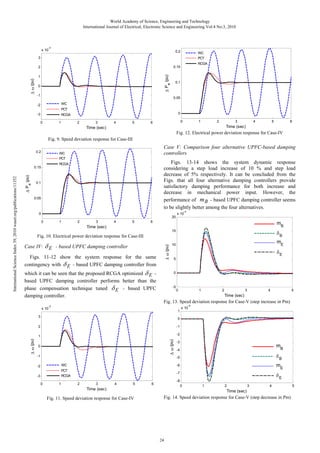
is assumed. The system speed and electrical power deviation
response for the above contingency are shown in Figs. 5-6. It
is clear from Figs. that without control the system is
oscillatory and becomes unstable. Stability of the system is
maintained and power system oscillations are effectively
damped out with m B - based UPFC damping controller. It
can also be seen from Figs. that the performance of the system
is better with the proposed RCGA optimized damping
controller compared to the conventionally designed controller.
0
-1
-2
WC
-3
PCT
RCGA
0
1
2
3
4
5
6
Time (sec)
Fig. 7. Speed deviation response for Case-II
-3
x 10
0.2
3
2
Δ Pe (pu)
Δ ω (pu)
WC
PCT
RCGA
0.15
1
0
-1
0.1
0.05
-2
WC
-3
PCT
RCGA
0
1
0
2
3
4
5
0
6
Time (sec)
0.2
1
2
3
4
5
6
Time (sec)
Fig. 5. Speed deviation response for Case-I
Fig. 8. Electrical power deviation response for Case-II
WC
PCT
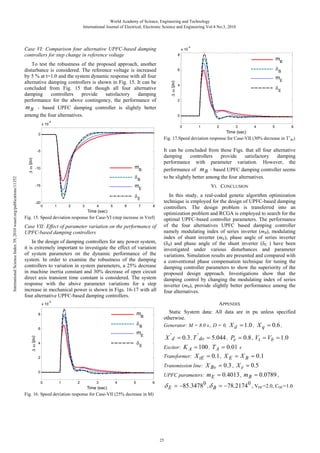
Case III: m E - based UPFC damping controller
RCGA
0.15
Δ Pe (pu)
International Science Index 39, 2010 waset.org/publications/11352
Case I: m B - based UPFC damping controller
The performance of the system for the under same
contingency (10% step increase in mechanical power input at t
= 1.0 s) is demonstrated with m E - based UPFC damping
controller. It can be observed from the system response
shown in Figs. 9-10 that the performance of the system is
slightly better with the proposed RCGA optimized m E based UPFC damping controller compared to the conventional
phase compensation technique based designed of m E - based
UPFC damping controller.
0.1
0.05
0
0
1
2
3
4
5
Time (sec)
6
Fig. 6. Electrical power deviation response for Case-I
23](https://image.slidesharecdn.com/upfc-supplementary-controller-design-using-real-coded-genetic-algorithm-for-damping-low-frequency-os-140127055831-phpapp02/85/Upfc-supplementary-controller-design-using-real-coded-genetic-algorithm-for-damping-low-frequency-oscillations-in-power-systems-8-320.jpg)
![World Academy of Science, Engineering and Technology
International Journal of Electrical, Electronic Science and Engineering Vol:4 No:3, 2010
REFERENCES
[1]
[2]
[3]
[4]
[5]
[6]
[7]
[8]
International Science Index 39, 2010 waset.org/publications/11352
[9]
[10]
[11]
[12]
[13]
[14]
[15]
[16]
[17]
[18]
[19]
[20]
[21]
[22]
[23]
P. Kundur, Power System Stability and Control. New York: McGrawHill, 1994.
N. G. Hingorani, L. Gyugyi, Understanding FACTS: Concepts and
Technology of Flexible AC Transmission Systems, IEEE Press, New
York, 2000.
Y. H Song, T. A. Johns, Flexible AC Transmission Systems (FACTS),
IEE, London, 2000.
R. M Mathur, R. K. Verma, Thyristor-based FACTS Controllers for
Electrical Transmission Systems, IEEE Press, Piscataway, 2002.
L Gyugyi. ‘Unified Power Flow Control Concept for Flexible ac
Transmission Systems.’ IEE Proceedings-C, Vol. 139, No 4, pp. 323331, 1992.
L. Gyugyi et. al., “The Unified Power Flow Controller: A New
Approach to Power Transmission Control”, IEEE Trans. Power Delv.
Vol. 10, No. 2, pp. 1085-1093, 1995.
Sidhartha Panda, “Application of non-dominated sorting genetic
algorithm-II technique for optimal FACTS-based controller design”,
Journal of the Franklin Institute, doi:10.1016/j.jfranklin.2010.03.013.
Sidhartha Panda, S.C. Swain, P.K. Rautray, R. Mallik, G. Panda,
“Design and analysis of SSSC-based supplementary damping
controller”, Simulation Modelling Practice and Theory, doi:
10.1016/j.simpat.2010.04.007.
Sidhartha Panda, “Multi-Objective Evolutionary Algorithm for SSSCBased Controller Design”, Electric Power System Research, Vol. 79,
Issue 6, pp. 937-944, 2009.
Sidhartha Panda, “Differential Evolutionary Algorithm for TCSC-Based
Controller Design”, Simulation Modelling Practice and Theory, Vol. 17,
pp. 1618-1634, 2009.
Sidhartha Panda, “Multi-objective Non-Dominated Shorting Genetic
Algorithm-II for Excitation and TCSC-Based Controller Design”,
Journal of Electrical Engineering, Vol. 60, No. 2, pp. 87-94, 2009.
Sidhartha Panda, N.P. Padhy, “Comparison of Particle Swarm
Optimization And Genetic Algorithm for FACTS-Based Controller
Design”, Applied Soft Computing, Vol. 8, Issue 4, pp. 1418-1427, 2008.
M. Nambu and Y. Ohsawa, “Development of an advanced power system
stabilizer using a strict linearization approach”, IEEE Transactions on
Power Systems, Vol. 11, pp. 813-818, 1996.
E. V. Larsen and D. A. Swann “Applying Power System Stabilizers Part
II: Performance Objectives and Tuning Concepts’, IEEE Transactions on
Power Apparatus and Systems, Vol. 100, pp. 3025-3033, 1981.
N. Tambey, M.L Kothari, “Unified Power Flow Controller (UPFC)
Based Damping Controllers for Damping Low Frequency Oscillations in
a Power System”, IE(I) Journal-EL, Vol. 84, pp. 35-41, 2003.
M. E. About-Ela, A. A. Sallam, J. D. McCalley and A. A. Fouad,
“Damping controller design for power system oscillations using global
signals’, IEEE Transactions on Power Systems, Vol. 11, pp. 767-773,
1996.
D. E. Goldberg, Genetic Algorithms in Search, Optimization and
Machine Learning. Addison-Wesley, 1989.
Sidhartha Panda, A.K. Baliarsingh, R.K. Sahu, “Multi-objective
Optimization Technique for TCSC-Based Supplementary Damping
Controller Design”, Proceedings World Congress on Nature &
Biologically Inspired Computing (NaBIC 2009), 21st -23rd Dec., 2009
Bhubaneswar, India., pp. 1065-1070, 2009.
Sidhartha Panda, C. Ardil, “Real-Coded Genetic Algorithm for Robust
Power System Stabilizer Design”, International Journal of Electrical,
Computers and System Engineering, Vol. 2, No. 1, pp. 6-14, 2008.
Sidhartha Panda, S.C. Swain, A.K. Baliarsingh, “Real-Coded Genetic
Algorithm for Robust Coordinated Design Of Excitation And SSSCBased Controller”, Journal of Electrical Engineering, Vol. 8, Issue 4, pp.
31-38, 2008.
S. Panda, S.C. Swain, A.K. Baliarsingh, C. Ardil, “Optimal
Supplementary Damping Controller Design For TCSC Employing
RCGA”, International Journal of Computational Intelligence, Vol. 5, No.
1, pp. 36-45, 2009.
H F Wang. ‘A Unified Model for the Analysis of FACTS Devices in
Damping Power System Oscillations — Part III : Unified Power Flow
Controller.’ IEEETransactions on Power Delivery, Vol. 15, no 3, July
2000, p 978.
N. Tambey, M.L Kothari, “Damping of Power System Oscillations with
Unified Power Flow Controller (UPFC)”, IEE Proc. Gener. Trans.
Distrib., Vol. 150, No. 2, pp. 129-140, 2003.
Asini Kumar Baliarsingh is working as an
Assistant Professor in the Department of
Electrical Engineering, Orissa Engineering
College, Bhubaneswar, Orissa, India. He is
working towards his PhD in KIIT University in
the area of Application of Computational
Intelligent Techniques to Power System Stability
Problems and Flexible AC Transmission
Systems controller design.
Dr. Sidhartha Panda received Ph.D. degree from
Indian Institute of Technology (IIT), Roorkee,
India in 2008, M.E. degree from VSS University of
Technology, (erstwhile UCE, Burla) in 2001 and.
B.E. degree from Bangalore University in 1991 all
in Electrical Engineering. Presently he is working
as a Professor in the EEE department at National
Institute of Science and Technology (NIST),
Berhampur, Orissa. Earlier he worked as an
Associate Professor in KIIT Deemed University
and also in various other engineering colleges for
about 15 years. He has published about 60 papers in various International
Journals. Presently, he is acting as a reviewer of some International Journals
namely; IEEE Transactions on Industrial Electronics, Applied Soft Computing
(Elsevier), International Journal Electric Power and Energy Systems
(Elsevier), International Journal Simulation Modelling Practice and Theory
(Elsevier), International Journal of Control and Intelligent Systems (ACTA
Press). The biography of Dr Panda has been included “Who's Who in the
World”: 2010 edition, and “Who's Who in Science and Engineering”: 20112012, by in Marquis', USA, “2000 Outstanding Intellectuals of The 21st
Century”, and “2000 Outstanding Scientists: 2010”, and nominated for “Top
100 Engineers: 2010”, by International Biographical Centre, Cambridge,
England.. His areas of research include MATLAB/SIMULINK, Flexible AC
Transmission Systems (FACTS), Modeling of Machines, Power Systems and
FACTS, Controller Design, Power System Stability, Genetic Algorithm,
Particle Swarm Optimization, Differential Evolution, Multi-objective
Optimization, Economic Operation of Power System, Fuzzy Logic, Model
Order Reduction, Distributed Generation and Wind Energy.
Dr. A. K. Mohanty is an Ex-Professor in N.I.T.Rourkela.Now he is working
as a Professor Emeritus in Electrical Engg. Deptt. at KIIT UNIVERSITY
Bhubaneswar.
Cemal Ardil is with National Academy of Aviation, AZ1045, Baku,
Azerbaijan, Bina, 25th km, NAA
26](https://image.slidesharecdn.com/upfc-supplementary-controller-design-using-real-coded-genetic-algorithm-for-damping-low-frequency-os-140127055831-phpapp02/85/Upfc-supplementary-controller-design-using-real-coded-genetic-algorithm-for-damping-low-frequency-oscillations-in-power-systems-11-320.jpg)

This document summarizes a research paper that proposes using a Real-Coded Genetic Algorithm to design Unified Power Flow Controller (UPFC) damping controllers. The goal is to damp low frequency oscillations in power systems. The paper models a single-machine infinite-bus power system installed with a UPFC. It linearizes the system equations and formulates the controller design as an optimization problem to minimize oscillations. Simulation results comparing the proposed RCGA approach to conventional tuning are presented to demonstrate its effectiveness and robustness in damping power system oscillations.


