Understanding
Complements in
Grammar: Focusing
on Noun Complements
What is a Complement?
● A complement is a word or phrase
that completes the meaning of a
sentence
● It provides additional information
about the subject or object
● Complements are essential for
creating clear and complete
sentences
● Can you think of a sentence that feels
incomplete without extra information?
Types of Complements
● There are several types of complements in
grammar
● Today, we'll focus on noun complements
● Other types include subject complements,
object complements, and adjective
complements
● Why do you think we need different types of
complements?
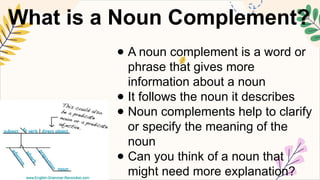
What is a Noun Complement?
● A noun complement is a word or
phrase that gives more
information about a noun
● It follows the noun it describes
● Noun complements help to clarify
or specify the meaning of the
noun
● Can you think of a noun that
might need more explanation?
Examples of Noun
Complements
● "The fact that it's raining" - "that it's raining" is the
noun complement
● "The idea of going to the moon" - "of going to the
moon" is the noun complement
● "The belief in ghosts" - "in ghosts" is the noun
complement
● Can you identify the noun and its complement in each
example?
Noun Complements: That-
Clauses
● One common type of noun complement
is a that-clause
● It begins with the word "that" and
contains a subject and a verb
● Example: "The rumor that the school will
close is not true"
● How does the that-clause help to explain
the noun "rumor" in this sentence?
Noun Complements: Infinitive
Phrases
● Another type of noun complement is an
infinitive phrase
● It begins with the word "to" followed by a verb
● Example: "Her decision to study abroad was
exciting"
● What does the infinitive phrase tell us about
"Her decision" in this sentence?
Noun Complements:
Prepositional Phrases
● Prepositional phrases can also
serve as noun complements
● They begin with a preposition (e.g.,
in, on, at, by) and end with a noun
● Example: "The book on the table is
mine"
● How does "on the table" help
describe "The book" in this
sentence?
Why Are Noun
Complements Important?
● They provide essential information about nouns
● Help to create more precise and detailed
sentences
● Allow us to express complex ideas more clearly
● Can you think of a situation where adding details
to a noun would be helpful?
Identifying Noun
Complements
● Look for phrases or clauses that
directly follow a noun
● Ask yourself: Does this phrase give
more information about the noun?
● If you remove the phrase, does the
sentence lose important meaning?
● Let's practice identifying noun
complements in some sentences!
Practice: Spot the Noun
Complement
● "The news that we won the game spread
quickly"
● "Her desire to become a doctor motivated her
studies"
● "The man in the red hat is my uncle"
● Can you underline the noun complement in
each sentence?
Creating Sentences with
Noun Complements
● Start with a simple noun: "The announcement..."
● Add a that-clause: "The announcement that school
was canceled..."
● Complete the sentence: "The announcement that
school was canceled made the students cheer"
● Now it's your turn! Create a sentence using a noun
complement
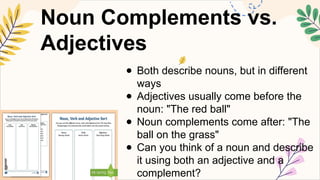
Noun Complements vs.
Adjectives
● Both describe nouns, but in different
ways
● Adjectives usually come before the
noun: "The red ball"
● Noun complements come after: "The
ball on the grass"
● Can you think of a noun and describe
it using both an adjective and a
complement?
Common Nouns That Often
Use Complements
●Idea, fact, belief, rumor, news
●Decision, plan, attempt, desire
●Reason, way, time, place
●Can you create a sentence using one
of these nouns with a complement?
Review: What Have We
Learned?
● Noun complements provide additional information
about nouns
● They can be that-clauses, infinitive phrases, or
prepositional phrases
● Noun complements help create more detailed and
precise sentences
● What's one new thing you learned about noun
complements today?
Your Turn: Noun Complement
Challenge
● Write three sentences using different
types of noun complements
● Share your sentences with a partner
and identify each other's noun
complements
● Can you explain why each complement
is important to its sentence?
● Have fun exploring the world of noun
complements!
Question 1
● What is a noun complement?
● A) A word that describes a verb
● B) A phrase that gives more information about
a noun
● C) A type of punctuation mark
● D) An adverb that modifies an adjective
● What's your answer? Write it down before
moving to the next slide!
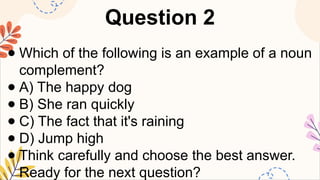
Question 2
● Which of the following is an example of a noun
complement?
● A) The happy dog
● B) She ran quickly
● C) The fact that it's raining
● D) Jump high
● Think carefully and choose the best answer.
Ready for the next question?
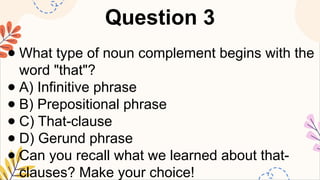
Question 3
● What type of noun complement begins with the
word "that"?
● A) Infinitive phrase
● B) Prepositional phrase
● C) That-clause
● D) Gerund phrase
● Can you recall what we learned about that-
clauses? Make your choice!
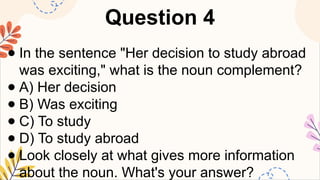
Question 4
● In the sentence "Her decision to study abroad
was exciting," what is the noun complement?
● A) Her decision
● B) Was exciting
● C) To study
● D) To study abroad
● Look closely at what gives more information
about the noun. What's your answer?
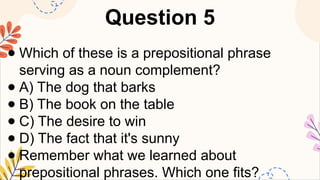
Question 5
● Which of these is a prepositional phrase
serving as a noun complement?
● A) The dog that barks
● B) The book on the table
● C) The desire to win
● D) The fact that it's sunny
● Remember what we learned about
prepositional phrases. Which one fits?
Question 6
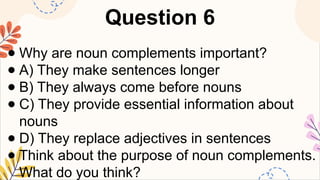
● Why are noun complements important?
● A) They make sentences longer
● B) They always come before nouns
● C) They provide essential information about
nouns
● D) They replace adjectives in sentences
● Think about the purpose of noun complements.
What do you think?
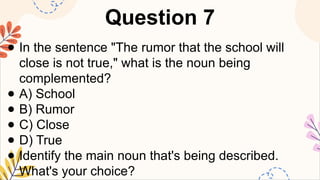
Question 7
● In the sentence "The rumor that the school will
close is not true," what is the noun being
complemented?
● A) School
● B) Rumor
● C) Close
● D) True
● Identify the main noun that's being described.
What's your choice?
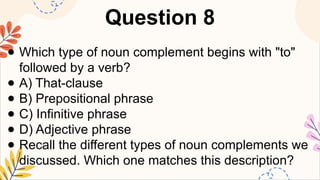
Question 8
● Which type of noun complement begins with "to"
followed by a verb?
● A) That-clause
● B) Prepositional phrase
● C) Infinitive phrase
● D) Adjective phrase
● Recall the different types of noun complements we
discussed. Which one matches this description?
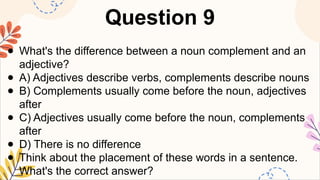
Question 9
● What's the difference between a noun complement and an
adjective?
● A) Adjectives describe verbs, complements describe nouns
● B) Complements usually come before the noun, adjectives
after
● C) Adjectives usually come before the noun, complements
after
● D) There is no difference
● Think about the placement of these words in a sentence.
What's the correct answer?
Question 10
● Which of these nouns often uses complements?
● A) Cat
● B) Tree
● C) Belief
● D) Pencil
● Remember the list of common nouns we
discussed that often use complements. Which
one fits?
Answer Key
● 1. B) A phrase that gives more information about a noun
● 2. C) The fact that it's raining
● 3. C) That-clause
● 4. D) To study abroad
● 5. B) The book on the table
● 6. C) They provide essential information about nouns
● 7. B) Rumor
● 8. C) Infinitive phrase
● 9. C) Adjectives usually come before the noun, complements after
● 10. C) Belief
● How many did you get right? Great job on completing the quiz!
ENGLISH5 Q2 5 using complement_ noun.pptx

  • 1.
  • 2.
    What is aComplement? ● A complement is a word or phrase that completes the meaning of a sentence ● It provides additional information about the subject or object ● Complements are essential for creating clear and complete sentences ● Can you think of a sentence that feels incomplete without extra information?
  • 3.
    Types of Complements ●There are several types of complements in grammar ● Today, we'll focus on noun complements ● Other types include subject complements, object complements, and adjective complements ● Why do you think we need different types of complements?
  • 4.
    What is aNoun Complement? ● A noun complement is a word or phrase that gives more information about a noun ● It follows the noun it describes ● Noun complements help to clarify or specify the meaning of the noun ● Can you think of a noun that might need more explanation?
  • 5.
    Examples of Noun Complements ●"The fact that it's raining" - "that it's raining" is the noun complement ● "The idea of going to the moon" - "of going to the moon" is the noun complement ● "The belief in ghosts" - "in ghosts" is the noun complement ● Can you identify the noun and its complement in each example?
  • 6.
    Noun Complements: That- Clauses ●One common type of noun complement is a that-clause ● It begins with the word "that" and contains a subject and a verb ● Example: "The rumor that the school will close is not true" ● How does the that-clause help to explain the noun "rumor" in this sentence?
  • 7.
    Noun Complements: Infinitive Phrases ●Another type of noun complement is an infinitive phrase ● It begins with the word "to" followed by a verb ● Example: "Her decision to study abroad was exciting" ● What does the infinitive phrase tell us about "Her decision" in this sentence?
  • 8.
    Noun Complements: Prepositional Phrases ●Prepositional phrases can also serve as noun complements ● They begin with a preposition (e.g., in, on, at, by) and end with a noun ● Example: "The book on the table is mine" ● How does "on the table" help describe "The book" in this sentence?
  • 9.
    Why Are Noun ComplementsImportant? ● They provide essential information about nouns ● Help to create more precise and detailed sentences ● Allow us to express complex ideas more clearly ● Can you think of a situation where adding details to a noun would be helpful?
  • 10.
    Identifying Noun Complements ● Lookfor phrases or clauses that directly follow a noun ● Ask yourself: Does this phrase give more information about the noun? ● If you remove the phrase, does the sentence lose important meaning? ● Let's practice identifying noun complements in some sentences!
  • 11.
    Practice: Spot theNoun Complement ● "The news that we won the game spread quickly" ● "Her desire to become a doctor motivated her studies" ● "The man in the red hat is my uncle" ● Can you underline the noun complement in each sentence?
  • 12.
    Creating Sentences with NounComplements ● Start with a simple noun: "The announcement..." ● Add a that-clause: "The announcement that school was canceled..." ● Complete the sentence: "The announcement that school was canceled made the students cheer" ● Now it's your turn! Create a sentence using a noun complement
  • 13.
    Noun Complements vs. Adjectives ●Both describe nouns, but in different ways ● Adjectives usually come before the noun: "The red ball" ● Noun complements come after: "The ball on the grass" ● Can you think of a noun and describe it using both an adjective and a complement?
  • 14.
    Common Nouns ThatOften Use Complements ●Idea, fact, belief, rumor, news ●Decision, plan, attempt, desire ●Reason, way, time, place ●Can you create a sentence using one of these nouns with a complement?
  • 15.
    Review: What HaveWe Learned? ● Noun complements provide additional information about nouns ● They can be that-clauses, infinitive phrases, or prepositional phrases ● Noun complements help create more detailed and precise sentences ● What's one new thing you learned about noun complements today?
  • 16.
    Your Turn: NounComplement Challenge ● Write three sentences using different types of noun complements ● Share your sentences with a partner and identify each other's noun complements ● Can you explain why each complement is important to its sentence? ● Have fun exploring the world of noun complements!
  • 17.
    Question 1 ● Whatis a noun complement? ● A) A word that describes a verb ● B) A phrase that gives more information about a noun ● C) A type of punctuation mark ● D) An adverb that modifies an adjective ● What's your answer? Write it down before moving to the next slide!
  • 18.
    Question 2 ● Whichof the following is an example of a noun complement? ● A) The happy dog ● B) She ran quickly ● C) The fact that it's raining ● D) Jump high ● Think carefully and choose the best answer. Ready for the next question?
  • 19.
    Question 3 ● Whattype of noun complement begins with the word "that"? ● A) Infinitive phrase ● B) Prepositional phrase ● C) That-clause ● D) Gerund phrase ● Can you recall what we learned about that- clauses? Make your choice!
  • 20.
    Question 4 ● Inthe sentence "Her decision to study abroad was exciting," what is the noun complement? ● A) Her decision ● B) Was exciting ● C) To study ● D) To study abroad ● Look closely at what gives more information about the noun. What's your answer?
  • 21.
    Question 5 ● Whichof these is a prepositional phrase serving as a noun complement? ● A) The dog that barks ● B) The book on the table ● C) The desire to win ● D) The fact that it's sunny ● Remember what we learned about prepositional phrases. Which one fits?
  • 22.
    Question 6 ● Whyare noun complements important? ● A) They make sentences longer ● B) They always come before nouns ● C) They provide essential information about nouns ● D) They replace adjectives in sentences ● Think about the purpose of noun complements. What do you think?
  • 23.
    Question 7 ● Inthe sentence "The rumor that the school will close is not true," what is the noun being complemented? ● A) School ● B) Rumor ● C) Close ● D) True ● Identify the main noun that's being described. What's your choice?
  • 24.
    Question 8 ● Whichtype of noun complement begins with "to" followed by a verb? ● A) That-clause ● B) Prepositional phrase ● C) Infinitive phrase ● D) Adjective phrase ● Recall the different types of noun complements we discussed. Which one matches this description?
  • 25.
    Question 9 ● What'sthe difference between a noun complement and an adjective? ● A) Adjectives describe verbs, complements describe nouns ● B) Complements usually come before the noun, adjectives after ● C) Adjectives usually come before the noun, complements after ● D) There is no difference ● Think about the placement of these words in a sentence. What's the correct answer?
  • 26.
    Question 10 ● Whichof these nouns often uses complements? ● A) Cat ● B) Tree ● C) Belief ● D) Pencil ● Remember the list of common nouns we discussed that often use complements. Which one fits?
  • 27.
    Answer Key ● 1.B) A phrase that gives more information about a noun ● 2. C) The fact that it's raining ● 3. C) That-clause ● 4. D) To study abroad ● 5. B) The book on the table ● 6. C) They provide essential information about nouns ● 7. B) Rumor ● 8. C) Infinitive phrase ● 9. C) Adjectives usually come before the noun, complements after ● 10. C) Belief ● How many did you get right? Great job on completing the quiz!