Identify the following as LINEAR or
NON-LINEAR multimedia.
1. MOVIE
LINEAR
2. POWER-POINT
PRESENTATION
LINEAR
3. LIVE VLOG
NON-LINEAR
4. RECORDED
VLOG
LINEAR
5. GAMES
NON-LINEAR
English 7
quarter 3-MODULE 2
NON-VERBAL
CUES
OBJECTIVES
•Understand the difference between verbal
and nonverbal communication,
•And recognize the functions of nonverbal
communication.
VIDEO
COMMUNICATION
is the process of sending and
receiving messages.
VERBAL COMMUNICATION
is the use of words to convey a
message. It could be in a form
of written or oral
communication.
NONVERBAL
COMMUNICATION
is the transfer of information
through the use of body
language.
Functions of NON-VERBAL
COMMUNICATION
1. REPETITION-
It repeats to emphasize one’s idea
or verbal message.
Ex. Saying OK with your hands and
verbally.
2. CONTRADICTION-
It contradicts the message you’re
trying to convey.
Ex. Saying you’re NOT yelling, while
yelling.
3. SUBSTITUTION-
Non-verbal cues could be used as
substitute to verbal message.
Ex. Waving your hands to say good
bye
4. COMPLEMENTING-
It may add to or complement your
verbal message.
Ex. Patting the back of your friend
while praising him can increase the
impact of the message.
5. ACCENTING-
It may accent or underline a verbal
message.
Ex. Pounding the table can emphasize
the importance of the message.
TYPES OF NON-VERBAL CUES
1. FACIAL EXPRESSION
2. BODY MOVEMENT AND
POSTURE
3. GESTURES
4. EYE CONTACT
5. TOUCH
IDENTIFY THE FUNCTION OF EACH NON-
VERBAL CUES. (Repeating, Complementing,
Substituting, Contradicting or Accenting)
1. Saying “I’m happy!” in a sad face.
CONTRADICTING
2. Saying “It was your idea” while pointing fingers.
ACCENTING
3. Saying “What’s up” with a head nod.
COMPLEMENTING
4. Saying “No!” while shaking head.
REPEATING
5. Saying YES through a thumbs-up.
SUBSTITUTING
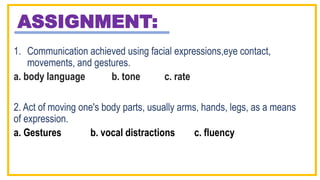
ASSIGNMENT:
1. Communication achieved using facial expressions,eye contact,
movements, and gestures.
a. body language b. tone c. rate
2. Act of moving one's body parts, usually arms, hands, legs, as a means
of expression.
a. Gestures b. vocal distractions c. fluency
3. Communicating ideas and emotions non verbally by changing one's
face.
a. Gestures b. facial expressions c. vocal variety
2. Communication is the process of sending and receiving messages.
a. True b. False C. Maybe
5. The following are all examples of _______________________ cues:
gestures, eye contact, posture, facial expressions, and touch.
a. verbal b. physical c non-verbal
THANK YOU SO
MUCH!
SEE YOU ON
OUR NEXT
VIRTUAL CLASS!

NONVERBAL CUES PPT.pptx