https://pixabay.com/photos/books-bookstore-book-reading-1204029/shared under CC0
1
Noun Clauses
Lunch&Learn
(CLB5+)
https://pixabay.com/photos/books-bookstore-book-reading-1204029/shared under CC0
2
Welcome to the English Online community!
Our Equity, Diversity, and Inclusion Acknowledgment
This community welcomes, appreciates, and respects everyone –
it doesn’t matter what country you’re from or who you are!
Discrimination of any kind, however, (including political, religious, nationality, or gender-based)
is NOT WELCOME.
If you are uncomfortable attending this class (or any other at EO), you are free to leave and
email us at info@myenglishonline.ca
VOCABULARY
1. Phrase
2. Clause
3. Independent Clause
4. Dependent Clause
5. Noun Clause
3
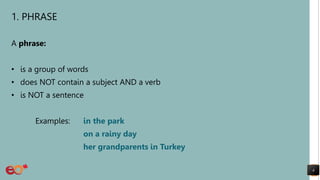
1. PHRASE
A phrase:
• is a group of words
• does NOT contain a subject AND a verb
• is NOT a sentence
Examples: in the park
on a rainy day
her grandparents in Turkey
4
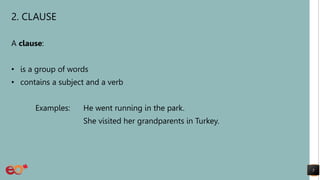
2. CLAUSE
A clause:
• is a group of words
• contains a subject and a verb
Examples: He went running in the park.
She visited her grandparents in Turkey.
5
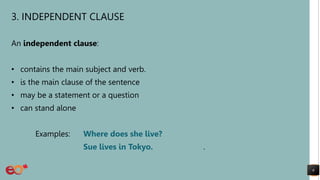
3. INDEPENDENT CLAUSE
An independent clause:
• contains the main subject and verb.
• is the main clause of the sentence
• may be a statement or a question
• can stand alone
Examples: Where does she live?
Sue lives in Tokyo. .
6
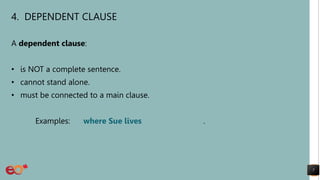
4. DEPENDENT CLAUSE
A dependent clause:
• is NOT a complete sentence.
• cannot stand alone.
• must be connected to a main clause.
Examples: where Sue lives .
7
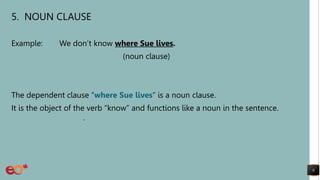
5. NOUN CLAUSE
Example: We don’t know where Sue lives.
(noun clause)
The dependent clause “where Sue lives” is a noun clause.
It is the object of the verb “know” and functions like a noun in the sentence.
.
8
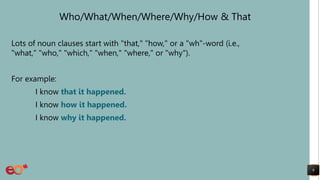
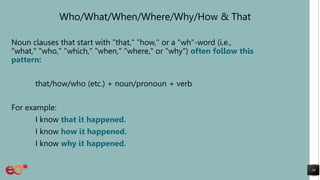
Who/What/When/Where/Why/How & That
Lots of noun clauses start with "that," "how," or a "wh"-word (i.e.,
"what," "who," "which," "when," "where," or "why").
For example:
I know that it happened.
I know how it happened.
I know why it happened.
9
Who/What/When/Where/Why/How & That
Noun clauses that start with "that," "how," or a "wh"-word (i.e.,
"what," "who," "which," "when," "where," or "why") often follow this
pattern:
that/how/who (etc.) + noun/pronoun + verb
For example:
I know that it happened.
I know how it happened.
I know why it happened.
10
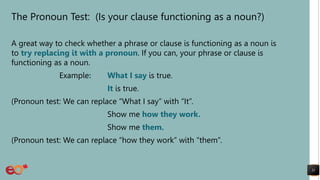
The Pronoun Test: (Is your clause functioning as a noun?)
A great way to check whether a phrase or clause is functioning as a noun is
to try replacing it with a pronoun. If you can, your phrase or clause is
functioning as a noun.
Example: What I say is true.
It is true.
(Pronoun test: We can replace “What I say” with “It”.
Show me how they work.
Show me them.
(Pronoun test: We can replace “how they work” with “them”.
11
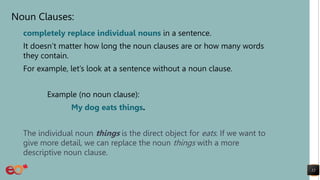
Noun Clauses:
completely replace individual nouns in a sentence.
It doesn’t matter how long the noun clauses are or how many words
they contain.
For example, let’s look at a sentence without a noun clause.
Example (no noun clause):
My dog eats things.
The individual noun things is the direct object for eats. If we want to
give more detail, we can replace the noun things with a more
descriptive noun clause.
12
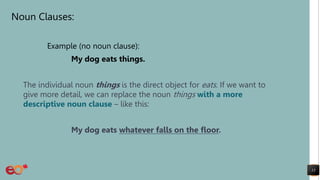
Noun Clauses:
Example (no noun clause):
My dog eats things.
The individual noun things is the direct object for eats. If we want to
give more detail, we can replace the noun things with a more
descriptive noun clause – like this:
My dog eats whatever falls on the floor.
13
https://pixabay.com/photos/books-bookstore-book-reading-shop-1204038/ shared under CC0
Let’spractice!
https://pixabay.com/photos/books-bookstore-book-reading-shop-1204038/ shared under CC0
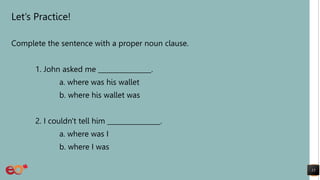
Let’s Practice!
Complete the sentence with a proper noun clause.
1. John asked me ________________.
a. where was his wallet
b. where his wallet was
2. I couldn't tell him ________________.
a. where was I
b. where I was
15
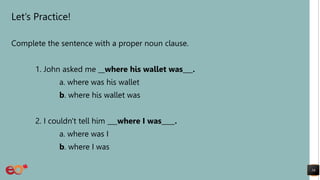
Let’s Practice!
Complete the sentence with a proper noun clause.
1. John asked me __where his wallet was___.
a. where was his wallet
b. where his wallet was
2. I couldn't tell him ___where I was____.
a. where was I
b. where I was
16
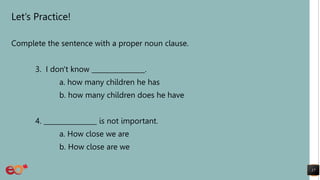
Let’s Practice!
Complete the sentence with a proper noun clause.
3. I don't know ________________.
a. how many children he has
b. how many children does he have
4. ________________ is not important.
a. How close we are
b. How close are we
17
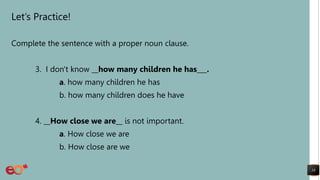
Let’s Practice!
Complete the sentence with a proper noun clause.
3. I don't know __how many children he has___.
a. how many children he has
b. how many children does he have
4. __How close we are__ is not important.
a. How close we are
b. How close are we
18
Let’s Practice!
Complete the sentence with a proper noun clause.
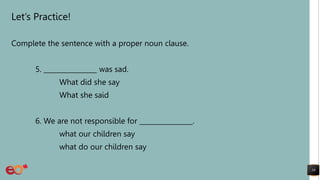
5. ________________ was sad.
What did she say
What she said
6. We are not responsible for ________________.
what our children say
what do our children say
19
Let’s Practice!
Complete the sentence with a proper noun clause.
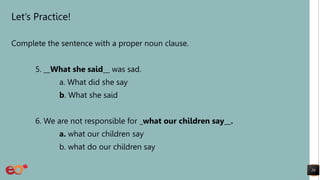
5. __What she said__ was sad.
a. What did she say
b. What she said
6. We are not responsible for _what our children say__.
a. what our children say
b. what do our children say
20
Let’s Practice!
Complete the sentence with a proper noun clause.
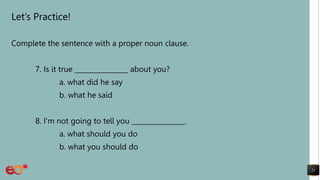
7. Is it true ________________ about you?
a. what did he say
b. what he said
8. I'm not going to tell you ________________.
a. what should you do
b. what you should do
21
Let’s Practice!
Complete the sentence with a proper noun clause.
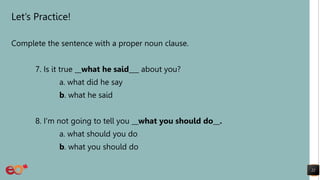
7. Is it true __what he said___ about you?
a. what did he say
b. what he said
8. I'm not going to tell you __what you should do__.
a. what should you do
b. what you should do
22
Let’s Practice!
Complete the sentence with a proper noun clause.
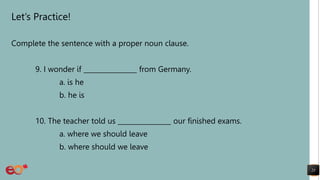
9. I wonder if ________________ from Germany.
a. is he
b. he is
10. The teacher told us ________________ our finished exams.
a. where we should leave
b. where should we leave
23
Let’s Practice!
Complete the sentence with a proper noun clause.
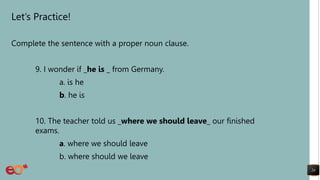
9. I wonder if _he is _ from Germany.
a. is he
b. he is
10. The teacher told us _where we should leave_ our finished
exams.
a. where we should leave
b. where should we leave
24
Let’s Practice!
Find the noun clause in each sentence.
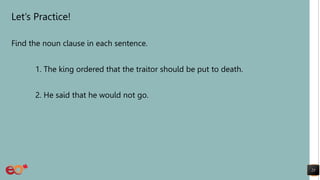
1. The king ordered that the traitor should be put to death.
2. He said that he would not go.
25
Let’s Practice!
Find the noun clause in each sentence.
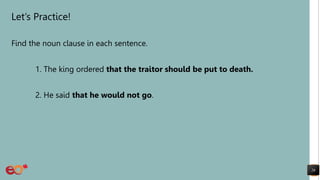
1. The king ordered that the traitor should be put to death.
2. He said that he would not go.
26
Let’s Practice!
Find the noun clause in each sentence.
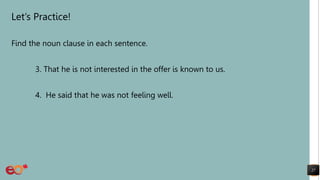
3. That he is not interested in the offer is known to us.
4. He said that he was not feeling well.
27
Let’s Practice!
Find the noun clause in each sentence.
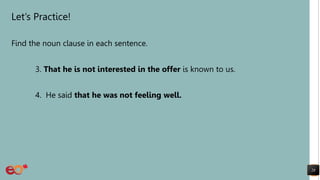
3. That he is not interested in the offer is known to us.
4. He said that he was not feeling well.
28
Let’s Practice!
Find the noun clause in each sentence.
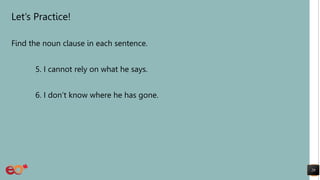
5. I cannot rely on what he says.
6. I don’t know where he has gone.
29
Let’s Practice!
Find the noun clause in each sentence.
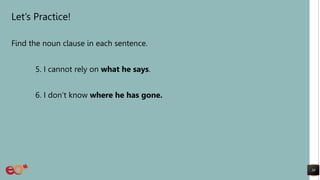
5. I cannot rely on what he says.
6. I don’t know where he has gone.
30
Let’s Practice!
Find the noun clause in each sentence.
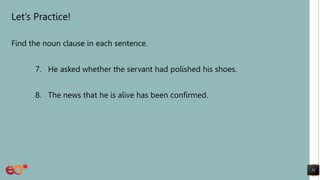
7. He asked whether the servant had polished his shoes.
8. The news that he is alive has been confirmed.
31
Let’s Practice!
Find the noun clause in each sentence.
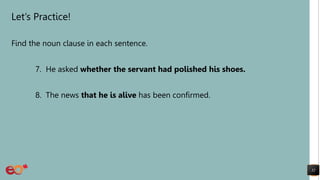
7. He asked whether the servant had polished his shoes.
8. The news that he is alive has been confirmed.
32
Let’s Practice!
Find the noun clause in each sentence.
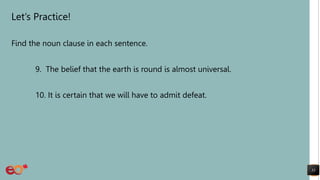
9. The belief that the earth is round is almost universal.
10. It is certain that we will have to admit defeat.
33
Let’s Practice!
Find the noun clause in each sentence.
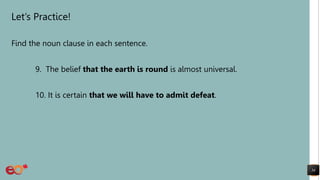
9. The belief that the earth is round is almost universal.
10. It is certain that we will have to admit defeat.
34
Let’s Practice!
Find the noun clause in each sentence.
11. It was fortunate that he was present.
12. The report that only ten persons were killed in the riots is not
true.
35
Let’s Practice!
Find the noun clause in each sentence.
11. It was fortunate that he was present.
12. The report that only ten persons were killed in the riots is not
true.
36
https://pixabay.com/photos/books-bookstore-book-reading-shop-1204038/ shared under CC0
More practice!
https://pixabay.com/photos/books-bookstore-book-reading-shop-1204038/ shared under CC0
Functions of Noun Clauses
Noun clauses function just like nouns in a sentence. Just like
nouns, they can be subjects or objects.
In each sentence, identify the noun clause, and determine if it is
functioning as the subject, or the object of the sentence.
38
Let’s Practice!
Find the noun clause in each sentence. Is the noun clause a subject or an
object?
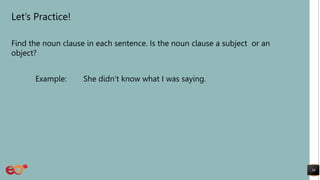
Example: She didn’t know what I was saying.
39
Let’s Practice!
Find the noun clause in each sentence. Is the noun clause a subject or an
object?
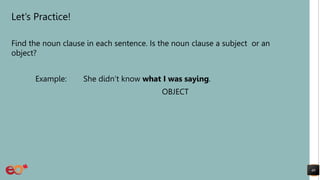
Example: She didn’t know what I was saying.
OBJECT
40
Let’s Practice!
Find the noun clause in each sentence. Is the noun clause a subject or an
object?
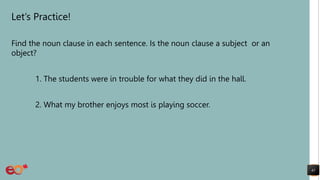
1. The students were in trouble for what they did in the hall.
2. What my brother enjoys most is playing soccer.
41
Let’s Practice!
Find the noun clause in each sentence. Is the noun clause a subject or an
object?
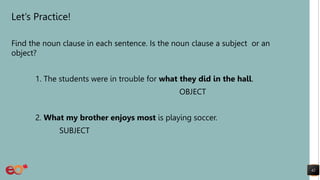
1. The students were in trouble for what they did in the hall.
OBJECT
2. What my brother enjoys most is playing soccer.
SUBJECT
42
Let’s Practice!
Find the noun clause in each sentence. Is the noun clause a subject or an
object?
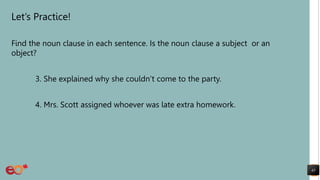
3. She explained why she couldn’t come to the party.
4. Mrs. Scott assigned whoever was late extra homework.
43
Let’s Practice!
Find the noun clause in each sentence. Is the noun clause a subject or an
object?
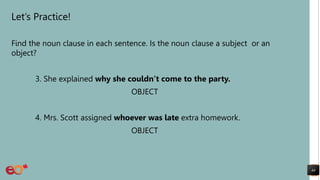
3. She explained why she couldn’t come to the party.
OBJECT
4. Mrs. Scott assigned whoever was late extra homework.
OBJECT
44
Let’s Practice!
Find the noun clause in each sentence. Is the noun clause a subject or an
object?
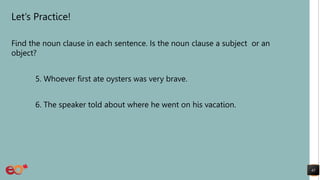
5. Whoever first ate oysters was very brave.
6. The speaker told about where he went on his vacation.
45
Let’s Practice!
Find the noun clause in each sentence. Is the noun clause a subject or an
object?
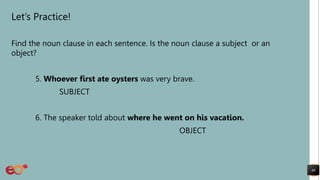
5. Whoever first ate oysters was very brave.
SUBJECT
6. The speaker told about where he went on his vacation.
OBJECT
46
Let’s Practice!
Find the noun clause in each sentence. Is the noun clause a subject or an
object?
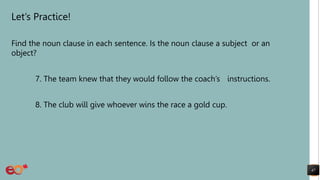
7. The team knew that they would follow the coach’s instructions.
8. The club will give whoever wins the race a gold cup.
47
Let’s Practice!
Find the noun clause in each sentence. Is the noun clause a subject or an
object?
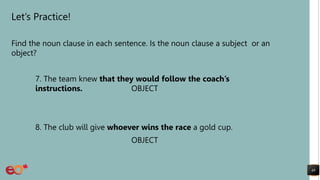
7. The team knew that they would follow the coach’s
instructions. OBJECT
8. The club will give whoever wins the race a gold cup.
OBJECT
48
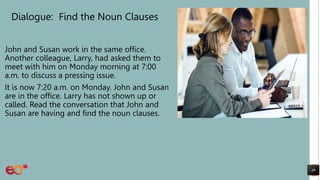
Dialogue: Find the Noun Clauses
John and Susan work in the same office.
Another colleague, Larry, had asked them to
meet with him on Monday morning at 7:00
a.m. to discuss a pressing issue.
It is now 7:20 a.m. on Monday. John and Susan
are in the office. Larry has not shown up or
called. Read the conversation that John and
Susan are having and find the noun clauses.
49
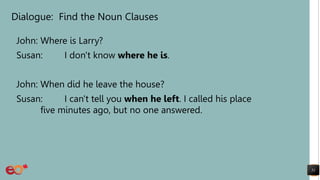
Dialogue: Find the Noun Clauses
John: Where is Larry?
Susan: I don't know where he is.
John: When did he leave the house?
Susan: I can't tell you when he left. I called his place
five minutes ago, but no one answered.

50
Dialogue: Find the Noun Clauses
John: Where is Larry?
Susan: I don't know where he is.
John: When did he leave the house?
Susan: I can't tell you when he left. I called his place
five minutes ago, but no one answered.
51
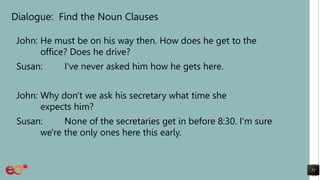
Dialogue: Find the Noun Clauses
John: He must be on his way then. How does he get to the
office? Does he drive?
Susan: I've never asked him how he gets here.
John: Why don't we ask his secretary what time she
expects him?
Susan: None of the secretaries get in before 8:30. I'm sure
we're the only ones here this early.
52
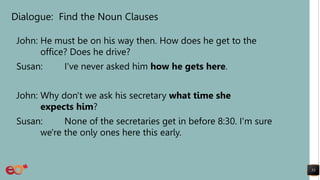
Dialogue: Find the Noun Clauses
John: He must be on his way then. How does he get to the
office? Does he drive?
Susan: I've never asked him how he gets here.
John: Why don't we ask his secretary what time she
expects him?
Susan: None of the secretaries get in before 8:30. I'm sure
we're the only ones here this early.
53
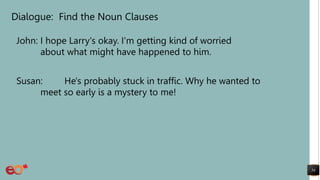
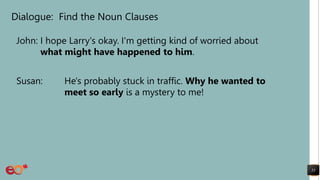
Dialogue: Find the Noun Clauses
John: I hope Larry's okay. I'm getting kind of worried
about what might have happened to him.
Susan: He's probably stuck in traffic. Why he wanted to
meet so early is a mystery to me!
54
Dialogue: Find the Noun Clauses
John: I hope Larry's okay. I'm getting kind of worried about
what might have happened to him.
Susan: He's probably stuck in traffic. Why he wanted to
meet so early is a mystery to me!
55
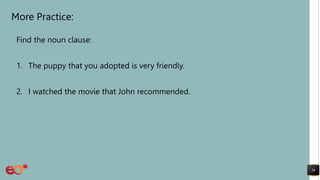
More Practice:
Find the noun clause:
1. The puppy that you adopted is very friendly.
2. I watched the movie that John recommended.
56
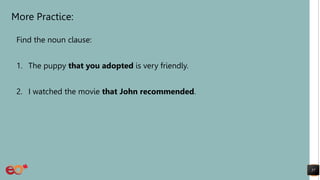
More Practice:
Find the noun clause:
1. The puppy that you adopted is very friendly.
2. I watched the movie that John recommended.
57
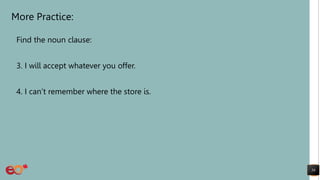
More Practice:
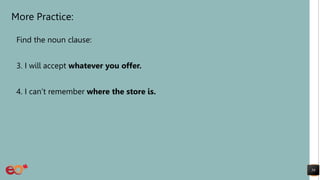
Find the noun clause:
3. I will accept whatever you offer.
4. I can’t remember where the store is.
58
More Practice:
Find the noun clause:
3. I will accept whatever you offer.
4. I can’t remember where the store is.
59
More Practice:
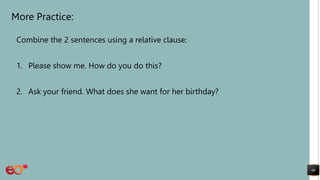
Combine the 2 sentences using a relative clause:
1. Please show me. How do you do this?
2. Ask your friend. What does she want for her birthday?
60
More Practice:
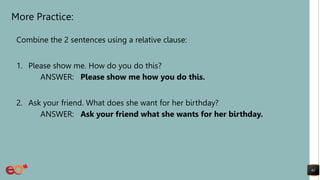
Combine the 2 sentences using a relative clause:
1. Please show me. How do you do this?
ANSWER: Please show me how you do this.
2. Ask your friend. What does she want for her birthday?
ANSWER: Ask your friend what she wants for her birthday.
61
More Practice:
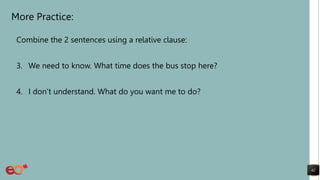
Combine the 2 sentences using a relative clause:
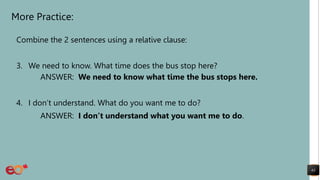
3. We need to know. What time does the bus stop here?
4. I don’t understand. What do you want me to do?
62
More Practice:
Combine the 2 sentences using a relative clause:
3. We need to know. What time does the bus stop here?
ANSWER: We need to know what time the bus stops here.
4. I don’t understand. What do you want me to do?
ANSWER: I don’t understand what you want me to do.
63
Questions?
64
https://pixabay.com/photos/cup-of-coffee-laptop-office-macbook-1280537/ shared under CC0
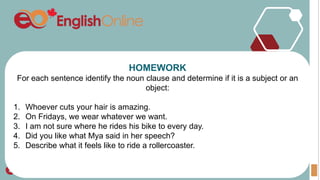
HOMEWORK
For each sentence identify the noun clause and determine if it is a subject or an
object:
1. Whoever cuts your hair is amazing.
2. On Fridays, we wear whatever we want.
3. I am not sure where he rides his bike to every day.
4. Did you like what Mya said in her speech?
5. Describe what it feels like to ride a rollercoaster.
HOMEWORK: The details:
1. Submit your homework to Lori on Skype: live:loramoren
2. After class, you have until the 11:59 pm the next day to complete the assignment.
3. I will correct the homework and offer feedback. 
Language Contest
Want to learn more expressions, Canadian cultural
references and idioms?
Check English Online’s Facebook and Instagram
pages and take the challenge
of our Language Contest every
other Thursday!
You can win EO personalized
prizes and improve your English
skills one idiom at a time!
Sources
Azar, Betty and Hagen, Stacy. Understanding and Using English Grammar, fifth edition. Pearson
Education, Hoboken, NY, 2017.
https://www.learnenglishfeelgood.com/esl-noun-clauses1.html
https://www.grammar-monster.com/glossary/noun_clauses.html
https://www.grammarly.com/blog/noun-clause/
https://is.muni.cz/el/1422/podzim2009/DVVP01/um/9401373/Noun_Clauses.pdf
68
https://pixabay.com/photos/books-pages-story-stories-notes-1245690/ shared under CC0
Thankyou!
Lori Morency
Skype: live:loramoren
livelearn.ca
Thankyou!
Blaine
broberts@myenglishonline.ca
livelearn.ca
1-204-946-5140
Website:
livelearn.ca
Email:
info@myenglishonline.ca

NounClausesEnglishOnlineLunch&Learn.pptx

  • 1.
    https://pixabay.com/photos/books-bookstore-book-reading-1204029/shared under CC0 1 NounClauses Lunch&Learn (CLB5+) https://pixabay.com/photos/books-bookstore-book-reading-1204029/shared under CC0
  • 2.
    2 Welcome to theEnglish Online community! Our Equity, Diversity, and Inclusion Acknowledgment This community welcomes, appreciates, and respects everyone – it doesn’t matter what country you’re from or who you are! Discrimination of any kind, however, (including political, religious, nationality, or gender-based) is NOT WELCOME. If you are uncomfortable attending this class (or any other at EO), you are free to leave and email us at info@myenglishonline.ca
  • 3.
    VOCABULARY 1. Phrase 2. Clause 3.Independent Clause 4. Dependent Clause 5. Noun Clause 3
  • 4.
    1. PHRASE A phrase: •is a group of words • does NOT contain a subject AND a verb • is NOT a sentence Examples: in the park on a rainy day her grandparents in Turkey 4
  • 5.
    2. CLAUSE A clause: •is a group of words • contains a subject and a verb Examples: He went running in the park. She visited her grandparents in Turkey. 5
  • 6.
    3. INDEPENDENT CLAUSE Anindependent clause: • contains the main subject and verb. • is the main clause of the sentence • may be a statement or a question • can stand alone Examples: Where does she live? Sue lives in Tokyo. . 6
  • 7.
    4. DEPENDENT CLAUSE Adependent clause: • is NOT a complete sentence. • cannot stand alone. • must be connected to a main clause. Examples: where Sue lives . 7
  • 8.
    5. NOUN CLAUSE Example:We don’t know where Sue lives. (noun clause) The dependent clause “where Sue lives” is a noun clause. It is the object of the verb “know” and functions like a noun in the sentence. . 8
  • 9.
    Who/What/When/Where/Why/How & That Lotsof noun clauses start with "that," "how," or a "wh"-word (i.e., "what," "who," "which," "when," "where," or "why"). For example: I know that it happened. I know how it happened. I know why it happened. 9
  • 10.
    Who/What/When/Where/Why/How & That Nounclauses that start with "that," "how," or a "wh"-word (i.e., "what," "who," "which," "when," "where," or "why") often follow this pattern: that/how/who (etc.) + noun/pronoun + verb For example: I know that it happened. I know how it happened. I know why it happened. 10
  • 11.
    The Pronoun Test:(Is your clause functioning as a noun?) A great way to check whether a phrase or clause is functioning as a noun is to try replacing it with a pronoun. If you can, your phrase or clause is functioning as a noun. Example: What I say is true. It is true. (Pronoun test: We can replace “What I say” with “It”. Show me how they work. Show me them. (Pronoun test: We can replace “how they work” with “them”. 11
  • 12.
    Noun Clauses: completely replaceindividual nouns in a sentence. It doesn’t matter how long the noun clauses are or how many words they contain. For example, let’s look at a sentence without a noun clause. Example (no noun clause): My dog eats things. The individual noun things is the direct object for eats. If we want to give more detail, we can replace the noun things with a more descriptive noun clause. 12
  • 13.
    Noun Clauses: Example (nonoun clause): My dog eats things. The individual noun things is the direct object for eats. If we want to give more detail, we can replace the noun things with a more descriptive noun clause – like this: My dog eats whatever falls on the floor. 13
  • 14.
    https://pixabay.com/photos/books-bookstore-book-reading-shop-1204038/ shared underCC0 Let’spractice! https://pixabay.com/photos/books-bookstore-book-reading-shop-1204038/ shared under CC0
  • 15.
    Let’s Practice! Complete thesentence with a proper noun clause. 1. John asked me ________________. a. where was his wallet b. where his wallet was 2. I couldn't tell him ________________. a. where was I b. where I was 15
  • 16.
    Let’s Practice! Complete thesentence with a proper noun clause. 1. John asked me __where his wallet was___. a. where was his wallet b. where his wallet was 2. I couldn't tell him ___where I was____. a. where was I b. where I was 16
  • 17.
    Let’s Practice! Complete thesentence with a proper noun clause. 3. I don't know ________________. a. how many children he has b. how many children does he have 4. ________________ is not important. a. How close we are b. How close are we 17
  • 18.
    Let’s Practice! Complete thesentence with a proper noun clause. 3. I don't know __how many children he has___. a. how many children he has b. how many children does he have 4. __How close we are__ is not important. a. How close we are b. How close are we 18
  • 19.
    Let’s Practice! Complete thesentence with a proper noun clause. 5. ________________ was sad. What did she say What she said 6. We are not responsible for ________________. what our children say what do our children say 19
  • 20.
    Let’s Practice! Complete thesentence with a proper noun clause. 5. __What she said__ was sad. a. What did she say b. What she said 6. We are not responsible for _what our children say__. a. what our children say b. what do our children say 20
  • 21.
    Let’s Practice! Complete thesentence with a proper noun clause. 7. Is it true ________________ about you? a. what did he say b. what he said 8. I'm not going to tell you ________________. a. what should you do b. what you should do 21
  • 22.
    Let’s Practice! Complete thesentence with a proper noun clause. 7. Is it true __what he said___ about you? a. what did he say b. what he said 8. I'm not going to tell you __what you should do__. a. what should you do b. what you should do 22
  • 23.
    Let’s Practice! Complete thesentence with a proper noun clause. 9. I wonder if ________________ from Germany. a. is he b. he is 10. The teacher told us ________________ our finished exams. a. where we should leave b. where should we leave 23
  • 24.
    Let’s Practice! Complete thesentence with a proper noun clause. 9. I wonder if _he is _ from Germany. a. is he b. he is 10. The teacher told us _where we should leave_ our finished exams. a. where we should leave b. where should we leave 24
  • 25.
    Let’s Practice! Find thenoun clause in each sentence. 1. The king ordered that the traitor should be put to death. 2. He said that he would not go. 25
  • 26.
    Let’s Practice! Find thenoun clause in each sentence. 1. The king ordered that the traitor should be put to death. 2. He said that he would not go. 26
  • 27.
    Let’s Practice! Find thenoun clause in each sentence. 3. That he is not interested in the offer is known to us. 4. He said that he was not feeling well. 27
  • 28.
    Let’s Practice! Find thenoun clause in each sentence. 3. That he is not interested in the offer is known to us. 4. He said that he was not feeling well. 28
  • 29.
    Let’s Practice! Find thenoun clause in each sentence. 5. I cannot rely on what he says. 6. I don’t know where he has gone. 29
  • 30.
    Let’s Practice! Find thenoun clause in each sentence. 5. I cannot rely on what he says. 6. I don’t know where he has gone. 30
  • 31.
    Let’s Practice! Find thenoun clause in each sentence. 7. He asked whether the servant had polished his shoes. 8. The news that he is alive has been confirmed. 31
  • 32.
    Let’s Practice! Find thenoun clause in each sentence. 7. He asked whether the servant had polished his shoes. 8. The news that he is alive has been confirmed. 32
  • 33.
    Let’s Practice! Find thenoun clause in each sentence. 9. The belief that the earth is round is almost universal. 10. It is certain that we will have to admit defeat. 33
  • 34.
    Let’s Practice! Find thenoun clause in each sentence. 9. The belief that the earth is round is almost universal. 10. It is certain that we will have to admit defeat. 34
  • 35.
    Let’s Practice! Find thenoun clause in each sentence. 11. It was fortunate that he was present. 12. The report that only ten persons were killed in the riots is not true. 35
  • 36.
    Let’s Practice! Find thenoun clause in each sentence. 11. It was fortunate that he was present. 12. The report that only ten persons were killed in the riots is not true. 36
  • 37.
    https://pixabay.com/photos/books-bookstore-book-reading-shop-1204038/ shared underCC0 More practice! https://pixabay.com/photos/books-bookstore-book-reading-shop-1204038/ shared under CC0
  • 38.
    Functions of NounClauses Noun clauses function just like nouns in a sentence. Just like nouns, they can be subjects or objects. In each sentence, identify the noun clause, and determine if it is functioning as the subject, or the object of the sentence. 38
  • 39.
    Let’s Practice! Find thenoun clause in each sentence. Is the noun clause a subject or an object? Example: She didn’t know what I was saying. 39
  • 40.
    Let’s Practice! Find thenoun clause in each sentence. Is the noun clause a subject or an object? Example: She didn’t know what I was saying. OBJECT 40
  • 41.
    Let’s Practice! Find thenoun clause in each sentence. Is the noun clause a subject or an object? 1. The students were in trouble for what they did in the hall. 2. What my brother enjoys most is playing soccer. 41
  • 42.
    Let’s Practice! Find thenoun clause in each sentence. Is the noun clause a subject or an object? 1. The students were in trouble for what they did in the hall. OBJECT 2. What my brother enjoys most is playing soccer. SUBJECT 42
  • 43.
    Let’s Practice! Find thenoun clause in each sentence. Is the noun clause a subject or an object? 3. She explained why she couldn’t come to the party. 4. Mrs. Scott assigned whoever was late extra homework. 43
  • 44.
    Let’s Practice! Find thenoun clause in each sentence. Is the noun clause a subject or an object? 3. She explained why she couldn’t come to the party. OBJECT 4. Mrs. Scott assigned whoever was late extra homework. OBJECT 44
  • 45.
    Let’s Practice! Find thenoun clause in each sentence. Is the noun clause a subject or an object? 5. Whoever first ate oysters was very brave. 6. The speaker told about where he went on his vacation. 45
  • 46.
    Let’s Practice! Find thenoun clause in each sentence. Is the noun clause a subject or an object? 5. Whoever first ate oysters was very brave. SUBJECT 6. The speaker told about where he went on his vacation. OBJECT 46
  • 47.
    Let’s Practice! Find thenoun clause in each sentence. Is the noun clause a subject or an object? 7. The team knew that they would follow the coach’s instructions. 8. The club will give whoever wins the race a gold cup. 47
  • 48.
    Let’s Practice! Find thenoun clause in each sentence. Is the noun clause a subject or an object? 7. The team knew that they would follow the coach’s instructions. OBJECT 8. The club will give whoever wins the race a gold cup. OBJECT 48
  • 49.
    Dialogue: Find theNoun Clauses John and Susan work in the same office. Another colleague, Larry, had asked them to meet with him on Monday morning at 7:00 a.m. to discuss a pressing issue. It is now 7:20 a.m. on Monday. John and Susan are in the office. Larry has not shown up or called. Read the conversation that John and Susan are having and find the noun clauses. 49
  • 50.
    Dialogue: Find theNoun Clauses John: Where is Larry? Susan: I don't know where he is. John: When did he leave the house? Susan: I can't tell you when he left. I called his place five minutes ago, but no one answered. 50
  • 51.
    Dialogue: Find theNoun Clauses John: Where is Larry? Susan: I don't know where he is. John: When did he leave the house? Susan: I can't tell you when he left. I called his place five minutes ago, but no one answered. 51
  • 52.
    Dialogue: Find theNoun Clauses John: He must be on his way then. How does he get to the office? Does he drive? Susan: I've never asked him how he gets here. John: Why don't we ask his secretary what time she expects him? Susan: None of the secretaries get in before 8:30. I'm sure we're the only ones here this early. 52
  • 53.
    Dialogue: Find theNoun Clauses John: He must be on his way then. How does he get to the office? Does he drive? Susan: I've never asked him how he gets here. John: Why don't we ask his secretary what time she expects him? Susan: None of the secretaries get in before 8:30. I'm sure we're the only ones here this early. 53
  • 54.
    Dialogue: Find theNoun Clauses John: I hope Larry's okay. I'm getting kind of worried about what might have happened to him. Susan: He's probably stuck in traffic. Why he wanted to meet so early is a mystery to me! 54
  • 55.
    Dialogue: Find theNoun Clauses John: I hope Larry's okay. I'm getting kind of worried about what might have happened to him. Susan: He's probably stuck in traffic. Why he wanted to meet so early is a mystery to me! 55
  • 56.
    More Practice: Find thenoun clause: 1. The puppy that you adopted is very friendly. 2. I watched the movie that John recommended. 56
  • 57.
    More Practice: Find thenoun clause: 1. The puppy that you adopted is very friendly. 2. I watched the movie that John recommended. 57
  • 58.
    More Practice: Find thenoun clause: 3. I will accept whatever you offer. 4. I can’t remember where the store is. 58
  • 59.
    More Practice: Find thenoun clause: 3. I will accept whatever you offer. 4. I can’t remember where the store is. 59
  • 60.
    More Practice: Combine the2 sentences using a relative clause: 1. Please show me. How do you do this? 2. Ask your friend. What does she want for her birthday? 60
  • 61.
    More Practice: Combine the2 sentences using a relative clause: 1. Please show me. How do you do this? ANSWER: Please show me how you do this. 2. Ask your friend. What does she want for her birthday? ANSWER: Ask your friend what she wants for her birthday. 61
  • 62.
    More Practice: Combine the2 sentences using a relative clause: 3. We need to know. What time does the bus stop here? 4. I don’t understand. What do you want me to do? 62
  • 63.
    More Practice: Combine the2 sentences using a relative clause: 3. We need to know. What time does the bus stop here? ANSWER: We need to know what time the bus stops here. 4. I don’t understand. What do you want me to do? ANSWER: I don’t understand what you want me to do. 63
  • 64.
  • 65.
    HOMEWORK For each sentenceidentify the noun clause and determine if it is a subject or an object: 1. Whoever cuts your hair is amazing. 2. On Fridays, we wear whatever we want. 3. I am not sure where he rides his bike to every day. 4. Did you like what Mya said in her speech? 5. Describe what it feels like to ride a rollercoaster.
  • 66.
    HOMEWORK: The details: 1.Submit your homework to Lori on Skype: live:loramoren 2. After class, you have until the 11:59 pm the next day to complete the assignment. 3. I will correct the homework and offer feedback. 
  • 67.
    Language Contest Want tolearn more expressions, Canadian cultural references and idioms? Check English Online’s Facebook and Instagram pages and take the challenge of our Language Contest every other Thursday! You can win EO personalized prizes and improve your English skills one idiom at a time!
  • 68.
    Sources Azar, Betty andHagen, Stacy. Understanding and Using English Grammar, fifth edition. Pearson Education, Hoboken, NY, 2017. https://www.learnenglishfeelgood.com/esl-noun-clauses1.html https://www.grammar-monster.com/glossary/noun_clauses.html https://www.grammarly.com/blog/noun-clause/ https://is.muni.cz/el/1422/podzim2009/DVVP01/um/9401373/Noun_Clauses.pdf 68 https://pixabay.com/photos/books-pages-story-stories-notes-1245690/ shared under CC0
  • 69.
  • 70.