ENGLISH REINFORCEMENT PACKAGE 1º
WEEK 1
GREETINGS AND FAREWELLS
Good morning. - Buenos días.
Good afternoon. - Buenas tardes.
Good evening. - Buenas noches.
Hello. (más formal), Hi. (menos
formal), Hey. (muy informal) - Hola.
Hey! - ¡Oye!/¡Oiga!/¡Oigan!
How's it going? - ¿Qué tal?/¿Cómo te va? (o más
informalmente What’s up?)
How are you? - ¿Cómo estás?/¿Cómo está Ud.?
How are you all? - ¿Cómo están Uds.?
Good-bye./Bye. - Adiós.
Good night. - Buenas noches.**
See you later. - Hasta luego./Nos vemos. (o I’ll
see you later., etc.)
See you tomorrow. - Hasta mañana.
See you soon. - Hasta pronto.
See you then. - Hasta entonces.
Take
care. Cuídate./Cuídese./Cuidaos./Cuídense.
(o más informalmente Take it easy.)
So long- Hasta luego
WEEK 2
PERSONAL PRONOUNS AND PERSONAL PRESENTACIÓN
Personal Pronouns
Personal pronouns represent specific people or things. We use them depending on:
number: singular (eg: I) or plural (eg: we)
person: 1st person (eg: I), 2nd person (eg: you) or 3rd person (eg: he)
gender: male (eg: he), female (eg: she) or neuter (eg: it)
case: subject (eg: we) or object (eg: us)
We use personal pronouns in place of the person or people that we are talking about. My name is Josef
but when I am talking about myself I almost always use "I" or "me", not "Josef". When I am talking
direct to you, I almost always use "you", not your name. When I am talking about another person, say
John, I may start with "John" but then use "he" or "him". And so on.
Here are the personal pronouns, followed by some example sentences:
PRONOUNS VERB “TO BE” ESPAÑOL EXAMPLE
I
You
He
She
It
We
You
They
am
are
is
is
is
are
are
are
I am- yo soy/yo estoy
You are-Tú eres/Tú estás
He is-El es/El está
She is-Ella es/Ella está
It is-Esto(a) es/Esto(a) está
We are-Nosotros somos/estamos
You are-Ustede son/ Uds. Están
They are-Ellos son/Ellos están
I am Fabián
You are in Japan
He is Doctor
She is in the school
It is a car
We are a basket ball team
You are singing
They are boys
WEEK 2
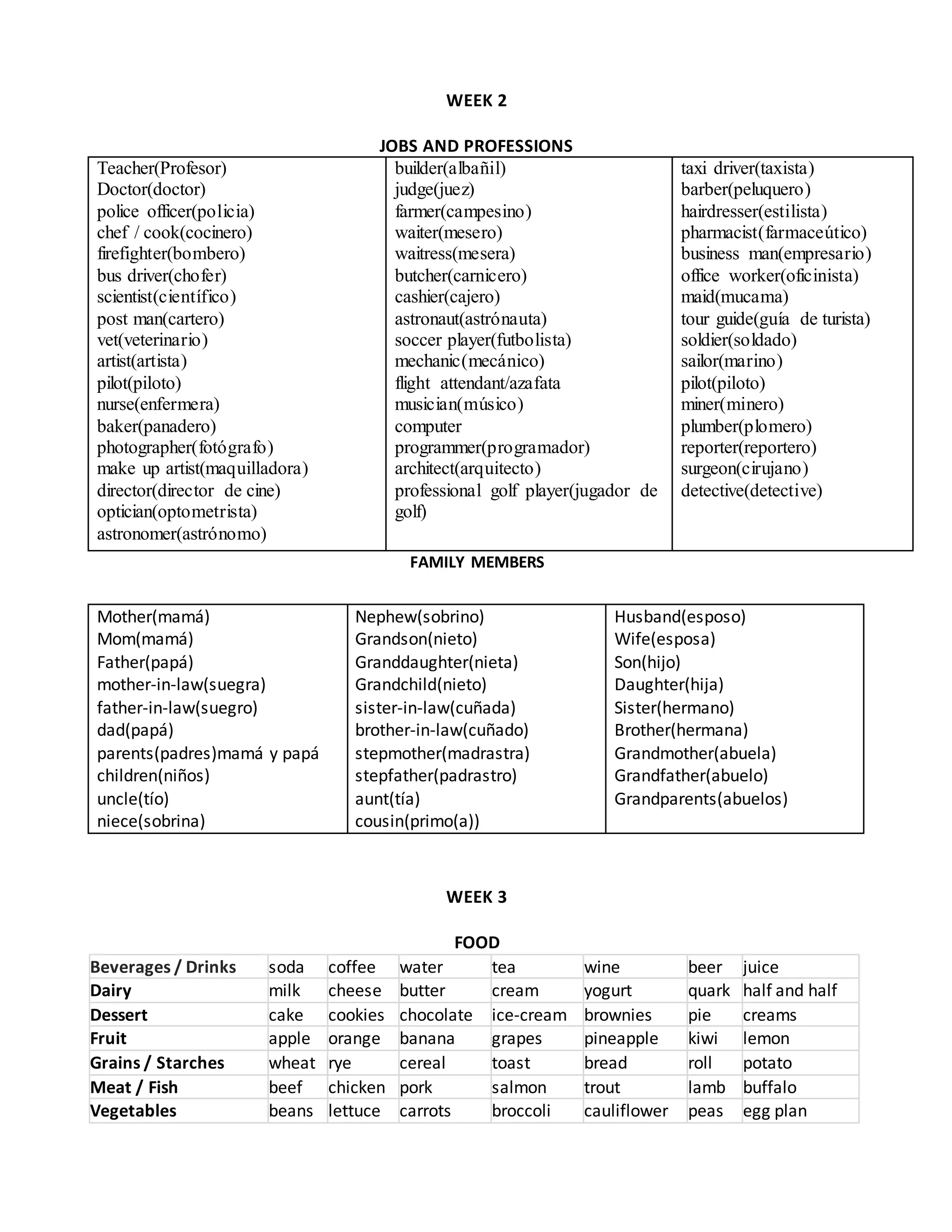
JOBS AND PROFESSIONS
Teacher(Profesor)
Doctor(doctor)
police officer(policia)
chef / cook(cocinero)
firefighter(bombero)
bus driver(chofer)
scientist(científico)
post man(cartero)
vet(veterinario)
artist(artista)
pilot(piloto)
nurse(enfermera)
baker(panadero)
photographer(fotógrafo)
make up artist(maquilladora)
director(director de cine)
optician(optometrista)
astronomer(astrónomo)
builder(albañil)
judge(juez)
farmer(campesino)
waiter(mesero)
waitress(mesera)
butcher(carnicero)
cashier(cajero)
astronaut(astrónauta)
soccer player(futbolista)
mechanic(mecánico)
flight attendant/azafata
musician(músico)
computer
programmer(programador)
architect(arquitecto)
professional golf player(jugador de
golf)
taxi driver(taxista)
barber(peluquero)
hairdresser(estilista)
pharmacist(farmaceútico)
business man(empresario)
office worker(oficinista)
maid(mucama)
tour guide(guía de turista)
soldier(soldado)
sailor(marino)
pilot(piloto)
miner(minero)
plumber(plomero)
reporter(reportero)
surgeon(cirujano)
detective(detective)
FAMILY MEMBERS
Mother(mamá)
Mom(mamá)
Father(papá)
mother-in-law(suegra)
father-in-law(suegro)
dad(papá)
parents(padres)mamá y papá
children(niños)
uncle(tío)
niece(sobrina)
Nephew(sobrino)
Grandson(nieto)
Granddaughter(nieta)
Grandchild(nieto)
sister-in-law(cuñada)
brother-in-law(cuñado)
stepmother(madrastra)
stepfather(padrastro)
aunt(tía)
cousin(primo(a))
Husband(esposo)
Wife(esposa)
Son(hijo)
Daughter(hija)
Sister(hermano)
Brother(hermana)
Grandmother(abuela)
Grandfather(abuelo)
Grandparents(abuelos)
WEEK 3
FOOD
Beverages / Drinks soda coffee water tea wine beer juice
Dairy milk cheese butter cream yogurt quark half and half
Dessert cake cookies chocolate ice-cream brownies pie creams
Fruit apple orange banana grapes pineapple kiwi lemon
Grains / Starches wheat rye cereal toast bread roll potato
Meat / Fish beef chicken pork salmon trout lamb buffalo
Vegetables beans lettuce carrots broccoli cauliflower peas egg plan
ACTIVITIES
Week 1. From August 24th to August 28th
1. Copy the information in their notebook
2. Learn the expressions (greetings and farewells)
3. Make a video saying the expressions
Week 2. From August 31st to September 04th
1. Copy the jobs, profession and members family in their notebooks
2. Illustrate the vocabulary
3. Learn the list of names
Week 3. From September 07th to September 11th
1. Copy the list of food in their notebooks
2. Illustrate the vocabulary
3. Learn the list of names of food
ENGLISH REINFORCEMENT PACKAGE 2º
WEEK 1
What is a comic strip?
A comic strip is a sequence of images with a small amount of text in each box. This text is normally
inside balloons or written as captions. Comic strips (or comic books) are a form of story-telling, which
uses drawings or cartoon characters to tell a story. Most comic strips are created for humour, while
some can be serious.
Comic strips are most likely to be seen in newspapers or magazines. While entire comic books or
graphic novels can be found at your local library or bookstore. Superman is one of the best-selling
comic books of all time. You might know of other examples of comic strips or books that you’ve seen
or read.
In the professional world, comic strips or comic books are created by cartoonists or professional
graphic artists. But today we’ll show you how to create your own comic strip at home with no
experience needed!
How to create a comic strip
As this is your first-ever comic strip we will focus on creating a three-frame comic. But when you
become a master at creating short comic strips, you can make yours much longer and filled with way
more characters.
Step 1: Write your ideas for your comic
Step 2: Draw the three-frames
Step 3: Use basic shapes to draw
Step 4: Add in the speech and lettering
Step 5: Add detail to your cartoon
Step 6: Go over your comic in pen
WEEK 2
Simple present tense
The simple present tense is one of several forms of present tense in English. It is used to
describe habits, unchanging situations, general truths, and fixed arrangements. The simple present
tense is simple to form. Just use the base form of the verb: (I take, you take, we take, they take) The
3rd person singular takes an -s at the end. (he takes, she takes)
The simple present tense is used:
To express habits, general truths, repeated actions or unchanging situations, emotions and wishes:
I smoke (habit); I work in London (unchanging situation); London is a large city (general truth)
To give instructions or directions:
You walk for two hundred meters, then you turn left.
To express fixed arrangements, present or future:
Your exam starts at 09.00
To express future time, after some conjunctions: after, when, before, as soon as, until:
He'll give it to you when you come next Saturday.
Examples
For habits
He drinks tea at breakfast.
For general truths
Water freezes at zero degrees.
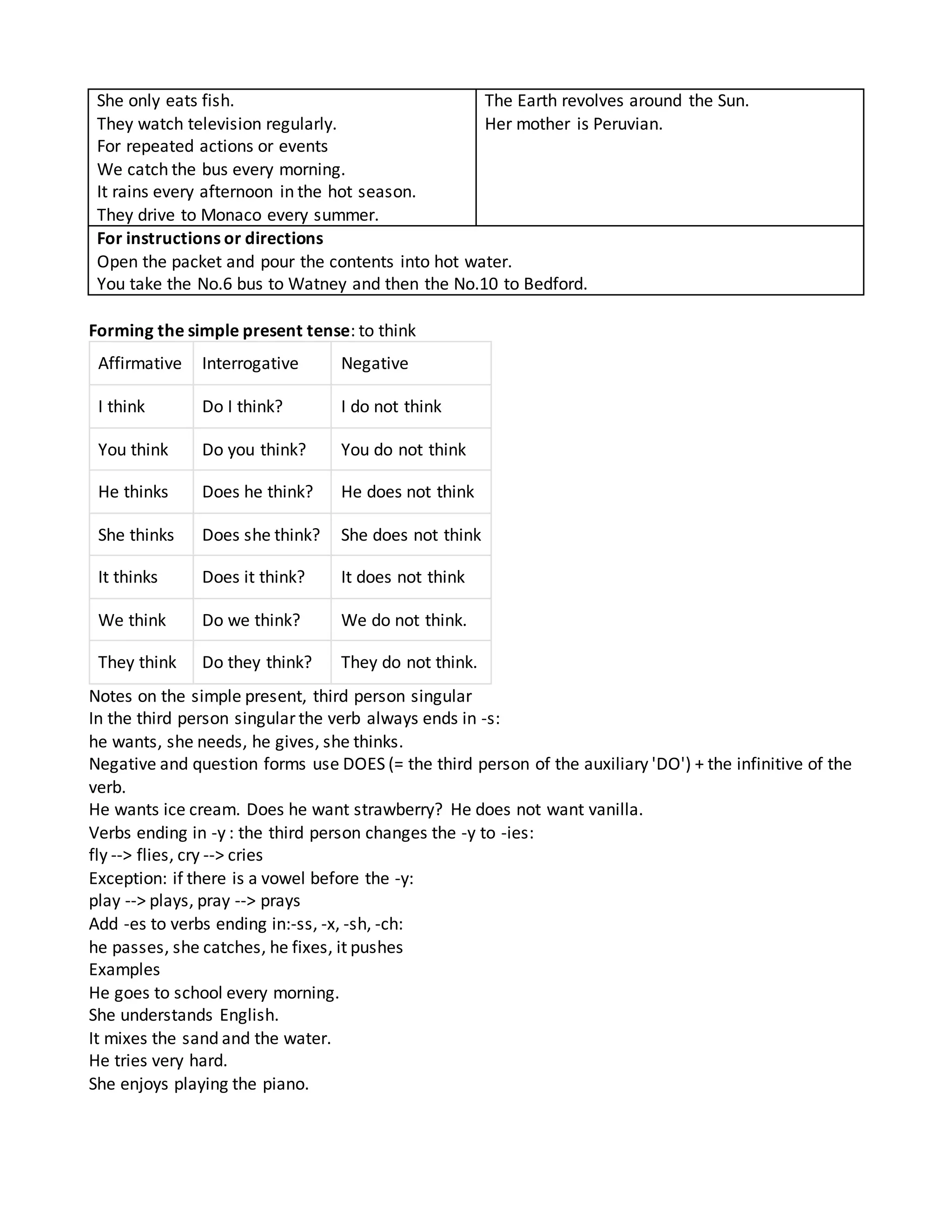
She only eats fish.
They watch television regularly.
For repeated actions or events
We catch the bus every morning.
It rains every afternoon in the hot season.
They drive to Monaco every summer.
The Earth revolves around the Sun.
Her mother is Peruvian.
For instructions or directions
Open the packet and pour the contents into hot water.
You take the No.6 bus to Watney and then the No.10 to Bedford.
Forming the simple present tense: to think
Affirmative Interrogative Negative
I think Do I think? I do not think
You think Do you think? You do not think
He thinks Does he think? He does not think
She thinks Does she think? She does not think
It thinks Does it think? It does not think
We think Do we think? We do not think.
They think Do they think? They do not think.
Notes on the simple present, third person singular
In the third person singular the verb always ends in -s:
he wants, she needs, he gives, she thinks.
Negative and question forms use DOES (= the third person of the auxiliary 'DO') + the infinitive of the
verb.
He wants ice cream. Does he want strawberry? He does not want vanilla.
Verbs ending in -y : the third person changes the -y to -ies:
fly --> flies, cry --> cries
Exception: if there is a vowel before the -y:
play --> plays, pray --> prays
Add -es to verbs ending in:-ss, -x, -sh, -ch:
he passes, she catches, he fixes, it pushes
Examples
He goes to school every morning.
She understands English.
It mixes the sand and the water.
He tries very hard.
She enjoys playing the piano.
WEEK 3
Simple Future Tense
The simple future is a verb tense that’s used to talk about things that haven’t happened yet.
This year, Jen will read War and Peace. It will be hard, but she’s determined to do it.
Use the simple future to talk about an action or condition that will begin and end in the future.
How to Form the Simple Future
The formula for the simple future is will + [root form of verb].
I will learn a new language. Jen will read that book. My brothers will sleep till noon if no one wakes them up.
You will see what I mean.
It doesn’t matter if the subject is singular or plural; the formula for the simple future doesn’t change.
But…
There is another way to show that something will happen in the future. It follows the formula [am/is/are] + going
to + [root form verb].
I am going to learn a new language. Jen is going to read that book. My brothers are going to sleep till noon if
no one wakes them up. You are going to see what I mean.
The “going to” construction is common in speech and casual writing. Keep in mind though that it’s on the
informal side, so it’s a good idea to stick to the will + [root form] construction in formal writing.
How to Make the Simple Future Negative
To make the simple future negative, the formula is will + not + [root form].
Jen will not quit before she reaches her goal. Make sure you arrive on time tomorrow because the bus will not
wait for you. He will not say anything bad about his boss. I will not finish my homework in time for class.
Using the “going to” construction, the formula is [am/is/are] + not + going to + [root form].
Jen is not going to quit before she reaches her goal. Make sure you arrive on time tomorrow because the
bus is not going to wait for you. He is not going to say anything bad about his boss. I am not going to
finish my homework in time for class.
How to Ask a Question
To ask a question in the simple future, the formula is will + [subject] + [root form].
Will Jen finish War and Peace over the summer? Will I have the discipline to study Spanish every day?
What will you buy with the money you found?
The formula for the “going to” construction is [am/is/are] + [subject] +going to + [root form].
Is Jen going to finish War and Peace over the summer? Am I going to have the discipline to study Spanish
every day? What are you going to buy with the money you found?
ACTIVITIES
Week 1. From August 24th to August 28th
4. Read the text
5. Draw a comic strip using the steps to make a comic strip
6. Present their works
Week 2. From August 31st to September 04th
4. Copy the information in your notebooks
5. Make sentences using the present tense (affirmative form)
6. Change the last sentences to present interrogative form
Week 3. From September 07th to September 11th
1. Read the information
2. Write sentences of what they would do on a trip to Chiapas using future tense
(affirmative form).
3. Write a text using the last sentences where they narrate what they´ll do on their
journey.
ENGLISH REINFORCEMENT PACKAGE 3º
WEEK 1
Prefixes
A prefix is a group of letters placed before the root of a word. For example, the word “unhappy”
consists of the prefix “un-” [which means “not”] combined with the root (or stem) word “happy”; the
word “unhappy” means “not happy.”
A short list of prefixes:
Prefix Meaning Examples
de- from, down, away, reverse, opposite decode, decrease
dis- not, opposite, reverse, away disagree, disappear
ex- out of, away from, lacking, former exhale, explosion
il- not illegal, illogical
im- not, without impossible, improper
in- not, without inaction, invisible
mis- bad, wrong mislead, misplace
non- not nonfiction, nonsense
pre- before prefix, prehistory
pro- for, forward, before proactive, profess, program
re- again, back react, reappear
un- against, not, opposite undo, unequal, unusual
Suffixes
A suffix is a group of letters placed after the root of a word. For example, the word flavorless consists
of the root word “flavor” combined with the suffix “-less” [which means “without”]; the word
“flavorless” means “having no flavor.”
A short list of suffixes:
Suffix Meaning Examples
-able able to, having the quality of comfortable, portable
-al relating to annual comical
-er comparative bigger, stronger
-est superlative strongest, tiniest
-ful full of beautiful, grateful
-ible forming an adjective reversible, terrible
-ily forming an adverb eerily, happily, lazily
-ing denoting an action, a material, or a gerund acting, showing
Suffix Meaning Examples
-less without, not affected by friendless, tireless
-ly forming an adjective clearly, hourly
-ness denoting a state or condition kindness, wilderness
-y full of, denoting a condition, or a diminutive glory, messy, victory
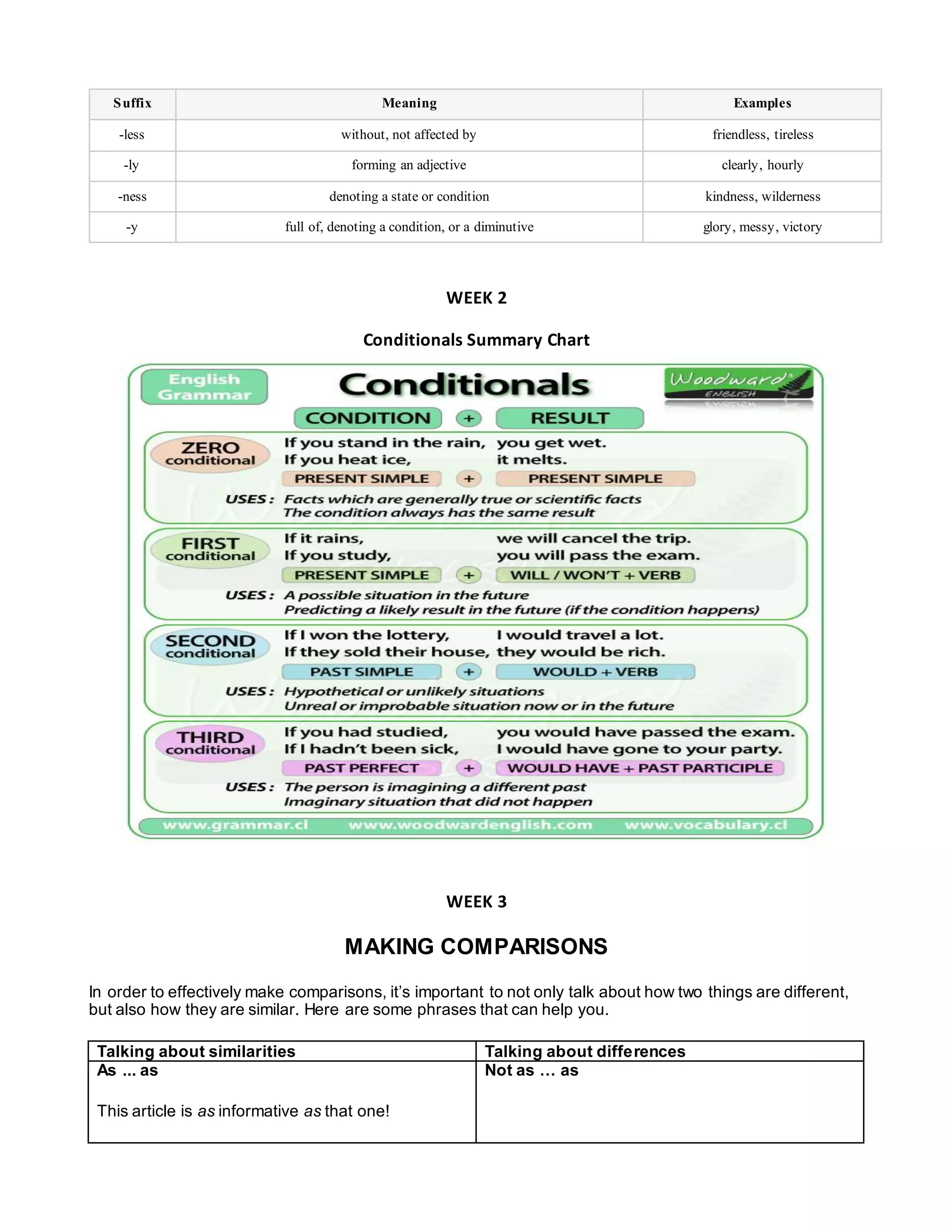
WEEK 2
Conditionals Summary Chart
WEEK 3
MAKING COMPARISONS
In order to effectively make comparisons, it’s important to not only talk about how two things are different,
but also how they are similar. Here are some phrases that can help you.
Talking about similarities Talking about differences
As ... as
This article is as informative as that one!
Not as … as
Both
In my opinion, both articles are about the same
topic.
Just like
This article was fun to read, just like the other one.
The information here is not as serious as the one
in the newspaper.
Comparative + than
This report is more boring than that one.
Less + comparative + than
This information is less interesting than the one
online.
ACTIVITIES
Week 1. From August 24th to August 28th
1. Copy the information in their notebooks
2. Write an example for each prefix
3. Write an example for each suffix
Week 2. From August 31st to September 04th
1. Copy the chart in their notebooks
2. Write 5 examples with the zero and first conditional
3. Write 5 examples with the second and third conditional
Week 3. From September 07th to September 11th
1. Read the information
2. Write sentences of what they would do on a trip to Chiapas using future tense
(affirmative form).
3. Write a text using the last sentences where they narrate what they´ll do on their
journey.

English reinforcement package

  • 1.
    ENGLISH REINFORCEMENT PACKAGE1º WEEK 1 GREETINGS AND FAREWELLS Good morning. - Buenos días. Good afternoon. - Buenas tardes. Good evening. - Buenas noches. Hello. (más formal), Hi. (menos formal), Hey. (muy informal) - Hola. Hey! - ¡Oye!/¡Oiga!/¡Oigan! How's it going? - ¿Qué tal?/¿Cómo te va? (o más informalmente What’s up?) How are you? - ¿Cómo estás?/¿Cómo está Ud.? How are you all? - ¿Cómo están Uds.? Good-bye./Bye. - Adiós. Good night. - Buenas noches.** See you later. - Hasta luego./Nos vemos. (o I’ll see you later., etc.) See you tomorrow. - Hasta mañana. See you soon. - Hasta pronto. See you then. - Hasta entonces. Take care. Cuídate./Cuídese./Cuidaos./Cuídense. (o más informalmente Take it easy.) So long- Hasta luego WEEK 2 PERSONAL PRONOUNS AND PERSONAL PRESENTACIÓN Personal Pronouns Personal pronouns represent specific people or things. We use them depending on: number: singular (eg: I) or plural (eg: we) person: 1st person (eg: I), 2nd person (eg: you) or 3rd person (eg: he) gender: male (eg: he), female (eg: she) or neuter (eg: it) case: subject (eg: we) or object (eg: us) We use personal pronouns in place of the person or people that we are talking about. My name is Josef but when I am talking about myself I almost always use "I" or "me", not "Josef". When I am talking direct to you, I almost always use "you", not your name. When I am talking about another person, say John, I may start with "John" but then use "he" or "him". And so on. Here are the personal pronouns, followed by some example sentences: PRONOUNS VERB “TO BE” ESPAÑOL EXAMPLE I You He She It We You They am are is is is are are are I am- yo soy/yo estoy You are-Tú eres/Tú estás He is-El es/El está She is-Ella es/Ella está It is-Esto(a) es/Esto(a) está We are-Nosotros somos/estamos You are-Ustede son/ Uds. Están They are-Ellos son/Ellos están I am Fabián You are in Japan He is Doctor She is in the school It is a car We are a basket ball team You are singing They are boys
  • 2.
    WEEK 2 JOBS ANDPROFESSIONS Teacher(Profesor) Doctor(doctor) police officer(policia) chef / cook(cocinero) firefighter(bombero) bus driver(chofer) scientist(científico) post man(cartero) vet(veterinario) artist(artista) pilot(piloto) nurse(enfermera) baker(panadero) photographer(fotógrafo) make up artist(maquilladora) director(director de cine) optician(optometrista) astronomer(astrónomo) builder(albañil) judge(juez) farmer(campesino) waiter(mesero) waitress(mesera) butcher(carnicero) cashier(cajero) astronaut(astrónauta) soccer player(futbolista) mechanic(mecánico) flight attendant/azafata musician(músico) computer programmer(programador) architect(arquitecto) professional golf player(jugador de golf) taxi driver(taxista) barber(peluquero) hairdresser(estilista) pharmacist(farmaceútico) business man(empresario) office worker(oficinista) maid(mucama) tour guide(guía de turista) soldier(soldado) sailor(marino) pilot(piloto) miner(minero) plumber(plomero) reporter(reportero) surgeon(cirujano) detective(detective) FAMILY MEMBERS Mother(mamá) Mom(mamá) Father(papá) mother-in-law(suegra) father-in-law(suegro) dad(papá) parents(padres)mamá y papá children(niños) uncle(tío) niece(sobrina) Nephew(sobrino) Grandson(nieto) Granddaughter(nieta) Grandchild(nieto) sister-in-law(cuñada) brother-in-law(cuñado) stepmother(madrastra) stepfather(padrastro) aunt(tía) cousin(primo(a)) Husband(esposo) Wife(esposa) Son(hijo) Daughter(hija) Sister(hermano) Brother(hermana) Grandmother(abuela) Grandfather(abuelo) Grandparents(abuelos) WEEK 3 FOOD Beverages / Drinks soda coffee water tea wine beer juice Dairy milk cheese butter cream yogurt quark half and half Dessert cake cookies chocolate ice-cream brownies pie creams Fruit apple orange banana grapes pineapple kiwi lemon Grains / Starches wheat rye cereal toast bread roll potato Meat / Fish beef chicken pork salmon trout lamb buffalo Vegetables beans lettuce carrots broccoli cauliflower peas egg plan
  • 3.
    ACTIVITIES Week 1. FromAugust 24th to August 28th 1. Copy the information in their notebook 2. Learn the expressions (greetings and farewells) 3. Make a video saying the expressions Week 2. From August 31st to September 04th 1. Copy the jobs, profession and members family in their notebooks 2. Illustrate the vocabulary 3. Learn the list of names Week 3. From September 07th to September 11th 1. Copy the list of food in their notebooks 2. Illustrate the vocabulary 3. Learn the list of names of food
  • 4.
    ENGLISH REINFORCEMENT PACKAGE2º WEEK 1 What is a comic strip? A comic strip is a sequence of images with a small amount of text in each box. This text is normally inside balloons or written as captions. Comic strips (or comic books) are a form of story-telling, which uses drawings or cartoon characters to tell a story. Most comic strips are created for humour, while some can be serious. Comic strips are most likely to be seen in newspapers or magazines. While entire comic books or graphic novels can be found at your local library or bookstore. Superman is one of the best-selling comic books of all time. You might know of other examples of comic strips or books that you’ve seen or read. In the professional world, comic strips or comic books are created by cartoonists or professional graphic artists. But today we’ll show you how to create your own comic strip at home with no experience needed! How to create a comic strip As this is your first-ever comic strip we will focus on creating a three-frame comic. But when you become a master at creating short comic strips, you can make yours much longer and filled with way more characters. Step 1: Write your ideas for your comic Step 2: Draw the three-frames Step 3: Use basic shapes to draw Step 4: Add in the speech and lettering Step 5: Add detail to your cartoon Step 6: Go over your comic in pen WEEK 2 Simple present tense The simple present tense is one of several forms of present tense in English. It is used to describe habits, unchanging situations, general truths, and fixed arrangements. The simple present tense is simple to form. Just use the base form of the verb: (I take, you take, we take, they take) The 3rd person singular takes an -s at the end. (he takes, she takes) The simple present tense is used: To express habits, general truths, repeated actions or unchanging situations, emotions and wishes: I smoke (habit); I work in London (unchanging situation); London is a large city (general truth) To give instructions or directions: You walk for two hundred meters, then you turn left. To express fixed arrangements, present or future: Your exam starts at 09.00 To express future time, after some conjunctions: after, when, before, as soon as, until: He'll give it to you when you come next Saturday. Examples For habits He drinks tea at breakfast. For general truths Water freezes at zero degrees.
  • 5.
    She only eatsfish. They watch television regularly. For repeated actions or events We catch the bus every morning. It rains every afternoon in the hot season. They drive to Monaco every summer. The Earth revolves around the Sun. Her mother is Peruvian. For instructions or directions Open the packet and pour the contents into hot water. You take the No.6 bus to Watney and then the No.10 to Bedford. Forming the simple present tense: to think Affirmative Interrogative Negative I think Do I think? I do not think You think Do you think? You do not think He thinks Does he think? He does not think She thinks Does she think? She does not think It thinks Does it think? It does not think We think Do we think? We do not think. They think Do they think? They do not think. Notes on the simple present, third person singular In the third person singular the verb always ends in -s: he wants, she needs, he gives, she thinks. Negative and question forms use DOES (= the third person of the auxiliary 'DO') + the infinitive of the verb. He wants ice cream. Does he want strawberry? He does not want vanilla. Verbs ending in -y : the third person changes the -y to -ies: fly --> flies, cry --> cries Exception: if there is a vowel before the -y: play --> plays, pray --> prays Add -es to verbs ending in:-ss, -x, -sh, -ch: he passes, she catches, he fixes, it pushes Examples He goes to school every morning. She understands English. It mixes the sand and the water. He tries very hard. She enjoys playing the piano.
  • 6.
    WEEK 3 Simple FutureTense The simple future is a verb tense that’s used to talk about things that haven’t happened yet. This year, Jen will read War and Peace. It will be hard, but she’s determined to do it. Use the simple future to talk about an action or condition that will begin and end in the future. How to Form the Simple Future The formula for the simple future is will + [root form of verb]. I will learn a new language. Jen will read that book. My brothers will sleep till noon if no one wakes them up. You will see what I mean. It doesn’t matter if the subject is singular or plural; the formula for the simple future doesn’t change. But… There is another way to show that something will happen in the future. It follows the formula [am/is/are] + going to + [root form verb]. I am going to learn a new language. Jen is going to read that book. My brothers are going to sleep till noon if no one wakes them up. You are going to see what I mean. The “going to” construction is common in speech and casual writing. Keep in mind though that it’s on the informal side, so it’s a good idea to stick to the will + [root form] construction in formal writing. How to Make the Simple Future Negative To make the simple future negative, the formula is will + not + [root form]. Jen will not quit before she reaches her goal. Make sure you arrive on time tomorrow because the bus will not wait for you. He will not say anything bad about his boss. I will not finish my homework in time for class. Using the “going to” construction, the formula is [am/is/are] + not + going to + [root form]. Jen is not going to quit before she reaches her goal. Make sure you arrive on time tomorrow because the bus is not going to wait for you. He is not going to say anything bad about his boss. I am not going to finish my homework in time for class. How to Ask a Question To ask a question in the simple future, the formula is will + [subject] + [root form]. Will Jen finish War and Peace over the summer? Will I have the discipline to study Spanish every day? What will you buy with the money you found? The formula for the “going to” construction is [am/is/are] + [subject] +going to + [root form]. Is Jen going to finish War and Peace over the summer? Am I going to have the discipline to study Spanish every day? What are you going to buy with the money you found? ACTIVITIES Week 1. From August 24th to August 28th 4. Read the text 5. Draw a comic strip using the steps to make a comic strip 6. Present their works Week 2. From August 31st to September 04th 4. Copy the information in your notebooks 5. Make sentences using the present tense (affirmative form) 6. Change the last sentences to present interrogative form Week 3. From September 07th to September 11th
  • 7.
    1. Read theinformation 2. Write sentences of what they would do on a trip to Chiapas using future tense (affirmative form). 3. Write a text using the last sentences where they narrate what they´ll do on their journey.
  • 8.
    ENGLISH REINFORCEMENT PACKAGE3º WEEK 1 Prefixes A prefix is a group of letters placed before the root of a word. For example, the word “unhappy” consists of the prefix “un-” [which means “not”] combined with the root (or stem) word “happy”; the word “unhappy” means “not happy.” A short list of prefixes: Prefix Meaning Examples de- from, down, away, reverse, opposite decode, decrease dis- not, opposite, reverse, away disagree, disappear ex- out of, away from, lacking, former exhale, explosion il- not illegal, illogical im- not, without impossible, improper in- not, without inaction, invisible mis- bad, wrong mislead, misplace non- not nonfiction, nonsense pre- before prefix, prehistory pro- for, forward, before proactive, profess, program re- again, back react, reappear un- against, not, opposite undo, unequal, unusual Suffixes A suffix is a group of letters placed after the root of a word. For example, the word flavorless consists of the root word “flavor” combined with the suffix “-less” [which means “without”]; the word “flavorless” means “having no flavor.” A short list of suffixes: Suffix Meaning Examples -able able to, having the quality of comfortable, portable -al relating to annual comical -er comparative bigger, stronger -est superlative strongest, tiniest -ful full of beautiful, grateful -ible forming an adjective reversible, terrible -ily forming an adverb eerily, happily, lazily -ing denoting an action, a material, or a gerund acting, showing
  • 9.
    Suffix Meaning Examples -lesswithout, not affected by friendless, tireless -ly forming an adjective clearly, hourly -ness denoting a state or condition kindness, wilderness -y full of, denoting a condition, or a diminutive glory, messy, victory WEEK 2 Conditionals Summary Chart WEEK 3 MAKING COMPARISONS In order to effectively make comparisons, it’s important to not only talk about how two things are different, but also how they are similar. Here are some phrases that can help you. Talking about similarities Talking about differences As ... as This article is as informative as that one! Not as … as
  • 10.
    Both In my opinion,both articles are about the same topic. Just like This article was fun to read, just like the other one. The information here is not as serious as the one in the newspaper. Comparative + than This report is more boring than that one. Less + comparative + than This information is less interesting than the one online. ACTIVITIES Week 1. From August 24th to August 28th 1. Copy the information in their notebooks 2. Write an example for each prefix 3. Write an example for each suffix Week 2. From August 31st to September 04th 1. Copy the chart in their notebooks 2. Write 5 examples with the zero and first conditional 3. Write 5 examples with the second and third conditional Week 3. From September 07th to September 11th 1. Read the information 2. Write sentences of what they would do on a trip to Chiapas using future tense (affirmative form). 3. Write a text using the last sentences where they narrate what they´ll do on their journey.