PRESENT SIMPLE
Expresses an action in the present taking place once, never
or several times. It is also used for actions that take place
one after another and for actions that are set by a timetable
or schedule. The simple present also expresses facts in the
present.
_____________________________*___________________________________
PAST SIMPLE PRESENT FUTURE
For example: I wake up everyday at 7:00 a.m.
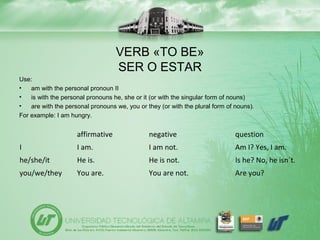
VERB «TO BE»
SER O ESTAR
Use:
• am with the personal pronoun II
• is with the personal pronouns he, she or it (or with the singular form of nouns)
• are with the personal pronouns we, you or they (or with the plural form of nouns).
For example: I am hungry.
affirmative negative question
I I am. I am not. Am I? Yes, I am.
he/she/it He is. He is not. Is he? No, he isn´t.
you/we/they You are. You are not. Are you?
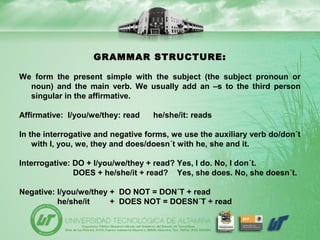
GRAMMAR STRUCTURE:
We form the present simple with the subject (the subject pronoun or
noun) and the main verb. We usually add an –s to the third person
singular in the affirmative.
Affirmative: I/you/we/they: read he/she/it: reads
In the interrogative and negative forms, we use the auxiliary verb do/don´t
with I, you, we, they and does/doesn´t with he, she and it.
Interrogative: DO + I/you/we/they + read? Yes, I do. No, I don´t.
DOES + he/she/it + read? Yes, she does. No, she doesn´t.
Negative: I/you/we/they + DO NOT = DON´T + read
he/she/it + DOES NOT = DOESN´T + read
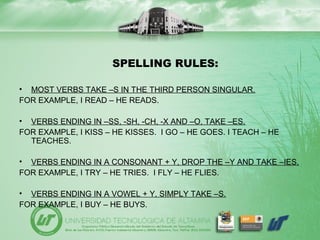
SPELLING RULES:
• MOST VERBS TAKE –S IN THE THIRD PERSON SINGULAR.
FOR EXAMPLE, I READ – HE READS.
• VERBS ENDING IN –SS, -SH, -CH, -X AND –O, TAKE –ES.
FOR EXAMPLE, I KISS – HE KISSES. I GO – HE GOES. I TEACH – HE
TEACHES.
• VERBS ENDING IN A CONSONANT + Y, DROP THE –Y AND TAKE –IES.
FOR EXAMPLE, I TRY – HE TRIES. I FLY – HE FLIES.
• VERBS ENDING IN A VOWEL + Y, SIMPLY TAKE –S.
FOR EXAMPLE, I BUY – HE BUYS.
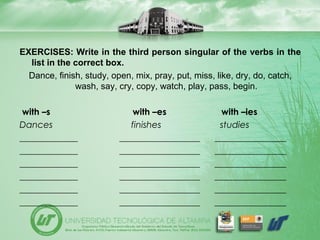
EXERCISES: Write in the third person singular of the verbs in the
list in the correct box.
Dance, finish, study, open, mix, pray, put, miss, like, dry, do, catch,
wash, say, cry, copy, watch, play, pass, begin.
with –s with –es with –ies
Dances finishes studies
_____________ __________________ ________________
_____________ __________________ ________________
_____________ __________________ ________________
_____________ __________________ ________________
_____________ __________________ ________________
_____________ __________________ ________________
BIBLIOGRAFIA:
Evans, Virginia. Successful Writing Proeficiency. Express
Publishing. Pg. 9. United Kingdom. 2002.
Elaborado por LRI. Divina Margarita Gómez Alvarenga
Para la Universidad Tecnológica de Altamira
Altamira, México.
BIBLIOGRAFIA:
Evans, Virginia. Successful Writing Proeficiency. Express
Publishing. Pg. 9. United Kingdom. 2002.
Elaborado por LRI. Divina Margarita Gómez Alvarenga
Para la Universidad Tecnológica de Altamira
Altamira, México.

Present Simple

  • 1.
    PRESENT SIMPLE Expresses anaction in the present taking place once, never or several times. It is also used for actions that take place one after another and for actions that are set by a timetable or schedule. The simple present also expresses facts in the present. _____________________________*___________________________________ PAST SIMPLE PRESENT FUTURE For example: I wake up everyday at 7:00 a.m.
  • 2.
    VERB «TO BE» SERO ESTAR Use: • am with the personal pronoun II • is with the personal pronouns he, she or it (or with the singular form of nouns) • are with the personal pronouns we, you or they (or with the plural form of nouns). For example: I am hungry. affirmative negative question I I am. I am not. Am I? Yes, I am. he/she/it He is. He is not. Is he? No, he isn´t. you/we/they You are. You are not. Are you?
  • 3.
    GRAMMAR STRUCTURE: We formthe present simple with the subject (the subject pronoun or noun) and the main verb. We usually add an –s to the third person singular in the affirmative. Affirmative: I/you/we/they: read he/she/it: reads In the interrogative and negative forms, we use the auxiliary verb do/don´t with I, you, we, they and does/doesn´t with he, she and it. Interrogative: DO + I/you/we/they + read? Yes, I do. No, I don´t. DOES + he/she/it + read? Yes, she does. No, she doesn´t. Negative: I/you/we/they + DO NOT = DON´T + read he/she/it + DOES NOT = DOESN´T + read
  • 4.
    SPELLING RULES: • MOSTVERBS TAKE –S IN THE THIRD PERSON SINGULAR. FOR EXAMPLE, I READ – HE READS. • VERBS ENDING IN –SS, -SH, -CH, -X AND –O, TAKE –ES. FOR EXAMPLE, I KISS – HE KISSES. I GO – HE GOES. I TEACH – HE TEACHES. • VERBS ENDING IN A CONSONANT + Y, DROP THE –Y AND TAKE –IES. FOR EXAMPLE, I TRY – HE TRIES. I FLY – HE FLIES. • VERBS ENDING IN A VOWEL + Y, SIMPLY TAKE –S. FOR EXAMPLE, I BUY – HE BUYS.
  • 5.
    EXERCISES: Write inthe third person singular of the verbs in the list in the correct box. Dance, finish, study, open, mix, pray, put, miss, like, dry, do, catch, wash, say, cry, copy, watch, play, pass, begin. with –s with –es with –ies Dances finishes studies _____________ __________________ ________________ _____________ __________________ ________________ _____________ __________________ ________________ _____________ __________________ ________________ _____________ __________________ ________________ _____________ __________________ ________________
  • 6.
    BIBLIOGRAFIA: Evans, Virginia. SuccessfulWriting Proeficiency. Express Publishing. Pg. 9. United Kingdom. 2002. Elaborado por LRI. Divina Margarita Gómez Alvarenga Para la Universidad Tecnológica de Altamira Altamira, México.
  • 7.
    BIBLIOGRAFIA: Evans, Virginia. SuccessfulWriting Proeficiency. Express Publishing. Pg. 9. United Kingdom. 2002. Elaborado por LRI. Divina Margarita Gómez Alvarenga Para la Universidad Tecnológica de Altamira Altamira, México.