WHAT EVERY COLLEGE
PROFESSOR WISHES YOU
KNEW ABOUT RESEARCH
RICHELLE O’NEIL, PROSPER ISD
THEY WISH YOU
WOULD DO A
BETTER JOB OF
CHOOSING AND
EVALUATING
YOUR SOURCES
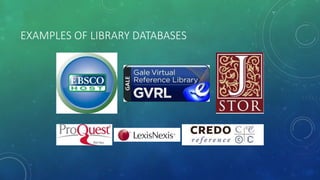
EXAMPLES OF LIBRARY DATABASES
WHAT IS THE DIFFERENCE BETWEEN A LIBRARY
DATABASE AND A WEBSITE?
LIBRARY DATABASES
• Library databases get their information from
professionals or experts in the field.
• Library databases contain published works
where facts are checked.
• Library databases are easy to cite in a
bibliography and may create the citation for
you.
• Library databases can help you narrow your
topic or suggest related subjects.
• Library databases are updated frequently and
include the date of publication.
WEBSITES
• Websites can be written by anyone regardless
of expertise.
• Website content is not necessarily checked by
an expert.
• Websites often don’t provide the information
necessary to create a complete citation.
• Websites often aren’t organized to support
student research needs.
• Websites may not indicate when a page is
updated.
Source: Hennepin County Library,
http://tinyurl.com/nmvqoge
EVALUATING WEBSITES USING S.P.I.D.E.R.
•Source
• Who is the author? What are his/her credentials?
• If the website is not signed, is there another way to trace it’s
sponsor?
Adapted from Dr. Tom Johnson,
sites.google.com/site/spiderwebsiteevaluation/
EVALUATING WEBSITES USING S.P.I.D.E.R.
•Purpose
• Why is the author hosting the site?
• For profit or to share scholarly materials?
• Is the information biased?
Adapted from Dr. Tom Johnson,
sites.google.com/site/spiderwebsiteevaluation/
S.P.I.D.E.R.
•Information
• Is the information relevant and current?
• Has the website been updated recently?
Adapted from Dr. Tom Johnson,
sites.google.com/site/spiderwebsiteevaluation/
S.P.I.D.E.R.
•Domain
• What does the URL say about the website?
• These are restricted to certain institutions:
• .gov Government Agency www.whitehouse.gov
• .mil Military Agency www.navy.mil
• .edu Educational Institutions www.unt.edu
Adapted from Dr. Tom Johnson,
sites.google.com/site/spiderwebsiteevaluation/
S.P.I.D.E.R.
• Domain
• The following domains are open and unrestricted
• Anyone can purchase these names:
• .com Commercial Agency www.amazon.com/
www.thedogisland.com
• .net Internet Service Providers www.netzero.net/
www.prosper-isd.net
• .org Organization www.redcross.org/
www.martinlutherking.org/
Adapted from Dr. Tom Johnson,
sites.google.com/site/spiderwebsiteevaluation/
S.P.I.D.E.R.
•Educational
• How in-depth is the material?
• Is it a hoax or silly?
Adapted from Dr. Tom Johnson,
sites.google.com/site/spiderwebsiteevaluation/
S.P.I.D.E.R.
•Reliable
• Can the same information be found on other reliable websites?
Adapted from Dr. Tom Johnson,
sites.google.com/site/spiderwebsiteevaluation/
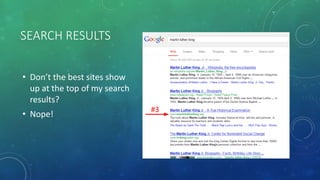
SEARCH RESULTS
• Don’t the best sites show
up at the top of my search
results?
• Nope!
#3
WHAT ABOUT WIKIPEDIA?
• Use information found on Wikipedia cautiously.
• While it may be a good source of information in your everyday life,
many people do not consider it to be an authoritative source.
• Most professors will not accept Wikipedia as a source for your
projects.
• UT Dallas policy: students receive an automatic F if Wikipedia is
used as a source
• You may, however, find authoritative sources in the references
section.
THE GOOD & BAD OF WIKIPEDIA
• Featured article: en.wikipedia.org/wiki/Bald_Eagle
• Article that needs improving:
en.wikipedia.org/wiki/List_of_Boston_Legal_characters
THEY WISH YOU UNDERSTOOD WHAT A BIG DEAL
PLAGIARISM REALLY IS
• Consequences of plagiarism in college:
• Grade penalty
• Fail the course
• Suspension from school
• Expulsion from school
• Some schools have a Student Judicial Committee that will hear the
plagiarism case against a student and determine a punishment
• Don’t forget – your instructors talk to one another. If you plagiarize in one
class, your other instructors will know about it.
HOW CAN YOU AVOID PLAGIARISM?
• Cite your sources!
• In-text (parenthetical) citations
• Works Cited page (Bibliography)
• Cite anything and everything that is not your original idea
CITING YOUR SOURCES IS EASIER THAN EVER BEFORE
Source:
http://ovidlibrary.org/history.html
SO JUST DO IT!

English IV - What Every College Professor Wishes You Knew About Validity and Citations

  • 1.
    WHAT EVERY COLLEGE PROFESSORWISHES YOU KNEW ABOUT RESEARCH RICHELLE O’NEIL, PROSPER ISD
  • 2.
    THEY WISH YOU WOULDDO A BETTER JOB OF CHOOSING AND EVALUATING YOUR SOURCES
  • 3.
  • 4.
    WHAT IS THEDIFFERENCE BETWEEN A LIBRARY DATABASE AND A WEBSITE? LIBRARY DATABASES • Library databases get their information from professionals or experts in the field. • Library databases contain published works where facts are checked. • Library databases are easy to cite in a bibliography and may create the citation for you. • Library databases can help you narrow your topic or suggest related subjects. • Library databases are updated frequently and include the date of publication. WEBSITES • Websites can be written by anyone regardless of expertise. • Website content is not necessarily checked by an expert. • Websites often don’t provide the information necessary to create a complete citation. • Websites often aren’t organized to support student research needs. • Websites may not indicate when a page is updated. Source: Hennepin County Library, http://tinyurl.com/nmvqoge
  • 5.
    EVALUATING WEBSITES USINGS.P.I.D.E.R. •Source • Who is the author? What are his/her credentials? • If the website is not signed, is there another way to trace it’s sponsor? Adapted from Dr. Tom Johnson, sites.google.com/site/spiderwebsiteevaluation/
  • 6.
    EVALUATING WEBSITES USINGS.P.I.D.E.R. •Purpose • Why is the author hosting the site? • For profit or to share scholarly materials? • Is the information biased? Adapted from Dr. Tom Johnson, sites.google.com/site/spiderwebsiteevaluation/
  • 7.
    S.P.I.D.E.R. •Information • Is theinformation relevant and current? • Has the website been updated recently? Adapted from Dr. Tom Johnson, sites.google.com/site/spiderwebsiteevaluation/
  • 8.
    S.P.I.D.E.R. •Domain • What doesthe URL say about the website? • These are restricted to certain institutions: • .gov Government Agency www.whitehouse.gov • .mil Military Agency www.navy.mil • .edu Educational Institutions www.unt.edu Adapted from Dr. Tom Johnson, sites.google.com/site/spiderwebsiteevaluation/
  • 9.
    S.P.I.D.E.R. • Domain • Thefollowing domains are open and unrestricted • Anyone can purchase these names: • .com Commercial Agency www.amazon.com/ www.thedogisland.com • .net Internet Service Providers www.netzero.net/ www.prosper-isd.net • .org Organization www.redcross.org/ www.martinlutherking.org/ Adapted from Dr. Tom Johnson, sites.google.com/site/spiderwebsiteevaluation/
  • 10.
    S.P.I.D.E.R. •Educational • How in-depthis the material? • Is it a hoax or silly? Adapted from Dr. Tom Johnson, sites.google.com/site/spiderwebsiteevaluation/
  • 11.
    S.P.I.D.E.R. •Reliable • Can thesame information be found on other reliable websites? Adapted from Dr. Tom Johnson, sites.google.com/site/spiderwebsiteevaluation/
  • 12.
    SEARCH RESULTS • Don’tthe best sites show up at the top of my search results? • Nope! #3
  • 13.
    WHAT ABOUT WIKIPEDIA? •Use information found on Wikipedia cautiously. • While it may be a good source of information in your everyday life, many people do not consider it to be an authoritative source. • Most professors will not accept Wikipedia as a source for your projects. • UT Dallas policy: students receive an automatic F if Wikipedia is used as a source • You may, however, find authoritative sources in the references section.
  • 14.
    THE GOOD &BAD OF WIKIPEDIA • Featured article: en.wikipedia.org/wiki/Bald_Eagle • Article that needs improving: en.wikipedia.org/wiki/List_of_Boston_Legal_characters
  • 15.
    THEY WISH YOUUNDERSTOOD WHAT A BIG DEAL PLAGIARISM REALLY IS • Consequences of plagiarism in college: • Grade penalty • Fail the course • Suspension from school • Expulsion from school • Some schools have a Student Judicial Committee that will hear the plagiarism case against a student and determine a punishment • Don’t forget – your instructors talk to one another. If you plagiarize in one class, your other instructors will know about it.
  • 16.
    HOW CAN YOUAVOID PLAGIARISM? • Cite your sources! • In-text (parenthetical) citations • Works Cited page (Bibliography) • Cite anything and everything that is not your original idea
  • 17.
    CITING YOUR SOURCESIS EASIER THAN EVER BEFORE Source: http://ovidlibrary.org/history.html
  • 18.