BRITISH CUISINE
From Wikipedia, the free encyclopedia : http:// en.wikipedia.org
A bit of history
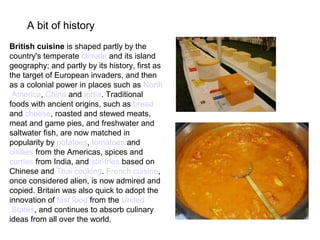
British cuisine is shaped partly by the
country's temperate climate and its island
geography; and partly by its history, first as
the target of European invaders, and then
as a colonial power in places such as North
America, China and India. Traditional
foods with ancient origins, such as bread
and cheese, roasted and stewed meats,
meat and game pies, and freshwater and
saltwater fish, are now matched in
popularity by potatoes, tomatoes and
chillies from the Americas, spices and
curries from India, and stir-fries based on
Chinese and Thai cooking. French cuisine,
once considered alien, is now admired and
copied. Britain was also quick to adopt the
innovation of fast food from the United
States, and continues to absorb culinary
ideas from all over the world.
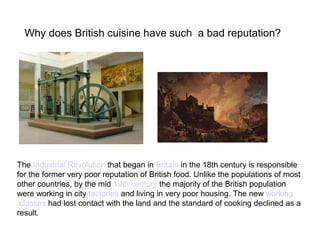
The Industrial Revolution that began in Britain in the 18th century is responsible
for the former very poor reputation of British food. Unlike the populations of most
other countries, by the mid 19th century the majority of the British population
were working in city factories and living in very poor housing. The new working
classes had lost contact with the land and the standard of cooking declined as a
result.
Why does British cuisine have such a bad reputation?
- Take-away food
What else gives English food a
bad name?
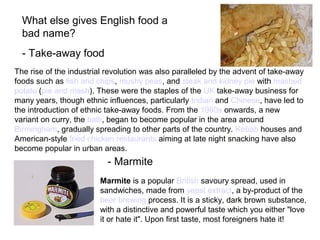
The rise of the industrial revolution was also paralleled by the advent of take-away
foods such as fish and chips, mushy peas, and steak and kidney pie with mashed
potato (pie and mash). These were the staples of the UK take-away business for
many years, though ethnic influences, particularly Indian and Chinese, have led to
the introduction of ethnic take-away foods. From the 1980s onwards, a new
variant on curry, the balti, began to become popular in the area around
Birmingham, gradually spreading to other parts of the country. Kebab houses and
American-style fried chicken restaurants aiming at late night snacking have also
become popular in urban areas.
Marmite is a popular British savoury spread, used in
sandwiches, made from yeast extract, a by-product of the
beer brewing process. It is a sticky, dark brown substance,
with a distinctive and powerful taste which you either "love
it or hate it". Upon first taste, most foreigners hate it!
- Marmite
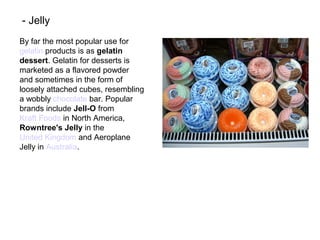
By far the most popular use for
gelatin products is as gelatin
dessert. Gelatin for desserts is
marketed as a flavored powder
and sometimes in the form of
loosely attached cubes, resembling
a wobbly chocolate bar. Popular
brands include Jell-O from
Kraft Foods in North America,
Rowntree's Jelly in the
United Kingdom and Aeroplane
Jelly in Australia.
- Jelly
Can’t we say anything good about English food?
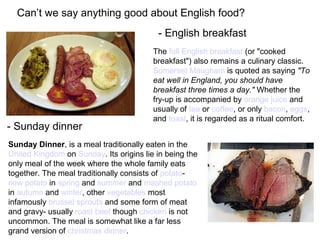
Sunday Dinner, is a meal traditionally eaten in the
United Kingdom on Sunday. Its origins lie in being the
only meal of the week where the whole family eats
together. The meal traditionally consists of potato-
new potato in spring and summer and mashed potato
in autumn and winter, other vegetables most
infamously brussel sprouts and some form of meat
and gravy- usually roast beef though chicken is not
uncommon. The meal is somewhat like a far less
grand version of christmas dinner.
- Sunday dinner
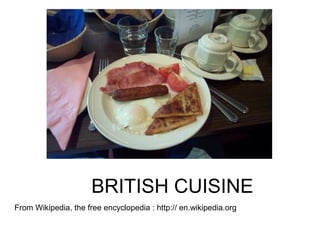
The full English breakfast (or "cooked
breakfast") also remains a culinary classic.
Somerset Maugham is quoted as saying "To
eat well in England, you should have
breakfast three times a day." Whether the
fry-up is accompanied by orange juice and
usually of tea or coffee, or only bacon, eggs,
and toast, it is regarded as a ritual comfort.
- English breakfast
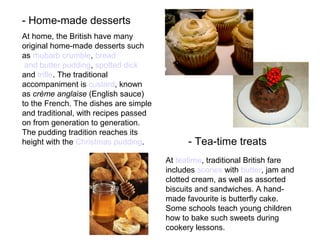
At home, the British have many
original home-made desserts such
as rhubarb crumble, bread
and butter pudding, spotted dick
and trifle. The traditional
accompaniment is custard, known
as crème anglaise (English sauce)
to the French. The dishes are simple
and traditional, with recipes passed
on from generation to generation.
The pudding tradition reaches its
height with the Christmas pudding.
- Home-made desserts
- Tea-time treats
At teatime, traditional British fare
includes scones with butter, jam and
clotted cream, as well as assorted
biscuits and sandwiches. A hand-
made favourite is butterfly cake.
Some schools teach young children
how to bake such sweets during
cookery lessons.
Rhubarb crumble is a traditional British dessert. Served with custard, cream or
ice cream it is a hearty, filling, and warm feast, best served after a light meal.
Ingredients
1 c. brown sugar
3/4 c. oats
1 c. flour
1/2 c. butter
1 tsp. cinnamon
4 c. uncooked cut up rhubarb
1 c. white sugar
2 tbsp. corn starch/cornflour
1 c. water
1 tsp. vanilla
Method
Mix brown sugar, oats, flour, butter and cinnamon until crumbly. Press 1/2 of
mixture into a 9 inch square pan. Cover crumb mixture with cut up rhubarb.
Mix white sugar, cornstarch and water. Cook until clear and thick, stirring
constantly. Add vanilla and stir. Pour over rhubarb. Sprinkle with remaining
crumb mixture over the top. Bake for 1 hour at 180°C.
A TYPICALLY BRITISH RECIPE
Thank you for your attention,
And enjoy your meal!!
Thank you for your attention,
And enjoy your meal!!

English food ppt

  • 1.
    BRITISH CUISINE From Wikipedia,the free encyclopedia : http:// en.wikipedia.org
  • 2.
    A bit ofhistory British cuisine is shaped partly by the country's temperate climate and its island geography; and partly by its history, first as the target of European invaders, and then as a colonial power in places such as North America, China and India. Traditional foods with ancient origins, such as bread and cheese, roasted and stewed meats, meat and game pies, and freshwater and saltwater fish, are now matched in popularity by potatoes, tomatoes and chillies from the Americas, spices and curries from India, and stir-fries based on Chinese and Thai cooking. French cuisine, once considered alien, is now admired and copied. Britain was also quick to adopt the innovation of fast food from the United States, and continues to absorb culinary ideas from all over the world.
  • 3.
    The Industrial Revolutionthat began in Britain in the 18th century is responsible for the former very poor reputation of British food. Unlike the populations of most other countries, by the mid 19th century the majority of the British population were working in city factories and living in very poor housing. The new working classes had lost contact with the land and the standard of cooking declined as a result. Why does British cuisine have such a bad reputation?
  • 4.
    - Take-away food Whatelse gives English food a bad name? The rise of the industrial revolution was also paralleled by the advent of take-away foods such as fish and chips, mushy peas, and steak and kidney pie with mashed potato (pie and mash). These were the staples of the UK take-away business for many years, though ethnic influences, particularly Indian and Chinese, have led to the introduction of ethnic take-away foods. From the 1980s onwards, a new variant on curry, the balti, began to become popular in the area around Birmingham, gradually spreading to other parts of the country. Kebab houses and American-style fried chicken restaurants aiming at late night snacking have also become popular in urban areas. Marmite is a popular British savoury spread, used in sandwiches, made from yeast extract, a by-product of the beer brewing process. It is a sticky, dark brown substance, with a distinctive and powerful taste which you either "love it or hate it". Upon first taste, most foreigners hate it! - Marmite
  • 5.
    By far themost popular use for gelatin products is as gelatin dessert. Gelatin for desserts is marketed as a flavored powder and sometimes in the form of loosely attached cubes, resembling a wobbly chocolate bar. Popular brands include Jell-O from Kraft Foods in North America, Rowntree's Jelly in the United Kingdom and Aeroplane Jelly in Australia. - Jelly
  • 6.
    Can’t we sayanything good about English food? Sunday Dinner, is a meal traditionally eaten in the United Kingdom on Sunday. Its origins lie in being the only meal of the week where the whole family eats together. The meal traditionally consists of potato- new potato in spring and summer and mashed potato in autumn and winter, other vegetables most infamously brussel sprouts and some form of meat and gravy- usually roast beef though chicken is not uncommon. The meal is somewhat like a far less grand version of christmas dinner. - Sunday dinner The full English breakfast (or "cooked breakfast") also remains a culinary classic. Somerset Maugham is quoted as saying "To eat well in England, you should have breakfast three times a day." Whether the fry-up is accompanied by orange juice and usually of tea or coffee, or only bacon, eggs, and toast, it is regarded as a ritual comfort. - English breakfast
  • 7.
    At home, theBritish have many original home-made desserts such as rhubarb crumble, bread and butter pudding, spotted dick and trifle. The traditional accompaniment is custard, known as crème anglaise (English sauce) to the French. The dishes are simple and traditional, with recipes passed on from generation to generation. The pudding tradition reaches its height with the Christmas pudding. - Home-made desserts - Tea-time treats At teatime, traditional British fare includes scones with butter, jam and clotted cream, as well as assorted biscuits and sandwiches. A hand- made favourite is butterfly cake. Some schools teach young children how to bake such sweets during cookery lessons.
  • 8.
    Rhubarb crumble isa traditional British dessert. Served with custard, cream or ice cream it is a hearty, filling, and warm feast, best served after a light meal. Ingredients 1 c. brown sugar 3/4 c. oats 1 c. flour 1/2 c. butter 1 tsp. cinnamon 4 c. uncooked cut up rhubarb 1 c. white sugar 2 tbsp. corn starch/cornflour 1 c. water 1 tsp. vanilla Method Mix brown sugar, oats, flour, butter and cinnamon until crumbly. Press 1/2 of mixture into a 9 inch square pan. Cover crumb mixture with cut up rhubarb. Mix white sugar, cornstarch and water. Cook until clear and thick, stirring constantly. Add vanilla and stir. Pour over rhubarb. Sprinkle with remaining crumb mixture over the top. Bake for 1 hour at 180°C. A TYPICALLY BRITISH RECIPE
  • 9.
    Thank you foryour attention, And enjoy your meal!!
  • 10.
    Thank you foryour attention, And enjoy your meal!!