 English cuisine encompasses the cooking styles,
traditions and recipes associated with England.
 It has distinctive attributes of its own, but also
shares much with wider British cuisine, largely due
to the importation of ingredients and ideas from
places such as North America, China,
and India during the time of the British
Empire and as a result of post-war immigration.
 In the Early Modern
Period the food of England
was historically
characterised by its
simplicity of approach and
a reliance on the high
quality of natural produce.
 Traditional meals have
ancient origins, such
as bread and cheese,
roasted and stewed meats,
pies, boiled vegetables and
broths, and freshwater
and saltwater fish.
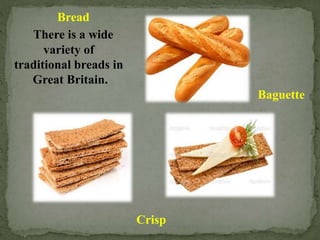
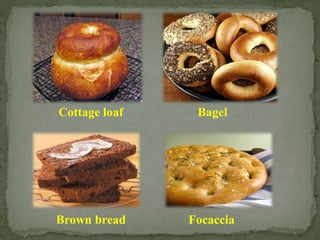
Bread
There is a wide
variety of
traditional breads in
Great Britain.
Crisp
Baguette
BagelCottage loaf
Brown bread Focaccia
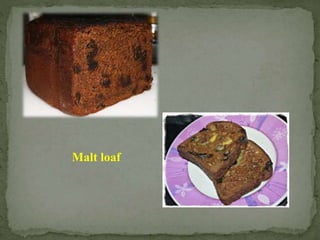
Malt loaf
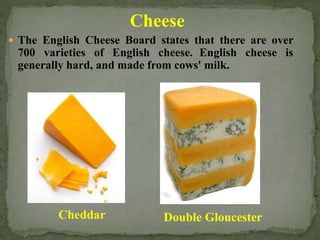
Cheese
 The English Cheese Board states that there are over
700 varieties of English cheese. English cheese is
generally hard, and made from cows' milk.
Cheddar Double Gloucester
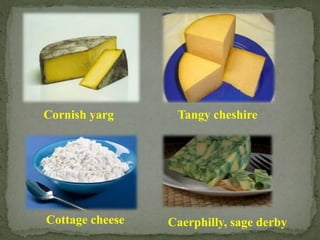
Cottage cheese
Tangy cheshireCornish yarg
Caerphilly, sage derby
Fish and seafood
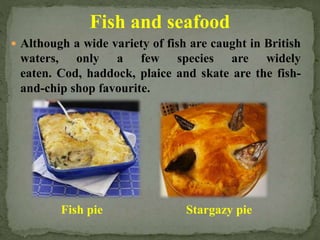
 Although a wide variety of fish are caught in British
waters, only a few species are widely
eaten. Cod, haddock, plaice and skate are the fish-
and-chip shop favourite.
Stargazy pieFish pie
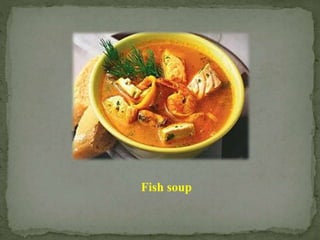
Fish soup
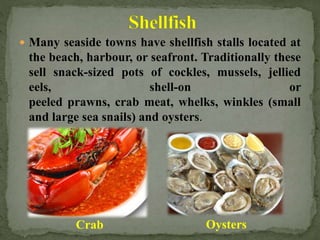
 Many seaside towns have shellfish stalls located at
the beach, harbour, or seafront. Traditionally these
sell snack-sized pots of cockles, mussels, jellied
eels, shell-on or
peeled prawns, crab meat, whelks, winkles (small
and large sea snails) and oysters.
Crab Oysters
Pies, pastries and savoury
puddings
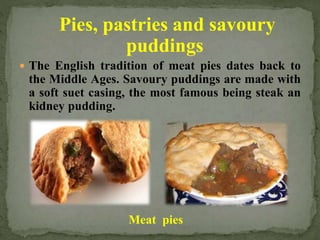
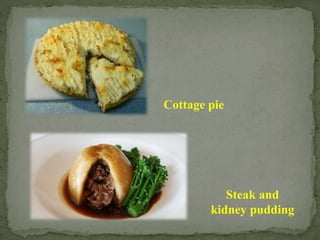
 The English tradition of meat pies dates back to
the Middle Ages. Savoury puddings are made with
a soft suet casing, the most famous being steak an
kidney pudding.
Meat pies
Cottage pie
Steak and
kidney pudding
Sausages
 English sausages are colloquially known as
"bangers".
 They are distinctive in that they are usually made
from fresh meats and rarely smoked, dried, or
strongly flavoured.
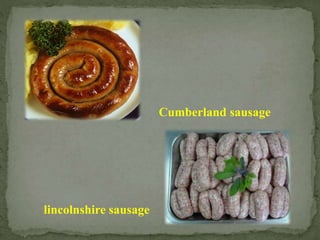
 England will stock at least a dozen types of English
sausage: not only Cumberland and Lincolnshire
but often varieties such as pork and apple, pork
and herb; pork and mozzarella, and others. There
are estimated to be around 400 sausage varieties in
the United Kingdom.
Cumberland sausage
lincolnshire sausage
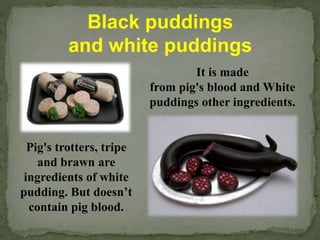
Black puddings
and white puddings
It is made
from pig's blood and White
puddings other ingredients.
Pig's trotters, tripe
and brawn are
ingredients of white
pudding. But doesn’t
contain pig blood.
Sandwiches
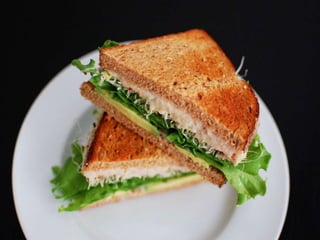
 England can claim to have given the world
the word "sandwich", although the
eponymous John Montagu, 4th Earl of
Sandwich was not the first to add a filling to bread.
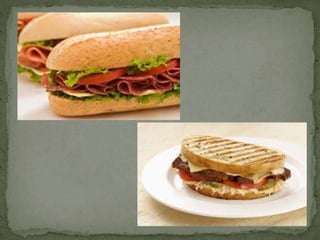
 English sandwiches are made with two slices of
bread, or some kind of roll.
 Common types of sandwich are roast beef, chicken
salad, ham and mustard, cheese and pickle,
egg mayonnaise, prawn mayonnaise, tuna and jam.
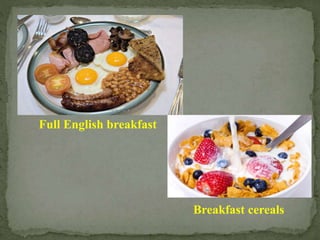
 A light breakfast might consist of breakfast
cereal, muesli, boiled or scrambled eggs, toast and
conserves or sometimes poached kippers.
 In the 18th and 19th centuries, the upper classes ate
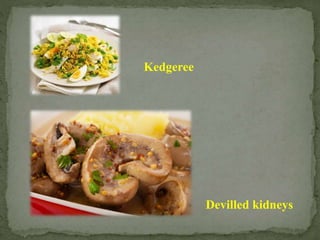
elaborate breakfasts including such dishes as kedgeree
and devilled kidneys.
 Now, the substantial breakfast is the full English
breakfast. A traditional full English breakfast includes
bacon, fried or scrambled eggs, fried or grilled
tomatoes, fried mushrooms, fried bread or toast with
butter, sausages and black pudding, usually served
with a mug of tea.
Kedgeree
Devilled kidneys
Full English breakfast
Breakfast cereals
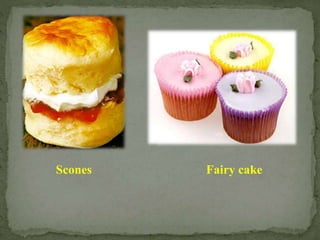
 Afternoon tea may
include scones with jam and clotted
cream (together known as a cream tea).
 There are also fairy cakes, simple small sponge
cakes which can be iced or eaten plain.
Nationwide, assorted biscuits and sandwiches are
eaten.
Scones Fairy cake
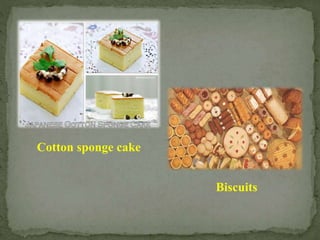
Cotton sponge cake
Biscuits
 The Sunday roast was once the most common feature
of English cooking. It is traditionally eaten every
Sunday.
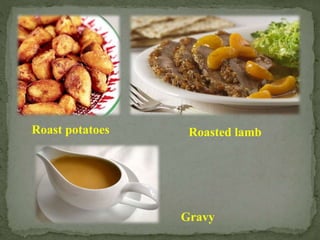
 It includes roast potatoes accompanying a roasted joint
of meat such as beef, lamb, pork, duck or chicken and
assorted other vegetables, themselves generally boiled
and served with a gravy or roasted with the meat in its
juices, which are then used as or added to the gravy.
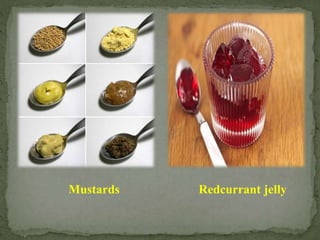
 Sauces and jellies are chosen depending on the type of
meat: horseradish or various mustards for beef, mint
sauce or redcurrant jelly for lamb, apple sauce for
pork and cranberry sauce for turkey.
Roast potatoes Roasted lamb
Gravy
Mustards Redcurrant jelly
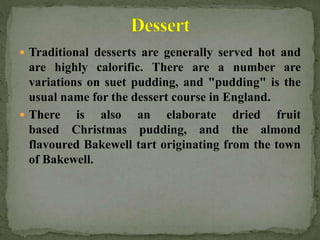
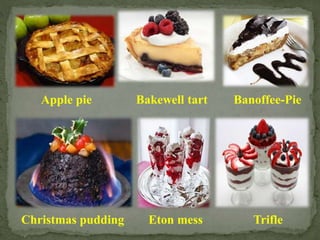
 Traditional desserts are generally served hot and
are highly calorific. There are a number are
variations on suet pudding, and "pudding" is the
usual name for the dessert course in England.
 There is also an elaborate dried fruit
based Christmas pudding, and the almond
flavoured Bakewell tart originating from the town
of Bakewell.
Apple pie Bakewell tart Banoffee-Pie
Christmas pudding Eton mess Trifle
 Catherine of Braganza, Portuguese wife of Charles
II, took the Portuguese habit of tea to Great
Britain around 1660, subsequent to the
introduction of coffee. Initially, its expense
restricted it to wealthy consumers, but the price
gradually dropped, until the 19th century, when
tea became as widely consumed as it is today.
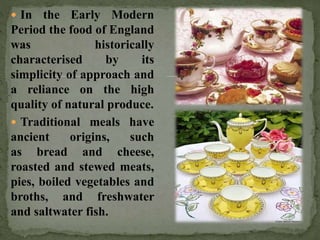
 Strong tea served with lots of milk and sometimes
two teaspoons of sugar, usually in a mug.
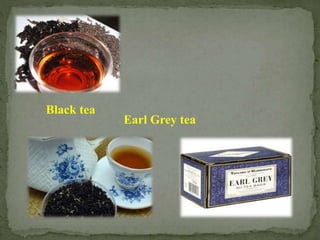
 Earl Grey tea is a distinctive variation flavoured
with Bergamot. In recent years, tisanes and
speciality teas have also become popular.
Black tea
Earl Grey tea
 Introduced in the 17th century, coffee quickly
became highly popular by the 18th century.
 The coffee houses of London were important
literary, commercial and political meeting-places.
 Coffee is now perhaps a little less popular than in
continental Europe, but is still drunk by many in
both its instant and percolated forms, often with
milk (but rarely with cream).
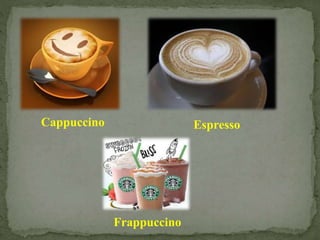
Cappuccino Espresso
Frappuccino
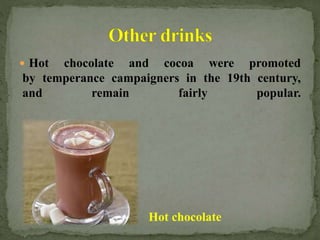
 Hot chocolate and cocoa were promoted
by temperance campaigners in the 19th century,
and remain fairly popular.
Hot chocolate
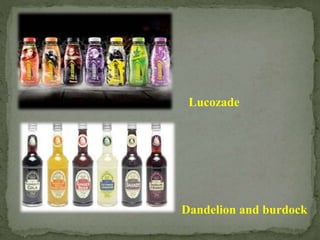
 Dandelion and burdock was originally a lightly
fermented beverage similar to root beer. Later
versions were more artificially made and alcohol
free.
 Tizer and Lucozade are British carbonated
drinks, the latter marketed as an energy drink.
.
Lucozade
Dandelion and burdock
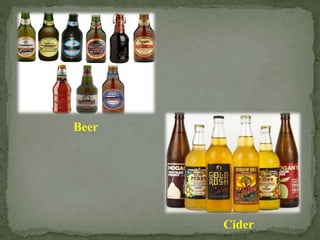
 England is one of the few countries where cask
conditioned beer is still a major part of the market.
 In Britain, "cider" always means an alcoholic
drink of fermented apple juice and is served by the
pint or half pint like beer.
Beer
Cider
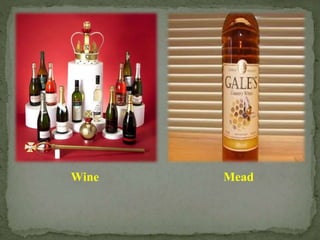
 Wine often accompanies formal meals.
 By the late, 20th century wines from around the
world were available to the mass market.
 Mead, fermented honey, was popular in the Middle
Ages, but is now a curiosity.
Wine Mead
Cuisine

Cuisine

  • 2.
     English cuisineencompasses the cooking styles, traditions and recipes associated with England.  It has distinctive attributes of its own, but also shares much with wider British cuisine, largely due to the importation of ingredients and ideas from places such as North America, China, and India during the time of the British Empire and as a result of post-war immigration.
  • 3.
     In theEarly Modern Period the food of England was historically characterised by its simplicity of approach and a reliance on the high quality of natural produce.  Traditional meals have ancient origins, such as bread and cheese, roasted and stewed meats, pies, boiled vegetables and broths, and freshwater and saltwater fish.
  • 4.
    Bread There is awide variety of traditional breads in Great Britain. Crisp Baguette
  • 5.
  • 6.
  • 7.
    Cheese  The EnglishCheese Board states that there are over 700 varieties of English cheese. English cheese is generally hard, and made from cows' milk. Cheddar Double Gloucester
  • 8.
    Cottage cheese Tangy cheshireCornishyarg Caerphilly, sage derby
  • 9.
    Fish and seafood Although a wide variety of fish are caught in British waters, only a few species are widely eaten. Cod, haddock, plaice and skate are the fish- and-chip shop favourite. Stargazy pieFish pie
  • 10.
  • 11.
     Many seasidetowns have shellfish stalls located at the beach, harbour, or seafront. Traditionally these sell snack-sized pots of cockles, mussels, jellied eels, shell-on or peeled prawns, crab meat, whelks, winkles (small and large sea snails) and oysters. Crab Oysters
  • 12.
    Pies, pastries andsavoury puddings  The English tradition of meat pies dates back to the Middle Ages. Savoury puddings are made with a soft suet casing, the most famous being steak an kidney pudding. Meat pies
  • 13.
  • 14.
    Sausages  English sausagesare colloquially known as "bangers".  They are distinctive in that they are usually made from fresh meats and rarely smoked, dried, or strongly flavoured.  England will stock at least a dozen types of English sausage: not only Cumberland and Lincolnshire but often varieties such as pork and apple, pork and herb; pork and mozzarella, and others. There are estimated to be around 400 sausage varieties in the United Kingdom.
  • 15.
  • 16.
    Black puddings and whitepuddings It is made from pig's blood and White puddings other ingredients. Pig's trotters, tripe and brawn are ingredients of white pudding. But doesn’t contain pig blood.
  • 17.
    Sandwiches  England canclaim to have given the world the word "sandwich", although the eponymous John Montagu, 4th Earl of Sandwich was not the first to add a filling to bread.  English sandwiches are made with two slices of bread, or some kind of roll.  Common types of sandwich are roast beef, chicken salad, ham and mustard, cheese and pickle, egg mayonnaise, prawn mayonnaise, tuna and jam.
  • 20.
     A lightbreakfast might consist of breakfast cereal, muesli, boiled or scrambled eggs, toast and conserves or sometimes poached kippers.  In the 18th and 19th centuries, the upper classes ate elaborate breakfasts including such dishes as kedgeree and devilled kidneys.  Now, the substantial breakfast is the full English breakfast. A traditional full English breakfast includes bacon, fried or scrambled eggs, fried or grilled tomatoes, fried mushrooms, fried bread or toast with butter, sausages and black pudding, usually served with a mug of tea.
  • 21.
  • 22.
  • 23.
     Afternoon teamay include scones with jam and clotted cream (together known as a cream tea).  There are also fairy cakes, simple small sponge cakes which can be iced or eaten plain. Nationwide, assorted biscuits and sandwiches are eaten.
  • 24.
  • 25.
  • 26.
     The Sundayroast was once the most common feature of English cooking. It is traditionally eaten every Sunday.  It includes roast potatoes accompanying a roasted joint of meat such as beef, lamb, pork, duck or chicken and assorted other vegetables, themselves generally boiled and served with a gravy or roasted with the meat in its juices, which are then used as or added to the gravy.  Sauces and jellies are chosen depending on the type of meat: horseradish or various mustards for beef, mint sauce or redcurrant jelly for lamb, apple sauce for pork and cranberry sauce for turkey.
  • 27.
  • 28.
  • 29.
     Traditional dessertsare generally served hot and are highly calorific. There are a number are variations on suet pudding, and "pudding" is the usual name for the dessert course in England.  There is also an elaborate dried fruit based Christmas pudding, and the almond flavoured Bakewell tart originating from the town of Bakewell.
  • 30.
    Apple pie Bakewelltart Banoffee-Pie Christmas pudding Eton mess Trifle
  • 31.
     Catherine ofBraganza, Portuguese wife of Charles II, took the Portuguese habit of tea to Great Britain around 1660, subsequent to the introduction of coffee. Initially, its expense restricted it to wealthy consumers, but the price gradually dropped, until the 19th century, when tea became as widely consumed as it is today.  Strong tea served with lots of milk and sometimes two teaspoons of sugar, usually in a mug.  Earl Grey tea is a distinctive variation flavoured with Bergamot. In recent years, tisanes and speciality teas have also become popular.
  • 32.
  • 33.
     Introduced inthe 17th century, coffee quickly became highly popular by the 18th century.  The coffee houses of London were important literary, commercial and political meeting-places.  Coffee is now perhaps a little less popular than in continental Europe, but is still drunk by many in both its instant and percolated forms, often with milk (but rarely with cream).
  • 34.
  • 35.
     Hot chocolateand cocoa were promoted by temperance campaigners in the 19th century, and remain fairly popular. Hot chocolate
  • 36.
     Dandelion andburdock was originally a lightly fermented beverage similar to root beer. Later versions were more artificially made and alcohol free.  Tizer and Lucozade are British carbonated drinks, the latter marketed as an energy drink. .
  • 37.
  • 38.
     England isone of the few countries where cask conditioned beer is still a major part of the market.  In Britain, "cider" always means an alcoholic drink of fermented apple juice and is served by the pint or half pint like beer.
  • 39.
  • 40.
     Wine oftenaccompanies formal meals.  By the late, 20th century wines from around the world were available to the mass market.  Mead, fermented honey, was popular in the Middle Ages, but is now a curiosity.
  • 41.