History of British Food
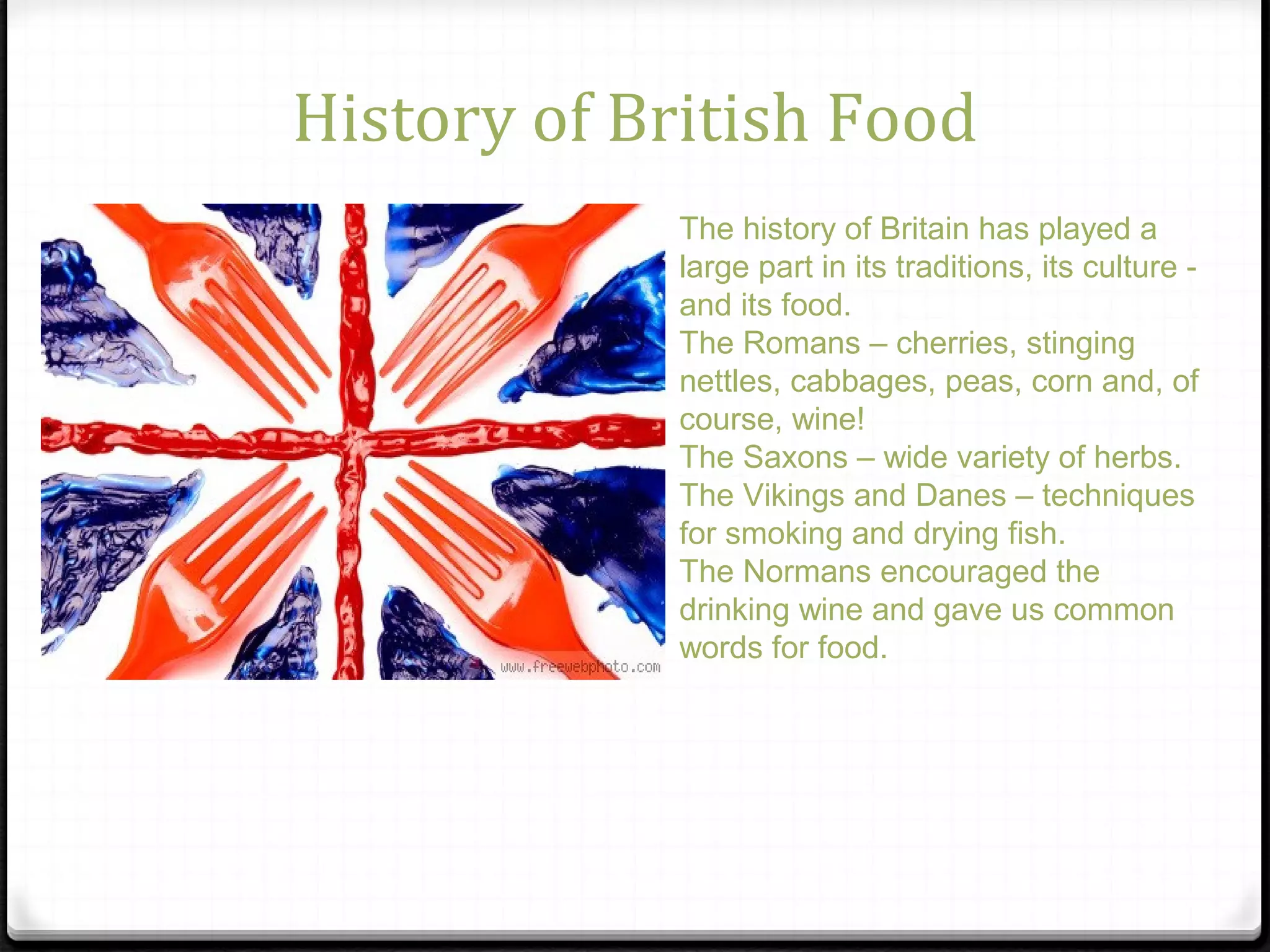
The history of Britain has played a
large part in its traditions, its culture -
and its food.
The Romans – cherries, stinging
nettles, cabbages, peas, corn and, of
course, wine!
The Saxons – wide variety of herbs.
The Vikings and Danes – techniques
for smoking and drying fish.
The Normans encouraged the
drinking wine and gave us common
words for food.
History of British Food&Drinks
The most popular drink in England is
undoubtedly tea, and you can't leave the British Isles
without experiencing the genuine five o'clock.
"There are few hours in life more
agreeable than the hour dedicated to
the ceremony known as afternoon tea."
Henry James
History of British Food&Drinks
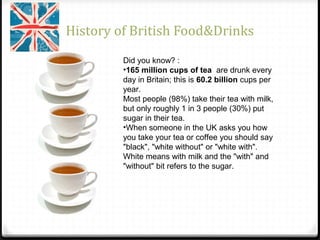
Did you know? :
•165 million cups of tea are drunk every
day in Britain; this is 60.2 billion cups per
year.
Most people (98%) take their tea with milk,
but only roughly 1 in 3 people (30%) put
sugar in their tea.
•When someone in the UK asks you how
you take your tea or coffee you should say
"black", "white without" or "white with".
White means with milk and the "with" and
"without" bit refers to the sugar.
History of British Food&Drinks
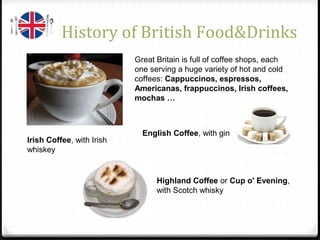
English Coffee, with gin
Highland Coffee or Cup o' Evening,
with Scotch whisky
Great Britain is full of coffee shops, each
one serving a huge variety of hot and cold
coffees: Cappuccinos, espressos,
Americanas, frappuccinos, Irish coffees,
mochas …
Irish Coffee, with Irish
whiskey
History of British Food&Drinks
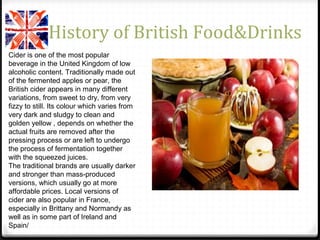
Cider is one of the most popular
beverage in the United Kingdom of low
alcoholic content. Traditionally made out
of the fermented apples or pear, the
British cider appears in many different
variations, from sweet to dry, from very
fizzy to still. Its colour which varies from
very dark and sludgy to clean and
golden yellow , depends on whether the
actual fruits are removed after the
pressing process or are left to undergo
the process of fermentation together
with the squeezed juices.
The traditional brands are usually darker
and stronger than mass-produced
versions, which usually go at more
affordable prices. Local versions of
cider are also popular in France,
especially in Brittany and Normandy as
well as in some part of Ireland and
Spain/
History of British
Food&Drinks
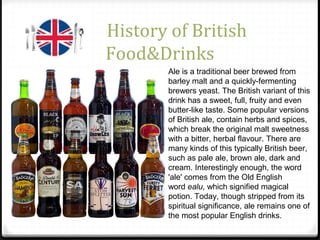
Ale is a traditional beer brewed from
barley malt and a quickly-fermenting
brewers yeast. The British variant of this
drink has a sweet, full, fruity and even
butter-like taste. Some popular versions
of British ale, contain herbs and spices,
which break the original malt sweetness
with a bitter, herbal flavour. There are
many kinds of this typically British beer,
such as pale ale, brown ale, dark and
cream. Interestingly enough, the word
'ale' comes from the Old English
word ealu, which signified magical
potion. Today, though stripped from its
spiritual significance, ale remains one of
the most popular English drinks.
History of British Food&Drinks
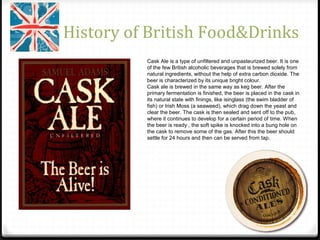
Cask Ale is a type of unfiltered and unpasteurized beer. It is one
of the few British alcoholic beverages that is brewed solely from
natural ingredients, without the help of extra carbon dioxide. The
beer is characterized by its unique bright colour.
Cask ale is brewed in the same way as keg beer. After the
primary fermentation is finished, the beer is placed in the cask in
its natural state with finings, like isinglass (the swim bladder of
fish) or Irish Moss (a seaweed), which drag down the yeast and
clear the beer. The cask is then sealed and sent off to the pub,
where it continues to develop for a certain period of time. When
the beer is ready , the soft spike is knocked into a bung hole on
the cask to remove some of the gas. After this the beer should
settle for 24 hours and then can be served from tap.
History of British Food&Drinks
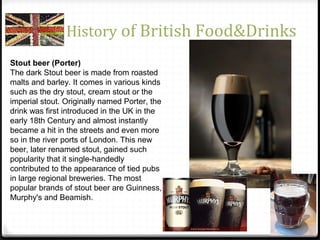
Stout beer (Porter)
The dark Stout beer is made from roasted
malts and barley. It comes in various kinds
such as the dry stout, cream stout or the
imperial stout. Originally named Porter, the
drink was first introduced in the UK in the
early 18th Century and almost instantly
became a hit in the streets and even more
so in the river ports of London. This new
beer, later renamed stout, gained such
popularity that it single-handedly
contributed to the appearance of tied pubs
in large regional breweries. The most
popular brands of stout beer are Guinness,
Murphy's and Beamish.
History of British Food&Drinks
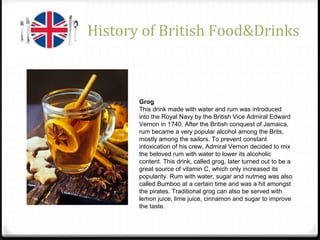
Grog
This drink made with water and rum was introduced
into the Royal Navy by the British Vice Admiral Edward
Vernon in 1740. After the British conquest of Jamaica,
rum became a very popular alcohol among the Brits,
mostly among the sailors. To prevent constant
intoxication of his crew, Admiral Vernon decided to mix
the beloved rum with water to lower its alcoholic
content. This drink, called grog, later turned out to be a
great source of vitamin C, which only increased its
popularity. Rum with water, sugar and nutmeg was also
called Bumboo at a certain time and was a hit amongst
the pirates. Traditional grog can also be served with
lemon juice, lime juice, cinnamon and sugar to improve
the taste.
History of British
Food&Drinks
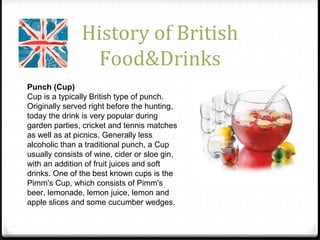
Punch (Cup)
Cup is a typically British type of punch.
Originally served right before the hunting,
today the drink is very popular during
garden parties, cricket and tennis matches
as well as at picnics. Generally less
alcoholic than a traditional punch, a Cup
usually consists of wine, cider or sloe gin,
with an addition of fruit juices and soft
drinks. One of the best known cups is the
Pimm's Cup, which consists of Pimm's
beer, lemonade, lemon juice, lemon and
apple slices and some cucumber wedges.
History of British Food&Drinks
Thank you
for attention!

Food and drink gb

  • 1.
    History of BritishFood The history of Britain has played a large part in its traditions, its culture - and its food. The Romans – cherries, stinging nettles, cabbages, peas, corn and, of course, wine! The Saxons – wide variety of herbs. The Vikings and Danes – techniques for smoking and drying fish. The Normans encouraged the drinking wine and gave us common words for food.
  • 2.
    History of BritishFood&Drinks The most popular drink in England is undoubtedly tea, and you can't leave the British Isles without experiencing the genuine five o'clock. "There are few hours in life more agreeable than the hour dedicated to the ceremony known as afternoon tea." Henry James
  • 3.
    History of BritishFood&Drinks Did you know? : •165 million cups of tea are drunk every day in Britain; this is 60.2 billion cups per year. Most people (98%) take their tea with milk, but only roughly 1 in 3 people (30%) put sugar in their tea. •When someone in the UK asks you how you take your tea or coffee you should say "black", "white without" or "white with". White means with milk and the "with" and "without" bit refers to the sugar.
  • 4.
    History of BritishFood&Drinks English Coffee, with gin Highland Coffee or Cup o' Evening, with Scotch whisky Great Britain is full of coffee shops, each one serving a huge variety of hot and cold coffees: Cappuccinos, espressos, Americanas, frappuccinos, Irish coffees, mochas … Irish Coffee, with Irish whiskey
  • 5.
    History of BritishFood&Drinks
  • 6.
    History of BritishFood&Drinks Cider is one of the most popular beverage in the United Kingdom of low alcoholic content. Traditionally made out of the fermented apples or pear, the British cider appears in many different variations, from sweet to dry, from very fizzy to still. Its colour which varies from very dark and sludgy to clean and golden yellow , depends on whether the actual fruits are removed after the pressing process or are left to undergo the process of fermentation together with the squeezed juices. The traditional brands are usually darker and stronger than mass-produced versions, which usually go at more affordable prices. Local versions of cider are also popular in France, especially in Brittany and Normandy as well as in some part of Ireland and Spain/
  • 7.
    History of British Food&Drinks Aleis a traditional beer brewed from barley malt and a quickly-fermenting brewers yeast. The British variant of this drink has a sweet, full, fruity and even butter-like taste. Some popular versions of British ale, contain herbs and spices, which break the original malt sweetness with a bitter, herbal flavour. There are many kinds of this typically British beer, such as pale ale, brown ale, dark and cream. Interestingly enough, the word 'ale' comes from the Old English word ealu, which signified magical potion. Today, though stripped from its spiritual significance, ale remains one of the most popular English drinks.
  • 8.
    History of BritishFood&Drinks Cask Ale is a type of unfiltered and unpasteurized beer. It is one of the few British alcoholic beverages that is brewed solely from natural ingredients, without the help of extra carbon dioxide. The beer is characterized by its unique bright colour. Cask ale is brewed in the same way as keg beer. After the primary fermentation is finished, the beer is placed in the cask in its natural state with finings, like isinglass (the swim bladder of fish) or Irish Moss (a seaweed), which drag down the yeast and clear the beer. The cask is then sealed and sent off to the pub, where it continues to develop for a certain period of time. When the beer is ready , the soft spike is knocked into a bung hole on the cask to remove some of the gas. After this the beer should settle for 24 hours and then can be served from tap.
  • 9.
    History of BritishFood&Drinks Stout beer (Porter) The dark Stout beer is made from roasted malts and barley. It comes in various kinds such as the dry stout, cream stout or the imperial stout. Originally named Porter, the drink was first introduced in the UK in the early 18th Century and almost instantly became a hit in the streets and even more so in the river ports of London. This new beer, later renamed stout, gained such popularity that it single-handedly contributed to the appearance of tied pubs in large regional breweries. The most popular brands of stout beer are Guinness, Murphy's and Beamish.
  • 10.
    History of BritishFood&Drinks Grog This drink made with water and rum was introduced into the Royal Navy by the British Vice Admiral Edward Vernon in 1740. After the British conquest of Jamaica, rum became a very popular alcohol among the Brits, mostly among the sailors. To prevent constant intoxication of his crew, Admiral Vernon decided to mix the beloved rum with water to lower its alcoholic content. This drink, called grog, later turned out to be a great source of vitamin C, which only increased its popularity. Rum with water, sugar and nutmeg was also called Bumboo at a certain time and was a hit amongst the pirates. Traditional grog can also be served with lemon juice, lime juice, cinnamon and sugar to improve the taste.
  • 11.
    History of British Food&Drinks Punch(Cup) Cup is a typically British type of punch. Originally served right before the hunting, today the drink is very popular during garden parties, cricket and tennis matches as well as at picnics. Generally less alcoholic than a traditional punch, a Cup usually consists of wine, cider or sloe gin, with an addition of fruit juices and soft drinks. One of the best known cups is the Pimm's Cup, which consists of Pimm's beer, lemonade, lemon juice, lemon and apple slices and some cucumber wedges.
  • 12.
    History of BritishFood&Drinks Thank you for attention!