Used to
solia
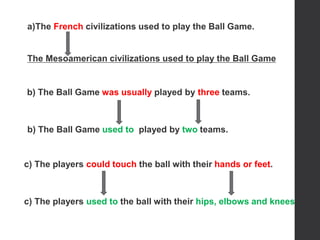
a)The French civilizations used to play the Ball Game.
The Mesoamerican civilizations used to play the Ball Game
b) The Ball Game used to played by two teams.
c) The players could touch the ball with their hands or feet.
b) The Ball Game was usually played by three teams.
c) The players used to the ball with their hips, elbows and knees
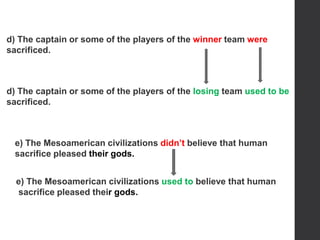
d) The captain or some of the players of the winner team were
sacrificed.
e) The Mesoamerican civilizations didn’t believe that human
sacrifice pleased their gods.
d) The captain or some of the players of the losing team used to be
sacrificed.
e) The Mesoamerican civilizations used to believe that human
sacrifice pleased their gods.
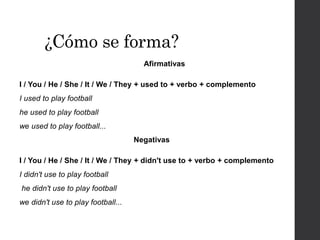
¿Cómo se forma?
Afirmativas
I / You / He / She / It / We / They + used to + verbo + complemento
I used to play football
he used to play football
we used to play football...
Negativas
I / You / He / She / It / We / They + didn't use to + verbo + complemento
I didn't use to play football
he didn't use to play football
we didn't use to play football...
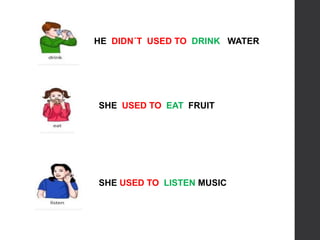
HE DIDN´T USED TO DRINK WATER
SHE USED TO EAT FRUIT
SHE USED TO LISTEN MUSIC
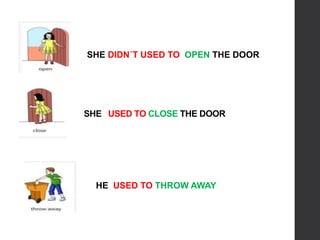
SHE USED TO CLOSE THE DOOR
SHE DIDN´T USED TO OPEN THE DOOR
HE USED TO THROW AWAY
El uso de 'did' para
preguntas en el pasado
simple
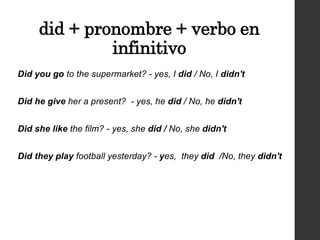
did + pronombre + verbo en
infinitivo
Did you go to the supermarket? - yes, I did / No, I didn't
Did he give her a present? - yes, he did / No, he didn't
Did she like the film? - yes, she did / No, she didn't
Did they play football yesterday? - yes, they did /No, they didn't
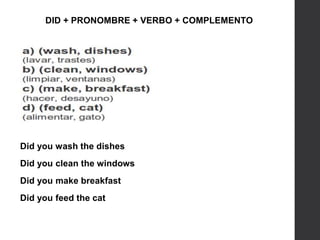
Did you wash the dishes
Did you clean the windows
Did you make breakfast
Did you feed the cat
DID + PRONOMBRE + VERBO + COMPLEMENTO
REGLAS PARA LOS
VERBOS REGULARES EN
INGLÉS
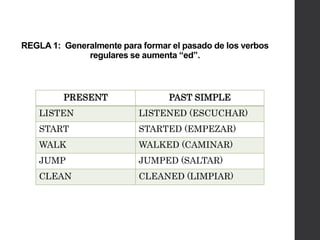
REGLA 1: Generalmente para formar el pasado de los verbos
regulares se aumenta “ed”.
PRESENT PAST SIMPLE
LISTEN LISTENED (ESCUCHAR)
START STARTED (EMPEZAR)
WALK WALKED (CAMINAR)
JUMP JUMPED (SALTAR)
CLEAN CLEANED (LIMPIAR)
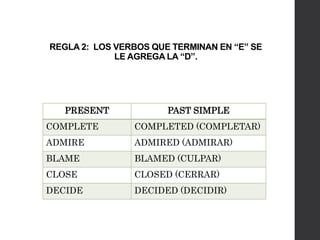
REGLA 2: LOS VERBOS QUE TERMINAN EN “E” SE
LE AGREGA LA “D”.
PRESENT PAST SIMPLE
COMPLETE COMPLETED (COMPLETAR)
ADMIRE ADMIRED (ADMIRAR)
BLAME BLAMED (CULPAR)
CLOSE CLOSED (CERRAR)
DECIDE DECIDED (DECIDIR)
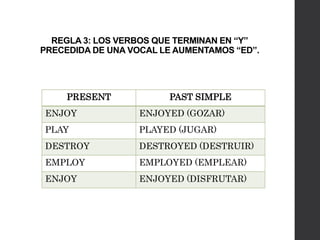
REGLA 3: LOS VERBOS QUE TERMINAN EN “Y”
PRECEDIDA DE UNA VOCAL LE AUMENTAMOS “ED”.
PRESENT PAST SIMPLE
ENJOY ENJOYED (GOZAR)
PLAY PLAYED (JUGAR)
DESTROY DESTROYED (DESTRUIR)
EMPLOY EMPLOYED (EMPLEAR)
ENJOY ENJOYED (DISFRUTAR)
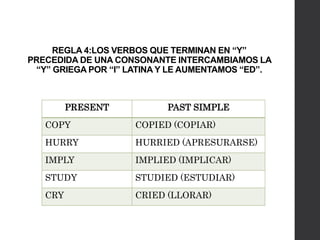
REGLA 4:LOS VERBOS QUE TERMINAN EN “Y”
PRECEDIDA DE UNA CONSONANTE INTERCAMBIAMOS LA
“Y” GRIEGA POR “I” LATINA Y LE AUMENTAMOS “ED”.
PRESENT PAST SIMPLE
COPY COPIED (COPIAR)
HURRY HURRIED (APRESURARSE)
IMPLY IMPLIED (IMPLICAR)
STUDY STUDIED (ESTUDIAR)
CRY CRIED (LLORAR)
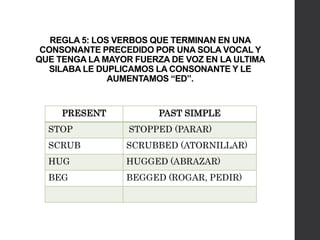
REGLA 5: LOS VERBOS QUE TERMINAN EN UNA
CONSONANTE PRECEDIDO POR UNA SOLA VOCAL Y
QUE TENGA LA MAYOR FUERZA DE VOZ EN LA ULTIMA
SILABA LE DUPLICAMOS LA CONSONANTE Y LE
AUMENTAMOS “ED”.
PRESENT PAST SIMPLE
STOP STOPPED (PARAR)
SCRUB SCRUBBED (ATORNILLAR)
HUG HUGGED (ABRAZAR)
BEG BEGGED (ROGAR, PEDIR)
VERBOS
IRREGULARES EN
PASADO SIMPLE
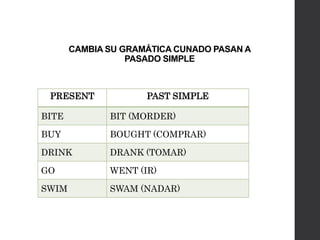
CAMBIA SU GRAMÁTICA CUNADO PASAN A
PASADO SIMPLE
PRESENT PAST SIMPLE
BITE BIT (MORDER)
BUY BOUGHT (COMPRAR)
DRINK DRANK (TOMAR)
GO WENT (IR)
SWIM SWAM (NADAR)
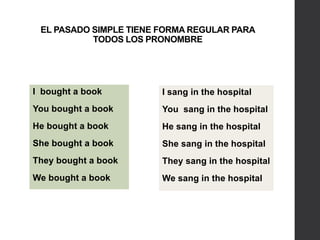
EL PASADO SIMPLE TIENE FORMA REGULAR PARA
TODOS LOS PRONOMBRE
I bought a book
You bought a book
He bought a book
She bought a book
They bought a book
We bought a book
I sang in the hospital
You sang in the hospital
He sang in the hospital
She sang in the hospital
They sang in the hospital
We sang in the hospital
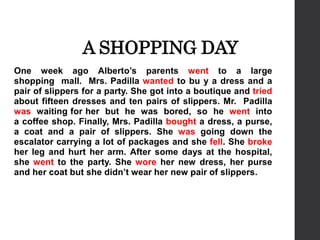
A SHOPPING DAY
One week ago Alberto’s parents went to a large
shopping mall. Mrs. Padilla wanted to bu y a dress and a
pair of slippers for a party. She got into a boutique and tried
about fifteen dresses and ten pairs of slippers. Mr. Padilla
was waiting for her but he was bored, so he went into
a coffee shop. Finally, Mrs. Padilla bought a dress, a purse,
a coat and a pair of slippers. She was going down the
escalator carrying a lot of packages and she fell. She broke
her leg and hurt her arm. After some days at the hospital,
she went to the party. She wore her new dress, her purse
and her coat but she didn’t wear her new pair of slippers.
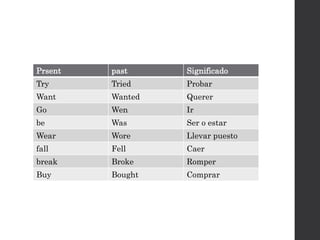
Prsent past Significado
Try Tried Probar
Want Wanted Querer
Go Wen Ir
be Was Ser o estar
Wear Wore Llevar puesto
fall Fell Caer
break Broke Romper
Buy Bought Comprar
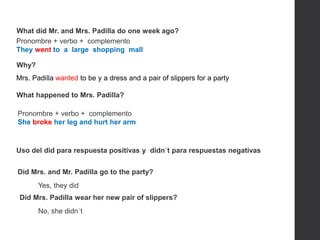
What did Mr. and Mrs. Padilla do one week ago?
Why?
What happened to Mrs. Padilla?
Did Mrs. and Mr. Padilla go to the party?
Did Mrs. Padilla wear her new pair of slippers?
Uso del did para respuesta positivas y didn´t para respuestas negativas
Pronombre + verbo + complemento
They went to a large shopping mall
Pronombre + verbo + complemento
She broke her leg and hurt her arm
Yes, they did
Mrs. Padilla wanted to be y a dress and a pair of slippers for a party
No, she didn´t
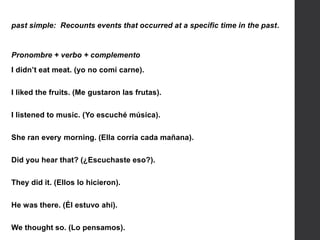
past simple: Recounts events that occurred at a specific time in the past.
Pronombre + verbo + complemento
I didn’t eat meat. (yo no comí carne).
I liked the fruits. (Me gustaron las frutas).
I listened to music. (Yo escuché música).
She ran every morning. (Ella corría cada mañana).
Did you hear that? (¿Escuchaste eso?).
They did it. (Ellos lo hicieron).
He was there. (Él estuvo ahí).
We thought so. (Lo pensamos).
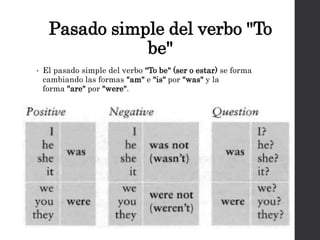
Pasado simple del verbo "To
be"
• El pasado simple del verbo "To be" (ser o estar) se forma
cambiando las formas "am" e "is“ por "was" y la
forma "are" por "were".
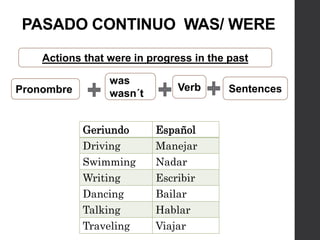
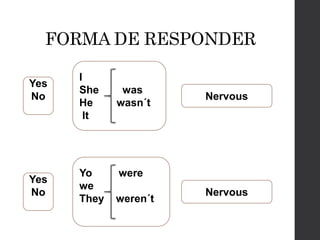
PASADO CONTINUO WAS/ WERE
was
wasn´t
Verb SentencesPronombre
Geriundo Español
Driving Manejar
Swimming Nadar
Writing Escribir
Dancing Bailar
Talking Hablar
Traveling Viajar
Actions that were in progress in the past
Yes
No
I
She was
He wasn´t
It
Nervous
FORMA DE RESPONDER
Yes
No
Yo were
we
They weren´t
Nervous
He was walking to work when he fell.
[SUJETO] + was/were + [VERBO con terminación -ing (gerundio)]
Estructura para formar oraciones en pasado
continuo
Paula wasn't living in Spain in 2005.
We were still working at 10 o'clock last night.
My son was reading while I was cooking
They were talking very loudly while we were trying to
watch the movie.
Estructura para formar oraciones en pasado
simple
[SUJETO] + was/were + [VERBO en past tense + complemento
They were jumped in the park
I was sang in the home
Adriana was slept in the classroom
Carmela was swept the street
We were talked about the movie
When = cuando
[SUJETO] + was/were + [VERBO (gerundio)]+ when+ complemento
+ verbo en pasado simple (past tense)
we were running in the classroom when Maria fell
jorge was doing homework when arturo broke a glass
we were shopping at the supermarket when they raided
carlos was dancing when his mom arrived home
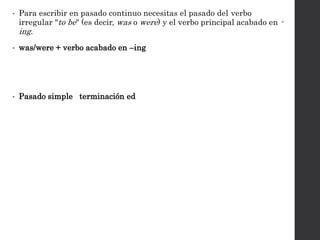
• Para escribir en pasado continuo necesitas el pasado del verbo
irregular "to be" (es decir, was o were) y el verbo principal acabado en -
ing.
• was/were + verbo acabado en –ing
• Pasado simple terminación ed
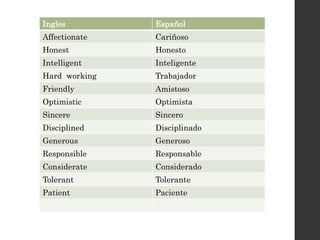
Ingles Español
Affectionate Cariñoso
Honest Honesto
Intelligent Inteligente
Hard working Trabajador
Friendly Amistoso
Optimistic Optimista
Sincere Sincero
Disciplined Disciplinado
Generous Generoso
Responsible Responsable
Considerate Considerado
Tolerant Tolerante
Patient Paciente
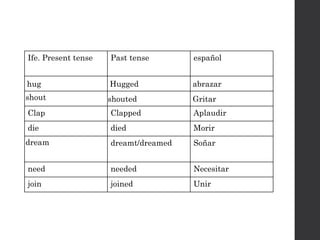
Ife. Present tense Past tense español
hug Hugged abrazar
shout shouted Gritar
Clap Clapped Aplaudir
die died Morir
dream dreamt/dreamed Soñar
need needed Necesitar
join joined Unir
PROHIBICIONES
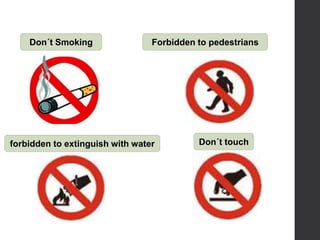
Don´t Smoking Forbidden to pedestrians
forbidden to extinguish with water Don´t touch
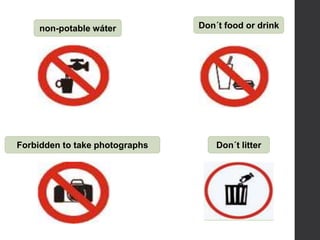
Forbidden to take photographs
non-potable wáter Don´t food or drink
Don´t litter
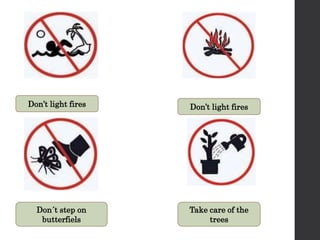
Don’t light fires
Don´t step on
butterfiels
Take care of the
trees
Don’t light fires
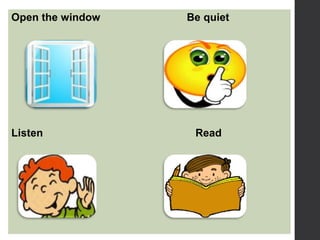
Open the window Be quiet
Listen Read
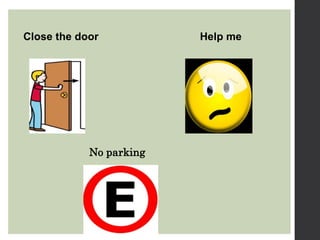
Close the door Help me
No parking
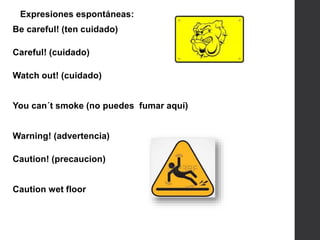
Expresiones espontáneas:
Be careful! (ten cuidado)
Careful! (cuidado)
Watch out! (cuidado)
You can´t smoke (no puedes fumar aquí)
Warning! (advertencia)
Caution! (precaucion)
Caution wet floor
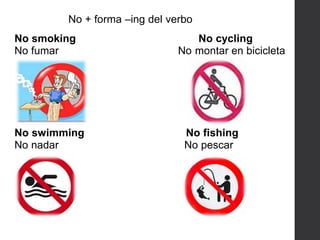
No + forma –ing del verbo
No smoking No cycling
No fumar No montar en bicicleta
No swimming No fishing
No nadar No pescar
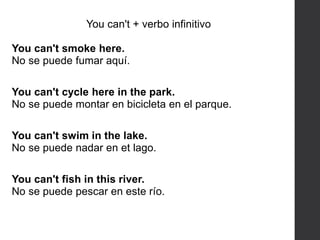
You can't + verbo infinitivo
You can't smoke here.
No se puede fumar aquí.
You can't cycle here in the park.
No se puede montar en bicicleta en el parque.
You can't swim in the lake.
No se puede nadar en et lago.
You can't fish in this river.
No se puede pescar en este río.
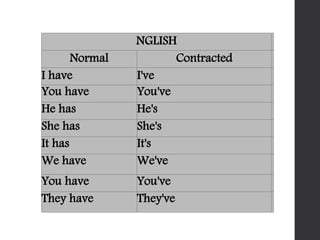
[SUJETO] + have/has + [PARTICIPIO DEL VERBO]
NGLISH
Normal Contracted
I have I've
You have You've
He has He's
She has She's
It has It's
We have We've
You have You've
They have They've
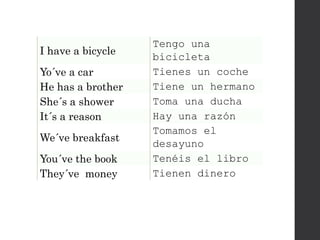
I have a bicycle
Tengo una
bicicleta
Yo´ve a car Tienes un coche
He has a brother Tiene un hermano
She´s a shower Toma una ducha
It´s a reason Hay una razón
We´ve breakfast
Tomamos el
desayuno
You´ve the book Tenéis el libro
They´ve money Tienen dinero
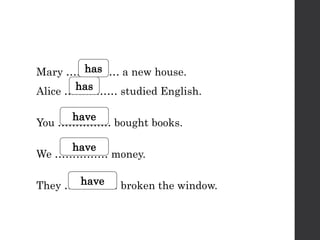
Mary …………… a new house.
Alice …………… studied English.
You …………… bought books.
We …………… money.
They …………… broken the window.
have
has
has
have
have
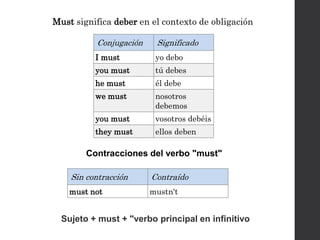
Must significa deber en el contexto de obligación
Conjugación Significado
I must yo debo
you must tú debes
he must él debe
we must nosotros
debemos
you must vosotros debéis
they must ellos deben
Contracciones del verbo "must"
Sin contracción Contraído
must not mustn't
Sujeto + must + "verbo principal en infinitivo
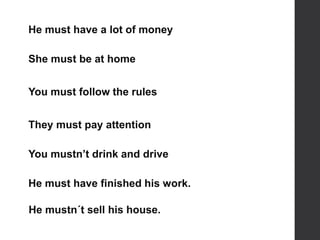
He must have a lot of money
She must be at home
You must follow the rules
They must pay attention
You mustn’t drink and drive
He must have finished his work.
He mustn´t sell his house.
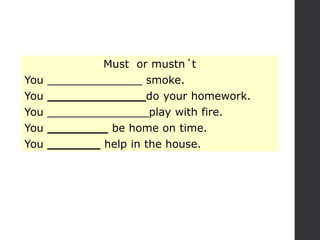
Must or mustn´t
You ______________ smoke.
You _____________do your homework.
You _______________play with fire.
You ________ be home on time.
You _______ help in the house.
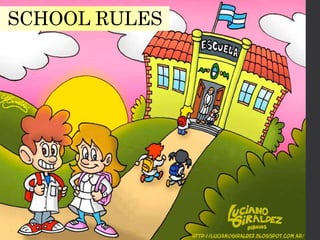
SCHOOL RULES
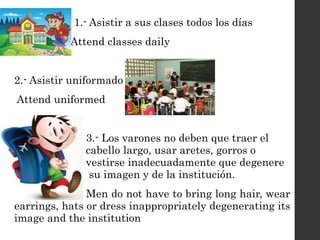
1.- Asistir a sus clases todos los días
Attend classes daily
2.- Asistir uniformado
Attend uniformed
3.- Los varones no deben que traer el
. cabello largo, usar aretes, gorros o .
. vestirse inadecuadamente que degenere
. su imagen y de la institución.
Men do not have to bring long hair, wear
earrings, hats or dress inappropriately degenerating its
image and the institution
4.- Las alumnas no deberán traer el pelo teñido
Women should not bring dyed hair
5.- Queda prohibido consumir cigarrillos y cualquier
otro tipo de enervantes que dañen la imagen del centro
escolar
It is forbidden to consume cigarettes and other types of
narcotics which damage the image of the school
6.- Mantener el orden y disciplina dentro
de las aulas
To maintain order and discipline in the
classroom
7.- Cumplir con las tareas e investigaciones
encomendadas por sus maestros
Comply with homework and research
entrusted by their teachers
8 .- Conservar y cuidar el edificio escolar
Preserve and protect the school building
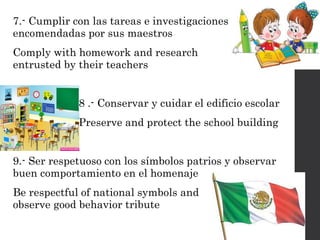
9.- Ser respetuoso con los símbolos patrios y observar
buen comportamiento en el homenaje
Be respectful of national symbols and
observe good behavior tribute
10.- Todo alumno deberá presentarse a recoger su
boleta de calificaciones acompañado de su padre o
tutor
Every student will have to get his grades slip
accompanied his father or guardian
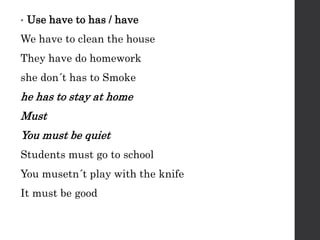
• Use have to has / have
We have to clean the house
They have do homework
she don´t has to Smoke
he has to stay at home
Must
You must be quiet
Students must go to school
You musetn´t play with the knife
It must be good
If my smile like an
ornament for
Christmas has it,
if my hand is will help
you both,
if my heart brings you
happiness is all yours.
Merry Christmas!
The best gift you can receive this
Christmas and what I have ... you.
Merry Christmas!
Make your life a dream
And your dream a reality
Happy New Year!
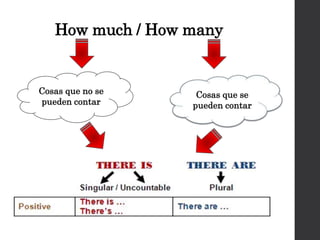
How much / How many
Cosas que se
pueden contar
Cosas que no se
pueden contar
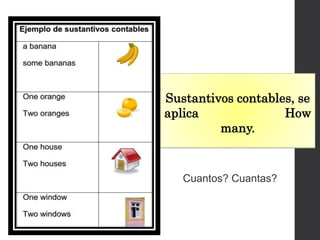
Sustantivos contables, se
aplica How
many.
Cuantos? Cuantas?
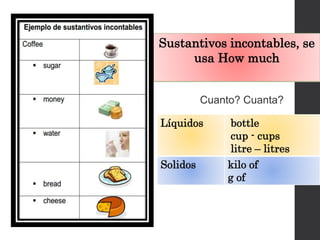
Sustantivos incontables, se
usa How much
Líquidos bottle
cup - cups
litre – litres
Solidos kilo of
g of
Cuanto? Cuanta?
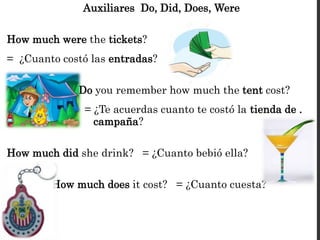
Auxiliares Do, Did, Does, Were
How much were the tickets?
= ¿Cuanto costó las entradas?
Do you remember how much the tent cost?
= ¿Te acuerdas cuanto te costó la tienda de .
. campaña?
How much did she drink? = ¿Cuanto bebió ella?
How much does it cost? = ¿Cuanto cuesta?
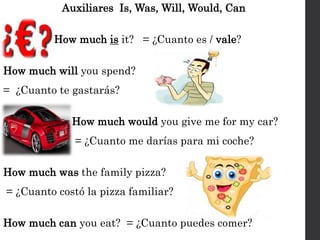
Auxiliares Is, Was, Will, Would, Can
How much is it? = ¿Cuanto es / vale?
How much will you spend?
= ¿Cuanto te gastarás?
How much would you give me for my car?
= ¿Cuanto me darías para mi coche?
How much was the family pizza?
= ¿Cuanto costó la pizza familiar?
How much can you eat? = ¿Cuanto puedes comer?
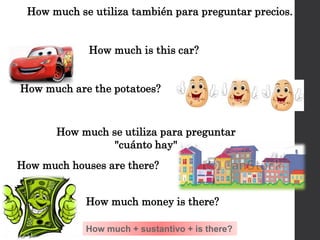
How much se utiliza también para preguntar precios.
How much is this car?
How much are the potatoes?
How much se utiliza para preguntar
"cuánto hay"
How much houses are there?
How much money is there?
How much + sustantivo + is there?
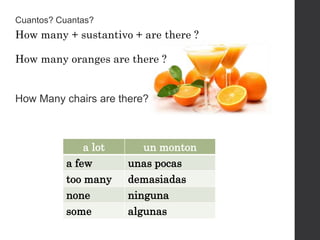
How many + sustantivo + are there ?
How many oranges are there ?
a lot un monton
a few unas pocas
too many demasiadas
none ninguna
some algunas
Cuantos? Cuantas?
How Many chairs are there?
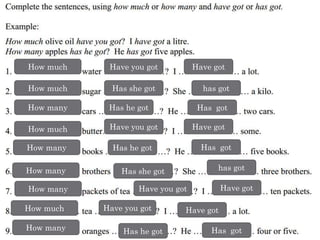
How much Have you got Have got
How much
How much
How much
How many
How many
How many
How many
How many
Has she got has got
Has he got
Have you got Have got
Has got
Has he got Has got
has gotHas she got
Have you got
Have you got
Have got
Have got
Has he got Has got
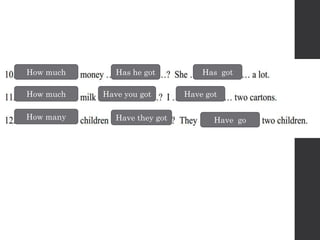
How much Has he got Has got
How much Have you got Have got
How many Have they got Have go
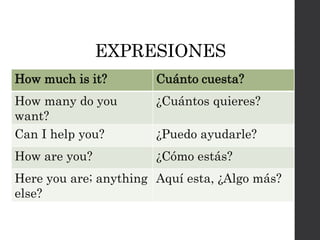
EXPRESIONES
How much is it? Cuánto cuesta?
How many do you
want?
¿Cuántos quieres?
Can I help you? ¿Puedo ayudarle?
How are you? ¿Cómo estás?
Here you are; anything
else?
Aquí esta, ¿Algo más?
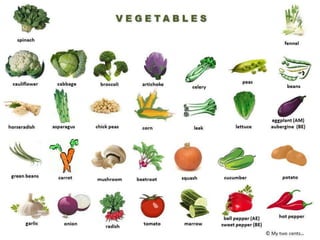
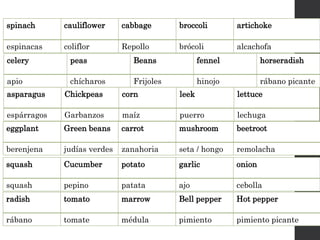
spinach cauliflower cabbage broccoli artichoke
espinacas coliflor Repollo brócoli alcachofa
celery peas Beans fennel horseradish
apio chícharos Frijoles hinojo rábano picante
asparagus Chickpeas corn leek lettuce
espárragos Garbanzos maíz puerro lechuga
eggplant Green beans carrot mushroom beetroot
berenjena judías verdes zanahoria seta / hongo remolacha
squash Cucumber potato garlic onion
squash pepino patata ajo cebolla
radish tomato marrow Bell pepper Hot pepper
rábano tomate médula pimiento pimiento picante
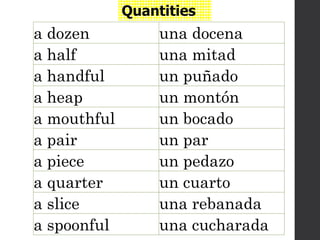
a dozen una docena
a half una mitad
a handful un puñado
a heap un montón
a mouthful un bocado
a pair un par
a piece un pedazo
a quarter un cuarto
a slice una rebanada
a spoonful una cucharada
Quantities
Used to
Used to

Used to

  • 1.
  • 2.
    a)The French civilizationsused to play the Ball Game. The Mesoamerican civilizations used to play the Ball Game b) The Ball Game used to played by two teams. c) The players could touch the ball with their hands or feet. b) The Ball Game was usually played by three teams. c) The players used to the ball with their hips, elbows and knees
  • 3.
    d) The captainor some of the players of the winner team were sacrificed. e) The Mesoamerican civilizations didn’t believe that human sacrifice pleased their gods. d) The captain or some of the players of the losing team used to be sacrificed. e) The Mesoamerican civilizations used to believe that human sacrifice pleased their gods.
  • 4.
    ¿Cómo se forma? Afirmativas I/ You / He / She / It / We / They + used to + verbo + complemento I used to play football he used to play football we used to play football... Negativas I / You / He / She / It / We / They + didn't use to + verbo + complemento I didn't use to play football he didn't use to play football we didn't use to play football...
  • 5.
    HE DIDN´T USEDTO DRINK WATER SHE USED TO EAT FRUIT SHE USED TO LISTEN MUSIC
  • 6.
    SHE USED TOCLOSE THE DOOR SHE DIDN´T USED TO OPEN THE DOOR HE USED TO THROW AWAY
  • 7.
    El uso de'did' para preguntas en el pasado simple
  • 8.
    did + pronombre+ verbo en infinitivo Did you go to the supermarket? - yes, I did / No, I didn't Did he give her a present? - yes, he did / No, he didn't Did she like the film? - yes, she did / No, she didn't Did they play football yesterday? - yes, they did /No, they didn't
  • 9.
    Did you washthe dishes Did you clean the windows Did you make breakfast Did you feed the cat DID + PRONOMBRE + VERBO + COMPLEMENTO
  • 10.
    REGLAS PARA LOS VERBOSREGULARES EN INGLÉS
  • 11.
    REGLA 1: Generalmentepara formar el pasado de los verbos regulares se aumenta “ed”. PRESENT PAST SIMPLE LISTEN LISTENED (ESCUCHAR) START STARTED (EMPEZAR) WALK WALKED (CAMINAR) JUMP JUMPED (SALTAR) CLEAN CLEANED (LIMPIAR)
  • 12.
    REGLA 2: LOSVERBOS QUE TERMINAN EN “E” SE LE AGREGA LA “D”. PRESENT PAST SIMPLE COMPLETE COMPLETED (COMPLETAR) ADMIRE ADMIRED (ADMIRAR) BLAME BLAMED (CULPAR) CLOSE CLOSED (CERRAR) DECIDE DECIDED (DECIDIR)
  • 13.
    REGLA 3: LOSVERBOS QUE TERMINAN EN “Y” PRECEDIDA DE UNA VOCAL LE AUMENTAMOS “ED”. PRESENT PAST SIMPLE ENJOY ENJOYED (GOZAR) PLAY PLAYED (JUGAR) DESTROY DESTROYED (DESTRUIR) EMPLOY EMPLOYED (EMPLEAR) ENJOY ENJOYED (DISFRUTAR)
  • 14.
    REGLA 4:LOS VERBOSQUE TERMINAN EN “Y” PRECEDIDA DE UNA CONSONANTE INTERCAMBIAMOS LA “Y” GRIEGA POR “I” LATINA Y LE AUMENTAMOS “ED”. PRESENT PAST SIMPLE COPY COPIED (COPIAR) HURRY HURRIED (APRESURARSE) IMPLY IMPLIED (IMPLICAR) STUDY STUDIED (ESTUDIAR) CRY CRIED (LLORAR)
  • 15.
    REGLA 5: LOSVERBOS QUE TERMINAN EN UNA CONSONANTE PRECEDIDO POR UNA SOLA VOCAL Y QUE TENGA LA MAYOR FUERZA DE VOZ EN LA ULTIMA SILABA LE DUPLICAMOS LA CONSONANTE Y LE AUMENTAMOS “ED”. PRESENT PAST SIMPLE STOP STOPPED (PARAR) SCRUB SCRUBBED (ATORNILLAR) HUG HUGGED (ABRAZAR) BEG BEGGED (ROGAR, PEDIR)
  • 16.
  • 17.
    CAMBIA SU GRAMÁTICACUNADO PASAN A PASADO SIMPLE PRESENT PAST SIMPLE BITE BIT (MORDER) BUY BOUGHT (COMPRAR) DRINK DRANK (TOMAR) GO WENT (IR) SWIM SWAM (NADAR)
  • 18.
    EL PASADO SIMPLETIENE FORMA REGULAR PARA TODOS LOS PRONOMBRE I bought a book You bought a book He bought a book She bought a book They bought a book We bought a book I sang in the hospital You sang in the hospital He sang in the hospital She sang in the hospital They sang in the hospital We sang in the hospital
  • 19.
    A SHOPPING DAY Oneweek ago Alberto’s parents went to a large shopping mall. Mrs. Padilla wanted to bu y a dress and a pair of slippers for a party. She got into a boutique and tried about fifteen dresses and ten pairs of slippers. Mr. Padilla was waiting for her but he was bored, so he went into a coffee shop. Finally, Mrs. Padilla bought a dress, a purse, a coat and a pair of slippers. She was going down the escalator carrying a lot of packages and she fell. She broke her leg and hurt her arm. After some days at the hospital, she went to the party. She wore her new dress, her purse and her coat but she didn’t wear her new pair of slippers.
  • 20.
    Prsent past Significado TryTried Probar Want Wanted Querer Go Wen Ir be Was Ser o estar Wear Wore Llevar puesto fall Fell Caer break Broke Romper Buy Bought Comprar
  • 21.
    What did Mr.and Mrs. Padilla do one week ago? Why? What happened to Mrs. Padilla? Did Mrs. and Mr. Padilla go to the party? Did Mrs. Padilla wear her new pair of slippers? Uso del did para respuesta positivas y didn´t para respuestas negativas Pronombre + verbo + complemento They went to a large shopping mall Pronombre + verbo + complemento She broke her leg and hurt her arm Yes, they did Mrs. Padilla wanted to be y a dress and a pair of slippers for a party No, she didn´t
  • 22.
    past simple: Recountsevents that occurred at a specific time in the past. Pronombre + verbo + complemento I didn’t eat meat. (yo no comí carne). I liked the fruits. (Me gustaron las frutas). I listened to music. (Yo escuché música). She ran every morning. (Ella corría cada mañana). Did you hear that? (¿Escuchaste eso?). They did it. (Ellos lo hicieron). He was there. (Él estuvo ahí). We thought so. (Lo pensamos).
  • 23.
    Pasado simple delverbo "To be" • El pasado simple del verbo "To be" (ser o estar) se forma cambiando las formas "am" e "is“ por "was" y la forma "are" por "were".
  • 24.
    PASADO CONTINUO WAS/WERE was wasn´t Verb SentencesPronombre Geriundo Español Driving Manejar Swimming Nadar Writing Escribir Dancing Bailar Talking Hablar Traveling Viajar Actions that were in progress in the past
  • 25.
    Yes No I She was He wasn´t It Nervous FORMADE RESPONDER Yes No Yo were we They weren´t Nervous
  • 26.
    He was walkingto work when he fell. [SUJETO] + was/were + [VERBO con terminación -ing (gerundio)] Estructura para formar oraciones en pasado continuo Paula wasn't living in Spain in 2005. We were still working at 10 o'clock last night. My son was reading while I was cooking They were talking very loudly while we were trying to watch the movie.
  • 27.
    Estructura para formaroraciones en pasado simple [SUJETO] + was/were + [VERBO en past tense + complemento They were jumped in the park I was sang in the home Adriana was slept in the classroom Carmela was swept the street We were talked about the movie
  • 28.
    When = cuando [SUJETO]+ was/were + [VERBO (gerundio)]+ when+ complemento + verbo en pasado simple (past tense) we were running in the classroom when Maria fell jorge was doing homework when arturo broke a glass we were shopping at the supermarket when they raided carlos was dancing when his mom arrived home
  • 29.
    • Para escribiren pasado continuo necesitas el pasado del verbo irregular "to be" (es decir, was o were) y el verbo principal acabado en - ing. • was/were + verbo acabado en –ing • Pasado simple terminación ed
  • 30.
    Ingles Español Affectionate Cariñoso HonestHonesto Intelligent Inteligente Hard working Trabajador Friendly Amistoso Optimistic Optimista Sincere Sincero Disciplined Disciplinado Generous Generoso Responsible Responsable Considerate Considerado Tolerant Tolerante Patient Paciente
  • 31.
    Ife. Present tensePast tense español hug Hugged abrazar shout shouted Gritar Clap Clapped Aplaudir die died Morir dream dreamt/dreamed Soñar need needed Necesitar join joined Unir
  • 32.
  • 33.
    Don´t Smoking Forbiddento pedestrians forbidden to extinguish with water Don´t touch
  • 34.
    Forbidden to takephotographs non-potable wáter Don´t food or drink Don´t litter
  • 35.
    Don’t light fires Don´tstep on butterfiels Take care of the trees Don’t light fires
  • 36.
    Open the windowBe quiet Listen Read
  • 37.
    Close the doorHelp me No parking
  • 38.
    Expresiones espontáneas: Be careful!(ten cuidado) Careful! (cuidado) Watch out! (cuidado) You can´t smoke (no puedes fumar aquí) Warning! (advertencia) Caution! (precaucion) Caution wet floor
  • 39.
    No + forma–ing del verbo No smoking No cycling No fumar No montar en bicicleta No swimming No fishing No nadar No pescar
  • 40.
    You can't +verbo infinitivo You can't smoke here. No se puede fumar aquí. You can't cycle here in the park. No se puede montar en bicicleta en el parque. You can't swim in the lake. No se puede nadar en et lago. You can't fish in this river. No se puede pescar en este río.
  • 41.
    [SUJETO] + have/has+ [PARTICIPIO DEL VERBO]
  • 42.
    NGLISH Normal Contracted I haveI've You have You've He has He's She has She's It has It's We have We've You have You've They have They've
  • 43.
    I have abicycle Tengo una bicicleta Yo´ve a car Tienes un coche He has a brother Tiene un hermano She´s a shower Toma una ducha It´s a reason Hay una razón We´ve breakfast Tomamos el desayuno You´ve the book Tenéis el libro They´ve money Tienen dinero
  • 44.
    Mary …………… anew house. Alice …………… studied English. You …………… bought books. We …………… money. They …………… broken the window. have has has have have
  • 45.
    Must significa deberen el contexto de obligación Conjugación Significado I must yo debo you must tú debes he must él debe we must nosotros debemos you must vosotros debéis they must ellos deben Contracciones del verbo "must" Sin contracción Contraído must not mustn't Sujeto + must + "verbo principal en infinitivo
  • 46.
    He must havea lot of money She must be at home You must follow the rules They must pay attention You mustn’t drink and drive He must have finished his work. He mustn´t sell his house.
  • 47.
    Must or mustn´t You______________ smoke. You _____________do your homework. You _______________play with fire. You ________ be home on time. You _______ help in the house.
  • 48.
  • 49.
    1.- Asistir asus clases todos los días Attend classes daily 2.- Asistir uniformado Attend uniformed 3.- Los varones no deben que traer el . cabello largo, usar aretes, gorros o . . vestirse inadecuadamente que degenere . su imagen y de la institución. Men do not have to bring long hair, wear earrings, hats or dress inappropriately degenerating its image and the institution
  • 50.
    4.- Las alumnasno deberán traer el pelo teñido Women should not bring dyed hair 5.- Queda prohibido consumir cigarrillos y cualquier otro tipo de enervantes que dañen la imagen del centro escolar It is forbidden to consume cigarettes and other types of narcotics which damage the image of the school 6.- Mantener el orden y disciplina dentro de las aulas To maintain order and discipline in the classroom
  • 51.
    7.- Cumplir conlas tareas e investigaciones encomendadas por sus maestros Comply with homework and research entrusted by their teachers 8 .- Conservar y cuidar el edificio escolar Preserve and protect the school building 9.- Ser respetuoso con los símbolos patrios y observar buen comportamiento en el homenaje Be respectful of national symbols and observe good behavior tribute
  • 52.
    10.- Todo alumnodeberá presentarse a recoger su boleta de calificaciones acompañado de su padre o tutor Every student will have to get his grades slip accompanied his father or guardian
  • 53.
    • Use haveto has / have We have to clean the house They have do homework she don´t has to Smoke he has to stay at home Must You must be quiet Students must go to school You musetn´t play with the knife It must be good
  • 54.
    If my smilelike an ornament for Christmas has it, if my hand is will help you both, if my heart brings you happiness is all yours. Merry Christmas!
  • 55.
    The best giftyou can receive this Christmas and what I have ... you. Merry Christmas!
  • 56.
    Make your lifea dream And your dream a reality Happy New Year!
  • 57.
    How much /How many Cosas que se pueden contar Cosas que no se pueden contar
  • 58.
    Sustantivos contables, se aplicaHow many. Cuantos? Cuantas?
  • 59.
    Sustantivos incontables, se usaHow much Líquidos bottle cup - cups litre – litres Solidos kilo of g of Cuanto? Cuanta?
  • 60.
    Auxiliares Do, Did,Does, Were How much were the tickets? = ¿Cuanto costó las entradas? Do you remember how much the tent cost? = ¿Te acuerdas cuanto te costó la tienda de . . campaña? How much did she drink? = ¿Cuanto bebió ella? How much does it cost? = ¿Cuanto cuesta?
  • 61.
    Auxiliares Is, Was,Will, Would, Can How much is it? = ¿Cuanto es / vale? How much will you spend? = ¿Cuanto te gastarás? How much would you give me for my car? = ¿Cuanto me darías para mi coche? How much was the family pizza? = ¿Cuanto costó la pizza familiar? How much can you eat? = ¿Cuanto puedes comer?
  • 62.
    How much seutiliza también para preguntar precios. How much is this car? How much are the potatoes? How much se utiliza para preguntar "cuánto hay" How much houses are there? How much money is there? How much + sustantivo + is there?
  • 63.
    How many +sustantivo + are there ? How many oranges are there ? a lot un monton a few unas pocas too many demasiadas none ninguna some algunas Cuantos? Cuantas? How Many chairs are there?
  • 64.
    How much Haveyou got Have got How much How much How much How many How many How many How many How many Has she got has got Has he got Have you got Have got Has got Has he got Has got has gotHas she got Have you got Have you got Have got Have got Has he got Has got
  • 65.
    How much Hashe got Has got How much Have you got Have got How many Have they got Have go
  • 66.
    EXPRESIONES How much isit? Cuánto cuesta? How many do you want? ¿Cuántos quieres? Can I help you? ¿Puedo ayudarle? How are you? ¿Cómo estás? Here you are; anything else? Aquí esta, ¿Algo más?
  • 69.
    spinach cauliflower cabbagebroccoli artichoke espinacas coliflor Repollo brócoli alcachofa celery peas Beans fennel horseradish apio chícharos Frijoles hinojo rábano picante asparagus Chickpeas corn leek lettuce espárragos Garbanzos maíz puerro lechuga eggplant Green beans carrot mushroom beetroot berenjena judías verdes zanahoria seta / hongo remolacha squash Cucumber potato garlic onion squash pepino patata ajo cebolla radish tomato marrow Bell pepper Hot pepper rábano tomate médula pimiento pimiento picante
  • 70.
    a dozen unadocena a half una mitad a handful un puñado a heap un montón a mouthful un bocado a pair un par a piece un pedazo a quarter un cuarto a slice una rebanada a spoonful una cucharada Quantities