i
University of Niš
FACULTY OF PHILOSOPHY
MASTER THESIS
Vladimir Nikolić
ii
University of Niš
FACULTY OF PHILOSOPHY
English department
MA studies
Systemic Functional Grammar
PSEUDO-INTRANSITIVES IN TEFL
(TEACHING ENGLISH AS A FOREIGN
LANGUAGE)
Mentor Student
Tatjana Paunović, PhD Vladimir Nikolić, 69
Niš, 2014
iii
Unfortunately, I never had a significant opportunity to
express my gratitude to my beloved grandmother for
everything she had done for me.
In Memoriam - Dragoslava Nikolić (1929-2014)
iv
CONTENT
ABSTRACT……………………………………………………………………………………1
1. INTRODUCTION…………………………………………………………………….…....3
2. THEORETICAL BACKGROUND.....................................................................................6
2.1. DEFINING TERMS.................................................................................................6
2.1.1. TRANSITIVE AND INTRANSITIVE VERBS………………….…….6
2.1.2. SYSTEMIC FUNCTIONAL GRAMMAR……………………………..6
2.1.3. PSEUDO-INTRANSITIVES....................................................................8
2.2. PREVIOUS RESEARCH......................................................................................12
2.3. TRANSITIVE AND INTRANSITIVE VERBS IN THE ELEMENTARY
SCHOOL CURRICULUM……………………………………………………………….…..18
3. PRESENT STUDY.............................................................................................................22
3.1. THE RESULTS......................................................................................................23
3.1.1. WORK......................................................................................................26
3.1.2. DRIVE......................................................................................................30
3.1.3. GO...........................................................................................................33
3.1.4. EAT..........................................................................................................38
3.1.5. RUN.........................................................................................................41
3.1.6. BREAK.....................................................................................................46
3.1.7. FIND........................................................................................................50
3.1.8. DISAGREE..............................................................................................54
3.1.9. READ.......................................................................................................56
3.1.10. NOMINATE...........................................................................................60
3.1.11 WAKE UP...............................................................................................63
3.1.12. TURN DOWN........................................................................................66
3.1.13. ARRIVE..................................................................................................69
v
3.2. THE SUMMARY OF THE RESULTS OF SAMPLE ANALYSIS......................72
3.3. THE RESULTS OF SENTENCES WITH PSEUDO-INTRANSITIVES.............76
4. CONCLUSION....................................................................................................................77
4.1. LIMITATIONS AND FURTHER RESEARCH...............................................................79
4.2. PEDAGOGICAL IMPLICATIONS..................................................................................79
REFERENCES..........................................................................................................................81
APPENDIX...............................................................................................................................84
1
Abstract
The research aims to explore several questions related to pseudo-intransitive verbs in
English. First, it examines whether, and to what extent, students that learn English as L2 can
recognize and use pseudo-intransitives in sentences in the English language. It investigates
whether students are familiar with the grammar properties of transitive and intransitive
verbs, as well as, if they make a clear difference between transitive and intransitive verbs.
Also, it explores if students know which verbs can be used transitively and which
intransitively. Finally, the research focuses on those verbs that can be used as both – in which
case students are tested on whether they are capable of recognizing pseudo-intransitives.
The theoretical background for conveying this research was provided by Systemic
Functional Grammar, which, unlike traditional grammar, recognizes pseudo-intransitive
verbs. Pseudo-intransitives are often present in everyday written and spoken form of the
English language, however, despite this fact, these verbs are neither being lectured nor
learned in elementary and high schools in Serbia. In this respect, it could be said that
traditional grammar approach is still mostly and widely applied one in elementary and high
schools in Serbia. There are no data of any research which included pseudo-intransitives in
English in Serbia. On the other hand, there are researches which included these verbs as the
topic of an investigation, as well as, the comparisons of pseudo-intransitives in English to
similar grammatical structures in other languages. These studies are presented in the
theoretical part of the paper.
The goal of this paper is, first of all, to present these verbs, and then, to emphasize
that knowing pseudo-intransitives and properties of their usage reflects on the level of
grammar knowledge and composing a sentence that is grammatically correct. The initial
assumption of this research is that students who attend third grade of high school are capable
of determining pseudo-intransitive verbs regarding that they learnt transitive and intransitive
verbs in elementary school. For this purpose, it was necessarily to briefly examine teaching
methods that are used in introducing and presenting transitive and intransitive verbs
according to the curriculum of elementary schools in Serbia. This brief analysis includes the
way transitive and intransitive verbs are introduced, taught, learnt and exercised in
elementary schools in Serbia.
In compliance with our objective, we conducted a survey, by means of a test
distributed to third year students of “Bora Stanković“ high school in Niš. The test results
were quantitatively and qualitatively analysed. The aim of these analyses was testing their
overall knowledge of transitive and intransitive verbs with the emphasis on whether the
students are capable of determining and using pseudo-intransitive verbs in a sentence in the
English language. The test results showed that most respondents successfully recognized
pseudo-intransitives but that they had much more difficulties in using these verbs while
composing their own sentences.
Key words: Systemic Functional Grammar, pseudo-intransitives, transitive and intransitive
verbs, EFL teaching
2
Apstrakt
Ovo istraživanje ima za cilj da utvrdi da li, i u kojoj meri, učenici koji pohađaju
engleski kao strani jezik mogu da prepoznaju i upotrebe pseudo-neprelazne glagole u
rečenicama na engleskom jeziku. Istraživanje ispituje da li su učenici dovoljno dobro
upoznati sa gramatičkim svojstvima prelaznih i neprelaznih glagola, i da li prave jasnu
razliku između prelaznih i neprelaznih glagola, zatim, da li znaju koji se glagoli mogu korsiti
kao neprelazni, a koji kao prelazni glagoli, a koji kao jedno i drugo – čime se ispituje da li
mogu da prepoznaju pseudo-neprelazne glagole.
Teorijski okvir za ovo istraživanje pružila je sistematsko-funkcionalna gramatika. SFG
se za razliku od tradicionalne gramatike, koja se još uvek najšire uči i predaje u osnovnim i
srednjim školama u Srbiji, bavi pseudo-neprelaznim glagolima. Ovi glagoli su često prisutni u
svakodnevnom pisanom i govornom obliku engleskog jezika, međutim i pored te činjenice oni
se ne predaju i ne uče u osnovnim i srednjim školama u Srbiji. Nema podataka o sličnim
istraživanjima koja su uključivala pseudo-neprelazne glagole u engleskom jeziku u Srbiji.
Postoje istraživanja koja su se bavila temom pseudo-neprelaznih glagola i poređenjem ovih
glagola u engleskom sa sličnim gramatičkim strukturama u drugim jezicima. Ove studije
predstavljane su u teorijskom delu rada.
Ovaj rad ima za cilj da najpre prezentuje ove glagole, zatim da istakne da se
poznavanje pseudo-neprelaznih glagola i dobro vladanje ovim glagolima odražava na nivo
gramatičkog znanja i građenja rečenice koja je gramatički ispravna. Osnovna pretpostavka
ovog istraživanja je da učenici koji pohađaju treću godinu srednje škole u Srbiji mogu da
prepoznaju pseudo-neprelazne glagole obzirom na to da su prelazne i neprelazne glagole
učili još u osnovnoj školi. Uzimajući to u obzir, bilo je neophodno ukratko ispitati nastavne
metode pri uvođenju i učenju prelaznih i neprelaznih glagola prema nastavnom planu
osnovnih škola u Srbiji. Ova kratka analiza obuhvata način na koji se prelazni i neprelazni
glagoli prezentuju, uče i vežbaju tokom pohađanja osnovne škole u Srbiji.
U skladu sa ovim ciljevima, izvršeno je istraživanje uz pomoć testa koji je podeljen
đacima koji pohađaju treću godinu srednje škole - gimanzije ,,Bora Stanković“ u Nišu.
Rezultati testa su obrađeni putem kvantitativne i kvalitativne analize. Cilj ovih analiza je bio
da se ispita njihovo vladanje prelaznim i neprelaznim glagolima sa naglaskom na to da li
mogu da prepoznaju i upotrebe pseudo-neprelazne glagole u rečenici na engleskom jeziku.
Rezultati istraživanja pokazali su da su ispitanici uglavnom uspešno prepoznali pseudo-
neprelane glagole, a mnogo više problema imali sa upotrebom ovih glagola u samostalnim
rečenicama.
Ključne reči: sistematsko funkcionalna gramatika, pseudo-neprelazni glagoli, prelazni i
neprelazni glagoli, nastava na engleskom jeziku koji se uči kao strani jezik
3
I INTRODUCTION
“The grammarian’s dream is (and must be, such is
the nature of grammar) of constant territorial expansion.
He would like to turn the whole of linguistic form into
grammar, hoping to show that lexis can be defined as
most delicate grammar”.1
Pseudo-intransitives are relatively new scientific field that belongs to Systemic
Functional Grammar. The term is precisely defined but there is little data relevant to the
subject that can be found in literature and the World Wide Web. The paper aims to explore
existing data about pseudo-intransitive and raise the level of knowledge about these verbs
among EFL students.
Eminent linguists who included pseudo-intransitives in their researches, beside
M.A.K. Halliday, are: Angela Downing, Philip Locke, Cliff Goddard, Gordon H. Tucker,
Diane D. Bornstein, Christian M. I. M. Matthiessen, Clare Painter, John Newman, Peter H.
Matthews, etc. Comparison of pseudo-intransitives in English as a foreign language to
grammatical properties in their mother tongue was conveyed by Iraqi linguist Murtadha J.
Bakir and Japanese linguist Fusa Katada. This paper indicates that pseudo-intransitives are
very important in the process of grammar learning and better understanding of grammatical
rules of a language. Learning pseudo-intransitives implies prior knowledge of transitive and
intransitive verbs. These verbs are introduced on mother tongue form in the sixth grade of
elementary schools in Serbia, but only a year later these verbs are introduced in English form.
Regarding that pseudo-intransitives are similar to transitive and intransitive verbs, learning
pseudo-intransitives is not hard if one knows transitive and intransitive verbs very well. A
segment that is very important for the research is to determine if students that attend third
grade of high schools in Serbia are capable of determining and using transitive and
intransitive verbs. The argument that supports the decision to examine the inclusion and
progress of transitive and intransitive verbs in the curriculum is that the level of knowledge
and usage of pseudo-intransitive verbs much depends from the quality of presenting teaching,
learning and exercising methods of transitive and intransitive verbs. Therefore, a part of the
research includes methods of presenting, learning and exercising transitive and intransitive
verbs primarily in mother tongue, i.e. in Serbian, in the sixth grade and afterwards in English
in the seventh grade of elementary schools in Serbia. The analysis includes curriculum for the
sixth and the seventh grade of elementary schools in Serbia. Lexicon is very important in the
process of learning a language because it shows if a student have mastered previous teaching
material, as well as student’s mastery of the language in general.
Primary motive for conveying the research is to examine whether the students that
learn English as a foreign language, to whom transitive and intransitive verbs were introduced
1
Michael Halliday: Categories of the theory of grammar, Oxford University Press, 1961.
4
years ago, are capable of recognizing pseudo-intransitives in given sentences. Pseudo-
intransitives are not a part of traditional grammar, but a part of Systemic Functional Grammar
(SFG). The basis of SFG was set by eminent linguist, a British-born Australian, Michael
Alexander Kirkwood Halliday (M.A.K. Halliday). These verbs were labeled in literature also
as ambitransitive and labile. In fact, ambitransitive verbs are defined as verbs that can be
intransitive or transitive without requiring a morphological change, i.e. the same verb may or
may not be followed by a direct object. The prefix pseudo is of Greek origin. As the meaning
of the prefix tells itself, it’s about false intransitive verbs, i.e. it’s about verbs that are
transitive but they behave in a sentence as if they are intransitive. For example: the verb to
read is intrinsically transitive, but can also be pseudo-intransitive. The difference between
usage of this verb as transitive and pseudo-intransitive is clearly perceptible in the following
sentences: Susan reads; Susan reads a book. There are not a lot of pseudo-intransitive verbs.
The following verbs are well-known pseudo-intransitives: break, eat, cook, read, steal,
translate, wash, tan, close/shut, fasten, kick and lock.
The research aims to conclude if students in high schools are capable of determining
which verbs are pseudo-intransitives.2
If the results would be positive, the conclusion would
be that students that attend third grade of high schools in Serbia are qualified to learn and
exercise pseudo-intransitives and that would indicate that these verbs should be included in
the curriculum of learning English as a foreign language in elementary and high schools in
Serbia. Literature about pseudo-intransitives that was studied in detail for the purpose of this
research supports this idea. Educationally speaking, the inclusion of pseudo-intransitives in
the curriculum of elementary and high schools would result in increasing comprehension
about grammar properties and it would contribute to the overall knowledge in the area of
grammar.
The conclusion would be that those who learnt and mastered transitive and intransitive
verbs could easily identify pseudo-intransitives if they are informed that pseudo-intransitives
are actually intrinsically transitive verbs that are not followed by an object in a sentence.
Taking this into account, we conducted a survey that examines capability of students that
attend the third grade of high schools in Serbia to identify pseudo-intransitives in given
sentences. The survey was designed especially for this research under the supervision of the
mentor. The test aims to examine students’ ability to recognize and use transitive and
intransitive verbs in a sentence, and finally, their capability of determining pseudo-intransitive
verbs. The results of the test would indicate on defects in some of these segments that occur
during teaching if incorrect answers prevail on the test, or on the contrary, if the correct
answers predominate on the test it would indicate that these verbs can easily be introduced
into curriculum of high schools in Serbia.
Knowing transitive and intransitive verbs reflects mastery of grammatical properties
and methods of constructing a sentence which is grammatically correct, the exploration could
indicate on omissions and mistakes in the process of teaching transitive and intransitive verbs
if incorrect answers on the test overcome correct ones, i.e. if students didn’t master transitive
2
Considering that these students haven't learnt pseudo-intransitives, they were asked to determine if a verb that
is intransitive in a sentence can be transitive as well, and vice versa.
5
and intransitive verbs, or on the other hand, it would enhance the former methods of teaching
these verbs if students in general would solve the test successfully. Regarding that third year
high school students in Serbia have been learning and exercising transitive and intransitive
verbs for years, students are expected to give correct answers and to solve the test
successfully.
This paper emphasis the importance of pseudo-intransitives because although these
verbs are present in everyday speech and when dealing with grammar, they are not present in
the curriculum for learning English as a foreign language in elementary and high schools in
Serbia. The research is based on the material taken from literature that is relevant to pseudo-
intransitives in the English language with a review on methods of introducing, teaching and
exercising transitive and intransitive verbs in the Serbian language in elementary schools in
Serbia.
“If a substance seems complex,
this is because the grammar is complex -
it has to be, to do all the things we make it
to do for us. It does no service to anyone
in the long run if we pretend that semiosis
– the making and understanding of
meaning – is a simpler matter than it
really is.”3
3
Halliday, M. A. K. and Matthiessen, Christian: An Introduction to Functional Grammar: third edition, Hodder
Arnold, 2004, p. 5
6
II THEORETICAL BACKGROUND
2.1. DEFINING TERMS
2.1.1. TRANSITIVE AND INTRANSITIVE VERBS
According to the traditional grammar, verbs are classified into two groups – transitive
and intransitive. Whether a verb is transitive or intransitive depends on if the verb is followed
by a direct object in a sentence. In other words, transitive verbs are the verbs that are
accompanied by a direct object in a sentence while intransitive verbs are the verbs that are not
followed by an object in a sentence. For example:
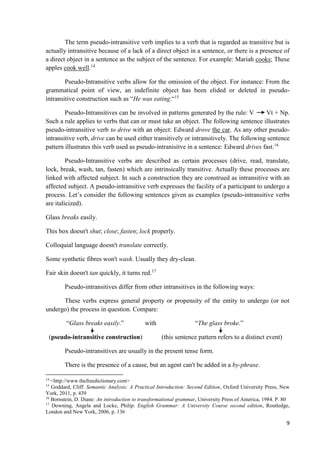
The class starts. intransitive construction
The teacher starts the class. transitive construction
Intransitive verbs express an action that happens by itself and the passive form is
impossible. Compare: “The earthquake happened on July 26, 1963 in Skopje” with “The
earthquake was happened* on July 26, 1963 in Skopje”.
Transitive and intransitive verbs are introduced in mother tongue, i.e. in Serbian, in the
sixth grade curriculum of elementary schools in Serbia. They are introduced in the English
language, which is learned as L2, in the seventh grade.4
These verbs are clearly defined in traditional grammar and the difference between
these two classes of verbs is highly visible and noticeable. But the researches that are done
within SFG concluded that there are verbs that do not strictly belong to one of these two
classes of verbs, but that there are verbs that can be used both transitively and intransitively,
or more precisely, verbs that are intrinsically transitive but can function intransitively as well,
i.e. pseudo-intransitives. Pseudo-intransitives will be discussed further in the research.
2.1.2. SYSTEMIC FUNCTIONAL GRAMMAR
Pseudo-intransitives are not introduced in traditional grammar, but in Systemic
Functional Grammar. Before discussing about pseudo-intransitives, we need to briefly clarify
the definition of Systemic Functional Grammar.
The theory of Systemic Functional Grammar was originally formulated by M.A.K.
Halliday in the early 1960s. Before it was labeled as “systemic grammar”, the theory was
known as “scale and grammar category”. The fuller title is “Systemic Functional Grammar”,
but the abbreviation “SFG” is used for working purposes.5
4
Lompur Vesna: Srpski jezik 6, gramatika, Klett, 2010.
5
Morley, G. David: Syntax in Functional Grammar: An introduction to lexicogrammar in systemic linguistic,
Continuum, London and New York, 2000, p. 2 - 20
7
M.A.K. Halliday based Systemic Functional Grammar by elaborating the works
created by his teacher J. R. Firth and the Prague school (a group of eminent linguists of the
early 20th
century). By exploring the purpose of a language, Halliday came to a conclusion
that text which is a product of written or oral communication refers to a language by means
that a person that speaks that language understands its message.6
The prior focus of Systemic
Functional Grammar is functional description and interpretation of a language, i.e. the usage
of a language. SFG provides useful interpretations of grammatical structures in terms of
different kinds of meaning, and has a well worked out model of language and context.7
Being
inspired by Louis Hjelmslev, Halliday sees text as a process that is defined as a part of system
of transitivity where: subject (noun) is described as participant – actor, agent and patient;
verb as process – action or state; prepositional phrase as circumstance – location; object
(noun) as participant - goal and patient; adjective as attribute – feature; etc.8
Therefore, according to the SFG terms, clauses that possess two participants - actor
and goal - are transitive clauses; and on the other hand, clauses that possess just one
participant - actor - are intransitive ones.9
Those clauses in which “someone does something“
and that are probed by asking “what did x do?“ are considered to be intransitive or middle. On
the contrary, clauses in which “someone does something and the doing involves another
entity“ are transitive. These clauses are probed by asking “what did x do to y?“10
In transitive
clauses, action is performed by an agent that acts deliberately being followed by a patient
who undergoes a change of state, or is affected in a precisely manner.
The verbs that are listed in dictionaries as transitive, such as: “decipher, depress,
stimulate”, are normally followed by direct object Complements (Cdo). Furthermore, verbs
labeled in the dictionary as intransitive tend to occur without an object Complement. There is
a problem if one tries to give a neat account of all this. The problem is that majority of verbs
in English (but not all) appear to be able to function both transitively and intransitively, or in
other words, with or without a Complement. For instance: in the following extract Cdo is
presented in italics in both a and b sentences:
a. […] some nerves stimulate an organ and others depress it;
b. […] some drugs stimulate while others depress.
(as we can see there is no Cdo in the sentence b.)11
6
Halliday M.A.K., Hasan, R.: Cohesion in English, Longman, London, 1976, Chapter 1; Halliday M.A.K:
Spoken and Written Language. Geelong, Vic: Deakin University Press, 1985.
7
Jones, H. Rodney and Lock, Graham: Functional grammar in the EFL classroom, PALGRAVE
MACMILLAN, 2011, P. 7
8
Matthiessen, M. I. M. Christian, Painter, Clare: Working with Functional Grammar: A Workbook, Arnold, 1997
9
Lock, Graham: Functional English Grammar: An introduction for second language teachers, Cambridge
University Press, 1996, p. 74
10
Eggins, Suzanne: An Introduction to Systemic Functional Linguistics: 2nd edition, Continuum, New York –
London, 2004, p. 216
11
Bloor, Thomas and Bloor, Meriel: The Functional Analysis of English: A Hallidayan Approach: second
edition, London: Distributed in United States of America by Oxford University Press Inc., New York, Arnold: A
member of the Hodder Headline Group, 2004, p. 50
8
Transitive and intransitive verbs according to SFG terms in clauses are presented in
the table below12
:
Actor and Process [intransitive] Action optionally extended to a Goal [transitive]
the troops attacked the troops attacked the capital
the guerillas hunted the guerillas hunted the militia
Glen kicked Glen kicked the ball
Advantages of Systemic Functional Grammar over traditional grammar:
- it includes the better part of the scope of linguistic;
- processing of a content includes context of a content as well;
- reliably interpret connection between grammar and experience of reality;
- it simultaneously deals with different linguistic functions; etc.13
Systemic Functional Grammar expands the horizons in terms of grammar of the
English language that was not included in traditional grammar. This scientific field critically
explores and reviews previous data about grammar. Besides determining pseudo-intransitives,
that is the topic of this research, SFG has determined and expanded notions of many other
grammar properties in all fields within traditional grammar. The following subchapter
describes characteristics of pseudo-intransitives.
2.1.3. PSEUDO-INTRANSITIVES
Regarding that these verbs are not the part of traditional grammar and that the majority
of educated people do not know of existence of such verbs, this research explored all existing
definitions and properties about this class of verbs. The aim is to develop a crystal clear
picture about these verbs.
We will start from the term pseudo-intransitives itself. The prefix “pseudo“ in pseudo-
intransitives derives from the Greek language. The actual translation of the Greek word
(ψευδής) is “false, lying, untrue“. It is used to label something that is false, fraudulent, or
pretending to be what is not.
12
J. R. Martin, Cristian M.I.M Matthiessen, Painter Clare, Working with Functional Grammar, Arnold, London,
1997, p. 122
13
Halliday M.A.K., Hasan Ruqaiya: Language, context and text: a social semiotic perspective, Oxford
University Press, USA, 1989; Halliday M.A.K., Matthiessen Christian M.I.M.: Construing Experience through
Meaning: A Language-based Approach to Cognition, Cassell, London, 1999.
9
The term pseudo-intransitive verb implies to a verb that is regarded as transitive but is
actually intransitive because of a lack of a direct object in a sentence, or there is a presence of
a direct object in a sentence as the subject of the sentence. For example: Mariah cooks; These
apples cook well.14
Pseudo-Intransitive verbs allow for the omission of the object. For instance: From the
grammatical point of view, an indefinite object has been elided or deleted in pseudo-
intransitive construction such as “He was eating.“15
Pseudo-Intransitives can be involved in patterns generated by the rule: V Vt + Np.
Such a rule applies to verbs that can or must take an object. The following sentence illustrates
pseudo-intransitive verb to drive with an object: Edward drove the car. As any other pseudo-
intransitive verb, drive can be used either transitively or intransitively. The following sentence
pattern illustrates this verb used as pseudo-intranisitve in a sentence: Edward drives fast.16
Pseudo-Intransitive verbs are described as certain processes (drive, read, translate,
lock, break, wash, tan, fasten) which are intrinsically transitive. Actually these processes are
linked with affected subject. In such a construction they are construed as intransitive with an
affected subject. A pseudo-intransitive verb expresses the facility of a participant to undergo a
process. Let’s consider the following sentences given as examples (pseudo-intransitive verbs
are italicized).
Glass breaks easily.
This box doesn't shut; close; fasten; lock properly.
Colloquial language doesn't translate correctly.
Some synthetic fibres won't wash. Usually they dry-clean.
Fair skin doesn't tan quickly, it turns red.17
Pseudo-intransitives differ from other intransitives in the following ways:
These verbs express general property or propensity of the entity to undergo (or not
undergo) the process in question. Compare:
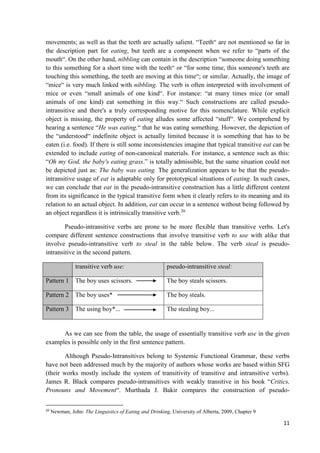
“Glass breaks easily.” with “The glass broke.”
(pseudo-intransitive construction) (this sentence pattern refers to a distinct event)
Pseudo-intransitives are usually in the present tense form.
There is the presence of a cause, but an agent can't be added in a by-phrase.
14
<http://www.thefreedictionary.com>
15
Goddard, Cliff: Semantic Analysis: A Practical Introduction: Second Edition, Oxford University Press, New
York, 2011, p. 439
16
Bornstein, D. Diane: An introduction to transformational grammar, University Press of America, 1984. P. 80
17
Downing, Angela and Locke, Philip: English Grammar: A University Course second edition, Routledge,
London and New York, 2006, p. 136
10
Pseudo-intransitive verb is followed by negation, a modal (usually will/ won't) or an
adverb such as easily, well - any of which specify the tendency of the thing to undergo the
process or otherwise (not to undergo the process).
There is the absence of active or passive corresponding transitive construction, which
precisely expresses the same significance as these intransitives. For example, “Colloquial
language is translated badly.” implies to translators' lack of skill, rather than about
characteristic of colloquial language. The problem of just paraphrasing the pattern indicates
how truly distinct and valuable it is.
Note the differences in a variety of sentences describing an event:
Ben broke the glass. active
The glass was broken by Ed. be-passive
The glass got broken. get-passive
The glass was already broken. copular (state)
The glass broke. (anti-causative)
Glass breaks easily. (pseudo-intransitive)18
The verb to be functioning as intransitive with comparative that is pseudo:
The rain tub is much fuller after all the rain.19
In this sentence pattern fuller signifies “more content“ since the tub cannot be “fuller
than full“.
Pseudo-intransitive verbs are: break, eat, cook, drive, read, steal, translate, lock, sew,
wash, hammer, tan, write, fasten, breathe, smoke, etc.
Furthermore, let's compare, for instance, verbs to eat and to nibble. Although these
verbs describe similar actions, there are many differences between eating and nibbling. We
could say that eating is in some sense usual, daily and routine activity, whereas nibbling isn't.
For eating we can depict a prototypical inspiring scenario with the component “at many times
someone does something like this to something when it is like this...“, but this would not be
the case with nibbling because such a component wouldn't add up. The first phrase is
adaptable to change, for instance: “at some times“. Opposite from eating, nibbling implies to
refusing to get food inside their body by using the mouth, or requiring just “little bits“ of food
into the bodies, and probably not just as much into the body as into the mouth. At this point as
description is concerned, it is understood that nibbling includes “smaller“, shorter
18
Downing, Angela and Locke, Philip: English Grammar: A University Course second edition, Routledge,
London and New York, 2006, p. 136
19
Tucker, H. Gordon: The Lexicogrammar of Adjectives: A Systemic Functional Approach to Lexis, Cassell,
London and New York, 1998, p. 147
11
movements; as well as that the teeth are actually salient. “Teeth“ are not mentioned so far in
the description part for eating, but teeth are a component when we refer to “parts of the
mouth“. On the other hand, nibbling can contain in the description “someone doing something
to this something for a short time with the teeth“ or “for some time, this someone's teeth are
touching this something, the teeth are moving at this time“; or similar. Actually, the image of
“mice“ is very much linked with nibbling. The verb is often interpreted with involvement of
mice or even “small animals of one kind“. For instance: “at many times mice (or small
animals of one kind) eat something in this way.“ Such constructions are called pseudo-
intransitive and there's a truly corresponding motive for this nomenclature. While explicit
object is missing, the property of eating alludes some affected “stuff“. We comprehend by
hearing a sentence “He was eating.“ that he was eating something. However, the depiction of
the “understood“ indefinite object is actually limited because it is something that has to be
eaten (i.e. food). If there is still some inconsistencies imagine that typical transitive eat can be
extended to include eating of non-canonical materials. For instance, a sentence such as this:
“Oh my God, the baby's eating grass.” is totally admissible, but the same situation could not
be depicted just as: The baby was eating. The generalization appears to be that the pseudo-
intransitive usage of eat is adaptable only for prototypical situations of eating. In such cases,
we can conclude that eat in the pseudo-intransitive construction has a little different content
from its significance in the typical transitive form when it clearly refers to its meaning and its
relation to an actual object. In addition, eat can occur in a sentence without being followed by
an object regardless it is intrinsically transitive verb.20
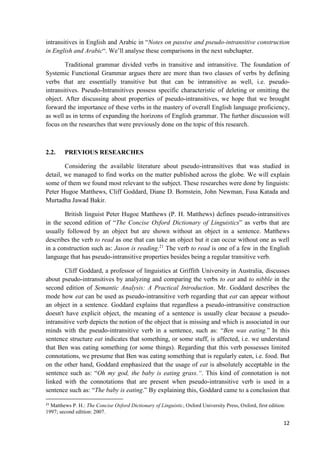
Pseudo-intransitive verbs are prone to be more flexible than transitive verbs. Let's
compare different sentence constructions that involve transitive verb to use with alike that
involve pseudo-intransitive verb to steal in the table below. The verb steal is pseudo-
intransitive in the second pattern.
transitive verb use: pseudo-intransitive steal:
Pattern 1 The boy uses scissors. The boy steals scissors.
Pattern 2 The boy uses* The boy steals.
Pattern 3 The using boy*... The stealing boy...
As we can see from the table, the usage of essentially transitive verb use in the given
examples is possible only in the first sentence pattern.
Although Pseudo-Intransitives belong to Systemic Functional Grammar, these verbs
have not been addressed much by the majority of authors whose works are based within SFG
(their works mostly include the system of transitivity of transitive and intransitive verbs).
James R. Black compares pseudo-intransitives with weakly transitive in his book “Critics,
Pronouns and Movement“. Murthada J. Bakir compares the construction of pseudo-
20
Newman, John: The Linguistics of Eating and Drinking, University of Alberta, 2009, Chapter 9
12
intransitives in English and Arabic in “Notes on passive and pseudo-intransitive construction
in English and Arabic“. We’ll analyse these comparisons in the next subchapter.
Traditional grammar divided verbs in transitive and intransitive. The foundation of
Systemic Functional Grammar argues there are more than two classes of verbs by defining
verbs that are essentially transitive but that can be intransitive as well, i.e. pseudo-
intransitives. Pseudo-Intransitives possess specific characteristic of deleting or omitting the
object. After discussing about properties of pseudo-intransitives, we hope that we brought
forward the importance of these verbs in the mastery of overall English language proficiency,
as well as in terms of expanding the horizons of English grammar. The further discussion will
focus on the researches that were previously done on the topic of this research.
2.2. PREVIOUS RESEARCHES
Considering the available literature about pseudo-intransitives that was studied in
detail, we managed to find works on the matter published across the globe. We will explain
some of them we found most relevant to the subject. These researches were done by linguists:
Peter Hugoe Matthews, Cliff Goddard, Diane D. Bornstein, John Newman, Fusa Katada and
Murtadha Jawad Bakir.
British linguist Peter Hugoe Matthews (P. H. Matthews) defines pseudo-intransitives
in the second edition of “The Concise Oxford Dictionary of Linguistics” as verbs that are
usually followed by an object but are shown without an object in a sentence. Matthews
describes the verb to read as one that can take an object but it can occur without one as well
in a construction such as: Jason is reading.21
The verb to read is one of a few in the English
language that has pseudo-intransitive properties besides being a regular transitive verb.
Cliff Goddard, a professor of linguistics at Griffith University in Australia, discusses
about pseudo-intransitives by analyzing and comparing the verbs to eat and to nibble in the
second edition of Semantic Analysis: A Practical Introduction. Mr. Goddard describes the
mode how eat can be used as pseudo-intransitive verb regarding that eat can appear without
an object in a sentence. Goddard explains that regardless a pseudo-intransitive construction
doesn't have explicit object, the meaning of a sentence is usually clear because a pseudo-
intransitive verb depicts the notion of the object that is missing and which is associated in our
minds with the pseudo-intransitive verb in a sentence, such as: “Ben was eating.” In this
sentence structure eat indicates that something, or some stuff, is affected, i.e. we understand
that Ben was eating something (or some things). Regarding that this verb possesses limited
connotations, we presume that Ben was eating something that is regularly eaten, i.e. food. But
on the other hand, Goddard emphasized that the usage of eat is absolutely acceptable in the
sentence such as: “Oh my god, the baby is eating grass.“. This kind of connotation is not
linked with the connotations that are present when pseudo-intransitive verb is used in a
sentence such as: “The baby is eating.” By explaining this, Goddard came to a conclusion that
21
Matthews P. H.: The Concise Oxford Dictionary of Linguistic, Oxford University Press, Oxford, first edition:
1997; second edition: 2007.
13
eat as a regular transitive verb can possess different connotation comparing to the usual
connotation when it is used as a pseudo-intransitive verb.22
Many pseudo-intransitive verbs
implicate on a single object. For instance: The verb to lock is usually associated to a door as
object. But, of course, there are other objects that can be linked with this verb, such as: a
house, a car, a folder, a padlock, a safe, etc. Also, the verb to read is usually associated to a
book as object, but other objects that can be linked with the verb could be: a novel,
newspapers, a magazine, a poem, an article, a cheque, a file, etc. Such various connotations
can be found with the rest of pseudo-intransitive verbs. Goddard's research clarifies the
connotations that pseudo-intransitives essentially have, particularly the connotations that the
verb to eat possesses. It would be wise and useful if some research in the future would be
analysing the connotations of the rest of pseudo-intransitives in order to make this
phenomenon of SFG clearer.
Diane D. Bornstein, the author of “An Introduction to Transformational Grammar”,
includes the analysis of pseudo-intransitives in the content of the book. The research precisely
describes verbal terms such as pseudo-intransitives and verbs that are related to pseudo-
intransitives. First of all, Bornstein construes verbs that cannot be followed by an object such
as to walk and to arrive. These are the most common verbs and they are labelled as
intransitive verbs in traditional grammar. For instance:
S
NP VP
aux. Vi
N tense
George past arrive
George arrived.
Afterwards, Bornstein argues about verbs that can be followed by a cognate object
which appertains to the action of a verb and possesses a similar name such as: dream a
dream; sing a song, etc; and finally, she describes verbs that are considered to be transitive
but still can be used without an object, such as: drive, steal, eat, etc; and emphasises that such
verbs are often named pseudo-intransitives. Mrs. Diane concludes that these verbs can appear
in the following pattern that is applied for transitive verbs:
V Vt + Np
Diane Bornstein also notes that pseudo-intransitives are defined in traditional grammar
as verbs that can be either transitive or intransitive.23
For instance, compare: Frank is cooking
a breakfast; with: Frank cooks well. (pseudo-intransitive construction) The study of the verbs
22
Goddard, Cliff: Semantic Analysis: A Practical Introduction: Second Edition, Oxford University Press, New
York, 2011.
23
Bornstein, D. Diane: An introduction to transformational grammar, University Press of America, 1984.
14
emphasized the difference between pseudo-intransitives and the verbs that are closely related
to this class of verbs. This research contributed to defining the characteristics of pseudo-
intransitives and differentiating them from the verbs that are similar to them.
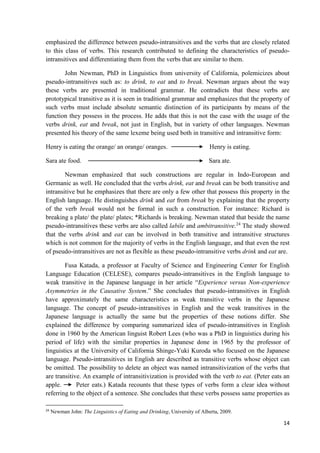
John Newman, PhD in Linguistics from university of California, polemicizes about
pseudo-intransitives such as: to drink, to eat and to break. Newman argues about the way
these verbs are presented in traditional grammar. He contradicts that these verbs are
prototypical transitive as it is seen in traditional grammar and emphasizes that the property of
such verbs must include absolute semantic distinction of its participants by means of the
function they possess in the process. He adds that this is not the case with the usage of the
verbs drink, eat and break, not just in English, but in variety of other languages. Newman
presented his theory of the same lexeme being used both in transitive and intransitive form:
Henry is eating the orange/ an orange/ oranges. Henry is eating.
Sara ate food. Sara ate.
Newman emphasized that such constructions are regular in Indo-European and
Germanic as well. He concluded that the verbs drink, eat and break can be both transitive and
intransitive but he emphasizes that there are only a few other that possess this property in the
English language. He distinguishes drink and eat from break by explaining that the property
of the verb break would not be formal in such a construction. For instance: Richard is
breaking a plate/ the plate/ plates; *Richards is breaking. Newman stated that beside the name
pseudo-intransitives these verbs are also called labile and ambitransitive.24
The study showed
that the verbs drink and eat can be involved in both transitive and intransitive structures
which is not common for the majority of verbs in the English language, and that even the rest
of pseudo-intransitives are not as flexible as these pseudo-intransitive verbs drink and eat are.
Fusa Katada, a professor at Faculty of Science and Engineering Center for English
Language Education (CELESE), compares pseudo-intransitives in the English language to
weak transitive in the Japanese language in her article “Experience versus Non-experience
Asymmetries in the Causative System.” She concludes that pseudo-intransitives in English
have approximately the same characteristics as weak transitive verbs in the Japanese
language. The concept of pseudo-intransitives in English and the weak transitives in the
Japanese language is actually the same but the properties of these notions differ. She
explained the difference by comparing summarized idea of pseudo-intransitives in English
done in 1960 by the American linguist Robert Lees (who was a PhD in linguistics during his
period of life) with the similar properties in Japanese done in 1965 by the professor of
linguistics at the University of California Shinge-Yuki Kuroda who focused on the Japanese
language. Pseudo-intransitives in English are described as transitive verbs whose object can
be omitted. The possibility to delete an object was named intransitivization of the verbs that
are transitive. An example of intransitivization is provided with the verb to eat. (Peter eats an
apple. Peter eats.) Katada recounts that these types of verbs form a clear idea without
referring to the object of a sentence. She concludes that these verbs possess same properties as
24
Newman John: The Linguistics of Eating and Drinking, University of Alberta, 2009.
15
pure intransitives do, such as the verb to walk. She adds that pure transitive verbs do not have
that kind of characteristic by analyzing the verb to kick which is comprehensible only in case
if an object determines what is to be kicked. Mrs. Katada explained that Kuroda used the idea
of pseudo-intransitives in the Japanese language and reconceptualised it as weakly intransitive
in 1965. Actually, Kuroda pointed out on a mismatch between pseudo-intransitives in the
English language and weak transitive in the Japanese language. The mismatch is concerning
the syntactic characteristic of intransitivation. In other words, in English, intransitivation is
implied if an object is omitted, while in Japanese, null prominals can occur which means that
the deletion of an object doesn’t mean that the action would still be that much precise.
Consider the following sentences:
Yao eats an apple.
Yao eats. intransitivation
Yao eats. (something) null-prominalization
Although it was difficult to determine whether such verbs as the pseudo-intransitives
in English are present in the Japanese language, Mrs. Katada concluded that pseudo-
intransitives in English possess approximately the same grammar properties as weakly
transitives in Japanese.25
The research brought closer the definition of pseudo-intransitive
verbs in English with the similar properties in the Japanese language, i.e. weakly transitive
verbs in Japanese. The research can be useful to those who study the grammar of these
languages, particularly to Japanese people who learn English as L2, or vice versa.
Iraqi linguist Murtadha Jawad Bakir in his research “Notes on Passive and Pseudo-
Intransitive Constructions in English and Arabic” attempted to define the difference between
passive and pseudo-intransitives by comparing the English language to modern Arabian
language by using the examples from both languages. He came to the conclusion that same
meaningful content used separately in passive and by the presence of pseudo-intransitives is
often different by its structure of words in a sentence in modern Arabian language comparing
to the structure of words in a sentence in the English language, but Bakir argues that there are
some similarities as well.
Mr. Bakir begins with explaining that a message that language depicts is construed
throughout limited number of processes which are represented in a limited number of
structural modes. The fundamental ones are transitive and intransitive. The rest of structural
modes can be depicted by the way we understand the process, the participants and the
properties these participants play in the activity we want to construe. The selection is usually
made between passive voice structure and the structure that is based on voice difference from
the passive in which the logical object assumes the essence of the grammatical subject. For
instance:
25
Katada Fusa: Experience versus Non-experience Asymmetries in the Causative System: Senshu University;
Clitics, Pronouns and movements, edited by Black R. James and Motapanyane Virginia, John Benjamins
Publishing Company, 1997.
16
1. a. The soup is being cooked;
b. The soup is cooked.
2. a. That book was sold out within two months;
b. That book is selling fast.
3. a. The cotton shirt was washed by the maid;
b. Cotton shirts wash easier than others.
Bakir defined the sentences on b. as pseudo-intransitive structures following Lyons’s
research “Introduction to theoretical linguistics“ from 1968. He basically explained that
expressions of processes that any sentence has are divided to lexicon of the process itself, i.e.
the verb, and the other processes that denote the participants, which can be further divided
into the roles of an agent or an actor which are defined as subject in traditional grammar; and
a patient, a goal, a receiver or a beneficier which are defined as object in traditional grammar.
(All of these terms that are not the part of traditional grammar are components of Systemic
Functional Grammar.)
Mr. Bakir precisely explained the characteristics of passive by defining it and
providing several sentences in passive. He concluded that passive involves the deletion of
object and depiction of a sentence construction composed without an agent. The conclusion
Bakir came to was that passive has similar properties as pseudo-intransitives. A patient or the
logical object, i.e. the affected participant has a role of a subject in both passive and pseudo-
intransitives constructions, but the difference is that a verb in pseudo-intransitive
constructions is in active voice. For example, compare the following sentences:
The book was sold. passive
Science fiction sells fast. pseudo-intransitive construction
In passive there is a feeling that the action is carried out by someone and regardless it
is not realised there is a presence of the notion of agent/ actor or initiator, while pseudo-
intransitive constructions depict process or action, i.e. depicts it by emphasizing only the
affected participants (without an agent or an actor). Briefly, the passive constructions are
agent-oriented, while pseudo-intransitives are process-oriented. The reason why pseudo-
intransitive constructions are felt to be passive ones is because in such constructions it appears
as if we predicate a specific property of an entity that appears to have some characteristics
that facilitates or magnifies what we predicate out if it. Bakir tried to explain this theory
further by providing the following examples of structures both in passive and pseudo-
intransitive:
Those shirts were washed easily. passive
Those shirts wash fast. pseudo-intransitive construction
17
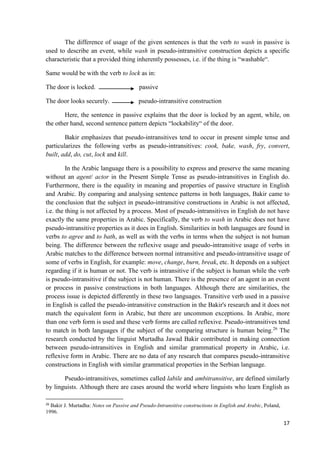
The difference of usage of the given sentences is that the verb to wash in passive is
used to describe an event, while wash in pseudo-intransitive construction depicts a specific
characteristic that a provided thing inherently possesses, i.e. if the thing is “washable“.
Same would be with the verb to lock as in:
The door is locked. passive
The door looks securely. pseudo-intransitive construction
Here, the sentence in passive explains that the door is locked by an agent, while, on
the other hand, second sentence pattern depicts “lockability“ of the door.
Bakir emphasizes that pseudo-intransitives tend to occur in present simple tense and
particularizes the following verbs as pseudo-intransitives: cook, bake, wash, fry, convert,
built, add, do, cut, lock and kill.
In the Arabic language there is a possibility to express and preserve the same meaning
without an agent/ actor in the Present Simple Tense as pseudo-intransitives in English do.
Furthermore, there is the equality in meaning and properties of passive structure in English
and Arabic. By comparing and analysing sentence patterns in both languages, Bakir came to
the conclusion that the subject in pseudo-intransitive constructions in Arabic is not affected,
i.e. the thing is not affected by a process. Most of pseudo-intransitives in English do not have
exactly the same properties in Arabic. Specifically, the verb to wash in Arabic does not have
pseudo-intransitive properties as it does in English. Similarities in both languages are found in
verbs to agree and to bath, as well as with the verbs in terms when the subject is not human
being. The difference between the reflexive usage and pseudo-intransitive usage of verbs in
Arabic matches to the difference between normal intransitive and pseudo-intransitive usage of
some of verbs in English, for example: move, change, burn, break, etc. It depends on a subject
regarding if it is human or not. The verb is intransitive if the subject is human while the verb
is pseudo-intransitive if the subject is not human. There is the presence of an agent in an event
or process in passive constructions in both languages. Although there are similarities, the
process issue is depicted differently in these two languages. Transitive verb used in a passive
in English is called the pseudo-intransitive construction in the Bakir's research and it does not
match the equivalent form in Arabic, but there are uncommon exceptions. In Arabic, more
than one verb form is used and these verb forms are called reflexive. Pseudo-intransitives tend
to match in both languages if the subject of the comparing structure is human being.26
The
research conducted by the linguist Murtadha Jawad Bakir contributed in making connection
between pseudo-intransitives in English and similar grammatical property in Arabic, i.e.
reflexive form in Arabic. There are no data of any research that compares pseudo-intransitive
constructions in English with similar grammatical properties in the Serbian language.
Pseudo-intransitives, sometimes called labile and ambitransitive, are defined similarly
by linguists. Although there are cases around the world where linguists who learn English as
26
Bakir J. Murtadha: Notes on Passive and Pseudo-Intransitive constructions in English and Arabic, Poland,
1996.
18
L2 compared pseudo-intransitive verbs with similar grammar properties in their own
language, there are no data that pseudo-intransitives have been compared with analogous
grammar properties in the Serbian language. This research indicated that these verbs exist in
Serbian as well but they are not precisely determined. In addition, there is a lack of
nomenclature for the property of these verbs in Serbian.
2.3. TRANSITIVE AND INTRANSITIVE VERBS IN THE ELEMENTARY
SCHOOL CURRICULUM
We need to contemplate the methods used by introducing transitive and intransitive
verbs in grammar teaching according to the curriculum in Serbia in order to comprehend the
level of knowledge of these high school students that were put through the test. Educational
system in Serbia introduces transitive and intransitive verbs to students in the sixth grade of
elementary schools. The inclusion of these verbs in the curriculum of elementary schools in
Serbia is being done in mother tongue i.e. in Serbian. The students start practicing these verbs
in English a year later, i.e. in the seventh grade of the elementary schools.
Let’s briefly analyze the procedure how transitive and intransitive verbs are being
introduced to students in their mother tongue language, i.e. in Serbian, in the sixth grade of
elementary schools in Serbia. The following sentences in the table below that are written in
Serbian represent the original way how transitive and intransitive verbs are introduced to
students in the sixth grade of the elementary schools. It is an insertion. It’s italicized and
translated from the Serbian language. We analyzed it and explained the procedure how these
verbs are lectured and taught in elementary schools in Serbia:
THE
ORIGINAL
(SERBIAN)
Glagoli prema predmetu radnje mogu biti:
Prelazni glagoli - uz njih stoji pravi objekat.
Npr. čitati (knjigu), gledati, stajati, itd.
Uz sebe mogu imati imenicu u akuzativu bez predloga.
TRANSLATION
(ENGLISH)
Verbs are divided according to object action into:
Transitive verbs - the verbs that are accompanied by a direct object
E.g. to read (a book), to see, to stand, etc.
These verbs can be accompanied by an accusative noun without a preposition.
As we can see there are no discrepancies between English and Serbian in terms of
teaching transitive verbs and presenting their properties. Let's proceed with the division of
19
verbs according to the curriculum and consider the way intransitive verbs are taught in
elementary schools in Serbia:
THE
ORIGINAL
(SERBIAN)
Neprelazni glagoli: - uz njih ne može da stoji objekat.
Npr. ići, hodati, maštati, itd.
Uz sebe ne mogu imati imenicu u akuzativu bez predolga.
TRANSLATION
(ENGLISH)
Intransitive verbs - the verbs that cannot be accompanied by an object
E.g. to go, to walk, to daydream, etc.
These verbs cannot be accompanied by an accusative noun without a
preposition.
There are neither mismatches in terms of representing and teaching intransitive verbs
in both languages, nor in terms of properties of listed verbs except for the verb to go if we
consider saying a sentence such as: “Peter would like to go fishing.“, in which fishing has a
function as a receiver.
By analyzing the pattern of the mode how transitive and intransitive verbs are taught
in Serbia, as well as the properties of these verbs, we concluded that there are no significant
dissimilarities between English and Serbian regarding these verbs. We also reassured that
these methods are proper in teaching these verbs.
Now let’s contemplate the way how transitive and intransitive verbs are introduced in
English in the seventh grade of elementary schools in Serbia which is presented in the table
below. The following scheme was taken from elementary school curriculum. It represents the
way these verbs are taught and practiced in English. The original part that is in Serbian is
italicized and translated.
THE
ORIGINAL
(SERBIAN)
Prelazni glagoli su oni glagoli uz koje može stajati direktni objekat u
akuzativu. (subject+ verb+ object) Na primier:
They built the bridge last year;
I saw a monkey;
Before leaving they sold the car;
He speaks English.
TRANSLATION
(ENGLISH)
Transitive verbs are those verbs that are accompanied by a direct
object in accusative case. (subject+ verb+ object) For example:
(examples were already written and lectured in the English language)
20
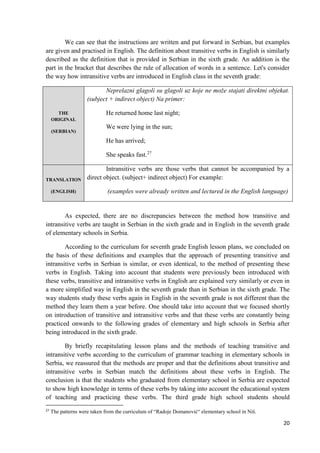
We can see that the instructions are written and put forward in Serbian, but examples
are given and practised in English. The definition about transitive verbs in English is similarly
described as the definition that is provided in Serbian in the sixth grade. An addition is the
part in the bracket that describes the rule of allocation of words in a sentence. Let's consider
the way how intransitive verbs are introduced in English class in the seventh grade:
THE
ORIGINAL
(SERBIAN)
Neprelazni glagoli su glagoli uz koje ne može stajati direktni objekat.
(subject + indirect object) Na primer:
He returned home last night;
We were lying in the sun;
He has arrived;
She speaks fast.27
TRANSLATION
(ENGLISH)
Intransitive verbs are those verbs that cannot be accompanied by a
direct object. (subject+ indirect object) For example:
(examples were already written and lectured in the English language)
As expected, there are no discrepancies between the method how transitive and
intransitive verbs are taught in Serbian in the sixth grade and in English in the seventh grade
of elementary schools in Serbia.
According to the curriculum for seventh grade English lesson plans, we concluded on
the basis of these definitions and examples that the approach of presenting transitive and
intransitive verbs in Serbian is similar, or even identical, to the method of presenting these
verbs in English. Taking into account that students were previously been introduced with
these verbs, transitive and intransitive verbs in English are explained very similarly or even in
a more simplified way in English in the seventh grade than in Serbian in the sixth grade. The
way students study these verbs again in English in the seventh grade is not different than the
method they learn them a year before. One should take into account that we focused shortly
on introduction of transitive and intransitive verbs and that these verbs are constantly being
practiced onwards to the following grades of elementary and high schools in Serbia after
being introduced in the sixth grade.
By briefly recapitulating lesson plans and the methods of teaching transitive and
intransitive verbs according to the curriculum of grammar teaching in elementary schools in
Serbia, we reassured that the methods are proper and that the definitions about transitive and
intransitive verbs in Serbian match the definitions about these verbs in English. The
conclusion is that the students who graduated from elementary school in Serbia are expected
to show high knowledge in terms of these verbs by taking into account the educational system
of teaching and practicing these verbs. The third grade high school students should
27
The patterns were taken from the curriculum of “Radoje Domanović“ elementary school in Niš.
21
successfully recognize pseudo-intransitives regarding their prior knowledge of transitive and
intransitive verbs and four years of practicing them in elementary and high schools in Serbia.
To summarize, in traditional grammar there are only two types of verbs: transitive and
intransitive. Transitive verbs are those that are accompanied by a direct object while
intransitive verbs are not accompanied by a direct object. Systemic Functional Grammar
proved there is a third class of verbs that are intrinsically transitive but can act as intransitive
as well and named this class of verbs pseudo-intransitives. Although this class of verbs is
clearly defined and its characteristics proved to be important part of grammar itself, pseudo-
intransitives are not taught in schools in Serbia. There are many researches that were focused
on defining this group of verbs more precisely as well as many comparison researches that
compared pseudo-intransitives in English with similar grammar-verbal properties in other
languages, but still there is no evidence of comparing these verbs with the Serbian grammar.
Regarding that learning pseudo-intransitives implies prior knowledge of transitive and
intransitive verbs, we analyzed the methods that are used in teaching these verbs in schools in
Serbia and then compared the definitions and applied teaching methods with the definitions
and teaching methods in English class. The analysis reassured us that the methods are proper,
as well as that English and Serbian are very or completely similar in this segment. According
to the conclusion we had come to, our expectation was that the third year high school students
who were put to the test are capable of recognizing pseudo-intransitive verbs, as well as, that
they would be able to solve the test successfully although they haven’t learnt pseudo-
intransitives before at the time they were tested.
22
III PRESENT STUDY
The research aim in this study was to examine if third year high schools students are
capable of determining pseudo-intransitive verbs. The hypothesis was that they do. The
reason for such supposition was the proper way of teaching and practicing transitive and
intransitive verbs throughout years of elementary and high school.
The subject matter of the investigation presented in the thesis focused on pseudo-
intransitives. Specifically, this research is primarily focused on determining if high schools
students in Serbia are capable of determining these verbs. Consequently, if the test proves
they are capable, we would raise the question why these verbs are not a part of the curriculum
of schools in Serbia. Besides the primary goal of the research, it also strives to define the
terms, definitions and characteristics of pseudo-intransitives, as well as to analyze and
scrutinize existing comparisons that have been done to similar properties in other languages.
The participants in the test were two classes composed of 54 third year high schools
students of the grammar school “Bora Stanković” in Niš. These students had learnt transitive
and intransitive verbs in the sixth grade of elementary school and they have been practicing
them ever since, but they have never learnt about pseudo-intransitives before.
The study was conceived as a quantitative and a qualitative investigation throughout a
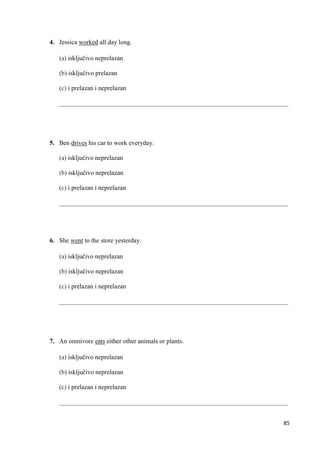
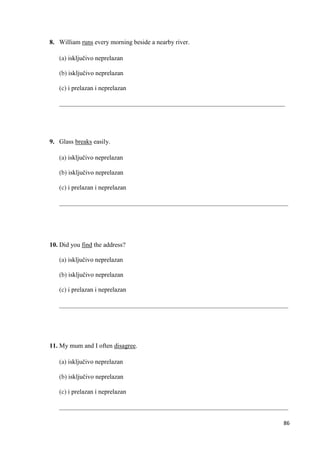
test as the main data gathering instrument. The test was composed of 16 sentences (including
the first three that were done as examples) that the students were asked to solve. The students
were supposed to circle the right answer and determine whether a verb in a sentence can be
either (a) exclusively intransitive, (b) exclusively transitive or (c) both – the case when a verb
can be used both transitively and intransitively, in which case if a given verb is intrinsically
transitive it’s actually pseudo-intransitive. If a verb can be both used both transitively and
intransitively, the students were supposed to rewrite a sentence of their own using the
opposite verb from the one given in a sentence (if a verb in a sentence was transitive they
were asked to compose a sentence with an intransitive one, and vice versa). The testing took
place in the grammar school “Bora Stanković” in Niš on the 27th of May 2013. It included
two classes consisted of third-year high school students. Total number of respondents was 54.
The test was created by the help and supervision of Professor Violeta Stojičić. The
director and the psychologist of the school where the testing took place had been informed
about the testing before it was conducted. The testing occurred during English class. Before
the testing started the students had confirmed that they had learnt transitive and intransitive
verbs in school. Officially, there were 57 respondents - 54 who done the test and 3 who left
the test blank.
The results of the test were quantitatively analyzed in terms of correct and incorrect
answers, problematic structures and verbs, while the sentences which the participants
produced themselves were all qualitatively analyzed in terms of the correct usage of the
transitive and intransitive verbs.
23
3.1. THE RESULTS
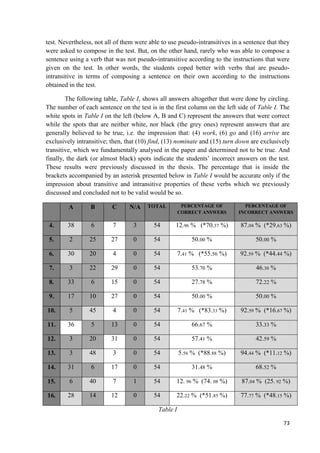
The students were given 13 sentences to solve by recognizing the class of a verb in
terms of transitivity and intransitivity in each sentence. The verbs that were the part of the test
were: to work, to drive, to go, to eat, to run, to break, to find, to disagree, to read, to
nominate, to wake up, to turn down and to arrive. First of all, we will consider all the verbs
that have been put to the test including pseudo-intransitive ones, and after that we will
especially, but briefly, focus on the verbs that were exclusively pseudo-intransitives. Let’s
consider the number and the percentage of correct and incorrect answers provided by the
respondents on the test. The exact number and the percentage of correct and incorrect answers
in each sentence, i.e. for each verb are presented in the table below. The detailed discussion
about the results is done further within this subchapter.
No. VERB TOTAL CORRECT INCORRECT PERCENTAGE OF
CORRECTNESS
PERCENTAGE OF
WRONG ANSWERS
4. WORK 54 7 47 12.96 % (*70.37 %) 87.04 % (*29.63 %)
5. DRIVE 54 27 27 50.00 % 50.00 %
6. GO 54 4 50 7.41 % (*55.56 %) 92.59 % (*44.44 %)
7. EAT 54 29 25 53.70 % 46.30 %
8. RUN 54 15 39 27.78 % 72.22 %
9. BREAK 54 27 27 50.00 % 50.00 %
10. FIND 54 4 50 7.41 % (*83.33 %) 92.59 % (*16.67 %)
11. DISAGREE 54 36 18 66.67 % 33.33 %
12. READ 54 31 23 57.41 % 42.59 %
13. NOMINATE 54 3 51 5.56 % (*88.88 %) 94.44 % (*11.12 %)
14. WAKE UP 54 17 37 31.48 % 68.52 %
15. TURN DOWN 54 7 47 12.96 % (*74.08 %) 87.04 % (*25.92 %)
16. ARRIVE 54 12 42 22.22 % (*51.85 %) 77.77 % (*48.15 %)
The fundamental analysis, which was conducted during this research in terms of
transitivity and intransitivity of these English verbs that were on the test, showed that there
were no exclusively transitive verbs among the sixteen verbs that took place on this survey.
Moreover, this research concludes that there are just a few, or even none, exclusively
transitive verbs in the English language such as the verb to use. But even this verb can be
used intransitively as in: “This is the fuel we will use from now on.” On the other hand, there
24
are many verbs that are typically used transitively and very rarely used intransitively. These
verbs are often called almost exclusively transitive verbs.
There are discussions about this topic among academicians. The British linguist,
Martin J. Endley, in his book “Linguistic perspectives on English grammar: a guide for EFL
teachers” argues about verbs that are exclusively or almost exclusively transitive verbs.
Though mentioning that those verbs that are widely regarded as exclusively transitive verbs
are actually almost exclusively transitive ones, Endley quotes that the verb to find appear to
be exclusively transitive regarding the sentence pattern such as “ *He found”, declaring that
such a sentence, without an object following the verb, is not grammatically acceptable.
Furthermore, Mr. Endley quotes the following sentences which he emphasized as the ones
that have exclusively transitive verbs in their constructions. The original examples from this
book are presented below:
“The old lady angrily smashed the plate. (*The old lady angrily smashed _____ );
Belle chopped the onions (*Belle chopped _____ )”28
These sentences cited Martin Endley’s
statement that claimed verbs find, smash and chop to be exclusively transitive. In fact, we
found that these verbs can be used intransitively as in the following examples:
- The verb to find used intransitively in a sentence:
The jury found in Blake’s favour;
- The verb to smash used intransitively in the following sentences:
The truck smashed into a concrete lamppost;
A couple of glasses have been smashed; The kitchen plate smashed into a thousand pieces.
- The verb to chop used intransitively in the following sentences:
The country was chopped up into several provinces; The share price was chopped from 30 to
10 pounds.
We came across an assertion that the verb to hit is exclusively transitive, which,
actually, is not. This statement was quoted by the American developmental psychologist
Michael Tomasello in his research book “Constructing a language: A usage-based theory of
language acquisition”. We would paraphrase Mr. Tomasello’s statement from this book
which asserts hit is exclusively transitive. Focusing on cognitivity abilities of children from
3.5 to 8 years, Michael Tomasello mentioned that there are exclusively intransitive and
exclusively transitive verbs in English. Tomasello quoted only the verb to hit as the
representative of those that are exclusively transitive.29
But, hit can be used intransitively as
well. For example: Poor countries have been worst hit by the world crisis; A tornado hit on
Monday morning.
28
Endley J. Martin, Linguistic perspectives on English grammar: a guide for EFL teachers, Information Age
Publishing Inc., USA, 2010, p. 192
29
Tomasello, Michael: Constructing a language: A usage-based theory of language acquisition, First Harvard
University Press paperback edition, 2005, USA, p. 179
25
This thesis suggests that there are no verbs that can be used exclusively transitively in
English, i.e. not having properties and affinities to act intransitively. However, there are many
verbs that are typically used transitively and extremely rarely used intransitively.
The detailed analysis of all the verbs that the students who were put to the test were
asked to solve is below. These verbs were: work, drive, go, eat, run, break, find, disagree,
read, nominate and arrive, as well as two phrasal verbs: turn down and wake up. The thesis
will analyse these verbs and discuss about the ways how they can be used transitively and
intransitively. This research was based on many dictionaries and grammar books that can be
found in references. This part of the research includes quantitative and qualitative analysis of
the verbs that the students were asked to recognize and use in the test. In other words, the
following analysis examined all possible forms of the verbs that were in the test in terms of
transitive and intransitive usage. In addition, the analysis indicates whether verbs from the test
were transitive or intransitive and it shows and examines the sentences which the students
composed and wrote by themselves using the verb from the sentence transitively or
intransitively depending on the case. All data were statistically calculated, displayed and
analysed. The results for each verb that was on the test were presented within six tables.
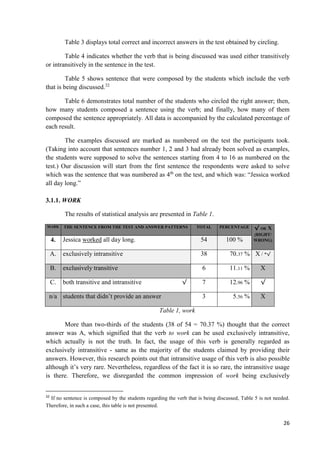
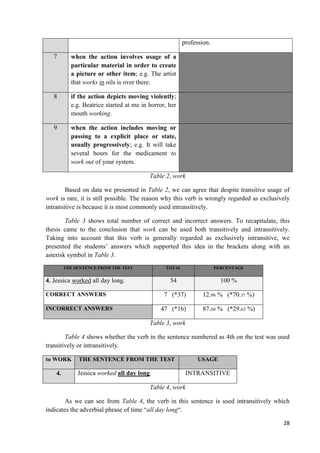
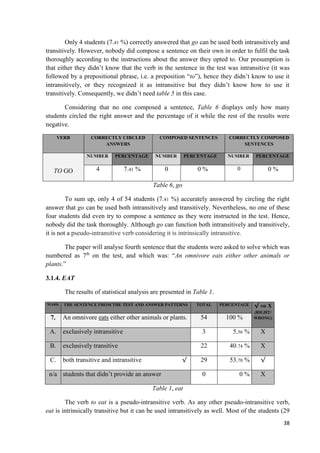
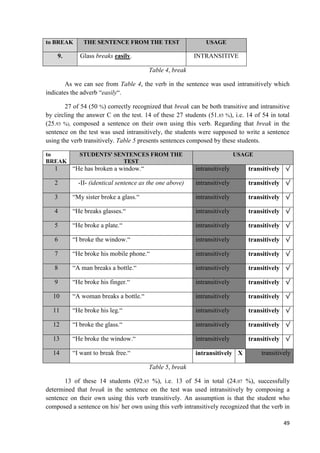
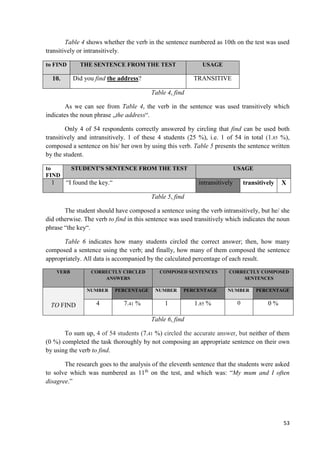
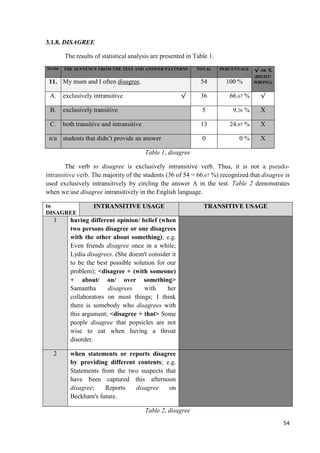
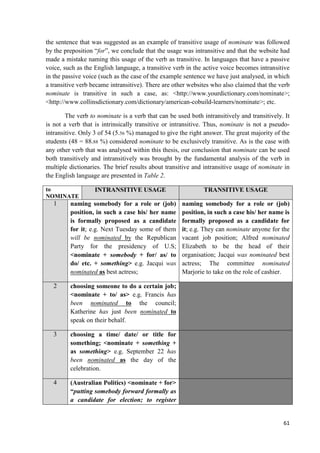
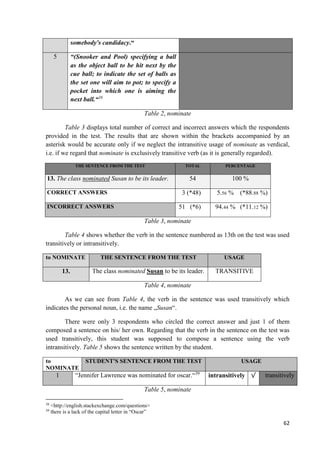
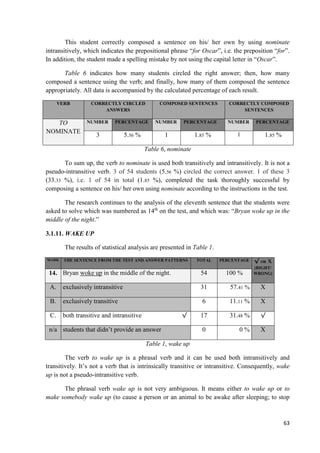
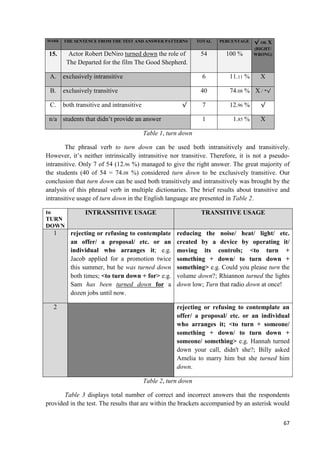
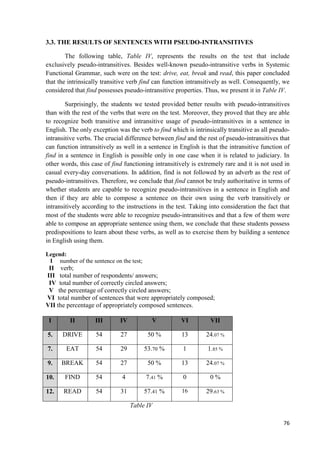
Table number 1 shows exactly how many students answered A, B and C to be the right
answers for each sentence on the test.30
The top field in the left corner of each table represents
numerical number of each sentence in the test while the third column (that is located in the
middle) indicates total number of respondents that were put to the test. Second column of
each table displays a sentence from the test that is analysed which is accompanied by the
answers that were offered. The verb that was analyzed is underlined just as it was underlined
on the test which had been done in order to help the students to concentrate easily on the task
they had to fulfil. On the left side of each table are alphabetical indications of each of three
optional answers marked as A, B and C (and n/a which represents no answer at all) that are
followed by optional verb that these alphabetical marks represent. The answer C indicates that
the answer may involve pseudo-intransitives. The optional answer that is regarded as accurate
is marked with a check mark symbol31
. The percentage of the students’ responses for each
optional answer is shown in the fourth column. Additionally, the last (the fifth) column
portrays if an answer was right or wrong which was depicted by a check mark symbol* if the
answer was correct or, on the contrary, by X if the answer was inaccurate. At the bottom of
each table is emphasized how many students didn’t provide any answer at all.
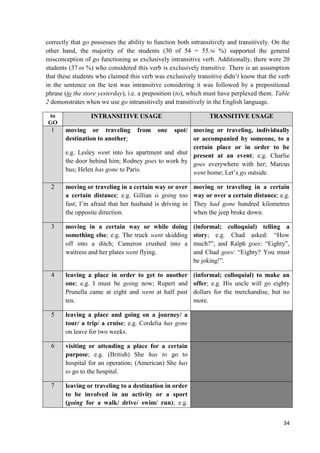
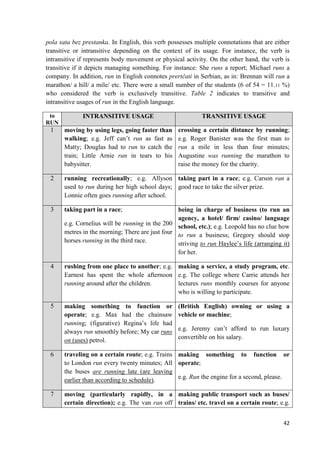
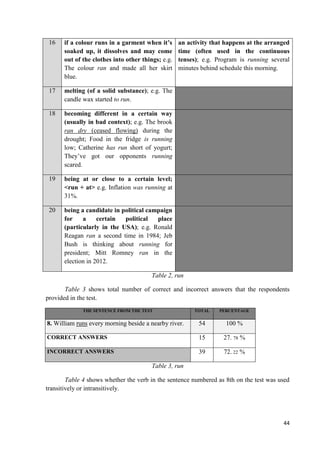
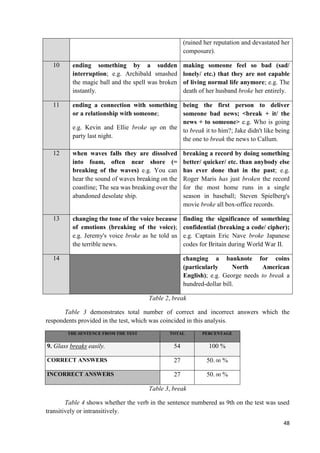
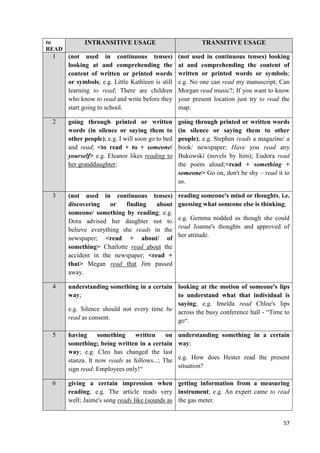
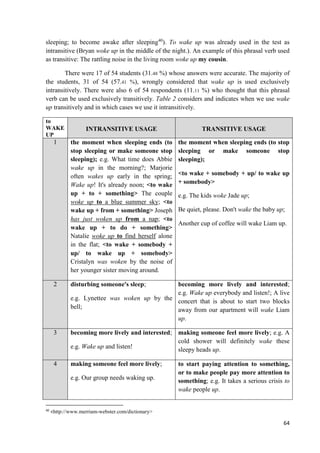
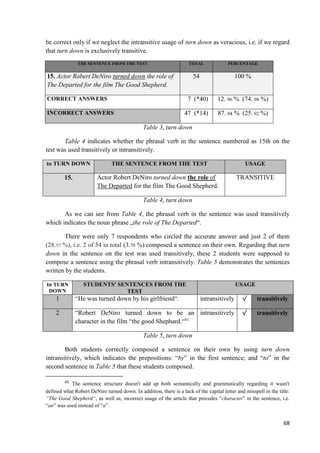
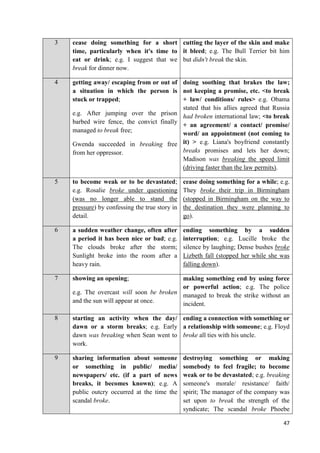
Table 2 shows all possible functional patterns in terms of transitive and intransitive
usage in the English language of the verb that is being discussed. The review in this table is
the result of the thorough analysis of the verb that is discussed in terms of its transitive and
intransitive usage in the English language.
30
The first three sentences are skipped because they were already solved as examples in the test.
31
Square root symbol in Verdana’s font (√ ) is used instead of check mark symbol (✓) because of its better
visibility in Microsoft Word. In other words, check mark symbol is appreciably smaller than square root symbol.
Nevertheless, it requires more space when it is inserted. Taking all this into account, as well as the resemblence
of these two symblos, we decided to use square root symbol (√ ) as the impersonation of the answers that were
correct in the test.
26
Table 3 displays total correct and incorrect answers in the test obtained by circling.
Table 4 indicates whether the verb that is being discussed was used either transitively
or intransitively in the sentence in the test.
Table 5 shows sentence that were composed by the students which include the verb
that is being discussed.32
Table 6 demonstrates total number of the students who circled the right answer; then,
how many students composed a sentence using the verb; and finally, how many of them
composed the sentence appropriately. All data is accompanied by the calculated percentage of
each result.
The examples discussed are marked as numbered on the test the participants took.
(Taking into account that sentences number 1, 2 and 3 had already been solved as examples,
the students were supposed to solve the sentences starting from 4 to 16 as numbered on the
test.) Our discussion will start from the first sentence the respondents were asked to solve
which was the sentence that was numbered as 4th
on the test, and which was: “Jessica worked
all day long.”
3.1.1. WORK
The results of statistical analysis are presented in Table 1.
MARK THE SENTENCE FROM THE TEST AND ANSWER PATTERNS TOTAL PERCENTAGE √ OR X
(RIGHT/
WRONG)4. Jessica worked all day long. 54 100 %
A. exclusively intransitive 38 70.37 % X / *√
B. exclusively transitive 6 11.11 % X
C. both transitive and intransitive √ 7 12.96 % √
n/a students that didn’t provide an answer 3 5.56 % X
Table 1, work
More than two-thirds of the students (38 of 54 = 70.37 %) thought that the correct
answer was A, which signified that the verb to work can be used exclusively intransitive,
which actually is not the truth. In fact, the usage of this verb is generally regarded as
exclusively intransitive - same as the majority of the students claimed by providing their
answers. However, this research points out that intransitive usage of this verb is also possible
although it’s very rare. Nevertheless, regardless of the fact it is so rare, the intransitive usage
is there. Therefore, we disregarded the common impression of work being exclusively
32
If no sentence is composed by the students regarding the verb that is being discussed, Table 5 is not needed.
Therefore, in such a case, this table is not presented.
27
intransitive verb and acknowledged the answers which claimed this verb can be used both
transitively and intransitively as correct answers. There were just 7 of 54 students (12.96 %)
whose answers claimed this. Table 2 considers and shows when we use work intransitively
and when we use it transitively in the English language.
to
WORK
INTRANSITIVE USAGE TRANSITIVE USAGE
1 when the action involves physical or
mental exertion (which generally
refers to a job); e.g. Arthur has been
working on his assignment all night;
Lewis is working on a new book;
Medical staff members frequently work
very long hours.
a subject that is affected by very hard
working;
e.g. Peter works himself too hard.
2 when the action depicts possession of
a job; e.g. Both Kevin and Ralph work;
<work + for + someone/ something>
Lester is working for an international
business company; <work + with +
someone/ something> Scarlett is
enjoying working with children; <work
+ as + something> Cressida is working
as a lawyer.
managing or operating something to
profit from it; e.g. Kerwin works the
land (= he grows crops on it); Sophia
works a large area (i.e. selling a
company's goods, etc.); Lombard is a
good motivational speaker who knows
how to work a crowd (to animate them or
make them sympathize with him).
3 when the action refers to striving to
achieve something; e.g. Government
and other public institutions need to
work together to combat poverty.
making a machine, a device, etc. to
operate; e.g. John knows how to work
the coffee machine.
4 with the action that involves
functioning or operating; e.g. The air
conditioner is not working; The device
works by solar energy.
causing or producing something as an
outcome of exertion; e.g. Jessica can
work miracles with very little money if
she follows our home decoration tips.
5 when the action has the outcome or
impact that you want; e.g. The
medicine the physician gave me is not
working; Her charm doesn't work on
Clementine.
making a material into a certain shape
by pressing, stretching, hitting it, etc.
e.g. Anybody can try to work the mixture
into a paste.
6 when the action has a particular
impact; e.g. That kind of attitude can
work against you; Speaking Japanese
should work in her favour.
moving or passing to an exclusive
place or state, usually progressively;
e.g. Carl was tied up, but he managed to
work himself free; (figurative) Lester
worked his way to the top of his
28
profession.
7 when the action involves usage of a
particular material in order to create
a picture or other item; e.g. The artist
that works in oils is over there.
8 if the action depicts moving violently;
e.g. Beatrice started at me in horror, her
mouth working.
9 when the action includes moving or
passing to a explicit place or state,
usually progressively; e.g. It will take
several hours for the medicament to
work out of your system.
Table 2, work
Based on data we presented in Table 2, we can agree that despite transitive usage of
work is rare, it is still possible. The reason why this verb is wrongly regarded as exclusively
intransitive is because it is most commonly used intransitively.
Table 3 shows total number of correct and incorrect answers. To recapitulate, this
thesis came to the conclusion that work can be used both transitively and intransitively.
Taking into account that this verb is generally regarded as exclusively intransitive, we
presented the students’ answers which supported this idea in the brackets along with an
asterisk symbol in Table 3.
THE SENTENCE FROM THE TEST TOTAL PERCENTAGE
4. Jessica worked all day long. 54 100 %
CORRECT ANSWERS 7 (*37) 12.96 % (*70.37 %)
INCORRECT ANSWERS 47 (*16) 87.04 % (*29.63 %)
Table 3, work
Table 4 shows whether the verb in the sentence numbered as 4th on the test was used
transitively or intransitively.
to WORK THE SENTENCE FROM THE TEST USAGE
4. Jessica worked all day long. INTRANSITIVE
Table 4, work
As we can see from Table 4, the verb in this sentence is used intransitively which
indicates the adverbial phrase of time “all day long“.
29
Table 5 displays the sentences composed by the students who accurately claimed work
can be used either transitively or intransitively by circling the answer C on the test. There
were only 2 of 7 respondents (28.57 %), i.e. 2 of 54 in total (3.70 %), who composed a
sentence on their own. Regarding that the verb in the sentence on the test was used
intransitively, the students were supposed to compose a sentence using the verb transitively.
to
WORK
STUDENTS' SENTENCES FROM THE TEST USAGE
1 “I worked on a project last week.“ intransitively X transitively
2 “I worked on building my muscles.“ intransitively X transitively
Table 5, work
As shown in Table 5, these 2 students failed to provide a sentence using work
transitively. These two students either mistakenly thought that the verb in the sentence on the
test was transitive or they recognized that this verb in the sentence on the test was intransitive,
but they didn't manage to give an appropriate example. Taking all the results into account, we
came to the conclusion that neither of the students (0 %) completed the task thoroughly in the
sentence numbered as 4th
in the test.
Table 6 displays how many students circled the right answer; then, how many of them
composed a sentence using the verb; and finally, how many of them composed the sentence
appropriately. All data is accompanied by the calculated percentage of each result.
VERB CORRECTLY CIRCLED
ANSWERS
COMPOSED SENTENCES CORRECTLY COMPOSED
SENTENCES
TO WORK NUMBER PERCENTAGE NUMBER PERCENTAGE NUMBER PERCENTAGE
7 12.96 % 2 3.70 % 0 0 %
Table 6, work
In Serbian, this verb is usually used intransitively. Transitive usage is possible as well
although it's not so formal. e.g. *Tamara radi domaći zadatak. But this sentence would be
more appropriate by using the verb pisati (to write): Tamara piše domaći zadatak. Comparing
these examples with the English ones, we conclude that transitive and intransitive usage of the
verb work in Serbian is similar to the usage of this verb in English. However, there are more
cases and examples of transitive usage of work in English comparing to the number of case
patterns of this verb in the Serbian language.
Although work can be used either transitively or intransitively, this verb is not a
pseudo-intransitive verb regarding it is intrinsically intransitive. To summarize, 7 of 54
students (12.96 %) circled the correct answer, but neither of them (0 %) done the task
completely successfully by composing an adequate sentence on their own using the verb to
work.
30
The analysis continues to the second sentence that the students were asked to solve,
which was the sentence numbered as 5th
on the test, and which was: “Ben drives his car to
work everyday.”
3.1.2. DRIVE
The results of statistical analysis are presented in Table 1.
MARK THE SENTENCE FROM THE TEST AND ANSWER PATTERNS TOTAL PERCENTAGE √ OR X
(RIGHT/
WRONG)5. Ben drives his car to work everyday. 54 100 %
A. exclusively intransitive 2 3.70 % X
B. exclusively transitive 25 46.30 % X
C. both transitive and intransitive √ 27 50.00 % √
n/a students that didn’t provide an answer 0 0 % X
Table 1, drive
The verb to drive is intrinsically transitive, but it can be used both transitively and
intransitively. This verb is a pseudo-intransitive. We concluded this by reassessing properties
of drive in terms of its transitive and intransitive function and usage in a sentence in the
English language. As a result, all possible functions and usages of drive in a sentence in
English are presented in Table 2. Half of the students, 27 of 54 (50 %), managed to give the
right answer (which was C). In other words, the number of total correct and incorrect answers
coincided. There were 25 students (46.30 %) who considered drive to be exclusively transitive
and 2 (3.70 %) who thought this verb can be used exclusively intransitively.
to
DRIVE
INTRANSITIVE USAGE TRANSITIVE USAGE
1 driving a vehicle in order to go in a
certain direction; e.g. Cooper drove
to work at dawn; Eleanor drives too
slowly.
driving a vehicle in order to go in a
certain direction; e.g. Jasper drives a van
(= that's his job); Can you drive a truck?
2 falling or moving rapidly and with
huge amount of energy; e.g. The
waves were driving against the shore.
providing transportation for someone by
car, taxi, etc. e.g. Would you like to drive
Jessica to school tomorrow?
3 owning or using a certain type of vehicle;
e.g. Leah drives red convertible.
4 forcing someone to act in a certain way;
e.g. The urge to survive drove Christopher
and his friends on; Rhys is driving himself
too hard.
31
5 making someone to be very agitated or
making them doing something extreme;
e.g. Victoria drives me crazy; Hunger drove
him to mug; Rebecca’s co-workers are
driving her to despair.
6 forcing someone or something to move in
a certain direction; e.g. A shepherd drove
sheep into a field.
7 forcing something to go in a certain
direction or into a certain place by
pushing or hitting it; e.g. Jack knows how
to drive a nail into a piece of wood.
8 making an opening in or through
something by using force; e.g. Dylan and
Jake drove a tunnel through a solid rock.
9 hitting a ball with force/ sending it
forward; e.g. (in golf) Tiger Woods drove
the ball into the rough.
10 carrying something along; e.g. Massive
waves drove the ship onto the rocks.
Table 2, drive
Table 3 presents the number of total right and wrong answers which are coincided.
THE SENTENCE FROM THE TEST TOTAL PERCENTAGE
5. Ben drives his car to work everyday. 54 100 %
CORRECT ANSWERS 27 50.00 %
INCORRECT ANSWERS 27 50.00 %
Table 3, drive
Table 4 shows whether the verb in the sentence numbered as 5th on the test was used
transitively or intransitively.
to DRIVE THE SENTENCE FROM THE TEST USAGE
5. Ben drives his car to work everyday. TRANSITIVE
Table 4, drive
32
As we can see from Table 4, the verb in the sentence was used transitively which
indicates the noun phrase „his car“.
Although there were 27 respondents who circled the accurate answer, 15 of them
composed a sentence on their own. Regarding that the verb in the sentence on the test was
used transitively, the students were supposed to compose a sentence using the verb
intransitively. Table 5 shows sentences composed by the students who correctly claimed by
circling the answer C on the test to be the right answer which signified that drive can be used
either transitively or intransitively.
to
DRIVE
STUDENTS' SENTENCES FROM THE
TEST
USAGE
1 “Ben usually drives well.” intransitively √ transitively
2 -II- (identical sentence as the one above) intransitively √ transitively
3 -II- (identical sentence as the one above) intransitively √ transitively
4 “Ben drives fast.” intransitively √ transitively
5 -II- (identical sentence as the one above) intransitively √ transitively
6 “Ben drives everyday.” intransitively √ transitively
7 “Ben drives carefully.” intransitively √ transitively
8 “Ben drives to work everyday.” intransitively √ transitively
9 “Ben drives well.” intransitively √ transitively
10 “Ben drives carelessly.” intransitively √ transitively
11 “Ben drives often.” intransitively √ transitively
12 “Ben drives.” intransitively √ transitively
13 -II- (identical sentence as the one above) intransitively √ transitively
14 “Ben drives aeroplane every Sunday.” intransitively transitively X
15 “Ben drives his moto-bike.” intransitively transitively X
Table 5, drive
13 of these 15 students successfully determined that the verb to drive in the sentence
on the test was transitive by composing a sentence on their own using this verb intransitively.
There is a supposition that two students who composed a sentence using this verb transitively
either erroneously considered that the verb in the sentence on the test was intransitive or they
did recognize that the verb in the sentence on the test was transitive but they couldn’t
compose a sentence using this verb intransitively.
33
Table 6 indicates how many students circled the right answer; then, how many
composed a sentence using the verb; and finally, how many of them composed the sentence
appropriately. All data is accompanied by the calculated percentage of each result.
VERB CORRECTLY CIRCLED
ANSWERS
COMPOSED SENTENCES CORRECTLY COMPOSED
SENTENCES
TO DRIVE NUMBER PERCENTAGE NUMBER PERCENTAGE NUMBER PERCENTAGE
27 50 % 15 27.78 % 13 24.07 %
Table 6, drive
To sum up, 27 of 54 students (50 %) had accurately circled C on the test to be the right
answer which signified that drive can be used either transitively or intransitively. 15 of these
27 (55.56 %), i.e. 15 of 54 in total (27.78 %), composed a sentence on their own in which case
13 of these 15 students (86.67 %) did that well. In other words, 13 of 54 students (24.07 %)
completed the task thoroughly by composing an appropriate sentence on their own. As all
pseudo-intransitive verbs, the verb to drive is intrinsically transitive but it can be used
intransitively as well. In addition, as it is the case with every pseudo-intransitive verb, the
intransitive usage of drive is slightly rarer comparing to the transitive one.
The analysis proceeds to the third sentence that the students were asked to solve which
was numbered as 6th
on the test, and which was: “She went to the store yesterday.”
3.1.3. GO
The results of statistical analysis are presented in Table 1.
MARK THE SENTENCE FROM THE TEST AND ANSWER PATTERNS TOTAL PERCENTAGE √ OR X
(RIGHT/
WRONG)6. She went to the store yesterday. 54 100 %
A. exclusively intransitive 30 55.56 % X / *√
B. exclusively transitive 20 37.04 % X
C. both transitive and intransitive √ 4 7.41 % √
n/a students that didn’t provide an answer 0 0 % X
Table 1, go
The verb to go is intrinsically intransitive. Moreover, this verb is generally regarded as
exclusively intransitive verb, but there are ways this verb can function transitively which we
presented in Table 2. In addition, we came across transitively usages of go which are informal
that occur orally in a speech when someone is telling a story. Considering the fact that such
sentences are a part of informal speech, this paper does not formally recognize these kinds of
transitive usages of go, but, on the other hand, it does recognize transitive usage of go as in:
Amber went outside; Go home! There were only 4 of 54 respondents (7.41 %) who answered
34
correctly that go possesses the ability to function both intransitively and transitively. On the
other hand, the majority of the students (30 of 54 = 55.56 %) supported the general
misconception of go functioning as exclusively intransitive verb. Additionally, there were 20
students (37.04 %) who considered this verb is exclusively transitive. There is an assumption
that these students who claimed this verb was exclusively transitive didn’t know that the verb
in the sentence on the test was intransitive considering it was followed by a prepositional
phrase (to the store yesterday), i.e. a preposition (to), which must have perplexed them. Table
2 demonstrates when we use go intransitively and transitively in the English language.
to
GO
INTRANSITIVE USAGE TRANSITIVE USAGE
1 moving or traveling from one spot/
destination to another;
e.g. Lesley went into his apartment and shut
the door behind him; Rodney goes to work by
bus; Helen has gone to Paris.
moving or traveling, individually
or accompanied by someone, to a
certain place or in order to be
present at an event; e.g. Charlie
goes everywhere with her; Marcus
went home; Let’s go outside.
2 moving or traveling in a certain way or over
a certain distance; e.g. Gillian is going too
fast; I’m afraid that her husband is driving in
the opposite direction.
moving or traveling in a certain
way or over a certain distance; e.g.
They had gone hundred kilometres
when the jeep broke down.
3 moving in a certain way or while doing
something else; e.g. The truck went skidding
off into a ditch; Cameron crushed into a
waitress and her plates went flying.
(informal; colloquial) telling a
story; e.g. Chad asked: “How
much?”, and Ralph goes: “Eighty”,
and Chad goes: “Eighty? You must
be joking!”.
4 leaving a place in order to get to another
one; e.g. I must be going now; Rupert and
Prunella came at eight and went at half past
ten.
(informal; colloquial) to make an
offer; e.g. His uncle will go eighty
dollars for the merchandise, but no
more.
5 leaving a place and going on a journey/ a
tour/ a trip/ a cruise; e.g. Cordelia has gone
on leave for two weeks.
6 visiting or attending a place for a certain
purpose; e.g. (British) She has to go to
hospital for an operation; (American) She has
to go to the hospital.
7 leaving or traveling to a destination in order
to be involved in an activity or a sport
(going for a walk/ drive/ swim/ run); e.g.
35
Anne has to go shopping next morning; Kyle
and Adam are going sailing on Sunday.
8 being sent or passed somewhere; e.g. Owen
wants this memo to go to all employees.
9 leading or extending from one place to
another; e.g. Joe demanded a rope that would
go from the top of the building to the first
floor.
10 having an usual place or correcting present
position; e.g. The grammar book goes on the
bottom shelf.
11 saying that something does not adjust into a
certain position or location; e.g. Laura’s stuff
will not all go into this pink traveling bag.
12 starting an activity; e.g. The coach will
exclaim: “one, two, three, go!”, as a signal for
you to start; As soon as Nathan gets home
Scarlett and I are ready to go.
13 talking about the quality of progress or
success of something; e.g. “How did the
promotion go?” “It went very successfully.”;
The way the situation is going the enterprise
will be bankrupt at this time next year.
14 expressions that indicate that someone/
something has come to a certain state/ is not
in a certain state anymore; e.g. Eleanor went
to sleep; Green colour has gone out of fashion.
15 becoming different in a certain manner
(often possessing a bad connotation – to go
bald/ mad/ blind/ bankrupt/ bad, etc.); e.g.
Matilda’s hair is going grey; The milk in the
pitcher has gone sour; The kids went wild with
excitement.
16 living or moving around in a certain state
(going naked/ barefooted); e.g. Emma can’t
bear the thought of kids going hungry.
36
17 not being noticed/ reported/ etc. e.g. Citizens
are concerned that many felonies go
unreported.
18 talking about what tune or words a song/
poem has or about plot of a story; e.g. Chloe
often forgets how the next line goes.
19 making a certain sound or movement; e.g.
The rifle went “bang”; Caitlin went like this
with her hand.
20 a sound as a signal or warning; e.g. The
whistle went for the end of the match.
21 working of a machine/ device; e.g. The wall
clock in the living room doesn’t go.
22 stop of existence or being lost or stolen; e.g.
Sienna’s headache hasn’t gone yet; Leo left his
motorcycle outside the cafeteria and when he
came out afterwards it had gone.
23 talking about a desire to get rid of someone/
something; e.g. The old wardrobe will have to
go; Dylan is useless, he’ll have to go.
24 getting worse by becoming damaged or stop
working correctly; e.g. Lillian’s sight is
beginning to go; Nash was driving home when
his brakes went.
25 dying (to go is used as avoidance of saying
the verb to die); e.g. Becket can’t take his
lifetime savings with him when he is gone.
26 spending or using money for something; e.g.
Alton doesn’t know where his money goes;
Most of Carter’s salary goes on his debts.
27 selling a product/ property/ etc. e.g. Her
family won’t let the apartment go for less than
₤100000; Bread usually goes cheap (being
sold cheaply) in the evenings.
28 willingness to pay a certain amount of
money for something; e.g. The potential
37
buyer has offered ₤4000 for the car and Claire
doesn’t expect he would go any higher; I will
go to ₤350 but that is my limit.
29 helping by playing a part in doing
something; e.g. This all goes to justify his
version of the story.
30 talking about how slowly or quickly time
appears to pass; e.g. An hour and a half went
past while we were standing at the station.
31 (informal) using a toilet; e.g. Brad, do you
need to go?
Table 2, go
As we have seen in Table 2, there are thirty-one different ways of using go
intransitively in a sentence in English, as well as four ways of using this verb transitively
including two non-formal ways of usage. Although the intransitive usage of go is much
widely applied and used, the transitive usage is there. Therefore, this thesis recognizes the
answer C in the test as accurate.
Table 3 reviews total number of correct and incorrect answers which the respondents
provided in the test. The numbers in the brackets accompanied by an asterisk symbols would
be regarded as accurate only if we consider go to be exclusively intransitive verb which we
assured in this analysis not to be plausible by taking into account there are ways this verb can
be used transitively.
THE SENTENCE FROM THE TEST TOTAL PERCENTAGE
6. She went to the store yesterday. 54 100 %
CORRECT ANSWERS 4 (*30) 7.41 % (*55.56 %)
INCORRECT ANSWERS 50 (*24) 92. 59 % (*44.44 %)
Table 3, go
Table 4 shows whether the verb in the sentence was used transitively or intransitively.
to GO THE SENTENCE FROM THE TEST USAGE
6. She went to the store yesterday. INTRANSITIVE
Table 4, go
As we can see in Table 4, the verb in the sentence in the test was used intransitively
which indicates the prepositional phrase “to the store yesterday“, i.e. the preposition “to“.
38
Only 4 students (7.41 %) correctly answered that go can be used both intransitively and
transitively. However, nobody did compose a sentence on their own in order to fulfil the task
thoroughly according to the instructions about the answer they opted to. Our presumption is
that either they didn’t know that the verb in the sentence in the test was intransitive (it was
followed by a prepositional phrase, i.e. a preposition “to”), hence they didn’t know to use it
intransitively, or they recognized it as intransitive but they didn’t know how to use it
transitively. Consequently, we didn’t need table 5 in this case.
Considering that no one composed a sentence, Table 6 displays only how many
students circled the right answer and the percentage of it while the rest of the results were
negative.
VERB CORRECTLY CIRCLED
ANSWERS
COMPOSED SENTENCES CORRECTLY COMPOSED
SENTENCES
TO GO
NUMBER PERCENTAGE NUMBER PERCENTAGE NUMBER PERCENTAGE
4 7.41 % 0 0 % 0 0 %
Table 6, go
To sum up, only 4 of 54 students (7.41 %) accurately answered by circling the right
answer that go can be used both intransitively and transitively. Nevertheless, no one of these
four students did even try to compose a sentence as they were instructed in the test. Hence,
nobody did the task thoroughly. Although go can function both intransitively and transitively,
it is not a pseudo-intransitive verb considering it is intrinsically intransitive.
The paper will analyse fourth sentence that the students were asked to solve which was
numbered as 7th
on the test, and which was: “An omnivore eats either other animals or
plants.”
3.1.4. EAT
The results of statistical analysis are presented in Table 1.
MARK THE SENTENCE FROM THE TEST AND ANSWER PATTERNS TOTAL PERCENTAGE √ OR X
(RIGHT/
WRONG)7. An omnivore eats either other animals or plants. 54 100 %
A. exclusively intransitive 3 5.56 % X
B. exclusively transitive 22 40.74 % X
C. both transitive and intransitive √ 29 53.70 % √
n/a students that didn’t provide an answer 0 0 % X
Table 1, eat
The verb to eat is a pseudo-intransitive verb. As any other pseudo-intransitive verb,
eat is intrinsically transitive but it can be used intransitively as well. Most of the students (29
39
of 54 = 53.70 %) answered correctly. There were 22 students (40.74 %) who considered this
verb can be used exclusively transitively and 3 (5.56 %) who regarded this verb can be used
exclusively intransitively. There is a supposition that the respondents who incorrectly
answered by considering eat to be exclusively transitive had most likely been perplexed by
the quantifier/ determiner either (either other animals or plants). In other words, they didn’t
know that a verb is intransitive if it is followed by a quantifier/ determiner. Table 2 displays
transitive and intransitive usage of eat in English.
to
EAT
INTRANSITIVE USAGE TRANSITIVE USAGE
1 putting food in the mouth, chewing it
and swallowing it; e.g. Fiona and
Ashley were too nervous to eat; Dustin
doesn’t eat sensibly (he doesn’t eat
healthy food).
putting food in the mouth, chewing it
and swallowing it; e.g. Shelly doesn’t eat
cheese; The guests were so satiated that
they couldn’t eat another thing (they have
had enough food).
2 having a meal; e.g. What would you
like to eat for lunch?; Brett and Rod
have just eaten at a pizzeria in the mall.
Table 2, eat
Table 3 demonstrates total number of correct and incorrect answers which the
respondents provided in the test.
THE SENTENCE FROM THE TEST TOTAL PERCENTAGE
7. An omnivore eats either other animals or plants. 54 100 %
CORRECT ANSWERS 29 53. 70 %
INCORRECT ANSWERS 25 46. 30 %
Table 3, eat
Table 4 shows whether the verb in the sentence was used transitively or intransitively.
to EAT THE SENTENCE FROM THE TEST USAGE
7. An omnivore eats either other animals or plants. INTRANSITIVE
Table 4, eat
The verb in the sentence in the test was used intransitively which indicates the
quantifier/ determiner either.
29 of 54 students correctly recognized that eat can be both transitive and intransitive
by circling the answer C on the test, but only 13 of these 29 students composed a sentence on
their own using this verb. Regarding that the verb in the sentence on the test was used
40
intransitively, the students were supposed to compose a sentence using the verb transitively.
Table 5 presents sentences composed by 13 of 29 students whose answers were correct.
to
EAT
STUDENTS' SENTENCES FROM THE
TEST
USAGE
1 “We like to eat ice-cream.” intransitively transitively √
2 “An omnivore eats a lot.” intransitively X transitively
3 -II- (identical sentence as the one above) intransitively X transitively
4 “An omnivore eats slowly.” intransitively X transitively
5 “An omnivore eats all day long.” intransitively X transitively
6 “An omnivore eats everyday.” intransitively X transitively
7 “I eat everyday.” intransitively X transitively
8 “She eats everyday.” intransitively X transitively
9 “An omnivore eats loud.”33
intransitively X transitively
10 -II- (identical sentence as the one above) intransitively X transitively
11 “An omnivore eats very much.”34
intransitively X transitively
12 -II- (identical sentence as the one above) intransitively X transitively
13 “He is eating, he will be done in few
seconds.”35
intransitively X transitively
Table 5, eat
Only 1 of these 13 students successfully determined that the verb eat in the sentence
on the test was used intransitively by composing a sentence on his/ her own using this verb
transitively. The rest of them either didn't know that a verb is intransitive if it is followed by a
quantifier/ determiner, which was either in this case (An omnivore eats either other animals
or plants), or they didn't know how to compose a sentence using this verb transitively which
is unlikely.
Table 6 indicates how many students circled the right answer; then, how many
composed a sentence using the verb; and finally, how many of them composed the sentence
appropriately. All data is accompanied by the calculated percentage of each result.
33
the adverb loudly was misspelled. i.e. it was used as adjective
34
the sentence is grammatically incorrect: instead of the adverb very much the student should have used too
much
35
there is a lack of the article “a”, i.e. the sentence is semantically incorrect
41
VERB CORRECTLY CIRCLED
ANSWERS
COMPOSED SENTENCES CORRECTLY COMPOSED
SENTENCES
TO EAT
NUMBER PERCENTAGE NUMBER PERCENTAGE NUMBER PERCENTAGE
29 53.70 % 13 24.07 % 1 1.85 %
Table 6, eat
Taking all the results into account, we conclude that: 29 of 54 students (53.70 %)
successfully determined that eat can be used either transitively or intransitively; 13 of these
29 (44.82 %), i.e. 13 of 54 in total (24.07 %), composed a sentence on their own in which case 1
of these 13 students (7.69 %) did that appropriately. In other words, only 1 of 54 students (1.85
%) completed the task thoroughly successful in the sentence numbered as 8th
in the test.
The analysis progresses to the fifth sentence that the students were asked to solve
which was numbered as 8th
on the test, and which was: “William runs every morning beside a
nearby river.”
3.1.5. RUN
The results of statistical analysis are presented in Table 1.
MARK THE SENTENCE FROM THE TEST AND ANSWER PATTERNS TOTAL PERCENTAGE √ OR X
(RIGHT/
WRONG)8. William runs every morning beside a nearby river. 54 100 %
A. exclusively intransitive 33 61.11 % X
B. exclusively transitive 6 11.11 % X
C. both transitive and intransitive √ 15 27.78 % √
n/a students that didn’t provide an answer 0 0 % X
Table 1, run
The verb to run is intrinsically intransitive, but it can be used transitively as well,
which means that the right answer on the test was C. Although it can be used either
transitively or intransitively, it’s not a pseudo-intransitive verb regarding that pseudo-
intransitives verbs are intrinsically transitive.
Almost one third of the students (15 of 54 = 27.78 %) gave the right answer that run
can be used either intransitively or transitively. Most of the students (33 of 54 = 61.11 %)
thought that this verb is exclusively intransitive. This research presumes that these results
were caused by the students' misconception of the usage of run in the English language. The
assumption is that the majority of the students were misguided by the properties of run in
Serbian. In the Serbian language the verb to run exclusively signifies running, i.e. depicts that
a person runs/ is running by using legs. In other words, it exclusively implies to the movement
of body or physical exercise. Examples in Serbian: David trči svakog jutra; David trči već
42
pola sata bez prestanka. In English, this verb possesses multiple connotations that are either
transitive or intransitive depending on the context of its usage. For instance, the verb is
intransitive if represents body movement or physical activity. On the other hand, the verb is
transitive if it depicts managing something. For instance: She runs a report; Michael runs a
company. In addition, run in English connotes prertčati in Serbian, as in: Brennan will run a
marathon/ a hill/ a mile/ etc. There were a small number of the students (6 of 54 = 11.11 %)
who considered the verb is exclusively transitive. Table 2 indicates to transitive and
intransitive usages of run in the English language.
to
RUN
INTRANSITIVE USAGE TRANSITIVE USAGE
1 moving by using legs, going faster than
walking; e.g. Jeff can’t run as fast as
Matty; Douglas had to run to catch the
train; Little Arnie ran in tears to his
babysitter.
crossing a certain distance by running;
e.g. Roger Banister was the first man to
run a mile in less than four minutes;
Augustine was running the marathon to
raise the money for the charity.
2 running recreationally; e.g. Allyson
used to run during her high school days;
Lonnie often goes running after school.
taking part in a race; e.g. Carson ran a
good race to take the silver prize.
3 taking part in a race;
e.g. Cornelius will be running in the 200
metres in the morning; There are just four
horses running in the third race.
being in charge of business (to run an
agency, a hotel/ firm/ casino/ language
school, etc.); e.g. Leopold has no clue how
to run a business; Gregory should stop
striving to run Haylee’s life (arranging it)
for her.
4 rushing from one place to another; e.g.
Earnest has spent the whole afternoon
running around after the children.
making a service, a study program, etc.
e.g. The college where Carrie attends her
lectures runs monthly courses for anyone
who is willing to participate.
5 making something to function or
operate; e.g. Max had the chainsaw
running; (figurative) Regina’s life had
always run smoothly before; My car runs
on (uses) petrol.
(British English) owning or using a
vehicle or machine;
e.g. Jeremy can’t afford to run luxury
convertible on his salary.
6 traveling on a certain route; e.g. Trains
to London run every twenty minutes; All
the buses are running late (are leaving
earlier than according to schedule).
making something to function or
operate;
e.g. Run the engine for a second, please.
7 moving (particularly rapidly, in a
certain direction); e.g. The van ran off
making public transport such as buses/
trains/ etc. travel on a certain route; e.g.
43
the path into a filed; A cold chill ran
down Ellen’s spine.
The company runs extra buses during the
peak of the season.
8 leading or stretching from one spot to
another; e.g. Travis had a scar running
down from his forehead; This path runs
parallel to the railway.
(informal) giving somebody a lift;
e.g. Edgar will run Janet home.
9 continuing an activity/ event/ etc. for a
certain period of time without a pause;
e.g. Mariah’s last song ran for seven
months on MTV; That debate is going to
run and run!
moving something in a certain direction;
e.g. Ivy ran her fingers nervously through
her hair; Thomas ran his eyes over the
painting and eventually decided to buy it.
10 operating or being valid for certain
period of time; e.g. The permit runs for
eighteen months; The lease on Jeffrey’s
real estate has only eight months left to
run.
making something to be stretched from
one spot to another;
e.g. The crew ran the rope from one side
of the cliff to another.
11 an activity that happens at the
arranged time (often used in the
continuous tenses); e.g. The convict was
given a ten year-sentence for each
robbery, to run concurrently; All the
sentences were to run concurrent.
bringing something into a country
illegally or in secret;
e.g. Irvine used to run firearm across the
border.
12 having certain words, statements,
contents, etc. e.g. The chorus of the song
run something like this…
having certain words, statements,
contents, etc. e.g. “Police have the
strangler”, ran the newspaper headline.
13 flowing; e.g. The tears ran down the
boy’s face; Water was running all over
the kitchen floor.
making liquid to flow; e.g. Nancy ran
fresh milk into a jug; Rosemary will run a
bath for you; Rose will run you a bath.
14 sending out a liquid; e.g. Could you
leave the tap running for five minutes?;
His nose is running (mucus is flowing
from it); The smoke makes Shirley’s eyes
run.
printing or publishing an item or a
story;
e.g. The editorial staff of the local
newspaper decided not to run the article;
15 being covered with liquid (often used
in continuous tenses); <run + with>
e.g. Todd’s face was running with sweat;
The kitchen floor was running with
water.
doing a test/ check on something; <ran
+ a test/ check>
e.g. Dr. Nick decided to run a few more
analysis performed on a blood sample.
44
16 if a colour runs in a garment when it’s
soaked up, it dissolves and may come
out of the clothes into other things; e.g.
The colour ran and made all her skirt
blue.
an activity that happens at the arranged
time (often used in the continuous
tenses); e.g. Program is running several
minutes behind schedule this morning.
17 melting (of a solid substance); e.g. The
candle wax started to run.
18 becoming different in a certain way
(usually in bad context); e.g. The brook
ran dry (ceased flowing) during the
drought; Food in the fridge is running
low; Catherine has run short of yogurt;
They’ve got our opponents running
scared.
19 being at or close to a certain level;
<run + at> e.g. Inflation was running at
31%.
20 being a candidate in political campaign
for a certain political place
(particularly in the USA); e.g. Ronald
Reagan ran a second time in 1984; Jeb
Bush is thinking about running for
president; Mitt Romney ran in the
election in 2012.
Table 2, run
Table 3 shows total number of correct and incorrect answers that the respondents
provided in the test.
THE SENTENCE FROM THE TEST TOTAL PERCENTAGE
8. William runs every morning beside a nearby river. 54 100 %
CORRECT ANSWERS 15 27. 78 %
INCORRECT ANSWERS 39 72. 22 %
Table 3, run
Table 4 shows whether the verb in the sentence numbered as 8th on the test was used
transitively or intransitively.
45
to RUN THE SENTENCE FROM THE TEST USAGE
8. William runs every morning beside a nearby river. INTRANSITIVE
Table 4, run
As we can see from Table 4, the verb in the sentence was used intransitively which
indicates the quantifier/ determiner „every“.
The following table shows sentences composed by the students who correctly claimed
that run can be used either transitively or intransitively by circling the answer C on the test.
There were 15 of them who correctly circled the accurate answer, but only 5 of them
composed a sentence on their own. Regarding that the verb in the sentence on the test was
used intransitively, the students were supposed to write a sentence using the verb transitively.
The sentences that were composed by the respondents are displayed in Table 5.
to
RUN
STUDENTS' SENTENCES FROM THE TEST USAGE
1 “My family runs a very successful company“. intransitively transitively √
2 “William runs a company.“ intransitively transitively √
3 “William run a marathon.“36
intransitively transitively √
4 -II- (identical sentence as the one above) intransitively transitively √
5 “William ran into athee.“ intransitively X transitively
Table 5, run
4 of these 5 respondents successfully recognized that run in the sentence on the test
was used intransitively. Thus, they appropriately composed a sentence on their own using this
verb transitively. However, there was 1 student of these 5 respondents who made a mistake by
composing a sentence by using this verb intransitively. There is a presumption that this
student didn't know that a verb is intransitive if it is followed by a preposition (which was
“into“ in this case).
Table 6 indicates how many students circled the accurate answer; then, how many
composed a sentence using the verb; and finally, how many of them composed the sentence
appropriately. All data is accompanied by the calculated percentage of each result.
VERB CORRECTLY CIRCLED
ANSWERS
COMPOSED SENTENCES CORRECTLY COMPOSED
SENTENCES
TO RUN
NUMBER PERCENTAGE NUMBER PERCENTAGE NUMBER PERCENTAGE
15 27.78 % 5 9.26 % 4 7.41 %
Table 6, run
36
third-person singular “s” is missing in the verb to run
46
Taking all the results into account, the thesis comes to the conclusion that: 15 of 54
(27.78 %) students circled the correct answer; 5 of these 15 (33.33 %), i.e. 5 of 54 in total (9.26
%), composed a sentence on their own in which case 4 of these 5 students (80 %) did that
appropriately. In other words, 4 of 54 students (7.41 %) completed the task thoroughly
accurately in the sentence numbered as 8th
in the test.
The research goes on to the sixth sentence that the students were asked to solve which
was numbered as 9th
on the test, and which was: “Glass breaks easily.”
3.1.6. BREAK
The results of statistical analysis are displayed in Table 1.
MARK THE SENTENCE FROM THE TEST AND ANSWER PATTERNS TOTAL PERCENTAGE √ OR X
(RIGHT/
WRONG)9. Glass breaks easily. 54 100 %
A. exclusively intransitive 17 31.48 % X
B. exclusively transitive 10 18.52 % X
C. both transitive and intransitive √ 27 50.00 % √
n/a students that didn’t provide an answer 0 0 % X
Table 1, break
The verb to break is a pseudo-intransitive verb. In other words, it is intrinsically
transitive, but it can be used intransitively as well, although the intransitive usage is rarer.
Half of the students (27 of 54 = 50 %) circled the correct answer (which was C on the
test). There were 17 of 54 students (31.48 %) who deemed that this verb can be used
exclusively intransitively and 17 of 54 (18.52 %) who regarded it can be used exclusively
transitively. Table 2 displays transitive and intransitive usage of the verb to break in English.
to
BREAK
INTRANSITIVE USAGE TRANSITIVE USAGE
1 being impaired and separated into
two or more pieces as outcome of
some force; damaging something in
this way;
e.g. All the shopwindows broke with the
force of the explosion; The sack broke
under the weight of the bricks inside it.
being impaired and separated into two
or more pieces as outcome of some
force; damaging something in this
way; e.g. Children broke the window;
Alina fell off her bicycle and broke her
elbow; Gracie broke the chocolate in
two; <break + in/ into> Cedric dropped
the vase and broke it into pieces.
2 stopping work as an outcome of being
broken; e.g. Gilbert's mobile phone is
broken.
breaking something and stopping it
from functioning; e.g. Elian has broken
the DVD player Jasper bought yesterday.
47
3 cease doing something for a short
time, particularly when it's time to
eat or drink; e.g. I suggest that we
break for dinner now.
cutting the layer of the skin and make
it bleed; e.g. The Bull Terrier bit him
but didn't break the skin.
4 getting away/ escaping from or out of
a situation in which the person is
stuck or trapped;
e.g. After jumping over the prison
barbed wire fence, the convict finally
managed to break free;
Gwenda succeeded in breaking free
from her oppressor.
doing soothing that brakes the law;
not keeping a promise, etc. <to break
+ law/ conditions/ rules> e.g. Obama
stated that his allies agreed that Russia
had broken international law; <to break
+ an agreement/ a contact/ promise/
word/ an appointment (not coming to
it) > e.g. Liana's boyfriend constantly
breaks promises and lets her down;
Madison was breaking the speed limit
(driving faster than the law permits).
5 to become weak or to be devastated;
e.g. Rosalie broke under questioning
(was no longer able to stand the
pressure) by confessing the true story in
detail.
cease doing something for a while; e.g.
They broke their trip in Birmingham
(stopped in Birmingham on the way to
the destination they were planning to
go).
6 a sudden weather change, often after
a period it has been nice or bad; e.g.
The clouds broke after the storm;
Sunlight broke into the room after a
heavy rain.
ending something by a sudden
interruption; e.g. Lucille broke the
silence by laughing; Dense bushes broke
Lizbeth fall (stopped her while she was
falling down).
7 showing an opening;
e.g. The overcast will soon be broken
and the sun will appear at once.
making something end by using force
or powerful action; e.g. The police
managed to break the strike without an
incident.
8 starting an activity when the day/
dawn or a storm breaks; e.g. Early
dawn was breaking when Sean went to
work.
ending a connection with something or
a relationship with someone; e.g. Floyd
broke all ties with his uncle.
9 sharing information about someone
or something in public/ media/
newspapers/ etc. (if a part of news
breaks, it becomes known); e.g. A
public outcry occurred at the time the
scandal broke.
destroying something or making
somebody to feel fragile; to become
weak or to be devastated; e.g. breaking
someone's morale/ resistance/ faith/
spirit; The manager of the company was
set upon to break the strength of the
syndicate; The scandal broke Phoebe
48
(ruined her reputation and devastated her
composure).
10 ending something by a sudden
interruption; e.g. Archibald smashed
the magic ball and the spell was broken
instantly.
making someone feel so bad (sad/
lonely/ etc.) that they are not capable
of living normal life anymore; e.g. The
death of her husband broke her entirely.
11 ending a connection with something
or a relationship with someone;
e.g. Kevin and Ellie broke up on the
party last night.
being the first person to deliver
someone bad news; <break + it/ the
news + to someone> e.g. Who is going
to break it to him?; Jake didn't like being
the one to break the news to Callum.
12 when waves falls they are dissolved
into foam, often near shore (=
breaking of the waves) e.g. You can
hear the sound of waves breaking on the
coastline; The sea was breaking over the
abandoned desolate ship.
breaking a record by doing something
better/ quicker/ etc. than anybody else
has ever done that in the past; e.g.
Roger Maris has just broken the record
for the most home runs in a single
season in baseball; Steven Spielberg's
movie broke all box-office records.
13 changing the tone of the voice because
of emotions (breaking of the voice);
e.g. Jeremy's voice broke as he told us
the terrible news.
finding the significance of something
confidential (breaking a code/ cipher);
e.g. Captain Eric Nave broke Japanese
codes for Britain during World War II.
14 changing a banknote for coins
(particularly North American
English); e.g. George needs to break a
hundred-dollar bill.
Table 2, break
Table 3 demonstrates total number of correct and incorrect answers which the
respondents provided in the test, which was coincided in this analysis.
THE SENTENCE FROM THE TEST TOTAL PERCENTAGE
9. Glass breaks easily. 54 100 %
CORRECT ANSWERS 27 50. 00 %
INCORRECT ANSWERS 27 50. 00 %
Table 3, break
Table 4 shows whether the verb in the sentence numbered as 9th on the test was used
transitively or intransitively.
49
to BREAK THE SENTENCE FROM THE TEST USAGE
9. Glass breaks easily. INTRANSITIVE
Table 4, break
As we can see from Table 4, the verb in the sentence was used intransitively which
indicates the adverb “easily“.
27 of 54 (50 %) correctly recognized that break can be both transitive and intransitive
by circling the answer C on the test. 14 of these 27 students (51.85 %), i.e. 14 of 54 in total
(25.93 %), composed a sentence on their own using this verb. Regarding that break in the
sentence on the test was used intransitively, the students were supposed to write a sentence
using the verb transitively. Table 5 presents sentences composed by these students.
to
BREAK
STUDENTS' SENTENCES FROM THE
TEST
USAGE
1 “He has broken a window.“ intransitively transitively √
2 -II- (identical sentence as the one above) intransitively transitively √
3 “My sister broke a glass.“ intransitively transitively √
4 “He breaks glasses.“ intransitively transitively √
5 “He broke a plate.“ intransitively transitively √
6 “I broke the window.“ intransitively transitively √
7 “He broke his mobile phone.“ intransitively transitively √
8 “A man breaks a bottle.“ intransitively transitively √
9 “He broke his finger.“ intransitively transitively √
10 “A woman breaks a bottle.“ intransitively transitively √
11 “He broke his leg.“ intransitively transitively √
12 “I broke the glass.“ intransitively transitively √
13 “He broke the window.“ intransitively transitively √
14 “I want to break free.“ intransitively X transitively
Table 5, break
13 of these 14 students (92.85 %), i.e. 13 of 54 in total (24.07 %), successfully
determined that break in the sentence on the test was used intransitively by composing a
sentence on their own using this verb transitively. An assumption is that the student who
composed a sentence on his/ her own using this verb intransitively recognized that the verb in
50
the sentence on the test was transitive but failed to provide a sentence by using this verb
transitively because he/ she didn't know that a verb is intransitive if it is followed by an
adverb, which was „free“ in this case. Another presumption could be that he/ she mistakenly
thought that the verb in the sentence on the test was transitive but he /she couldn’t compose a
sentence using this verb intransitively which is unlikely.
Table 6 indicates how many students circled the correct answer; then, how many
composed a sentence using the verb; and finally, how many of them composed the sentence
appropriately. All data is accompanied by the calculated percentage of each result.
VERB CORRECTLY CIRCLED
ANSWERS
COMPOSED SENTENCES CORRECTLY COMPOSED
SENTENCES
TO BREAK
NUMBER PERCENTAGE NUMBER PERCENTAGE NUMBER PERCENTAGE
27 50 % 14 51.85 % 13 24.07 %
Table 6, break
To summarize, there were 27 of 54 (50 %) students who circled the accurate answer;
14 of these 27 (51.85 %) composed a sentence on their own, while 13 of these 14 students
(92.86 %) did that appropriately. As a conclusion, 13 of 54 students (24.07 %) completed the
task completely appropriately in the sentence numbered as 9th
in the test.
The analysis continues to the seventh sentence that the students were asked to solve
which was numbered as 10th
on the test, and which was interrogative one: “Did you find the
address?”
3.1.7. FIND
The results of statistical analysis are presented in Table 1.
MARK THE SENTENCE FROM THE TEST AND ANSWER PATTERNS TOTAL PERCENTAGE √ OR X
(RIGHT/
WRONG)10. Did you find the address? 54 100 %
A. exclusively intransitive 5 9.26 % X
B. exclusively transitive 45 83.33 % √ / *X
C. both transitive and intransitive √ 4 7.41 % √
n/a students that didn’t provide an answer 0 0 % X
Table 1, find
The verb to find is intrinsically transitive. Actually, the verb is almost exclusively
transitive, but it can be used intransitively when it refers to making decisions in judiciary and
when it is related to activities within a court. In general, this verb is regarded as exclusively
transitive - exactly as the great majority of the students answered on the test. This paper
indicates that intransitive usage of this verb is also possible although it’s extremely rare. Even
51
so, regardless of the fact it is so rare, the intransitive usage is there. Therefore, we disregarded
the common impression of find being exclusively transitive verb and acknowledged the
answers which claimed that this verb can be used both transitively and intransitively as
correct ones. Thus, find possesses properties of a pseudo-intransitive verb, i.e. it turns out to
be a pseudo-intransitive regarding it’s an intrinsically transitive verb that can function
intransitively as well.
There were only 4 of 54 students (7.41 %) whose answers claimed this. There were 45
of 54 students (83.33 %) who indicated to share the general impression of find being
exclusively transitive verb. On the other hand, 5 of 54 respondents (9.26 %) thought that this
verb can be used exclusively intransitively. Table 2 considers and displays in which cases we
use find transitively, as well as the one and only case when this verb is used intransitively in
judicature.
to
FIND
INTRANSITIVE USAGE TRANSITIVE USAGE
1 making a certain decision in a court
case; e.g. The court found in Edwin's
favour.
finding someone/ something surprisingly
or accidentally; e.g. Liam has found a
shortcut that directly leads to seaside.
2 getting back something/ someone that
disappeared after looking for it/ them;
e.g. Mervyn couldn't find her lipstick;
Malcolm found Kyle's ring under the sofa.
3 finding something/ someone by
searching, studying or thoughtfully
contemplating; e.g. Scientists are striving
to find a cure for Tourette syndrome;
Prentis succeeded in finding a solution to
the problem; Ridgewell found a cheap
hotel in downtown.
4 discovering that information/ a story/
etc. is true after you have tested it, tried
it or experienced it; e.g. The family found
the accommodation very cozy; Fionulla's
new colleagues found her to be nice and
polite.
5 having a certain emotion or belief about
something; e.g. You may found your
illness difficult to accept; You may find it
hard to believe that your marriage is falling
apart; I find it interesting that the
community cannot protect this famous
52
author; Mary finds it a strain to travel
abroad.
6 having something available so that it can
be used; e.g. Sarah should see a doctor,
but never seem to find the time; How are
you going to find ₤2000 for a motorcycle?
7 finding someone/ something/ yourself
doing an activity or in a certain situation
(particularly when that is unpredicted);
e.g. Braedon woke up and found himself
lying in an infirmary bed; Carolyn came
home and found her husband asleep on the
sofa; Georgiana was disappointed to find
they had departed without saying goodbye.
8 arriving at/ reaching to something in a
natural way; e.g. The river will find its
own level; Money often finds its path to
those who need it.
9 emphasising that something exists/
grows/ etc. in a particular place; e.g. You
will find these sweet fruits all over the
village.
10 (formal) making a certain decision in a
court case; e.g. The jury found Harold
guilty of voluntary manslaughter.
Table 2, find
Table 3 displays total number of correct and incorrect answers which the respondents
provided in the test. The results that are within the brackets accompanied by an asterisk
symbol would be accurate only if we neglect the intransitive usage of find which we proved to
be possible although it is extremely rare.
THE SENTENCE FROM THE TEST TOTAL PERCENTAGE
10. Did you find the address? 54 100 %
CORRECT ANSWERS 4 (*45) 7.41 % (*83.33 %)
INCORRECT ANSWERS 50 (*9) 92.59 % (*16. 67 %)
Table 3, find
53
Table 4 shows whether the verb in the sentence numbered as 10th on the test was used
transitively or intransitively.
to FIND THE SENTENCE FROM THE TEST USAGE
10. Did you find the address? TRANSITIVE
Table 4, find
As we can see from Table 4, the verb in the sentence was used transitively which
indicates the noun phrase „the address“.
Only 4 of 54 respondents correctly answered by circling that find can be used both
transitively and intransitively. 1 of these 4 students (25 %), i.e. 1 of 54 in total (1.85 %),
composed a sentence on his/ her own by using this verb. Table 5 presents the sentence written
by the student.
to
FIND
STUDENT'S SENTENCE FROM THE TEST USAGE
1 “I found the key.“ intransitively transitively X
Table 5, find
The student should have composed a sentence using the verb intransitively, but he/ she
did otherwise. The verb to find in this sentence was used transitively which indicates the noun
phrase “the key“.
Table 6 indicates how many students circled the correct answer; then, how many
composed a sentence using the verb; and finally, how many of them composed the sentence
appropriately. All data is accompanied by the calculated percentage of each result.
VERB CORRECTLY CIRCLED
ANSWERS
COMPOSED SENTENCES CORRECTLY COMPOSED
SENTENCES
TO FIND
NUMBER PERCENTAGE NUMBER PERCENTAGE NUMBER PERCENTAGE
4 7.41 % 1 1.85 % 0 0 %
Table 6, find
To sum up, 4 of 54 students (7.41 %) circled the accurate answer, but neither of them
(0 %) completed the task thoroughly by not composing an appropriate sentence on their own
by using the verb to find.
The research goes to the analysis of the eleventh sentence that the students were asked
to solve which was numbered as 11th
on the test, and which was: “My mum and I often
disagree.”
54
3.1.8. DISAGREE
The results of statistical analysis are presented in Table 1.
MARK THE SENTENCE FROM THE TEST AND ANSWER PATTERNS TOTAL PERCENTAGE √ OR X
(RIGHT/
WRONG)11. My mum and I often disagree. 54 100 %
A. exclusively intransitive √ 36 66.67 % √
B. exclusively transitive 5 9.26 % X
C. both transitive and intransitive 13 24.07 % X
n/a students that didn’t provide an answer 0 0 % X
Table 1, disagree
The verb to disagree is exclusively intransitive verb. Thus, it is not a pseudo-
intransitive verb. The majority of the students (36 of 54 = 66.67 %) recognized that disagree is
used exclusively intransitively by circling the answer A in the test. Table 2 demonstrates
when we use disagree intransitively in the English language.
to
DISAGREE
INTRANSITIVE USAGE TRANSITIVE USAGE
1 having different opinion/ belief (when
two persons disagree or one disagrees
with the other about something); e.g.
Even friends disagree once in a while;
Lydia disagrees. (She doesn't consider it
to be the best possible solution for our
problem); <disagree + (with someone)
+ about/ on/ over something>
Samantha disagrees with her
collaborators on most things; I think
there is somebody who disagrees with
this argument; <disagree + that> Some
people disagree that popsicles are not
wise to eat when having a throat
disorder.
2 when statements or reports disagree
by providing different contents; e.g.
Statements from the two suspects that
have been captured this afternoon
disagree; Reports disagree on
Beckham's future.
Table 2, disagree
55
Table 3 displays total number of correct and incorrect answers which the respondents
provided on the test.
THE SENTENCE FROM THE TEST TOTAL PERCENTAGE
11. My mum and I often disagree. 54 100 %
CORRECT ANSWERS 36 66. 67 %
INCORRECT ANSWERS 18 33. 33 %
Table 3, disagree
Table 4 shows whether the verb in the sentence numbered as 11th on the test was used
transitively or intransitively.
to DISAGREE THE SENTENCE FROM THE TEST USAGE
11. My mum and I often disagree. INTRANSITIVE
Table 4, disagree
As we can see from the table, the verb in the sentence was used intransitively because
the verb is neither followed by an object, nor by any other lexeme/ grammatical unit.
Despite the fact that disagree is exclusively intransitive verb, there were 13 students
(24.07 %) who thought that this verb can be used both transitively or intransitively. 3 of these
13 students composed a sentence on their own using disagree in order to clarify their opinion.
Table 5 presents these sentences.
to
DISAGREE
STUDENTS' SENTENCES FROM THE
TEST
USAGE
1 “I disagree with you.“ intransitively X transitively
2 -II- (identical sentence as the one above) intransitively X transitively
3 “She disagrees about your suggestion.“ intransitively X transitively
Table 5, disagree
As we can see from Table 5, all 3 respondents who wrote a sentence on their own
composed it using disagree intransitively as it had been used in the sentence in the test they
had to solve. The assumption is that they recognized that the verb in the sentence was used
intransitively, but mistakenly thought that a verb is transitive if it’s followed by a preposition
such were “with” or “about” that were used in each of these 3 students’ sentence structure.
56
Regarding that the students were not supposed to compose a sentence using disagree,
Table 6 displays only the number of the students who circled the right answer and the
percentage.
VERB CORRECTLY CIRCLED
ANSWERS
COMPOSED SENTENCES CORRECTLY COMPOSED
SENTENCES
TO
DISAGREE
NUMBER PERCENTAGE NUMBER PERCENTAGE NUMBER PERCENTAGE
36 66.67 % / / / /
Table 6, disagree
To summarize, considering that disagree is exclusively intransitive, there was no need
for any other task further to be done besides circling the right answer. Therefore, all 36 of 54
students (66.67 %) who correctly determined that the verb to disagree is exclusively
intransitive verb did the task thoroughly and entirely accurately considering that there was no
need for any other task to be done in addition to circling, i.e. it wasn’t required from them to
compose a sentence on their own. On the other hand, there were 18 students in total (33. 33 %)
whose answers were incorrect.
The paper will analyse ninth sentence that the students were asked to solve which was
numbered as 12th
on the test, and which was: “A man reads today’s newspaper.”
3.1.9. READ
The results of statistical analysis are presented in Table 1.
MARK THE SENTENCE FROM THE TEST AND ANSWER PATTERNS TOTAL PERCENTAGE √ OR X
(RIGHT/
WRONG)12. A man reads today’s newspaper. 54 100 %
A. exclusively intransitive 3 5.56 % X
B. exclusively transitive 20 37.03 % X
C. both transitive and intransitive √ 31 57.41 % √
n/a students that didn’t provide an answer 0 0 % X
Table 1, read
The verb to read is intrinsically transitive, but it can be used as intransitive as well, i.e.
this verb is pseudo-intransitive. We came to this conclusion about properties of read by
analyzing all possible transitive and intransitive usages of this verb in the English language
which are presented in Table 2. More than half of the students, 31 of 54 (57.41 %), managed to
give the right answer by circling C in the test. There were 20 students (37.03 %) who
considered read to be exclusively transitive and 3 (5.56 %) who thought this verb is used
exclusively intransitively.
57
to
READ
INTRANSITIVE USAGE TRANSITIVE USAGE
1 (not used in continuous tenses)
looking at and comprehending the
content of written or printed words
or symbols; e.g. Little Kathleen is still
learning to read; There are children
who know to read and write before they
start going to school.
(not used in continuous tenses) looking
at and comprehending the content of
written or printed words or symbols;
e.g. No one can read my manuscript; Can
Morgan read music?; If you want to know
your present location just try to read the
map.
2 going through printed or written
words (in silence or saying them to
other people); e.g. I will soon go to bed
and read; <to read + to + someone/
yourself> e.g. Eleanor likes reading to
her granddaughter;
going through printed or written words
(in silence or saying them to other
people); e.g. Stephen reads a magazine/ a
book/ newspaper; Have you read any
Bukowski (novels by him); Eudora read
the poem aloud;<read + something +
someone> Go on, don't be shy – read it to
us.
3 (not used in continuous tenses)
discovering or finding about
someone/ something by reading; e.g.
Dora advised her daughter not to
believe everything she reads in the
newspaper; <read + about/ of
something> Charlotte read about the
accident in the newspaper; <read +
that> Megan read that Jim passed
away.
reading someone's mind or thoughts, i.e.
guessing what someone else is thinking;
e.g. Gemma nodded as though she could
read Joanne's thoughts and approved of
her attitude.
4 understanding something in a certain
way;
e.g. Silence should not every time be
read as consent.
looking at the motion of someone's lips
to understand what that individual is
saying; e.g. Imelda read Chloe's lips
across the busy conference hall - “Time to
go“.
5 having something written on
something; being written in a certain
way; e.g. Cleo has changed the last
stanza. It now reads as follows...; The
sign read: Employees only!“
understanding something in a certain
way;
e.g. How does Hester read the present
situation?
6 giving a certain impression when
reading; e.g. The article reads very
well; Jaime's song reads like (sounds as
getting information from a measuring
instrument; e.g. An expert came to read
the gas meter.
58
if it is) a translation.
7 showing a certain weight, pressure,
etc. on measuring instruments;
e.g. What did the thermometer read last
night?
hearing and figuring out someone
speaking on a radio set (the phrases
used during radio communication); e.g.
“Do you read me?“ - “I read you loud and
clear/ five by five.“
8 (British-English, rather old-
fashioned) studying a subject,
particularly at a university; e.g.
Belinda is reading for a psychology
degree.
replacing one word with another when
correcting text;
e.g. For “brag“ in line two read “bag“.
9 (British-English, rather old-fashioned)
studying a subject, particularly at a
university; e.g. Reece reads Portuguese at
Cambridge.
10 (computing) taking information from a
disk; e.g. Ashleigh's computer cannot read
the DVD-RW disc you sent; The computer
cannot read the file.
Table 2, read
Table 3 shows total number of correct and incorrect answers which the respondents
provided in the test.
THE SENTENCE FROM THE TEST TOTAL PERCENTAGE
12. A man reads today’s newspaper. 54 100 %
CORRECT ANSWERS 31 57 .41 %
INCORRECT ANSWERS 23 42. 59 %
Table 3, read
Table 4 shows whether the verb in the sentence numbered as 12th on the test was used
transitively or intransitively.
to READ THE SENTENCE FROM THE TEST USAGE
12. A man reads today’s newspaper. TRANSITIVE
Table 4, read
As we can see from Table 4, the verb in the sentence was used transitively which
indicates the noun phrase „today’s newspaper“.
59
There were 31 respondents who circled the accurate answer. 17 of them composed a
sentence on their own. Regarding that the verb in the sentence on the test was used
transitively, the students were supposed to write a sentence using the verb intransitively.
Table 5 shows sentences composed by the students who correctly circled on the test that read
can be used either transitively or intransitively.
to
READ
STUDENTS' SENTENCES FROM THE TEST USAGE
1 “He reads a lot.“ intransitively √ transitively
2 -II- (identical sentence as the one above) intransitively √ transitively
3 “He is reading.“ intransitively √ transitively
4 -II- (identical sentence as the one above) intransitively √ transitively
5 “A man reads every day.“ intransitively √ transitively
6 “A man reads very fast.“ intransitively √ transitively
7 -II- (identical sentence as the one above) intransitively √ transitively
8 “A man reads often.“ intransitively √ transitively
9 “A man reads fast.“ intransitively √ transitively
10 “A man reads aloud.“ intransitively √ transitively
11 “A man reads.“ intransitively √ transitively
12 -II- (identical sentence as the one above) intransitively √ transitively
13 “A man reads slowely.“37
intransitively √ transitively
14 -II- (identical sentence as the one above) intransitively √ transitively
15 “I couldn't read when I was little.“ intransitively √ transitively
16 “I am reading, stop bugging me!“ intransitively √ transitively
17 “I am reading a book.“ intransitively transitively X
Table 5, read
16 of these 17 students successfully determined that read in the sentence on the test
was transitive by composing a sentence on their own using this verb intransitively.
We came to the conclusion that: 31 of 54 (57.41 %) students accurately circled C. to be
the right answer; 17 of these 31 (54.84 %), i.e. 17 of 54 in total (31.48 %), composed a
37
the adverb slowly was misspelled
60
sentence on their own in which case 16 of these 17 students (94.12 %) did that appropriately.
In other words, 16 of 31 (51.61 %) who correctly circled the right answer on the test
completed the task thoroughly accurately in the sentence numbered as 12th
in the test.
Table 6 displays the number of the students who: circled the right answer; composed a
sentence using the verb; and finally, how many of them composed the sentence appropriately.
All data is accompanied by the calculated percentage of each result.
VERB CORRECTLY CIRCLED
ANSWERS
COMPOSED SENTENCES CORRECTLY COMPOSED
SENTENCES
TO READ
NUMBER PERCENTAGE NUMBER PERCENTAGE NUMBER PERCENTAGE
31 57 .41 % 17 31.48 % 16 29.63 %
Table 6, read
To recapitulate, as any pseudo-intransitive verb, read is intrinsically transitive but it
can be used intransitively as well. 31 of 54 (57.41 %) recognized that this verb can be used
either transitively or intransitively, while 16 of 54 students (29.63 %) completed the task
thoroughly successfully by composing an appropriate sentence on their own.
The analysis continues to the tenth sentence that the students were asked to solve
which was numbered as 13th
on the test, and which was: “The class nominated Susan to be its
leader.”
3.1.10. NOMINATE
The results of statistical analysis are presented in Table 1.
MARK THE SENTENCE FROM THE TEST AND ANSWER PATTERNS TOTAL PERCENTAGE √ OR X
(RIGHT/
WRONG)13. The class nominated Susan to be its leader. 54 100 %
A. exclusively intransitive 3 5.56 % X
B. exclusively transitive 48 88.88 % X / *√
C. both transitive and intransitive √ 3 5.56 % √
n/a students that didn’t provide an answer 0 0 % X
Table 1, nominate
The verb to nominate is generally regarded as transitive, but this paper came to the
conclusion that the verb can be used both transitively and intransitively. There are numerous
dictionaries (printed editions and online versions) and educational websites which consider
that the verb to nominate is used exclusively transitively, such as the website page:
<http://simple.wiktionary.org/wiki/nominate>. The website says that the verb is used
transitively when something is being named for an award/ prize, e.g. The movie Auderey
wants to watch was nominated for an Academy Award a year ago. Regarding that the verb in
61
the sentence that was suggested as an example of transitive usage of nominate was followed
by the preposition “for”, we conclude that the usage was intransitive and that the website had
made a mistake naming this usage of the verb as transitive. In languages that have a passive
voice, such as the English language, a transitive verb in the active voice becomes intransitive
in the passive voice (such as the case of the example sentence we have just analysed, in which
a transitive verb became intransitive). There are other websites who also claimed that the verb
nominate is transitive in such a case, as: <http://www.yourdictionary.com/nominate>;
<http://www.collinsdictionary.com/dictionary/american-cobuild-learners/nominate>; etc.
The verb to nominate is a verb that can be used both intransitively and transitively. It
is not a verb that is intrinsically transitive or intransitive. Thus, nominate is not a pseudo-
intransitive. Only 3 of 54 (5.56 %) managed to give the right answer. The great majority of the
students (48 = 88.88 %) considered nominate to be exclusively transitive. As is the case with
any other verb that was analysed within this thesis, our conclusion that nominate can be used
both transitively and intransitively was brought by the fundamental analysis of the verb in
multiple dictionaries. The brief results about transitive and intransitive usage of nominate in
the English language are presented in Table 2.
to
NOMINATE
INTRANSITIVE USAGE TRANSITIVE USAGE
1 naming somebody for a role or (job)
position, in such a case his/ her name
is formally proposed as a candidate
for it; e.g. Next Tuesday some of them
will be nominated by the Republican
Party for the presidency of U.S;
<nominate + somebody + for/ as/ to
do/ etc. + something> e.g. Jacqui was
nominated as best actress;
naming somebody for a role or (job)
position, in such a case his/ her name is
formally proposed as a candidate for
it; e.g. They can nominate anyone for the
vacant job position; Alfred nominated
Elizabeth to be the head of their
organisation; Jacqui was nominated best
actress; The committee nominated
Marjorie to take on the role of cashier.
2 choosing someone to do a certain job;
<nominate + to/ as> e.g. Francis has
been nominated to the council;
Katherine has just been nominated to
speak on their behalf.
3 choosing a time/ date/ or title for
something; <nominate + something +
as something> e.g. September 22 has
been nominated as the day of the
celebration.
4 (Australian Politics) <nominate + for>
“putting somebody forward formally as
a candidate for election; to register
62
somebody's candidacy.“
5 “(Snooker and Pool) specifying a ball
as the object ball to be hit next by the
cue ball; to indicate the set of balls as
the set one will aim to pot; to specify a
pocket into which one is aiming the
next ball.“38
Table 2, nominate
Table 3 displays total number of correct and incorrect answers which the respondents
provided in the test. The results that are shown within the brackets accompanied by an
asterisk would be accurate only if we neglect the intransitive usage of nominate as verdical,
i.e. if we regard that nominate is exclusively transitive verb (as it is generally regarded).
THE SENTENCE FROM THE TEST TOTAL PERCENTAGE
13. The class nominated Susan to be its leader. 54 100 %
CORRECT ANSWERS 3 (*48) 5.56 % (*88.88 %)
INCORRECT ANSWERS 51 (*6) 94.44 % (*11.12 %)
Table 3, nominate
Table 4 shows whether the verb in the sentence numbered as 13th on the test was used
transitively or intransitively.
to NOMINATE THE SENTENCE FROM THE TEST USAGE
13. The class nominated Susan to be its leader. TRANSITIVE
Table 4, nominate
As we can see from Table 4, the verb in the sentence was used transitively which
indicates the personal noun, i.e. the name „Susan“.
There were only 3 respondents who circled the correct answer and just 1 of them
composed a sentence on his/ her own. Regarding that the verb in the sentence on the test was
used transitively, this student was supposed to compose a sentence using the verb
intransitively. Table 5 shows the sentence written by the student.
to
NOMINATE
STUDENT'S SENTENCE FROM THE TEST USAGE
1 “Jennifer Lawrence was nominated for oscar.“39
intransitively √ transitively
Table 5, nominate
38
<http://english.stackexchange.com/questions>
39
there is a lack of the capital letter in “Oscar”
63
This student correctly composed a sentence on his/ her own by using nominate
intransitively, which indicates the prepositional phrase “for Oscar”, i.e. the preposition “for”.
In addition, the student made a spelling mistake by not using the capital letter in “Oscar”.
Table 6 indicates how many students circled the right answer; then, how many
composed a sentence using the verb; and finally, how many of them composed the sentence
appropriately. All data is accompanied by the calculated percentage of each result.
VERB CORRECTLY CIRCLED
ANSWERS
COMPOSED SENTENCES CORRECTLY COMPOSED
SENTENCES
TO
NOMINATE
NUMBER PERCENTAGE NUMBER PERCENTAGE NUMBER PERCENTAGE
3 5.56 % 1 1.85 % 1 1.85 %
Table 6, nominate
To sum up, the verb to nominate is used both transitively and intransitively. It is not a
pseudo-intransitive verb. 3 of 54 students (5.56 %) circled the correct answer. 1 of these 3
(33.33 %), i.e. 1 of 54 in total (1.85 %), completed the task thoroughly successful by
composing a sentence on his/ her own using nominate according to the instructions in the test.
The research continues to the analysis of the eleventh sentence that the students were
asked to solve which was numbered as 14th
on the test, and which was: “Bryan woke up in the
middle of the night.”
3.1.11. WAKE UP
The results of statistical analysis are presented in Table 1.
MARK THE SENTENCE FROM THE TEST AND ANSWER PATTERNS TOTAL PERCENTAGE √ OR X
(RIGHT/
WRONG)14. Bryan woke up in the middle of the night. 54 100 %
A. exclusively intransitive 31 57.41 % X
B. exclusively transitive 6 11.11 % X
C. both transitive and intransitive √ 17 31.48 % √
n/a students that didn’t provide an answer 0 0 % X
Table 1, wake up
The verb to wake up is a phrasal verb and it can be used both intransitively and
transitively. It’s not a verb that is intrinsically transitive or intransitive. Consequently, wake
up is not a pseudo-intransitive verb.
The phrasal verb wake up is not very ambiguous. It means either to wake up or to
make somebody wake up (to cause a person or an animal to be awake after sleeping; to stop
64
sleeping; to become awake after sleeping40
). To wake up was already used in the test as
intransitive (Bryan woke up in the middle of the night.). An example of this phrasal verb used
as transitive: The rattling noise in the living room woke up my cousin.
There were 17 of 54 students (31.48 %) whose answers were accurate. The majority of
the students, 31 of 54 (57.41 %), wrongly considered that wake up is used exclusively
intransitively. There were also 6 of 54 respondents (11.11 %) who thought that this phrasal
verb can be used exclusively transitively. Table 2 considers and indicates when we use wake
up transitively and in which cases we use it intransitively.
to
WAKE
UP
INTRANSITIVE USAGE TRANSITIVE USAGE
1 the moment when sleeping ends (to
stop sleeping or make someone stop
sleeping); e.g. What time does Abbie
wake up in the morning?; Marjorie
often wakes up early in the spring;
Wake up! It's already noon; <to wake
up + to + something> The couple
woke up to a blue summer sky; <to
wake up + from + something> Joseph
has just woken up from a nap; <to
wake up + to do + something>
Natalie woke up to find herself alone
in the flat; <to wake + somebody +
up/ to wake up + somebody>
Cristalyn was woken by the noise of
her younger sister moving around.
the moment when sleeping ends (to stop
sleeping or make someone stop
sleeping);
<to wake + somebody + up/ to wake up
+ somebody>
e.g. The kids woke Jade up;
Be quiet, please. Don't wake the baby up;
Another cup of coffee will wake Liam up.
2 disturbing someone's sleep;
e.g. Lynettee was woken up by the
bell;
becoming more lively and interested;
e.g. Wake up everybody and listen!; A live
concert that is about to start two blocks
away from our apartment will wake Liam
up.
3 becoming more lively and interested;
e.g. Wake up and listen!
making someone feel more lively; e.g. A
cold shower will definitely wake these
sleepy heads up.
4 making someone feel more lively;
e.g. Our group needs waking up.
to start paying attention to something,
or to make people pay more attention to
something; e.g. It takes a serious crisis to
wake people up.
40
<http://www.merriam-webster.com/dictionary>
65
5 becoming aware of something;
figuring out something; e.g. Shannon
hasn't woken up to the severity of the
situation; The president is waking up to
citizens' needs eventually.
Table 2, wake up
Table 3 shows total number of correct and incorrect answers which the respondents
provided in the test.
THE SENTENCE FROM THE TEST TOTAL PERCENTAGE
14. Bryan woke up in the middle of the night. 54 100 %
CORRECT ANSWERS 17 31. 48 %
INCORRECT ANSWERS 37 68. 52 %
Table 3, wake up
Table 4 shows whether the phrasal verb in the sentence numbered as 14th on the test
was used transitively or intransitively.
to WAKE UP THE SENTENCE FROM THE TEST USAGE
14. Bryan woke up in the middle of the night. INTRANSITIVE
Table 4, wake up
As we can see from the table, the phrasal verb in the sentence was used intransitively
which indicates the preposition of time (prepositional phrase) “in the middle of the night“, i.e.,
the preposition “in“.
Table 5 shows sentences composed by the students who correctly claimed that wake
up can be used either transitively or intransitively by circling the answer C on the test. There
were 17 respondents who correctly circled the right answer, but only 7 of these 17 (41.18 %),
i.e. 7 of 54 in total (12.96 %), composed a sentence on their own. Regarding that wake up in
the sentence on the test was used intransitively, the students were supposed to compose a
sentence using the phrasal verb transitively. The sentences that were written by the
respondents are shown below in Table 5.
to
WAKE
UP
STUDENTS' SENTENCES FROM THE
TEST
USAGE
1 “Bryan woke me up.“ intransitively √ transitively
2 “Bryan woke up his sister.“ intransitively √ transitively
66
3 “She wakes me up every evening.“ intransitively √ transitively
4 “I woke up my brother because he was late
for school.“
intransitively √ transitively
5 “He woke me up.“ intransitively √ transitively
6 “She woke me up.“ intransitively √ transitively
7 “My mum woke up this morning.“ intransitively X transitively
Table 5, wake up
6 of these 7 respondents (85.71 %), i.e. 6 of 54 in total (11.11 %), appropriately
composed a sentence using the phrasal verb transitively. The hypothesis for the reason why
one of the students composed a sentence using wake up intransitively was most likely because
he/ she didn’t consider that the preposition of time “this morning“ is a noun phrase. This
hypothesis seems more likely than that the student didn’t recognize that wake up in the
sentence on the test was used intransitively.
Table 6 indicates how many students circled the accurate answer; then, how many
composed a sentence using the verb; and finally, how many of them composed the sentence
appropriately. All data is accompanied by the calculated percentage of each result.
VERB CORRECTLY CIRCLED
ANSWERS
COMPOSED SENTENCES CORRECTLY COMPOSED
SENTENCES
TO
WAKE UP
NUMBER PERCENTAGE NUMBER PERCENTAGE NUMBER PERCENTAGE
17 31. 48 % 7 12.96 % 6 11.11 %
Table 6, wake up
To sum up, the phrasal verb to wake up is both transitive and intransitive verb. It is not
a pseudo-intransitive. 17 of 54 students (31.48 %) circled the correct answer, while 6 of these
17 (35.29 %), i.e. 6 of 54 in total (11.11 %) completed the task thoroughly accurately by
composing an appropriate sentence on their own by using wake up.
The research progresses to the analysis of the twelfth sentence that the students were
asked to solve which was numbered as 15th
on the test, and which was: “Actor Robert DeNiro
turned down the role of The Departed for the film The Good Shepherd.”
3.1.12. TURN DOWN
The results of statistical analysis are presented in Table 1.
67
MARK THE SENTENCE FROM THE TEST AND ANSWER PATTERNS TOTAL PERCENTAGE √ OR X
(RIGHT/
WRONG)15. Actor Robert DeNiro turned down the role of
The Departed for the film The Good Shepherd.
54 100 %
A. exclusively intransitive 6 11.11 % X
B. exclusively transitive 40 74.08 % X / *√
C. both transitive and intransitive √ 7 12.96 % √
n/a students that didn’t provide an answer 1 1.85 % X
Table 1, turn down
The phrasal verb to turn down can be used both intransitively and transitively.
However, it’s neither intrinsically intransitive nor transitive. Therefore, it is not a pseudo-
intransitive. Only 7 of 54 (12.96 %) managed to give the right answer. The great majority of
the students (40 of 54 = 74.08 %) considered turn down to be exclusively transitive. Our
conclusion that turn down can be used both transitively and intransitively was brought by the
analysis of this phrasal verb in multiple dictionaries. The brief results about transitive and
intransitive usage of turn down in the English language are presented in Table 2.
to
TURN
DOWN
INTRANSITIVE USAGE TRANSITIVE USAGE
1 rejecting or refusing to contemplate
an offer/ a proposal/ etc. or an
individual who arranges it; e.g.
Jacob applied for a promotion twice
this summer, but he was turned down
both times; <to turn down + for> e.g.
Sam has been turned down for a
dozen jobs until now.
reducing the noise/ heat/ light/ etc.
created by a device by operating it/
moving its controls; <to turn +
something + down/ to turn down +
something> e.g. Could you please turn the
volume down?; Rhiannon turned the lights
down low; Turn that radio down at once!
2 rejecting or refusing to contemplate an
offer/ a proposal/ etc. or an individual
who arranges it; <to turn + someone/
something + down/ to turn down +
someone/ something> e.g. Hannah turned
down your call, didn't she?; Billy asked
Amelia to marry him but she turned him
down.
Table 2, turn down
Table 3 displays total number of correct and incorrect answers that the respondents
provided in the test. The results that are within the brackets accompanied by an asterisk would
68
be correct only if we neglect the intransitive usage of turn down as veracious, i.e. if we regard
that turn down is exclusively transitive.
THE SENTENCE FROM THE TEST TOTAL PERCENTAGE
15. Actor Robert DeNiro turned down the role of
The Departed for the film The Good Shepherd.
54 100 %
CORRECT ANSWERS 7 (*40) 12. 96 % (74. 08 %)
INCORRECT ANSWERS 47 (*14) 87. 04 % (25. 92 %)
Table 3, turn down
Table 4 indicates whether the phrasal verb in the sentence numbered as 15th on the
test was used transitively or intransitively.
to TURN DOWN THE SENTENCE FROM THE TEST USAGE
15. Actor Robert DeNiro turned down the role of
The Departed for the film The Good Shepherd.
TRANSITIVE
Table 4, turn down
As we can see from Table 4, the phrasal verb in the sentence was used transitively
which indicates the noun phrase „the role of The Departed“.
There were only 7 respondents who circled the accurate answer and just 2 of them
(28.57 %), i.e. 2 of 54 in total (3.70 %) composed a sentence on their own. Regarding that turn
down in the sentence on the test was used transitively, these 2 students were supposed to
compose a sentence using the phrasal verb intransitively. Table 5 demonstrates the sentences
written by the students.
to TURN
DOWN
STUDENTS' SENTENCES FROM THE
TEST
USAGE
1 “He was turned down by his girlfriend“. intransitively √ transitively
2 “Robert DeNiro turned down to be an
character in the film “the good Shephard.“41
intransitively √ transitively
Table 5, turn down
Both students correctly composed a sentence on their own by using turn down
intransitively, which indicates the prepositions: “by” in the first sentence; and “to” in the
second sentence in Table 5 that these students composed.
41 The sentence structure doesn't add up both semantically and grammatically regarding it wasn't
defined what Robert DeNiro turned down. In addition, there is a lack of the capital letter and misspell in the title:
“The Good Shepherd“, as well as, incorrect usage of the article that precedes “character” in the sentence, i.e.
“an” was used instead of “a”.
69
Table 6 indicates how many students circled the correct answer; then, how many wrote
down their own sentence using the verb; and finally, how many of them composed the
sentence appropriately. All data is accompanied by the calculated percentage of each result.
VERB CORRECTLY CIRCLED
ANSWERS
COMPOSED SENTENCES CORRECTLY COMPOSED
SENTENCES
to TURN
DOWN
NUMBER PERCENTAGE NUMBER PERCENTAGE NUMBER PERCENTAGE
7 12. 96 % 2 3.70 % 2 3.70 %
Table 6, turn down
To sum up, the phrasal verb to nominate is used both transitively and intransitively. It
is not a pseudo-intransitive verb. 7 of 54 students (12. 96 %) circled the correct answer, while
2 of them (3.70 %) completed the task thoroughly successful by composing an accurate
sentence on their own using turn down transitively.
The research continues to the analysis of the thirteenth and the last sentence withal that
the students were asked to solve which was numbered as 16th
on the test, and which was:
“Luckily, we arrived to the meeting place on time.”
3.1.13. ARRIVE
The results of statistical analysis are presented in Table 1.
MARK THE SENTENCE FROM THE TEST AND ANSWER PATTERNS TOTAL PERCENTAGE √ OR X
(RIGHT/
WRONG)16. Luckily, we arrived to the meeting place on time. 54 100 %
A. exclusively intransitive 28 51.85 % X / *√
B. exclusively transitive 14 25.93 % X
C. both transitive and intransitive √ 12 22.22 % √
n/a students that didn’t provide an answer 0 0 % X
Table 1, arrive
The verb to arrive is intrinsically intransitive verb. There is a belief that the structure
to arrive + home as a part of a sentence is informal lexical form and it’s regarded as
grammatically incorrect in many English dictionaries. An example: Megan arrived home. This
kind of allocation of grammatical units is believed to be formal, correct, only if we replace
arrive with the verb to come (to come + home), as in: Tom came home. The formal, or
correct, allocation of grammatical units which includes the usage of the verb to arrive is
considered to be: to arrive + at + home, as in the following example: Megan arrived at home.
On the other hand, there are dictionaries, such as “Macmillan On Line Dictionary” that
considers the allocation of grammatical units to arrive + home as correct, as in: “I finally
arrived home at five in the morning.”; “When they finally arrived home, all they want to do is
70
sleep.” 42
By considering in detail this segment of the properties that the verb to arrive
possesses, this paper recognized the allocation of grammatical units to arrive + home as
correct. Thus, we determined that arrive can function as transitive as well. Nevertheless, this
verb is not a pseudo-intransitive verb.
There were 12 of 54 students (22.22 %) whose answers were accurate. Most of the
students, 28 of 54 (51.85 %), wrongly considered that arrive is used exclusively intransitively.
There were also 14 of 54 respondents (25.93 %) who thought that this verb can be used
exclusively transitively. Table 2 indicates when we use arrive transitively and in which cases
we use it intransitively.
to
ARRIVE
INTRANSITIVE USAGE TRANSITIVE USAGE
1 reaching to a place, particularly at the
end of a trip; e.g. Ross will be waiting
for them at the station until they arrive;
The cops arrived to arrest the suspect;
<arrive+ at/ in/ on/ etc.> e.g. Iona will
arrive in Leeds in the morning; The bus
arrived at the station five minutes
earlier; By the time Cynthia arrived on
the scene, there was nothing that could
be done; Marc arrived back at the hotel
late at night.
reaching to a place, particularly at
the end of a trip;
e.g. Ellen felt relieved after hearing
they arrived home securely;
Owen arrived home.
2 an item or a thing being brought to
someone; e.g. A letter arrived for
Melissa today; Please send your CV to
arrive by 15th
of May; Patrick and
Gwendolyn waited forty minutes for
their dinner to arrive; New articles will
arrive (= be accessible) on store shelves
by the end of the month.
3 an event or a moment that is about to
happen or that is approaching/
coming, particularly the one that you
have been waiting for; e.g. Oswald and
Eleanor's wedding day has finally
arrived!; The baby arrived (= was born)
just in time.
Table 2, arrive
42
<http://www.macmillandictionary.com/dictionary/british/arrive>
71
Table 3 displays total number of correct and incorrect answers that the respondents
provided in the test. The results that are within the brackets accompanied by an asterisk would
be correct only if we neglect the transitive usage of arrive as true, i.e. if we regard that arrive
is exclusively intransitive.
THE SENTENCE FROM THE TEST TOTAL PERCENTAGE
16. Luckily, we arrived to the meeting place on time. 54 100 %
CORRECT ANSWERS 12 (*28) 22. 22 % (*51. 85 %)
INCORRECT ANSWERS 42 (*26) 77. 77 % (*48. 15 %)
Table 3, arrive
Table 4 indicates whether the verb in the sentence numbered as 16th on the test was
used transitively or intransitively.
to ARRIVE THE SENTENCE FROM THE TEST USAGE
16. Luckily, we arrived to the meeting place on time. INTRANSITIVE
Table 4, arrive
As we can see from Table 4, the verb in the sentence was used intransitively which
indicates the prepositional phrase: “to the meeting place“, i.e. the preposition: “to“.
There were 12 respondents who circled the right answer, while 4 of these 12 (33.33 %),
i.e. 4 of 54 in total (7.41 %), composed a sentence on their own. Regarding that arrive in the
sentence on the test was used intransitively, the students were supposed to compose a
sentence using the verb transitively. Table 5 shows sentences written by the students who
correctly circled on the test that arrive can be used either transitively or intransitively.
to
ARRIVE
STUDENTS' SENTENCES FROM THE
TEST
USAGE
1 “We arrived home.“ intransitively √ transitively
2 “We arrived just in time.“ intransitively X transitively
3 -II- (identical sentence as the one above) intransitively X transitively
4 “We have arrived.“ intransitively X transitively
Table 5, arrive
Only 1 of these 4 respondents (25 %) appropriately composed a sentence using the
verb transitively according to the instructions obtained in the test. An assumption why the
other three students made a mistake (by composing a sentence in which arrive is used
intransitively) was most likely because they didn’t recognize arrive in the sentence on the test
72
as intransitive. The reason for such ignorance could be that they didn’t know that a verb is
intransitive if it is followed by a prepositional phrase (to the meeting place)/ preposition (to).
Table 6 indicates how many students circled the right answer; then, how many
composed a sentence using the verb; and finally, how many of them composed the sentence
appropriately. All data is accompanied by the calculated percentage of each result.
VERB CORRECTLY CIRCLED
ANSWERS
COMPOSED SENTENCES CORRECTLY COMPOSED
SENTENCES
TO
ARRIVE
NUMBER PERCENTAGE NUMBER PERCENTAGE NUMBER PERCENTAGE
12 22. 22 % 4 7.41 % 1 1.85 %
Table 6, arrive
To summarise, the verb to arrive is intrinsically intransitive, but it is used both
transitively and intransitively. It is not a pseudo-intransitive. 12 of 54 students (22. 22 %)
circled the correct answer, but only 1 of these 12 (8.33 %), i.e. 1 of 54 in total (1.85 %),
completed the task thoroughly accurately by composing an appropriate sentence on his/ her
own using arrive.
Arrive in a sentence was the last one that the respondents were asked to solve on the
test. The analysis is finished. The paper will make a summary of the results in the next
subchapter.
3.2. THE SUMMARY OF THE RESULTS OF SAMPLE ANALYSIS
Verbs in English are very similar to verbs in Serbian. Considering this congruence
between these two languages, the students who learn English as L2, or vice versa (English
students who learn Serbian as L2), don't have to study hard the properties of compatibility of
the verbs in both languages in terms of their transitive or intransitive usage, but there are
exceptions as well. For instance, we concluded in the thesis that transitive and intransitive
usage of the verb run is not so congruent in English and the Serbian language.
Except from find, most of the students that were put to the test were able to recognize
pseudo-intransitive verbs in terms of their transitive or intransitive function in a sentence in
the test. On the other hand, the majority of them didn’t recognize transitive or intransitive
function of the verbs that are not pseudo-intransitives, except for exclusively intransitive verb
disagree. The majority of them had problems recognizing transitive form of the verbs that
were intrinsically intransitive, such were on the test: work, go, nominate and arrive.
Moreover, most of them didn’t recognize go functioning as transitive verb, as well as work
whose transitive function is very rarely used in the English language. Additionally, most of
the students had difficulties in recognizing intransitive form of the verbs that were
intrinsically transitive, such was the verb find whose intransitive form is extremely rare, but
still possible. Taking all this into account, it was a surprise that most of the students were able
to recognize pseudo-intransitives although they have never learnt them before. Furthermore,
they demonstrated the best results in the sentence that included pseudo-intransitives in the
73
test. Nevertheless, not all of them were able to use pseudo-intransitives in a sentence that they
were asked to compose in the test. But, on the other hand, rarely who was able to compose a
sentence using a verb that was not pseudo-intransitive according to the instructions that were
given on the test. In other words, the students coped better with verbs that are pseudo-
intransitive in terms of composing a sentence on their own according to the instructions
obtained in the test.
The following table, Table I, shows all answers altogether that were done by circling.
The number of each sentence on the test is in the first column on the left side of Table I. The
white spots in Table I on the left (below A, B and C) represent the answers that were correct
while the spots that are neither white, nor black (the grey ones) represent answers that are
generally believed to be true, i.e. the impression that: (4) work, (6) go and (16) arrive are
exclusively intransitive; then, that (10) find, (13) nominate and (15) turn down are exclusively
transitive, which we fundamentally analysed in the paper and determined not to be true. And
finally, the dark (or almost black) spots indicate the students’ incorrect answers on the test.
These results were previously discussed in the thesis. The percentage that is inside the
brackets accompanied by an asterisk presented below in Table I would be accurate only if the
impression about transitive and intransitive properties of these verbs which we previously
discussed and concluded not to be valid would be so.
A B C N/A TOTAL PERCENTAGE OF
CORRECT ANSWERS
PERCENTAGE OF
INCORRECT ANSWERS
4. 38 6 7 3 54 12.96 % (*70.37 %) 87.04 % (*29.63 %)
5. 2 25 27 0 54 50.00 % 50.00 %
6. 30 20 4 0 54 7.41 % (*55.56 %) 92.59 % (*44.44 %)
7. 3 22 29 0 54 53.70 % 46.30 %
8. 33 6 15 0 54 27.78 % 72.22 %
9. 17 10 27 0 54 50.00 % 50.00 %
10. 5 45 4 0 54 7.41 % (*83.33 %) 92.59 % (*16.67 %)
11. 36 5 13 0 54 66.67 % 33.33 %
12. 3 20 31 0 54 57.41 % 42.59 %
13. 3 48 3 0 54 5.56 % (*88.88 %) 94.44 % (*11.12 %)
14. 31 6 17 0 54 31.48 % 68.52 %
15. 6 40 7 1 54 12. 96 % (74. 08 %) 87.04 % (25. 92 %)
16. 28 14 12 0 54 22.22 % (*51.85 %) 77.77 % (*48.15 %)
Table I
74
The following table, Table II, demonstrates total number of answers that were correct
in the test solved by circling and their percentage. Additionally, last two columns on the right
side of the table indicate the number of appropriately composed sentences and the percentage
of the accuracy of composing these sentences according to the instructions that were given in
the test. Actually, Table II indicates the results that are most substantial to this research. All
the results were formerly discussed in details in this paper.
Legend:
I number of the sentence on the test;
II verb;
III total number of respondents/ answers;
IV total number of correctly circled answers;
V the percentage of correctly circled answers;
VI total number of sentences that are appropriately composed;
VII the percentage of appropriately composed sentences.
I II III IV V VI VII
4. WORK 54 7 12.96 % 0 0 %
5. DRIVE 54 27 50 % 13 24.07 %
6. GO 54 4 7.41 % 0 0 %
7. EAT 54 29 53.70 % 1 1.85 %
8. RUN 54 15 27.78 % 4 7.41 %
9. BREAK 54 27 50 % 13 24.07 %
10. FIND 54 4 7.41 % 0 0 %
11. DISAGREE 54 36 66.67 % / /
12. READ 54 31 57.41 % 16 29.63 %
13. NOMINATE 54 3 5.56 % 1 1.85 %
14. WAKE UP 54 17 31.48 % 6 11.11 %
15. TURN DOWN 54 7 12.96 % 2 3.70 %
16. ARRIVE 54 12 22.22 % 1 1.85 %
Table II
The following table, Table III, presents all statistical data about the survey that was
conveyed. Each result from the table was discussed earlier in the thesis.
75
Legend:
I number of the sentence on the test; II verb; III total number of respondents/ answers;
IV total number of correct answers by circling;
V the percentage of correct answers by circling;
VI total number of incorrect answers by circling;
VII the percentage of incorrect answers by circling;
VIII total number of the students who composed a sentence after accurately circling the
correct answer;
IX the percentage of the students who composed a sentence after accurately circling the
correct answer;
X general percentage of the students who composed a sentence;
XI total number of the students who appropriately composed a sentence after accurately
circling the correct answer;
XII the percentage of accuracy among those students who composed a sentence (after
accurately circling the correct answer);
XIII the percentage of appropriately composing a sentence after accurately circling the
correct answer;
XIV the percentage of the students who accurately circled the correct answer and
appropriately composed a sentence
Table III
I II III IV V VI VII VIII IX X XI XII XIII XIV
4. WORK 54 7 12.96 47 87.04 2 28.57 3.70 0 0 0 0
5. DRIVE 54 27 50 27 50 15 55.56 27.78 13 86.67 48.15 24.07
6. GO 54 4 7.41 50 92.59 0 0 0 0 0 0 0
7. EAT 54 29 53.70 25 46.30 13 44.82 24.07 1 7.69 3.45 1.85
8. RUN 54 15 27.78 39 72.22 5 33.33 9.26 4 80 26.67 7.41
9. BREAK 54 27 50 27 50 14 51.85 25.93 13 92.85 48.15 24.07
10. FIND 54 4 7.41 50 92.59 1 25 1.85 0 0 0 0
11. DISAGREE 54 36 66.67 18 33.33 / / / / / / /
12. READ 54 31 57.41 23 42.59 17 54.84 31.48 16 94.12 51.61 29.63
13. NOMINATE 54 3 5.56 51 94.44 1 33.33 1.85 1 100 33.33 1.85
14. WAKE UP 54 17 31.48 37 68.52 7 41.18 12.96 6 85.71 35.29 11.11
15. TURN
DOWN
54 7 12.96 47 87.04 2 28.57 3.70 2 100 28.57 3.70
16. ARRIVE 54 12 22.22 42 77.77 4 33.33 7.41 1 25 8.33 1.85
76
3.3. THE RESULTS OF SENTENCES WITH PSEUDO-INTRANSITIVES
The following table, Table IV, represents the results on the test that include
exclusively pseudo-intransitives. Besides well-known pseudo-intransitive verbs in Systemic
Functional Grammar, such were on the test: drive, eat, break and read, this paper concluded
that the intrinsically transitive verb find can function intransitively as well. Consequently, we
considered that find possesses pseudo-intransitive properties. Thus, we present it in Table IV.
Surprisingly, the students we tested provided better results with pseudo-intransitives
than with the rest of the verbs that were on the test. Moreover, they proved that they are able
to recognize both transitive and intransitive usage of pseudo-intransitives in a sentence in
English. The only exception was the verb to find which is intrinsically transitive as all pseudo-
intransitive verbs. The crucial difference between find and the rest of pseudo-intransitives that
can function intransitively as well in a sentence in English is that the intransitive function of
find in a sentence in English is possible only in one case when it is related to judiciary. In
other words, this case of find functioning intransitively is extremely rare and it is not used in
casual every-day conversations. In addition, find is not followed by an adverb as the rest of
pseudo-intransitives. Therefore, we conclude that find cannot be truly authoritative in terms of
whether students are capable to recognize pseudo-intransitives in a sentence in English and
then if they are able to compose a sentence on their own using the verb transitively or
intransitively according to the instructions in the test. Taking into consideration the fact that
most of the students were able to recognize pseudo-intransitives and that a few of them were
able to compose an appropriate sentence using them, we conclude that these students possess
predispositions to learn about these verbs, as well as to exercise them by building a sentence
in English using them.
Legend:
I number of the sentence on the test;
II verb;
III total number of respondents/ answers;
IV total number of correctly circled answers;
V the percentage of correctly circled answers;
VI total number of sentences that were appropriately composed;
VII the percentage of appropriately composed sentences.
I II III IV V VI VII
5. DRIVE 54 27 50 % 13 24.07 %
7. EAT 54 29 53.70 % 1 1.85 %
9. BREAK 54 27 50 % 13 24.07 %
10. FIND 54 4 7.41 % 0 0 %
12. READ 54 31 57.41 % 16 29.63 %
Table IV
77
IV CONCLUSION
The results of the survey presented in this thesis indicate that the students had more
difficulties in composing a sentence using a given verb in the test than in recognizing whether
a verb in the sentence in the test was used transitively or intransitively. In general, the results
were different depending on the verb. The verb disagree was correctly recognized as
exclusively intransitive and some of the rest of the verbs as those that possess the ability to
function both transitively and intransitively by the majority of the students we put to the test,
while some of these verbs were correctly recognized by just a few of them. As expected, most
of the students didn’t recognize transitive or intransitive form of the verbs that are very rarely
used in the English language. Surprisingly, the students generally more successfully
recognized properties of the verbs that are pseudo-intransitives in terms of transitive and
intransitive functions. These data suggest that pseudo-intransitives would not cause
difficulties if they would be more involved in the curriculum of schools in Serbia. Moreover,
it would only improve students’ knowledge about transitive and intransitive function of verb
usage in a sentence in the English language.
Approximately one-sixth of the students we tested composed a sentence by using a
given verb either transitively or intransitively depending on the instructions that were
provided in the test. Nevertheless, a few of them, approximately one-tenth in total, depending
on the verb that was given in the sentence in the test, knew to compose an appropriate
sentence using the given verb according to the instructions that were provided in the test, i.e.
either transitively or intransitively depending on the case. Considering this, the thesis
concludes that most of the students we tested don’t reproduce their lexical and grammatical
knowledge very well regarding the fact that the majority of them didn’t manage to compose a
sentence on their own. On the other hand, approximately half of those who composed a
sentence didn’t do it appropriately according to the instructions they obtained, which alludes
to their insufficient knowledge in terms of using English verbs transitively and intransitively
in a sentence.
A brief examination of teaching methods that are used in introducing and presenting
transitive and intransitive verbs in the curriculum of schools in Serbia proved to be proper in
terms of the definitions with examples that are lectured and exercises that are practiced, as
well as in terms of overall students’ knowledge in this field of grammar that we were able to
put to the test by conducting a survey. Their knowledge proved to be sufficient according to
the level of the English language proficiency they would be expected to have at their age.
Systemic Functional Grammar brings new cognitions, methods and approaches in
teaching the English language and grammar. Thus, it spreads the horizons in multiple fields of
language teaching in terms of grammar. Pseudo-intransitives are only a segment of the wide
impact that SFG has in improving and expanding the traditional grammar.
Pseudo-intransitives are present in written and spoken communicative form that occurs
spontaneously on a daily basis. Considering that the communication that involves pseudo-
78
intransitives is done or performed everyday, these verbs should not be neglected. This thesis
indicates that knowing pseudo-intransitives are of utmost importance for accurately
composing sentences in English and in terms of knowing the grammar of this language, as
well as, in terms of overall English language proficiency.
By the result we obtained from the research, we concluded that transitive and
intransitive usages of the pseudo-intransitives are easy to perceive and use in a sentence. In
other words, pseudo-intransitives’ transitive and intransitive usages are easier to realize in a
sentence than it is the case with the verbs which can also function both transitively and
intransitively but which are not pseudo-intransitives. Moreover, transitive and intransitive
function of pseudo-intransitives is more common and used comparing to these functions of
the verbs that are not pseudo-intransitives. As a proof for this statement, the students we
tested composed sentence more successfully using pseudo-intransitives according to the
instructions they had on the test than it was the case with composing sentences with the verbs
that also possess ability to function both transitively and intransitively but which are not
pseudo-intransitives.
This thesis examined the existing material about transitivity and intransitivity of
English verbs including pseudo-intransitives and provided new conclusions concerning
transitive and intransitive functions of the verbs that were analysed. There are verbs that are
considered to be exclusively transitive or exclusively intransitive, but this thesis indicated that
the verbs can be used both transitively and intransitively, although the other usage is often
extremely rare. Taking this into account, this scientific field should not be neglected, as this
research ratiocinates it is, in grammar teaching in English class in schools in Serbia.
In a conclusion, taking all the results this research obtained, the inclusion of pseudo-
intransitives in the curriculum of schools in Serbia would not perplex the students and distract
them from improving their knowledge in this sphere. On the contrary, it would stimulate their
knowledge and even encourage them by giving them ability to learn more about the substance
in this field of English grammar.
We came to the conclusion that, although students have never learnt about pseudo-
intransitives, they are able to use them in a sentence both transitively and intransitively. Based
on these results, this paper regards that students’ English language proficiency in terms of
transitive and intransitive usage would be refreshed and upgraded if pseudo-intransitives are
introduced in the curriculum of English class in schools in Serbia.
By taking into consideration the importance of pseudo-intransitives as a segment in
learning a language, this research emphasised the importance of these verbs and concluded
that they would be of great benefit in terms of students' scope of overall knowledge about
English grammar. Consequently, this paper suggests that this phenomenon named pseudo-
intransitives that was discovered by Systemic Functional Grammar should be introduced and
taught in high schools in Serbia.
79
4.1. LIMITATIONS AND FURTHER RESEARCH
This research included the analysis of sixteen verbs in total, of which five (if we
regard find among them) were pseudo-intransitives. If more verbs were included, or all verbs
that are in the English language, the scope of the research would have been more trustworthy.
The test focused on students that attend the high school “Bora Stanković“. Although
this high school has high reputation, the research that would gather students from multiple
high schools all over Serbia would bring forth much clearer picture in terms of students'
overall knowledge about transitive and intransitive usage of English verbs in a sentence, as
well as in terms of their predispositions for learning pseudo-intransitives in English.
Pseudo-intransitive verbs have not been empirically studied enough, and research
papers that would focus on this grammatical question are scarce. Consequently, it was
difficult finding a literature, academic works or even online data that deals with pseudo-
intransitives, which made the analysis to be aggravated. Despite the fact that the scope of this
research could have been larger if otherwise, this paper succeeded in gathering data about
pseudo-intransitives including definitions with examples, different opinions among eminent
linguists about these verbs, researches that included comparison between pseudo-intransitives
in English and similar properties in other languages, and above all, the paper successfully
tested students' predispositions for learning pseudo-intransitives in schools in Serbia. In
addition, the research aim was successfully conducted considering that the results were
obtained and fundamentally analysed which pointed out to the disclosure of the actual
students’ English language proficiency in terms of pseudo-intransitives.
Further researches could involve other pseudo-intransitives that were not put to the test
in the analysis, such as: to steal, to translate, to lock, to sew, to wash, to hammer, to tan, to
write, to fasten, to breathe, to smoke. This would result in receiving a more reliable picture
about whether students are able to recognize and use pseudo-intransitives, as well as to what
extent they do, in a sentence in the English language.
Additionally, students’ usage of pseudo-intransitives could be tested in verbal form,
i.e. orally in a speech.
4.2. PEDAGOGICAL IMPLICATIONS
As any new scientific field that is about to be taught, we regard that foreign language
instruction regarding pseudo-intransitives in English as L2 should include and depict
situations that would be interesting to students. In this way, students would be easily
approached to learn these verbs that are seemingly more complicated than transitive and
intransitive verbs, although this thesis came to the conclusion that students recognize and use
80
pseudo-intransitives more accurately than they do it by using other verbs that are not pseudo-
intransitives.
In addition, regarding that most of the students that were put to the test didn't compose
a sentence as they were asked to, or they composed it but didn't use the given verb as they
were instructed in the test, special attention should be given on the lexical methods to
encourage students to use the language in a written form, i.e. to write in English. On the other
hand, teaching a language should not be neglected in striving to train students to compose as
grammatically correct sentences as possible. Although, in the beginning of learning a
language, the priority should be students' capability of using the language, and the knowledge
they acquire while learning it, even if the substance would not be absolutely grammatically
correct. And finally, attention should be focused to improving the students' skills in terms of
accuracy of using English verbs transitively and intransitively.
Taking into account that students learn transitive and intransitive verbs in the seventh
grade in English class, it would be wise if they started learning pseudo-intransitives in the
eighth grade of elementary schools.
We hold fast our hope that our research contributes in raising the awareness about the
importance of pseudo-intransitives in overall English language proficiency, as well as, that
would affect on enforcing pseudo-intransitives in teaching practice and the curriculum of
elementary and high schools in Serbia.
81
References
Academic Dictionaries and Encyclopedias, 2000- 2013. <http://en.academic.ru>
Bakir, J. Murtadha: Notes on Passive and Pseudo-Intransitive constructions in English and
Arabic, Poland, 1996.
Bloor, Thomas and Bloor, Meriel: The Functional Analysis of English: A Hallidayan
Approach: second edition, London: Distributed in United States of America by Oxford
University Press Inc., New York, Arnold: A member of the Hodder Headline Group, 2004.
Bornstein, D. Diane: An introduction to transformational grammar, University Press of
America, 1984.
Butt, David: Way into Systemic Functional Grammar, Hornsby: Macquarie University, 1990.
Cambridge Advanced Learner's Dictionary, Cambridge University Press, third edition, 2008.
Cambridge Advanced Learner's Dictionary, Cambridge University Press, 2014. Cambridge
dictionaries available online on: <http://dictionary.cambridge.org/dictionary/british>
Cobuild, Collins: English Dictionary for Advanced Learners, Harper Collins Publishers, third
edition 2001.
Dictionary.com, LLC, 2014. <http://dictionary.reference.com>
Dixon, R. M. W. and Aikhenvald, Y. Alexandra: Changing valency Case studies in
transitivity, United Kingdom: Cambridge University Press, 2000.
Downing, Angela and Locke, Philip: English Grammar: A University Course, Routledge,
London and New York: Routledge, second edition, 2006.
Eggins, Suzanne: An Introduction to Systemic Functional Linguistics: 2nd edition, New York
– London: Continuum, 2004.
Endley, J. Martin: Linguistic perspectives on English grammar: a guide for EFL teachers,
USA: Information Age Publishing Inc., 2010.
English Language and Usage, Accessed multiple times between May 2013 and May 2104.
<http://english.stackexchange.com/questions>
Gerot, Linda: Making sense of Functional Grammar: An Introductory Workbook, Cammeray:
Gedard Stabler Antipodean Educational Enterprises, 1994.
Gerot, Linda: Making sense of Text: the Context – Text Relationship, Cammeray: Gedard
Stabler Antipodean Educational Enterprises, 1995.
82
Goddard, Cliff: Semantic Analysis: A Practical Introduction: Second Edition, New York:
Oxford University Press, 2011.
Grujić, Branislav: English – Serbocroatian school dictionary, Titograd: Grafičkizavod, 1972.
Halliday, M. A. K. and Matthiessen, Christian: An Introduction to Functional Grammar: third
edition, Hodder Arnold, 2004.
Halliday, M. A. K.: Categories of the theory of grammar, Oxford University Press, 1961.
Halliday, M.A.K., Hasan, R.: Cohesion in English, London: Longman, 1976.
Halliday, M.A.K., Matthiessen, Christian M.I.M.: Construing Experience through Meaning:
A Language-based Approach to Cognition, London: Cassell, 1999.
Halliday, M.A.K., Hasan Ruqaiya: Language, context and text: a social semiotic perspective,
USA: Oxford University Press, 1989.
Halliday, M.A.K.: Notes on transitivity and theme in English, 1968.
Halliday, M.A.K.: Spoken and Written Language. Geelong, Vic.: Deakin University Press,
1985.
Jones, H. Rodney and Lock, Graham: Functional grammar in the EFL classroom, Palgrave
Macmillan, 2011.
Katada, Fusa: Experience versus Non-experience Asymmetries in the Causative System:
Senshu University; from: Clitics, Pronouns and movements, edited by Black R. James and
Motapanyane Virginia, John Benjamins Publishing Company, 1997.
Lock, Graham: Functional English Grammar: An introduction for second language teachers,
Cambridge University Press, 1996.
Longman Dictionary of Contemporary English, Longman, Paerson Education Ltd. 2014.
Available on the internet on the following link: <http://www.ldoceonline.com>
Matthews, P. H.: The Concise Oxford Dictionary of Linguistic, Oxford: Oxford University
Press, first edition: 1997; second edition: 2007.
Matthiessen, M. I. M. Christian, Painter Clare: Working with Functional Grammar: A
Workbook, Arnold, 1997.
Merriam-Webster Online Dictionary copyright, Britannica Digital Learning, Incoporated,
1995-2014. Available online on the following link: <http://www.merriam-
webster.com/dictionary>
Morley, G. David: an Introduction to Systemic Grammar, London: Macmillan, 1985.
Morley, G. David: Syntax in Functional Grammar: An Introduction to Lexicogrammar in
Systemic Linguistic, London and New York: Continuum, 2000.
83
Muir, James: A Modern Approach to English Grammar: An Introduction to Systemic
Grammar, London: Batsford, 1972.
Newman, John: The Linguistics of Eating and Drinking, University of Alberta, 2009.
Lompur, Vesna: Srpski jezik 6, gramatika, Klett, 2010.
Lyons, John: Introduction to Theoretical Linguistics, Cambridge University Press, first
published in 1968
Oxford ENGLISH – SERBIAN Student’s Dictionary, OXFORD University Press, 2012.
Pendlebury, Jonathan and Kovačević, Katarina: Enjoying English 7, Zavod za udžbenike,
2012.
Practice on Points of English Grammar <http://www.grammar-quizzes.com/passive1d.html>
Radovanović, Karin; Dimitrijević, Naum: Ready for English 3, Zavod za udžbenike, 2006.
Scott, F. S.; C. S. Brockett; J. G. Brown; P. R. Goddard: English Grammar: A Linguistic
Study of its Clauses and Structures, London: Heinemann Educational Books, 1968.
Stenton, Adrian; De Joia, Alex: Terms in Systemic Linguistics: A Guide to Halliday, London:
Batford, 1980.
The patterns taken from the curriculum of “Radoje Domanović“ elementary school in Niš.
The Collins English Dictionary: American English for Learners, Cobuild, 1819-2014,
available online: <http://www.collinsdictionary.com/dictionary/american-cobuild-learners>
The Free Dictionary, Farlex, USA, 2014. <http://www.thefreedictionary.com>
The Oxford 3000: Oxford Learner’s Dictionary, OXFORD University Press, 2014. Available
online on the following link: <http://www.oxfordlearnersdictionaries.com/definition/english>
Tomasello, Michael: “Constructing a language: A usage-based theory of language
acquisition”, USA: First Harvard University Press paperback edition, 2005.
Tucker, H. Gordon: The Lexicogrammar of Adjectives: A Systemic Functional Approach to
Lexis, London and New York: Cassell, 1998.
Wikimedia Foundation: Ambitransitive verb, accessed on 17th
of January 2014;
<http://en.wikipedia.org/wiki/Ambitransitive_verb>
Wiktionary: the free dictionary: the Simple English Wiktionary (simple English definitions of
more than twenty-one thousand words). Available on the internet on the following link:
<http://simple.wiktionary.org/wiki>
Young, David: The Structure of English Clauses, London: Hutchinson, 1980.
Yourdictionary, online dictionary available on <http://www.yourdictionary.com>
84
APPENDIX
Odredite i zaokružite da li je glagol u navedenim rečenicama:
(a) isključivo neprelazan; (b) isključivo prelazan; (c) može biti i prelazan i neprelazan. Ako je
odgovor pod C: u slučaju da je glagol prelazan napišite neku rečenicu koristeći neprelazni
glagol, i obrnuto (ako je glagol neprelazan napišite neku rečenicu koristeći prelazni glagol).
(Prve tri rečenice su već urađene kao primer.)
1. A spectator fell during the concert.
(a) isključivo neprelazan
(b) isključivo prelazan
(c) i prelazan i neprelazan
Odgovor je pod A. (Navedeni glagol može biti isključivo neprelazan.)
____/__________________________________________________________________
2. Freddie and Betty stole jewelry worth over ₤15000.
(a) isključivo neprelazan
(b) isključivo prelazan
(c) i prelazan i neprelazan
Odgovor je pod C. (Navedeni glagol može biti i prelazan i neprelazan.)
(Glagol „to steal“ u navedenoj rečenici je prelazan, stoga sledi nova rečenica sa upotrebom
istog glagola kao neprelazan.) Jacob’s credit card has been stolen.
3. Mary cooks well.
(a) isključivo neprelazan
(b) isključivo prelazan
(c) i prelazan i neprelazan
Odgovor je pod C. (Navedeni glagol može biti i prelazan i neprelazan.)
(Glagol „to cook“ u rečenici „Mary cooks well.“ je neprelazan, stoga sledi nova rečenica sa
upotrebom istog glagola kao prelazan.) Mary cooks soup on Sundays.
85
4. Jessica worked all day long.
(a) isključivo neprelazan
(b) isključivo prelazan
(c) i prelazan i neprelazan
_______________________________________________________________________
5. Ben drives his car to work everyday.
(a) isključivo neprelazan
(b) isključivo neprelazan
(c) i prelazan i neprelazan
_______________________________________________________________________
6. She went to the store yesterday.
(a) isključivo neprelazan
(b) isključivo neprelazan
(c) i prelazan i neprelazan
_______________________________________________________________________
7. An omnivore eats either other animals or plants.
(a) isključivo neprelazan
(b) isključivo neprelazan
(c) i prelazan i neprelazan
_______________________________________________________________________
86
8. William runs every morning beside a nearby river.
(a) isključivo neprelazan
(b) isključivo neprelazan
(c) i prelazan i neprelazan
______________________________________________________________________
9. Glass breaks easily.
(a) isključivo neprelazan
(b) isključivo neprelazan
(c) i prelazan i neprelazan
_______________________________________________________________________
10. Did you find the address?
(a) isključivo neprelazan
(b) isključivo neprelazan
(c) i prelazan i neprelazan
_______________________________________________________________________
11. My mum and I often disagree.
(a) isključivo neprelazan
(b) isključivo neprelazan
(c) i prelazan i neprelazan
_______________________________________________________________________
87
12. A man reads today’s newspaper.
(a) isključivo neprelazan
(b) isključivo neprelazan
(c) i prelazan i neprelazan
_______________________________________________________________________
13. The class nominated Susan to be its leader.
(a) isključivo neprelazan
(b) isključivo neprelazan
(c) i prelazan i neprelazan
_______________________________________________________________________
14. Bryan woke up in the middle of the night.
(a) isključivo neprelazan
(b) isključivo neprelazan
(c) i prelazan i neprelazan
_______________________________________________________________________
15. Actor Robert DeNiro turned down the role of The Departed for the film The Good
Shepherd.
(a) isključivo neprelazan
(b) isključivo neprelazan
(c) i prelazan i neprelazan
_______________________________________________________________________
88
16. Luckily, we arrived to the meeting place on time.
(a) isključivo neprelazan
(b) isključivo neprelazan
(c) i prelazan i neprelazan
________________________________________________________________________

1

  • 1.
    i University of Niš FACULTYOF PHILOSOPHY MASTER THESIS Vladimir Nikolić
  • 2.
    ii University of Niš FACULTYOF PHILOSOPHY English department MA studies Systemic Functional Grammar PSEUDO-INTRANSITIVES IN TEFL (TEACHING ENGLISH AS A FOREIGN LANGUAGE) Mentor Student Tatjana Paunović, PhD Vladimir Nikolić, 69 Niš, 2014
  • 3.
    iii Unfortunately, I neverhad a significant opportunity to express my gratitude to my beloved grandmother for everything she had done for me. In Memoriam - Dragoslava Nikolić (1929-2014)
  • 4.
    iv CONTENT ABSTRACT……………………………………………………………………………………1 1. INTRODUCTION…………………………………………………………………….…....3 2. THEORETICALBACKGROUND.....................................................................................6 2.1. DEFINING TERMS.................................................................................................6 2.1.1. TRANSITIVE AND INTRANSITIVE VERBS………………….…….6 2.1.2. SYSTEMIC FUNCTIONAL GRAMMAR……………………………..6 2.1.3. PSEUDO-INTRANSITIVES....................................................................8 2.2. PREVIOUS RESEARCH......................................................................................12 2.3. TRANSITIVE AND INTRANSITIVE VERBS IN THE ELEMENTARY SCHOOL CURRICULUM……………………………………………………………….…..18 3. PRESENT STUDY.............................................................................................................22 3.1. THE RESULTS......................................................................................................23 3.1.1. WORK......................................................................................................26 3.1.2. DRIVE......................................................................................................30 3.1.3. GO...........................................................................................................33 3.1.4. EAT..........................................................................................................38 3.1.5. RUN.........................................................................................................41 3.1.6. BREAK.....................................................................................................46 3.1.7. FIND........................................................................................................50 3.1.8. DISAGREE..............................................................................................54 3.1.9. READ.......................................................................................................56 3.1.10. NOMINATE...........................................................................................60 3.1.11 WAKE UP...............................................................................................63 3.1.12. TURN DOWN........................................................................................66 3.1.13. ARRIVE..................................................................................................69
  • 5.
    v 3.2. THE SUMMARYOF THE RESULTS OF SAMPLE ANALYSIS......................72 3.3. THE RESULTS OF SENTENCES WITH PSEUDO-INTRANSITIVES.............76 4. CONCLUSION....................................................................................................................77 4.1. LIMITATIONS AND FURTHER RESEARCH...............................................................79 4.2. PEDAGOGICAL IMPLICATIONS..................................................................................79 REFERENCES..........................................................................................................................81 APPENDIX...............................................................................................................................84
  • 6.
    1 Abstract The research aimsto explore several questions related to pseudo-intransitive verbs in English. First, it examines whether, and to what extent, students that learn English as L2 can recognize and use pseudo-intransitives in sentences in the English language. It investigates whether students are familiar with the grammar properties of transitive and intransitive verbs, as well as, if they make a clear difference between transitive and intransitive verbs. Also, it explores if students know which verbs can be used transitively and which intransitively. Finally, the research focuses on those verbs that can be used as both – in which case students are tested on whether they are capable of recognizing pseudo-intransitives. The theoretical background for conveying this research was provided by Systemic Functional Grammar, which, unlike traditional grammar, recognizes pseudo-intransitive verbs. Pseudo-intransitives are often present in everyday written and spoken form of the English language, however, despite this fact, these verbs are neither being lectured nor learned in elementary and high schools in Serbia. In this respect, it could be said that traditional grammar approach is still mostly and widely applied one in elementary and high schools in Serbia. There are no data of any research which included pseudo-intransitives in English in Serbia. On the other hand, there are researches which included these verbs as the topic of an investigation, as well as, the comparisons of pseudo-intransitives in English to similar grammatical structures in other languages. These studies are presented in the theoretical part of the paper. The goal of this paper is, first of all, to present these verbs, and then, to emphasize that knowing pseudo-intransitives and properties of their usage reflects on the level of grammar knowledge and composing a sentence that is grammatically correct. The initial assumption of this research is that students who attend third grade of high school are capable of determining pseudo-intransitive verbs regarding that they learnt transitive and intransitive verbs in elementary school. For this purpose, it was necessarily to briefly examine teaching methods that are used in introducing and presenting transitive and intransitive verbs according to the curriculum of elementary schools in Serbia. This brief analysis includes the way transitive and intransitive verbs are introduced, taught, learnt and exercised in elementary schools in Serbia. In compliance with our objective, we conducted a survey, by means of a test distributed to third year students of “Bora Stanković“ high school in Niš. The test results were quantitatively and qualitatively analysed. The aim of these analyses was testing their overall knowledge of transitive and intransitive verbs with the emphasis on whether the students are capable of determining and using pseudo-intransitive verbs in a sentence in the English language. The test results showed that most respondents successfully recognized pseudo-intransitives but that they had much more difficulties in using these verbs while composing their own sentences. Key words: Systemic Functional Grammar, pseudo-intransitives, transitive and intransitive verbs, EFL teaching
  • 7.
    2 Apstrakt Ovo istraživanje imaza cilj da utvrdi da li, i u kojoj meri, učenici koji pohađaju engleski kao strani jezik mogu da prepoznaju i upotrebe pseudo-neprelazne glagole u rečenicama na engleskom jeziku. Istraživanje ispituje da li su učenici dovoljno dobro upoznati sa gramatičkim svojstvima prelaznih i neprelaznih glagola, i da li prave jasnu razliku između prelaznih i neprelaznih glagola, zatim, da li znaju koji se glagoli mogu korsiti kao neprelazni, a koji kao prelazni glagoli, a koji kao jedno i drugo – čime se ispituje da li mogu da prepoznaju pseudo-neprelazne glagole. Teorijski okvir za ovo istraživanje pružila je sistematsko-funkcionalna gramatika. SFG se za razliku od tradicionalne gramatike, koja se još uvek najšire uči i predaje u osnovnim i srednjim školama u Srbiji, bavi pseudo-neprelaznim glagolima. Ovi glagoli su često prisutni u svakodnevnom pisanom i govornom obliku engleskog jezika, međutim i pored te činjenice oni se ne predaju i ne uče u osnovnim i srednjim školama u Srbiji. Nema podataka o sličnim istraživanjima koja su uključivala pseudo-neprelazne glagole u engleskom jeziku u Srbiji. Postoje istraživanja koja su se bavila temom pseudo-neprelaznih glagola i poređenjem ovih glagola u engleskom sa sličnim gramatičkim strukturama u drugim jezicima. Ove studije predstavljane su u teorijskom delu rada. Ovaj rad ima za cilj da najpre prezentuje ove glagole, zatim da istakne da se poznavanje pseudo-neprelaznih glagola i dobro vladanje ovim glagolima odražava na nivo gramatičkog znanja i građenja rečenice koja je gramatički ispravna. Osnovna pretpostavka ovog istraživanja je da učenici koji pohađaju treću godinu srednje škole u Srbiji mogu da prepoznaju pseudo-neprelazne glagole obzirom na to da su prelazne i neprelazne glagole učili još u osnovnoj školi. Uzimajući to u obzir, bilo je neophodno ukratko ispitati nastavne metode pri uvođenju i učenju prelaznih i neprelaznih glagola prema nastavnom planu osnovnih škola u Srbiji. Ova kratka analiza obuhvata način na koji se prelazni i neprelazni glagoli prezentuju, uče i vežbaju tokom pohađanja osnovne škole u Srbiji. U skladu sa ovim ciljevima, izvršeno je istraživanje uz pomoć testa koji je podeljen đacima koji pohađaju treću godinu srednje škole - gimanzije ,,Bora Stanković“ u Nišu. Rezultati testa su obrađeni putem kvantitativne i kvalitativne analize. Cilj ovih analiza je bio da se ispita njihovo vladanje prelaznim i neprelaznim glagolima sa naglaskom na to da li mogu da prepoznaju i upotrebe pseudo-neprelazne glagole u rečenici na engleskom jeziku. Rezultati istraživanja pokazali su da su ispitanici uglavnom uspešno prepoznali pseudo- neprelane glagole, a mnogo više problema imali sa upotrebom ovih glagola u samostalnim rečenicama. Ključne reči: sistematsko funkcionalna gramatika, pseudo-neprelazni glagoli, prelazni i neprelazni glagoli, nastava na engleskom jeziku koji se uči kao strani jezik
  • 8.
    3 I INTRODUCTION “The grammarian’sdream is (and must be, such is the nature of grammar) of constant territorial expansion. He would like to turn the whole of linguistic form into grammar, hoping to show that lexis can be defined as most delicate grammar”.1 Pseudo-intransitives are relatively new scientific field that belongs to Systemic Functional Grammar. The term is precisely defined but there is little data relevant to the subject that can be found in literature and the World Wide Web. The paper aims to explore existing data about pseudo-intransitive and raise the level of knowledge about these verbs among EFL students. Eminent linguists who included pseudo-intransitives in their researches, beside M.A.K. Halliday, are: Angela Downing, Philip Locke, Cliff Goddard, Gordon H. Tucker, Diane D. Bornstein, Christian M. I. M. Matthiessen, Clare Painter, John Newman, Peter H. Matthews, etc. Comparison of pseudo-intransitives in English as a foreign language to grammatical properties in their mother tongue was conveyed by Iraqi linguist Murtadha J. Bakir and Japanese linguist Fusa Katada. This paper indicates that pseudo-intransitives are very important in the process of grammar learning and better understanding of grammatical rules of a language. Learning pseudo-intransitives implies prior knowledge of transitive and intransitive verbs. These verbs are introduced on mother tongue form in the sixth grade of elementary schools in Serbia, but only a year later these verbs are introduced in English form. Regarding that pseudo-intransitives are similar to transitive and intransitive verbs, learning pseudo-intransitives is not hard if one knows transitive and intransitive verbs very well. A segment that is very important for the research is to determine if students that attend third grade of high schools in Serbia are capable of determining and using transitive and intransitive verbs. The argument that supports the decision to examine the inclusion and progress of transitive and intransitive verbs in the curriculum is that the level of knowledge and usage of pseudo-intransitive verbs much depends from the quality of presenting teaching, learning and exercising methods of transitive and intransitive verbs. Therefore, a part of the research includes methods of presenting, learning and exercising transitive and intransitive verbs primarily in mother tongue, i.e. in Serbian, in the sixth grade and afterwards in English in the seventh grade of elementary schools in Serbia. The analysis includes curriculum for the sixth and the seventh grade of elementary schools in Serbia. Lexicon is very important in the process of learning a language because it shows if a student have mastered previous teaching material, as well as student’s mastery of the language in general. Primary motive for conveying the research is to examine whether the students that learn English as a foreign language, to whom transitive and intransitive verbs were introduced 1 Michael Halliday: Categories of the theory of grammar, Oxford University Press, 1961.
  • 9.
    4 years ago, arecapable of recognizing pseudo-intransitives in given sentences. Pseudo- intransitives are not a part of traditional grammar, but a part of Systemic Functional Grammar (SFG). The basis of SFG was set by eminent linguist, a British-born Australian, Michael Alexander Kirkwood Halliday (M.A.K. Halliday). These verbs were labeled in literature also as ambitransitive and labile. In fact, ambitransitive verbs are defined as verbs that can be intransitive or transitive without requiring a morphological change, i.e. the same verb may or may not be followed by a direct object. The prefix pseudo is of Greek origin. As the meaning of the prefix tells itself, it’s about false intransitive verbs, i.e. it’s about verbs that are transitive but they behave in a sentence as if they are intransitive. For example: the verb to read is intrinsically transitive, but can also be pseudo-intransitive. The difference between usage of this verb as transitive and pseudo-intransitive is clearly perceptible in the following sentences: Susan reads; Susan reads a book. There are not a lot of pseudo-intransitive verbs. The following verbs are well-known pseudo-intransitives: break, eat, cook, read, steal, translate, wash, tan, close/shut, fasten, kick and lock. The research aims to conclude if students in high schools are capable of determining which verbs are pseudo-intransitives.2 If the results would be positive, the conclusion would be that students that attend third grade of high schools in Serbia are qualified to learn and exercise pseudo-intransitives and that would indicate that these verbs should be included in the curriculum of learning English as a foreign language in elementary and high schools in Serbia. Literature about pseudo-intransitives that was studied in detail for the purpose of this research supports this idea. Educationally speaking, the inclusion of pseudo-intransitives in the curriculum of elementary and high schools would result in increasing comprehension about grammar properties and it would contribute to the overall knowledge in the area of grammar. The conclusion would be that those who learnt and mastered transitive and intransitive verbs could easily identify pseudo-intransitives if they are informed that pseudo-intransitives are actually intrinsically transitive verbs that are not followed by an object in a sentence. Taking this into account, we conducted a survey that examines capability of students that attend the third grade of high schools in Serbia to identify pseudo-intransitives in given sentences. The survey was designed especially for this research under the supervision of the mentor. The test aims to examine students’ ability to recognize and use transitive and intransitive verbs in a sentence, and finally, their capability of determining pseudo-intransitive verbs. The results of the test would indicate on defects in some of these segments that occur during teaching if incorrect answers prevail on the test, or on the contrary, if the correct answers predominate on the test it would indicate that these verbs can easily be introduced into curriculum of high schools in Serbia. Knowing transitive and intransitive verbs reflects mastery of grammatical properties and methods of constructing a sentence which is grammatically correct, the exploration could indicate on omissions and mistakes in the process of teaching transitive and intransitive verbs if incorrect answers on the test overcome correct ones, i.e. if students didn’t master transitive 2 Considering that these students haven't learnt pseudo-intransitives, they were asked to determine if a verb that is intransitive in a sentence can be transitive as well, and vice versa.
  • 10.
    5 and intransitive verbs,or on the other hand, it would enhance the former methods of teaching these verbs if students in general would solve the test successfully. Regarding that third year high school students in Serbia have been learning and exercising transitive and intransitive verbs for years, students are expected to give correct answers and to solve the test successfully. This paper emphasis the importance of pseudo-intransitives because although these verbs are present in everyday speech and when dealing with grammar, they are not present in the curriculum for learning English as a foreign language in elementary and high schools in Serbia. The research is based on the material taken from literature that is relevant to pseudo- intransitives in the English language with a review on methods of introducing, teaching and exercising transitive and intransitive verbs in the Serbian language in elementary schools in Serbia. “If a substance seems complex, this is because the grammar is complex - it has to be, to do all the things we make it to do for us. It does no service to anyone in the long run if we pretend that semiosis – the making and understanding of meaning – is a simpler matter than it really is.”3 3 Halliday, M. A. K. and Matthiessen, Christian: An Introduction to Functional Grammar: third edition, Hodder Arnold, 2004, p. 5
  • 11.
    6 II THEORETICAL BACKGROUND 2.1.DEFINING TERMS 2.1.1. TRANSITIVE AND INTRANSITIVE VERBS According to the traditional grammar, verbs are classified into two groups – transitive and intransitive. Whether a verb is transitive or intransitive depends on if the verb is followed by a direct object in a sentence. In other words, transitive verbs are the verbs that are accompanied by a direct object in a sentence while intransitive verbs are the verbs that are not followed by an object in a sentence. For example: The class starts. intransitive construction The teacher starts the class. transitive construction Intransitive verbs express an action that happens by itself and the passive form is impossible. Compare: “The earthquake happened on July 26, 1963 in Skopje” with “The earthquake was happened* on July 26, 1963 in Skopje”. Transitive and intransitive verbs are introduced in mother tongue, i.e. in Serbian, in the sixth grade curriculum of elementary schools in Serbia. They are introduced in the English language, which is learned as L2, in the seventh grade.4 These verbs are clearly defined in traditional grammar and the difference between these two classes of verbs is highly visible and noticeable. But the researches that are done within SFG concluded that there are verbs that do not strictly belong to one of these two classes of verbs, but that there are verbs that can be used both transitively and intransitively, or more precisely, verbs that are intrinsically transitive but can function intransitively as well, i.e. pseudo-intransitives. Pseudo-intransitives will be discussed further in the research. 2.1.2. SYSTEMIC FUNCTIONAL GRAMMAR Pseudo-intransitives are not introduced in traditional grammar, but in Systemic Functional Grammar. Before discussing about pseudo-intransitives, we need to briefly clarify the definition of Systemic Functional Grammar. The theory of Systemic Functional Grammar was originally formulated by M.A.K. Halliday in the early 1960s. Before it was labeled as “systemic grammar”, the theory was known as “scale and grammar category”. The fuller title is “Systemic Functional Grammar”, but the abbreviation “SFG” is used for working purposes.5 4 Lompur Vesna: Srpski jezik 6, gramatika, Klett, 2010. 5 Morley, G. David: Syntax in Functional Grammar: An introduction to lexicogrammar in systemic linguistic, Continuum, London and New York, 2000, p. 2 - 20
  • 12.
    7 M.A.K. Halliday basedSystemic Functional Grammar by elaborating the works created by his teacher J. R. Firth and the Prague school (a group of eminent linguists of the early 20th century). By exploring the purpose of a language, Halliday came to a conclusion that text which is a product of written or oral communication refers to a language by means that a person that speaks that language understands its message.6 The prior focus of Systemic Functional Grammar is functional description and interpretation of a language, i.e. the usage of a language. SFG provides useful interpretations of grammatical structures in terms of different kinds of meaning, and has a well worked out model of language and context.7 Being inspired by Louis Hjelmslev, Halliday sees text as a process that is defined as a part of system of transitivity where: subject (noun) is described as participant – actor, agent and patient; verb as process – action or state; prepositional phrase as circumstance – location; object (noun) as participant - goal and patient; adjective as attribute – feature; etc.8 Therefore, according to the SFG terms, clauses that possess two participants - actor and goal - are transitive clauses; and on the other hand, clauses that possess just one participant - actor - are intransitive ones.9 Those clauses in which “someone does something“ and that are probed by asking “what did x do?“ are considered to be intransitive or middle. On the contrary, clauses in which “someone does something and the doing involves another entity“ are transitive. These clauses are probed by asking “what did x do to y?“10 In transitive clauses, action is performed by an agent that acts deliberately being followed by a patient who undergoes a change of state, or is affected in a precisely manner. The verbs that are listed in dictionaries as transitive, such as: “decipher, depress, stimulate”, are normally followed by direct object Complements (Cdo). Furthermore, verbs labeled in the dictionary as intransitive tend to occur without an object Complement. There is a problem if one tries to give a neat account of all this. The problem is that majority of verbs in English (but not all) appear to be able to function both transitively and intransitively, or in other words, with or without a Complement. For instance: in the following extract Cdo is presented in italics in both a and b sentences: a. […] some nerves stimulate an organ and others depress it; b. […] some drugs stimulate while others depress. (as we can see there is no Cdo in the sentence b.)11 6 Halliday M.A.K., Hasan, R.: Cohesion in English, Longman, London, 1976, Chapter 1; Halliday M.A.K: Spoken and Written Language. Geelong, Vic: Deakin University Press, 1985. 7 Jones, H. Rodney and Lock, Graham: Functional grammar in the EFL classroom, PALGRAVE MACMILLAN, 2011, P. 7 8 Matthiessen, M. I. M. Christian, Painter, Clare: Working with Functional Grammar: A Workbook, Arnold, 1997 9 Lock, Graham: Functional English Grammar: An introduction for second language teachers, Cambridge University Press, 1996, p. 74 10 Eggins, Suzanne: An Introduction to Systemic Functional Linguistics: 2nd edition, Continuum, New York – London, 2004, p. 216 11 Bloor, Thomas and Bloor, Meriel: The Functional Analysis of English: A Hallidayan Approach: second edition, London: Distributed in United States of America by Oxford University Press Inc., New York, Arnold: A member of the Hodder Headline Group, 2004, p. 50
  • 13.
    8 Transitive and intransitiveverbs according to SFG terms in clauses are presented in the table below12 : Actor and Process [intransitive] Action optionally extended to a Goal [transitive] the troops attacked the troops attacked the capital the guerillas hunted the guerillas hunted the militia Glen kicked Glen kicked the ball Advantages of Systemic Functional Grammar over traditional grammar: - it includes the better part of the scope of linguistic; - processing of a content includes context of a content as well; - reliably interpret connection between grammar and experience of reality; - it simultaneously deals with different linguistic functions; etc.13 Systemic Functional Grammar expands the horizons in terms of grammar of the English language that was not included in traditional grammar. This scientific field critically explores and reviews previous data about grammar. Besides determining pseudo-intransitives, that is the topic of this research, SFG has determined and expanded notions of many other grammar properties in all fields within traditional grammar. The following subchapter describes characteristics of pseudo-intransitives. 2.1.3. PSEUDO-INTRANSITIVES Regarding that these verbs are not the part of traditional grammar and that the majority of educated people do not know of existence of such verbs, this research explored all existing definitions and properties about this class of verbs. The aim is to develop a crystal clear picture about these verbs. We will start from the term pseudo-intransitives itself. The prefix “pseudo“ in pseudo- intransitives derives from the Greek language. The actual translation of the Greek word (ψευδής) is “false, lying, untrue“. It is used to label something that is false, fraudulent, or pretending to be what is not. 12 J. R. Martin, Cristian M.I.M Matthiessen, Painter Clare, Working with Functional Grammar, Arnold, London, 1997, p. 122 13 Halliday M.A.K., Hasan Ruqaiya: Language, context and text: a social semiotic perspective, Oxford University Press, USA, 1989; Halliday M.A.K., Matthiessen Christian M.I.M.: Construing Experience through Meaning: A Language-based Approach to Cognition, Cassell, London, 1999.
  • 14.
    9 The term pseudo-intransitiveverb implies to a verb that is regarded as transitive but is actually intransitive because of a lack of a direct object in a sentence, or there is a presence of a direct object in a sentence as the subject of the sentence. For example: Mariah cooks; These apples cook well.14 Pseudo-Intransitive verbs allow for the omission of the object. For instance: From the grammatical point of view, an indefinite object has been elided or deleted in pseudo- intransitive construction such as “He was eating.“15 Pseudo-Intransitives can be involved in patterns generated by the rule: V Vt + Np. Such a rule applies to verbs that can or must take an object. The following sentence illustrates pseudo-intransitive verb to drive with an object: Edward drove the car. As any other pseudo- intransitive verb, drive can be used either transitively or intransitively. The following sentence pattern illustrates this verb used as pseudo-intranisitve in a sentence: Edward drives fast.16 Pseudo-Intransitive verbs are described as certain processes (drive, read, translate, lock, break, wash, tan, fasten) which are intrinsically transitive. Actually these processes are linked with affected subject. In such a construction they are construed as intransitive with an affected subject. A pseudo-intransitive verb expresses the facility of a participant to undergo a process. Let’s consider the following sentences given as examples (pseudo-intransitive verbs are italicized). Glass breaks easily. This box doesn't shut; close; fasten; lock properly. Colloquial language doesn't translate correctly. Some synthetic fibres won't wash. Usually they dry-clean. Fair skin doesn't tan quickly, it turns red.17 Pseudo-intransitives differ from other intransitives in the following ways: These verbs express general property or propensity of the entity to undergo (or not undergo) the process in question. Compare: “Glass breaks easily.” with “The glass broke.” (pseudo-intransitive construction) (this sentence pattern refers to a distinct event) Pseudo-intransitives are usually in the present tense form. There is the presence of a cause, but an agent can't be added in a by-phrase. 14 <http://www.thefreedictionary.com> 15 Goddard, Cliff: Semantic Analysis: A Practical Introduction: Second Edition, Oxford University Press, New York, 2011, p. 439 16 Bornstein, D. Diane: An introduction to transformational grammar, University Press of America, 1984. P. 80 17 Downing, Angela and Locke, Philip: English Grammar: A University Course second edition, Routledge, London and New York, 2006, p. 136
  • 15.
    10 Pseudo-intransitive verb isfollowed by negation, a modal (usually will/ won't) or an adverb such as easily, well - any of which specify the tendency of the thing to undergo the process or otherwise (not to undergo the process). There is the absence of active or passive corresponding transitive construction, which precisely expresses the same significance as these intransitives. For example, “Colloquial language is translated badly.” implies to translators' lack of skill, rather than about characteristic of colloquial language. The problem of just paraphrasing the pattern indicates how truly distinct and valuable it is. Note the differences in a variety of sentences describing an event: Ben broke the glass. active The glass was broken by Ed. be-passive The glass got broken. get-passive The glass was already broken. copular (state) The glass broke. (anti-causative) Glass breaks easily. (pseudo-intransitive)18 The verb to be functioning as intransitive with comparative that is pseudo: The rain tub is much fuller after all the rain.19 In this sentence pattern fuller signifies “more content“ since the tub cannot be “fuller than full“. Pseudo-intransitive verbs are: break, eat, cook, drive, read, steal, translate, lock, sew, wash, hammer, tan, write, fasten, breathe, smoke, etc. Furthermore, let's compare, for instance, verbs to eat and to nibble. Although these verbs describe similar actions, there are many differences between eating and nibbling. We could say that eating is in some sense usual, daily and routine activity, whereas nibbling isn't. For eating we can depict a prototypical inspiring scenario with the component “at many times someone does something like this to something when it is like this...“, but this would not be the case with nibbling because such a component wouldn't add up. The first phrase is adaptable to change, for instance: “at some times“. Opposite from eating, nibbling implies to refusing to get food inside their body by using the mouth, or requiring just “little bits“ of food into the bodies, and probably not just as much into the body as into the mouth. At this point as description is concerned, it is understood that nibbling includes “smaller“, shorter 18 Downing, Angela and Locke, Philip: English Grammar: A University Course second edition, Routledge, London and New York, 2006, p. 136 19 Tucker, H. Gordon: The Lexicogrammar of Adjectives: A Systemic Functional Approach to Lexis, Cassell, London and New York, 1998, p. 147
  • 16.
    11 movements; as wellas that the teeth are actually salient. “Teeth“ are not mentioned so far in the description part for eating, but teeth are a component when we refer to “parts of the mouth“. On the other hand, nibbling can contain in the description “someone doing something to this something for a short time with the teeth“ or “for some time, this someone's teeth are touching this something, the teeth are moving at this time“; or similar. Actually, the image of “mice“ is very much linked with nibbling. The verb is often interpreted with involvement of mice or even “small animals of one kind“. For instance: “at many times mice (or small animals of one kind) eat something in this way.“ Such constructions are called pseudo- intransitive and there's a truly corresponding motive for this nomenclature. While explicit object is missing, the property of eating alludes some affected “stuff“. We comprehend by hearing a sentence “He was eating.“ that he was eating something. However, the depiction of the “understood“ indefinite object is actually limited because it is something that has to be eaten (i.e. food). If there is still some inconsistencies imagine that typical transitive eat can be extended to include eating of non-canonical materials. For instance, a sentence such as this: “Oh my God, the baby's eating grass.” is totally admissible, but the same situation could not be depicted just as: The baby was eating. The generalization appears to be that the pseudo- intransitive usage of eat is adaptable only for prototypical situations of eating. In such cases, we can conclude that eat in the pseudo-intransitive construction has a little different content from its significance in the typical transitive form when it clearly refers to its meaning and its relation to an actual object. In addition, eat can occur in a sentence without being followed by an object regardless it is intrinsically transitive verb.20 Pseudo-intransitive verbs are prone to be more flexible than transitive verbs. Let's compare different sentence constructions that involve transitive verb to use with alike that involve pseudo-intransitive verb to steal in the table below. The verb steal is pseudo- intransitive in the second pattern. transitive verb use: pseudo-intransitive steal: Pattern 1 The boy uses scissors. The boy steals scissors. Pattern 2 The boy uses* The boy steals. Pattern 3 The using boy*... The stealing boy... As we can see from the table, the usage of essentially transitive verb use in the given examples is possible only in the first sentence pattern. Although Pseudo-Intransitives belong to Systemic Functional Grammar, these verbs have not been addressed much by the majority of authors whose works are based within SFG (their works mostly include the system of transitivity of transitive and intransitive verbs). James R. Black compares pseudo-intransitives with weakly transitive in his book “Critics, Pronouns and Movement“. Murthada J. Bakir compares the construction of pseudo- 20 Newman, John: The Linguistics of Eating and Drinking, University of Alberta, 2009, Chapter 9
  • 17.
    12 intransitives in Englishand Arabic in “Notes on passive and pseudo-intransitive construction in English and Arabic“. We’ll analyse these comparisons in the next subchapter. Traditional grammar divided verbs in transitive and intransitive. The foundation of Systemic Functional Grammar argues there are more than two classes of verbs by defining verbs that are essentially transitive but that can be intransitive as well, i.e. pseudo- intransitives. Pseudo-Intransitives possess specific characteristic of deleting or omitting the object. After discussing about properties of pseudo-intransitives, we hope that we brought forward the importance of these verbs in the mastery of overall English language proficiency, as well as in terms of expanding the horizons of English grammar. The further discussion will focus on the researches that were previously done on the topic of this research. 2.2. PREVIOUS RESEARCHES Considering the available literature about pseudo-intransitives that was studied in detail, we managed to find works on the matter published across the globe. We will explain some of them we found most relevant to the subject. These researches were done by linguists: Peter Hugoe Matthews, Cliff Goddard, Diane D. Bornstein, John Newman, Fusa Katada and Murtadha Jawad Bakir. British linguist Peter Hugoe Matthews (P. H. Matthews) defines pseudo-intransitives in the second edition of “The Concise Oxford Dictionary of Linguistics” as verbs that are usually followed by an object but are shown without an object in a sentence. Matthews describes the verb to read as one that can take an object but it can occur without one as well in a construction such as: Jason is reading.21 The verb to read is one of a few in the English language that has pseudo-intransitive properties besides being a regular transitive verb. Cliff Goddard, a professor of linguistics at Griffith University in Australia, discusses about pseudo-intransitives by analyzing and comparing the verbs to eat and to nibble in the second edition of Semantic Analysis: A Practical Introduction. Mr. Goddard describes the mode how eat can be used as pseudo-intransitive verb regarding that eat can appear without an object in a sentence. Goddard explains that regardless a pseudo-intransitive construction doesn't have explicit object, the meaning of a sentence is usually clear because a pseudo- intransitive verb depicts the notion of the object that is missing and which is associated in our minds with the pseudo-intransitive verb in a sentence, such as: “Ben was eating.” In this sentence structure eat indicates that something, or some stuff, is affected, i.e. we understand that Ben was eating something (or some things). Regarding that this verb possesses limited connotations, we presume that Ben was eating something that is regularly eaten, i.e. food. But on the other hand, Goddard emphasized that the usage of eat is absolutely acceptable in the sentence such as: “Oh my god, the baby is eating grass.“. This kind of connotation is not linked with the connotations that are present when pseudo-intransitive verb is used in a sentence such as: “The baby is eating.” By explaining this, Goddard came to a conclusion that 21 Matthews P. H.: The Concise Oxford Dictionary of Linguistic, Oxford University Press, Oxford, first edition: 1997; second edition: 2007.
  • 18.
    13 eat as aregular transitive verb can possess different connotation comparing to the usual connotation when it is used as a pseudo-intransitive verb.22 Many pseudo-intransitive verbs implicate on a single object. For instance: The verb to lock is usually associated to a door as object. But, of course, there are other objects that can be linked with this verb, such as: a house, a car, a folder, a padlock, a safe, etc. Also, the verb to read is usually associated to a book as object, but other objects that can be linked with the verb could be: a novel, newspapers, a magazine, a poem, an article, a cheque, a file, etc. Such various connotations can be found with the rest of pseudo-intransitive verbs. Goddard's research clarifies the connotations that pseudo-intransitives essentially have, particularly the connotations that the verb to eat possesses. It would be wise and useful if some research in the future would be analysing the connotations of the rest of pseudo-intransitives in order to make this phenomenon of SFG clearer. Diane D. Bornstein, the author of “An Introduction to Transformational Grammar”, includes the analysis of pseudo-intransitives in the content of the book. The research precisely describes verbal terms such as pseudo-intransitives and verbs that are related to pseudo- intransitives. First of all, Bornstein construes verbs that cannot be followed by an object such as to walk and to arrive. These are the most common verbs and they are labelled as intransitive verbs in traditional grammar. For instance: S NP VP aux. Vi N tense George past arrive George arrived. Afterwards, Bornstein argues about verbs that can be followed by a cognate object which appertains to the action of a verb and possesses a similar name such as: dream a dream; sing a song, etc; and finally, she describes verbs that are considered to be transitive but still can be used without an object, such as: drive, steal, eat, etc; and emphasises that such verbs are often named pseudo-intransitives. Mrs. Diane concludes that these verbs can appear in the following pattern that is applied for transitive verbs: V Vt + Np Diane Bornstein also notes that pseudo-intransitives are defined in traditional grammar as verbs that can be either transitive or intransitive.23 For instance, compare: Frank is cooking a breakfast; with: Frank cooks well. (pseudo-intransitive construction) The study of the verbs 22 Goddard, Cliff: Semantic Analysis: A Practical Introduction: Second Edition, Oxford University Press, New York, 2011. 23 Bornstein, D. Diane: An introduction to transformational grammar, University Press of America, 1984.
  • 19.
    14 emphasized the differencebetween pseudo-intransitives and the verbs that are closely related to this class of verbs. This research contributed to defining the characteristics of pseudo- intransitives and differentiating them from the verbs that are similar to them. John Newman, PhD in Linguistics from university of California, polemicizes about pseudo-intransitives such as: to drink, to eat and to break. Newman argues about the way these verbs are presented in traditional grammar. He contradicts that these verbs are prototypical transitive as it is seen in traditional grammar and emphasizes that the property of such verbs must include absolute semantic distinction of its participants by means of the function they possess in the process. He adds that this is not the case with the usage of the verbs drink, eat and break, not just in English, but in variety of other languages. Newman presented his theory of the same lexeme being used both in transitive and intransitive form: Henry is eating the orange/ an orange/ oranges. Henry is eating. Sara ate food. Sara ate. Newman emphasized that such constructions are regular in Indo-European and Germanic as well. He concluded that the verbs drink, eat and break can be both transitive and intransitive but he emphasizes that there are only a few other that possess this property in the English language. He distinguishes drink and eat from break by explaining that the property of the verb break would not be formal in such a construction. For instance: Richard is breaking a plate/ the plate/ plates; *Richards is breaking. Newman stated that beside the name pseudo-intransitives these verbs are also called labile and ambitransitive.24 The study showed that the verbs drink and eat can be involved in both transitive and intransitive structures which is not common for the majority of verbs in the English language, and that even the rest of pseudo-intransitives are not as flexible as these pseudo-intransitive verbs drink and eat are. Fusa Katada, a professor at Faculty of Science and Engineering Center for English Language Education (CELESE), compares pseudo-intransitives in the English language to weak transitive in the Japanese language in her article “Experience versus Non-experience Asymmetries in the Causative System.” She concludes that pseudo-intransitives in English have approximately the same characteristics as weak transitive verbs in the Japanese language. The concept of pseudo-intransitives in English and the weak transitives in the Japanese language is actually the same but the properties of these notions differ. She explained the difference by comparing summarized idea of pseudo-intransitives in English done in 1960 by the American linguist Robert Lees (who was a PhD in linguistics during his period of life) with the similar properties in Japanese done in 1965 by the professor of linguistics at the University of California Shinge-Yuki Kuroda who focused on the Japanese language. Pseudo-intransitives in English are described as transitive verbs whose object can be omitted. The possibility to delete an object was named intransitivization of the verbs that are transitive. An example of intransitivization is provided with the verb to eat. (Peter eats an apple. Peter eats.) Katada recounts that these types of verbs form a clear idea without referring to the object of a sentence. She concludes that these verbs possess same properties as 24 Newman John: The Linguistics of Eating and Drinking, University of Alberta, 2009.
  • 20.
    15 pure intransitives do,such as the verb to walk. She adds that pure transitive verbs do not have that kind of characteristic by analyzing the verb to kick which is comprehensible only in case if an object determines what is to be kicked. Mrs. Katada explained that Kuroda used the idea of pseudo-intransitives in the Japanese language and reconceptualised it as weakly intransitive in 1965. Actually, Kuroda pointed out on a mismatch between pseudo-intransitives in the English language and weak transitive in the Japanese language. The mismatch is concerning the syntactic characteristic of intransitivation. In other words, in English, intransitivation is implied if an object is omitted, while in Japanese, null prominals can occur which means that the deletion of an object doesn’t mean that the action would still be that much precise. Consider the following sentences: Yao eats an apple. Yao eats. intransitivation Yao eats. (something) null-prominalization Although it was difficult to determine whether such verbs as the pseudo-intransitives in English are present in the Japanese language, Mrs. Katada concluded that pseudo- intransitives in English possess approximately the same grammar properties as weakly transitives in Japanese.25 The research brought closer the definition of pseudo-intransitive verbs in English with the similar properties in the Japanese language, i.e. weakly transitive verbs in Japanese. The research can be useful to those who study the grammar of these languages, particularly to Japanese people who learn English as L2, or vice versa. Iraqi linguist Murtadha Jawad Bakir in his research “Notes on Passive and Pseudo- Intransitive Constructions in English and Arabic” attempted to define the difference between passive and pseudo-intransitives by comparing the English language to modern Arabian language by using the examples from both languages. He came to the conclusion that same meaningful content used separately in passive and by the presence of pseudo-intransitives is often different by its structure of words in a sentence in modern Arabian language comparing to the structure of words in a sentence in the English language, but Bakir argues that there are some similarities as well. Mr. Bakir begins with explaining that a message that language depicts is construed throughout limited number of processes which are represented in a limited number of structural modes. The fundamental ones are transitive and intransitive. The rest of structural modes can be depicted by the way we understand the process, the participants and the properties these participants play in the activity we want to construe. The selection is usually made between passive voice structure and the structure that is based on voice difference from the passive in which the logical object assumes the essence of the grammatical subject. For instance: 25 Katada Fusa: Experience versus Non-experience Asymmetries in the Causative System: Senshu University; Clitics, Pronouns and movements, edited by Black R. James and Motapanyane Virginia, John Benjamins Publishing Company, 1997.
  • 21.
    16 1. a. Thesoup is being cooked; b. The soup is cooked. 2. a. That book was sold out within two months; b. That book is selling fast. 3. a. The cotton shirt was washed by the maid; b. Cotton shirts wash easier than others. Bakir defined the sentences on b. as pseudo-intransitive structures following Lyons’s research “Introduction to theoretical linguistics“ from 1968. He basically explained that expressions of processes that any sentence has are divided to lexicon of the process itself, i.e. the verb, and the other processes that denote the participants, which can be further divided into the roles of an agent or an actor which are defined as subject in traditional grammar; and a patient, a goal, a receiver or a beneficier which are defined as object in traditional grammar. (All of these terms that are not the part of traditional grammar are components of Systemic Functional Grammar.) Mr. Bakir precisely explained the characteristics of passive by defining it and providing several sentences in passive. He concluded that passive involves the deletion of object and depiction of a sentence construction composed without an agent. The conclusion Bakir came to was that passive has similar properties as pseudo-intransitives. A patient or the logical object, i.e. the affected participant has a role of a subject in both passive and pseudo- intransitives constructions, but the difference is that a verb in pseudo-intransitive constructions is in active voice. For example, compare the following sentences: The book was sold. passive Science fiction sells fast. pseudo-intransitive construction In passive there is a feeling that the action is carried out by someone and regardless it is not realised there is a presence of the notion of agent/ actor or initiator, while pseudo- intransitive constructions depict process or action, i.e. depicts it by emphasizing only the affected participants (without an agent or an actor). Briefly, the passive constructions are agent-oriented, while pseudo-intransitives are process-oriented. The reason why pseudo- intransitive constructions are felt to be passive ones is because in such constructions it appears as if we predicate a specific property of an entity that appears to have some characteristics that facilitates or magnifies what we predicate out if it. Bakir tried to explain this theory further by providing the following examples of structures both in passive and pseudo- intransitive: Those shirts were washed easily. passive Those shirts wash fast. pseudo-intransitive construction
  • 22.
    17 The difference ofusage of the given sentences is that the verb to wash in passive is used to describe an event, while wash in pseudo-intransitive construction depicts a specific characteristic that a provided thing inherently possesses, i.e. if the thing is “washable“. Same would be with the verb to lock as in: The door is locked. passive The door looks securely. pseudo-intransitive construction Here, the sentence in passive explains that the door is locked by an agent, while, on the other hand, second sentence pattern depicts “lockability“ of the door. Bakir emphasizes that pseudo-intransitives tend to occur in present simple tense and particularizes the following verbs as pseudo-intransitives: cook, bake, wash, fry, convert, built, add, do, cut, lock and kill. In the Arabic language there is a possibility to express and preserve the same meaning without an agent/ actor in the Present Simple Tense as pseudo-intransitives in English do. Furthermore, there is the equality in meaning and properties of passive structure in English and Arabic. By comparing and analysing sentence patterns in both languages, Bakir came to the conclusion that the subject in pseudo-intransitive constructions in Arabic is not affected, i.e. the thing is not affected by a process. Most of pseudo-intransitives in English do not have exactly the same properties in Arabic. Specifically, the verb to wash in Arabic does not have pseudo-intransitive properties as it does in English. Similarities in both languages are found in verbs to agree and to bath, as well as with the verbs in terms when the subject is not human being. The difference between the reflexive usage and pseudo-intransitive usage of verbs in Arabic matches to the difference between normal intransitive and pseudo-intransitive usage of some of verbs in English, for example: move, change, burn, break, etc. It depends on a subject regarding if it is human or not. The verb is intransitive if the subject is human while the verb is pseudo-intransitive if the subject is not human. There is the presence of an agent in an event or process in passive constructions in both languages. Although there are similarities, the process issue is depicted differently in these two languages. Transitive verb used in a passive in English is called the pseudo-intransitive construction in the Bakir's research and it does not match the equivalent form in Arabic, but there are uncommon exceptions. In Arabic, more than one verb form is used and these verb forms are called reflexive. Pseudo-intransitives tend to match in both languages if the subject of the comparing structure is human being.26 The research conducted by the linguist Murtadha Jawad Bakir contributed in making connection between pseudo-intransitives in English and similar grammatical property in Arabic, i.e. reflexive form in Arabic. There are no data of any research that compares pseudo-intransitive constructions in English with similar grammatical properties in the Serbian language. Pseudo-intransitives, sometimes called labile and ambitransitive, are defined similarly by linguists. Although there are cases around the world where linguists who learn English as 26 Bakir J. Murtadha: Notes on Passive and Pseudo-Intransitive constructions in English and Arabic, Poland, 1996.
  • 23.
    18 L2 compared pseudo-intransitiveverbs with similar grammar properties in their own language, there are no data that pseudo-intransitives have been compared with analogous grammar properties in the Serbian language. This research indicated that these verbs exist in Serbian as well but they are not precisely determined. In addition, there is a lack of nomenclature for the property of these verbs in Serbian. 2.3. TRANSITIVE AND INTRANSITIVE VERBS IN THE ELEMENTARY SCHOOL CURRICULUM We need to contemplate the methods used by introducing transitive and intransitive verbs in grammar teaching according to the curriculum in Serbia in order to comprehend the level of knowledge of these high school students that were put through the test. Educational system in Serbia introduces transitive and intransitive verbs to students in the sixth grade of elementary schools. The inclusion of these verbs in the curriculum of elementary schools in Serbia is being done in mother tongue i.e. in Serbian. The students start practicing these verbs in English a year later, i.e. in the seventh grade of the elementary schools. Let’s briefly analyze the procedure how transitive and intransitive verbs are being introduced to students in their mother tongue language, i.e. in Serbian, in the sixth grade of elementary schools in Serbia. The following sentences in the table below that are written in Serbian represent the original way how transitive and intransitive verbs are introduced to students in the sixth grade of the elementary schools. It is an insertion. It’s italicized and translated from the Serbian language. We analyzed it and explained the procedure how these verbs are lectured and taught in elementary schools in Serbia: THE ORIGINAL (SERBIAN) Glagoli prema predmetu radnje mogu biti: Prelazni glagoli - uz njih stoji pravi objekat. Npr. čitati (knjigu), gledati, stajati, itd. Uz sebe mogu imati imenicu u akuzativu bez predloga. TRANSLATION (ENGLISH) Verbs are divided according to object action into: Transitive verbs - the verbs that are accompanied by a direct object E.g. to read (a book), to see, to stand, etc. These verbs can be accompanied by an accusative noun without a preposition. As we can see there are no discrepancies between English and Serbian in terms of teaching transitive verbs and presenting their properties. Let's proceed with the division of
  • 24.
    19 verbs according tothe curriculum and consider the way intransitive verbs are taught in elementary schools in Serbia: THE ORIGINAL (SERBIAN) Neprelazni glagoli: - uz njih ne može da stoji objekat. Npr. ići, hodati, maštati, itd. Uz sebe ne mogu imati imenicu u akuzativu bez predolga. TRANSLATION (ENGLISH) Intransitive verbs - the verbs that cannot be accompanied by an object E.g. to go, to walk, to daydream, etc. These verbs cannot be accompanied by an accusative noun without a preposition. There are neither mismatches in terms of representing and teaching intransitive verbs in both languages, nor in terms of properties of listed verbs except for the verb to go if we consider saying a sentence such as: “Peter would like to go fishing.“, in which fishing has a function as a receiver. By analyzing the pattern of the mode how transitive and intransitive verbs are taught in Serbia, as well as the properties of these verbs, we concluded that there are no significant dissimilarities between English and Serbian regarding these verbs. We also reassured that these methods are proper in teaching these verbs. Now let’s contemplate the way how transitive and intransitive verbs are introduced in English in the seventh grade of elementary schools in Serbia which is presented in the table below. The following scheme was taken from elementary school curriculum. It represents the way these verbs are taught and practiced in English. The original part that is in Serbian is italicized and translated. THE ORIGINAL (SERBIAN) Prelazni glagoli su oni glagoli uz koje može stajati direktni objekat u akuzativu. (subject+ verb+ object) Na primier: They built the bridge last year; I saw a monkey; Before leaving they sold the car; He speaks English. TRANSLATION (ENGLISH) Transitive verbs are those verbs that are accompanied by a direct object in accusative case. (subject+ verb+ object) For example: (examples were already written and lectured in the English language)
  • 25.
    20 We can seethat the instructions are written and put forward in Serbian, but examples are given and practised in English. The definition about transitive verbs in English is similarly described as the definition that is provided in Serbian in the sixth grade. An addition is the part in the bracket that describes the rule of allocation of words in a sentence. Let's consider the way how intransitive verbs are introduced in English class in the seventh grade: THE ORIGINAL (SERBIAN) Neprelazni glagoli su glagoli uz koje ne može stajati direktni objekat. (subject + indirect object) Na primer: He returned home last night; We were lying in the sun; He has arrived; She speaks fast.27 TRANSLATION (ENGLISH) Intransitive verbs are those verbs that cannot be accompanied by a direct object. (subject+ indirect object) For example: (examples were already written and lectured in the English language) As expected, there are no discrepancies between the method how transitive and intransitive verbs are taught in Serbian in the sixth grade and in English in the seventh grade of elementary schools in Serbia. According to the curriculum for seventh grade English lesson plans, we concluded on the basis of these definitions and examples that the approach of presenting transitive and intransitive verbs in Serbian is similar, or even identical, to the method of presenting these verbs in English. Taking into account that students were previously been introduced with these verbs, transitive and intransitive verbs in English are explained very similarly or even in a more simplified way in English in the seventh grade than in Serbian in the sixth grade. The way students study these verbs again in English in the seventh grade is not different than the method they learn them a year before. One should take into account that we focused shortly on introduction of transitive and intransitive verbs and that these verbs are constantly being practiced onwards to the following grades of elementary and high schools in Serbia after being introduced in the sixth grade. By briefly recapitulating lesson plans and the methods of teaching transitive and intransitive verbs according to the curriculum of grammar teaching in elementary schools in Serbia, we reassured that the methods are proper and that the definitions about transitive and intransitive verbs in Serbian match the definitions about these verbs in English. The conclusion is that the students who graduated from elementary school in Serbia are expected to show high knowledge in terms of these verbs by taking into account the educational system of teaching and practicing these verbs. The third grade high school students should 27 The patterns were taken from the curriculum of “Radoje Domanović“ elementary school in Niš.
  • 26.
    21 successfully recognize pseudo-intransitivesregarding their prior knowledge of transitive and intransitive verbs and four years of practicing them in elementary and high schools in Serbia. To summarize, in traditional grammar there are only two types of verbs: transitive and intransitive. Transitive verbs are those that are accompanied by a direct object while intransitive verbs are not accompanied by a direct object. Systemic Functional Grammar proved there is a third class of verbs that are intrinsically transitive but can act as intransitive as well and named this class of verbs pseudo-intransitives. Although this class of verbs is clearly defined and its characteristics proved to be important part of grammar itself, pseudo- intransitives are not taught in schools in Serbia. There are many researches that were focused on defining this group of verbs more precisely as well as many comparison researches that compared pseudo-intransitives in English with similar grammar-verbal properties in other languages, but still there is no evidence of comparing these verbs with the Serbian grammar. Regarding that learning pseudo-intransitives implies prior knowledge of transitive and intransitive verbs, we analyzed the methods that are used in teaching these verbs in schools in Serbia and then compared the definitions and applied teaching methods with the definitions and teaching methods in English class. The analysis reassured us that the methods are proper, as well as that English and Serbian are very or completely similar in this segment. According to the conclusion we had come to, our expectation was that the third year high school students who were put to the test are capable of recognizing pseudo-intransitive verbs, as well as, that they would be able to solve the test successfully although they haven’t learnt pseudo- intransitives before at the time they were tested.
  • 27.
    22 III PRESENT STUDY Theresearch aim in this study was to examine if third year high schools students are capable of determining pseudo-intransitive verbs. The hypothesis was that they do. The reason for such supposition was the proper way of teaching and practicing transitive and intransitive verbs throughout years of elementary and high school. The subject matter of the investigation presented in the thesis focused on pseudo- intransitives. Specifically, this research is primarily focused on determining if high schools students in Serbia are capable of determining these verbs. Consequently, if the test proves they are capable, we would raise the question why these verbs are not a part of the curriculum of schools in Serbia. Besides the primary goal of the research, it also strives to define the terms, definitions and characteristics of pseudo-intransitives, as well as to analyze and scrutinize existing comparisons that have been done to similar properties in other languages. The participants in the test were two classes composed of 54 third year high schools students of the grammar school “Bora Stanković” in Niš. These students had learnt transitive and intransitive verbs in the sixth grade of elementary school and they have been practicing them ever since, but they have never learnt about pseudo-intransitives before. The study was conceived as a quantitative and a qualitative investigation throughout a test as the main data gathering instrument. The test was composed of 16 sentences (including the first three that were done as examples) that the students were asked to solve. The students were supposed to circle the right answer and determine whether a verb in a sentence can be either (a) exclusively intransitive, (b) exclusively transitive or (c) both – the case when a verb can be used both transitively and intransitively, in which case if a given verb is intrinsically transitive it’s actually pseudo-intransitive. If a verb can be both used both transitively and intransitively, the students were supposed to rewrite a sentence of their own using the opposite verb from the one given in a sentence (if a verb in a sentence was transitive they were asked to compose a sentence with an intransitive one, and vice versa). The testing took place in the grammar school “Bora Stanković” in Niš on the 27th of May 2013. It included two classes consisted of third-year high school students. Total number of respondents was 54. The test was created by the help and supervision of Professor Violeta Stojičić. The director and the psychologist of the school where the testing took place had been informed about the testing before it was conducted. The testing occurred during English class. Before the testing started the students had confirmed that they had learnt transitive and intransitive verbs in school. Officially, there were 57 respondents - 54 who done the test and 3 who left the test blank. The results of the test were quantitatively analyzed in terms of correct and incorrect answers, problematic structures and verbs, while the sentences which the participants produced themselves were all qualitatively analyzed in terms of the correct usage of the transitive and intransitive verbs.
  • 28.
    23 3.1. THE RESULTS Thestudents were given 13 sentences to solve by recognizing the class of a verb in terms of transitivity and intransitivity in each sentence. The verbs that were the part of the test were: to work, to drive, to go, to eat, to run, to break, to find, to disagree, to read, to nominate, to wake up, to turn down and to arrive. First of all, we will consider all the verbs that have been put to the test including pseudo-intransitive ones, and after that we will especially, but briefly, focus on the verbs that were exclusively pseudo-intransitives. Let’s consider the number and the percentage of correct and incorrect answers provided by the respondents on the test. The exact number and the percentage of correct and incorrect answers in each sentence, i.e. for each verb are presented in the table below. The detailed discussion about the results is done further within this subchapter. No. VERB TOTAL CORRECT INCORRECT PERCENTAGE OF CORRECTNESS PERCENTAGE OF WRONG ANSWERS 4. WORK 54 7 47 12.96 % (*70.37 %) 87.04 % (*29.63 %) 5. DRIVE 54 27 27 50.00 % 50.00 % 6. GO 54 4 50 7.41 % (*55.56 %) 92.59 % (*44.44 %) 7. EAT 54 29 25 53.70 % 46.30 % 8. RUN 54 15 39 27.78 % 72.22 % 9. BREAK 54 27 27 50.00 % 50.00 % 10. FIND 54 4 50 7.41 % (*83.33 %) 92.59 % (*16.67 %) 11. DISAGREE 54 36 18 66.67 % 33.33 % 12. READ 54 31 23 57.41 % 42.59 % 13. NOMINATE 54 3 51 5.56 % (*88.88 %) 94.44 % (*11.12 %) 14. WAKE UP 54 17 37 31.48 % 68.52 % 15. TURN DOWN 54 7 47 12.96 % (*74.08 %) 87.04 % (*25.92 %) 16. ARRIVE 54 12 42 22.22 % (*51.85 %) 77.77 % (*48.15 %) The fundamental analysis, which was conducted during this research in terms of transitivity and intransitivity of these English verbs that were on the test, showed that there were no exclusively transitive verbs among the sixteen verbs that took place on this survey. Moreover, this research concludes that there are just a few, or even none, exclusively transitive verbs in the English language such as the verb to use. But even this verb can be used intransitively as in: “This is the fuel we will use from now on.” On the other hand, there
  • 29.
    24 are many verbsthat are typically used transitively and very rarely used intransitively. These verbs are often called almost exclusively transitive verbs. There are discussions about this topic among academicians. The British linguist, Martin J. Endley, in his book “Linguistic perspectives on English grammar: a guide for EFL teachers” argues about verbs that are exclusively or almost exclusively transitive verbs. Though mentioning that those verbs that are widely regarded as exclusively transitive verbs are actually almost exclusively transitive ones, Endley quotes that the verb to find appear to be exclusively transitive regarding the sentence pattern such as “ *He found”, declaring that such a sentence, without an object following the verb, is not grammatically acceptable. Furthermore, Mr. Endley quotes the following sentences which he emphasized as the ones that have exclusively transitive verbs in their constructions. The original examples from this book are presented below: “The old lady angrily smashed the plate. (*The old lady angrily smashed _____ ); Belle chopped the onions (*Belle chopped _____ )”28 These sentences cited Martin Endley’s statement that claimed verbs find, smash and chop to be exclusively transitive. In fact, we found that these verbs can be used intransitively as in the following examples: - The verb to find used intransitively in a sentence: The jury found in Blake’s favour; - The verb to smash used intransitively in the following sentences: The truck smashed into a concrete lamppost; A couple of glasses have been smashed; The kitchen plate smashed into a thousand pieces. - The verb to chop used intransitively in the following sentences: The country was chopped up into several provinces; The share price was chopped from 30 to 10 pounds. We came across an assertion that the verb to hit is exclusively transitive, which, actually, is not. This statement was quoted by the American developmental psychologist Michael Tomasello in his research book “Constructing a language: A usage-based theory of language acquisition”. We would paraphrase Mr. Tomasello’s statement from this book which asserts hit is exclusively transitive. Focusing on cognitivity abilities of children from 3.5 to 8 years, Michael Tomasello mentioned that there are exclusively intransitive and exclusively transitive verbs in English. Tomasello quoted only the verb to hit as the representative of those that are exclusively transitive.29 But, hit can be used intransitively as well. For example: Poor countries have been worst hit by the world crisis; A tornado hit on Monday morning. 28 Endley J. Martin, Linguistic perspectives on English grammar: a guide for EFL teachers, Information Age Publishing Inc., USA, 2010, p. 192 29 Tomasello, Michael: Constructing a language: A usage-based theory of language acquisition, First Harvard University Press paperback edition, 2005, USA, p. 179
  • 30.
    25 This thesis suggeststhat there are no verbs that can be used exclusively transitively in English, i.e. not having properties and affinities to act intransitively. However, there are many verbs that are typically used transitively and extremely rarely used intransitively. The detailed analysis of all the verbs that the students who were put to the test were asked to solve is below. These verbs were: work, drive, go, eat, run, break, find, disagree, read, nominate and arrive, as well as two phrasal verbs: turn down and wake up. The thesis will analyse these verbs and discuss about the ways how they can be used transitively and intransitively. This research was based on many dictionaries and grammar books that can be found in references. This part of the research includes quantitative and qualitative analysis of the verbs that the students were asked to recognize and use in the test. In other words, the following analysis examined all possible forms of the verbs that were in the test in terms of transitive and intransitive usage. In addition, the analysis indicates whether verbs from the test were transitive or intransitive and it shows and examines the sentences which the students composed and wrote by themselves using the verb from the sentence transitively or intransitively depending on the case. All data were statistically calculated, displayed and analysed. The results for each verb that was on the test were presented within six tables. Table number 1 shows exactly how many students answered A, B and C to be the right answers for each sentence on the test.30 The top field in the left corner of each table represents numerical number of each sentence in the test while the third column (that is located in the middle) indicates total number of respondents that were put to the test. Second column of each table displays a sentence from the test that is analysed which is accompanied by the answers that were offered. The verb that was analyzed is underlined just as it was underlined on the test which had been done in order to help the students to concentrate easily on the task they had to fulfil. On the left side of each table are alphabetical indications of each of three optional answers marked as A, B and C (and n/a which represents no answer at all) that are followed by optional verb that these alphabetical marks represent. The answer C indicates that the answer may involve pseudo-intransitives. The optional answer that is regarded as accurate is marked with a check mark symbol31 . The percentage of the students’ responses for each optional answer is shown in the fourth column. Additionally, the last (the fifth) column portrays if an answer was right or wrong which was depicted by a check mark symbol* if the answer was correct or, on the contrary, by X if the answer was inaccurate. At the bottom of each table is emphasized how many students didn’t provide any answer at all. Table 2 shows all possible functional patterns in terms of transitive and intransitive usage in the English language of the verb that is being discussed. The review in this table is the result of the thorough analysis of the verb that is discussed in terms of its transitive and intransitive usage in the English language. 30 The first three sentences are skipped because they were already solved as examples in the test. 31 Square root symbol in Verdana’s font (√ ) is used instead of check mark symbol (✓) because of its better visibility in Microsoft Word. In other words, check mark symbol is appreciably smaller than square root symbol. Nevertheless, it requires more space when it is inserted. Taking all this into account, as well as the resemblence of these two symblos, we decided to use square root symbol (√ ) as the impersonation of the answers that were correct in the test.
  • 31.
    26 Table 3 displaystotal correct and incorrect answers in the test obtained by circling. Table 4 indicates whether the verb that is being discussed was used either transitively or intransitively in the sentence in the test. Table 5 shows sentence that were composed by the students which include the verb that is being discussed.32 Table 6 demonstrates total number of the students who circled the right answer; then, how many students composed a sentence using the verb; and finally, how many of them composed the sentence appropriately. All data is accompanied by the calculated percentage of each result. The examples discussed are marked as numbered on the test the participants took. (Taking into account that sentences number 1, 2 and 3 had already been solved as examples, the students were supposed to solve the sentences starting from 4 to 16 as numbered on the test.) Our discussion will start from the first sentence the respondents were asked to solve which was the sentence that was numbered as 4th on the test, and which was: “Jessica worked all day long.” 3.1.1. WORK The results of statistical analysis are presented in Table 1. MARK THE SENTENCE FROM THE TEST AND ANSWER PATTERNS TOTAL PERCENTAGE √ OR X (RIGHT/ WRONG)4. Jessica worked all day long. 54 100 % A. exclusively intransitive 38 70.37 % X / *√ B. exclusively transitive 6 11.11 % X C. both transitive and intransitive √ 7 12.96 % √ n/a students that didn’t provide an answer 3 5.56 % X Table 1, work More than two-thirds of the students (38 of 54 = 70.37 %) thought that the correct answer was A, which signified that the verb to work can be used exclusively intransitive, which actually is not the truth. In fact, the usage of this verb is generally regarded as exclusively intransitive - same as the majority of the students claimed by providing their answers. However, this research points out that intransitive usage of this verb is also possible although it’s very rare. Nevertheless, regardless of the fact it is so rare, the intransitive usage is there. Therefore, we disregarded the common impression of work being exclusively 32 If no sentence is composed by the students regarding the verb that is being discussed, Table 5 is not needed. Therefore, in such a case, this table is not presented.
  • 32.
    27 intransitive verb andacknowledged the answers which claimed this verb can be used both transitively and intransitively as correct answers. There were just 7 of 54 students (12.96 %) whose answers claimed this. Table 2 considers and shows when we use work intransitively and when we use it transitively in the English language. to WORK INTRANSITIVE USAGE TRANSITIVE USAGE 1 when the action involves physical or mental exertion (which generally refers to a job); e.g. Arthur has been working on his assignment all night; Lewis is working on a new book; Medical staff members frequently work very long hours. a subject that is affected by very hard working; e.g. Peter works himself too hard. 2 when the action depicts possession of a job; e.g. Both Kevin and Ralph work; <work + for + someone/ something> Lester is working for an international business company; <work + with + someone/ something> Scarlett is enjoying working with children; <work + as + something> Cressida is working as a lawyer. managing or operating something to profit from it; e.g. Kerwin works the land (= he grows crops on it); Sophia works a large area (i.e. selling a company's goods, etc.); Lombard is a good motivational speaker who knows how to work a crowd (to animate them or make them sympathize with him). 3 when the action refers to striving to achieve something; e.g. Government and other public institutions need to work together to combat poverty. making a machine, a device, etc. to operate; e.g. John knows how to work the coffee machine. 4 with the action that involves functioning or operating; e.g. The air conditioner is not working; The device works by solar energy. causing or producing something as an outcome of exertion; e.g. Jessica can work miracles with very little money if she follows our home decoration tips. 5 when the action has the outcome or impact that you want; e.g. The medicine the physician gave me is not working; Her charm doesn't work on Clementine. making a material into a certain shape by pressing, stretching, hitting it, etc. e.g. Anybody can try to work the mixture into a paste. 6 when the action has a particular impact; e.g. That kind of attitude can work against you; Speaking Japanese should work in her favour. moving or passing to an exclusive place or state, usually progressively; e.g. Carl was tied up, but he managed to work himself free; (figurative) Lester worked his way to the top of his
  • 33.
    28 profession. 7 when theaction involves usage of a particular material in order to create a picture or other item; e.g. The artist that works in oils is over there. 8 if the action depicts moving violently; e.g. Beatrice started at me in horror, her mouth working. 9 when the action includes moving or passing to a explicit place or state, usually progressively; e.g. It will take several hours for the medicament to work out of your system. Table 2, work Based on data we presented in Table 2, we can agree that despite transitive usage of work is rare, it is still possible. The reason why this verb is wrongly regarded as exclusively intransitive is because it is most commonly used intransitively. Table 3 shows total number of correct and incorrect answers. To recapitulate, this thesis came to the conclusion that work can be used both transitively and intransitively. Taking into account that this verb is generally regarded as exclusively intransitive, we presented the students’ answers which supported this idea in the brackets along with an asterisk symbol in Table 3. THE SENTENCE FROM THE TEST TOTAL PERCENTAGE 4. Jessica worked all day long. 54 100 % CORRECT ANSWERS 7 (*37) 12.96 % (*70.37 %) INCORRECT ANSWERS 47 (*16) 87.04 % (*29.63 %) Table 3, work Table 4 shows whether the verb in the sentence numbered as 4th on the test was used transitively or intransitively. to WORK THE SENTENCE FROM THE TEST USAGE 4. Jessica worked all day long. INTRANSITIVE Table 4, work As we can see from Table 4, the verb in this sentence is used intransitively which indicates the adverbial phrase of time “all day long“.
  • 34.
    29 Table 5 displaysthe sentences composed by the students who accurately claimed work can be used either transitively or intransitively by circling the answer C on the test. There were only 2 of 7 respondents (28.57 %), i.e. 2 of 54 in total (3.70 %), who composed a sentence on their own. Regarding that the verb in the sentence on the test was used intransitively, the students were supposed to compose a sentence using the verb transitively. to WORK STUDENTS' SENTENCES FROM THE TEST USAGE 1 “I worked on a project last week.“ intransitively X transitively 2 “I worked on building my muscles.“ intransitively X transitively Table 5, work As shown in Table 5, these 2 students failed to provide a sentence using work transitively. These two students either mistakenly thought that the verb in the sentence on the test was transitive or they recognized that this verb in the sentence on the test was intransitive, but they didn't manage to give an appropriate example. Taking all the results into account, we came to the conclusion that neither of the students (0 %) completed the task thoroughly in the sentence numbered as 4th in the test. Table 6 displays how many students circled the right answer; then, how many of them composed a sentence using the verb; and finally, how many of them composed the sentence appropriately. All data is accompanied by the calculated percentage of each result. VERB CORRECTLY CIRCLED ANSWERS COMPOSED SENTENCES CORRECTLY COMPOSED SENTENCES TO WORK NUMBER PERCENTAGE NUMBER PERCENTAGE NUMBER PERCENTAGE 7 12.96 % 2 3.70 % 0 0 % Table 6, work In Serbian, this verb is usually used intransitively. Transitive usage is possible as well although it's not so formal. e.g. *Tamara radi domaći zadatak. But this sentence would be more appropriate by using the verb pisati (to write): Tamara piše domaći zadatak. Comparing these examples with the English ones, we conclude that transitive and intransitive usage of the verb work in Serbian is similar to the usage of this verb in English. However, there are more cases and examples of transitive usage of work in English comparing to the number of case patterns of this verb in the Serbian language. Although work can be used either transitively or intransitively, this verb is not a pseudo-intransitive verb regarding it is intrinsically intransitive. To summarize, 7 of 54 students (12.96 %) circled the correct answer, but neither of them (0 %) done the task completely successfully by composing an adequate sentence on their own using the verb to work.
  • 35.
    30 The analysis continuesto the second sentence that the students were asked to solve, which was the sentence numbered as 5th on the test, and which was: “Ben drives his car to work everyday.” 3.1.2. DRIVE The results of statistical analysis are presented in Table 1. MARK THE SENTENCE FROM THE TEST AND ANSWER PATTERNS TOTAL PERCENTAGE √ OR X (RIGHT/ WRONG)5. Ben drives his car to work everyday. 54 100 % A. exclusively intransitive 2 3.70 % X B. exclusively transitive 25 46.30 % X C. both transitive and intransitive √ 27 50.00 % √ n/a students that didn’t provide an answer 0 0 % X Table 1, drive The verb to drive is intrinsically transitive, but it can be used both transitively and intransitively. This verb is a pseudo-intransitive. We concluded this by reassessing properties of drive in terms of its transitive and intransitive function and usage in a sentence in the English language. As a result, all possible functions and usages of drive in a sentence in English are presented in Table 2. Half of the students, 27 of 54 (50 %), managed to give the right answer (which was C). In other words, the number of total correct and incorrect answers coincided. There were 25 students (46.30 %) who considered drive to be exclusively transitive and 2 (3.70 %) who thought this verb can be used exclusively intransitively. to DRIVE INTRANSITIVE USAGE TRANSITIVE USAGE 1 driving a vehicle in order to go in a certain direction; e.g. Cooper drove to work at dawn; Eleanor drives too slowly. driving a vehicle in order to go in a certain direction; e.g. Jasper drives a van (= that's his job); Can you drive a truck? 2 falling or moving rapidly and with huge amount of energy; e.g. The waves were driving against the shore. providing transportation for someone by car, taxi, etc. e.g. Would you like to drive Jessica to school tomorrow? 3 owning or using a certain type of vehicle; e.g. Leah drives red convertible. 4 forcing someone to act in a certain way; e.g. The urge to survive drove Christopher and his friends on; Rhys is driving himself too hard.
  • 36.
    31 5 making someoneto be very agitated or making them doing something extreme; e.g. Victoria drives me crazy; Hunger drove him to mug; Rebecca’s co-workers are driving her to despair. 6 forcing someone or something to move in a certain direction; e.g. A shepherd drove sheep into a field. 7 forcing something to go in a certain direction or into a certain place by pushing or hitting it; e.g. Jack knows how to drive a nail into a piece of wood. 8 making an opening in or through something by using force; e.g. Dylan and Jake drove a tunnel through a solid rock. 9 hitting a ball with force/ sending it forward; e.g. (in golf) Tiger Woods drove the ball into the rough. 10 carrying something along; e.g. Massive waves drove the ship onto the rocks. Table 2, drive Table 3 presents the number of total right and wrong answers which are coincided. THE SENTENCE FROM THE TEST TOTAL PERCENTAGE 5. Ben drives his car to work everyday. 54 100 % CORRECT ANSWERS 27 50.00 % INCORRECT ANSWERS 27 50.00 % Table 3, drive Table 4 shows whether the verb in the sentence numbered as 5th on the test was used transitively or intransitively. to DRIVE THE SENTENCE FROM THE TEST USAGE 5. Ben drives his car to work everyday. TRANSITIVE Table 4, drive
  • 37.
    32 As we cansee from Table 4, the verb in the sentence was used transitively which indicates the noun phrase „his car“. Although there were 27 respondents who circled the accurate answer, 15 of them composed a sentence on their own. Regarding that the verb in the sentence on the test was used transitively, the students were supposed to compose a sentence using the verb intransitively. Table 5 shows sentences composed by the students who correctly claimed by circling the answer C on the test to be the right answer which signified that drive can be used either transitively or intransitively. to DRIVE STUDENTS' SENTENCES FROM THE TEST USAGE 1 “Ben usually drives well.” intransitively √ transitively 2 -II- (identical sentence as the one above) intransitively √ transitively 3 -II- (identical sentence as the one above) intransitively √ transitively 4 “Ben drives fast.” intransitively √ transitively 5 -II- (identical sentence as the one above) intransitively √ transitively 6 “Ben drives everyday.” intransitively √ transitively 7 “Ben drives carefully.” intransitively √ transitively 8 “Ben drives to work everyday.” intransitively √ transitively 9 “Ben drives well.” intransitively √ transitively 10 “Ben drives carelessly.” intransitively √ transitively 11 “Ben drives often.” intransitively √ transitively 12 “Ben drives.” intransitively √ transitively 13 -II- (identical sentence as the one above) intransitively √ transitively 14 “Ben drives aeroplane every Sunday.” intransitively transitively X 15 “Ben drives his moto-bike.” intransitively transitively X Table 5, drive 13 of these 15 students successfully determined that the verb to drive in the sentence on the test was transitive by composing a sentence on their own using this verb intransitively. There is a supposition that two students who composed a sentence using this verb transitively either erroneously considered that the verb in the sentence on the test was intransitive or they did recognize that the verb in the sentence on the test was transitive but they couldn’t compose a sentence using this verb intransitively.
  • 38.
    33 Table 6 indicateshow many students circled the right answer; then, how many composed a sentence using the verb; and finally, how many of them composed the sentence appropriately. All data is accompanied by the calculated percentage of each result. VERB CORRECTLY CIRCLED ANSWERS COMPOSED SENTENCES CORRECTLY COMPOSED SENTENCES TO DRIVE NUMBER PERCENTAGE NUMBER PERCENTAGE NUMBER PERCENTAGE 27 50 % 15 27.78 % 13 24.07 % Table 6, drive To sum up, 27 of 54 students (50 %) had accurately circled C on the test to be the right answer which signified that drive can be used either transitively or intransitively. 15 of these 27 (55.56 %), i.e. 15 of 54 in total (27.78 %), composed a sentence on their own in which case 13 of these 15 students (86.67 %) did that well. In other words, 13 of 54 students (24.07 %) completed the task thoroughly by composing an appropriate sentence on their own. As all pseudo-intransitive verbs, the verb to drive is intrinsically transitive but it can be used intransitively as well. In addition, as it is the case with every pseudo-intransitive verb, the intransitive usage of drive is slightly rarer comparing to the transitive one. The analysis proceeds to the third sentence that the students were asked to solve which was numbered as 6th on the test, and which was: “She went to the store yesterday.” 3.1.3. GO The results of statistical analysis are presented in Table 1. MARK THE SENTENCE FROM THE TEST AND ANSWER PATTERNS TOTAL PERCENTAGE √ OR X (RIGHT/ WRONG)6. She went to the store yesterday. 54 100 % A. exclusively intransitive 30 55.56 % X / *√ B. exclusively transitive 20 37.04 % X C. both transitive and intransitive √ 4 7.41 % √ n/a students that didn’t provide an answer 0 0 % X Table 1, go The verb to go is intrinsically intransitive. Moreover, this verb is generally regarded as exclusively intransitive verb, but there are ways this verb can function transitively which we presented in Table 2. In addition, we came across transitively usages of go which are informal that occur orally in a speech when someone is telling a story. Considering the fact that such sentences are a part of informal speech, this paper does not formally recognize these kinds of transitive usages of go, but, on the other hand, it does recognize transitive usage of go as in: Amber went outside; Go home! There were only 4 of 54 respondents (7.41 %) who answered
  • 39.
    34 correctly that gopossesses the ability to function both intransitively and transitively. On the other hand, the majority of the students (30 of 54 = 55.56 %) supported the general misconception of go functioning as exclusively intransitive verb. Additionally, there were 20 students (37.04 %) who considered this verb is exclusively transitive. There is an assumption that these students who claimed this verb was exclusively transitive didn’t know that the verb in the sentence on the test was intransitive considering it was followed by a prepositional phrase (to the store yesterday), i.e. a preposition (to), which must have perplexed them. Table 2 demonstrates when we use go intransitively and transitively in the English language. to GO INTRANSITIVE USAGE TRANSITIVE USAGE 1 moving or traveling from one spot/ destination to another; e.g. Lesley went into his apartment and shut the door behind him; Rodney goes to work by bus; Helen has gone to Paris. moving or traveling, individually or accompanied by someone, to a certain place or in order to be present at an event; e.g. Charlie goes everywhere with her; Marcus went home; Let’s go outside. 2 moving or traveling in a certain way or over a certain distance; e.g. Gillian is going too fast; I’m afraid that her husband is driving in the opposite direction. moving or traveling in a certain way or over a certain distance; e.g. They had gone hundred kilometres when the jeep broke down. 3 moving in a certain way or while doing something else; e.g. The truck went skidding off into a ditch; Cameron crushed into a waitress and her plates went flying. (informal; colloquial) telling a story; e.g. Chad asked: “How much?”, and Ralph goes: “Eighty”, and Chad goes: “Eighty? You must be joking!”. 4 leaving a place in order to get to another one; e.g. I must be going now; Rupert and Prunella came at eight and went at half past ten. (informal; colloquial) to make an offer; e.g. His uncle will go eighty dollars for the merchandise, but no more. 5 leaving a place and going on a journey/ a tour/ a trip/ a cruise; e.g. Cordelia has gone on leave for two weeks. 6 visiting or attending a place for a certain purpose; e.g. (British) She has to go to hospital for an operation; (American) She has to go to the hospital. 7 leaving or traveling to a destination in order to be involved in an activity or a sport (going for a walk/ drive/ swim/ run); e.g.
  • 40.
    35 Anne has togo shopping next morning; Kyle and Adam are going sailing on Sunday. 8 being sent or passed somewhere; e.g. Owen wants this memo to go to all employees. 9 leading or extending from one place to another; e.g. Joe demanded a rope that would go from the top of the building to the first floor. 10 having an usual place or correcting present position; e.g. The grammar book goes on the bottom shelf. 11 saying that something does not adjust into a certain position or location; e.g. Laura’s stuff will not all go into this pink traveling bag. 12 starting an activity; e.g. The coach will exclaim: “one, two, three, go!”, as a signal for you to start; As soon as Nathan gets home Scarlett and I are ready to go. 13 talking about the quality of progress or success of something; e.g. “How did the promotion go?” “It went very successfully.”; The way the situation is going the enterprise will be bankrupt at this time next year. 14 expressions that indicate that someone/ something has come to a certain state/ is not in a certain state anymore; e.g. Eleanor went to sleep; Green colour has gone out of fashion. 15 becoming different in a certain manner (often possessing a bad connotation – to go bald/ mad/ blind/ bankrupt/ bad, etc.); e.g. Matilda’s hair is going grey; The milk in the pitcher has gone sour; The kids went wild with excitement. 16 living or moving around in a certain state (going naked/ barefooted); e.g. Emma can’t bear the thought of kids going hungry.
  • 41.
    36 17 not beingnoticed/ reported/ etc. e.g. Citizens are concerned that many felonies go unreported. 18 talking about what tune or words a song/ poem has or about plot of a story; e.g. Chloe often forgets how the next line goes. 19 making a certain sound or movement; e.g. The rifle went “bang”; Caitlin went like this with her hand. 20 a sound as a signal or warning; e.g. The whistle went for the end of the match. 21 working of a machine/ device; e.g. The wall clock in the living room doesn’t go. 22 stop of existence or being lost or stolen; e.g. Sienna’s headache hasn’t gone yet; Leo left his motorcycle outside the cafeteria and when he came out afterwards it had gone. 23 talking about a desire to get rid of someone/ something; e.g. The old wardrobe will have to go; Dylan is useless, he’ll have to go. 24 getting worse by becoming damaged or stop working correctly; e.g. Lillian’s sight is beginning to go; Nash was driving home when his brakes went. 25 dying (to go is used as avoidance of saying the verb to die); e.g. Becket can’t take his lifetime savings with him when he is gone. 26 spending or using money for something; e.g. Alton doesn’t know where his money goes; Most of Carter’s salary goes on his debts. 27 selling a product/ property/ etc. e.g. Her family won’t let the apartment go for less than ₤100000; Bread usually goes cheap (being sold cheaply) in the evenings. 28 willingness to pay a certain amount of money for something; e.g. The potential
  • 42.
    37 buyer has offered₤4000 for the car and Claire doesn’t expect he would go any higher; I will go to ₤350 but that is my limit. 29 helping by playing a part in doing something; e.g. This all goes to justify his version of the story. 30 talking about how slowly or quickly time appears to pass; e.g. An hour and a half went past while we were standing at the station. 31 (informal) using a toilet; e.g. Brad, do you need to go? Table 2, go As we have seen in Table 2, there are thirty-one different ways of using go intransitively in a sentence in English, as well as four ways of using this verb transitively including two non-formal ways of usage. Although the intransitive usage of go is much widely applied and used, the transitive usage is there. Therefore, this thesis recognizes the answer C in the test as accurate. Table 3 reviews total number of correct and incorrect answers which the respondents provided in the test. The numbers in the brackets accompanied by an asterisk symbols would be regarded as accurate only if we consider go to be exclusively intransitive verb which we assured in this analysis not to be plausible by taking into account there are ways this verb can be used transitively. THE SENTENCE FROM THE TEST TOTAL PERCENTAGE 6. She went to the store yesterday. 54 100 % CORRECT ANSWERS 4 (*30) 7.41 % (*55.56 %) INCORRECT ANSWERS 50 (*24) 92. 59 % (*44.44 %) Table 3, go Table 4 shows whether the verb in the sentence was used transitively or intransitively. to GO THE SENTENCE FROM THE TEST USAGE 6. She went to the store yesterday. INTRANSITIVE Table 4, go As we can see in Table 4, the verb in the sentence in the test was used intransitively which indicates the prepositional phrase “to the store yesterday“, i.e. the preposition “to“.
  • 43.
    38 Only 4 students(7.41 %) correctly answered that go can be used both intransitively and transitively. However, nobody did compose a sentence on their own in order to fulfil the task thoroughly according to the instructions about the answer they opted to. Our presumption is that either they didn’t know that the verb in the sentence in the test was intransitive (it was followed by a prepositional phrase, i.e. a preposition “to”), hence they didn’t know to use it intransitively, or they recognized it as intransitive but they didn’t know how to use it transitively. Consequently, we didn’t need table 5 in this case. Considering that no one composed a sentence, Table 6 displays only how many students circled the right answer and the percentage of it while the rest of the results were negative. VERB CORRECTLY CIRCLED ANSWERS COMPOSED SENTENCES CORRECTLY COMPOSED SENTENCES TO GO NUMBER PERCENTAGE NUMBER PERCENTAGE NUMBER PERCENTAGE 4 7.41 % 0 0 % 0 0 % Table 6, go To sum up, only 4 of 54 students (7.41 %) accurately answered by circling the right answer that go can be used both intransitively and transitively. Nevertheless, no one of these four students did even try to compose a sentence as they were instructed in the test. Hence, nobody did the task thoroughly. Although go can function both intransitively and transitively, it is not a pseudo-intransitive verb considering it is intrinsically intransitive. The paper will analyse fourth sentence that the students were asked to solve which was numbered as 7th on the test, and which was: “An omnivore eats either other animals or plants.” 3.1.4. EAT The results of statistical analysis are presented in Table 1. MARK THE SENTENCE FROM THE TEST AND ANSWER PATTERNS TOTAL PERCENTAGE √ OR X (RIGHT/ WRONG)7. An omnivore eats either other animals or plants. 54 100 % A. exclusively intransitive 3 5.56 % X B. exclusively transitive 22 40.74 % X C. both transitive and intransitive √ 29 53.70 % √ n/a students that didn’t provide an answer 0 0 % X Table 1, eat The verb to eat is a pseudo-intransitive verb. As any other pseudo-intransitive verb, eat is intrinsically transitive but it can be used intransitively as well. Most of the students (29
  • 44.
    39 of 54 =53.70 %) answered correctly. There were 22 students (40.74 %) who considered this verb can be used exclusively transitively and 3 (5.56 %) who regarded this verb can be used exclusively intransitively. There is a supposition that the respondents who incorrectly answered by considering eat to be exclusively transitive had most likely been perplexed by the quantifier/ determiner either (either other animals or plants). In other words, they didn’t know that a verb is intransitive if it is followed by a quantifier/ determiner. Table 2 displays transitive and intransitive usage of eat in English. to EAT INTRANSITIVE USAGE TRANSITIVE USAGE 1 putting food in the mouth, chewing it and swallowing it; e.g. Fiona and Ashley were too nervous to eat; Dustin doesn’t eat sensibly (he doesn’t eat healthy food). putting food in the mouth, chewing it and swallowing it; e.g. Shelly doesn’t eat cheese; The guests were so satiated that they couldn’t eat another thing (they have had enough food). 2 having a meal; e.g. What would you like to eat for lunch?; Brett and Rod have just eaten at a pizzeria in the mall. Table 2, eat Table 3 demonstrates total number of correct and incorrect answers which the respondents provided in the test. THE SENTENCE FROM THE TEST TOTAL PERCENTAGE 7. An omnivore eats either other animals or plants. 54 100 % CORRECT ANSWERS 29 53. 70 % INCORRECT ANSWERS 25 46. 30 % Table 3, eat Table 4 shows whether the verb in the sentence was used transitively or intransitively. to EAT THE SENTENCE FROM THE TEST USAGE 7. An omnivore eats either other animals or plants. INTRANSITIVE Table 4, eat The verb in the sentence in the test was used intransitively which indicates the quantifier/ determiner either. 29 of 54 students correctly recognized that eat can be both transitive and intransitive by circling the answer C on the test, but only 13 of these 29 students composed a sentence on their own using this verb. Regarding that the verb in the sentence on the test was used
  • 45.
    40 intransitively, the studentswere supposed to compose a sentence using the verb transitively. Table 5 presents sentences composed by 13 of 29 students whose answers were correct. to EAT STUDENTS' SENTENCES FROM THE TEST USAGE 1 “We like to eat ice-cream.” intransitively transitively √ 2 “An omnivore eats a lot.” intransitively X transitively 3 -II- (identical sentence as the one above) intransitively X transitively 4 “An omnivore eats slowly.” intransitively X transitively 5 “An omnivore eats all day long.” intransitively X transitively 6 “An omnivore eats everyday.” intransitively X transitively 7 “I eat everyday.” intransitively X transitively 8 “She eats everyday.” intransitively X transitively 9 “An omnivore eats loud.”33 intransitively X transitively 10 -II- (identical sentence as the one above) intransitively X transitively 11 “An omnivore eats very much.”34 intransitively X transitively 12 -II- (identical sentence as the one above) intransitively X transitively 13 “He is eating, he will be done in few seconds.”35 intransitively X transitively Table 5, eat Only 1 of these 13 students successfully determined that the verb eat in the sentence on the test was used intransitively by composing a sentence on his/ her own using this verb transitively. The rest of them either didn't know that a verb is intransitive if it is followed by a quantifier/ determiner, which was either in this case (An omnivore eats either other animals or plants), or they didn't know how to compose a sentence using this verb transitively which is unlikely. Table 6 indicates how many students circled the right answer; then, how many composed a sentence using the verb; and finally, how many of them composed the sentence appropriately. All data is accompanied by the calculated percentage of each result. 33 the adverb loudly was misspelled. i.e. it was used as adjective 34 the sentence is grammatically incorrect: instead of the adverb very much the student should have used too much 35 there is a lack of the article “a”, i.e. the sentence is semantically incorrect
  • 46.
    41 VERB CORRECTLY CIRCLED ANSWERS COMPOSEDSENTENCES CORRECTLY COMPOSED SENTENCES TO EAT NUMBER PERCENTAGE NUMBER PERCENTAGE NUMBER PERCENTAGE 29 53.70 % 13 24.07 % 1 1.85 % Table 6, eat Taking all the results into account, we conclude that: 29 of 54 students (53.70 %) successfully determined that eat can be used either transitively or intransitively; 13 of these 29 (44.82 %), i.e. 13 of 54 in total (24.07 %), composed a sentence on their own in which case 1 of these 13 students (7.69 %) did that appropriately. In other words, only 1 of 54 students (1.85 %) completed the task thoroughly successful in the sentence numbered as 8th in the test. The analysis progresses to the fifth sentence that the students were asked to solve which was numbered as 8th on the test, and which was: “William runs every morning beside a nearby river.” 3.1.5. RUN The results of statistical analysis are presented in Table 1. MARK THE SENTENCE FROM THE TEST AND ANSWER PATTERNS TOTAL PERCENTAGE √ OR X (RIGHT/ WRONG)8. William runs every morning beside a nearby river. 54 100 % A. exclusively intransitive 33 61.11 % X B. exclusively transitive 6 11.11 % X C. both transitive and intransitive √ 15 27.78 % √ n/a students that didn’t provide an answer 0 0 % X Table 1, run The verb to run is intrinsically intransitive, but it can be used transitively as well, which means that the right answer on the test was C. Although it can be used either transitively or intransitively, it’s not a pseudo-intransitive verb regarding that pseudo- intransitives verbs are intrinsically transitive. Almost one third of the students (15 of 54 = 27.78 %) gave the right answer that run can be used either intransitively or transitively. Most of the students (33 of 54 = 61.11 %) thought that this verb is exclusively intransitive. This research presumes that these results were caused by the students' misconception of the usage of run in the English language. The assumption is that the majority of the students were misguided by the properties of run in Serbian. In the Serbian language the verb to run exclusively signifies running, i.e. depicts that a person runs/ is running by using legs. In other words, it exclusively implies to the movement of body or physical exercise. Examples in Serbian: David trči svakog jutra; David trči već
  • 47.
    42 pola sata bezprestanka. In English, this verb possesses multiple connotations that are either transitive or intransitive depending on the context of its usage. For instance, the verb is intransitive if represents body movement or physical activity. On the other hand, the verb is transitive if it depicts managing something. For instance: She runs a report; Michael runs a company. In addition, run in English connotes prertčati in Serbian, as in: Brennan will run a marathon/ a hill/ a mile/ etc. There were a small number of the students (6 of 54 = 11.11 %) who considered the verb is exclusively transitive. Table 2 indicates to transitive and intransitive usages of run in the English language. to RUN INTRANSITIVE USAGE TRANSITIVE USAGE 1 moving by using legs, going faster than walking; e.g. Jeff can’t run as fast as Matty; Douglas had to run to catch the train; Little Arnie ran in tears to his babysitter. crossing a certain distance by running; e.g. Roger Banister was the first man to run a mile in less than four minutes; Augustine was running the marathon to raise the money for the charity. 2 running recreationally; e.g. Allyson used to run during her high school days; Lonnie often goes running after school. taking part in a race; e.g. Carson ran a good race to take the silver prize. 3 taking part in a race; e.g. Cornelius will be running in the 200 metres in the morning; There are just four horses running in the third race. being in charge of business (to run an agency, a hotel/ firm/ casino/ language school, etc.); e.g. Leopold has no clue how to run a business; Gregory should stop striving to run Haylee’s life (arranging it) for her. 4 rushing from one place to another; e.g. Earnest has spent the whole afternoon running around after the children. making a service, a study program, etc. e.g. The college where Carrie attends her lectures runs monthly courses for anyone who is willing to participate. 5 making something to function or operate; e.g. Max had the chainsaw running; (figurative) Regina’s life had always run smoothly before; My car runs on (uses) petrol. (British English) owning or using a vehicle or machine; e.g. Jeremy can’t afford to run luxury convertible on his salary. 6 traveling on a certain route; e.g. Trains to London run every twenty minutes; All the buses are running late (are leaving earlier than according to schedule). making something to function or operate; e.g. Run the engine for a second, please. 7 moving (particularly rapidly, in a certain direction); e.g. The van ran off making public transport such as buses/ trains/ etc. travel on a certain route; e.g.
  • 48.
    43 the path intoa filed; A cold chill ran down Ellen’s spine. The company runs extra buses during the peak of the season. 8 leading or stretching from one spot to another; e.g. Travis had a scar running down from his forehead; This path runs parallel to the railway. (informal) giving somebody a lift; e.g. Edgar will run Janet home. 9 continuing an activity/ event/ etc. for a certain period of time without a pause; e.g. Mariah’s last song ran for seven months on MTV; That debate is going to run and run! moving something in a certain direction; e.g. Ivy ran her fingers nervously through her hair; Thomas ran his eyes over the painting and eventually decided to buy it. 10 operating or being valid for certain period of time; e.g. The permit runs for eighteen months; The lease on Jeffrey’s real estate has only eight months left to run. making something to be stretched from one spot to another; e.g. The crew ran the rope from one side of the cliff to another. 11 an activity that happens at the arranged time (often used in the continuous tenses); e.g. The convict was given a ten year-sentence for each robbery, to run concurrently; All the sentences were to run concurrent. bringing something into a country illegally or in secret; e.g. Irvine used to run firearm across the border. 12 having certain words, statements, contents, etc. e.g. The chorus of the song run something like this… having certain words, statements, contents, etc. e.g. “Police have the strangler”, ran the newspaper headline. 13 flowing; e.g. The tears ran down the boy’s face; Water was running all over the kitchen floor. making liquid to flow; e.g. Nancy ran fresh milk into a jug; Rosemary will run a bath for you; Rose will run you a bath. 14 sending out a liquid; e.g. Could you leave the tap running for five minutes?; His nose is running (mucus is flowing from it); The smoke makes Shirley’s eyes run. printing or publishing an item or a story; e.g. The editorial staff of the local newspaper decided not to run the article; 15 being covered with liquid (often used in continuous tenses); <run + with> e.g. Todd’s face was running with sweat; The kitchen floor was running with water. doing a test/ check on something; <ran + a test/ check> e.g. Dr. Nick decided to run a few more analysis performed on a blood sample.
  • 49.
    44 16 if acolour runs in a garment when it’s soaked up, it dissolves and may come out of the clothes into other things; e.g. The colour ran and made all her skirt blue. an activity that happens at the arranged time (often used in the continuous tenses); e.g. Program is running several minutes behind schedule this morning. 17 melting (of a solid substance); e.g. The candle wax started to run. 18 becoming different in a certain way (usually in bad context); e.g. The brook ran dry (ceased flowing) during the drought; Food in the fridge is running low; Catherine has run short of yogurt; They’ve got our opponents running scared. 19 being at or close to a certain level; <run + at> e.g. Inflation was running at 31%. 20 being a candidate in political campaign for a certain political place (particularly in the USA); e.g. Ronald Reagan ran a second time in 1984; Jeb Bush is thinking about running for president; Mitt Romney ran in the election in 2012. Table 2, run Table 3 shows total number of correct and incorrect answers that the respondents provided in the test. THE SENTENCE FROM THE TEST TOTAL PERCENTAGE 8. William runs every morning beside a nearby river. 54 100 % CORRECT ANSWERS 15 27. 78 % INCORRECT ANSWERS 39 72. 22 % Table 3, run Table 4 shows whether the verb in the sentence numbered as 8th on the test was used transitively or intransitively.
  • 50.
    45 to RUN THESENTENCE FROM THE TEST USAGE 8. William runs every morning beside a nearby river. INTRANSITIVE Table 4, run As we can see from Table 4, the verb in the sentence was used intransitively which indicates the quantifier/ determiner „every“. The following table shows sentences composed by the students who correctly claimed that run can be used either transitively or intransitively by circling the answer C on the test. There were 15 of them who correctly circled the accurate answer, but only 5 of them composed a sentence on their own. Regarding that the verb in the sentence on the test was used intransitively, the students were supposed to write a sentence using the verb transitively. The sentences that were composed by the respondents are displayed in Table 5. to RUN STUDENTS' SENTENCES FROM THE TEST USAGE 1 “My family runs a very successful company“. intransitively transitively √ 2 “William runs a company.“ intransitively transitively √ 3 “William run a marathon.“36 intransitively transitively √ 4 -II- (identical sentence as the one above) intransitively transitively √ 5 “William ran into athee.“ intransitively X transitively Table 5, run 4 of these 5 respondents successfully recognized that run in the sentence on the test was used intransitively. Thus, they appropriately composed a sentence on their own using this verb transitively. However, there was 1 student of these 5 respondents who made a mistake by composing a sentence by using this verb intransitively. There is a presumption that this student didn't know that a verb is intransitive if it is followed by a preposition (which was “into“ in this case). Table 6 indicates how many students circled the accurate answer; then, how many composed a sentence using the verb; and finally, how many of them composed the sentence appropriately. All data is accompanied by the calculated percentage of each result. VERB CORRECTLY CIRCLED ANSWERS COMPOSED SENTENCES CORRECTLY COMPOSED SENTENCES TO RUN NUMBER PERCENTAGE NUMBER PERCENTAGE NUMBER PERCENTAGE 15 27.78 % 5 9.26 % 4 7.41 % Table 6, run 36 third-person singular “s” is missing in the verb to run
  • 51.
    46 Taking all theresults into account, the thesis comes to the conclusion that: 15 of 54 (27.78 %) students circled the correct answer; 5 of these 15 (33.33 %), i.e. 5 of 54 in total (9.26 %), composed a sentence on their own in which case 4 of these 5 students (80 %) did that appropriately. In other words, 4 of 54 students (7.41 %) completed the task thoroughly accurately in the sentence numbered as 8th in the test. The research goes on to the sixth sentence that the students were asked to solve which was numbered as 9th on the test, and which was: “Glass breaks easily.” 3.1.6. BREAK The results of statistical analysis are displayed in Table 1. MARK THE SENTENCE FROM THE TEST AND ANSWER PATTERNS TOTAL PERCENTAGE √ OR X (RIGHT/ WRONG)9. Glass breaks easily. 54 100 % A. exclusively intransitive 17 31.48 % X B. exclusively transitive 10 18.52 % X C. both transitive and intransitive √ 27 50.00 % √ n/a students that didn’t provide an answer 0 0 % X Table 1, break The verb to break is a pseudo-intransitive verb. In other words, it is intrinsically transitive, but it can be used intransitively as well, although the intransitive usage is rarer. Half of the students (27 of 54 = 50 %) circled the correct answer (which was C on the test). There were 17 of 54 students (31.48 %) who deemed that this verb can be used exclusively intransitively and 17 of 54 (18.52 %) who regarded it can be used exclusively transitively. Table 2 displays transitive and intransitive usage of the verb to break in English. to BREAK INTRANSITIVE USAGE TRANSITIVE USAGE 1 being impaired and separated into two or more pieces as outcome of some force; damaging something in this way; e.g. All the shopwindows broke with the force of the explosion; The sack broke under the weight of the bricks inside it. being impaired and separated into two or more pieces as outcome of some force; damaging something in this way; e.g. Children broke the window; Alina fell off her bicycle and broke her elbow; Gracie broke the chocolate in two; <break + in/ into> Cedric dropped the vase and broke it into pieces. 2 stopping work as an outcome of being broken; e.g. Gilbert's mobile phone is broken. breaking something and stopping it from functioning; e.g. Elian has broken the DVD player Jasper bought yesterday.
  • 52.
    47 3 cease doingsomething for a short time, particularly when it's time to eat or drink; e.g. I suggest that we break for dinner now. cutting the layer of the skin and make it bleed; e.g. The Bull Terrier bit him but didn't break the skin. 4 getting away/ escaping from or out of a situation in which the person is stuck or trapped; e.g. After jumping over the prison barbed wire fence, the convict finally managed to break free; Gwenda succeeded in breaking free from her oppressor. doing soothing that brakes the law; not keeping a promise, etc. <to break + law/ conditions/ rules> e.g. Obama stated that his allies agreed that Russia had broken international law; <to break + an agreement/ a contact/ promise/ word/ an appointment (not coming to it) > e.g. Liana's boyfriend constantly breaks promises and lets her down; Madison was breaking the speed limit (driving faster than the law permits). 5 to become weak or to be devastated; e.g. Rosalie broke under questioning (was no longer able to stand the pressure) by confessing the true story in detail. cease doing something for a while; e.g. They broke their trip in Birmingham (stopped in Birmingham on the way to the destination they were planning to go). 6 a sudden weather change, often after a period it has been nice or bad; e.g. The clouds broke after the storm; Sunlight broke into the room after a heavy rain. ending something by a sudden interruption; e.g. Lucille broke the silence by laughing; Dense bushes broke Lizbeth fall (stopped her while she was falling down). 7 showing an opening; e.g. The overcast will soon be broken and the sun will appear at once. making something end by using force or powerful action; e.g. The police managed to break the strike without an incident. 8 starting an activity when the day/ dawn or a storm breaks; e.g. Early dawn was breaking when Sean went to work. ending a connection with something or a relationship with someone; e.g. Floyd broke all ties with his uncle. 9 sharing information about someone or something in public/ media/ newspapers/ etc. (if a part of news breaks, it becomes known); e.g. A public outcry occurred at the time the scandal broke. destroying something or making somebody to feel fragile; to become weak or to be devastated; e.g. breaking someone's morale/ resistance/ faith/ spirit; The manager of the company was set upon to break the strength of the syndicate; The scandal broke Phoebe
  • 53.
    48 (ruined her reputationand devastated her composure). 10 ending something by a sudden interruption; e.g. Archibald smashed the magic ball and the spell was broken instantly. making someone feel so bad (sad/ lonely/ etc.) that they are not capable of living normal life anymore; e.g. The death of her husband broke her entirely. 11 ending a connection with something or a relationship with someone; e.g. Kevin and Ellie broke up on the party last night. being the first person to deliver someone bad news; <break + it/ the news + to someone> e.g. Who is going to break it to him?; Jake didn't like being the one to break the news to Callum. 12 when waves falls they are dissolved into foam, often near shore (= breaking of the waves) e.g. You can hear the sound of waves breaking on the coastline; The sea was breaking over the abandoned desolate ship. breaking a record by doing something better/ quicker/ etc. than anybody else has ever done that in the past; e.g. Roger Maris has just broken the record for the most home runs in a single season in baseball; Steven Spielberg's movie broke all box-office records. 13 changing the tone of the voice because of emotions (breaking of the voice); e.g. Jeremy's voice broke as he told us the terrible news. finding the significance of something confidential (breaking a code/ cipher); e.g. Captain Eric Nave broke Japanese codes for Britain during World War II. 14 changing a banknote for coins (particularly North American English); e.g. George needs to break a hundred-dollar bill. Table 2, break Table 3 demonstrates total number of correct and incorrect answers which the respondents provided in the test, which was coincided in this analysis. THE SENTENCE FROM THE TEST TOTAL PERCENTAGE 9. Glass breaks easily. 54 100 % CORRECT ANSWERS 27 50. 00 % INCORRECT ANSWERS 27 50. 00 % Table 3, break Table 4 shows whether the verb in the sentence numbered as 9th on the test was used transitively or intransitively.
  • 54.
    49 to BREAK THESENTENCE FROM THE TEST USAGE 9. Glass breaks easily. INTRANSITIVE Table 4, break As we can see from Table 4, the verb in the sentence was used intransitively which indicates the adverb “easily“. 27 of 54 (50 %) correctly recognized that break can be both transitive and intransitive by circling the answer C on the test. 14 of these 27 students (51.85 %), i.e. 14 of 54 in total (25.93 %), composed a sentence on their own using this verb. Regarding that break in the sentence on the test was used intransitively, the students were supposed to write a sentence using the verb transitively. Table 5 presents sentences composed by these students. to BREAK STUDENTS' SENTENCES FROM THE TEST USAGE 1 “He has broken a window.“ intransitively transitively √ 2 -II- (identical sentence as the one above) intransitively transitively √ 3 “My sister broke a glass.“ intransitively transitively √ 4 “He breaks glasses.“ intransitively transitively √ 5 “He broke a plate.“ intransitively transitively √ 6 “I broke the window.“ intransitively transitively √ 7 “He broke his mobile phone.“ intransitively transitively √ 8 “A man breaks a bottle.“ intransitively transitively √ 9 “He broke his finger.“ intransitively transitively √ 10 “A woman breaks a bottle.“ intransitively transitively √ 11 “He broke his leg.“ intransitively transitively √ 12 “I broke the glass.“ intransitively transitively √ 13 “He broke the window.“ intransitively transitively √ 14 “I want to break free.“ intransitively X transitively Table 5, break 13 of these 14 students (92.85 %), i.e. 13 of 54 in total (24.07 %), successfully determined that break in the sentence on the test was used intransitively by composing a sentence on their own using this verb transitively. An assumption is that the student who composed a sentence on his/ her own using this verb intransitively recognized that the verb in
  • 55.
    50 the sentence onthe test was transitive but failed to provide a sentence by using this verb transitively because he/ she didn't know that a verb is intransitive if it is followed by an adverb, which was „free“ in this case. Another presumption could be that he/ she mistakenly thought that the verb in the sentence on the test was transitive but he /she couldn’t compose a sentence using this verb intransitively which is unlikely. Table 6 indicates how many students circled the correct answer; then, how many composed a sentence using the verb; and finally, how many of them composed the sentence appropriately. All data is accompanied by the calculated percentage of each result. VERB CORRECTLY CIRCLED ANSWERS COMPOSED SENTENCES CORRECTLY COMPOSED SENTENCES TO BREAK NUMBER PERCENTAGE NUMBER PERCENTAGE NUMBER PERCENTAGE 27 50 % 14 51.85 % 13 24.07 % Table 6, break To summarize, there were 27 of 54 (50 %) students who circled the accurate answer; 14 of these 27 (51.85 %) composed a sentence on their own, while 13 of these 14 students (92.86 %) did that appropriately. As a conclusion, 13 of 54 students (24.07 %) completed the task completely appropriately in the sentence numbered as 9th in the test. The analysis continues to the seventh sentence that the students were asked to solve which was numbered as 10th on the test, and which was interrogative one: “Did you find the address?” 3.1.7. FIND The results of statistical analysis are presented in Table 1. MARK THE SENTENCE FROM THE TEST AND ANSWER PATTERNS TOTAL PERCENTAGE √ OR X (RIGHT/ WRONG)10. Did you find the address? 54 100 % A. exclusively intransitive 5 9.26 % X B. exclusively transitive 45 83.33 % √ / *X C. both transitive and intransitive √ 4 7.41 % √ n/a students that didn’t provide an answer 0 0 % X Table 1, find The verb to find is intrinsically transitive. Actually, the verb is almost exclusively transitive, but it can be used intransitively when it refers to making decisions in judiciary and when it is related to activities within a court. In general, this verb is regarded as exclusively transitive - exactly as the great majority of the students answered on the test. This paper indicates that intransitive usage of this verb is also possible although it’s extremely rare. Even
  • 56.
    51 so, regardless ofthe fact it is so rare, the intransitive usage is there. Therefore, we disregarded the common impression of find being exclusively transitive verb and acknowledged the answers which claimed that this verb can be used both transitively and intransitively as correct ones. Thus, find possesses properties of a pseudo-intransitive verb, i.e. it turns out to be a pseudo-intransitive regarding it’s an intrinsically transitive verb that can function intransitively as well. There were only 4 of 54 students (7.41 %) whose answers claimed this. There were 45 of 54 students (83.33 %) who indicated to share the general impression of find being exclusively transitive verb. On the other hand, 5 of 54 respondents (9.26 %) thought that this verb can be used exclusively intransitively. Table 2 considers and displays in which cases we use find transitively, as well as the one and only case when this verb is used intransitively in judicature. to FIND INTRANSITIVE USAGE TRANSITIVE USAGE 1 making a certain decision in a court case; e.g. The court found in Edwin's favour. finding someone/ something surprisingly or accidentally; e.g. Liam has found a shortcut that directly leads to seaside. 2 getting back something/ someone that disappeared after looking for it/ them; e.g. Mervyn couldn't find her lipstick; Malcolm found Kyle's ring under the sofa. 3 finding something/ someone by searching, studying or thoughtfully contemplating; e.g. Scientists are striving to find a cure for Tourette syndrome; Prentis succeeded in finding a solution to the problem; Ridgewell found a cheap hotel in downtown. 4 discovering that information/ a story/ etc. is true after you have tested it, tried it or experienced it; e.g. The family found the accommodation very cozy; Fionulla's new colleagues found her to be nice and polite. 5 having a certain emotion or belief about something; e.g. You may found your illness difficult to accept; You may find it hard to believe that your marriage is falling apart; I find it interesting that the community cannot protect this famous
  • 57.
    52 author; Mary findsit a strain to travel abroad. 6 having something available so that it can be used; e.g. Sarah should see a doctor, but never seem to find the time; How are you going to find ₤2000 for a motorcycle? 7 finding someone/ something/ yourself doing an activity or in a certain situation (particularly when that is unpredicted); e.g. Braedon woke up and found himself lying in an infirmary bed; Carolyn came home and found her husband asleep on the sofa; Georgiana was disappointed to find they had departed without saying goodbye. 8 arriving at/ reaching to something in a natural way; e.g. The river will find its own level; Money often finds its path to those who need it. 9 emphasising that something exists/ grows/ etc. in a particular place; e.g. You will find these sweet fruits all over the village. 10 (formal) making a certain decision in a court case; e.g. The jury found Harold guilty of voluntary manslaughter. Table 2, find Table 3 displays total number of correct and incorrect answers which the respondents provided in the test. The results that are within the brackets accompanied by an asterisk symbol would be accurate only if we neglect the intransitive usage of find which we proved to be possible although it is extremely rare. THE SENTENCE FROM THE TEST TOTAL PERCENTAGE 10. Did you find the address? 54 100 % CORRECT ANSWERS 4 (*45) 7.41 % (*83.33 %) INCORRECT ANSWERS 50 (*9) 92.59 % (*16. 67 %) Table 3, find
  • 58.
    53 Table 4 showswhether the verb in the sentence numbered as 10th on the test was used transitively or intransitively. to FIND THE SENTENCE FROM THE TEST USAGE 10. Did you find the address? TRANSITIVE Table 4, find As we can see from Table 4, the verb in the sentence was used transitively which indicates the noun phrase „the address“. Only 4 of 54 respondents correctly answered by circling that find can be used both transitively and intransitively. 1 of these 4 students (25 %), i.e. 1 of 54 in total (1.85 %), composed a sentence on his/ her own by using this verb. Table 5 presents the sentence written by the student. to FIND STUDENT'S SENTENCE FROM THE TEST USAGE 1 “I found the key.“ intransitively transitively X Table 5, find The student should have composed a sentence using the verb intransitively, but he/ she did otherwise. The verb to find in this sentence was used transitively which indicates the noun phrase “the key“. Table 6 indicates how many students circled the correct answer; then, how many composed a sentence using the verb; and finally, how many of them composed the sentence appropriately. All data is accompanied by the calculated percentage of each result. VERB CORRECTLY CIRCLED ANSWERS COMPOSED SENTENCES CORRECTLY COMPOSED SENTENCES TO FIND NUMBER PERCENTAGE NUMBER PERCENTAGE NUMBER PERCENTAGE 4 7.41 % 1 1.85 % 0 0 % Table 6, find To sum up, 4 of 54 students (7.41 %) circled the accurate answer, but neither of them (0 %) completed the task thoroughly by not composing an appropriate sentence on their own by using the verb to find. The research goes to the analysis of the eleventh sentence that the students were asked to solve which was numbered as 11th on the test, and which was: “My mum and I often disagree.”
  • 59.
    54 3.1.8. DISAGREE The resultsof statistical analysis are presented in Table 1. MARK THE SENTENCE FROM THE TEST AND ANSWER PATTERNS TOTAL PERCENTAGE √ OR X (RIGHT/ WRONG)11. My mum and I often disagree. 54 100 % A. exclusively intransitive √ 36 66.67 % √ B. exclusively transitive 5 9.26 % X C. both transitive and intransitive 13 24.07 % X n/a students that didn’t provide an answer 0 0 % X Table 1, disagree The verb to disagree is exclusively intransitive verb. Thus, it is not a pseudo- intransitive verb. The majority of the students (36 of 54 = 66.67 %) recognized that disagree is used exclusively intransitively by circling the answer A in the test. Table 2 demonstrates when we use disagree intransitively in the English language. to DISAGREE INTRANSITIVE USAGE TRANSITIVE USAGE 1 having different opinion/ belief (when two persons disagree or one disagrees with the other about something); e.g. Even friends disagree once in a while; Lydia disagrees. (She doesn't consider it to be the best possible solution for our problem); <disagree + (with someone) + about/ on/ over something> Samantha disagrees with her collaborators on most things; I think there is somebody who disagrees with this argument; <disagree + that> Some people disagree that popsicles are not wise to eat when having a throat disorder. 2 when statements or reports disagree by providing different contents; e.g. Statements from the two suspects that have been captured this afternoon disagree; Reports disagree on Beckham's future. Table 2, disagree
  • 60.
    55 Table 3 displaystotal number of correct and incorrect answers which the respondents provided on the test. THE SENTENCE FROM THE TEST TOTAL PERCENTAGE 11. My mum and I often disagree. 54 100 % CORRECT ANSWERS 36 66. 67 % INCORRECT ANSWERS 18 33. 33 % Table 3, disagree Table 4 shows whether the verb in the sentence numbered as 11th on the test was used transitively or intransitively. to DISAGREE THE SENTENCE FROM THE TEST USAGE 11. My mum and I often disagree. INTRANSITIVE Table 4, disagree As we can see from the table, the verb in the sentence was used intransitively because the verb is neither followed by an object, nor by any other lexeme/ grammatical unit. Despite the fact that disagree is exclusively intransitive verb, there were 13 students (24.07 %) who thought that this verb can be used both transitively or intransitively. 3 of these 13 students composed a sentence on their own using disagree in order to clarify their opinion. Table 5 presents these sentences. to DISAGREE STUDENTS' SENTENCES FROM THE TEST USAGE 1 “I disagree with you.“ intransitively X transitively 2 -II- (identical sentence as the one above) intransitively X transitively 3 “She disagrees about your suggestion.“ intransitively X transitively Table 5, disagree As we can see from Table 5, all 3 respondents who wrote a sentence on their own composed it using disagree intransitively as it had been used in the sentence in the test they had to solve. The assumption is that they recognized that the verb in the sentence was used intransitively, but mistakenly thought that a verb is transitive if it’s followed by a preposition such were “with” or “about” that were used in each of these 3 students’ sentence structure.
  • 61.
    56 Regarding that thestudents were not supposed to compose a sentence using disagree, Table 6 displays only the number of the students who circled the right answer and the percentage. VERB CORRECTLY CIRCLED ANSWERS COMPOSED SENTENCES CORRECTLY COMPOSED SENTENCES TO DISAGREE NUMBER PERCENTAGE NUMBER PERCENTAGE NUMBER PERCENTAGE 36 66.67 % / / / / Table 6, disagree To summarize, considering that disagree is exclusively intransitive, there was no need for any other task further to be done besides circling the right answer. Therefore, all 36 of 54 students (66.67 %) who correctly determined that the verb to disagree is exclusively intransitive verb did the task thoroughly and entirely accurately considering that there was no need for any other task to be done in addition to circling, i.e. it wasn’t required from them to compose a sentence on their own. On the other hand, there were 18 students in total (33. 33 %) whose answers were incorrect. The paper will analyse ninth sentence that the students were asked to solve which was numbered as 12th on the test, and which was: “A man reads today’s newspaper.” 3.1.9. READ The results of statistical analysis are presented in Table 1. MARK THE SENTENCE FROM THE TEST AND ANSWER PATTERNS TOTAL PERCENTAGE √ OR X (RIGHT/ WRONG)12. A man reads today’s newspaper. 54 100 % A. exclusively intransitive 3 5.56 % X B. exclusively transitive 20 37.03 % X C. both transitive and intransitive √ 31 57.41 % √ n/a students that didn’t provide an answer 0 0 % X Table 1, read The verb to read is intrinsically transitive, but it can be used as intransitive as well, i.e. this verb is pseudo-intransitive. We came to this conclusion about properties of read by analyzing all possible transitive and intransitive usages of this verb in the English language which are presented in Table 2. More than half of the students, 31 of 54 (57.41 %), managed to give the right answer by circling C in the test. There were 20 students (37.03 %) who considered read to be exclusively transitive and 3 (5.56 %) who thought this verb is used exclusively intransitively.
  • 62.
    57 to READ INTRANSITIVE USAGE TRANSITIVEUSAGE 1 (not used in continuous tenses) looking at and comprehending the content of written or printed words or symbols; e.g. Little Kathleen is still learning to read; There are children who know to read and write before they start going to school. (not used in continuous tenses) looking at and comprehending the content of written or printed words or symbols; e.g. No one can read my manuscript; Can Morgan read music?; If you want to know your present location just try to read the map. 2 going through printed or written words (in silence or saying them to other people); e.g. I will soon go to bed and read; <to read + to + someone/ yourself> e.g. Eleanor likes reading to her granddaughter; going through printed or written words (in silence or saying them to other people); e.g. Stephen reads a magazine/ a book/ newspaper; Have you read any Bukowski (novels by him); Eudora read the poem aloud;<read + something + someone> Go on, don't be shy – read it to us. 3 (not used in continuous tenses) discovering or finding about someone/ something by reading; e.g. Dora advised her daughter not to believe everything she reads in the newspaper; <read + about/ of something> Charlotte read about the accident in the newspaper; <read + that> Megan read that Jim passed away. reading someone's mind or thoughts, i.e. guessing what someone else is thinking; e.g. Gemma nodded as though she could read Joanne's thoughts and approved of her attitude. 4 understanding something in a certain way; e.g. Silence should not every time be read as consent. looking at the motion of someone's lips to understand what that individual is saying; e.g. Imelda read Chloe's lips across the busy conference hall - “Time to go“. 5 having something written on something; being written in a certain way; e.g. Cleo has changed the last stanza. It now reads as follows...; The sign read: Employees only!“ understanding something in a certain way; e.g. How does Hester read the present situation? 6 giving a certain impression when reading; e.g. The article reads very well; Jaime's song reads like (sounds as getting information from a measuring instrument; e.g. An expert came to read the gas meter.
  • 63.
    58 if it is)a translation. 7 showing a certain weight, pressure, etc. on measuring instruments; e.g. What did the thermometer read last night? hearing and figuring out someone speaking on a radio set (the phrases used during radio communication); e.g. “Do you read me?“ - “I read you loud and clear/ five by five.“ 8 (British-English, rather old- fashioned) studying a subject, particularly at a university; e.g. Belinda is reading for a psychology degree. replacing one word with another when correcting text; e.g. For “brag“ in line two read “bag“. 9 (British-English, rather old-fashioned) studying a subject, particularly at a university; e.g. Reece reads Portuguese at Cambridge. 10 (computing) taking information from a disk; e.g. Ashleigh's computer cannot read the DVD-RW disc you sent; The computer cannot read the file. Table 2, read Table 3 shows total number of correct and incorrect answers which the respondents provided in the test. THE SENTENCE FROM THE TEST TOTAL PERCENTAGE 12. A man reads today’s newspaper. 54 100 % CORRECT ANSWERS 31 57 .41 % INCORRECT ANSWERS 23 42. 59 % Table 3, read Table 4 shows whether the verb in the sentence numbered as 12th on the test was used transitively or intransitively. to READ THE SENTENCE FROM THE TEST USAGE 12. A man reads today’s newspaper. TRANSITIVE Table 4, read As we can see from Table 4, the verb in the sentence was used transitively which indicates the noun phrase „today’s newspaper“.
  • 64.
    59 There were 31respondents who circled the accurate answer. 17 of them composed a sentence on their own. Regarding that the verb in the sentence on the test was used transitively, the students were supposed to write a sentence using the verb intransitively. Table 5 shows sentences composed by the students who correctly circled on the test that read can be used either transitively or intransitively. to READ STUDENTS' SENTENCES FROM THE TEST USAGE 1 “He reads a lot.“ intransitively √ transitively 2 -II- (identical sentence as the one above) intransitively √ transitively 3 “He is reading.“ intransitively √ transitively 4 -II- (identical sentence as the one above) intransitively √ transitively 5 “A man reads every day.“ intransitively √ transitively 6 “A man reads very fast.“ intransitively √ transitively 7 -II- (identical sentence as the one above) intransitively √ transitively 8 “A man reads often.“ intransitively √ transitively 9 “A man reads fast.“ intransitively √ transitively 10 “A man reads aloud.“ intransitively √ transitively 11 “A man reads.“ intransitively √ transitively 12 -II- (identical sentence as the one above) intransitively √ transitively 13 “A man reads slowely.“37 intransitively √ transitively 14 -II- (identical sentence as the one above) intransitively √ transitively 15 “I couldn't read when I was little.“ intransitively √ transitively 16 “I am reading, stop bugging me!“ intransitively √ transitively 17 “I am reading a book.“ intransitively transitively X Table 5, read 16 of these 17 students successfully determined that read in the sentence on the test was transitive by composing a sentence on their own using this verb intransitively. We came to the conclusion that: 31 of 54 (57.41 %) students accurately circled C. to be the right answer; 17 of these 31 (54.84 %), i.e. 17 of 54 in total (31.48 %), composed a 37 the adverb slowly was misspelled
  • 65.
    60 sentence on theirown in which case 16 of these 17 students (94.12 %) did that appropriately. In other words, 16 of 31 (51.61 %) who correctly circled the right answer on the test completed the task thoroughly accurately in the sentence numbered as 12th in the test. Table 6 displays the number of the students who: circled the right answer; composed a sentence using the verb; and finally, how many of them composed the sentence appropriately. All data is accompanied by the calculated percentage of each result. VERB CORRECTLY CIRCLED ANSWERS COMPOSED SENTENCES CORRECTLY COMPOSED SENTENCES TO READ NUMBER PERCENTAGE NUMBER PERCENTAGE NUMBER PERCENTAGE 31 57 .41 % 17 31.48 % 16 29.63 % Table 6, read To recapitulate, as any pseudo-intransitive verb, read is intrinsically transitive but it can be used intransitively as well. 31 of 54 (57.41 %) recognized that this verb can be used either transitively or intransitively, while 16 of 54 students (29.63 %) completed the task thoroughly successfully by composing an appropriate sentence on their own. The analysis continues to the tenth sentence that the students were asked to solve which was numbered as 13th on the test, and which was: “The class nominated Susan to be its leader.” 3.1.10. NOMINATE The results of statistical analysis are presented in Table 1. MARK THE SENTENCE FROM THE TEST AND ANSWER PATTERNS TOTAL PERCENTAGE √ OR X (RIGHT/ WRONG)13. The class nominated Susan to be its leader. 54 100 % A. exclusively intransitive 3 5.56 % X B. exclusively transitive 48 88.88 % X / *√ C. both transitive and intransitive √ 3 5.56 % √ n/a students that didn’t provide an answer 0 0 % X Table 1, nominate The verb to nominate is generally regarded as transitive, but this paper came to the conclusion that the verb can be used both transitively and intransitively. There are numerous dictionaries (printed editions and online versions) and educational websites which consider that the verb to nominate is used exclusively transitively, such as the website page: <http://simple.wiktionary.org/wiki/nominate>. The website says that the verb is used transitively when something is being named for an award/ prize, e.g. The movie Auderey wants to watch was nominated for an Academy Award a year ago. Regarding that the verb in
  • 66.
    61 the sentence thatwas suggested as an example of transitive usage of nominate was followed by the preposition “for”, we conclude that the usage was intransitive and that the website had made a mistake naming this usage of the verb as transitive. In languages that have a passive voice, such as the English language, a transitive verb in the active voice becomes intransitive in the passive voice (such as the case of the example sentence we have just analysed, in which a transitive verb became intransitive). There are other websites who also claimed that the verb nominate is transitive in such a case, as: <http://www.yourdictionary.com/nominate>; <http://www.collinsdictionary.com/dictionary/american-cobuild-learners/nominate>; etc. The verb to nominate is a verb that can be used both intransitively and transitively. It is not a verb that is intrinsically transitive or intransitive. Thus, nominate is not a pseudo- intransitive. Only 3 of 54 (5.56 %) managed to give the right answer. The great majority of the students (48 = 88.88 %) considered nominate to be exclusively transitive. As is the case with any other verb that was analysed within this thesis, our conclusion that nominate can be used both transitively and intransitively was brought by the fundamental analysis of the verb in multiple dictionaries. The brief results about transitive and intransitive usage of nominate in the English language are presented in Table 2. to NOMINATE INTRANSITIVE USAGE TRANSITIVE USAGE 1 naming somebody for a role or (job) position, in such a case his/ her name is formally proposed as a candidate for it; e.g. Next Tuesday some of them will be nominated by the Republican Party for the presidency of U.S; <nominate + somebody + for/ as/ to do/ etc. + something> e.g. Jacqui was nominated as best actress; naming somebody for a role or (job) position, in such a case his/ her name is formally proposed as a candidate for it; e.g. They can nominate anyone for the vacant job position; Alfred nominated Elizabeth to be the head of their organisation; Jacqui was nominated best actress; The committee nominated Marjorie to take on the role of cashier. 2 choosing someone to do a certain job; <nominate + to/ as> e.g. Francis has been nominated to the council; Katherine has just been nominated to speak on their behalf. 3 choosing a time/ date/ or title for something; <nominate + something + as something> e.g. September 22 has been nominated as the day of the celebration. 4 (Australian Politics) <nominate + for> “putting somebody forward formally as a candidate for election; to register
  • 67.
    62 somebody's candidacy.“ 5 “(Snookerand Pool) specifying a ball as the object ball to be hit next by the cue ball; to indicate the set of balls as the set one will aim to pot; to specify a pocket into which one is aiming the next ball.“38 Table 2, nominate Table 3 displays total number of correct and incorrect answers which the respondents provided in the test. The results that are shown within the brackets accompanied by an asterisk would be accurate only if we neglect the intransitive usage of nominate as verdical, i.e. if we regard that nominate is exclusively transitive verb (as it is generally regarded). THE SENTENCE FROM THE TEST TOTAL PERCENTAGE 13. The class nominated Susan to be its leader. 54 100 % CORRECT ANSWERS 3 (*48) 5.56 % (*88.88 %) INCORRECT ANSWERS 51 (*6) 94.44 % (*11.12 %) Table 3, nominate Table 4 shows whether the verb in the sentence numbered as 13th on the test was used transitively or intransitively. to NOMINATE THE SENTENCE FROM THE TEST USAGE 13. The class nominated Susan to be its leader. TRANSITIVE Table 4, nominate As we can see from Table 4, the verb in the sentence was used transitively which indicates the personal noun, i.e. the name „Susan“. There were only 3 respondents who circled the correct answer and just 1 of them composed a sentence on his/ her own. Regarding that the verb in the sentence on the test was used transitively, this student was supposed to compose a sentence using the verb intransitively. Table 5 shows the sentence written by the student. to NOMINATE STUDENT'S SENTENCE FROM THE TEST USAGE 1 “Jennifer Lawrence was nominated for oscar.“39 intransitively √ transitively Table 5, nominate 38 <http://english.stackexchange.com/questions> 39 there is a lack of the capital letter in “Oscar”
  • 68.
    63 This student correctlycomposed a sentence on his/ her own by using nominate intransitively, which indicates the prepositional phrase “for Oscar”, i.e. the preposition “for”. In addition, the student made a spelling mistake by not using the capital letter in “Oscar”. Table 6 indicates how many students circled the right answer; then, how many composed a sentence using the verb; and finally, how many of them composed the sentence appropriately. All data is accompanied by the calculated percentage of each result. VERB CORRECTLY CIRCLED ANSWERS COMPOSED SENTENCES CORRECTLY COMPOSED SENTENCES TO NOMINATE NUMBER PERCENTAGE NUMBER PERCENTAGE NUMBER PERCENTAGE 3 5.56 % 1 1.85 % 1 1.85 % Table 6, nominate To sum up, the verb to nominate is used both transitively and intransitively. It is not a pseudo-intransitive verb. 3 of 54 students (5.56 %) circled the correct answer. 1 of these 3 (33.33 %), i.e. 1 of 54 in total (1.85 %), completed the task thoroughly successful by composing a sentence on his/ her own using nominate according to the instructions in the test. The research continues to the analysis of the eleventh sentence that the students were asked to solve which was numbered as 14th on the test, and which was: “Bryan woke up in the middle of the night.” 3.1.11. WAKE UP The results of statistical analysis are presented in Table 1. MARK THE SENTENCE FROM THE TEST AND ANSWER PATTERNS TOTAL PERCENTAGE √ OR X (RIGHT/ WRONG)14. Bryan woke up in the middle of the night. 54 100 % A. exclusively intransitive 31 57.41 % X B. exclusively transitive 6 11.11 % X C. both transitive and intransitive √ 17 31.48 % √ n/a students that didn’t provide an answer 0 0 % X Table 1, wake up The verb to wake up is a phrasal verb and it can be used both intransitively and transitively. It’s not a verb that is intrinsically transitive or intransitive. Consequently, wake up is not a pseudo-intransitive verb. The phrasal verb wake up is not very ambiguous. It means either to wake up or to make somebody wake up (to cause a person or an animal to be awake after sleeping; to stop
  • 69.
    64 sleeping; to becomeawake after sleeping40 ). To wake up was already used in the test as intransitive (Bryan woke up in the middle of the night.). An example of this phrasal verb used as transitive: The rattling noise in the living room woke up my cousin. There were 17 of 54 students (31.48 %) whose answers were accurate. The majority of the students, 31 of 54 (57.41 %), wrongly considered that wake up is used exclusively intransitively. There were also 6 of 54 respondents (11.11 %) who thought that this phrasal verb can be used exclusively transitively. Table 2 considers and indicates when we use wake up transitively and in which cases we use it intransitively. to WAKE UP INTRANSITIVE USAGE TRANSITIVE USAGE 1 the moment when sleeping ends (to stop sleeping or make someone stop sleeping); e.g. What time does Abbie wake up in the morning?; Marjorie often wakes up early in the spring; Wake up! It's already noon; <to wake up + to + something> The couple woke up to a blue summer sky; <to wake up + from + something> Joseph has just woken up from a nap; <to wake up + to do + something> Natalie woke up to find herself alone in the flat; <to wake + somebody + up/ to wake up + somebody> Cristalyn was woken by the noise of her younger sister moving around. the moment when sleeping ends (to stop sleeping or make someone stop sleeping); <to wake + somebody + up/ to wake up + somebody> e.g. The kids woke Jade up; Be quiet, please. Don't wake the baby up; Another cup of coffee will wake Liam up. 2 disturbing someone's sleep; e.g. Lynettee was woken up by the bell; becoming more lively and interested; e.g. Wake up everybody and listen!; A live concert that is about to start two blocks away from our apartment will wake Liam up. 3 becoming more lively and interested; e.g. Wake up and listen! making someone feel more lively; e.g. A cold shower will definitely wake these sleepy heads up. 4 making someone feel more lively; e.g. Our group needs waking up. to start paying attention to something, or to make people pay more attention to something; e.g. It takes a serious crisis to wake people up. 40 <http://www.merriam-webster.com/dictionary>
  • 70.
    65 5 becoming awareof something; figuring out something; e.g. Shannon hasn't woken up to the severity of the situation; The president is waking up to citizens' needs eventually. Table 2, wake up Table 3 shows total number of correct and incorrect answers which the respondents provided in the test. THE SENTENCE FROM THE TEST TOTAL PERCENTAGE 14. Bryan woke up in the middle of the night. 54 100 % CORRECT ANSWERS 17 31. 48 % INCORRECT ANSWERS 37 68. 52 % Table 3, wake up Table 4 shows whether the phrasal verb in the sentence numbered as 14th on the test was used transitively or intransitively. to WAKE UP THE SENTENCE FROM THE TEST USAGE 14. Bryan woke up in the middle of the night. INTRANSITIVE Table 4, wake up As we can see from the table, the phrasal verb in the sentence was used intransitively which indicates the preposition of time (prepositional phrase) “in the middle of the night“, i.e., the preposition “in“. Table 5 shows sentences composed by the students who correctly claimed that wake up can be used either transitively or intransitively by circling the answer C on the test. There were 17 respondents who correctly circled the right answer, but only 7 of these 17 (41.18 %), i.e. 7 of 54 in total (12.96 %), composed a sentence on their own. Regarding that wake up in the sentence on the test was used intransitively, the students were supposed to compose a sentence using the phrasal verb transitively. The sentences that were written by the respondents are shown below in Table 5. to WAKE UP STUDENTS' SENTENCES FROM THE TEST USAGE 1 “Bryan woke me up.“ intransitively √ transitively 2 “Bryan woke up his sister.“ intransitively √ transitively
  • 71.
    66 3 “She wakesme up every evening.“ intransitively √ transitively 4 “I woke up my brother because he was late for school.“ intransitively √ transitively 5 “He woke me up.“ intransitively √ transitively 6 “She woke me up.“ intransitively √ transitively 7 “My mum woke up this morning.“ intransitively X transitively Table 5, wake up 6 of these 7 respondents (85.71 %), i.e. 6 of 54 in total (11.11 %), appropriately composed a sentence using the phrasal verb transitively. The hypothesis for the reason why one of the students composed a sentence using wake up intransitively was most likely because he/ she didn’t consider that the preposition of time “this morning“ is a noun phrase. This hypothesis seems more likely than that the student didn’t recognize that wake up in the sentence on the test was used intransitively. Table 6 indicates how many students circled the accurate answer; then, how many composed a sentence using the verb; and finally, how many of them composed the sentence appropriately. All data is accompanied by the calculated percentage of each result. VERB CORRECTLY CIRCLED ANSWERS COMPOSED SENTENCES CORRECTLY COMPOSED SENTENCES TO WAKE UP NUMBER PERCENTAGE NUMBER PERCENTAGE NUMBER PERCENTAGE 17 31. 48 % 7 12.96 % 6 11.11 % Table 6, wake up To sum up, the phrasal verb to wake up is both transitive and intransitive verb. It is not a pseudo-intransitive. 17 of 54 students (31.48 %) circled the correct answer, while 6 of these 17 (35.29 %), i.e. 6 of 54 in total (11.11 %) completed the task thoroughly accurately by composing an appropriate sentence on their own by using wake up. The research progresses to the analysis of the twelfth sentence that the students were asked to solve which was numbered as 15th on the test, and which was: “Actor Robert DeNiro turned down the role of The Departed for the film The Good Shepherd.” 3.1.12. TURN DOWN The results of statistical analysis are presented in Table 1.
  • 72.
    67 MARK THE SENTENCEFROM THE TEST AND ANSWER PATTERNS TOTAL PERCENTAGE √ OR X (RIGHT/ WRONG)15. Actor Robert DeNiro turned down the role of The Departed for the film The Good Shepherd. 54 100 % A. exclusively intransitive 6 11.11 % X B. exclusively transitive 40 74.08 % X / *√ C. both transitive and intransitive √ 7 12.96 % √ n/a students that didn’t provide an answer 1 1.85 % X Table 1, turn down The phrasal verb to turn down can be used both intransitively and transitively. However, it’s neither intrinsically intransitive nor transitive. Therefore, it is not a pseudo- intransitive. Only 7 of 54 (12.96 %) managed to give the right answer. The great majority of the students (40 of 54 = 74.08 %) considered turn down to be exclusively transitive. Our conclusion that turn down can be used both transitively and intransitively was brought by the analysis of this phrasal verb in multiple dictionaries. The brief results about transitive and intransitive usage of turn down in the English language are presented in Table 2. to TURN DOWN INTRANSITIVE USAGE TRANSITIVE USAGE 1 rejecting or refusing to contemplate an offer/ a proposal/ etc. or an individual who arranges it; e.g. Jacob applied for a promotion twice this summer, but he was turned down both times; <to turn down + for> e.g. Sam has been turned down for a dozen jobs until now. reducing the noise/ heat/ light/ etc. created by a device by operating it/ moving its controls; <to turn + something + down/ to turn down + something> e.g. Could you please turn the volume down?; Rhiannon turned the lights down low; Turn that radio down at once! 2 rejecting or refusing to contemplate an offer/ a proposal/ etc. or an individual who arranges it; <to turn + someone/ something + down/ to turn down + someone/ something> e.g. Hannah turned down your call, didn't she?; Billy asked Amelia to marry him but she turned him down. Table 2, turn down Table 3 displays total number of correct and incorrect answers that the respondents provided in the test. The results that are within the brackets accompanied by an asterisk would
  • 73.
    68 be correct onlyif we neglect the intransitive usage of turn down as veracious, i.e. if we regard that turn down is exclusively transitive. THE SENTENCE FROM THE TEST TOTAL PERCENTAGE 15. Actor Robert DeNiro turned down the role of The Departed for the film The Good Shepherd. 54 100 % CORRECT ANSWERS 7 (*40) 12. 96 % (74. 08 %) INCORRECT ANSWERS 47 (*14) 87. 04 % (25. 92 %) Table 3, turn down Table 4 indicates whether the phrasal verb in the sentence numbered as 15th on the test was used transitively or intransitively. to TURN DOWN THE SENTENCE FROM THE TEST USAGE 15. Actor Robert DeNiro turned down the role of The Departed for the film The Good Shepherd. TRANSITIVE Table 4, turn down As we can see from Table 4, the phrasal verb in the sentence was used transitively which indicates the noun phrase „the role of The Departed“. There were only 7 respondents who circled the accurate answer and just 2 of them (28.57 %), i.e. 2 of 54 in total (3.70 %) composed a sentence on their own. Regarding that turn down in the sentence on the test was used transitively, these 2 students were supposed to compose a sentence using the phrasal verb intransitively. Table 5 demonstrates the sentences written by the students. to TURN DOWN STUDENTS' SENTENCES FROM THE TEST USAGE 1 “He was turned down by his girlfriend“. intransitively √ transitively 2 “Robert DeNiro turned down to be an character in the film “the good Shephard.“41 intransitively √ transitively Table 5, turn down Both students correctly composed a sentence on their own by using turn down intransitively, which indicates the prepositions: “by” in the first sentence; and “to” in the second sentence in Table 5 that these students composed. 41 The sentence structure doesn't add up both semantically and grammatically regarding it wasn't defined what Robert DeNiro turned down. In addition, there is a lack of the capital letter and misspell in the title: “The Good Shepherd“, as well as, incorrect usage of the article that precedes “character” in the sentence, i.e. “an” was used instead of “a”.
  • 74.
    69 Table 6 indicateshow many students circled the correct answer; then, how many wrote down their own sentence using the verb; and finally, how many of them composed the sentence appropriately. All data is accompanied by the calculated percentage of each result. VERB CORRECTLY CIRCLED ANSWERS COMPOSED SENTENCES CORRECTLY COMPOSED SENTENCES to TURN DOWN NUMBER PERCENTAGE NUMBER PERCENTAGE NUMBER PERCENTAGE 7 12. 96 % 2 3.70 % 2 3.70 % Table 6, turn down To sum up, the phrasal verb to nominate is used both transitively and intransitively. It is not a pseudo-intransitive verb. 7 of 54 students (12. 96 %) circled the correct answer, while 2 of them (3.70 %) completed the task thoroughly successful by composing an accurate sentence on their own using turn down transitively. The research continues to the analysis of the thirteenth and the last sentence withal that the students were asked to solve which was numbered as 16th on the test, and which was: “Luckily, we arrived to the meeting place on time.” 3.1.13. ARRIVE The results of statistical analysis are presented in Table 1. MARK THE SENTENCE FROM THE TEST AND ANSWER PATTERNS TOTAL PERCENTAGE √ OR X (RIGHT/ WRONG)16. Luckily, we arrived to the meeting place on time. 54 100 % A. exclusively intransitive 28 51.85 % X / *√ B. exclusively transitive 14 25.93 % X C. both transitive and intransitive √ 12 22.22 % √ n/a students that didn’t provide an answer 0 0 % X Table 1, arrive The verb to arrive is intrinsically intransitive verb. There is a belief that the structure to arrive + home as a part of a sentence is informal lexical form and it’s regarded as grammatically incorrect in many English dictionaries. An example: Megan arrived home. This kind of allocation of grammatical units is believed to be formal, correct, only if we replace arrive with the verb to come (to come + home), as in: Tom came home. The formal, or correct, allocation of grammatical units which includes the usage of the verb to arrive is considered to be: to arrive + at + home, as in the following example: Megan arrived at home. On the other hand, there are dictionaries, such as “Macmillan On Line Dictionary” that considers the allocation of grammatical units to arrive + home as correct, as in: “I finally arrived home at five in the morning.”; “When they finally arrived home, all they want to do is
  • 75.
    70 sleep.” 42 By consideringin detail this segment of the properties that the verb to arrive possesses, this paper recognized the allocation of grammatical units to arrive + home as correct. Thus, we determined that arrive can function as transitive as well. Nevertheless, this verb is not a pseudo-intransitive verb. There were 12 of 54 students (22.22 %) whose answers were accurate. Most of the students, 28 of 54 (51.85 %), wrongly considered that arrive is used exclusively intransitively. There were also 14 of 54 respondents (25.93 %) who thought that this verb can be used exclusively transitively. Table 2 indicates when we use arrive transitively and in which cases we use it intransitively. to ARRIVE INTRANSITIVE USAGE TRANSITIVE USAGE 1 reaching to a place, particularly at the end of a trip; e.g. Ross will be waiting for them at the station until they arrive; The cops arrived to arrest the suspect; <arrive+ at/ in/ on/ etc.> e.g. Iona will arrive in Leeds in the morning; The bus arrived at the station five minutes earlier; By the time Cynthia arrived on the scene, there was nothing that could be done; Marc arrived back at the hotel late at night. reaching to a place, particularly at the end of a trip; e.g. Ellen felt relieved after hearing they arrived home securely; Owen arrived home. 2 an item or a thing being brought to someone; e.g. A letter arrived for Melissa today; Please send your CV to arrive by 15th of May; Patrick and Gwendolyn waited forty minutes for their dinner to arrive; New articles will arrive (= be accessible) on store shelves by the end of the month. 3 an event or a moment that is about to happen or that is approaching/ coming, particularly the one that you have been waiting for; e.g. Oswald and Eleanor's wedding day has finally arrived!; The baby arrived (= was born) just in time. Table 2, arrive 42 <http://www.macmillandictionary.com/dictionary/british/arrive>
  • 76.
    71 Table 3 displaystotal number of correct and incorrect answers that the respondents provided in the test. The results that are within the brackets accompanied by an asterisk would be correct only if we neglect the transitive usage of arrive as true, i.e. if we regard that arrive is exclusively intransitive. THE SENTENCE FROM THE TEST TOTAL PERCENTAGE 16. Luckily, we arrived to the meeting place on time. 54 100 % CORRECT ANSWERS 12 (*28) 22. 22 % (*51. 85 %) INCORRECT ANSWERS 42 (*26) 77. 77 % (*48. 15 %) Table 3, arrive Table 4 indicates whether the verb in the sentence numbered as 16th on the test was used transitively or intransitively. to ARRIVE THE SENTENCE FROM THE TEST USAGE 16. Luckily, we arrived to the meeting place on time. INTRANSITIVE Table 4, arrive As we can see from Table 4, the verb in the sentence was used intransitively which indicates the prepositional phrase: “to the meeting place“, i.e. the preposition: “to“. There were 12 respondents who circled the right answer, while 4 of these 12 (33.33 %), i.e. 4 of 54 in total (7.41 %), composed a sentence on their own. Regarding that arrive in the sentence on the test was used intransitively, the students were supposed to compose a sentence using the verb transitively. Table 5 shows sentences written by the students who correctly circled on the test that arrive can be used either transitively or intransitively. to ARRIVE STUDENTS' SENTENCES FROM THE TEST USAGE 1 “We arrived home.“ intransitively √ transitively 2 “We arrived just in time.“ intransitively X transitively 3 -II- (identical sentence as the one above) intransitively X transitively 4 “We have arrived.“ intransitively X transitively Table 5, arrive Only 1 of these 4 respondents (25 %) appropriately composed a sentence using the verb transitively according to the instructions obtained in the test. An assumption why the other three students made a mistake (by composing a sentence in which arrive is used intransitively) was most likely because they didn’t recognize arrive in the sentence on the test
  • 77.
    72 as intransitive. Thereason for such ignorance could be that they didn’t know that a verb is intransitive if it is followed by a prepositional phrase (to the meeting place)/ preposition (to). Table 6 indicates how many students circled the right answer; then, how many composed a sentence using the verb; and finally, how many of them composed the sentence appropriately. All data is accompanied by the calculated percentage of each result. VERB CORRECTLY CIRCLED ANSWERS COMPOSED SENTENCES CORRECTLY COMPOSED SENTENCES TO ARRIVE NUMBER PERCENTAGE NUMBER PERCENTAGE NUMBER PERCENTAGE 12 22. 22 % 4 7.41 % 1 1.85 % Table 6, arrive To summarise, the verb to arrive is intrinsically intransitive, but it is used both transitively and intransitively. It is not a pseudo-intransitive. 12 of 54 students (22. 22 %) circled the correct answer, but only 1 of these 12 (8.33 %), i.e. 1 of 54 in total (1.85 %), completed the task thoroughly accurately by composing an appropriate sentence on his/ her own using arrive. Arrive in a sentence was the last one that the respondents were asked to solve on the test. The analysis is finished. The paper will make a summary of the results in the next subchapter. 3.2. THE SUMMARY OF THE RESULTS OF SAMPLE ANALYSIS Verbs in English are very similar to verbs in Serbian. Considering this congruence between these two languages, the students who learn English as L2, or vice versa (English students who learn Serbian as L2), don't have to study hard the properties of compatibility of the verbs in both languages in terms of their transitive or intransitive usage, but there are exceptions as well. For instance, we concluded in the thesis that transitive and intransitive usage of the verb run is not so congruent in English and the Serbian language. Except from find, most of the students that were put to the test were able to recognize pseudo-intransitive verbs in terms of their transitive or intransitive function in a sentence in the test. On the other hand, the majority of them didn’t recognize transitive or intransitive function of the verbs that are not pseudo-intransitives, except for exclusively intransitive verb disagree. The majority of them had problems recognizing transitive form of the verbs that were intrinsically intransitive, such were on the test: work, go, nominate and arrive. Moreover, most of them didn’t recognize go functioning as transitive verb, as well as work whose transitive function is very rarely used in the English language. Additionally, most of the students had difficulties in recognizing intransitive form of the verbs that were intrinsically transitive, such was the verb find whose intransitive form is extremely rare, but still possible. Taking all this into account, it was a surprise that most of the students were able to recognize pseudo-intransitives although they have never learnt them before. Furthermore, they demonstrated the best results in the sentence that included pseudo-intransitives in the
  • 78.
    73 test. Nevertheless, notall of them were able to use pseudo-intransitives in a sentence that they were asked to compose in the test. But, on the other hand, rarely who was able to compose a sentence using a verb that was not pseudo-intransitive according to the instructions that were given on the test. In other words, the students coped better with verbs that are pseudo- intransitive in terms of composing a sentence on their own according to the instructions obtained in the test. The following table, Table I, shows all answers altogether that were done by circling. The number of each sentence on the test is in the first column on the left side of Table I. The white spots in Table I on the left (below A, B and C) represent the answers that were correct while the spots that are neither white, nor black (the grey ones) represent answers that are generally believed to be true, i.e. the impression that: (4) work, (6) go and (16) arrive are exclusively intransitive; then, that (10) find, (13) nominate and (15) turn down are exclusively transitive, which we fundamentally analysed in the paper and determined not to be true. And finally, the dark (or almost black) spots indicate the students’ incorrect answers on the test. These results were previously discussed in the thesis. The percentage that is inside the brackets accompanied by an asterisk presented below in Table I would be accurate only if the impression about transitive and intransitive properties of these verbs which we previously discussed and concluded not to be valid would be so. A B C N/A TOTAL PERCENTAGE OF CORRECT ANSWERS PERCENTAGE OF INCORRECT ANSWERS 4. 38 6 7 3 54 12.96 % (*70.37 %) 87.04 % (*29.63 %) 5. 2 25 27 0 54 50.00 % 50.00 % 6. 30 20 4 0 54 7.41 % (*55.56 %) 92.59 % (*44.44 %) 7. 3 22 29 0 54 53.70 % 46.30 % 8. 33 6 15 0 54 27.78 % 72.22 % 9. 17 10 27 0 54 50.00 % 50.00 % 10. 5 45 4 0 54 7.41 % (*83.33 %) 92.59 % (*16.67 %) 11. 36 5 13 0 54 66.67 % 33.33 % 12. 3 20 31 0 54 57.41 % 42.59 % 13. 3 48 3 0 54 5.56 % (*88.88 %) 94.44 % (*11.12 %) 14. 31 6 17 0 54 31.48 % 68.52 % 15. 6 40 7 1 54 12. 96 % (74. 08 %) 87.04 % (25. 92 %) 16. 28 14 12 0 54 22.22 % (*51.85 %) 77.77 % (*48.15 %) Table I
  • 79.
    74 The following table,Table II, demonstrates total number of answers that were correct in the test solved by circling and their percentage. Additionally, last two columns on the right side of the table indicate the number of appropriately composed sentences and the percentage of the accuracy of composing these sentences according to the instructions that were given in the test. Actually, Table II indicates the results that are most substantial to this research. All the results were formerly discussed in details in this paper. Legend: I number of the sentence on the test; II verb; III total number of respondents/ answers; IV total number of correctly circled answers; V the percentage of correctly circled answers; VI total number of sentences that are appropriately composed; VII the percentage of appropriately composed sentences. I II III IV V VI VII 4. WORK 54 7 12.96 % 0 0 % 5. DRIVE 54 27 50 % 13 24.07 % 6. GO 54 4 7.41 % 0 0 % 7. EAT 54 29 53.70 % 1 1.85 % 8. RUN 54 15 27.78 % 4 7.41 % 9. BREAK 54 27 50 % 13 24.07 % 10. FIND 54 4 7.41 % 0 0 % 11. DISAGREE 54 36 66.67 % / / 12. READ 54 31 57.41 % 16 29.63 % 13. NOMINATE 54 3 5.56 % 1 1.85 % 14. WAKE UP 54 17 31.48 % 6 11.11 % 15. TURN DOWN 54 7 12.96 % 2 3.70 % 16. ARRIVE 54 12 22.22 % 1 1.85 % Table II The following table, Table III, presents all statistical data about the survey that was conveyed. Each result from the table was discussed earlier in the thesis.
  • 80.
    75 Legend: I number ofthe sentence on the test; II verb; III total number of respondents/ answers; IV total number of correct answers by circling; V the percentage of correct answers by circling; VI total number of incorrect answers by circling; VII the percentage of incorrect answers by circling; VIII total number of the students who composed a sentence after accurately circling the correct answer; IX the percentage of the students who composed a sentence after accurately circling the correct answer; X general percentage of the students who composed a sentence; XI total number of the students who appropriately composed a sentence after accurately circling the correct answer; XII the percentage of accuracy among those students who composed a sentence (after accurately circling the correct answer); XIII the percentage of appropriately composing a sentence after accurately circling the correct answer; XIV the percentage of the students who accurately circled the correct answer and appropriately composed a sentence Table III I II III IV V VI VII VIII IX X XI XII XIII XIV 4. WORK 54 7 12.96 47 87.04 2 28.57 3.70 0 0 0 0 5. DRIVE 54 27 50 27 50 15 55.56 27.78 13 86.67 48.15 24.07 6. GO 54 4 7.41 50 92.59 0 0 0 0 0 0 0 7. EAT 54 29 53.70 25 46.30 13 44.82 24.07 1 7.69 3.45 1.85 8. RUN 54 15 27.78 39 72.22 5 33.33 9.26 4 80 26.67 7.41 9. BREAK 54 27 50 27 50 14 51.85 25.93 13 92.85 48.15 24.07 10. FIND 54 4 7.41 50 92.59 1 25 1.85 0 0 0 0 11. DISAGREE 54 36 66.67 18 33.33 / / / / / / / 12. READ 54 31 57.41 23 42.59 17 54.84 31.48 16 94.12 51.61 29.63 13. NOMINATE 54 3 5.56 51 94.44 1 33.33 1.85 1 100 33.33 1.85 14. WAKE UP 54 17 31.48 37 68.52 7 41.18 12.96 6 85.71 35.29 11.11 15. TURN DOWN 54 7 12.96 47 87.04 2 28.57 3.70 2 100 28.57 3.70 16. ARRIVE 54 12 22.22 42 77.77 4 33.33 7.41 1 25 8.33 1.85
  • 81.
    76 3.3. THE RESULTSOF SENTENCES WITH PSEUDO-INTRANSITIVES The following table, Table IV, represents the results on the test that include exclusively pseudo-intransitives. Besides well-known pseudo-intransitive verbs in Systemic Functional Grammar, such were on the test: drive, eat, break and read, this paper concluded that the intrinsically transitive verb find can function intransitively as well. Consequently, we considered that find possesses pseudo-intransitive properties. Thus, we present it in Table IV. Surprisingly, the students we tested provided better results with pseudo-intransitives than with the rest of the verbs that were on the test. Moreover, they proved that they are able to recognize both transitive and intransitive usage of pseudo-intransitives in a sentence in English. The only exception was the verb to find which is intrinsically transitive as all pseudo- intransitive verbs. The crucial difference between find and the rest of pseudo-intransitives that can function intransitively as well in a sentence in English is that the intransitive function of find in a sentence in English is possible only in one case when it is related to judiciary. In other words, this case of find functioning intransitively is extremely rare and it is not used in casual every-day conversations. In addition, find is not followed by an adverb as the rest of pseudo-intransitives. Therefore, we conclude that find cannot be truly authoritative in terms of whether students are capable to recognize pseudo-intransitives in a sentence in English and then if they are able to compose a sentence on their own using the verb transitively or intransitively according to the instructions in the test. Taking into consideration the fact that most of the students were able to recognize pseudo-intransitives and that a few of them were able to compose an appropriate sentence using them, we conclude that these students possess predispositions to learn about these verbs, as well as to exercise them by building a sentence in English using them. Legend: I number of the sentence on the test; II verb; III total number of respondents/ answers; IV total number of correctly circled answers; V the percentage of correctly circled answers; VI total number of sentences that were appropriately composed; VII the percentage of appropriately composed sentences. I II III IV V VI VII 5. DRIVE 54 27 50 % 13 24.07 % 7. EAT 54 29 53.70 % 1 1.85 % 9. BREAK 54 27 50 % 13 24.07 % 10. FIND 54 4 7.41 % 0 0 % 12. READ 54 31 57.41 % 16 29.63 % Table IV
  • 82.
    77 IV CONCLUSION The resultsof the survey presented in this thesis indicate that the students had more difficulties in composing a sentence using a given verb in the test than in recognizing whether a verb in the sentence in the test was used transitively or intransitively. In general, the results were different depending on the verb. The verb disagree was correctly recognized as exclusively intransitive and some of the rest of the verbs as those that possess the ability to function both transitively and intransitively by the majority of the students we put to the test, while some of these verbs were correctly recognized by just a few of them. As expected, most of the students didn’t recognize transitive or intransitive form of the verbs that are very rarely used in the English language. Surprisingly, the students generally more successfully recognized properties of the verbs that are pseudo-intransitives in terms of transitive and intransitive functions. These data suggest that pseudo-intransitives would not cause difficulties if they would be more involved in the curriculum of schools in Serbia. Moreover, it would only improve students’ knowledge about transitive and intransitive function of verb usage in a sentence in the English language. Approximately one-sixth of the students we tested composed a sentence by using a given verb either transitively or intransitively depending on the instructions that were provided in the test. Nevertheless, a few of them, approximately one-tenth in total, depending on the verb that was given in the sentence in the test, knew to compose an appropriate sentence using the given verb according to the instructions that were provided in the test, i.e. either transitively or intransitively depending on the case. Considering this, the thesis concludes that most of the students we tested don’t reproduce their lexical and grammatical knowledge very well regarding the fact that the majority of them didn’t manage to compose a sentence on their own. On the other hand, approximately half of those who composed a sentence didn’t do it appropriately according to the instructions they obtained, which alludes to their insufficient knowledge in terms of using English verbs transitively and intransitively in a sentence. A brief examination of teaching methods that are used in introducing and presenting transitive and intransitive verbs in the curriculum of schools in Serbia proved to be proper in terms of the definitions with examples that are lectured and exercises that are practiced, as well as in terms of overall students’ knowledge in this field of grammar that we were able to put to the test by conducting a survey. Their knowledge proved to be sufficient according to the level of the English language proficiency they would be expected to have at their age. Systemic Functional Grammar brings new cognitions, methods and approaches in teaching the English language and grammar. Thus, it spreads the horizons in multiple fields of language teaching in terms of grammar. Pseudo-intransitives are only a segment of the wide impact that SFG has in improving and expanding the traditional grammar. Pseudo-intransitives are present in written and spoken communicative form that occurs spontaneously on a daily basis. Considering that the communication that involves pseudo-
  • 83.
    78 intransitives is doneor performed everyday, these verbs should not be neglected. This thesis indicates that knowing pseudo-intransitives are of utmost importance for accurately composing sentences in English and in terms of knowing the grammar of this language, as well as, in terms of overall English language proficiency. By the result we obtained from the research, we concluded that transitive and intransitive usages of the pseudo-intransitives are easy to perceive and use in a sentence. In other words, pseudo-intransitives’ transitive and intransitive usages are easier to realize in a sentence than it is the case with the verbs which can also function both transitively and intransitively but which are not pseudo-intransitives. Moreover, transitive and intransitive function of pseudo-intransitives is more common and used comparing to these functions of the verbs that are not pseudo-intransitives. As a proof for this statement, the students we tested composed sentence more successfully using pseudo-intransitives according to the instructions they had on the test than it was the case with composing sentences with the verbs that also possess ability to function both transitively and intransitively but which are not pseudo-intransitives. This thesis examined the existing material about transitivity and intransitivity of English verbs including pseudo-intransitives and provided new conclusions concerning transitive and intransitive functions of the verbs that were analysed. There are verbs that are considered to be exclusively transitive or exclusively intransitive, but this thesis indicated that the verbs can be used both transitively and intransitively, although the other usage is often extremely rare. Taking this into account, this scientific field should not be neglected, as this research ratiocinates it is, in grammar teaching in English class in schools in Serbia. In a conclusion, taking all the results this research obtained, the inclusion of pseudo- intransitives in the curriculum of schools in Serbia would not perplex the students and distract them from improving their knowledge in this sphere. On the contrary, it would stimulate their knowledge and even encourage them by giving them ability to learn more about the substance in this field of English grammar. We came to the conclusion that, although students have never learnt about pseudo- intransitives, they are able to use them in a sentence both transitively and intransitively. Based on these results, this paper regards that students’ English language proficiency in terms of transitive and intransitive usage would be refreshed and upgraded if pseudo-intransitives are introduced in the curriculum of English class in schools in Serbia. By taking into consideration the importance of pseudo-intransitives as a segment in learning a language, this research emphasised the importance of these verbs and concluded that they would be of great benefit in terms of students' scope of overall knowledge about English grammar. Consequently, this paper suggests that this phenomenon named pseudo- intransitives that was discovered by Systemic Functional Grammar should be introduced and taught in high schools in Serbia.
  • 84.
    79 4.1. LIMITATIONS ANDFURTHER RESEARCH This research included the analysis of sixteen verbs in total, of which five (if we regard find among them) were pseudo-intransitives. If more verbs were included, or all verbs that are in the English language, the scope of the research would have been more trustworthy. The test focused on students that attend the high school “Bora Stanković“. Although this high school has high reputation, the research that would gather students from multiple high schools all over Serbia would bring forth much clearer picture in terms of students' overall knowledge about transitive and intransitive usage of English verbs in a sentence, as well as in terms of their predispositions for learning pseudo-intransitives in English. Pseudo-intransitive verbs have not been empirically studied enough, and research papers that would focus on this grammatical question are scarce. Consequently, it was difficult finding a literature, academic works or even online data that deals with pseudo- intransitives, which made the analysis to be aggravated. Despite the fact that the scope of this research could have been larger if otherwise, this paper succeeded in gathering data about pseudo-intransitives including definitions with examples, different opinions among eminent linguists about these verbs, researches that included comparison between pseudo-intransitives in English and similar properties in other languages, and above all, the paper successfully tested students' predispositions for learning pseudo-intransitives in schools in Serbia. In addition, the research aim was successfully conducted considering that the results were obtained and fundamentally analysed which pointed out to the disclosure of the actual students’ English language proficiency in terms of pseudo-intransitives. Further researches could involve other pseudo-intransitives that were not put to the test in the analysis, such as: to steal, to translate, to lock, to sew, to wash, to hammer, to tan, to write, to fasten, to breathe, to smoke. This would result in receiving a more reliable picture about whether students are able to recognize and use pseudo-intransitives, as well as to what extent they do, in a sentence in the English language. Additionally, students’ usage of pseudo-intransitives could be tested in verbal form, i.e. orally in a speech. 4.2. PEDAGOGICAL IMPLICATIONS As any new scientific field that is about to be taught, we regard that foreign language instruction regarding pseudo-intransitives in English as L2 should include and depict situations that would be interesting to students. In this way, students would be easily approached to learn these verbs that are seemingly more complicated than transitive and intransitive verbs, although this thesis came to the conclusion that students recognize and use
  • 85.
    80 pseudo-intransitives more accuratelythan they do it by using other verbs that are not pseudo- intransitives. In addition, regarding that most of the students that were put to the test didn't compose a sentence as they were asked to, or they composed it but didn't use the given verb as they were instructed in the test, special attention should be given on the lexical methods to encourage students to use the language in a written form, i.e. to write in English. On the other hand, teaching a language should not be neglected in striving to train students to compose as grammatically correct sentences as possible. Although, in the beginning of learning a language, the priority should be students' capability of using the language, and the knowledge they acquire while learning it, even if the substance would not be absolutely grammatically correct. And finally, attention should be focused to improving the students' skills in terms of accuracy of using English verbs transitively and intransitively. Taking into account that students learn transitive and intransitive verbs in the seventh grade in English class, it would be wise if they started learning pseudo-intransitives in the eighth grade of elementary schools. We hold fast our hope that our research contributes in raising the awareness about the importance of pseudo-intransitives in overall English language proficiency, as well as, that would affect on enforcing pseudo-intransitives in teaching practice and the curriculum of elementary and high schools in Serbia.
  • 86.
    81 References Academic Dictionaries andEncyclopedias, 2000- 2013. <http://en.academic.ru> Bakir, J. Murtadha: Notes on Passive and Pseudo-Intransitive constructions in English and Arabic, Poland, 1996. Bloor, Thomas and Bloor, Meriel: The Functional Analysis of English: A Hallidayan Approach: second edition, London: Distributed in United States of America by Oxford University Press Inc., New York, Arnold: A member of the Hodder Headline Group, 2004. Bornstein, D. Diane: An introduction to transformational grammar, University Press of America, 1984. Butt, David: Way into Systemic Functional Grammar, Hornsby: Macquarie University, 1990. Cambridge Advanced Learner's Dictionary, Cambridge University Press, third edition, 2008. Cambridge Advanced Learner's Dictionary, Cambridge University Press, 2014. Cambridge dictionaries available online on: <http://dictionary.cambridge.org/dictionary/british> Cobuild, Collins: English Dictionary for Advanced Learners, Harper Collins Publishers, third edition 2001. Dictionary.com, LLC, 2014. <http://dictionary.reference.com> Dixon, R. M. W. and Aikhenvald, Y. Alexandra: Changing valency Case studies in transitivity, United Kingdom: Cambridge University Press, 2000. Downing, Angela and Locke, Philip: English Grammar: A University Course, Routledge, London and New York: Routledge, second edition, 2006. Eggins, Suzanne: An Introduction to Systemic Functional Linguistics: 2nd edition, New York – London: Continuum, 2004. Endley, J. Martin: Linguistic perspectives on English grammar: a guide for EFL teachers, USA: Information Age Publishing Inc., 2010. English Language and Usage, Accessed multiple times between May 2013 and May 2104. <http://english.stackexchange.com/questions> Gerot, Linda: Making sense of Functional Grammar: An Introductory Workbook, Cammeray: Gedard Stabler Antipodean Educational Enterprises, 1994. Gerot, Linda: Making sense of Text: the Context – Text Relationship, Cammeray: Gedard Stabler Antipodean Educational Enterprises, 1995.
  • 87.
    82 Goddard, Cliff: SemanticAnalysis: A Practical Introduction: Second Edition, New York: Oxford University Press, 2011. Grujić, Branislav: English – Serbocroatian school dictionary, Titograd: Grafičkizavod, 1972. Halliday, M. A. K. and Matthiessen, Christian: An Introduction to Functional Grammar: third edition, Hodder Arnold, 2004. Halliday, M. A. K.: Categories of the theory of grammar, Oxford University Press, 1961. Halliday, M.A.K., Hasan, R.: Cohesion in English, London: Longman, 1976. Halliday, M.A.K., Matthiessen, Christian M.I.M.: Construing Experience through Meaning: A Language-based Approach to Cognition, London: Cassell, 1999. Halliday, M.A.K., Hasan Ruqaiya: Language, context and text: a social semiotic perspective, USA: Oxford University Press, 1989. Halliday, M.A.K.: Notes on transitivity and theme in English, 1968. Halliday, M.A.K.: Spoken and Written Language. Geelong, Vic.: Deakin University Press, 1985. Jones, H. Rodney and Lock, Graham: Functional grammar in the EFL classroom, Palgrave Macmillan, 2011. Katada, Fusa: Experience versus Non-experience Asymmetries in the Causative System: Senshu University; from: Clitics, Pronouns and movements, edited by Black R. James and Motapanyane Virginia, John Benjamins Publishing Company, 1997. Lock, Graham: Functional English Grammar: An introduction for second language teachers, Cambridge University Press, 1996. Longman Dictionary of Contemporary English, Longman, Paerson Education Ltd. 2014. Available on the internet on the following link: <http://www.ldoceonline.com> Matthews, P. H.: The Concise Oxford Dictionary of Linguistic, Oxford: Oxford University Press, first edition: 1997; second edition: 2007. Matthiessen, M. I. M. Christian, Painter Clare: Working with Functional Grammar: A Workbook, Arnold, 1997. Merriam-Webster Online Dictionary copyright, Britannica Digital Learning, Incoporated, 1995-2014. Available online on the following link: <http://www.merriam- webster.com/dictionary> Morley, G. David: an Introduction to Systemic Grammar, London: Macmillan, 1985. Morley, G. David: Syntax in Functional Grammar: An Introduction to Lexicogrammar in Systemic Linguistic, London and New York: Continuum, 2000.
  • 88.
    83 Muir, James: AModern Approach to English Grammar: An Introduction to Systemic Grammar, London: Batsford, 1972. Newman, John: The Linguistics of Eating and Drinking, University of Alberta, 2009. Lompur, Vesna: Srpski jezik 6, gramatika, Klett, 2010. Lyons, John: Introduction to Theoretical Linguistics, Cambridge University Press, first published in 1968 Oxford ENGLISH – SERBIAN Student’s Dictionary, OXFORD University Press, 2012. Pendlebury, Jonathan and Kovačević, Katarina: Enjoying English 7, Zavod za udžbenike, 2012. Practice on Points of English Grammar <http://www.grammar-quizzes.com/passive1d.html> Radovanović, Karin; Dimitrijević, Naum: Ready for English 3, Zavod za udžbenike, 2006. Scott, F. S.; C. S. Brockett; J. G. Brown; P. R. Goddard: English Grammar: A Linguistic Study of its Clauses and Structures, London: Heinemann Educational Books, 1968. Stenton, Adrian; De Joia, Alex: Terms in Systemic Linguistics: A Guide to Halliday, London: Batford, 1980. The patterns taken from the curriculum of “Radoje Domanović“ elementary school in Niš. The Collins English Dictionary: American English for Learners, Cobuild, 1819-2014, available online: <http://www.collinsdictionary.com/dictionary/american-cobuild-learners> The Free Dictionary, Farlex, USA, 2014. <http://www.thefreedictionary.com> The Oxford 3000: Oxford Learner’s Dictionary, OXFORD University Press, 2014. Available online on the following link: <http://www.oxfordlearnersdictionaries.com/definition/english> Tomasello, Michael: “Constructing a language: A usage-based theory of language acquisition”, USA: First Harvard University Press paperback edition, 2005. Tucker, H. Gordon: The Lexicogrammar of Adjectives: A Systemic Functional Approach to Lexis, London and New York: Cassell, 1998. Wikimedia Foundation: Ambitransitive verb, accessed on 17th of January 2014; <http://en.wikipedia.org/wiki/Ambitransitive_verb> Wiktionary: the free dictionary: the Simple English Wiktionary (simple English definitions of more than twenty-one thousand words). Available on the internet on the following link: <http://simple.wiktionary.org/wiki> Young, David: The Structure of English Clauses, London: Hutchinson, 1980. Yourdictionary, online dictionary available on <http://www.yourdictionary.com>
  • 89.
    84 APPENDIX Odredite i zaokružiteda li je glagol u navedenim rečenicama: (a) isključivo neprelazan; (b) isključivo prelazan; (c) može biti i prelazan i neprelazan. Ako je odgovor pod C: u slučaju da je glagol prelazan napišite neku rečenicu koristeći neprelazni glagol, i obrnuto (ako je glagol neprelazan napišite neku rečenicu koristeći prelazni glagol). (Prve tri rečenice su već urađene kao primer.) 1. A spectator fell during the concert. (a) isključivo neprelazan (b) isključivo prelazan (c) i prelazan i neprelazan Odgovor je pod A. (Navedeni glagol može biti isključivo neprelazan.) ____/__________________________________________________________________ 2. Freddie and Betty stole jewelry worth over ₤15000. (a) isključivo neprelazan (b) isključivo prelazan (c) i prelazan i neprelazan Odgovor je pod C. (Navedeni glagol može biti i prelazan i neprelazan.) (Glagol „to steal“ u navedenoj rečenici je prelazan, stoga sledi nova rečenica sa upotrebom istog glagola kao neprelazan.) Jacob’s credit card has been stolen. 3. Mary cooks well. (a) isključivo neprelazan (b) isključivo prelazan (c) i prelazan i neprelazan Odgovor je pod C. (Navedeni glagol može biti i prelazan i neprelazan.) (Glagol „to cook“ u rečenici „Mary cooks well.“ je neprelazan, stoga sledi nova rečenica sa upotrebom istog glagola kao prelazan.) Mary cooks soup on Sundays.
  • 90.
    85 4. Jessica workedall day long. (a) isključivo neprelazan (b) isključivo prelazan (c) i prelazan i neprelazan _______________________________________________________________________ 5. Ben drives his car to work everyday. (a) isključivo neprelazan (b) isključivo neprelazan (c) i prelazan i neprelazan _______________________________________________________________________ 6. She went to the store yesterday. (a) isključivo neprelazan (b) isključivo neprelazan (c) i prelazan i neprelazan _______________________________________________________________________ 7. An omnivore eats either other animals or plants. (a) isključivo neprelazan (b) isključivo neprelazan (c) i prelazan i neprelazan _______________________________________________________________________
  • 91.
    86 8. William runsevery morning beside a nearby river. (a) isključivo neprelazan (b) isključivo neprelazan (c) i prelazan i neprelazan ______________________________________________________________________ 9. Glass breaks easily. (a) isključivo neprelazan (b) isključivo neprelazan (c) i prelazan i neprelazan _______________________________________________________________________ 10. Did you find the address? (a) isključivo neprelazan (b) isključivo neprelazan (c) i prelazan i neprelazan _______________________________________________________________________ 11. My mum and I often disagree. (a) isključivo neprelazan (b) isključivo neprelazan (c) i prelazan i neprelazan _______________________________________________________________________
  • 92.
    87 12. A manreads today’s newspaper. (a) isključivo neprelazan (b) isključivo neprelazan (c) i prelazan i neprelazan _______________________________________________________________________ 13. The class nominated Susan to be its leader. (a) isključivo neprelazan (b) isključivo neprelazan (c) i prelazan i neprelazan _______________________________________________________________________ 14. Bryan woke up in the middle of the night. (a) isključivo neprelazan (b) isključivo neprelazan (c) i prelazan i neprelazan _______________________________________________________________________ 15. Actor Robert DeNiro turned down the role of The Departed for the film The Good Shepherd. (a) isključivo neprelazan (b) isključivo neprelazan (c) i prelazan i neprelazan _______________________________________________________________________
  • 93.
    88 16. Luckily, wearrived to the meeting place on time. (a) isključivo neprelazan (b) isključivo neprelazan (c) i prelazan i neprelazan ________________________________________________________________________