GREY WATER
CONTENT
 What is grey water ?
 Domestic water consumption for one person
 Design Parameters for Grey water Reuse System
 Grey water treatment & its reuse
 Gray water reuse options
 Conclusions
WHAT IS GREYWATER?
Grey water is the wastewater from:
(a) Washing machines.
(b) Laundry tubs.
(c) Showers.
(d) Basins.
(e) Baths.
(f) Kitchen sink
Grey water is all water from house except from toilets and
garbage disposal.
Grey water system
Domestic water consumption for
one person
Design Parameters for Greywater
Reuse System
Water availability/scarcity
 Quantity of greywater
 Land availability
 Ground slope
 Reuse type such as toilet flushing,
gardening, floor washing etc.
 Availability and cost of filter media
GREYWATER TREATMENT AND
REUSE SYSTEM
A number of technologies have been applied for greywater
treatment worldwide varying in both complexity and
performance. The following in general greywater systems
considered :-
Primary treatment - pre-treatment to
secondary treatment
 Equalization
 Screening
Secondary treatment
 Gravel filtration
 Sand filtration
 Chlorination
Primary Treatment Systems
Grey water Diversion Devices
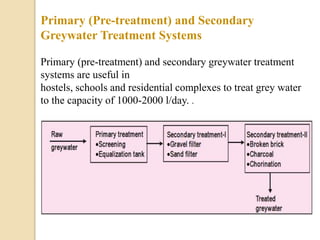
Primary (Pre-treatment) and Secondary
Greywater Treatment Systems
Primary (pre-treatment) and secondary greywater treatment
systems are useful in
hostels, schools and residential complexes to treat grey water
to the capacity of 1000-2000 l/day. .
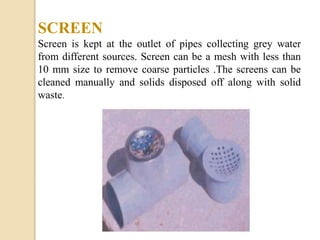
SCREEN
Screen is kept at the outlet of pipes collecting grey water
from different sources. Screen can be a mesh with less than
10 mm size to remove coarse particles .The screens can be
cleaned manually and solids disposed off along with solid
waste.
Equalization or settling tank
Grey water is continuously collected in the tank and
flows to filters for treatment. In addition to providing
constant load to the filter system it facilitates settling of
coarse particles (>10mm size).
Filter
The type of filter required for a greywater system depends
largely upon the amount of greywater to be filtered, the type
of contaminants present and end use.
In filtration, water is passed through a filter medium in order
to remove the particulate matter not previously removed by
sedimentation.
During filtration, the turbidity and colloidal matter of non-
settleable type protozoan cysts and helminth eggs are also
removed.
The Filter types are as below:
 Up flow – down flow filter
 Multi Media Filter
 Slow Sand Filter
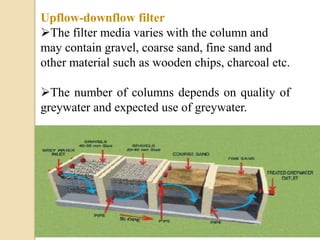
Upflow-downflow filter
The filter media varies with the column and
may contain gravel, coarse sand, fine sand and
other material such as wooden chips, charcoal etc.
The number of columns depends on quality of
greywater and expected use of greywater.
Multi-media filter
Multi-media filters are filled with a variety of media in
order of increasing size, for example , fine sand, coarse
sand, gravel, stone, and wood chips to a total depth of
0.75 m to 1 m.
The inlet is provided at the top so that the filtered water
is collected through outlet in the bottom. A vent is
provided at the top for letting out odorous emissions, if
generated in the filter.
 Media can be replaced periodically depending on the
grey water characteristics and quantity.
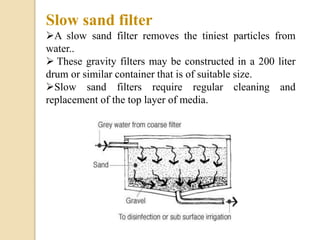
Slow sand filter
A slow sand filter removes the tiniest particles from
water..
 These gravity filters may be constructed in a 200 liter
drum or similar container that is of suitable size.
Slow sand filters require regular cleaning and
replacement of the top layer of media.
Collection Sump
A collection sump of an appropriate capacity to handle the
average daily generation of treated grey water is required
along with grey water treatment plant.
 Freeboard of 0.2-0.3 m should be provided in collection
sump.
Pump
 Various types of pumping mechanisms can be
employed in greywater reuse systems.
 These include manual as well as
electrical/mechanically operated pumps.
Due to lack of spare parts and fluctuation in electric
power supply in many rural buildings, it may be
appropriate to consider manually operated pumps.
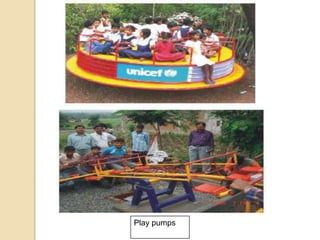
These may include force lift hand pumps, treddle
pumps or play pumps.
Play pumps
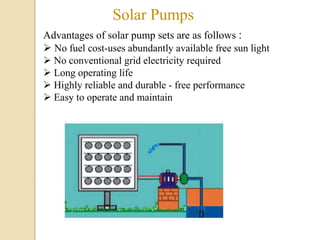
Solar Pumps
Advantages of solar pump sets are as follows :
 No fuel cost-uses abundantly available free sun light
 No conventional grid electricity required
 Long operating life
 Highly reliable and durable - free performance
 Easy to operate and maintain
Gray water reuse options
 Subsurface applications
• Irrigation
 Surface applications
• Irrigation
• Toilet flushing
• Cooling water
• Concrete water
• Fire sprinklers, hydrants
Sub-surface applications
Surface applications
Conclusions
For the purpose of landscaping, gardening, irrigations, plant
growths and toilet flushing.
 The benefits found are low energy demand, less operating and
maintenance cost, lower load on fresh water, less strain on
septic tank, highly effective purification, and ground water
recharge.
 So, this is an environmental friendly, without chemical
operation ,cost effective and resourceful plant for rural
development.
37

Slide gray wtr

  • 1.
  • 2.
    CONTENT  What isgrey water ?  Domestic water consumption for one person  Design Parameters for Grey water Reuse System  Grey water treatment & its reuse  Gray water reuse options  Conclusions
  • 3.
    WHAT IS GREYWATER? Greywater is the wastewater from: (a) Washing machines. (b) Laundry tubs. (c) Showers. (d) Basins. (e) Baths. (f) Kitchen sink Grey water is all water from house except from toilets and garbage disposal.
  • 4.
  • 5.
  • 6.
    Design Parameters forGreywater Reuse System Water availability/scarcity  Quantity of greywater  Land availability  Ground slope  Reuse type such as toilet flushing, gardening, floor washing etc.  Availability and cost of filter media
  • 7.
    GREYWATER TREATMENT AND REUSESYSTEM A number of technologies have been applied for greywater treatment worldwide varying in both complexity and performance. The following in general greywater systems considered :- Primary treatment - pre-treatment to secondary treatment  Equalization  Screening Secondary treatment  Gravel filtration  Sand filtration  Chlorination
  • 8.
    Primary Treatment Systems Greywater Diversion Devices
  • 9.
    Primary (Pre-treatment) andSecondary Greywater Treatment Systems Primary (pre-treatment) and secondary greywater treatment systems are useful in hostels, schools and residential complexes to treat grey water to the capacity of 1000-2000 l/day. .
  • 10.
    SCREEN Screen is keptat the outlet of pipes collecting grey water from different sources. Screen can be a mesh with less than 10 mm size to remove coarse particles .The screens can be cleaned manually and solids disposed off along with solid waste.
  • 11.
    Equalization or settlingtank Grey water is continuously collected in the tank and flows to filters for treatment. In addition to providing constant load to the filter system it facilitates settling of coarse particles (>10mm size).
  • 12.
    Filter The type offilter required for a greywater system depends largely upon the amount of greywater to be filtered, the type of contaminants present and end use. In filtration, water is passed through a filter medium in order to remove the particulate matter not previously removed by sedimentation. During filtration, the turbidity and colloidal matter of non- settleable type protozoan cysts and helminth eggs are also removed.
  • 13.
    The Filter typesare as below:  Up flow – down flow filter  Multi Media Filter  Slow Sand Filter
  • 14.
    Upflow-downflow filter The filtermedia varies with the column and may contain gravel, coarse sand, fine sand and other material such as wooden chips, charcoal etc. The number of columns depends on quality of greywater and expected use of greywater.
  • 15.
    Multi-media filter Multi-media filtersare filled with a variety of media in order of increasing size, for example , fine sand, coarse sand, gravel, stone, and wood chips to a total depth of 0.75 m to 1 m. The inlet is provided at the top so that the filtered water is collected through outlet in the bottom. A vent is provided at the top for letting out odorous emissions, if generated in the filter.  Media can be replaced periodically depending on the grey water characteristics and quantity.
  • 16.
    Slow sand filter Aslow sand filter removes the tiniest particles from water..  These gravity filters may be constructed in a 200 liter drum or similar container that is of suitable size. Slow sand filters require regular cleaning and replacement of the top layer of media.
  • 17.
    Collection Sump A collectionsump of an appropriate capacity to handle the average daily generation of treated grey water is required along with grey water treatment plant.  Freeboard of 0.2-0.3 m should be provided in collection sump.
  • 18.
    Pump  Various typesof pumping mechanisms can be employed in greywater reuse systems.  These include manual as well as electrical/mechanically operated pumps. Due to lack of spare parts and fluctuation in electric power supply in many rural buildings, it may be appropriate to consider manually operated pumps. These may include force lift hand pumps, treddle pumps or play pumps.
  • 19.
  • 20.
    Solar Pumps Advantages ofsolar pump sets are as follows :  No fuel cost-uses abundantly available free sun light  No conventional grid electricity required  Long operating life  Highly reliable and durable - free performance  Easy to operate and maintain
  • 21.
    Gray water reuseoptions  Subsurface applications • Irrigation  Surface applications • Irrigation • Toilet flushing • Cooling water • Concrete water • Fire sprinklers, hydrants
  • 22.
  • 23.
  • 24.
    Conclusions For the purposeof landscaping, gardening, irrigations, plant growths and toilet flushing.  The benefits found are low energy demand, less operating and maintenance cost, lower load on fresh water, less strain on septic tank, highly effective purification, and ground water recharge.  So, this is an environmental friendly, without chemical operation ,cost effective and resourceful plant for rural development.
  • 25.