DPEV 1103
VARIETIES OF ENGLISH
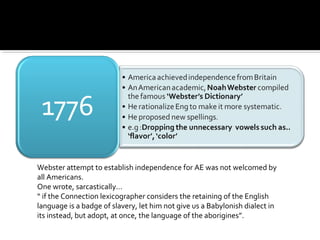
Webster attempt to establish independence for AE was not welcomed by
all Americans.
One wrote, sarcastically…
“ if the Connection lexicographer considers the retaining of the English
language is a badge of slavery, let him not give us a Babylonish dialect in
its instead, but adopt, at once, the language of the aborigines”.
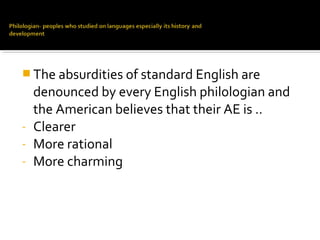
 The absurdities of standard English are
denounced by every English philologian and
the American believes that their AE is ..

- Clearer
- More rational
- More charming
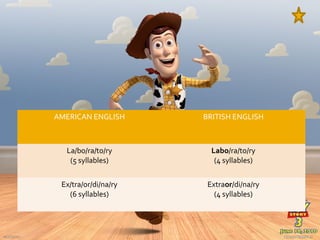
AMERICAN ENGLISH BRITISH ENGLISH
La/bo/ra/to/ry
(5 syllables)
Labo/ra/to/ry
(4 syllables)
Ex/tra/or/di/na/ry
(6 syllables)
Extraor/di/na/ry
(4 syllables)
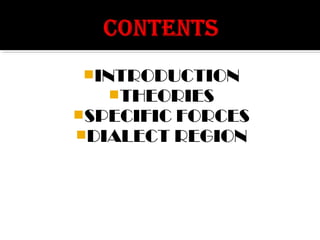
INTRODUCTION
THEORIES
SPECIFIC FORCES
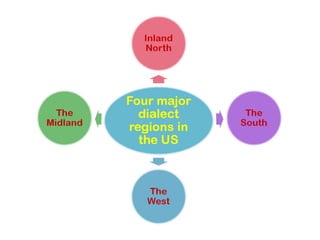
DIALECT REGION
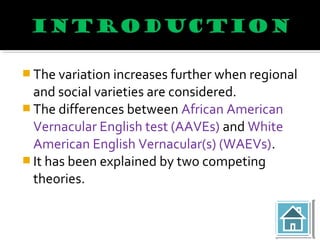
 The variation increases further when regional
and social varieties are considered.
 The differences between African American
Vernacular English test (AAVEs) and White
American English Vernacular(s) (WAEVs).
 It has been explained by two competing
theories.
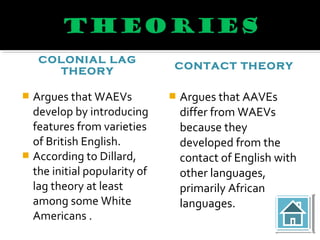
COLONIAL LAG
THEORY
 Argues that WAEVs
develop by introducing
features from varieties
of British English.
 According to Dillard,
the initial popularity of
lag theory at least
among some White
Americans .
CONTACT THEORY
 Argues that AAVEs
differ from WAEVs
because they
developed from the
contact of English with
other languages,
primarily African
languages.
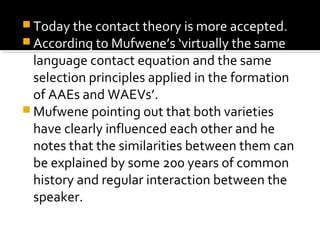
 Today the contact theory is more accepted.
 According to Mufwene’s ‘virtually the same
language contact equation and the same
selection principles applied in the formation
of AAEs and WAEVs’.
 Mufwene pointing out that both varieties
have clearly influenced each other and he
notes that the similarities between them can
be explained by some 200 years of common
history and regular interaction between the
speaker.
 In some cases the majority of the population
are not native to the community.
 The varieties of English spoken in
communities are likely undergo significant
change.
 In the early years, each settlement developed
different varieties.
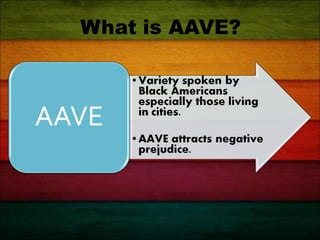
 A variety of different acronyms and terms are
used to describe certain varieties of American
English. For example:
 Black English Vernacular, African English
Vernacular, African American English, African
American Vernacular English and Ebonics.
 ‘Ebonics’ was a term originally created to
indicate that Black American English was
actually a variety of African languages rather
than a variety of English.
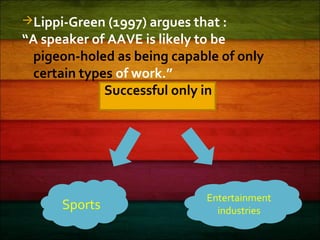
Lippi-Green (1997) argues that :
“A speaker of AAVE is likely to be
pigeon-holed as being capable of only
certain types of work.”
Successful only in
Sports
Entertainment
industries
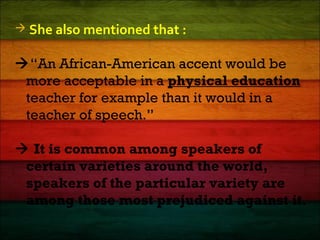
 She also mentioned that :
“An African-American accent would be
more acceptable in a physical education
teacher for example than it would in a
teacher of speech.”
 It is common among speakers of
certain varieties around the world,
speakers of the particular variety are
among those most prejudiced against it.
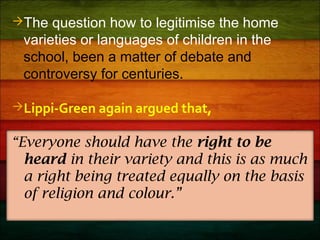
The question how to legitimise the home
varieties or languages of children in the
school, been a matter of debate and
controversy for centuries.
Lippi-Green again argued that,
“Everyone should have the right to be
heard in their variety and this is as much
a right being treated equally on the basis
of religion and colour.”
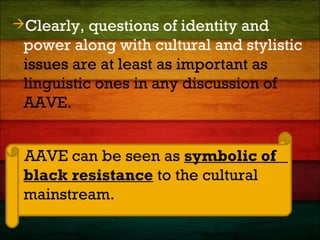
Clearly, questions of identity and
power along with cultural and stylistic
issues are at least as important as
linguistic ones in any discussion of
AAVE.
AAVE can be seen as symbolic of
black resistance to the cultural
mainstream.
are aimed at
allowing Black writers
to capture a distinctive
Black identity as
writers.
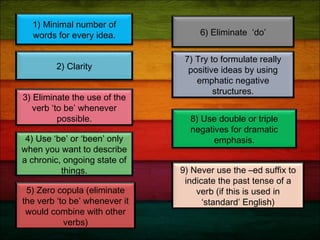
1) Minimal number of
words for every idea.
2) Clarity
5) Zero copula (eliminate
the verb ‘to be’ whenever it
would combine with other
verbs)
6) Eliminate ‘do’
7) Try to formulate really
positive ideas by using
emphatic negative
structures.
4) Use ‘be’ or ‘been’ only
when you want to describe
a chronic, ongoing state of
things.
3) Eliminate the use of the
verb ‘to be’ whenever
possible. 8) Use double or triple
negatives for dramatic
emphasis.
9) Never use the –ed suffix to
indicate the past tense of a
verb (if this is used in
‘standard’ English)
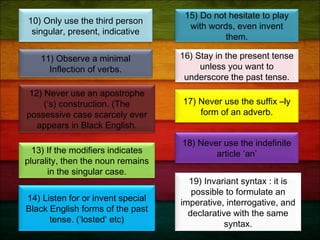
16) Stay in the present tense
unless you want to
underscore the past tense.
11) Observe a minimal
Inflection of verbs.
13) If the modifiers indicates
plurality, then the noun remains
in the singular case.
10) Only use the third person
singular, present, indicative
15) Do not hesitate to play
with words, even invent
them.
12) Never use an apostrophe
(‘s) construction. (The
possessive case scarcely ever
appears in Black English.
14) Listen for or invent special
Black English forms of the past
tense. (‘losted’ etc)
19) Invariant syntax : it is
possible to formulate an
imperative, interrogative, and
declarative with the same
syntax.
17) Never use the suffix –ly
form of an adverb.
18) Never use the indefinite
article ‘an’
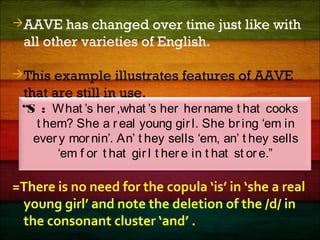
AAVE has changed over time just like with
all other varieties of English.
This example illustrates features of AAVE
that are still in use.
“S : What ’s her,what ’s her her name t hat cooks
t hem? She a r eal young girl. She bring ‘em in
ever y mor nin’. An’ t hey sells ‘em, an’ t hey sells
‘em f or t hat gir l t her e in t hat st ore.”
=There is no need for the copula ‘is’ in ‘she a real
young girl’ and note the deletion of the /d/ in
the consonant cluster ‘and’ .
 In AAVE, ‘-s’ inflection occurred in instances
of present tense 1st
singular and with the
present 3rd
plural.
 Jordan’s 4th
‘rule’ says that ‘be’ should only be
used to described a chronic, ongoing state of
things.
 For example:
‘If you don’t do nothing but farm work , your
social security don’t be nothing.’
‘If you only do farm work, then social security
isn’t usually very much.’
 In General American, ‘be’ often occurs with
the 1st
person singular pronoun and the
neutral 3rd
person singular.
 It’s use is compulsory in the past tense ‘was’
but ‘was’ is used for both singular and plural
subjects. For example:
‘Well, that’s the way it best’ (Well, that’s the
way it usually is).
 AAVE also creates a distinctive vocabulary by
according different meanings to words
commonly found in GA. For example:
 the verb ‘mash’ to mean ‘press’ as in ‘mash
the accelerator’ to mean press the
accelerator as hard as possible.
 AAVE has a wide range of distinctive
phonological features. Includes the non-use
of consonant clusters especially final
position. For example:
 ‘wes’ for ‘west’, ‘de’ for ‘the’.
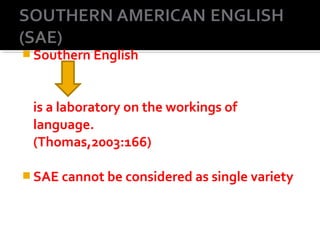
 Southern English
is a laboratory on the workings of
language.
(Thomas,2003:166)
 SAE cannot be considered as single variety
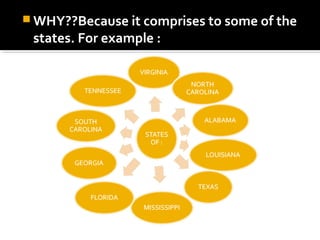
 WHY??Because it comprises to some of the
states. For example :
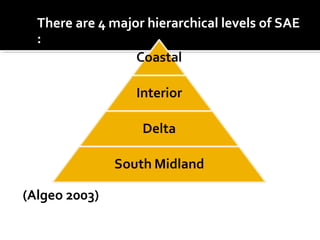
• There are 4 major hierarchical levels of SAE
:
(Algeo 2003)
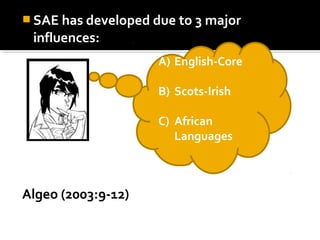
 SAE has developed due to 3 major
influences:
Algeo (2003:9-12)
A) English-Core
B) Scots-Irish
C) African
Languages
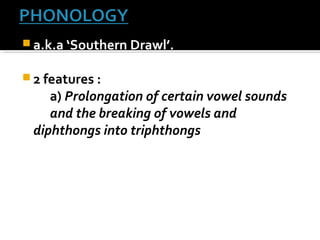
 a.k.a ‘Southern Drawl’.
 2 features :
a) Prolongation of certain vowel sounds
and the breaking of vowels and
diphthongs into triphthongs
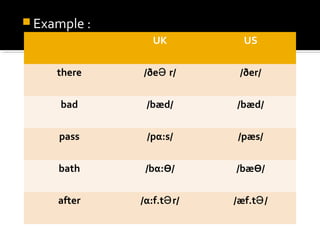
 Example :
UK US
there /ðe r/Ə /ðer/
bad /bæd/ /bæd/
pass /pα:s/ /pæs/
bath /bα:Ѳ/ /bæѲ/
after /α:f.t r/Ə /æf.t /Ə
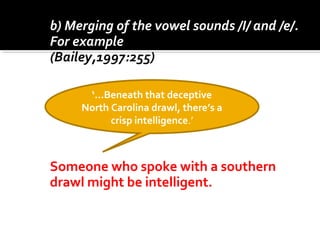
b) Merging of the vowel sounds /I/ and /e/.
For example ‘pin’ and ‘pen’.
(Bailey,1997:255)
Someone who spoke with a southern
drawl might be intelligent.
‘…Beneath that deceptive
North Carolina drawl, there’s a
crisp intelligence.’
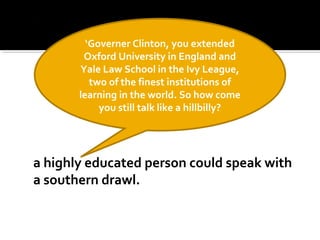
a highly educated person could speak with
a southern drawl.
‘Governer Clinton, you extended
Oxford University in England and
Yale Law School in the Ivy League,
two of the finest institutions of
learning in the world. So how come
you still talk like a hillbilly?
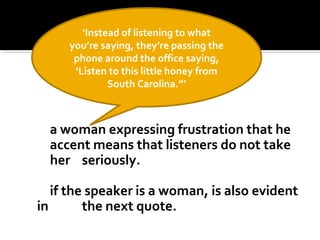
a woman expressing frustration that he
accent means that listeners do not take
her seriously.
if the speaker is a woman, is also evident
in the next quote.
‘Instead of listening to what
you’re saying, they’re passing the
phone around the office saying,
‘Listen to this little honey from
South Carolina.”’
the speaker is a woman who sells mailing
list over the phone. She is describing the
effect of her southern drawl has on men.
‘Its hilarious how these businessmen turn
to gravy when they hear it. I get some of
the most callous. And I start talking to
them in a mellow southern drawl. I saw
their heart rate down and I can sell them a
list in a heartbeat.’
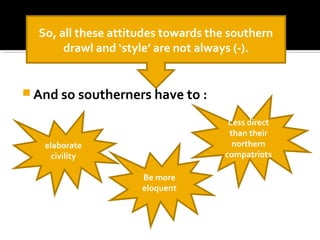
 And so southerners have to :
So, all these attitudes towards the southern
drawl and ‘style’ are not always (-).
elaborate
civility
Less direct
than their
northern
compatriots
Be more
eloquent
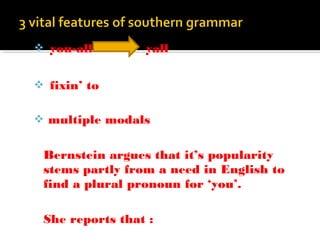
 you-all yall
 fixin’ to
 multiple modals
Bernstein argues that it’s popularity
stems partly from a need in English to
find a plural pronoun for ‘you’.
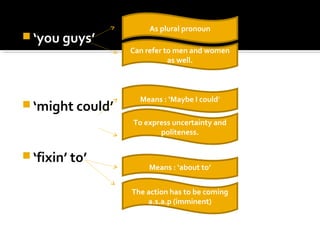
She reports that :
 ‘you guys’
 ‘might could’
 ‘fixin’ to’
As plural pronoun
Can refer to men and women
as well.
Means : ‘Maybe I could’
To express uncertainty and
politeness.
Means : ‘about to’
The action has to be coming
a.s.a.p (imminent)
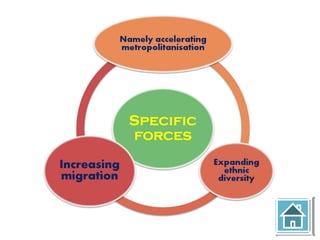
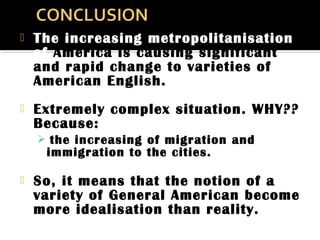
 The increasing metropolitanisation
of America is causing significant
and rapid change to varieties of
American English.
 Extremely complex situation. WHY??
Because:
 the increasing of migration and
immigration to the cities.
 So, it means that the notion of a
variety of General American become
more idealisation than reality.
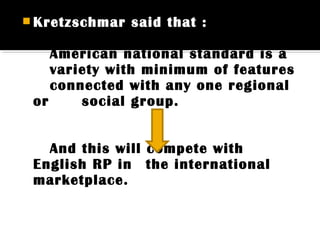
 Kretzschmar said that :
American national standard is a
variety with minimum of features
connected with any one regional
or social group.
And this will compete with
English RP in the international
marketplace.
 AMERICAN ENGLISH, Retrieved 17 January, 2011,
From
http://www.hawaii.edu/satocenter/langnet/definitio
ns/aave.html
 Dialect, Retrieved 17 January, 2011,
Fromhttp://www.cal.org/topics/dialects/aae.html

AMERICAN ENGLISH

  • 1.
  • 8.
    Webster attempt toestablish independence for AE was not welcomed by all Americans. One wrote, sarcastically… “ if the Connection lexicographer considers the retaining of the English language is a badge of slavery, let him not give us a Babylonish dialect in its instead, but adopt, at once, the language of the aborigines”.
  • 10.
     The absurditiesof standard English are denounced by every English philologian and the American believes that their AE is .. - Clearer - More rational - More charming
  • 17.
    AMERICAN ENGLISH BRITISHENGLISH La/bo/ra/to/ry (5 syllables) Labo/ra/to/ry (4 syllables) Ex/tra/or/di/na/ry (6 syllables) Extraor/di/na/ry (4 syllables)
  • 20.
  • 21.
     The variationincreases further when regional and social varieties are considered.  The differences between African American Vernacular English test (AAVEs) and White American English Vernacular(s) (WAEVs).  It has been explained by two competing theories.
  • 22.
    COLONIAL LAG THEORY  Arguesthat WAEVs develop by introducing features from varieties of British English.  According to Dillard, the initial popularity of lag theory at least among some White Americans . CONTACT THEORY  Argues that AAVEs differ from WAEVs because they developed from the contact of English with other languages, primarily African languages.
  • 23.
     Today thecontact theory is more accepted.  According to Mufwene’s ‘virtually the same language contact equation and the same selection principles applied in the formation of AAEs and WAEVs’.  Mufwene pointing out that both varieties have clearly influenced each other and he notes that the similarities between them can be explained by some 200 years of common history and regular interaction between the speaker.
  • 25.
     In somecases the majority of the population are not native to the community.  The varieties of English spoken in communities are likely undergo significant change.  In the early years, each settlement developed different varieties.
  • 27.
     A varietyof different acronyms and terms are used to describe certain varieties of American English. For example:  Black English Vernacular, African English Vernacular, African American English, African American Vernacular English and Ebonics.  ‘Ebonics’ was a term originally created to indicate that Black American English was actually a variety of African languages rather than a variety of English.
  • 30.
    Lippi-Green (1997) arguesthat : “A speaker of AAVE is likely to be pigeon-holed as being capable of only certain types of work.” Successful only in Sports Entertainment industries
  • 31.
     She alsomentioned that : “An African-American accent would be more acceptable in a physical education teacher for example than it would in a teacher of speech.”  It is common among speakers of certain varieties around the world, speakers of the particular variety are among those most prejudiced against it.
  • 32.
    The question howto legitimise the home varieties or languages of children in the school, been a matter of debate and controversy for centuries. Lippi-Green again argued that, “Everyone should have the right to be heard in their variety and this is as much a right being treated equally on the basis of religion and colour.”
  • 33.
    Clearly, questions ofidentity and power along with cultural and stylistic issues are at least as important as linguistic ones in any discussion of AAVE. AAVE can be seen as symbolic of black resistance to the cultural mainstream.
  • 34.
    are aimed at allowingBlack writers to capture a distinctive Black identity as writers.
  • 35.
    1) Minimal numberof words for every idea. 2) Clarity 5) Zero copula (eliminate the verb ‘to be’ whenever it would combine with other verbs) 6) Eliminate ‘do’ 7) Try to formulate really positive ideas by using emphatic negative structures. 4) Use ‘be’ or ‘been’ only when you want to describe a chronic, ongoing state of things. 3) Eliminate the use of the verb ‘to be’ whenever possible. 8) Use double or triple negatives for dramatic emphasis. 9) Never use the –ed suffix to indicate the past tense of a verb (if this is used in ‘standard’ English)
  • 36.
    16) Stay inthe present tense unless you want to underscore the past tense. 11) Observe a minimal Inflection of verbs. 13) If the modifiers indicates plurality, then the noun remains in the singular case. 10) Only use the third person singular, present, indicative 15) Do not hesitate to play with words, even invent them. 12) Never use an apostrophe (‘s) construction. (The possessive case scarcely ever appears in Black English. 14) Listen for or invent special Black English forms of the past tense. (‘losted’ etc) 19) Invariant syntax : it is possible to formulate an imperative, interrogative, and declarative with the same syntax. 17) Never use the suffix –ly form of an adverb. 18) Never use the indefinite article ‘an’
  • 37.
    AAVE has changedover time just like with all other varieties of English. This example illustrates features of AAVE that are still in use. “S : What ’s her,what ’s her her name t hat cooks t hem? She a r eal young girl. She bring ‘em in ever y mor nin’. An’ t hey sells ‘em, an’ t hey sells ‘em f or t hat gir l t her e in t hat st ore.” =There is no need for the copula ‘is’ in ‘she a real young girl’ and note the deletion of the /d/ in the consonant cluster ‘and’ .
  • 38.
     In AAVE,‘-s’ inflection occurred in instances of present tense 1st singular and with the present 3rd plural.  Jordan’s 4th ‘rule’ says that ‘be’ should only be used to described a chronic, ongoing state of things.  For example: ‘If you don’t do nothing but farm work , your social security don’t be nothing.’ ‘If you only do farm work, then social security isn’t usually very much.’
  • 39.
     In GeneralAmerican, ‘be’ often occurs with the 1st person singular pronoun and the neutral 3rd person singular.  It’s use is compulsory in the past tense ‘was’ but ‘was’ is used for both singular and plural subjects. For example: ‘Well, that’s the way it best’ (Well, that’s the way it usually is).
  • 40.
     AAVE alsocreates a distinctive vocabulary by according different meanings to words commonly found in GA. For example:  the verb ‘mash’ to mean ‘press’ as in ‘mash the accelerator’ to mean press the accelerator as hard as possible.  AAVE has a wide range of distinctive phonological features. Includes the non-use of consonant clusters especially final position. For example:  ‘wes’ for ‘west’, ‘de’ for ‘the’.
  • 42.
     Southern English isa laboratory on the workings of language. (Thomas,2003:166)  SAE cannot be considered as single variety
  • 43.
     WHY??Because itcomprises to some of the states. For example :
  • 44.
    • There are4 major hierarchical levels of SAE : (Algeo 2003)
  • 45.
     SAE hasdeveloped due to 3 major influences: Algeo (2003:9-12) A) English-Core B) Scots-Irish C) African Languages
  • 46.
     a.k.a ‘SouthernDrawl’.  2 features : a) Prolongation of certain vowel sounds and the breaking of vowels and diphthongs into triphthongs
  • 47.
     Example : UKUS there /ðe r/Ə /ðer/ bad /bæd/ /bæd/ pass /pα:s/ /pæs/ bath /bα:Ѳ/ /bæѲ/ after /α:f.t r/Ə /æf.t /Ə
  • 48.
    b) Merging ofthe vowel sounds /I/ and /e/. For example ‘pin’ and ‘pen’. (Bailey,1997:255) Someone who spoke with a southern drawl might be intelligent. ‘…Beneath that deceptive North Carolina drawl, there’s a crisp intelligence.’
  • 49.
    a highly educatedperson could speak with a southern drawl. ‘Governer Clinton, you extended Oxford University in England and Yale Law School in the Ivy League, two of the finest institutions of learning in the world. So how come you still talk like a hillbilly?
  • 50.
    a woman expressingfrustration that he accent means that listeners do not take her seriously. if the speaker is a woman, is also evident in the next quote. ‘Instead of listening to what you’re saying, they’re passing the phone around the office saying, ‘Listen to this little honey from South Carolina.”’
  • 51.
    the speaker isa woman who sells mailing list over the phone. She is describing the effect of her southern drawl has on men. ‘Its hilarious how these businessmen turn to gravy when they hear it. I get some of the most callous. And I start talking to them in a mellow southern drawl. I saw their heart rate down and I can sell them a list in a heartbeat.’
  • 52.
     And sosoutherners have to : So, all these attitudes towards the southern drawl and ‘style’ are not always (-). elaborate civility Less direct than their northern compatriots Be more eloquent
  • 53.
     you-all yall fixin’ to  multiple modals Bernstein argues that it’s popularity stems partly from a need in English to find a plural pronoun for ‘you’. She reports that :
  • 54.
     ‘you guys’ ‘might could’  ‘fixin’ to’ As plural pronoun Can refer to men and women as well. Means : ‘Maybe I could’ To express uncertainty and politeness. Means : ‘about to’ The action has to be coming a.s.a.p (imminent)
  • 55.
     The increasingmetropolitanisation of America is causing significant and rapid change to varieties of American English.  Extremely complex situation. WHY?? Because:  the increasing of migration and immigration to the cities.  So, it means that the notion of a variety of General American become more idealisation than reality.
  • 56.
     Kretzschmar saidthat : American national standard is a variety with minimum of features connected with any one regional or social group. And this will compete with English RP in the international marketplace.
  • 57.
     AMERICAN ENGLISH,Retrieved 17 January, 2011, From http://www.hawaii.edu/satocenter/langnet/definitio ns/aave.html  Dialect, Retrieved 17 January, 2011, Fromhttp://www.cal.org/topics/dialects/aae.html