COMPOSING
TEXTS WITH
MULTIMODAL
A PRESENTATION PREPARED BY GROUP 5
WHAT IS A
MULTIMOD
AL TEXT?
MULTIMODAL
TEXTS
As we communicate, we use different
processes or what we called modes to
further convey the meaning/message of
the text whether it is oral or written. A
text maybe defined as multimodal when
it combines two or more modes to
present information.
What are the
multimodal texts
presented in the
previous activities?
How are they being
4 PICS AND 1 WORD
SITEWEB
4 PICS AND 1 WORD
WEBSITE
WEBSIT
E
WEBSITE
The first image is a screenshot from a
Year 5 student's project on 'Food,
fitness and photos' presented as a
web site using Wipasnapa, a very
easy to use web site creation tool.
WEBSITE
The task had a dual learning focus on
food and fitness, along with photography
and the strategic use of images to convey
meaning. The completed project included
user generated (original) video and audio
content, photographs and print.
4 PICS AND 1 WORD
RESOPT
4 PICS AND 1 WORD
POSTER
POSTER
POSTER
The second image is a film poster
used to promote and advertise a film
primarily to persuade paying
customers into a theatre to see it.
There are different types of posters
which students can be asked to
produce.
It is important to attend to the
differences in purpose for each poster
type and to identify the specific text
structures, visual design and language
features for each.
A poster is a large sheet that is placed
either on a public space to promote
something or on a wall as decoration.
Posters are also used for reproductions
of artwork, particularly famous works,
and are generally low-cost compared to
the original artwork. Typically, posters
include both textual and graphic
elements, although a poster may be
either wholly graphical or wholly text.
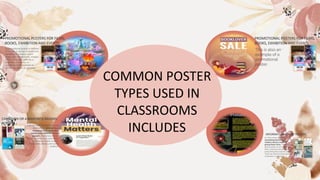
COMMON
POSTER TYPES
USED IN
CLASSROOMS
INCLUDES
COMMON POSTER
TYPES USED IN
CLASSROOMS
INCLUDES
PROMOTIONAL POSTERS FOR
FILMS, BOOKS, EXHIBITION
AND EVENTS
A promotional poster is defined
as a type of poster created and
designed in various colors,
materials, mechanisms, shapes,
sizes, and styles used by a
business, company, or
organization to promote its
goods, products, or services.
PROMOTIONAL POSTERS FOR
FILMS, BOOKS, EXHIBITION
AND EVENTS
This is also an
example of a
promotional
poster.
a design which contains images
and texts for promoting a
campaign or a cause that
needs more attention from
people. Awareness Poster
Design is commonly used when it
comes to charity events,
fundraisers, drives, and social
projects.
CAMPAIGN OR AWARENESS
RAISING POSTERS
INFORMATION REPORT
POSTERS
an information report is
something that informs
readers about a topic by
giving them facts. They can be
about pretty much anything, from
a famous person to a non-living
thing like a planet or city. They
can also be about groups of
people or objects.
4 PICS 1 WORD
LINGLRYSTOTE LATIGID
4 PICS 1 WORD
DIGITAL STORYTELLING
DIGITAL
STORYTELLI
NG
DIGITAL STORYTELLI
The third material is an example of
digital storytelling. It brings the
ancient tradition of oral storytelling
and new technologies together in a
powerful, interdisciplinary learning
process.
Through digital storytelling, we
can weave together video,
photos, art, music, narration,
print, and sound effects using
simple multimedia publishing
tools to tell our stories.
A digital story is short usually, one
to three minutes in length,
narrated in first person using your
own voice. Still images are
commonly used with camera tools
used to frame the shot.
and to pan across the photograph, or
zoom in or out, creating a sense of
movement within an image and
across a sequence of images. Music
and sound effects are added for
dramatic effect and to add emotional
tone. Moving image can also be
used.
As presented, there are numerous
types of multimodal texts. As a
student, you need to be equipped
with clear accessible literacy
teaching guidelines and an explicit
supportive pedagogy to help you
develop the necessary skills and
knowledge to successfully construct
(and interpret) multimodal meaning.
HOW DO I
CREATE A
MULTIMODAL
TEXT?
As with writing, multimodal
composing is a process and
should not only emphasize the
final result. Therefore, the first
three strategies listed below are
pre- drafting activities
01 Determine your rhetorical situation
02 Review and analyze other
multimodal texts.
03
04 Cite and attribute information
appropriately.
Gather content, media, and
tools.
05 Begin drafting your text.
RHETORICAL
RHETORICAL SITUATI
A piece of writing is shaped and
influenced by its surrounding
circumstances and contexts. The
rhetorical situation can be described
in five parts: purpose, audience,
topic, writer, and context
These parts work together to better
describe the circumstances and
contexts of a piece of writing, which if
understood properly, can help you
make smart writing choices in your
work.
5 COMPONENTS
OF RHETORICAL
SITUATION
THE
MESSAGE
This relates to your purpose,
and you might ask yourself,
what am I trying to accomplish?
You should try to make the
message as clear and specific
An unclear message might be
getting more people to donate to
charities." A clearer message is
"convincing your fellow students to
donate through your website
because the audience and purpose
THE
AUDIENCE
THERE ARE TWO
TYPES OF
AUDIENCES
An intended audience, who you target in
your message, and an unintentional
audience, who may stumble upon your text.
When determining your message, you want
to consider the beliefs, values, and
demographics of your intended audience as
well as the likelihood that unintentional
audiences will interact with your text.
Using the example, your fellow
students are the intended audience,
and teachers, parents, and/or
students
from other schools or people in your
community represent unintentional
audience members.
THE
AUTHOR
You are the author and should
consider
your relationship to the message and
audience. As an author, you bring
explicit (obvious) and/or implicit (not
obvious) biases to your message, so it
is important
to recognize how these might affect it
Also, you may be targeting an
audience you are familiar with
or not. It is important to think
about how your familiarity
might affect
THE GENRE
In the context of multimodal
composing, genre refers to a
type of text that has genre
conventions, or audience
expectations.
For example, if you are creating a
website (the genre), an audience
would expect the following conventions
an easy-to-navigate toolbar, functional
tabs, hyperlinks, and images. Yet,
when thinking about genre, it is more
useful to think specifically.
If you are creating a website for
horror film fans (the specific genre),
then the audience. would expect the
following genre conventions:
references, images, and sounds
associated with horror films,
directors, actors, actresses,
THE
MEDIUM
While genre is the type of text you
want to create: the medium refers to
where you will distribute it. Classic
media (plural for medium) includes
distribution via radio, newspapers,
magazines, and television; however,
new media is defined by a text's online
Importantly, medium refers to
where you will distribute your
text but not how. The how refers
to the technology tools you'll
use to create the text and
possibly to distribute it.
For example, to create a podcast,
you might use your smartphone (a
tool) to record, a free sound editor
like Audacity (another tool) to edit
it, and Soundcloud (a tool and the
medium) to distribute it.
QUESTION
S:
1.) A ____ is a large sheet that is
placed either on a public space to
promote something or on a wall as a
decoration.
A. Website
B. Multimodal text
C. Poster
D. Digital story telling
2.) A text maybe defined as ____
when it combines two or more
modes to present information.
Multimodal
B. Multiply
C. Multitasking
D. Muntinlupa
3.) What type of Poster is used by a
business, company or organization to
promote its goods, products, or services?
A. Campaign or Awareness Raising Posters
B. Information Report Posters
C. Promotional Posters For Film, Books,
Exhibition or Events a
D. Digital Story telling
4.) Through _______, we can weave
together video, photos, art, music,
narration, print, and sound effects using
simple multimedia publishing tools to tell
our stories.
A. Photoshop
B. Digital storytelling
C. Digital cartooning
D. Digital art
5. _____ refers to where you will
distribute your text but not how.
A. Website
B. Poster
C. The Medium
D. The Message
6. An _____, who you
target in your message.
A. Unintentional Audience
B. Intended Audience
C. Rhetorical Situation
D. Website
7._____ a piece of writing is shaped
and influenced by its surrounding
circumstances and contexts.
A. Rhetorical Situation
B. Multimodal Text
C. Digital Story Telling
D. Poster
8. What are the 5 components of Rhetorical
Situation?
A. The Messages, The Audience, The Author,
The Genre, The Medium
B. The Message, The Audience, The Author,
The Genre, The Website
C. The Message, The Audience, The Author,
The Genre, The Multimodal Text
D. The Message, The Audience, The Author,
The Genre, The Poster
9. How many Components
of Rhetorical Situation?
A. 4
B. 5
C. 6
D. 3
10. What are the two types of Audience?
A. Audience Intended and Audience
Unintended
B. Website Audience and Poster Audience
C. Author Audience and Medium Audience
D. Intended Audience and Unintentional
Audience
11. In the context of multimodal
composing, ______ refers to a type
of fext that has _____ conventions,
expectations or audience.
A. Poster
B. The Message
C. The Genre
D. Digital
12. _____ the task had a dual learning
focus on food and fitness, along with
photography and the strategic use of
images to convey meaning.
A. Multimodal
B. The Medium
C. Website
D. Message
1. C
2. A
3. C
4. B
5. C
6. B
7. A
8. A
9. B
10. D
11. C
12. C
ANSWER KEY:
AND FOR THE LAST 3
QUESTIONS PLEASE
CHOOSE A
REPRESENTATIVE FOR THE
FOLLOWING QNA
THANK YOU FOR
LISTENING WE HOPE YOU
LEARNED SOMETHING!

ENGLISH 10 Composing text with multimodal elements.pptx

  • 1.
  • 2.
  • 3.
    MULTIMODAL TEXTS As we communicate,we use different processes or what we called modes to further convey the meaning/message of the text whether it is oral or written. A text maybe defined as multimodal when it combines two or more modes to present information.
  • 4.
    What are the multimodaltexts presented in the previous activities? How are they being
  • 5.
    4 PICS AND1 WORD SITEWEB
  • 6.
    4 PICS AND1 WORD WEBSITE
  • 7.
  • 8.
    WEBSITE The first imageis a screenshot from a Year 5 student's project on 'Food, fitness and photos' presented as a web site using Wipasnapa, a very easy to use web site creation tool.
  • 10.
    WEBSITE The task hada dual learning focus on food and fitness, along with photography and the strategic use of images to convey meaning. The completed project included user generated (original) video and audio content, photographs and print.
  • 11.
    4 PICS AND1 WORD RESOPT
  • 12.
    4 PICS AND1 WORD POSTER
  • 13.
  • 14.
    POSTER The second imageis a film poster used to promote and advertise a film primarily to persuade paying customers into a theatre to see it. There are different types of posters which students can be asked to produce.
  • 15.
    It is importantto attend to the differences in purpose for each poster type and to identify the specific text structures, visual design and language features for each. A poster is a large sheet that is placed either on a public space to promote something or on a wall as decoration.
  • 16.
    Posters are alsoused for reproductions of artwork, particularly famous works, and are generally low-cost compared to the original artwork. Typically, posters include both textual and graphic elements, although a poster may be either wholly graphical or wholly text.
  • 17.
  • 18.
    COMMON POSTER TYPES USEDIN CLASSROOMS INCLUDES
  • 19.
    PROMOTIONAL POSTERS FOR FILMS,BOOKS, EXHIBITION AND EVENTS A promotional poster is defined as a type of poster created and designed in various colors, materials, mechanisms, shapes, sizes, and styles used by a business, company, or organization to promote its goods, products, or services.
  • 20.
    PROMOTIONAL POSTERS FOR FILMS,BOOKS, EXHIBITION AND EVENTS This is also an example of a promotional poster.
  • 21.
    a design whichcontains images and texts for promoting a campaign or a cause that needs more attention from people. Awareness Poster Design is commonly used when it comes to charity events, fundraisers, drives, and social projects. CAMPAIGN OR AWARENESS RAISING POSTERS
  • 22.
    INFORMATION REPORT POSTERS an informationreport is something that informs readers about a topic by giving them facts. They can be about pretty much anything, from a famous person to a non-living thing like a planet or city. They can also be about groups of people or objects.
  • 23.
    4 PICS 1WORD LINGLRYSTOTE LATIGID
  • 24.
    4 PICS 1WORD DIGITAL STORYTELLING
  • 25.
  • 26.
    DIGITAL STORYTELLI The thirdmaterial is an example of digital storytelling. It brings the ancient tradition of oral storytelling and new technologies together in a powerful, interdisciplinary learning process.
  • 27.
    Through digital storytelling,we can weave together video, photos, art, music, narration, print, and sound effects using simple multimedia publishing tools to tell our stories.
  • 28.
    A digital storyis short usually, one to three minutes in length, narrated in first person using your own voice. Still images are commonly used with camera tools used to frame the shot.
  • 29.
    and to panacross the photograph, or zoom in or out, creating a sense of movement within an image and across a sequence of images. Music and sound effects are added for dramatic effect and to add emotional tone. Moving image can also be used.
  • 30.
    As presented, thereare numerous types of multimodal texts. As a student, you need to be equipped with clear accessible literacy teaching guidelines and an explicit supportive pedagogy to help you develop the necessary skills and knowledge to successfully construct (and interpret) multimodal meaning.
  • 31.
    HOW DO I CREATEA MULTIMODAL TEXT?
  • 32.
    As with writing,multimodal composing is a process and should not only emphasize the final result. Therefore, the first three strategies listed below are pre- drafting activities
  • 33.
    01 Determine yourrhetorical situation 02 Review and analyze other multimodal texts.
  • 34.
    03 04 Cite andattribute information appropriately. Gather content, media, and tools. 05 Begin drafting your text.
  • 35.
  • 36.
    RHETORICAL SITUATI A pieceof writing is shaped and influenced by its surrounding circumstances and contexts. The rhetorical situation can be described in five parts: purpose, audience, topic, writer, and context
  • 37.
    These parts worktogether to better describe the circumstances and contexts of a piece of writing, which if understood properly, can help you make smart writing choices in your work.
  • 38.
  • 39.
  • 40.
    This relates toyour purpose, and you might ask yourself, what am I trying to accomplish? You should try to make the message as clear and specific
  • 41.
    An unclear messagemight be getting more people to donate to charities." A clearer message is "convincing your fellow students to donate through your website because the audience and purpose
  • 42.
  • 43.
    THERE ARE TWO TYPESOF AUDIENCES
  • 44.
    An intended audience,who you target in your message, and an unintentional audience, who may stumble upon your text. When determining your message, you want to consider the beliefs, values, and demographics of your intended audience as well as the likelihood that unintentional audiences will interact with your text.
  • 45.
    Using the example,your fellow students are the intended audience, and teachers, parents, and/or students from other schools or people in your community represent unintentional audience members.
  • 46.
  • 47.
    You are theauthor and should consider your relationship to the message and audience. As an author, you bring explicit (obvious) and/or implicit (not obvious) biases to your message, so it is important to recognize how these might affect it
  • 48.
    Also, you maybe targeting an audience you are familiar with or not. It is important to think about how your familiarity might affect
  • 49.
  • 50.
    In the contextof multimodal composing, genre refers to a type of text that has genre conventions, or audience expectations.
  • 51.
    For example, ifyou are creating a website (the genre), an audience would expect the following conventions an easy-to-navigate toolbar, functional tabs, hyperlinks, and images. Yet, when thinking about genre, it is more useful to think specifically.
  • 52.
    If you arecreating a website for horror film fans (the specific genre), then the audience. would expect the following genre conventions: references, images, and sounds associated with horror films, directors, actors, actresses,
  • 53.
  • 54.
    While genre isthe type of text you want to create: the medium refers to where you will distribute it. Classic media (plural for medium) includes distribution via radio, newspapers, magazines, and television; however, new media is defined by a text's online
  • 55.
    Importantly, medium refersto where you will distribute your text but not how. The how refers to the technology tools you'll use to create the text and possibly to distribute it.
  • 56.
    For example, tocreate a podcast, you might use your smartphone (a tool) to record, a free sound editor like Audacity (another tool) to edit it, and Soundcloud (a tool and the medium) to distribute it.
  • 57.
  • 58.
    1.) A ____is a large sheet that is placed either on a public space to promote something or on a wall as a decoration. A. Website B. Multimodal text C. Poster D. Digital story telling
  • 59.
    2.) A textmaybe defined as ____ when it combines two or more modes to present information. Multimodal B. Multiply C. Multitasking D. Muntinlupa
  • 60.
    3.) What typeof Poster is used by a business, company or organization to promote its goods, products, or services? A. Campaign or Awareness Raising Posters B. Information Report Posters C. Promotional Posters For Film, Books, Exhibition or Events a D. Digital Story telling
  • 61.
    4.) Through _______,we can weave together video, photos, art, music, narration, print, and sound effects using simple multimedia publishing tools to tell our stories. A. Photoshop B. Digital storytelling C. Digital cartooning D. Digital art
  • 62.
    5. _____ refersto where you will distribute your text but not how. A. Website B. Poster C. The Medium D. The Message
  • 63.
    6. An _____,who you target in your message. A. Unintentional Audience B. Intended Audience C. Rhetorical Situation D. Website
  • 64.
    7._____ a pieceof writing is shaped and influenced by its surrounding circumstances and contexts. A. Rhetorical Situation B. Multimodal Text C. Digital Story Telling D. Poster
  • 65.
    8. What arethe 5 components of Rhetorical Situation? A. The Messages, The Audience, The Author, The Genre, The Medium B. The Message, The Audience, The Author, The Genre, The Website C. The Message, The Audience, The Author, The Genre, The Multimodal Text D. The Message, The Audience, The Author, The Genre, The Poster
  • 66.
    9. How manyComponents of Rhetorical Situation? A. 4 B. 5 C. 6 D. 3
  • 67.
    10. What arethe two types of Audience? A. Audience Intended and Audience Unintended B. Website Audience and Poster Audience C. Author Audience and Medium Audience D. Intended Audience and Unintentional Audience
  • 68.
    11. In thecontext of multimodal composing, ______ refers to a type of fext that has _____ conventions, expectations or audience. A. Poster B. The Message C. The Genre D. Digital
  • 69.
    12. _____ thetask had a dual learning focus on food and fitness, along with photography and the strategic use of images to convey meaning. A. Multimodal B. The Medium C. Website D. Message
  • 70.
    1. C 2. A 3.C 4. B 5. C 6. B 7. A 8. A 9. B 10. D 11. C 12. C ANSWER KEY:
  • 71.
    AND FOR THELAST 3 QUESTIONS PLEASE CHOOSE A REPRESENTATIVE FOR THE FOLLOWING QNA
  • 72.
    THANK YOU FOR LISTENINGWE HOPE YOU LEARNED SOMETHING!