CREATING MULTIMODAL
TEXTS
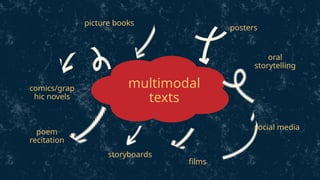
Multimodal textscombine two or more modes
such as written language, spoken language, visual
(still and moving image), audio, gestural, and spatial
meaning (The New London Group, 2000; Cope and
Kalantzis, 2009).
Creating digital multimodal texts involves the use of
communication technologies, however, multimodal
texts can also be paper-based or live performances.
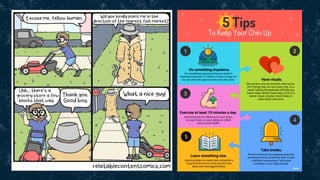
• Include comics/graphicnovels, picture books,
newspapers, brochures, print advertisements,
posters, storyboards, digital slide presentations
(e.g. PowerPoint), e-posters, e-books, and social
media.
• Meaning is conveyed to the reader through
varying combinations of written language, visual,
gestural, and spatial modes.
Simple multimodal texts
16.
Live multimodal texts
Includedance, performance, oral
storytelling, and presentations. Meaning
is conveyed through combinations of
various modes such as gestural, spatial,
audio, and oral language.
17.
Complex digital multimodaltexts
Complex digital multimodal texts include live-action
films, animations, digital stories, web pages, book
trailers, documentaries, music videos. Meaning is
conveyed through dynamic combinations of various
modes across written and spoken language, visual
(still and moving image), audio, gesture (acting), and
spatial semiotic resources. Producing these texts also
requires skills with more sophisticated digital
communication technologies.
a type oftext combining words and images—essentially a
comic, although the term most commonly refers to a complete
story presented as a book rather than a periodical.
comics/graphic novels
is a book, typically for children, in which the illustrations are as
important as—or more important than—the words in telling
the story. Picture books have traditionally been 32 pages long.
In picture books, there are illustrations on every page or on one
page of every pair of facing pages.
picture books
20.
A large printedpicture, photograph, or notice that you stick or
pin to a wall or board, usually for decoration or to advertise
something.
posters
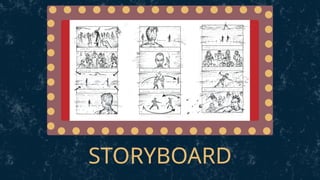
A storyboard is a visual representation of a film sequence and
breaks down the action into individual panels. It is a series of
ordered drawings, with camera direction, dialogue, or other
pertinent details. It sketches out how a video will unfold, shot
by shot.
storyboards
21.
Social media refersto a variety of technologies that facilitate the sharing
of ideas and information among their users. Some well-known platforms
are Facebook, X (formerly known as Twitter), Instagram, and Youtube.
social media
is the act of telling a story using words or actions. It is a form of
communication that involves a storyteller and a listener. Because both a
storyteller and a listener are necessary elements in the storytelling
definition, telling stories can also be considered an interactive art form.
Stories can be relayed through writing or through speaking. Oral storytelling
was the first type of storytelling and existed long before humans developed
written language.
storyboards
22.
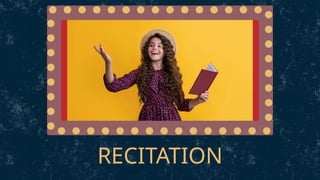
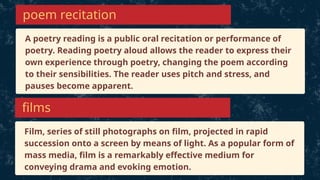
A poetry readingis a public oral recitation or performance of
poetry. Reading poetry aloud allows the reader to express their
own experience through poetry, changing the poem according
to their sensibilities. The reader uses pitch and stress, and
pauses become apparent.
poem recitation
Film, series of still photographs on film, projected in rapid
succession onto a screen by means of light. As a popular form of
mass media, film is a remarkably effective medium for
conveying drama and evoking emotion.
films
24.
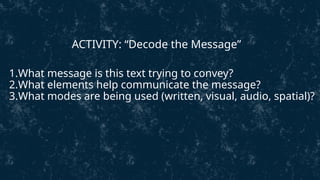
1.What message isthis text trying to convey?
2.What elements help communicate the message?
3.What modes are being used (written, visual, audio, spatial)?
ACTIVITY: “Decode the Message”
25.
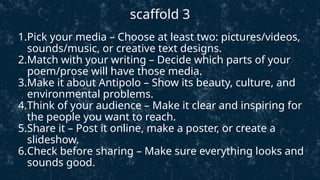
1.Pick your media– Choose at least two: pictures/videos,
sounds/music, or creative text designs.
2.Match with your writing – Decide which parts of your
poem/prose will have those media.
3.Make it about Antipolo – Show its beauty, culture, and
environmental problems.
4.Think of your audience – Make it clear and inspiring for
the people you want to reach.
5.Share it – Post it online, make a poster, or create a
slideshow.
6.Check before sharing – Make sure everything looks and
sounds good.
scaffold 3
26.
1. Add MultimediaElements – You’ll choose at least two
types of media (pictures, videos, sounds, creative text
design) to combine with your writing. These extra elements
should match your message and make it stronger.
Example: If your poem talks about Antipolo’s nature, you
might use photos of its parks and soft background music.
2. Plan Where They Go – You’ll decide which lines or parts
of your piece will have visuals, sounds, or special text
effects. You’ll also explain why these elements will make the
message clearer and more emotional.
scaffold 3
27.
3. Show Antipolo’sStory – The images, sounds, and
designs you choose should highlight Antipolo’s unique
beauty, culture, and environmental challenges, especially
the plastic waste issue.
4. Think About Your Audience – You’ll make sure your
work is easy to understand and inspiring for the people
who will see it (like the Antipolo community or local
leaders).
5. Plan How to Share It – You’ll decide the best way to
“publish” your work, like a social media video, a poster with
a QR code linking to an audio recording, or an online
slideshow.
6. Test & Finalize – Before sharing, you’ll make sure
everything looks and sounds good and works smoothly
without errors.