ISE Ethics in Engineering 5th Edition Mike Martin Prof.
ISE Ethics in Engineering 5th Edition Mike Martin Prof.
ISE Ethics in Engineering 5th Edition Mike Martin Prof.
ISE Ethics in Engineering 5th Edition Mike Martin Prof.
ISE Ethics in Engineering 5th Edition Mike Martin Prof.
1.
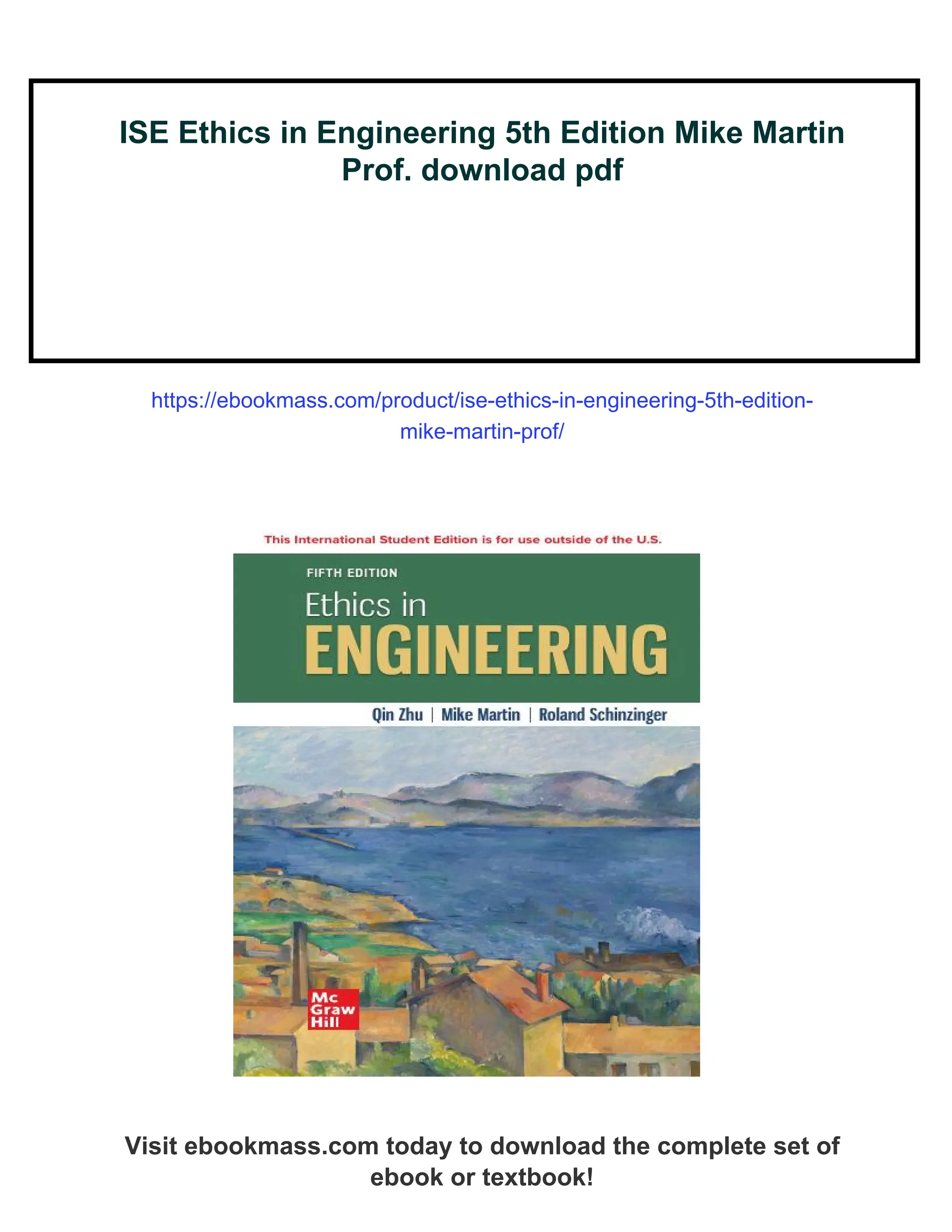
ISE Ethics inEngineering 5th Edition Mike Martin
Prof. download pdf
https://ebookmass.com/product/ise-ethics-in-engineering-5th-edition-
mike-martin-prof/
Visit ebookmass.com today to download the complete set of
ebook or textbook!
2.
We have selectedsome products that you may be interested in
Click the link to download now or visit ebookmass.com
for more options!.
ISE Principles of Statistics for Engineers and Scientists
(ISE HED IRWIN INDUSTRIAL ENGINEERING) 2nd Edition William
Navidi Prof.
https://ebookmass.com/product/ise-principles-of-statistics-for-
engineers-and-scientists-ise-hed-irwin-industrial-engineering-2nd-
edition-william-navidi-prof/
ISE MATLAB for Engineering Applications 5th Edition
William Palm
https://ebookmass.com/product/ise-matlab-for-engineering-
applications-5th-edition-william-palm/
MATLAB for Engineering Applications, 5e ISE 5th/ISE
Edition William J. Palm Iii
https://ebookmass.com/product/matlab-for-engineering-
applications-5e-ise-5th-ise-edition-william-j-palm-iii/
Ethics for Engineers Martin Peterson
https://ebookmass.com/product/ethics-for-engineers-martin-peterson/
3.
Global Strategy, 5thEdition Mike W. Peng
https://ebookmass.com/product/global-strategy-5th-edition-mike-w-peng/
The Ethics of Artificial Intelligence_ Principles,
Challenges, and Opportunities Prof Luciano Floridi
https://ebookmass.com/product/the-ethics-of-artificial-intelligence_-
principles-challenges-and-opportunities-prof-luciano-floridi/
ISE Statics and Mechanics of Materials (ISE HED MECHANICAL
ENGINEERING) 3rd Edition Ferdinand P. Beer
https://ebookmass.com/product/ise-statics-and-mechanics-of-materials-
ise-hed-mechanical-engineering-3rd-edition-ferdinand-p-beer/
Chemistry: Atoms First ISE 5th Edition Julia Burdge
https://ebookmass.com/product/chemistry-atoms-first-ise-5th-edition-
julia-burdge/
ISE An Introduction to Business Ethics 7th Edition Joseph
R. Desjardins
https://ebookmass.com/product/ise-an-introduction-to-business-
ethics-7th-edition-joseph-r-desjardins/
7.
Page i
ETHICS INENGINEERING
FIFTH EDITION
Qin Zhu
Assistant Professor of Humanities, Arts & Social Sciences
Colorado School of Mines
Mike W. Martin
Professor of Philosophy
Chapman University
Roland Schinzinger
Professor Emeritus of Electrical Engineering
University of California, Irvine
Page iii
Page iv
ABOUTTHE AUTHORS
Qin Zhu is Assistant Professor of Ethics and Engineering Education in the Department of
Humanities, Arts & Social Sciences and an affiliate faculty member in the Department of
Engineering, Design & Society and the Robotics Graduate Program at the Colorado School
of Mines. Dr. Zhu is Editor for International Perspectives at the Online Ethics Center for
Engineering and Science, Associate Editor for Engineering Studies, Program Chair of
American Society for Engineering Education’s Division of Engineering Ethics (2020–2021),
Executive Committee Member of the Society for Ethics Across the Curriculum, and
Treasurer of the Society for Philosophy and Technology. Dr. Zhu’s research interests include
the cultural foundations of engineering ethics, global engineering education, and ethics and
policy of computing technologies and robotics.
Mike W. Martin and Roland Schinzinger participated as a philosopher-engineer team in the
National Project on Philosophy and Engineering Ethics, 1978–1980. Since then they have
coauthored articles, team-taught courses, and given presentations to audiences of engineers
and philosophers. In 1992 they received the Award for Distinguished Literary Contributions
Furthering Engineering Professionalism from The Institute of Electrical and Electronics
Engineers, United States Activities Board.
Mike W. Martin received his B.S. (Phi Beta Kappa, Phi Kappa Phi) and M.A. from the
University of Utah, and his Ph.D. from the University of California, Irvine, and he is
currently professor of philosophy at Chapman University. In addition to publishing many
articles, he is author, coauthor, or editor of eight books, including Meaningful Work:
Rethinking Professional Ethics (2000) and Everyday Morality (3rd ed., 2001). He received the
Arnold L. and Lois S. Graves Award for Teachers in the Humanities and two fellowships
from the National Endowment for the Humanities.
Roland Schinzinger received his B.S., M.S., and Ph.D. in electrical engineering from
the University of California at Berkeley. Born and raised in Japan where he had industrial
experience with Bosch-Japan, Tsurumi Shipyard of Nippon Steel Tube Co., and Far Eastern
Equipment Co., he worked in the United States as design/development engineer at
10.
Westinghouse Electric Corp.and taught at the University of Pittsburgh and at Robert
College/Bosporus University (in Istanbul). He was a founding faculty member to the
University of California at Irvine, from which he retired as Professor Emeritus of Electrical
Engineering in 1993. He authored or co-authored Conformal Mapping: Methods and
Applications (1991, 2003), Emergencies in Water Delivery (1979), and Experiments in
Electricity and Magnetism (1961, accompanying a kit he designed for use in Turkey). His
honors include the IEEE Centennial and Third Millennium medals, Fellow of IEEE, and
Fellow of AAAS. He is a registered professional engineer.
11.
Page v
FOR ELLYB. ZHU, FOR LILI GUAN
QIN ZHU
FOR SONIA AND NICOLE MARTIN, FOR
SHANNON SNOW MARTIN, AND IN
MEMORY OF THEODORE R. MARTIN
AND RUTH L. MARTIN.
MIKE W. MARTIN
FOR STEFAN, ANNELISE, AND BARBARA
SCHINZINGER, FOR SHIRLEY BARROWS
PRICE, AND IN MEMORY OF MARY JANE
HARRIS SCHINZINGER
ROLAND SCHINZINGER
12.
Page ix
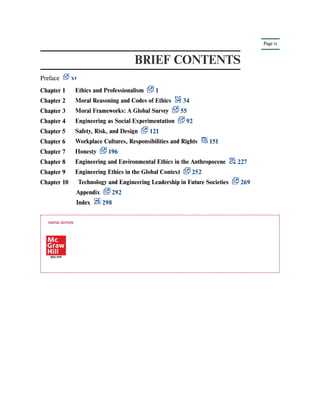
BRIEF CONTENTS
Prefacexv
DIGITAL EDITION
Chapter 1 Ethics and Professionalism 1
Chapter 2 Moral Reasoning and Codes of Ethics 34
Chapter 3 Moral Frameworks: A Global Survey 55
Chapter 4 Engineering as Social Experimentation 92
Chapter 5 Safety, Risk, and Design 121
Chapter 6 Workplace Cultures, Responsibilities and Rights 151
Chapter 7 Honesty 196
Chapter 8 Engineering and Environmental Ethics in the Anthropocene 227
Chapter 9 Engineering Ethics in the Global Context 252
Chapter 10 Technology and Engineering Leadership in Future Societies 269
Appendix 292
Index 298
13.
Page vi
Page vii
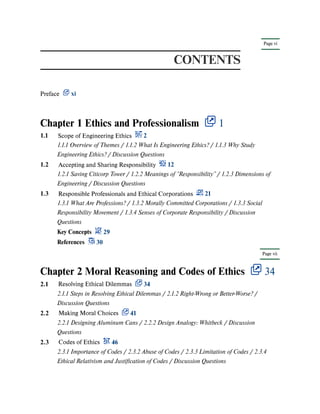
CONTENTS
Prefacexi
Chapter 1 Ethics and Professionalism 1
Chapter 2 Moral Reasoning and Codes of Ethics 34
1.1 Scope of Engineering Ethics 2
1.1.1 Overview of Themes / 1.1.2 What Is Engineering Ethics? / 1.1.3 Why Study
Engineering Ethics? / Discussion Questions
1.2 Accepting and Sharing Responsibility 12
1.2.1 Saving Citicorp Tower / 1.2.2 Meanings of “Responsibility” / 1.2.3 Dimensions of
Engineering / Discussion Questions
1.3 Responsible Professionals and Ethical Corporations 21
1.3.1 What Are Professions? / 1.3.2 Morally Committed Corporations / 1.3.3 Social
Responsibility Movement / 1.3.4 Senses of Corporate Responsibility / Discussion
Questions
Key Concepts 29
References 30
2.1 Resolving Ethical Dilemmas 34
2.1.1 Steps in Resolving Ethical Dilemmas / 2.1.2 Right-Wrong or Better-Worse? /
Discussion Questions
2.2 Making Moral Choices 41
2.2.1 Designing Aluminum Cans / 2.2.2 Design Analogy: Whitbeck / Discussion
Questions
2.3 Codes of Ethics 46
2.3.1 Importance of Codes / 2.3.2 Abuse of Codes / 2.3.3 Limitation of Codes / 2.3.4
Ethical Relativism and Justification of Codes / Discussion Questions
14.
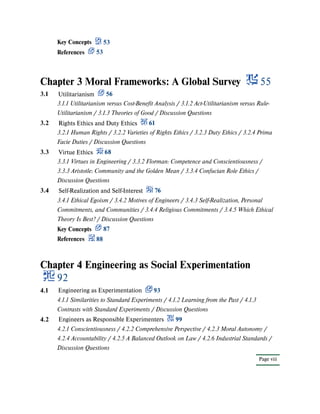
Chapter 3 MoralFrameworks: A Global Survey 55
Chapter 4 Engineering as Social Experimentation
92
Key Concepts 53
References 53
3.1 Utilitarianism 56
3.1.1 Utilitarianism versus Cost-Benefit Analysis / 3.1.2 Act-Utilitarianism versus Rule-
Utilitarianism / 3.1.3 Theories of Good / Discussion Questions
3.2 Rights Ethics and Duty Ethics 61
3.2.1 Human Rights / 3.2.2 Varieties of Rights Ethics / 3.2.3 Duty Ethics / 3.2.4 Prima
Facie Duties / Discussion Questions
3.3 Virtue Ethics 68
3.3.1 Virtues in Engineering / 3.3.2 Florman: Competence and Conscientiousness /
3.3.3 Aristotle: Community and the Golden Mean / 3.3.4 Confucian Role Ethics /
Discussion Questions
3.4 Self-Realization and Self-Interest 76
3.4.1 Ethical Egoism / 3.4.2 Motives of Engineers / 3.4.3 Self-Realization, Personal
Commitments, and Communities / 3.4.4 Religious Commitments / 3.4.5 Which Ethical
Theory Is Best? / Discussion Questions
Key Concepts 87
References 88
4.1 Engineering as Experimentation 93
4.1.1 Similarities to Standard Experiments / 4.1.2 Learning from the Past / 4.1.3
Contrasts with Standard Experiments / Discussion Questions
Page viii
4.2 Engineers as Responsible Experimenters 99
4.2.1 Conscientiousness / 4.2.2 Comprehensive Perspective / 4.2.3 Moral Autonomy /
4.2.4 Accountability / 4.2.5 A Balanced Outlook on Law / 4.2.6 Industrial Standards /
Discussion Questions
15.
Visit https://ebookmass.com todayto explore
a vast collection of ebooks across various
genres, available in popular formats like
PDF, EPUB, and MOBI, fully compatible with
all devices. Enjoy a seamless reading
experience and effortlessly download high-
quality materials in just a few simple steps.
Plus, don’t miss out on exciting offers that
let you access a wealth of knowledge at the
best prices!
16.
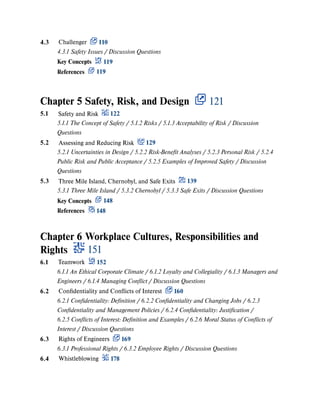
Chapter 5 Safety,Risk, and Design 121
Chapter 6 Workplace Cultures, Responsibilities and
Rights 151
4.3 Challenger 110
4.3.1 Safety Issues / Discussion Questions
Key Concepts 119
References 119
5.1 Safety and Risk 122
5.1.1 The Concept of Safety / 5.1.2 Risks / 5.1.3 Acceptability of Risk / Discussion
Questions
5.2 Assessing and Reducing Risk 129
5.2.1 Uncertainties in Design / 5.2.2 Risk-Benefit Analyses / 5.2.3 Personal Risk / 5.2.4
Public Risk and Public Acceptance / 5.2.5 Examples of Improved Safety / Discussion
Questions
5.3 Three Mile Island, Chernobyl, and Safe Exits 139
5.3.1 Three Mile Island / 5.3.2 Chernobyl / 5.3.3 Safe Exits / Discussion Questions
Key Concepts 148
References 148
6.1 Teamwork 152
6.1.1 An Ethical Corporate Climate / 6.1.2 Loyalty and Collegiality / 6.1.3 Managers and
Engineers / 6.1.4 Managing Conflict / Discussion Questions
6.2 Confidentiality and Conflicts of Interest 160
6.2.1 Confidentiality: Definition / 6.2.2 Confidentiality and Changing Jobs / 6.2.3
Confidentiality and Management Policies / 6.2.4 Confidentiality: Justification /
6.2.5 Conflicts of Interest: Definition and Examples / 6.2.6 Moral Status of Conflicts of
Interest / Discussion Questions
6.3 Rights of Engineers 169
6.3.1 Professional Rights / 6.3.2 Employee Rights / Discussion Questions
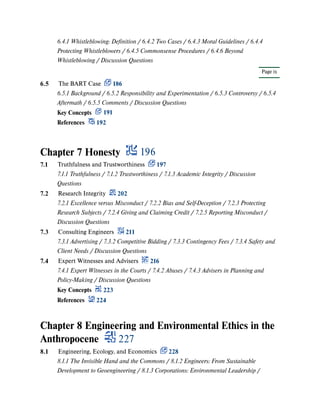
6.4 Whistleblowing 178
17.
Chapter 7 Honesty196
Chapter 8 Engineering and Environmental Ethics in the
Anthropocene 227
Page ix
6.4.1 Whistleblowing: Definition / 6.4.2 Two Cases / 6.4.3 Moral Guidelines / 6.4.4
Protecting Whistleblowers / 6.4.5 Commonsense Procedures / 6.4.6 Beyond
Whistleblowing / Discussion Questions
6.5 The BART Case 186
6.5.1 Background / 6.5.2 Responsibility and Experimentation / 6.5.3 Controversy / 6.5.4
Aftermath / 6.5.5 Comments / Discussion Questions
Key Concepts 191
References 192
7.1 Truthfulness and Trustworthiness 197
7.1.1 Truthfulness / 7.1.2 Trustworthiness / 7.1.3 Academic Integrity / Discussion
Questions
7.2 Research Integrity 202
7.2.1 Excellence versus Misconduct / 7.2.2 Bias and Self-Deception / 7.2.3 Protecting
Research Subjects / 7.2.4 Giving and Claiming Credit / 7.2.5 Reporting Misconduct /
Discussion Questions
7.3 Consulting Engineers 211
7.3.1 Advertising / 7.3.2 Competitive Bidding / 7.3.3 Contingency Fees / 7.3.4 Safety and
Client Needs / Discussion Questions
7.4 Expert Witnesses and Advisers 216
7.4.1 Expert Witnesses in the Courts / 7.4.2 Abuses / 7.4.3 Advisers in Planning and
Policy-Making / Discussion Questions
Key Concepts 223
References 224
8.1 Engineering, Ecology, and Economics 228
8.1.1 The Invisible Hand and the Commons / 8.1.2 Engineers: From Sustainable
Development to Geoengineering / 8.1.3 Corporations: Environmental Leadership /
18.
Page x
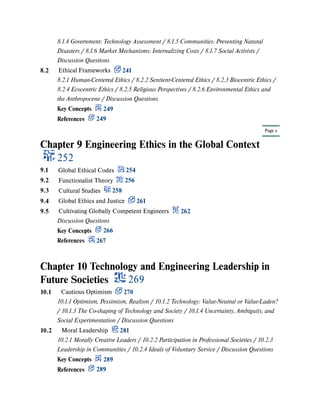
Chapter 9Engineering Ethics in the Global Context
252
Chapter 10 Technology and Engineering Leadership in
Future Societies 269
8.1.4 Government: Technology Assessment / 8.1.5 Communities: Preventing Natural
Disasters / 8.1.6 Market Mechanisms: Internalizing Costs / 8.1.7 Social Activists /
Discussion Questions
8.2 Ethical Frameworks 241
8.2.1 Human-Centered Ethics / 8.2.2 Sentient-Centered Ethics / 8.2.3 Biocentric Ethics /
8.2.4 Ecocentric Ethics / 8.2.5 Religious Perspectives / 8.2.6 Environmental Ethics and
the Anthropocene / Discussion Questions
Key Concepts 249
References 249
9.1 Global Ethical Codes 254
9.2 Functionalist Theory 256
9.3 Cultural Studies 258
9.4 Global Ethics and Justice 261
9.5 Cultivating Globally Competent Engineers 262
Discussion Questions
Key Concepts 266
References 267
10.1 Cautious Optimism 270
10.1.1 Optimism, Pessimism, Realism / 10.1.2 Technology: Value-Neutral or Value-Laden?
/ 10.1.3 The Co-shaping of Technology and Society / 10.1.4 Uncertainty, Ambiguity, and
Social Experimentation / Discussion Questions
10.2 Moral Leadership 281
10.2.1 Morally Creative Leaders / 10.2.2 Participation in Professional Societies / 10.2.3
Leadership in Communities / 10.2.4 Ideals of Voluntary Service / Discussion Questions
Key Concepts 289
References 289
Page xi
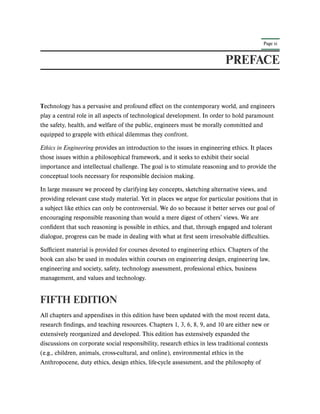
PREFACE
Technology hasa pervasive and profound effect on the contemporary world, and engineers
play a central role in all aspects of technological development. In order to hold paramount
the safety, health, and welfare of the public, engineers must be morally committed and
equipped to grapple with ethical dilemmas they confront.
Ethics in Engineering provides an introduction to the issues in engineering ethics. It places
those issues within a philosophical framework, and it seeks to exhibit their social
importance and intellectual challenge. The goal is to stimulate reasoning and to provide the
conceptual tools necessary for responsible decision making.
In large measure we proceed by clarifying key concepts, sketching alternative views, and
providing relevant case study material. Yet in places we argue for particular positions that in
a subject like ethics can only be controversial. We do so because it better serves our goal of
encouraging responsible reasoning than would a mere digest of others’ views. We are
confident that such reasoning is possible in ethics, and that, through engaged and tolerant
dialogue, progress can be made in dealing with what at first seem irresolvable difficulties.
Sufficient material is provided for courses devoted to engineering ethics. Chapters of the
book can also be used in modules within courses on engineering design, engineering law,
engineering and society, safety, technology assessment, professional ethics, business
management, and values and technology.
FIFTH EDITION
All chapters and appendixes in this edition have been updated with the most recent data,
research findings, and teaching resources. Chapters 1, 3, 6, 8, 9, and 10 are either new or
extensively reorganized and developed. This edition has extensively expanded the
discussions on corporate social responsibility, research ethics in less traditional contexts
(e.g., children, animals, cross-cultural, and online), environmental ethics in the
Anthropocene, duty ethics, design ethics, life-cycle assessment, and the philosophy of
21.
technology. Particularly, onemajor strength added to this edition is the global and
international dimension. Chapter 3 added one section on Confucian role ethics, which has
not been well discussed in any other engineering ethics textbooks. Chapter 9 is completely
new and it has incorporated a comprehensive review of four existing approaches to
engineering ethics in the global context. Most recent studies in artificial intelligence and
robotics have been added to Chapter 10. The pedagogical resources in Appendix A have
been fully updated to 2021. Qin Zhu worked on revising this edition, with general approval
from Mike W. Martin.
22.
Page xii
ACKNOWLEDGMENTS
Since thefirst edition of Ethics in Engineering appeared in 1983, many students, professors,
and reviewers have provided helpful feedback or in other ways influenced our thinking. We
wish to thank especially Robert J. Baum, Michael Davis, Dave Dorchester, Walter Elden,
Charles B. Fleddermann, Albert Flores, Alastair S. Gunn, Charles E. (Ed) Harris, Joseph R.
Herkert, Deborah G. Johnson, Ron Kline, Edwin T. Layton, Jerome Lederer, Heinz C.
Luegenbiehl, Mark Maier, Nicole Marie Martin, Sonia Renée Martin, Carl Mitcham, Steve
Nichols, Michael J. Rabins, Jimmy Smith, Michael S. Pritchard, Harold Sjursen, Carl M.
Skooglund, John Stupar, Stephen H. Unger, Pennington Vann, P. Aarne Vesilind, Vivien
Weil, Caroline Whitbeck, and Joseph Wujek.
And we thank the many authors and publishers who granted us permission to use
copyrighted material as acknowledged in the notes, and also the professional societies who
allowed us to print their codes of ethics in Appendix B.
Mike and Roland’s deepest gratitude is to Shannon Snow Martin and to Shirley Barrows
Price, whose love and insights have so deeply enriched our work and our lives. Qin’s greatest
gratitude is to Elly and Lili who have been unconditionally supportive while Qin was
working on revising this edition. Qin also appreciates the longtime mentorship and
encouragement from Carl Mitcham.
Qin Zhu
Mike W. Martin
Roland Schinzinger
23.
Page 1
Page 2
CHAPTER1
ETHICS AND PROFESSIONALISM
Engineers create products and processes to improve food production, shelter, energy,
communication, transportation, health, and protection against natural calamities—and to
enhance the convenience and beauty of our everyday lives. They make possible spectacular
human triumphs once only dreamed of in myth and science fiction. Almost a century and a
half ago in From the Earth to the Moon, Jules Verne imagined American space travelers being
launched from Florida, circling the moon, and returning to splash down in the Pacific
Ocean. In December 1968, three astronauts aboard an Apollo spacecraft did exactly that.
Seven months later, on July 20, 1969, Neil Armstrong took the first human steps on the
moon. This extraordinary event was shared with millions of earthbound people watching the
live broadcast on television. Engineering had transformed our sense of connection with the
cosmos and even fostered dreams of routine space travel for ordinary citizens.
Most technology, however, has double implications: As it creates benefits it raises new moral
challenges. Just as exploration of the moon and planets stand as engineering triumphs, so
the crashes of two new Boeing 737 Max series aircrafts (Lion Air Flight 610 in 2018 and
Ethiopian Airlines Flight 302 in 2019) were tragedies that could have been prevented, had
urgent warnings voiced by experienced engineers been heeded. We will examine these and
other cases of human error, for in considering ethics and engineering alike we can learn from
seeing how things go wrong. Technological risks, however, should not overshadow
technological benefits, and ethics involves appreciating the many positive dimensions of
engineering that so deeply enrich our lives.
This chapter introduces central themes, defines engineering ethics, and states the
goals in studying it. Next, the importance of accepting and sharing moral responsibility is
underscored. Finally, we attend to the corporate setting in which today most engineering
takes place and the communal setting in which an increasing number of engineers are
working, emphasizing the need for reflecting on the broader social and ethical implications
of engineering work.
24.
1.1 SCOPE OFENGINEERING ETHICS
1.1.1 Overview of Themes
In this book we explore a wide variety of topics and issues, but seven themes recur. Taken
together, the themes constitute a normative (value) perspective on engineering and on
engineering ethics.
Let us briefly introduce and illustrate each of these themes.
(1) ENGINEERING AS SOCIAL
EXPERIMENTATION
When the space shuttle Columbia exploded on February 1, 2003, killing the seven astronauts
on board, some people feared the cause was a terrorist attack, given the post–September 11
concerns about terrorism. The working hypothesis quickly emerged, however, that the cause
was a piece of insulating foam from the external fuel tank that struck the left wing 82
1. Engineering projects are social experiments that generate both new possibilities and
risks, and engineers share responsibility for creating benefits, preventing harm, and
pointing out dangers.
2. Moral values permeate all aspects of technological development, and hence ethics and
excellence in engineering go together.
3. Personal meaning and commitments matter in engineering ethics, along with principles
of responsibility that are stated in codes of ethics and are incumbent on all engineers.
4. Promoting responsible conduct and advocating good works is even more important than
punishing wrongdoing.
5. Ethical dilemmas arise in engineering, as elsewhere, because moral values are myriad and
can conflict.
6. Engineering ethics should explore both micro and macro issues, which are often
connected and more ethical issues are arising from the global context of engineering.
7. Technological development especially in the age of artificial intelligence warrants
cautious optimism—optimism, with caution.
25.
Page 3
seconds afterlaunch. The panels on the leading edge of the wing were composed of
reinforced carbon carbon, a remarkable material that protected it from 3000-degree
temperatures caused by air friction upon reentry from space into the earth’s atmosphere.
Even a small gap allowed superheated gases to enter the wing, melt the wiring, and spray
molten metal throughout the wing structure.
Investigators stated they were interested in far more than pinpointing the immediate
cause of the disaster. Several previous incidents involved insulating material breaking off
from the fuel tank. Why were these occurrences not scrutinized more carefully? And why
were so many additional hazards emerging, such as faulty “bolt catchers,” which were
chambers designed to capture bolts attaching the solid rocket boosters to the external fuel
tank after their detonated-release? Had the safety culture at NASA eroded, contrary to
assumptions that it had improved since the 1986 Challenger disaster, such that the
independent judgment of engineers was not being heeded? Even during Columbia’s last trip,
when crumbling shielding hit fragile tiles covering the craft’s wings, some knowledgeable
engineers were rebuffed when they requested that the impacts be simulated and observed
without delay. Had the necessary time, money, personnel, and procedures for ensuring safety
been shortchanged?
Very often technological development is double-edged, Janus-faced, morally ambiguous: As
engineering projects create new possibilities they also generate new dangers. To emphasize
the benefit-risk aspects in engineering, in chapter 4 we introduce a model of engineering
as social experiments—experiments on a societal scale. This model underscores the need for
engineers to accept and share responsibility for their work, exercise due care, imaginatively
foresee hazards, conscientiously monitor their projects when possible, and alert others of
dangers to permit them to give informed consent to risks. In highlighting risk, the model
also accents the good made possible through engineering discoveries and achievements.
And it underscores the need for preventive ethics: ethical reflection and action aimed at
preventing moral harm and avoidable ethical dilemmas.
(2) ETHICS AND EXCELLENCE: MORAL VALUES
ARE EMBEDDED IN ENGINEERING
Moral values are embedded in even the simplest engineering projects, not “tacked on” as
external burdens. Consider the following assignment given to students in a freshman course
at Harvey Mudd College:
1
26.
Visit https://ebookmass.com todayto explore
a vast collection of ebooks across various
genres, available in popular formats like
PDF, EPUB, and MOBI, fully compatible with
all devices. Enjoy a seamless reading
experience and effortlessly download high-
quality materials in just a few simple steps.
Plus, don’t miss out on exciting offers that
let you access a wealth of knowledge at the
best prices!
Our saintly censordevotes an indignant chapter to "the stones
which silly women wear fastened to chains and set in necklaces;"
and he compares the eagerness with which they rush after
glittering jewelry to the senseless attraction which draws children to
a blazing fire. He quotes from Aristophanes a whole catalogue of
female ornaments:
"Snoods, fillets, natron, and steel;
Pumice-stone, band, back-band,
Back-veil, paint, necklaces,
Paints for the eyes, soft garment, hair-net, [Footnote 22]
Girdle, shawl, fine purple border,
Long robe, tunic, Barathrum, round tunic,
Ear-pendants, jewelry, ear-rings,
Mallow-colored cluster-shaped anklets,
Buckles, clasps, necklets,
Fetters, seals, chains, rings, powders,
Bosses, bands, Sardian stones,
Fans, helicters."
[Footnote 22: Is it possible that waterfalls were worn
in those days?]
And he cries out, wearied with the enumeration: "I wonder how
those who bear such a burden are not worried to death. O foolish
trouble! O silly craze for display!" And of what use is it all? It is
nothing but art contending against nature, falsehood struggling
against truth. If a woman is ugly, she only makes her ugliness
more conspicuous by decking herself out with meretricious
ornaments. Besides, the custom of "applying things unsuitable to
the body as if they were suitable, begets a practice of lying and a
habit of falsehood." The sight of an over-dressed woman seems to
have affected St. Clement very much as a worthless picture in an
elegant frame. "The body of one of these ladies," he exclaims,
29.
"would never fetchmore than one hundred and fifty dollars; but
you may see her wearing a dress that cost two hundred and
fifty thousand." We complain of the extravagance of modern
belles; but, do they ever spend such enormous sums as that on a
single dress? Alexandria, we imagine, must bear away the palm
from Newport and Saratoga.
There were particular fashions in jewelry and ornament toward
which the saint had a special dislike. Bracelets in the form of a
serpent, he calls the manifest badges of the evil one. Golden chains
and necklaces are nothing better than fetters. Earrings and ear-
drops he forbids as contrary to nature, and he beseeches his
female hearers not to have their ears pierced. If you pierce your
ears, he says, why not have rings in your noses also? A signet-ring
may be worn on the finger, because it is useful for sealing; but no
good Christian ought to wear rings for mere ornament. Yet he
makes one curious exception to this rule. If a woman have,
unfortunately, a dissipated husband, she may adorn herself as
much as she can, for the purpose of keeping him at home.
How bitter is the contempt which the philosopher pours out upon
the fashionable ladies of the time, who spend their days in the
mysterious rites of the toilet, curling their locks, anointing their
cheeks, painting their eyes, "mangling, racking, and plastering
themselves over with certain compositions, chilling the skin and
furrowing the flesh with poisonous cosmetics;" and then in the
evening "creeping out to candle-light as out of a hole." Love of
display is not the characteristic of a true lady. The woman who
gives herself up to finery is worse than one who is addicted to the
pleasures of the table and the bottle! She is a lazy housekeeper,
sitting like a painted thing to be looked at, not as if made for
domestic economy, and she cares a great deal more about getting
at her husband's purse-strings than about staying at home with
him. And how preposterous is her behavior when she goes abroad.
Is she short? she wears cork-soles. Is she tall? she carries her head
down on her shoulder. Has she fine teeth? she is always laughing.
30.
Has she noflanks? she has something sewed on to her, so
that the spectators may exclaim on her fine shape. A little while
ago, a mania for yellow hair broke out in Paris, and fashionable
ladies had their locks dyed of the popular hue. Well, it appears
from St. Clement's discourses that this folly is over sixteen hundred
years old. He upbraids the Alexandrian ladies for following the
same absurd custom, and asks, in the words of Aristophanes,
"What can women do wise or brilliant who sit with hair dyed
yellow?" Nor is this the only modern fashion about the hair which
was known and condemned in his time. Read this, young ladies:
"Additions of other people's hair are entirely to be rejected,
and it is a most sacrilegious thing for spurious hair to shade the
head, covering the skull with dead locks. For on whom does the
priest lay his hand? Whom does he bless? Not the woman decked
out, but another's hairs, and through them another head."
Chignons, braids, tresses, and all the other wonderful paraphernalia
of the hair-dresser's art are condemned as no better than lies, and
a shameful defamation of the human head, which, says St.
Clement, is truly beautiful. Neither is it allowable to dye gray hairs,
or in any other way to conceal the approach of old age. "It is
enough for women to protect their locks and bind up their hair
simply along the neck with a plain hair-pin, nourishing chaste locks
with simple care to true beauty." And then he draws a comical
picture of a lady with her hair so elaborately "done up," that she is
afraid to touch her head, and dares not go to sleep for fear of
pulling down the whole structure.
A man ought to shave his crown, (unless he has curly hair,) but not
his chin, because the beard gives "dignity and paternal terror" to
the face. The mustache, however, "which is dirtied in eating, is to
be cut round, not by the razor, for that were ungenteel, but by a
pair of cropping scissors." The practice of shaving was a mark of
effeminacy in those days, and it was thought disgraceful for a man
to rob himself of the "hairiness" which distinguishes his sex, even
as the lion is known by his shaggy mane. So St. Clement is
unsparing in his denunciations of the unmanly creatures who "comb
31.
themselves and shavethemselves with a razor for the sake of fine
effect, and arrange their hair at the looking-glass." Manly sports,
provided they be pursued for health's sake and not for vainglory, he
warmly approves. A sparing use of the gymnasium and an
occasional bout at wrestling will do no harm, but rather good; yet,
when you wrestle, says the saint, be sure you stand squarely up to
your adversary, and try to throw him by main strength, not by
trickery and finesse. A game of ball he especially recommends,
(who knows but there may have been base-ball clubs in Egypt?)
and he mildly suggests that, if a man were to handle the hoe now
and then, the labor would not be "ungentlemanly." Pittacus, King of
Miletus, set a good example to mankind by grinding at the mill with
his own hand; and, if St. Clement were alive now, he might add
that Charles V. employed himself in constructing time-pieces, and
that notorious savage, Theodoras, Emperor of Abyssinia, passes
most of his days making umbrellas. Fishing is a commendable
pastime, for it has the example of the apostles in its favor. Another
capital exercise for a gentleman is chopping wood. This, we may
remark, is said to be the favorite athletic pursuit of the Honorable
Horace Greeley.
The daily occupations of women must not be too sedentary, yet
neither, on the other hand, ought the gentler sex to be
"encouraged in wrestling or running!" Instead of dawdling about
the shops of the silk merchant, the goldsmith, and the perfumer, or
riding aimlessly about town in litters, just to be admired, the true
lady will employ herself in spinning and weaving, and, if necessary,
will superintend the cooking. She must not be above turning the
mill, or getting her husband a good dinner. She must shake up the
beds, reach drink to her husband when he is thirsty, set the table
as neatly as possible, and when anything is wanted from the store,
let her go for it and fetch it home herself. We fear it is not the
fashion, even yet, to follow St. Clement's advice. She ought to keep
her face clean, and her glances cast down, and to beware of
languishing looks, and "ogling, which is to wink with the eyes," and
of a mincing gait.
32.
A gentleman inthe street should never walk furiously, nor swagger,
nor try to stare people out of countenance; neither when going up-
hill ought he to be shoved up by his domestics! He ought not to
waste his time in barbers' shops and taverns, babbling nonsense;
nor to watch the women who pass by; nor to gamble. He must not
kiss his wife in the presence of his servants. If he is a merchant, he
must not have two prices for his goods. He must be his own valet.
He must wash his own feet, and put on his own shoes.
And so the holy man goes on with much more sage counsel and
Christian direction, teaching his flock not only how to be faithful
children of the church, but how to be true gentlemen and
gentlewomen. The etiquette which he lays down is not based upon
the arbitrary and changeable rules of fashion, but upon the fixed
principles of morality and good fellowship. We have thought it not
amiss to give our readers a specimen of them, partly, indeed,
because they show us in such an interesting manner what kind of
lives people used to lead in his day, but also because they are full
of good lessons and wholesome rebukes for ourselves, and because
many of the follies which St. Clement condemned are still
flourishing, just as they flourished then, or are newly springing into
life after they have been for so many centuries forgotten. Of
course, there are many of his rules which are not applicable to us.
Many things which he forbade because they were indications or
accompaniments of certain sinful practices are no longer wrong,
because they have been completely dissevered from their evil
associations. But upon the whole, we doubt not that a new edition
of St. Clement's Paedagogus, or as we might translate it,
"Complete Guide to Politeness," would be vastly more beneficial to
the public than any of the hand-books of etiquette which are
multiplied by the modern press.
A treacherous spiritcame up from the sea,
And passing inland found a boy where he
Lay underneath the green roof of a tree,
In the golden summer weather.
And to the boy it whispered soft and low—
Come! let us leave this weary land, and go
Over the seas where the free breezes blow,
In the golden summer weather.
I know green isles in far-off sunny seas,
Where grow great cocoa-palms and orange-trees,
And spicy odors perfume every breeze,
In the golden summer weather.
There, underneath the ever-glowing skies,
Gay parrokeets and birds of paradise,
Make bright the woods with plumes of gorgeous dyes,
In the golden summer weather.
And in that land a happy people stay:
No hateful books perplex them night nor day;
No cares of business fret their lives away,
In the golden summer weather.
But all day long they wander where they please,
Plucking delicious fruits, that on the trees
Hang all the year and never know decrease,
In the golden summer weather.
Or over flower-enamelled vale and slope
They chase the silv'ry-footed antelope;
Or with the pard in manly conflict cope
In the golden summer weather.
35.
And in thoseislands troops of maidens are,
Whose lovely shapes no foolish fashions mar;
Eyes black as Night, and brighter than her stars
In the golden summer weather.
Earth hath no maidens like them otherwhere;
With teeth like pearls and wreaths of jetty hair,
And lips more sweet than tinted syrups are,
In the golden summer weather.
Ah! what a life it were to live with them!
'Twould pass by sweetly as a happy dream:
The years like days, the days like minutes seem,
In the golden summer weather.
Come! let us go! the wind blows fair and free;
The clouds sail seaward, and to-morrow we
May see the billows dancing on the sea,
In the golden summer weather.
The heavens were bright, the earth was fair to see,
A thousand birds sang round the boy, but he
Heard nothing but that spirit from the sea,
In the golden summer weather.
All night, as sleepless on his bed he lay,
He seemed to hear that treacherous spirit say,
Come, let us seek those islands far away,
In the golden summer weather.
So ere the morning in the east grew red,
He stole adown the stairs with barefoot tread,
Unbarred the door with trembling hands, and fled
In the golden summer weather.
In the last hour of night the city slept;
36.
Upon his beatthe drowsy watchman stept;
When like a thief along the streets he crept,
In the golden summer weather.
And when the sun brought in the busy day,
His father's home afar behind him lay,
And he stood 'mongst the sailors on the quay,
In the golden summer weather.
Like sleeping swans, with white wings folded, ride
The great ships at their moorings, side by side;
Moving but with the pulses of the tide,
In the golden summer weather.
And one is slowly ruffling out her wings
For flight, as seaward round her bowsprit swings;
Whilst at the capstan-bars the sailor sings
In the golden summer weather.
He is aboard. The wind blows fresh abeam:
The ship drifts slowly seaward with the stream;
And soon the land fades from him like a dream,
In the golden summer weather.
And if he found those islands far away,
Or those fair maidens, there is none can say:
For ship or boy returned not since that day,
In the golden summer weather.
E. YOUNG.
37.
A Royal Nun.
Amongthe pleasant alleys of Versailles, or under the stately groves
of St. Cloud, or in the grand corridors of the Tuileries, might often
have been seen, about the year 1773, pacing up and down
together in tender and confidential converse, two young maidens in
the early bloom of youth, and often by their side would sport a
careless, wilful, but engaging child some eight or nine years old.
These three young girls were all of royal birth, and bound together
by the ties of close relationship; they were the sisters and cousin of
a great king; their lineage one of the proudest of the earth; they
were all fair to look upon, and all endowed with mental gifts of no
mean order. How bright looked their future! Monarchs often sought
their hands in marriage, and men speculated on their fate, and
wondered which should form the most brilliant alliance. Could the
angels who guarded their footsteps have revealed their future, how
the wise men of this world would have laughed the prophecy to
scorn! Yet above those fair young heads hangs a strange destiny.
For one the martyr's palm; the name of another was to echo within
the walls of St. Peter, as of her whom the church delighteth to
honor; the third was to wear the veil of the religious through
dangers and under vicissitudes such as seldom fall to the lot of any
woman. Those of whom we speak were these: Clotilde and
Elizabeth of France, sisters of Louis XVI., and Louise de Bourbon
Condé, their cousin. Louise and Clotilde, almost of the same age,
were bound together in close intimacy. We may wonder, now, on
what topics their conversation would run. Did they speak of the
gayeties of the court; of the round of the giddy dissipation which
had, perhaps, reached its culminating point about this period? or
were they talking of the last sermon of Père Beauregard, when,
with unsparing and apostolic severity, he condemned the
fashionable vices of the age? or were they speaking of the cases of
distress among the poor who day by day trooped to the house of
38.
Mademoiselle, as Louisede Condé was called, and were there
succored by her own hands? On some such theme as these latter
we may be almost sure that their converse ran. The heart of
Clotilde was never given to the world; from her childhood she had
yearned for a cloister, and would fain have found herself at the side
of her aunt, Madame Louise, who was then prioress of the
Carmelites of St. Denis. To the grille of this convent Clotilde,
Louise, and Elizabeth would often go; and no doubt it was partly
owing to the conversation and example of the holy Carmelite
princess that the three girls, placed, as they all were, in most
dangerous and difficult positions, not only threaded their way
through the maze safely, but became examples of eminent piety
and virtue.
The elder of the three friends was Louise, only daughter of Louis
Joseph de Bourbon Condé, great-great-grandson of the Great
Condé, and son of the Duke de Bourbon, for some time prime
minister to Louis XV. He had early chosen the army as his career,
and as early won laurels for himself in the Seven Years' War. On
one occasion he was entreated by his attendants to withdraw from
the heat of the battle. "I never heard," said he, "of such
precautions being taken by the Great Condé." His admiration for
his glorious ancestor was, indeed, intense, and he devoted himself
to the task of writing a history of this great man; for, though an
ardent soldier, he was well educated. Men of science and genius
gathered round him in his chateau of Chantilly, whither he would
retire in the brief intervals of peace. At a very early age the Prince
de Condé married Charlotte de Rohan Soubise, a maiden as noble
in her character as her birth. She was merciful to the poor, gentle
and charitable to all who surrounded her. The marriage was a
happy one, but was not destined to last long. The princess died in
1760, leaving behind her a son, the Duke de Bourbon, and Louise
Adelaide, of whom we have been speaking.
The little girl, thus left motherless at the age of five years, was
consigned to the care of her great-aunt, the abbess of Beaumont
39.
les Tours, aboutsixty leagues from Paris. All the religious
assembled to receive the little princess on the day of her arrival,
and everything was done to please her. After showing her all the
interior of the convent, she was asked where she would like to go.
"Oh! take me," cried she, "where there is the most noise." Poor
child! she was destined to find her after-life a little too noisy. She
next chose to go into the choir while the nuns chanted compline;
but before the end of the first psalm whispered to her attendant, "I
have had enough." In these peaceful walls her childhood passed
away. She grew fond of the convent, and gave every mark of
external piety. She was wont to declare afterward that the grace of
God had made little interior progress in her heart; nevertheless, a
solid foundation of good instruction had been laid, which was
hereafter to bear fruit. At twelve years of age she made her first
communion, and then returned to Paris to finish her education in a
convent there, "to prepare her for the world."
Years fled on, Louise attained womanhood, her brother married one
of the Orleans princesses, and a marriage was projected for Louise
with the Count d'Artois, afterward Charles X., but political
differences caused the match to be broken off. Louise was not
destined ever to become Queen of France. The tender friendship
which subsisted between her and the Princess Clotilde was now to
be broken, in one sense, by their total separation. Clotilde's heart's
desire for the religious life was rudely crossed; the daughters of
royal houses had less control over their fates then (and perhaps
even now) than the meanest peasant in the land. A marriage was
"arranged" for Madame Clotilde with the Prince of Piedmont, heir-
apparent to the throne of Sardinia. She was but sixteen years of
age when she had to leave France and all she loved and clung to,
and set out to meet her unknown husband; for she was married by
proxy only in Paris, and was received by the Prince of Piedmont at
Turin. She was very beautiful, but unfortunately excessively stout,
to such a degree that it injured not only her appearance, but her
health. At Turin she was welcomed by a vast crowd, but cries of
"Che grossa!" ("How fat she is!") struck unpleasantly on her ear.
40.
"Be consoled," saidthe Queen of Sardinia; "when I entered the
city, the people cried, 'Che brutta!'" ("How plain she is!") "You
find me very stout?" questioned Clotilde, anxiously looking into her
husband's face. "I find you adorable," was the graceful and
affectionate reply.
Years flew by. Mademoiselle, as Louise was now called, had her
own establishment, and presided at royal fêtes given by her father
at Chantilly. Thither came once to partake of his hospitality the heir
of the throne of all the Russias, travelling, together with his wife,
under the incognito of the Comte du Nord. A friendship sprang up
between them and Louise de Condé, hereafter to be put to the
proof in extraordinary and unforeseen circumstances. Little did they
think as they parted within the splendid halls of Chantilly where
their next meeting should be.
The license of manners that preceded the Revolution, as the
gathering clouds foretell a storm, was principally to be observed in
the grossness of the theatre and the corruption of literature. The
theatre was a favorite amusement with Louise de Condé, and she
took great delight in private theatricals, and frequently played a
part. She heard Père Beauregard preach on the subject, and her
resolution was instantly taken. A comedy was to be acted next day
at Chantilly, but the princess renounced her part. It cost her not a
little thus to throw out the arrangements for the fête; but she
vanquished all human respect, and thus took the part of God
against the world.
It was a turning-point in her life. It may seem to us that it was but
a small sacrifice to make; but one grace corresponded to lead on to
others, and from that resolution to give up theatrical
entertainments Louise dated the commencement of the great
spiritual graces and benefits of her after-life. That she was
endowed with the courage of her race may be known from the fact
that, having sustained by a fall a severe fracture of her leg, she
sent for her Italian master to give her a lesson while waiting for the
41.
surgeon. This brokenleg was destined in her case, as in that of St.
Ignatius, to become one of her greatest blessings. She rose up
from her bed determined to give herself more entirely to God's
service. Naturally of a deeply affectionate disposition, Louise loved
her family tenderly, but in an especial manner her only nephew, the
Duc d'Enghien, then in his early youth. Day by day did Louise bring
the name of this beloved boy before the Mother of Good Counsel,
begging her, in her own simple words, to become his mother and
protectress, and "never to suffer his faith to perish." We shall see a
little later on how this prayer was answered. And now time had
passed on, and the Revolution was at hand, and had even begun.
After the taking of the Bastile, the Prince de Condé quitted France
with all his family, and immediately set himself to organize an army
for the defence of Louis XVI. Ordered by the Directory to return
to France, he disobeyed, and was instantly stripped of all his vast
property. The prince sold all his jewels, and bore his altered
fortunes with patience and courage. Meanwhile, the Princess Louise
accompanied her father and acted as his secretary. They moved
about from place to place, and at Turin she was able to renew the
friendship of her youth with Clotilde, who was now Queen of
Sardinia, and displayed on her throne a pattern of womanly and
saintly virtues. Near the Queen of Sardinia flattery could not
subsist. It is recorded of her that she never pronounced a doubtful
word, far less the smallest falsehood. Intercourse with this dear
friend strengthened in the heart of Louise the earnest desire she
had of belonging entirely to God. "I am obliged to take time for
prayer from my sleep," she writes to her director. "I cannot do
without it. When at table, surrounded with officers, all talking, I
pray inwardly." The crime of the 21st of January, 1793, fell like a
thunderbolt on the army of Condé; but, rising from his grief, the
brave general instantly proclaimed Louis XVII., although that little
king, whose piteous story history surely can never outdo, was still
being tortured by his savage subjects. The Archbishop of Turin was
deputed to escort the terrible news to Queen Clotilde. "Madam,"
said he, "will your majesty pray for your illustrious brother,
especially for his soul?" The terrible truth flashed at once upon her,
42.
and, falling onher knees, she exclaimed: "Let us do better still—let
us pray for his murderers!" Surely, in the annals of the saints, few
words more truly heroic can have been recorded than this impulsive
utterance of Clotilde de Bourbon. The active operations of the army
commanded by the Prince de Condé made it impossible for the
princess to remain any longer at her father's side; she accordingly
repaired to Fribourg, a favorite place of refuge for French
emigrants. No less than three hundred French priests had found a
temporary asylum within its walls, and the services of the church
were performed with every possible care and frequency. Among
these priests the princess met one, supposed to be one of the
exiled French bishops, to whom she was able to give her entire
confidence, and from whom she received wise and spiritual advice.
The idea of a religious vocation now began to take firm hold of her
mind but her director would not let her take any step for two years,
wishing in every possible way to test the reality of this call from
God. No ordinary obstacles stood in the way of the royal postulant.
Times had changed since those when the entrance of Madame
Louise, of France, into the Carmelites had been hailed as an
especial mark of God's providence over a poor community. Every
convent in Europe was now trembling for its safety, and few were
willing to open their doors to one bearing the now unfortunate
name of Bourbon. About this time, it would seem, the princess was
in communication with the Père de Tournely, founder of that
Society of the Sacred Heart which was afterward absorbed into the
Society of Jesus, and who was earnestly seeking to found a new
order for women, and especially at this moment to gather together
a community of emigrant French ladies, some of whom had been
driven from their convents. The idea naturally presented itself of
placing the Princess Louise at the head of such a community, but
she shrank from the task. "I should fear," she said, "from the force
of custom, the deference that would be paid to what the world
calls my rank. The place that I am ambitious of is the last of all.
What are the thrones of the universe compared to that last place?"
God had other designs for her, and for the projected order an
humbler instrument was to be chosen for the foundation-stone of
43.
the order ofthe Sacred Heart; and at this moment the foundress,
all unconscious of her fate, was as yet "playing with her dolls."
Louise de Condé, determined to enter a poor, obscure convent of
Capuchinesses, or religious, following the rule of St. Clare, in Turin,
a city which it was then hoped was likely to remain in tranquillity.
Before doing so she had obtained her father's consent, and also
that of Louis XVIII, whom the emigrant French had proclaimed as
their king when the prison-house of the little Louis XVII. had been
mercifully opened by death. The emigrants were careful to keep up
with their exiled monarch all the forms and traditions which would
have surrounded him had he been peaceably sitting on the throne
of his fathers. It is worth while to give the princess's own words:
"Sire: It is not at the moment when I am about to have the
happiness of consecrating myself to God that I could forget for
the first time what I owe to my king. I have for long past felt
myself called to the religious state, and I have come to Turin,
where the kindness and friendship of the Queen of Sardinia has
given me the means to execute my design—a design which has
been well examined and reflected upon; but, before its final
accomplishment, I supplicate your majesty to deign to give your
consent to it. I ask it with the more confidence because I am
certain it will not be refused, and that your piety, sire, will cause
you to find consolation in seeing a princess of your blood
invested with the livery of Jesus Christ. May God, whose infinite
mercy I have so wonderfully experienced, hear the prayers I
shall constantly make for the reestablishment of the altar and
the throne in my unfortunate country. They will be as earnest as
the efforts of my relatives for the same object. The desire for
the personal happiness of your majesty is equally in my heart. I
implore him to be persuaded of it. I am, etc.,
"Louise Adélaide De Bourbon Condé.
"Turin, November, 1795."
44.
There could beno doubt of the devotion of Louise's family to the
cause of Louis XVIII. Her father, brother, and nephew were all
under arms for the restoration of his crown, and Delille celebrated
the incident in verse:
"Trois générations vont ensemble à la gloire."
The king wrote back to the royal postulant:
"You have deeply reflected, my dear cousin, on the step which
you have taken. Your father has given his consent. I give mine
also, or rather, I give you up to Providence, who requires this
sacrifice from me. I will not conceal from you that it is a great
one, and it is with deep regret that I give up the hope of seeing
you by your virtues become one day an example to my court,
and an edification to all my subjects. I have but one
consolation, and it is that of thinking that, while the courage
and talents of your nearest relations are aiding me to recover
the throne of St. Louis, your prayers will draw down the
benedictions of the Most High on my cause, and afterward on
all my reign. I recommend it to you, and I pray you, my dear
cousin, to be well persuaded of my friendship for you.
"Louis."
On the 26th of November, 1798, the Queen of Sardinia took her
cousin to the convent, and saw her enter on the mode of life she
had so ardently desired for herself, but from which she had been
severed. And here Louise began to lead at once a life of hardship
and austerity. Earnest in all things by character, she threw herself
into the practice of her rule, and became a model to all the
novitiates. She counted the months as they passed which should
bring her to her profession day; but it was not to be. God saw fit to
purify her by many sufferings, by long anxieties, before she should
find rest in his house. She was to be the instrument for a great
work for his glory, and by many vicissitudes she was to be trained
45.
and fitted forit. The French Directory had declared war against
Piedmont, the princess's presence endangered the whole of her
community, and she hastened to quit their roof and take refuge
temporarily at the convent of the Annonciades, from whence, as
she was only a boarder, she could fly at any moment; but before
leaving her convent she cut off her hair. As a witness to herself, she
wrote of the firm resolution she had taken of living for God only.
No one but God, she said long afterward, could tell what her
sufferings were at having to leave her convent; but she adds: "The
graces that God poured upon me in that holy house gave the
necessary strength to my soul to bear the long trials which I had to
pass through for so many years!" Few recitals are more touching
than the sufferings of this poor novice, thus roughly torn away from
her beloved convent. Shortly after she took up her abode with the
Annonciades, a profession of one of their novices took place, and
the ceremony made the poor princess feel her disappointment more
bitterly. According to the custom of the order, the novice wore a
crown of flowers, and her cell and her bed were both decked with
them, and the sight moved Louise de Condé to tears, and, when
the novice pronounced her vows, her sobs almost stifled her. She
said to herself that she was unworthy to become the spouse of
Christ, and therefore these obstacles had arisen; and, humbling
herself at the feet of her Lord, she bewailed the follies of her life in
the world, of which she took a far harsher view than those did who
knew how it had been passed, and she implored him to have mercy
on her and others, to attain a perfect resignation to his will.
She had not left her convent too soon. The rapid approach of the
French army on Turin obliged her to quit the city and direct her
steps toward Switzerland. There she hoped to find a convent of
Trappist nuns who would venture to receive her; but, when she had
passed Mount St. Bernard, she found that the community had not
yet been able to find a resting-place in Switzerland. She travelled
on to Bavaria, and was told that no French emigrant could remain
in the country. Verily, it seemed as if she were destined to have
nowhere to lay her head. She did not know where to turn; for war
46.
was ruling inall directions, and her name was dreaded by all who
desired to keep a neutral part in the conflict. She was driven to
seek refuge at Vienna, and went to board with a convent of
Visitation nuns; for this order she did not feel any attraction, and
she cherished the hope that the Trappist nuns, of whom she had
heard would be able to find a place of refuge and receive her
among their number. While thus waiting, she took, by the advice of
her confessor, the three vows privately, thus binding herself as
closely as possible to her crucified Lord. Her description of this
action of her life gives a great insight into the beauty of her soul.
Deep humility, a fervent love of God, and a child-like simplicity were
her eminent characteristics. She made these vows at communion,
unknown to all save God, his angels, and her spiritual guide. Then
she said the Te Deum and Magnificat, which would have been
sung so joyfully by her sisters had she been suffered to remain
among them. "I neglected not in spirit," she adds, "the ceremony
of the funeral pall, begging from God the grace to die to all, so as
to live only in God and for God."
This private act of consecration was an immense comfort to her;
but it by no means prevented her longing and striving to reenter a
convent, and all her hopes continued to be fixed on La Trappe.
At this period an affecting meeting took place between her and
Madame Royale, the only survivor of the royal victims of the
Temple, the young girl born to one of the highest destinies in this
world, and whose youth had been overshadowed by a tragedy so
prolonged and so frightful that history can scarce furnish a parallel
case. It is only extraordinary that reason had survived such awful
suffering, falling on one so young and so tenderly nurtured. Is it
any wonder that a shade was cast over the rest of her life, and
that she was never among the light-hearted or the gay? From
Vienna she wrote to Queen Clotilde: "I have had a great pleasure
here in finding that the virtues of my aunt Elizabeth were well
known, and she is spoken of with veneration. I hope that one day
the pope will place my relation in the list of saints." It was, no
47.
doubt, a greatcomfort to her to speak freely with Louise of the
aunt and cousin both had so fondly loved. Louise could tell Madame
Royale many anecdotes of the youth of one whose end had been
so saintly. We must now say a few words about the convent which
the princess wished to enter.
When the order of La Trappe was suppressed in France, in common
with those of other religious in 1790, the Abbé L'Estrange, called in
religion Dom Augustin, was master of novices, and he conceived
the idea of removing the whole community from France instead of
dispersing it.
After many difficulties this was accomplished, and the monastery
was founded at Val-Sainte, near Fribourg. The abbé now conceived
the idea of founding a convent of Trappist nuns, to be composed
chiefly of those religious who had been driven from their own
convents, and of fresh novices. The director of Madame Louise had
many doubts as to the advisability of her entering this community;
but her desire for it was so ardent, and continued so long, that he
withdrew his opposition; and when the community had really taken
root, near that of the Trappist monks, under the title of the
Monastery of the Will of God, Louise de Condé set out from Vienna
and entered it. None but the superiors knew who she was—such
was the simplicity of her dress, so retiring her manners, so humble
were all her ways; but instead of a princess many of the religious
thought her to be of lowly extraction, and wondered that Dom
Augustin gave her so much of his time. With great delight she
received the holy habit and began to practise the rule. The life was
a hard one; the house was a great deal too small for the number
of religious who occupied it; there was a great want of fresh air;
and the rule and austerities were most trying. In a very few
months the torrent of European war was about to pour down on
Switzerland, and the whole community were obliged to take a hasty
departure. Dom Augustin could see no other place of refuge for his
flock than the shores of Russia, and he bade Louise de Condé use
her influence with the emperor to allow them to take up their
48.
abode in hiskingdom. The Emperor Paul was the same who, as
archduke and under the title of Comte du Nord, had sat by the
princess's side at the brilliant banquets and festivities of Chantilly.
Louise wrote to him with all the grace of a French woman: "I beg
the amiable Comte du Nord to become my interpreter with the
Emperor Paul." The advance of the republican army was so rapid
that there was no time to wait for a reply. The community were
divided into different bands, and started at different times and by
different routes, all agreeing to reunite their forces in Bavaria. The
vicissitudes of this one journey would be enough for a good-sized
volume could we go into its details. At one place she is received by
the bishop of the diocese as a princess, only to be driven out by
the civil authorities; at another she was lodged in a bake-house,
full of dirt and smoke. She observed only it was quite good enough
for her, and that she was very happy. At another time the cook
neglects to cleanse the copper cooking-vessels, and the whole
community are all but poisoned. When the answer came from the
Emperor Paul, it was found that he consented to receive thirty of
the religious only, to whom he promised support as well as
protection. It was necessary, therefore, to find some place for the
others, and Louise accompanied some of her sisters and the monks
to Vienna, where her former friends, the good Visitation nuns, gave
a refuge to another band of the Trappists. Notwithstanding all these
changes, Louise as strictly as possible observed the rule of her
order and the exercises of her novitiate. Being desired by her
superiors to write down her thoughts on the religious life, she
instantly complied, though she said afterward it was difficult to do
so in the midst of fourteen persons, crowded together in a very
small room, and all at different occupations. It was true they kept
silent, but they had to ask necessary questions of the prioress, and
among so many this necessity was very frequent.
She was now desired to set out for Russia, and thus undertake
another long journey of discomfort and fatigue. People urged her to
leave the order, saying that the weakness of her knee, which had
never wholly recovered from the fall she had had many years
49.
before, would renderit impossible for her to be useful. She replied
that, if she were only allowed to keep the lamp burning before the
blessed sacrament, she would be contented. So she set out for
Orcha, the town named by the emperor for their reception. It
proved a really terrible journey; sometimes the religious had to
sleep under the open sky; they had the roughest food, and more
than once were without any for twenty-four hours. But never once
did the patience, sweetness, and perfect content of Louise de
Condé fail; her face was always bright, for her whole soul was filled
with the one thought—a desire of doing penance. The arrival in
Russia did not put an end to the difficulties of either Madame
Louise or her order. It was necessary to make some arrangement
for the rest of the community left in Germany. The Emperor Paul
finally agreed to receive fifty. Dom Augustin accordingly went to
fetch them. During his absence no communication could be held
with him, while various offers of help, which had to be accepted or
refused, were brought to the princess, embarrassing her greatly.
After ten months of this suspense Dom Augustin returned, having
made up his mind to go to America. This was a severe blow to
Madame Louise; for, being still a novice, it became a grave question
whether she would, in such circumstances, be right in
accompanying them, and after much prayer and thought she, by
the counsel of her director, decided to leave. Once more was she to
be driven out into the cold world; once more her heart's desire
crossed, her hopes delayed indefinitely. "I thought that God willed
in his justice to break my heart, and thus arrest its impetuous
ardor. I had once more to strip myself of the livery of the Lord,
which had been my glory and my happiness. I did it, and did not
die, that is all I can say." Before her departure she implored the
emperor, and all over whom she had any personal influence, to
continue their kindness to the order. In reality, it was a good thing
for the order that Madame Louise quitted it, as events afterward
proved. One of the very first communities allowed by Bonaparte to
reenter France was this very one, and he certainly would not have
done so had a Bourbon been in its ranks. It is true his favor was
50.
Welcome to ourwebsite – the perfect destination for book lovers and
knowledge seekers. We believe that every book holds a new world,
offering opportunities for learning, discovery, and personal growth.
That’s why we are dedicated to bringing you a diverse collection of
books, ranging from classic literature and specialized publications to
self-development guides and children's books.
More than just a book-buying platform, we strive to be a bridge
connecting you with timeless cultural and intellectual values. With an
elegant, user-friendly interface and a smart search system, you can
quickly find the books that best suit your interests. Additionally,
our special promotions and home delivery services help you save time
and fully enjoy the joy of reading.
Join us on a journey of knowledge exploration, passion nurturing, and
personal growth every day!
ebookmasss.com











![Our saintly censor devotes an indignant chapter to "the stones
which silly women wear fastened to chains and set in necklaces;"
and he compares the eagerness with which they rush after
glittering jewelry to the senseless attraction which draws children to
a blazing fire. He quotes from Aristophanes a whole catalogue of
female ornaments:
"Snoods, fillets, natron, and steel;
Pumice-stone, band, back-band,
Back-veil, paint, necklaces,
Paints for the eyes, soft garment, hair-net, [Footnote 22]
Girdle, shawl, fine purple border,
Long robe, tunic, Barathrum, round tunic,
Ear-pendants, jewelry, ear-rings,
Mallow-colored cluster-shaped anklets,
Buckles, clasps, necklets,
Fetters, seals, chains, rings, powders,
Bosses, bands, Sardian stones,
Fans, helicters."
[Footnote 22: Is it possible that waterfalls were worn
in those days?]
And he cries out, wearied with the enumeration: "I wonder how
those who bear such a burden are not worried to death. O foolish
trouble! O silly craze for display!" And of what use is it all? It is
nothing but art contending against nature, falsehood struggling
against truth. If a woman is ugly, she only makes her ugliness
more conspicuous by decking herself out with meretricious
ornaments. Besides, the custom of "applying things unsuitable to
the body as if they were suitable, begets a practice of lying and a
habit of falsehood." The sight of an over-dressed woman seems to
have affected St. Clement very much as a worthless picture in an
elegant frame. "The body of one of these ladies," he exclaims,](https://image.slidesharecdn.com/52125-250616164155-141eb7d4/85/ISE-Ethics-in-Engineering-5th-Edition-Mike-Martin-Prof-28-320.jpg)