ISE Ethics in Engineering 5th Edition Mike Martin Prof.
ISE Ethics in Engineering 5th Edition Mike Martin Prof.
ISE Ethics in Engineering 5th Edition Mike Martin Prof.
ISE Ethics in Engineering 5th Edition Mike Martin Prof.
ISE Ethics in Engineering 5th Edition Mike Martin Prof.
1.
Download the fullversion and explore a variety of ebooks
or textbooks at https://ebookmass.com
ISE Ethics in Engineering 5th Edition Mike Martin
Prof.
_____ Follow the link below to get your download now _____
https://ebookmass.com/product/ise-ethics-in-engineering-5th-
edition-mike-martin-prof/
Access ebookmass.com now to download high-quality
ebooks or textbooks
2.
We have selectedsome products that you may be interested in
Click the link to download now or visit ebookmass.com
for more options!.
ISE Principles of Statistics for Engineers and Scientists
(ISE HED IRWIN INDUSTRIAL ENGINEERING) 2nd Edition William
Navidi Prof.
https://ebookmass.com/product/ise-principles-of-statistics-for-
engineers-and-scientists-ise-hed-irwin-industrial-engineering-2nd-
edition-william-navidi-prof/
ISE MATLAB for Engineering Applications 5th Edition
William Palm
https://ebookmass.com/product/ise-matlab-for-engineering-
applications-5th-edition-william-palm/
MATLAB for Engineering Applications, 5e ISE 5th/ISE
Edition William J. Palm Iii
https://ebookmass.com/product/matlab-for-engineering-
applications-5e-ise-5th-ise-edition-william-j-palm-iii/
Ethics for Engineers Martin Peterson
https://ebookmass.com/product/ethics-for-engineers-martin-peterson/
3.
Global Strategy, 5thEdition Mike W. Peng
https://ebookmass.com/product/global-strategy-5th-edition-mike-w-peng/
The Ethics of Artificial Intelligence_ Principles,
Challenges, and Opportunities Prof Luciano Floridi
https://ebookmass.com/product/the-ethics-of-artificial-intelligence_-
principles-challenges-and-opportunities-prof-luciano-floridi/
ISE Statics and Mechanics of Materials (ISE HED MECHANICAL
ENGINEERING) 3rd Edition Ferdinand P. Beer
https://ebookmass.com/product/ise-statics-and-mechanics-of-materials-
ise-hed-mechanical-engineering-3rd-edition-ferdinand-p-beer/
Chemistry: Atoms First ISE 5th Edition Julia Burdge
https://ebookmass.com/product/chemistry-atoms-first-ise-5th-edition-
julia-burdge/
ISE An Introduction to Business Ethics 7th Edition Joseph
R. Desjardins
https://ebookmass.com/product/ise-an-introduction-to-business-
ethics-7th-edition-joseph-r-desjardins/
7.
Page i
ETHICS INENGINEERING
FIFTH EDITION
Qin Zhu
Assistant Professor of Humanities, Arts & Social Sciences
Colorado School of Mines
Mike W. Martin
Professor of Philosophy
Chapman University
Roland Schinzinger
Professor Emeritus of Electrical Engineering
University of California, Irvine
Page iii
Page iv
ABOUTTHE AUTHORS
Qin Zhu is Assistant Professor of Ethics and Engineering Education in the Department of
Humanities, Arts & Social Sciences and an affiliate faculty member in the Department of
Engineering, Design & Society and the Robotics Graduate Program at the Colorado School
of Mines. Dr. Zhu is Editor for International Perspectives at the Online Ethics Center for
Engineering and Science, Associate Editor for Engineering Studies, Program Chair of
American Society for Engineering Education’s Division of Engineering Ethics (2020–2021),
Executive Committee Member of the Society for Ethics Across the Curriculum, and
Treasurer of the Society for Philosophy and Technology. Dr. Zhu’s research interests include
the cultural foundations of engineering ethics, global engineering education, and ethics and
policy of computing technologies and robotics.
Mike W. Martin and Roland Schinzinger participated as a philosopher-engineer team in the
National Project on Philosophy and Engineering Ethics, 1978–1980. Since then they have
coauthored articles, team-taught courses, and given presentations to audiences of engineers
and philosophers. In 1992 they received the Award for Distinguished Literary Contributions
Furthering Engineering Professionalism from The Institute of Electrical and Electronics
Engineers, United States Activities Board.
Mike W. Martin received his B.S. (Phi Beta Kappa, Phi Kappa Phi) and M.A. from the
University of Utah, and his Ph.D. from the University of California, Irvine, and he is
currently professor of philosophy at Chapman University. In addition to publishing many
articles, he is author, coauthor, or editor of eight books, including Meaningful Work:
Rethinking Professional Ethics (2000) and Everyday Morality (3rd ed., 2001). He received the
Arnold L. and Lois S. Graves Award for Teachers in the Humanities and two fellowships
from the National Endowment for the Humanities.
Roland Schinzinger received his B.S., M.S., and Ph.D. in electrical engineering from
the University of California at Berkeley. Born and raised in Japan where he had industrial
experience with Bosch-Japan, Tsurumi Shipyard of Nippon Steel Tube Co., and Far Eastern
Equipment Co., he worked in the United States as design/development engineer at
10.
Westinghouse Electric Corp.and taught at the University of Pittsburgh and at Robert
College/Bosporus University (in Istanbul). He was a founding faculty member to the
University of California at Irvine, from which he retired as Professor Emeritus of Electrical
Engineering in 1993. He authored or co-authored Conformal Mapping: Methods and
Applications (1991, 2003), Emergencies in Water Delivery (1979), and Experiments in
Electricity and Magnetism (1961, accompanying a kit he designed for use in Turkey). His
honors include the IEEE Centennial and Third Millennium medals, Fellow of IEEE, and
Fellow of AAAS. He is a registered professional engineer.
11.
Page v
FOR ELLYB. ZHU, FOR LILI GUAN
QIN ZHU
FOR SONIA AND NICOLE MARTIN, FOR
SHANNON SNOW MARTIN, AND IN
MEMORY OF THEODORE R. MARTIN
AND RUTH L. MARTIN.
MIKE W. MARTIN
FOR STEFAN, ANNELISE, AND BARBARA
SCHINZINGER, FOR SHIRLEY BARROWS
PRICE, AND IN MEMORY OF MARY JANE
HARRIS SCHINZINGER
ROLAND SCHINZINGER
12.
Page ix
BRIEF CONTENTS
Prefacexv
DIGITAL EDITION
Chapter 1 Ethics and Professionalism 1
Chapter 2 Moral Reasoning and Codes of Ethics 34
Chapter 3 Moral Frameworks: A Global Survey 55
Chapter 4 Engineering as Social Experimentation 92
Chapter 5 Safety, Risk, and Design 121
Chapter 6 Workplace Cultures, Responsibilities and Rights 151
Chapter 7 Honesty 196
Chapter 8 Engineering and Environmental Ethics in the Anthropocene 227
Chapter 9 Engineering Ethics in the Global Context 252
Chapter 10 Technology and Engineering Leadership in Future Societies 269
Appendix 292
Index 298
13.
Page vi
Page vii
CONTENTS
Prefacexi
Chapter 1 Ethics and Professionalism 1
Chapter 2 Moral Reasoning and Codes of Ethics 34
1.1 Scope of Engineering Ethics 2
1.1.1 Overview of Themes / 1.1.2 What Is Engineering Ethics? / 1.1.3 Why Study
Engineering Ethics? / Discussion Questions
1.2 Accepting and Sharing Responsibility 12
1.2.1 Saving Citicorp Tower / 1.2.2 Meanings of “Responsibility” / 1.2.3 Dimensions of
Engineering / Discussion Questions
1.3 Responsible Professionals and Ethical Corporations 21
1.3.1 What Are Professions? / 1.3.2 Morally Committed Corporations / 1.3.3 Social
Responsibility Movement / 1.3.4 Senses of Corporate Responsibility / Discussion
Questions
Key Concepts 29
References 30
2.1 Resolving Ethical Dilemmas 34
2.1.1 Steps in Resolving Ethical Dilemmas / 2.1.2 Right-Wrong or Better-Worse? /
Discussion Questions
2.2 Making Moral Choices 41
2.2.1 Designing Aluminum Cans / 2.2.2 Design Analogy: Whitbeck / Discussion
Questions
2.3 Codes of Ethics 46
2.3.1 Importance of Codes / 2.3.2 Abuse of Codes / 2.3.3 Limitation of Codes / 2.3.4
Ethical Relativism and Justification of Codes / Discussion Questions
14.
Chapter 3 MoralFrameworks: A Global Survey 55
Chapter 4 Engineering as Social Experimentation
92
Key Concepts 53
References 53
3.1 Utilitarianism 56
3.1.1 Utilitarianism versus Cost-Benefit Analysis / 3.1.2 Act-Utilitarianism versus Rule-
Utilitarianism / 3.1.3 Theories of Good / Discussion Questions
3.2 Rights Ethics and Duty Ethics 61
3.2.1 Human Rights / 3.2.2 Varieties of Rights Ethics / 3.2.3 Duty Ethics / 3.2.4 Prima
Facie Duties / Discussion Questions
3.3 Virtue Ethics 68
3.3.1 Virtues in Engineering / 3.3.2 Florman: Competence and Conscientiousness /
3.3.3 Aristotle: Community and the Golden Mean / 3.3.4 Confucian Role Ethics /
Discussion Questions
3.4 Self-Realization and Self-Interest 76
3.4.1 Ethical Egoism / 3.4.2 Motives of Engineers / 3.4.3 Self-Realization, Personal
Commitments, and Communities / 3.4.4 Religious Commitments / 3.4.5 Which Ethical
Theory Is Best? / Discussion Questions
Key Concepts 87
References 88
4.1 Engineering as Experimentation 93
4.1.1 Similarities to Standard Experiments / 4.1.2 Learning from the Past / 4.1.3
Contrasts with Standard Experiments / Discussion Questions
Page viii
4.2 Engineers as Responsible Experimenters 99
4.2.1 Conscientiousness / 4.2.2 Comprehensive Perspective / 4.2.3 Moral Autonomy /
4.2.4 Accountability / 4.2.5 A Balanced Outlook on Law / 4.2.6 Industrial Standards /
Discussion Questions
15.
Chapter 5 Safety,Risk, and Design 121
Chapter 6 Workplace Cultures, Responsibilities and
Rights 151
4.3 Challenger 110
4.3.1 Safety Issues / Discussion Questions
Key Concepts 119
References 119
5.1 Safety and Risk 122
5.1.1 The Concept of Safety / 5.1.2 Risks / 5.1.3 Acceptability of Risk / Discussion
Questions
5.2 Assessing and Reducing Risk 129
5.2.1 Uncertainties in Design / 5.2.2 Risk-Benefit Analyses / 5.2.3 Personal Risk / 5.2.4
Public Risk and Public Acceptance / 5.2.5 Examples of Improved Safety / Discussion
Questions
5.3 Three Mile Island, Chernobyl, and Safe Exits 139
5.3.1 Three Mile Island / 5.3.2 Chernobyl / 5.3.3 Safe Exits / Discussion Questions
Key Concepts 148
References 148
6.1 Teamwork 152
6.1.1 An Ethical Corporate Climate / 6.1.2 Loyalty and Collegiality / 6.1.3 Managers and
Engineers / 6.1.4 Managing Conflict / Discussion Questions
6.2 Confidentiality and Conflicts of Interest 160
6.2.1 Confidentiality: Definition / 6.2.2 Confidentiality and Changing Jobs / 6.2.3
Confidentiality and Management Policies / 6.2.4 Confidentiality: Justification /
6.2.5 Conflicts of Interest: Definition and Examples / 6.2.6 Moral Status of Conflicts of
Interest / Discussion Questions
6.3 Rights of Engineers 169
6.3.1 Professional Rights / 6.3.2 Employee Rights / Discussion Questions
6.4 Whistleblowing 178
16.
Chapter 7 Honesty196
Chapter 8 Engineering and Environmental Ethics in the
Anthropocene 227
Page ix
6.4.1 Whistleblowing: Definition / 6.4.2 Two Cases / 6.4.3 Moral Guidelines / 6.4.4
Protecting Whistleblowers / 6.4.5 Commonsense Procedures / 6.4.6 Beyond
Whistleblowing / Discussion Questions
6.5 The BART Case 186
6.5.1 Background / 6.5.2 Responsibility and Experimentation / 6.5.3 Controversy / 6.5.4
Aftermath / 6.5.5 Comments / Discussion Questions
Key Concepts 191
References 192
7.1 Truthfulness and Trustworthiness 197
7.1.1 Truthfulness / 7.1.2 Trustworthiness / 7.1.3 Academic Integrity / Discussion
Questions
7.2 Research Integrity 202
7.2.1 Excellence versus Misconduct / 7.2.2 Bias and Self-Deception / 7.2.3 Protecting
Research Subjects / 7.2.4 Giving and Claiming Credit / 7.2.5 Reporting Misconduct /
Discussion Questions
7.3 Consulting Engineers 211
7.3.1 Advertising / 7.3.2 Competitive Bidding / 7.3.3 Contingency Fees / 7.3.4 Safety and
Client Needs / Discussion Questions
7.4 Expert Witnesses and Advisers 216
7.4.1 Expert Witnesses in the Courts / 7.4.2 Abuses / 7.4.3 Advisers in Planning and
Policy-Making / Discussion Questions
Key Concepts 223
References 224
8.1 Engineering, Ecology, and Economics 228
8.1.1 The Invisible Hand and the Commons / 8.1.2 Engineers: From Sustainable
Development to Geoengineering / 8.1.3 Corporations: Environmental Leadership /
17.
Page x
Chapter 9Engineering Ethics in the Global Context
252
Chapter 10 Technology and Engineering Leadership in
Future Societies 269
8.1.4 Government: Technology Assessment / 8.1.5 Communities: Preventing Natural
Disasters / 8.1.6 Market Mechanisms: Internalizing Costs / 8.1.7 Social Activists /
Discussion Questions
8.2 Ethical Frameworks 241
8.2.1 Human-Centered Ethics / 8.2.2 Sentient-Centered Ethics / 8.2.3 Biocentric Ethics /
8.2.4 Ecocentric Ethics / 8.2.5 Religious Perspectives / 8.2.6 Environmental Ethics and
the Anthropocene / Discussion Questions
Key Concepts 249
References 249
9.1 Global Ethical Codes 254
9.2 Functionalist Theory 256
9.3 Cultural Studies 258
9.4 Global Ethics and Justice 261
9.5 Cultivating Globally Competent Engineers 262
Discussion Questions
Key Concepts 266
References 267
10.1 Cautious Optimism 270
10.1.1 Optimism, Pessimism, Realism / 10.1.2 Technology: Value-Neutral or Value-Laden?
/ 10.1.3 The Co-shaping of Technology and Society / 10.1.4 Uncertainty, Ambiguity, and
Social Experimentation / Discussion Questions
10.2 Moral Leadership 281
10.2.1 Morally Creative Leaders / 10.2.2 Participation in Professional Societies / 10.2.3
Leadership in Communities / 10.2.4 Ideals of Voluntary Service / Discussion Questions
Key Concepts 289
References 289
Page xi
PREFACE
Technology hasa pervasive and profound effect on the contemporary world, and engineers
play a central role in all aspects of technological development. In order to hold paramount
the safety, health, and welfare of the public, engineers must be morally committed and
equipped to grapple with ethical dilemmas they confront.
Ethics in Engineering provides an introduction to the issues in engineering ethics. It places
those issues within a philosophical framework, and it seeks to exhibit their social
importance and intellectual challenge. The goal is to stimulate reasoning and to provide the
conceptual tools necessary for responsible decision making.
In large measure we proceed by clarifying key concepts, sketching alternative views, and
providing relevant case study material. Yet in places we argue for particular positions that in
a subject like ethics can only be controversial. We do so because it better serves our goal of
encouraging responsible reasoning than would a mere digest of others’ views. We are
confident that such reasoning is possible in ethics, and that, through engaged and tolerant
dialogue, progress can be made in dealing with what at first seem irresolvable difficulties.
Sufficient material is provided for courses devoted to engineering ethics. Chapters of the
book can also be used in modules within courses on engineering design, engineering law,
engineering and society, safety, technology assessment, professional ethics, business
management, and values and technology.
FIFTH EDITION
All chapters and appendixes in this edition have been updated with the most recent data,
research findings, and teaching resources. Chapters 1, 3, 6, 8, 9, and 10 are either new or
extensively reorganized and developed. This edition has extensively expanded the
discussions on corporate social responsibility, research ethics in less traditional contexts
(e.g., children, animals, cross-cultural, and online), environmental ethics in the
Anthropocene, duty ethics, design ethics, life-cycle assessment, and the philosophy of
20.
technology. Particularly, onemajor strength added to this edition is the global and
international dimension. Chapter 3 added one section on Confucian role ethics, which has
not been well discussed in any other engineering ethics textbooks. Chapter 9 is completely
new and it has incorporated a comprehensive review of four existing approaches to
engineering ethics in the global context. Most recent studies in artificial intelligence and
robotics have been added to Chapter 10. The pedagogical resources in Appendix A have
been fully updated to 2021. Qin Zhu worked on revising this edition, with general approval
from Mike W. Martin.
21.
Page xii
ACKNOWLEDGMENTS
Since thefirst edition of Ethics in Engineering appeared in 1983, many students, professors,
and reviewers have provided helpful feedback or in other ways influenced our thinking. We
wish to thank especially Robert J. Baum, Michael Davis, Dave Dorchester, Walter Elden,
Charles B. Fleddermann, Albert Flores, Alastair S. Gunn, Charles E. (Ed) Harris, Joseph R.
Herkert, Deborah G. Johnson, Ron Kline, Edwin T. Layton, Jerome Lederer, Heinz C.
Luegenbiehl, Mark Maier, Nicole Marie Martin, Sonia Renée Martin, Carl Mitcham, Steve
Nichols, Michael J. Rabins, Jimmy Smith, Michael S. Pritchard, Harold Sjursen, Carl M.
Skooglund, John Stupar, Stephen H. Unger, Pennington Vann, P. Aarne Vesilind, Vivien
Weil, Caroline Whitbeck, and Joseph Wujek.
And we thank the many authors and publishers who granted us permission to use
copyrighted material as acknowledged in the notes, and also the professional societies who
allowed us to print their codes of ethics in Appendix B.
Mike and Roland’s deepest gratitude is to Shannon Snow Martin and to Shirley Barrows
Price, whose love and insights have so deeply enriched our work and our lives. Qin’s greatest
gratitude is to Elly and Lili who have been unconditionally supportive while Qin was
working on revising this edition. Qin also appreciates the longtime mentorship and
encouragement from Carl Mitcham.
Qin Zhu
Mike W. Martin
Roland Schinzinger
22.
Page 1
Page 2
CHAPTER1
ETHICS AND PROFESSIONALISM
Engineers create products and processes to improve food production, shelter, energy,
communication, transportation, health, and protection against natural calamities—and to
enhance the convenience and beauty of our everyday lives. They make possible spectacular
human triumphs once only dreamed of in myth and science fiction. Almost a century and a
half ago in From the Earth to the Moon, Jules Verne imagined American space travelers being
launched from Florida, circling the moon, and returning to splash down in the Pacific
Ocean. In December 1968, three astronauts aboard an Apollo spacecraft did exactly that.
Seven months later, on July 20, 1969, Neil Armstrong took the first human steps on the
moon. This extraordinary event was shared with millions of earthbound people watching the
live broadcast on television. Engineering had transformed our sense of connection with the
cosmos and even fostered dreams of routine space travel for ordinary citizens.
Most technology, however, has double implications: As it creates benefits it raises new moral
challenges. Just as exploration of the moon and planets stand as engineering triumphs, so
the crashes of two new Boeing 737 Max series aircrafts (Lion Air Flight 610 in 2018 and
Ethiopian Airlines Flight 302 in 2019) were tragedies that could have been prevented, had
urgent warnings voiced by experienced engineers been heeded. We will examine these and
other cases of human error, for in considering ethics and engineering alike we can learn from
seeing how things go wrong. Technological risks, however, should not overshadow
technological benefits, and ethics involves appreciating the many positive dimensions of
engineering that so deeply enrich our lives.
This chapter introduces central themes, defines engineering ethics, and states the
goals in studying it. Next, the importance of accepting and sharing moral responsibility is
underscored. Finally, we attend to the corporate setting in which today most engineering
takes place and the communal setting in which an increasing number of engineers are
working, emphasizing the need for reflecting on the broader social and ethical implications
of engineering work.
23.
1.1 SCOPE OFENGINEERING ETHICS
1.1.1 Overview of Themes
In this book we explore a wide variety of topics and issues, but seven themes recur. Taken
together, the themes constitute a normative (value) perspective on engineering and on
engineering ethics.
Let us briefly introduce and illustrate each of these themes.
(1) ENGINEERING AS SOCIAL
EXPERIMENTATION
When the space shuttle Columbia exploded on February 1, 2003, killing the seven astronauts
on board, some people feared the cause was a terrorist attack, given the post–September 11
concerns about terrorism. The working hypothesis quickly emerged, however, that the cause
was a piece of insulating foam from the external fuel tank that struck the left wing 82
1. Engineering projects are social experiments that generate both new possibilities and
risks, and engineers share responsibility for creating benefits, preventing harm, and
pointing out dangers.
2. Moral values permeate all aspects of technological development, and hence ethics and
excellence in engineering go together.
3. Personal meaning and commitments matter in engineering ethics, along with principles
of responsibility that are stated in codes of ethics and are incumbent on all engineers.
4. Promoting responsible conduct and advocating good works is even more important than
punishing wrongdoing.
5. Ethical dilemmas arise in engineering, as elsewhere, because moral values are myriad and
can conflict.
6. Engineering ethics should explore both micro and macro issues, which are often
connected and more ethical issues are arising from the global context of engineering.
7. Technological development especially in the age of artificial intelligence warrants
cautious optimism—optimism, with caution.
24.
Page 3
seconds afterlaunch. The panels on the leading edge of the wing were composed of
reinforced carbon carbon, a remarkable material that protected it from 3000-degree
temperatures caused by air friction upon reentry from space into the earth’s atmosphere.
Even a small gap allowed superheated gases to enter the wing, melt the wiring, and spray
molten metal throughout the wing structure.
Investigators stated they were interested in far more than pinpointing the immediate
cause of the disaster. Several previous incidents involved insulating material breaking off
from the fuel tank. Why were these occurrences not scrutinized more carefully? And why
were so many additional hazards emerging, such as faulty “bolt catchers,” which were
chambers designed to capture bolts attaching the solid rocket boosters to the external fuel
tank after their detonated-release? Had the safety culture at NASA eroded, contrary to
assumptions that it had improved since the 1986 Challenger disaster, such that the
independent judgment of engineers was not being heeded? Even during Columbia’s last trip,
when crumbling shielding hit fragile tiles covering the craft’s wings, some knowledgeable
engineers were rebuffed when they requested that the impacts be simulated and observed
without delay. Had the necessary time, money, personnel, and procedures for ensuring safety
been shortchanged?
Very often technological development is double-edged, Janus-faced, morally ambiguous: As
engineering projects create new possibilities they also generate new dangers. To emphasize
the benefit-risk aspects in engineering, in chapter 4 we introduce a model of engineering
as social experiments—experiments on a societal scale. This model underscores the need for
engineers to accept and share responsibility for their work, exercise due care, imaginatively
foresee hazards, conscientiously monitor their projects when possible, and alert others of
dangers to permit them to give informed consent to risks. In highlighting risk, the model
also accents the good made possible through engineering discoveries and achievements.
And it underscores the need for preventive ethics: ethical reflection and action aimed at
preventing moral harm and avoidable ethical dilemmas.
(2) ETHICS AND EXCELLENCE: MORAL VALUES
ARE EMBEDDED IN ENGINEERING
Moral values are embedded in even the simplest engineering projects, not “tacked on” as
external burdens. Consider the following assignment given to students in a freshman course
at Harvey Mudd College:
1
25.
Page 4
Design achicken coop that would increase egg and chicken production, using materials that
were readily available and maintainable by local workers [at a Mayan cooperative in
Guatemala]. The end users were to be the women of a weaving cooperative who wanted to
increase the protein in their children’s diet in ways that are consistent with their traditional diet,
while not appreciably distracting from their weaving.
The task proved more complex than it at first appeared. The students had to identify
plausible building materials, decide between cages or one open area, and design structures
for strength and endurance. They had to create safe access for the villagers, including ample
head and shoulder room at entrances and a safe floor for bare feet. They had to ensure
humane conditions for the chickens, including adequate space and ventilation, comfort
during climate changes, convenient delivery of food and water, and protection from local
predators that could dig under fences. They also had to improve cleaning procedures to
minimize damage to the environment while recycling chicken droppings as fertilizers. The
primary goal, however, was to double current chicken and egg production. A number of
design concepts were explored before a variation of a fenced-in concept proved preferable to
a set of cages. In 1997 four students and their advisor, supported by a humanitarian aid
group named Xela-Aid, traveled to San Martin Chiquito, Guatemala, and worked with
villagers in building the chicken coop and additional structures such as a weaving building.
Moral values are embedded at several junctures in engineering projects, including: the basic
standards of safety and efficiency, the social, cultural, and environmental contexts of the
community, the character of engineers who spearhead technological progress, and the very
idea of engineering as a profession that combines advanced skill with commitment to the
public good. In engineering, as in other professions, excellence and ethics go together—for
the most part and in the long run. In general, ethics involves much more than problems and
punishment, duties and dilemmas. Ethics involves the full range of moral values to which
we aspire in guiding our endeavors and in structuring our relationships and communities.
This emphasis on moral aspiration was identified by the ancient Greeks, whose word arete
translates into English as either “excellence” or as “virtue.”
(3) PERSONAL COMMITMENT AND MEANING
A team of engineers are redesigning an artificial lung marketed by their company. They are
working in a highly competitive market, with long hours and high stress. The engineers have
little or no contact with the firm’s customers, and they are focused on technical problems,
not people. It occurs to the project engineer to invite recipients of artificial lungs and their
families to the plant to talk about how their lives were affected by the artificial lung. The
2
3
26.
Page 5
change isimmediate and striking: “When families began to bring in their children who for
the first time could breathe freely, relax, learn, and enjoy life because of the firm’s product, it
came as a revelation. The workers were energized by concrete evidence that their efforts
really did improve people’s lives, and the morale of the workplace was given a great lift.”
Engineers’ motives and commitments are as many and varied as those of all human
beings. The desire for meaningful work, concern to make a living, care for other human
beings, and the need to maintain self-respect all combine to motivate excellence in
engineering. For the most part, they are mutually reinforcing in advancing a sense of
personal responsibility for one’s work. As we emphasize repeatedly, engineering is about
people as well as products, and the people include engineers who stand in moral (as well as
monetary) relationships with customers, colleagues, employers, and the general public.
All engineers are required to meet the responsibilities stated in their code of ethics. These
requirements set a minimum, albeit a high standard of excellence. The personal
commitments of individual engineers need to be aimed at and integrated with these shared
responsibilities. Yet some responsibilities and sources of meaning are highly personal, and
cannot be incumbent on every engineer. They include commitments concerning religion, the
environment, military work, family, and personal ambitions. When we speak of “personal
commitments” we have in mind both commitments to shared responsibilities and to these
more individual commitments as they affect professional endeavors.
Engineers’ motives and commitments are critical for them to actually devote themselves to
ethical actions. Based on the findings in moral psychology, it is very likely that an engineer
knows what the right action is but feels hesitant to do it as the engineer lacks motivation.
Engineering ethics education programs in the United States tend to teach students to
separate their personal commitments and meaning from professional ideals. Arguably, the
traditional approach to engineering ethics education often assumes that engineers are
isolated, rational, and autonomous human beings and engineering as a profession needs to
be depersonalized. Therefore, personal traits such as emotion, virtues, and commitments
are sometimes invisible in engineering education or are considered irrelevant. Philosopher
Michael Davis argues that emotion is quite normal and sometimes can be justified and
necessary in the everyday practice of engineers. For instance, an engineer can feel angry
when their company generates chemical pollutants to the community and the company
leadership has kept overlooking this engineer’s remonstration. The emotional state of this
engineer in fact well demonstrates their commitment to the safety, health, and welfare of the
public.
4
5
6
7
27.
Page 6
(4) PROMOTINGRESPONSIBLE CONDUCT,
PREVENTING WRONGDOING, AND
ADVOCATING GOOD WORKS
Beginning in 2001, a wave of corporate scandals shook Americans’ confidence in
corporations.* In that year, Enron became the largest bankruptcy in U.S. history, erasing
about $60 billion in shareholder value. The following year the scandal-ridden WorldCom
bankruptcy set another new record. Arthur Andersen, a large and respected accounting firm
charged with checking the books of Enron and other corporations, was charged with
complicity and was forced to dissolve. We return to these events later in this chapter.
Compliance issues are about making sure that individuals comply to professional standards
and avoid wrongdoing. Procedures are needed in all corporations to deter fraud, theft,
bribery, incompetence, and a host of other forms of outright immorality. Equally essential
are reasonable laws and government regulation, including penalties for reckless and
negligent conduct. We should examine the pressures that sometimes lead engineers to
cooperate in wrongdoing, rather than reporting wrongdoing to proper authorities.
Having said this, an important part of engineering ethics is preventing wrongdoing in
the first place. There is a need for what we have referred to as “preventive ethics”: ethical
reflection and action aimed at preventing moral harm and unnecessary ethical problems.
The main emphasis in ethics should be supporting responsible conduct. In fact, the vast
majority of engineers are morally committed. So too are most corporations. Reinforcing the
connection between ethics and excellence, individuals and corporations should primarily be
“value-driven,” rather than simply preoccupied with “compliance-based” procedures, to
invoke terms used in management theory. More recently, Charles Harris and his colleagues
have suggested that engineering ethics education needs to pay closer attention to the more
positive aspects or the “aspirational ethics” of engineering. Most articles in engineering
codes of ethics often focus on preventative ethics and they do not provide much clear
guidance on how engineering work can promote human well-being. Practicing aspirational
ethics often requires engineers to go beyond what is obligatory for them. Nevertheless, we
argue that advocating aspirational ethics is beneficial for building positive public images of
engineering, cultivating ethical culture of the engineering profession, enhancing the mutual
trust between engineers and the public, and generating positive impacts of technological
change.
8
9
10
28.
Page 7
(5) MYRIADMORAL REASONS GENERATE
ETHICAL DILEMMAS
A chemical engineer working in the environmental division of a computer manufacturing
firm learns that their company might be discharging unlawful amounts of lead and arsenic
into the city sewer. The city processes the sludge into a fertilizer used by local farmers. To
ensure safety, it imposes restrictive laws on the discharge of lead and arsenic. Preliminary
investigations convince the engineer that the company should implement stronger pollution
controls, but their manager insists the cost of doing so is prohibitive and that technically the
company is in compliance with the law. The engineer is responsible for doing what promotes
the success of their company, but they also have responsibilities to the local community that
might be harmed by the effluent. In addition, they have responsibilities to their family, and
rights to pursue their career. What should they do?
Ethical dilemmas, or moral dilemmas, are situations in which moral reasons come into
conflict, or in which the applications of moral values are problematic, and it is not
immediately obvious what should be done. The moral reasons might be obligations, rights,
goods, ideals, or other moral considerations. In engineering as elsewhere, moral values are
myriad and they can come into conflict, requiring good judgment about how to reconcile
and integrate them. Beginning in chapter 2 we discuss resources for understanding and
resolving ethical dilemmas, including codes of ethics and ethical theories. We emphasize
that ethical dilemmas need not be a sign that something has gone wrong; instead, they
indicate the presence of moral complexity. That complexity would exist even if we could
eliminate all preventable problems, such as the corporate scandals.
(6) MICRO AND MACRO ISSUES
Micro issues consider individuals and internal relations of the engineering profession. Macro
issues concern much broader issues, such as the directions in technological development,
the laws that should or should not be passed, and the collective responsibilities of groups
such as engineering professional societies and consumer groups. Both micro and macro
issues are important in engineering ethics, and often they are interwoven.
As an illustration, consider debates about sport utility vehicles (SUVs). Micro issues
arose, for example, concerning the Ford Explorer and also Bridgestone/Firestone, who
provided tires for the Explorer. During the late 1990s, reports began to multiply about the
11
12
13
29.
Page 8
tread onExplorer tires separating from the rest of the tire, leading to blowouts and rollovers.
By 2002, estimates were that 300 people had died and another thousand were injured and
more recent estimates place the numbers much higher since then. Ford and
Bridgestone/Firestone blamed each other for the problem, leading to the breakup of a
century-old business partnership. As it turned out, the hazard had multiple sources.
Bridgestone/Firestone used a flawed tire design and poor quality control at a major
manufacturing facility. Ford chose tires with a poor safety margin, relied on drivers to
maintain proper inflation within a very narrow range, and then dragged its feet in admitting
the problem and recalling dangerous tires.
In contrast, macro issues center on charges that SUVs are among the most harmful vehicles
on the road, even the most harmful, given their numbers. The problems are many: instability
because of their height that leads to rollovers, far greater “kill rate” of other drivers during
accidents, reducing the vision of drivers in shorter cars behind them on freeways, blinding
other drivers’ vision because of high-set lights, gas-guzzling, and excessively polluting. Keith
Bradsher estimates that SUVs are causing about 3,000 deaths in excess of what cars would
have caused: “Roughly 1,000 extra deaths occur each year in SUVs that roll over, compared
to the expected rollover death rate if these motorists had been driving cars. About 1,000
more people die each year in cars hit by SUVs than would occur if the cars had been hit by
other cars. And up to 1,000 additional people succumb each year to respiratory problems
because of the extra smog caused by SUVs.” Bradsher believes these numbers will
continue to increase as more SUVs are added to the road each year and as older vehicles are
resold to younger and more dangerous drivers.
Should “the SUV issue” be examined within engineering as a whole, or at least by
representative professional and technical societies? If so, what should be done? Or, in a
democratic and capitalistic society, should engineers play a role only as individuals, but not
as organized groups? Should engineers remain uninvolved, leaving the issue entirely to
consumer groups and lawmakers? Even larger macro issues surround public transportation
issues, in relation to all automobiles and SUVs, as we look to the future with a dramatically
increasing population and a shrinking of our traditional resources.
(7) CAUTIOUS OPTIMISM ABOUT TECHNOLOGY
The most general macro issues pertain to technology in its entirety, including its
overall promise and perils, an issue taken up in chapter 10. Pessimists view advanced
technology as ominous and often out of our control. They point to pollution, depletion of
14
15
30.
natural resources, fearsof biological and chemical weapons, and the lingering threat of
robotics taking human jobs. Optimists highlight how technology profoundly improves all our
lives. Each of us benefits in some ways from the top 20 engineering achievements of the
twentieth century, as identified by the National Academy of Engineering: electrification,
automobiles, airplanes, water supply and distribution, electronics, radio and television,
agricultural mechanization, computers, telephones, air-conditioning and refrigeration,
highways, spacecrafts, Internet, imaging technologies in medicine and elsewhere, household
appliances, health technologies, petrochemical technologies, laser and fiber optics, nuclear
technologies, and high-performance materials.
As authors, we are cautiously optimistic about technology. Nothing is more central to
human progress than sound technology, and no aspect of creative human achievement is less
appreciated by the public than engineers’ ingenuity. At the same time, consistent with the
social experimentation model, the exuberant confidence and hope—so essential to
technological progress—needs to be accompanied by sober realism about dangers.
Such a cautiously optimistic attitude is even more critical in the age of AI. Given the huge
potential of AI-enabled technologies in improving human well-being and production
efficiency, it is unlikely that humans will completely terminate or abandon the development
of these technologies. As philosopher Peter-Paul Verbeek has suggested, we as humans need
to learn how to morally accompany technology. We are required to thoroughly engage with
designers and engineers and “look for points of application for moral reflection and
anticipate the social impact of technology-in-design.”
1.1.2 What Is Engineering Ethics?
With this overview of themes and sampling of issues in mind, we can now define
engineering ethics. The word ethics has several meanings. In the sense used in the title of
this book, ethics is synonymous with morality. It refers to moral values that are sound,
actions that are morally required (right) or morally permissible (all right), policies and laws
that are desirable. Accordingly, engineering ethics consists of the responsibilities and rights that
ought to be endorsed by those engaged in engineering, and also of desirable ideals and personal
commitments in engineering.
In a second sense, ethics is the study of morality; it is an inquiry into ethics in the first
sense. It studies which actions, goals, principles, policies, and laws are morally justified.
Using this meaning, which also names the field of study of this book, engineering ethics is the
16
17
31.
Page 9
study ofthe decisions, policies, and values that are morally desirable in engineering practice and
research.
These two senses are normative: They refer to justified values and choices, to things that are
desirable (not merely desired). Normative senses differ from descriptive senses of ethics. In
one descriptive sense, we speak of Henry Ford’s ethics or the ethics of American engineers,
referring thereby to what specific individuals or groups believe and how they act, without
implying that their beliefs and actions are justified. In another descriptive sense, social
scientists study ethics when they describe and explain what people believe and how they act;
they conduct opinion polls, observe behavior, examine documents written by professional
societies, and uncover the social forces shaping engineering ethics.
As it turns out, morality is not easy to define. Of course, we can all give examples of
moral values, but the moment we try to provide a comprehensive definition of morality we
are drawn into at least rudimentary ethical theory—a normative theory about morality. For
example, if we say that morality consists in promoting the most good, we are invoking an
ethical theory called utilitarianism. If we say that morality is about human rights, we invoke
rights ethics. And if we say that morality is essentially about good character, we might be
invoking virtue ethics.
These and other ethical theories are discussed in chapter 3. For now, let us simply say
that morality concerns respect for persons, both others and ourselves. It involves being fair
and just, meeting obligations and respecting rights, and not causing unnecessary harm by
dishonesty and cruelty or by hubris. In addition, it involves ideals of character, such as
integrity, gratitude, and willingness to help people in severe distress. And it implies
minimizing suffering to animals and damage to the environment.
1.1.3 Why Study Engineering Ethics?
Engineering ethics should be studied because it is important, both in contributing to safe and
useful technological products and in giving meaning to engineers’ endeavors. It is also
complex, in ways that call for serious reflection throughout a career, beginning with earning a
degree. But beyond these general observations, what specific aims should guide the study of
engineering ethics?
In our view, the direct aim is to increase one’s ability to deal effectively with moral
complexity in engineering. Accordingly, the study of engineering ethics strengthens one’s
18
32.
Page 10
ability toreason clearly and carefully about moral questions. To invoke a term widely used in
ethics, the unifying goal is to increase moral autonomy.
Autonomy means “self-determining” or “independent.” But not just any kind of independent
reflection about ethics amounts to moral autonomy. Moral autonomy can be viewed as the
skill and habit of thinking rationally about ethical issues on the basis of moral concern. This
foundation of moral concern, or general responsiveness to moral values, derives primarily
from the training we receive as children in being sensitive to the needs and rights of others,
as well as of ourselves. When such training is absent, as it often is with seriously abused
children, the tragic result can be an adult sociopath who lacks any sense of moral right and
wrong. Sociopaths (or psychopaths) are not morally autonomous, regardless of how
“independent” their intellectual reasoning about ethics might be.
Improving the ability to reflect carefully on moral issues can be accomplished by
improving various practical skills that will help produce autonomous thought about moral
issues. As related to engineering ethics, these skills include the following:
These are the direct goals in college courses. They center on cognitive skills—skills of the
intellect in thinking clearly and cogently. But it is possible to have these skills and yet not act
in morally responsible ways. Should we therefore add to our list of goals the following goals
that specify aspects of moral commitment and responsible conduct?
19
1. Moral awareness: Proficiency in recognizing moral problems and issues in engineering.
2. Cogent moral reasoning: Comprehending, clarifying, and assessing arguments on
opposing sides of moral issues.
3. Moral coherence: Forming consistent and comprehensive viewpoints based upon a
consideration of relevant facts.
4. Moral imagination: Discerning alternative responses to moral issues and receptivity to
creative solutions for practical difficulties.
5. Moral communication: Precision in the use of a common ethical language, a skill needed
to express and support one’s moral views adequately to others.
6. Moral reasonableness: The willingness and ability to be morally reasonable.
7. Respect for persons: Genuine concern for the well-being of others as well as oneself.
8. Tolerance of diversity: Within a broad range, respect for ethnic and religious differences,
and acceptance of reasonable differences in moral perspectives.
33.
In our viewwe should add these goals to the study of engineering ethics, for there would be
little moral point to studying ethics without the expectation that doing so contributes to the
goals. At the same time, these goals are often best pursued implicitly and indirectly, more in
how material is studied and taught than in preaching and testing. A foundation of moral
concern must be presupposed, as well as evoked and expanded, in studying ethics at the
college level.
DISCUSSION QUESTIONS
9. Moral hope: Enriched appreciation of the possibilities of using rational dialogue in
resolving moral conflicts.
10. Integrity: Maintaining moral integrity, and integrating one’s professional life and
personal convictions.
11. Moral emotions: Social emotions (feelings or intuitions) that “are linked to the interests
or welfare either of society as a whole or at least of persons other than the judge or
agent.”20
Page 11
1. Identify the moral values, issues, and dilemmas, if any, involved in the following cases,
and explain why you consider them moral values and dilemmas.
a. An engineer notified his firm that for a relatively minor cost, a flashlight
could be made to last several years longer by using a more reliable bulb. The firm
decides that it would be in its interests not to use the new bulb, both to keep costs
lower and to have the added advantage of “built-in obsolescence” so that consumers
would need to purchase new flashlights more often.
b. A linear electron accelerator for therapeutic use was built as a dual-mode system that
could either produce X-rays or electron beams. It had been in successful use for some
time, but every now and then some patients received high overdoses, resulting in
painful aftereffects and several deaths. One patient on a repeat visit experienced great
pain, but the remotely located operator was unaware of any problem because of lack
of communication between them: the intercom was broken and the video monitor had
been unplugged. There also was no way for the patient to exit the examination
chamber without help from the outside, and hence the hospital was partly at fault.
Upon cursory examination of the machine, the manufacturer insisted that the
computerized and automatic control system could not possibly have malfunctioned
and that no one should spread unproven and potentially libelous information about
34.
the design. Itwas the painstaking, day-and-night effort of the hospital’s physicist that
finally traced the problem to a software error introduced by the manufacturer’s efforts
to make the machine more user-friendly.21
2. Regarding the artificial lung example, comment on why you think simple human contact
made such a large difference. What does it say about what motivated the engineers, both
before and after the encounter? Is the case too unique to permit generalizations to other
engineering products?
3. Should SUV problems at the macro level be of concern to engineers as a group and their
professional societies? And should individual automotive engineers, in their daily work,
be concerned about the general social and environmental impacts of SUVs?
4. It is not easy to define morality in a simple way, but it does not follow that morality is
a hopelessly vague notion. For a long time, philosophers thought that an adequate
definition of any idea would specify a set of logically necessary and sufficient conditions
for applying the idea. For example, each of the following features is logically necessary
for a triangle, and together they are sufficient: a plane figure, having three straight lines,
closed to form three angles. The philosopher Ludwig Wittgenstein (1889–1951),
however, argued that most ordinary (nontechnical) ideas cannot be neatly defined in this
way. Instead, there are often only “family resemblances” among the things to which
words are applied, analogous to the partly overlapping similarities among members of a
family—similar eye color, shape of nose, body build, temperament, and so forth. Thus,
a book might be hardback, paperback, or electronic; printed or handwritten; in English
or German; etc. Can you specify necessary and sufficient conditions for the following
ideas: chairs, buildings, energy, safety, morality?
22
5. Unfortunately, the mention of ethics sometimes evokes groans, rather than engagement,
because it brings to mind onerous constraints and unpleasant disagreements. Worse, it
evokes images of self-righteousness, hypocrisy, and excessively punitive attitudes of blame
and punishment—attitudes that are themselves subject to moral critique. Think of a
recent event that led to a public outcry. With regard to the event, discuss the difference
between being morally reasonable and being “moralistic” in a pejorative sense. In doing
so, consider such things as breadth of vision, tolerance, sensitivity to context, and
commitment.
35.
Page 12
1.2 ACCEPTINGAND SHARING
RESPONSIBILITY
Before he became president of the United States, Herbert Hoover was a mining engineer. In
his memoirs he reflects on engineering in general:
It is a great profession. There is the fascination of watching a figment of the imagination emerge
through the aid of science to a plan on paper. Then it moves to realization in stone or metal or
energy. Then it brings jobs and homes to men. Then it elevates the standards of living and adds
to the comforts of life. That is the engineer’s high privilege.
The great liability of the engineer compared to men of other professions is that his works are out
in the open where all can see them. His acts, step by step, are in hard substance. He cannot bury
his mistakes in the grave like the doctors. He cannot argue them into thin air or blame the judge
like the lawyers. He cannot, like the architects, cover his failures with trees and vines. He cannot,
like the politicians, screen his shortcomings by blaming his opponents and hope that the people
will forget. The engineer simply cannot deny that he did it. If his works do not work, he is
damned.
Hoover is reflecting on an era when engineering was dominated, at least in outlook, by the
independent consultant, rather than by the corporate engineer. In his day, it was easier for
individual engineers to work with a sense of personal responsibility for an entire project.
When a bridge fell or a ship sank, the engineers responsible could be more easily identified.
This made it easier to endorse Hoover’s vision of individualism in regard both to creativity
and personal accountability within engineering.
Today, the products of engineering are “out in the open” as much as they were in Hoover’s
time. In fact, mass communication ensures that major mistakes receive even closer public
scrutiny. And there are more engineers than ever. Yet despite their greater numbers,
engineers of today are less visible to the public than were those of Hoover’s era.
Technological progress is taken for granted as being the norm, and technological failure is
blamed on corporations, if not government. And in the public’s eye, the representative of
any corporation is its top manager, who is often far removed from the daily creative
endeavors of the company’s engineers. This “invisibility” can make it difficult for engineers
to retain a sense of mutual understanding with and accountability to the public.
Nevertheless, individuals who accept responsibility for their work can make an enormous
difference, as the following case illustrates.
1.2.1 Saving Citicorp Tower
23
36.
Page 13
Structural engineerBill LeMessurier (pronounced “LeMeasure”) and architect Hugh
Stubbins faced a challenge when they worked on the plans for New York’s fifth highest
skyscraper. St. Peter’s Lutheran Church owned and occupied a corner of the lot designated
in its entirety as the site for the new structure. An agreement was reached: The bank tower
would rise from nine-story-high stilts positioned at the center of each side of the tower, and
the church would be offered a brand new St. Peter’s standing freely underneath one of the
cantilevered corners. Completed in 1977, the Citicorp Center appears as shown in
figure 1-1. The new church building is seen below the lower left corner of the raised
tower.
FIGURE 1-1
Axonometric view of Citicorp tower
with the church in the lower left-
hand corner. Wind loads: F, frontal
and Q, Quartering. (Adaptation of
an axonometric drawing by Henry
Dong, Anspach Grossman Portugal,
Inc., in Buildings Type Study 492,
Architectural Record, Mid-August
Special Issue, 1976, p. 66.)
37.
Page 14
LeMessurier’s structuredeparted from the usual in that the massive stilts are not situated at
the corners of the building, and half of its gravity load as well all of its wind load is brought
down an imaginatively designed trussed frame, which incorporates wind braces, on the
outside of the tower. In addition, LeMessurier installed a tuned mass damper, the first of
its kind in a tall building, to keep the building from swaying in the wind.
Questions asked by an engineering student a year after the tower’s completion prompted
LeMessurier to review certain structural aspects of the tower and pose some questions of his
own. For instance, could the structure withstand certain loads due to strong quartering
winds? In such cases, two sides of the building receive the oblique force of the wind, and the
resultant force is 40 percent larger than when the wind hits only one face of the structure
straight on. The only requirement stated in the building code specified adequacy to
withstand certain perpendicular wind loads, and that was the basis for the design of the
wind braces. But there was no need to worry since the braces as designed could handle such
an excess load without difficulty, provided the welds were of the expected high quality.
Nevertheless, the student’s questions prompted LeMessurier to place a call from his
Cambridge, Massachusetts, office to his New York office, to ask Stanley Goldstein, his
engineer in charge of the tower erection, how the welded joints of the bracing structure had
worked out. How difficult was the job? How good was the workmanship? To his dismay,
Goldstein answered, “Oh, didn’t you know? [The joints] were never welded at all because
Bethlehem Steel came to us and said they didn’t think we needed to do it.” The New York
office, as it was allowed to do, had approved the proposal that the joints be bolted instead.
But again the diagonal winds had not been taken into account.
At first, LeMessurier was not too concerned; after all, the tuned mass damper would still
take care of the sway. So he turned to his consultant on the behavior of high buildings in
wind, Alan Davenport at the University of Western Ontario. On reviewing the results of his
earlier wind tunnel tests on a scaled-down Citicorp Center, Davenport reported that a
diagonal wind load would exceed the perpendicular wind load by much more than the 40
percent increase in stress predicted by an idealized mathematical model. Winds sufficient to
cause failure of certain critical bolted joints—and therefore of the building—could occur in
New York every 16 years. Fortunately, those braces that required strengthening were
accessible, but the job would be disruptive and expensive, exceeding the insurance
LeMessurier carried.
LeMessurier faced an ethical dilemma involving a conflict between his responsibilities to
ensure the safety of his building for the sake of people who use it, his responsibilities to
24
25
38.
Page 15
various financialconstituencies, and his self-interest, which might be served by remaining
silent. What to do? He retreated to his summerhouse on an island on Sebago Lake in Maine.
There, in the quiet, he worked once more through all the design and wind tunnel numbers.
Suddenly he was struck with “an almost giddy sense of power,” as he realized that only he
could prevent an eventual disaster by taking the initiative.
Having made a decision, he acted quickly. He and Stubbins met with their insurers, lawyers,
the bank management, and the city building department to describe the problem. A retrofit
plan was agreed upon: The wind braces would be strengthened at critical locations “by
welding two-inch-thick steel plates over each of more than 200 bolted joints.” Journalists, at
first curious about the many lawyers converging on the various offices, disappeared when
New York’s major newspapers were shut down by a strike. The lawyers sought the advice of
Leslie Robertson, a structural engineer with experience in disaster management. He alerted
the mayor’s Office of Emergency Management and the Red Cross so the surroundings of the
building could be evacuated in case of a high wind alert. He also arranged for a network of
strain gages to be attached to the structure at strategic points. This instrumentation allowed
actual strains experienced by the steel to be monitored at a remote location. LeMessurier
insisted on the installation of an emergency generator to assure uninterrupted availability of
the damper.
When hurricane Ella appeared off the coast, there was some cause for worry, but work on
the critical joints had almost been completed. Eventually the hurricane veered off and
evacuation was not required. Even so, the retrofit and the tuned mass damper had been
readied to withstand as much as a 200-year storm.
The parties were able to settle out of court, with Stubbins held blameless; LeMessurier and
his joint-venture partners were charged the $2 million his insurance agreed to pay. The total
repair bill had amounted to over $12.5 million. Not only did LeMessurier save lives and
preserve his integrity, but his reputation was enhanced rather than tarnished by the episode.
1.2.2 Meanings of “Responsibility”
If we say that LeMessurier was responsible, as a person and as an engineer, we might mean
several things: he met his responsibilities (obligations); he was responsible (accountable) for
doing so; he acted responsibly (conscientiously); and he is admirable (praiseworthy). Let us
clarify these and related senses of “responsibility,” beginning with obligations—the core idea
around which all the other senses revolve.26
39.
1. Obligations. Responsibilitiesare obligations—types of actions that are morally mandatory.
Some obligations are incumbent on each of us, such as to be honest, fair, and decent.
Other obligations are role responsibilities, acquired when we take on special roles such as
parents, employees, or professionals. Thus, a safety engineer might have responsibilities
for making regular inspections at a building site, or an operations engineer might have
responsibilities for identifying potential benefits and risks of one system as compared to
another.
2. Accountable. Being responsible means being accountable. This means having the general
capacities for moral agency, including the capacity to understand and act on moral
reasons. It also means being answerable for meeting particular obligations, that is, liable
to be held to account by other people in general or by specific individuals in positions of
authority. We can be called upon to explain why we acted as we did, perhaps providing a
justification or perhaps offering reasonable excuses. We also hold ourselves accountable
for meeting our obligations, sometimes responding with emotions of self-respect and
pride, other times responding with guilt for harming others and shame for falling short of
our ideals.
Wrongdoing takes two primary forms: voluntary wrongdoing and negligence. Voluntary
actions occur when we knew what we were doing was wrong and we were not coerced.
Some voluntary wrongdoing is recklessness, that is, flagrant disregard of known risks and
responsibilities. Other voluntary wrongdoing is due to weakness of will, whereby we give
in to temptation or fail to try hard enough. In contrast, negligence occurs when we
unintentionally fail to exercise due care in meeting responsibilities. We might not have
known what we were doing, but we should have. Shoddy engineering, due to sheer
incompetence, usually falls into this category.
3. Conscientious. Morally admirable engineers like LeMessurier accept their obligations and
are conscientious in meeting them. They diligently try to do the right thing, and they
largely succeed in doing so, even under difficult circumstances. Of course, no one is
perfect, and it is possible to be conscientious in some areas of life, such as one’s work,
and less conscientious in other areas, such as raising a child.
Page 16
4. Blameworthy/Praiseworthy. In contexts where it is clear that accountability for
wrongdoing is at issue, “responsible” becomes a synonym for blameworthy. In
contexts where it is clear that right conduct is at issue, “responsible” is a synonym for
praiseworthy. Thus, the question “Who is responsible for designing the antenna tower?”
might be used to ask who is blameworthy for its collapse or who deserves credit for its
success in withstanding a severe storm.
40.
The preceding meaningsall concerned moral responsibility. Moral responsibility overlaps
with, but is distinguishable from, causal, job, and legal responsibility. Causal responsibility
consists simply in being a cause of some event. (A young child playing with matches causes
a house to burn down, but the adult who left the child with the matches is morally
responsible.) Job responsibility consists of one’s assigned tasks at the place of employment.
And legal responsibility is whatever the law requires—including legal obligations and
accountability for meeting them. Within large domains, the causal, job, and legal
responsibilities of engineers overlap with their moral responsibilities, but not completely.
Indeed, it makes sense to say that a particular law is morally unjustified. Moreover,
professional responsibilities transcend narrow job assignments. For example, LeMessurier
recognized and accepted a responsibility to protect the public even though his particular job
description left it unclear exactly what was required of him.
1.2.3 Dimensions of Engineering
Let us now gain a more detailed understanding of the complexity of sharing responsibility
within corporations. Doing so will also reveal to us a wider range of moral issues that arise
in engineering, as well as a richer appreciation of how moral values are embedded in all
aspects of engineering.
Ethical issues arise as a product develops from a mental concept to physical completion.
Engineers encounter both moral and technical problems concerning variability in the
materials available to them, the quality of work by coworkers at all levels, pressures imposed
by time and the whims of the marketplace, and relationships of authority within
corporations. Figure 1-2 charts the sequence of tasks that leads from the concept of a
product to its design, manufacture, sale, use, and ultimate disposal.
41.
For convenience, severalterms are used in broad, generic senses. Products can be mass-
produced household appliances, an entire communication system, or an oil refinery
complex. Manufacturing can occur on a factory floor or at a construction site. Engineers
FIGURE 1-2
Progression of engineering tasks (→ ideal progression, — typical
iterations)
42.
Page 17
Page 18
mightbe employees of large or small corporations, entrepreneurs, or consultants.
Organizations might be for-profit organizations, consulting firms, the public works
department of a city, or non-for-profit organizations devoted to community development.
Tasks include creating the concept of a new product, improving an existing product, detailed
design of part of an engine, or manufacture of a product according to complete drawings
and specifications submitted by another party.
The idea of a new product is first captured in a conceptual design, which will lead to
establishing performance specifications and conducting a preliminary analysis based on the
functional relationships among design variables. These activities lead to a more detailed
analysis, possibly assisted by computer simulations and physical models or prototypes. The
end product of the design task will be detailed specifications and shop drawings for all
components.
Manufacturing is the next major task. It involves scheduling and carrying out the tasks of
purchasing materials and components, fabricating parts and subassemblies, and finally
assembling and performance-testing the product.
Selling comes next, or delivery if the product is the result of a prior contract.
Thereafter, either the manufacturer’s or the customer’s engineers perform installation,
personnel training, maintenance, repair, and ultimately recycling or disposal.
Seldom is the process carried out in such a smooth, continuous fashion as indicated by the
arrows progressing down the middle of figure 1-2. Instead of this uninterrupted
sequence, intermediate results during or at the end of each stage often require backtracking
to make modifications in the design developed thus far. Errors need to be detected and
corrected. Changes may be needed to improve product performance or to meet cost and
time constraints. An altogether different, alternative design might have to be considered. In
the words of Herbert Simon, “Design is usually the kind of problem solving we call ill-
structured . . . you don’t start off with a well-defined goal. Nor do you start off with a clear
set of alternatives, or perhaps any alternatives at all. Goals and alternatives have to emerge
through the design process itself: one of its first tasks is to clarify goals and to begin to
generate alternatives.”
This results in an iterative process, with some of the possible recursive steps indicated by the
thin lines and arrows on either side of figure 1-2. As shown, engineers are usually forced
to stop during an initial attempt at a solution when they hit a snag or think of a better
approach. They will then return to an earlier stage with changes in mind. Such
27
43.
Page 19
reconsiderations ofearlier tasks do not necessarily start and end at the same respective
stages during subsequent passes through design, manufacture, and implementation. That is
because the retracing is governed by the latest findings from current experiments, tempered
by the outcome of earlier iterations and experience with similar product designs.
Changes made during one stage will not only affect subsequent stages but may also require
an assessment of prior decisions. Requests for design changes while manufacture or
construction is in progress must be handled with particular care, or else tragic consequences
such as the Hyatt-Regency walkway failure illustrated in figure 1-3 may result. Dealing
with this complexity requires close cooperation among the engineers of many different
departments and disciplines such as chemical, civil, electrical, industrial, and mechanical
engineering. It is not uncommon for engineering organizations to suffer from “silo
mentality,” which makes engineers disregard or denigrate the work carried out by groups
other than their own. It can be difficult to improve a design or even to rectify mistakes under
such circumstances. Engineers do well to establish contact with colleagues across such
artificial boundaries so that information can be exchanged more freely. Such contacts
become especially important when there is a need to tackle morally complex problems.
(a) As designed (b) As modified (c) The result
44.
To repeat, engineeringgenerally does not consist of completing designs or processes one
after another in a straightforward progression of isolated tasks. Instead, it involves a trial-
and-error process with backtracking based on decisions made after examining results
obtained along the way. The design iterations resemble feedback loops, and like any well-
functioning feedback control system, engineering takes into account natural and social
environments that affect the product and people using it. Let us therefore revisit the
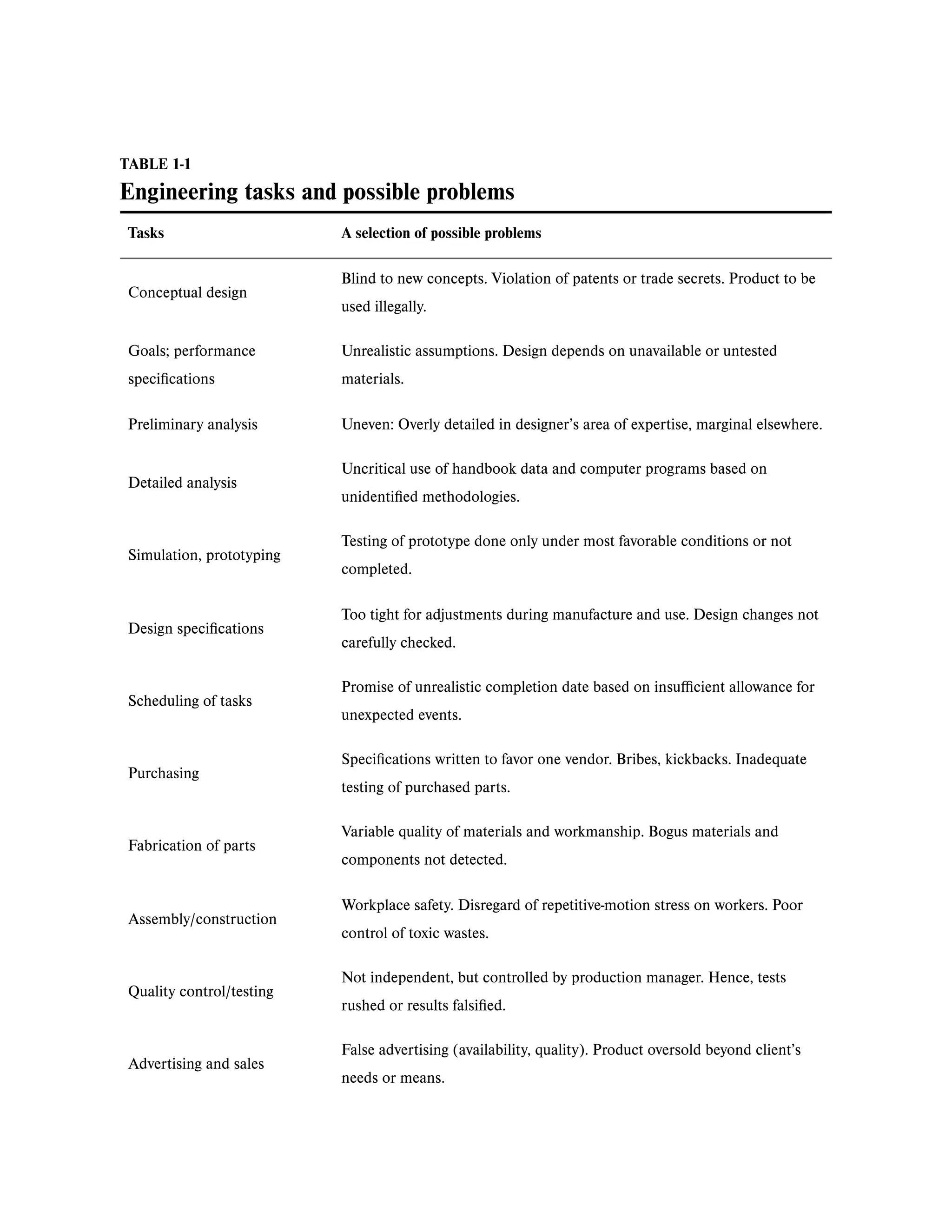
engineering tasks, this time as listed in table 1-1, along with examples of problems that
might arise.
FIGURE 1-3
The Kansas City Hyatt-Regency walkway collapse. Two walkways—one above the other—along one wall of a large atrium are
to be supported by welded box-beams, which in turn are held up along the atrium side by long rods extending from the
ceiling. Because of perceived difficulties in implementing design (a), the modification (b) using two shorter rods to replace
each long rod was proposed and approved. What is the result? Let the expected load on each box-beam at its atrium end be
P (the same on each floor). Then, in design (a) an upper-floor beam would have to support P pounds as shown in sketch
(d), but the design change raised that to 2P as shown in (e). This overload caused the box-beam/rod/nut supports on the
upper floor to fail as shown in (c). In turn, the upper and lower walkways collapsed, causing a final death toll of 114
with 200 injured. Later it was found that the design change had been stamped “approved” but not checked. [(For more, see
M. Levy and M. Salvadori, Why Buildings Fall Down [Norton & Co., 1992].)]
(d) Loads for case (a) (e) Loads for case (b)
28
45.
TABLE 1-1
Engineering tasksand possible problems
Tasks A selection of possible problems
Conceptual design
Blind to new concepts. Violation of patents or trade secrets. Product to be
used illegally.
Goals; performance
specifications
Unrealistic assumptions. Design depends on unavailable or untested
materials.
Preliminary analysis Uneven: Overly detailed in designer’s area of expertise, marginal elsewhere.
Detailed analysis
Uncritical use of handbook data and computer programs based on
unidentified methodologies.
Simulation, prototyping
Testing of prototype done only under most favorable conditions or not
completed.
Design specifications
Too tight for adjustments during manufacture and use. Design changes not
carefully checked.
Scheduling of tasks
Promise of unrealistic completion date based on insufficient allowance for
unexpected events.
Purchasing
Specifications written to favor one vendor. Bribes, kickbacks. Inadequate
testing of purchased parts.
Fabrication of parts
Variable quality of materials and workmanship. Bogus materials and
components not detected.
Assembly/construction
Workplace safety. Disregard of repetitive-motion stress on workers. Poor
control of toxic wastes.
Quality control/testing
Not independent, but controlled by production manager. Hence, tests
rushed or results falsified.
Advertising and sales
False advertising (availability, quality). Product oversold beyond client’s
needs or means.
46.
Page 20
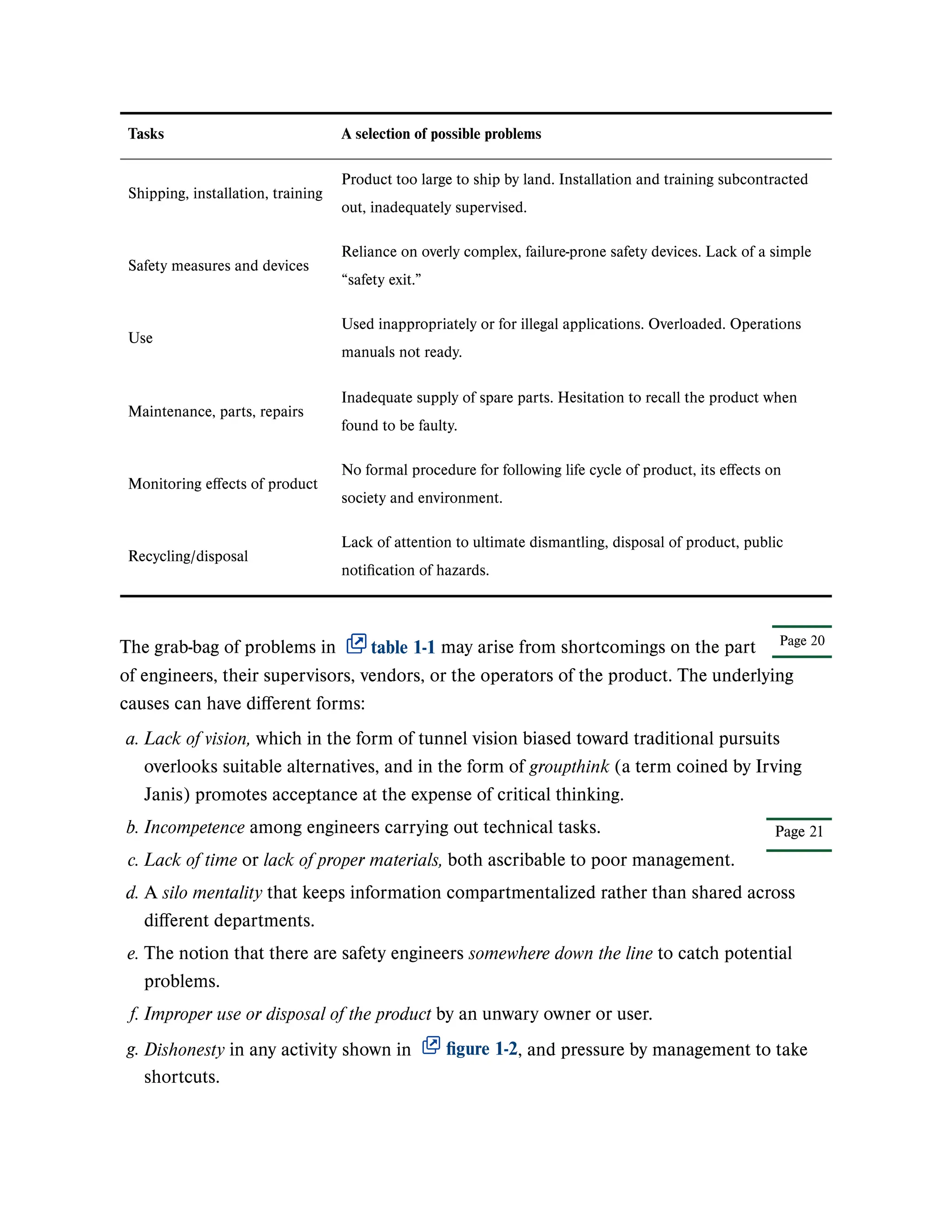
The grab-bagof problems in table 1-1 may arise from shortcomings on the part
of engineers, their supervisors, vendors, or the operators of the product. The underlying
causes can have different forms:
Tasks A selection of possible problems
Shipping, installation, training
Product too large to ship by land. Installation and training subcontracted
out, inadequately supervised.
Safety measures and devices
Reliance on overly complex, failure-prone safety devices. Lack of a simple
“safety exit.”
Use
Used inappropriately or for illegal applications. Overloaded. Operations
manuals not ready.
Maintenance, parts, repairs
Inadequate supply of spare parts. Hesitation to recall the product when
found to be faulty.
Monitoring effects of product
No formal procedure for following life cycle of product, its effects on
society and environment.
Recycling/disposal
Lack of attention to ultimate dismantling, disposal of product, public
notification of hazards.
a. Lack of vision, which in the form of tunnel vision biased toward traditional pursuits
overlooks suitable alternatives, and in the form of groupthink (a term coined by Irving
Janis) promotes acceptance at the expense of critical thinking.
Page 21
b. Incompetence among engineers carrying out technical tasks.
c. Lack of time or lack of proper materials, both ascribable to poor management.
d. A silo mentality that keeps information compartmentalized rather than shared across
different departments.
e. The notion that there are safety engineers somewhere down the line to catch potential
problems.
f. Improper use or disposal of the product by an unwary owner or user.
g. Dishonesty in any activity shown in figure 1-2, and pressure by management to take
shortcuts.
47.
Although this listis not complete, it hints at the range of problems that can generate moral
challenges for engineers. It also suggests why engineers need foresight and caution,
especially in imagining who might be affected indirectly by their products and by their
decisions, in good or harmful ways.
DISCUSSION QUESTIONS
h. Inattention to how the product is performing after it is sold and when in use.
1. Upon identifying the structural danger in the Citicorp building, should LeMessurier have
immediately notified the workers in the building, surrounding neighbors, and the general
public who might do business in the building? Or was it enough that he made sure
evacuation plans were in place and that he was prepared to provide warning to people
affected in the event of a major storm?
2. Laws play an enormously important role in engineering, but sometimes they overshadow
and even threaten morally responsible conduct. Thus, attorneys often advise individuals
not to admit responsibility. Bring to mind some occasions where that is good advice.
Then discuss whether it would have been sound advice to LeMessurier in the Citicorp
Tower case.
3. Herbert Hoover assumes that engineers are accountable for whether the products they
make actually work according to expectations. But suppose, as is typical, that an engineer
works on only a small part of a building or computer. Is Hoover mistaken in saying that
the engineer shares responsibility for the product in its entirety? Does what he says apply
only to the project engineer responsible for overseeing an entire project? Distinguish the
applicable senses of “responsibility.”
48.
Page 22
1.3 RESPONSIBLEPROFESSIONALS
AND ETHICAL CORPORATIONS
From its inception as a profession, as distinct from a craft, much engineering has been
embedded in corporations. That is due to the nature of engineering, both in its goal of
producing economical and safe products for the marketplace and in its usual complexity of
large projects that requires that many individuals work together.
Engineer and historian Edwin T. Layton, Jr., identifies two main stages in the
development of engineering as a profession during the nineteenth century. First, the growth
of public resources during the first half of the century made possible the extensive building
of railroads, canals, and other large projects that only large technological organizations
could undertake. Second, from 1880 to 1920 the demand for engineers exploded, increasing
their ranks 20 times over. Along with this increase came a demand for science- and
mathematics-based training, as engineering schools began to multiply. About the same time,
the dominance of independent consulting engineers began to fade, as engineering became
increasingly tied to corporations.
Layton also suggests that corporate control underlies the primary ethical dilemmas
confronted by engineers: “The engineer’s problem has centered on a conflict between
professional independence and bureaucratic loyalty,” and “the role of the engineer
represents a patchwork of compromises between professional ideals and business
demands.”
We will encounter ethical dilemmas that provide some support for Layton’s generalization.
But we emphasize that corporate influence is by no means unique to engineering. Today, all
professions are interwoven with corporations, including medicine, law, journalism, and
science. Professional ethics and business ethics should be connected from the outset,
although by no means equated. Let us begin with a brief characterization of professional
ethics and then turn to business ethics.
1.3.1 What Are Professions?
In a broad sense, a profession is any occupation that provides a means by which to earn a
living. In the sense intended here, however, professions are those forms of work involving
29
30
49.
Page 23
advanced expertise,self-regulation, and concerted service to the public good.
Drawing attention to the positive, honorific connotations of “profession,” some
critics argue that the attempt to distinguish professions from other forms of work is an elitist
attempt to elevate the prestige and income of certain groups of workers. Innumerable forms
of work contribute to the public good, even though they do not require advanced expertise:
for example, hair cutting, selling real estate, garbage collection, and professional sports.
In reply, we agree that these are valuable forms of work and that professionalism should not
be primarily about social status. Nevertheless, we believe that concerted efforts to maintain
high ethical standards, together with a sophisticated level of required skill and the requisite
autonomy to do so, warrants the recognition traditionally associated with the word
profession. We readily acknowledge, however, that in taking seriously this traditional idea of
professions, we are tacitly asserting a value perspective. In this way, how one defines
professions expresses one’s values, a point to which we return in the Discussion Questions.
30
1. Advanced expertise. Professions require sophisticated skills (“knowing-how”) and
theoretical knowledge (“knowing-that”) in exercising judgment that is not entirely routine
or susceptible to mechanization. Preparation to engage in the work typically requires
extensive formal education, including technical studies in one or more areas of
systematic knowledge as well as broader studies in the liberal arts (humanities, sciences,
arts). Generally, continuing education and updating knowledge are also required.
2. Self-regulation. Well-established societies of professionals are allowed by the public to
play a major role in setting standards for admission to the profession, drafting codes of
ethics, enforcing standards of conduct, and representing the profession before the public
and the government. Often this is referred to as the “autonomy of the profession,” which
forms the basis for individual professionals to exercise autonomous professional
judgment in their work.
3. Public good. The occupation serves some important public good, or aspect of the public
good, and it does so by making a concerted effort to maintain high ethical standards
throughout the profession. For example, medicine is directed toward promoting health,
law toward protecting the public’s legal rights, and engineering toward technological
solutions to problems concerning the public’s well-being, safety, and health. The aims
and guidelines in serving the public good are detailed in professional codes of ethics,
which, in order to ensure the public good is served, need to be taken seriously throughout
the profession.
T
CHAPTER XI
BROTHER VANAND NEW
MONTANA
HE building of railroads through the state of Montana brought
a rapid development. The section around Great Falls became
a prosperous farming country. The settlement, therefore,
formed a new center for the church, and Brother Van came to this
district, not as a missionary at large, nor junior preacher, nor circuit-
rider this time, he came now as a presiding elder, or district
superintendent for all of that part of Montana east of the Rocky
Mountains and north of the Musselshell River. It was known as the
North Montana Mission and was about five twelfths of the total area
of the state. Let us get some idea concerning this new work with
which Brother Van was busy by making a comparison. The whole of
Massachusetts, New Hampshire, Vermont, Rhode Island,
Connecticut, New Jersey, Delaware, Maryland, and the District of
Columbia could be placed within the bounds of the district and still
leave four thousand square miles of territory.
In all this area there were three hundred and fifty-five members
of Brother Van’s church and fifty-three probationers. There were ten
52.
church buildings altogether.This property was valued at twenty-five
thousand dollars. There were four parsonages valued at four
thousand dollars. The twenty Sunday-schools had a membership of
nine hundred and twenty-five. The ten preachers received five
thousand, six hundred and fifty-one dollars a year, or an average of
five hundred and sixty dollars each. The churches gave four hundred
and seventy-six dollars to benevolences.
Many of the people whom Brother Van now served came from
Eastern homes and were familiar with ideals of culture and
refinement. They had cut loose from the East with its old
associations and conventionalities, and had come to face a new life
on the frontier so full of promise. Imagine a town of two thousand
inhabitants composed of people from every state in the Union, and
from every civilized country in the world, of every color, race, and
creed, speaking fifteen or twenty languages, and clinging to varying
religious beliefs, and you will then have an idea of a mining town
such as Brother Van found as he traveled through his district. The
West was still, however, the easy prey for evil, and at every
crossroad and station could be seen the sign, “Saloon and Licensed
Gambling.” The gamblers and saloon men were leading citizens, and
they had to be reckoned with. Brother Van had been a prohibitionist
always. He had seen the effect of alcohol in his boyhood days,
especially in the oil regions. As he grew all too familiar with the
dreadful fire-water which demoralized and beggared the Indians
whom he sought to emancipate, a new hatred of the vile stuff took
possession of him.
The Rev. George Logan tells a story of Brother Van as district
superintendent which illustrates the spirit of comradeship that he
shares with all men, even the saloon men and gamblers. On one
Sunday morning Mr. Logan asked for a good collection to make up
the district superintendent’s salary, saying, “If I don’t get it this
morning, I’ll come again tonight.” The collection was not big enough,
and true to his word the second collection was asked for. One man
put a stack of six silver dollars on the plate and so the amount
53.
received was sufficientto make up the sum required for the unpaid
salary.
Going down town next day Mr. Logan met the man of the silver
dollars, who with a grin asked, “Did you raise Brother Van’s money
last night?”
“I did,” was the pastor’s reply.
“Did you notice that stack of silver dollars on the plate?”
“I did,” said Mr. Logan again.
“Well, I’ll tell you a story if you’ll promise not to get angry about
it.”
“I promise,” said the preacher.
“Two men at the service on Sunday morning remembered
afterward that Brother Van’s salary was short, and they agreed to
play for the money in the afternoon. If A. won, the money was to be
Brother Van’s; if B. did, Brother Van lost. Word went around and the
saloon filled with sports to watch the game. If A. won, the crowd
yelled, ‘The Lord gets that!’ and if B. was lucky, ‘That goes to the
devil!’”
A. had won, and the unsuspecting District Superintendent’s salary
was paid by the successful gambler. Mr. Logan looked the narrator in
the eye, and said, “I’m so glad I got that money; it has been in the
hands of the devil long enough. Brother Van will put it to a better
use.”
It was through many unique incidents and strange experiences
that Brother Van’s work was built up. Steadily the character of the
country changed and another generation was growing up. Stalwart
sons and daughters of the settlers began to try to win a means of
education in the desert. They looked beyond the shining mountains
54.
to college andto seminary. As Brother Van traveled from place to
place he pondered over this problem. No children of his own will
look to him for education, but had he not claimed spirituality in this
wide land for the children? He saw that the boys and girls were
eager for larger social privileges and for a higher intellectual life; so
he decided that Montana should have a Christian school. For thirteen
years he toiled to secure one; other men’s names appeared on the
committee formed for the enterprise and in time disappeared, but
the name of William Wesley Van Orsdel always headed the list. He
was not an educated man as far as the study of books was
concerned. Only in the School of Experience and in the Seminary of
Hard Knocks had he taken postgraduate courses. But he was now
determined that the young people of Montana should have first, a
Christian influence, and, second, an education.
Because of that thinking, planning, and praying of the missionary,
there came a day when the capital city, Helena, had a new asset.
Five miles from the center of the town stood a fifty-thousand-dollar
brick building dedicated to the young people of Montana. The
campus of two hundred and thirty-five acres was beautified, and the
school was opened. The distance from town, the newness of the
undertaking, the indifference of the people, all proved
insurmountable difficulties to every one but Brother Van. For ten
years the school struggled to succeed while the trustees felt almost
constantly that they must close it, but Brother Van would not
consent. Then a radical measure was adopted. The school was
moved to Helena, where to-day Montana Wesleyan University stands
in friendly neighborliness to the capitol building. Montana Wesleyan
antedated all state schools in Montana for higher education.
Brother Van watched those two buildings on Capitol Hill with a
peculiar yearning. He remembered the town of Helena as it had
looked when he reached it on that summer day in 1872. He
remembered the first capitol building in Bannack, where it was his
lot to bury the four plainsmen who had lost their lives because the
Indians could not understand the coming of the white man into their
55.
hunting ground. Thefirst legislature was held in two rooms in a log
cabin. Tallow candles emphasized the gloom. Sheet-iron stoves
made the pent-up air seem stifling. One desk and a bench in each
room completed the furnishing of this first capitol. The library was
composed of one copy of the Idaho Statutes.
On February 22, 1889, Montana became a state and Helena
became the capital. Helena of Last Chance Gulch fame had grown
rapidly, as its eastern seekers of gold became housed in cabins,
wickiups, shacks, and tents. Helena became a wicked city, where
Sunday was the wildest day of the wild week. Then came a period of
reconstruction. Schools were built, imposing sites were sought for
churches; the dugout school disappeared from the prairie, and in its
place came the little red schoolhouse. The first public school had
been opened on March 5, 1866, in Virginia City. There were no text-
books. Every child brought any book he might possess. Now schools
were becoming common in Montana. Daily papers were needed and
in place of the Montana Post which had been published in the cellar
of a log cabin in Virginia City and dates from May, 1868, came the
Montana Record Herald.
Montana had a state pride and no man could surpass Brother
Van as he sang the praises of his adopted state. As civilization
progressed the new State-house now standing on Capitol Hill was
needed. This was a thrilling time in the life of the young state. When
the imposing building was completed and ready to be dedicated,
Montana’s representatives gathered and stood with bared heads as
Brother Van offered this prayer:
“O thou God of our fathers, we draw near to thee in the name of
thy Son, our Saviour, to acknowledge the many blessings of which
we are the recipients, on this our nation’s birthday; the day when
this was declared to be a free and independent nation, and which
now stands out among the nations as a star of the first magnitude.
O God, may thy presence ever abide with our nation. We invoke thy
56.
blessing on ourPresident, and those associated with him in directing
the affairs of the nation.
“We are here in this great new commonwealth, pioneer men and
women, who came here in the earlier settlements and opened up
the way for success; we are here to-day with our children and
associates to honor the state and thee. We are here to dedicate and
set apart this magnificent building, this capitol building, to the
purpose for which it was built. Let thy blessing rest on the exercises
of this hour. May thy blessing rest on the government of the state,
the officers, the capitol commission, and all who have been
associated with the planning and completing of the building.
“Let thy blessing be upon our representatives, on both houses of
congress, on state senators and legislators, who shall meet in this
house from time to time. May we all realize that great is that people
whose God is the Lord. May we flee evil. Amen.”
The walls of the Senate Chamber of that great building are
adorned with paintings done by Mr. Charles Russell, who came to
Montana in 1881 and achieved fame as the cowboy artist. No
creation of his brain or brush ever exploits any theme but Montana
and the West. The modern home of Mr. Russell is at Great Falls and
in the spacious grounds surrounding it stands a log cabin. Let us
visit it with Brother Van, who is an old-time friend of the owner.
57.
Painting by CharlesM. Russell.
RIDING TOWARD THE FRONT OF THE STAMPEDING BEASTS, BROTHER
VAN SHOT THE HERD LEADER IN THE HEAD
The porch has no board floor and is low, so we can see the roof
strewn with buffalo horns and skulls. On the stockade-door the
latch-string hangs out, and it means just that, a true Western
hospitality. We pull the string, the latch lifts, and we stand in the
presence of the cowboy artist. He looks both cowboy and artist. His
long hair is thrown back from a strong and sun-browned face, and
this suggests the artist; so does the scarlet sash that he wears. His
flannel shirt is open at the throat, and his Khaki trousers are thrust
into high boots, showing the habit of the cowboy.
Around that interesting room is a record of the history of
Montana. War-bonnets and tomahawks hang from pegs. In a rack
are rifles which tell the story of firearm progress from the flintlock to
the Springfield, and then to the Winchester. Indian beads, rugs,
baskets, and blankets form a wealth of color on the walls, and
before a great fireplace stands an easel, and lo, the artist is telling
our story in a finer way. There are the figures of Lewis and Clarke on
58.
the canvas. AnIndian village is in the background, and in the center
we recognize the woman guide, Sacajawea. She is meeting her
childhood friend who had been taken prisoner when she was.
As he watched Montana develop with the anxiety that a father
gives to the growth of an awkward, beloved boy, Brother Van saw a
new need. Always had he ministered to sick and dying miners,
cowboys, and settlers. But as the years passed he saw that it would
be a great advantage to the state if the sick and dying could be
cared for with all the help that modern medical science affords. He
realized the necessity of placing patients under religious influence
and teaching. The cure of souls was to him even more important
than the cure of bodies; so he began to talk and to pray for a
Christian hospital. Probably fifty thousand dollars has passed
through Brother Van’s hands in the time he has served Montana, but
he owns no home or cattle. Even the pony is no more and a Ford is
not its successor. The salary for his first year’s work was nothing,
and for the second it was seventy-five dollars. In later years he
received seventeen hundred dollars. Yet every Protestant enterprise
has had an impetus from Brother Van’s pocketbook.
He interested his church in the need of a hospital, and
deaconesses were brought west and a hospital was started. Every
one but the prime mover became discouraged by the hardships that
the project encountered, but he continued to sing, to pray, to praise
Montana, and to work for Montana. In Great Falls now stands a
beautiful hospital, entirely fireproof and modern in every
convenience. In the hall of the building hangs a painting. It is a
western scene, and shows a man riding furiously toward the leader
of a herd of buffalo; Indians ride behind as interested spectators to
the shooting of the large beast. The inscription below is “Brother Van
shooting buffalo,” and it illustrates the story already told. The artist
is Charles M. Russell.
Across the street is the Van Orsdel Home where white-capped
and swift-footed nurses reside, and this is the story of the building.
59.
Once upon atime some gamblers, cowboys, and saloon men
decided that they, too, wanted to tell Brother Van that they wished
him well. He had fought the saloon with a zeal that could not be
misunderstood, but he fought fairly. He hated the business and told
its supporters so in no mincing language; but he didn’t hate the men
and they knew that. They decided to raise one thousand dollars and
give it to him that he might buy a home of his own, or that he might
have the money to do as he wished. The fund was started. At first it
grew slowly and then by bounds. It was put in a bank and as time
went by the deposit was forgotten. A gambler, who was on his
death-bed, wanted to see Brother Van. He answered the call at
once, and was able to help the dying man hear from the Master,
“Thy sins are forgiven thee.” In his last moments the man told about
the money that was lying in the bank and accumulating interest.
Brother Van drew it out and soon a nurses’ home was started.
Within the walls of the Van Orsdel Home is a home life of rare
culture and beauty. Many girls are sheltered and trained there who
were brought to the pioneer preacher as infants twenty years earlier
that he might lay hands on them in baptism. At the beginning of
each school year of the Nurses’ Training School, Brother Van greets
those uniformed students with encouraging words and with a tender
appeal for loyalty to the Master whom he serves.
One of Brother Van’s enterprises seemed not to be of God’s
planning. That was the original home of Montana Wesleyan, five
miles from Helena. People spoke of the neglected building as a
mistake and an expensive failure. Boys threw stones through every
pane of glass in the three-story building. A family of lively coyotes
occupied the big dining-room; bats took up their abode in the dark
corners; spiders spun their webs unhindered over the ceiling, and
owls seemingly joined the scoffers in their derision of the enterprise.
Occasionally a solitary figure would come into the building and
kneeling in the dust, would implore God to give him a reason against
the prevalent unbelief. He would ask God to use these buildings for
his own service, and for the Christian uplift of young people. Surely
60.
there was someuse for them. The years passed, and this solitary
figure began to see another need for his cherished Montana. The
young people had long since been coming to the university on
Capitol Hill, but in the wide expanses of the state there were yet
many children unschooled. There were orphans to be protected, and
other children too far from the district school for daily attendance.
These became a new and dear care to Brother Van.
61.
THE VAN ORSDELHOME FOR NURSES IS ONE OF THE MANY
INSTITUTIONS FOUNDED BY BROTHER VAN
Again the old pocketbook made a beginning. As the hard-earned
money went for the house-cleaning a gift came to Brother Van; a
grateful ranchman presented him with a cow. It was driven promptly
to the two hundred-and-thirty-five-acre campus which surrounded
the neglected building out by Helena, so that the few children he
might gather there should be fed. The building, so recently the
home of the bats and the coyotes, was cleaned and repaired and put
in readiness for its first pupil, a child whom a dying mother
committed to the care of Brother Van. Others needing school
advantages were found and placed in the renovated building. The
title page of the first Annual published by the students of this school
of faith is inscribed: “To Brother Van as an expression of love from
the class of 1915.”
Not all the time was Brother Van building churches. There are
one hundred churches in Montana built by him, and about fifty
parsonages due to his labors, besides six hospitals and two large
institutions of learning, but there is another piece of work which he
62.
has been doingbetween times for the church he loves. Since 1876
he has represented the Methodist Church of Montana in the
denomination’s great governing body, the General Conference. At
the meeting at Saratoga Springs in 1916, one evening was given
over to the two friends, Dr. Thomas C. Iliff and Brother Van. They
recounted the struggles and triumphs of their western life, and sang
the old songs which had carried inspiration to the people of the
west.
A few years ago Brother Van made a long trip across the country
and came again to Gettysburg, where, as a boy, fifty-four years
before, he had witnessed that great battle. A large part of the land
where the battle was fought has been bought by the United States
government, and the government and the states spent seven million
dollars in erecting the memorials that do honor to the men who fell
in those July days of 1863. Brother Van saw again the house in
which President Lincoln was entertained when he made that
memorable address familiar to-day to every schoolboy and
schoolgirl. He recalled how he had gone to seek the sad-faced man.
He had come into his presence a towsled, barefoot, awkward boy,
and with new appreciation he remembered how that great man had
shaken hands with him. Since then other presidents have shaken
hands with the boy grown into a missionary. Grant, Roosevelt, and
Taft have all done honor to the man so well loved in Montana.
63.
T
CHAPTER XII
SEVENTY YEARSYOUNG
HE haze of Indian summer hangs over the prairies of
Montana as they flaunt their golden flowers. There could be
no more perfect days than these for a journey with Brother
Van through the great state. One might almost call it his parish, so
closely has he been associated with the settlement and growth of
vast stretches of its territory. He shall be our guide as we visit the
widely scattered villages and thriving towns, where he is eagerly
welcomed by men, women, and children of all faiths and of none.
There are no strangers to Great Heart of the Indians. Brother Van
greets every one he meets with the Indians’ guttural “Oi-Oi-Oi,”
meaning “How do you do!” When we ask why he always uses the
expression, he replies, “Oh, just to show that I’m a friendly Indian.”
We start our trip at Fort Benton, where, in a well kept park, stand
the ruins of the old fort, a crumbling relic of days forever past. The
stockade is gone and only a blockhouse remains. It is carefully
guarded, for inside are precious relics of the past. Let us stand on
the very spot where Brother Van celebrated his first Fourth of July in
Montana by eating a dinner of jerked buffalo meat. Our eyes sweep
the horizon and we try to imagine the scenes of former days when
64.
over those flashingwaters of the Missouri came bull-boats or birch
canoes, bringing precious furs to the Northwest Fur Company’s post.
In the town itself we pass the site of the old mud saloon where,
on that far-away Sunday, the tenderfoot missionary preached to a
curious throng. What of the church life of to-day? We spend a
Sabbath in the historic town and go to the old mother church. It is a
small building, simple in style, but we enter it in a spirit of
reverence. Repairs are in progress; with his own hands the minister,
a college and seminary graduate, has painted the woodwork and
papered the walls. He has been aided in the evenings by the earnest
men of his congregation.
The days of the Northwest Fur Company seem very remote when
the new generation, with a small group from the older one, kneel to
receive Holy Communion. The life of the trapper and trader, starved
and godless, seems a haunting and an impossible dream. Yet the
pastor has his problems. His church must be enlarged and
modernized to meet the social demands of the little city. He must
find means for providing recreation and wholesome entertainment in
connection with the church, so that the people of the community
may not have to depend for their amusement on the cheap “movie”
theater with its sensuous appeals. He must travel far out on the
wide prairie to care for the ranchers who are setting up homes in
these lands that under new methods of cultivation are proving to be
far more fruitful than it was once considered possible for them to be.
The scout-missionary is still keen about first churches, and we
accompany him on a visit to a little town near Fort Benton. We go to
the schoolhouse. We are early; so we will play janitor. The bell is to
be rung. The songbooks are to be distributed. Brother Van does not
preach this time, but his influence is felt all through the service. He
stands in the closing moments and urges upon the people a new
loyalty to Jesus Christ and a new loyalty to the church as the center
of their common life. All who will so pledge are asked to come and
take him by the hand, and every man, woman, and child in the little
65.
group comes forward.Among them are three soldiers, guards in the
uncertain days of war of the big bridge which swings over the Teton
River at the outskirts of the town.
One of Brother Van’s churches is in process of building in this
town. You may smile at its dimensions. It has one main room and a
basement which is to be cut up into smaller social rooms.
“Well, Brother Van, when is it to be finished?” he is asked.
“Don’t know, Sister!”
“Why not finish it right away?”
“I’d love to, but not one cent of debt is to be placed on this or on
any other church I have anything to do with.”
“But, can these few people build this church?”
“They can and will, with the help of the Board of Home Missions.”
“Ah, if people only knew the need of home missions, we would
not have to see these churches which we try to put in the new
centers struggle and languish as they do,” he adds.
“Why try to have a church so soon, then?”
“Ah, Sister, that is the point. We must claim these new towns for
our Christ. The devil has his agents at work in the saloon and dance
halls. Why should we give up to him?”
In that distant time when Brother Van made his first visit to the
Indian agency, he traveled in an army post wagon. As we seek the
Blackfeet Indians, we travel with him on a railroad train. His vivid
stories of the towns through which we pass make us realize how
much the frontier owes to missionary influence. Brother Van gets off
at every station to look around.
66.
“See that churchhouse,” he exclaims proudly, for he always calls
it that. “Isn’t it beautiful?”
It is small and in need of paint. Compared, however, to the
saloon building in which he had probably held the first service, it is
beautiful.
67.
GREAT HEART WITHA BLACKFOOT BROTHER AND HIS FAMILY
“Browning! Browning!” calls the conductor. Nothing here but a
small station.
“This way, Brother Van,” calls a voice from the starlit darkness,
and soon we are on our way to the Indian reservation and the
parsonage home of Rev. A. W. Hammer, the cowboy preacher.
A cheerful welcome awaits us in the little prairie home. Here in the
shadow of the snow-clad mountains is symbolized the Montana
dreamed about by the boy from Gettysburg. A home has been
established. A trained preacher ministers to the Indians.
On the following morning we find spread out before us a scene
of rich beauty as we look across the fields from which the grain has
been harvested. All the members of the household gather in front of
the cottage where there stands a straight mountain pine, carefully
trimmed and braced. From a home-made cabinet the oldest
daughter has taken a carefully folded bundle, and now at her
bidding it is fastened to the ropes swaying from the pine tree.
A steady pull brings Old Glory up to catch the breeze while the
68.
shining mountains seemto smile approval. The son places his hat
over his heart, while Brother Van, his head bared, his face
transfigured, sings, “O say can you see by the dawn’s early light”
and girlish voices catch up the refrain. No flag raising in the
presence of statesmen and of armies could be more impressive.
Here one sees the loyal soul of the west laid bare. This is the
America that the forces of the Christian church, the Christian home,
and the Christian school are building on the vast plains and through
the mountain valleys of the younger states.
The drive to the church in a lumber wagon is a novel experience,
and we understand why fur overcoats are called “life preservers,” for
the air gives a foretaste of the winter’s cold. The congregation of
Indians, plainsmen, business men, and college graduates gathers.
The Indians interest us the most. These are the adopted brothers of
Great Heart. These are the people whom William Van Orsdel loved
before he had seen them and whom he had left the old Gettysburg
home to serve. He has seen disease, ignorance, and intemperance
threatening to wipe out the race, and he has had to give a large part
of his energy to teaching a better way of life to the white man who
is so largely responsible for the conditions that exist; but he has
persevered in finding ways to help his red brothers.
In the United States there are now three hundred and thirty-six
thousand Indians; nearly one third of these are unchurched. There
are many who have no opportunity to know the living God, yet they
were the first Americans. Their loyalty was proved when nine
thousand young braves entered the army and navy to fight for a
world democracy, and one third of those entered the service through
enlistment. These wards of the nation, though driven back from
wide prairie to reservations, have been taught trades and
agriculture. Twenty million dollars worth of Liberty Bonds were
bought by Indians. The war has given the Indian an opportunity to
show his fine qualities of manhood, and to demonstrate his fitness
for those privileges of citizenship which have been denied him.
Hereafter, too, this native American will be a citizen of the world.
69.
“They have learnedto step to the drum-beat of democracy,” says
Hon. Cato Sells, “and they will come out of the conflict an element of
real and progressive strength in our National life.” Like many others
who have fought abroad, they will ask the churches and schools to
put into practise the principles that they defended “over there.”
The teachers to succeed Brother Van, Mr. Hammer, and all of that
host of devoted workers who have given their whole lives for the
building of a Christian civilization in the west must come from the
young people of the church. Young men and young women of the
new generation must have a vision clear enough to see the
beckoning hands that point the way to great unfinished tasks. The
high purpose of the boy from Gettysburg must fill other lives that will
take up the new tasks, as hard as the old, perhaps harder, which the
changing times have brought to Montana.
Leaving the Indians, we find ourselves on the railroad and bound
for the new frontier. The monotony of the prairie is only relieved by
homes and schoolhouses but these appear at intervals as we travel.
Occasionally we pass small towns clustering around grain elevators,
which show the new day of agriculture. We come at last to the end
of our journey to the new section and from the small station we
drive to a settler’s shack on a claim. Surely tales of frontier life have
been exaggerated, for here are warmth, blooming plants, books, and
papers. The homesteader is a retired preacher.
“We must get the surveyor while you are here, Brother Van, and
mark up that lot for the church,” says our host.
“A church out on this prairie!” we exclaim.
“Yes, do you see yonder that grain elevator and a few buildings?
That is a new town starting and we must have a church. A saloon
and a pool-room are there already. The storekeeper has given us a
lot for the church,” he explains.
70.
This is awise merchant who realized that the new town would
not be fit for his family unless the church was the central interest.
With pick and compass we go; Brother Van steps off the distance,
and the faithful pick finds the marker.
“The corner-stone will be right here,” says the master of
ceremonies. The spade is stuck into the rich soil while the people
cheer; but Brother Van is silent; his latest church is being started. He
is anxious that the children of the new town shall have a chance of a
Christian education. The government will see to the schoolhouses,
but the responsibility of the churches rests on Brother Van and his
aids, even on you and me.
We continue our sight-seeing tour of Montana and reach Helena
at a time when the city is thronged with visitors to the Fair. Yonder is
the Capitol, and in friendly nearness is a smaller building; it is
Montana Wesleyan University where college is opening. Brother Van
has a tumultuous greeting. The Board of Trustees has just declared
for a fifty-thousand-dollar enlargement of the institution. The
students and President Sweetland are riotously happy. Visitors make
speeches in the chapel. One man does not need the well-chosen
introductory speech from the new president. He is not allowed to
finish it.
“Who’s all right?” sings out a yell-leader.
“Brother Van! Brother Van!” comes roaring back from the eager
crowd.
No mention is made by the pioneer of his part in the enterprise
which has made the Christian education of these eager students
possible. When he finishes speaking, a demand is made: “A song! A
song!” So he sings “Diamonds in the Rough” for them. Then we
hasten to a meeting of the Board of Trustees, and arrive in time, for
Brother Van is never late for an engagement.
71.
“Now, let’s goto the Fair!” he says. To go to the Montana State
Fair with Brother Van is to become almost as much a center of
interest as the prize pumpkin or the heaviest sheaf of wheat. The
hold the man has on the people of the state begins to dawn on you.
“Hello, Van, old scout.”
“Why, Brother Van, how is the church at ――?”
“Isn’t this Brother Van?” ask children, shyly, as we pass.
Out in the enclosure a flag is to be raised. They send a
messenger to Brother Van to say that he is wanted to offer the
prayer. After the prayer, Governor Stewart is introduced, and the
heart of the Eastern visitor is stirred to hear from him how great a
part this new state took in the great world struggle for democracy;
how great an outpouring of its wealth there was for the needs of the
government and for the relief of suffering; and how large a number
of the boys from these thinly peopled plains left their homes to take
their places in the ranks of the armies of freedom.
It is a short drive over to the once owl-haunted, coyote-inhabited
building, which for a time seemed to be Brother Van’s mistake.
Children’s voices call a glad greeting, for now it is the Montana
Deaconess School. Out on the campus is an old building which the
boys have fitted up, and which they dignify by the name of “gym.”
Class work which meets the regular school standards is done in this
home, but that is only a part of its work. The development of strong,
helpful Christian character is the great task to which the earnest
teachers who labor here are devoting themselves.
Now we visit the Capitol, a beautiful building of which the young
state is justly proud. We go directly to the Governor’s suite and find
a delegation of citizens there waiting to consult him. The attendant
smiles on one member of our party and then disappears. We resign
ourselves for a long wait, but immediately the messenger returns.
“The Governor will see you, Brother Van,” he says. We then have the
72.
privilege of listeningto a conference between the pioneer missionary
and modern Montana’s chief man of affairs.
It is near Helena that Last Chance Gulch is situated and the city
still presents the problems of a mining center. In the old days the
miners came without families. They lived the hard, rough life of the
pioneers. Many were only adventurers. They gambled, and even
killed for the lure of gold. Yet it was they who found and developed
the mines which have furnished so large a share of Montana’s wealth
—and that of the nation.
Not only gold, but silver, copper, lead, coal, and iron are found.
Especially rich are the fields of copper, and since 1892, Montana has
been the leading state in the production of this metal. Great
smelting and refining plants costing millions of dollars have been
established around which thriving cities have quickly grown. In the
maze of stacks, mills, ore-dumps, tracks, and surrounding streets
filled with the cottages of the laborers, the visitor who has been to
the new settlements on the plains and to the reservations sees a
different Montana—not that of the rancher and the Indians but that
of the industrial worker.
We have an enthusiastic guide when we travel through the
mining regions with Brother Van. He keeps the spirit of the pioneer.
While his work has led him more among the Indians and the
plainsmen, he sees the great needs that have arisen with the growth
of the industrial centers. He is eager that the Christian forces of
America undertake new tasks of helpfulness for the men who toil
underground and in the mills, and for their families.
73.
Copyright, Brown Brothers.
ACOPPER MINE AT BUTTE
A new America must be won in the restless, throbbing centers of industrial life.
It is in Butte that we find the heart of the great copper region of
Montana. From the hill north of the city, ore to the value of a million
and a half dollars has been taken. When Brother Van made his first
visit there he found but fifty residents. Not only is it now a busy city
of forty thousand inhabitants, but the character of the community
has entirely changed. The settlers of that period were of American
birth and parentage. To-day the great majority of the miners are
from distant countries. The pioneers of the days of Brother Van’s
young manhood lived the hearty open life of the wind-swept plains;
the newcomers from Europe must toil in the dark mine shafts or
amid the dust and roar of the mills and smelters.
Coming as these workers do for the most part from southern and
eastern Europe, differing greatly in customs and in language from
the older population, they must be given special guidance, if they
are to find the real America of their dreams. They will attain the kind
74.
of citizenship whichwill make them able to take a really helpful place
in the life of the country only as we interpret Christian ideals for
them. It was for these ideals of democratic brotherhood that the
young men of America went abroad and for which thousands of
them gave their lives. Is America now to show to those who have
come as strangers to us, and who do such a large share of the hard
work of our country, that these ideals of democratic brotherhood are
being put into practise for the benefit of all?
Brother Van found a frontier region when he stepped ashore from
the river boat at Fort Benton on that July morning in 1872. He threw
himself into the life about him, and his years of service have brought
friendship and hope and courage to lonely men and women and to
aspiring young people all over a great commonwealth. Cowboy,
Indian, and miner have welcomed his help, for, as they put it, he
“prayed lucky.” There is need to-day—there will always be a need—
for the same ministry that Brother Van has been carrying on in his
founding of new churches, and in his friendly visiting in lonely
homes, and in his preaching anywhere and everywhere the word of
cheer and of faith that his whole life taught. And as a part of the
same great task to which he has devoted all his years, Brother Van
will tell you that there is need for another kind of scouting to-day in
the land of the shining mountains.
This vast development of modern industry calls for new and
varied kinds of service. The thrill of adventure is there, although it
may be different from that which was found in the early days of the
frontier, and the joy of conquest remains. The winning of a new
America is yet to be achieved in many of those restless, throbbing
centers of industrial life where men have not yet learned how to
bring the spirit of Christ into their daily toil; where home life is
narrow and harsh; where growing boys and girls are shut out from
the opportunities for recreation and for training, that a preparation
for healthy, capable citizenship demands.
75.
As we leaveBrother Van looking out over the wide plains of his
beloved Montana and gazing at the great black masses of the mills
and mines with the dismal clusters of miners’ cottages around them,
we know what he is thinking about. It is of the new scouts who will
come to occupy these frontiers of modern industrial and community
life for the Master. And we know that only those who are worthy to
be called Great Heart will be able to carry on in the new age of
world democracy the tasks that have been so well begun in the old
days of the opening West.
Other books for all boys and girls who love
tales of heroic adventure
PATHFINDER SERIES
Livingstone the Pathfinder
By BASIL MATHEWS
This story of the life of the great missionary explorer is told in a
thrilling manner. Every one should know the work of this well-known
hero.
Cloth, 60 cents; paper, 40 cents, prepaid
The Black Bearded Barbarian
By MARIAN KEITH
76.
The life storyof George Leslie Mackay, of Formosa. American Youth
says of it: “All workers with boys should welcome this little volume.
It has camp-fire stuff in it.”
Cloth, 60 cents; paper, 40 cents, prepaid
Uganda’s White Man of Work
By SOPHIA LYON FAHS
The story of Alexander Mackay, an engineer, who answered Stanley’s
call to go to “Darkest Africa.” His adventures and the life of the
people are vividly told.
Cloth, 60 cents; paper, 40 cents, prepaid
Martin of Mansfield
By MARGARET R. SEEBACH
This book tells many interesting things about the great reformer,
Martin Luther, but chiefly about his family, friends, and school days.
Cloth, 60 cents; paper, 40 cents, prepaid
Brother Van
By STELLA W. BRUMMITT
The fascinating story of the life of Dr. W. W. Van Orsdel, who has
had a long and adventurous career as a home missionary in
Montana.
Cloth, 75 cents; paper, 50 cents, prepaid
78.
*** END OFTHE PROJECT GUTENBERG EBOOK BROTHER VAN ***
Updated editions will replace the previous one—the old editions will
be renamed.
Creating the works from print editions not protected by U.S.
copyright law means that no one owns a United States copyright in
these works, so the Foundation (and you!) can copy and distribute it
in the United States without permission and without paying
copyright royalties. Special rules, set forth in the General Terms of
Use part of this license, apply to copying and distributing Project
Gutenberg™ electronic works to protect the PROJECT GUTENBERG™
concept and trademark. Project Gutenberg is a registered trademark,
and may not be used if you charge for an eBook, except by following
the terms of the trademark license, including paying royalties for use
of the Project Gutenberg trademark. If you do not charge anything
for copies of this eBook, complying with the trademark license is
very easy. You may use this eBook for nearly any purpose such as
creation of derivative works, reports, performances and research.
Project Gutenberg eBooks may be modified and printed and given
away—you may do practically ANYTHING in the United States with
eBooks not protected by U.S. copyright law. Redistribution is subject
to the trademark license, especially commercial redistribution.
START: FULL LICENSE
PLEASE READ THISBEFORE YOU DISTRIBUTE OR USE THIS WORK
To protect the Project Gutenberg™ mission of promoting the free
distribution of electronic works, by using or distributing this work (or
any other work associated in any way with the phrase “Project
Gutenberg”), you agree to comply with all the terms of the Full
Project Gutenberg™ License available with this file or online at
www.gutenberg.org/license.
Section 1. General Terms of Use and
Redistributing Project Gutenberg™
electronic works
1.A. By reading or using any part of this Project Gutenberg™
electronic work, you indicate that you have read, understand, agree
to and accept all the terms of this license and intellectual property
(trademark/copyright) agreement. If you do not agree to abide by all
the terms of this agreement, you must cease using and return or
destroy all copies of Project Gutenberg™ electronic works in your
possession. If you paid a fee for obtaining a copy of or access to a
Project Gutenberg™ electronic work and you do not agree to be
bound by the terms of this agreement, you may obtain a refund
from the person or entity to whom you paid the fee as set forth in
paragraph 1.E.8.
1.B. “Project Gutenberg” is a registered trademark. It may only be
used on or associated in any way with an electronic work by people
who agree to be bound by the terms of this agreement. There are a
few things that you can do with most Project Gutenberg™ electronic
works even without complying with the full terms of this agreement.
See paragraph 1.C below. There are a lot of things you can do with
Project Gutenberg™ electronic works if you follow the terms of this
agreement and help preserve free future access to Project
Gutenberg™ electronic works. See paragraph 1.E below.
81.
1.C. The ProjectGutenberg Literary Archive Foundation (“the
Foundation” or PGLAF), owns a compilation copyright in the
collection of Project Gutenberg™ electronic works. Nearly all the
individual works in the collection are in the public domain in the
United States. If an individual work is unprotected by copyright law
in the United States and you are located in the United States, we do
not claim a right to prevent you from copying, distributing,
performing, displaying or creating derivative works based on the
work as long as all references to Project Gutenberg are removed. Of
course, we hope that you will support the Project Gutenberg™
mission of promoting free access to electronic works by freely
sharing Project Gutenberg™ works in compliance with the terms of
this agreement for keeping the Project Gutenberg™ name associated
with the work. You can easily comply with the terms of this
agreement by keeping this work in the same format with its attached
full Project Gutenberg™ License when you share it without charge
with others.
1.D. The copyright laws of the place where you are located also
govern what you can do with this work. Copyright laws in most
countries are in a constant state of change. If you are outside the
United States, check the laws of your country in addition to the
terms of this agreement before downloading, copying, displaying,
performing, distributing or creating derivative works based on this
work or any other Project Gutenberg™ work. The Foundation makes
no representations concerning the copyright status of any work in
any country other than the United States.
1.E. Unless you have removed all references to Project Gutenberg:
1.E.1. The following sentence, with active links to, or other
immediate access to, the full Project Gutenberg™ License must
appear prominently whenever any copy of a Project Gutenberg™
work (any work on which the phrase “Project Gutenberg” appears,
or with which the phrase “Project Gutenberg” is associated) is
accessed, displayed, performed, viewed, copied or distributed:
82.
This eBook isfor the use of anyone anywhere in the United
States and most other parts of the world at no cost and with
almost no restrictions whatsoever. You may copy it, give it away
or re-use it under the terms of the Project Gutenberg License
included with this eBook or online at www.gutenberg.org. If you
are not located in the United States, you will have to check the
laws of the country where you are located before using this
eBook.
1.E.2. If an individual Project Gutenberg™ electronic work is derived
from texts not protected by U.S. copyright law (does not contain a
notice indicating that it is posted with permission of the copyright
holder), the work can be copied and distributed to anyone in the
United States without paying any fees or charges. If you are
redistributing or providing access to a work with the phrase “Project
Gutenberg” associated with or appearing on the work, you must
comply either with the requirements of paragraphs 1.E.1 through
1.E.7 or obtain permission for the use of the work and the Project
Gutenberg™ trademark as set forth in paragraphs 1.E.8 or 1.E.9.
1.E.3. If an individual Project Gutenberg™ electronic work is posted
with the permission of the copyright holder, your use and distribution
must comply with both paragraphs 1.E.1 through 1.E.7 and any
additional terms imposed by the copyright holder. Additional terms
will be linked to the Project Gutenberg™ License for all works posted
with the permission of the copyright holder found at the beginning
of this work.
1.E.4. Do not unlink or detach or remove the full Project
Gutenberg™ License terms from this work, or any files containing a
part of this work or any other work associated with Project
Gutenberg™.
1.E.5. Do not copy, display, perform, distribute or redistribute this
electronic work, or any part of this electronic work, without
prominently displaying the sentence set forth in paragraph 1.E.1
83.
with active linksor immediate access to the full terms of the Project
Gutenberg™ License.
1.E.6. You may convert to and distribute this work in any binary,
compressed, marked up, nonproprietary or proprietary form,
including any word processing or hypertext form. However, if you
provide access to or distribute copies of a Project Gutenberg™ work
in a format other than “Plain Vanilla ASCII” or other format used in
the official version posted on the official Project Gutenberg™ website
(www.gutenberg.org), you must, at no additional cost, fee or
expense to the user, provide a copy, a means of exporting a copy, or
a means of obtaining a copy upon request, of the work in its original
“Plain Vanilla ASCII” or other form. Any alternate format must
include the full Project Gutenberg™ License as specified in
paragraph 1.E.1.
1.E.7. Do not charge a fee for access to, viewing, displaying,
performing, copying or distributing any Project Gutenberg™ works
unless you comply with paragraph 1.E.8 or 1.E.9.
1.E.8. You may charge a reasonable fee for copies of or providing
access to or distributing Project Gutenberg™ electronic works
provided that:
• You pay a royalty fee of 20% of the gross profits you derive
from the use of Project Gutenberg™ works calculated using the
method you already use to calculate your applicable taxes. The
fee is owed to the owner of the Project Gutenberg™ trademark,
but he has agreed to donate royalties under this paragraph to
the Project Gutenberg Literary Archive Foundation. Royalty
payments must be paid within 60 days following each date on
which you prepare (or are legally required to prepare) your
periodic tax returns. Royalty payments should be clearly marked
as such and sent to the Project Gutenberg Literary Archive
Foundation at the address specified in Section 4, “Information
84.
about donations tothe Project Gutenberg Literary Archive
Foundation.”
• You provide a full refund of any money paid by a user who
notifies you in writing (or by e-mail) within 30 days of receipt
that s/he does not agree to the terms of the full Project
Gutenberg™ License. You must require such a user to return or
destroy all copies of the works possessed in a physical medium
and discontinue all use of and all access to other copies of
Project Gutenberg™ works.
• You provide, in accordance with paragraph 1.F.3, a full refund of
any money paid for a work or a replacement copy, if a defect in
the electronic work is discovered and reported to you within 90
days of receipt of the work.
• You comply with all other terms of this agreement for free
distribution of Project Gutenberg™ works.
1.E.9. If you wish to charge a fee or distribute a Project Gutenberg™
electronic work or group of works on different terms than are set
forth in this agreement, you must obtain permission in writing from
the Project Gutenberg Literary Archive Foundation, the manager of
the Project Gutenberg™ trademark. Contact the Foundation as set
forth in Section 3 below.
1.F.
1.F.1. Project Gutenberg volunteers and employees expend
considerable effort to identify, do copyright research on, transcribe
and proofread works not protected by U.S. copyright law in creating
the Project Gutenberg™ collection. Despite these efforts, Project
Gutenberg™ electronic works, and the medium on which they may
be stored, may contain “Defects,” such as, but not limited to,
incomplete, inaccurate or corrupt data, transcription errors, a
copyright or other intellectual property infringement, a defective or
85.
damaged disk orother medium, a computer virus, or computer
codes that damage or cannot be read by your equipment.
1.F.2. LIMITED WARRANTY, DISCLAIMER OF DAMAGES - Except for
the “Right of Replacement or Refund” described in paragraph 1.F.3,
the Project Gutenberg Literary Archive Foundation, the owner of the
Project Gutenberg™ trademark, and any other party distributing a
Project Gutenberg™ electronic work under this agreement, disclaim
all liability to you for damages, costs and expenses, including legal
fees. YOU AGREE THAT YOU HAVE NO REMEDIES FOR
NEGLIGENCE, STRICT LIABILITY, BREACH OF WARRANTY OR
BREACH OF CONTRACT EXCEPT THOSE PROVIDED IN PARAGRAPH
1.F.3. YOU AGREE THAT THE FOUNDATION, THE TRADEMARK
OWNER, AND ANY DISTRIBUTOR UNDER THIS AGREEMENT WILL
NOT BE LIABLE TO YOU FOR ACTUAL, DIRECT, INDIRECT,
CONSEQUENTIAL, PUNITIVE OR INCIDENTAL DAMAGES EVEN IF
YOU GIVE NOTICE OF THE POSSIBILITY OF SUCH DAMAGE.
1.F.3. LIMITED RIGHT OF REPLACEMENT OR REFUND - If you
discover a defect in this electronic work within 90 days of receiving
it, you can receive a refund of the money (if any) you paid for it by
sending a written explanation to the person you received the work
from. If you received the work on a physical medium, you must
return the medium with your written explanation. The person or
entity that provided you with the defective work may elect to provide
a replacement copy in lieu of a refund. If you received the work
electronically, the person or entity providing it to you may choose to
give you a second opportunity to receive the work electronically in
lieu of a refund. If the second copy is also defective, you may
demand a refund in writing without further opportunities to fix the
problem.
1.F.4. Except for the limited right of replacement or refund set forth
in paragraph 1.F.3, this work is provided to you ‘AS-IS’, WITH NO
OTHER WARRANTIES OF ANY KIND, EXPRESS OR IMPLIED,
86.
Welcome to ourwebsite – the perfect destination for book lovers and
knowledge seekers. We believe that every book holds a new world,
offering opportunities for learning, discovery, and personal growth.
That’s why we are dedicated to bringing you a diverse collection of
books, ranging from classic literature and specialized publications to
self-development guides and children's books.
More than just a book-buying platform, we strive to be a bridge
connecting you with timeless cultural and intellectual values. With an
elegant, user-friendly interface and a smart search system, you can
quickly find the books that best suit your interests. Additionally,
our special promotions and home delivery services help you save time
and fully enjoy the joy of reading.
Join us on a journey of knowledge exploration, passion nurturing, and
personal growth every day!
ebookmasss.com


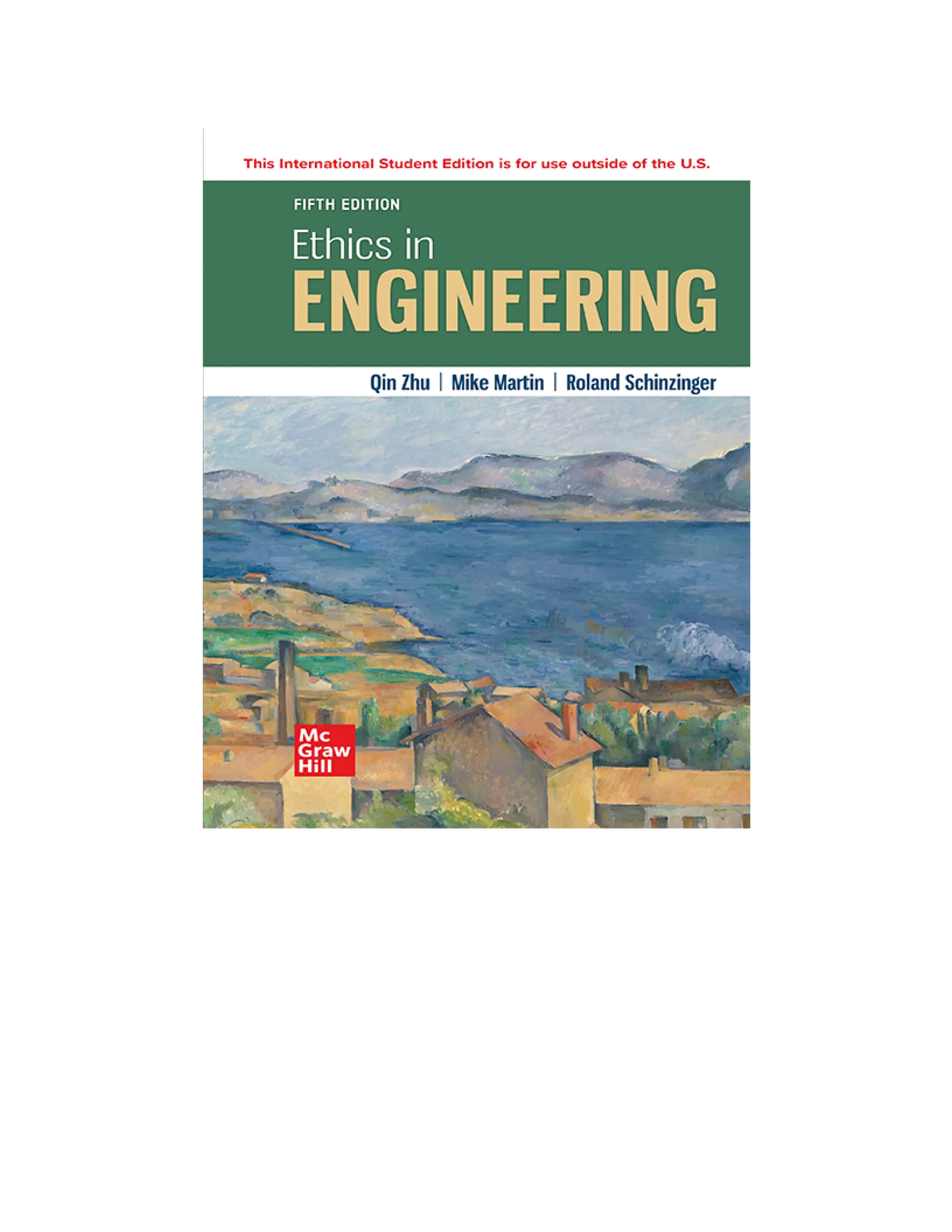
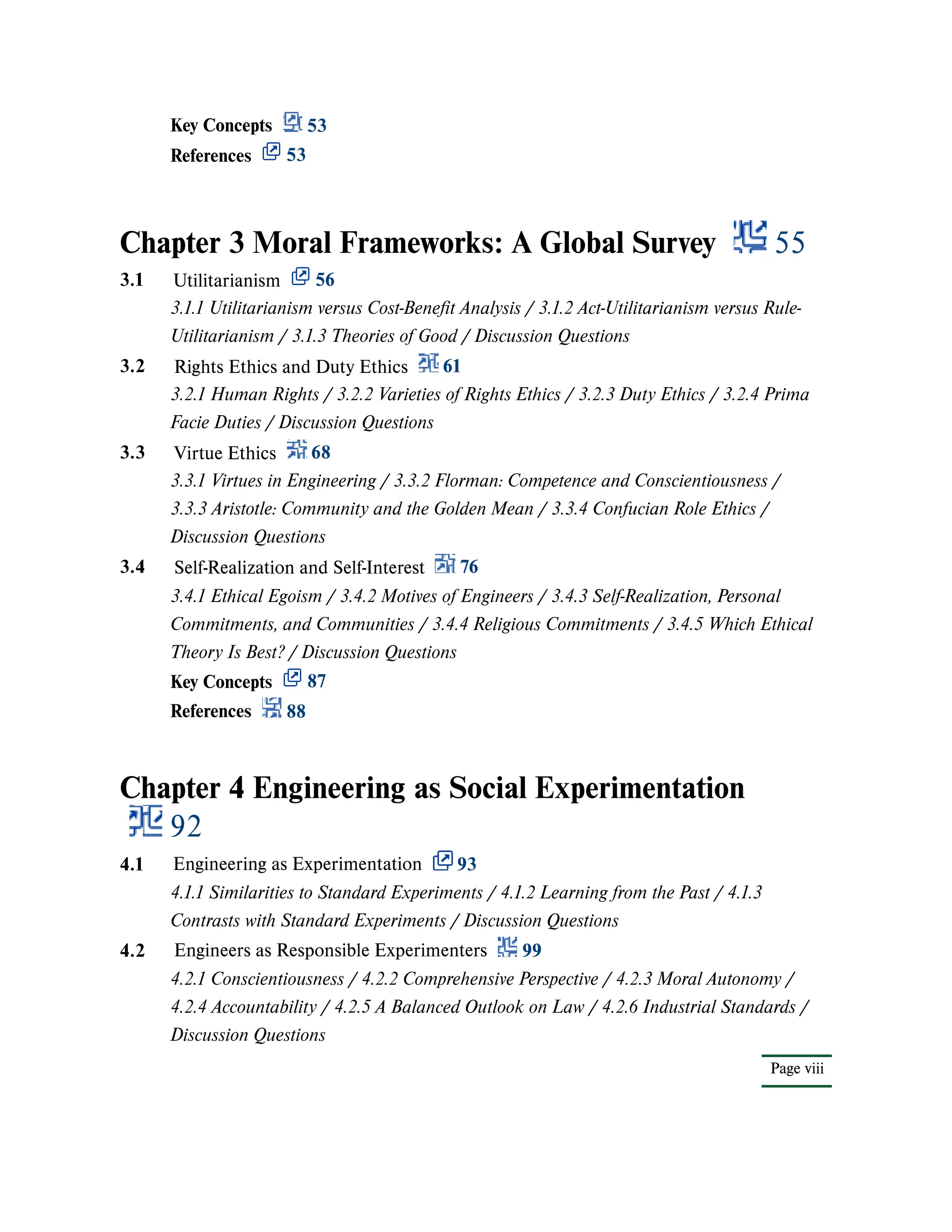
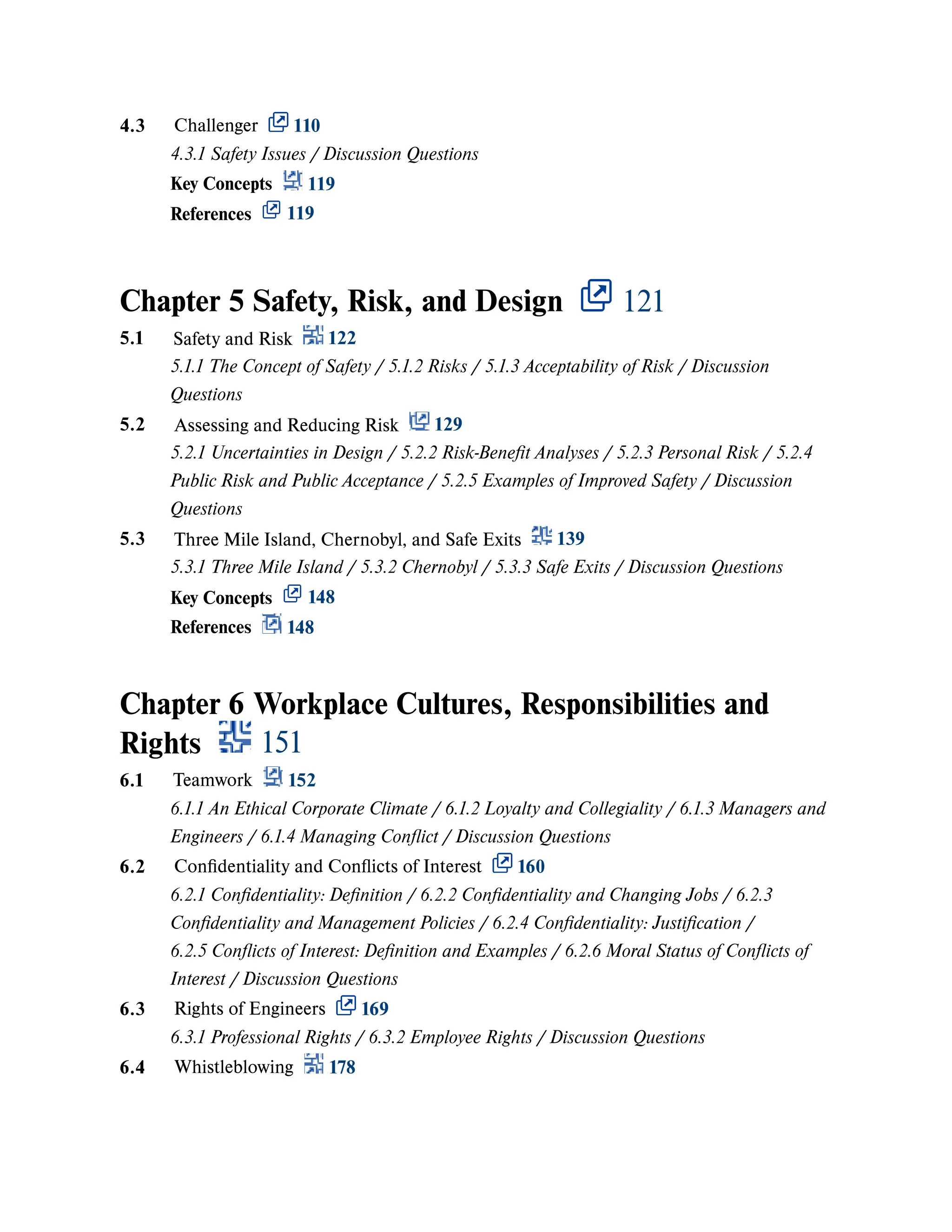
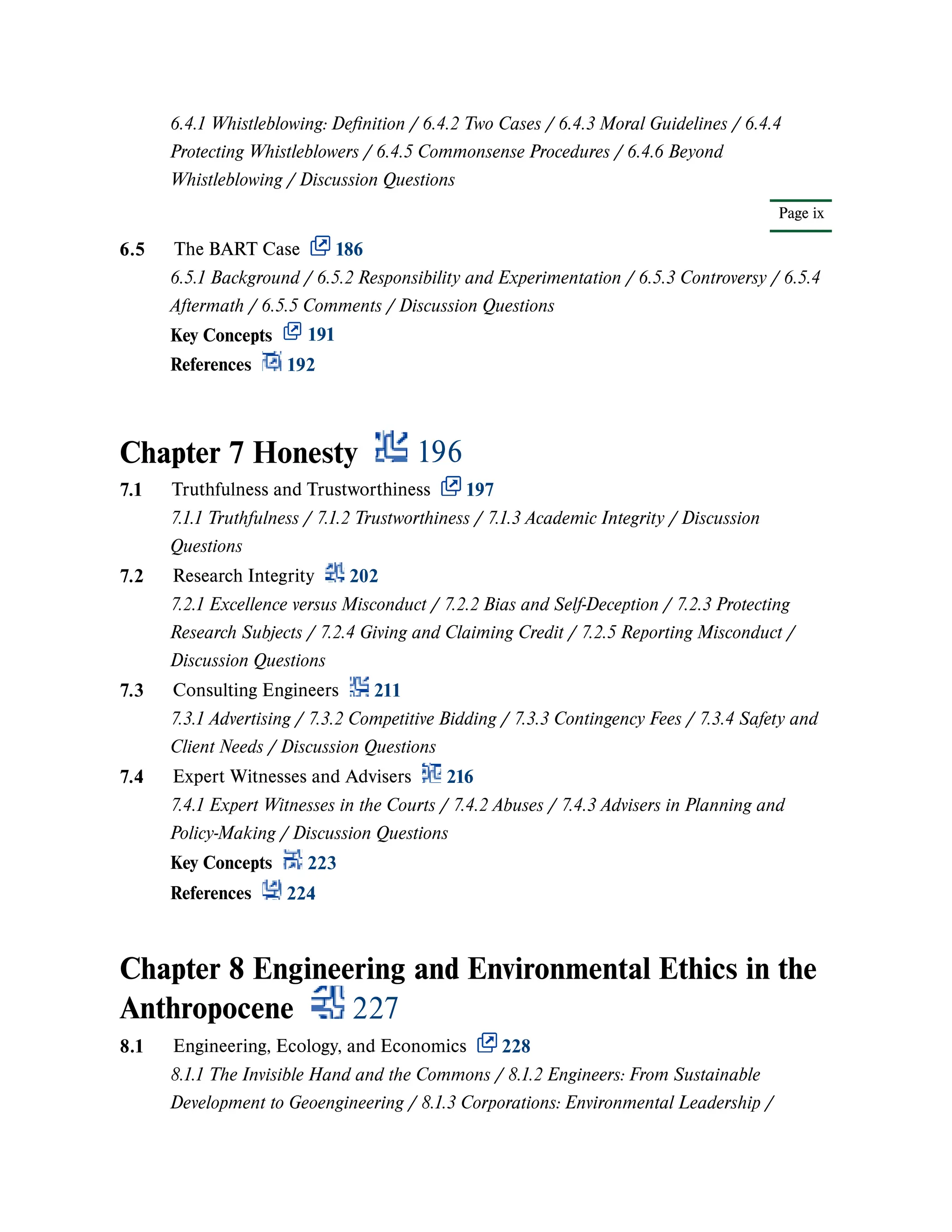
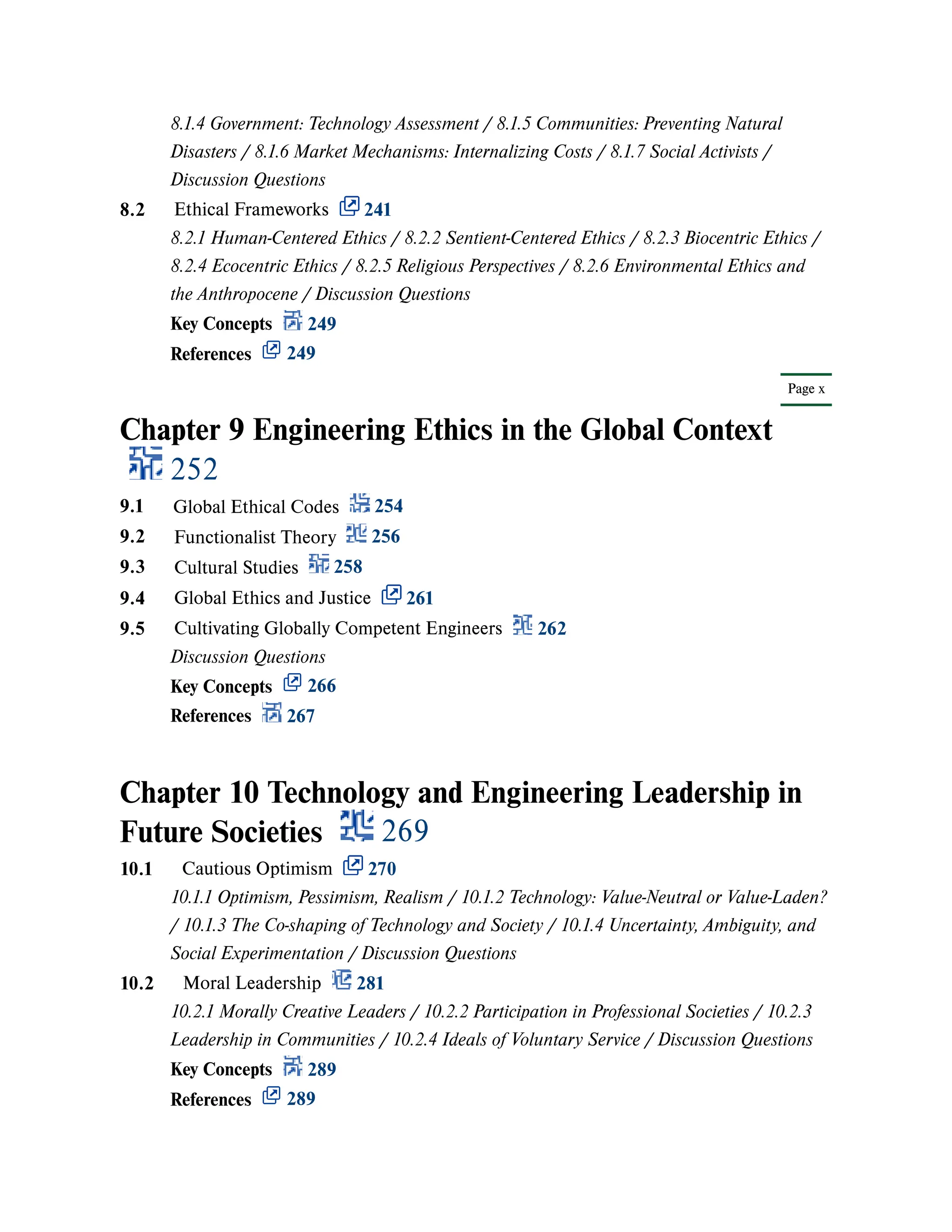

![Page 4
Design a chicken coop that would increase egg and chicken production, using materials that
were readily available and maintainable by local workers [at a Mayan cooperative in
Guatemala]. The end users were to be the women of a weaving cooperative who wanted to
increase the protein in their children’s diet in ways that are consistent with their traditional diet,
while not appreciably distracting from their weaving.
The task proved more complex than it at first appeared. The students had to identify
plausible building materials, decide between cages or one open area, and design structures
for strength and endurance. They had to create safe access for the villagers, including ample
head and shoulder room at entrances and a safe floor for bare feet. They had to ensure
humane conditions for the chickens, including adequate space and ventilation, comfort
during climate changes, convenient delivery of food and water, and protection from local
predators that could dig under fences. They also had to improve cleaning procedures to
minimize damage to the environment while recycling chicken droppings as fertilizers. The
primary goal, however, was to double current chicken and egg production. A number of
design concepts were explored before a variation of a fenced-in concept proved preferable to
a set of cages. In 1997 four students and their advisor, supported by a humanitarian aid
group named Xela-Aid, traveled to San Martin Chiquito, Guatemala, and worked with
villagers in building the chicken coop and additional structures such as a weaving building.
Moral values are embedded at several junctures in engineering projects, including: the basic
standards of safety and efficiency, the social, cultural, and environmental contexts of the
community, the character of engineers who spearhead technological progress, and the very
idea of engineering as a profession that combines advanced skill with commitment to the
public good. In engineering, as in other professions, excellence and ethics go together—for
the most part and in the long run. In general, ethics involves much more than problems and
punishment, duties and dilemmas. Ethics involves the full range of moral values to which
we aspire in guiding our endeavors and in structuring our relationships and communities.
This emphasis on moral aspiration was identified by the ancient Greeks, whose word arete
translates into English as either “excellence” or as “virtue.”
(3) PERSONAL COMMITMENT AND MEANING
A team of engineers are redesigning an artificial lung marketed by their company. They are
working in a highly competitive market, with long hours and high stress. The engineers have
little or no contact with the firm’s customers, and they are focused on technical problems,
not people. It occurs to the project engineer to invite recipients of artificial lungs and their
families to the plant to talk about how their lives were affected by the artificial lung. The
2
3](https://image.slidesharecdn.com/52125-250403001041-ec7172ae/75/ISE-Ethics-in-Engineering-5th-Edition-Mike-Martin-Prof-25-2048.jpg)
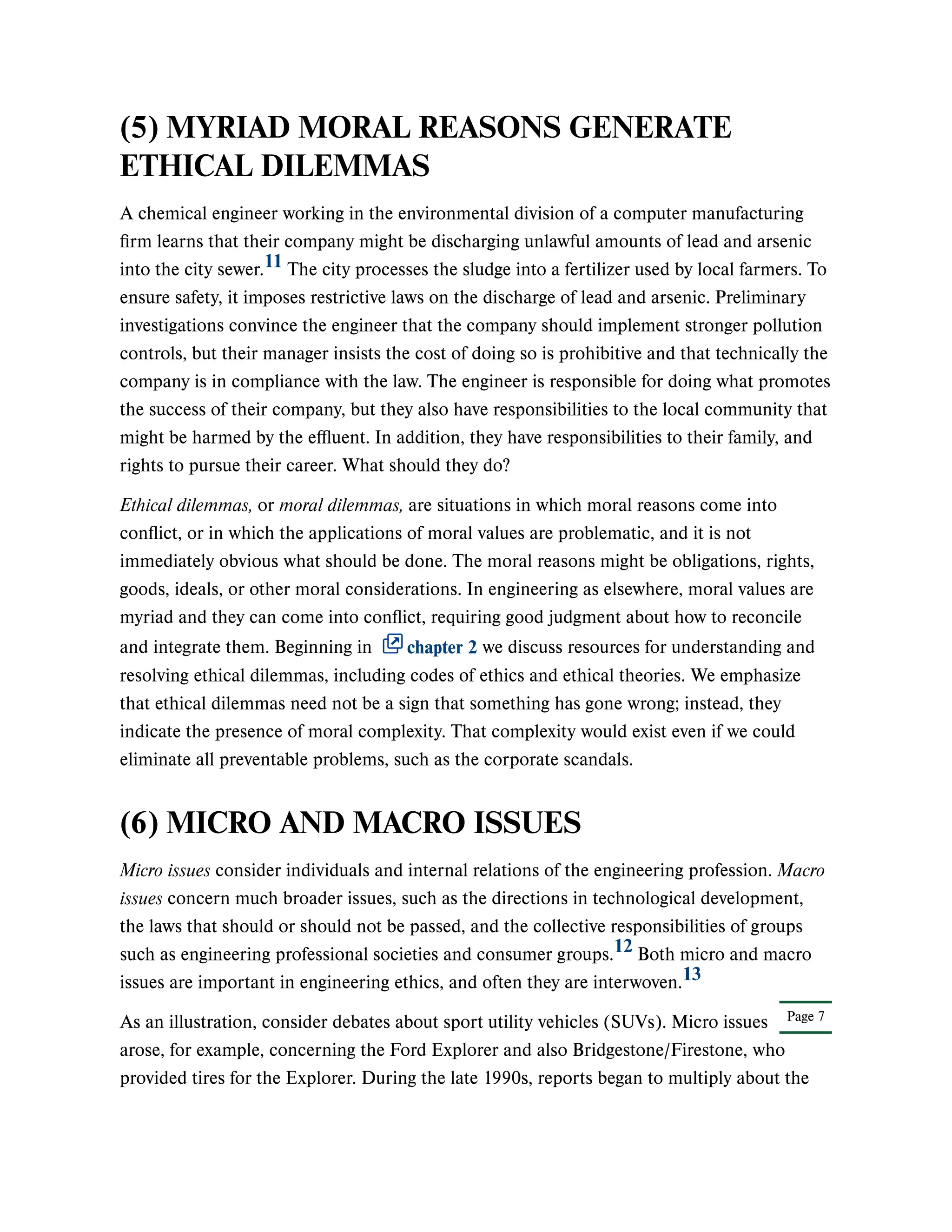
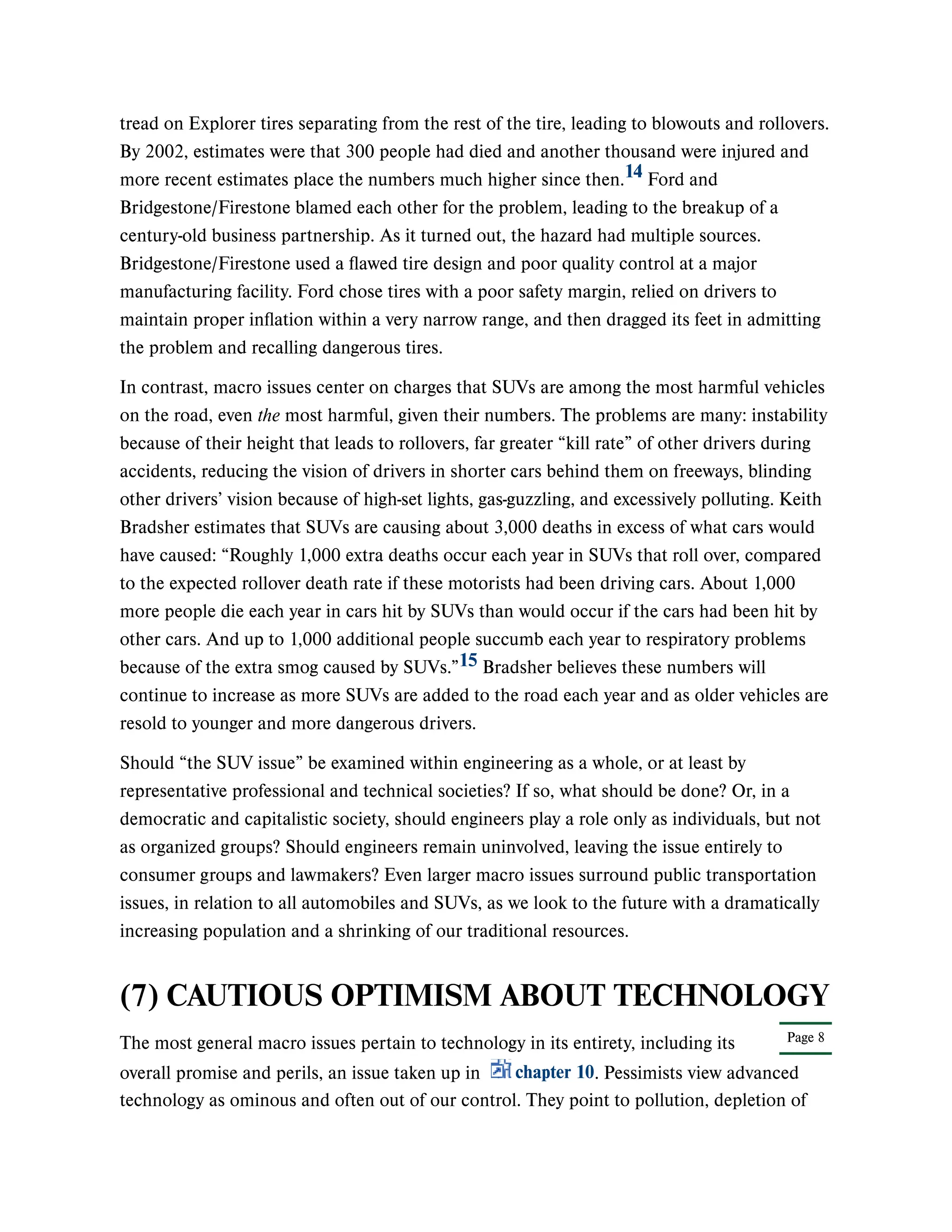
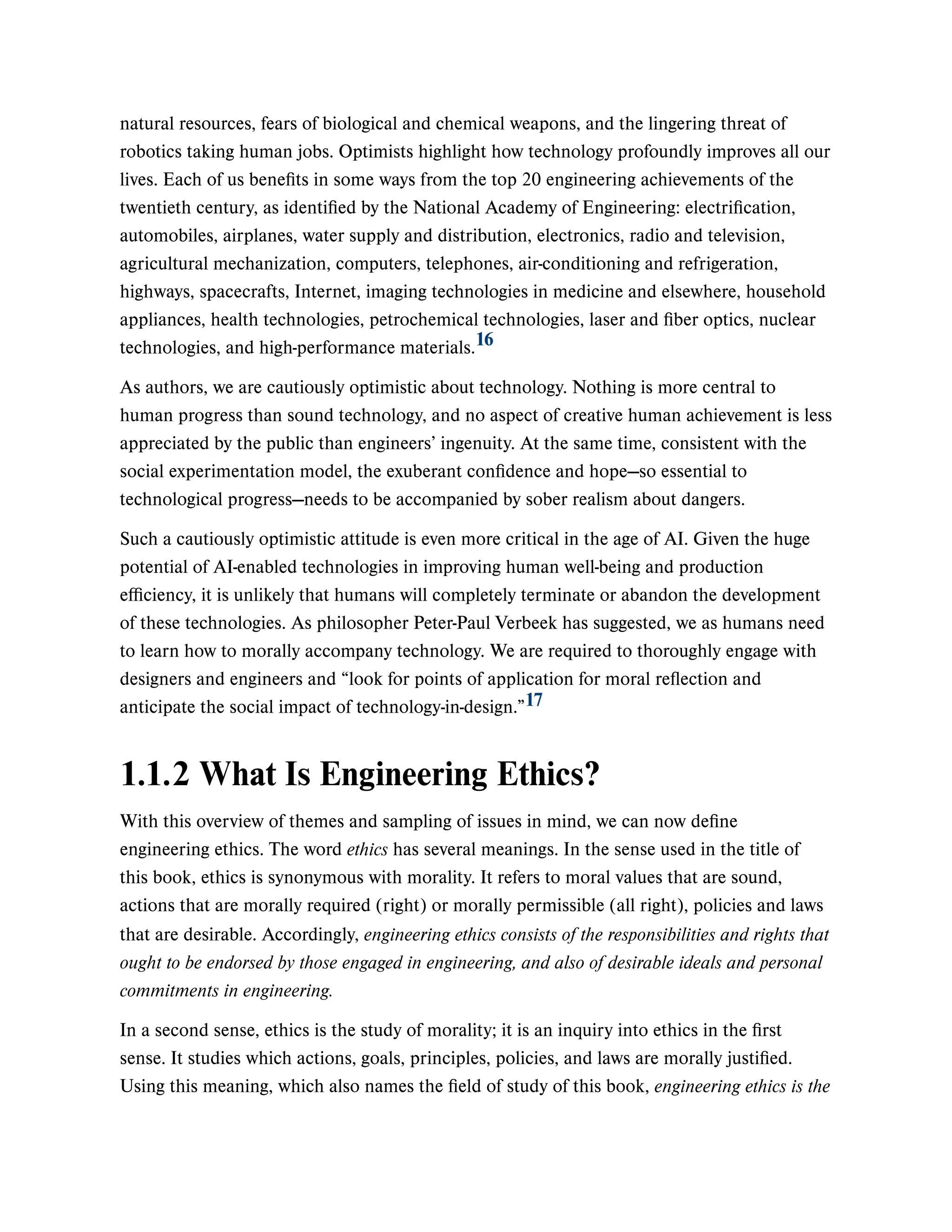
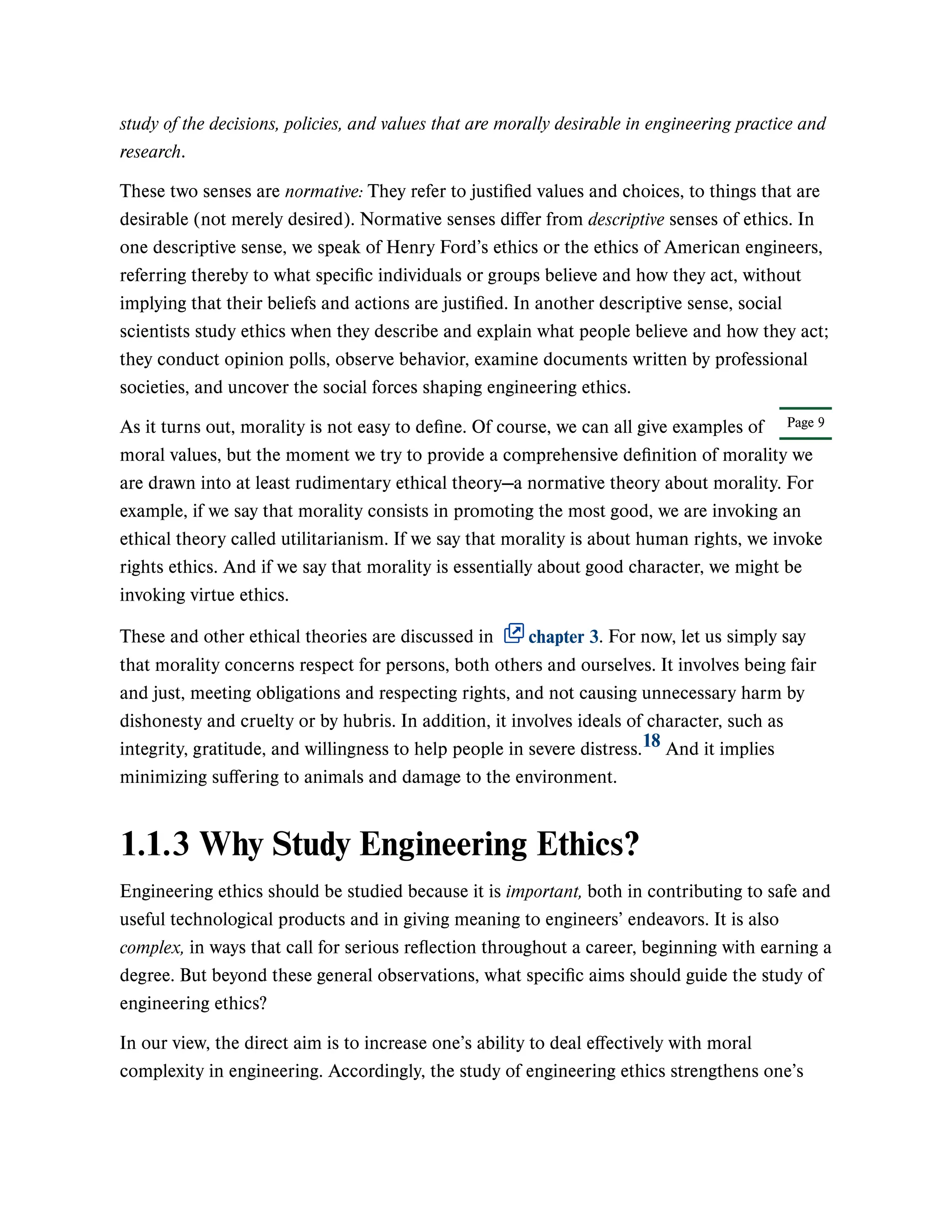
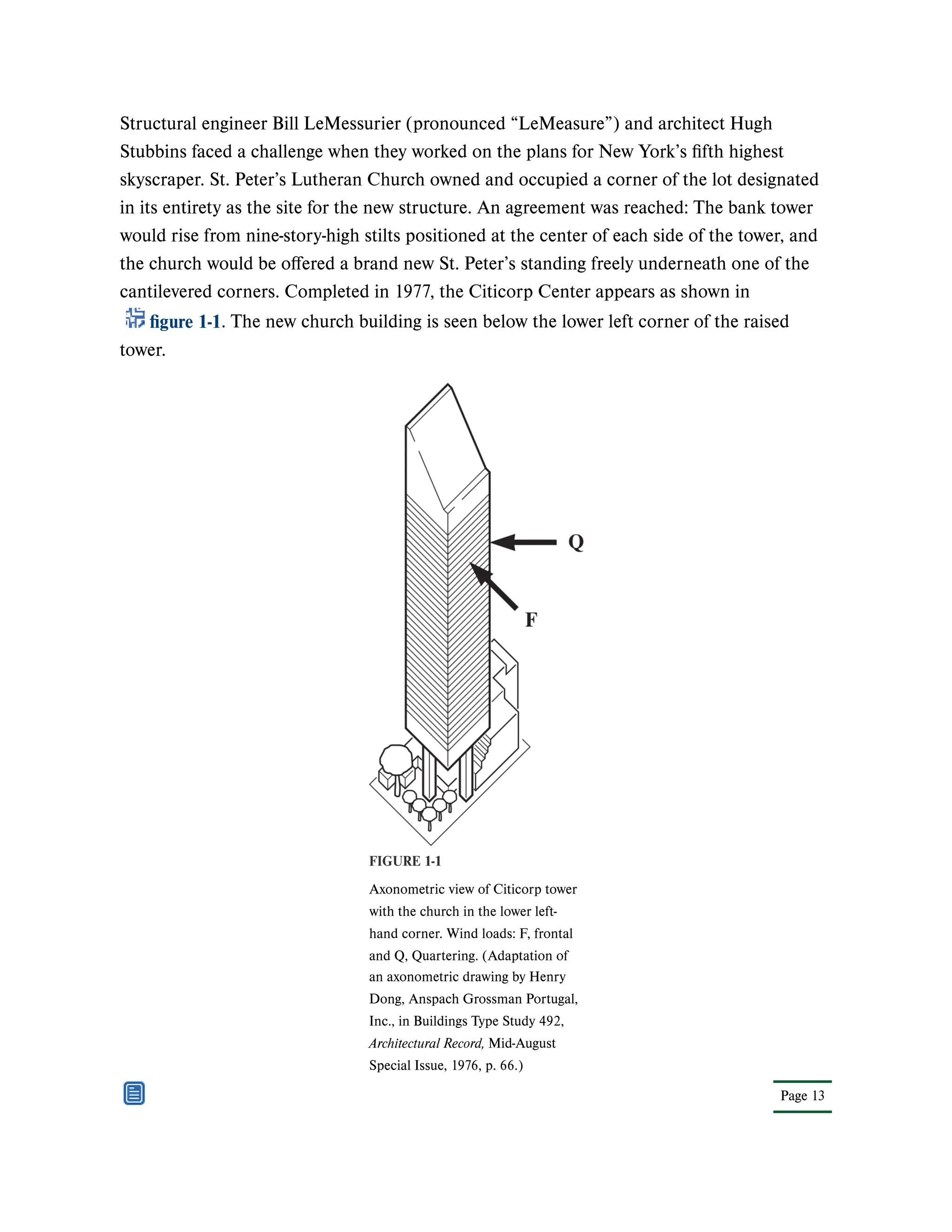
![Page 14
LeMessurier’s structure departed from the usual in that the massive stilts are not situated at
the corners of the building, and half of its gravity load as well all of its wind load is brought
down an imaginatively designed trussed frame, which incorporates wind braces, on the
outside of the tower. In addition, LeMessurier installed a tuned mass damper, the first of
its kind in a tall building, to keep the building from swaying in the wind.
Questions asked by an engineering student a year after the tower’s completion prompted
LeMessurier to review certain structural aspects of the tower and pose some questions of his
own. For instance, could the structure withstand certain loads due to strong quartering
winds? In such cases, two sides of the building receive the oblique force of the wind, and the
resultant force is 40 percent larger than when the wind hits only one face of the structure
straight on. The only requirement stated in the building code specified adequacy to
withstand certain perpendicular wind loads, and that was the basis for the design of the
wind braces. But there was no need to worry since the braces as designed could handle such
an excess load without difficulty, provided the welds were of the expected high quality.
Nevertheless, the student’s questions prompted LeMessurier to place a call from his
Cambridge, Massachusetts, office to his New York office, to ask Stanley Goldstein, his
engineer in charge of the tower erection, how the welded joints of the bracing structure had
worked out. How difficult was the job? How good was the workmanship? To his dismay,
Goldstein answered, “Oh, didn’t you know? [The joints] were never welded at all because
Bethlehem Steel came to us and said they didn’t think we needed to do it.” The New York
office, as it was allowed to do, had approved the proposal that the joints be bolted instead.
But again the diagonal winds had not been taken into account.
At first, LeMessurier was not too concerned; after all, the tuned mass damper would still
take care of the sway. So he turned to his consultant on the behavior of high buildings in
wind, Alan Davenport at the University of Western Ontario. On reviewing the results of his
earlier wind tunnel tests on a scaled-down Citicorp Center, Davenport reported that a
diagonal wind load would exceed the perpendicular wind load by much more than the 40
percent increase in stress predicted by an idealized mathematical model. Winds sufficient to
cause failure of certain critical bolted joints—and therefore of the building—could occur in
New York every 16 years. Fortunately, those braces that required strengthening were
accessible, but the job would be disruptive and expensive, exceeding the insurance
LeMessurier carried.
LeMessurier faced an ethical dilemma involving a conflict between his responsibilities to
ensure the safety of his building for the sake of people who use it, his responsibilities to
24
25](https://image.slidesharecdn.com/52125-250403001041-ec7172ae/75/ISE-Ethics-in-Engineering-5th-Edition-Mike-Martin-Prof-37-2048.jpg)
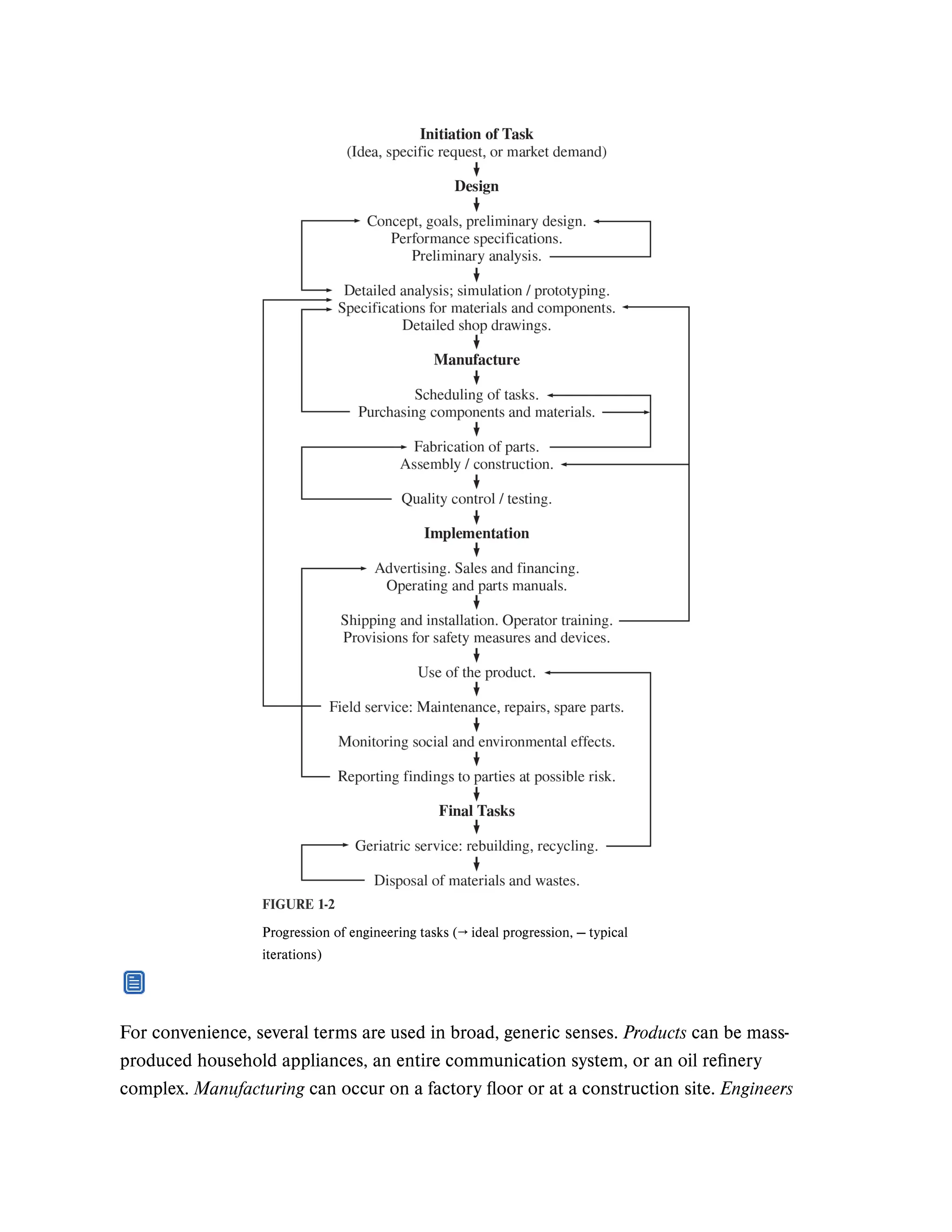
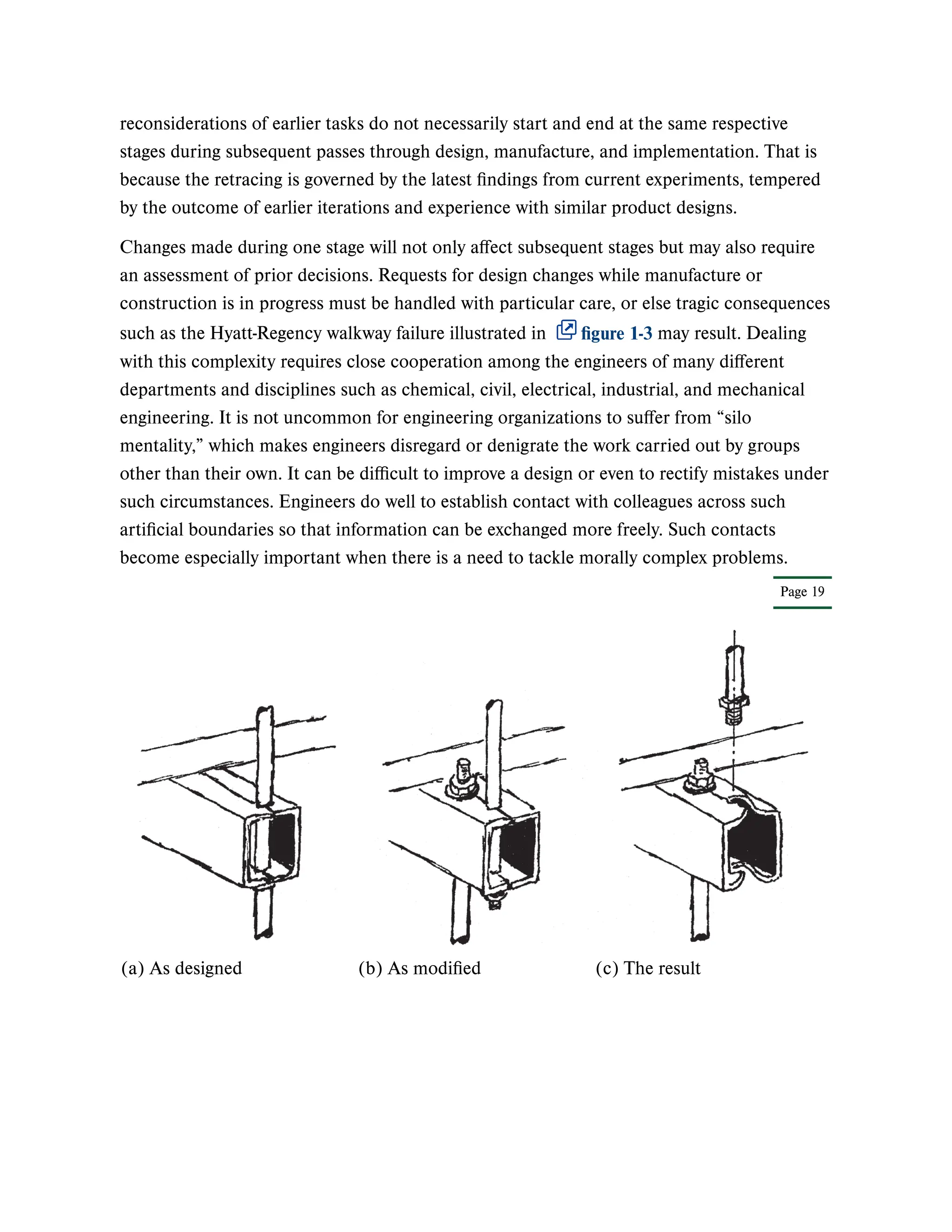
![To repeat, engineering generally does not consist of completing designs or processes one
after another in a straightforward progression of isolated tasks. Instead, it involves a trial-
and-error process with backtracking based on decisions made after examining results
obtained along the way. The design iterations resemble feedback loops, and like any well-
functioning feedback control system, engineering takes into account natural and social
environments that affect the product and people using it. Let us therefore revisit the
engineering tasks, this time as listed in table 1-1, along with examples of problems that
might arise.
FIGURE 1-3
The Kansas City Hyatt-Regency walkway collapse. Two walkways—one above the other—along one wall of a large atrium are
to be supported by welded box-beams, which in turn are held up along the atrium side by long rods extending from the
ceiling. Because of perceived difficulties in implementing design (a), the modification (b) using two shorter rods to replace
each long rod was proposed and approved. What is the result? Let the expected load on each box-beam at its atrium end be
P (the same on each floor). Then, in design (a) an upper-floor beam would have to support P pounds as shown in sketch
(d), but the design change raised that to 2P as shown in (e). This overload caused the box-beam/rod/nut supports on the
upper floor to fail as shown in (c). In turn, the upper and lower walkways collapsed, causing a final death toll of 114
with 200 injured. Later it was found that the design change had been stamped “approved” but not checked. [(For more, see
M. Levy and M. Salvadori, Why Buildings Fall Down [Norton & Co., 1992].)]
(d) Loads for case (a) (e) Loads for case (b)
28](https://image.slidesharecdn.com/52125-250403001041-ec7172ae/75/ISE-Ethics-in-Engineering-5th-Edition-Mike-Martin-Prof-44-2048.jpg)