A Step Change In
Safety Management


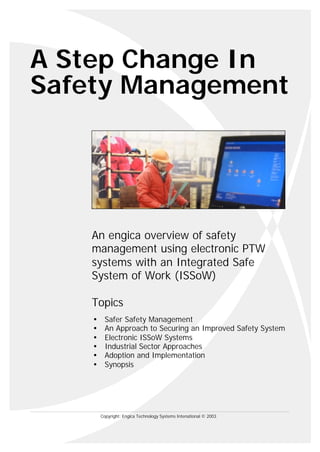
    An engica overview of safety
    management using electronic PTW
    systems with an Integrated Safe
    System of Work (ISSoW)

    Topics
    Ÿ    Safer Safety Management
    Ÿ    An Approach to Securing an Improved Safety System
    Ÿ    Electronic ISSoW Systems
    Ÿ    Industrial Sector Approaches
    Ÿ    Adoption and Implementation
    Ÿ    Synopsis


        Copyright: Engica Technology Systems Intenational © 2003
A STEP CHANGE IN SAFETY MANAGEMENT


Safer Safety
Management
All industries have issues
with safety, some more
than others and some who
have had regrettable and
unpleasant experiences.
Industrial organisations have the responsibility to
adhere to regulations, retain records, mainta i n                   This short review looks at various aspects of safety
standards, and if concerned improve in house safety                 and software associated with work risk assessment
standards. Under the umbrella of HSE directives,                    and permit to work (PTW) systems in the energy
initiatives and a number of industrial safety focus                 and chemical industries. Its scope is to explain how
groups there has been significant promotion of task                 an electronic software system can be used to assist
risk assessment with the aim to improve safety. Within              the necessary processes. It also covers general
the UK oil & gas sector there is also an alignment of               aspects of implementation and the various issues
idea's associated with permits and naming practices to              associated with the adoption of software tools to
standardise certain core aspects. P a r t i c i p a n t s           make a step change in safety management.
demonstrate a positi v e p r o a c t i v e a t t i t u d e t o
implementing such standards but adoption timetables
are yet to be confirmed.                                            Safety Implications
The Energy operators have a number of additional                    Most people would regard safety from the point of
issues to handle influenced by international operation              view of their own and colleagues well being and
and rapid ownership and equity changes. The effects                 rightly so. There are howeve r o t h e r d r i v e s
of increased asset disposal and acquisition, build and              stemming from commercial and production issues
maintain life cycle contracts, global expansion, ageing             including insurance premiums, operational uptime
experience, regional skills shortfalls, increased staff             and environmental laws. The combin e d
mobility and contract outsourcing to mention a few, all             requirements are now prompting organisations to
bring a strain on safety knowledge and local practice.              seek and adopt more systematic approaches to
These effects must be count e r b a l a n c e d w i t h             enhance existing methods.
techniques not only to maintain levels of safety but to
strive to improve them.                                             Safety processes with the rig h t d i s t r i b u t e d
                                                                    knowledge and correctly applied precautions will
Engica hav e b e e n a c t i v e l y i n v o l v e d i n w o r k    handle safety effectively, but this statement holds
management techniques for over two decades and                      the key to the problem "distributed knowledge and
over the past five years have made substa n t i a l                 correctly applied precautions". Each person often
investment into a focused design and development                    relies upon measures ta k e n b y o t h e r t e a m
group to construct an Integrated Safe System of Work                members. If one reflects upon serious events in
(ISSoW) software syste m . T h e p u r p o s e i s t o              hindsight they all could have been avoided with
consolidate the ideas and initiatives derived from the              appropriate precautions and controls. Lessons
various focus groups to support our existing and                    learned springs to mind. Management's k e y
prospective clients. The Q4 Safety ISSoW system is                  objective should be to establish intrinsically safe
now being launched into active duty having undergone                methods with near zero risk tolerance, and get
major verification and site acceptance trials to attain             them working without bankrupting the organisation
intrinsically safe certification.                                   in the process.

     An engica overview of safety management using electronic PTW systems with an Integrated Safe System of Work (ISSoW)
                                                           Page 1 of 8
A STEP CHANGE IN SAFETY MANAGEMENT

An Approach to Securing an
 Improved Safety System


Engica's approach is not to assume that a single system with, say,
preset permits will satisfy all organisations. It is recognised that
radical changes in many cases could cause more problems than
solutions. Staff in general are used to their existing paper based
systems that have been derived over time within their organisation.
What is beneficial in many cases is a step enhancement to
strengthen the process rather than radical change.
This does not go against the grain       One shoul d n o t i g n o r e t h a t          Although many may think that
of standardising certain elements        changing practices takes time.                 safety systems have al r e a d y
of safety which has been done            The sensible approach is a step                been made electronic or have an
successfully in many aspects such        by step philosophy to accumulate               opinion that such systems do not
as hazardous s u b s t a n c e s         a major step change.                           improve the process, it should be
definitions or lifting regulations.                                                     noted that this ar t i c l e i s
For example colour standards of          The industrial organisations we                discussing a more advanced and
the various permit and certificates      deal with in safety management                 highly integrated safe system of
would seem sensible in industrial        range from power generation, oil               work approach.
sectors to help cross company            & gas, chemical and pr o c e s s
working especially for contract          based i n d u s t r i e s . T h i s h a s      Such systems are now be i n g
personnel. Another item could be         allowed Engica to draw upon the                adopte d i n t h e e n e r g y a n d
t h e s t a n d a r di s a t i o n o f   past and current practices in use              proces s i n d u s t r i e s a n d w e
authorisation naming                     in each sector during o u r                    believe they will be c o m e D E
nomenclature. These aspects rely         research. It has presented us                  FACTO in the course of time. No
up o n g o v e r n m e n t a n d         with the insight into sys t e m s              doubt you will have opinions and
organisation forums to establish         advancement. T h i s h a s a n d               Engica welcome comment and
common practices although it is          continues to be done, by critical              participation in r e l a t e d H S E
worth noting tha t e l e c t r o n i c   analysis and by using the best                 forums.
systems are well positioned to           methods from each sector. Our
adopt and impose such standards.         research into task ri s k
                                         assessment and its approa c h
In man y c a s e s , i t i s t h e       however has derived a method
application of current or slightly       that f i t s a l l i n d u s t r i e s a n d
enhanced permit and certificate          provides integration from both
form f o r m a t s w i t h i n a n e w   work management and permit
electronic system that will gain         aspects.
the acceptance of use.

    An engica overview of safety management using electronic PTW systems with an Integrated Safe System of Work (ISSoW)
                                                          Page 2 of 8
A STEP CHANGE IN SAFETY MANAGEMENT


Electronic ISSoW Systems
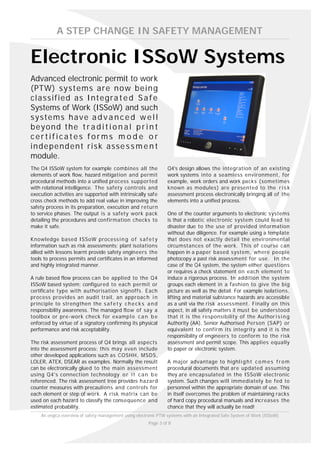
Advanced electronic permit to work
(PTW) s y s t e m s a r e n o w b e i n g
classified as Integra t e d S a f e
Systems of Work (ISSoW) and such
systems have a d v a n c e d w e l l
beyond the t r a d i t i o n a l p r i n t
certificates forms m o d e o r
independent risk asse s s m e n t
module.
The Q4 ISSoW system for example combines all the                 Q4's design allows the integration of an existing
elements of work flow, hazard mitigation and permit              work systems into a seamless environment, for
procedural methods into a unified process supported              example, work orders and work packs (sometimes
with relational intelligence. The safety controls and            known as modules) are presented to the r i s k
execution activities are supported with intrinsically safe       assessment process electronically bringing all of the
cross check methods to add real value in improving the           elements into a unified process.
safety process in its preparation, execution and return
to service phases. The output is a safety work pack              One of the counter arguments to electronic systems
detailing the procedures and confirmation checks to              is that a robotic electronic system could lead to
make it safe.                                                    disaster due to the use of provided information
                                                                 without due diligence. For example using a template
Knowledge based ISSoW process i n g o f s a f e t y              that does not exactly detail the environmental
information such as risk assessments; plant isolations           circumstances of the work. This of course can
allied with lessons learnt provide safety engineers the          happen in a paper based system, where people
tools to process permits and certificates in an informed         photocopy a past risk assessment for use. In the
and highly integrated manner.                                    case of the Q4 system, the system either questions
                                                                 or requires a check statement on each element to
A rule based flow process can be applied to the Q4               induce a rigorous process. In addition the system
ISSoW based system; configured to each permit or                 groups each element in a fashion to give the big
certificate type with authorisation signoffs. Each               picture as well as the detail. For example isolations,
process provides an audit trail, an approac h i n                lifting and material substance hazards are accessible
principle to strengthen the s a f e t y c h e c k s a n d        as a unit via the risk assessment. Finally on this
responsibility awareness. The managed flow of say a              aspect, in all safety matters it must be understood
toolbox or pre-work check for examp l e c a n b e                that it is the responsibility of the Author i s i n g
enforced by virtue of a signatory confirming its physical        Authority (AA), Senior Authorised Person (SAP) or
performance and risk acceptability.                              equivalent to confirm its integrity and it is the
                                                                 responsibility of engineers to conform to the risk
The risk assessment process of Q4 brings all aspects             assessment and permit scope. This applies equally
into the assessment process; this may even include               to paper or electronic system.
other developed applications such as COSHH, MSDS,
LOLER, ATEX, DSEAR as examples. Normally the result              A major advantage to highl i g h t c o m e s f r o m
can be electronically glued to the main assessment               procedural documents that are updated assuming
using Q4's connection technology o r i t c a n b e               they are encapsulated in the ISSoW electronic
referenced. The risk assessment tree provides hazard             system. Such changes will immediately be fed to
counter measures with precautions and controls for               personnel within the appropriate domain of use. This
each element or step of work. A risk matrix can be               in itself overcomes the problem of maintaining racks
used on each hazard to classify the consequence and              of hard copy procedural manuals and increases the
estimated probability.                                           chance that they will actually be read!
    An engica overview of safety management using electronic PTW systems with an Integrated Safe System of Work (ISSoW)
                                                        Page 3 of 8
A STEP CHANGE IN SAFETY MANAGEMENT


Electronic ISSoW Systems
Practical ISSoW Usage Issues
Assuming that a system has the necessary functionality
and processes, successful adoption depends on two key
factors: - ease of use, this one we classify as natural use
and the other is the speed of use.
"Speed of use is vital."
Even the most functionally rich system if tediously
slow will result in operators finding ways of
bypassing the system. After all a good system is
about providing information in order to give more
time to the consideration of the safety issues, risk
assessment and precaution precision with regard
to the tasks at hand, not just to a c t a s a n
executive safe guard to litigation. The measure
should be at least equal if not quicker than
manual methods.


"Natural use is important."
Systems designed for rocket scientists are only
good for rocket scientists. This does not mean
that a bit of training is not needed but it does
mean that the system provides an intuitive and
consistent interface at each stage or phase of the
safety assessment or permit assembly. Q4
systems for example have been developed by
standing over the shoulders of safety engineers
and watching experienced and novice users use
the system many times to refine its interface. We
do not accept inco h e r e n c y b l a m i n g i t o n
technology shortfalls. This has led in one of its
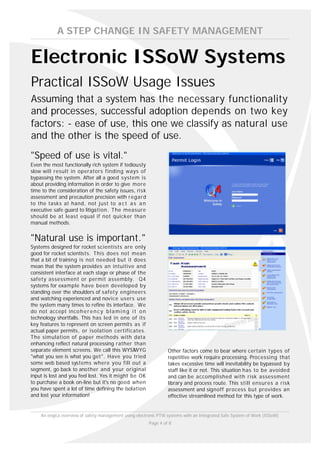
key features to represent on screen permits as if
actual paper permits, or isolation certificates.
The simulation of paper methods with data
enhancing reflect natural processing rather than
separate element screens. We call this WYSIWYG                    Other factors come to bear where certain types of
"what you see is what you get". Have you tried                    repetitive work require processing. Processing that
some web based systems where you fill out a                       takes excessive time will inevitability be bypassed by
segment, go back to another and your original                     staff like it or not. This situation has to be avoided
input is lost and you feel lost. Yes it might be OK               and can be accomplished with risk assessment
to purchase a book on-line but it's no good when                  library and process route. This still ensures a risk
you have spent a lot of time defining the isolation               assessment and signoff process but provides an
and lost your information!                                        effective streamlined method for this type of work.


    An engica overview of safety management using electronic PTW systems with an Integrated Safe System of Work (ISSoW)
                                                         Page 4 of 8
A STEP CHANGE IN SAFETY MANAGEMENT

Industrial Sector Approaches
Our observation of the oil & gas,
power generation and chemical
sectors show that each has a
framework of permits and
certificates that reflect practices
within that industrial sector.

Taking the the Oil & Gas sector first, its "permit form"
generally acts as a risk assessment along w i t h
references to applicable isolation and other related
certificates. The Power Generation industry tends to
provides risk and method statements that are attached
to a work order along with specific PTW and isolations
certificates that have to be obtained prior to work
commencement. In essence both are similar but the                Improved Safety
presentation of information varies substantially.

It is difficult to generalise in a short overview, but a
                                                                 Planning & Tracking
brief synopsis is that the Oil & Gas industry in the UK
feature a permit which contains a check approach to              Engica have introduced two new concepts and
risk assessment with attached isolation certificates.            methods to support the safety process, one being
Most systems provide a form of surren d e r a n d                the m e c h a n i s m t o p l a n s h u t d o w n s a f e t y
handover method with an emphasis on the permit valid             requirements visually and efficiently. The other is
duration and its expiry time. Power Generation in the            an introduction of a digital dashboard to inform
UK tends to lead with an appropriate permit containing           operational controllers of all work permit activities,
the isolations, controls and precautions with a risk and         permit location tracking and validity status.
method statement attached to the work order.
                                                                 The Q4 ISSoW Safety System provides a unique
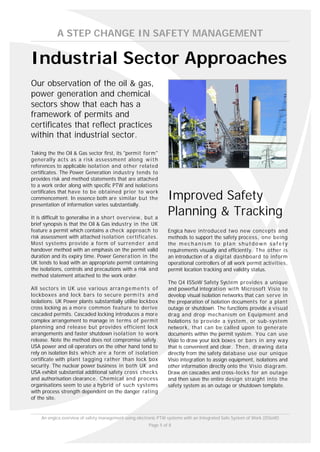
All sectors in UK use various arra n g e m e n t s o f           and powerful integration with Microsoft Visio to
lockboxes and lock bars to secure perm i t s a n d               develop visual isolation networks that can serve in
isolations. UK Power plants substantially utilise lockbox        the preparation of isolation documents for a plant
cross locking as a more common feature to derive                 outage or shutdown. The functions provide a visual
cascaded permits. Cascaded locking introduces a more             drag and drop mechanism on Equipment an d
complex arrangement to manage in terms of permit                 Isolations to provide a system, or sub-system
planning and release but provides efficient lock                 network, that can be called upon to generate
arrangements and faster shutdown isolation to work               documents within the permit system. You can use
release. Note the method does not compromise safety.             Visio to draw your lock boxes or bars in any way
USA power and oil operators on the other hand tend to            that is convenient and clear. Then, drawing data
rely on isolation lists which are a form of isolation            directly from the safety database use our unique
certificate with plant tagging rather than lock box              Visio integration to assign equipment, isolations and
security. The nuclear power business in both UK and              other information directly onto the Visio diagram.
USA exhibit substantial additional safety cross checks           Draw on cascades and cross-locks for an outage
and authorisation clearance. Chemical and process                and then save the entire design straight into the
organisations seem to use a hybrid of such systems               safety system as an outage or shutdown template.
with process strength dependent on the danger rating
of the site.


    An engica overview of safety management using electronic PTW systems with an Integrated Safe System of Work (ISSoW)
                                                        Page 5 of 8
A STEP CHANGE IN SAFETY MANAGEMENT

Adoption and Implementation
                   Safety is no doubt one of the top priorities to
                   operators and introducing a step improvement
                   change to safety methods needs a plan, resource
                   and a supplier with the necessary expertise.
An electronic system can be installed and configured quite quickly onto an organisation
network. A summary of elements associated with an electronic system configuration are
shown below.
Ÿ   Configuration of Screen and Hardcopy Permit and Certificate Forms along with State Flow Logic
Ÿ   Entry of Authorisation personnel and permissions
Ÿ   Injection of Plant Isolation Information (note: - can be grown with system)
Ÿ   Injection of Risk Assessment Information (note: - can be grown with system)
Ÿ   Configuration of Site Drawing for Digital Dashboard (optional)
Ÿ   Integration with existing Work Management System (optional)

It is the definition and the adoption programme tha t
needs special attention. As one might guess the
definition stage presents a series of challenges to
get agreement if methods are going to be improved
over the existing process rather than a current
system setup. For the oil and gas offshore people
getting people together should be factored into the
plan. Always put in place a project manager with
the authority level to facilitate and make decisions.
Allocate realistic timescales but with hard target
milestones. All pretty obvious but needless to say
are the reasons why many software systems get
delayed. Engica are obviously here to help the
process. Our UK office currently implem e n t s
numerous major systems each year so we've seen
and been there. We rely on success for our next
job so we want our clients to shape up well.

Quality training is centr a l t o t h e u s e o f a n
Integrated Safe System of Work. Central to the use               Here are some aspects that pertain to
of the Q4 Permit system are a series of training                 offshore sites
packages to get the system working effectively for
all your staff and contracting personnel. A series of            Ÿ     Project Management
purpose built training packages to get the system                Ÿ     Awareness and Communication Campaign
implemented across the field and onshore sites can               Ÿ     Purpose Built E-Training Adoption Package
be constructed to install confidence in the system               Ÿ     Procedure Manuals
and the discipline to use the systems correctly. In              Ÿ     Super User and Administ r a t i o n S y s t e m
addition purpose built e-learning courses can be                       Training
designed as part of the overall project. The e-                  Ÿ     Mass Staff Training
learning courses are tailored around the necessary               Ÿ     Offshore Handholding
level of knowledge each user needs.


    An engica overview of safety management using electronic PTW systems with an Integrated Safe System of Work (ISSoW)
                                                        Page 6 of 8
A STEP CHANGE IN SAFETY MANAGEMENT


Adoption and Implementation
Operational Languages
International installations with regard to nativ e
language operators such as China and Kazakhstan
have to be borne in mind. The Q4 Safety system has
been purposely designed for multi-lingual deployment.
This can be in the pure native langua g e w h i c h
substantially applies to Power utilities, whilst oil and
gas often uses English as its management language.
Having a single language however may degrade its
message functions to native staff. Engica overcome
this by having dual language formats on both forms
and data. This type of configuration takes longer to
implement and increases the cost of a system due to
providing dual language training and other elements.

As a footnote our experience is that Polish translation
represented one of the harder languages to present
due to phrase and field label lengths. Chinese or
symbolic script is surprisingly much easier but requires
the whole system to be uni-coded which Q4 is. Another
advisory point is to choose a system that has already
undergone one system multi-language use or you will                  Cost Considerations
be waiting a long time for its delivery, Engica's first
translation experience was Japanese over ten years                   Recognising that safety should not be sacrificed for
ago and we had to learn many hard lessons about data                 cost, it is however normal to factor the cost into a
base query language handling and other language                      solution selection. With regard to a Software Safety
interface factors. Engica are pleased to say that we                 Management System a view must be taken not only
have developed the necessary techniques to overcome                  on the initial implementa t i o n w h i c h s h o u l d
these factors and have a track record of proven use in               encompass the necessary project elements to make
many languages.                                                      the installation a success but also confirmation on
                                                                     the life running costs. Selection of the technology
                                                                     and its underlying architecture play a key role in
Life Cycle Considerations                                            keeping the costs fair with regard to sys t e m
                                                                     support, upgrades and development of new custom
                                                                     elements that may be needed. Sound advice is to
Situations vary depending upon the plants life cycle
                                                                     always check with existing users and to question
which can categorised into six basic phases; plant
                                                                     variation to contract costs as well as overall costs.
design, plant construction & commissioning, early life
operation, mid-life operation, late-life operation but
                                                                     Factors such as experience, size of user base,
approaching retirement and finally decommissioning &
                                                                     integration track record and international support
disassembly. All require a comprehensive approach to
                                                                     may well affect a solution choice. The best is not
safety but d e s i g n t o m i d - l i f e o f f e r t h e b e s t
                                                                     necessarily the most expensive but the application
opportunities to apply new electronic systems if looking
                                                                     choice must have a pedigree of proven use to avoid
at the return on investment.
                                                                     problems with a mission critical safety system.
The oil and gas industry have a good track record of
                                                                     Engica feel well positioned in all of the aspects
early deployment of management systems and new
                                                                     mentioned above and more, and can a s s e s s
design and builds offer a great opportunity to get
                                                                     potential client requirements and prepare a detailed
systems set up even through the design phase ready
                                                                     project plan with unambiguous costs for both the
for the construction and operation phases.
                                                                     implementation project and its life cycle costs.

     An engica overview of safety management using electronic PTW systems with an Integrated Safe System of Work (ISSoW)
                                                            Page 7 of 8
A STEP CHANGE IN SAFETY MANAGEMENT


Synopsis
The age of Integrated Safe System of Work
ISSoW systems is taking shape and there are
a number of further techniques not covered in
this short article that can also assist a safety
engineer. The next decade will see substantial
improvements although a completely risk free
environment is somewhat hard to envisage.
Dealing with high energy, Mother Nature,
harsh environme n t s a n d a b s o l u t e s t a f f
awareness all create a challenge to safety.

For more information see
www.engica.com

Engica Technology provide software,
implementation and integration for
mission critical maintenance, work
flow, safety and logistic management.

Author: Ken Huskisson
Copyright: Engica Technology Systems
Intenational © 2003


    An engica overview of safety management using electronic PTW systems with an Integrated Safe System of Work (ISSoW)
                                                        Page 8 of 8

Engica ptw-electronic-permit-to-work-step-change-

  • 1.
    A Step ChangeIn Safety Management An engica overview of safety management using electronic PTW systems with an Integrated Safe System of Work (ISSoW) Topics Ÿ Safer Safety Management Ÿ An Approach to Securing an Improved Safety System Ÿ Electronic ISSoW Systems Ÿ Industrial Sector Approaches Ÿ Adoption and Implementation Ÿ Synopsis Copyright: Engica Technology Systems Intenational © 2003
  • 2.
    A STEP CHANGEIN SAFETY MANAGEMENT Safer Safety Management All industries have issues with safety, some more than others and some who have had regrettable and unpleasant experiences. Industrial organisations have the responsibility to adhere to regulations, retain records, mainta i n This short review looks at various aspects of safety standards, and if concerned improve in house safety and software associated with work risk assessment standards. Under the umbrella of HSE directives, and permit to work (PTW) systems in the energy initiatives and a number of industrial safety focus and chemical industries. Its scope is to explain how groups there has been significant promotion of task an electronic software system can be used to assist risk assessment with the aim to improve safety. Within the necessary processes. It also covers general the UK oil & gas sector there is also an alignment of aspects of implementation and the various issues idea's associated with permits and naming practices to associated with the adoption of software tools to standardise certain core aspects. P a r t i c i p a n t s make a step change in safety management. demonstrate a positi v e p r o a c t i v e a t t i t u d e t o implementing such standards but adoption timetables are yet to be confirmed. Safety Implications The Energy operators have a number of additional Most people would regard safety from the point of issues to handle influenced by international operation view of their own and colleagues well being and and rapid ownership and equity changes. The effects rightly so. There are howeve r o t h e r d r i v e s of increased asset disposal and acquisition, build and stemming from commercial and production issues maintain life cycle contracts, global expansion, ageing including insurance premiums, operational uptime experience, regional skills shortfalls, increased staff and environmental laws. The combin e d mobility and contract outsourcing to mention a few, all requirements are now prompting organisations to bring a strain on safety knowledge and local practice. seek and adopt more systematic approaches to These effects must be count e r b a l a n c e d w i t h enhance existing methods. techniques not only to maintain levels of safety but to strive to improve them. Safety processes with the rig h t d i s t r i b u t e d knowledge and correctly applied precautions will Engica hav e b e e n a c t i v e l y i n v o l v e d i n w o r k handle safety effectively, but this statement holds management techniques for over two decades and the key to the problem "distributed knowledge and over the past five years have made substa n t i a l correctly applied precautions". Each person often investment into a focused design and development relies upon measures ta k e n b y o t h e r t e a m group to construct an Integrated Safe System of Work members. If one reflects upon serious events in (ISSoW) software syste m . T h e p u r p o s e i s t o hindsight they all could have been avoided with consolidate the ideas and initiatives derived from the appropriate precautions and controls. Lessons various focus groups to support our existing and learned springs to mind. Management's k e y prospective clients. The Q4 Safety ISSoW system is objective should be to establish intrinsically safe now being launched into active duty having undergone methods with near zero risk tolerance, and get major verification and site acceptance trials to attain them working without bankrupting the organisation intrinsically safe certification. in the process. An engica overview of safety management using electronic PTW systems with an Integrated Safe System of Work (ISSoW) Page 1 of 8
  • 3.
    A STEP CHANGEIN SAFETY MANAGEMENT An Approach to Securing an Improved Safety System Engica's approach is not to assume that a single system with, say, preset permits will satisfy all organisations. It is recognised that radical changes in many cases could cause more problems than solutions. Staff in general are used to their existing paper based systems that have been derived over time within their organisation. What is beneficial in many cases is a step enhancement to strengthen the process rather than radical change. This does not go against the grain One shoul d n o t i g n o r e t h a t Although many may think that of standardising certain elements changing practices takes time. safety systems have al r e a d y of safety which has been done The sensible approach is a step been made electronic or have an successfully in many aspects such by step philosophy to accumulate opinion that such systems do not as hazardous s u b s t a n c e s a major step change. improve the process, it should be definitions or lifting regulations. noted that this ar t i c l e i s For example colour standards of The industrial organisations we discussing a more advanced and the various permit and certificates deal with in safety management highly integrated safe system of would seem sensible in industrial range from power generation, oil work approach. sectors to help cross company & gas, chemical and pr o c e s s working especially for contract based i n d u s t r i e s . T h i s h a s Such systems are now be i n g personnel. Another item could be allowed Engica to draw upon the adopte d i n t h e e n e r g y a n d t h e s t a n d a r di s a t i o n o f past and current practices in use proces s i n d u s t r i e s a n d w e authorisation naming in each sector during o u r believe they will be c o m e D E nomenclature. These aspects rely research. It has presented us FACTO in the course of time. No up o n g o v e r n m e n t a n d with the insight into sys t e m s doubt you will have opinions and organisation forums to establish advancement. T h i s h a s a n d Engica welcome comment and common practices although it is continues to be done, by critical participation in r e l a t e d H S E worth noting tha t e l e c t r o n i c analysis and by using the best forums. systems are well positioned to methods from each sector. Our adopt and impose such standards. research into task ri s k assessment and its approa c h In man y c a s e s , i t i s t h e however has derived a method application of current or slightly that f i t s a l l i n d u s t r i e s a n d enhanced permit and certificate provides integration from both form f o r m a t s w i t h i n a n e w work management and permit electronic system that will gain aspects. the acceptance of use. An engica overview of safety management using electronic PTW systems with an Integrated Safe System of Work (ISSoW) Page 2 of 8
  • 4.
    A STEP CHANGEIN SAFETY MANAGEMENT Electronic ISSoW Systems Advanced electronic permit to work (PTW) s y s t e m s a r e n o w b e i n g classified as Integra t e d S a f e Systems of Work (ISSoW) and such systems have a d v a n c e d w e l l beyond the t r a d i t i o n a l p r i n t certificates forms m o d e o r independent risk asse s s m e n t module. The Q4 ISSoW system for example combines all the Q4's design allows the integration of an existing elements of work flow, hazard mitigation and permit work systems into a seamless environment, for procedural methods into a unified process supported example, work orders and work packs (sometimes with relational intelligence. The safety controls and known as modules) are presented to the r i s k execution activities are supported with intrinsically safe assessment process electronically bringing all of the cross check methods to add real value in improving the elements into a unified process. safety process in its preparation, execution and return to service phases. The output is a safety work pack One of the counter arguments to electronic systems detailing the procedures and confirmation checks to is that a robotic electronic system could lead to make it safe. disaster due to the use of provided information without due diligence. For example using a template Knowledge based ISSoW process i n g o f s a f e t y that does not exactly detail the environmental information such as risk assessments; plant isolations circumstances of the work. This of course can allied with lessons learnt provide safety engineers the happen in a paper based system, where people tools to process permits and certificates in an informed photocopy a past risk assessment for use. In the and highly integrated manner. case of the Q4 system, the system either questions or requires a check statement on each element to A rule based flow process can be applied to the Q4 induce a rigorous process. In addition the system ISSoW based system; configured to each permit or groups each element in a fashion to give the big certificate type with authorisation signoffs. Each picture as well as the detail. For example isolations, process provides an audit trail, an approac h i n lifting and material substance hazards are accessible principle to strengthen the s a f e t y c h e c k s a n d as a unit via the risk assessment. Finally on this responsibility awareness. The managed flow of say a aspect, in all safety matters it must be understood toolbox or pre-work check for examp l e c a n b e that it is the responsibility of the Author i s i n g enforced by virtue of a signatory confirming its physical Authority (AA), Senior Authorised Person (SAP) or performance and risk acceptability. equivalent to confirm its integrity and it is the responsibility of engineers to conform to the risk The risk assessment process of Q4 brings all aspects assessment and permit scope. This applies equally into the assessment process; this may even include to paper or electronic system. other developed applications such as COSHH, MSDS, LOLER, ATEX, DSEAR as examples. Normally the result A major advantage to highl i g h t c o m e s f r o m can be electronically glued to the main assessment procedural documents that are updated assuming using Q4's connection technology o r i t c a n b e they are encapsulated in the ISSoW electronic referenced. The risk assessment tree provides hazard system. Such changes will immediately be fed to counter measures with precautions and controls for personnel within the appropriate domain of use. This each element or step of work. A risk matrix can be in itself overcomes the problem of maintaining racks used on each hazard to classify the consequence and of hard copy procedural manuals and increases the estimated probability. chance that they will actually be read! An engica overview of safety management using electronic PTW systems with an Integrated Safe System of Work (ISSoW) Page 3 of 8
  • 5.
    A STEP CHANGEIN SAFETY MANAGEMENT Electronic ISSoW Systems Practical ISSoW Usage Issues Assuming that a system has the necessary functionality and processes, successful adoption depends on two key factors: - ease of use, this one we classify as natural use and the other is the speed of use. "Speed of use is vital." Even the most functionally rich system if tediously slow will result in operators finding ways of bypassing the system. After all a good system is about providing information in order to give more time to the consideration of the safety issues, risk assessment and precaution precision with regard to the tasks at hand, not just to a c t a s a n executive safe guard to litigation. The measure should be at least equal if not quicker than manual methods. "Natural use is important." Systems designed for rocket scientists are only good for rocket scientists. This does not mean that a bit of training is not needed but it does mean that the system provides an intuitive and consistent interface at each stage or phase of the safety assessment or permit assembly. Q4 systems for example have been developed by standing over the shoulders of safety engineers and watching experienced and novice users use the system many times to refine its interface. We do not accept inco h e r e n c y b l a m i n g i t o n technology shortfalls. This has led in one of its key features to represent on screen permits as if actual paper permits, or isolation certificates. The simulation of paper methods with data enhancing reflect natural processing rather than separate element screens. We call this WYSIWYG Other factors come to bear where certain types of "what you see is what you get". Have you tried repetitive work require processing. Processing that some web based systems where you fill out a takes excessive time will inevitability be bypassed by segment, go back to another and your original staff like it or not. This situation has to be avoided input is lost and you feel lost. Yes it might be OK and can be accomplished with risk assessment to purchase a book on-line but it's no good when library and process route. This still ensures a risk you have spent a lot of time defining the isolation assessment and signoff process but provides an and lost your information! effective streamlined method for this type of work. An engica overview of safety management using electronic PTW systems with an Integrated Safe System of Work (ISSoW) Page 4 of 8
  • 6.
    A STEP CHANGEIN SAFETY MANAGEMENT Industrial Sector Approaches Our observation of the oil & gas, power generation and chemical sectors show that each has a framework of permits and certificates that reflect practices within that industrial sector. Taking the the Oil & Gas sector first, its "permit form" generally acts as a risk assessment along w i t h references to applicable isolation and other related certificates. The Power Generation industry tends to provides risk and method statements that are attached to a work order along with specific PTW and isolations certificates that have to be obtained prior to work commencement. In essence both are similar but the Improved Safety presentation of information varies substantially. It is difficult to generalise in a short overview, but a Planning & Tracking brief synopsis is that the Oil & Gas industry in the UK feature a permit which contains a check approach to Engica have introduced two new concepts and risk assessment with attached isolation certificates. methods to support the safety process, one being Most systems provide a form of surren d e r a n d the m e c h a n i s m t o p l a n s h u t d o w n s a f e t y handover method with an emphasis on the permit valid requirements visually and efficiently. The other is duration and its expiry time. Power Generation in the an introduction of a digital dashboard to inform UK tends to lead with an appropriate permit containing operational controllers of all work permit activities, the isolations, controls and precautions with a risk and permit location tracking and validity status. method statement attached to the work order. The Q4 ISSoW Safety System provides a unique All sectors in UK use various arra n g e m e n t s o f and powerful integration with Microsoft Visio to lockboxes and lock bars to secure perm i t s a n d develop visual isolation networks that can serve in isolations. UK Power plants substantially utilise lockbox the preparation of isolation documents for a plant cross locking as a more common feature to derive outage or shutdown. The functions provide a visual cascaded permits. Cascaded locking introduces a more drag and drop mechanism on Equipment an d complex arrangement to manage in terms of permit Isolations to provide a system, or sub-system planning and release but provides efficient lock network, that can be called upon to generate arrangements and faster shutdown isolation to work documents within the permit system. You can use release. Note the method does not compromise safety. Visio to draw your lock boxes or bars in any way USA power and oil operators on the other hand tend to that is convenient and clear. Then, drawing data rely on isolation lists which are a form of isolation directly from the safety database use our unique certificate with plant tagging rather than lock box Visio integration to assign equipment, isolations and security. The nuclear power business in both UK and other information directly onto the Visio diagram. USA exhibit substantial additional safety cross checks Draw on cascades and cross-locks for an outage and authorisation clearance. Chemical and process and then save the entire design straight into the organisations seem to use a hybrid of such systems safety system as an outage or shutdown template. with process strength dependent on the danger rating of the site. An engica overview of safety management using electronic PTW systems with an Integrated Safe System of Work (ISSoW) Page 5 of 8
  • 7.
    A STEP CHANGEIN SAFETY MANAGEMENT Adoption and Implementation Safety is no doubt one of the top priorities to operators and introducing a step improvement change to safety methods needs a plan, resource and a supplier with the necessary expertise. An electronic system can be installed and configured quite quickly onto an organisation network. A summary of elements associated with an electronic system configuration are shown below. Ÿ Configuration of Screen and Hardcopy Permit and Certificate Forms along with State Flow Logic Ÿ Entry of Authorisation personnel and permissions Ÿ Injection of Plant Isolation Information (note: - can be grown with system) Ÿ Injection of Risk Assessment Information (note: - can be grown with system) Ÿ Configuration of Site Drawing for Digital Dashboard (optional) Ÿ Integration with existing Work Management System (optional) It is the definition and the adoption programme tha t needs special attention. As one might guess the definition stage presents a series of challenges to get agreement if methods are going to be improved over the existing process rather than a current system setup. For the oil and gas offshore people getting people together should be factored into the plan. Always put in place a project manager with the authority level to facilitate and make decisions. Allocate realistic timescales but with hard target milestones. All pretty obvious but needless to say are the reasons why many software systems get delayed. Engica are obviously here to help the process. Our UK office currently implem e n t s numerous major systems each year so we've seen and been there. We rely on success for our next job so we want our clients to shape up well. Quality training is centr a l t o t h e u s e o f a n Integrated Safe System of Work. Central to the use Here are some aspects that pertain to of the Q4 Permit system are a series of training offshore sites packages to get the system working effectively for all your staff and contracting personnel. A series of Ÿ Project Management purpose built training packages to get the system Ÿ Awareness and Communication Campaign implemented across the field and onshore sites can Ÿ Purpose Built E-Training Adoption Package be constructed to install confidence in the system Ÿ Procedure Manuals and the discipline to use the systems correctly. In Ÿ Super User and Administ r a t i o n S y s t e m addition purpose built e-learning courses can be Training designed as part of the overall project. The e- Ÿ Mass Staff Training learning courses are tailored around the necessary Ÿ Offshore Handholding level of knowledge each user needs. An engica overview of safety management using electronic PTW systems with an Integrated Safe System of Work (ISSoW) Page 6 of 8
  • 8.
    A STEP CHANGEIN SAFETY MANAGEMENT Adoption and Implementation Operational Languages International installations with regard to nativ e language operators such as China and Kazakhstan have to be borne in mind. The Q4 Safety system has been purposely designed for multi-lingual deployment. This can be in the pure native langua g e w h i c h substantially applies to Power utilities, whilst oil and gas often uses English as its management language. Having a single language however may degrade its message functions to native staff. Engica overcome this by having dual language formats on both forms and data. This type of configuration takes longer to implement and increases the cost of a system due to providing dual language training and other elements. As a footnote our experience is that Polish translation represented one of the harder languages to present due to phrase and field label lengths. Chinese or symbolic script is surprisingly much easier but requires the whole system to be uni-coded which Q4 is. Another advisory point is to choose a system that has already undergone one system multi-language use or you will Cost Considerations be waiting a long time for its delivery, Engica's first translation experience was Japanese over ten years Recognising that safety should not be sacrificed for ago and we had to learn many hard lessons about data cost, it is however normal to factor the cost into a base query language handling and other language solution selection. With regard to a Software Safety interface factors. Engica are pleased to say that we Management System a view must be taken not only have developed the necessary techniques to overcome on the initial implementa t i o n w h i c h s h o u l d these factors and have a track record of proven use in encompass the necessary project elements to make many languages. the installation a success but also confirmation on the life running costs. Selection of the technology and its underlying architecture play a key role in Life Cycle Considerations keeping the costs fair with regard to sys t e m support, upgrades and development of new custom elements that may be needed. Sound advice is to Situations vary depending upon the plants life cycle always check with existing users and to question which can categorised into six basic phases; plant variation to contract costs as well as overall costs. design, plant construction & commissioning, early life operation, mid-life operation, late-life operation but Factors such as experience, size of user base, approaching retirement and finally decommissioning & integration track record and international support disassembly. All require a comprehensive approach to may well affect a solution choice. The best is not safety but d e s i g n t o m i d - l i f e o f f e r t h e b e s t necessarily the most expensive but the application opportunities to apply new electronic systems if looking choice must have a pedigree of proven use to avoid at the return on investment. problems with a mission critical safety system. The oil and gas industry have a good track record of Engica feel well positioned in all of the aspects early deployment of management systems and new mentioned above and more, and can a s s e s s design and builds offer a great opportunity to get potential client requirements and prepare a detailed systems set up even through the design phase ready project plan with unambiguous costs for both the for the construction and operation phases. implementation project and its life cycle costs. An engica overview of safety management using electronic PTW systems with an Integrated Safe System of Work (ISSoW) Page 7 of 8
  • 9.
    A STEP CHANGEIN SAFETY MANAGEMENT Synopsis The age of Integrated Safe System of Work ISSoW systems is taking shape and there are a number of further techniques not covered in this short article that can also assist a safety engineer. The next decade will see substantial improvements although a completely risk free environment is somewhat hard to envisage. Dealing with high energy, Mother Nature, harsh environme n t s a n d a b s o l u t e s t a f f awareness all create a challenge to safety. For more information see www.engica.com Engica Technology provide software, implementation and integration for mission critical maintenance, work flow, safety and logistic management. Author: Ken Huskisson Copyright: Engica Technology Systems Intenational © 2003 An engica overview of safety management using electronic PTW systems with an Integrated Safe System of Work (ISSoW) Page 8 of 8