
Engaging with DARPA
Dr. Stefanie Tompkins
June 1, 2016
Distribution Statement “A” (Approved for Public Release, Distribution Unlimited)
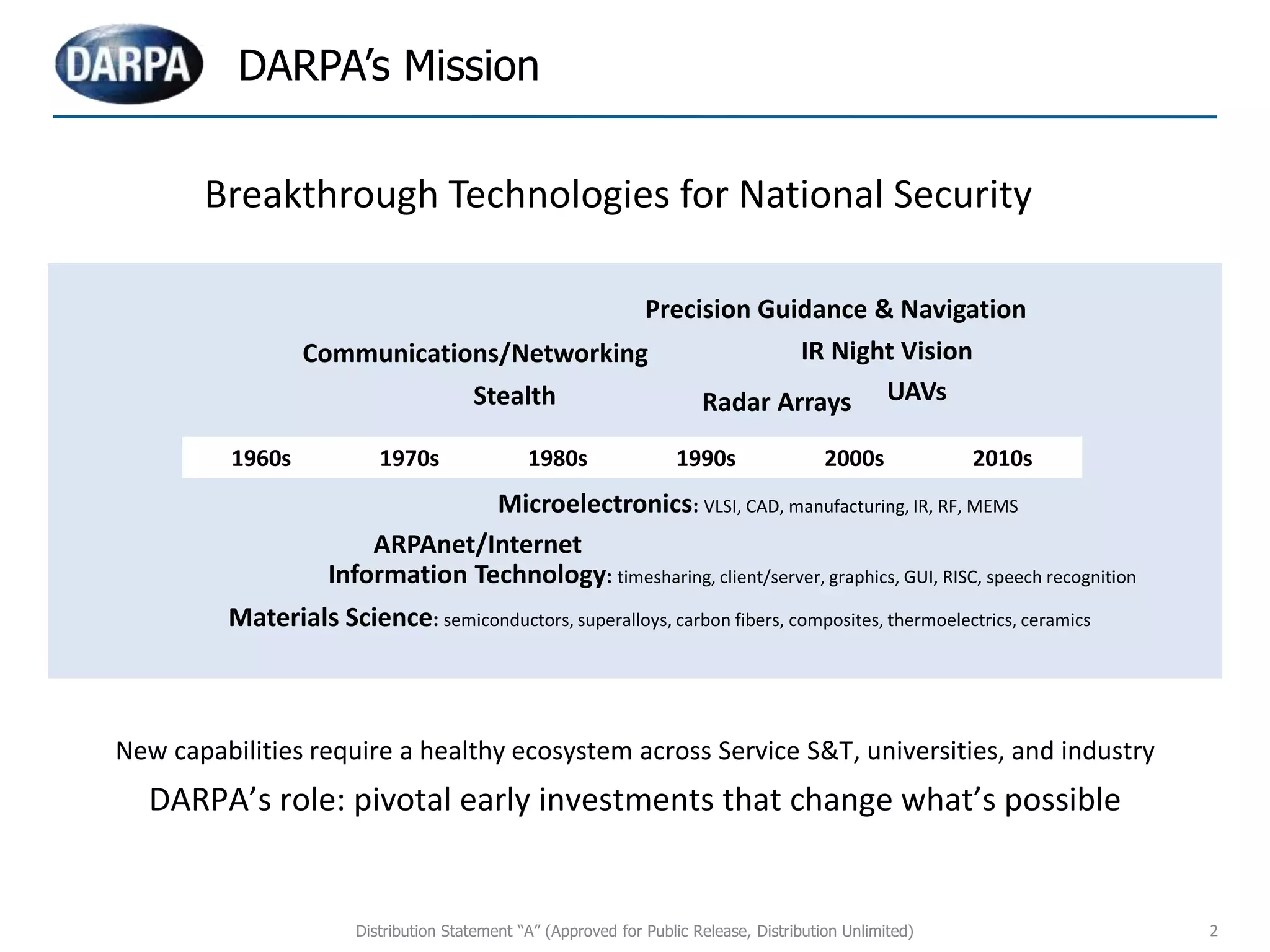
DARPA’s Mission
Communications/Networking
Precision Guidance & Navigation
Stealth UAVs
Materials Science: semiconductors, superalloys, carbon fibers, composites, thermoelectrics, ceramics
ARPAnet/Internet
Microelectronics: VLSI, CAD, manufacturing, IR, RF, MEMS
Information Technology: timesharing, client/server, graphics, GUI, RISC, speech recognition
New capabilities require a healthy ecosystem across Service S&T, universities, and industry
DARPA’s role: pivotal early investments that change what’s possible
IR Night Vision
Radar Arrays
Breakthrough Technologies for National Security
1960s 1970s 1980s 1990s 2000s 2010s
2Distribution Statement “A” (Approved for Public Release, Distribution Unlimited)
3
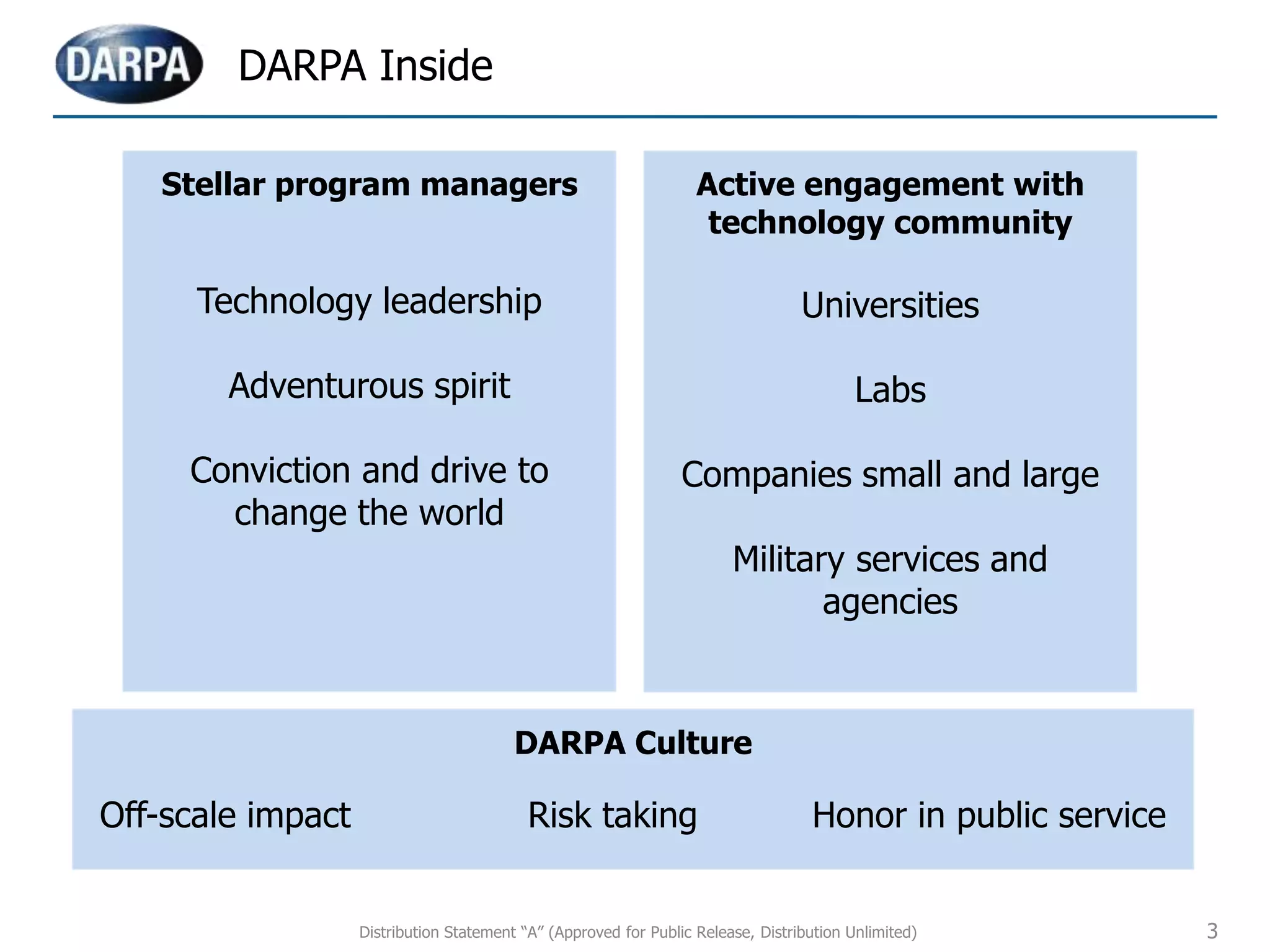
DARPA Inside
Stellar program managers
Technology leadership
Adventurous spirit
Conviction and drive to
change the world
Active engagement with
technology community
Universities
Labs
Companies small and large
Military services and
agencies
DARPA Culture
Off-scale impact Risk taking Honor in public service
Distribution Statement “A” (Approved for Public Release, Distribution Unlimited)
4
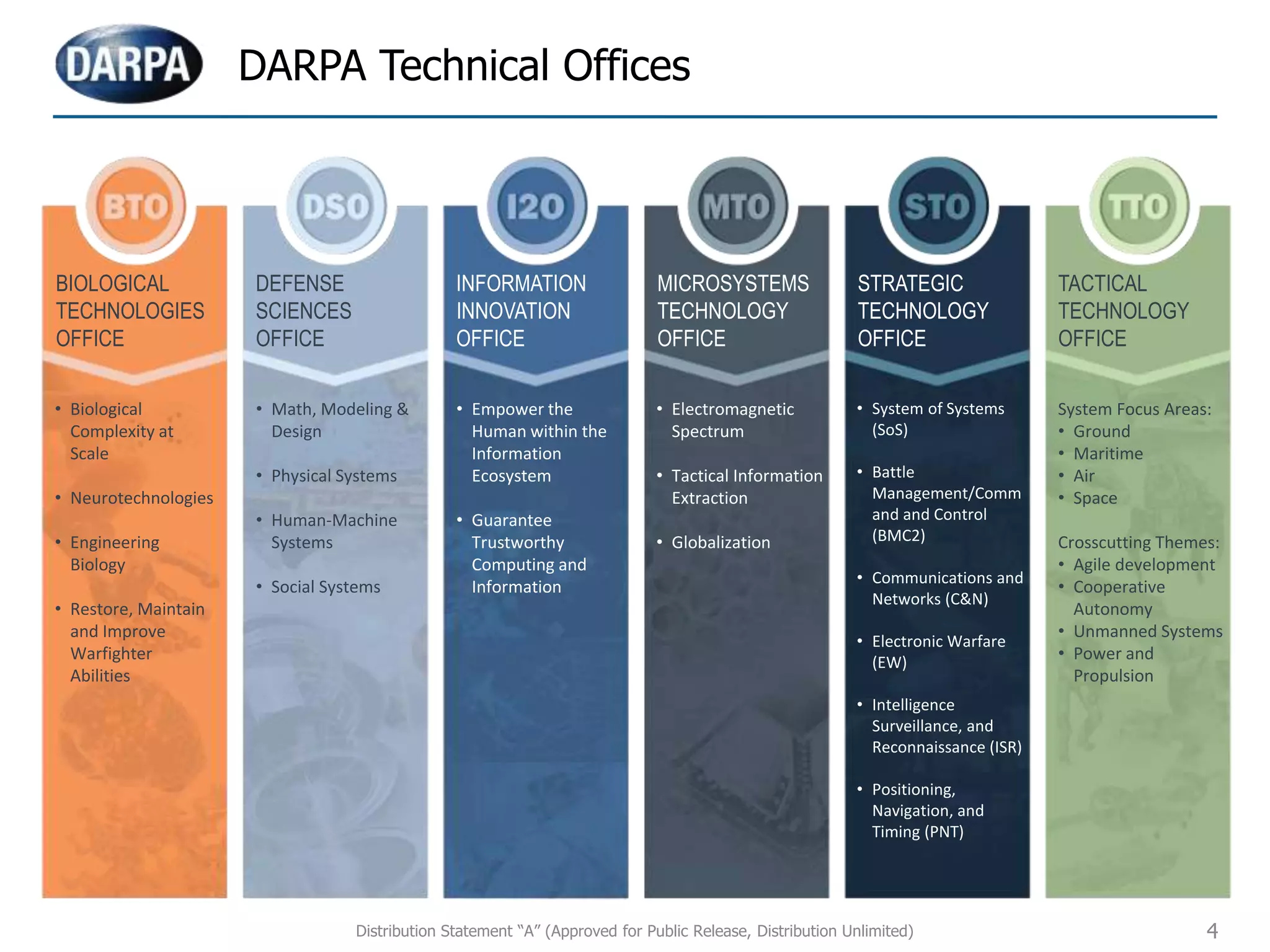
DARPA Technical Offices
BIOLOGICAL
TECHNOLOGIES
OFFICE
DEFENSE
SCIENCES
OFFICE
INFORMATION
INNOVATION
OFFICE
MICROSYSTEMS
TECHNOLOGY
OFFICE
TACTICAL
TECHNOLOGY
OFFICE
STRATEGIC
TECHNOLOGY
OFFICE
• Biological
Complexity at
Scale
• Neurotechnologies
• Engineering
Biology
• Restore, Maintain
and Improve
Warfighter
Abilities
• Math, Modeling &
Design
• Physical Systems
• Human-Machine
Systems
• Social Systems
• Empower the
Human within the
Information
Ecosystem
• Guarantee
Trustworthy
Computing and
Information
• Electromagnetic
Spectrum
• Tactical Information
Extraction
• Globalization
System Focus Areas:
• Ground
• Maritime
• Air
• Space
Crosscutting Themes:
• Agile development
• Cooperative
Autonomy
• Unmanned Systems
• Power and
Propulsion
• System of Systems
(SoS)
• Battle
Management/Comm
and and Control
(BMC2)
• Communications and
Networks (C&N)
• Electronic Warfare
(EW)
• Intelligence
Surveillance, and
Reconnaissance (ISR)
• Positioning,
Navigation, and
Timing (PNT)
Distribution Statement “A” (Approved for Public Release, Distribution Unlimited)
Distribution Statement “A” (Approved for Public Release, Distribution Unlimited) 5
• Usually submitted through DSO
Office-Wide BAA
• Small short duration (6-9 months)
projects
• Move concepts from “disbelief” to
“mere doubt”
• May lead to the next generation of
program ideas
• Proposals solicited through specific
DSO program BAAs
• Often multi-year, multi-disciplinary
efforts
• Technology development to move
from “possibility” to “capability”
Seedlings vs. Programs
Seedlings Programs
Distribution Statement “A” (Approved for Public Release, Distribution Unlimited) 6
Important questions to consider when approaching DARPA with ideas:
• What are you trying to do? (no jargon!)
• How does this get done today?
• What is new about your approach?
• If you succeed, what difference do you think it will make?
• How long do you think it will take?
• Can your work transition (to the DoD or others)?
• How much will it cost?
How we think: The Heilmeier Catechism
7
Three Ways to Engage with DARPA
Talk to a Program Manager (PM)
• Email/phone/face to face
throughout the year
Concepts → New
Ideas
Seedlings:
Disbelief → “Mere”
Doubt
Programs:
Possibility →
Capability
Distribution Statement “A” (Approved for Public Release, Distribution Unlimited)
Respond to DARPA program BAAs
Submit ideas to an Office-Wide BAA
(DSO‘s is BAA-15-39)
8
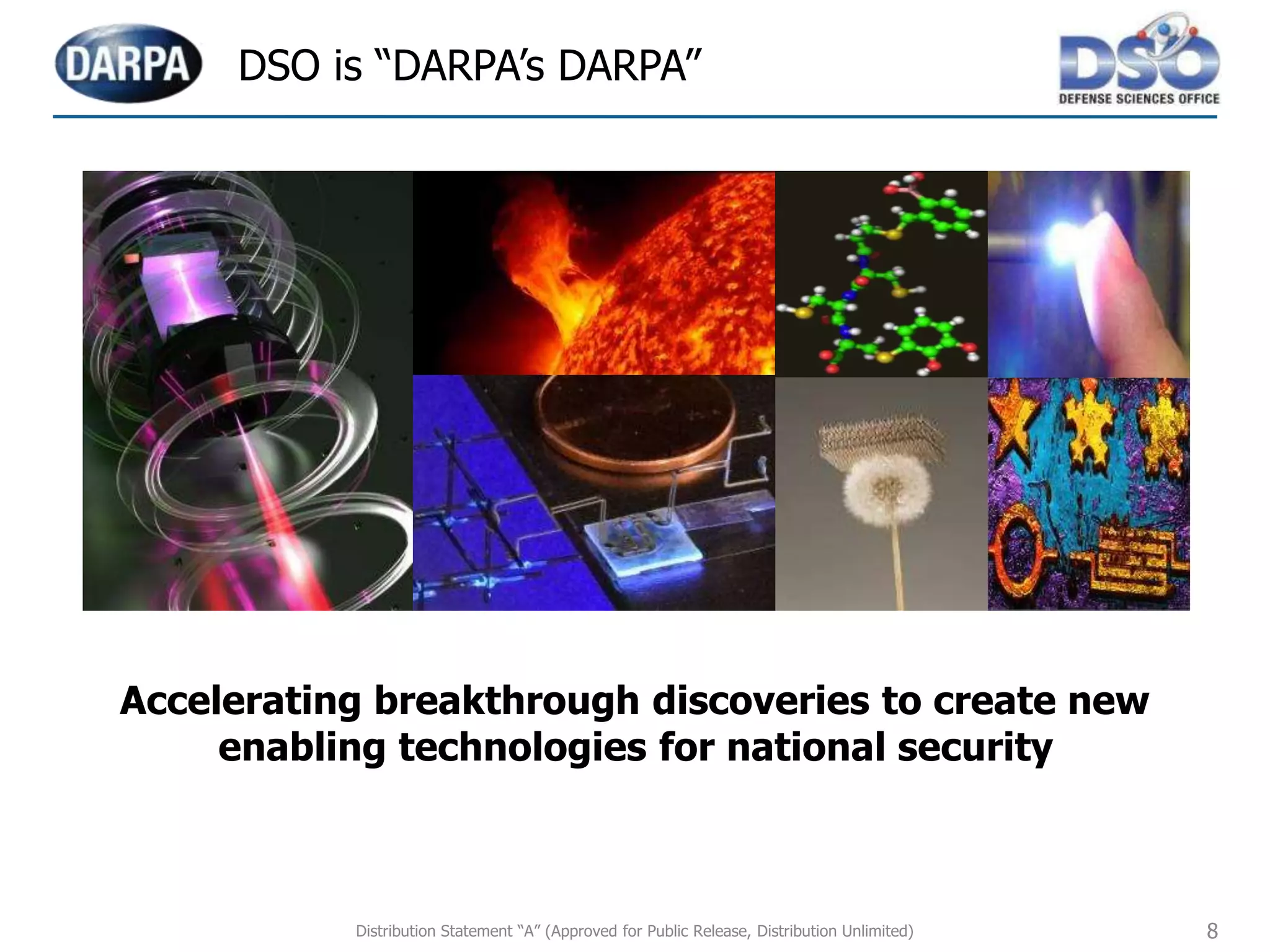
Accelerating breakthrough discoveries to create new
enabling technologies for national security
DSO is “DARPA’s DARPA”
Distribution Statement “A” (Approved for Public Release, Distribution Unlimited)
Factors Shaping DARPA Investments Today
Wide range of national security challenges: evolving
nation states, shifting networks
Powerful, globally available technologies set a fast pace
Military systems’ cost, pace, and inflexibility limit our
operational capabilities
Distribution Statement “A” (Approved for Public Release, Distribution Unlimited) 9
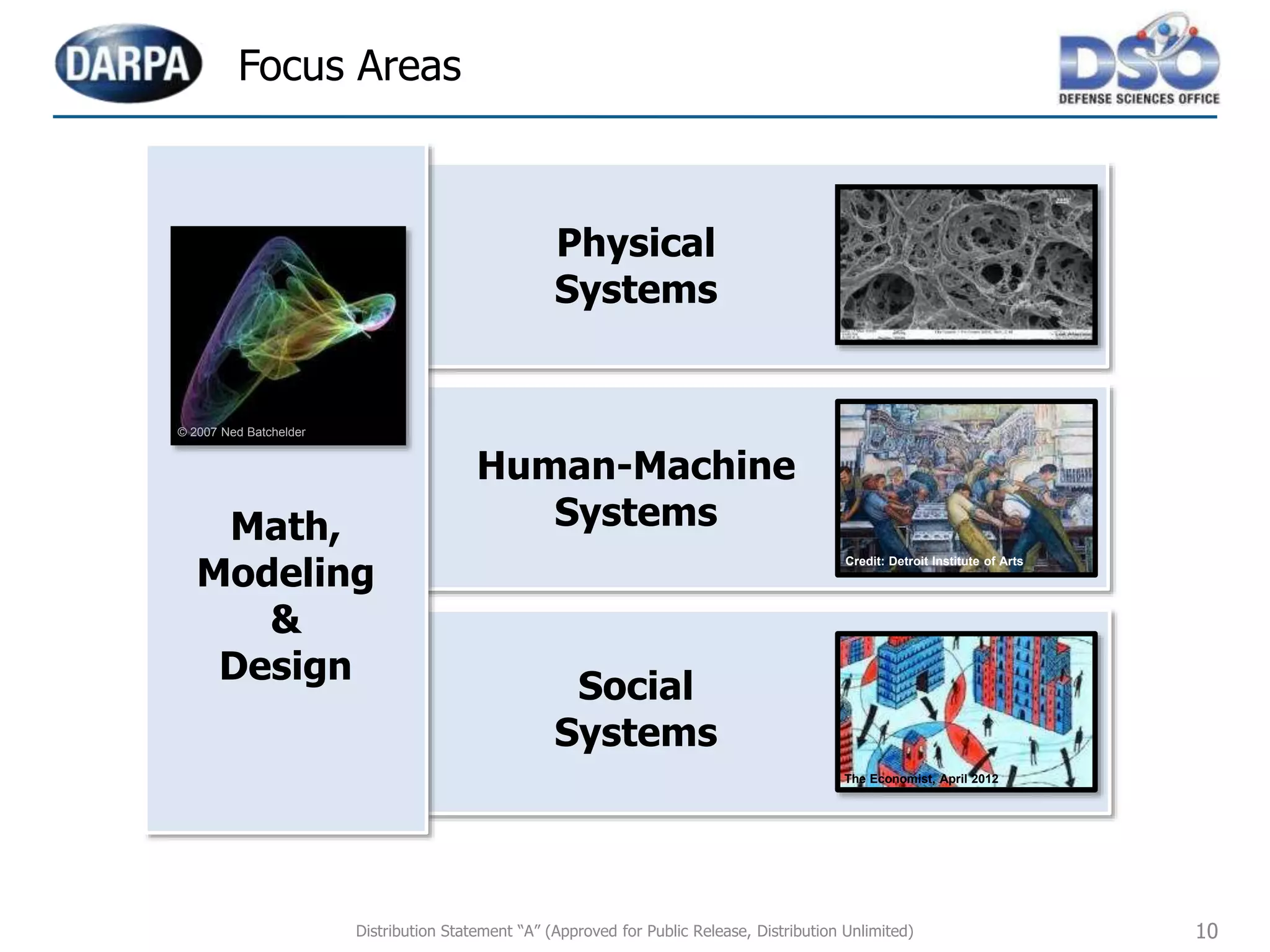
10
Focus Areas
Distribution Statement “A” (Approved for Public Release, Distribution Unlimited)
Physical
Systems
Human-Machine
Systems
Social
Systems
Math,
Modeling
&
Design
The Economist, April 2012
© 2007 Ned Batchelder
Credit: Detroit Institute of Arts
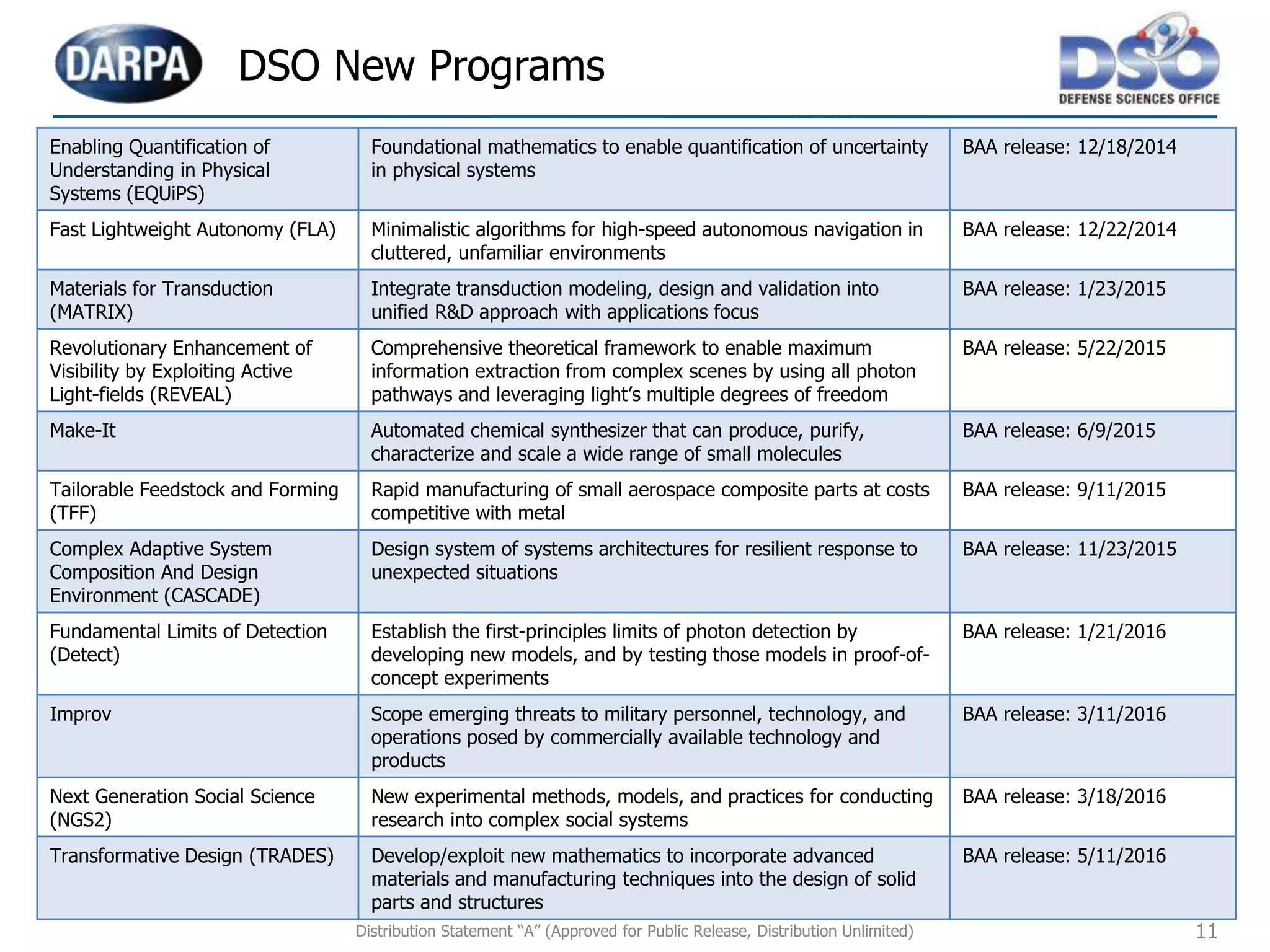
11
Enabling Quantification of
Understanding in Physical
Systems (EQUiPS)
Foundational mathematics to enable quantification of uncertainty
in physical systems
BAA release: 12/18/2014
Fast Lightweight Autonomy (FLA) Minimalistic algorithms for high-speed autonomous navigation in
cluttered, unfamiliar environments
BAA release: 12/22/2014
Materials for Transduction
(MATRIX)
Integrate transduction modeling, design and validation into
unified R&D approach with applications focus
BAA release: 1/23/2015
Revolutionary Enhancement of
Visibility by Exploiting Active
Light-fields (REVEAL)
Comprehensive theoretical framework to enable maximum
information extraction from complex scenes by using all photon
pathways and leveraging light’s multiple degrees of freedom
BAA release: 5/22/2015
Make-It Automated chemical synthesizer that can produce, purify,
characterize and scale a wide range of small molecules
BAA release: 6/9/2015
Tailorable Feedstock and Forming
(TFF)
Rapid manufacturing of small aerospace composite parts at costs
competitive with metal
BAA release: 9/11/2015
Complex Adaptive System
Composition And Design
Environment (CASCADE)
Design system of systems architectures for resilient response to
unexpected situations
BAA release: 11/23/2015
Fundamental Limits of Detection
(Detect)
Establish the first-principles limits of photon detection by
developing new models, and by testing those models in proof-of-
concept experiments
BAA release: 1/21/2016
Improv Scope emerging threats to military personnel, technology, and
operations posed by commercially available technology and
products
BAA release: 3/11/2016
Next Generation Social Science
(NGS2)
New experimental methods, models, and practices for conducting
research into complex social systems
BAA release: 3/18/2016
Transformative Design (TRADES) Develop/exploit new mathematics to incorporate advanced
materials and manufacturing techniques into the design of solid
parts and structures
BAA release: 5/11/2016
DSO New Programs
Distribution Statement “A” (Approved for Public Release, Distribution Unlimited)
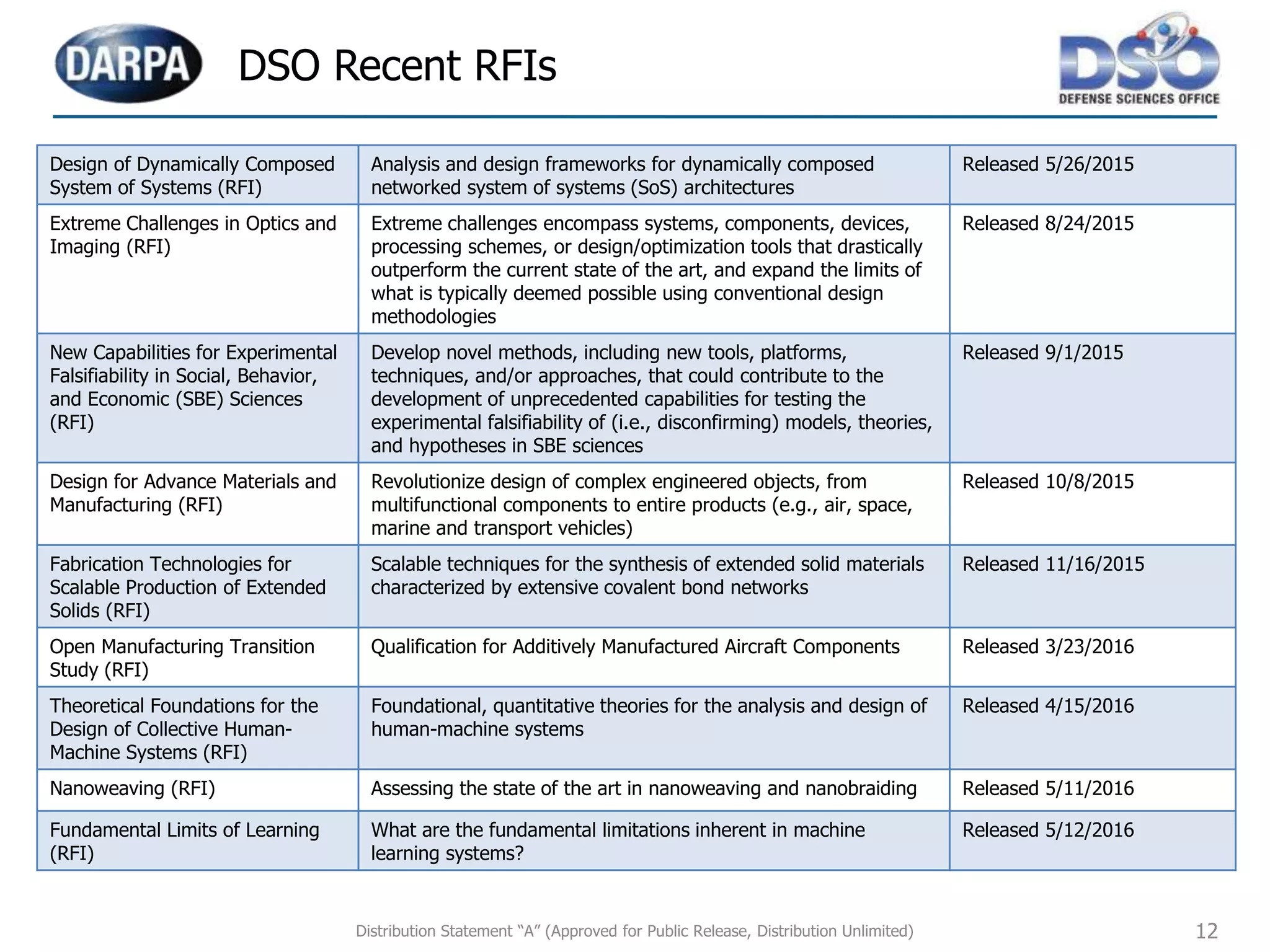
12
DSO Recent RFIs
Design of Dynamically Composed
System of Systems (RFI)
Analysis and design frameworks for dynamically composed
networked system of systems (SoS) architectures
Released 5/26/2015
Extreme Challenges in Optics and
Imaging (RFI)
Extreme challenges encompass systems, components, devices,
processing schemes, or design/optimization tools that drastically
outperform the current state of the art, and expand the limits of
what is typically deemed possible using conventional design
methodologies
Released 8/24/2015
New Capabilities for Experimental
Falsifiability in Social, Behavior,
and Economic (SBE) Sciences
(RFI)
Develop novel methods, including new tools, platforms,
techniques, and/or approaches, that could contribute to the
development of unprecedented capabilities for testing the
experimental falsifiability of (i.e., disconfirming) models, theories,
and hypotheses in SBE sciences
Released 9/1/2015
Design for Advance Materials and
Manufacturing (RFI)
Revolutionize design of complex engineered objects, from
multifunctional components to entire products (e.g., air, space,
marine and transport vehicles)
Released 10/8/2015
Fabrication Technologies for
Scalable Production of Extended
Solids (RFI)
Scalable techniques for the synthesis of extended solid materials
characterized by extensive covalent bond networks
Released 11/16/2015
Open Manufacturing Transition
Study (RFI)
Qualification for Additively Manufactured Aircraft Components Released 3/23/2016
Theoretical Foundations for the
Design of Collective Human-
Machine Systems (RFI)
Foundational, quantitative theories for the analysis and design of
human-machine systems
Released 4/15/2016
Nanoweaving (RFI) Assessing the state of the art in nanoweaving and nanobraiding Released 5/11/2016
Fundamental Limits of Learning
(RFI)
What are the fundamental limitations inherent in machine
learning systems?
Released 5/12/2016
Distribution Statement “A” (Approved for Public Release, Distribution Unlimited)
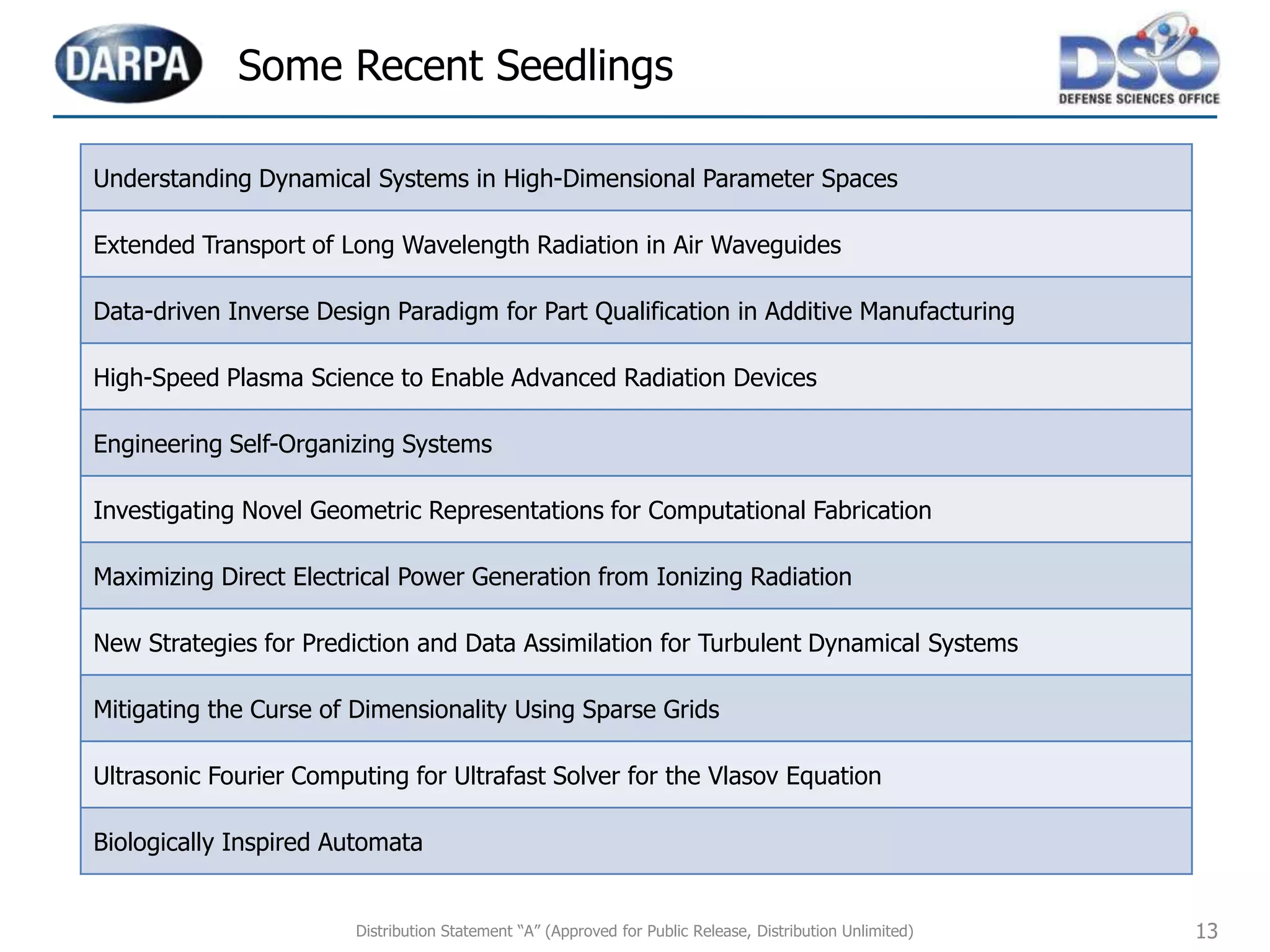
13
Some Recent Seedlings
Understanding Dynamical Systems in High-Dimensional Parameter Spaces
Extended Transport of Long Wavelength Radiation in Air Waveguides
Data-driven Inverse Design Paradigm for Part Qualification in Additive Manufacturing
High-Speed Plasma Science to Enable Advanced Radiation Devices
Engineering Self-Organizing Systems
Investigating Novel Geometric Representations for Computational Fabrication
Maximizing Direct Electrical Power Generation from Ionizing Radiation
New Strategies for Prediction and Data Assimilation for Turbulent Dynamical Systems
Mitigating the Curse of Dimensionality Using Sparse Grids
Ultrasonic Fourier Computing for Ultrafast Solver for the Vlasov Equation
Biologically Inspired Automata
Distribution Statement “A” (Approved for Public Release, Distribution Unlimited)
We look forward to your ideas
14Distribution Statement “A” (Approved for Public Release, Distribution Unlimited)
www.darpa.mil
15
16
Backups
17
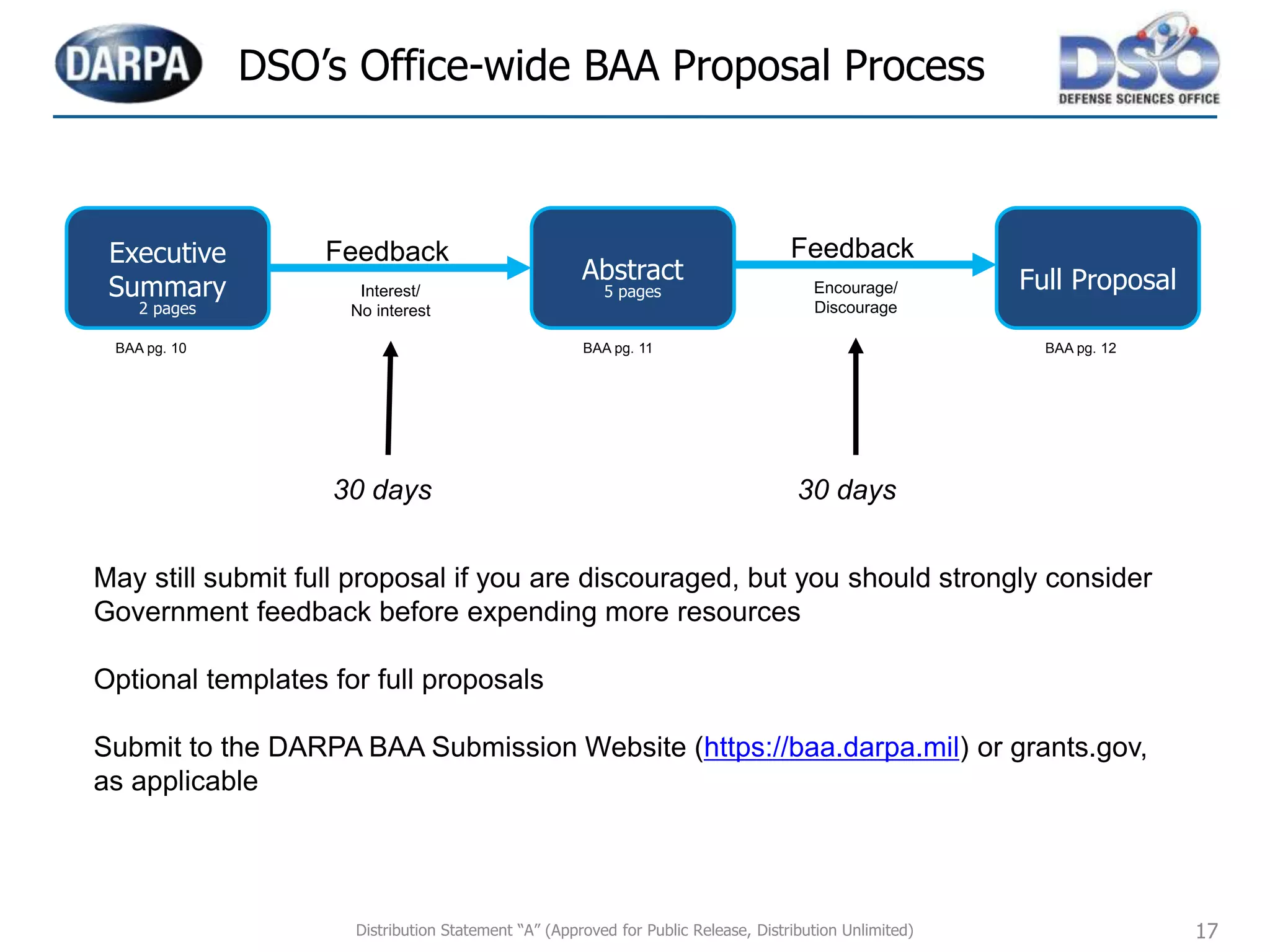
DSO’s Office-wide BAA Proposal Process
May still submit full proposal if you are discouraged, but you should strongly consider
Government feedback before expending more resources
Optional templates for full proposals
Submit to the DARPA BAA Submission Website (https://baa.darpa.mil) or grants.gov,
as applicable
Executive
Summary
2 pages
Abstract
5 pages Full Proposal
Feedback
Interest/
No interest
Feedback
Encourage/
Discourage
BAA pg. 10 BAA pg. 11 BAA pg. 12
30 days 30 days
Distribution Statement “A” (Approved for Public Release, Distribution Unlimited)
18
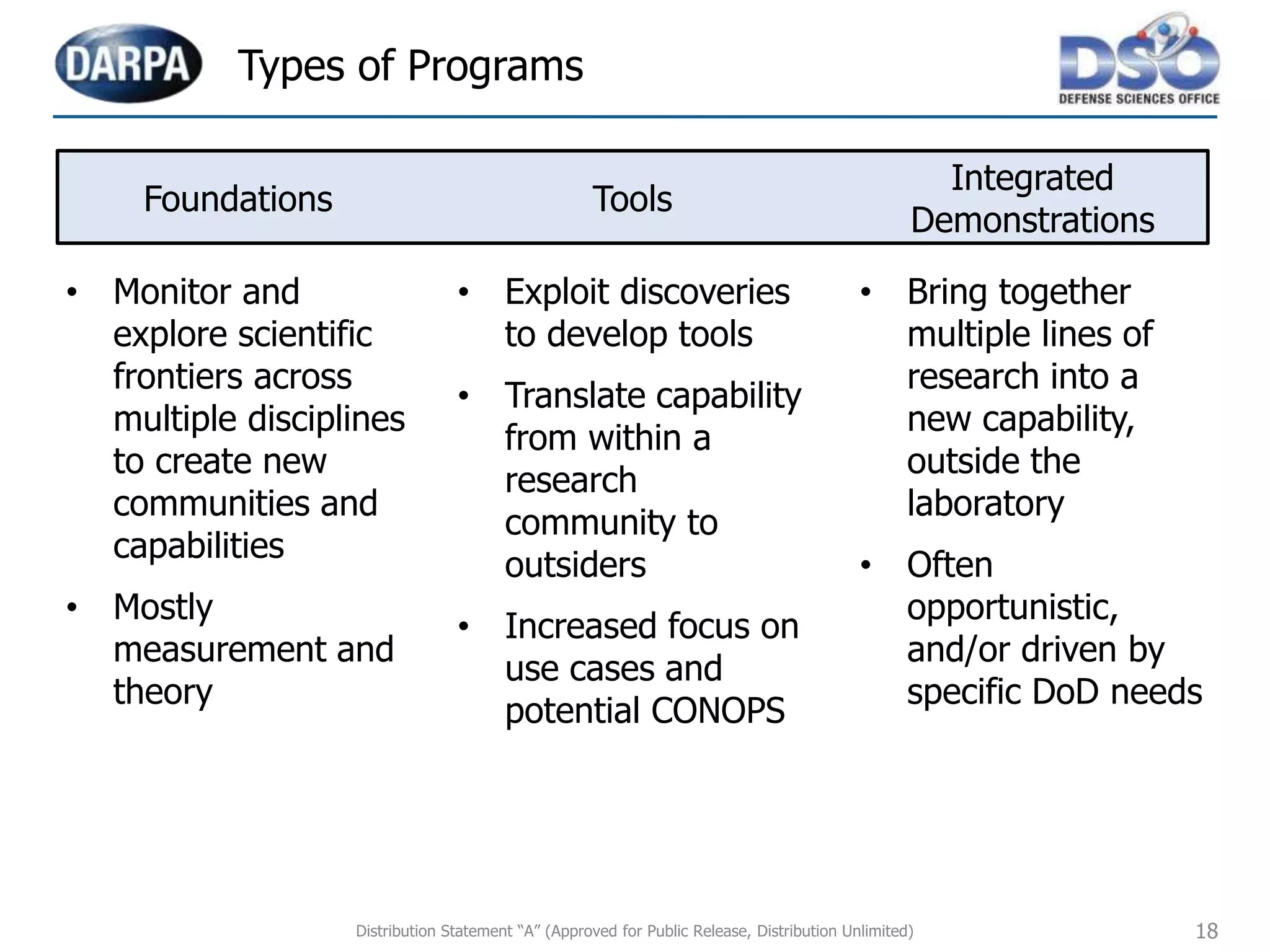
Types of Programs
Integrated
Demonstrations
ToolsFoundations
• Monitor and
explore scientific
frontiers across
multiple disciplines
to create new
communities and
capabilities
• Mostly
measurement and
theory
• Exploit discoveries
to develop tools
• Translate capability
from within a
research
community to
outsiders
• Increased focus on
use cases and
potential CONOPS
• Bring together
multiple lines of
research into a
new capability,
outside the
laboratory
• Often
opportunistic,
and/or driven by
specific DoD needs
Distribution Statement “A” (Approved for Public Release, Distribution Unlimited)
19
• E-mail questions about the BAA to DARPA-BAA-15-
39@darpa.mil
• FAQs posted under the BAA at
http://www.darpa.mil/work-with-us/opportunities (filter
by “DSO”)
• Find PM bios and program information at
https://www.darpa.mil/about-us/offices/dso
Important links
Distribution Statement “A” (Approved for Public Release, Distribution Unlimited)

Engaging with DARPA - Stefanie Thompkins

  • 1.
    Engaging with DARPA Dr.Stefanie Tompkins June 1, 2016 Distribution Statement “A” (Approved for Public Release, Distribution Unlimited)
  • 2.
    DARPA’s Mission Communications/Networking Precision Guidance& Navigation Stealth UAVs Materials Science: semiconductors, superalloys, carbon fibers, composites, thermoelectrics, ceramics ARPAnet/Internet Microelectronics: VLSI, CAD, manufacturing, IR, RF, MEMS Information Technology: timesharing, client/server, graphics, GUI, RISC, speech recognition New capabilities require a healthy ecosystem across Service S&T, universities, and industry DARPA’s role: pivotal early investments that change what’s possible IR Night Vision Radar Arrays Breakthrough Technologies for National Security 1960s 1970s 1980s 1990s 2000s 2010s 2Distribution Statement “A” (Approved for Public Release, Distribution Unlimited)
  • 3.
    3 DARPA Inside Stellar programmanagers Technology leadership Adventurous spirit Conviction and drive to change the world Active engagement with technology community Universities Labs Companies small and large Military services and agencies DARPA Culture Off-scale impact Risk taking Honor in public service Distribution Statement “A” (Approved for Public Release, Distribution Unlimited)
  • 4.
    4 DARPA Technical Offices BIOLOGICAL TECHNOLOGIES OFFICE DEFENSE SCIENCES OFFICE INFORMATION INNOVATION OFFICE MICROSYSTEMS TECHNOLOGY OFFICE TACTICAL TECHNOLOGY OFFICE STRATEGIC TECHNOLOGY OFFICE •Biological Complexity at Scale • Neurotechnologies • Engineering Biology • Restore, Maintain and Improve Warfighter Abilities • Math, Modeling & Design • Physical Systems • Human-Machine Systems • Social Systems • Empower the Human within the Information Ecosystem • Guarantee Trustworthy Computing and Information • Electromagnetic Spectrum • Tactical Information Extraction • Globalization System Focus Areas: • Ground • Maritime • Air • Space Crosscutting Themes: • Agile development • Cooperative Autonomy • Unmanned Systems • Power and Propulsion • System of Systems (SoS) • Battle Management/Comm and and Control (BMC2) • Communications and Networks (C&N) • Electronic Warfare (EW) • Intelligence Surveillance, and Reconnaissance (ISR) • Positioning, Navigation, and Timing (PNT) Distribution Statement “A” (Approved for Public Release, Distribution Unlimited)
  • 5.
    Distribution Statement “A”(Approved for Public Release, Distribution Unlimited) 5 • Usually submitted through DSO Office-Wide BAA • Small short duration (6-9 months) projects • Move concepts from “disbelief” to “mere doubt” • May lead to the next generation of program ideas • Proposals solicited through specific DSO program BAAs • Often multi-year, multi-disciplinary efforts • Technology development to move from “possibility” to “capability” Seedlings vs. Programs Seedlings Programs
  • 6.
    Distribution Statement “A”(Approved for Public Release, Distribution Unlimited) 6 Important questions to consider when approaching DARPA with ideas: • What are you trying to do? (no jargon!) • How does this get done today? • What is new about your approach? • If you succeed, what difference do you think it will make? • How long do you think it will take? • Can your work transition (to the DoD or others)? • How much will it cost? How we think: The Heilmeier Catechism
  • 7.
    7 Three Ways toEngage with DARPA Talk to a Program Manager (PM) • Email/phone/face to face throughout the year Concepts → New Ideas Seedlings: Disbelief → “Mere” Doubt Programs: Possibility → Capability Distribution Statement “A” (Approved for Public Release, Distribution Unlimited) Respond to DARPA program BAAs Submit ideas to an Office-Wide BAA (DSO‘s is BAA-15-39)
  • 8.
    8 Accelerating breakthrough discoveriesto create new enabling technologies for national security DSO is “DARPA’s DARPA” Distribution Statement “A” (Approved for Public Release, Distribution Unlimited)
  • 9.
    Factors Shaping DARPAInvestments Today Wide range of national security challenges: evolving nation states, shifting networks Powerful, globally available technologies set a fast pace Military systems’ cost, pace, and inflexibility limit our operational capabilities Distribution Statement “A” (Approved for Public Release, Distribution Unlimited) 9
  • 10.
    10 Focus Areas Distribution Statement“A” (Approved for Public Release, Distribution Unlimited) Physical Systems Human-Machine Systems Social Systems Math, Modeling & Design The Economist, April 2012 © 2007 Ned Batchelder Credit: Detroit Institute of Arts
  • 11.
    11 Enabling Quantification of Understandingin Physical Systems (EQUiPS) Foundational mathematics to enable quantification of uncertainty in physical systems BAA release: 12/18/2014 Fast Lightweight Autonomy (FLA) Minimalistic algorithms for high-speed autonomous navigation in cluttered, unfamiliar environments BAA release: 12/22/2014 Materials for Transduction (MATRIX) Integrate transduction modeling, design and validation into unified R&D approach with applications focus BAA release: 1/23/2015 Revolutionary Enhancement of Visibility by Exploiting Active Light-fields (REVEAL) Comprehensive theoretical framework to enable maximum information extraction from complex scenes by using all photon pathways and leveraging light’s multiple degrees of freedom BAA release: 5/22/2015 Make-It Automated chemical synthesizer that can produce, purify, characterize and scale a wide range of small molecules BAA release: 6/9/2015 Tailorable Feedstock and Forming (TFF) Rapid manufacturing of small aerospace composite parts at costs competitive with metal BAA release: 9/11/2015 Complex Adaptive System Composition And Design Environment (CASCADE) Design system of systems architectures for resilient response to unexpected situations BAA release: 11/23/2015 Fundamental Limits of Detection (Detect) Establish the first-principles limits of photon detection by developing new models, and by testing those models in proof-of- concept experiments BAA release: 1/21/2016 Improv Scope emerging threats to military personnel, technology, and operations posed by commercially available technology and products BAA release: 3/11/2016 Next Generation Social Science (NGS2) New experimental methods, models, and practices for conducting research into complex social systems BAA release: 3/18/2016 Transformative Design (TRADES) Develop/exploit new mathematics to incorporate advanced materials and manufacturing techniques into the design of solid parts and structures BAA release: 5/11/2016 DSO New Programs Distribution Statement “A” (Approved for Public Release, Distribution Unlimited)
  • 12.
    12 DSO Recent RFIs Designof Dynamically Composed System of Systems (RFI) Analysis and design frameworks for dynamically composed networked system of systems (SoS) architectures Released 5/26/2015 Extreme Challenges in Optics and Imaging (RFI) Extreme challenges encompass systems, components, devices, processing schemes, or design/optimization tools that drastically outperform the current state of the art, and expand the limits of what is typically deemed possible using conventional design methodologies Released 8/24/2015 New Capabilities for Experimental Falsifiability in Social, Behavior, and Economic (SBE) Sciences (RFI) Develop novel methods, including new tools, platforms, techniques, and/or approaches, that could contribute to the development of unprecedented capabilities for testing the experimental falsifiability of (i.e., disconfirming) models, theories, and hypotheses in SBE sciences Released 9/1/2015 Design for Advance Materials and Manufacturing (RFI) Revolutionize design of complex engineered objects, from multifunctional components to entire products (e.g., air, space, marine and transport vehicles) Released 10/8/2015 Fabrication Technologies for Scalable Production of Extended Solids (RFI) Scalable techniques for the synthesis of extended solid materials characterized by extensive covalent bond networks Released 11/16/2015 Open Manufacturing Transition Study (RFI) Qualification for Additively Manufactured Aircraft Components Released 3/23/2016 Theoretical Foundations for the Design of Collective Human- Machine Systems (RFI) Foundational, quantitative theories for the analysis and design of human-machine systems Released 4/15/2016 Nanoweaving (RFI) Assessing the state of the art in nanoweaving and nanobraiding Released 5/11/2016 Fundamental Limits of Learning (RFI) What are the fundamental limitations inherent in machine learning systems? Released 5/12/2016 Distribution Statement “A” (Approved for Public Release, Distribution Unlimited)
  • 13.
    13 Some Recent Seedlings UnderstandingDynamical Systems in High-Dimensional Parameter Spaces Extended Transport of Long Wavelength Radiation in Air Waveguides Data-driven Inverse Design Paradigm for Part Qualification in Additive Manufacturing High-Speed Plasma Science to Enable Advanced Radiation Devices Engineering Self-Organizing Systems Investigating Novel Geometric Representations for Computational Fabrication Maximizing Direct Electrical Power Generation from Ionizing Radiation New Strategies for Prediction and Data Assimilation for Turbulent Dynamical Systems Mitigating the Curse of Dimensionality Using Sparse Grids Ultrasonic Fourier Computing for Ultrafast Solver for the Vlasov Equation Biologically Inspired Automata Distribution Statement “A” (Approved for Public Release, Distribution Unlimited)
  • 14.
    We look forwardto your ideas 14Distribution Statement “A” (Approved for Public Release, Distribution Unlimited)
  • 15.
  • 16.
  • 17.
    17 DSO’s Office-wide BAAProposal Process May still submit full proposal if you are discouraged, but you should strongly consider Government feedback before expending more resources Optional templates for full proposals Submit to the DARPA BAA Submission Website (https://baa.darpa.mil) or grants.gov, as applicable Executive Summary 2 pages Abstract 5 pages Full Proposal Feedback Interest/ No interest Feedback Encourage/ Discourage BAA pg. 10 BAA pg. 11 BAA pg. 12 30 days 30 days Distribution Statement “A” (Approved for Public Release, Distribution Unlimited)
  • 18.
    18 Types of Programs Integrated Demonstrations ToolsFoundations •Monitor and explore scientific frontiers across multiple disciplines to create new communities and capabilities • Mostly measurement and theory • Exploit discoveries to develop tools • Translate capability from within a research community to outsiders • Increased focus on use cases and potential CONOPS • Bring together multiple lines of research into a new capability, outside the laboratory • Often opportunistic, and/or driven by specific DoD needs Distribution Statement “A” (Approved for Public Release, Distribution Unlimited)
  • 19.
    19 • E-mail questionsabout the BAA to DARPA-BAA-15- 39@darpa.mil • FAQs posted under the BAA at http://www.darpa.mil/work-with-us/opportunities (filter by “DSO”) • Find PM bios and program information at https://www.darpa.mil/about-us/offices/dso Important links Distribution Statement “A” (Approved for Public Release, Distribution Unlimited)

Editor's Notes

  • #6 We do often look for seedlings via the office-wide BAA. For DSO purposes, a seedling is defined as a short duration study or proof of concept with a period of performance of usually 6-9 months and a dollar value equivalent to 1-2 FTEs.
  • #7 As you formulate your executive summaries, abstracts and full proposals, you will want to make sure you are able to answer the Heilmeier questions as they relate to your proposed research. Former DARPA Director George Heilmeier formulated these questions 40 years ago, and DARPA staff still rely on them today when assessing the viability of new program ideas and proposals. IF YOU ALREADY KNOW HOW TO SOLVE IT, IT’S NOT DARPA HARD
  • #18  More questions: How many of you have received an award under a DARPA BAA? How many of you communicated with a DARPA PM before submitting a full proposal? Was the opportunity to communicate with the PM helpful? One cool thing the DSO Office-wide BAA affords you that program BAAs do not is the ability to get a quick heading check before investing time and money in proposal preparation. By submitting a 1-page executive summary, you will receive a response in the form of a statement of interest or no interest from DSO. You can use this information to decide whether to submit a 5-page abstract. If you choose to submit an abstract, you will receive a response from DSO, this time encouraging or discouraging the submittal of a full proposal. If the decision is not favorable, the response will include feedback to explain the rationale behind the decision. Of course, you may still submit a full proposal, even if you are discouraged, but you should seriously consider the feedback provided before investing the more substantial resources required to prepare a full proposal. The DSO Office-wide BAA has attachments providing optional templates to assist you with drafting a full proposal:: Attachment 1 is for the Technical & Management Volume, Attachment 2 is for the Cost Volume, and Attachment 3 is for the executive summary slide (introductory section of the Technical Volume All executive summaries, abstracts, and full proposals must be submitted through the DARPA BAA Submission Website or grants.gov, as applicable. Full proposals have two options: (1) if you’re requesting a contract or OT, you should use the DARPA BAA portal; (2) if you’re requesting a grant or cooperative agreement, you should use grants.gov. Note, grants.gov is outside DARPA control so we recommend you review their website to ensure you are up to speed with their specific registration/submission requirements. DSO endeavors to provide responses to executive summaries and feedback to abstracts within 30 days of receipt. NEED TO SEE IF WE HAVE FUNDED SOMETHING THAT WAS FIRST SUBMITTED AS EXECUTIVE SUMMARY ADD ANECDOTES