Energy Consumption Benchmarking of a Swarm Intelligence Inspired MANET Protocol Project Team : Shashant Kumar Vibhooti Gupta Mohit Bansal Eeshan Srivastava Under the guidance of: Mr. Keshav Singh
Conceptual Overview Inherent Energy consumption problem of MANETs in practical applications Swarm Intelligence provides a solution: ACO (Ant Colony Optimization) Small ant packets collect network state by  Stigmergy Pheromone tables are built using this information
Continued… We follow a global optimization approach Goal is to find paths that cost least energy in the long run Compare performance of this protocol with existing Ad-Hoc routing protocols: AODV DSDV DSR
Previous Semester Work Researched various MANET protocols Designed  an implementable  version of the ant-based protocol Learned NS-2 simulation environment for wired and wireless topologies Simulated the following on NS-2: Distance Vector Routing Queuing AODV (small scale)
Packet classes and structures Data packets : represent the information that end users  exchange with each other.  Forward and Backward ants : are control packets used to update the routing tables and distribute information about traffic load in the network. Broadcast Ants : every node broadcasts remaining energy level using this packet.
packet.cc Class  basic_ant  defines the structure for an ant packet:  -> source_add (nsaddr_t) -> dest_add (nsaddr_t) -> packet length (int) -> packet seq_number (int) -> packet start_time (double) Classes for F-ants and B-ants derived from the class basic_ant Methods for adding new nodes and keeping track of visited nodes Project  Development Files
router.cc Its main class is derived from class ‘Agent’ which is the base class for all routing agents in ns2. It contains: reinforcement factor  timer for generation of F-ants methods generate F-ants and B-ants send F-ant to next hop as determined by algorithm  Continued…
pheromone.cc class for storing pheromone values ph value (double) next node address (nsaddr_t) methods  to add and remove entry method to return pheromone value routingtable.cc method to increment and evaporate pheromone values methods to add and delete pheromone tables. Continued…
Simulation Environment Integration of protocol into NS-2 by adding definitions in NS-2 environment files such as packet.cc, cmu-trace.cc, ns-lib.tcl etc.  Traffic Model Generation: 50 nodes with CBR sources (UDP) Max 10 connections at 8kbps Mobility Model Generation 50 nodes, pause-time 0 sec Max speed 20m/s 500x500 topology Simulation Time: 100 seconds
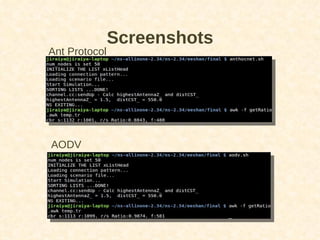
Screenshots Ant Protocol AODV
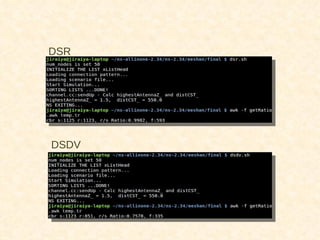
DSR DSDV
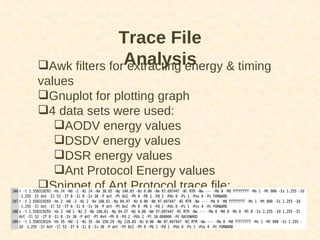
Trace File Analysis Awk filters for extracting energy & timing values Gnuplot for plotting graph 4 data sets were used: AODV energy values DSDV energy values DSR energy values Ant Protocol Energy values Snippet of Ant Protocol trace file:
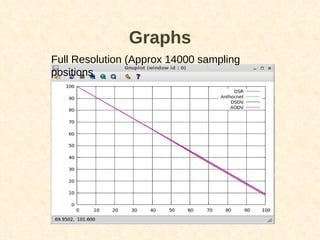
Graphs Full Resolution (Approx 14000 sampling positions
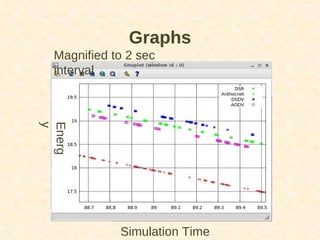
Graphs Energy Simulation Time -----> Magnified to 2 sec interval
Results: Benchmark R/S efficiency: DSR with 99.82% (1123/1125) AODV with 98.74% (1099/1113) Ant Protocol with 88.43% (1001/1132) DSDV with 75.78% (851/1123) Energy Efficiency: DSDV Ant Protocol AODV DSR
Research Paper and References C. Srisathapornphat and C.-C. Shen.  Swarm Intelligence-Inspired Energy Conservation Scheme in Ad Hoc Networks . The 3rd Conference on Mobile Technology, Applications and Systems — Mobility 2006, Pg 1-7 E. Bonabeau, M. Dorigo, and G. Theraulaz.  Swarm Intelligence: From Natural to Artificial Systems . Oxford University Press, New York, 1999. www.isi.edu/nsnam/ns/

My Final Year B.Tech Research Project

  • 1.
    Energy Consumption Benchmarkingof a Swarm Intelligence Inspired MANET Protocol Project Team : Shashant Kumar Vibhooti Gupta Mohit Bansal Eeshan Srivastava Under the guidance of: Mr. Keshav Singh
  • 2.
    Conceptual Overview InherentEnergy consumption problem of MANETs in practical applications Swarm Intelligence provides a solution: ACO (Ant Colony Optimization) Small ant packets collect network state by Stigmergy Pheromone tables are built using this information
  • 3.
    Continued… We followa global optimization approach Goal is to find paths that cost least energy in the long run Compare performance of this protocol with existing Ad-Hoc routing protocols: AODV DSDV DSR
  • 4.
    Previous Semester WorkResearched various MANET protocols Designed an implementable version of the ant-based protocol Learned NS-2 simulation environment for wired and wireless topologies Simulated the following on NS-2: Distance Vector Routing Queuing AODV (small scale)
  • 5.
    Packet classes andstructures Data packets : represent the information that end users exchange with each other. Forward and Backward ants : are control packets used to update the routing tables and distribute information about traffic load in the network. Broadcast Ants : every node broadcasts remaining energy level using this packet.
  • 6.
    packet.cc Class basic_ant defines the structure for an ant packet: -> source_add (nsaddr_t) -> dest_add (nsaddr_t) -> packet length (int) -> packet seq_number (int) -> packet start_time (double) Classes for F-ants and B-ants derived from the class basic_ant Methods for adding new nodes and keeping track of visited nodes Project Development Files
  • 7.
    router.cc Its mainclass is derived from class ‘Agent’ which is the base class for all routing agents in ns2. It contains: reinforcement factor timer for generation of F-ants methods generate F-ants and B-ants send F-ant to next hop as determined by algorithm Continued…
  • 8.
    pheromone.cc class forstoring pheromone values ph value (double) next node address (nsaddr_t) methods to add and remove entry method to return pheromone value routingtable.cc method to increment and evaporate pheromone values methods to add and delete pheromone tables. Continued…
  • 9.
    Simulation Environment Integrationof protocol into NS-2 by adding definitions in NS-2 environment files such as packet.cc, cmu-trace.cc, ns-lib.tcl etc. Traffic Model Generation: 50 nodes with CBR sources (UDP) Max 10 connections at 8kbps Mobility Model Generation 50 nodes, pause-time 0 sec Max speed 20m/s 500x500 topology Simulation Time: 100 seconds
  • 10.
  • 11.
  • 12.
    Trace File AnalysisAwk filters for extracting energy & timing values Gnuplot for plotting graph 4 data sets were used: AODV energy values DSDV energy values DSR energy values Ant Protocol Energy values Snippet of Ant Protocol trace file:
  • 13.
    Graphs Full Resolution(Approx 14000 sampling positions
  • 14.
    Graphs Energy SimulationTime -----> Magnified to 2 sec interval
  • 15.
    Results: Benchmark R/Sefficiency: DSR with 99.82% (1123/1125) AODV with 98.74% (1099/1113) Ant Protocol with 88.43% (1001/1132) DSDV with 75.78% (851/1123) Energy Efficiency: DSDV Ant Protocol AODV DSR
  • 16.
    Research Paper andReferences C. Srisathapornphat and C.-C. Shen. Swarm Intelligence-Inspired Energy Conservation Scheme in Ad Hoc Networks . The 3rd Conference on Mobile Technology, Applications and Systems — Mobility 2006, Pg 1-7 E. Bonabeau, M. Dorigo, and G. Theraulaz. Swarm Intelligence: From Natural to Artificial Systems . Oxford University Press, New York, 1999. www.isi.edu/nsnam/ns/