Proceedings Of 4th International Conference In
Software Engineering For Defence Applications
Seda 2015 1st Edition Paolo Ciancarini download
https://ebookbell.com/product/proceedings-of-4th-international-
conference-in-software-engineering-for-defence-applications-
seda-2015-1st-edition-paolo-ciancarini-5355516
Explore and download more ebooks at ebookbell.com
Here are some recommended products that we believe you will be
interested in. You can click the link to download.
Trends And Applications In Software Engineering Proceedings Of The 4th
International Conference On Software Process Improvement Cimps2015 1st
Edition Jezreel Mejia
https://ebookbell.com/product/trends-and-applications-in-software-
engineering-proceedings-of-the-4th-international-conference-on-
software-process-improvement-cimps2015-1st-edition-jezreel-
mejia-5236784
Software Engineering In Intelligent Systems Proceedings Of The 4th
Computer Science Online Conference 2015 Csoc2015 Vol 3 Software
Engineering In Intelligent Systems 1st Edition Radek Silhavy
https://ebookbell.com/product/software-engineering-in-intelligent-
systems-proceedings-of-the-4th-computer-science-online-
conference-2015-csoc2015-vol-3-software-engineering-in-intelligent-
systems-1st-edition-radek-silhavy-5141366
Sustainability In Energy And Buildings Proceedings Of The 4th
International Conference In Sustainability In Energy And Buildings
Seb12 1st Edition Stephen Robert Berry Auth
https://ebookbell.com/product/sustainability-in-energy-and-buildings-
proceedings-of-the-4th-international-conference-in-sustainability-in-
energy-and-buildings-seb12-1st-edition-stephen-robert-berry-
auth-4231004
Proceedings Of The 4th International Conference On Advances In Civil
And Ecological Engineering Research Aceer2022 Chihhuang Weng
https://ebookbell.com/product/proceedings-of-the-4th-international-
conference-on-advances-in-civil-and-ecological-engineering-research-
aceer2022-chihhuang-weng-48683400
Proceedings Of The 4th International Conference On Frontiers In
Intelligent Computing Theory And Applications Ficta 2015 1st Edition
Swagatam Das
https://ebookbell.com/product/proceedings-of-the-4th-international-
conference-on-frontiers-in-intelligent-computing-theory-and-
applications-ficta-2015-1st-edition-swagatam-das-5238110
Proceedings Of The 4th International Conference On Applications In
Nonlinear Dynamics Icand 2016 1st Edition Visarath In
https://ebookbell.com/product/proceedings-of-the-4th-international-
conference-on-applications-in-nonlinear-dynamics-icand-2016-1st-
edition-visarath-in-5882638
Proceedings Of The 4th International Conference On Symmetry In
Nonlinear Mathematical Physics A G Nikitin
https://ebookbell.com/product/proceedings-of-the-4th-international-
conference-on-symmetry-in-nonlinear-mathematical-physics-a-g-
nikitin-59186110
Proceedings Of 4th International Conference On Machine Learning
Advances In Computing Renewable Energy And Communication Marc 2023
Volume 1 Lecture Notes In Electrical Engineering 1231 1st Edition
Anuradha Tomar
https://ebookbell.com/product/proceedings-of-4th-international-
conference-on-machine-learning-advances-in-computing-renewable-energy-
and-communication-marc-2023-volume-1-lecture-notes-in-electrical-
engineering-1231-1st-edition-anuradha-tomar-209902722
Uncertainty In Mechanical Engineering Proceedings Of The 4th
International Conference On Uncertainty In Mechanical Engineering
Icume 2021 June 78 2021 1st Edition Peter F Pelz
https://ebookbell.com/product/uncertainty-in-mechanical-engineering-
proceedings-of-the-4th-international-conference-on-uncertainty-in-
mechanical-engineering-icume-2021-june-78-2021-1st-edition-peter-f-
pelz-51883876
Advances in Intelligent Systems and Computing 422
Paolo Ciancarini
Alberto Sillitti
Giancarlo Succi
Angelo Messina Editors
Proceedings of
4th International
Conference in
Software Engineering
for Defence
Applications
SEDA 2015
Advances in Intelligent Systems and Computing
Volume 422
Series editor
Janusz Kacprzyk, Polish Academy of Sciences, Warsaw, Poland
e-mail: kacprzyk@ibspan.waw.pl
About this Series
The series “Advances in Intelligent Systems and Computing” contains publications on theory,
applications, and design methods of Intelligent Systems and Intelligent Computing. Virtually
all disciplines such as engineering, natural sciences, computer and information science, ICT,
economics, business, e-commerce, environment, healthcare, life science are covered. The list
of topics spans all the areas of modern intelligent systems and computing.
The publications within “Advances in Intelligent Systems and Computing” are primarily
textbooks and proceedings of important conferences, symposia and congresses. They cover
significant recent developments in the field, both of a foundational and applicable character.
An important characteristic feature of the series is the short publication time and world-wide
distribution. This permits a rapid and broad dissemination of research results.
Advisory Board
Chairman
Nikhil R. Pal, Indian Statistical Institute, Kolkata, India
e-mail: nikhil@isical.ac.in
Members
Rafael Bello, Universidad Central “Marta Abreu” de Las Villas, Santa Clara, Cuba
e-mail: rbellop@uclv.edu.cu
Emilio S. Corchado, University of Salamanca, Salamanca, Spain
e-mail: escorchado@usal.es
Hani Hagras, University of Essex, Colchester, UK
e-mail: hani@essex.ac.uk
László T. Kóczy, Széchenyi István University, Győr, Hungary
e-mail: koczy@sze.hu
Vladik Kreinovich, University of Texas at El Paso, El Paso, USA
e-mail: vladik@utep.edu
Chin-Teng Lin, National Chiao Tung University, Hsinchu, Taiwan
e-mail: ctlin@mail.nctu.edu.tw
Jie Lu, University of Technology, Sydney, Australia
e-mail: Jie.Lu@uts.edu.au
Patricia Melin, Tijuana Institute of Technology, Tijuana, Mexico
e-mail: epmelin@hafsamx.org
Nadia Nedjah, State University of Rio de Janeiro, Rio de Janeiro, Brazil
e-mail: nadia@eng.uerj.br
Ngoc Thanh Nguyen, Wroclaw University of Technology, Wroclaw, Poland
e-mail: Ngoc-Thanh.Nguyen@pwr.edu.pl
Jun Wang, The Chinese University of Hong Kong, Shatin, Hong Kong
e-mail: jwang@mae.cuhk.edu.hk
More information about this series at http://www.springer.com/series/11156
Paolo Ciancarini • Alberto Sillitti
Giancarlo Succi • Angelo Messina
Editors
Proceedings of 4th
International Conference
in Software Engineering
for Defence Applications
SEDA 2015
123
Editors
Paolo Ciancarini
Dipartimento di Informatica
University of Bologna
Bologna
Italy
Alberto Sillitti
Center for Applied Software Engineering
and CINI
Bolzano
Italy
Giancarlo Succi
Innopolis University
Kazan, Tatarstan Republic
Russia
Angelo Messina
Logistic Department of Italian Army
Rome
Italy
ISSN 2194-5357 ISSN 2194-5365 (electronic)
Advances in Intelligent Systems and Computing
ISBN 978-3-319-27894-0 ISBN 978-3-319-27896-4 (eBook)
DOI 10.1007/978-3-319-27896-4
Library of Congress Control Number: 2015958323
© Springer International Publishing Switzerland 2016
This work is subject to copyright. All rights are reserved by the Publisher, whether the whole or part
of the material is concerned, specifically the rights of translation, reprinting, reuse of illustrations,
recitation, broadcasting, reproduction on microfilms or in any other physical way, and transmission
or information storage and retrieval, electronic adaptation, computer software, or by similar or dissimilar
methodology now known or hereafter developed.
The use of general descriptive names, registered names, trademarks, service marks, etc. in this
publication does not imply, even in the absence of a specific statement, that such names are exempt from
the relevant protective laws and regulations and therefore free for general use.
The publisher, the authors and the editors are safe to assume that the advice and information in this
book are believed to be true and accurate at the date of publication. Neither the publisher nor the
authors or the editors give a warranty, express or implied, with respect to the material contained herein or
for any errors or omissions that may have been made.
Printed on acid-free paper
This Springer imprint is published by SpringerNature
The registered company is Springer International Publishing AG Switzerland
Preface
The military world has always shown great interest in the evolution of software and
in the way it has been produced through the years. The first standard for software
quality was originated by the US DOD (2167A and 498) to demonstrate the need
for this particular user to implement repeatable and controllable processes to pro-
duce software to be used in high-reliability applications.
Military systems rely more and more on software than older systems did. For
example, the percentage of avionics specification requirements involving software
control has risen from approximately 8 % of the F-4 in 1960 to 45 % of the F-16 in
1982, 80 % of the F-22 in 2000, and 90 % of the F-35 in 2006. This reliance on
software and its reliability is now the most important aspect of military systems.
The area of application includes mission data systems, radars/sensors, flight/engine
controls, communications, mission planning/execution, weapons deployment, test
infrastructure, program lifecycle management systems, software integration labo-
ratories, battle laboratories, and centers of excellence. Even if it is slightly less
significant, the same scenario applies to the land component of the armed forces.
Software is now embedded in all the platforms used in operations, starting from the
wearable computers of the dismounted soldier up to various levels of command and
control, and every detail of modern operations relies on the correct behavior of
some software product.
Many of the mentioned criticalities are shared with other public security sectors
such as the police, the firefighters, and the public health system. The rising
awareness of the critical aspects of the described software diffusion convinced the
Italian Army General Staff that a moment of reflection and discussion was needed
and with the help of the universities, the SEDA conference cycle was started.
For the third conference SEDA 2014, it was decided to shift the focus of the
event slightly away from the traditional approach to look at innovative software
engineering. Considering the title: software engineering for defense application, this
time, the emphasis was deliberately put on the “defense application” part. For the
first time, papers not strictly connected to the “pure” concept of software
v
engineering, were accepted together with others that went deep into the heart of this
science.
The reasons for this change were first of all the need for this event to evolve and
widen its horizon and secondly the need to find more opportunities for the evolution
of military capabilities. In a moment of economic difficulty, it is of paramount
importance to find new ways to acquire capabilities at a lower level of funding using
innovation as a facilitator. It was deemed very important, in a period of scarce
resources to look ahead and leverage from dual use and commercial technologies.
Software is, as said, a very pervasive entity and is almost everywhere, even in
those areas where it is not explicitly quoted. A mention was made to the changes in
the area of software engineering experienced in the Italian Army and the starting of
a new methodology which would then become “Italian Army Agile.”
The base of the new approach was presented this way by Gen. Angelo Messina
in his introductory speech:
In the commercial world, “Agile” software production methods have emerged as the
industry’s preferred choice for innovative software manufacturing. All the Android apps
and similar software are generated using short and lean production cycles. Lately Agile
practices seem to be in line with the objectives the USA DoD is trying to achieve with the
reforms directed by Congress and DoD Acquisition Executives.
DoD Instruction 5000.02 (Dec 2013) heavily emphasizes tailoring program structures and
acquisition processes to the program characteristics. At the same time, in May 2013, the
Italian Army started looking for a way of solving the problem of the volatility of the user
requirement that is at the base of the software development process. The area considered
was the Command and Control one where a good deal of lessons learned were available
from operations in Iraq and Afghanistan. It was observed that the mission needs in the area
were not only changing from one mission to another but also in the time frame of the same
mission.
It was evident that the traditional “waterfall” software factories approach was not usable
any more. Agile development methods seemed to be capable of deploying quicker and less
risky production lines by the adoption of simple principles:
• Responding rapidly to changes in operations, technology, and budgets;
• Actively involving users throughout development to ensure high operational value;
• Focusing on small, frequent capability releases;
• Valuing working software over comprehensive documentation.
Agile practices such as SCRUM include: planning, design, development, and testing into
an iterative production cycle (Sprint) able to deliver working software at short intervals
(3 weeks). The development teams can deliver interim capabilities (at demo level) to users
and stakeholders monthly. These fast iterations with user community give a tangible and
effective measure of product progress meanwhile reducing technical and programmatic risk.
Response to feedback and changes stimulated by users is far quicker than using traditional
methods.
The User/stakeholder community in the Army is very articulated, including Operational
Units, Main Area Commands, and Schools. The first step we had to take was the estab-
lishment of a governance body which could effectively and univocally define the “Mission
Threads” from which the support functions are derived.
vi Preface
Our first Scrum team (including members from Industry) was established in March 2014
and until now has successfully run 8 production cycles. Let me say proudly that there are
not many similar production lines in the military software arena. Of course the introduction
of the Agile Scrum methodology was not easy nor simple to be worked out. A relevant
cultural change is required to switch from a Program Management, time goal, approach to a
team centric, customer satisfaction, approach. I cannot say today that the process is con-
cluded but we have enough confidence in the method now to see a clear way ahead.
We are ready to share, with our industrial partners the results of our experience to help them
build solid and permanent agile production teams.
Preface vii
Contents
Managing Increasing User Needs Complexity Within the ITA
Army Agile Framework . . . . . . . . . . . . . . . . . . . . . . . . . . . . . . . . . . . 1
Franco Raffaele Cotugno
How Agile Development Can Transform Defense IT Acquisition . . . . . . 13
Su J. Chang, Angelo Messina and Peter Modigliani
AMINSEP-Agile Methodology Implementation for a New Software
Engineering Paradigm Definition. A Research Project Proposal. . . . . . . 27
Vincenzo Mauro and Angelo Messina
Ita Army Agile Software Implementation of the LC2EVO Army
Infrastructure Strategic Management Tool. . . . . . . . . . . . . . . . . . . . . . 35
Davide Dettori, Stefano Salomoni, Vittorio Sanzari, Dino Trenta
and Cristina Ventrelli
Consumer Electronics Augmented Reality in Defense Applications . . . . 51
Cristian Coman, Pascal van Paridon and Franco Fiore
Agile: The Human Factors as the Weakest Link in the Chain . . . . . . . . 59
Ercole Colonese
Rapid Prototyping. . . . . . . . . . . . . . . . . . . . . . . . . . . . . . . . . . . . . . . . 75
Nazario Tancredi, Stefano Alunni and Piergiuseppe Bruno
Pair Programming and Other Agile Techniques: An Overview
and a Hands-on Experience. . . . . . . . . . . . . . . . . . . . . . . . . . . . . . . . . 87
Marco Stella, Francesco Biscione and Marco Garzuoli
Expressing, Managing, and Validating User Stories:
Experiences from the Market . . . . . . . . . . . . . . . . . . . . . . . . . . . . . . . 103
Carlo Pecchia, Marco Trincardi and Pietro Di Bello
ix
Supplementing Agile Practices with Decision Support Methods
for Military Software Development . . . . . . . . . . . . . . . . . . . . . . . . . . . 113
Luigi Benedicenti
Benefits of Open Source Software in Defense Environments . . . . . . . . . 123
Daniel Russo
Agile Software Development: A Modeling and Simulation
Showcase in Military Logistics. . . . . . . . . . . . . . . . . . . . . . . . . . . . . . . 133
Francesco Longo and Stefano Iazzolino
Software Characteristics for Program Forza NEC Main Systems . . . . . 145
Angelo Ing. Gervasio
Agile Plus New Army Diffused and Shared Leadership. . . . . . . . . . . . . 163
Stella Gazzerro, Antonio Francesco Muschitiello and Carlo Pasqui
Role of the Design Authority in Large Scrum of Scrum
Multi-team-based Programs. . . . . . . . . . . . . . . . . . . . . . . . . . . . . . . . . 181
Giovanni Arseni
Make Your Enterprise Agile Transformation Initiative
an Awesome Success . . . . . . . . . . . . . . . . . . . . . . . . . . . . . . . . . . . . . . 191
Enrico Mancin
DevOps Movement of Enterprise Agile Breakdown Silos,
Create Collaboration, Increase Quality, and Application Speed . . . . . . . 203
Francesco Colavita
MBDA Extendible C2 Weapon System in Collaboration
Environment. . . . . . . . . . . . . . . . . . . . . . . . . . . . . . . . . . . . . . . . . . . . 215
C. Di Biagio, P. Piccirilli, F. Batino, S. Capoleoni, F. Giammarino,
M. Ronchi, D. Vitelli and A.E. Guida
Shu-ha-ri: How to Break the Rules and Still Be Agile. . . . . . . . . . . . . . 231
Dott Antonio Capobianco
A New Device for High-Accuracy Measurements
of the Hardness Depth Profile in Steels . . . . . . . . . . . . . . . . . . . . . . . . 239
Roberto Li Voti, Grigore Leahu and Concita Sibilia
AGILE Methodology in Progesi MDA Model
(Meta–Dynamic–Agile) . . . . . . . . . . . . . . . . . . . . . . . . . . . . . . . . . . . . 243
Marco De Angelis and Roberto Bizzoni
Data Breaches, Data Leaks, Web Defacements:
Why Secure Coding Is Important . . . . . . . . . . . . . . . . . . . . . . . . . . . . 261
Raoul Chiesa and Marco De Luca Saggese
Self-validating Bundles for Flexible Data Access Control. . . . . . . . . . . . 273
P. Gallo, A. Andò and G. Garbo
x Contents
Improving Bug Predictions in Multicore Cyber-Physical Systems . . . . . 287
Paolo Ciancarini, Francesco Poggi, Davide Rossi and Alberto Sillitti
Predicting the Fate of Requirements in Embedded Domains . . . . . . . . . 297
Witold Pedrycz, Joana Iljazi, Alberto Sillitti and Giancarlo Succi
Capturing User Needs for Agile Software Development. . . . . . . . . . . . . 307
Stella Gazzerro, Roberto Marsura, Angelo Messina and Stefano Rizzo
A Course on Software Architecture for Defense Applications . . . . . . . . 321
Paolo Ciancarini, Stefano Russo and Vincenzo Sabbatino
Contents xi
Managing Increasing User Needs
Complexity Within the ITA Army
Agile Framework
Franco Raffaele Cotugno
Abstract The innovations introduced in the Italian Army in Software
(SW) Development Methodologies in the context of the “ITA ARMY AGILE”
(IAA) initiative require attentive and tailored governance with regard to the growth
of the enterprise complexity and the future requirements related to the development
of Command and Control systems. Starting from a limited approach centered on a
single Integrated Development Team (IDT), an unprecedented growth of the pro-
duct is being experienced due essentially to the fact that the customer has been
“educated” and is now capable of stating its needs. Consequently, in the positive
environment created and witnessed by the change of mentality, a brief description
of the issues, chiefly but not solely linked to the scarcity of resources, time man-
agement, and procedures complexity, will be provided in order to take the whole
Land Command and Control Evolution (LC2EVO) under the expected control.
1 Introduction
Starting from 2014, a new methodology, strongly supported by the Army General
Staff (AGS) Logistic Department (LD), has unquestionably served to change the
Italian Army’s way of procuring/developing software. Due mainly, but not solely to
the fact that military requirements are hardly prone to be defined too much in
advance but rather are to be scoped in a repetitive cycle of continuous refinements,
the Italian Army has approached and ultimately implemented an Agile Software
Development Methodology (AM) [1, 2].
Franco Raffaele Cotugno—Italian Army General Staff (IAGS).
F.R. Cotugno (&)
Stato Maggiore dell’Esercito Italiano (SME), Rome, Italy
e-mail: franco.cotugno@esercito.difesa.it
© Springer International Publishing Switzerland 2016
P. Ciancarini et al. (eds.), Proceedings of 4th International Conference
in Software Engineering for Defence Applications, Advances in Intelligent
Systems and Computing 422, DOI 10.1007/978-3-319-27896-4_1
1
Among a number of AMs, SCRUM has proved to better fit the specific envi-
ronment leveraging onto its inherent ability of successfully managing and accom-
modating ever-changing requirements [3].
The initial implementation has pointed out some incompatibilities between the
traditional SCRUM and the specificities of the Army environment to be essentially
linked back to the bidimensional nature of the organization involving both military
and civilians as well as to the complexity of the defense structure involving multiple
threads. As a direct consequence of these constrains, ITA ARMY AGILE (IAA) has
been implemented in the form of a customized approach to the SCRUM method-
ology specifically tailored to address the Army needs [4].
Therefore, IAA has been firstly considered as an opportunity to be investigated
and only after a positive assessment with regard to its feasibility to address Army
requirements had been made, it was gradually implemented, hence providing for an
opportunity to demonstrate its ability in timely delivering quality software focusing
on value from the user’s perspective [5–7]. The experience, thus far, has provided
evidence of the fact that the IAA applied to military systems whose reliability
constitutes an element of paramount importance is also instrumental in controlling
software development costs and length of the development cycles, and ultimately
generates customers’ satisfaction [7, 8].
Last year’s activities have mainly focused on reinforcing experiences,
approaching the cultural change beneficial to all of community of interest (COI),
and persuading and “educating” people with respect to the need to remain at the
center of the process, as both the requirements’ owner and the final user. Having
matured a clear understanding of the process and acquired an unambiguous idea of
their needs enabled people to support the methodology.
Consequently, the mission of the AGS LD has been of significant complexity in,
concurrently, educating people, delivering incremental “pieces” of capabilities all
the while monitoring, assessing, and eventually refining processes with the aim to
enhance their effectiveness.
The stepwise refinement process has been put in place, and it has proved that
within the Italian Army, IAA can work effectively only if it is capable of managing
its growth [9].
All these above-mentioned aspects will be explored in this paper, including
the whole process of managing the IAA to develop the new Command and
Control System (LC2EVO—Land Command and Control Evolution) for the Italian
Army [10].
In so doing, the paper is organized as follows: Sect. 2 underlines the main
characteristics of the Command and Control function and why developing in terms
of mission threads is convenient; Sect. 3 presents some details about the one-team
system on which the IAA has been based; Sect. 4 discusses how IAA has grown
and how the portfolio management issues have posed a threat to the entire process
but also highlights how solutions have been implemented; and finally, Sect. 5 draws
the conclusions.
2 F.R. Cotugno
2 Command and Control
Any Command and Control (C2) capability is essentially based upon the exercise of
authority and direction by a properly designated commander over assigned forces in
the accomplishment of the mission [9]. The challenge is to deliver this capability in
the form of a C2 “automated system” which seamlessly integrates hardware,
software, personnel, facilities, and procedures. Furthermore, such system is to
orchestrate and enact automated and efficient processes of information collection,
processing, aggregation, storage, display, and dissemination, which are necessary to
effectively exercise command and control functions [11].
LC2EVO is based upon the development of an automated process for managing
mission threads (developed as Functional Area Services—FAS) which consist of an
operational and technical description of the “end-to-end” set of activities and sys-
tems that enable the execution of a mission.
These mission threads are a useful mechanism to set up a framework for
developing users’ needs for a new system. They describe the system from the user’s
prospective as well as the interaction between one or more actors, may these actors
be end users, other systems, or hardware devices.
Each mission thread is further characterized by specific variables, to include
geographical/climate, cultural/social, and even military functional areas or single
organization specificities.
Pursuant to NATO ISAF doctrine, the Mission threads on which LC2EVO
development has been based upon are as follows:
– Battle space management (BSM),
– Joint intelligence, surveillance, reconnaissance (JISR),
– Targeting joint fires (TJF),
– Military engineering—counter-improvised explosive devices (ME-CIEDs),
– Medical evacuation (MEDEVAC),
– Freedom of movement (FM),
– Force protection (FP), and
– Service management (SM).
3 ITA Army Agile—The First Team
The first team (so-called IDT1) has been developing the first mission thread “battle
space management” without any concern about the necessity of managing coher-
ently more teams developing more MT (portfolio of products).
Since requirements change during the period between initial specification and
delivery of a “piece” of the product, IAA appears to be very attractive for military
applications, whereas the appetite of the stakeholder needs to be both stimulated
and even educated. The concept supports Humphrey’s Requirements Uncertainty
Managing Increasing User Needs Complexity Within the ITA Army … 3
Principle, which states that for a new software system, the requirement (the user
story) will not be completely known until after the users have used it [9, 12].
IAA, similar to SCRUM, allows for Ziv’s Uncertainty Principle in software
engineering, which observes that uncertainty is inherent and inevitable in software
development processes and products [13]. And it accounts for Wegner’s mathematical
proof (lemma) that it is not possible to completely specify an interactive system.
IAA is thought to support changing requirements through the implementation of
an incremental development approach and close interaction with the customer and
the user and finally with all the stakeholders. According to this approach, the
customer becomes part of the IDT, allowing a better understanding of the needs and
a faster development of the solution.
The IAA methodology is not a one-size-fits-all approach in which all the details
of the process are predefined and the development team have to stick with it without
any modification. On the contrary, IAA defines a high-level approach and a “state
of mind” for the team promoting change management and flexibility in the work
organization aimed at satisfying the customer needs (which is the final target of the
entire effort). As all the other AMs, IAA defines values, principles, and practices
focused on close collaboration, knowledge sharing, fast feedback, task automation,
etc.
An IAA team includes the following actors: a Product Owner Team (POT), a
SCRUM Master (SM), an Integrated Development Team (IDT), and a IAA Coach.
The development process starts from a vision of the Product Owner (PO). Such
vision is a broad stroke and high-level definition of the problem to address that will
be refined and narrowed during the development through the backlog grooming.
The backlog grooming is an activity that takes place during the entire development
process focusing on sharpening the problem definition, pruning redundant and/or
obsolete requirements, and prioritizing requirements. Moreover, the PO defines the
scenarios and the criteria used to test (and accept) the user stories.
To adopt SCRUM for the purpose of developing software systems in close
cooperation between the Italian Army and external contractors, the IAA team has
been organized as follows [1]:
– Product Owner Team (military): It provides the vision of the final product to
the team. Members representing all the governance levels (according to the
below-mentioned organization) are assigned to the POT. The more this role can
be played by the stakeholder, the better it is, since shortening the length between
the user and the developer has proved to be key for success. Embedding the
stakeholder within the team, making him/her well aware of the methodology and
providing for the ability of interfacing directly with the developers, is a way of
pursuing customer satisfaction to the greatest extent. The availability of the
stakeholder in fully supporting the IDT and the SM has a significant impact on
the development itself serving concurrently as a vehicle for requirements’
refinement and as a ground for building a sense of ownership of the final product
which, in turn, is deemed to facilitate operational and users’ acceptance [12]. For
these reasons, the IDT members need to possess a wide knowledge about the
4 F.R. Cotugno
system under development and a clear vision on the expected results. Moreover,
they have to be involved in the testing of the system in accordance with a
specific organization that the Army has developed. The contribution of the PO is
of extraordinary importance, particularly at the beginning of the project during
the definition of the product backlog and during the reprioritization activities
required in case of significant changes in the backlog. Within the POT, the
individual delegated to support the everyday life of the DP is the Operational
Product Owner (OPO). The OPO participates actively in the development and in
promoting team-building activities in conjunction with the SM.
– IAA Master or simply Scrum Master (SM) (military): He is an expert in the
usage of the IAA methodology and has a central role in the team coaching the
IDT and helping in the management of the product backlog. The SM helps the
IDT to address the issues in the usage and adaptation of the IAA methodology to
the specific context in which the team works. Moreover, he leads the continuous
improvement that is expected from any agile team. An additional duty of the SM
is to protect the IDT from any external interferences and lead the team in the
removal of obstacles that may negatively impact productivity. Once again the
SM needs to be a military and to have a stronger attitude than his homologue in
the “classic” SCRUM methodology. He is still a facilitator, but he does need to
take the control of the team, accounting for the different cultural origins of the
members. The SM and the PO are to closely and continuously collaborate to
clarify the requirements and get feedback. He also has to take responsibility for
overall progress and initiate corrective actions when necessary. Moreover, he is
expected to build and sustain effective communications with key staff and
organizational elements involved in the development as required.
– Integrated Development Team (both military and civilians from contractors):
Team members are collectively responsible for the development of the entire
product (step by step, piece after piece), and there are no specialists focusing on
limited areas such as design, testing, and development. All the members of the team
contribute to the entire production. The DT is self-organized, although coming from
different companies and even some of them from military branches, they are to be
empowered to determine without any external constraints how to organize and
execute the sprint backlog (the selected part of the product backlog that has been
identified to be executed in a sprint or development iteration/cycle) based on the
priorities defined by the POT. They are guided by the SA, who, as said, is a military
in charge of managing the team in terms of problem solver, decision supporter, and
to interface with the external complex organization. The DT usually includes
between 3 and 5 people, all expert software developers.
– IAA Coach (civilian from the main contractor): He/she manages and plans
required resources within the framework of the IAA in accordance with the
financial regulations and in the framework of the running contracts (it is not the
core of this paper looking into the contractual issues). Industry is delegated
authority to tailor expert knowledge to meet specific circumstances and coor-
dinating pool of resources. Scrum Masters are in charge of directly seeking
Managing Increasing User Needs Complexity Within the ITA Army … 5
resources from IAA Coach, who is entitled to allocate them and negotiate the
required time as well as the relevant labor profiles.
The goal of IAA is to deliver as much quality software as possible within each
four-weeks-lasting sprint. Each sprint is to produce a deployable system, although
partial, to be fully tested by the user for the purpose of providing fast feedback and
to fix the potential problems or requirements misunderstandings.
In the context of the Army’s activities, testing vests a primarily role and will be
done at three different layers: (1) performed by the development team in the “de-
velopment environment” and then in a specific “testing environment” having the
same characteristics of the “deployment environment”; (2) testing activities per-
formed by military personnel involved in test bed-based activities, in limited
environments to validate the actual effectiveness of the developed systems in
training and real operating scenarios (integrated test bed environment); and
(3) testing activities “on the field” performed to verify the compliance of the
developed systems to the national and international standards and gather opera-
tional feedback to improve the system’s performance and usability [1].
IAA is characterized by short, intensive, daily meeting during which team
member inputs system two variables (what has been developed the day before and
what is to be performed on the specific date) for each active task.
At the end of each sprint, a sprint review takes place to verify the progress of the
project by comparing development performance to predeveloped benchmark
expectations. The results of the review are used to adapt the product backlog
modifying, removing, and adding requirements. This activity is very important for
the success of a project and involves all the member of the IDT and the interested
stakeholders. The product backlog is dynamic, changing continuously collecting all
the requirements, issues, ideas, etc., and should not be considered as a static ele-
ments as indeed it is designed to support the variability of the environment.
The sprint review is followed by the sprint retrospective in which the POT, the
SM, and the IDT analyze together the sprint end results to evaluate its effectiveness
and to identify issues and opportunities.
In conclusion, the content of the paragraph states that IAA has demonstrated
having the organization to deliver quality software on time, focusing on the value
from the customer’s perspective [1, 4, 5] but limited to one IDT.
4 ITA Army Agile—TP2S (Team–Product–Portfolio–
Strategy)
Critical to the overall development is a unified organization for managing growing
complexity, involving more teams developing user stories for the whole C2 com-
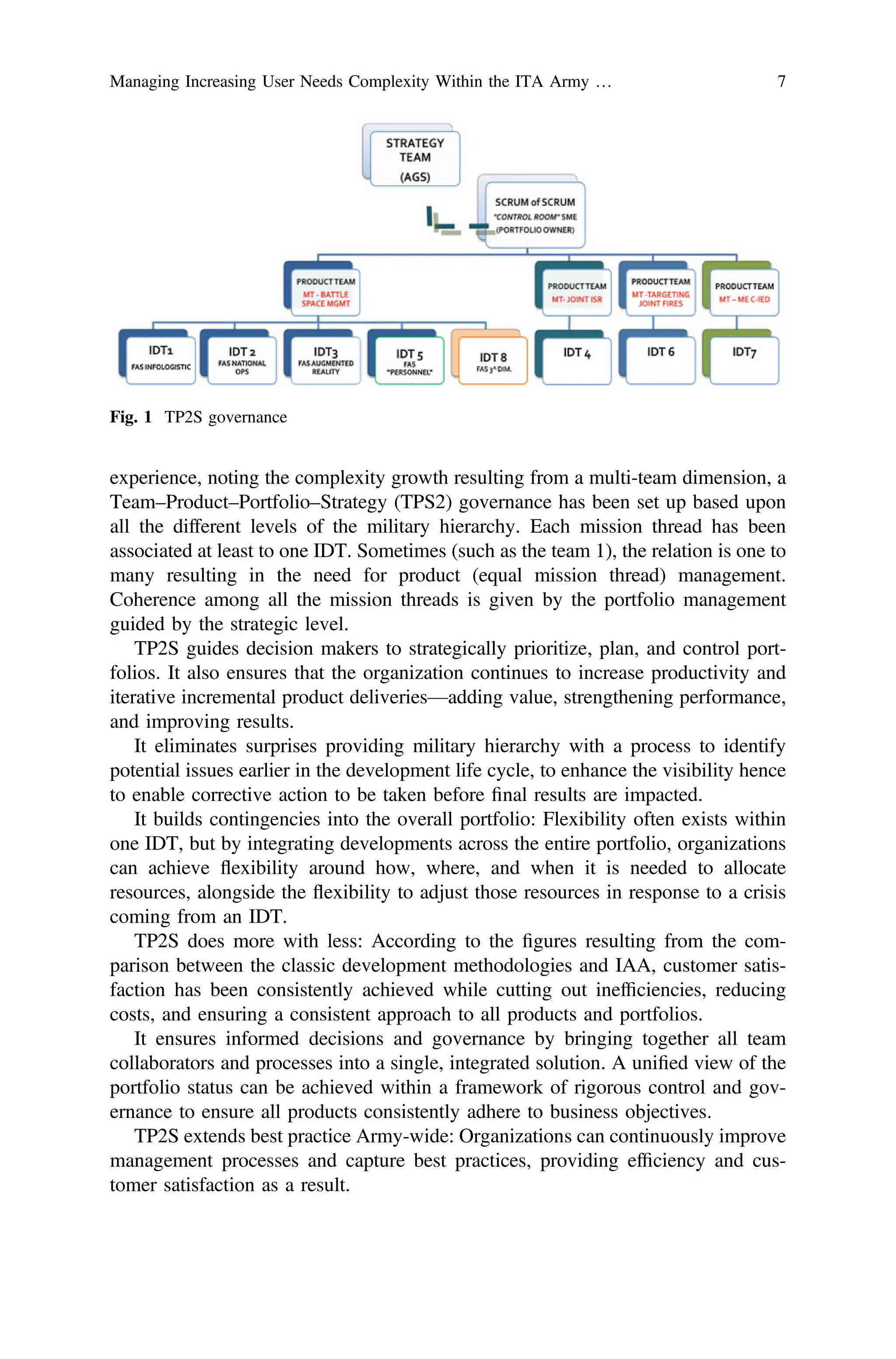
munity, within several mission threads (Fig. 1). Starting from the just-one-team
6 F.R. Cotugno
experience, noting the complexity growth resulting from a multi-team dimension, a
Team–Product–Portfolio–Strategy (TPS2) governance has been set up based upon
all the different levels of the military hierarchy. Each mission thread has been
associated at least to one IDT. Sometimes (such as the team 1), the relation is one to
many resulting in the need for product (equal mission thread) management.
Coherence among all the mission threads is given by the portfolio management
guided by the strategic level.
TP2S guides decision makers to strategically prioritize, plan, and control port-
folios. It also ensures that the organization continues to increase productivity and
iterative incremental product deliveries—adding value, strengthening performance,
and improving results.
It eliminates surprises providing military hierarchy with a process to identify
potential issues earlier in the development life cycle, to enhance the visibility hence
to enable corrective action to be taken before final results are impacted.
It builds contingencies into the overall portfolio: Flexibility often exists within
one IDT, but by integrating developments across the entire portfolio, organizations
can achieve flexibility around how, where, and when it is needed to allocate
resources, alongside the flexibility to adjust those resources in response to a crisis
coming from an IDT.
TP2S does more with less: According to the figures resulting from the com-
parison between the classic development methodologies and IAA, customer satis-
faction has been consistently achieved while cutting out inefficiencies, reducing
costs, and ensuring a consistent approach to all products and portfolios.
It ensures informed decisions and governance by bringing together all team
collaborators and processes into a single, integrated solution. A unified view of the
portfolio status can be achieved within a framework of rigorous control and gov-
ernance to ensure all products consistently adhere to business objectives.
TP2S extends best practice Army-wide: Organizations can continuously improve
management processes and capture best practices, providing efficiency and cus-
tomer satisfaction as a result.
Fig. 1 TP2S governance
Managing Increasing User Needs Complexity Within the ITA Army … 7
Eventually, it forecasts future resource needs: By aligning the right resources to
the right team at the right time, organizations can ensure individual resources are
fully leveraged and requirements, in terms of user needs, are clearly understood.
4.1 Strategy Team
The Strategy Team (ST) is the senior Army Board with the responsibility for the
development of the user stories and oversight of the TP2S processes that will be
employed to exercise high-level control of the whole development process.
It will support POT (a member is part of the POT as well) in managing both the
product backlog and the Product/Portfolio Teams to deliver iterations of the product
to customers while also pursuing overall system coherence.
It will resolve issues arising from portfolio management and will identify IAA
process high-level shortfalls and initiate efforts to address them.
4.2 Portfolio Owner—Scrum of Scrum (POSoS)
Individual teams work together to deliver working software at each iteration while
coordinating with other teams within the program.
But, when several scrum teams work together on a large project, scrum of
scrums is the natural next step for scaling agile, also in IAA framework. Firstly, the
stand-up meeting component of scrum of scrums is a multi-team stand-up. This is
not a status meeting nor is it a meeting for scrum masters to talk about agile process.
It is a rather a short meeting to keep people from around the organization abreast of
important issues across the portfolio and it touches on different dimensions in
accordance with the technical expertise of the participants.
To get started, a member from each team has to be selected as a representative at
the scrum of scrums in the foreseen format, ideally someone in a technical role. The
scrum of scrums is a democratic meeting. A scrum master can help facilitate the
stand-up, but unlike in single team’s stand-ups, the aim here is to facilitate problem
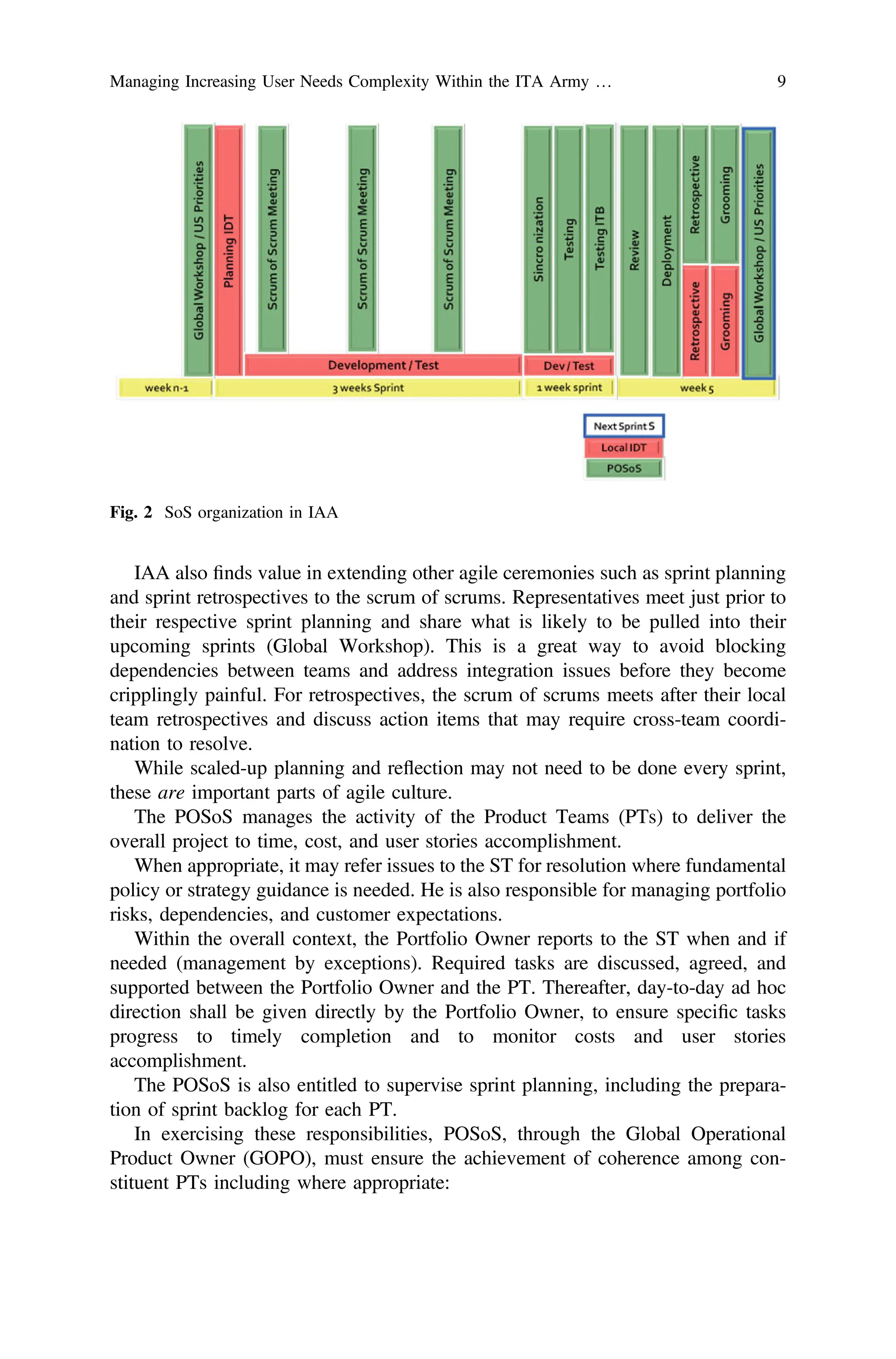
solving. As depicted in Fig. 2, the meeting will be held weekly, but alternatives are
being arranged to enable the meeting to be held daily.
Nevertheless, whenever regardless of its cadence, this meeting is intended to
open doors for knowledge sharing and to bring to the surface important integration
issues as well as to serve as a forum for technical stakeholders to be made aware
early and engage.
So far it has been chosen to have the scrum of scrums only once per week but
run the meeting a bit longer than 15 min. The focus remains onto bringing issues
affecting the group to the surface and determine what actions (if any) need to be
taken and by whom [9, 14].
8 F.R. Cotugno
IAA also finds value in extending other agile ceremonies such as sprint planning
and sprint retrospectives to the scrum of scrums. Representatives meet just prior to
their respective sprint planning and share what is likely to be pulled into their
upcoming sprints (Global Workshop). This is a great way to avoid blocking
dependencies between teams and address integration issues before they become
cripplingly painful. For retrospectives, the scrum of scrums meets after their local
team retrospectives and discuss action items that may require cross-team coordi-
nation to resolve.
While scaled-up planning and reflection may not need to be done every sprint,
these are important parts of agile culture.
The POSoS manages the activity of the Product Teams (PTs) to deliver the
overall project to time, cost, and user stories accomplishment.
When appropriate, it may refer issues to the ST for resolution where fundamental
policy or strategy guidance is needed. He is also responsible for managing portfolio
risks, dependencies, and customer expectations.
Within the overall context, the Portfolio Owner reports to the ST when and if
needed (management by exceptions). Required tasks are discussed, agreed, and
supported between the Portfolio Owner and the PT. Thereafter, day-to-day ad hoc
direction shall be given directly by the Portfolio Owner, to ensure specific tasks
progress to timely completion and to monitor costs and user stories
accomplishment.
The POSoS is also entitled to supervise sprint planning, including the prepara-
tion of sprint backlog for each PT.
In exercising these responsibilities, POSoS, through the Global Operational
Product Owner (GOPO), must ensure the achievement of coherence among con-
stituent PTs including where appropriate:
Fig. 2 SoS organization in IAA
Managing Increasing User Needs Complexity Within the ITA Army … 9
– Management and coordination of user stories capture;
– Everyday activities, including support to architecture development and design
with a reverse engineering process; and
– Management oversight of test and synchronization of system increments,
including the establishment of suitable facilities where testing “on the military
field.”
4.3 Product Team (PT)
A PT is defined as a temporary organization that is created for the purpose of
developing SW related to one single Mission Thread. More development teams can
be incorporated into a single PT. If the team developing one single mission thread is
unique, then the PT can be consolidated with the DT.
It ensures that everyone involved knows the expectations and contributes in
keeping cost, time, and risk under control.
Successful teams have active management of risks, issues, and timely decision
making.
The prime responsibility of the PT is to ensure that the project produces the
product as depicted by the related user stories, to the required standard of quality
and within the specified constraints of time and cost.
5 Conclusions
In this paper, an overview of the methodology for addressing the new Italian Army
C2 system development process and the related governance process has been
provided. The depicted analysis has started less than one year ago, but it has
provided the Italian Army with a product that has met users’ needs and expecta-
tions. Cost has also been significantly reduced. Although clearly a lot of work
remains to be done, the inception of the initiative has produced significant results.
References
1. Cotugno FR, Messina A (2014) Adapting SCRUM to the Italian army: methods and (open)
tools. OSS 2014, the 10th international conference on open source systems, Springer, Berlin
2. Sillitti A, Ceschi M, Russo B, Succi G (2005) Managing uncertainty in requirements: a survey
in plan-based and agile companies, 11th IEEE international software metrics symposium
(METRICS 2005), Como, Italy, 19–22 September
3. Schwaber K (2004) Agile project management with scrum, Microsoft Press, USA
4. Ruggiero M (2014) Coalition information sharing and C2 & enterprise systems evolution @
Italian army, briefing given at the NATO ACT strategic command, Norfolk, 10 December 2014
10 F.R. Cotugno
5. Origin A (2004) Method for Qualification and Selection of Open Source Software (QSOS),
http://www.qsos.org
6. Wasserman A, Pal M, Chan C (2005) Business readiness rating project. BRR whitepaper.
http://www.openbrr.org/wiki/images/d/da/BRR_whitepaper_2005RFC1.pdf
7. Jermakovics A, Sillitti A, Succi G (2013) Exploring collaboration networks in open-source
projects. 9th international conference on open source systems (OSS 2013), Koper, Slovenia,
25–28 June
8. Messina A (2014) Adopting Agile methodology in mission critical software production. Point
paper. http://ec.europa.eu/informationsociety/newsroom/cf/dae/document.cfm?
9. Sutherland J (2001) Agile can scale: inventing and reinventing SCRUM in five companies.
CUTTER IT J 12(14)
10. Cotugno FR, Messina A (2014) Implementing SCRUM in the army general staff environment,
SEDA 2014, the 3rd international conference in software engineering for defence applications
11. U.S. DOD (2008) Interoperability and Supportability of Information Technology and National
Security Systems (CJCSI 6212.01E)
12. Sillitti A, Succi G (2005) Requirements engineering for agile methods. In: Aurum A,
Wohlin C (eds) Engineering and managing software requirements, Springer
13. Ziv H, Richardson D (1997) The uncertainty principle in software engineering, 19th
international conference on SW engineering, IEEE
14. https://www.atlassian.com/agile/ways-to-scale-agile, 07/04/2015 18:00
15. Humphrey WS (1996) Introduction to the personal software process, Addison Wesley, Boston
16. http://en.wikipedia.org/wiki/Project_portfolio_management
Managing Increasing User Needs Complexity Within the ITA Army … 11
How Agile Development Can Transform
Defense IT Acquisition
Su J. Chang, Angelo Messina and Peter Modigliani
Abstract Traditional defense acquisition frameworks are often too large, complex,
and slow to acquire information technology (IT) capabilities effectively. Defense
acquisition organizations for years have been concerned about the lengthy IT
development timelines and given the pace of change in operations and technology,
it is critical to look for new strategies to acquire IT for defense systems. Over the
last decade, agile software development emerged as a leading model across industry
with growing adoption and success. Agile is centered on small development Teams
delivering small, frequent releases of capabilities, with active user involvement.
From a planning and execution viewpoint, agile emphasizes an iterative approach
with each iteration informing the next. The focus is less on extensive upfront
planning for entire programs and more on responsiveness to internal and external
changes, such as operations, technology, and budgets. Based on US and Italian
experiences, this paper discusses some of the common challenges in implementing
agile practices and recommended solutions to overcome these barriers.
Angelo Messina: Deputy Chief Italian Army General Staff Logistic Department and DSSEA
Secretary.
S.J. Chang (&)  A. Messina  P. Modigliani
The MITRE Corporation, Virginia, USA
e-mail: sjchang@mitre.org
A. Messina
e-mail: angelo.messina@esercito.difesa.it
P. Modigliani
e-mail: pmodigliani@mitre.org
© Springer International Publishing Switzerland 2016
P. Ciancarini et al. (eds.), Proceedings of 4th International Conference
in Software Engineering for Defence Applications, Advances in Intelligent
Systems and Computing 422, DOI 10.1007/978-3-319-27896-4_2
13
1 Introduction
Agile software development practices integrate planning, design, development, and
testing into an iterative lifecycle to deliver software at frequent intervals.
Structuring programs and processes around small, frequent agile releases enable
responsiveness to changes in operations, technologies, and budgets. These frequent
iterations effectively measure progress, reduce technical and programmatic risk, and
respond to feedback and changes more quickly than traditional waterfall methods.
While the commercial sector has broadly adopted agile development to rapidly
and dynamically deliver software capability, agile has just begun to take root across
many defense organizations.1,2
Agile development can be distilled into four core elements:
• Focusing on small, frequent capability releases;
• Valuing working software over comprehensive documentation;
• Responding rapidly to changes in operations, technology, and budgets; and
• Active users involved throughout the development process to ensure high
operational value.
The foundation of agile is a culture of small, dynamic, empowered Teams
actively collaborating with stakeholders throughout product development. Agile
development requires Team members to follow disciplined processes that require
training, guidance, and openness to change.3
While agile does impose some rigor,
the method does not consist of simply following a set of prescribed processes, but
instead allows dynamic, tailored, and rapidly evolving approaches that suit each
organization’s IT environment.
The first section of this paper will discuss the Italian Army (ITA) experience
with agile implementation and how they have managed the hurdles related to
process and culture. The second section of the paper will discuss agile in the US
DoD acquisition environment, the prerequisites for agile adoption in the USA, and
the barriers as it relates to program structure, requirements, and contracting. Lastly,
the paper will summarize with a comparison of both the ITA and DoD experiences
with agile adoption.
2 Agile in the Italian Army Environment
The lessons identified and learned for the last ten years of military operations in the
area of the Command and Control software have clearly shown the limits of the
software engineering traditional approach. The rapidly changing scenario of every
1
Lapham et al. [10].
2
Northern et al. [15].
3
US Government Accountability Office [8].
14 S.J. Chang et al.
operation has pointed out how difficult it is to define a stable and consolidated user
requirement for the C4I software applications. The ITA General Staff call it as
“volatility of the user requirement.” On the other end, the software products to be
used in the military applications are traditionally developed in strict adherence to
software quality standards to limit the risk produced by errors, faults, and
malfunctions.
At the ITA General Staff, it was decided to try to overcome the problem of the
requirement volatility by substituting the physical document with a
“Functional-technological Demonstrator” a software prototype to be used by the
military user to describe his needs in practical terms by interacting with the proto-
type. The “agile” methods seemed to be best candidates to this particular kind of
production. The SCRUM declination of agile was the selected approach because of
the short and fixed length of the “Sprint” production cycles and the clear definition of
the roles.
When the ITA Team was at the point of starting this new approach for the first
time, there was a wide spread awareness in the military community of the risks
connected to the agile methods: Scrum, XP, Kanban, etc. Nonetheless, the need for
a paramount change was such to be willing to take the risk. This is the first step
every organization must face: taking the risk but managing it deliberately and
aggressively.
At the time the first Team was started, agile scrum had been around as long as
almost 10 years and though there were many success stories, there are as many that
can also be characterized as a failure. As a matter of fact, when the first Team
finished the first Sprint and there was a “real” delivery, it was quite a surprise. The
people in charge of the effort where quite ready to watch a couple of “warm up
pseudo-sprints” but to their surprise, all worked pretty well since the very
beginning.
In the initial period, a technical investigation or a comparative analysis with
other similar efforts was out of the scope of the initiative. Later on, the need to come
to a thorough understanding of why this Scrum-derived method worked so well in
the Army Logistic environment became a real need. After the first release of the
software realized with this new approach in a seven-month period, the need to
understand the reasons of such a good performance was no longer a methodology
issue or a software engineering curiosity but a real necessary step in the process of
consolidating a production procedure.
After a year in the process, the ITA has seven agile Teams in place and working.
The full “Scrum of Scrum” complex production line is active and synchronized.
The Teams turned on progressively taking charge of the full architecture of an
overarching strategic Command and Control tool that implements full spectrum of
the decision support activity, stretching from the facilities management to the
operational Field Application Services (FAS).
The project was named LC2EVO and is now working on a 5-week “Sprints”
delivery cycle.
How Agile Development Can Transform Defense IT Acquisition 15
3 Italian Army Culture and Processes
Effective agile adoption requires a new culture and set of processes that may be
radically different from those in many defense organizations today. Agile practices,
processes, and culture often run counter to those in the long-established defense
organizations. The agile model represents a change in the way the government
conducts business, and programs must rethink how they are staffed, organized, and
managed, as well as whether the business processes, governance reviews, funding
models, that support an acquisition are structured to support agile. The following
eight reasons are why early adopters in ITA Army defense organizations are
succeeding.
1. Trust in people. The empowerment of the Team should be deeply enforced
from the beginning. In the case of the ITA, it was not easy nor simple, but the
first step in shaping the agile effort was to value individual skills and com-
mitments. A scrum tool was used for this purpose: the use of a scrum dashboard
with “post-its” and all the relevant connected “ritual” processes was used by the
ITA. The scrum “Champion” and his co-workers took full responsibility for the
result of the effort but implemented a zero-tolerance acceptance of all the scrum
elements the Team accepted to implement. In particular, some psychological
side effects were actively pursued. In the case of the scrum dashboard for
example, the electronic equivalent of the “post-it” user story was implemented
in parallel to ensure traceability and documentation, but it never substituted the
physical act of drawing the “post-it” with the programmer name and sticking it
on the “to do” area of the dashboard. The value of this simple (public) ritual has
deep implications to gain personal commitment.
2. People do their best if given enough freedom. An integrated development
Team with subject-matter experts (SMEs) working together with both con-
tractor’s and government analysts and programmers is the optimal Team mix.
The pressure generated by the direct relationship with the product owner (PO) is
useful to inspire strong work commitments and create positive tension. The
SMEs benefit from actually witnessing “their” functionality take shape and
become working software; and the programmers take pride in their ability to
translate user requirements into software functionality. When the right level of
performance or quality is not being achieved, there is shared accountability for
the success or failure of the results that force the Team to work together on
common solutions.
3. No project management on top of Scrum Teams. According to the ITA agile
methodology, putting program management on top of a “Scrum Team” is a
conceptual mistake. Sprints are timeboxed and the only date available for public
release is the end of the Sprint. Any question such as “are you able to finish by
xx xx?” has to be rephrased as “How many stories are you able to finish within
the time box of the next Sprint?” This is probably the toughest issue to solve
with any legacy organization. Flowcharts, pert charts, and time-marked pro-
grams are incompatible with this vision of agile scrum.
16 S.J. Chang et al.
4. Scrum does not improve software quality, capable people do. Having
low-skilled personnel on the Team is not acceptable. For some professionals
(security, data architecture, software architecture, and few others) top-level
expertise is required. Sometimes, teamwork and a good Scrum Master can work
out situations where there is a lack of specific expertise. In such cases, “technical
gap filling training” stories have to be added to the product backlog and their
priority level has to be acknowledged by the product owner/stake holder.
5. An agile Team continuously improves. That is why Scrum has retrospectives
to see what went well, what can be improved, and to define actions. People have
a natural tendency to seek improvement. In the ITA agile “scrum” environment,
improvement is almost automatic: It comes out by the continuous confrontation
process in the Team. Each Team member learns from the others especially from
the non-programmers.
Resistance to change is one of the major issues to overcome when implementing
any agile production Team. Resistance to the new way is almost as natural as the
tendency to seek continuous improvement. In the LC2EVO implementation, not
much of this problem was found among the analysts and programmers, but it
could have been an issue among the management. As stated before, no traditional
program management of any kind was allowed in the ITA Army agile effort.
6. The product owner role. The PO is never alone. A product ownership board is
recommended that it includes stake holder representatives with decision capa-
bility. A PO has to continuously work with the Team to ensure the “nominal”
scrum functions are met and give the Team a precise point of reference. On the
other end, in the ITA vision, a PO has to keep close contact with the stake holder
to refine the user vision of the evolving “requirements” and make sure the stake
holder’s expectations are met. The adoption of a PO board ensures a continuous
link with both sides of the community: the stake holders and the Team. Being
part of the Team (at least with one member), the PO board is fully aware of the
level of quality of the developed software. In the domain of “mission-critical”
applications, the quality and then the security and reliability of the product are
specified by the definition of high priority user stories (written by the relevant
experts on the Team) and the implementation of such stories cannot be different.
It is true that the stake holder side of the PO board will try to go back to the old
way “Just deliver those features as fast as possible” and will try to transform the
Sprint delivery date in a deadline but this can be avoided with the continuous
watch by the POs and Scrum Master on the correctness of the approach.
7. Product quality. A controlled environment where the use of coding standards
was the rule was implemented by the ITA Army. To avoid “cowboy coding,”
the ITA Army agile environment includes a layer of software tools which give
in real time the quality level of the produced code. This environment is, first of
all, a support to the programmers to understand how well they are performing.
In the event the level of quality decreases, they have the possibility to insert
“knowledge acquisition” stories in the product backlog to fill “technical or
cultural” gaps.
How Agile Development Can Transform Defense IT Acquisition 17
8. Tailored organization. As stated before, no project management on the
stakeholder side is accepted as the “fee” to pay in exchange of the possibility of
modifying the product backlog after any of the Sprints. Any negotiation is
carried on in terms of features (user stories to be deleted, inserted or changed in
priority) to be delivered in the next Sprint(s).
The matter of the contractual implementation of the agile framework is far from
being solved and many groups are working on this issue. In the ITA Army agile
effort [3] to produce LC2EVO, a relevant decrease in the total cost of the produced
software was experienced. Detailed investigation on the technical details of this
decrease is still ongoing, but at first glance, it is reasonable to say that the main cost
reduction drivers were the following:
• Only the required documents were elaborated, no one was tasked to write
useless pieces of paper that nobody was going to read just because of a standard.
• The focus by the Team on the most desired features ends up in a “natural” code
density in the areas most valued by the customer producing some kind of
multiplying factor (still under investigation).
• User stories with no business value are quickly dropped out and canceled from
the product backlog. In this area, the quick delivery feature of the agile methods
helps to stimulate the customer focus on what he really wants which may not be
so clear at the beginning of the project.
4 Agile in the DoD Environment
Despite the success that agile development has achieved in the private sector,
commercial implementation of agile does not directly translate to agile adoption in
the DoD environment. The barriers to program structure, requirements, contracting,
and culture and processes often stem from these key differences. First, the gov-
ernment must adhere to a set of rigorous policies, statutes, and regulations that do
not apply to the same degree to the commercial sector.4
Following the rules that
govern federal acquisition often involves a bureaucratic, laborious, and slow pro-
cess that greatly influences how effectively DoD can implement agile. Second, the
commercial sector has a different stakeholder management process than the gov-
ernment. Private firms are accountable to an internal and layered management
structure that usually goes no higher than a corporate board of directors; the few
possible external stakeholders (e.g., labor unions) rarely cause frequent and major
disruptions.
The government bureaucracy has layers upon layers of stakeholders with a high
degree of influence that can create frequent and significant disruptions. Everything
from a change in the political administration to budget sequestration can exert
4
Lapham et al. [11].
18 S.J. Chang et al.
significant external influence on a DoD program. Lastly, the bureaucratic layers of
government make it difficult to empower agile Teams to the same extent as in the
private sector. The commercial sector has considerable latitude to make adjustments
throughout the course of the development because companies closely link
accountability, authority, and responsibilities to push decision making to the lowest
levels. The government’s tiered management chain of command makes it difficult
for the agile Team to make decisions quickly and unilaterally.
The above comparisons demonstrate the need for DoD to tailor agile processes
to its unique set of policies and laws. Herein lies the fundamental issue with agile
adoption in DoD. The practices, processes, and culture that have made agile
development successful in the commercial sector often run counter to the current
practices, processes, and culture in the long-established defense acquisition enter-
prise.5
In many ways, the acquisition environment needed to execute agile devel-
opment is the opposite of the acquisition environment in place today.
• The small, frequent capability releases that characterize the agile development
approach directly contrast with the traditional DoD acquisition model designed
for a single big-bang waterfall approach.6
Currently, every step in the acquisi-
tion system must be extensively documented and approved prior to execution.
For example, according to DoD policies, an IT acquisition program must meet
34 statutory and regulatory documentation requirements prior to beginning
development,7
whereas agile emphasizes working software over comprehensive
documentation.8
• Agile also enables rapid response to changes in operations, technology, and
budgets. By contrast, DoD requires budgets, requirements, and acquisitions to
be planned up front, often several years in advance of execution, and changing
requirements, budgets, and strategies during the execution process is disruptive,
time-consuming, and costly.9
• Lastly, agile values active involvement of users throughout the development
process to ensure high operational value and continuously re-prioritizes the
ongoing requirement process on the basis of feedback from the user community
on deployed capabilities. Today’s DoD requirement process is static, and rigid
and limits active user involvement and feedback during the development
process.10
5
Broadus (January–Feburary [2]).
6
Ibid.
7
Defense Acquisition University (DAU) [4].
8
Lapham, DoD agile Adoption, [9].
9
Modigliani and Chang (March [14]).
10
Lapham et al. [10].
How Agile Development Can Transform Defense IT Acquisition 19
Given the above key differences, DoD has been ill prepared to adopt agile
development practices and in fact agile implementations so far have not always
succeeded. Some early DoD adopters attempted what they thought or promoted as
“agile,” yet they did not incorporate some of the foundational agile elements into
their structures or strategies. This resulted partly from the lack of definition and
standardized processes for agile in the federal sector. In some cases, programs
implemented a few agile principles, such as breaking large requirements into
smaller increments, but did not integrate users during the development process to
provide insight or feedback. Other programs structured capability releases in a
timeboxed manner,11
yet did not understand what to do when releases could not be
completed in time.
Adopting only a handful of agile practices without a broader agile strategy often
fails to achieve desired results.12
For example, one DoD early adopter initially
attempted to implement agile practices by breaking large requirements into several
4-week Sprint cycles. However, the program lacked high-level agreement on what
to develop in each cycle and did not have a robust requirements identification and
planning process in place. Furthermore, the program lacked an organized user
community and active user-participation throughout the development process—a
fundamental agile tenet. As a result, the agile processes quickly degenerated and the
program only delivered 10 % of its objective capability after two years of failed
agile development attempts. The program finally retreated to a waterfall-based
process. It simply could not execute the agile strategy without the proper envi-
ronment, foundation, and processes in place. On the other hand, DoD has recorded
some significant successes with agile, such as the Global Combat Support System–
Joint (GCSS-J) program, which has routinely developed, tested, and fielded new
functionality and enhanced capabilities in six-month deployments.13
Another successful early agile adopter had their testing leaders report “after a
decade of waterfall developed releases, the first agile iteration is the most reliable,
with fewest defects, than any other release or iteration.” They attributed it to the
frequent feedback, number of releases, continuous builds, and engineering releases
with stable functionality. DoD programs are beginning to turn the corner to suc-
cessfully adopt agile practices. The programs that have had the most success were
ones with major capabilities already deployed and used agile practices for subse-
quent upgrades. The goal is to position IT programs to adopt agile from the start of
the acquisition life cycle.
11
A timebox is a fixed time period allocated to each planned activity. For example, within agile, a
Sprint is often timeboxed to a 4- to 6-week-time period or a release is timeboxed for a 4- to
6-month time frame.
12
US Government Accountability Office [8].
13
Defense Information Systems Agency [5].
20 S.J. Chang et al.
5 Prerequisites for Agile Adoption
As a starting point, defense organizations should adopt a common understanding of
agile and identify the underlying set of values that describe the purpose and
meaning of their agile practices. The authors propose the following guiding prin-
ciples for agile adoption:
1. Focus on small, frequent capability releases to users—Smaller releases are
easier to plan, present lower risks, and are more responsive to changes. Projects
should focus on delivering working software as the primary objective.
2. Embrace change—Projects must allow for changes to scope and requirements
based on operational priorities, user feedback, early developments, budgets,
technologies, etc. This requires flexible contracts, strong collaboration, and
rigorous processes. Projects should plan early and then adapt based on current
conditions.
3. Establish a partnership between the requirements, acquisition, and con-
tractor communities—Projects should foster active collaboration on opera-
tions, technologies, costs, designs, and solutions. This requires committed users
who contribute to development, tradeoff discussions, and regular demonstrations
of capabilities. One DoD program had the acquirers, contractors, and users all
participating in agile training. This provided a foundational education and a
forum to discuss the specific agile processes for their program.
4. Rely on small, empowered, high-performing Teams to achieve great results
—Organizing around each release with streamlined processes and decisions
enables faster deliveries that are more successful. A DoD program benefited
greatly with an integrated, high-performing Team by co-locating users,
acquirers, testers, requirements leads, and many developers.
5. Leverage a portfolio structure—Individual programs and releases can deliver
capabilities faster by using portfolio or enterprise strategies, processes, archi-
tectures, resources, and contracts.
These tenets align with the recommended set of principles in the Government
Accountability Office (GAO) report on “Effective Practices and Federal Challenges
in Applying agile Methods.”
6 Agile Requirements Process
The agile requirements process values flexibility and the ability to reprioritize
requirements as a continuous activity based on user inputs and lessons learned
during the development process. In contrast to current acquisition practices, the
agile methodology does not force programs to establish their full scope, require-
ments, and design at the start, but assumes that these will change over time.
How Agile Development Can Transform Defense IT Acquisition 21
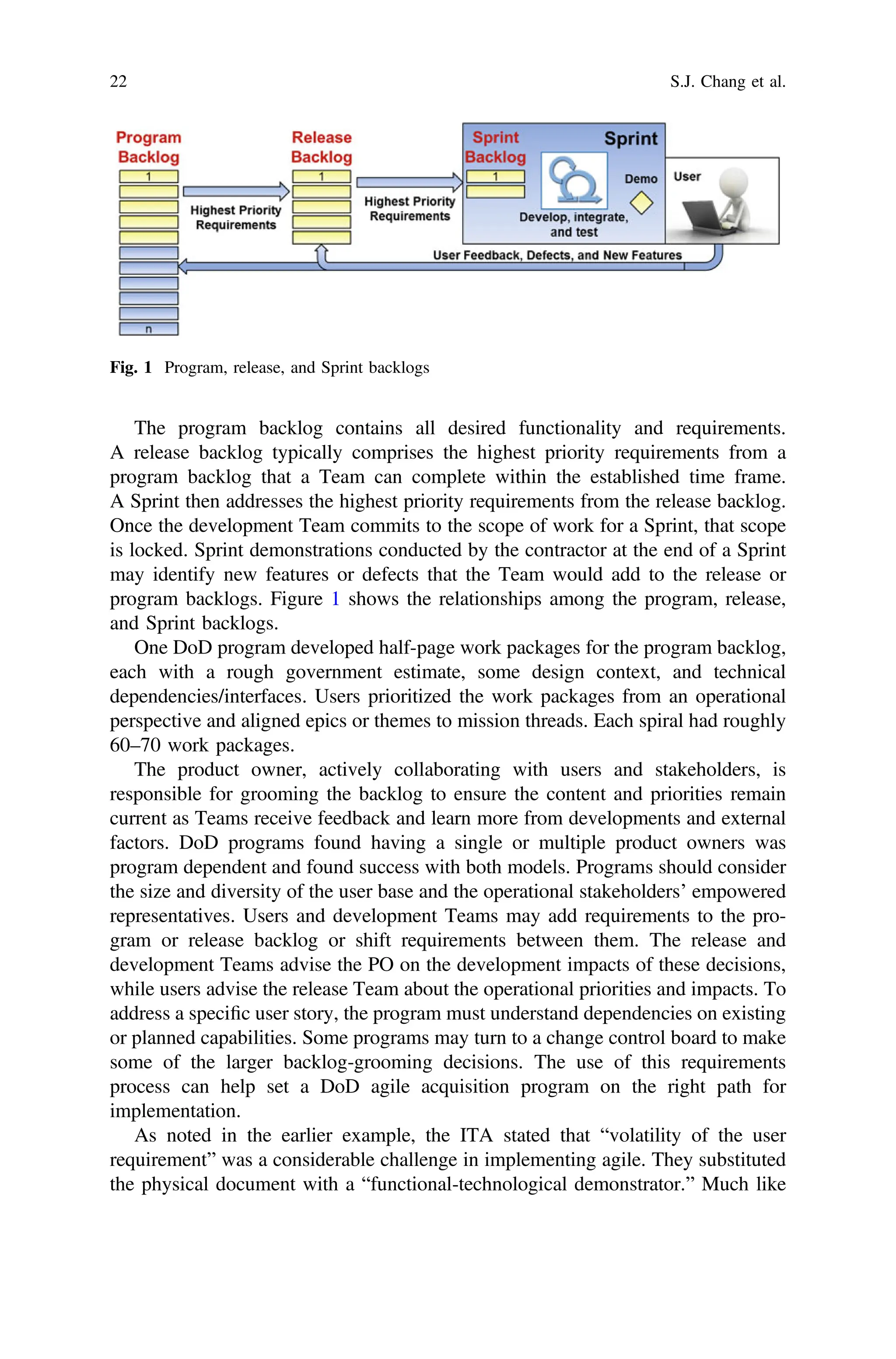
The program backlog contains all desired functionality and requirements.
A release backlog typically comprises the highest priority requirements from a
program backlog that a Team can complete within the established time frame.
A Sprint then addresses the highest priority requirements from the release backlog.
Once the development Team commits to the scope of work for a Sprint, that scope
is locked. Sprint demonstrations conducted by the contractor at the end of a Sprint
may identify new features or defects that the Team would add to the release or
program backlogs. Figure 1 shows the relationships among the program, release,
and Sprint backlogs.
One DoD program developed half-page work packages for the program backlog,
each with a rough government estimate, some design context, and technical
dependencies/interfaces. Users prioritized the work packages from an operational
perspective and aligned epics or themes to mission threads. Each spiral had roughly
60–70 work packages.
The product owner, actively collaborating with users and stakeholders, is
responsible for grooming the backlog to ensure the content and priorities remain
current as Teams receive feedback and learn more from developments and external
factors. DoD programs found having a single or multiple product owners was
program dependent and found success with both models. Programs should consider
the size and diversity of the user base and the operational stakeholders’ empowered
representatives. Users and development Teams may add requirements to the pro-
gram or release backlog or shift requirements between them. The release and
development Teams advise the PO on the development impacts of these decisions,
while users advise the release Team about the operational priorities and impacts. To
address a specific user story, the program must understand dependencies on existing
or planned capabilities. Some programs may turn to a change control board to make
some of the larger backlog-grooming decisions. The use of this requirements
process can help set a DoD agile acquisition program on the right path for
implementation.
As noted in the earlier example, the ITA stated that “volatility of the user
requirement” was a considerable challenge in implementing agile. They substituted
the physical document with a “functional-technological demonstrator.” Much like
Fig. 1 Program, release, and Sprint backlogs
22 S.J. Chang et al.
the Italians, several DoD programs have also adopted similar approaches, using
databases, Excel spreadsheets, or agile-based software tools to track changes to user
requirements. The agile manifesto emphasizes “working software over compre-
hensive documentation.” Plans should be developed by the Team, for the Team, to
provide some level of consistency and rigor, but the level of documentation should
not impede the Team’s ability to focus on capability delivery.14
The key is to do
“just enough” documentation that describes high-level requirements to satisfy the
institutionalized requirements processes, but using another type of requirements
tool and process to track the detailed user-level requirements that are subject to
frequent changes and reprioritizations.
7 Structuring and Tailoring for Agile
To effectively integrate agile principles into a rigid, bureaucratic defense environ-
ment one must proactively tailor program structures and acquisition processes.
Agile experts working closely with executives and process owners across each
functional area can collaboratively design an agile, new framework for acquiring IT
capabilities. The foundational element is the structure of the program’s releases and
redesigning the key acquisition processes to support the release time frames. While
many of DoD’s large IT systems are structured in five year increments, they have
historically taken over eight years to deliver IT capabilities. Programs should
structure releases to deliver capabilities in less than 18 months with a goal of 6–
12 months. The smaller scoped releases reduce risk and improve chances of suc-
cessful deliveries. Small, frequent releases enable the program to be responsive to
changes in operations, technologies, and budgets.
Many of DoD’s early agile adopters have designed releases 6–18 months long
further subdivided by Sprints. Those programs that had 18-month releases believe
an 8- to 12-month release structure would have been better suited to their envi-
ronment. During release planning prior to development, they finalize their
requirements and designs for the scope of the release. Monthly Sprints provided
working software that address the highest priority release requirements first and
deliver to the government. Some programs required interactive demonstrations with
users every two Sprints, while others required integration into a government testing
and demonstration environment at the release midpoint. Many reserved the final
Sprint to not have planned features, but instead finalize any incomplete features and
rework based on testing and feedback of the previous Sprints.
14
Modigliani and Chang (March [14]).
How Agile Development Can Transform Defense IT Acquisition 23
8 Contracting for Agile Development
Contracting for agile development has proven tremendously difficult for US and
Italian governments. While commercial firms often rely on in-house staff to execute
the agile practices, the government must obtain agile development through con-
tracted support. Long contracting timelines and costly change requests have become
major hurdles in executing agile developments and enabling small, frequent
releases. Contracting strategies for agile programs must be designed to support the
short development and delivery timelines that IT requires.15
Complex laws and regulations often drive long contracting timelines, defined
requirements upfront, rigid government contractor interaction, and contractor
selection based on the strength of technical proposal. These runs counter to agile’s
tenets of short delivery cycles, dynamic requirements, close Team coordination, and
using an expert Team with demonstrated success.
To overcome many of these challenges, programs should use a service contract
instead of a product contract. A service contract provides the program with greater
flexibility to modify requirements along the development process, because it
describes the people and time required to execute the development process rather
than locking-down the technical details of the end-product deliverable. However,
this strategy assumes the government is the lead systems integrator and is
responsible for overall product rollout and delivery. If the government expects the
contractor to act as the systems integrator, determine the release schedule, and be
accountable for overall product delivery, then a product-based contract in which the
government describes overall delivery outcomes and objectives is more practical.
However, this scenario would make it difficult for the government to execute a true
agile process, because changes to requirements in the course of development, or a
change to the delivery schedule, will require a contract negotiation that could affect
the agile process.
Lastly, the program should focus on the competition strategy to be used for the
initial award as well as for follow-on task orders and awards. This will help
determine how to scope the contract or task order for each contract action. In some
cases, the program would benefit from bundling a set of releases into a single
contract action to minimize the number of contract activities during the develop-
ment process. However, the program should balance this against the need to
maintain continuous competition throughout the program life cycle to keep rates
low and receive the best value for products and services.
One DoD program used many contractors, each having their own agile pro-
cesses, epics, stories, story point system, etc. This required the DoD to learn and
operate via multiple approaches and proved to be a challenge for requirements
traceability. This is a trade-off between competition and developer autonomy versus
government integration and management complexity.
15
See Footnote 14.
24 S.J. Chang et al.
9 Summary
ITA and DoD have experienced many similar challenges with agile adoption;
however, both governments have also witnessed the potential for great success
using this development methodology. Both encountered similar challenges with
introducing agile methods [16] because they are so different from long-held tra-
ditional development methods. The culture and processes are the biggest obstacles
to overcome, especially as it relates to a requirements community that is charac-
terized as dynamic and volatile. However, despite these challenges, both countries
were able to break from tradition and in many cases, fully embrace the agile
methodology to deliver working software in short capability drops.
The focus on iterative development and frequent capability deployments makes
agile an attractive option for many defense acquisition programs, especially
time-sensitive and mission-critical systems. However, agile differs so profoundly
from traditional development practices that defense organizations must overcome
significant challenges to foster greater agile adoption. Leaders cannot expect
individual programs to tailor current acquisition processes on their own, because the
complexities of the laws and policies do not lend themselves to obvious solutions,
let alone accommodate processes so fundamentally different from current defense
practices.
This paper has offered potential solutions to these key challenges in order to aid
programs in laying a foundation for successful agile implementation. As agile
adoption continues to take root and expand across programs, defense organizations
would benefit from additional guidance and training to ensure consistent and per-
vasive success in agile IT acquisition.
References
1. Balter BJ (Fall 2011). Towards a more agile government: the case for rebooting federal IT
procurement. Publ Contract Law J
2. Broadus W (January–Feburary 2013) The challenges of being agile in DoD. Defense ATL
Mag, 5–9
3. Cotugno F, Messina A (2014) Implementing SCRUM in the army general staff environment.
The 3rd international conference in software engineering for defence applications—SEDA,
Roma, Italy, 22–23 September 2014
4. Defense Acquisition University (DAU) (2015, March 20) Milestone document identification
(MDID). Retrieved from DAU: https://dap.dau.mil/mdid/Pages/Default.aspx?ms=2acat=
2acatsub=1source=Alltype=chart0
5. Defense Information Systems Agency (2015, March 20) GCSS-J. Retrieved from Defense
Information Systems Agency: http://www.disa.mil/Mission-Support/Command-and-Control/
GCSS-J/About
6. Defense Science Board (2009) Report of the defense science board task force on: department
of defense policies and procedures for the acquisition of information technology. Retrieved
from Office of the Under Secretary of Defense for Acquisition and Technology: www.acq.osd.
mil/dsb/reports/ADA498375.pdf
How Agile Development Can Transform Defense IT Acquisition 25
7. Duquette J, Bloom M (2008) Transitioning agile/rapid acquisition initiatives to the warfighter.
The MITRE Corporation, Virginia
8. U.S. Government Accountability Office (2012) Software development: effective practices and
federal challenges in applying agile methods (GAO-12-681), U.S. Government Accountability
Office, Washington, DC
9. Lapham MA (2012, January/February) DoD agile adoption. Retrieved from Cross Talk: http://
www.crosstalkonline.org/storage/issue-archives/2012/201201/201201-Lapham.pdf
10. Lapham MA., Williams R, Hammons C, Burton D, Schenker A (2010) Considerations for
using agile in DoD Acquisition. Software Engineering Institute, USA
11. Lapham M, Miller S, Adams L, Brown N, Hackemarck B, Hammons C, Schenker A et al.
(2011) Agile methods: selected DoD management and acquisition concerns. Software
Engineering Institute, USA
12. Messina A (2014) Adopting Agile methodology in mission critical software production.
Consultation on Cloud Computing and Software closing workshop, Bruxelles, 4 November
2014
13. Messina A, Cotugno F (2014) Adapting SCRUM to the Italian army: methods and (open)
tools. The 10th international conference on open source systems, San Jose, Costa Rica, 6–9
May 2014. ISBN 978-3-642-55127-7
14. Modigliani P, Chang S (March 2014) Defense agile acquisition guide. The MITRE
Corporation, Virginia
15. Northern C, Mayfield K, Benito R, Casagni M (2010) Handbook for implementing agile in
department of defense information technology acquisition. The MITRE Corporation, McLean,
VA
16. Office of the Secretary of Defense (2010, November) A new approach for delivering
information technology capabilities to the department of defense. Retrieved from Office of the
Deputy Chief Management Officer: http://dcmo.defense.gov/documents/OSD%2013744-10%
20-%20804%20Report%20to%20Congress%20.pdf
26 S.J. Chang et al.
AMINSEP-Agile Methodology
Implementation for a New Software
Engineering Paradigm Definition.
A Research Project Proposal
Vincenzo Mauro and Angelo Messina
Abstract The application of the “Agile” methodology to a Military Application
Software production line is not to be taken for granted. The adoption of the new
production style has implied the solution of multiple problems and the generation of
a custom version of the basic “Scrum” theory. One of the major changes has been
imposed by the need to include Military Test Beds and Military Units in the
workflow. Even if the “Agile Scrum” methodology has been around for over a
decade now, there are many successful implementation stories the Italian Army
experience and clearly show there is more conceptual work to be done. There are a
number of open issues to be tackled and a growth potential to be exploited.
AMINSEP tackles the area of monitoring and measuring using noninvasive tools
(Italian Army choice) necessary to keep high the product quality level and monitor
criticalities. Those tools need to evolve. The evolution has to take into account the
peculiar environment of the agile teams. The current tools are based on complexity
metrics borne for the old fashion software factories. The collected data do not give a
complete picture of the team-based code development cycle. A new set of metrics is
needed to complement the existing ones. The basic concept and the structure of the
research project are presented.
Vincenzo Mauro: Italian Secretariat General of Defence.
Angelo Messina: Italian Army General Staff.
V. Mauro ()
Italian Secretariat General of Defence, Rome, Italy
e-mail: vincenzo.mauro1@esercito.difesa.it
A. Messina
Logistic Department of Italian Army, Rome, Italy
e-mail: angelo.messina@esercito.difesa.it
© Springer International Publishing Switzerland 2016
P. Ciancarini et al. (eds.), Proceedings of 4th International Conference
in Software Engineering for Defence Applications, Advances in Intelligent
Systems and Computing 422, DOI 10.1007/978-3-319-27896-4_3
27
1 Introduction
The lessons identified and learned from the last ten years of military operations in
the area of the Command and Control software have clearly shown the limits of the
software engineering traditional approach. The rapidly changing scenario of every
operation has pointed out how difficult it is to define a stable and consolidated user
requirement for the C4I software applications. The Italian Army General Staff call
it: “Volatility of the user requirement.” On the other end, the software products to
be used in the military applications are traditionally developed in strict adherence to
software quality standards (i.e., mil 2167A, DOD 2167, ISO IEC 9126) to limit the
risk produced by errors, faults, and malfunctions.
At the Italian Army General Staff, it was decided to try to overcome the problem
of the requirement volatility by substituting the physical document with a
“Functional-technological Demonstrator,” a software prototype to be used by the
military user to describe his needs in practical terms by interacting with the pro-
totype. The “agile” methods seemed to be best candidates to this particular kind of
production. The SCRUM declination of agile was the choice because of the short
and fixed length of the “Sprint” production cycles and the clear definition of the
roles. After one year, the “ITA ARMY AGILE” method has been defined as
particular declination of agile, leveraging rules and rituals from Agile Scrum and
integrating tools and procedures peculiar of the Army environment. This method
seems to be particularly useful to implement production lines (teams) in the area of
high-reliability mission-critical software (Fig. 1).
2 The Research Area
The application of the “Agile Scrum” methodology in the Italian Army software
development experience has clearly shown a number of open issues to be analyzed.
In order to face the related problems and exploit opportunities, deep investigations
are needed in several research sectors.
Fig. 1 Traditional “Scrum” approach
28 V. Mauro and A. Messina
2.1 Collection and Management of “User Stories”
Natural Language is an easy tool for users but besides its embedded ambiguity is
too unstructured for developers to correctly figure out the correlated tasks. The need
for some discipline in the process of collecting the user stories must not create
prejudice for the human interaction that is the base of the effectiveness of the user
stories collection (non linear process).
According to the “theory,” the user stories must respond to the INVEST criterion
(Independent Negotiable Valuable Estimable Short Testable). Most of the above
attributes belong to the linguistic-semantic arena not to the SW engineering one.
Some research on this subject is needed to include a human sciences expertise point
of view on this part of the sprint planning. The use of some computational
linguistic-based tool could be considered in parallel.
Once the user stories are collected, some kind of (formal) CASE tool has to be used
as entry point to a SW engineering process. Using, for example, UML to “formalize” a
Product Back Log is an unwanted form of translation. In such a case, there is a risk of
loss meaning and effectiveness of the user stories. This is a topic for investigation.
2.2 Monitoring and Measuring
Noninvasive tools, preferred by the Italian Army, are necessary to keep high the
product quality level and monitor criticalities. But continuous improvement and
adaptation of those tools is necessary, taking into account the peculiar environment
of the agile teams. Current tools are based on complexity metrics borne for the old
fashion software factories: the collected data do not give a complete picture of the
code development cycle implemented by the agile team: new metrics are, therefore,
needed to complement the existing ones. Open question is: what is the right amount
of “control” for the agile environment? The needs are to monitor and assess without
disrupting the intrinsic nonlinear elements of the agile methodology, which are
matching the correspondent ones embedded in the software product nature, giving
much better results when compared to the linear, traditional, “waterfall” methods.
2.3 “Scrum” Adaptation
Although the Scrum methodology [1] is a framework flexible enough to adapt to
different projects and processes (and adaptation itself is one of three pillars of the
scrum theory), the peculiarity of the military environment requires some reflections
and modifications on aspects usually considered strictly unchangeable.
One of the most critical aspects on this perspective is the application of the rule
concerning the unicity of the Product Owner, defined as “the sole person respon-
sible for managing the Product Backlog.”
AMINSEP-Agile Methodology Implementation … 29
Product Owner is always accountable for expressing Product Backlog items,
ordering the items in the Product Backlog to best achieve goals and missions,
optimizing the value of the work of the development team, ensuring that the
Product Backlog is visible, transparent, and clear to all (Fig. 2).
We will see later that in our experience the Product Owner is represented by
multiple entities. This specification has a relevant impact on team composition and
may introduce a degree of complexity also on scrum artifacts.
2.4 New SW Engineering Paradigm
Mission-critical SW has to be developed in a software engineering environment that
ensure the quality of the product and enables all traditional features needed for the
product lifecycle management. Unfortunately, all the available tools and the
expertise themselves are legacy of the traditional methods and are not so effective in
a scrum environment. Just to give an example out of the Army Scrum experience:
software high-level design (architecture) in “agile,” being very simplistic, is a
parallel concurrent effort with the coding activity. Software architects, therefore,
need flexibility and vision to merge their effort with the analysts/programmers one.
Professionals familiar with the “traditional” approach are reluctant to accommodate
changes in the architectural design during the scrum production cycles and tend to
produce an exaggerated quantity of “nonfunctional requirements” to block the
product backlog. Professional skills in the area (SW architects) with necessary
flexibility are difficult to find.
3 Horizon 2020 Opportunities
Research activities in this area fully qualify for possible funding under the “Horizon
2020” European Union program (Fig. 3).
Fig. 2 Traditional “Scrum”
team composition
30 V. Mauro and A. Messina
Information and communication technologies (ICTs) underpin innovation and
competitiveness across private and public sectors and enable scientific progress in
all disciplines. Thus in Horizon 2020, ICT-related topics can be found in all pri-
orities, from “Excellence Science” to “Industrial Leadership” to “Societal
Challenges.” EU investments in ICTs are expected to increase by about 25 % under
Horizon 2020 compared to the previous framework program, FP7.
Developments in ICT provide major opportunities for Europe to develop the
next generation of open platforms on top of which a multiplicity of innovative
devices, systems and applications can be implemented.
The “Software  Services, Cloud” unit recently undertook an open web-based
public consultation on the research and innovation challenges for the Horizon 2020
Work Programme 2016–17 [2]. The challenges and research priorities identified in
software (including Open Source) covered all phases of the software development
cycle, starting with new approaches, languages and tools for requirements engi-
neering; agile/scrum development frameworks; software development methodolo-
gies and tools for highly distributed systems; higher-level, intention-driven
programming models; and approaches for the automation of interoperability and
compliance testing, risk identification, detection, and mitigation.
Even if the “Horizon 2020” program is not intended to support pure military
research projects, the “dual use” connotation of certain topics, such as software
development, opens realistic opportunities for military sector.
This research project, in particular, is valid not only in the defense and security
sector, but also in other areas where issues related to Command and Control
Fig. 3 Horizon 2020
framework programme
Table 1 Time schedule of the AMINSEP project (months dedicated to specific activities are gray
shaded)
AMINSEP-Agile Methodology Implementation … 31
software requirements and development have to be addresses in the framework of a
complex organization and/or in critical missions (Table 1).
4 Aminsep
A research project proposal called AMINSEP (Agile Methodology Implementation
for a New Software Engineering Paradigm definition) has been presented to the
Secretariat General of Defence and National Armament Directorate of the Italian
Ministry of Defence, with the purpose of obtaining a funding in the framework of
the “National Military Research Plan.”
The main proponent of the project is the Italian Army General Staff, that intend
to develop the program in cooperation with the “Center of Information Systems of
the Army,” Academic Departments and Research Institutions.
The application of the methodology “Agile” to a “software factory for military”
is not immediate and involved a series of adaptations of both procedures is of some
roles that after a few months set up a variant “EI Custom” of the SCRUM
methodology. The need for adaptation resulted mainly from the complexity of the
structure that defines the end user, and therefore the Product Owner that in the case
of systems C2 is represented by multiple entities: Army General Staff, Command
for Education and Doctrine, and Military Units. The strength of the Scrum process
E.I. is the opportunity to test the products (in an almost continuous cycle) on test
bed already available (e.g., that of the “Center of Information Systems of the
Army”) and by Military Units, taking advantage of already planned exercises.
These characteristics of Scrum E.I. configure specific methodology and determine
the need to generate a conceptual framework for autonomous reference, enabling
the formal definition of the model and the evolution of the production cycle. It is
therefore necessary to compare the ideas and techniques born within Scrum E.I.
with the current practice of software engineering. The approach was presented at
the “Open Source Software Conference (OSS)” in Costa Rica on May 7, 2014 [3]
and gained consensus on the reasons behind the choices made by the Italian Army,
providing a positive feedback the validity of the methodology adopted, with the
necessary variations, only able to handle the “volatile” requirement, also aimed at
reducing costs, as well as user satisfaction and time compression.
It is now proposed to start a research on technologies which enables to determine
SW tools, metrics, and everything else needed to consolidate a new concept
(paradigm) of software engineering that allows a further reduction of the cost of the
life cycle of the software and full coverage of the military needs of the user.
The project will be carried out in three phases:
I phase. Evaluation of tools and metrics used in a previous experience of the
development team (software LC2-Evo Infra), fine-tuning of existing tools and
inclusion of additional tools for the improvement of parameters of production
(velocity, quality, defects, cost), with a goal of a minimum 20 % improvement.
32 V. Mauro and A. Messina
Definition of the new model of SW production line. Definition of a model of the
defectiveness of the SW.
II phase. Implementation of the new model of production line creating and/or
integrating the development environment with COTS possibly Open Source;
definition/consolidation agile procedures optimized for the new development
environment; definition of a procedure for team building.
III phase. Implementation of a real case study through the creation of a computer
procedure relating to a functional area of software support to the Command and
Control indicated by Army General Staff; Final preparation of the analysis and the
final demonstration.
5 Conclusions
Agile/scrum development methodologies can reduce development costs, increase
customer satisfaction and adapt to volatile requirements changes. However,
developing mission-critical and safety-critical systems with agile/scrum techniques
requires further study, as the existing tools and expertise for the development of
mission-critical and safety-critical software are not suited for agile development
methods. Mission-critical SW has to be developed in a software engineering
environment that guaranties the quality of the product and enables all traditional
features needed for the product lifecycle management.
All the available tools and the expertise themselves are legacy of the traditional
methods and are not so effective in a scrum environment [4].
Further work is therefore required on software monitoring and measuring sys-
tems and metrics as current tools are based on complexity metrics developed for
traditional software development processes and are not well suited to modern
agile/scrum frameworks.
The results of the AMINSEP research project will be applied and tested on a real
case study, by developing a Command and Control support software chosen by the
Army General Staff.
References
1. Schwaber K, Sutherland J (2013) The Scrum Guide. http://www.scrum.org. July 2013
2. Messina A (2014) Adopting Agile methodology in mission critical software production. In:
Consultation on cloud computing and software closing workshop, Bruxelles, 4 November 2014
3. Messina A, Cotugno F (2014) Adapting SCRUM to the Italian Army: Methods and (Open)
Tools. In: The 10th international conference on open source systems, San Jose, Costa Rica, 6–9
May 2014
4. Cotugno F, Messina A (2014) Implementing SCRUM in the Army General Staff Environment.
In: The 3rd international conference in software engineering for defence applications—SEDA,
Roma, Italy, 22–23 Sept 2014
AMINSEP-Agile Methodology Implementation … 33
Ita Army Agile Software Implementation
of the LC2EVO Army Infrastructure
Strategic Management Tool
Davide Dettori, Stefano Salomoni, Vittorio Sanzari, Dino Trenta
and Cristina Ventrelli
Abstract The Army General Staff has identified the need for a strategic man-
agement tool for the numerous and widespread infrastructures belonging to the
Italian Army. The generic requirement has called for various functions at different
levels of information aggregation and fusion. The first attempt at finding a solution
was based on the traditional software engineering approach which pointed out the
difficulty of producing a high-definition requirement document. A customized
“SCRUM Agile” software development methodology was then implemented pro-
ducing excellent results. The process is described with particular focus on the User
Community–Development Team relationship and the evolution of the associated
Product Backlog. Results on the software cost reduction and on user satisfaction are
reported. A detailed description of the User Stories evolution through the various
Sprints is presented as a case study.
1 Introduction
Today, the army military infrastructures represent a real estate synthesis of the
history of our Nation [1]. This is mainly due to an inheritance received at the end of
the “Risorgimento” period or to substantial interventions which took place with the
D. Dettori ()  S. Salomoni  V. Sanzari  D. Trenta  C. Ventrelli
Stato Maggiore Esercito Italiano—IV Reparto Logistico, Rome, Italy
e-mail: davide.dettori@esercito.difesa.it
S. Salomoni
e-mail: stefano.salomoni@esercito.difesa.it
V. Sanzari
e-mail: vittorio.sanzari@esercito.difesa.it
D. Trenta
e-mail: dino.trenta1@esercito.difesa.it
C. Ventrelli
e-mail: cristina.ventrelli@esercito.difesa.it
© Springer International Publishing Switzerland 2016
P. Ciancarini et al. (eds.), Proceedings of 4th International Conference
in Software Engineering for Defence Applications, Advances in Intelligent
Systems and Computing 422, DOI 10.1007/978-3-319-27896-4_4
35
imminence of the conflicts of the First and Second World Wars. It is often a
question of real estate property which was assigned to other uses and subsequently
adequated to satisfy exacting allocations (Fig. 1).
From a recent reconnaissance of the Army’s real estate, the patrimony is of about
3700 infrastructures with a total area estimated in 30,000 Ha.
Mainly because of political–financial reasons, the Army has been unable to face
in a global or organic whole the problem of military infrastructures. For this reason,
during recent years studies and sector projects have been elaborated which have
evidenced the impossibility or, at least, the difficulties which have arisen in the
endeavor to activate a specific national organization Plan.
Furthermore, the recent regulations in the alienation of the real estate of the
Defense [2] have induced the Army to proceed with the rationalization of the
available spaces of the non-strategic real estate, thus reducing management costs.
For this reason, a new Army infrastructure management Plan whose criterion
guide centers on the new Defense Model [3] must be founded on an innovative
Command and Control System [4, 5] which is able to face with unity and com-
pleteness the overall available information.
To finalize this Plan, an investigation has been carried out on the market for a
new Informatic System which will be able to overcome the limits of current
Defense data-base [6] to guarantee to the Army a innovatory software defined
enterprise with direct access and updating capability via Web access by all the
headquarters, departments, and organizations responsible for or concerned with
Army real estate.
Moreover, not having and adequate know-how of the specific needs, a
methodological and managerial approach of the military real estate was carried out
through the identification of a high-quality functional software, suitable for the
Army needs.
Fig. 1 Army real estate patrimony
36 D. Dettori et al.
The features searched were of a favorable product, not fully predictive, but rather
adaptive in order to find suitable solutions to the problems of everyday life.
In this context, it is appropriate, from the beginning, to approach also the
management of the real estate of the Army with a management development
methodology able to provide an Agile, dynamic, and flexible product, using
“System Integration  Infrastructure solutions” which have the following
requirements:
• Portal (consisting of Core Services and F.A.S.1
);
• Record;
• Identity and Access Manager;
• Infrastructure and Database;
• Virtualization and Cloud Computing;
• Storage and Backup Consolidation; and
• Security and compliance.
Consequently, a more modern and interactive development approach, defined
“Agile,” has been adopted within the Army (ITA ARMY AGILE [7]) and has been
named “LC2EVO” [8].
“LC2EVO” has thus been identified as the new support system of Land
Command and Control (LC2) based on fundamental services (core services) and on
the different Functional Application Services (F.A.S.) focused on the direct
administration of the various information sectors.
The first F.A.S. which was developed was a pilot project: It was the infras-
tructure F.A.S., named “Infra-FAS.”
The “Agile” methodology [4] applied to the F.A.S. has foreseen the establish-
ment of a miscellaneous team (Scrum Team) where specialists in software system
design and development (Development Team) were supported by a Working Group
(User Community) with an expert infrastructure management Officer and three
architect and engineer Officers specialized in the real estate/building sector.
In this way, an osmosis between computer science and engineering may maxi-
mize the final output, focusing on the improvement of Command and Control
management efficiency of the infrastructures of the Army.
In this specific case, through frequent exchanges of information and opinions
within the above-mentioned development team, it was decided to start structuring a
Infra-FAS, lasted for about 8 months, allowing in this way a continual check of the
required software architecture and adapt them to the various needs which originated
during the development and the gradual use.
In this article, a case study will be described through the different evolution
phases and the prospective view of the user community (as one the involved
stakeholders).
1
Functional Area Service.
Ita Army Agile Software Implementation of the LC2EVO … 37
Starting from the real needs, it has been a success model where the unavoidable
distorsious which exist between two universes, the digital and the real world, has
been reduced to a minimum. In this way, the project idea was, as proved, as near as
possible to the expectatious of the customers and the user (remaining community
stakeholders).
2 The Development of the Project Seen by the “User
Community”
At the start of “LC2EVO-Infra” project implementation, the complex typological,
qualitative, and dimensional characteristics were analyzed, secondly, synthesizing
the specific need in accordance with the following factors:
• profound knowledge of the application domain is to limit of the extrapolation
mistakes following validation at the moment of release;
• overall vision is to predetermine the possible interventions for the perfecting of
the project—for probing levels of the management complexity of the military
infrastructures (reality)—also through the knowledge of the software already
available in the Defense ambit;
• analysis of possible variables is to aim for a product which adopts itself to the
changing needs of the final customer.
In substance, the elaboration process of the specific FAS-INFRA User Stories
was carried out in 5 phases: definition, knowledge, comparison, projecting, and
perfecting. These phases were necessary in order to involve a wide community of
the consumers who were interested, in different ways, for the different competences
related to infrastructures (Fig. 2).
In particular:
(A) Definition
In this phase, the guidelines were defined shared by the Development Team
for the whole subsequent infrastructure management process, prefigurating the
ideal results (“what will this project do?,” “toward who?,” “with what aim?”).
The elaboration of the common strategic vision was defined through a broad
planning of the activities to perform (sprint planning meetings) to answer the
continual requests of the Team stakeholders “component,” with the aim to
illustrate the following:
• the general objectives to reach in the Sprint and the length of time needed
to achieve them;
• the hightest priority requirements contained in Product Backlog (Fig. 3).
38 D. Dettori et al.
Fig. 2 Preliminary activities for the preparation of the specific team Agile
Fig. 3 “Sprint Planning Meeting” example
Ita Army Agile Software Implementation of the LC2EVO … 39
(B) Knowledge
In this phase, the “Development Team” research and preliminary project
activities, cooperating with the consumers who, above all, were more com-
petent for each specific case (the cited infrastructural Working Group), to
obtain a comprehensive vision, even if not complete, of the needs of the final
users (at central level the Army General Staff for Command and Control
activities and at a peripheral level, the Unit/Organization consignee of the
specific property for the infrastructure).
The information obtained in this first phase was confronted:
• with the reality represented by the extrapolations (consequences) derived
from the pre-existent Army infrastructure management systems, following
the traditional methodology;
• with the application context to verify the suitability of the strategic vision.
During the knowledge phase, only the activities which were sufficient to give a
first-quality delivery were studied and limited to:
• the interview of the members of the Team specialized in infrastructures;
• the collection of the most elementary identification requirements of the
chosen properties (location, perimeters, registry, …);
• the capability to confront and converse with the existing management
software following the “classic method.”
This choice is justified because of the capability to compensate possible gaps,
during the completion phase, relative to the user and the context (Fig. 4).
(C) Comparison
Starting from the elements obtained during the first two phases, the
Development Team has elaborated a first vision of the product which only the
special consumer administrators (user community at central level) have been
able to experiment.
The critical comparison with the stakeholders on these solutions has
allowed a wide sharing of the project idea and of the product development in a
medium term.
At the end of this phase, the characteristics of the first version of the
product (models, behavior, conceptual interfaces) and the strategies for its
release have been planned (Fig. 5).
(D) Design
During the design phase of the infrastructure management FAS a preliminary
study was faced:
(a) of the graphical interface visual representation of every single significant
Army infrastructure on a cartographical base, and classified as strategic,
transferable, inactive) (Fig. 6);
40 D. Dettori et al.
(b) of the contents a selection of the essential descriptive and capacitive data
(Fig. 7);
(c) of the dialog with the already-operating Defense General Staff
Infrastructural Database (Fig. 8);
(d) of the insert mode of the selected infrastructures in the System and the
subsequent population of data;
(e) of System communication (Fig. 9).
A “simplified” and “elementary” product of elevated potential of quanti-
tative and qualitative evolution was obtained.
A minimum working high-technical-quality product was achieved which
will serve as a base for subsequent developments during the refinement phase.
Fig. 4 User story 451—capacitive technical data management—20150507_0752734
Ita Army Agile Software Implementation of the LC2EVO … 41
Random documents with unrelated
content Scribd suggests to you:
Q. It was morocco?
A. Yes; the scabbard was gilt plate, and a handle of silver—it was a
uniform, I presume, the only one like it on the ground. General
Brinton's blouse was a perfectly plain blouse without the herring
bone trimmings on it—it was not slashed. I don't think any of the
other general officers had a blouse like it; in fact, I know they had
not.
Q. You have testified in regard to leaving before the firing?
A. When I left, there was no indications of any firing or anything of
that kind at all. There had been no stones thrown or pistol shots
fired—nothing to indicate that there would be.
By Senator Yutzy:
Q. Why did you leave?
A. I left, as I testified before, from the fact that I had been informed
by some of the officers of my own division, that there was a feeling
existing among the portion of the troops of my own division that
were at Twenty-eighth street, that probably they couldn't be
depended upon. I thought it was better to have the other divisions
that had been placed under arms sent for at once, and walked down
the tracks and telegraphed to General Latta for that purpose.
Q. What office did you go to?
A. Pitcairn's office was over the telegraph office, at the corner of
Twenty-sixth and Liberty. It is two squares away from where the
difficulty occurred.
Q. Were you in the telegraph office or above?
A. In Pitcairn's office. There were waiters running from Pitcairn's
office down to the telegraph office, so that messages could be
received or sent in that manner. I was accompanied by Major Evans,
who went with me.
Q. Major Evans you say went back with you?
A. Major Evans accompanied me from Twenty-eighth street to
Pitcairn's office and was there when we first received the information
that the affair had taken place, and was with me all the time that
the difficulty was going on.
Q. Does he occupy any position in the division?
A. He is major and paymaster of the division, but was acting as a
personal aid that day.
Q. Where is he?
A. He is out at his mill, at Soho.
Q. Iron mill?
A. Yes; the firm of Evans, Dalzell  Co. I think the first man that
gave me any information of any firing was Mr. Cassatt—that is a
positive assurance that the firing had taken place. He had been up in
the cupola of one of the buildings and had observed all the
proceedings that had taken place at Twenty-eighth street. I think he
was the first that gave me any positive assurance that the troops
had fired. I know I had heard no firing, had not heard the explosion
of the pieces at all. I am very free to confess that I am very sorry
that I was not at Twenty-eighth street at the time of the difficulty,
because General Brinton, when no other officer would have had any
reason to have waited for an order very long, for most undoubtedly
and most assuredly had I been there, and the pistol shots had been
fired as has been testified, and stones thrown, as Captain Breck has
stated, and the troops treated in the manner in which they
undoubtedly were treated, I would have directed Brinton at once to
fire upon the rioters, and would have kept it up just long enough
that they wouldn't have come back to that locality again, at least a
good many of them. I didn't believe an order was given, at least,
from what Brinton has informed, but I thought it should have been
given.
Colonel Gray, re-called:
By Senator Reyburn:
Q. You have given your testimony, I believe, before, as to the
occurrences. All we want to ask is, did you see General Pearson on
the afternoon of the 21st of July?
A. I saw him at a distance. I was on the hill side, and saw him come
up with the troops. I was up in the morning, in the forepart of the
day, probably twice I saw him there, but I was not close to him. I
was not down to the railroad that day.
Q. How was he dressed in the morning that you saw him?
A. I saw him at the Union depot at night—Friday night—and then in
the morning, before he went out there. He was dressed in his
fatigue uniform, and it has been very accurately described by
himself, and I think everybody in the Sixth division knows it, and
everybody who has seen him, the peculiar coat—different from any
other fatigue uniform that is in existence now. I think he was
dressed in that uniform and fatigue cap. I saw him come up with the
Philadelphia troops, at a distance. I was on the hill side, and
recognized him very distinctly. I was anxious that he should be
there, and was satisfied that he was there.
At this point the committee adjourned to meet at Harrisburg, at the
call of the chairman.
Harrisburg, March 8, 1878.
The committee met, pursuant to notice, in Senate committee room,
No. 6, all members present except Mr. Larrabee.
Governor John F. Hartranft, being duly sworn, testified as follows:
By Mr. Lindsey:
Q. Governor, just state in your own way where you were in July last,
when the railroad strikes first broke out, and when you received the
first information, and what was done by yourself thereafter?
A. I contemplated making a trip to the west with my family, and, in
thinking the matter over before I started, I had a conversation with
the Adjutant General, in which I stated to him that I thought
everything was as calm in the State it ever was since our
administration, yet, if there was any trouble, he should exercise the
authority vested in the commander-in-chief, in accordance with the
same rules and principles that we had established when there was
trouble prior to my leaving the State—that is, when there was
trouble in a section of the State, we frequently had calls from the
sheriffs of the county, and after we became satisfied that the sheriff
had exhausted his authority, or was unwilling to exercise his full
authority, we generally sent troops. With these general instructions,
not anticipating for a moment that it meant anything, I left the State
on Monday, the 16th of July. On Wednesday morning, I saw by the
papers, at Chicago, where I was, that there was trouble on the
Baltimore and Ohio road. On the next day, Thursday, receiving the
papers on the train, I saw that the trouble was spreading. I
telegraphed to the State for information as to whether this had
spread upon the Baltimore and Ohio road into the State. The first
dispatch that I received was received at Antelope, on the Union
Pacific railroad, on Friday forenoon sometime. The dispatch was as
follows:
Mob stopped all freight trains at Pittsburgh. Sheriff called for troops.
Ordered Pearson to take charge, and put one regiment on duty. Says
he may need more.
Q. Who was that dispatch received from?
A. It was from General Latta.
Q. That was on Friday, the 20th of July?
A. That was on the 20th, in the forenoon. As soon as I reached
Cheyenne, I sent a dispatch to General Latta, at one-thirty, P.M.:
Order promptly all troops necessary to support the sheriffs in
protecting moving trains on Baltimore and Ohio railroad. Go to
Pittsburgh and keep supervision of all troops ordered out. Will be
due at Ogden to-morrow at six o'clock. In the meantime, en route,
let me know the situation.
I again sent a dispatch from Laramie City, same day, five-twenty,
P.M.:
Spare nothing to protect all persons in their rights under the
Constitution and laws of the State, in accordance with the policy
heretofore adopted. Am on the train to Ogden.
I received a dispatch from General Latta—I do not remember
whether before sending this last or after—to this effect:
Pittsburgh, Pa., July 20,1877.
No difficulty on Baltimore and Ohio railroad in Pennsylvania. Strike
extended to Pennsylvania railroad. Trains stopped at Pittsburgh by
rioters, numbering two or three thousand.
General Pearson has six hundred men under arms guarding
property. General Brinton will be here to-day, with twelve or fifteen
hundred men. Movement will be made immediately on his arrival to
open road, and we expect to do so without bloodshed.
I will be at Union hotel, Pittsburgh, until order is restored. Keep me
advised of your movements. If your presence is needed, I will
promptly wire you.
I received numerous dispatches after that from General Latta, Mr.
Scott, and others, and at Ogden I sent the following dispatch to
General Latta, Saturday evening, the 21st of July:
Dispatch received. Unless I hear from you to change my mind, I will
take the first train to Pittsburgh. There must be no illegal
interference with any person willing to work, and to this end act
promptly, that it may be done without bloodshed.
I then went to Salt Lake City with my family, the next train east not
being due at Ogden until ten o'clock Sunday morning. When I
arrived at Salt Lake City, I had another dispatch from Mr. Quay. This
I received at nine o'clock Saturday evening:
A collision has occurred here between the strikers and the troops.
Number of persons have been killed and wounded. Intense
excitement prevails in city, and there are indications of further
bloodshed, and that the trouble will be wide-spread and protracted.
I suggest that you return, allowing your party to go forward.
I then secured a special train, leaving there at twelve o'clock, and
got to Pittsburgh on Tuesday afternoon.
Q. Before you go any further, I would like to ask a question or two:
In your instructions to General Latta, before leaving the State, was it
your intention to delegate to General Latta your power as
commander-in-chief to call out the militia in case of an emergency?
A. Not my power, but simply discretion, under the general order, to
act in accordance with our custom in case there was any trouble in
my absence, and to issue orders by my authority, just the same as if
I were in the State.
Q. Signing your name?
A. No; his own, by order of the commander-in-chief, or what is the
same thing, as Adjutant General. I may say that I talked with the
Attorney General before I left the State, and he thought there was
no reason why I should not go.
Q. He was to follow strictly the regulations that had been adopted
heretofore?
A. Yes, sir.
Q. Under the act of 1864, what have been the regulations—I do not
quite understand you on that point—about calling out troops?
A. We have not fallen back upon the act of 1864, because the
sheriffs have always called. In fact, the sheriffs are generally very
prompt to call for troops. They often wanted our assistance when we
thought it was not necessary, and in every instance when troops
have been ordered out during my administration, they have been
ordered, as they were in this case, upon the call of the civil
authorities to aid them. We have always kept the troops, so far as
we could, subordinate to the civil authorities. In this instance, and
some other instances, perhaps the civil authorities were not quite as
active as they ought to have been, and they, to a certain extent,
disappeared, and then, of course, we came under the act of 1864.
But in the first instance we have never exercised our authority under
that act.
Q. You would consider that under that act you have authority to call
out the militia upon notice, or your own knowledge, that there is any
serious riot or outbreak in the State?
A. Yes. If there is a riot in any section of the State, and the civil
authorities are unable or unwilling to suppress it, I think it would be
my duty, as Executive, to order out the National Guard, and to take
charge of the situation to protect life and property. I would not
hesitate to do it, whenever I became satisfied of that fact.
Q. In your judgment, would that be in conflict—would such an action
be in conflict, in any way—with the Constitution, which says that the
military shall always be in subordination to the civil authorities?
A. Well, I do not pretend to give any legal opinion upon that point;
but, so far as the past has been concerned, we would have been
glad and willing to let the civil authorities take entire control, and it
is only when they were willing and anxious that we took part, and
there never has been a conflict.
Q. That has always been the rule adopted by you, as commander-in-
chief?
A. Yes, sir. I am not quite sure that that question may not arise. I
can see very easily how it might arise in the near future, in any
locality where the civil authorities might be in sympathy with the
lawless elements, but we hope that it may not.
Q. And is that a reason why you have adhered to the rules that you
have just mentioned?
Q. I do not know that it was because of any supposed conflict, but I
adhered to that because I thought it was the common-sense way of
doing it. That is about all.
Q. Then the first telegram, I understood you to say, received from
General Latta was in the forenoon of Friday, the 20th?
A. Yes, sir.
Q. Did you know on that day that General Latta had already ordered
out the militia?
A. Not except through him.
Q. Does that telegram state that?
A. Yes. He says, Ordered Pearson to take charge, and put one
regiment on duty.
Q. Do you know what time General Latta gave that order to General
Pearson to take charge?
A. No; I do not.
Q. I would like you now to state when the news first reached you of
any disturbance at Scranton, and through what channel, and your
action in relation to the outbreak at Scranton.
A. I do not know that I knew anything definitely about the trouble
there until the 25th. As I was passing through Harrisburg to
Philadelphia, on the 25th, I received a dispatch from the
Brotherhood of Firemen and Brakemen, and there was also one, I
think, from the officers of the road, which I do not see here just
now. The question that arose there was that the railroad company
were unable to run their trains, because the firemen and brakemen
had struck, and mob would not let them, and then the Brotherhood
of Firemen and Brakeman agreed that they might run the mails
through, and the company did not want to do that unless they could
take a passenger train. I telegraphed back to the superintendent of
the railroad, Would advise you to let mails run through. My object
in that was not to precipitate any further disturbance until I had
everything in hand. There was, I think, no running of trains for a
week or ten days after that. They were making an effort to run
trains about the 31st of July, but on the 1st of August there was a
disturbance in Scranton, and the mayor called upon me for troops.
The miners came out on a strike about the 25th. In consequence of
this general confusion in Luzerne county, no trains moved. I had
anticipated a movement to Luzerne county for the purpose of
starting trains, and had made my arrangements, but this riot at
Scranton precipitated the movement, and I got there on August 2d.
The riot occurred on the 1st, and I got the first news about two
o'clock, and my advance troops got to Scranton early next morning.
Q. What day did you say you received the call from the mayor for
troops?
A. On the 1st of August. The dispatch was:
Mob have partly taken possession of the town. I was assaulted, and
sent to my committee for assistance. Mob attempted to follow me
up, when three or more were killed. Come to my assistance.
R. H. McKune,
Mayor.
Very soon afterward, I received another dispatch: How soon can I
expect troops? Then I received half a dozen dispatches from private
parties. I sent a dispatch to McKune: Keep quiet. Will be with you in
the morning.
Q. Had you any communication with the mayor prior to the 1st day
of August?
A. Yes; there were several dispatches in which he was confident that
he could manage the situation. For instance, here is one on the 29th
of July: Pumps will start to-morrow. Send no troops until you hear
further from me. Am in hopes of a peaceful settlement. Here is a
dispatch from the mayor on the 25th of July, which I overlooked
before: Strikers have taken the coaches off of the mail train, and
will not allow them to proceed. I am unable to assist the company in
getting the train started. That is on the 25th of July. There is
another dispatch here which influenced me to some extent, dated
July 25:
There is not flour or provisions enough in this (Wyoming) district to
last one week. We are informed that at Scranton the situation is no
better. Unless some means are adopted to open up western
communication by rail, there will be serious trouble here. The
situation is very grave, and demands urgent attention.
Very respectfully,
Conynghams  Paine.
That is dated Wilkes-Barre, July 25, 1877.
Q. Then, I understand, prior to August 1, the mayor of Scranton did
not desire troops to be sent?
A. No; the first dispatch did not call for troops, but he was evidently
looking to me for assistance. But in a few days after that, on the
29th, he thinks he is able to control it.
By Senator Reyburn:
Q. Up to that time he was confident that the civil authorities could
control it?
A. Yes. There was no conflict, because the railroad companies could
not move their trains, and did not attempt it. They could not move
them, and the civil authorities were unable to assist the railroad
companies, and therefore did not attempt it, and everything was
quiet. Eventually they were looking to me to help them, but I did not
propose to go there until I got through with Pittsburgh. Besides, I
thought if we got everything started at Pittsburgh, the moral effect
of that might settle the question in the whole State, and there would
be no necessity to go anywhere else.
By Mr. Lindsey:
Q. Did you have any other dispatches from him except the one you
have read, dated the 29th, in which he expressed himself as being
able to control it.
A. No; I think not. I find none in the appendix to the message, and I
have none in this package, I know. While I was at Pittsburgh, Mr.
Farr, my private secretary, was here in charge, and he kept me in
constant communication with the region—with the Luzerne region—
and there is one dispatch from him here; it is rather lengthy, but it
gives the situation on the 31st of July, the day before the riot
occurred.
The dispatch was read as follows:
With exception of Luzerne county, matters in eastern Pennsylvania
have returned to normal condition. Philadelphia is orderly. In
Reading all danger is over, and civil authorities are rapidly arresting
rioters. About fifty are now in jail. The citizens support General
Reeder's action, and believe the firing of his troops prevented great
destruction of property. Two of leaders of rioters were killed. The P.
 R.R. is running trains, and the bridge will be ready for trains in two
weeks. At Harrisburg all signs of disorders have disappeared. Forty
arrests have been made, and the authorities are rapidly ferreting
others. There is no doubt of their conviction of majority of prisoners,
both in Reading and Harrisburg. Captain Linden assures me there
are no fears of an outbreak in Schuylkill, unless irruptions of striking
miners from Luzerne force the men in Schuylkill to quit work.
General Sigfried's advices from Pottsville are to same effect. In
Luzerne affairs are threatening. The Lehigh Valley R.R. has not
resumed, and trains are stopped on other roads by miners.
Engineers driven from pumps, and mines are flooding. In Wilkes-
Barre there is said to be a scarcity of provisions, owing to
interrupted transportation, and fears are felt of disturbance on that
account. A concentration of troops in Luzerne, to give control of
property, open traffic, and protect workmen, would remove the last
vestige of lawlessness in eastern Pennsylvania. There are two
hundred regulars in Reading. Available troops can be taken from
Harrisburg or Reading without danger. If to-night's advices indicate
the necessity, I will go to Scranton and Wilkesbarre to-morrow, if I
can get there.
Witness: There is another one here, 11.30, P.M., that I suppose was
the same date.
The dispatch was read, as follows:
In answer to my dispatch of yesterday, Sheriff Kirkendall, of
Luzerne, telegraphs as follows: 'All travel and communication by
railroad stopped. Rumors that Lehigh Valley road resumes to-day.
There has been no riots so far, nor destruction of property, except
incident to stopping mines. Work in all mines stopped; men on
strike.' I report no immediate apprehension of danger. There are
some five hundred troops—National Guard—encamped here—
Wilkes-Barre…. telegraphs from Kingston, July 31, that Kingston,
Plymouth, and Nanticoke have been entirely in the hands of mob
since last night. If anything is being done to master it, I don't know
it. Last night, 30th, they mobbed a passenger train at Plymouth.
Have been ready all day to do so again, if one moved. This
afternoon, 31st, at Nanticoke, the mob stopped all the pumps at the
mines. The citizens are powerless to act; those in authority don't.
C. N. Farr, jr.,
Private Sec'y.
Q. Had you any communication with the sheriff of Luzerne county
direct?
A. His dispatch is incorporated in these: In answer to my dispatch
of yesterday, Sheriff Kirkendall, of Luzerne, telegraphs as follows: 'All
travel and communication by railroad stopped. Rumors that Lehigh
Valley road resumes to-day. There has been no riot so far, nor
destruction of property, except incident to stopping mines. Work in
mines all stopped; men on strike.' And there may have been other
dispatches received from him which I have not got—which I did not
print.
Q. Had you any dispatches from the sheriff of Luzerne county, in
which he expressed himself as being able to control the situation of
affairs without troops?
A. No; I think there were no such dispatches.
Q. Did he make any call for troops?
A. He made no call. The mayor of Scranton made a call, and so did
the mayor of Wilkes-Barre. I cannot find the dispatch from the
mayor of Wilkes-Barre, but I am satisfied there was one.
Q. Do you know what time the call was made by the mayor of
Wilkes-Barre?
A. It came on the same afternoon that Mayor McKune called for
troops. I do not know just what time the miners came out of the
mines. I do not think they came out until after railroad
communication was stopped. I think the strike was inaugurated after
that.
Q. Did you publish the proclamation in your message?
A. Yes; there are two proclamations there.
Q. I wish you would state when the first proclamation was issued?
A. The first proclamation was issued on the 20th of July. The
proclamation was gotten up at the office, and I was notified that it
was issued as soon as it was done.
Q. By the Secretary of the Commonwealth?
A. By the Adjutant General. It was signed by the Secretary of the
Commonwealth. The proclamation was prepared on a blank, which
was left signed for general purposes. Then, when I returned to
Pittsburgh I issued another proclamation, which was dated the 25th
of July.
The proclamation was as follows:
Pennsylvania, ss:
John F. Hartranft.
Place of
great
seal
of State.
In the name and by the authority of the
Commonwealth of
Pennsylvania.
John F. Hartranft,
Governor of the said Commonwealth.
A PROCLAMATION.
To the people of the State of Pennsylvania:
Whereas, There exists a condition of turbulence and disorder within
the State, extending to many interests and threatening all
communities, under the impulse of which there has grown up a spirit
of lawlessness requiring that all law-observing citizens shall organize
themselves into armed bodies for the purpose of self protection and
preserving the peace.
Therefore, I, John F. Hartranft, Governor of the State of
Pennsylvania, do hereby recommend that all citizens shall organize
themselves into associations, with such arms as they can procure,
for the purpose of maintaining order and suppressing violence; and
all good citizens are warned against appearing in company with any
mob or riotous assembly, and thus giving encouragement to violators
of the law.
Given under my hand, and the great seal of the State, at Harrisburg,
this twenty-fifth day of July, Anno Domini one thousand eight
hundred and seventy-seven, and of the Commonwealth, the one
hundred and second.
By the Governor:
M. S. Quay,
Secretary of the Commonwealth.
The witness: That was issued that night. It got into the morning
papers, I think of the 25th, in which I called upon the people to
organize, and aid the civil authorities.
Q. Have you a telegram notifying you of the issue of the first
proclamation?
A. Yes, sir.
Harrisburg, Pa., July 20, 2.20, P.M., 1877.
Governor J. F. Hartranft, on No. 3, Sherman, Wyoming:
Trouble on the P.R.R., at Pittsburgh. Railroad officials over-anxious,
fearing trouble would extend to Philadelphia, where train hands were
in session last night.
Scott suggested your return, but there is no necessity. Proclamation
issued. Go on. Where can we telegraph next? We go to Pittsburgh
this afternoon.
(Signed)
Jas. W. Latta,
C. N. Farr.
Q. When you arrived at Pittsburgh, state whether you were met by
any committee of citizens or not?
A. When I came to Allegheny there was a large number of citizens—
a committee in fact. They had telegraphed to me before I arrived.
The names in the dispatch were John Kirkpatrick, John Harper,
chairman of committee, G. Johnston, Joseph McCune, John B.
Guthrie, George A. Berry, John H. Bickelsen, John D. Scully, and
there were some twenty or twenty-five citizens, most of whom I was
personally acquainted with, asked me to remain. My intention was to
go right to Philadelphia, to consult with General Hancock, who had
charge of the regular troops that had been sent into the State, and
with General Schofield, who represented the President of the United
States. I did not see what I could do in Pittsburgh without troops,
but, to satisfy them, I remained, went to the hotel, and had the
wires brought into the room, and probably lost no time by doing it. I
did a great deal of work that night. I became satisfied, by my
inquiries, that the roads leading into Pittsburgh would have to be
opened as soon as possible. The committee claimed that their supply
of coal for the manufacturing establishments, for their water-works,
and gas-works would not be sufficient to hold out more than about a
week, at least, not two weeks, and if that supply should give out,
together with the supplies of food, there would be a terrible state of
affairs, and that made me more earnest and determined, perhaps, to
organize a force and get back as soon as possible. I then went to
Philadelphia and consulted with these gentlemen—the officers I
named—and we all agreed that there was but one thing to do, and
that was to organize a sufficient force and go to Pittsburgh and open
the roads, which was done.
Q. Was there any resistance in the city of Allegheny to your passage
through the city?
A. No, sir.
Q. By the rioters or strikers?
A. No, sir; they received me very kindly. They cheered me. I would
not say they were rioters, but they were the strikers connected with
the road.
Q. They were blockading freight, or holding freight trains, at that
time in Allegheny city?
A. Yes; but there was no destruction of property. Mr. R. A. Ammon
sent the following dispatch to me as I was coming into Pittsburgh. I
received it about fifty or one hundred miles out of Pittsburgh: We
bid you welcome home, and assure you a safe passage over Fort
Wayne road. He was very prominent at the depot when I arrived,
and I did not see any other person that assumed to have any
authority over the road when I arrived.
By Senator Yutzy:
Q. Will you please state who this R. A. Ammon is?
A. I saw him that day, and have never seen him since.
Q. Was he a railroad official, or was he one of the strikers?
A. I think he was one of the strikers. I think he had possession of
the telegraph—I am not sure about that. He told me—I do not know
whether it is proper to state this—that the principal railroad official, I
forget his name, sent him word to protect the property, which he
said he did.
Q. Mr. McCollough, was it?
A. I do not remember now. Very likely it was—Layng, I think, was
the name.
Q. State when you left the State, whether there was anything at all
to induce you to believe that there was any liability of a disturbance
of the peace?
A. Not the slightest in the world. I said at the time I had the
conversation with General Latta, that I thought things never looked
better than they did now—at that time.
Q. Since that time, in your intercourse with the railroad officials of
the State in any way, have you got information as to the causes of
the outbreak?
A. Not sufficient for me to express any opinion. I have never
investigated that.
Q. Far enough to express any opinion on the subject?
A. No, sir; I guess you know more about that than I do, by this time.
Q. Have you had any conversation or communications with any of
the railroad employés who were engaged in the strike, other than
Mr. Ammon?
A. No, sir.
Q. Did Mr. Ammon give any reasons for his taking charge of the
railroad and telegraph at Allegheny City?
A. No; the only reason he gave, so far as protecting the property
was concerned—I think it was Mr. Layng that sent him word to
protect the property that night—the night of the 21st—and he
claimed that he had. He claimed a good deal of credit for what was
done—I do not know, of my own knowledge, whether he had
anything to do with it. I might say that there was a committee of
engineers came to see me at Pittsburgh, when I was there with the
troops on Sunday. They pretended that they were informed that I
had authority to settle this question between them and the railroad
company. Of course, I told them I had nothing more to do with it
than any other citizen, so far as their differences were concerned.
Another committee also came to see me, when I was at Kingston
with troops—that was in Luzerne county—but there was nothing of
any importance passed, because there was nothing that we could do
—nothing that I could do. I went simply to preserve order.
Q. Had you been at home at the time of receiving the call from the
sheriff of Allegheny county for troops, would you have asked him
what measures he had taken to suppress the disturbance, before
you would have ordered out the troops?
A. It is very likely I would; but I would have been influenced by the
magnitude of the threatened disturbance to a very great extent. Of
course, we always resist the sending of troops to the last moment;
but, in this instance, I think it was perfectly proper to send troops.
Q. You would be influenced by the magnitude of the disturbance,
then, rather than by the efforts put forth by the sheriff to suppress
it?
A. If I knew the exact character of the sheriff I would be very much
influenced by his call; but they are nearly always strangers, and I do
not know to what extent they can be relied upon. I always avail
myself of all the information I can get, and is very difficult to say
what would control the Executive in making up his mind just at the
last moment. Some sheriffs are very timid, and they throw the
responsibility off as soon as possible. They think the moment they
get troops that they are relieved. Others have a good deal more
pride, and they try to control matters themselves. I think a great
deal more could be done by sheriffs than is generally done.
Q. After ordering out the military force of the State, are the civil
authorities relieved or superceded by the military force?
A. No; not as long as they appear active and on the ground. If they
retire, of course the responsibility falls upon the Executive and his
troops.
Q. To preserve the peace?
A. Yes, sir. Then we come under the act of 1864, which, I suppose,
was the case in this instance.
Q. If the civil authorities in the locality should retire and do nothing
towards the suppression of the riot, then you deem it the duty of the
military to preserve the peace?
A. Yes; I would not hesitate a moment.
By Senator Yutzy:
Q. Would you not regard it the duty of both military and civil
authorities to coöperate?
A. I would have the military support the civil authorities, and I think
the latter ought to appear somewhere all the time, even if not in any
great force, or with much power, because the rioters must be
arrested and tried by civil authorities.
By Mr. Lindsey:
Q. And the military is to support?
A. Is to support.
By Senator Yutzy:
Q. And the civil authorities are not relieved from any responsibility
after that just because the military are present?
A. I do not think so. I do not think that the laws relieved them. They
relieved themselves.
By Mr. Lindsey:
Q. I understood you to say you have never found it necessary to fall
back upon that act of 1864—the particular section that authorizes
the commander-in-chief to call out troops—I think it is the ninety-
second section?
A. At Susquehanna Depot the sheriff was active all the time, and
there was no conflict. In fact, we never had a conflict before. We
ordered the troops to Luzerne county again the next year—they
were sent there upon the call of the sheriff. He was not very active. I
finally told him to come to my office, and we consulted as to the
necessity of withdrawing the troops, and we both decided that it was
not the time to withdraw the troops. He would not take the entire
responsibility, but I divided it with him. That was the nearest to
taking the supreme control before. I considered the July riots of such
a magnitude and so wide spread over the State—railroad
communication stopped—the highways of the State obstructed—that
it was necessary to exercise the authority given by the act of 1864.
Although the troops went to Pittsburgh on the call of the sheriff, and
to Luzerne on the call of the mayor of Scranton and the mayor of
Wilkes-Barre, after they got on the spot, it was necessary, I think, to
assume general control.
By Senator Yutzy:
Q. Under the act of 1864, you have the authority or the power to call
out the military whenever you get information from any source that
there is a disturbance of the peace that cannot be quelled by the
civil authorities without being called on, or request made by the
sheriff or mayor or other civil authority?
A. That is my construction of it. I am quite sure that that was the
intention of the act, when it was passed.
Q. We are required to examine, and inquire into the conduct of the
military during the riot—will you please give us a statement of their
conduct—of the militia.
A. I think that would be simply expressing an opinion which the
committee is called upon to do after investigating the facts. I have
investigated the facts, and give my opinion in my message. You can
take that as my evidence.
Q. What you know of your own professional knowledge of the
conduct of the military?
A. That is a very comprehensive question. A great deal might be
said, pro and con.
By Senator Reyburn:
Q. I suppose you can tell what the conduct of the militia was after
you came home and took charge?
A. I had every faith in them. The troops that I went to Pittsburgh
with, and the troops I went to Luzerne county with, I think they
would have done anything I could have expected with that many
men.
By Senator Yutzy:
Q. Did you consider their conduct, as troops, commendable during
the time that you had charge of them after your return to the State?
A. Oh, yes; we had no conflict afterwards at all.
By Mr. Lindsey:
Q. I suppose what Mr. Yutzy would like to know is, whether there
was any individual instance of misconduct on the part of any officer
or soldier, after you took charge, that came within your own
knowledge—came under your observation?
A. No, sir; I had no occasion to have anybody court-martialed for
any misconduct.
By Senator Yutzy:
Q. If they had misconducted themselves you would have had them
court-martialed?
A. I would have taken notice of it in that way. A militia officer
occupies a very singular position. He ought to have more judgment
and more courage than an officer of like grade in the field if he is
confronted with any great emergency. The men that he commands
are part of the people—part of the very people he is called on to
oppose—and in a disturbance like this, suddenly thrown up, a large
proportion of the community may be against the troops and in favor
of the disturber of the peace. It is a very difficult position to hold,
and it requires a great deal of judgment. In fact, a great deal more
than it would require in the field.
By Mr. Means:
Q. It is not like meeting an enemy on the field to meet these people?
A. No. Of course this is only at first blush. After everybody cools off
and they begin to realize that there must be law and order, then the
reaction comes, but in the first instance it is a very difficult thing to
determine just what to do. I would not like to loosely condemn
people. I cannot tell what I would have done if I had been there. No
man can tell. It is probably much easier to tell what ought to have
been done after it is all over, and I am very confident now what I
would do in the future. I have learned a great deal from these riots
that I never knew before, and the experience has been quite
valuable to the officers of the National Guard, and everybody. I do
not think the like would occur again, unless there is a general
revolution.
By Mr. Lindsey:
Q. I would like to ask you this question: Whether you have noticed
any tendency of the civil authorities of the State to rely upon the
National Guard and shirk their own responsibility since the
organization of the guard?
A. There has always been a National Guard in the State. As to the
main question, there is a tendency to rely too much on the guard.
Q. Is that tendency growing, so far as your observation is
concerned?
A. About two years ago we had a good many calls. They seemed to
want troops for every little disturbance. I think there were four calls
for troops from the western part of the State—two in one day, I
believe. The troops were not sent. There has been no call since this
late riot, and there had not been before that for a long time.
Q. Has the National Guard been increased under your
administration?
A. No, sir; we have diminished it. Companies that would not come
up to the standard at the annual inspections were mustered out.
Last year we mustered out twenty companies.
Q. I suppose the Adjutant General's book shows the number of the
National Guard?
A. Yes; the most they can have is two hundred companies—two
hundred is the limit.
Welcome to our website – the perfect destination for book lovers and
knowledge seekers. We believe that every book holds a new world,
offering opportunities for learning, discovery, and personal growth.
That’s why we are dedicated to bringing you a diverse collection of
books, ranging from classic literature and specialized publications to
self-development guides and children's books.
More than just a book-buying platform, we strive to be a bridge
connecting you with timeless cultural and intellectual values. With an
elegant, user-friendly interface and a smart search system, you can
quickly find the books that best suit your interests. Additionally,
our special promotions and home delivery services help you save time
and fully enjoy the joy of reading.
Join us on a journey of knowledge exploration, passion nurturing, and
personal growth every day!
ebookbell.com

Proceedings Of 4th International Conference In Software Engineering For Defence Applications Seda 2015 1st Edition Paolo Ciancarini


  • 1.
    Proceedings Of 4thInternational Conference In Software Engineering For Defence Applications Seda 2015 1st Edition Paolo Ciancarini download https://ebookbell.com/product/proceedings-of-4th-international- conference-in-software-engineering-for-defence-applications- seda-2015-1st-edition-paolo-ciancarini-5355516 Explore and download more ebooks at ebookbell.com

  • 2.
    Here are somerecommended products that we believe you will be interested in. You can click the link to download. Trends And Applications In Software Engineering Proceedings Of The 4th International Conference On Software Process Improvement Cimps2015 1st Edition Jezreel Mejia https://ebookbell.com/product/trends-and-applications-in-software- engineering-proceedings-of-the-4th-international-conference-on- software-process-improvement-cimps2015-1st-edition-jezreel- mejia-5236784 Software Engineering In Intelligent Systems Proceedings Of The 4th Computer Science Online Conference 2015 Csoc2015 Vol 3 Software Engineering In Intelligent Systems 1st Edition Radek Silhavy https://ebookbell.com/product/software-engineering-in-intelligent- systems-proceedings-of-the-4th-computer-science-online- conference-2015-csoc2015-vol-3-software-engineering-in-intelligent- systems-1st-edition-radek-silhavy-5141366 Sustainability In Energy And Buildings Proceedings Of The 4th International Conference In Sustainability In Energy And Buildings Seb12 1st Edition Stephen Robert Berry Auth https://ebookbell.com/product/sustainability-in-energy-and-buildings- proceedings-of-the-4th-international-conference-in-sustainability-in- energy-and-buildings-seb12-1st-edition-stephen-robert-berry- auth-4231004 Proceedings Of The 4th International Conference On Advances In Civil And Ecological Engineering Research Aceer2022 Chihhuang Weng https://ebookbell.com/product/proceedings-of-the-4th-international- conference-on-advances-in-civil-and-ecological-engineering-research- aceer2022-chihhuang-weng-48683400
  • 3.
    Proceedings Of The4th International Conference On Frontiers In Intelligent Computing Theory And Applications Ficta 2015 1st Edition Swagatam Das https://ebookbell.com/product/proceedings-of-the-4th-international- conference-on-frontiers-in-intelligent-computing-theory-and- applications-ficta-2015-1st-edition-swagatam-das-5238110 Proceedings Of The 4th International Conference On Applications In Nonlinear Dynamics Icand 2016 1st Edition Visarath In https://ebookbell.com/product/proceedings-of-the-4th-international- conference-on-applications-in-nonlinear-dynamics-icand-2016-1st- edition-visarath-in-5882638 Proceedings Of The 4th International Conference On Symmetry In Nonlinear Mathematical Physics A G Nikitin https://ebookbell.com/product/proceedings-of-the-4th-international- conference-on-symmetry-in-nonlinear-mathematical-physics-a-g- nikitin-59186110 Proceedings Of 4th International Conference On Machine Learning Advances In Computing Renewable Energy And Communication Marc 2023 Volume 1 Lecture Notes In Electrical Engineering 1231 1st Edition Anuradha Tomar https://ebookbell.com/product/proceedings-of-4th-international- conference-on-machine-learning-advances-in-computing-renewable-energy- and-communication-marc-2023-volume-1-lecture-notes-in-electrical- engineering-1231-1st-edition-anuradha-tomar-209902722 Uncertainty In Mechanical Engineering Proceedings Of The 4th International Conference On Uncertainty In Mechanical Engineering Icume 2021 June 78 2021 1st Edition Peter F Pelz https://ebookbell.com/product/uncertainty-in-mechanical-engineering- proceedings-of-the-4th-international-conference-on-uncertainty-in- mechanical-engineering-icume-2021-june-78-2021-1st-edition-peter-f- pelz-51883876
  • 5.
    Advances in IntelligentSystems and Computing 422 Paolo Ciancarini Alberto Sillitti Giancarlo Succi Angelo Messina Editors Proceedings of 4th International Conference in Software Engineering for Defence Applications SEDA 2015
  • 6.
    Advances in IntelligentSystems and Computing Volume 422 Series editor Janusz Kacprzyk, Polish Academy of Sciences, Warsaw, Poland e-mail: kacprzyk@ibspan.waw.pl
  • 7.
    About this Series Theseries “Advances in Intelligent Systems and Computing” contains publications on theory, applications, and design methods of Intelligent Systems and Intelligent Computing. Virtually all disciplines such as engineering, natural sciences, computer and information science, ICT, economics, business, e-commerce, environment, healthcare, life science are covered. The list of topics spans all the areas of modern intelligent systems and computing. The publications within “Advances in Intelligent Systems and Computing” are primarily textbooks and proceedings of important conferences, symposia and congresses. They cover significant recent developments in the field, both of a foundational and applicable character. An important characteristic feature of the series is the short publication time and world-wide distribution. This permits a rapid and broad dissemination of research results. Advisory Board Chairman Nikhil R. Pal, Indian Statistical Institute, Kolkata, India e-mail: nikhil@isical.ac.in Members Rafael Bello, Universidad Central “Marta Abreu” de Las Villas, Santa Clara, Cuba e-mail: rbellop@uclv.edu.cu Emilio S. Corchado, University of Salamanca, Salamanca, Spain e-mail: escorchado@usal.es Hani Hagras, University of Essex, Colchester, UK e-mail: hani@essex.ac.uk László T. Kóczy, Széchenyi István University, Győr, Hungary e-mail: koczy@sze.hu Vladik Kreinovich, University of Texas at El Paso, El Paso, USA e-mail: vladik@utep.edu Chin-Teng Lin, National Chiao Tung University, Hsinchu, Taiwan e-mail: ctlin@mail.nctu.edu.tw Jie Lu, University of Technology, Sydney, Australia e-mail: Jie.Lu@uts.edu.au Patricia Melin, Tijuana Institute of Technology, Tijuana, Mexico e-mail: epmelin@hafsamx.org Nadia Nedjah, State University of Rio de Janeiro, Rio de Janeiro, Brazil e-mail: nadia@eng.uerj.br Ngoc Thanh Nguyen, Wroclaw University of Technology, Wroclaw, Poland e-mail: Ngoc-Thanh.Nguyen@pwr.edu.pl Jun Wang, The Chinese University of Hong Kong, Shatin, Hong Kong e-mail: jwang@mae.cuhk.edu.hk More information about this series at http://www.springer.com/series/11156
  • 8.
    Paolo Ciancarini •Alberto Sillitti Giancarlo Succi • Angelo Messina Editors Proceedings of 4th International Conference in Software Engineering for Defence Applications SEDA 2015 123
  • 9.
    Editors Paolo Ciancarini Dipartimento diInformatica University of Bologna Bologna Italy Alberto Sillitti Center for Applied Software Engineering and CINI Bolzano Italy Giancarlo Succi Innopolis University Kazan, Tatarstan Republic Russia Angelo Messina Logistic Department of Italian Army Rome Italy ISSN 2194-5357 ISSN 2194-5365 (electronic) Advances in Intelligent Systems and Computing ISBN 978-3-319-27894-0 ISBN 978-3-319-27896-4 (eBook) DOI 10.1007/978-3-319-27896-4 Library of Congress Control Number: 2015958323 © Springer International Publishing Switzerland 2016 This work is subject to copyright. All rights are reserved by the Publisher, whether the whole or part of the material is concerned, specifically the rights of translation, reprinting, reuse of illustrations, recitation, broadcasting, reproduction on microfilms or in any other physical way, and transmission or information storage and retrieval, electronic adaptation, computer software, or by similar or dissimilar methodology now known or hereafter developed. The use of general descriptive names, registered names, trademarks, service marks, etc. in this publication does not imply, even in the absence of a specific statement, that such names are exempt from the relevant protective laws and regulations and therefore free for general use. The publisher, the authors and the editors are safe to assume that the advice and information in this book are believed to be true and accurate at the date of publication. Neither the publisher nor the authors or the editors give a warranty, express or implied, with respect to the material contained herein or for any errors or omissions that may have been made. Printed on acid-free paper This Springer imprint is published by SpringerNature The registered company is Springer International Publishing AG Switzerland
  • 10.
    Preface The military worldhas always shown great interest in the evolution of software and in the way it has been produced through the years. The first standard for software quality was originated by the US DOD (2167A and 498) to demonstrate the need for this particular user to implement repeatable and controllable processes to pro- duce software to be used in high-reliability applications. Military systems rely more and more on software than older systems did. For example, the percentage of avionics specification requirements involving software control has risen from approximately 8 % of the F-4 in 1960 to 45 % of the F-16 in 1982, 80 % of the F-22 in 2000, and 90 % of the F-35 in 2006. This reliance on software and its reliability is now the most important aspect of military systems. The area of application includes mission data systems, radars/sensors, flight/engine controls, communications, mission planning/execution, weapons deployment, test infrastructure, program lifecycle management systems, software integration labo- ratories, battle laboratories, and centers of excellence. Even if it is slightly less significant, the same scenario applies to the land component of the armed forces. Software is now embedded in all the platforms used in operations, starting from the wearable computers of the dismounted soldier up to various levels of command and control, and every detail of modern operations relies on the correct behavior of some software product. Many of the mentioned criticalities are shared with other public security sectors such as the police, the firefighters, and the public health system. The rising awareness of the critical aspects of the described software diffusion convinced the Italian Army General Staff that a moment of reflection and discussion was needed and with the help of the universities, the SEDA conference cycle was started. For the third conference SEDA 2014, it was decided to shift the focus of the event slightly away from the traditional approach to look at innovative software engineering. Considering the title: software engineering for defense application, this time, the emphasis was deliberately put on the “defense application” part. For the first time, papers not strictly connected to the “pure” concept of software v
  • 11.
    engineering, were acceptedtogether with others that went deep into the heart of this science. The reasons for this change were first of all the need for this event to evolve and widen its horizon and secondly the need to find more opportunities for the evolution of military capabilities. In a moment of economic difficulty, it is of paramount importance to find new ways to acquire capabilities at a lower level of funding using innovation as a facilitator. It was deemed very important, in a period of scarce resources to look ahead and leverage from dual use and commercial technologies. Software is, as said, a very pervasive entity and is almost everywhere, even in those areas where it is not explicitly quoted. A mention was made to the changes in the area of software engineering experienced in the Italian Army and the starting of a new methodology which would then become “Italian Army Agile.” The base of the new approach was presented this way by Gen. Angelo Messina in his introductory speech: In the commercial world, “Agile” software production methods have emerged as the industry’s preferred choice for innovative software manufacturing. All the Android apps and similar software are generated using short and lean production cycles. Lately Agile practices seem to be in line with the objectives the USA DoD is trying to achieve with the reforms directed by Congress and DoD Acquisition Executives. DoD Instruction 5000.02 (Dec 2013) heavily emphasizes tailoring program structures and acquisition processes to the program characteristics. At the same time, in May 2013, the Italian Army started looking for a way of solving the problem of the volatility of the user requirement that is at the base of the software development process. The area considered was the Command and Control one where a good deal of lessons learned were available from operations in Iraq and Afghanistan. It was observed that the mission needs in the area were not only changing from one mission to another but also in the time frame of the same mission. It was evident that the traditional “waterfall” software factories approach was not usable any more. Agile development methods seemed to be capable of deploying quicker and less risky production lines by the adoption of simple principles: • Responding rapidly to changes in operations, technology, and budgets; • Actively involving users throughout development to ensure high operational value; • Focusing on small, frequent capability releases; • Valuing working software over comprehensive documentation. Agile practices such as SCRUM include: planning, design, development, and testing into an iterative production cycle (Sprint) able to deliver working software at short intervals (3 weeks). The development teams can deliver interim capabilities (at demo level) to users and stakeholders monthly. These fast iterations with user community give a tangible and effective measure of product progress meanwhile reducing technical and programmatic risk. Response to feedback and changes stimulated by users is far quicker than using traditional methods. The User/stakeholder community in the Army is very articulated, including Operational Units, Main Area Commands, and Schools. The first step we had to take was the estab- lishment of a governance body which could effectively and univocally define the “Mission Threads” from which the support functions are derived. vi Preface
  • 12.
    Our first Scrumteam (including members from Industry) was established in March 2014 and until now has successfully run 8 production cycles. Let me say proudly that there are not many similar production lines in the military software arena. Of course the introduction of the Agile Scrum methodology was not easy nor simple to be worked out. A relevant cultural change is required to switch from a Program Management, time goal, approach to a team centric, customer satisfaction, approach. I cannot say today that the process is con- cluded but we have enough confidence in the method now to see a clear way ahead. We are ready to share, with our industrial partners the results of our experience to help them build solid and permanent agile production teams. Preface vii
  • 13.
    Contents Managing Increasing UserNeeds Complexity Within the ITA Army Agile Framework . . . . . . . . . . . . . . . . . . . . . . . . . . . . . . . . . . . 1 Franco Raffaele Cotugno How Agile Development Can Transform Defense IT Acquisition . . . . . . 13 Su J. Chang, Angelo Messina and Peter Modigliani AMINSEP-Agile Methodology Implementation for a New Software Engineering Paradigm Definition. A Research Project Proposal. . . . . . . 27 Vincenzo Mauro and Angelo Messina Ita Army Agile Software Implementation of the LC2EVO Army Infrastructure Strategic Management Tool. . . . . . . . . . . . . . . . . . . . . . 35 Davide Dettori, Stefano Salomoni, Vittorio Sanzari, Dino Trenta and Cristina Ventrelli Consumer Electronics Augmented Reality in Defense Applications . . . . 51 Cristian Coman, Pascal van Paridon and Franco Fiore Agile: The Human Factors as the Weakest Link in the Chain . . . . . . . . 59 Ercole Colonese Rapid Prototyping. . . . . . . . . . . . . . . . . . . . . . . . . . . . . . . . . . . . . . . . 75 Nazario Tancredi, Stefano Alunni and Piergiuseppe Bruno Pair Programming and Other Agile Techniques: An Overview and a Hands-on Experience. . . . . . . . . . . . . . . . . . . . . . . . . . . . . . . . . 87 Marco Stella, Francesco Biscione and Marco Garzuoli Expressing, Managing, and Validating User Stories: Experiences from the Market . . . . . . . . . . . . . . . . . . . . . . . . . . . . . . . 103 Carlo Pecchia, Marco Trincardi and Pietro Di Bello ix
  • 14.
    Supplementing Agile Practiceswith Decision Support Methods for Military Software Development . . . . . . . . . . . . . . . . . . . . . . . . . . . 113 Luigi Benedicenti Benefits of Open Source Software in Defense Environments . . . . . . . . . 123 Daniel Russo Agile Software Development: A Modeling and Simulation Showcase in Military Logistics. . . . . . . . . . . . . . . . . . . . . . . . . . . . . . . 133 Francesco Longo and Stefano Iazzolino Software Characteristics for Program Forza NEC Main Systems . . . . . 145 Angelo Ing. Gervasio Agile Plus New Army Diffused and Shared Leadership. . . . . . . . . . . . . 163 Stella Gazzerro, Antonio Francesco Muschitiello and Carlo Pasqui Role of the Design Authority in Large Scrum of Scrum Multi-team-based Programs. . . . . . . . . . . . . . . . . . . . . . . . . . . . . . . . . 181 Giovanni Arseni Make Your Enterprise Agile Transformation Initiative an Awesome Success . . . . . . . . . . . . . . . . . . . . . . . . . . . . . . . . . . . . . . 191 Enrico Mancin DevOps Movement of Enterprise Agile Breakdown Silos, Create Collaboration, Increase Quality, and Application Speed . . . . . . . 203 Francesco Colavita MBDA Extendible C2 Weapon System in Collaboration Environment. . . . . . . . . . . . . . . . . . . . . . . . . . . . . . . . . . . . . . . . . . . . 215 C. Di Biagio, P. Piccirilli, F. Batino, S. Capoleoni, F. Giammarino, M. Ronchi, D. Vitelli and A.E. Guida Shu-ha-ri: How to Break the Rules and Still Be Agile. . . . . . . . . . . . . . 231 Dott Antonio Capobianco A New Device for High-Accuracy Measurements of the Hardness Depth Profile in Steels . . . . . . . . . . . . . . . . . . . . . . . . 239 Roberto Li Voti, Grigore Leahu and Concita Sibilia AGILE Methodology in Progesi MDA Model (Meta–Dynamic–Agile) . . . . . . . . . . . . . . . . . . . . . . . . . . . . . . . . . . . . 243 Marco De Angelis and Roberto Bizzoni Data Breaches, Data Leaks, Web Defacements: Why Secure Coding Is Important . . . . . . . . . . . . . . . . . . . . . . . . . . . . 261 Raoul Chiesa and Marco De Luca Saggese Self-validating Bundles for Flexible Data Access Control. . . . . . . . . . . . 273 P. Gallo, A. Andò and G. Garbo x Contents
  • 15.
    Improving Bug Predictionsin Multicore Cyber-Physical Systems . . . . . 287 Paolo Ciancarini, Francesco Poggi, Davide Rossi and Alberto Sillitti Predicting the Fate of Requirements in Embedded Domains . . . . . . . . . 297 Witold Pedrycz, Joana Iljazi, Alberto Sillitti and Giancarlo Succi Capturing User Needs for Agile Software Development. . . . . . . . . . . . . 307 Stella Gazzerro, Roberto Marsura, Angelo Messina and Stefano Rizzo A Course on Software Architecture for Defense Applications . . . . . . . . 321 Paolo Ciancarini, Stefano Russo and Vincenzo Sabbatino Contents xi
  • 16.
    Managing Increasing UserNeeds Complexity Within the ITA Army Agile Framework Franco Raffaele Cotugno Abstract The innovations introduced in the Italian Army in Software (SW) Development Methodologies in the context of the “ITA ARMY AGILE” (IAA) initiative require attentive and tailored governance with regard to the growth of the enterprise complexity and the future requirements related to the development of Command and Control systems. Starting from a limited approach centered on a single Integrated Development Team (IDT), an unprecedented growth of the pro- duct is being experienced due essentially to the fact that the customer has been “educated” and is now capable of stating its needs. Consequently, in the positive environment created and witnessed by the change of mentality, a brief description of the issues, chiefly but not solely linked to the scarcity of resources, time man- agement, and procedures complexity, will be provided in order to take the whole Land Command and Control Evolution (LC2EVO) under the expected control. 1 Introduction Starting from 2014, a new methodology, strongly supported by the Army General Staff (AGS) Logistic Department (LD), has unquestionably served to change the Italian Army’s way of procuring/developing software. Due mainly, but not solely to the fact that military requirements are hardly prone to be defined too much in advance but rather are to be scoped in a repetitive cycle of continuous refinements, the Italian Army has approached and ultimately implemented an Agile Software Development Methodology (AM) [1, 2]. Franco Raffaele Cotugno—Italian Army General Staff (IAGS). F.R. Cotugno (&) Stato Maggiore dell’Esercito Italiano (SME), Rome, Italy e-mail: franco.cotugno@esercito.difesa.it © Springer International Publishing Switzerland 2016 P. Ciancarini et al. (eds.), Proceedings of 4th International Conference in Software Engineering for Defence Applications, Advances in Intelligent Systems and Computing 422, DOI 10.1007/978-3-319-27896-4_1 1
  • 17.
    Among a numberof AMs, SCRUM has proved to better fit the specific envi- ronment leveraging onto its inherent ability of successfully managing and accom- modating ever-changing requirements [3]. The initial implementation has pointed out some incompatibilities between the traditional SCRUM and the specificities of the Army environment to be essentially linked back to the bidimensional nature of the organization involving both military and civilians as well as to the complexity of the defense structure involving multiple threads. As a direct consequence of these constrains, ITA ARMY AGILE (IAA) has been implemented in the form of a customized approach to the SCRUM method- ology specifically tailored to address the Army needs [4]. Therefore, IAA has been firstly considered as an opportunity to be investigated and only after a positive assessment with regard to its feasibility to address Army requirements had been made, it was gradually implemented, hence providing for an opportunity to demonstrate its ability in timely delivering quality software focusing on value from the user’s perspective [5–7]. The experience, thus far, has provided evidence of the fact that the IAA applied to military systems whose reliability constitutes an element of paramount importance is also instrumental in controlling software development costs and length of the development cycles, and ultimately generates customers’ satisfaction [7, 8]. Last year’s activities have mainly focused on reinforcing experiences, approaching the cultural change beneficial to all of community of interest (COI), and persuading and “educating” people with respect to the need to remain at the center of the process, as both the requirements’ owner and the final user. Having matured a clear understanding of the process and acquired an unambiguous idea of their needs enabled people to support the methodology. Consequently, the mission of the AGS LD has been of significant complexity in, concurrently, educating people, delivering incremental “pieces” of capabilities all the while monitoring, assessing, and eventually refining processes with the aim to enhance their effectiveness. The stepwise refinement process has been put in place, and it has proved that within the Italian Army, IAA can work effectively only if it is capable of managing its growth [9]. All these above-mentioned aspects will be explored in this paper, including the whole process of managing the IAA to develop the new Command and Control System (LC2EVO—Land Command and Control Evolution) for the Italian Army [10]. In so doing, the paper is organized as follows: Sect. 2 underlines the main characteristics of the Command and Control function and why developing in terms of mission threads is convenient; Sect. 3 presents some details about the one-team system on which the IAA has been based; Sect. 4 discusses how IAA has grown and how the portfolio management issues have posed a threat to the entire process but also highlights how solutions have been implemented; and finally, Sect. 5 draws the conclusions. 2 F.R. Cotugno
  • 18.
    2 Command andControl Any Command and Control (C2) capability is essentially based upon the exercise of authority and direction by a properly designated commander over assigned forces in the accomplishment of the mission [9]. The challenge is to deliver this capability in the form of a C2 “automated system” which seamlessly integrates hardware, software, personnel, facilities, and procedures. Furthermore, such system is to orchestrate and enact automated and efficient processes of information collection, processing, aggregation, storage, display, and dissemination, which are necessary to effectively exercise command and control functions [11]. LC2EVO is based upon the development of an automated process for managing mission threads (developed as Functional Area Services—FAS) which consist of an operational and technical description of the “end-to-end” set of activities and sys- tems that enable the execution of a mission. These mission threads are a useful mechanism to set up a framework for developing users’ needs for a new system. They describe the system from the user’s prospective as well as the interaction between one or more actors, may these actors be end users, other systems, or hardware devices. Each mission thread is further characterized by specific variables, to include geographical/climate, cultural/social, and even military functional areas or single organization specificities. Pursuant to NATO ISAF doctrine, the Mission threads on which LC2EVO development has been based upon are as follows: – Battle space management (BSM), – Joint intelligence, surveillance, reconnaissance (JISR), – Targeting joint fires (TJF), – Military engineering—counter-improvised explosive devices (ME-CIEDs), – Medical evacuation (MEDEVAC), – Freedom of movement (FM), – Force protection (FP), and – Service management (SM). 3 ITA Army Agile—The First Team The first team (so-called IDT1) has been developing the first mission thread “battle space management” without any concern about the necessity of managing coher- ently more teams developing more MT (portfolio of products). Since requirements change during the period between initial specification and delivery of a “piece” of the product, IAA appears to be very attractive for military applications, whereas the appetite of the stakeholder needs to be both stimulated and even educated. The concept supports Humphrey’s Requirements Uncertainty Managing Increasing User Needs Complexity Within the ITA Army … 3
  • 19.
    Principle, which statesthat for a new software system, the requirement (the user story) will not be completely known until after the users have used it [9, 12]. IAA, similar to SCRUM, allows for Ziv’s Uncertainty Principle in software engineering, which observes that uncertainty is inherent and inevitable in software development processes and products [13]. And it accounts for Wegner’s mathematical proof (lemma) that it is not possible to completely specify an interactive system. IAA is thought to support changing requirements through the implementation of an incremental development approach and close interaction with the customer and the user and finally with all the stakeholders. According to this approach, the customer becomes part of the IDT, allowing a better understanding of the needs and a faster development of the solution. The IAA methodology is not a one-size-fits-all approach in which all the details of the process are predefined and the development team have to stick with it without any modification. On the contrary, IAA defines a high-level approach and a “state of mind” for the team promoting change management and flexibility in the work organization aimed at satisfying the customer needs (which is the final target of the entire effort). As all the other AMs, IAA defines values, principles, and practices focused on close collaboration, knowledge sharing, fast feedback, task automation, etc. An IAA team includes the following actors: a Product Owner Team (POT), a SCRUM Master (SM), an Integrated Development Team (IDT), and a IAA Coach. The development process starts from a vision of the Product Owner (PO). Such vision is a broad stroke and high-level definition of the problem to address that will be refined and narrowed during the development through the backlog grooming. The backlog grooming is an activity that takes place during the entire development process focusing on sharpening the problem definition, pruning redundant and/or obsolete requirements, and prioritizing requirements. Moreover, the PO defines the scenarios and the criteria used to test (and accept) the user stories. To adopt SCRUM for the purpose of developing software systems in close cooperation between the Italian Army and external contractors, the IAA team has been organized as follows [1]: – Product Owner Team (military): It provides the vision of the final product to the team. Members representing all the governance levels (according to the below-mentioned organization) are assigned to the POT. The more this role can be played by the stakeholder, the better it is, since shortening the length between the user and the developer has proved to be key for success. Embedding the stakeholder within the team, making him/her well aware of the methodology and providing for the ability of interfacing directly with the developers, is a way of pursuing customer satisfaction to the greatest extent. The availability of the stakeholder in fully supporting the IDT and the SM has a significant impact on the development itself serving concurrently as a vehicle for requirements’ refinement and as a ground for building a sense of ownership of the final product which, in turn, is deemed to facilitate operational and users’ acceptance [12]. For these reasons, the IDT members need to possess a wide knowledge about the 4 F.R. Cotugno
  • 20.
    system under developmentand a clear vision on the expected results. Moreover, they have to be involved in the testing of the system in accordance with a specific organization that the Army has developed. The contribution of the PO is of extraordinary importance, particularly at the beginning of the project during the definition of the product backlog and during the reprioritization activities required in case of significant changes in the backlog. Within the POT, the individual delegated to support the everyday life of the DP is the Operational Product Owner (OPO). The OPO participates actively in the development and in promoting team-building activities in conjunction with the SM. – IAA Master or simply Scrum Master (SM) (military): He is an expert in the usage of the IAA methodology and has a central role in the team coaching the IDT and helping in the management of the product backlog. The SM helps the IDT to address the issues in the usage and adaptation of the IAA methodology to the specific context in which the team works. Moreover, he leads the continuous improvement that is expected from any agile team. An additional duty of the SM is to protect the IDT from any external interferences and lead the team in the removal of obstacles that may negatively impact productivity. Once again the SM needs to be a military and to have a stronger attitude than his homologue in the “classic” SCRUM methodology. He is still a facilitator, but he does need to take the control of the team, accounting for the different cultural origins of the members. The SM and the PO are to closely and continuously collaborate to clarify the requirements and get feedback. He also has to take responsibility for overall progress and initiate corrective actions when necessary. Moreover, he is expected to build and sustain effective communications with key staff and organizational elements involved in the development as required. – Integrated Development Team (both military and civilians from contractors): Team members are collectively responsible for the development of the entire product (step by step, piece after piece), and there are no specialists focusing on limited areas such as design, testing, and development. All the members of the team contribute to the entire production. The DT is self-organized, although coming from different companies and even some of them from military branches, they are to be empowered to determine without any external constraints how to organize and execute the sprint backlog (the selected part of the product backlog that has been identified to be executed in a sprint or development iteration/cycle) based on the priorities defined by the POT. They are guided by the SA, who, as said, is a military in charge of managing the team in terms of problem solver, decision supporter, and to interface with the external complex organization. The DT usually includes between 3 and 5 people, all expert software developers. – IAA Coach (civilian from the main contractor): He/she manages and plans required resources within the framework of the IAA in accordance with the financial regulations and in the framework of the running contracts (it is not the core of this paper looking into the contractual issues). Industry is delegated authority to tailor expert knowledge to meet specific circumstances and coor- dinating pool of resources. Scrum Masters are in charge of directly seeking Managing Increasing User Needs Complexity Within the ITA Army … 5
  • 21.
    resources from IAACoach, who is entitled to allocate them and negotiate the required time as well as the relevant labor profiles. The goal of IAA is to deliver as much quality software as possible within each four-weeks-lasting sprint. Each sprint is to produce a deployable system, although partial, to be fully tested by the user for the purpose of providing fast feedback and to fix the potential problems or requirements misunderstandings. In the context of the Army’s activities, testing vests a primarily role and will be done at three different layers: (1) performed by the development team in the “de- velopment environment” and then in a specific “testing environment” having the same characteristics of the “deployment environment”; (2) testing activities per- formed by military personnel involved in test bed-based activities, in limited environments to validate the actual effectiveness of the developed systems in training and real operating scenarios (integrated test bed environment); and (3) testing activities “on the field” performed to verify the compliance of the developed systems to the national and international standards and gather opera- tional feedback to improve the system’s performance and usability [1]. IAA is characterized by short, intensive, daily meeting during which team member inputs system two variables (what has been developed the day before and what is to be performed on the specific date) for each active task. At the end of each sprint, a sprint review takes place to verify the progress of the project by comparing development performance to predeveloped benchmark expectations. The results of the review are used to adapt the product backlog modifying, removing, and adding requirements. This activity is very important for the success of a project and involves all the member of the IDT and the interested stakeholders. The product backlog is dynamic, changing continuously collecting all the requirements, issues, ideas, etc., and should not be considered as a static ele- ments as indeed it is designed to support the variability of the environment. The sprint review is followed by the sprint retrospective in which the POT, the SM, and the IDT analyze together the sprint end results to evaluate its effectiveness and to identify issues and opportunities. In conclusion, the content of the paragraph states that IAA has demonstrated having the organization to deliver quality software on time, focusing on the value from the customer’s perspective [1, 4, 5] but limited to one IDT. 4 ITA Army Agile—TP2S (Team–Product–Portfolio– Strategy) Critical to the overall development is a unified organization for managing growing complexity, involving more teams developing user stories for the whole C2 com- munity, within several mission threads (Fig. 1). Starting from the just-one-team 6 F.R. Cotugno
  • 22.
    experience, noting thecomplexity growth resulting from a multi-team dimension, a Team–Product–Portfolio–Strategy (TPS2) governance has been set up based upon all the different levels of the military hierarchy. Each mission thread has been associated at least to one IDT. Sometimes (such as the team 1), the relation is one to many resulting in the need for product (equal mission thread) management. Coherence among all the mission threads is given by the portfolio management guided by the strategic level. TP2S guides decision makers to strategically prioritize, plan, and control port- folios. It also ensures that the organization continues to increase productivity and iterative incremental product deliveries—adding value, strengthening performance, and improving results. It eliminates surprises providing military hierarchy with a process to identify potential issues earlier in the development life cycle, to enhance the visibility hence to enable corrective action to be taken before final results are impacted. It builds contingencies into the overall portfolio: Flexibility often exists within one IDT, but by integrating developments across the entire portfolio, organizations can achieve flexibility around how, where, and when it is needed to allocate resources, alongside the flexibility to adjust those resources in response to a crisis coming from an IDT. TP2S does more with less: According to the figures resulting from the com- parison between the classic development methodologies and IAA, customer satis- faction has been consistently achieved while cutting out inefficiencies, reducing costs, and ensuring a consistent approach to all products and portfolios. It ensures informed decisions and governance by bringing together all team collaborators and processes into a single, integrated solution. A unified view of the portfolio status can be achieved within a framework of rigorous control and gov- ernance to ensure all products consistently adhere to business objectives. TP2S extends best practice Army-wide: Organizations can continuously improve management processes and capture best practices, providing efficiency and cus- tomer satisfaction as a result. Fig. 1 TP2S governance Managing Increasing User Needs Complexity Within the ITA Army … 7
  • 23.
    Eventually, it forecastsfuture resource needs: By aligning the right resources to the right team at the right time, organizations can ensure individual resources are fully leveraged and requirements, in terms of user needs, are clearly understood. 4.1 Strategy Team The Strategy Team (ST) is the senior Army Board with the responsibility for the development of the user stories and oversight of the TP2S processes that will be employed to exercise high-level control of the whole development process. It will support POT (a member is part of the POT as well) in managing both the product backlog and the Product/Portfolio Teams to deliver iterations of the product to customers while also pursuing overall system coherence. It will resolve issues arising from portfolio management and will identify IAA process high-level shortfalls and initiate efforts to address them. 4.2 Portfolio Owner—Scrum of Scrum (POSoS) Individual teams work together to deliver working software at each iteration while coordinating with other teams within the program. But, when several scrum teams work together on a large project, scrum of scrums is the natural next step for scaling agile, also in IAA framework. Firstly, the stand-up meeting component of scrum of scrums is a multi-team stand-up. This is not a status meeting nor is it a meeting for scrum masters to talk about agile process. It is a rather a short meeting to keep people from around the organization abreast of important issues across the portfolio and it touches on different dimensions in accordance with the technical expertise of the participants. To get started, a member from each team has to be selected as a representative at the scrum of scrums in the foreseen format, ideally someone in a technical role. The scrum of scrums is a democratic meeting. A scrum master can help facilitate the stand-up, but unlike in single team’s stand-ups, the aim here is to facilitate problem solving. As depicted in Fig. 2, the meeting will be held weekly, but alternatives are being arranged to enable the meeting to be held daily. Nevertheless, whenever regardless of its cadence, this meeting is intended to open doors for knowledge sharing and to bring to the surface important integration issues as well as to serve as a forum for technical stakeholders to be made aware early and engage. So far it has been chosen to have the scrum of scrums only once per week but run the meeting a bit longer than 15 min. The focus remains onto bringing issues affecting the group to the surface and determine what actions (if any) need to be taken and by whom [9, 14]. 8 F.R. Cotugno
  • 24.
    IAA also findsvalue in extending other agile ceremonies such as sprint planning and sprint retrospectives to the scrum of scrums. Representatives meet just prior to their respective sprint planning and share what is likely to be pulled into their upcoming sprints (Global Workshop). This is a great way to avoid blocking dependencies between teams and address integration issues before they become cripplingly painful. For retrospectives, the scrum of scrums meets after their local team retrospectives and discuss action items that may require cross-team coordi- nation to resolve. While scaled-up planning and reflection may not need to be done every sprint, these are important parts of agile culture. The POSoS manages the activity of the Product Teams (PTs) to deliver the overall project to time, cost, and user stories accomplishment. When appropriate, it may refer issues to the ST for resolution where fundamental policy or strategy guidance is needed. He is also responsible for managing portfolio risks, dependencies, and customer expectations. Within the overall context, the Portfolio Owner reports to the ST when and if needed (management by exceptions). Required tasks are discussed, agreed, and supported between the Portfolio Owner and the PT. Thereafter, day-to-day ad hoc direction shall be given directly by the Portfolio Owner, to ensure specific tasks progress to timely completion and to monitor costs and user stories accomplishment. The POSoS is also entitled to supervise sprint planning, including the prepara- tion of sprint backlog for each PT. In exercising these responsibilities, POSoS, through the Global Operational Product Owner (GOPO), must ensure the achievement of coherence among con- stituent PTs including where appropriate: Fig. 2 SoS organization in IAA Managing Increasing User Needs Complexity Within the ITA Army … 9
  • 25.
    – Management andcoordination of user stories capture; – Everyday activities, including support to architecture development and design with a reverse engineering process; and – Management oversight of test and synchronization of system increments, including the establishment of suitable facilities where testing “on the military field.” 4.3 Product Team (PT) A PT is defined as a temporary organization that is created for the purpose of developing SW related to one single Mission Thread. More development teams can be incorporated into a single PT. If the team developing one single mission thread is unique, then the PT can be consolidated with the DT. It ensures that everyone involved knows the expectations and contributes in keeping cost, time, and risk under control. Successful teams have active management of risks, issues, and timely decision making. The prime responsibility of the PT is to ensure that the project produces the product as depicted by the related user stories, to the required standard of quality and within the specified constraints of time and cost. 5 Conclusions In this paper, an overview of the methodology for addressing the new Italian Army C2 system development process and the related governance process has been provided. The depicted analysis has started less than one year ago, but it has provided the Italian Army with a product that has met users’ needs and expecta- tions. Cost has also been significantly reduced. Although clearly a lot of work remains to be done, the inception of the initiative has produced significant results. References 1. Cotugno FR, Messina A (2014) Adapting SCRUM to the Italian army: methods and (open) tools. OSS 2014, the 10th international conference on open source systems, Springer, Berlin 2. Sillitti A, Ceschi M, Russo B, Succi G (2005) Managing uncertainty in requirements: a survey in plan-based and agile companies, 11th IEEE international software metrics symposium (METRICS 2005), Como, Italy, 19–22 September 3. Schwaber K (2004) Agile project management with scrum, Microsoft Press, USA 4. Ruggiero M (2014) Coalition information sharing and C2 & enterprise systems evolution @ Italian army, briefing given at the NATO ACT strategic command, Norfolk, 10 December 2014 10 F.R. Cotugno
  • 26.
    5. Origin A(2004) Method for Qualification and Selection of Open Source Software (QSOS), http://www.qsos.org 6. Wasserman A, Pal M, Chan C (2005) Business readiness rating project. BRR whitepaper. http://www.openbrr.org/wiki/images/d/da/BRR_whitepaper_2005RFC1.pdf 7. Jermakovics A, Sillitti A, Succi G (2013) Exploring collaboration networks in open-source projects. 9th international conference on open source systems (OSS 2013), Koper, Slovenia, 25–28 June 8. Messina A (2014) Adopting Agile methodology in mission critical software production. Point paper. http://ec.europa.eu/informationsociety/newsroom/cf/dae/document.cfm? 9. Sutherland J (2001) Agile can scale: inventing and reinventing SCRUM in five companies. CUTTER IT J 12(14) 10. Cotugno FR, Messina A (2014) Implementing SCRUM in the army general staff environment, SEDA 2014, the 3rd international conference in software engineering for defence applications 11. U.S. DOD (2008) Interoperability and Supportability of Information Technology and National Security Systems (CJCSI 6212.01E) 12. Sillitti A, Succi G (2005) Requirements engineering for agile methods. In: Aurum A, Wohlin C (eds) Engineering and managing software requirements, Springer 13. Ziv H, Richardson D (1997) The uncertainty principle in software engineering, 19th international conference on SW engineering, IEEE 14. https://www.atlassian.com/agile/ways-to-scale-agile, 07/04/2015 18:00 15. Humphrey WS (1996) Introduction to the personal software process, Addison Wesley, Boston 16. http://en.wikipedia.org/wiki/Project_portfolio_management Managing Increasing User Needs Complexity Within the ITA Army … 11
  • 27.
    How Agile DevelopmentCan Transform Defense IT Acquisition Su J. Chang, Angelo Messina and Peter Modigliani Abstract Traditional defense acquisition frameworks are often too large, complex, and slow to acquire information technology (IT) capabilities effectively. Defense acquisition organizations for years have been concerned about the lengthy IT development timelines and given the pace of change in operations and technology, it is critical to look for new strategies to acquire IT for defense systems. Over the last decade, agile software development emerged as a leading model across industry with growing adoption and success. Agile is centered on small development Teams delivering small, frequent releases of capabilities, with active user involvement. From a planning and execution viewpoint, agile emphasizes an iterative approach with each iteration informing the next. The focus is less on extensive upfront planning for entire programs and more on responsiveness to internal and external changes, such as operations, technology, and budgets. Based on US and Italian experiences, this paper discusses some of the common challenges in implementing agile practices and recommended solutions to overcome these barriers. Angelo Messina: Deputy Chief Italian Army General Staff Logistic Department and DSSEA Secretary. S.J. Chang (&) A. Messina P. Modigliani The MITRE Corporation, Virginia, USA e-mail: sjchang@mitre.org A. Messina e-mail: angelo.messina@esercito.difesa.it P. Modigliani e-mail: pmodigliani@mitre.org © Springer International Publishing Switzerland 2016 P. Ciancarini et al. (eds.), Proceedings of 4th International Conference in Software Engineering for Defence Applications, Advances in Intelligent Systems and Computing 422, DOI 10.1007/978-3-319-27896-4_2 13
  • 28.
    1 Introduction Agile softwaredevelopment practices integrate planning, design, development, and testing into an iterative lifecycle to deliver software at frequent intervals. Structuring programs and processes around small, frequent agile releases enable responsiveness to changes in operations, technologies, and budgets. These frequent iterations effectively measure progress, reduce technical and programmatic risk, and respond to feedback and changes more quickly than traditional waterfall methods. While the commercial sector has broadly adopted agile development to rapidly and dynamically deliver software capability, agile has just begun to take root across many defense organizations.1,2 Agile development can be distilled into four core elements: • Focusing on small, frequent capability releases; • Valuing working software over comprehensive documentation; • Responding rapidly to changes in operations, technology, and budgets; and • Active users involved throughout the development process to ensure high operational value. The foundation of agile is a culture of small, dynamic, empowered Teams actively collaborating with stakeholders throughout product development. Agile development requires Team members to follow disciplined processes that require training, guidance, and openness to change.3 While agile does impose some rigor, the method does not consist of simply following a set of prescribed processes, but instead allows dynamic, tailored, and rapidly evolving approaches that suit each organization’s IT environment. The first section of this paper will discuss the Italian Army (ITA) experience with agile implementation and how they have managed the hurdles related to process and culture. The second section of the paper will discuss agile in the US DoD acquisition environment, the prerequisites for agile adoption in the USA, and the barriers as it relates to program structure, requirements, and contracting. Lastly, the paper will summarize with a comparison of both the ITA and DoD experiences with agile adoption. 2 Agile in the Italian Army Environment The lessons identified and learned for the last ten years of military operations in the area of the Command and Control software have clearly shown the limits of the software engineering traditional approach. The rapidly changing scenario of every 1 Lapham et al. [10]. 2 Northern et al. [15]. 3 US Government Accountability Office [8]. 14 S.J. Chang et al.
  • 29.
    operation has pointedout how difficult it is to define a stable and consolidated user requirement for the C4I software applications. The ITA General Staff call it as “volatility of the user requirement.” On the other end, the software products to be used in the military applications are traditionally developed in strict adherence to software quality standards to limit the risk produced by errors, faults, and malfunctions. At the ITA General Staff, it was decided to try to overcome the problem of the requirement volatility by substituting the physical document with a “Functional-technological Demonstrator” a software prototype to be used by the military user to describe his needs in practical terms by interacting with the proto- type. The “agile” methods seemed to be best candidates to this particular kind of production. The SCRUM declination of agile was the selected approach because of the short and fixed length of the “Sprint” production cycles and the clear definition of the roles. When the ITA Team was at the point of starting this new approach for the first time, there was a wide spread awareness in the military community of the risks connected to the agile methods: Scrum, XP, Kanban, etc. Nonetheless, the need for a paramount change was such to be willing to take the risk. This is the first step every organization must face: taking the risk but managing it deliberately and aggressively. At the time the first Team was started, agile scrum had been around as long as almost 10 years and though there were many success stories, there are as many that can also be characterized as a failure. As a matter of fact, when the first Team finished the first Sprint and there was a “real” delivery, it was quite a surprise. The people in charge of the effort where quite ready to watch a couple of “warm up pseudo-sprints” but to their surprise, all worked pretty well since the very beginning. In the initial period, a technical investigation or a comparative analysis with other similar efforts was out of the scope of the initiative. Later on, the need to come to a thorough understanding of why this Scrum-derived method worked so well in the Army Logistic environment became a real need. After the first release of the software realized with this new approach in a seven-month period, the need to understand the reasons of such a good performance was no longer a methodology issue or a software engineering curiosity but a real necessary step in the process of consolidating a production procedure. After a year in the process, the ITA has seven agile Teams in place and working. The full “Scrum of Scrum” complex production line is active and synchronized. The Teams turned on progressively taking charge of the full architecture of an overarching strategic Command and Control tool that implements full spectrum of the decision support activity, stretching from the facilities management to the operational Field Application Services (FAS). The project was named LC2EVO and is now working on a 5-week “Sprints” delivery cycle. How Agile Development Can Transform Defense IT Acquisition 15
  • 30.
    3 Italian ArmyCulture and Processes Effective agile adoption requires a new culture and set of processes that may be radically different from those in many defense organizations today. Agile practices, processes, and culture often run counter to those in the long-established defense organizations. The agile model represents a change in the way the government conducts business, and programs must rethink how they are staffed, organized, and managed, as well as whether the business processes, governance reviews, funding models, that support an acquisition are structured to support agile. The following eight reasons are why early adopters in ITA Army defense organizations are succeeding. 1. Trust in people. The empowerment of the Team should be deeply enforced from the beginning. In the case of the ITA, it was not easy nor simple, but the first step in shaping the agile effort was to value individual skills and com- mitments. A scrum tool was used for this purpose: the use of a scrum dashboard with “post-its” and all the relevant connected “ritual” processes was used by the ITA. The scrum “Champion” and his co-workers took full responsibility for the result of the effort but implemented a zero-tolerance acceptance of all the scrum elements the Team accepted to implement. In particular, some psychological side effects were actively pursued. In the case of the scrum dashboard for example, the electronic equivalent of the “post-it” user story was implemented in parallel to ensure traceability and documentation, but it never substituted the physical act of drawing the “post-it” with the programmer name and sticking it on the “to do” area of the dashboard. The value of this simple (public) ritual has deep implications to gain personal commitment. 2. People do their best if given enough freedom. An integrated development Team with subject-matter experts (SMEs) working together with both con- tractor’s and government analysts and programmers is the optimal Team mix. The pressure generated by the direct relationship with the product owner (PO) is useful to inspire strong work commitments and create positive tension. The SMEs benefit from actually witnessing “their” functionality take shape and become working software; and the programmers take pride in their ability to translate user requirements into software functionality. When the right level of performance or quality is not being achieved, there is shared accountability for the success or failure of the results that force the Team to work together on common solutions. 3. No project management on top of Scrum Teams. According to the ITA agile methodology, putting program management on top of a “Scrum Team” is a conceptual mistake. Sprints are timeboxed and the only date available for public release is the end of the Sprint. Any question such as “are you able to finish by xx xx?” has to be rephrased as “How many stories are you able to finish within the time box of the next Sprint?” This is probably the toughest issue to solve with any legacy organization. Flowcharts, pert charts, and time-marked pro- grams are incompatible with this vision of agile scrum. 16 S.J. Chang et al.
  • 31.
    4. Scrum doesnot improve software quality, capable people do. Having low-skilled personnel on the Team is not acceptable. For some professionals (security, data architecture, software architecture, and few others) top-level expertise is required. Sometimes, teamwork and a good Scrum Master can work out situations where there is a lack of specific expertise. In such cases, “technical gap filling training” stories have to be added to the product backlog and their priority level has to be acknowledged by the product owner/stake holder. 5. An agile Team continuously improves. That is why Scrum has retrospectives to see what went well, what can be improved, and to define actions. People have a natural tendency to seek improvement. In the ITA agile “scrum” environment, improvement is almost automatic: It comes out by the continuous confrontation process in the Team. Each Team member learns from the others especially from the non-programmers. Resistance to change is one of the major issues to overcome when implementing any agile production Team. Resistance to the new way is almost as natural as the tendency to seek continuous improvement. In the LC2EVO implementation, not much of this problem was found among the analysts and programmers, but it could have been an issue among the management. As stated before, no traditional program management of any kind was allowed in the ITA Army agile effort. 6. The product owner role. The PO is never alone. A product ownership board is recommended that it includes stake holder representatives with decision capa- bility. A PO has to continuously work with the Team to ensure the “nominal” scrum functions are met and give the Team a precise point of reference. On the other end, in the ITA vision, a PO has to keep close contact with the stake holder to refine the user vision of the evolving “requirements” and make sure the stake holder’s expectations are met. The adoption of a PO board ensures a continuous link with both sides of the community: the stake holders and the Team. Being part of the Team (at least with one member), the PO board is fully aware of the level of quality of the developed software. In the domain of “mission-critical” applications, the quality and then the security and reliability of the product are specified by the definition of high priority user stories (written by the relevant experts on the Team) and the implementation of such stories cannot be different. It is true that the stake holder side of the PO board will try to go back to the old way “Just deliver those features as fast as possible” and will try to transform the Sprint delivery date in a deadline but this can be avoided with the continuous watch by the POs and Scrum Master on the correctness of the approach. 7. Product quality. A controlled environment where the use of coding standards was the rule was implemented by the ITA Army. To avoid “cowboy coding,” the ITA Army agile environment includes a layer of software tools which give in real time the quality level of the produced code. This environment is, first of all, a support to the programmers to understand how well they are performing. In the event the level of quality decreases, they have the possibility to insert “knowledge acquisition” stories in the product backlog to fill “technical or cultural” gaps. How Agile Development Can Transform Defense IT Acquisition 17
  • 32.
    8. Tailored organization.As stated before, no project management on the stakeholder side is accepted as the “fee” to pay in exchange of the possibility of modifying the product backlog after any of the Sprints. Any negotiation is carried on in terms of features (user stories to be deleted, inserted or changed in priority) to be delivered in the next Sprint(s). The matter of the contractual implementation of the agile framework is far from being solved and many groups are working on this issue. In the ITA Army agile effort [3] to produce LC2EVO, a relevant decrease in the total cost of the produced software was experienced. Detailed investigation on the technical details of this decrease is still ongoing, but at first glance, it is reasonable to say that the main cost reduction drivers were the following: • Only the required documents were elaborated, no one was tasked to write useless pieces of paper that nobody was going to read just because of a standard. • The focus by the Team on the most desired features ends up in a “natural” code density in the areas most valued by the customer producing some kind of multiplying factor (still under investigation). • User stories with no business value are quickly dropped out and canceled from the product backlog. In this area, the quick delivery feature of the agile methods helps to stimulate the customer focus on what he really wants which may not be so clear at the beginning of the project. 4 Agile in the DoD Environment Despite the success that agile development has achieved in the private sector, commercial implementation of agile does not directly translate to agile adoption in the DoD environment. The barriers to program structure, requirements, contracting, and culture and processes often stem from these key differences. First, the gov- ernment must adhere to a set of rigorous policies, statutes, and regulations that do not apply to the same degree to the commercial sector.4 Following the rules that govern federal acquisition often involves a bureaucratic, laborious, and slow pro- cess that greatly influences how effectively DoD can implement agile. Second, the commercial sector has a different stakeholder management process than the gov- ernment. Private firms are accountable to an internal and layered management structure that usually goes no higher than a corporate board of directors; the few possible external stakeholders (e.g., labor unions) rarely cause frequent and major disruptions. The government bureaucracy has layers upon layers of stakeholders with a high degree of influence that can create frequent and significant disruptions. Everything from a change in the political administration to budget sequestration can exert 4 Lapham et al. [11]. 18 S.J. Chang et al.
  • 33.
    significant external influenceon a DoD program. Lastly, the bureaucratic layers of government make it difficult to empower agile Teams to the same extent as in the private sector. The commercial sector has considerable latitude to make adjustments throughout the course of the development because companies closely link accountability, authority, and responsibilities to push decision making to the lowest levels. The government’s tiered management chain of command makes it difficult for the agile Team to make decisions quickly and unilaterally. The above comparisons demonstrate the need for DoD to tailor agile processes to its unique set of policies and laws. Herein lies the fundamental issue with agile adoption in DoD. The practices, processes, and culture that have made agile development successful in the commercial sector often run counter to the current practices, processes, and culture in the long-established defense acquisition enter- prise.5 In many ways, the acquisition environment needed to execute agile devel- opment is the opposite of the acquisition environment in place today. • The small, frequent capability releases that characterize the agile development approach directly contrast with the traditional DoD acquisition model designed for a single big-bang waterfall approach.6 Currently, every step in the acquisi- tion system must be extensively documented and approved prior to execution. For example, according to DoD policies, an IT acquisition program must meet 34 statutory and regulatory documentation requirements prior to beginning development,7 whereas agile emphasizes working software over comprehensive documentation.8 • Agile also enables rapid response to changes in operations, technology, and budgets. By contrast, DoD requires budgets, requirements, and acquisitions to be planned up front, often several years in advance of execution, and changing requirements, budgets, and strategies during the execution process is disruptive, time-consuming, and costly.9 • Lastly, agile values active involvement of users throughout the development process to ensure high operational value and continuously re-prioritizes the ongoing requirement process on the basis of feedback from the user community on deployed capabilities. Today’s DoD requirement process is static, and rigid and limits active user involvement and feedback during the development process.10 5 Broadus (January–Feburary [2]). 6 Ibid. 7 Defense Acquisition University (DAU) [4]. 8 Lapham, DoD agile Adoption, [9]. 9 Modigliani and Chang (March [14]). 10 Lapham et al. [10]. How Agile Development Can Transform Defense IT Acquisition 19
  • 34.
    Given the abovekey differences, DoD has been ill prepared to adopt agile development practices and in fact agile implementations so far have not always succeeded. Some early DoD adopters attempted what they thought or promoted as “agile,” yet they did not incorporate some of the foundational agile elements into their structures or strategies. This resulted partly from the lack of definition and standardized processes for agile in the federal sector. In some cases, programs implemented a few agile principles, such as breaking large requirements into smaller increments, but did not integrate users during the development process to provide insight or feedback. Other programs structured capability releases in a timeboxed manner,11 yet did not understand what to do when releases could not be completed in time. Adopting only a handful of agile practices without a broader agile strategy often fails to achieve desired results.12 For example, one DoD early adopter initially attempted to implement agile practices by breaking large requirements into several 4-week Sprint cycles. However, the program lacked high-level agreement on what to develop in each cycle and did not have a robust requirements identification and planning process in place. Furthermore, the program lacked an organized user community and active user-participation throughout the development process—a fundamental agile tenet. As a result, the agile processes quickly degenerated and the program only delivered 10 % of its objective capability after two years of failed agile development attempts. The program finally retreated to a waterfall-based process. It simply could not execute the agile strategy without the proper envi- ronment, foundation, and processes in place. On the other hand, DoD has recorded some significant successes with agile, such as the Global Combat Support System– Joint (GCSS-J) program, which has routinely developed, tested, and fielded new functionality and enhanced capabilities in six-month deployments.13 Another successful early agile adopter had their testing leaders report “after a decade of waterfall developed releases, the first agile iteration is the most reliable, with fewest defects, than any other release or iteration.” They attributed it to the frequent feedback, number of releases, continuous builds, and engineering releases with stable functionality. DoD programs are beginning to turn the corner to suc- cessfully adopt agile practices. The programs that have had the most success were ones with major capabilities already deployed and used agile practices for subse- quent upgrades. The goal is to position IT programs to adopt agile from the start of the acquisition life cycle. 11 A timebox is a fixed time period allocated to each planned activity. For example, within agile, a Sprint is often timeboxed to a 4- to 6-week-time period or a release is timeboxed for a 4- to 6-month time frame. 12 US Government Accountability Office [8]. 13 Defense Information Systems Agency [5]. 20 S.J. Chang et al.
  • 35.
    5 Prerequisites forAgile Adoption As a starting point, defense organizations should adopt a common understanding of agile and identify the underlying set of values that describe the purpose and meaning of their agile practices. The authors propose the following guiding prin- ciples for agile adoption: 1. Focus on small, frequent capability releases to users—Smaller releases are easier to plan, present lower risks, and are more responsive to changes. Projects should focus on delivering working software as the primary objective. 2. Embrace change—Projects must allow for changes to scope and requirements based on operational priorities, user feedback, early developments, budgets, technologies, etc. This requires flexible contracts, strong collaboration, and rigorous processes. Projects should plan early and then adapt based on current conditions. 3. Establish a partnership between the requirements, acquisition, and con- tractor communities—Projects should foster active collaboration on opera- tions, technologies, costs, designs, and solutions. This requires committed users who contribute to development, tradeoff discussions, and regular demonstrations of capabilities. One DoD program had the acquirers, contractors, and users all participating in agile training. This provided a foundational education and a forum to discuss the specific agile processes for their program. 4. Rely on small, empowered, high-performing Teams to achieve great results —Organizing around each release with streamlined processes and decisions enables faster deliveries that are more successful. A DoD program benefited greatly with an integrated, high-performing Team by co-locating users, acquirers, testers, requirements leads, and many developers. 5. Leverage a portfolio structure—Individual programs and releases can deliver capabilities faster by using portfolio or enterprise strategies, processes, archi- tectures, resources, and contracts. These tenets align with the recommended set of principles in the Government Accountability Office (GAO) report on “Effective Practices and Federal Challenges in Applying agile Methods.” 6 Agile Requirements Process The agile requirements process values flexibility and the ability to reprioritize requirements as a continuous activity based on user inputs and lessons learned during the development process. In contrast to current acquisition practices, the agile methodology does not force programs to establish their full scope, require- ments, and design at the start, but assumes that these will change over time. How Agile Development Can Transform Defense IT Acquisition 21
  • 36.
    The program backlogcontains all desired functionality and requirements. A release backlog typically comprises the highest priority requirements from a program backlog that a Team can complete within the established time frame. A Sprint then addresses the highest priority requirements from the release backlog. Once the development Team commits to the scope of work for a Sprint, that scope is locked. Sprint demonstrations conducted by the contractor at the end of a Sprint may identify new features or defects that the Team would add to the release or program backlogs. Figure 1 shows the relationships among the program, release, and Sprint backlogs. One DoD program developed half-page work packages for the program backlog, each with a rough government estimate, some design context, and technical dependencies/interfaces. Users prioritized the work packages from an operational perspective and aligned epics or themes to mission threads. Each spiral had roughly 60–70 work packages. The product owner, actively collaborating with users and stakeholders, is responsible for grooming the backlog to ensure the content and priorities remain current as Teams receive feedback and learn more from developments and external factors. DoD programs found having a single or multiple product owners was program dependent and found success with both models. Programs should consider the size and diversity of the user base and the operational stakeholders’ empowered representatives. Users and development Teams may add requirements to the pro- gram or release backlog or shift requirements between them. The release and development Teams advise the PO on the development impacts of these decisions, while users advise the release Team about the operational priorities and impacts. To address a specific user story, the program must understand dependencies on existing or planned capabilities. Some programs may turn to a change control board to make some of the larger backlog-grooming decisions. The use of this requirements process can help set a DoD agile acquisition program on the right path for implementation. As noted in the earlier example, the ITA stated that “volatility of the user requirement” was a considerable challenge in implementing agile. They substituted the physical document with a “functional-technological demonstrator.” Much like Fig. 1 Program, release, and Sprint backlogs 22 S.J. Chang et al.
  • 37.
    the Italians, severalDoD programs have also adopted similar approaches, using databases, Excel spreadsheets, or agile-based software tools to track changes to user requirements. The agile manifesto emphasizes “working software over compre- hensive documentation.” Plans should be developed by the Team, for the Team, to provide some level of consistency and rigor, but the level of documentation should not impede the Team’s ability to focus on capability delivery.14 The key is to do “just enough” documentation that describes high-level requirements to satisfy the institutionalized requirements processes, but using another type of requirements tool and process to track the detailed user-level requirements that are subject to frequent changes and reprioritizations. 7 Structuring and Tailoring for Agile To effectively integrate agile principles into a rigid, bureaucratic defense environ- ment one must proactively tailor program structures and acquisition processes. Agile experts working closely with executives and process owners across each functional area can collaboratively design an agile, new framework for acquiring IT capabilities. The foundational element is the structure of the program’s releases and redesigning the key acquisition processes to support the release time frames. While many of DoD’s large IT systems are structured in five year increments, they have historically taken over eight years to deliver IT capabilities. Programs should structure releases to deliver capabilities in less than 18 months with a goal of 6– 12 months. The smaller scoped releases reduce risk and improve chances of suc- cessful deliveries. Small, frequent releases enable the program to be responsive to changes in operations, technologies, and budgets. Many of DoD’s early agile adopters have designed releases 6–18 months long further subdivided by Sprints. Those programs that had 18-month releases believe an 8- to 12-month release structure would have been better suited to their envi- ronment. During release planning prior to development, they finalize their requirements and designs for the scope of the release. Monthly Sprints provided working software that address the highest priority release requirements first and deliver to the government. Some programs required interactive demonstrations with users every two Sprints, while others required integration into a government testing and demonstration environment at the release midpoint. Many reserved the final Sprint to not have planned features, but instead finalize any incomplete features and rework based on testing and feedback of the previous Sprints. 14 Modigliani and Chang (March [14]). How Agile Development Can Transform Defense IT Acquisition 23
  • 38.
    8 Contracting forAgile Development Contracting for agile development has proven tremendously difficult for US and Italian governments. While commercial firms often rely on in-house staff to execute the agile practices, the government must obtain agile development through con- tracted support. Long contracting timelines and costly change requests have become major hurdles in executing agile developments and enabling small, frequent releases. Contracting strategies for agile programs must be designed to support the short development and delivery timelines that IT requires.15 Complex laws and regulations often drive long contracting timelines, defined requirements upfront, rigid government contractor interaction, and contractor selection based on the strength of technical proposal. These runs counter to agile’s tenets of short delivery cycles, dynamic requirements, close Team coordination, and using an expert Team with demonstrated success. To overcome many of these challenges, programs should use a service contract instead of a product contract. A service contract provides the program with greater flexibility to modify requirements along the development process, because it describes the people and time required to execute the development process rather than locking-down the technical details of the end-product deliverable. However, this strategy assumes the government is the lead systems integrator and is responsible for overall product rollout and delivery. If the government expects the contractor to act as the systems integrator, determine the release schedule, and be accountable for overall product delivery, then a product-based contract in which the government describes overall delivery outcomes and objectives is more practical. However, this scenario would make it difficult for the government to execute a true agile process, because changes to requirements in the course of development, or a change to the delivery schedule, will require a contract negotiation that could affect the agile process. Lastly, the program should focus on the competition strategy to be used for the initial award as well as for follow-on task orders and awards. This will help determine how to scope the contract or task order for each contract action. In some cases, the program would benefit from bundling a set of releases into a single contract action to minimize the number of contract activities during the develop- ment process. However, the program should balance this against the need to maintain continuous competition throughout the program life cycle to keep rates low and receive the best value for products and services. One DoD program used many contractors, each having their own agile pro- cesses, epics, stories, story point system, etc. This required the DoD to learn and operate via multiple approaches and proved to be a challenge for requirements traceability. This is a trade-off between competition and developer autonomy versus government integration and management complexity. 15 See Footnote 14. 24 S.J. Chang et al.
  • 39.
    9 Summary ITA andDoD have experienced many similar challenges with agile adoption; however, both governments have also witnessed the potential for great success using this development methodology. Both encountered similar challenges with introducing agile methods [16] because they are so different from long-held tra- ditional development methods. The culture and processes are the biggest obstacles to overcome, especially as it relates to a requirements community that is charac- terized as dynamic and volatile. However, despite these challenges, both countries were able to break from tradition and in many cases, fully embrace the agile methodology to deliver working software in short capability drops. The focus on iterative development and frequent capability deployments makes agile an attractive option for many defense acquisition programs, especially time-sensitive and mission-critical systems. However, agile differs so profoundly from traditional development practices that defense organizations must overcome significant challenges to foster greater agile adoption. Leaders cannot expect individual programs to tailor current acquisition processes on their own, because the complexities of the laws and policies do not lend themselves to obvious solutions, let alone accommodate processes so fundamentally different from current defense practices. This paper has offered potential solutions to these key challenges in order to aid programs in laying a foundation for successful agile implementation. As agile adoption continues to take root and expand across programs, defense organizations would benefit from additional guidance and training to ensure consistent and per- vasive success in agile IT acquisition. References 1. Balter BJ (Fall 2011). Towards a more agile government: the case for rebooting federal IT procurement. Publ Contract Law J 2. Broadus W (January–Feburary 2013) The challenges of being agile in DoD. Defense ATL Mag, 5–9 3. Cotugno F, Messina A (2014) Implementing SCRUM in the army general staff environment. The 3rd international conference in software engineering for defence applications—SEDA, Roma, Italy, 22–23 September 2014 4. Defense Acquisition University (DAU) (2015, March 20) Milestone document identification (MDID). Retrieved from DAU: https://dap.dau.mil/mdid/Pages/Default.aspx?ms=2acat= 2acatsub=1source=Alltype=chart0 5. Defense Information Systems Agency (2015, March 20) GCSS-J. Retrieved from Defense Information Systems Agency: http://www.disa.mil/Mission-Support/Command-and-Control/ GCSS-J/About 6. Defense Science Board (2009) Report of the defense science board task force on: department of defense policies and procedures for the acquisition of information technology. Retrieved from Office of the Under Secretary of Defense for Acquisition and Technology: www.acq.osd. mil/dsb/reports/ADA498375.pdf How Agile Development Can Transform Defense IT Acquisition 25
  • 40.
    7. Duquette J,Bloom M (2008) Transitioning agile/rapid acquisition initiatives to the warfighter. The MITRE Corporation, Virginia 8. U.S. Government Accountability Office (2012) Software development: effective practices and federal challenges in applying agile methods (GAO-12-681), U.S. Government Accountability Office, Washington, DC 9. Lapham MA (2012, January/February) DoD agile adoption. Retrieved from Cross Talk: http:// www.crosstalkonline.org/storage/issue-archives/2012/201201/201201-Lapham.pdf 10. Lapham MA., Williams R, Hammons C, Burton D, Schenker A (2010) Considerations for using agile in DoD Acquisition. Software Engineering Institute, USA 11. Lapham M, Miller S, Adams L, Brown N, Hackemarck B, Hammons C, Schenker A et al. (2011) Agile methods: selected DoD management and acquisition concerns. Software Engineering Institute, USA 12. Messina A (2014) Adopting Agile methodology in mission critical software production. Consultation on Cloud Computing and Software closing workshop, Bruxelles, 4 November 2014 13. Messina A, Cotugno F (2014) Adapting SCRUM to the Italian army: methods and (open) tools. The 10th international conference on open source systems, San Jose, Costa Rica, 6–9 May 2014. ISBN 978-3-642-55127-7 14. Modigliani P, Chang S (March 2014) Defense agile acquisition guide. The MITRE Corporation, Virginia 15. Northern C, Mayfield K, Benito R, Casagni M (2010) Handbook for implementing agile in department of defense information technology acquisition. The MITRE Corporation, McLean, VA 16. Office of the Secretary of Defense (2010, November) A new approach for delivering information technology capabilities to the department of defense. Retrieved from Office of the Deputy Chief Management Officer: http://dcmo.defense.gov/documents/OSD%2013744-10% 20-%20804%20Report%20to%20Congress%20.pdf 26 S.J. Chang et al.
  • 41.
    AMINSEP-Agile Methodology Implementation fora New Software Engineering Paradigm Definition. A Research Project Proposal Vincenzo Mauro and Angelo Messina Abstract The application of the “Agile” methodology to a Military Application Software production line is not to be taken for granted. The adoption of the new production style has implied the solution of multiple problems and the generation of a custom version of the basic “Scrum” theory. One of the major changes has been imposed by the need to include Military Test Beds and Military Units in the workflow. Even if the “Agile Scrum” methodology has been around for over a decade now, there are many successful implementation stories the Italian Army experience and clearly show there is more conceptual work to be done. There are a number of open issues to be tackled and a growth potential to be exploited. AMINSEP tackles the area of monitoring and measuring using noninvasive tools (Italian Army choice) necessary to keep high the product quality level and monitor criticalities. Those tools need to evolve. The evolution has to take into account the peculiar environment of the agile teams. The current tools are based on complexity metrics borne for the old fashion software factories. The collected data do not give a complete picture of the team-based code development cycle. A new set of metrics is needed to complement the existing ones. The basic concept and the structure of the research project are presented. Vincenzo Mauro: Italian Secretariat General of Defence. Angelo Messina: Italian Army General Staff. V. Mauro () Italian Secretariat General of Defence, Rome, Italy e-mail: vincenzo.mauro1@esercito.difesa.it A. Messina Logistic Department of Italian Army, Rome, Italy e-mail: angelo.messina@esercito.difesa.it © Springer International Publishing Switzerland 2016 P. Ciancarini et al. (eds.), Proceedings of 4th International Conference in Software Engineering for Defence Applications, Advances in Intelligent Systems and Computing 422, DOI 10.1007/978-3-319-27896-4_3 27
  • 42.
    1 Introduction The lessonsidentified and learned from the last ten years of military operations in the area of the Command and Control software have clearly shown the limits of the software engineering traditional approach. The rapidly changing scenario of every operation has pointed out how difficult it is to define a stable and consolidated user requirement for the C4I software applications. The Italian Army General Staff call it: “Volatility of the user requirement.” On the other end, the software products to be used in the military applications are traditionally developed in strict adherence to software quality standards (i.e., mil 2167A, DOD 2167, ISO IEC 9126) to limit the risk produced by errors, faults, and malfunctions. At the Italian Army General Staff, it was decided to try to overcome the problem of the requirement volatility by substituting the physical document with a “Functional-technological Demonstrator,” a software prototype to be used by the military user to describe his needs in practical terms by interacting with the pro- totype. The “agile” methods seemed to be best candidates to this particular kind of production. The SCRUM declination of agile was the choice because of the short and fixed length of the “Sprint” production cycles and the clear definition of the roles. After one year, the “ITA ARMY AGILE” method has been defined as particular declination of agile, leveraging rules and rituals from Agile Scrum and integrating tools and procedures peculiar of the Army environment. This method seems to be particularly useful to implement production lines (teams) in the area of high-reliability mission-critical software (Fig. 1). 2 The Research Area The application of the “Agile Scrum” methodology in the Italian Army software development experience has clearly shown a number of open issues to be analyzed. In order to face the related problems and exploit opportunities, deep investigations are needed in several research sectors. Fig. 1 Traditional “Scrum” approach 28 V. Mauro and A. Messina
  • 43.
    2.1 Collection andManagement of “User Stories” Natural Language is an easy tool for users but besides its embedded ambiguity is too unstructured for developers to correctly figure out the correlated tasks. The need for some discipline in the process of collecting the user stories must not create prejudice for the human interaction that is the base of the effectiveness of the user stories collection (non linear process). According to the “theory,” the user stories must respond to the INVEST criterion (Independent Negotiable Valuable Estimable Short Testable). Most of the above attributes belong to the linguistic-semantic arena not to the SW engineering one. Some research on this subject is needed to include a human sciences expertise point of view on this part of the sprint planning. The use of some computational linguistic-based tool could be considered in parallel. Once the user stories are collected, some kind of (formal) CASE tool has to be used as entry point to a SW engineering process. Using, for example, UML to “formalize” a Product Back Log is an unwanted form of translation. In such a case, there is a risk of loss meaning and effectiveness of the user stories. This is a topic for investigation. 2.2 Monitoring and Measuring Noninvasive tools, preferred by the Italian Army, are necessary to keep high the product quality level and monitor criticalities. But continuous improvement and adaptation of those tools is necessary, taking into account the peculiar environment of the agile teams. Current tools are based on complexity metrics borne for the old fashion software factories: the collected data do not give a complete picture of the code development cycle implemented by the agile team: new metrics are, therefore, needed to complement the existing ones. Open question is: what is the right amount of “control” for the agile environment? The needs are to monitor and assess without disrupting the intrinsic nonlinear elements of the agile methodology, which are matching the correspondent ones embedded in the software product nature, giving much better results when compared to the linear, traditional, “waterfall” methods. 2.3 “Scrum” Adaptation Although the Scrum methodology [1] is a framework flexible enough to adapt to different projects and processes (and adaptation itself is one of three pillars of the scrum theory), the peculiarity of the military environment requires some reflections and modifications on aspects usually considered strictly unchangeable. One of the most critical aspects on this perspective is the application of the rule concerning the unicity of the Product Owner, defined as “the sole person respon- sible for managing the Product Backlog.” AMINSEP-Agile Methodology Implementation … 29
  • 44.
    Product Owner isalways accountable for expressing Product Backlog items, ordering the items in the Product Backlog to best achieve goals and missions, optimizing the value of the work of the development team, ensuring that the Product Backlog is visible, transparent, and clear to all (Fig. 2). We will see later that in our experience the Product Owner is represented by multiple entities. This specification has a relevant impact on team composition and may introduce a degree of complexity also on scrum artifacts. 2.4 New SW Engineering Paradigm Mission-critical SW has to be developed in a software engineering environment that ensure the quality of the product and enables all traditional features needed for the product lifecycle management. Unfortunately, all the available tools and the expertise themselves are legacy of the traditional methods and are not so effective in a scrum environment. Just to give an example out of the Army Scrum experience: software high-level design (architecture) in “agile,” being very simplistic, is a parallel concurrent effort with the coding activity. Software architects, therefore, need flexibility and vision to merge their effort with the analysts/programmers one. Professionals familiar with the “traditional” approach are reluctant to accommodate changes in the architectural design during the scrum production cycles and tend to produce an exaggerated quantity of “nonfunctional requirements” to block the product backlog. Professional skills in the area (SW architects) with necessary flexibility are difficult to find. 3 Horizon 2020 Opportunities Research activities in this area fully qualify for possible funding under the “Horizon 2020” European Union program (Fig. 3). Fig. 2 Traditional “Scrum” team composition 30 V. Mauro and A. Messina
  • 45.
    Information and communicationtechnologies (ICTs) underpin innovation and competitiveness across private and public sectors and enable scientific progress in all disciplines. Thus in Horizon 2020, ICT-related topics can be found in all pri- orities, from “Excellence Science” to “Industrial Leadership” to “Societal Challenges.” EU investments in ICTs are expected to increase by about 25 % under Horizon 2020 compared to the previous framework program, FP7. Developments in ICT provide major opportunities for Europe to develop the next generation of open platforms on top of which a multiplicity of innovative devices, systems and applications can be implemented. The “Software Services, Cloud” unit recently undertook an open web-based public consultation on the research and innovation challenges for the Horizon 2020 Work Programme 2016–17 [2]. The challenges and research priorities identified in software (including Open Source) covered all phases of the software development cycle, starting with new approaches, languages and tools for requirements engi- neering; agile/scrum development frameworks; software development methodolo- gies and tools for highly distributed systems; higher-level, intention-driven programming models; and approaches for the automation of interoperability and compliance testing, risk identification, detection, and mitigation. Even if the “Horizon 2020” program is not intended to support pure military research projects, the “dual use” connotation of certain topics, such as software development, opens realistic opportunities for military sector. This research project, in particular, is valid not only in the defense and security sector, but also in other areas where issues related to Command and Control Fig. 3 Horizon 2020 framework programme Table 1 Time schedule of the AMINSEP project (months dedicated to specific activities are gray shaded) AMINSEP-Agile Methodology Implementation … 31
  • 46.
    software requirements anddevelopment have to be addresses in the framework of a complex organization and/or in critical missions (Table 1). 4 Aminsep A research project proposal called AMINSEP (Agile Methodology Implementation for a New Software Engineering Paradigm definition) has been presented to the Secretariat General of Defence and National Armament Directorate of the Italian Ministry of Defence, with the purpose of obtaining a funding in the framework of the “National Military Research Plan.” The main proponent of the project is the Italian Army General Staff, that intend to develop the program in cooperation with the “Center of Information Systems of the Army,” Academic Departments and Research Institutions. The application of the methodology “Agile” to a “software factory for military” is not immediate and involved a series of adaptations of both procedures is of some roles that after a few months set up a variant “EI Custom” of the SCRUM methodology. The need for adaptation resulted mainly from the complexity of the structure that defines the end user, and therefore the Product Owner that in the case of systems C2 is represented by multiple entities: Army General Staff, Command for Education and Doctrine, and Military Units. The strength of the Scrum process E.I. is the opportunity to test the products (in an almost continuous cycle) on test bed already available (e.g., that of the “Center of Information Systems of the Army”) and by Military Units, taking advantage of already planned exercises. These characteristics of Scrum E.I. configure specific methodology and determine the need to generate a conceptual framework for autonomous reference, enabling the formal definition of the model and the evolution of the production cycle. It is therefore necessary to compare the ideas and techniques born within Scrum E.I. with the current practice of software engineering. The approach was presented at the “Open Source Software Conference (OSS)” in Costa Rica on May 7, 2014 [3] and gained consensus on the reasons behind the choices made by the Italian Army, providing a positive feedback the validity of the methodology adopted, with the necessary variations, only able to handle the “volatile” requirement, also aimed at reducing costs, as well as user satisfaction and time compression. It is now proposed to start a research on technologies which enables to determine SW tools, metrics, and everything else needed to consolidate a new concept (paradigm) of software engineering that allows a further reduction of the cost of the life cycle of the software and full coverage of the military needs of the user. The project will be carried out in three phases: I phase. Evaluation of tools and metrics used in a previous experience of the development team (software LC2-Evo Infra), fine-tuning of existing tools and inclusion of additional tools for the improvement of parameters of production (velocity, quality, defects, cost), with a goal of a minimum 20 % improvement. 32 V. Mauro and A. Messina
  • 47.
    Definition of thenew model of SW production line. Definition of a model of the defectiveness of the SW. II phase. Implementation of the new model of production line creating and/or integrating the development environment with COTS possibly Open Source; definition/consolidation agile procedures optimized for the new development environment; definition of a procedure for team building. III phase. Implementation of a real case study through the creation of a computer procedure relating to a functional area of software support to the Command and Control indicated by Army General Staff; Final preparation of the analysis and the final demonstration. 5 Conclusions Agile/scrum development methodologies can reduce development costs, increase customer satisfaction and adapt to volatile requirements changes. However, developing mission-critical and safety-critical systems with agile/scrum techniques requires further study, as the existing tools and expertise for the development of mission-critical and safety-critical software are not suited for agile development methods. Mission-critical SW has to be developed in a software engineering environment that guaranties the quality of the product and enables all traditional features needed for the product lifecycle management. All the available tools and the expertise themselves are legacy of the traditional methods and are not so effective in a scrum environment [4]. Further work is therefore required on software monitoring and measuring sys- tems and metrics as current tools are based on complexity metrics developed for traditional software development processes and are not well suited to modern agile/scrum frameworks. The results of the AMINSEP research project will be applied and tested on a real case study, by developing a Command and Control support software chosen by the Army General Staff. References 1. Schwaber K, Sutherland J (2013) The Scrum Guide. http://www.scrum.org. July 2013 2. Messina A (2014) Adopting Agile methodology in mission critical software production. In: Consultation on cloud computing and software closing workshop, Bruxelles, 4 November 2014 3. Messina A, Cotugno F (2014) Adapting SCRUM to the Italian Army: Methods and (Open) Tools. In: The 10th international conference on open source systems, San Jose, Costa Rica, 6–9 May 2014 4. Cotugno F, Messina A (2014) Implementing SCRUM in the Army General Staff Environment. In: The 3rd international conference in software engineering for defence applications—SEDA, Roma, Italy, 22–23 Sept 2014 AMINSEP-Agile Methodology Implementation … 33
  • 48.
    Ita Army AgileSoftware Implementation of the LC2EVO Army Infrastructure Strategic Management Tool Davide Dettori, Stefano Salomoni, Vittorio Sanzari, Dino Trenta and Cristina Ventrelli Abstract The Army General Staff has identified the need for a strategic man- agement tool for the numerous and widespread infrastructures belonging to the Italian Army. The generic requirement has called for various functions at different levels of information aggregation and fusion. The first attempt at finding a solution was based on the traditional software engineering approach which pointed out the difficulty of producing a high-definition requirement document. A customized “SCRUM Agile” software development methodology was then implemented pro- ducing excellent results. The process is described with particular focus on the User Community–Development Team relationship and the evolution of the associated Product Backlog. Results on the software cost reduction and on user satisfaction are reported. A detailed description of the User Stories evolution through the various Sprints is presented as a case study. 1 Introduction Today, the army military infrastructures represent a real estate synthesis of the history of our Nation [1]. This is mainly due to an inheritance received at the end of the “Risorgimento” period or to substantial interventions which took place with the D. Dettori () S. Salomoni V. Sanzari D. Trenta C. Ventrelli Stato Maggiore Esercito Italiano—IV Reparto Logistico, Rome, Italy e-mail: davide.dettori@esercito.difesa.it S. Salomoni e-mail: stefano.salomoni@esercito.difesa.it V. Sanzari e-mail: vittorio.sanzari@esercito.difesa.it D. Trenta e-mail: dino.trenta1@esercito.difesa.it C. Ventrelli e-mail: cristina.ventrelli@esercito.difesa.it © Springer International Publishing Switzerland 2016 P. Ciancarini et al. (eds.), Proceedings of 4th International Conference in Software Engineering for Defence Applications, Advances in Intelligent Systems and Computing 422, DOI 10.1007/978-3-319-27896-4_4 35
  • 49.
    imminence of theconflicts of the First and Second World Wars. It is often a question of real estate property which was assigned to other uses and subsequently adequated to satisfy exacting allocations (Fig. 1). From a recent reconnaissance of the Army’s real estate, the patrimony is of about 3700 infrastructures with a total area estimated in 30,000 Ha. Mainly because of political–financial reasons, the Army has been unable to face in a global or organic whole the problem of military infrastructures. For this reason, during recent years studies and sector projects have been elaborated which have evidenced the impossibility or, at least, the difficulties which have arisen in the endeavor to activate a specific national organization Plan. Furthermore, the recent regulations in the alienation of the real estate of the Defense [2] have induced the Army to proceed with the rationalization of the available spaces of the non-strategic real estate, thus reducing management costs. For this reason, a new Army infrastructure management Plan whose criterion guide centers on the new Defense Model [3] must be founded on an innovative Command and Control System [4, 5] which is able to face with unity and com- pleteness the overall available information. To finalize this Plan, an investigation has been carried out on the market for a new Informatic System which will be able to overcome the limits of current Defense data-base [6] to guarantee to the Army a innovatory software defined enterprise with direct access and updating capability via Web access by all the headquarters, departments, and organizations responsible for or concerned with Army real estate. Moreover, not having and adequate know-how of the specific needs, a methodological and managerial approach of the military real estate was carried out through the identification of a high-quality functional software, suitable for the Army needs. Fig. 1 Army real estate patrimony 36 D. Dettori et al.
  • 50.
    The features searchedwere of a favorable product, not fully predictive, but rather adaptive in order to find suitable solutions to the problems of everyday life. In this context, it is appropriate, from the beginning, to approach also the management of the real estate of the Army with a management development methodology able to provide an Agile, dynamic, and flexible product, using “System Integration Infrastructure solutions” which have the following requirements: • Portal (consisting of Core Services and F.A.S.1 ); • Record; • Identity and Access Manager; • Infrastructure and Database; • Virtualization and Cloud Computing; • Storage and Backup Consolidation; and • Security and compliance. Consequently, a more modern and interactive development approach, defined “Agile,” has been adopted within the Army (ITA ARMY AGILE [7]) and has been named “LC2EVO” [8]. “LC2EVO” has thus been identified as the new support system of Land Command and Control (LC2) based on fundamental services (core services) and on the different Functional Application Services (F.A.S.) focused on the direct administration of the various information sectors. The first F.A.S. which was developed was a pilot project: It was the infras- tructure F.A.S., named “Infra-FAS.” The “Agile” methodology [4] applied to the F.A.S. has foreseen the establish- ment of a miscellaneous team (Scrum Team) where specialists in software system design and development (Development Team) were supported by a Working Group (User Community) with an expert infrastructure management Officer and three architect and engineer Officers specialized in the real estate/building sector. In this way, an osmosis between computer science and engineering may maxi- mize the final output, focusing on the improvement of Command and Control management efficiency of the infrastructures of the Army. In this specific case, through frequent exchanges of information and opinions within the above-mentioned development team, it was decided to start structuring a Infra-FAS, lasted for about 8 months, allowing in this way a continual check of the required software architecture and adapt them to the various needs which originated during the development and the gradual use. In this article, a case study will be described through the different evolution phases and the prospective view of the user community (as one the involved stakeholders). 1 Functional Area Service. Ita Army Agile Software Implementation of the LC2EVO … 37
  • 51.
    Starting from thereal needs, it has been a success model where the unavoidable distorsious which exist between two universes, the digital and the real world, has been reduced to a minimum. In this way, the project idea was, as proved, as near as possible to the expectatious of the customers and the user (remaining community stakeholders). 2 The Development of the Project Seen by the “User Community” At the start of “LC2EVO-Infra” project implementation, the complex typological, qualitative, and dimensional characteristics were analyzed, secondly, synthesizing the specific need in accordance with the following factors: • profound knowledge of the application domain is to limit of the extrapolation mistakes following validation at the moment of release; • overall vision is to predetermine the possible interventions for the perfecting of the project—for probing levels of the management complexity of the military infrastructures (reality)—also through the knowledge of the software already available in the Defense ambit; • analysis of possible variables is to aim for a product which adopts itself to the changing needs of the final customer. In substance, the elaboration process of the specific FAS-INFRA User Stories was carried out in 5 phases: definition, knowledge, comparison, projecting, and perfecting. These phases were necessary in order to involve a wide community of the consumers who were interested, in different ways, for the different competences related to infrastructures (Fig. 2). In particular: (A) Definition In this phase, the guidelines were defined shared by the Development Team for the whole subsequent infrastructure management process, prefigurating the ideal results (“what will this project do?,” “toward who?,” “with what aim?”). The elaboration of the common strategic vision was defined through a broad planning of the activities to perform (sprint planning meetings) to answer the continual requests of the Team stakeholders “component,” with the aim to illustrate the following: • the general objectives to reach in the Sprint and the length of time needed to achieve them; • the hightest priority requirements contained in Product Backlog (Fig. 3). 38 D. Dettori et al.
  • 52.
    Fig. 2 Preliminaryactivities for the preparation of the specific team Agile Fig. 3 “Sprint Planning Meeting” example Ita Army Agile Software Implementation of the LC2EVO … 39
  • 53.
    (B) Knowledge In thisphase, the “Development Team” research and preliminary project activities, cooperating with the consumers who, above all, were more com- petent for each specific case (the cited infrastructural Working Group), to obtain a comprehensive vision, even if not complete, of the needs of the final users (at central level the Army General Staff for Command and Control activities and at a peripheral level, the Unit/Organization consignee of the specific property for the infrastructure). The information obtained in this first phase was confronted: • with the reality represented by the extrapolations (consequences) derived from the pre-existent Army infrastructure management systems, following the traditional methodology; • with the application context to verify the suitability of the strategic vision. During the knowledge phase, only the activities which were sufficient to give a first-quality delivery were studied and limited to: • the interview of the members of the Team specialized in infrastructures; • the collection of the most elementary identification requirements of the chosen properties (location, perimeters, registry, …); • the capability to confront and converse with the existing management software following the “classic method.” This choice is justified because of the capability to compensate possible gaps, during the completion phase, relative to the user and the context (Fig. 4). (C) Comparison Starting from the elements obtained during the first two phases, the Development Team has elaborated a first vision of the product which only the special consumer administrators (user community at central level) have been able to experiment. The critical comparison with the stakeholders on these solutions has allowed a wide sharing of the project idea and of the product development in a medium term. At the end of this phase, the characteristics of the first version of the product (models, behavior, conceptual interfaces) and the strategies for its release have been planned (Fig. 5). (D) Design During the design phase of the infrastructure management FAS a preliminary study was faced: (a) of the graphical interface visual representation of every single significant Army infrastructure on a cartographical base, and classified as strategic, transferable, inactive) (Fig. 6); 40 D. Dettori et al.
  • 54.
    (b) of thecontents a selection of the essential descriptive and capacitive data (Fig. 7); (c) of the dialog with the already-operating Defense General Staff Infrastructural Database (Fig. 8); (d) of the insert mode of the selected infrastructures in the System and the subsequent population of data; (e) of System communication (Fig. 9). A “simplified” and “elementary” product of elevated potential of quanti- tative and qualitative evolution was obtained. A minimum working high-technical-quality product was achieved which will serve as a base for subsequent developments during the refinement phase. Fig. 4 User story 451—capacitive technical data management—20150507_0752734 Ita Army Agile Software Implementation of the LC2EVO … 41
  • 55.
    Random documents withunrelated content Scribd suggests to you:
  • 56.
    Q. It wasmorocco? A. Yes; the scabbard was gilt plate, and a handle of silver—it was a uniform, I presume, the only one like it on the ground. General Brinton's blouse was a perfectly plain blouse without the herring bone trimmings on it—it was not slashed. I don't think any of the other general officers had a blouse like it; in fact, I know they had not. Q. You have testified in regard to leaving before the firing? A. When I left, there was no indications of any firing or anything of that kind at all. There had been no stones thrown or pistol shots fired—nothing to indicate that there would be. By Senator Yutzy: Q. Why did you leave? A. I left, as I testified before, from the fact that I had been informed by some of the officers of my own division, that there was a feeling existing among the portion of the troops of my own division that were at Twenty-eighth street, that probably they couldn't be depended upon. I thought it was better to have the other divisions that had been placed under arms sent for at once, and walked down the tracks and telegraphed to General Latta for that purpose. Q. What office did you go to? A. Pitcairn's office was over the telegraph office, at the corner of Twenty-sixth and Liberty. It is two squares away from where the difficulty occurred. Q. Were you in the telegraph office or above? A. In Pitcairn's office. There were waiters running from Pitcairn's office down to the telegraph office, so that messages could be
  • 57.
    received or sentin that manner. I was accompanied by Major Evans, who went with me. Q. Major Evans you say went back with you? A. Major Evans accompanied me from Twenty-eighth street to Pitcairn's office and was there when we first received the information that the affair had taken place, and was with me all the time that the difficulty was going on. Q. Does he occupy any position in the division? A. He is major and paymaster of the division, but was acting as a personal aid that day. Q. Where is he? A. He is out at his mill, at Soho. Q. Iron mill? A. Yes; the firm of Evans, Dalzell Co. I think the first man that gave me any information of any firing was Mr. Cassatt—that is a positive assurance that the firing had taken place. He had been up in the cupola of one of the buildings and had observed all the proceedings that had taken place at Twenty-eighth street. I think he was the first that gave me any positive assurance that the troops had fired. I know I had heard no firing, had not heard the explosion of the pieces at all. I am very free to confess that I am very sorry that I was not at Twenty-eighth street at the time of the difficulty, because General Brinton, when no other officer would have had any reason to have waited for an order very long, for most undoubtedly and most assuredly had I been there, and the pistol shots had been fired as has been testified, and stones thrown, as Captain Breck has stated, and the troops treated in the manner in which they undoubtedly were treated, I would have directed Brinton at once to fire upon the rioters, and would have kept it up just long enough that they wouldn't have come back to that locality again, at least a
  • 58.
    good many ofthem. I didn't believe an order was given, at least, from what Brinton has informed, but I thought it should have been given. Colonel Gray, re-called: By Senator Reyburn: Q. You have given your testimony, I believe, before, as to the occurrences. All we want to ask is, did you see General Pearson on the afternoon of the 21st of July? A. I saw him at a distance. I was on the hill side, and saw him come up with the troops. I was up in the morning, in the forepart of the day, probably twice I saw him there, but I was not close to him. I was not down to the railroad that day. Q. How was he dressed in the morning that you saw him? A. I saw him at the Union depot at night—Friday night—and then in the morning, before he went out there. He was dressed in his fatigue uniform, and it has been very accurately described by himself, and I think everybody in the Sixth division knows it, and everybody who has seen him, the peculiar coat—different from any other fatigue uniform that is in existence now. I think he was dressed in that uniform and fatigue cap. I saw him come up with the Philadelphia troops, at a distance. I was on the hill side, and recognized him very distinctly. I was anxious that he should be there, and was satisfied that he was there. At this point the committee adjourned to meet at Harrisburg, at the call of the chairman. Harrisburg, March 8, 1878.
  • 59.
    The committee met,pursuant to notice, in Senate committee room, No. 6, all members present except Mr. Larrabee. Governor John F. Hartranft, being duly sworn, testified as follows: By Mr. Lindsey: Q. Governor, just state in your own way where you were in July last, when the railroad strikes first broke out, and when you received the first information, and what was done by yourself thereafter? A. I contemplated making a trip to the west with my family, and, in thinking the matter over before I started, I had a conversation with the Adjutant General, in which I stated to him that I thought everything was as calm in the State it ever was since our administration, yet, if there was any trouble, he should exercise the authority vested in the commander-in-chief, in accordance with the same rules and principles that we had established when there was trouble prior to my leaving the State—that is, when there was trouble in a section of the State, we frequently had calls from the sheriffs of the county, and after we became satisfied that the sheriff had exhausted his authority, or was unwilling to exercise his full authority, we generally sent troops. With these general instructions, not anticipating for a moment that it meant anything, I left the State on Monday, the 16th of July. On Wednesday morning, I saw by the papers, at Chicago, where I was, that there was trouble on the Baltimore and Ohio road. On the next day, Thursday, receiving the papers on the train, I saw that the trouble was spreading. I telegraphed to the State for information as to whether this had spread upon the Baltimore and Ohio road into the State. The first dispatch that I received was received at Antelope, on the Union Pacific railroad, on Friday forenoon sometime. The dispatch was as follows:
  • 60.
    Mob stopped allfreight trains at Pittsburgh. Sheriff called for troops. Ordered Pearson to take charge, and put one regiment on duty. Says he may need more. Q. Who was that dispatch received from? A. It was from General Latta. Q. That was on Friday, the 20th of July? A. That was on the 20th, in the forenoon. As soon as I reached Cheyenne, I sent a dispatch to General Latta, at one-thirty, P.M.: Order promptly all troops necessary to support the sheriffs in protecting moving trains on Baltimore and Ohio railroad. Go to Pittsburgh and keep supervision of all troops ordered out. Will be due at Ogden to-morrow at six o'clock. In the meantime, en route, let me know the situation. I again sent a dispatch from Laramie City, same day, five-twenty, P.M.: Spare nothing to protect all persons in their rights under the Constitution and laws of the State, in accordance with the policy heretofore adopted. Am on the train to Ogden. I received a dispatch from General Latta—I do not remember whether before sending this last or after—to this effect: Pittsburgh, Pa., July 20,1877.
  • 61.
    No difficulty onBaltimore and Ohio railroad in Pennsylvania. Strike extended to Pennsylvania railroad. Trains stopped at Pittsburgh by rioters, numbering two or three thousand. General Pearson has six hundred men under arms guarding property. General Brinton will be here to-day, with twelve or fifteen hundred men. Movement will be made immediately on his arrival to open road, and we expect to do so without bloodshed. I will be at Union hotel, Pittsburgh, until order is restored. Keep me advised of your movements. If your presence is needed, I will promptly wire you. I received numerous dispatches after that from General Latta, Mr. Scott, and others, and at Ogden I sent the following dispatch to General Latta, Saturday evening, the 21st of July: Dispatch received. Unless I hear from you to change my mind, I will take the first train to Pittsburgh. There must be no illegal interference with any person willing to work, and to this end act promptly, that it may be done without bloodshed. I then went to Salt Lake City with my family, the next train east not being due at Ogden until ten o'clock Sunday morning. When I arrived at Salt Lake City, I had another dispatch from Mr. Quay. This I received at nine o'clock Saturday evening: A collision has occurred here between the strikers and the troops. Number of persons have been killed and wounded. Intense excitement prevails in city, and there are indications of further bloodshed, and that the trouble will be wide-spread and protracted. I suggest that you return, allowing your party to go forward.
  • 62.
    I then secureda special train, leaving there at twelve o'clock, and got to Pittsburgh on Tuesday afternoon. Q. Before you go any further, I would like to ask a question or two: In your instructions to General Latta, before leaving the State, was it your intention to delegate to General Latta your power as commander-in-chief to call out the militia in case of an emergency? A. Not my power, but simply discretion, under the general order, to act in accordance with our custom in case there was any trouble in my absence, and to issue orders by my authority, just the same as if I were in the State. Q. Signing your name? A. No; his own, by order of the commander-in-chief, or what is the same thing, as Adjutant General. I may say that I talked with the Attorney General before I left the State, and he thought there was no reason why I should not go. Q. He was to follow strictly the regulations that had been adopted heretofore? A. Yes, sir. Q. Under the act of 1864, what have been the regulations—I do not quite understand you on that point—about calling out troops? A. We have not fallen back upon the act of 1864, because the sheriffs have always called. In fact, the sheriffs are generally very prompt to call for troops. They often wanted our assistance when we thought it was not necessary, and in every instance when troops have been ordered out during my administration, they have been ordered, as they were in this case, upon the call of the civil authorities to aid them. We have always kept the troops, so far as we could, subordinate to the civil authorities. In this instance, and some other instances, perhaps the civil authorities were not quite as active as they ought to have been, and they, to a certain extent,
  • 63.
    disappeared, and then,of course, we came under the act of 1864. But in the first instance we have never exercised our authority under that act. Q. You would consider that under that act you have authority to call out the militia upon notice, or your own knowledge, that there is any serious riot or outbreak in the State? A. Yes. If there is a riot in any section of the State, and the civil authorities are unable or unwilling to suppress it, I think it would be my duty, as Executive, to order out the National Guard, and to take charge of the situation to protect life and property. I would not hesitate to do it, whenever I became satisfied of that fact. Q. In your judgment, would that be in conflict—would such an action be in conflict, in any way—with the Constitution, which says that the military shall always be in subordination to the civil authorities? A. Well, I do not pretend to give any legal opinion upon that point; but, so far as the past has been concerned, we would have been glad and willing to let the civil authorities take entire control, and it is only when they were willing and anxious that we took part, and there never has been a conflict. Q. That has always been the rule adopted by you, as commander-in- chief? A. Yes, sir. I am not quite sure that that question may not arise. I can see very easily how it might arise in the near future, in any locality where the civil authorities might be in sympathy with the lawless elements, but we hope that it may not. Q. And is that a reason why you have adhered to the rules that you have just mentioned? Q. I do not know that it was because of any supposed conflict, but I adhered to that because I thought it was the common-sense way of doing it. That is about all.
  • 64.
    Q. Then thefirst telegram, I understood you to say, received from General Latta was in the forenoon of Friday, the 20th? A. Yes, sir. Q. Did you know on that day that General Latta had already ordered out the militia? A. Not except through him. Q. Does that telegram state that? A. Yes. He says, Ordered Pearson to take charge, and put one regiment on duty. Q. Do you know what time General Latta gave that order to General Pearson to take charge? A. No; I do not. Q. I would like you now to state when the news first reached you of any disturbance at Scranton, and through what channel, and your action in relation to the outbreak at Scranton. A. I do not know that I knew anything definitely about the trouble there until the 25th. As I was passing through Harrisburg to Philadelphia, on the 25th, I received a dispatch from the Brotherhood of Firemen and Brakemen, and there was also one, I think, from the officers of the road, which I do not see here just now. The question that arose there was that the railroad company were unable to run their trains, because the firemen and brakemen had struck, and mob would not let them, and then the Brotherhood of Firemen and Brakeman agreed that they might run the mails through, and the company did not want to do that unless they could take a passenger train. I telegraphed back to the superintendent of the railroad, Would advise you to let mails run through. My object in that was not to precipitate any further disturbance until I had everything in hand. There was, I think, no running of trains for a
  • 65.
    week or tendays after that. They were making an effort to run trains about the 31st of July, but on the 1st of August there was a disturbance in Scranton, and the mayor called upon me for troops. The miners came out on a strike about the 25th. In consequence of this general confusion in Luzerne county, no trains moved. I had anticipated a movement to Luzerne county for the purpose of starting trains, and had made my arrangements, but this riot at Scranton precipitated the movement, and I got there on August 2d. The riot occurred on the 1st, and I got the first news about two o'clock, and my advance troops got to Scranton early next morning. Q. What day did you say you received the call from the mayor for troops? A. On the 1st of August. The dispatch was: Mob have partly taken possession of the town. I was assaulted, and sent to my committee for assistance. Mob attempted to follow me up, when three or more were killed. Come to my assistance. R. H. McKune, Mayor. Very soon afterward, I received another dispatch: How soon can I expect troops? Then I received half a dozen dispatches from private parties. I sent a dispatch to McKune: Keep quiet. Will be with you in the morning. Q. Had you any communication with the mayor prior to the 1st day of August? A. Yes; there were several dispatches in which he was confident that he could manage the situation. For instance, here is one on the 29th of July: Pumps will start to-morrow. Send no troops until you hear further from me. Am in hopes of a peaceful settlement. Here is a
  • 66.
    dispatch from themayor on the 25th of July, which I overlooked before: Strikers have taken the coaches off of the mail train, and will not allow them to proceed. I am unable to assist the company in getting the train started. That is on the 25th of July. There is another dispatch here which influenced me to some extent, dated July 25: There is not flour or provisions enough in this (Wyoming) district to last one week. We are informed that at Scranton the situation is no better. Unless some means are adopted to open up western communication by rail, there will be serious trouble here. The situation is very grave, and demands urgent attention. Very respectfully, Conynghams Paine. That is dated Wilkes-Barre, July 25, 1877. Q. Then, I understand, prior to August 1, the mayor of Scranton did not desire troops to be sent? A. No; the first dispatch did not call for troops, but he was evidently looking to me for assistance. But in a few days after that, on the 29th, he thinks he is able to control it. By Senator Reyburn: Q. Up to that time he was confident that the civil authorities could control it? A. Yes. There was no conflict, because the railroad companies could not move their trains, and did not attempt it. They could not move them, and the civil authorities were unable to assist the railroad companies, and therefore did not attempt it, and everything was quiet. Eventually they were looking to me to help them, but I did not
  • 67.
    propose to gothere until I got through with Pittsburgh. Besides, I thought if we got everything started at Pittsburgh, the moral effect of that might settle the question in the whole State, and there would be no necessity to go anywhere else. By Mr. Lindsey: Q. Did you have any other dispatches from him except the one you have read, dated the 29th, in which he expressed himself as being able to control it. A. No; I think not. I find none in the appendix to the message, and I have none in this package, I know. While I was at Pittsburgh, Mr. Farr, my private secretary, was here in charge, and he kept me in constant communication with the region—with the Luzerne region— and there is one dispatch from him here; it is rather lengthy, but it gives the situation on the 31st of July, the day before the riot occurred. The dispatch was read as follows: With exception of Luzerne county, matters in eastern Pennsylvania have returned to normal condition. Philadelphia is orderly. In Reading all danger is over, and civil authorities are rapidly arresting rioters. About fifty are now in jail. The citizens support General Reeder's action, and believe the firing of his troops prevented great destruction of property. Two of leaders of rioters were killed. The P. R.R. is running trains, and the bridge will be ready for trains in two weeks. At Harrisburg all signs of disorders have disappeared. Forty arrests have been made, and the authorities are rapidly ferreting others. There is no doubt of their conviction of majority of prisoners, both in Reading and Harrisburg. Captain Linden assures me there are no fears of an outbreak in Schuylkill, unless irruptions of striking miners from Luzerne force the men in Schuylkill to quit work. General Sigfried's advices from Pottsville are to same effect. In
  • 68.
    Luzerne affairs arethreatening. The Lehigh Valley R.R. has not resumed, and trains are stopped on other roads by miners. Engineers driven from pumps, and mines are flooding. In Wilkes- Barre there is said to be a scarcity of provisions, owing to interrupted transportation, and fears are felt of disturbance on that account. A concentration of troops in Luzerne, to give control of property, open traffic, and protect workmen, would remove the last vestige of lawlessness in eastern Pennsylvania. There are two hundred regulars in Reading. Available troops can be taken from Harrisburg or Reading without danger. If to-night's advices indicate the necessity, I will go to Scranton and Wilkesbarre to-morrow, if I can get there. Witness: There is another one here, 11.30, P.M., that I suppose was the same date. The dispatch was read, as follows: In answer to my dispatch of yesterday, Sheriff Kirkendall, of Luzerne, telegraphs as follows: 'All travel and communication by railroad stopped. Rumors that Lehigh Valley road resumes to-day. There has been no riots so far, nor destruction of property, except incident to stopping mines. Work in all mines stopped; men on strike.' I report no immediate apprehension of danger. There are some five hundred troops—National Guard—encamped here— Wilkes-Barre…. telegraphs from Kingston, July 31, that Kingston, Plymouth, and Nanticoke have been entirely in the hands of mob since last night. If anything is being done to master it, I don't know it. Last night, 30th, they mobbed a passenger train at Plymouth. Have been ready all day to do so again, if one moved. This afternoon, 31st, at Nanticoke, the mob stopped all the pumps at the mines. The citizens are powerless to act; those in authority don't.
  • 69.
    C. N. Farr,jr., Private Sec'y. Q. Had you any communication with the sheriff of Luzerne county direct? A. His dispatch is incorporated in these: In answer to my dispatch of yesterday, Sheriff Kirkendall, of Luzerne, telegraphs as follows: 'All travel and communication by railroad stopped. Rumors that Lehigh Valley road resumes to-day. There has been no riot so far, nor destruction of property, except incident to stopping mines. Work in mines all stopped; men on strike.' And there may have been other dispatches received from him which I have not got—which I did not print. Q. Had you any dispatches from the sheriff of Luzerne county, in which he expressed himself as being able to control the situation of affairs without troops? A. No; I think there were no such dispatches. Q. Did he make any call for troops? A. He made no call. The mayor of Scranton made a call, and so did the mayor of Wilkes-Barre. I cannot find the dispatch from the mayor of Wilkes-Barre, but I am satisfied there was one. Q. Do you know what time the call was made by the mayor of Wilkes-Barre? A. It came on the same afternoon that Mayor McKune called for troops. I do not know just what time the miners came out of the mines. I do not think they came out until after railroad communication was stopped. I think the strike was inaugurated after that. Q. Did you publish the proclamation in your message?
  • 70.
    A. Yes; thereare two proclamations there. Q. I wish you would state when the first proclamation was issued? A. The first proclamation was issued on the 20th of July. The proclamation was gotten up at the office, and I was notified that it was issued as soon as it was done. Q. By the Secretary of the Commonwealth? A. By the Adjutant General. It was signed by the Secretary of the Commonwealth. The proclamation was prepared on a blank, which was left signed for general purposes. Then, when I returned to Pittsburgh I issued another proclamation, which was dated the 25th of July. The proclamation was as follows: Pennsylvania, ss: John F. Hartranft. Place of great seal of State. In the name and by the authority of the Commonwealth of Pennsylvania. John F. Hartranft, Governor of the said Commonwealth. A PROCLAMATION. To the people of the State of Pennsylvania: Whereas, There exists a condition of turbulence and disorder within the State, extending to many interests and threatening all communities, under the impulse of which there has grown up a spirit of lawlessness requiring that all law-observing citizens shall organize
  • 71.
    themselves into armedbodies for the purpose of self protection and preserving the peace. Therefore, I, John F. Hartranft, Governor of the State of Pennsylvania, do hereby recommend that all citizens shall organize themselves into associations, with such arms as they can procure, for the purpose of maintaining order and suppressing violence; and all good citizens are warned against appearing in company with any mob or riotous assembly, and thus giving encouragement to violators of the law. Given under my hand, and the great seal of the State, at Harrisburg, this twenty-fifth day of July, Anno Domini one thousand eight hundred and seventy-seven, and of the Commonwealth, the one hundred and second. By the Governor: M. S. Quay, Secretary of the Commonwealth. The witness: That was issued that night. It got into the morning papers, I think of the 25th, in which I called upon the people to organize, and aid the civil authorities. Q. Have you a telegram notifying you of the issue of the first proclamation? A. Yes, sir. Harrisburg, Pa., July 20, 2.20, P.M., 1877. Governor J. F. Hartranft, on No. 3, Sherman, Wyoming: Trouble on the P.R.R., at Pittsburgh. Railroad officials over-anxious, fearing trouble would extend to Philadelphia, where train hands were
  • 72.
    in session lastnight. Scott suggested your return, but there is no necessity. Proclamation issued. Go on. Where can we telegraph next? We go to Pittsburgh this afternoon. (Signed) Jas. W. Latta, C. N. Farr. Q. When you arrived at Pittsburgh, state whether you were met by any committee of citizens or not? A. When I came to Allegheny there was a large number of citizens— a committee in fact. They had telegraphed to me before I arrived. The names in the dispatch were John Kirkpatrick, John Harper, chairman of committee, G. Johnston, Joseph McCune, John B. Guthrie, George A. Berry, John H. Bickelsen, John D. Scully, and there were some twenty or twenty-five citizens, most of whom I was personally acquainted with, asked me to remain. My intention was to go right to Philadelphia, to consult with General Hancock, who had charge of the regular troops that had been sent into the State, and with General Schofield, who represented the President of the United States. I did not see what I could do in Pittsburgh without troops, but, to satisfy them, I remained, went to the hotel, and had the wires brought into the room, and probably lost no time by doing it. I did a great deal of work that night. I became satisfied, by my inquiries, that the roads leading into Pittsburgh would have to be opened as soon as possible. The committee claimed that their supply of coal for the manufacturing establishments, for their water-works, and gas-works would not be sufficient to hold out more than about a week, at least, not two weeks, and if that supply should give out, together with the supplies of food, there would be a terrible state of affairs, and that made me more earnest and determined, perhaps, to
  • 73.
    organize a forceand get back as soon as possible. I then went to Philadelphia and consulted with these gentlemen—the officers I named—and we all agreed that there was but one thing to do, and that was to organize a sufficient force and go to Pittsburgh and open the roads, which was done. Q. Was there any resistance in the city of Allegheny to your passage through the city? A. No, sir. Q. By the rioters or strikers? A. No, sir; they received me very kindly. They cheered me. I would not say they were rioters, but they were the strikers connected with the road. Q. They were blockading freight, or holding freight trains, at that time in Allegheny city? A. Yes; but there was no destruction of property. Mr. R. A. Ammon sent the following dispatch to me as I was coming into Pittsburgh. I received it about fifty or one hundred miles out of Pittsburgh: We bid you welcome home, and assure you a safe passage over Fort Wayne road. He was very prominent at the depot when I arrived, and I did not see any other person that assumed to have any authority over the road when I arrived. By Senator Yutzy: Q. Will you please state who this R. A. Ammon is? A. I saw him that day, and have never seen him since. Q. Was he a railroad official, or was he one of the strikers? A. I think he was one of the strikers. I think he had possession of the telegraph—I am not sure about that. He told me—I do not know whether it is proper to state this—that the principal railroad official, I
  • 74.
    forget his name,sent him word to protect the property, which he said he did. Q. Mr. McCollough, was it? A. I do not remember now. Very likely it was—Layng, I think, was the name. Q. State when you left the State, whether there was anything at all to induce you to believe that there was any liability of a disturbance of the peace? A. Not the slightest in the world. I said at the time I had the conversation with General Latta, that I thought things never looked better than they did now—at that time. Q. Since that time, in your intercourse with the railroad officials of the State in any way, have you got information as to the causes of the outbreak? A. Not sufficient for me to express any opinion. I have never investigated that. Q. Far enough to express any opinion on the subject? A. No, sir; I guess you know more about that than I do, by this time. Q. Have you had any conversation or communications with any of the railroad employés who were engaged in the strike, other than Mr. Ammon? A. No, sir. Q. Did Mr. Ammon give any reasons for his taking charge of the railroad and telegraph at Allegheny City? A. No; the only reason he gave, so far as protecting the property was concerned—I think it was Mr. Layng that sent him word to protect the property that night—the night of the 21st—and he
  • 75.
    claimed that hehad. He claimed a good deal of credit for what was done—I do not know, of my own knowledge, whether he had anything to do with it. I might say that there was a committee of engineers came to see me at Pittsburgh, when I was there with the troops on Sunday. They pretended that they were informed that I had authority to settle this question between them and the railroad company. Of course, I told them I had nothing more to do with it than any other citizen, so far as their differences were concerned. Another committee also came to see me, when I was at Kingston with troops—that was in Luzerne county—but there was nothing of any importance passed, because there was nothing that we could do —nothing that I could do. I went simply to preserve order. Q. Had you been at home at the time of receiving the call from the sheriff of Allegheny county for troops, would you have asked him what measures he had taken to suppress the disturbance, before you would have ordered out the troops? A. It is very likely I would; but I would have been influenced by the magnitude of the threatened disturbance to a very great extent. Of course, we always resist the sending of troops to the last moment; but, in this instance, I think it was perfectly proper to send troops. Q. You would be influenced by the magnitude of the disturbance, then, rather than by the efforts put forth by the sheriff to suppress it? A. If I knew the exact character of the sheriff I would be very much influenced by his call; but they are nearly always strangers, and I do not know to what extent they can be relied upon. I always avail myself of all the information I can get, and is very difficult to say what would control the Executive in making up his mind just at the last moment. Some sheriffs are very timid, and they throw the responsibility off as soon as possible. They think the moment they get troops that they are relieved. Others have a good deal more
  • 76.
    pride, and theytry to control matters themselves. I think a great deal more could be done by sheriffs than is generally done. Q. After ordering out the military force of the State, are the civil authorities relieved or superceded by the military force? A. No; not as long as they appear active and on the ground. If they retire, of course the responsibility falls upon the Executive and his troops. Q. To preserve the peace? A. Yes, sir. Then we come under the act of 1864, which, I suppose, was the case in this instance. Q. If the civil authorities in the locality should retire and do nothing towards the suppression of the riot, then you deem it the duty of the military to preserve the peace? A. Yes; I would not hesitate a moment. By Senator Yutzy: Q. Would you not regard it the duty of both military and civil authorities to coöperate? A. I would have the military support the civil authorities, and I think the latter ought to appear somewhere all the time, even if not in any great force, or with much power, because the rioters must be arrested and tried by civil authorities. By Mr. Lindsey: Q. And the military is to support? A. Is to support. By Senator Yutzy:
  • 77.
    Q. And thecivil authorities are not relieved from any responsibility after that just because the military are present? A. I do not think so. I do not think that the laws relieved them. They relieved themselves. By Mr. Lindsey: Q. I understood you to say you have never found it necessary to fall back upon that act of 1864—the particular section that authorizes the commander-in-chief to call out troops—I think it is the ninety- second section? A. At Susquehanna Depot the sheriff was active all the time, and there was no conflict. In fact, we never had a conflict before. We ordered the troops to Luzerne county again the next year—they were sent there upon the call of the sheriff. He was not very active. I finally told him to come to my office, and we consulted as to the necessity of withdrawing the troops, and we both decided that it was not the time to withdraw the troops. He would not take the entire responsibility, but I divided it with him. That was the nearest to taking the supreme control before. I considered the July riots of such a magnitude and so wide spread over the State—railroad communication stopped—the highways of the State obstructed—that it was necessary to exercise the authority given by the act of 1864. Although the troops went to Pittsburgh on the call of the sheriff, and to Luzerne on the call of the mayor of Scranton and the mayor of Wilkes-Barre, after they got on the spot, it was necessary, I think, to assume general control. By Senator Yutzy: Q. Under the act of 1864, you have the authority or the power to call out the military whenever you get information from any source that there is a disturbance of the peace that cannot be quelled by the
  • 78.
    civil authorities withoutbeing called on, or request made by the sheriff or mayor or other civil authority? A. That is my construction of it. I am quite sure that that was the intention of the act, when it was passed. Q. We are required to examine, and inquire into the conduct of the military during the riot—will you please give us a statement of their conduct—of the militia. A. I think that would be simply expressing an opinion which the committee is called upon to do after investigating the facts. I have investigated the facts, and give my opinion in my message. You can take that as my evidence. Q. What you know of your own professional knowledge of the conduct of the military? A. That is a very comprehensive question. A great deal might be said, pro and con. By Senator Reyburn: Q. I suppose you can tell what the conduct of the militia was after you came home and took charge? A. I had every faith in them. The troops that I went to Pittsburgh with, and the troops I went to Luzerne county with, I think they would have done anything I could have expected with that many men. By Senator Yutzy: Q. Did you consider their conduct, as troops, commendable during the time that you had charge of them after your return to the State? A. Oh, yes; we had no conflict afterwards at all.
  • 79.
    By Mr. Lindsey: Q.I suppose what Mr. Yutzy would like to know is, whether there was any individual instance of misconduct on the part of any officer or soldier, after you took charge, that came within your own knowledge—came under your observation? A. No, sir; I had no occasion to have anybody court-martialed for any misconduct. By Senator Yutzy: Q. If they had misconducted themselves you would have had them court-martialed? A. I would have taken notice of it in that way. A militia officer occupies a very singular position. He ought to have more judgment and more courage than an officer of like grade in the field if he is confronted with any great emergency. The men that he commands are part of the people—part of the very people he is called on to oppose—and in a disturbance like this, suddenly thrown up, a large proportion of the community may be against the troops and in favor of the disturber of the peace. It is a very difficult position to hold, and it requires a great deal of judgment. In fact, a great deal more than it would require in the field. By Mr. Means: Q. It is not like meeting an enemy on the field to meet these people? A. No. Of course this is only at first blush. After everybody cools off and they begin to realize that there must be law and order, then the reaction comes, but in the first instance it is a very difficult thing to determine just what to do. I would not like to loosely condemn people. I cannot tell what I would have done if I had been there. No man can tell. It is probably much easier to tell what ought to have been done after it is all over, and I am very confident now what I
  • 80.
    would do inthe future. I have learned a great deal from these riots that I never knew before, and the experience has been quite valuable to the officers of the National Guard, and everybody. I do not think the like would occur again, unless there is a general revolution. By Mr. Lindsey: Q. I would like to ask you this question: Whether you have noticed any tendency of the civil authorities of the State to rely upon the National Guard and shirk their own responsibility since the organization of the guard? A. There has always been a National Guard in the State. As to the main question, there is a tendency to rely too much on the guard. Q. Is that tendency growing, so far as your observation is concerned? A. About two years ago we had a good many calls. They seemed to want troops for every little disturbance. I think there were four calls for troops from the western part of the State—two in one day, I believe. The troops were not sent. There has been no call since this late riot, and there had not been before that for a long time. Q. Has the National Guard been increased under your administration? A. No, sir; we have diminished it. Companies that would not come up to the standard at the annual inspections were mustered out. Last year we mustered out twenty companies. Q. I suppose the Adjutant General's book shows the number of the National Guard? A. Yes; the most they can have is two hundred companies—two hundred is the limit.
  • 81.
    Welcome to ourwebsite – the perfect destination for book lovers and knowledge seekers. We believe that every book holds a new world, offering opportunities for learning, discovery, and personal growth. That’s why we are dedicated to bringing you a diverse collection of books, ranging from classic literature and specialized publications to self-development guides and children's books. More than just a book-buying platform, we strive to be a bridge connecting you with timeless cultural and intellectual values. With an elegant, user-friendly interface and a smart search system, you can quickly find the books that best suit your interests. Additionally, our special promotions and home delivery services help you save time and fully enjoy the joy of reading. Join us on a journey of knowledge exploration, passion nurturing, and personal growth every day! ebookbell.com