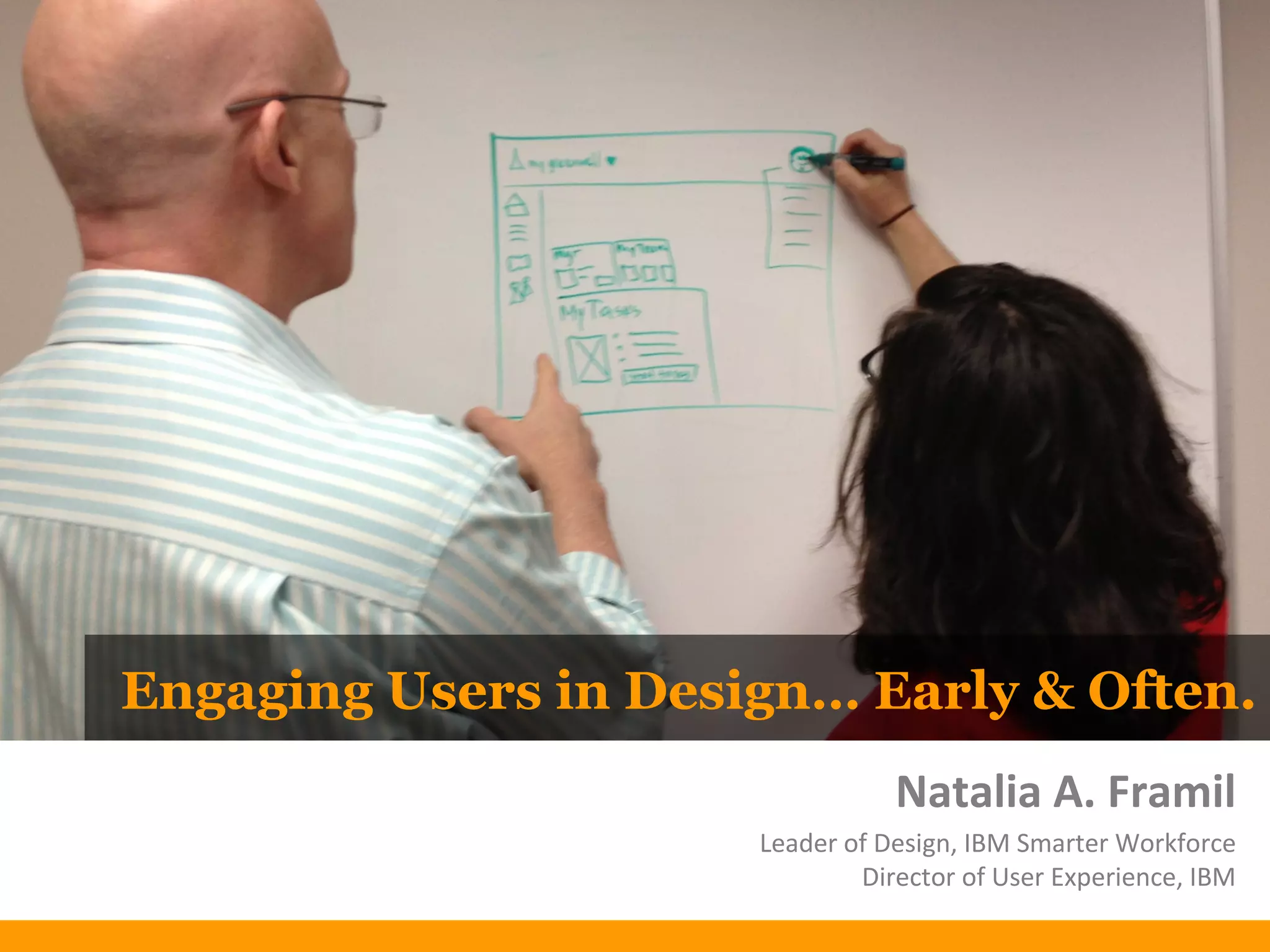

Engaging Users in Design… Early & Often.
Natalia A. Framil
Leader of Design, IBM Smarter Workforce
Director of User Experience, IBM
Summary
The Whys
Why do designers need frequent access to users, and what
are common barriers?
The Dos
What can you do to ensure that the voice of the user is
heard loud, clear, and often?
The Don’ts
What are some things that don’t help when trying to set
up a user engagement program?
The Whys
Why do designers need frequent access
to users, and what are common
barriers?
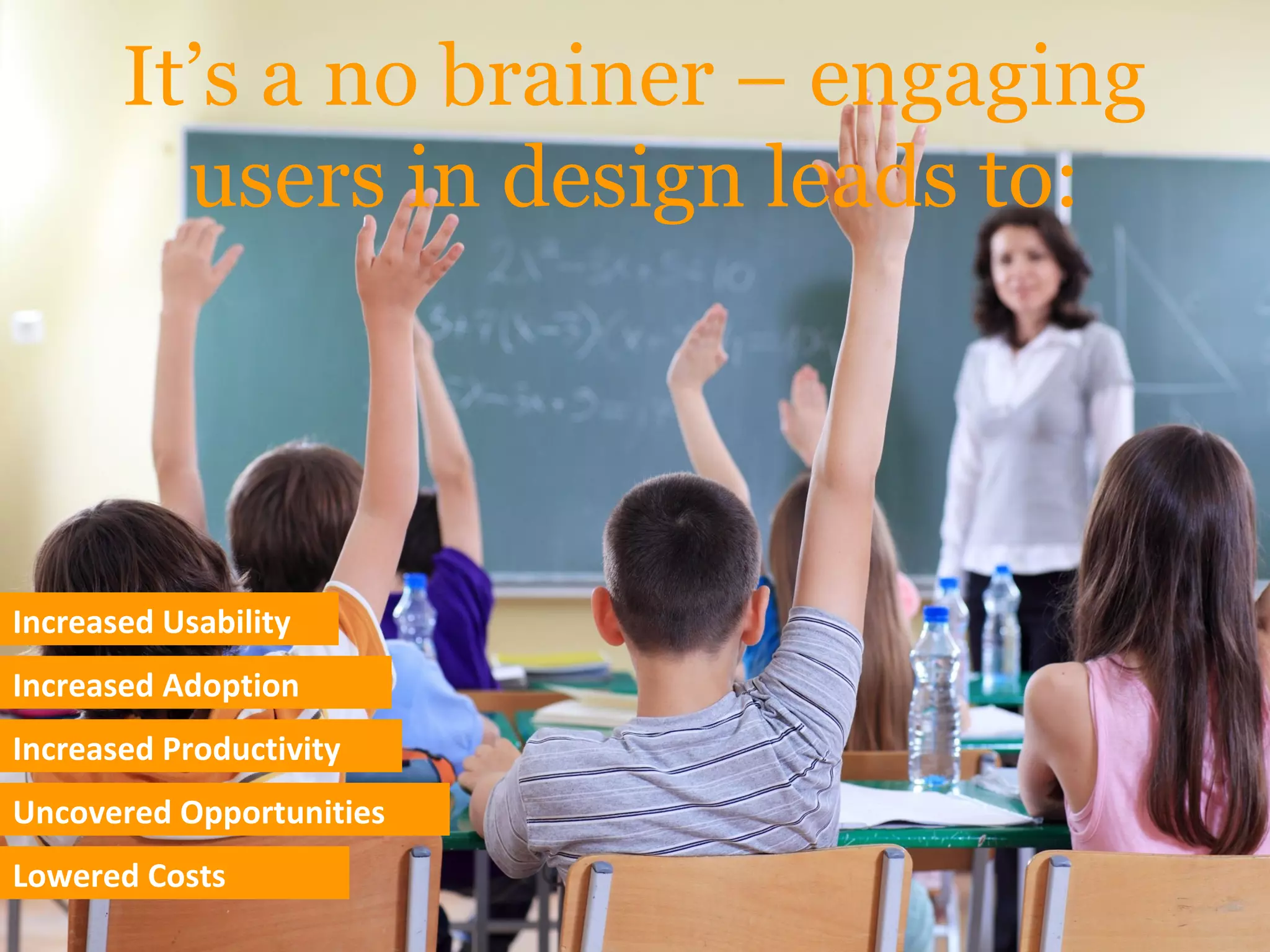
It’s a no brainer – engaging
users in design leads to:
Increased Usability
Increased Adoption
Increased Productivity
Uncovered Opportunities
Lowered Costs
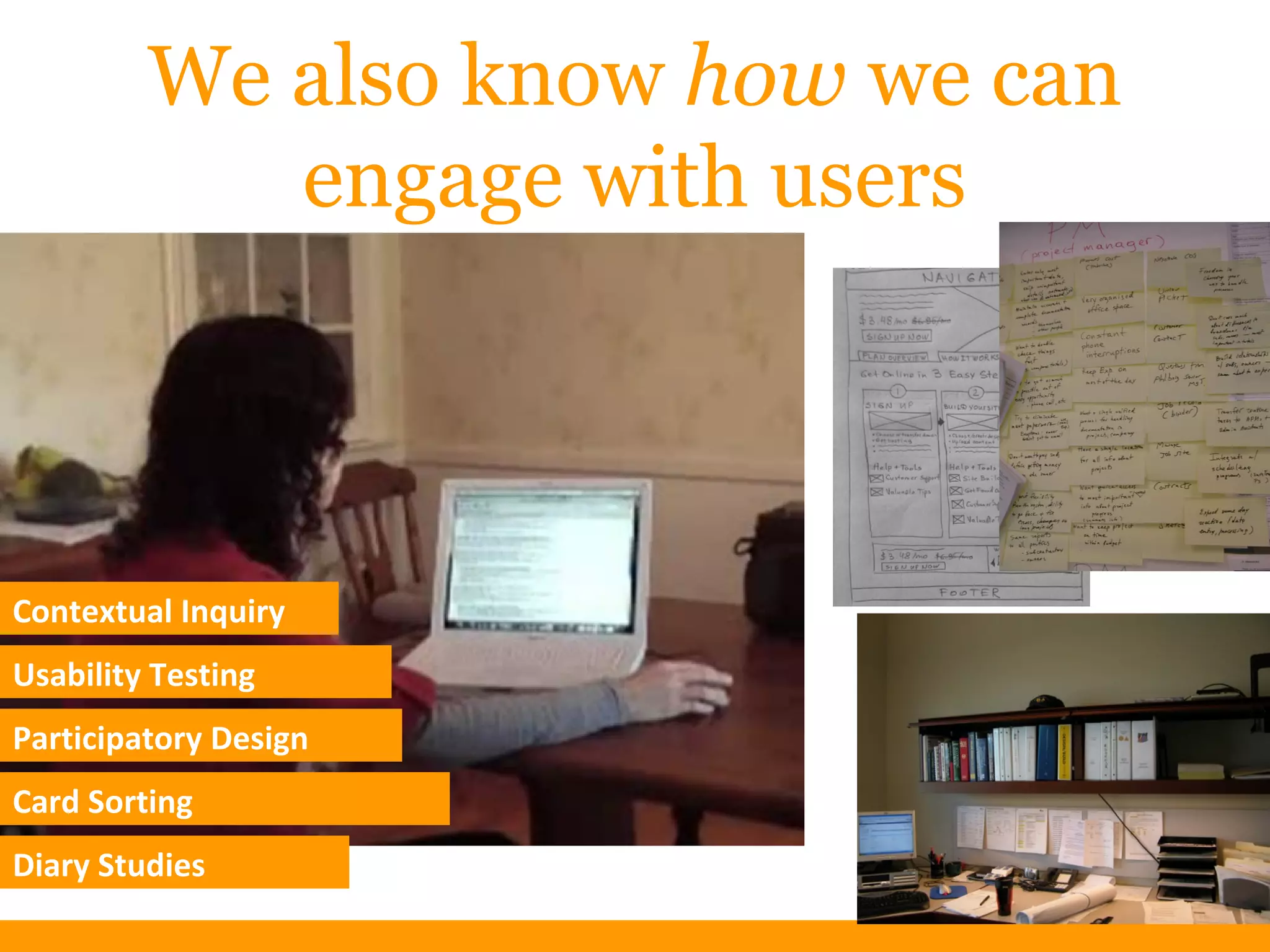
We also know how we can
engage with users
Contextual Inquiry
Usability Testing
Participatory Design
Card Sorting
Diary Studies
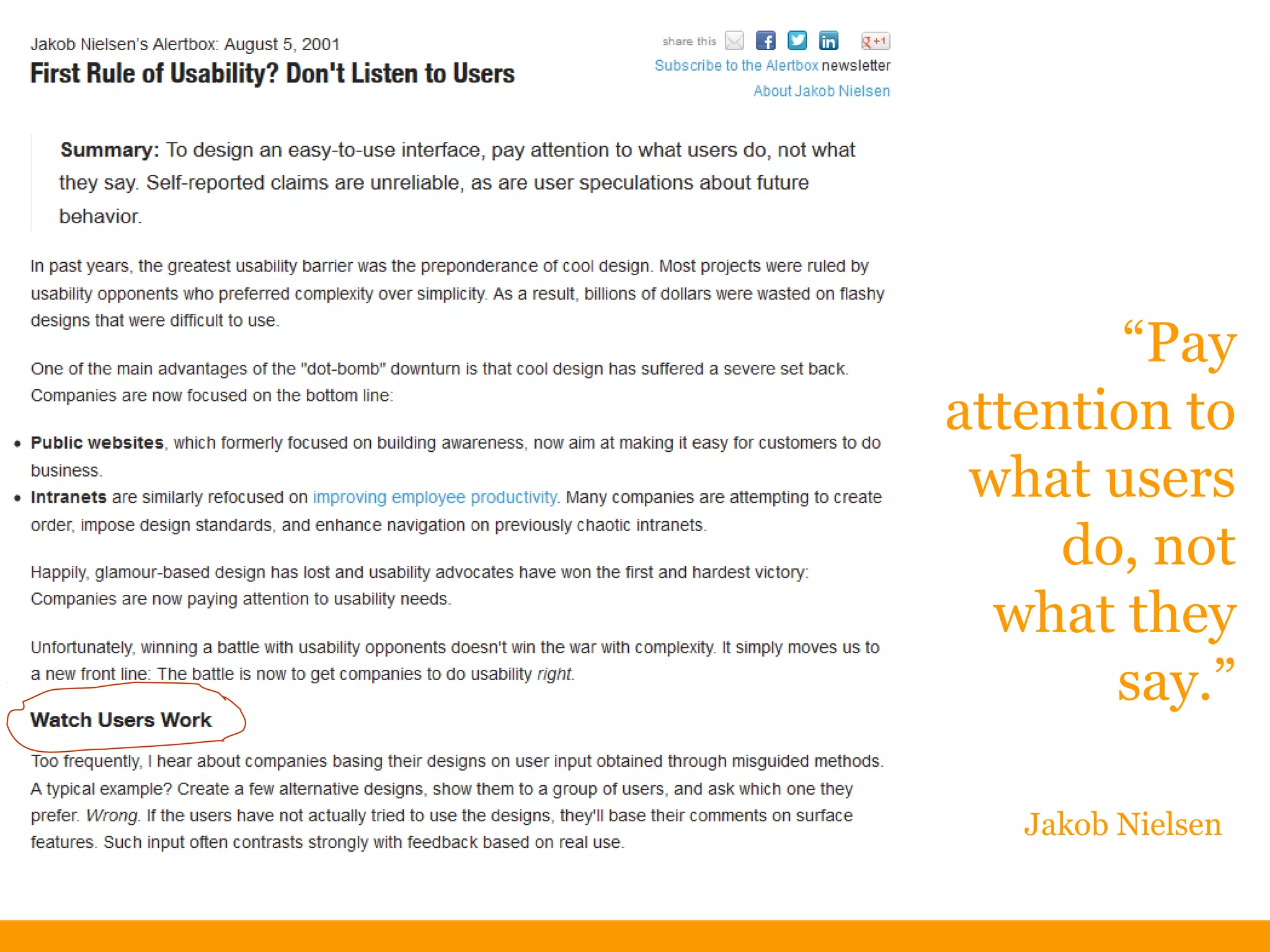
“Pay
attention to
what users
do, not
what they
say.”
Jakob Nielsen
… but when did you actually
do user research last?
• This week
• Last week
• Last month
• Last year
• (Never?)
“Know Thy User”
It’s easy to acknowledge the need to really
understand ”the other” in a movie… but how
about in real life?
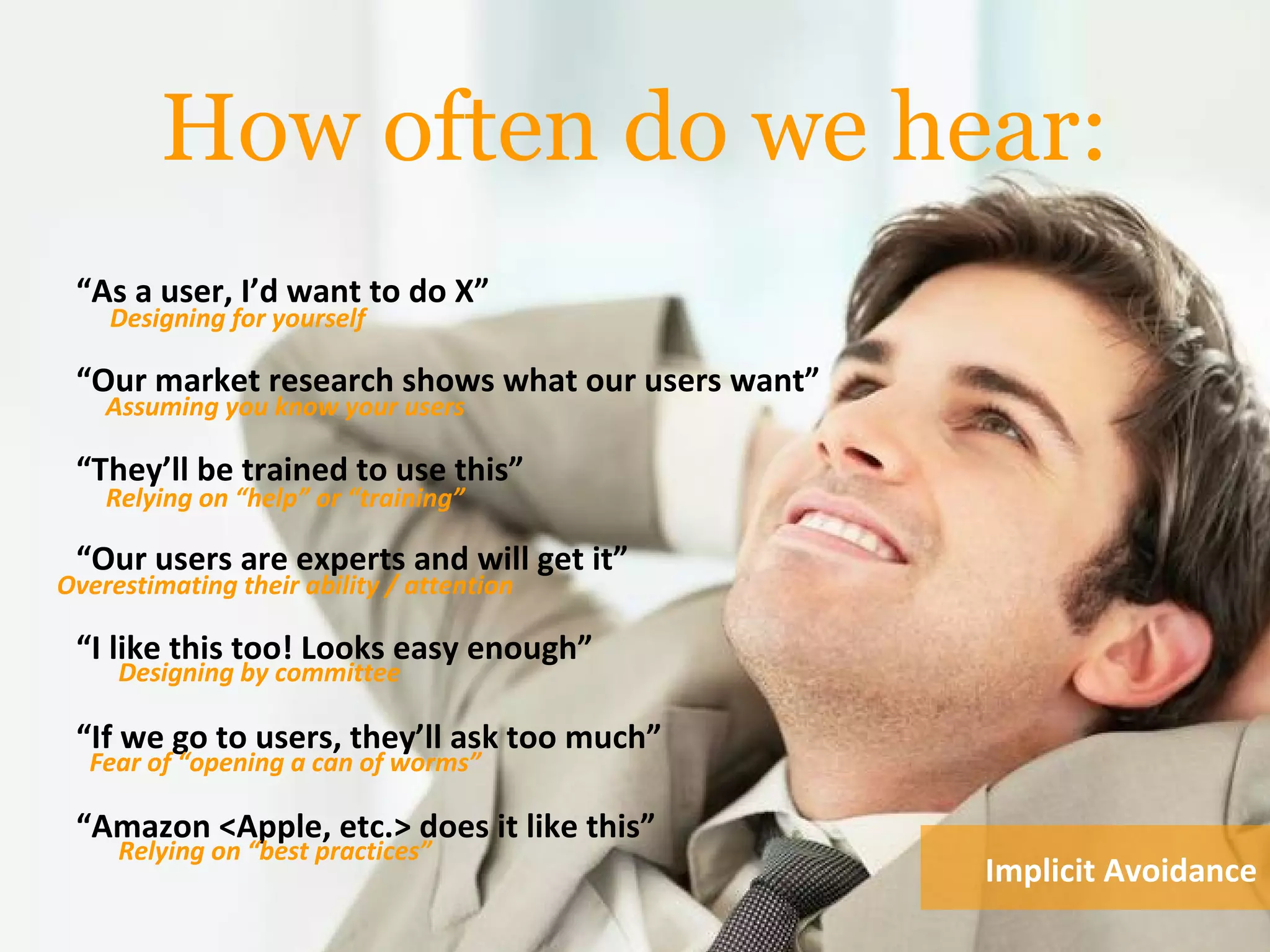
How often do we hear:
“As a user, I’d want to do X”
“Our market research shows what our users want”
“They’ll be trained to use this”
“Our users are experts and will get it”
“I like this too! Looks easy enough”
“If we go to users, they’ll ask too much”
“Amazon <Apple, etc.> does it like this”
Designing for yourself
Assuming you know your users
Relying on “help” or “training”
Designing by committee
Overestimating their ability / attention
Fear of “opening a can of worms”
Relying on “best practices”
Implicit Avoidance
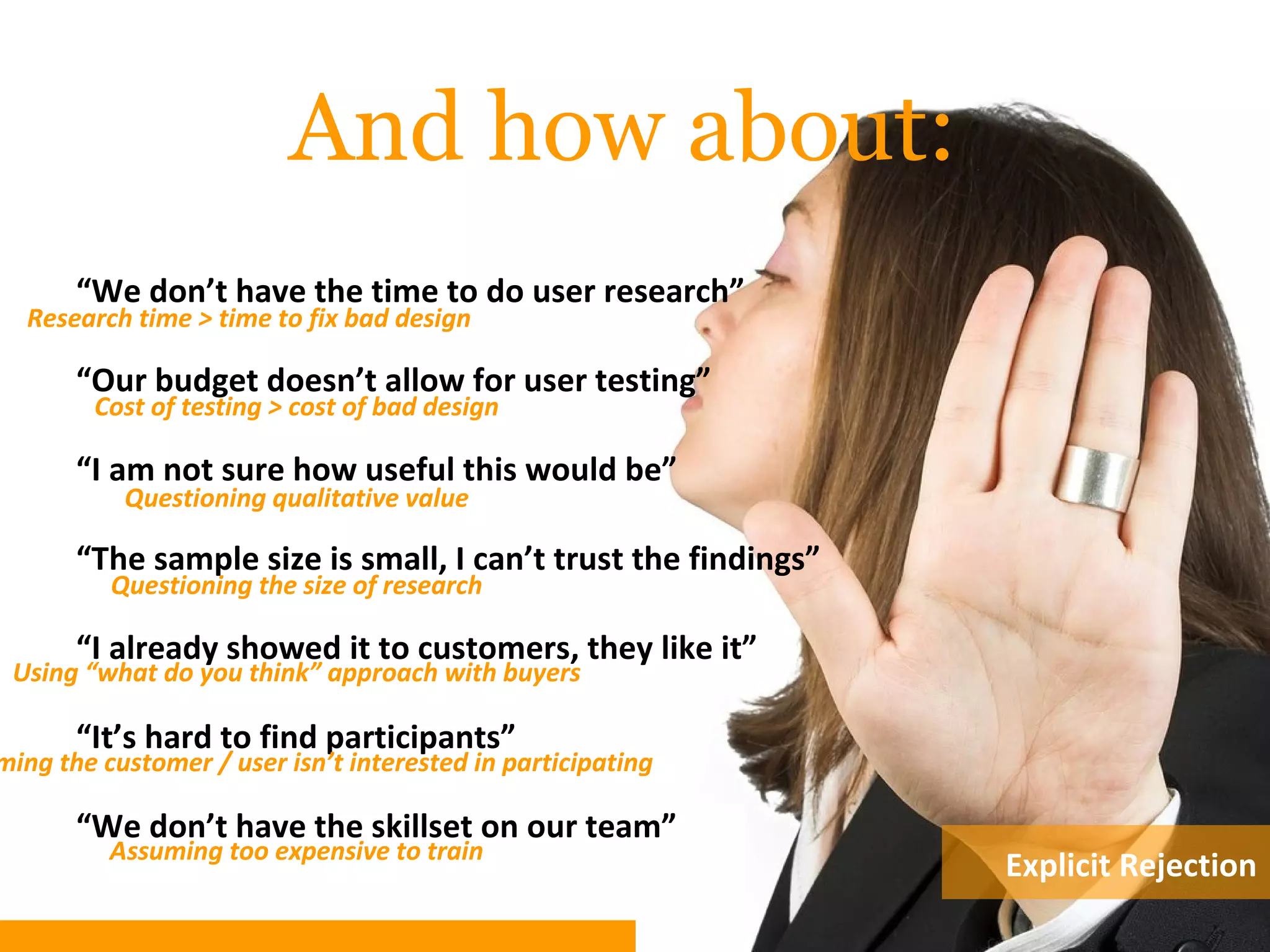
And how about:
“We don’t have the time to do user research”
“Our budget doesn’t allow for user testing”
“I am not sure how useful this would be”
“The sample size is small, I can’t trust the findings”
“I already showed it to customers, they like it”
“It’s hard to find participants”
“We don’t have the skillset on our team”
Research time > time to fix bad design
Cost of testing > cost of bad design
Questioning qualitative value
Using “what do you think” approach with buyers
Questioning the size of research
Assuming too expensive to train
ming the customer / user isn’t interested in participating
Explicit Rejection
The Dos
What can you do to ensure that the
voice of the user is heard loud, clear,
and often?
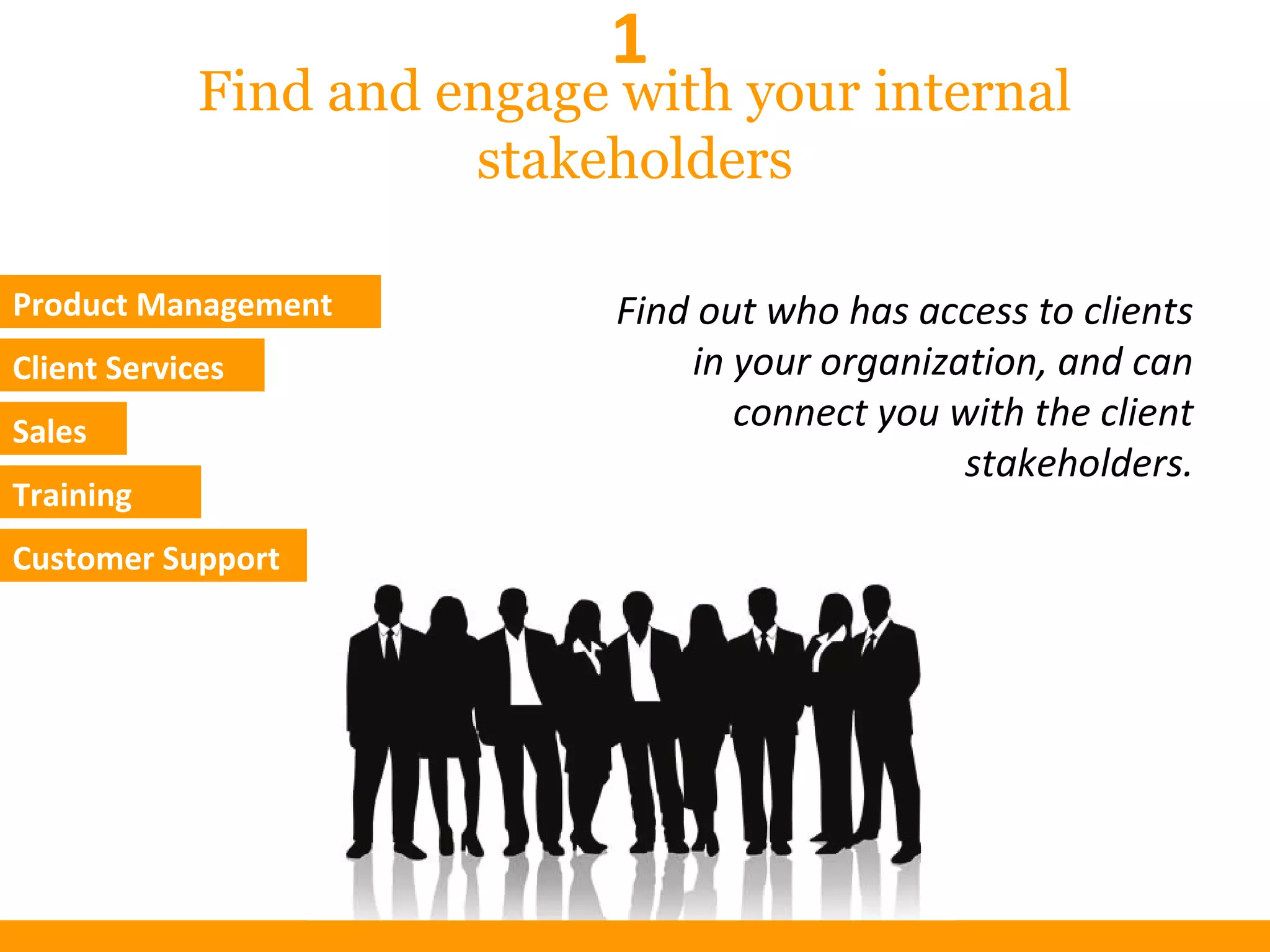
Find and engage with your internal
stakeholders
Product Management
Client Services
Sales
Training
Customer Support
Find out who has access to clients
in your organization, and can
connect you with the client
stakeholders.
1
Have a ready-to-use overview of UX goals
for user engagement
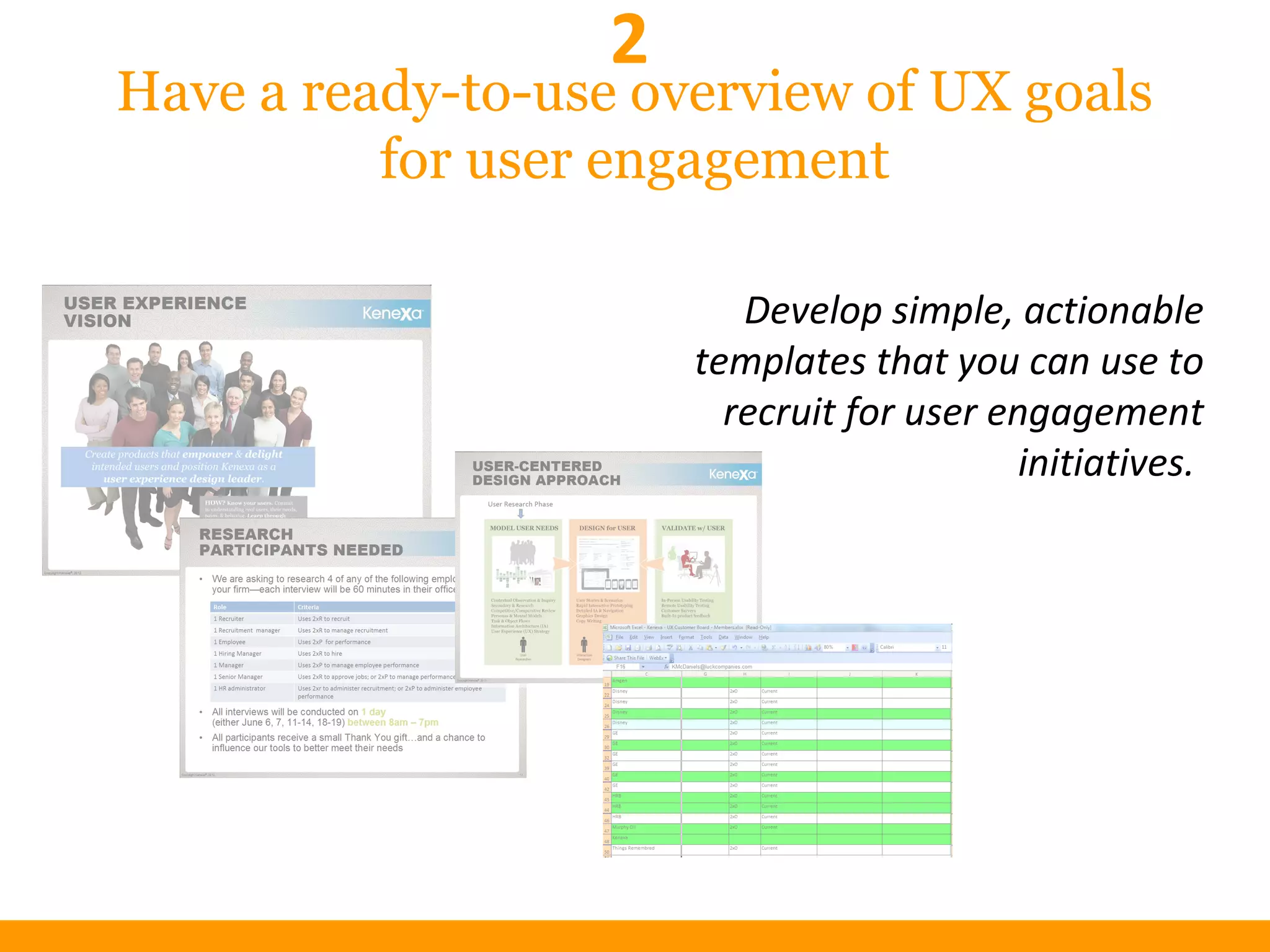
Develop simple, actionable
templates that you can use to
recruit for user engagement
initiatives.
2
Develop a customer board & cultivate it
continuously
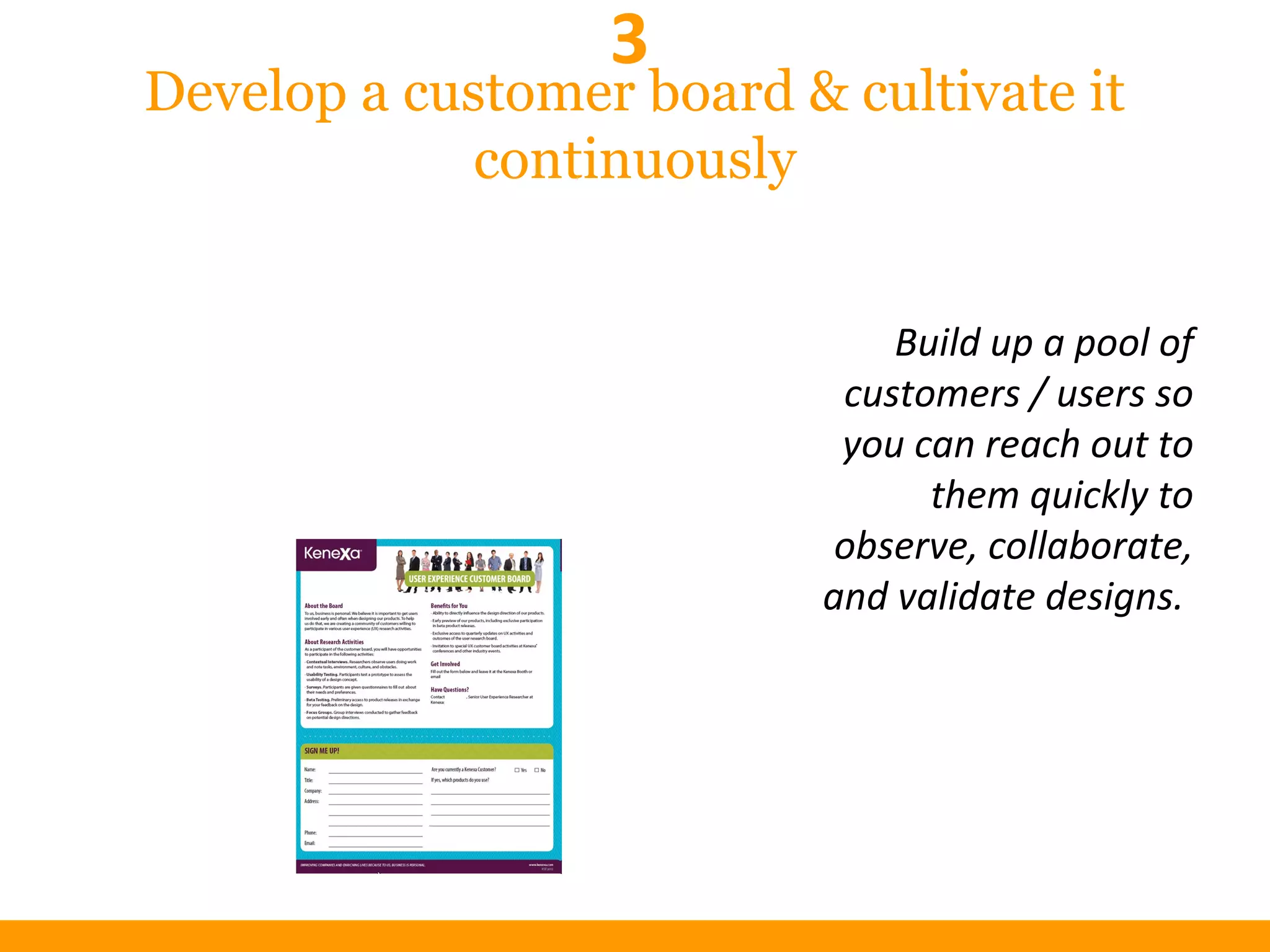
Build up a pool of
customers / users so
you can reach out to
them quickly to
observe, collaborate,
and validate designs.
3
Share your success stories with other teams
& departments to increase adoption
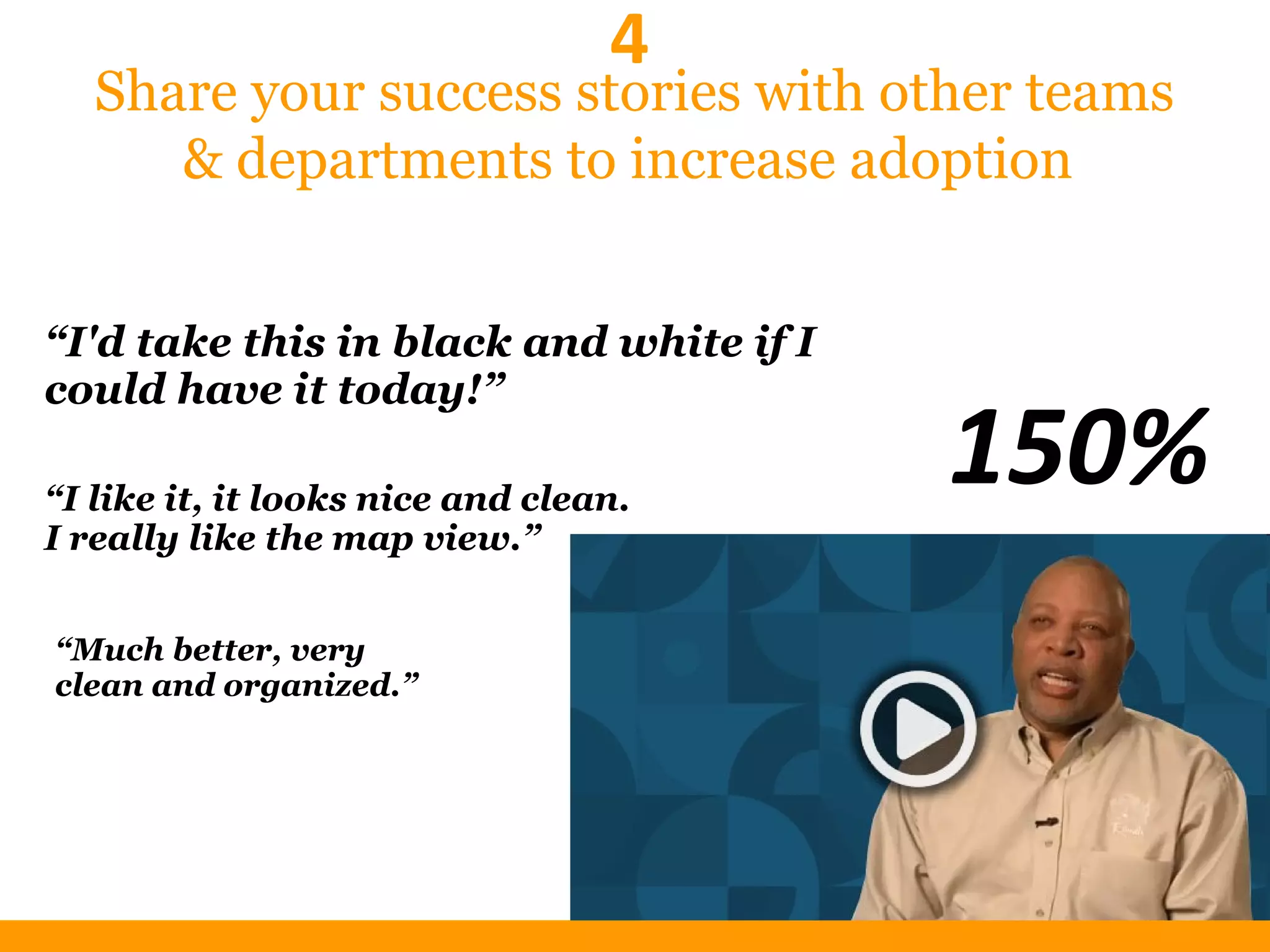
“Much better, very
clean and organized.”
“I'd take this in black and white if I
could have it today!”
“I like it, it looks nice and clean.
I really like the map view.”
150%
4
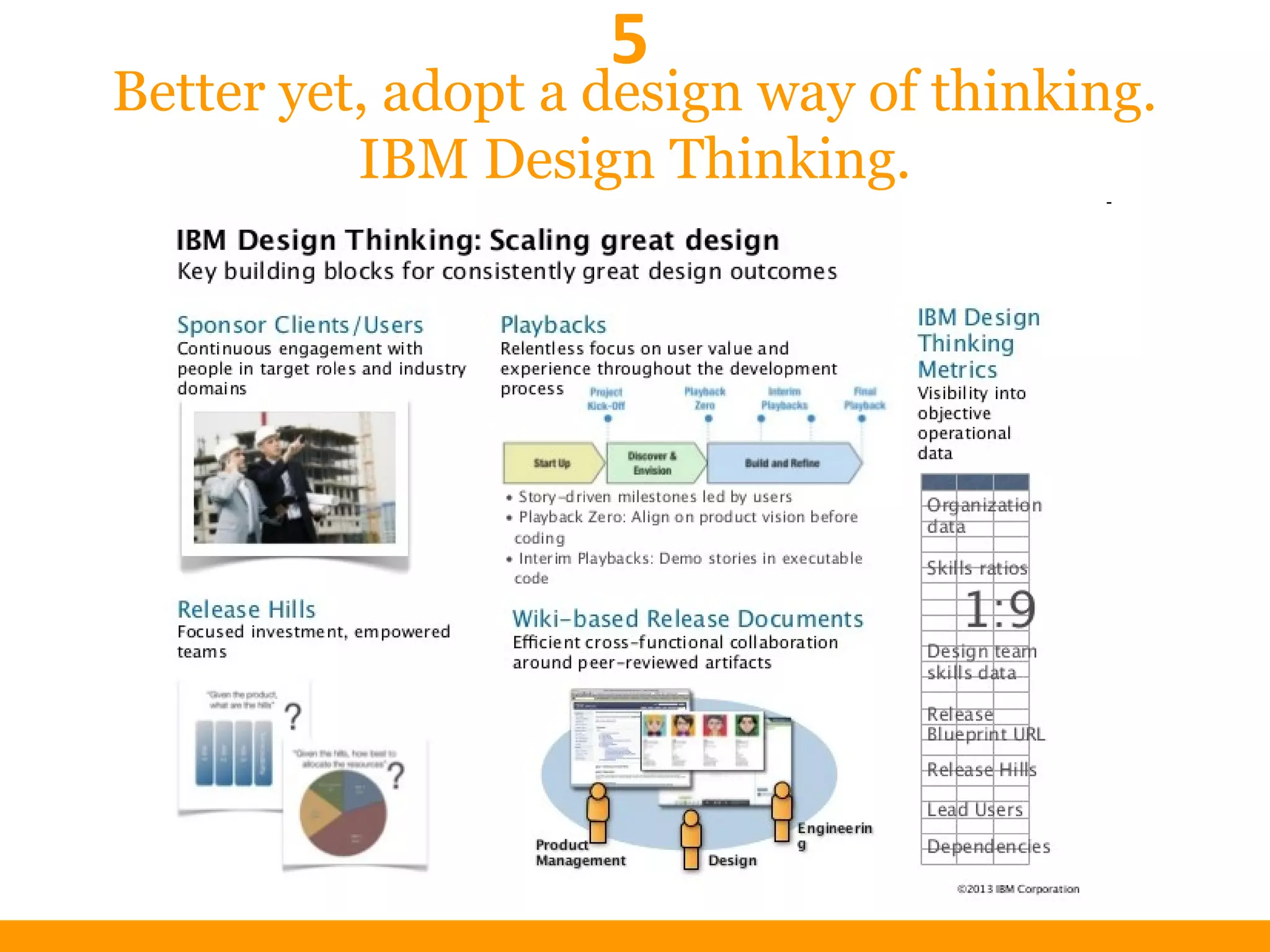
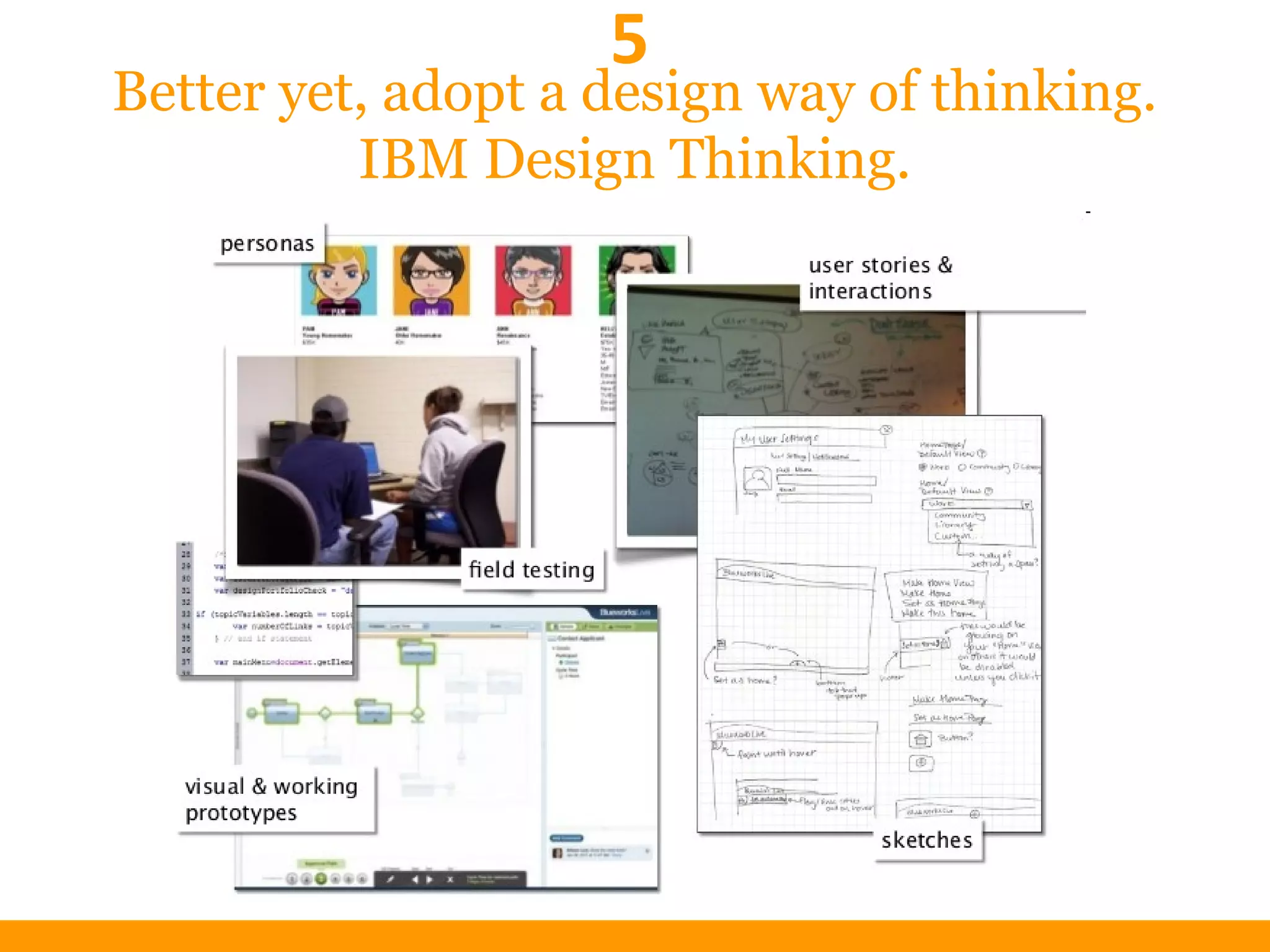
Better yet, adopt a design way of thinking.
IBM Design Thinking.
5
Better yet, adopt a design way of thinking.
IBM Design Thinking.
5
The Don’ts
What are some things that don’t help
when trying to set up a user
engagement program?
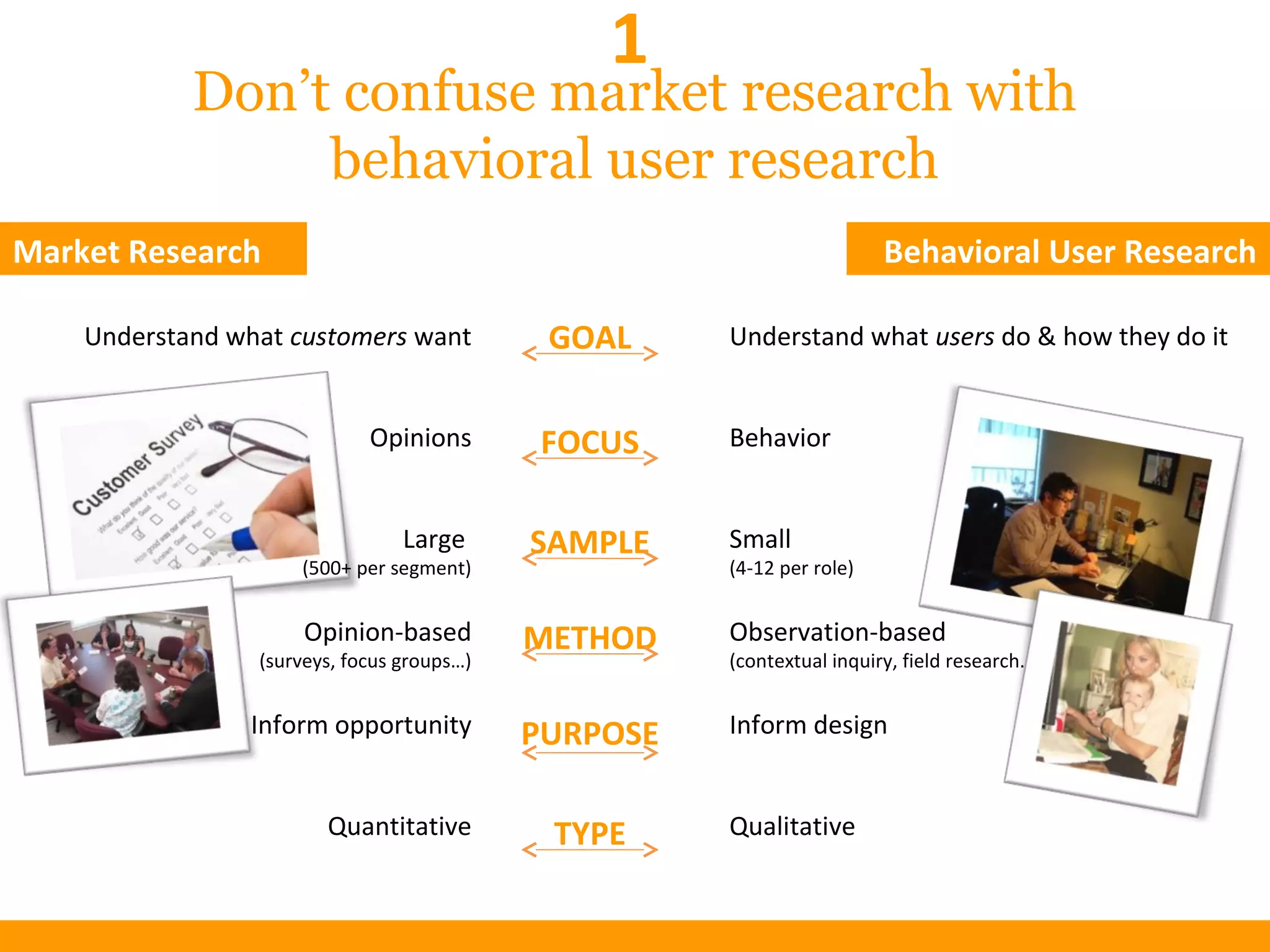
Don’t confuse market research with
behavioral user research
1
GOAL
FOCUS
SAMPLE
METHOD
Understand what users do & how they do it
Behavior
Small
(4-12 per role)
Observation-based
(contextual inquiry, field research…)
Inform design
Qualitative
PURPOSE
TYPE
Understand what customers want
Opinions
Large
(500+ per segment)
Opinion-based
(surveys, focus groups…)
Inform opportunity
Quantitative
Market Research Behavioral User Research
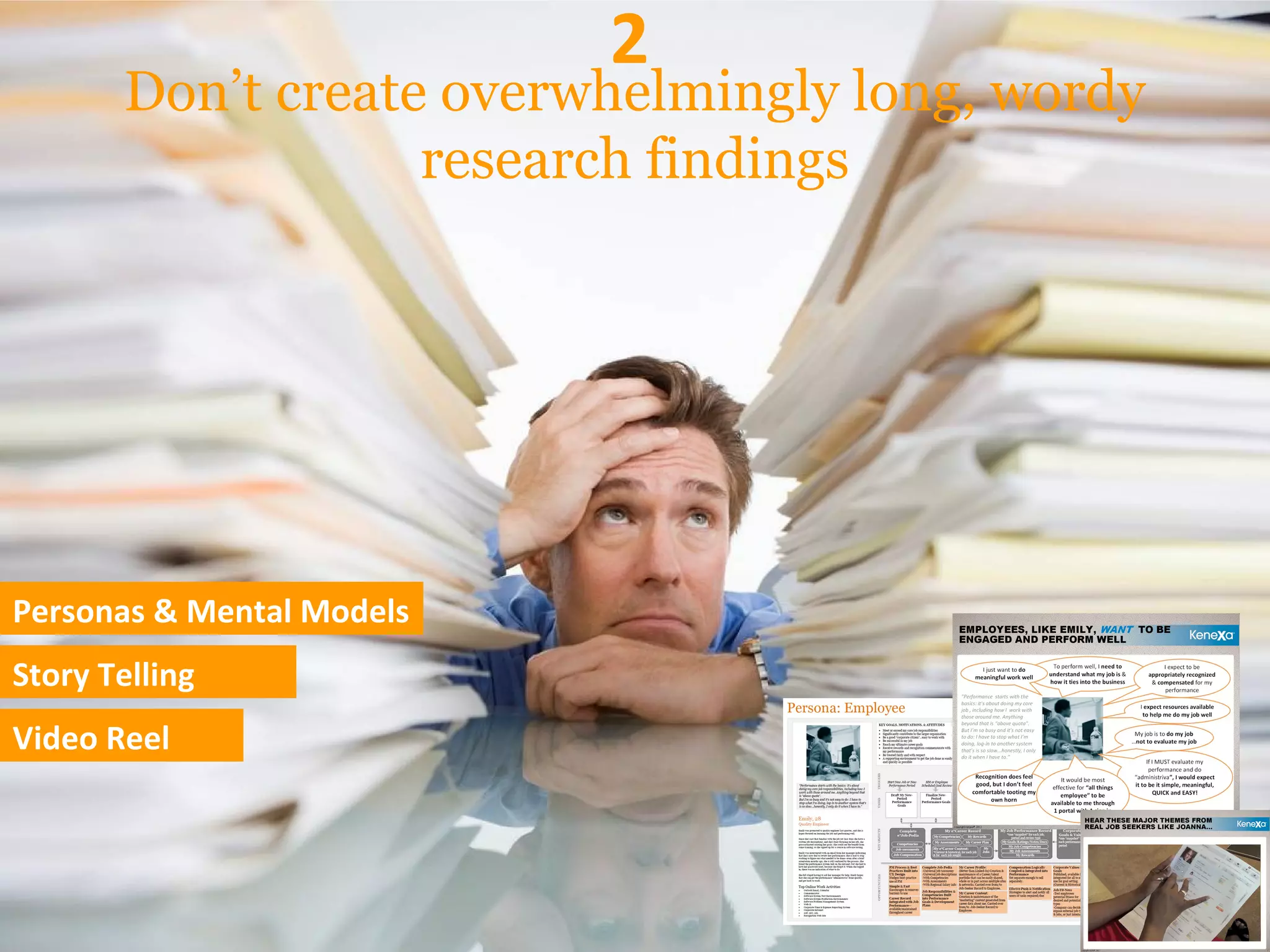
Don’t create overwhelmingly long, wordy
research findings
2
Personas & Mental Models
Story Telling
Video Reel
Don’t limit research sessions to researchers
and designers
3
… but don’t overcrowd users either.
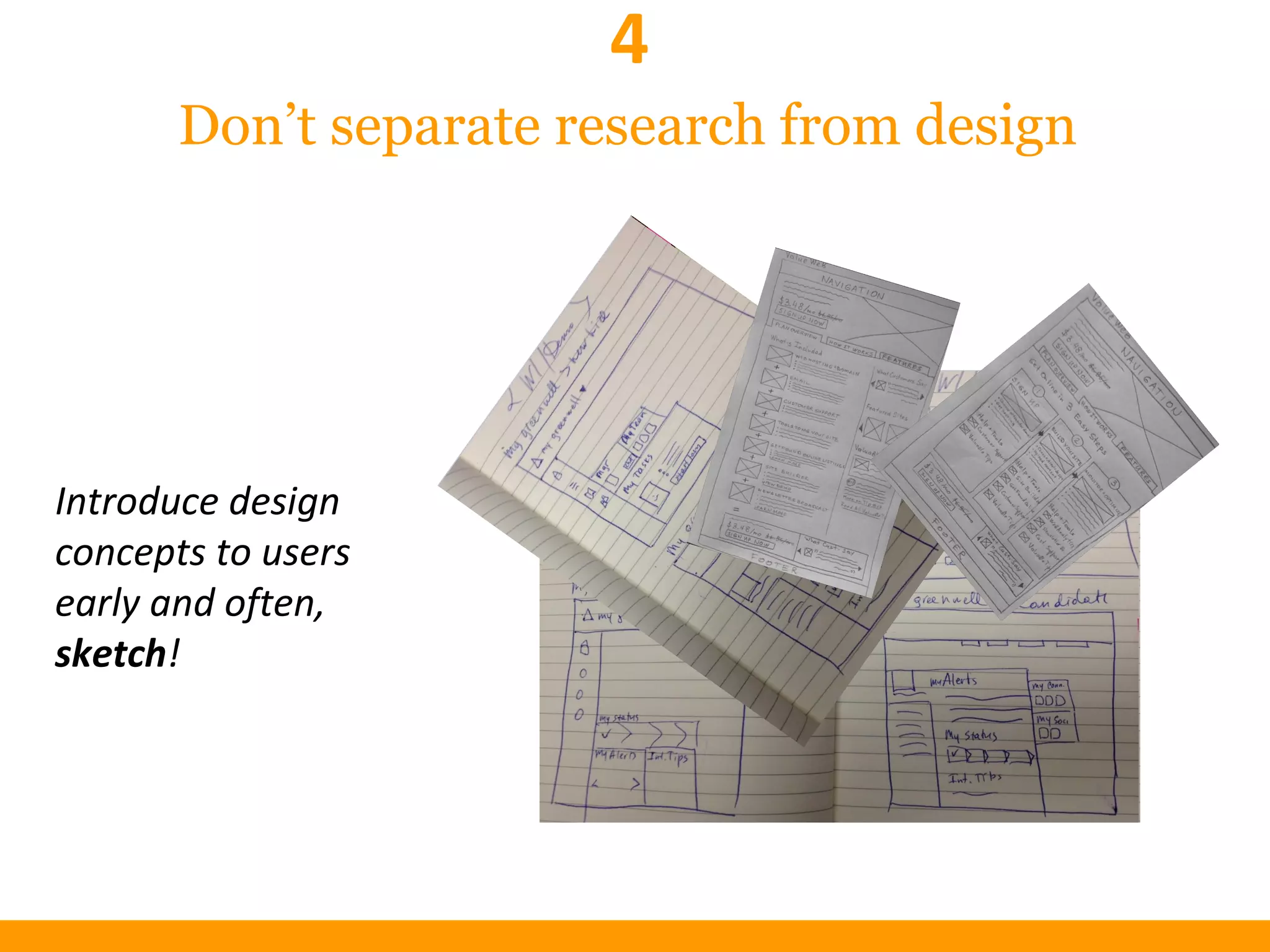
Don’t separate research from design
4
Introduce design
concepts to users
early and often,
sketch!
Don’t believe that
engaging users in design is luxury!
5
Thank You

Engaging Users in Design

  • 1.
    Engaging Users inDesign… Early & Often. Natalia A. Framil Leader of Design, IBM Smarter Workforce Director of User Experience, IBM
  • 2.
    Summary The Whys Why dodesigners need frequent access to users, and what are common barriers? The Dos What can you do to ensure that the voice of the user is heard loud, clear, and often? The Don’ts What are some things that don’t help when trying to set up a user engagement program?
  • 3.
    The Whys Why dodesigners need frequent access to users, and what are common barriers?
  • 4.
    It’s a nobrainer – engaging users in design leads to: Increased Usability Increased Adoption Increased Productivity Uncovered Opportunities Lowered Costs
  • 5.
    We also knowhow we can engage with users Contextual Inquiry Usability Testing Participatory Design Card Sorting Diary Studies
  • 6.
    “Pay attention to what users do,not what they say.” Jakob Nielsen
  • 7.
    … but whendid you actually do user research last? • This week • Last week • Last month • Last year • (Never?)
  • 8.
    “Know Thy User” It’seasy to acknowledge the need to really understand ”the other” in a movie… but how about in real life?
  • 9.
    How often dowe hear: “As a user, I’d want to do X” “Our market research shows what our users want” “They’ll be trained to use this” “Our users are experts and will get it” “I like this too! Looks easy enough” “If we go to users, they’ll ask too much” “Amazon <Apple, etc.> does it like this” Designing for yourself Assuming you know your users Relying on “help” or “training” Designing by committee Overestimating their ability / attention Fear of “opening a can of worms” Relying on “best practices” Implicit Avoidance
  • 10.
    And how about: “Wedon’t have the time to do user research” “Our budget doesn’t allow for user testing” “I am not sure how useful this would be” “The sample size is small, I can’t trust the findings” “I already showed it to customers, they like it” “It’s hard to find participants” “We don’t have the skillset on our team” Research time > time to fix bad design Cost of testing > cost of bad design Questioning qualitative value Using “what do you think” approach with buyers Questioning the size of research Assuming too expensive to train ming the customer / user isn’t interested in participating Explicit Rejection
  • 11.
    The Dos What canyou do to ensure that the voice of the user is heard loud, clear, and often?
  • 12.
    Find and engagewith your internal stakeholders Product Management Client Services Sales Training Customer Support Find out who has access to clients in your organization, and can connect you with the client stakeholders. 1
  • 13.
    Have a ready-to-useoverview of UX goals for user engagement Develop simple, actionable templates that you can use to recruit for user engagement initiatives. 2
  • 14.
    Develop a customerboard & cultivate it continuously Build up a pool of customers / users so you can reach out to them quickly to observe, collaborate, and validate designs. 3
  • 15.
    Share your successstories with other teams & departments to increase adoption “Much better, very clean and organized.” “I'd take this in black and white if I could have it today!” “I like it, it looks nice and clean. I really like the map view.” 150% 4
  • 16.
    Better yet, adopta design way of thinking. IBM Design Thinking. 5
  • 17.
    Better yet, adopta design way of thinking. IBM Design Thinking. 5
  • 18.
    The Don’ts What aresome things that don’t help when trying to set up a user engagement program?
  • 19.
    Don’t confuse marketresearch with behavioral user research 1 GOAL FOCUS SAMPLE METHOD Understand what users do & how they do it Behavior Small (4-12 per role) Observation-based (contextual inquiry, field research…) Inform design Qualitative PURPOSE TYPE Understand what customers want Opinions Large (500+ per segment) Opinion-based (surveys, focus groups…) Inform opportunity Quantitative Market Research Behavioral User Research
  • 20.
    Don’t create overwhelminglylong, wordy research findings 2 Personas & Mental Models Story Telling Video Reel
  • 21.
    Don’t limit researchsessions to researchers and designers 3 … but don’t overcrowd users either.
  • 22.
    Don’t separate researchfrom design 4 Introduce design concepts to users early and often, sketch!
  • 23.
    Don’t believe that engagingusers in design is luxury! 5
  • 24.

Editor's Notes

  • #15 This pool of users should be to cultivated to grow continuously, so that we don’t talk with the same users all the time. Customer advisory board also builds trust &amp; increases overall customer service satisfaction!