GET THE MOST FOR
YOUR $$NYLA Conference September 27, 2013
Presentation by:
Monica Kuryla, Fayetteville Free Library
Heather Matzel, Fayetteville Free Library
Richard Ashby, President, LiteracyNation
Andrew P. Jackson (Sekou Molefi Baako), Queens
Library
Intro
 How to develop/promote/implement
programming for little to no $
 Reallocating materials budget funds from print
resources to support/enhance new formats.
 Ways to enhance your reference service
offerings at little to no cost
Cost Effective Programming
LiteracyNation Inc.
 Volunteer activities can be fun for day time
patrons (DTP) and their friends.
 Once a month host a “My Library” program
 When your shelves are dusty or your
paperbacks need weeding…DTP are great
volunteers
Cost Effective Programming
 We offer job Fairs, Resume workshops. Health
seminars, Tax preparation assistance.
 New York State Department of Labor will host
job fairs and resume workshops, for no cost.
 Local Hospitals and health agencies will also
host your health fairs.
 Community and local authors will be happy to
come host book talks or writing workshops.
Cost Effective Programming
 DTP come to the library for a variety of reasons.
 People may go to the library looking mainly for
information.
 New moms connect at baby storytimes; elderly
people, often facing difficult life transitions,
attend events and find that they make new
friends. Patrons seek new careers and
employment.
Cost Effective Programming
 Adults love games.
 Set up a Game day or night for video and board
games at the library they feel empowered. They
will need little or no money to have a gaming
event
 Have the teens hand draw posters and flyers
for advertisement of the programs.
 DTP love Scrabble, monopoly, chest, checkers,
and card games.
 Offer zumba or yoga classes in the day or
evening.
Cost Effective Programming
 Craft projects can be offered to DTP in many ways:
as a stand-alone project.
 Morning sewing clubs, scrap book.
 Collect free craft materials from friends, coworkers
and relatives.
“…with literacy and justice for all”
www.literacynation.com
Make Your Library the Center of Your Community By
Any Means Necessary…
Examples of Local Program Ideas
 Local History
 Talks, site tours, power points, discussions,
walking tours
 Genealogy Workshops
 Family History Talks
 Local High School Teachers or College
Professor Lectures
 Local Historians and Town Hall Discussions
Musical Performances
 Open Mic (include more than just poetry or literature readings)
 Local choral groups or choirs, vocalists, choirs
 Holiday music concerts
 Barber Shop Quartets
 Dance troupes, ensembles, schools
 Music school recitals
 Significant local events, celebrations
 Local musicians and vocalists
 School/college ensembles, bands and orchestras with Q & A
 Classical, jazz, hip-hop, opera, string quartets, solo artists, orchestras,
do-wop
 Musical concerts featuring music from different cultures and ages
 Poetry with music; artist painting with music performance
 Acapella performances
 Puppet and Magic Shows
Library co-Sponsored Activities
and Events.
 Read-A-Loud (invite prominent local participants)
 Career Day (prominent local residents, business,
elected officials, etc.
 Library Open House (advocacy and outreach)
 Library Anniversary Celebration or significant
calendar dates
 Friends of the Library events
 Library Advocacy Day
 Family Day (community celebration, inclusive, co-
sponsored)
Library co-Sponsored Activities
and Events.
 Film Screenings and Discussions
 Old and New; Black and White/Color; Silent Films
 Televised prominent events, parades, celebrations,
inauguration, concerts, etc)
 Poet reading and discussion
 Author reading and discussion (local authors, critics,
journalists, etc)
 Book Talk and discussion
 Book Club open discussion – public invited
 Film screening and discussion (biographical, old black
& white, historical, etc.)
 Film and book talk of same title with guest speaker
Settings (Maximize your audience and exposure) @
Library and Off-Site
 Indoor or outdoor Senior Centers
 Town square Hospital
 In the park School yard
 Library Atrium Children’s Room
 YA Room Sidewalk
 Courtyard or Garden City Hall
Funding Sources (Not always
about the Benjamin$$ but In-
Kind Services)
 Library development office (grants,
foundations)
 Friends of the Library
 Local government grants (City, County, State)
 New York State Council on the Arts
 Local Arts Council
 New York City Department of Cultural Affairs
 Elected Official’s Discretionary Grants/Funds
Publicity & Outreach
 Website (keep it updated)
 Facebook, Twitter, Blog. Pinterest, Youtube, Library’s
plasma screen
 Flyers & Posters (English and Other Languages if
appropriate)
 Bulletin Boards
 Local Newspapers (paid and community bulletin
board)
 Public Access Television (public service
announcement, ad)
 Local radio interview
 Churches and Senior Centers
Who to Invite to Participate
 Library Board of Trustees, Director and Staff
 Library Volunteers and Residents
 Friends of the Library
 Library Customers
 Local Board of Regents Representative
 Elected Officials (Town, County, City, State)
 Corporate and Business leaders
 Socialites and Prominent and Famous Citizens
 College President and Professors
 School Principals and teachers School classes, band
 Athletes and Coaches (collegiate, schools, town leagues)
 Boy Scouts, Girl Scouts, Brownies, Cub Scouts
 Clergy and Religious Leaders
 Parents, Teachers, PTA and Community Groups
 Popular journalists and TV News Anchors
 Friends and Neighbors
 Retirees and Founding Library Staff and Board Members
 Enemies :0)
 In other words, invite everybody!
Ideas to Consider
 * Combine Programs When Optional to Maximize Audience
Development
 * Create Program Planning Committees. Invite Outsiders to
Participate.
 * Give you’re your youth and elders a voice.
 * Create Ownership of the Library and Programs for Success.
 * Everything Doesn’t Cost BIG Money to be Successful.
 * Give Yourself Ample Time to Plan and Execute Programs
 * Cross Section of Programs Should Be Representative of the Culture
and Ages of Your Community.
 * Ask!
 Andrew P. Jackson (Sekou Molefi Baako), Executive Director
 Queens Library’s Langston Hughes Community Library and Cultural
Center
Budgeting Strategy
Create rich collections and resources
 Challenges:
 changing formats and mediums
 rapidly changing patron requests
 set budgets
 increasing demands on our time as
librarians to support the community, we
need a way to make these important
decisions in a timely fashion
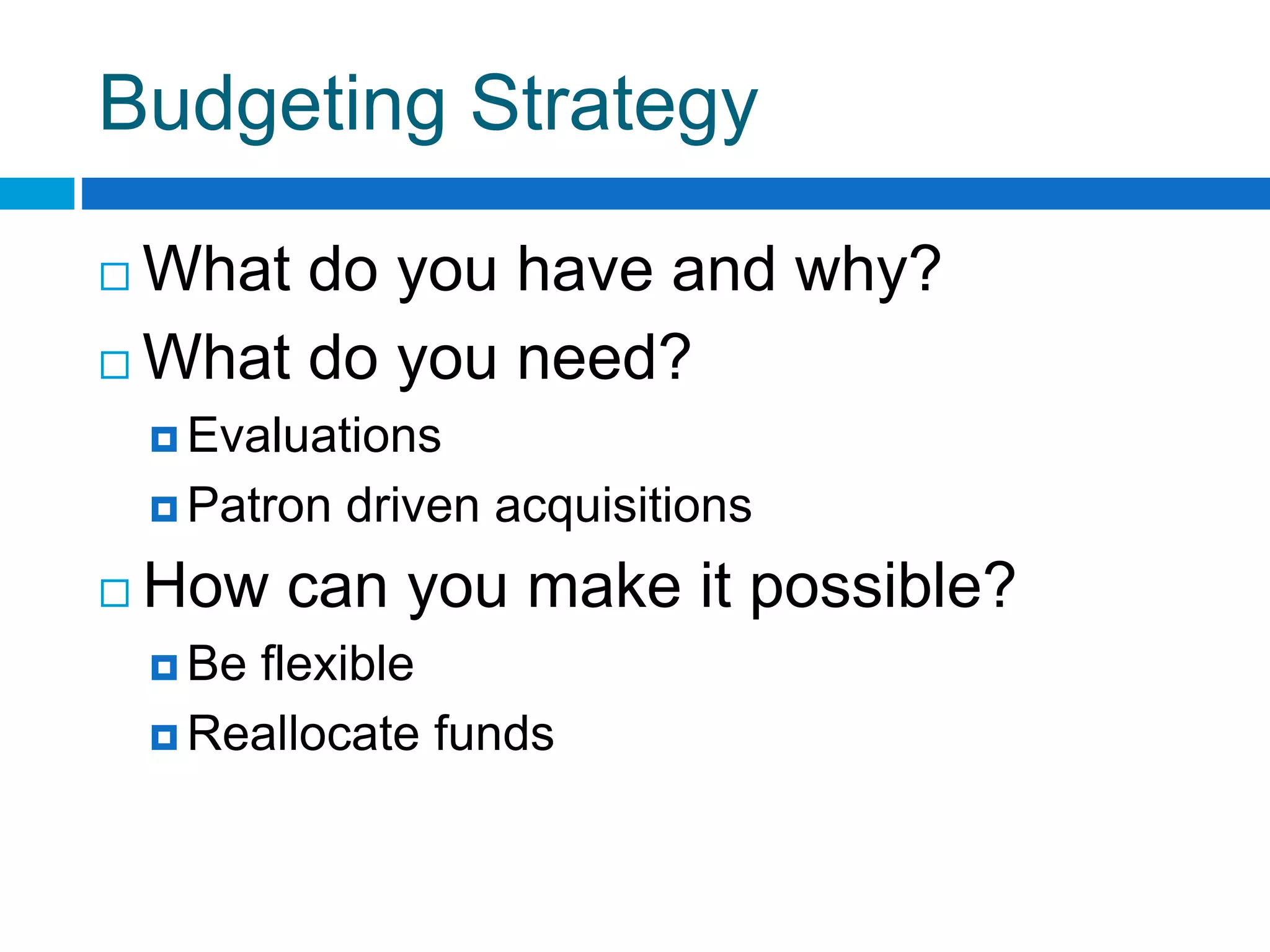
Budgeting Strategy
 What do you have and why?
 What do you need?
 Evaluations
 Patron driven acquisitions
 How can you make it possible?
 Be flexible
 Reallocate funds
Budgeting Strategy
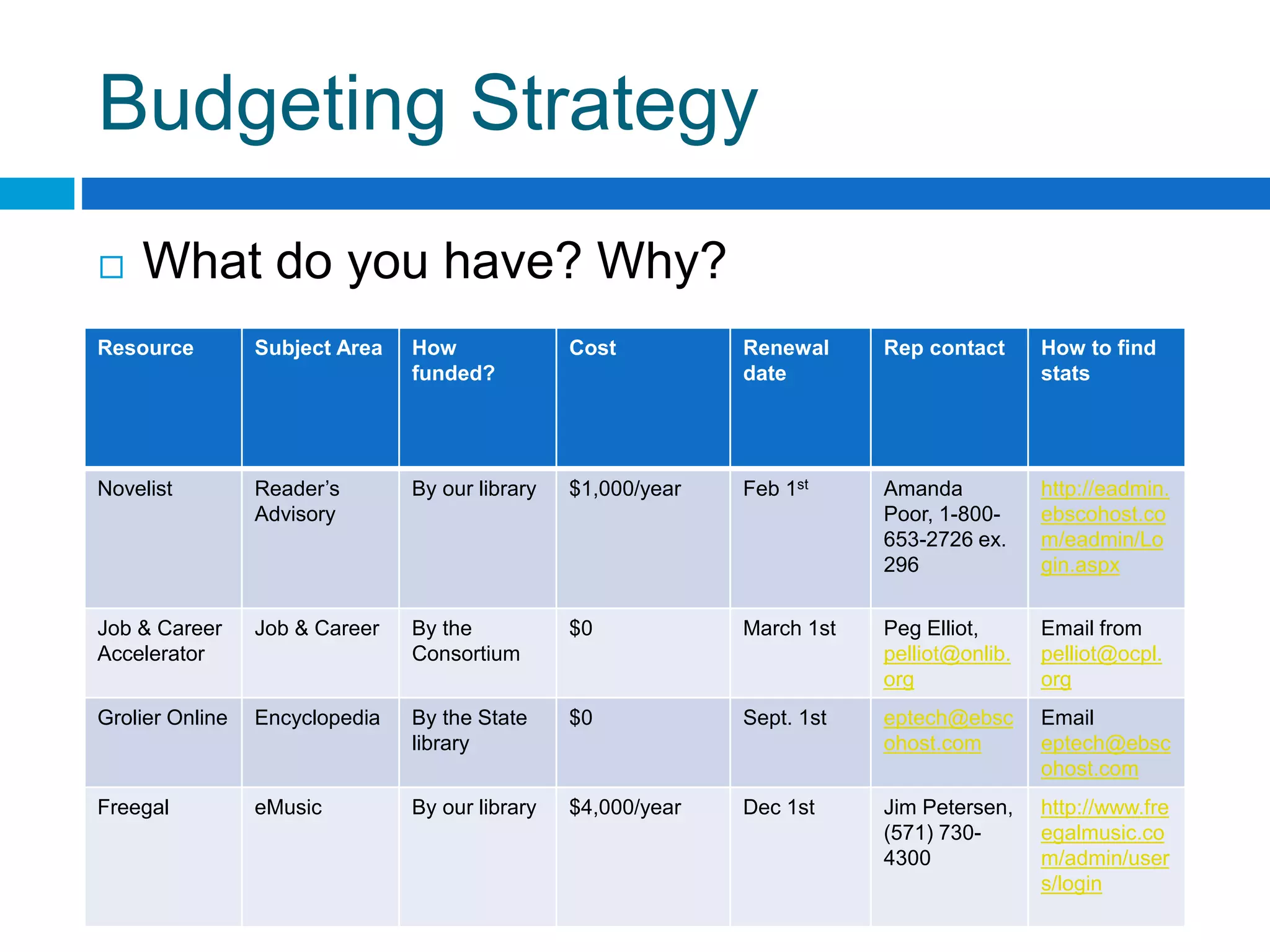
 What do you have? Why?
Resource Subject Area How
funded?
Cost Renewal
date
Rep contact How to find
stats
Novelist Reader’s
Advisory
By our library $1,000/year Feb 1st Amanda
Poor, 1-800-
653-2726 ex.
296
http://eadmin.
ebscohost.co
m/eadmin/Lo
gin.aspx
Job & Career
Accelerator
Job & Career By the
Consortium
$0 March 1st Peg Elliot,
pelliot@onlib.
org
Email from
pelliot@ocpl.
org
Grolier Online Encyclopedia By the State
library
$0 Sept. 1st eptech@ebsc
ohost.com
Email
eptech@ebsc
ohost.com
Freegal eMusic By our library $4,000/year Dec 1st Jim Petersen,
(571) 730-
4300
http://www.fre
egalmusic.co
m/admin/user
s/login
Budgeting Strategy
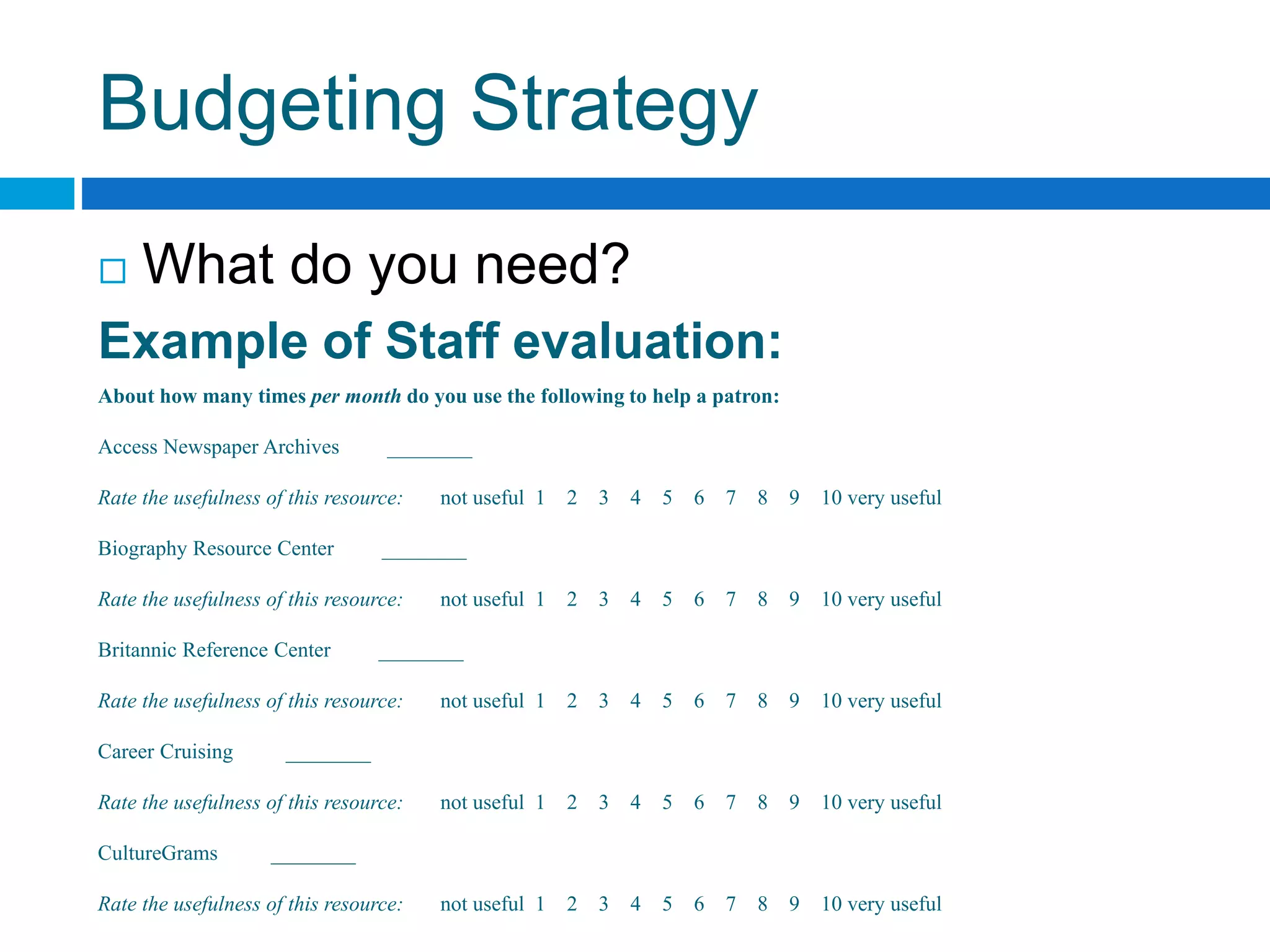
 What do you need?
Example of Staff evaluation:
About how many times per month do you use the following to help a patron:
Access Newspaper Archives ________
Rate the usefulness of this resource: not useful 1 2 3 4 5 6 7 8 9 10 very useful
Biography Resource Center ________
Rate the usefulness of this resource: not useful 1 2 3 4 5 6 7 8 9 10 very useful
Britannic Reference Center ________
Rate the usefulness of this resource: not useful 1 2 3 4 5 6 7 8 9 10 very useful
Career Cruising ________
Rate the usefulness of this resource: not useful 1 2 3 4 5 6 7 8 9 10 very useful
CultureGrams ________
Rate the usefulness of this resource: not useful 1 2 3 4 5 6 7 8 9 10 very useful
Budgeting Strategy
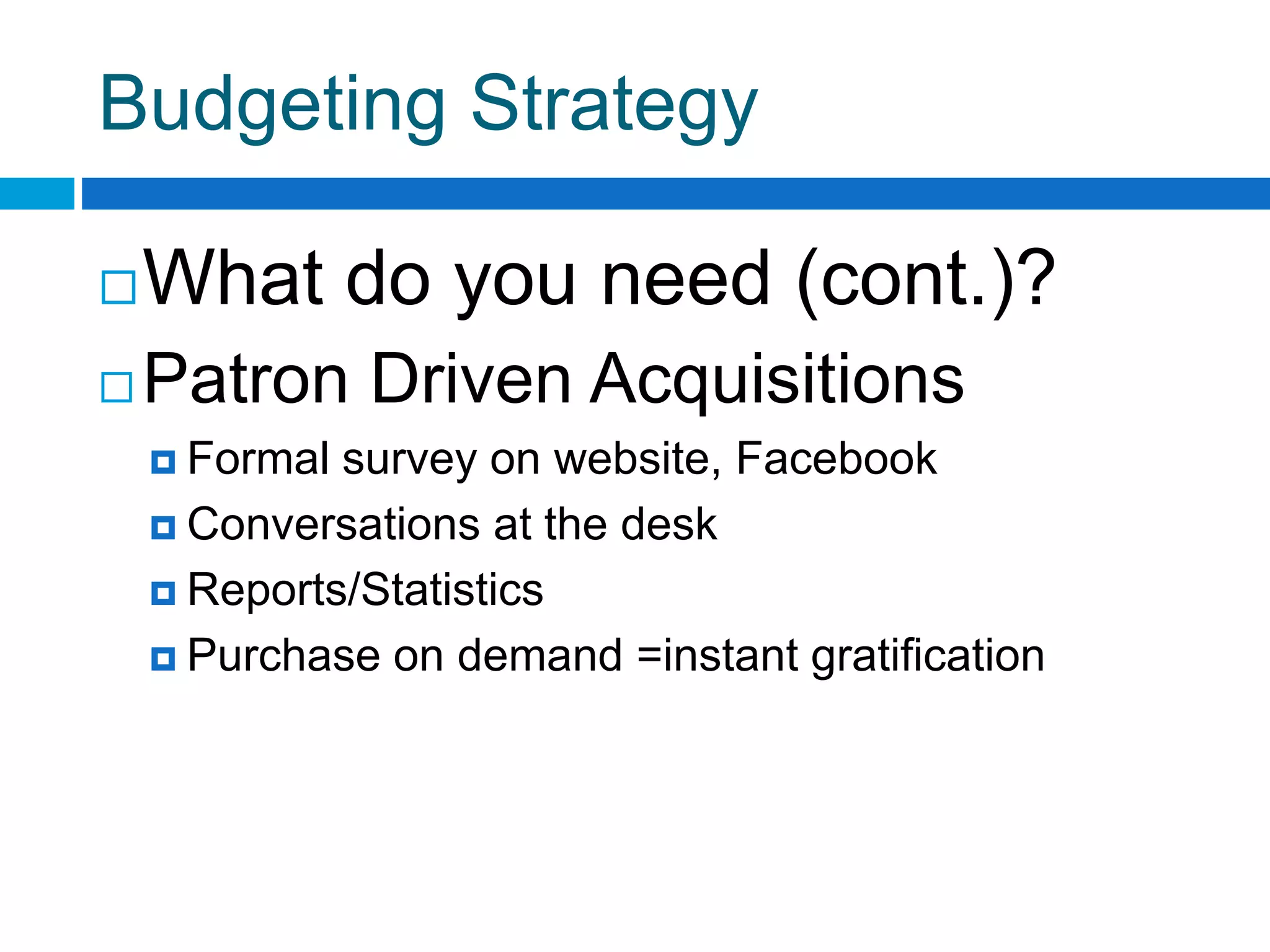
What do you need (cont.)?
 Patron Driven Acquisitions
 Formal survey on website, Facebook
 Conversations at the desk
 Reports/Statistics
 Purchase on demand =instant gratification
Budgeting Strategy
How can you make it
possible?
Latitude in the budget
Materials
Reallocation
Ask why?
Providing Cost Effective Reference
Resources
Creating a virtual “research room” with FREE
Resources
 Evaluate and assess existing resources, consider
specific user needs (Make sure they are relevant
to your community’s information needs!)
 Develop categories or subjects-research
resources available
 Make comparisons of selected resources per
subject and narrow resource list down to 5
credible sources per subject.
 Design layout, annotate and make it visible to
users
Providing Cost Effective Reference
Services
Creating virtual instruction opportunities for
FREE
 Offer live Skype instruction right from the
Reference desk during designated hours
 Record your own 3 minute video clips on “how
to…” (download an eBook to a Kindle Fire,
etc.) and upload to a YouTube account. A
great way to personalize the instruction and
promote it on social networks as “how to” of
the day.
Providing Cost Effective Reference
Promotion & Engagement
Reference and social networks FREE Promotion
 Create a social networking plan for how often to
post, what content to post, etc.
 Post links to free credible resources and explain
why you recommend them or how they can be
useful to your community.
 Ask questions, survey community
wants/needs/expectations of reference services
and/or resources
 Create a conversation with library users-for
example “What are you reading this weekend?”
Questions?
Contact info:
Monica Kuryla mkuryla@fflib.org
Heather Matzel hmatzel@fflib.org
Richard Ashby richardashby@literacynation.com
Andrew P. Jackson (Sekou Molefi Baako)
andrew.p.jackson@queenslibrary.org
Feedback: Shauntee Burns sburns@nypl.org

Get the Most for Your Money

  • 1.
    GET THE MOSTFOR YOUR $$NYLA Conference September 27, 2013 Presentation by: Monica Kuryla, Fayetteville Free Library Heather Matzel, Fayetteville Free Library Richard Ashby, President, LiteracyNation Andrew P. Jackson (Sekou Molefi Baako), Queens Library
  • 2.
    Intro  How todevelop/promote/implement programming for little to no $  Reallocating materials budget funds from print resources to support/enhance new formats.  Ways to enhance your reference service offerings at little to no cost
  • 3.
    Cost Effective Programming LiteracyNationInc.  Volunteer activities can be fun for day time patrons (DTP) and their friends.  Once a month host a “My Library” program  When your shelves are dusty or your paperbacks need weeding…DTP are great volunteers
  • 4.
    Cost Effective Programming We offer job Fairs, Resume workshops. Health seminars, Tax preparation assistance.  New York State Department of Labor will host job fairs and resume workshops, for no cost.  Local Hospitals and health agencies will also host your health fairs.  Community and local authors will be happy to come host book talks or writing workshops.
  • 5.
    Cost Effective Programming DTP come to the library for a variety of reasons.  People may go to the library looking mainly for information.  New moms connect at baby storytimes; elderly people, often facing difficult life transitions, attend events and find that they make new friends. Patrons seek new careers and employment.
  • 6.
    Cost Effective Programming Adults love games.  Set up a Game day or night for video and board games at the library they feel empowered. They will need little or no money to have a gaming event  Have the teens hand draw posters and flyers for advertisement of the programs.  DTP love Scrabble, monopoly, chest, checkers, and card games.  Offer zumba or yoga classes in the day or evening.
  • 7.
    Cost Effective Programming Craft projects can be offered to DTP in many ways: as a stand-alone project.  Morning sewing clubs, scrap book.  Collect free craft materials from friends, coworkers and relatives. “…with literacy and justice for all” www.literacynation.com
  • 8.
    Make Your Librarythe Center of Your Community By Any Means Necessary… Examples of Local Program Ideas  Local History  Talks, site tours, power points, discussions, walking tours  Genealogy Workshops  Family History Talks  Local High School Teachers or College Professor Lectures  Local Historians and Town Hall Discussions
  • 9.
    Musical Performances  OpenMic (include more than just poetry or literature readings)  Local choral groups or choirs, vocalists, choirs  Holiday music concerts  Barber Shop Quartets  Dance troupes, ensembles, schools  Music school recitals  Significant local events, celebrations  Local musicians and vocalists  School/college ensembles, bands and orchestras with Q & A  Classical, jazz, hip-hop, opera, string quartets, solo artists, orchestras, do-wop  Musical concerts featuring music from different cultures and ages  Poetry with music; artist painting with music performance  Acapella performances  Puppet and Magic Shows
  • 10.
    Library co-Sponsored Activities andEvents.  Read-A-Loud (invite prominent local participants)  Career Day (prominent local residents, business, elected officials, etc.  Library Open House (advocacy and outreach)  Library Anniversary Celebration or significant calendar dates  Friends of the Library events  Library Advocacy Day  Family Day (community celebration, inclusive, co- sponsored)
  • 11.
    Library co-Sponsored Activities andEvents.  Film Screenings and Discussions  Old and New; Black and White/Color; Silent Films  Televised prominent events, parades, celebrations, inauguration, concerts, etc)  Poet reading and discussion  Author reading and discussion (local authors, critics, journalists, etc)  Book Talk and discussion  Book Club open discussion – public invited  Film screening and discussion (biographical, old black & white, historical, etc.)  Film and book talk of same title with guest speaker
  • 12.
    Settings (Maximize youraudience and exposure) @ Library and Off-Site  Indoor or outdoor Senior Centers  Town square Hospital  In the park School yard  Library Atrium Children’s Room  YA Room Sidewalk  Courtyard or Garden City Hall
  • 13.
    Funding Sources (Notalways about the Benjamin$$ but In- Kind Services)  Library development office (grants, foundations)  Friends of the Library  Local government grants (City, County, State)  New York State Council on the Arts  Local Arts Council  New York City Department of Cultural Affairs  Elected Official’s Discretionary Grants/Funds
  • 14.
    Publicity & Outreach Website (keep it updated)  Facebook, Twitter, Blog. Pinterest, Youtube, Library’s plasma screen  Flyers & Posters (English and Other Languages if appropriate)  Bulletin Boards  Local Newspapers (paid and community bulletin board)  Public Access Television (public service announcement, ad)  Local radio interview  Churches and Senior Centers
  • 15.
    Who to Inviteto Participate  Library Board of Trustees, Director and Staff  Library Volunteers and Residents  Friends of the Library  Library Customers  Local Board of Regents Representative  Elected Officials (Town, County, City, State)  Corporate and Business leaders  Socialites and Prominent and Famous Citizens  College President and Professors  School Principals and teachers School classes, band  Athletes and Coaches (collegiate, schools, town leagues)  Boy Scouts, Girl Scouts, Brownies, Cub Scouts  Clergy and Religious Leaders  Parents, Teachers, PTA and Community Groups  Popular journalists and TV News Anchors  Friends and Neighbors  Retirees and Founding Library Staff and Board Members  Enemies :0)  In other words, invite everybody!
  • 16.
    Ideas to Consider * Combine Programs When Optional to Maximize Audience Development  * Create Program Planning Committees. Invite Outsiders to Participate.  * Give you’re your youth and elders a voice.  * Create Ownership of the Library and Programs for Success.  * Everything Doesn’t Cost BIG Money to be Successful.  * Give Yourself Ample Time to Plan and Execute Programs  * Cross Section of Programs Should Be Representative of the Culture and Ages of Your Community.  * Ask!  Andrew P. Jackson (Sekou Molefi Baako), Executive Director  Queens Library’s Langston Hughes Community Library and Cultural Center
  • 17.
    Budgeting Strategy Create richcollections and resources  Challenges:  changing formats and mediums  rapidly changing patron requests  set budgets  increasing demands on our time as librarians to support the community, we need a way to make these important decisions in a timely fashion
  • 18.
    Budgeting Strategy  Whatdo you have and why?  What do you need?  Evaluations  Patron driven acquisitions  How can you make it possible?  Be flexible  Reallocate funds
  • 19.
    Budgeting Strategy  Whatdo you have? Why? Resource Subject Area How funded? Cost Renewal date Rep contact How to find stats Novelist Reader’s Advisory By our library $1,000/year Feb 1st Amanda Poor, 1-800- 653-2726 ex. 296 http://eadmin. ebscohost.co m/eadmin/Lo gin.aspx Job & Career Accelerator Job & Career By the Consortium $0 March 1st Peg Elliot, pelliot@onlib. org Email from pelliot@ocpl. org Grolier Online Encyclopedia By the State library $0 Sept. 1st eptech@ebsc ohost.com Email eptech@ebsc ohost.com Freegal eMusic By our library $4,000/year Dec 1st Jim Petersen, (571) 730- 4300 http://www.fre egalmusic.co m/admin/user s/login
  • 20.
    Budgeting Strategy  Whatdo you need? Example of Staff evaluation: About how many times per month do you use the following to help a patron: Access Newspaper Archives ________ Rate the usefulness of this resource: not useful 1 2 3 4 5 6 7 8 9 10 very useful Biography Resource Center ________ Rate the usefulness of this resource: not useful 1 2 3 4 5 6 7 8 9 10 very useful Britannic Reference Center ________ Rate the usefulness of this resource: not useful 1 2 3 4 5 6 7 8 9 10 very useful Career Cruising ________ Rate the usefulness of this resource: not useful 1 2 3 4 5 6 7 8 9 10 very useful CultureGrams ________ Rate the usefulness of this resource: not useful 1 2 3 4 5 6 7 8 9 10 very useful
  • 21.
    Budgeting Strategy What doyou need (cont.)?  Patron Driven Acquisitions  Formal survey on website, Facebook  Conversations at the desk  Reports/Statistics  Purchase on demand =instant gratification
  • 22.
    Budgeting Strategy How canyou make it possible? Latitude in the budget Materials Reallocation Ask why?
  • 23.
    Providing Cost EffectiveReference Resources Creating a virtual “research room” with FREE Resources  Evaluate and assess existing resources, consider specific user needs (Make sure they are relevant to your community’s information needs!)  Develop categories or subjects-research resources available  Make comparisons of selected resources per subject and narrow resource list down to 5 credible sources per subject.  Design layout, annotate and make it visible to users
  • 24.
    Providing Cost EffectiveReference Services Creating virtual instruction opportunities for FREE  Offer live Skype instruction right from the Reference desk during designated hours  Record your own 3 minute video clips on “how to…” (download an eBook to a Kindle Fire, etc.) and upload to a YouTube account. A great way to personalize the instruction and promote it on social networks as “how to” of the day.
  • 25.
    Providing Cost EffectiveReference Promotion & Engagement Reference and social networks FREE Promotion  Create a social networking plan for how often to post, what content to post, etc.  Post links to free credible resources and explain why you recommend them or how they can be useful to your community.  Ask questions, survey community wants/needs/expectations of reference services and/or resources  Create a conversation with library users-for example “What are you reading this weekend?”
  • 26.
    Questions? Contact info: Monica Kurylamkuryla@fflib.org Heather Matzel hmatzel@fflib.org Richard Ashby richardashby@literacynation.com Andrew P. Jackson (Sekou Molefi Baako) andrew.p.jackson@queenslibrary.org Feedback: Shauntee Burns sburns@nypl.org