Engaging the older participant Bob Laventure  BHF National Centre for Physical Activity and Health, Loughborough University
Untapped Markets  – Ageing & Rehabilitation   Engaging the older participant Bob Laventure BHF National Centre for Physical Activity and Health, Loughborough University  and Later Life Training Ltd
Engaging the older participant  - overview of presentation Who are we targeting and why? What are the messages they want to hear and see? Using the evidence – keeping the customer satisfied What  else do we need to do? To reach and retain this untapped market Source: State of the Industry Report 2007
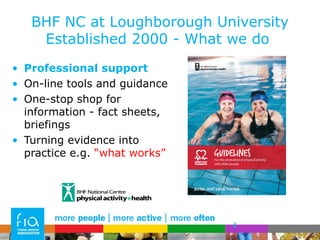
BHF NC at Loughborough University Established 2000 - What we do  Professional support On-line tools and guidance  One-stop shop for information - fact sheets, briefings Turning evidence into practice e.g.  “what works”
- Our core business The Later Life Training continuum Exercise for the Prevention of Falls & Injuries in Frailer Older People (PSI L4) Exercise and Fitness After Stroke (EFS L4) Otago Exercise Leaders Award (OEP L2) Chair-based Exercise Leaders Award (CBE) Underpinned by motivational and engagement theory “Someone Like Me” and “Motivate Me and  a range of CPD programmes
Top 10 trends in active ageing More wellness programmes More wellness professionals Convergence of rehabilitation and wellness Rejection of stereotypes of ageing Increase in energy boosting solutions Redefinition of retirement Technology, technology, technology Healthier older adult market Growth of “green exercise”  Age friendly cities  (ICAA 2011)
1. Who are we targeting and why? If there‘s no such thing as an “older consumer” - how should we differentiate? Health and functional status? Disease/referral pathway Spending power Life-stage Stages of or readiness to change More detailed market segmentation e.g. Sport England
Which older people? Entering old age (To promote and extend healthy and active life and to compress morbidity) Transitional phase (To identify emerging problems ahead of crisis and ensure effective responses which will prevent crisis and reduce long term dependency) Frail older people (Anticipate and respond to problems and recognise.. Interaction of physical, mental and social care factor s)  (The National Service Framework for Older People DOH 2001)
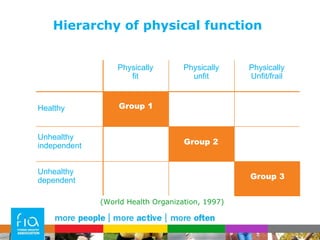
Hierarchy of physical function (World Health Organization, 1997) Physically fit Physically unfit Physically Unfit/frail Healthy Unhealthy independent Unhealthy dependent Group 1 Group 2 Group 3
Disease/referral pathways Let’s Get Moving (DH) - Primary care physical activity pathway Prevention and treatment e.g. Obesity, type 2 diabetes Disease specific (post event e.g. MI, fall or fracture, stroke) Dementia pathways NB Medical model - about patients
Life stage and status Still in work (2 nd  & 3 rd  careers) Part-time work (later retirement) Empty nesting Caring (grandchildren and own parents) Volunteering and lifelong learning Saga travel/leisure lifestyles Singles (divorced or widowed)
New generations but  wealthier ? 50+ is a society of two halves  – the health/wealth gap is widening 50+ spend £240 B per annum – 40% of total consumer spending Personal disposable income of £205 per week. 50 – 65s spend £2,761 per annum on leisure, under 30s - £1,679 BUT 31% of those retired, survive on less than £10 K a year. (Family Expenditure Survey 1999 – 2000)
Stages or readiness to change Those most in need/at risk least likely to – couch potato? The tryers, planners who want help to “fit it in, tips, strategies to try Tipping the balance with those with favourable attitudes Relapsed – returners (boomers have experienced Sport for All)
2. The messages they want to hear and see? NB They know it’s good for them and the health benefits! But is it right for me at my time of life? e.g. Energy boosting I can see myself doing that I will feel good (immediate and long term) I will get better – what does that mean ? restored confidence in themselves e.g. Sex life, ability to do X Tailored for me?
What else do they want to hear? They want a choice (control) nb. alternatives Green/blue prescription/gym Encouragement to try They will get personal attention and guidance from “someone who knows” (John Lewis) They will be with others They will get support (significant others)
Who are the significant others An authority e.g. The GP? Family Friends, acquaintances and peers Gym membership is not the social norm (what happened with fair trade coffee?) The instructor is a significant other (authority and supporter)
They want to feel safe and secure  Exercise has a bad press/reputation The evidence is otherwise “ Gentle exercise mafia” Chair based exercise - the default mode for older people (stereotype) Might make things worse or overdo it Access to your programme New guidelines will present a challenge (Strength and balance)
What else do they want to hear? What has meaning in later life? Play with the grandchildren Get out and about Stay in touch with people Look after someone else (and themselves) Anti-ageing or active ageing?
Gender differences - older women Relationships  strong motivator Previous history (esp. childhood) important The future is uncertain, so  immediate benefits please ! Caring for and supporting others “ Vulnerable” starters/newcomers , lacking in confidence Aerobic activity Women’s Sports Foundation (2006) LLT Motivati
Gender differences – older men Men more motivated by  competition, striving and challenge Strength How to  replace loss  (masculinity?) Health  denial? Differences significant at retirement  (Sport England 2009)
Self-determination theory and motivation Activities that offer Competence Autonomy Independence Social wellbeing Belonging Ryan, RM. & Deci, E.L. (2000).
Evidence on motivation Key motivations for older people to take up strength and balance training exercises? thinking you are the kind of person who should do these activities  (self efficacy) thinking other people think you should do these exercises  (social support and approval) believing that these activities would be enjoyable  (mastery and control) (Yardley 2007)
3. Using the evidence  – keeping the customer satisfied We understand quite a lot about helping people change Health outcomes/financial targets can only be achieved by physical activity maintenance (6 months and beyond) But we cherry pick the evidence Both programmes and process
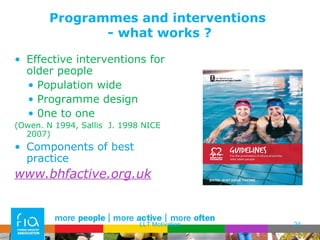
Programmes and interventions  - what works ? Effective interventions for older people Population wide Programme design 0ne to one  (Owen. N 1994, Sallis  J. 1998 NICE 2007) Components of best practice www.bhfactive.org.uk LLT Motivation
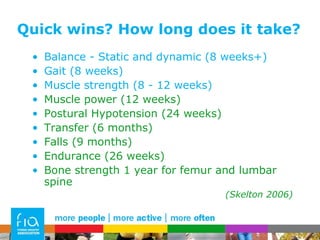
Quick wins? How long does it take? Balance - Static and dynamic (8 weeks+) Gait (8 weeks) Muscle strength (8 - 12 weeks)  Muscle power (12 weeks) Postural Hypotension (24 weeks) Transfer (6 months) Falls (9 months)  Endurance (26 weeks) Bone strength 1 year for femur and lumbar spine (Skelton 2006)
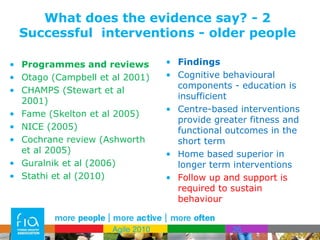
What does the evidence say? - 2 Successful  interventions - older people Programmes and reviews Otago (Campbell et al 2001)  CHAMPS (Stewart et al 2001) Fame (Skelton et al 2005) NICE (2005) Cochrane review (Ashworth et al 2005) Guralnik et al (2006) Stathi et al (2010) Findings Cognitive behavioural components - education is insufficient Centre-based interventions provide greater fitness and functional outcomes in the short term  Home based superior in longer term interventions Follow up and support is required to sustain behaviour Agile 2010
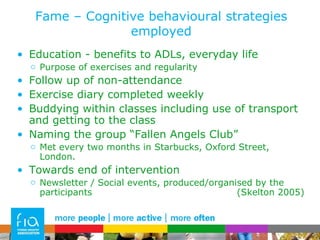
Fame – Cognitive behavioural strategies employed Education - benefits to ADLs, everyday life Purpose of exercises and regularity Follow up of non-attendance Exercise diary completed weekly Buddying within classes including use of transport and getting to the class Naming the group “Fallen Angels Club” Met every two months in Starbucks, Oxford Street, London. Towards end of intervention Newsletter / Social events, produced/organised by the participants  (Skelton 2005)
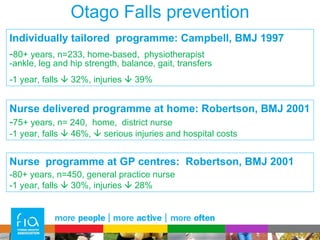
Otago Falls prevention Individually tailored  programme: Campbell, BMJ 1997 - 80+ years, n=233, home-based,  physiotherapist  - ankle, leg and hip strength, balance, gait, transfers -1 year, falls    32%, injuries    39% Nurse delivered programme at home: Robertson, BMJ 2001 - 75+ years, n= 240,  home,  district nurse -1 year, falls    46%,    serious injuries and hospital costs  Nurse  programme at GP centres:  Robertson, BMJ 2001 -80+ years, n=450, general practice nurse -1 year, falls    30%, injuries    28%
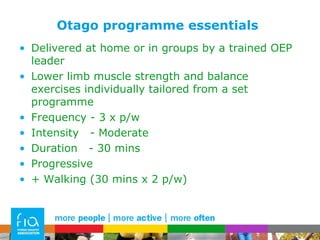
Otago programme essentials Delivered at home or in groups by a trained OEP leader Lower limb muscle strength and balance exercises individually tailored from a set programme Frequency - 3 x p/w Intensity  - Moderate Duration  - 30 mins Progressive + Walking (30 mins x 2 p/w)
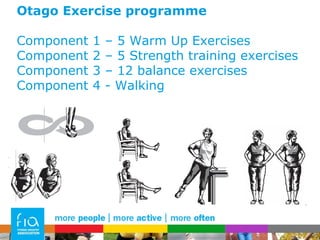
Otago Exercise programme Component 1 – 5 Warm Up Exercises Component 2 – 5 Strength training exercises Component 3 – 12 balance exercises Component 4 - Walking
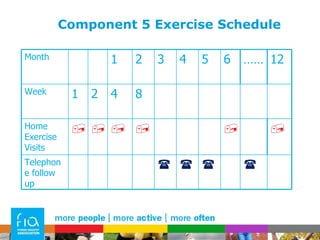
Component 5 Exercise Schedule Month 1 2 3 4 5 6 …… 12 Week 1 2 4 8 Home Exercise Visits       Telephone follow up    
Effectiveness – using all the evidence We concentrate on the exercise prescription (FIT) at the expense of  The cognitive behavioural e.g.  Increasing self-efficacy  Support strategies e.g. Peers/buddies or professionals,  Goal setting and review, education and problem solving, communication (NICE 2007, BHF NC 2008)  Problem? some components demand resources, cost money
LIFE – P programme Standardised 12 month programme Delivered in leisure centres and fitness/health clubs.  three phases:  Adoption (weeks 1–8)  Transition (weeks 9–24)  Maintenance (weeks 25 to 52). Different strategies required at each stage (Espelande et al 2007)
Adoption phase 1- 8 weeks Getting started – 1 st  steps Just getting there To establish physical activity behaviour  build confidence and a sense of attachment to the programme Activities designed with social involvement and enjoyment as a priority  stimulate improvements in physical activity and fitness (early wins)
1 st  experiences NB 50% of referrals don’t turn up! Following major event, MI, Fall, Stroke (denial/fear) To overcome nervousness (the unknown) Welcome and induction – how? The instructor - an authority? – do they know what they are doing Familiarity - routines, exercises
Transition phase (9 – 24 weeks) Add a programme of bi weekly social and educational sessions  Emphasis on lifestyle behaviour change Learning strategies and peer led solutions  Build social interaction and group identity Re-enforcing physical activity and behaviour change Learning to exercise
Maintenance phase 25 – 52 weeks Continued access to centre-based sessions ... and Encourage sustained home-based activity and closer connections with activity opportunities in local neighbourhoods.  Support from community activators (peers) Anticipate relapse (it’s normal) Sustaining to maintenace
4. What else do we need to do? Age friendly facilities and equipment Age friendly programmes Age friendly workforce skills
Age Friendly Facilities Feeling comfortable in the environment  Somewhere to sit out or rest  Music! Music! Music! Visual acuity- signage Who will help me, personal attention Social activities (golf club as the model?) Use mystery shoppers and learning from Inclusive Fitness Initiative (ICAA 2008)
Age friendly equipment Display panels, easy to read, change Low starting speeds (0.5 mph) Minimal pre-programmed workouts Access to weight machines for those with functional limitations Low starting resistance Small (1lb?) incremental increases in weight  Stable seating and support rails (ICAA 2008)
Age friendly programmes Senior specific or integrated? Educational opportunities, newsletters Customer care and support Accessible for those with conditions e.g. balance abnormalities Advice on nutrition, pain management, stress management Older, older people (80+)
Age friendly workforce skills Communication skills Programming skills Personal training skills Certified by training organisation to work with conditions e.g  Osteoporosis Ongoing support, e.g. telephone contact, follow up
Communication with the older customer Language and jargon Information processing speed and learning Understanding motivation Technology Instructions, learning re-enforcement, new skills, movements
What is the USP of the fitness industry? What do you offer that the older person can’t get anywhere else? Why would they want/need it?
A date for your diary ! The 8 th  World Congress on Active Ageing SECC – Glasgow August 13 th  – 17 th  2012 Will I see you there ?
Thank you for listening [email_address] www.bhfactive.org.uk www.wcaa2012.com www.active-ageing-events.org.uk

Engaging the older Participant

  • 1.
    Engaging the olderparticipant Bob Laventure BHF National Centre for Physical Activity and Health, Loughborough University
  • 2.
    Untapped Markets – Ageing & Rehabilitation Engaging the older participant Bob Laventure BHF National Centre for Physical Activity and Health, Loughborough University and Later Life Training Ltd
  • 3.
    Engaging the olderparticipant - overview of presentation Who are we targeting and why? What are the messages they want to hear and see? Using the evidence – keeping the customer satisfied What else do we need to do? To reach and retain this untapped market Source: State of the Industry Report 2007
  • 4.
    BHF NC atLoughborough University Established 2000 - What we do Professional support On-line tools and guidance One-stop shop for information - fact sheets, briefings Turning evidence into practice e.g. “what works”
  • 5.
    - Our corebusiness The Later Life Training continuum Exercise for the Prevention of Falls & Injuries in Frailer Older People (PSI L4) Exercise and Fitness After Stroke (EFS L4) Otago Exercise Leaders Award (OEP L2) Chair-based Exercise Leaders Award (CBE) Underpinned by motivational and engagement theory “Someone Like Me” and “Motivate Me and a range of CPD programmes
  • 6.
    Top 10 trendsin active ageing More wellness programmes More wellness professionals Convergence of rehabilitation and wellness Rejection of stereotypes of ageing Increase in energy boosting solutions Redefinition of retirement Technology, technology, technology Healthier older adult market Growth of “green exercise” Age friendly cities (ICAA 2011)
  • 7.
    1. Who arewe targeting and why? If there‘s no such thing as an “older consumer” - how should we differentiate? Health and functional status? Disease/referral pathway Spending power Life-stage Stages of or readiness to change More detailed market segmentation e.g. Sport England
  • 8.
    Which older people?Entering old age (To promote and extend healthy and active life and to compress morbidity) Transitional phase (To identify emerging problems ahead of crisis and ensure effective responses which will prevent crisis and reduce long term dependency) Frail older people (Anticipate and respond to problems and recognise.. Interaction of physical, mental and social care factor s) (The National Service Framework for Older People DOH 2001)
  • 9.
    Hierarchy of physicalfunction (World Health Organization, 1997) Physically fit Physically unfit Physically Unfit/frail Healthy Unhealthy independent Unhealthy dependent Group 1 Group 2 Group 3
  • 10.
    Disease/referral pathways Let’sGet Moving (DH) - Primary care physical activity pathway Prevention and treatment e.g. Obesity, type 2 diabetes Disease specific (post event e.g. MI, fall or fracture, stroke) Dementia pathways NB Medical model - about patients
  • 11.
    Life stage andstatus Still in work (2 nd & 3 rd careers) Part-time work (later retirement) Empty nesting Caring (grandchildren and own parents) Volunteering and lifelong learning Saga travel/leisure lifestyles Singles (divorced or widowed)
  • 12.
    New generations but wealthier ? 50+ is a society of two halves – the health/wealth gap is widening 50+ spend £240 B per annum – 40% of total consumer spending Personal disposable income of £205 per week. 50 – 65s spend £2,761 per annum on leisure, under 30s - £1,679 BUT 31% of those retired, survive on less than £10 K a year. (Family Expenditure Survey 1999 – 2000)
  • 13.
    Stages or readinessto change Those most in need/at risk least likely to – couch potato? The tryers, planners who want help to “fit it in, tips, strategies to try Tipping the balance with those with favourable attitudes Relapsed – returners (boomers have experienced Sport for All)
  • 14.
    2. The messagesthey want to hear and see? NB They know it’s good for them and the health benefits! But is it right for me at my time of life? e.g. Energy boosting I can see myself doing that I will feel good (immediate and long term) I will get better – what does that mean ? restored confidence in themselves e.g. Sex life, ability to do X Tailored for me?
  • 15.
    What else dothey want to hear? They want a choice (control) nb. alternatives Green/blue prescription/gym Encouragement to try They will get personal attention and guidance from “someone who knows” (John Lewis) They will be with others They will get support (significant others)
  • 16.
    Who are thesignificant others An authority e.g. The GP? Family Friends, acquaintances and peers Gym membership is not the social norm (what happened with fair trade coffee?) The instructor is a significant other (authority and supporter)
  • 17.
    They want tofeel safe and secure Exercise has a bad press/reputation The evidence is otherwise “ Gentle exercise mafia” Chair based exercise - the default mode for older people (stereotype) Might make things worse or overdo it Access to your programme New guidelines will present a challenge (Strength and balance)
  • 18.
    What else dothey want to hear? What has meaning in later life? Play with the grandchildren Get out and about Stay in touch with people Look after someone else (and themselves) Anti-ageing or active ageing?
  • 19.
    Gender differences -older women Relationships strong motivator Previous history (esp. childhood) important The future is uncertain, so immediate benefits please ! Caring for and supporting others “ Vulnerable” starters/newcomers , lacking in confidence Aerobic activity Women’s Sports Foundation (2006) LLT Motivati
  • 20.
    Gender differences –older men Men more motivated by competition, striving and challenge Strength How to replace loss (masculinity?) Health denial? Differences significant at retirement (Sport England 2009)
  • 21.
    Self-determination theory andmotivation Activities that offer Competence Autonomy Independence Social wellbeing Belonging Ryan, RM. & Deci, E.L. (2000).
  • 22.
    Evidence on motivationKey motivations for older people to take up strength and balance training exercises? thinking you are the kind of person who should do these activities (self efficacy) thinking other people think you should do these exercises (social support and approval) believing that these activities would be enjoyable (mastery and control) (Yardley 2007)
  • 23.
    3. Using theevidence – keeping the customer satisfied We understand quite a lot about helping people change Health outcomes/financial targets can only be achieved by physical activity maintenance (6 months and beyond) But we cherry pick the evidence Both programmes and process
  • 24.
    Programmes and interventions - what works ? Effective interventions for older people Population wide Programme design 0ne to one (Owen. N 1994, Sallis J. 1998 NICE 2007) Components of best practice www.bhfactive.org.uk LLT Motivation
  • 25.
    Quick wins? Howlong does it take? Balance - Static and dynamic (8 weeks+) Gait (8 weeks) Muscle strength (8 - 12 weeks) Muscle power (12 weeks) Postural Hypotension (24 weeks) Transfer (6 months) Falls (9 months) Endurance (26 weeks) Bone strength 1 year for femur and lumbar spine (Skelton 2006)
  • 26.
    What does theevidence say? - 2 Successful interventions - older people Programmes and reviews Otago (Campbell et al 2001) CHAMPS (Stewart et al 2001) Fame (Skelton et al 2005) NICE (2005) Cochrane review (Ashworth et al 2005) Guralnik et al (2006) Stathi et al (2010) Findings Cognitive behavioural components - education is insufficient Centre-based interventions provide greater fitness and functional outcomes in the short term Home based superior in longer term interventions Follow up and support is required to sustain behaviour Agile 2010
  • 27.
    Fame – Cognitivebehavioural strategies employed Education - benefits to ADLs, everyday life Purpose of exercises and regularity Follow up of non-attendance Exercise diary completed weekly Buddying within classes including use of transport and getting to the class Naming the group “Fallen Angels Club” Met every two months in Starbucks, Oxford Street, London. Towards end of intervention Newsletter / Social events, produced/organised by the participants (Skelton 2005)
  • 28.
    Otago Falls preventionIndividually tailored programme: Campbell, BMJ 1997 - 80+ years, n=233, home-based, physiotherapist - ankle, leg and hip strength, balance, gait, transfers -1 year, falls  32%, injuries  39% Nurse delivered programme at home: Robertson, BMJ 2001 - 75+ years, n= 240, home, district nurse -1 year, falls  46%,  serious injuries and hospital costs Nurse programme at GP centres: Robertson, BMJ 2001 -80+ years, n=450, general practice nurse -1 year, falls  30%, injuries  28%
  • 29.
    Otago programme essentialsDelivered at home or in groups by a trained OEP leader Lower limb muscle strength and balance exercises individually tailored from a set programme Frequency - 3 x p/w Intensity - Moderate Duration - 30 mins Progressive + Walking (30 mins x 2 p/w)
  • 30.
    Otago Exercise programmeComponent 1 – 5 Warm Up Exercises Component 2 – 5 Strength training exercises Component 3 – 12 balance exercises Component 4 - Walking
  • 31.
    Component 5 ExerciseSchedule Month 1 2 3 4 5 6 …… 12 Week 1 2 4 8 Home Exercise Visits       Telephone follow up    
  • 32.
    Effectiveness – usingall the evidence We concentrate on the exercise prescription (FIT) at the expense of The cognitive behavioural e.g. Increasing self-efficacy Support strategies e.g. Peers/buddies or professionals, Goal setting and review, education and problem solving, communication (NICE 2007, BHF NC 2008) Problem? some components demand resources, cost money
  • 33.
    LIFE – Pprogramme Standardised 12 month programme Delivered in leisure centres and fitness/health clubs. three phases: Adoption (weeks 1–8) Transition (weeks 9–24) Maintenance (weeks 25 to 52). Different strategies required at each stage (Espelande et al 2007)
  • 34.
    Adoption phase 1-8 weeks Getting started – 1 st steps Just getting there To establish physical activity behaviour build confidence and a sense of attachment to the programme Activities designed with social involvement and enjoyment as a priority stimulate improvements in physical activity and fitness (early wins)
  • 35.
    1 st experiences NB 50% of referrals don’t turn up! Following major event, MI, Fall, Stroke (denial/fear) To overcome nervousness (the unknown) Welcome and induction – how? The instructor - an authority? – do they know what they are doing Familiarity - routines, exercises
  • 36.
    Transition phase (9– 24 weeks) Add a programme of bi weekly social and educational sessions Emphasis on lifestyle behaviour change Learning strategies and peer led solutions Build social interaction and group identity Re-enforcing physical activity and behaviour change Learning to exercise
  • 37.
    Maintenance phase 25– 52 weeks Continued access to centre-based sessions ... and Encourage sustained home-based activity and closer connections with activity opportunities in local neighbourhoods. Support from community activators (peers) Anticipate relapse (it’s normal) Sustaining to maintenace
  • 38.
    4. What elsedo we need to do? Age friendly facilities and equipment Age friendly programmes Age friendly workforce skills
  • 39.
    Age Friendly FacilitiesFeeling comfortable in the environment Somewhere to sit out or rest Music! Music! Music! Visual acuity- signage Who will help me, personal attention Social activities (golf club as the model?) Use mystery shoppers and learning from Inclusive Fitness Initiative (ICAA 2008)
  • 40.
    Age friendly equipmentDisplay panels, easy to read, change Low starting speeds (0.5 mph) Minimal pre-programmed workouts Access to weight machines for those with functional limitations Low starting resistance Small (1lb?) incremental increases in weight Stable seating and support rails (ICAA 2008)
  • 41.
    Age friendly programmesSenior specific or integrated? Educational opportunities, newsletters Customer care and support Accessible for those with conditions e.g. balance abnormalities Advice on nutrition, pain management, stress management Older, older people (80+)
  • 42.
    Age friendly workforceskills Communication skills Programming skills Personal training skills Certified by training organisation to work with conditions e.g Osteoporosis Ongoing support, e.g. telephone contact, follow up
  • 43.
    Communication with theolder customer Language and jargon Information processing speed and learning Understanding motivation Technology Instructions, learning re-enforcement, new skills, movements
  • 44.
    What is theUSP of the fitness industry? What do you offer that the older person can’t get anywhere else? Why would they want/need it?
  • 45.
    A date foryour diary ! The 8 th World Congress on Active Ageing SECC – Glasgow August 13 th – 17 th 2012 Will I see you there ?
  • 46.
    Thank you forlistening [email_address] www.bhfactive.org.uk www.wcaa2012.com www.active-ageing-events.org.uk

Editor's Notes

  • #6 We offer a range of products – the four on the screen – I will return to these later in the presentation. We also offer bespoke training and awareness raising and all courses have a CPD programme to ensure that the professionals we work with remain up to date and evidence based. The four core products are all based on research evidence and have been fully validated and accredited by National Bodies.
  • #10 Health/fitness gradient The World Health Organization has provided the following classification of older adults according to their physical activity and health status (World Health Organization, 1997). Group 1: Physically fit – Healthy These individuals regularly engage in appropriate physical activity. They can be described as physically fit and can participate in all activities of daily living. Group 2: Physically unfit – Healthy independent These individuals are not engaged in physical activity. Although they are still living independently, they are beginning to develop chronic medical conditions which threaten their independence. Regular physical activity can improve functional capacity and prevent loss of independence. Group 3: Physically unfit frail – Unhealthy dependent These individuals are no longer able to function independently in society due to a variety of physical and/or psychological reasons. Appropriate physical activity can significantly enhance the quality of life and restore independence in some areas of functioning.
  • #29 Physiological studies : Exercise shown to increase muscle strength and improve balance thus provide rational for using it to attempt tp reduce falls. FICSIT metan.(5comm, 2 Nh)-Province 1999,2-4 yrs, dif progs,subjects assigned to an x gp less likely to fall. No x component sig for injurious falls Cochrane review 1997- incons. Data. x alone did not protect against falls Tai Chi: (Atlanta FICSIT): 48% reduction (adjusted for fall risk factors) cf computerised balance training programme(interestingly only controlgp improved balanced showing importance of fall as primary measure (Mcmurdo) Campbell 1997 : -cognitively intact, able to move around house - 4 1 hr visits over 2 months- individ 30 min progrm of strengthening exercises using ankle weights and balance training exercises included standing with one foot directlt in front of the other, walking tandem, heel walking, toe walking, knee squats. 3+ times a week and also walk outside home at least 3 times a week. -also relative hazard for injurious falls reduced and balance scores improved Campbell 1999 Age Ageing: rate of falls remained sig lower in the ex group than control gp at 2 years in those who continued the programme. Robertson; Nurse home : serious injuries and hosp admissions reduced. -cost /fall (1988 prices) Pv = NZ$1803 (£523) IRR = Inc rate ratio -cost / fall averted considering hospital costs NZ$155 (£45) Robertson: nurse. GP centres: no diff in serious injuries or hosp. Costs -cost/ fall averted : NZ$1519 (£441) Ebrahims 97, AgeAgeing brisk walking gp: falls up, therefore x is not x is not x. Qualified x practitioners-graded strengthening+ walking program