For more, visit EngagingScience.eu
Sinking island
Equipping the Next Generation for Active Engagement in Science
2
Objectives
To use what you know about climate
change to explain rising sea levels.
To make a prediction about rising sea
levels and estimate the uncertainty in
your prediction.
3
ISLAND TRAGEDY
Two tiny Kiribati islets
are already beneath the
Pacific.
Islanders fear that rising
seas will soon submerge
more of Kiribati’s
32 islands.
DAILY NEWS
STARTER
My home is
disappearing under
the sea.
I’m saving what I can
… but I will never return.
This used to
be my living
room.
3
4
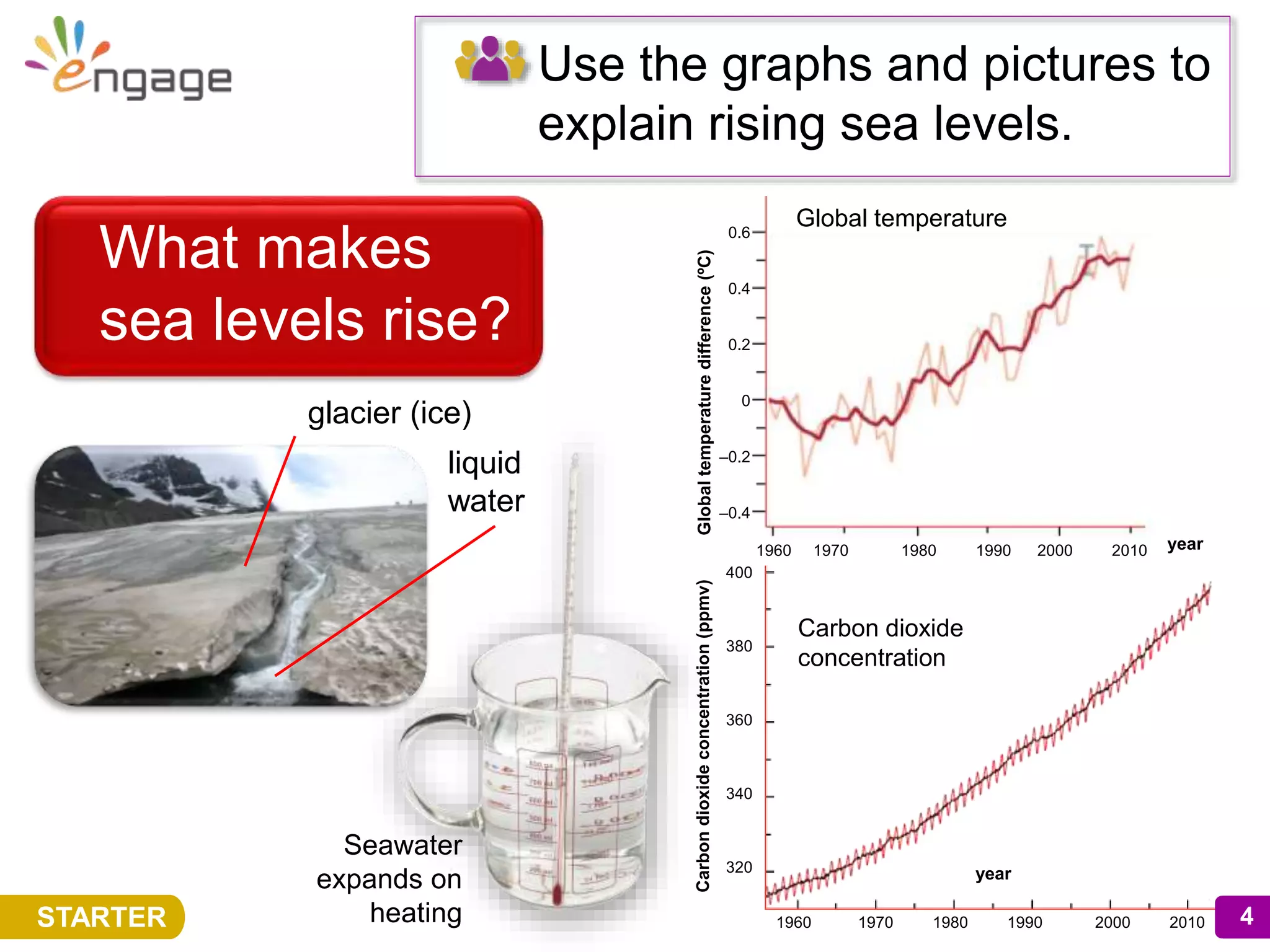
Use the graphs and pictures to
explain rising sea levels.
What makes
sea levels rise?
4STARTER
glacier (ice)
liquid
water
Seawater
expands on
heating
Globaltemperaturedifference(ºC)
Global temperature0.6
0.4
0.2
0
–0.2
–0.4
1960 1970 1980 1990 2000 2010 year
1960 1970 1980 1990 2000 2010
400
380
360
340
320
Carbondioxideconcentration(ppmv)
year
Carbon dioxide
concentration
4
5
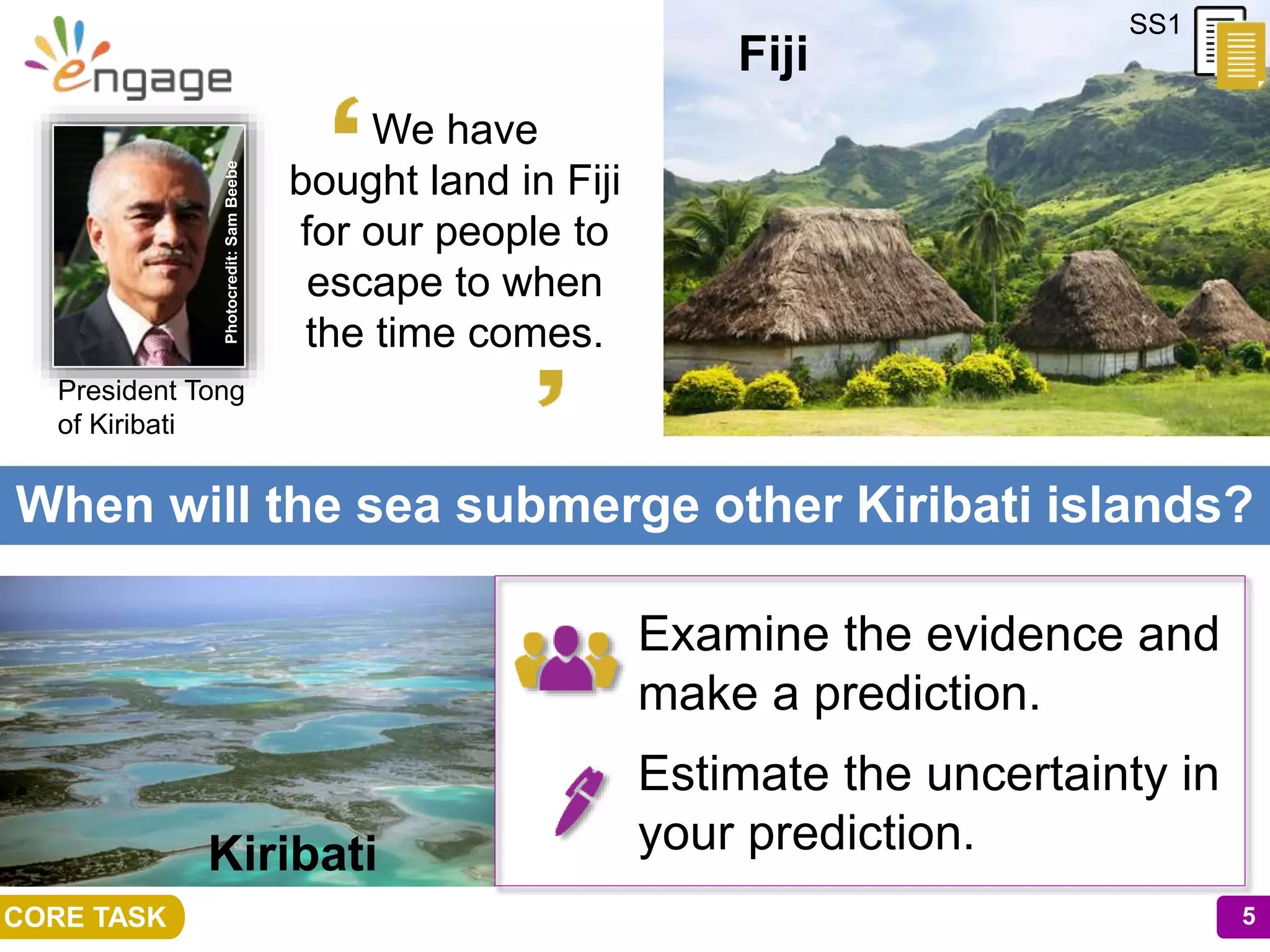
When will the sea submerge other Kiribati islands?
5CORE TASK
SS1
Fiji
Examine the evidence and
make a prediction.
Estimate the uncertainty in
your prediction.
We have
bought land in Fiji
for our people to
escape to when
the time comes.
Kiribati
President Tong
of Kiribati
Photocredit:SamBeebe
66EXTENSION
SS2 – 6
Climate change makes
sea levels rise.
Weigh up the evidence and
make a conclusion.
Can you be sure your
conclusion is correct?
Are humans to blame
for climate change?
7
Should the countries that make
the most carbon dioxide buy land for
vulnerable islanders to escape to?
7PLENARY
Vote yes or no.
How did you decide?
Were all your reasons
scientific?
If humans are to blame for
climate change…
Get students talking and thinking
For more, visit EngagingScience.eu
Student sheets
Sinking island
Sheet no. Title Notes
SS1 Kiribati – sink or survive? Reusable
SS2 Are humans to blame for climate
change?
Consumable. One per group.
SS3 – SS6 Climate change statements Reusable. Cut each student sheet in half.
Laminate and display around the room.
SS1
Kiribati – sink or survive?
Kiribati
 On most islands the highest
point is less than
3 m above sea level.
 Thousands of people live on
land that is 40 cm or less
above sea level.
3 m
40 cm
Part of a Kiribati island
What to do
1 Read this page. Why do scientists not know the values of future input variables?
 Use the dotted lines to find the
maximum and minimum predicted
sea level rises by 2030.
 Write down the predicted sea level
rise by 2030 as an uncertainty.
 Work out the predicted sea level rise
by 2080, and write it as an
uncertainty.
2 On the graph:
 Use the solid line to predict when the
sea will cover land that is 40 cm or less
above sea level.
 Use the left dotted line to predict the
earliest year the sea is likely to cover
land that is 40 cm or less above sea
level. How old will you be then?
 Use the solid line to find the average
predicted sea level rise by 2030.
Uncertainty
Scientists run computer models to predict sea level rises
for different years.
For any one year, say 2040, they cannot know the
values of input variables such as carbon dioxide
concentration. So scientists input maximum and
minimum predicted values for these variables.
The different values for each variable give a range of
predictions for sea level rise by 2040 (4 to 24 cm.)
This range of values for the prediction is expressed as
an uncertainty:
Predicted sea level rise by 2040 = (14 cm ± 10 cm)
Predicted sea level rise
Predictedsealevelrisesince1990(cm)
90
80
70
60
50
40
30
20
10
0
1990 2000 2010 2020 2030 2040 2050 2060 2070 2080 2090 2100
Maximum
predicted sea
level rise
Average
predicted sea
level rise
Minimum
predicted sea
level rise
year
SS2
Are humans to blame for climate change?
Study the statements
around the room. Write the letter
of each statement in one
column.
Weigh up the evidence and
make a conclusion: are
humans to blame for climate
change?
Discuss: How confident are you
in your conclusion? For help,
see can we be sure...
Statements
that are
opinions
Evidence that
climate change
is happening
Evidence that
humans are to
blame for
climate change
Evidence that
humans are
not to blame
for climate
change
Can we be sure…
 how much carbon dioxide
(and other greenhouse gases,
like methane) come from human
activities?
 how greenhouse gases affect global
temperatures?
 how other factors affect global
temperatures?
SS3
Climate change statements
Statement A Statement B
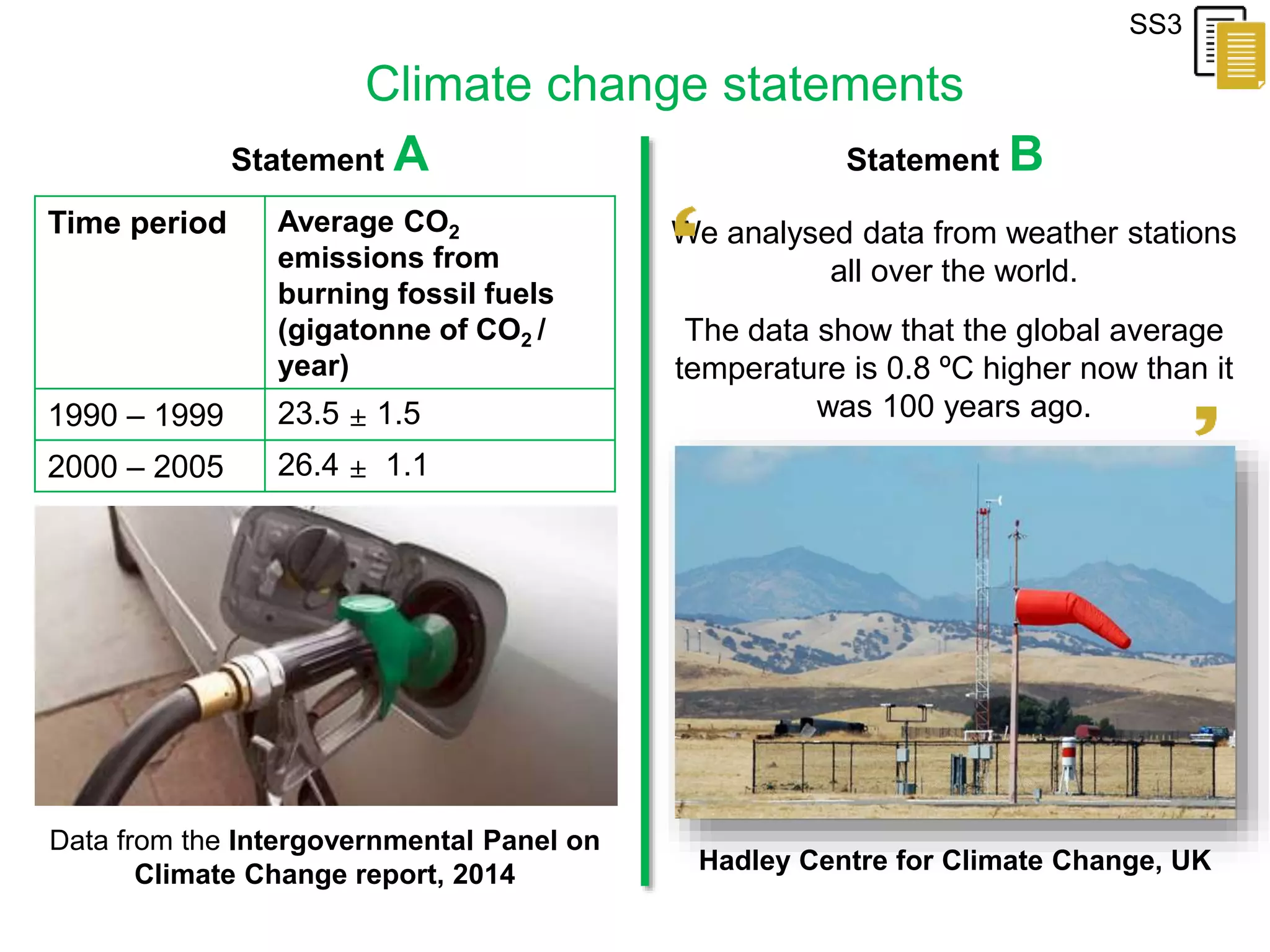
We analysed data from weather stations
all over the world.
The data show that the global average
temperature is 0.8 ºC higher now than it
was 100 years ago.
Hadley Centre for Climate Change, UK
Time period Average CO2
emissions from
burning fossil fuels
(gigatonne of CO2 /
year)
1990 – 1999 23.5 ± 1.5
2000 – 2005 26.4 ± 1.1
Data from the Intergovernmental Panel on
Climate Change report, 2014
SS4
Climate change statements
Al Gore, former US vice-president Intergovernmental Panel on
Climate Change report, 2014
The total global temperature
increase from 1850-1899 to 2001-
2005 is 0.76 ºC ± 0.19 ºC.
Nobody will do anything
about climate change unless they
are convinced humans are
responsible for it.
Statement C Statement D
SS5
Philip Stott
retired professor of biogeography
Methane is a greenhouse gas. It is
produced by cattle and growing rice.
Year Concentration of methane
in the atmosphere (parts
per billion)
1750 715
1990 1732
2005 1774
Data from the Intergovernmental
Panel on Climate Change report, 2014
Climate change statements
Statement E Statement F
Climate change is
too complicated to be
caused by just one factor.
It is governed by hundreds of factors,
including the Sun, volcanoes, water
vapour, methane, carbon dioxide and
atmospheric dust.
SS6
The European FoundationGraph from NASA
The graph shows the global
temperature difference compared to
the average temperature between
1951 and 1980.
The vertical black lines show
uncertainty.
Climate change statements
Statement G Statement H
Significant changes in
climate have continually occurred
throughout time
Graph credit: NASA
Last Ice Age
Globalaveragetemperature
comparedtopresent(ºC)
Time (millions of years before present)
2
0
–2
–4
–6
0.8 0.7 0.6 0.5 0.4 0.3 0.2 0.1 0
0.6
0.4
0.2
0
–0.2
–0.4
Globaltemperaturedifference(ºC)
1880 1900 1920 1940 1960 1980 2000
Global temperature
year
uncertainty
Get students talking and thinking
Equipping the Next Generation for Active Engagement in Science

ENGAGE sinking island

  • 1.
    For more, visitEngagingScience.eu Sinking island Equipping the Next Generation for Active Engagement in Science
  • 2.
    2 Objectives To use whatyou know about climate change to explain rising sea levels. To make a prediction about rising sea levels and estimate the uncertainty in your prediction.
  • 3.
    3 ISLAND TRAGEDY Two tinyKiribati islets are already beneath the Pacific. Islanders fear that rising seas will soon submerge more of Kiribati’s 32 islands. DAILY NEWS STARTER My home is disappearing under the sea. I’m saving what I can … but I will never return. This used to be my living room. 3
  • 4.
    4 Use the graphsand pictures to explain rising sea levels. What makes sea levels rise? 4STARTER glacier (ice) liquid water Seawater expands on heating Globaltemperaturedifference(ºC) Global temperature0.6 0.4 0.2 0 –0.2 –0.4 1960 1970 1980 1990 2000 2010 year 1960 1970 1980 1990 2000 2010 400 380 360 340 320 Carbondioxideconcentration(ppmv) year Carbon dioxide concentration 4
  • 5.
    5 When will thesea submerge other Kiribati islands? 5CORE TASK SS1 Fiji Examine the evidence and make a prediction. Estimate the uncertainty in your prediction. We have bought land in Fiji for our people to escape to when the time comes. Kiribati President Tong of Kiribati Photocredit:SamBeebe
  • 6.
    66EXTENSION SS2 – 6 Climatechange makes sea levels rise. Weigh up the evidence and make a conclusion. Can you be sure your conclusion is correct? Are humans to blame for climate change?
  • 7.
    7 Should the countriesthat make the most carbon dioxide buy land for vulnerable islanders to escape to? 7PLENARY Vote yes or no. How did you decide? Were all your reasons scientific? If humans are to blame for climate change…
  • 8.
  • 9.
    For more, visitEngagingScience.eu Student sheets Sinking island Sheet no. Title Notes SS1 Kiribati – sink or survive? Reusable SS2 Are humans to blame for climate change? Consumable. One per group. SS3 – SS6 Climate change statements Reusable. Cut each student sheet in half. Laminate and display around the room.
  • 10.
    SS1 Kiribati – sinkor survive? Kiribati  On most islands the highest point is less than 3 m above sea level.  Thousands of people live on land that is 40 cm or less above sea level. 3 m 40 cm Part of a Kiribati island What to do 1 Read this page. Why do scientists not know the values of future input variables?  Use the dotted lines to find the maximum and minimum predicted sea level rises by 2030.  Write down the predicted sea level rise by 2030 as an uncertainty.  Work out the predicted sea level rise by 2080, and write it as an uncertainty. 2 On the graph:  Use the solid line to predict when the sea will cover land that is 40 cm or less above sea level.  Use the left dotted line to predict the earliest year the sea is likely to cover land that is 40 cm or less above sea level. How old will you be then?  Use the solid line to find the average predicted sea level rise by 2030. Uncertainty Scientists run computer models to predict sea level rises for different years. For any one year, say 2040, they cannot know the values of input variables such as carbon dioxide concentration. So scientists input maximum and minimum predicted values for these variables. The different values for each variable give a range of predictions for sea level rise by 2040 (4 to 24 cm.) This range of values for the prediction is expressed as an uncertainty: Predicted sea level rise by 2040 = (14 cm ± 10 cm) Predicted sea level rise Predictedsealevelrisesince1990(cm) 90 80 70 60 50 40 30 20 10 0 1990 2000 2010 2020 2030 2040 2050 2060 2070 2080 2090 2100 Maximum predicted sea level rise Average predicted sea level rise Minimum predicted sea level rise year
  • 11.
    SS2 Are humans toblame for climate change? Study the statements around the room. Write the letter of each statement in one column. Weigh up the evidence and make a conclusion: are humans to blame for climate change? Discuss: How confident are you in your conclusion? For help, see can we be sure... Statements that are opinions Evidence that climate change is happening Evidence that humans are to blame for climate change Evidence that humans are not to blame for climate change Can we be sure…  how much carbon dioxide (and other greenhouse gases, like methane) come from human activities?  how greenhouse gases affect global temperatures?  how other factors affect global temperatures?
  • 12.
    SS3 Climate change statements StatementA Statement B We analysed data from weather stations all over the world. The data show that the global average temperature is 0.8 ºC higher now than it was 100 years ago. Hadley Centre for Climate Change, UK Time period Average CO2 emissions from burning fossil fuels (gigatonne of CO2 / year) 1990 – 1999 23.5 ± 1.5 2000 – 2005 26.4 ± 1.1 Data from the Intergovernmental Panel on Climate Change report, 2014
  • 13.
    SS4 Climate change statements AlGore, former US vice-president Intergovernmental Panel on Climate Change report, 2014 The total global temperature increase from 1850-1899 to 2001- 2005 is 0.76 ºC ± 0.19 ºC. Nobody will do anything about climate change unless they are convinced humans are responsible for it. Statement C Statement D
  • 14.
    SS5 Philip Stott retired professorof biogeography Methane is a greenhouse gas. It is produced by cattle and growing rice. Year Concentration of methane in the atmosphere (parts per billion) 1750 715 1990 1732 2005 1774 Data from the Intergovernmental Panel on Climate Change report, 2014 Climate change statements Statement E Statement F Climate change is too complicated to be caused by just one factor. It is governed by hundreds of factors, including the Sun, volcanoes, water vapour, methane, carbon dioxide and atmospheric dust.
  • 15.
    SS6 The European FoundationGraphfrom NASA The graph shows the global temperature difference compared to the average temperature between 1951 and 1980. The vertical black lines show uncertainty. Climate change statements Statement G Statement H Significant changes in climate have continually occurred throughout time Graph credit: NASA Last Ice Age Globalaveragetemperature comparedtopresent(ºC) Time (millions of years before present) 2 0 –2 –4 –6 0.8 0.7 0.6 0.5 0.4 0.3 0.2 0.1 0 0.6 0.4 0.2 0 –0.2 –0.4 Globaltemperaturedifference(ºC) 1880 1900 1920 1940 1960 1980 2000 Global temperature year uncertainty
  • 16.
  • 17.
    Equipping the NextGeneration for Active Engagement in Science