





For more, visit EngagingScience.eu
Two degrees (1 of 2)
Equipping the Next Generation for Active Engagement in Science
2
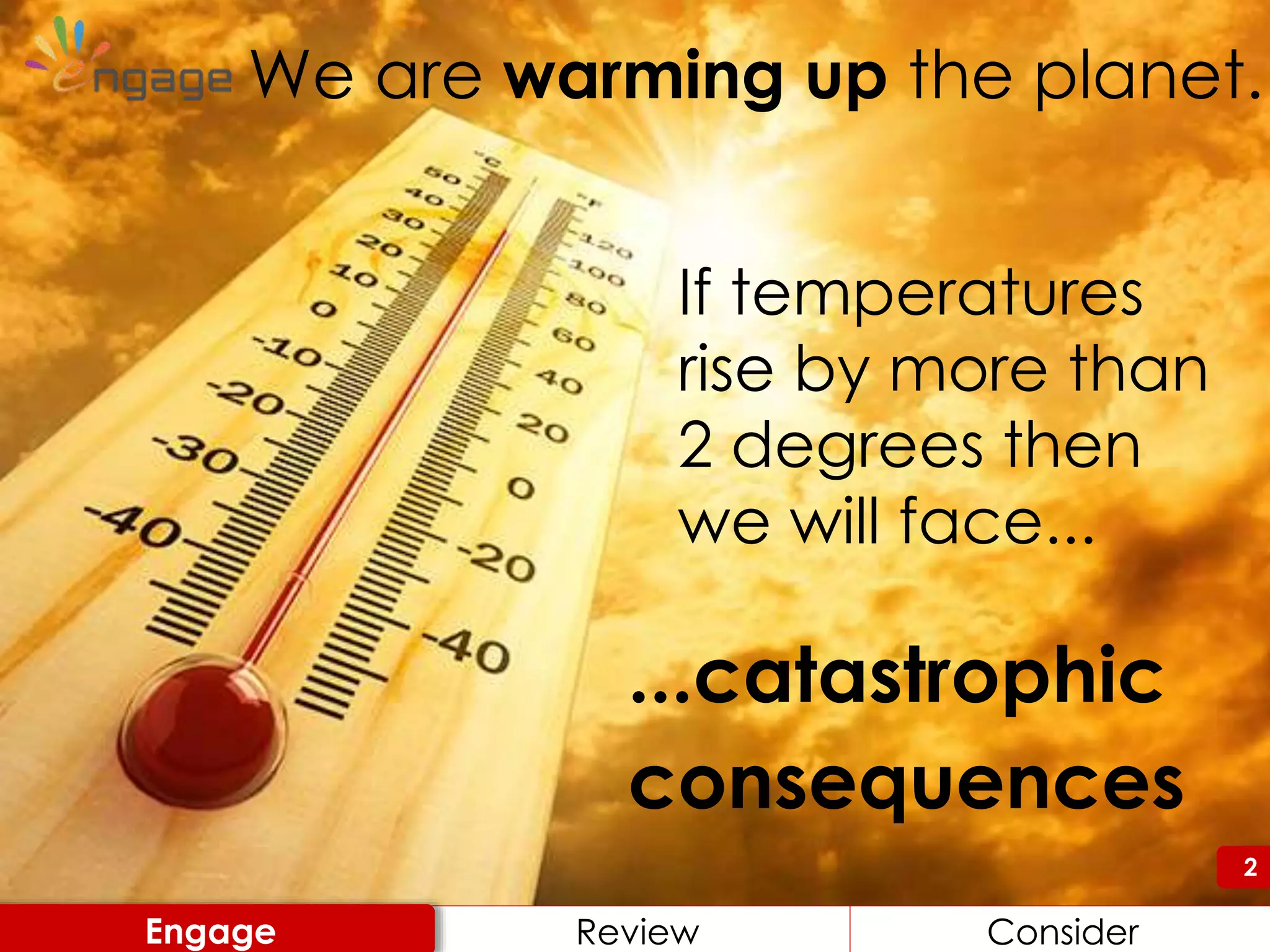
If temperatures
rise by more than
2 degrees then
we will face...
We are warming up the planet.
2
Review ConsiderEngage
...catastrophic
consequences
33
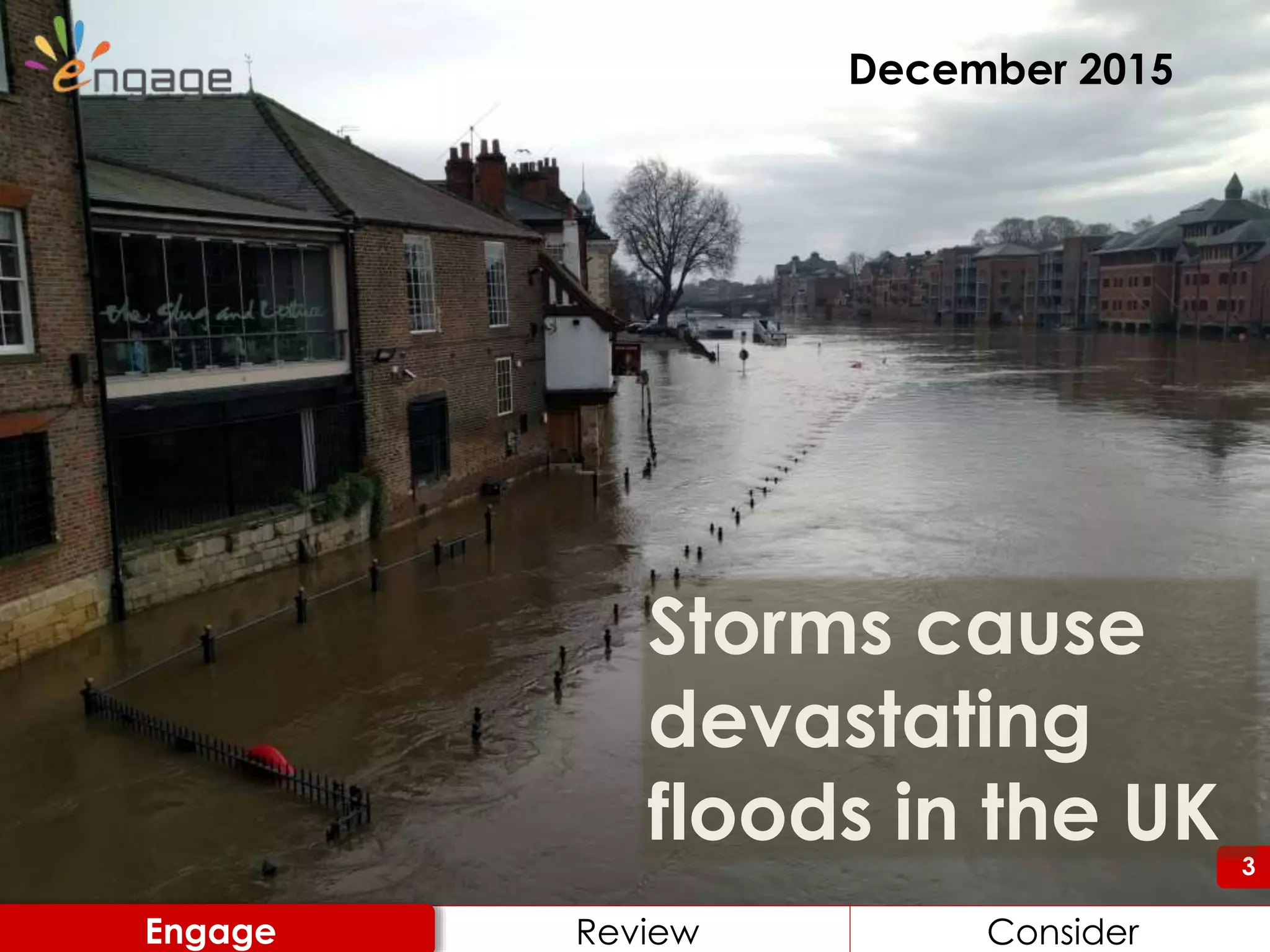
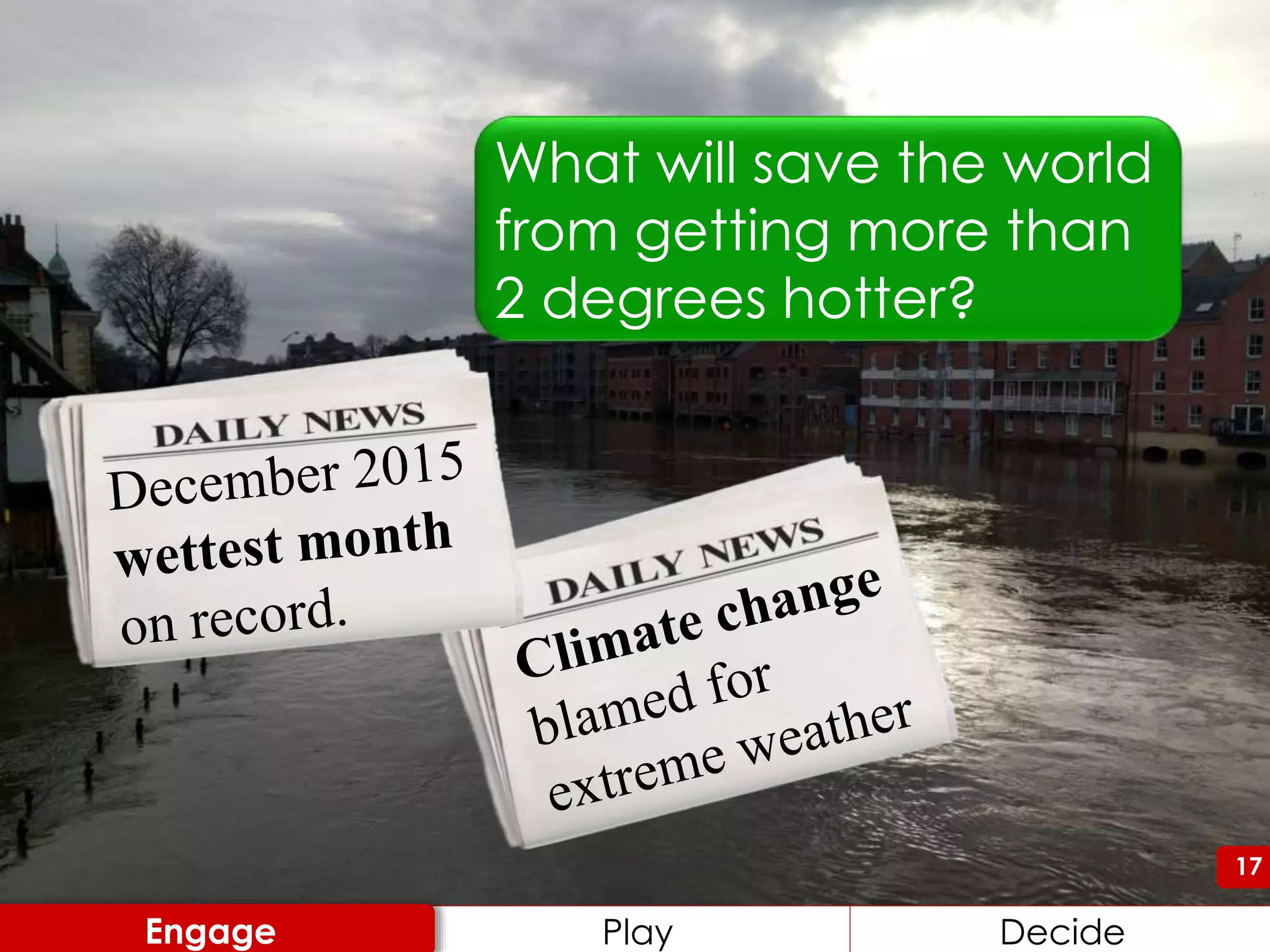
December 2015
Storms cause
devastating
floods in the UK
Engage Review ConsiderReview ConsiderEngage
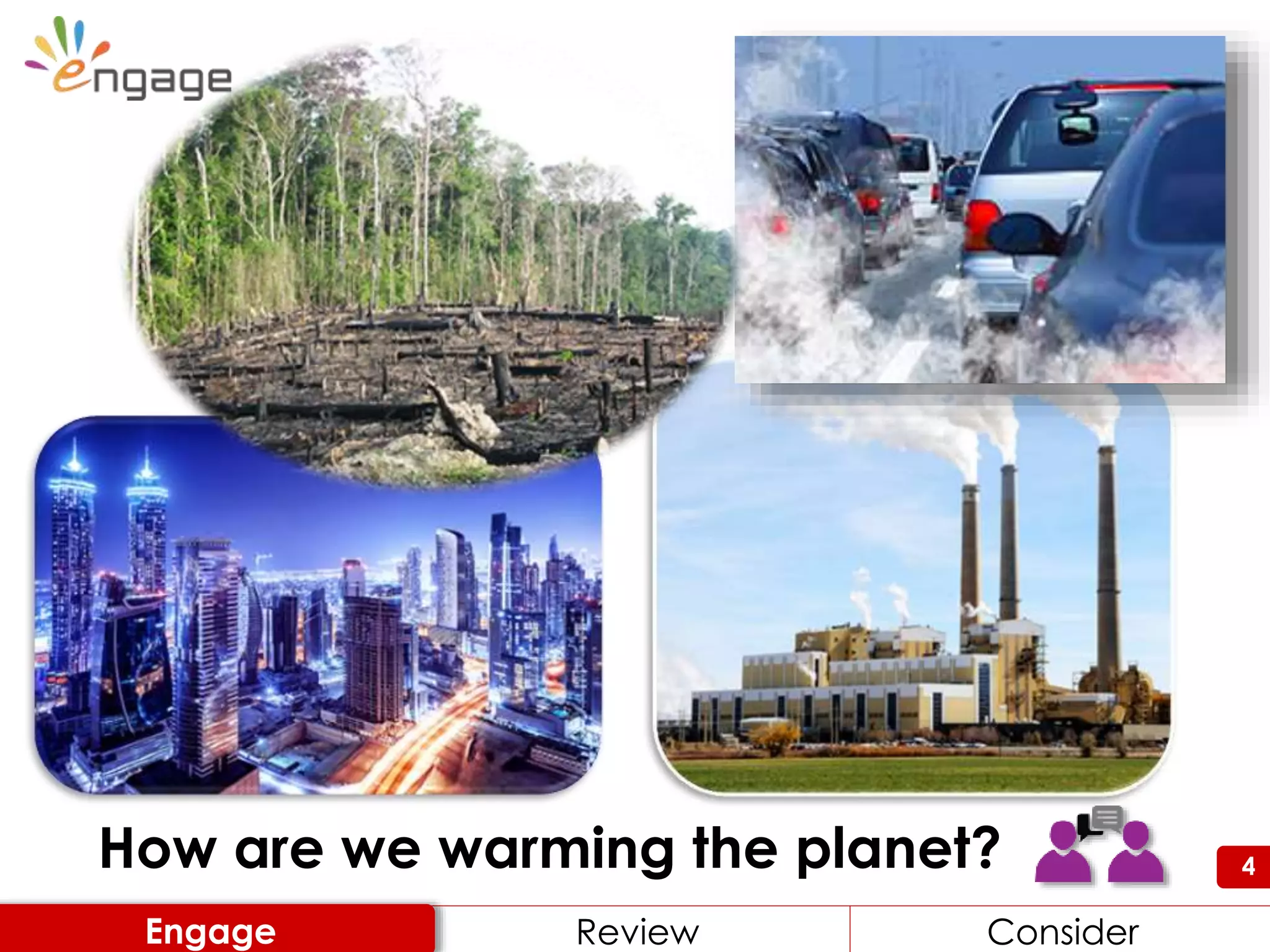
4How are we warming the planet? 4
Review ConsiderEngage
51900 1950 2000 2050 2100
5
4
3
2ºC
1
0
Globalaveragesurfacetemperature
increaseabovepre-industriallevels(ºC)
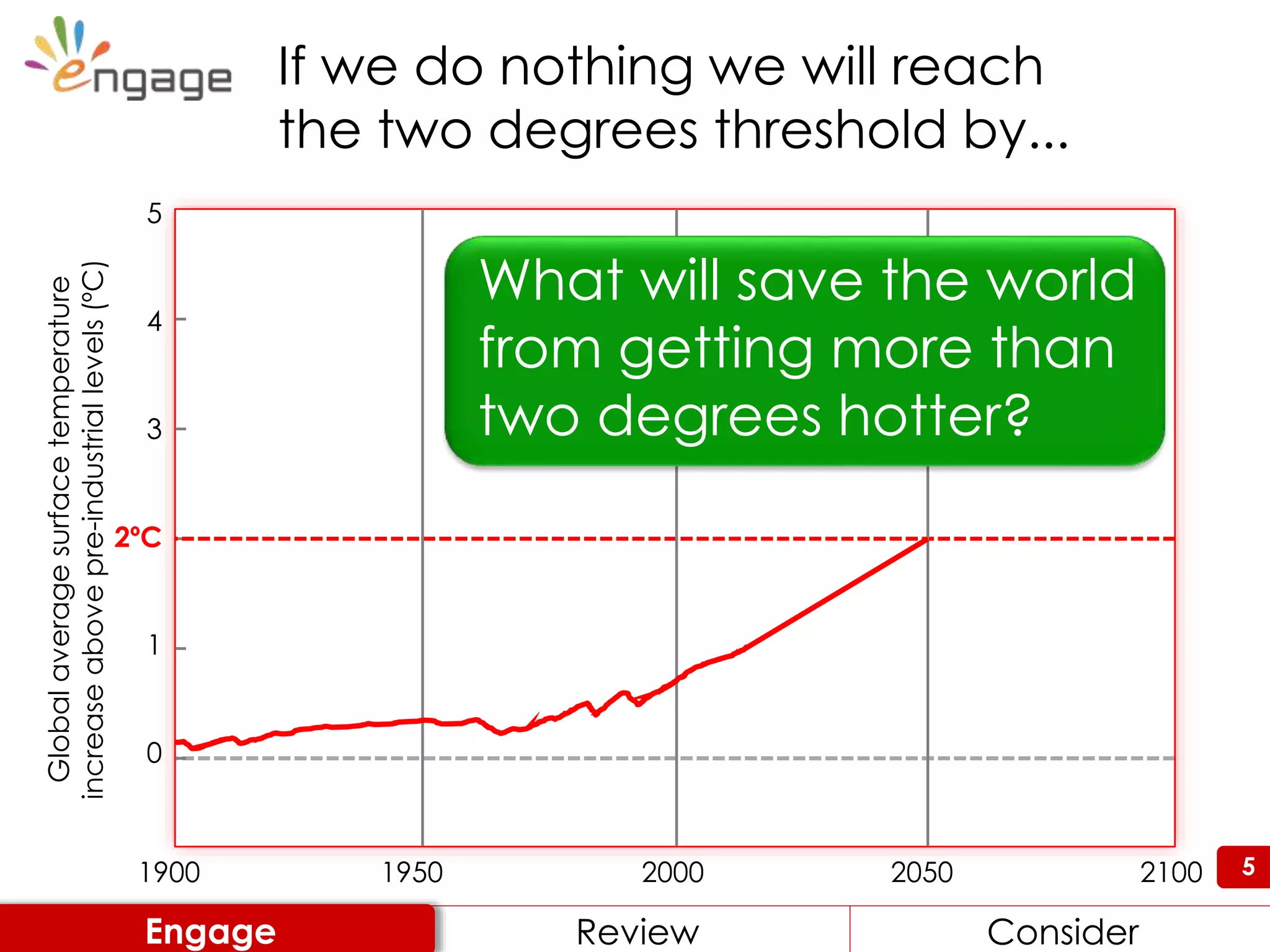
If we do nothing we will reach
the two degrees threshold by...
What will save the world
from getting more than
two degrees hotter?
Review ConsiderEngage
6
 describe how global warming can
impact on climate and local weather
patterns
Working ScientificallyBig Idea
Climate
Lesson 1
Examine
consequences
Lesson 2
In these lessons you will:
 Consider the impacts of carbon
emission actions on the environment,
people and money
7
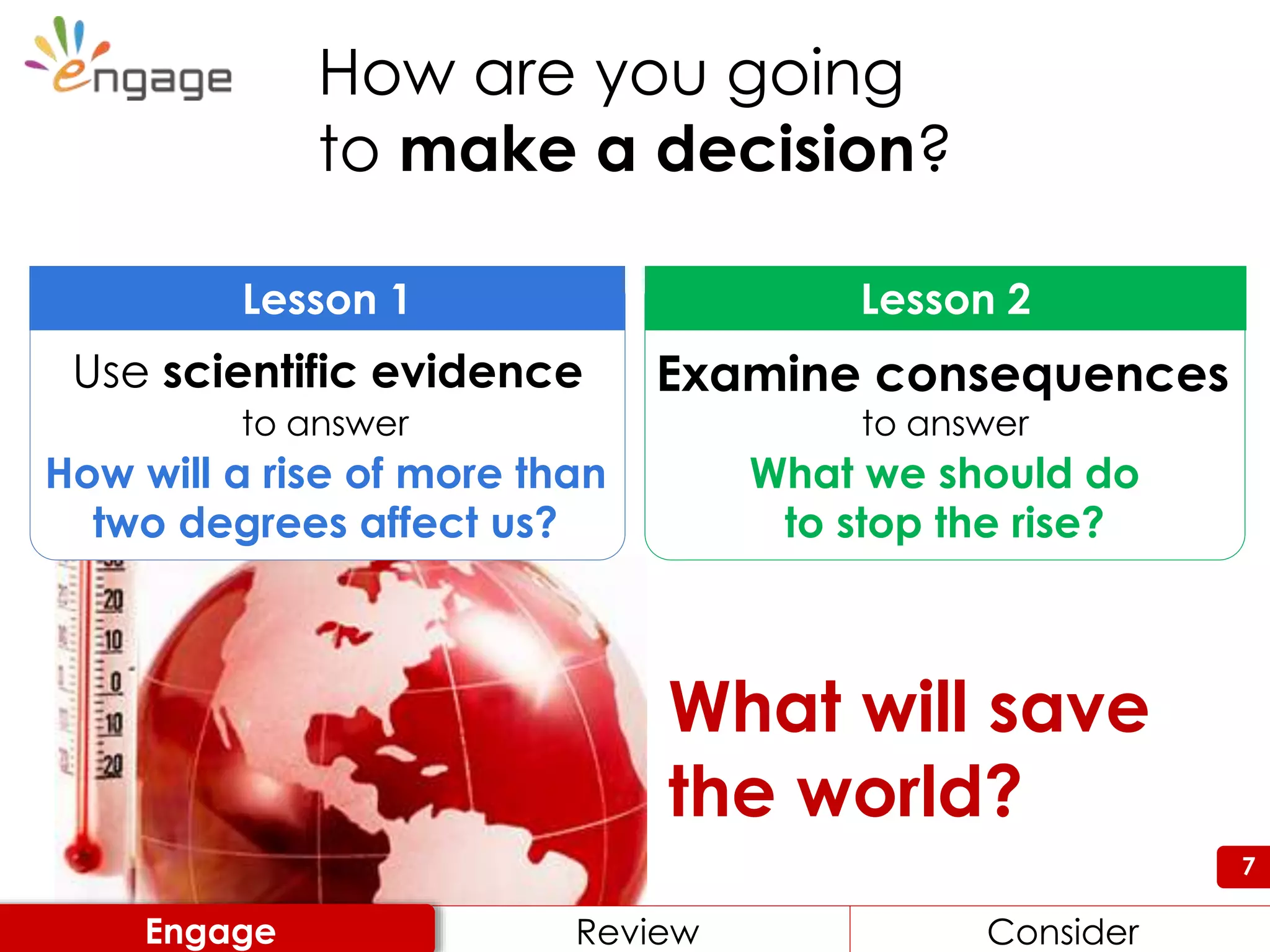
What will save
the world?
How are you going
to make a decision?
What we should do
to stop the rise?
Lesson 2
Examine consequences
to answer
How will a rise of more than
two degrees affect us?
Lesson 1
Use scientific evidence
to answer
Engage Review ConsiderReview ConsiderEngage
8
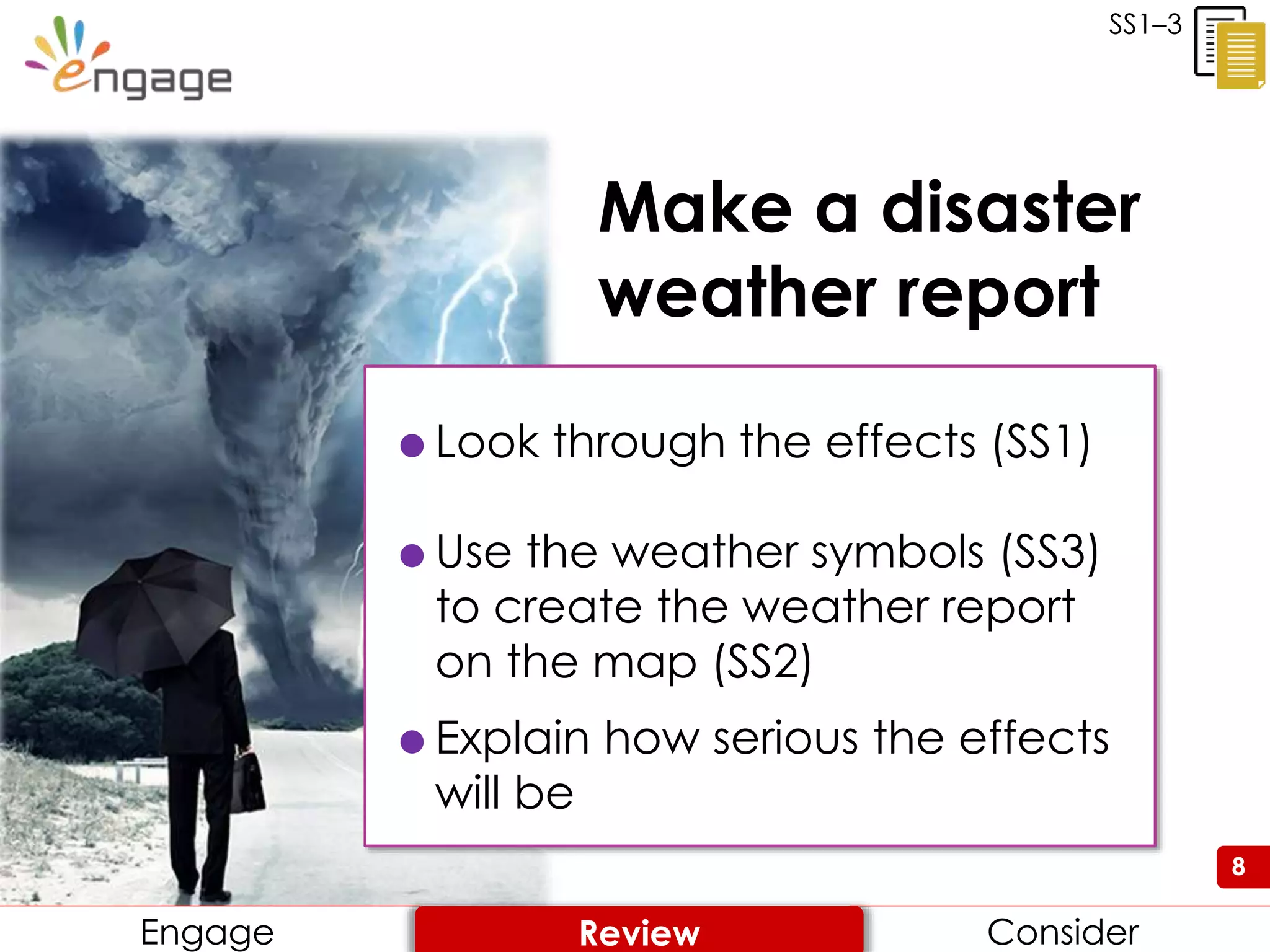
Make a disaster
weather report
8
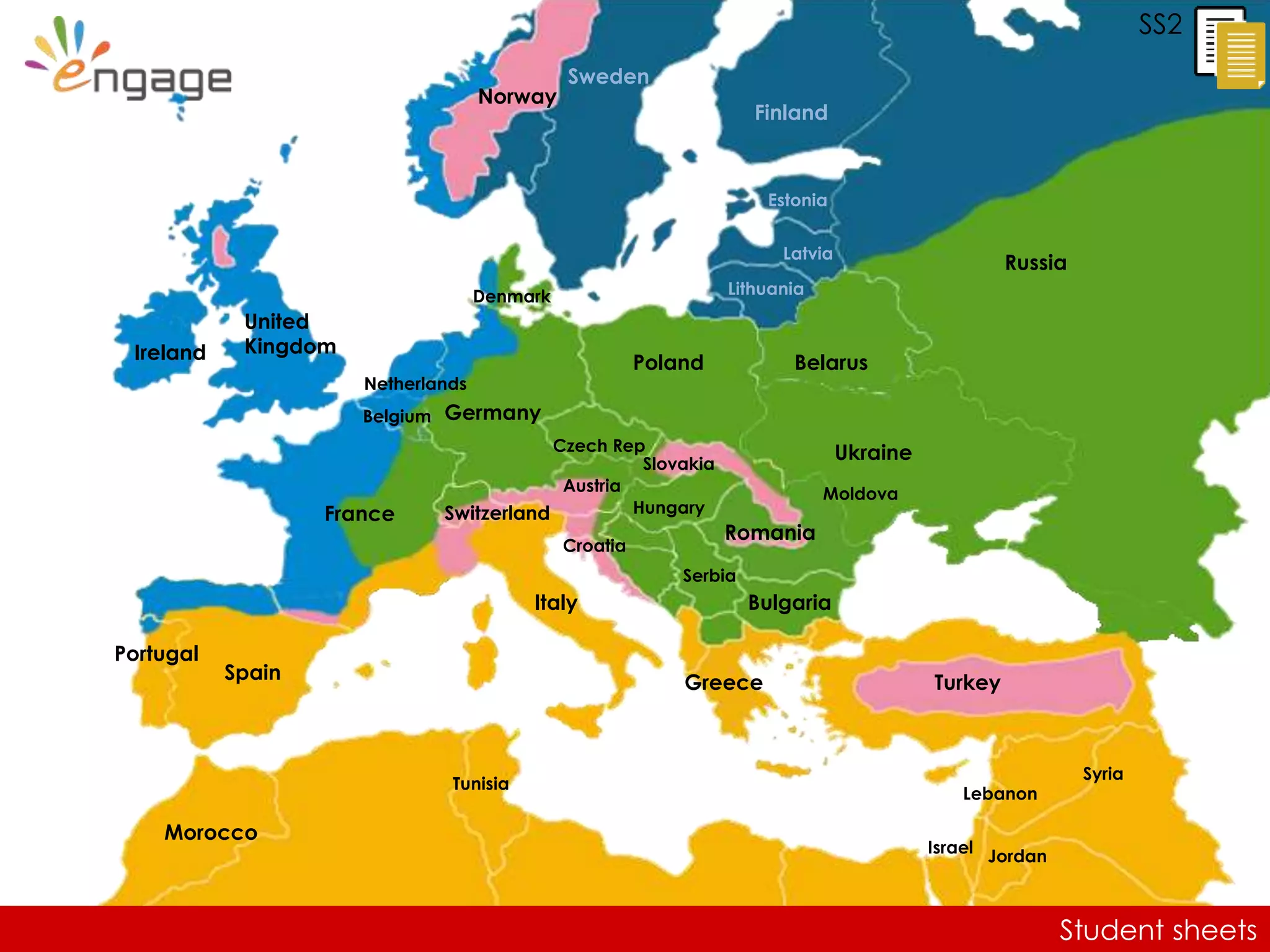
 Look through the effects (SS1)
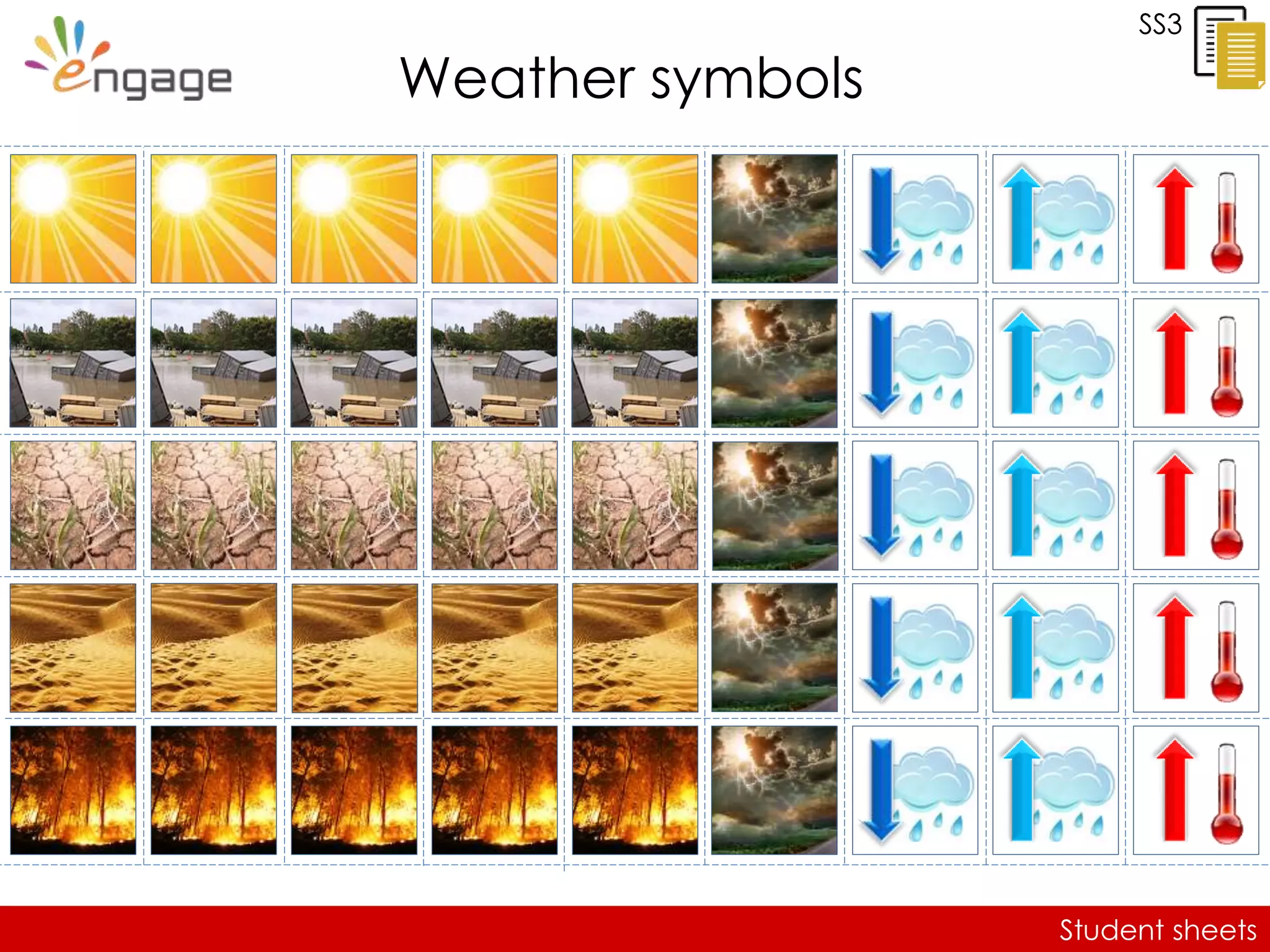
 Use the weather symbols (SS3)
to create the weather report
on the map (SS2)
 Explain how serious the effects
will be
SS1–3
Engage ConsiderReview
9
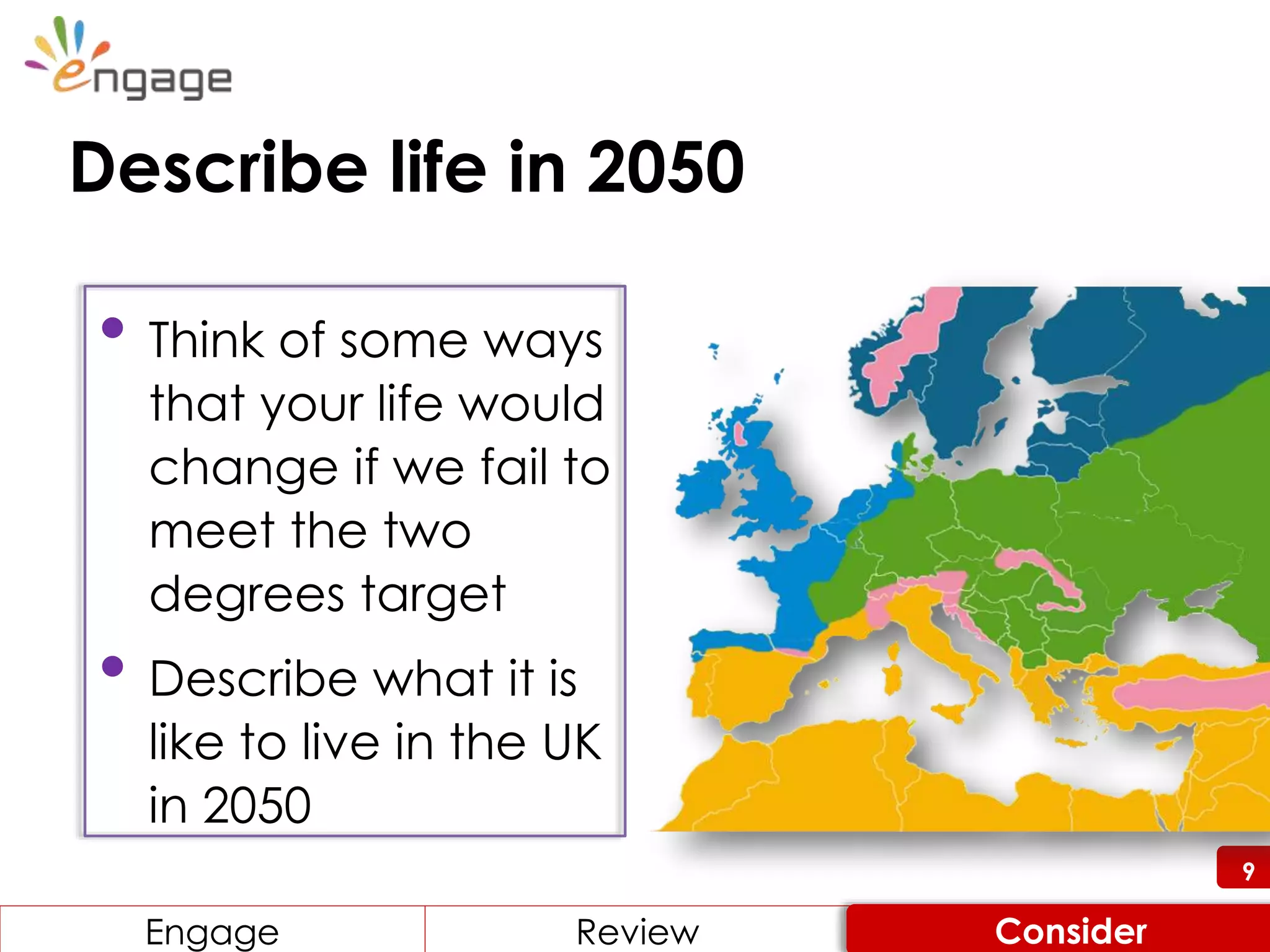
• Think of some ways
that your life would
change if we fail to
meet the two
degrees target
• Describe what it is
like to live in the UK
in 2050
9
Engage ReviewReviewEngage Consider
Describe life in 2050
For more, visit EngagingScience.eu
Get students talking and thinking
For more, visit EngagingScience.eu
Two degrees
Student sheets
Sheet no. Title Notes
SS1
The effects of a more than
two degrees rise
Reusable, one per group
SS2 Map
Consumable, enlarge to A3,
one per group
SS3 Weather symbols
Consumable, one per
group, print onto card
Student sheets
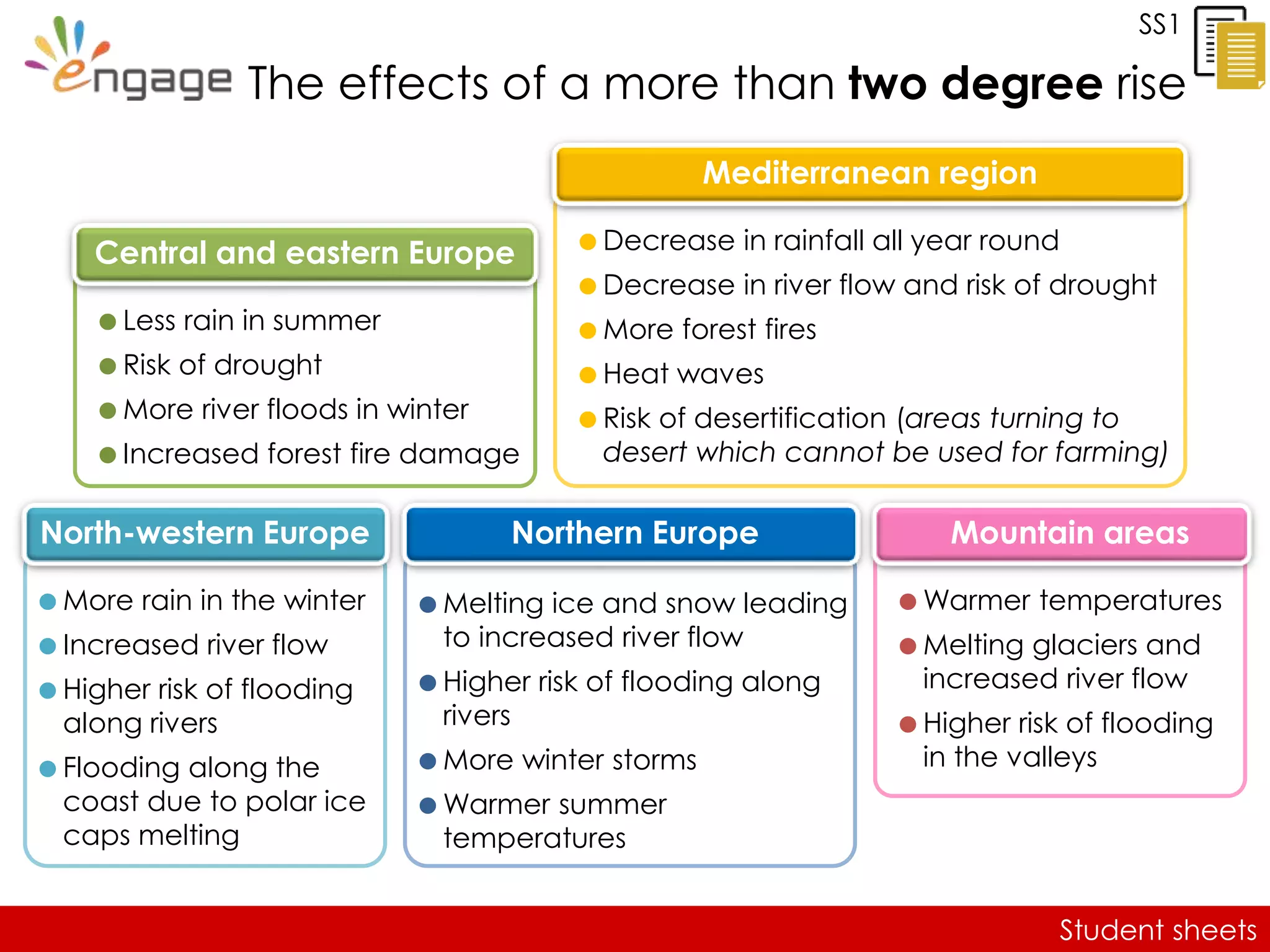
SS1
The effects of a more than two degree rise
 Melting ice and snow leading
to increased river flow
 Higher risk of flooding along
rivers
 More winter storms
 Warmer summer
temperatures
Northern Europe
 Less rain in summer
 Risk of drought
 More river floods in winter
 Increased forest fire damage
Central and eastern Europe  Decrease in rainfall all year round
 Decrease in river flow and risk of drought
 More forest fires
 Heat waves
 Risk of desertification (areas turning to
desert which cannot be used for farming)
Mediterranean region
 More rain in the winter
 Increased river flow
 Higher risk of flooding
along rivers
 Flooding along the
coast due to polar ice
caps melting
North-western Europe
 Warmer temperatures
 Melting glaciers and
increased river flow
 Higher risk of flooding
in the valleys
Mountain areas
Student sheets
SS2
United
KingdomIreland
Germany
Norway
Sweden
Finland
Russia
Estonia
Latvia
Lithuania
Belarus
Student sheets
Ukraine
TurkeyGreece
Bulgaria
Romania
Poland
Portugal
Spain
Morocco
Italy
SwitzerlandFrance
Israel Jordan
Lebanon
Syria
Serbia
Hungary
Slovakia
Czech Rep
Austria
Croatia
Netherlands
Belgium
Denmark
Tunisia
Moldova
Student sheets
SS3
Weather symbols
For more, visit EngagingScience.eu
Get students talking and thinking
For more, visit EngagingScience.eu
Two degrees (2 of 2)
Equipping the Next Generation for Active Engagement in Science
17
Play DecideEngage
17
What will save the world
from getting more than
2 degrees hotter?
18
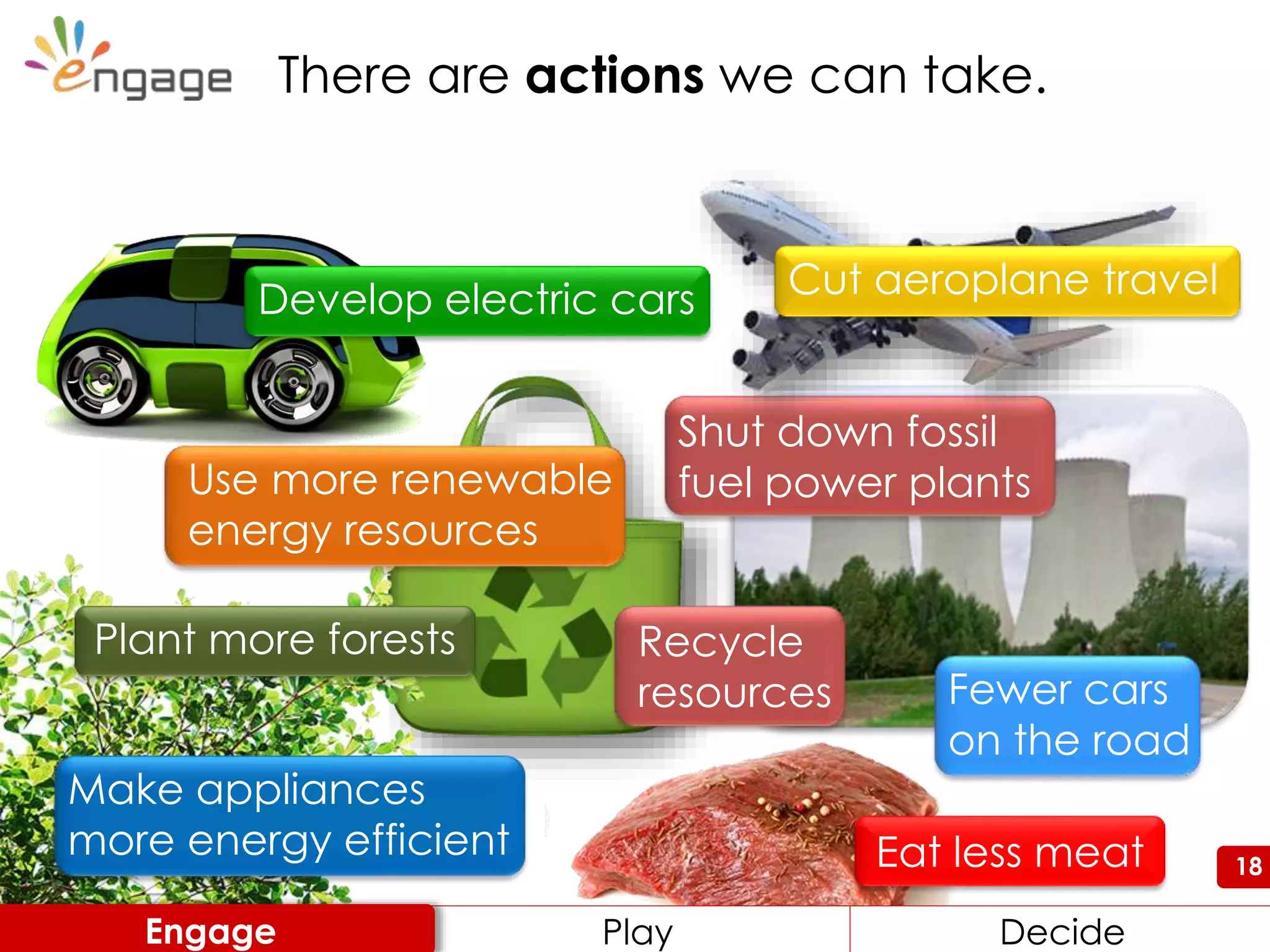
Shut down fossil
fuel power plants
Recycle
resources
Plant more forests
Develop electric cars
Eat less meat
There are actions we can take.
Make appliances
more energy efficient
Play DecideEngage
Cut aeroplane travel
Use more renewable
energy resources
Fewer cars
on the road
19
 describe how global warming can
impact on climate and local weather
patterns
 Consider the impacts of carbon
emission actions on the environment,
people and money
Working ScientificallyBig Idea
Climate
Lesson 1
Examine
consequences
Lesson 2
In these lessons you will :
20
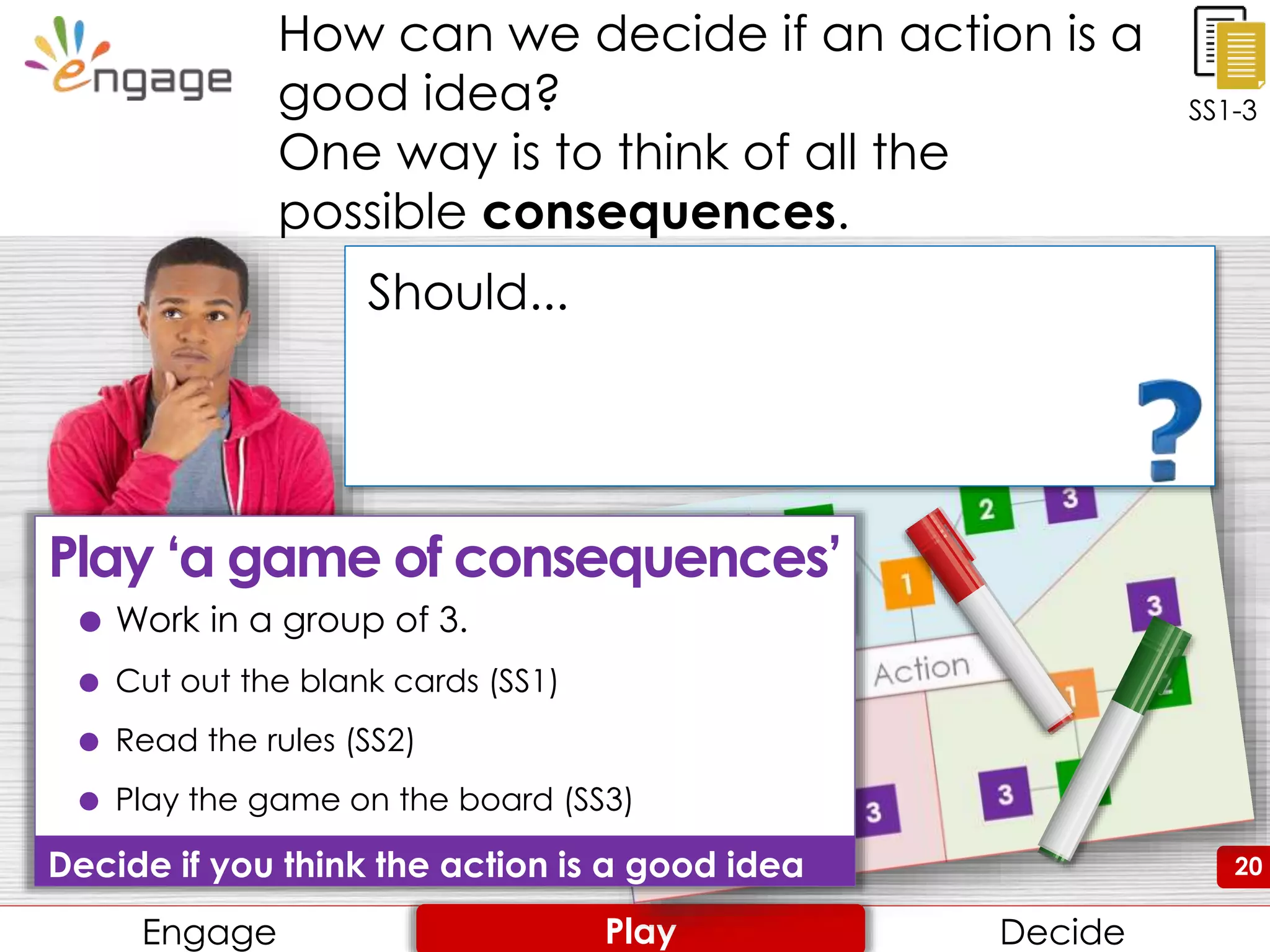
How can we decide if an action is a
good idea?
One way is to think of all the
possible consequences.
Engage Review ConsiderEngage DecidePlay
20
SS1-3
Should...
 Work in a group of 3.
 Cut out the blank cards (SS1)
 Read the rules (SS2)
 Play the game on the board (SS3)
Decide if you think the action is a good idea
Play ‘a game of consequences’
21
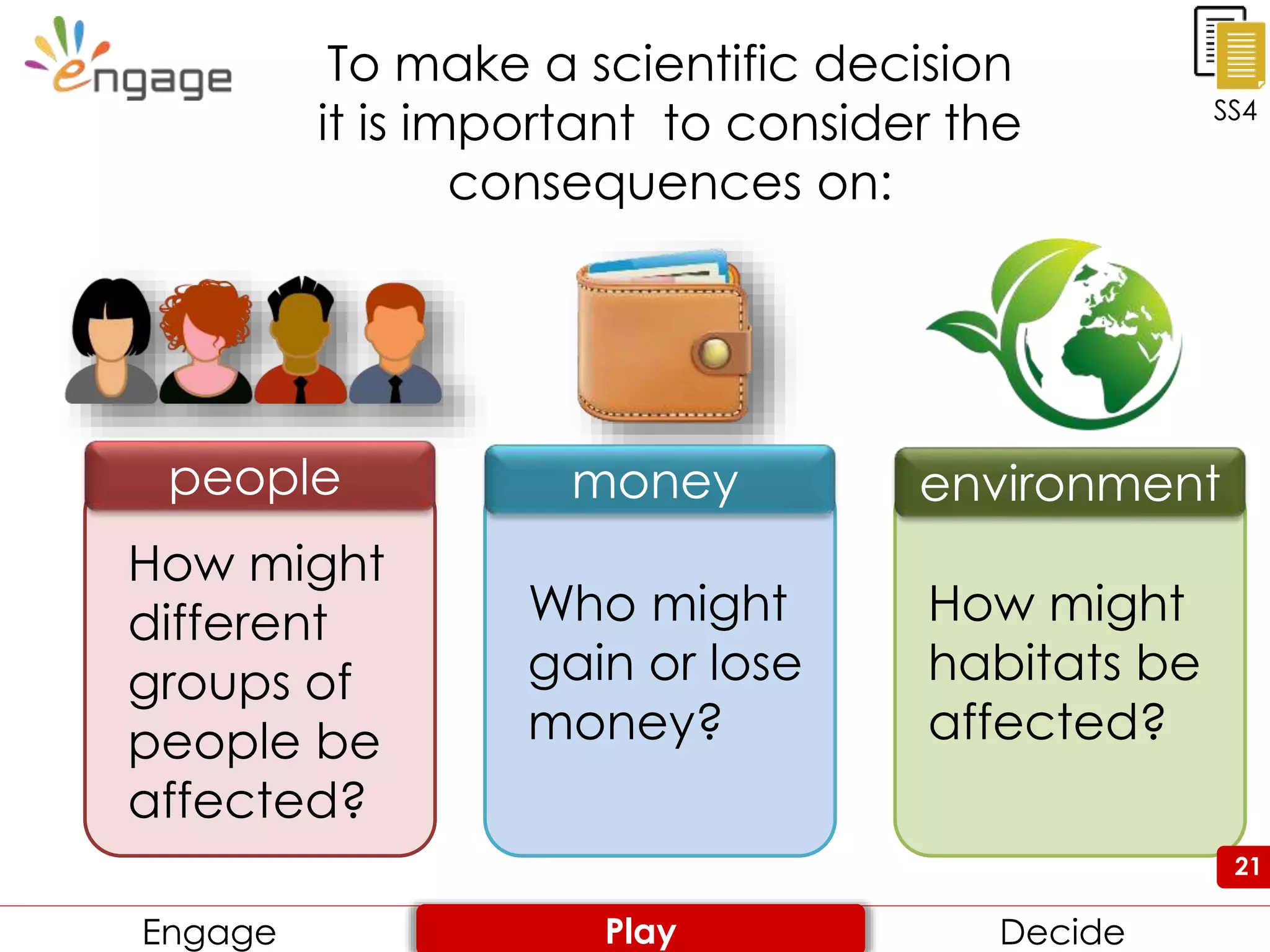
To make a scientific decision
it is important to consider the
consequences on:
How might
different
groups of
people be
affected?
Who might
gain or lose
money?
How might
habitats be
affected?
SS4
people money environment
21
Engage Review ConsiderEngage DecidePlay
22
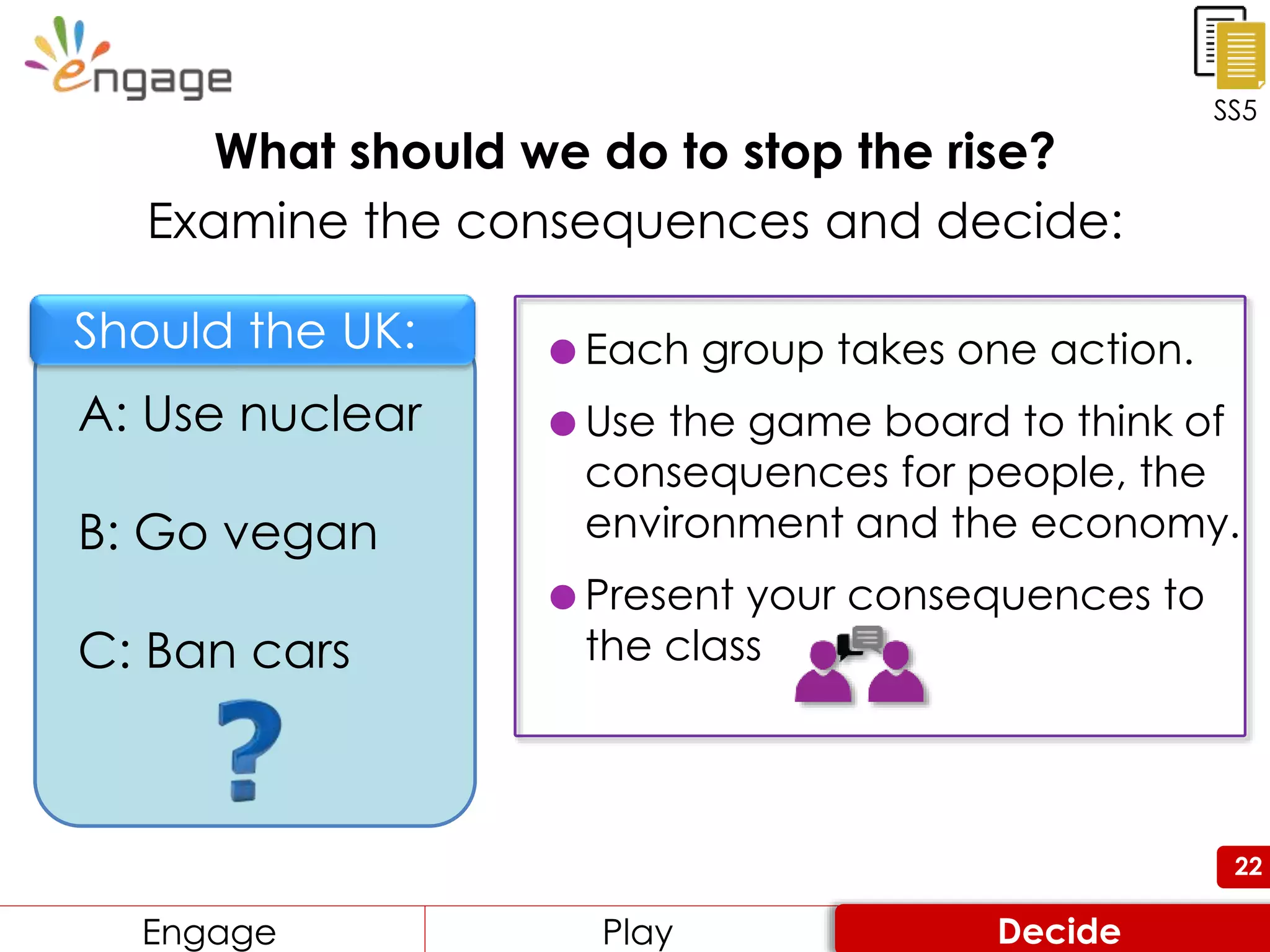
What should we do to stop the rise?
Examine the consequences and decide:
 Each group takes one action.
 Use the game board to think of
consequences for people, the
environment and the economy.
 Present your consequences to
the class
SS5
Engage Review ConsiderEngage Play Decide
A: Use nuclear
B: Go vegan
C: Ban cars
Should the UK:
23
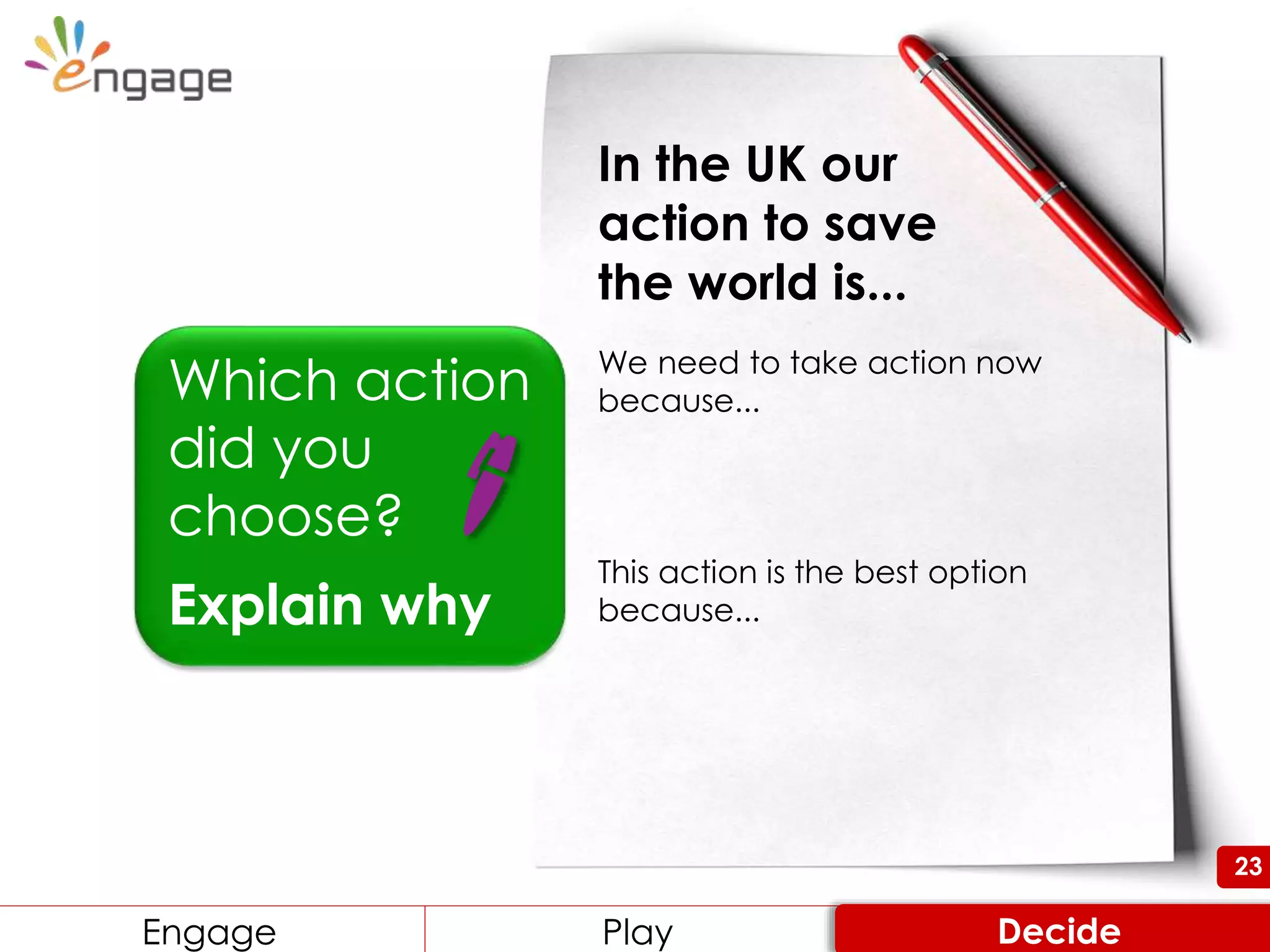
Which action
did you
choose?
Explain why
In the UK our
action to save
the world is...
We need to take action now
because...
This action is the best option
because...
Engage Review ConsiderEngage Play Decide
23
For more, visit EngagingScience.eu
Get students talking and thinking
For more, visit EngagingScience.eu
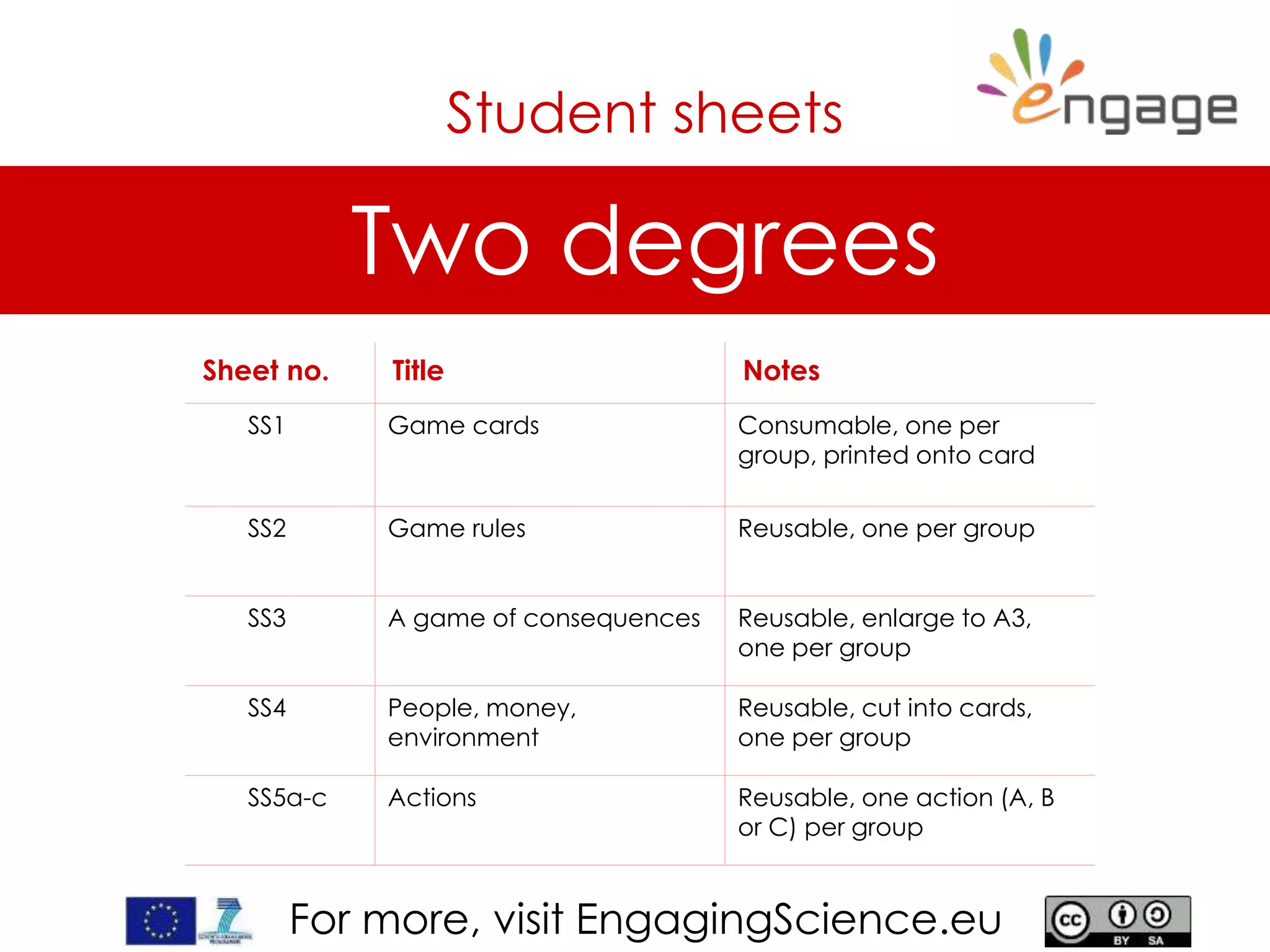
Two degrees
Student sheets
Sheet no. Title Notes
SS1 Game cards Consumable, one per
group, printed onto card
SS2 Game rules Reusable, one per group
SS3 A game of consequences Reusable, enlarge to A3,
one per group
SS4 People, money,
environment
Reusable, cut into cards,
one per group
SS5a-c Actions Reusable, one action (A, B
or C) per group
Student sheets
SS1
Game cards
Student sheets
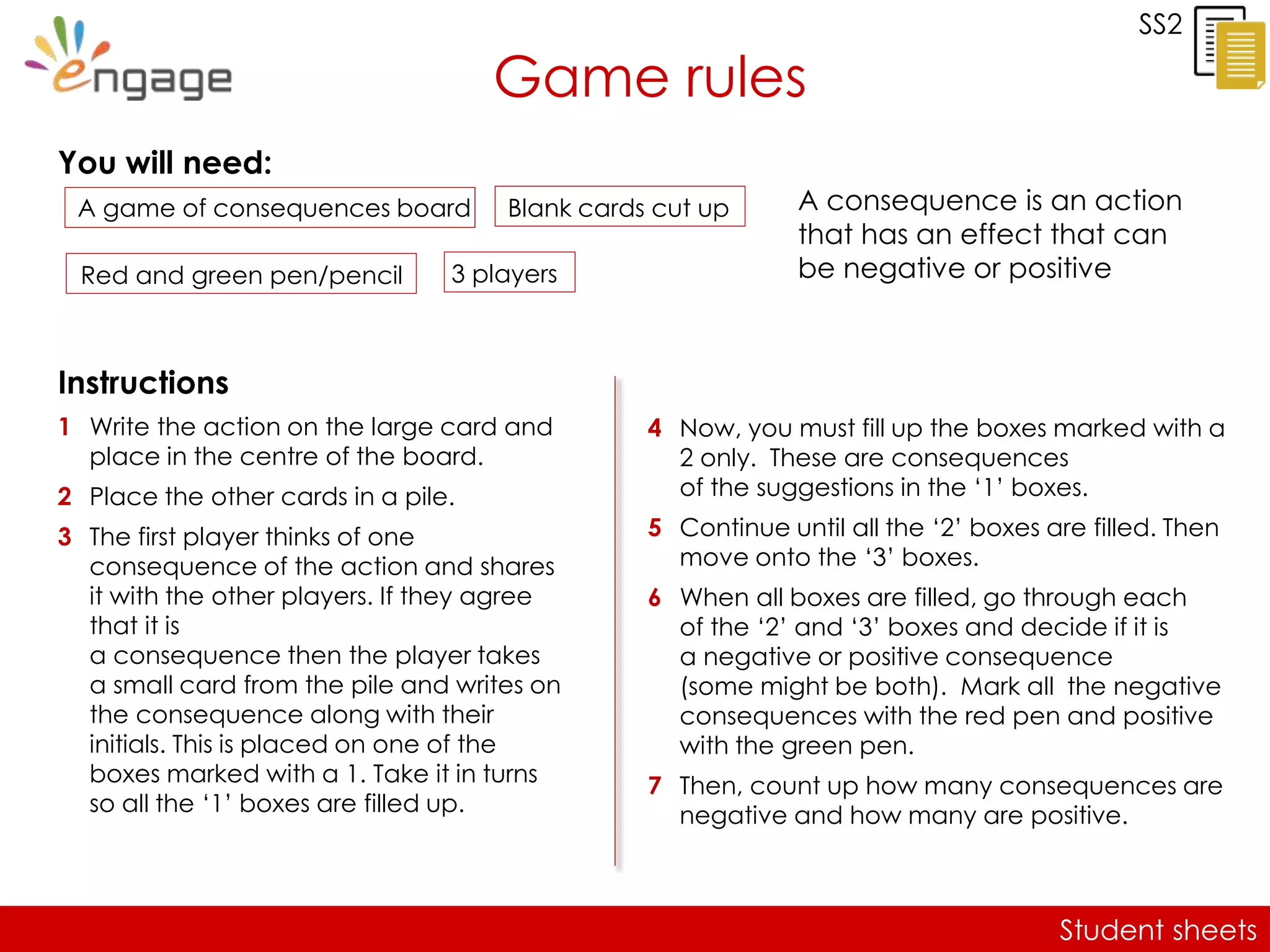
SS2
Game rules
4 Now, you must fill up the boxes marked with a
2 only. These are consequences
of the suggestions in the ‘1’ boxes.
5 Continue until all the ‘2’ boxes are filled. Then
move onto the ‘3’ boxes.
6 When all boxes are filled, go through each
of the ‘2’ and ‘3’ boxes and decide if it is
a negative or positive consequence
(some might be both). Mark all the negative
consequences with the red pen and positive
with the green pen.
7 Then, count up how many consequences are
negative and how many are positive.
A consequence is an action
that has an effect that can
be negative or positive
You will need:
Instructions
1 Write the action on the large card and
place in the centre of the board.
2 Place the other cards in a pile.
3 The first player thinks of one
consequence of the action and shares
it with the other players. If they agree
that it is
a consequence then the player takes
a small card from the pile and writes on
the consequence along with their
initials. This is placed on one of the
boxes marked with a 1. Take it in turns
so all the ‘1’ boxes are filled up.
Red and green pen/pencil 3 players
A game of consequences board Blank cards cut up
Student sheets
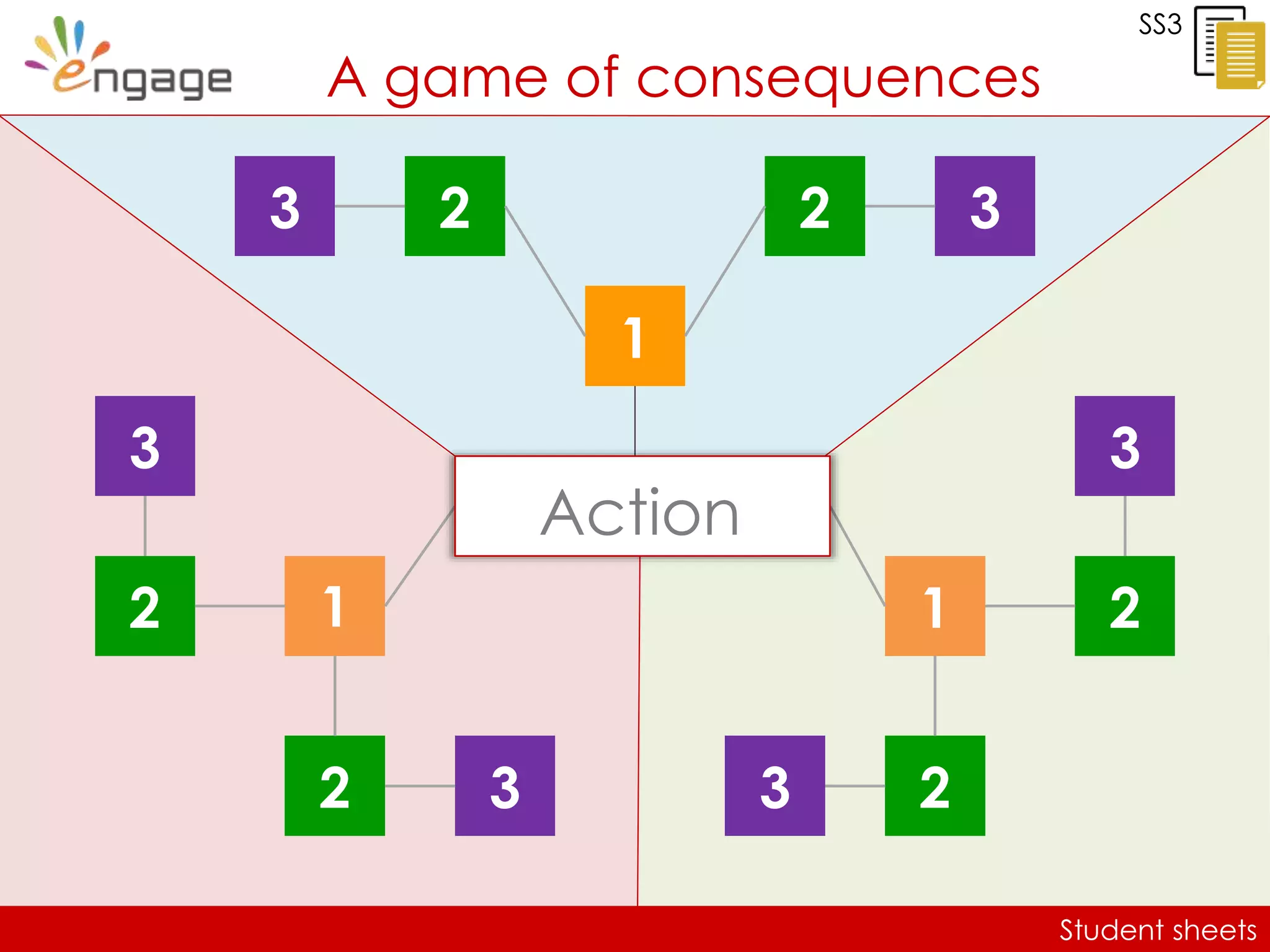
SS3
A game of consequences
1
1 1
22
2
2 2
2
3
3
3
3
3
3
Student sheets
Action
Student sheets
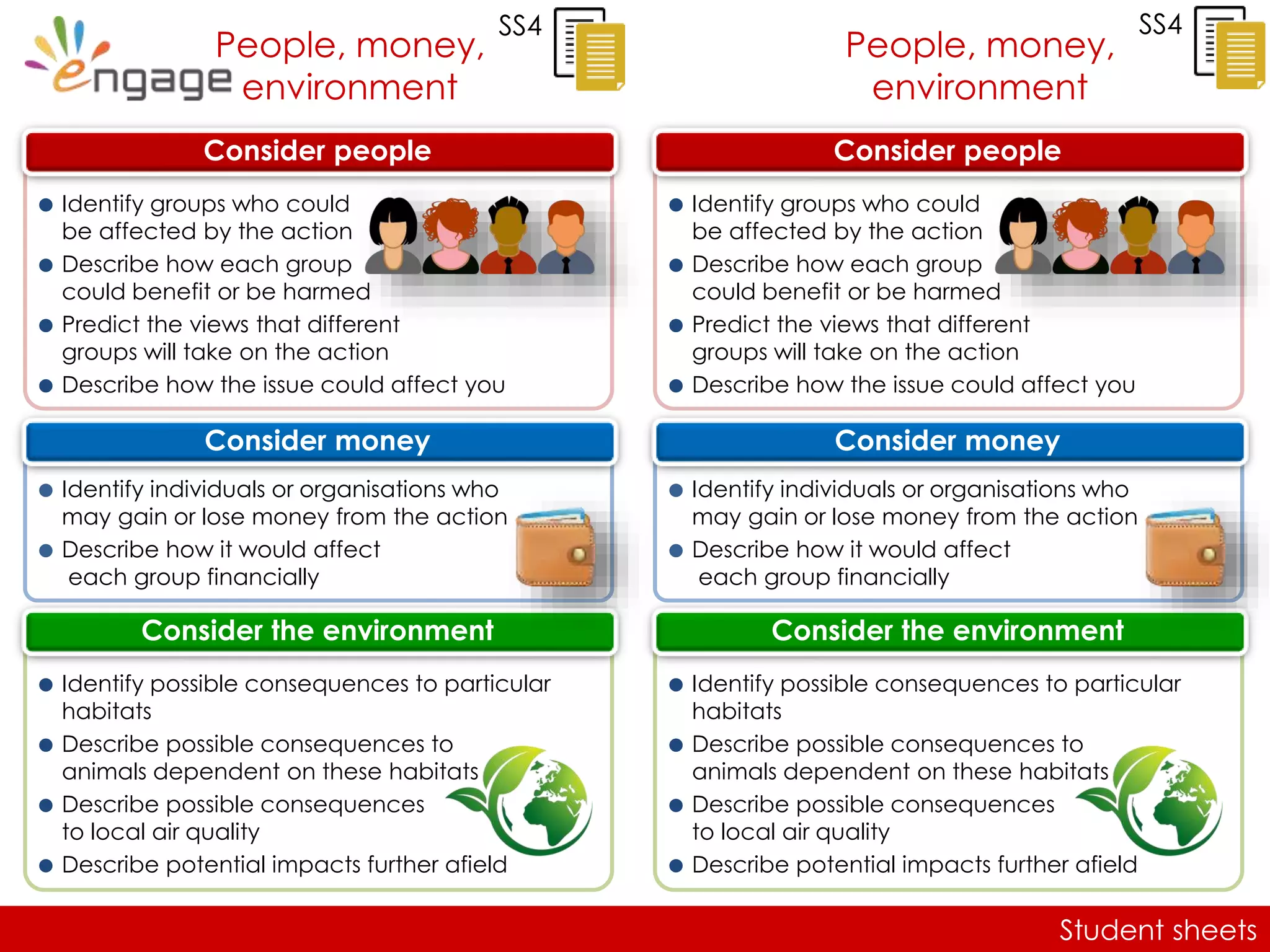
SS4
People, money,
environment
SS4
 Identify groups who could
be affected by the action
 Describe how each group
could benefit or be harmed
 Predict the views that different
groups will take on the action
 Describe how the issue could affect you
Consider people
 Identify individuals or organisations who
may gain or lose money from the action
 Describe how it would affect
each group financially
Consider money
 Identify possible consequences to particular
habitats
 Describe possible consequences to
animals dependent on these habitats
 Describe possible consequences
to local air quality
 Describe potential impacts further afield
Consider the environment
People, money,
environment
 Identify groups who could
be affected by the action
 Describe how each group
could benefit or be harmed
 Predict the views that different
groups will take on the action
 Describe how the issue could affect you
Consider people
 Identify individuals or organisations who
may gain or lose money from the action
 Describe how it would affect
each group financially
Consider money
 Identify possible consequences to particular
habitats
 Describe possible consequences to
animals dependent on these habitats
 Describe possible consequences
to local air quality
 Describe potential impacts further afield
Consider the environment
Student sheets
SS5a
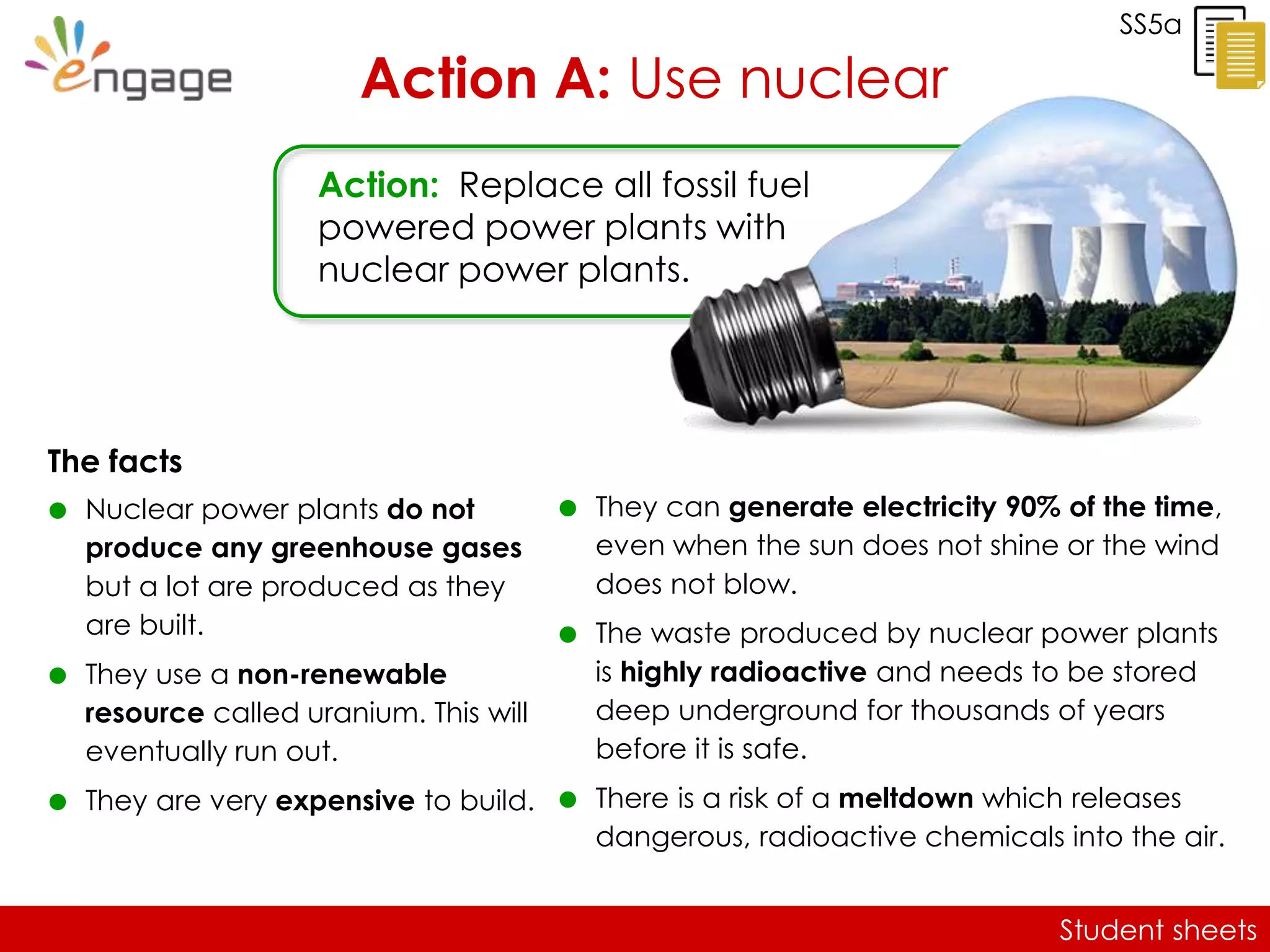
Action A: Use nuclear
The facts
 Nuclear power plants do not
produce any greenhouse gases
but a lot are produced as they
are built.
 They use a non-renewable
resource called uranium. This will
eventually run out.
 They are very expensive to build.
Action: Replace all fossil fuel
powered power plants with
nuclear power plants.
 They can generate electricity 90% of the time,
even when the sun does not shine or the wind
does not blow.
 The waste produced by nuclear power plants
is highly radioactive and needs to be stored
deep underground for thousands of years
before it is safe.
 There is a risk of a meltdown which releases
dangerous, radioactive chemicals into the air.
Student sheets
SS5b
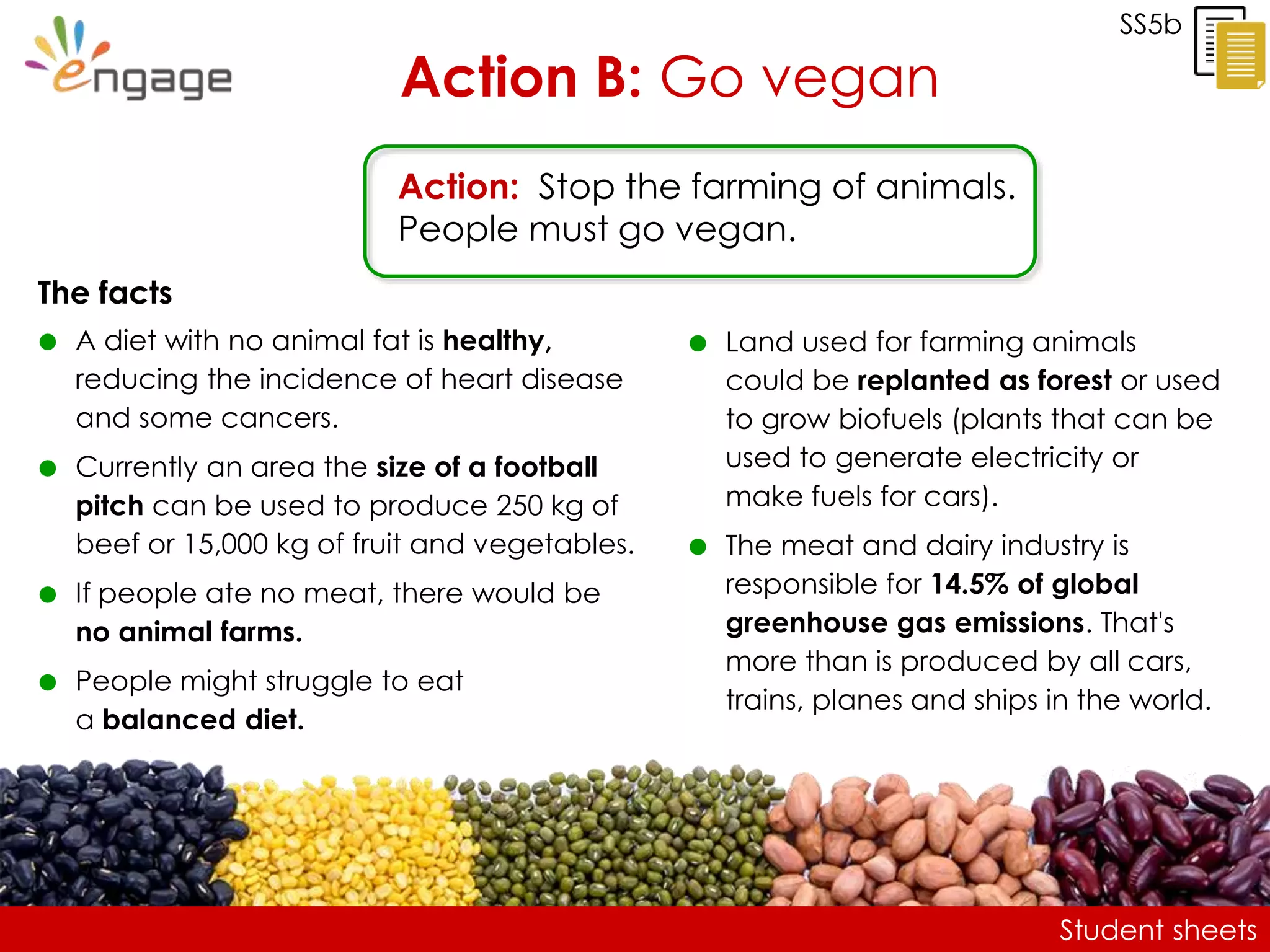
Action B: Go vegan
The facts
 A diet with no animal fat is healthy,
reducing the incidence of heart disease
and some cancers.
 Currently an area the size of a football
pitch can be used to produce 250 kg of
beef or 15,000 kg of fruit and vegetables.
 If people ate no meat, there would be
no animal farms.
 People might struggle to eat
a balanced diet.
Action: Stop the farming of animals.
People must go vegan.
 Land used for farming animals
could be replanted as forest or used
to grow biofuels (plants that can be
used to generate electricity or
make fuels for cars).
 The meat and dairy industry is
responsible for 14.5% of global
greenhouse gas emissions. That's
more than is produced by all cars,
trains, planes and ships in the world.
Student sheets
SS5c
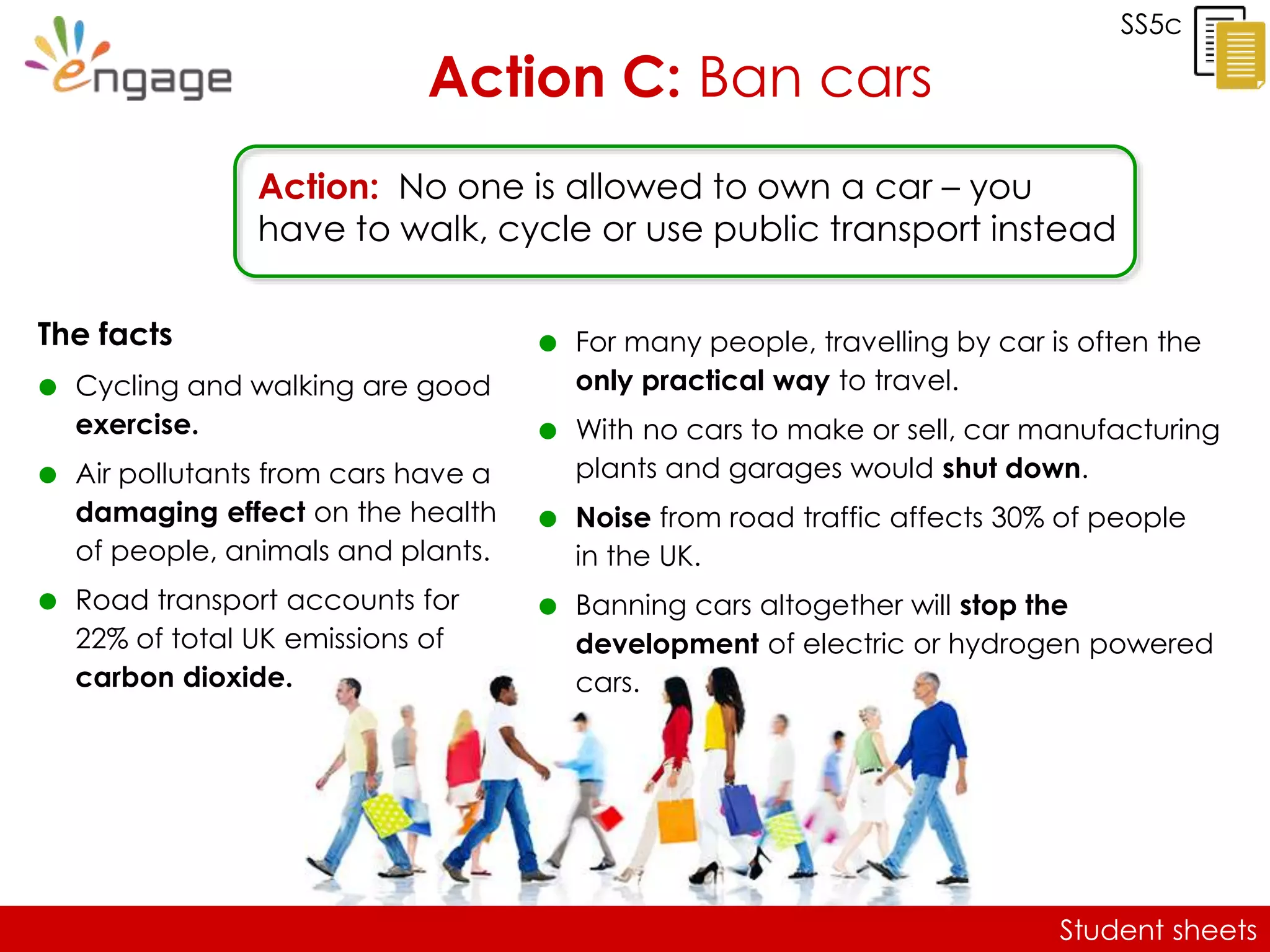
Action C: Ban cars
The facts
 Cycling and walking are good
exercise.
 Air pollutants from cars have a
damaging effect on the health
of people, animals and plants.
 Road transport accounts for
22% of total UK emissions of
carbon dioxide.
Action: No one is allowed to own a car – you
have to walk, cycle or use public transport instead
 For many people, travelling by car is often the
only practical way to travel.
 With no cars to make or sell, car manufacturing
plants and garages would shut down.
 Noise from road traffic affects 30% of people
in the UK.
 Banning cars altogether will stop the
development of electric or hydrogen powered
cars.
Student sheets
For more, visit EngagingScience.eu
Get students talking and thinking
ENGAGE CONSORTIUM

ENGAGE two degrees

  • 1.
    For more, visitEngagingScience.eu Two degrees (1 of 2) Equipping the Next Generation for Active Engagement in Science
  • 2.
    2 If temperatures rise bymore than 2 degrees then we will face... We are warming up the planet. 2 Review ConsiderEngage ...catastrophic consequences
  • 3.
    33 December 2015 Storms cause devastating floodsin the UK Engage Review ConsiderReview ConsiderEngage
  • 4.
    4How are wewarming the planet? 4 Review ConsiderEngage
  • 5.
    51900 1950 20002050 2100 5 4 3 2ºC 1 0 Globalaveragesurfacetemperature increaseabovepre-industriallevels(ºC) If we do nothing we will reach the two degrees threshold by... What will save the world from getting more than two degrees hotter? Review ConsiderEngage
  • 6.
    6  describe howglobal warming can impact on climate and local weather patterns Working ScientificallyBig Idea Climate Lesson 1 Examine consequences Lesson 2 In these lessons you will:  Consider the impacts of carbon emission actions on the environment, people and money
  • 7.
    7 What will save theworld? How are you going to make a decision? What we should do to stop the rise? Lesson 2 Examine consequences to answer How will a rise of more than two degrees affect us? Lesson 1 Use scientific evidence to answer Engage Review ConsiderReview ConsiderEngage
  • 8.
    8 Make a disaster weatherreport 8  Look through the effects (SS1)  Use the weather symbols (SS3) to create the weather report on the map (SS2)  Explain how serious the effects will be SS1–3 Engage ConsiderReview
  • 9.
    9 • Think ofsome ways that your life would change if we fail to meet the two degrees target • Describe what it is like to live in the UK in 2050 9 Engage ReviewReviewEngage Consider Describe life in 2050
  • 10.
    For more, visitEngagingScience.eu Get students talking and thinking
  • 11.
    For more, visitEngagingScience.eu Two degrees Student sheets Sheet no. Title Notes SS1 The effects of a more than two degrees rise Reusable, one per group SS2 Map Consumable, enlarge to A3, one per group SS3 Weather symbols Consumable, one per group, print onto card
  • 12.
    Student sheets SS1 The effectsof a more than two degree rise  Melting ice and snow leading to increased river flow  Higher risk of flooding along rivers  More winter storms  Warmer summer temperatures Northern Europe  Less rain in summer  Risk of drought  More river floods in winter  Increased forest fire damage Central and eastern Europe  Decrease in rainfall all year round  Decrease in river flow and risk of drought  More forest fires  Heat waves  Risk of desertification (areas turning to desert which cannot be used for farming) Mediterranean region  More rain in the winter  Increased river flow  Higher risk of flooding along rivers  Flooding along the coast due to polar ice caps melting North-western Europe  Warmer temperatures  Melting glaciers and increased river flow  Higher risk of flooding in the valleys Mountain areas
  • 13.
  • 14.
  • 15.
    For more, visitEngagingScience.eu Get students talking and thinking
  • 16.
    For more, visitEngagingScience.eu Two degrees (2 of 2) Equipping the Next Generation for Active Engagement in Science
  • 17.
    17 Play DecideEngage 17 What willsave the world from getting more than 2 degrees hotter?
  • 18.
    18 Shut down fossil fuelpower plants Recycle resources Plant more forests Develop electric cars Eat less meat There are actions we can take. Make appliances more energy efficient Play DecideEngage Cut aeroplane travel Use more renewable energy resources Fewer cars on the road
  • 19.
    19  describe howglobal warming can impact on climate and local weather patterns  Consider the impacts of carbon emission actions on the environment, people and money Working ScientificallyBig Idea Climate Lesson 1 Examine consequences Lesson 2 In these lessons you will :
  • 20.
    20 How can wedecide if an action is a good idea? One way is to think of all the possible consequences. Engage Review ConsiderEngage DecidePlay 20 SS1-3 Should...  Work in a group of 3.  Cut out the blank cards (SS1)  Read the rules (SS2)  Play the game on the board (SS3) Decide if you think the action is a good idea Play ‘a game of consequences’
  • 21.
    21 To make ascientific decision it is important to consider the consequences on: How might different groups of people be affected? Who might gain or lose money? How might habitats be affected? SS4 people money environment 21 Engage Review ConsiderEngage DecidePlay
  • 22.
    22 What should wedo to stop the rise? Examine the consequences and decide:  Each group takes one action.  Use the game board to think of consequences for people, the environment and the economy.  Present your consequences to the class SS5 Engage Review ConsiderEngage Play Decide A: Use nuclear B: Go vegan C: Ban cars Should the UK:
  • 23.
    23 Which action did you choose? Explainwhy In the UK our action to save the world is... We need to take action now because... This action is the best option because... Engage Review ConsiderEngage Play Decide 23
  • 24.
    For more, visitEngagingScience.eu Get students talking and thinking
  • 25.
    For more, visitEngagingScience.eu Two degrees Student sheets Sheet no. Title Notes SS1 Game cards Consumable, one per group, printed onto card SS2 Game rules Reusable, one per group SS3 A game of consequences Reusable, enlarge to A3, one per group SS4 People, money, environment Reusable, cut into cards, one per group SS5a-c Actions Reusable, one action (A, B or C) per group
  • 26.
  • 27.
    Student sheets SS2 Game rules 4Now, you must fill up the boxes marked with a 2 only. These are consequences of the suggestions in the ‘1’ boxes. 5 Continue until all the ‘2’ boxes are filled. Then move onto the ‘3’ boxes. 6 When all boxes are filled, go through each of the ‘2’ and ‘3’ boxes and decide if it is a negative or positive consequence (some might be both). Mark all the negative consequences with the red pen and positive with the green pen. 7 Then, count up how many consequences are negative and how many are positive. A consequence is an action that has an effect that can be negative or positive You will need: Instructions 1 Write the action on the large card and place in the centre of the board. 2 Place the other cards in a pile. 3 The first player thinks of one consequence of the action and shares it with the other players. If they agree that it is a consequence then the player takes a small card from the pile and writes on the consequence along with their initials. This is placed on one of the boxes marked with a 1. Take it in turns so all the ‘1’ boxes are filled up. Red and green pen/pencil 3 players A game of consequences board Blank cards cut up
  • 28.
    Student sheets SS3 A gameof consequences 1 1 1 22 2 2 2 2 3 3 3 3 3 3 Student sheets Action
  • 29.
    Student sheets SS4 People, money, environment SS4 Identify groups who could be affected by the action  Describe how each group could benefit or be harmed  Predict the views that different groups will take on the action  Describe how the issue could affect you Consider people  Identify individuals or organisations who may gain or lose money from the action  Describe how it would affect each group financially Consider money  Identify possible consequences to particular habitats  Describe possible consequences to animals dependent on these habitats  Describe possible consequences to local air quality  Describe potential impacts further afield Consider the environment People, money, environment  Identify groups who could be affected by the action  Describe how each group could benefit or be harmed  Predict the views that different groups will take on the action  Describe how the issue could affect you Consider people  Identify individuals or organisations who may gain or lose money from the action  Describe how it would affect each group financially Consider money  Identify possible consequences to particular habitats  Describe possible consequences to animals dependent on these habitats  Describe possible consequences to local air quality  Describe potential impacts further afield Consider the environment
  • 30.
    Student sheets SS5a Action A:Use nuclear The facts  Nuclear power plants do not produce any greenhouse gases but a lot are produced as they are built.  They use a non-renewable resource called uranium. This will eventually run out.  They are very expensive to build. Action: Replace all fossil fuel powered power plants with nuclear power plants.  They can generate electricity 90% of the time, even when the sun does not shine or the wind does not blow.  The waste produced by nuclear power plants is highly radioactive and needs to be stored deep underground for thousands of years before it is safe.  There is a risk of a meltdown which releases dangerous, radioactive chemicals into the air.
  • 31.
    Student sheets SS5b Action B:Go vegan The facts  A diet with no animal fat is healthy, reducing the incidence of heart disease and some cancers.  Currently an area the size of a football pitch can be used to produce 250 kg of beef or 15,000 kg of fruit and vegetables.  If people ate no meat, there would be no animal farms.  People might struggle to eat a balanced diet. Action: Stop the farming of animals. People must go vegan.  Land used for farming animals could be replanted as forest or used to grow biofuels (plants that can be used to generate electricity or make fuels for cars).  The meat and dairy industry is responsible for 14.5% of global greenhouse gas emissions. That's more than is produced by all cars, trains, planes and ships in the world.
  • 32.
    Student sheets SS5c Action C:Ban cars The facts  Cycling and walking are good exercise.  Air pollutants from cars have a damaging effect on the health of people, animals and plants.  Road transport accounts for 22% of total UK emissions of carbon dioxide. Action: No one is allowed to own a car – you have to walk, cycle or use public transport instead  For many people, travelling by car is often the only practical way to travel.  With no cars to make or sell, car manufacturing plants and garages would shut down.  Noise from road traffic affects 30% of people in the UK.  Banning cars altogether will stop the development of electric or hydrogen powered cars. Student sheets
  • 33.
    For more, visitEngagingScience.eu Get students talking and thinking
  • 34.

Editor's Notes

  • #3 Display the issue (2). Explain that this rise means that average global temperatures will have increased by more than 2 degrees since pre-industrial times.
  • #4 Remind students about the floods that affected the north in 2015. Talk about whether they think this is an effect of global warming and whether it could happen again.
  • #5 Ask students to discuss in pairs their previous knowledge of why temperatures are rising.
  • #6 Ask students to use the data to predict when we will pass the 2 degrees threshold if human behaviour does not change. Clicking will reveal the projection. The dilemma is introduced.
  • #7 The objectives for the lesson.
  • #8 A breakdown of how the students will use scientific evidence in lesson 1 and examine consequences in lesson 2 to help them to make a decision.
  • #9 Ask students to work in small groups and give each group copies of SS1-3. They read the information on SS1 about the effects on different regions. They then cut out the weather symbols from SS2 and use them to create a weather report on the map (SS2). You may wish students to look at all areas, just their local one or assign each group a different area. They should also explain how serious the effects will be. Groups can show their reports to each other or the whole class.
  • #10 Discuss how the changes to weather and climate will affect people and wildlife e.g. farming, food production, loss of housing through flooding and coastal erosion, migrants, increase in tropical diseases, loss of biodiversity (see weblinks for further information). Ask students to describe what it could be like to live in the UK in 2050 if we fail to meet the two degrees target. This could done by describing to a partner, writing down bullet points or a longer activity such as writing a diary entry or acting out a vlog.
  • #18 Remind students about the dilemma.
  • #19 Ask them to name some actions that will reduce greenhouse gases and reveal examples.
  • #20 A breakdown of how the students will use scientific evidence in lesson 1 and examine consequences in lesson 2 to help them to make a decision.
  • #21 Introduce the idea that to choose which action is best you must examine the consequences of each. Make sure students understand what we mean by a consequence i.e. an effect of an action which could be negative or positive. Students are introduced to 'a game of consequences' which will help them to decide if an action is a good idea. They work in a group of 3 and follow the instructions on the slide and SS2. To make the game more competitive an extra option is to allow students only 20 seconds to come up with a consequence when filling the 2 and 3 boxes. If they fail to do this, they miss their turn. The player with the most cards on the board at the end is then the winner. Spend some time going round each group asking them if they found that the action had more negative or positive consequences and examples of some of the consequences they came up with. They should then remove the game cards from the board.
  • #22 Introduce the fact that consequences can be classed as affecting people, money or environment. Give each group a copy of the cards from SS4 which outline these. They should be placed around the playing board.
  • #23 Explain that they will now be examining the consequences of some climate change actions. Assign each group one action and give them the corresponding version of SS5. Ask groups to spend time reading through the information and ask you any questions about the action if they wish. Groups then play the 'game of consequences' again using their action. This time, each third of the board corresponds to either people, money or environment and they should only place consequences affecting these in each area. They may find they can't fill the entire board - this is fine. In order for students to listen to the consequences of each action and make a choice, use a teacher-led class discussion or a specific format like a ‘Fishbowl’ : ask one person from each group to join up and discuss the consequences of their action. The rest of the class can watch and enter the fish bowl if they wish by tapping a person on the shoulder. As a class discuss the fact that the actions used in the game were radical that there is no one good action but a series of actions to take. 
  • #24 Students now consider the scientific evidence from lesson 1 and consequences from lesson 2 to come to a personal decision on which action they would choose and why. They could present it in a persuasive manner as a politician convincing the public of their decision.