ENG33
Week 8
Case Study Method and
Results
DR. RUSSELL RODRIGO
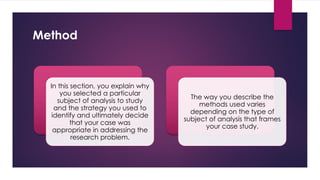
Method
In this section, you explain why
you selected a particular
subject of analysis to study
and the strategy you used to
identify and ultimately decide
that your case was
appropriate in addressing the
research problem.
The way you describe the
methods used varies
depending on the type of
subject of analysis that frames
your case study.
Writing the
Research
Method
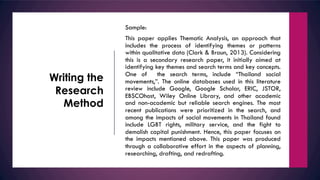
Sample:
This paper applies Thematic Analysis, an approach that
includes the process of identifying themes or patterns
within qualitative data (Clark & Braun, 2013). Considering
this is a secondary research paper, it initially aimed at
identifying key themes and search terms and key concepts.
One of the search terms, include “Thailand social
movements,”. The online databases used in this literature
review include Google, Google Scholar, ERIC, JSTOR,
EBSCOhost, Wiley Online Library, and other academic
and non-academic but reliable search engines. The most
recent publications were prioritized in the search, and
among the impacts of social movements in Thailand found
include LGBT rights, military service, and the fight to
demolish capital punishment. Hence, this paper focuses on
the impacts mentioned above. This paper was produced
through a collaborative effort in the aspects of planning,
researching, drafting, and redrafting.
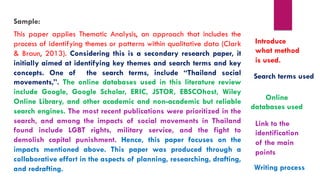
Sample:
This paper applies Thematic Analysis, an approach that includes the
process of identifying themes or patterns within qualitative data (Clark
& Braun, 2013). Considering this is a secondary research paper, it
initially aimed at identifying key themes and search terms and key
concepts. One of the search terms, include “Thailand social
movements,”. The online databases used in this literature review
include Google, Google Scholar, ERIC, JSTOR, EBSCOhost, Wiley
Online Library, and other academic and non-academic but reliable
search engines. The most recent publications were prioritized in the
search, and among the impacts of social movements in Thailand
found include LGBT rights, military service, and the fight to
demolish capital punishment. Hence, this paper focuses on the
impacts mentioned above. This paper was produced through a
collaborative effort in the aspects of planning, researching, drafting,
and redrafting.
Introduce
what method
is used.
Search terms used
Online
databases used
Link to the
identification
of the main
points
Writing process
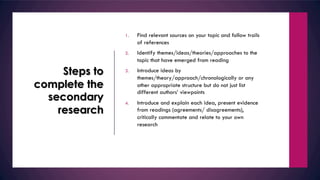
Steps to
complete the
secondary
research
1. Find relevant sources on your topic and follow trails
of references
2. Identify themes/ideas/theories/approaches to the
topic that have emerged from reading
3. Introduce ideas by
themes/theory/approach/chronologically or any
other appropriate structure but do not just list
different authors’ viewpoints
4. Introduce and explain each idea, present evidence
from readings (agreements/ disagreements),
critically commentate and relate to your own
research
Critical Reading
The importance of critical reading
Come up with at least 5 questions that you would ask yourself
when critically analysing a text for your review.
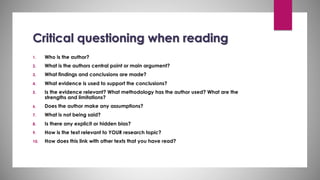
Critical questioning when reading
1. Who is the author?
2. What is the authors central point or main argument?
3. What findings and conclusions are made?
4. What evidence is used to support the conclusions?
5. Is the evidence relevant? What methodology has the author used? What are the
strengths and limitations?
6. Does the author make any assumptions?
7. What is not being said?
8. Is there any explicit or hidden bias?
9. How is the text relevant to YOUR research topic?
10. How does this link with other texts that you have read?
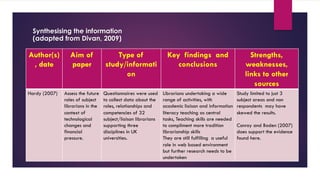
Synthesising the information
(adapted from Divan, 2009)
Author(s)
, date
Aim of
paper
Type of
study/informati
on
Key findings and
conclusions
Strengths,
weaknesses,
links to other
sources
Hardy (2007) Assess the future
roles of subject
librarians in the
context of
technological
changes and
financial
pressure.
Questionnaires were used
to collect data about the
roles, relationships and
competencies of 32
subject/liaison librarians
supporting three
disciplines in UK
universities.
Librarians undertaking a wide
range of activities, with
academic liaison and information
literacy teaching as central
tasks, Teaching skills are needed
to compliment more tradition
librarianship skills
They are still fulfilling a useful
role in web based environment
but further research needs to be
undertaken
Study limited to just 3
subject areas and non
respondents may have
skewed the results.
Conroy and Boden (2007)
does support the evidence
found here.
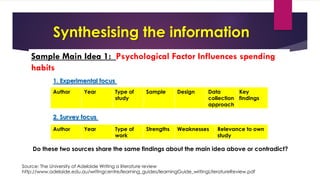
Synthesising the information
Sample Main Idea 1: Psychological Factor Influences spending
habits
Author Year Type of
study
Sample Design Data
collection
approach
Key
findings
1. Experimental focus
2. Survey focus
Author Year Type of
work
Strengths Weaknesses Relevance to own
study
Source: The University of Adelaide Writing a literature review
http://www.adelaide.edu.au/writingcentre/learning_guides/learningGuide_writingLiteratureReview.pdf
Do these two sources share the same findings about the main idea above or contradict?
What is the big picture?
photo by oddsock on Flickr
When reading for the body of your secondary research paper, you’re trying to identify links
between papers. Not just reviewing each paper separately. What’s the story? The overview
in your topic?
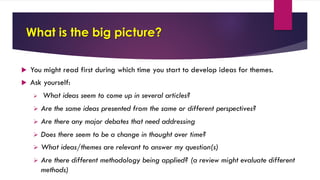
What is the big picture?
u You might read first during which time you start to develop ideas for themes.
u Ask yourself:
Ø What ideas seem to come up in several articles?
Ø Are the same ideas presented from the same or different perspectives?
Ø Are there any major debates that need addressing
Ø Does there seem to be a change in thought over time?
Ø What ideas/themes are relevant to answer my question(s)
Ø Are there different methodology being applied? (a review might evaluate different
methods)
What is the big picture?
You might already have a “big picture” idea. Your reading may then either:
Ø Confirm and support the structure of your initial plan
OR
Ø Lead you to change your plan due to new ideas you’ve developed in your
reading
General writing advice
“Provide the reader with strong "umbrella" sentences at beginnings of
paragraphs, "signposts" throughout, and brief "so what" summary
sentences at intermediate points in the review to aid in understanding
comparisons and analyses”.
Ø Use language to show confidence/caution:
e.g. There is clearly a link.../This suggests a possible link...
Ø Use you own voice to comment on the literature

ENG333 Week 8 writing the method and results

  • 1.
    ENG33 Week 8 Case StudyMethod and Results DR. RUSSELL RODRIGO
  • 2.
    Method In this section,you explain why you selected a particular subject of analysis to study and the strategy you used to identify and ultimately decide that your case was appropriate in addressing the research problem. The way you describe the methods used varies depending on the type of subject of analysis that frames your case study.
  • 3.
    Writing the Research Method Sample: This paperapplies Thematic Analysis, an approach that includes the process of identifying themes or patterns within qualitative data (Clark & Braun, 2013). Considering this is a secondary research paper, it initially aimed at identifying key themes and search terms and key concepts. One of the search terms, include “Thailand social movements,”. The online databases used in this literature review include Google, Google Scholar, ERIC, JSTOR, EBSCOhost, Wiley Online Library, and other academic and non-academic but reliable search engines. The most recent publications were prioritized in the search, and among the impacts of social movements in Thailand found include LGBT rights, military service, and the fight to demolish capital punishment. Hence, this paper focuses on the impacts mentioned above. This paper was produced through a collaborative effort in the aspects of planning, researching, drafting, and redrafting.
  • 4.
    Sample: This paper appliesThematic Analysis, an approach that includes the process of identifying themes or patterns within qualitative data (Clark & Braun, 2013). Considering this is a secondary research paper, it initially aimed at identifying key themes and search terms and key concepts. One of the search terms, include “Thailand social movements,”. The online databases used in this literature review include Google, Google Scholar, ERIC, JSTOR, EBSCOhost, Wiley Online Library, and other academic and non-academic but reliable search engines. The most recent publications were prioritized in the search, and among the impacts of social movements in Thailand found include LGBT rights, military service, and the fight to demolish capital punishment. Hence, this paper focuses on the impacts mentioned above. This paper was produced through a collaborative effort in the aspects of planning, researching, drafting, and redrafting. Introduce what method is used. Search terms used Online databases used Link to the identification of the main points Writing process
  • 5.
    Steps to complete the secondary research 1.Find relevant sources on your topic and follow trails of references 2. Identify themes/ideas/theories/approaches to the topic that have emerged from reading 3. Introduce ideas by themes/theory/approach/chronologically or any other appropriate structure but do not just list different authors’ viewpoints 4. Introduce and explain each idea, present evidence from readings (agreements/ disagreements), critically commentate and relate to your own research
  • 6.
    Critical Reading The importanceof critical reading Come up with at least 5 questions that you would ask yourself when critically analysing a text for your review.
  • 7.
    Critical questioning whenreading 1. Who is the author? 2. What is the authors central point or main argument? 3. What findings and conclusions are made? 4. What evidence is used to support the conclusions? 5. Is the evidence relevant? What methodology has the author used? What are the strengths and limitations? 6. Does the author make any assumptions? 7. What is not being said? 8. Is there any explicit or hidden bias? 9. How is the text relevant to YOUR research topic? 10. How does this link with other texts that you have read?
  • 8.
    Synthesising the information (adaptedfrom Divan, 2009) Author(s) , date Aim of paper Type of study/informati on Key findings and conclusions Strengths, weaknesses, links to other sources Hardy (2007) Assess the future roles of subject librarians in the context of technological changes and financial pressure. Questionnaires were used to collect data about the roles, relationships and competencies of 32 subject/liaison librarians supporting three disciplines in UK universities. Librarians undertaking a wide range of activities, with academic liaison and information literacy teaching as central tasks, Teaching skills are needed to compliment more tradition librarianship skills They are still fulfilling a useful role in web based environment but further research needs to be undertaken Study limited to just 3 subject areas and non respondents may have skewed the results. Conroy and Boden (2007) does support the evidence found here.
  • 9.
    Synthesising the information SampleMain Idea 1: Psychological Factor Influences spending habits Author Year Type of study Sample Design Data collection approach Key findings 1. Experimental focus 2. Survey focus Author Year Type of work Strengths Weaknesses Relevance to own study Source: The University of Adelaide Writing a literature review http://www.adelaide.edu.au/writingcentre/learning_guides/learningGuide_writingLiteratureReview.pdf Do these two sources share the same findings about the main idea above or contradict?
  • 10.
    What is thebig picture? photo by oddsock on Flickr When reading for the body of your secondary research paper, you’re trying to identify links between papers. Not just reviewing each paper separately. What’s the story? The overview in your topic?
  • 11.
    What is thebig picture? u You might read first during which time you start to develop ideas for themes. u Ask yourself: Ø What ideas seem to come up in several articles? Ø Are the same ideas presented from the same or different perspectives? Ø Are there any major debates that need addressing Ø Does there seem to be a change in thought over time? Ø What ideas/themes are relevant to answer my question(s) Ø Are there different methodology being applied? (a review might evaluate different methods)
  • 12.
    What is thebig picture? You might already have a “big picture” idea. Your reading may then either: Ø Confirm and support the structure of your initial plan OR Ø Lead you to change your plan due to new ideas you’ve developed in your reading
  • 13.
    General writing advice “Providethe reader with strong "umbrella" sentences at beginnings of paragraphs, "signposts" throughout, and brief "so what" summary sentences at intermediate points in the review to aid in understanding comparisons and analyses”. Ø Use language to show confidence/caution: e.g. There is clearly a link.../This suggests a possible link... Ø Use you own voice to comment on the literature