FRISK DOCUMENTATION MODEL 
Practical Guidelines for Evaluators in Documenting Unsatisfactory 
Employee Performance 
Office of Human Resources 
Ella Padilla 
Mary Miner 
Dina Perfetti-Deany 
Damon Brown
THE PURPOSE OF FRISK 
1. Improve Employee Performance 
2. Offer Coaching and Support 
3. Document Expectations 
4. Document Non-compliance 
5. Provide Evidence for Disciplinary Action and Potential 
Remediation
WHY DO WE NEED TO PRESERVE A RECORD OF 
EMPLOYEE PERFORMANCE? 
• to document Employee Performance 
• to meet the Burden of Proof in disciplinary cases 
• to defend a personnel decision regarding a grievance 
• to support district’s defense in discrimination and civil rights 
complaints or unfair practice charges
OTHER BENEFITS OF FRISK 
• It is a framework for positive behavioral change 
• It is aligned with Master Agreement 
• It supports the 7 Tests for Just Cause 
• It is a strategy that uses assertive communication skills 
• It creates clear understanding of expectations 
• It creates open, honest and precise communication 
• It is accountable and considerate
WHY YOU WOULD USE FRISK 
FRISK provides a concise and consistent format. 
FRISK helps document singular “events” that may demonstrate 
patterns and may become part of a permanent personnel 
record. 
FRISK can be used to support the termination process
CORE PHILOSOPHY OF FRISK 
POSTIVE – emphasis is placed on potential of employees to 
change/improve their behavior/performance rather than 
punitive measures. 
CORRECTIVE – Supervisors have a responsibility to assist 
employees in modifying their conduct. 
PROGRESSIVE – By progressively increasing the severity of the 
communication and discipline imposed for persistent 
misconduct or failure to meet the established standard it is 
expected that employees will be given the necessary incentive 
to take corrective action.
THE COMPONENTS OF FRISK 
• F – FACTS evidencing the employee’s unsatisfactory conduct. 
• R – RULE or authority violated by the employee’s behavior. 
• I – IMPACT of the employee’s unsatisfactory conduct on the 
workplace. 
• S – SUGGESTIONS to assist the employee in improving 
performance and directions as to the proper conduct the 
employee is expected to follow in the future. Theses 
directions are also referred to as Directives such as 
“Immediately you will…”. 
• K – KNOWLEDGE of the employee’s right to respond to 
corrective documentation placed in the personnel file.
THE FRISK PROGRESSIVE PROCESS 
1. Verbal Resolution and Coaching 
2. Written Warning 
3. Letter of Reprimand 
4. Unsatisfactory Evaluation 
5. Suspension Without Pay 
6. Dismissal 
Page 70 -73 When determining discipline. Steps may be 
skipped based on severity
FACTS RULES IMPACT SUGGESTIONS KNOWLEDGE 
FACTS: what did the employee do? 
• Be specific 
-Identify and isolate the issue 
-Avoid grouping multiple issues together 
• Be explicit 
-Dates, names, events, witnesses, etc. 
-Acknowledge previous warnings, discussions, employee 
admissions, etc. 
• Be factually accurate 
-CAUTION: Have specific, factual information: – Avoid 
general statements and conclusions
FACTS RULES IMPACT SUGGESTIONS KNOWLEDGE 
Facts - Examples 
• BAD LANGUAGE: 
“You are frequently late to staff meetings.” 
• GOOD LANGUAGE: 
“You are frequently late to staff meetings. Between 
September 1 and November 1, 2012 you were late to staff 
meetings on September 14 (15 minutes); September 26 (5 
minutes); October 10 (10 minutes); and October 22 (10 
minutes).
FACTS RULES IMPACT SUGGESTIONS KNOWLEDGE 
RULES: What should the employee have done? 
FIRST, DEFINE PROBLEM 
SECOND, TRANSLATE PROBLEM TO EXPECTED “RULE.” 
• The rule(s) should be a statement of specific expectation, 
standard practice, school or district policy. 
• Rules must be consistently applied to all employees. 
• Restating the rule is critical documentation and verifies the 
employee was made aware of the issue. 
• The “rule” is always restated as the directive that the 
employee is to follow in the future.
FACTS RULES IMPACT SUGGESTIONS KNOWLEDGE 
Rules - Examples 
• “Your conduct violated Article 502, Section 88 of the 
Agreement, which requires you to be in your room 15 
minutes before the bell rings.” 
• “Your conduct violated the memo sent by me in which the 
staff was directed to no longer have students line up on the 
west side of the building.” 
• “Your conduct violated Board Policy ____-----
FACTS RULES IMPACT SUGGESTIONS KNOWLEDGE 
Rules - Examples 
• PROBLEM: Argumentative/Abrasive Behavior 
The PROBLEM with an employee who uses profanity in the 
presence of students denotes “poor professional judgment.” 
TRANSLATE the PROBLEM into a “rule.” 
Your conduct in front of the class lacked good judgment 
which requires you to refrain from using profanity in front of, or 
in conversations with students.
FACTS RULES IMPACT SUGGESTIONS KNOWLEDGE 
Impact - Definition 
What is the impact of the employee’s conduct? 
• An “impact” is the consequence of the employee’s action on 
other individuals or the organization. 
• The impact is always adverse and substantiates the 
seriousness of the inappropriate conduct 
• An impact statement links the undesired behavior/event to 
the broader responsibilities of the employee’s position 
Pages 33-42 of FRISK Handbook
FACTS RULES IMPACT SUGGESTIONS KNOWLEDGE 
Impact – Examples 
• Your lack of supervision of students is a violation of BOE policy JLI 
(attached), exposed students to possible injury, and exposed the district to 
possible liability. 
• Your conduct of sending home parent notes with errors negatively 
impacted the trust parents have of our school and our instructional 
competence. 
• Your sarcastic and demeaning communication with students had an 
adverse impact on your teaching effectiveness and relationships with 
students, resulting in 3 student and parent complaints this school year. 
Contact HR to brainstorm examples of adverse impact evidence. Include 
all identifiable examples to make a clear connection between conduct 
and negative impact.
FACTS RULES IMPACT SUGGESTIONS KNOWLEDGE 
Suggestions / Directives – Definition 
What should the employee to do to improve their performance? 
• To demonstrate good faith and meet legal requirements, the supervisor should 
provide suggested strategies, resources, and timelines to help the employee meet 
performance expectations. 
• Suggestions should include a directive articulating future expectations for 
performance – clearly, not ambiguous. 
• Suggestions/Directives for improvement are always supported by a statement of 
consequences in the event of employee noncompliance 
Resources to reference: Board Policy, Master Agreement, Teacher Quality 
Standards, Strategic Plan, past directives
FACTS RULES IMPACT SUGGESTIONS KNOWLEDGE 
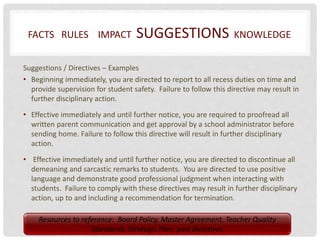
Suggestions / Directives – Examples 
• Beginning immediately, you are directed to report to all recess duties on time and 
provide supervision for student safety. Failure to follow this directive may result in 
further disciplinary action. 
• Effective immediately and until further notice, you are required to proofread all 
written parent communication and get approval by a school administrator before 
sending home. Failure to follow this directive will result in further disciplinary 
action. 
• Effective immediately and until further notice, you are directed to discontinue all 
demeaning and sarcastic remarks to students. You are directed to use positive 
language and demonstrate good professional judgment when interacting with 
students. Failure to comply with these directives may result in further disciplinary 
action, up to and including a recommendation for termination. 
Resources to reference: Board Policy, Master Agreement, Teacher Quality 
Standards, Strategic Plan, past directives
FACTS RULES IMPACT SUGGESTIONS KNOWLEDGE 
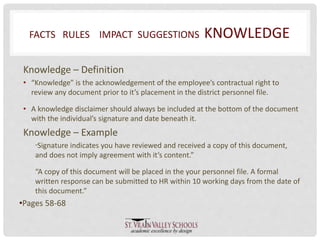
Knowledge – Definition 
• “Knowledge” is the acknowledgement of the employee’s contractual right to 
review any document prior to it’s placement in the district personnel file. 
• A knowledge disclaimer should always be included at the bottom of the document 
with the individual’s signature and date beneath it. 
Knowledge – Example 
“Signature indicates you have reviewed and received a copy of this document, 
and does not imply agreement with it’s content.” 
“A copy of this document will be placed in the your personnel file. A formal 
written response can be submitted to HR within 10 working days from the date of 
this document.” 
•Pages 58-68
FACTS RULES IMPACT SUGGESTIONS KNOWLEDGE 
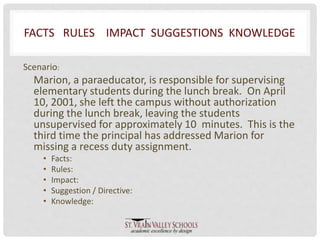
Scenario: 
Marion, a paraeducator, is responsible for supervising 
elementary students during the lunch break. On April 
10, 2001, she left the campus without authorization 
during the lunch break, leaving the students 
unsupervised for approximately 10 minutes. This is the 
third time the principal has addressed Marion for 
missing a recess duty assignment. 
• Facts: 
• Rules: 
• Impact: 
• Suggestion / Directive: 
• Knowledge:
FACTS RULES IMPACT SUGGESTIONS KNOWLEDGE 
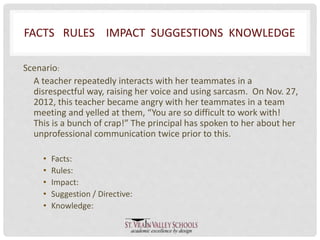
Scenario: 
A teacher repeatedly interacts with her teammates in a 
disrespectful way, raising her voice and using sarcasm. On Nov. 27, 
2012, this teacher became angry with her teammates in a team 
meeting and yelled at them, “You are so difficult to work with! 
This is a bunch of crap!” The principal has spoken to her about her 
unprofessional communication twice prior to this. 
• Facts: 
• Rules: 
• Impact: 
• Suggestion / Directive: 
• Knowledge:
FACTS RULES IMPACT SUGGESTIONS KNOWLEDGE 
Scenario: 
“THIS IS YOUR LIFE” 
With a partner, talk about a situation you have in your building. 
What is the next step you think you should take with this 
employee? 
If you decide on a formal write-up, how would you word the 
situation using FRISK? 
• Facts: 
• Rules: 
• Impact: 
• Suggestion / Directive: 
• Knowledge:
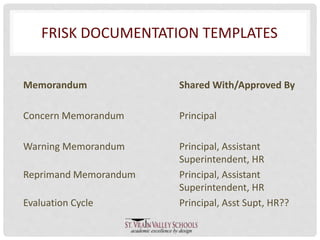
FRISK DOCUMENTATION TEMPLATES 
Memorandum Shared With/Approved By 
Concern Memorandum Principal 
Warning Memorandum Principal, Assistant 
Superintendent, HR 
Reprimand Memorandum Principal, Assistant 
Superintendent, HR 
Evaluation Cycle Principal, Asst Supt, HR??
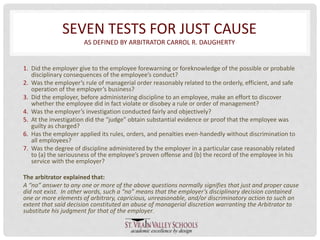
SEVEN TESTS FOR JUST CAUSE 
AS DEFINED BY ARBITRATOR CARROL R. DAUGHERTY 
1. Did the employer give to the employee forewarning or foreknowledge of the possible or probable 
disciplinary consequences of the employee’s conduct? 
2. Was the employer’s rule of managerial order reasonably related to the orderly, efficient, and safe 
operation of the employer’s business? 
3. Did the employer, before administering discipline to an employee, make an effort to discover 
whether the employee did in fact violate or disobey a rule or order of management? 
4. Was the employer’s investigation conducted fairly and objectively? 
5. At the investigation did the “judge” obtain substantial evidence or proof that the employee was 
guilty as charged? 
6. Has the employer applied its rules, orders, and penalties even-handedly without discrimination to 
all employees? 
7. Was the degree of discipline administered by the employer in a particular case reasonably related 
to (a) the seriousness of the employee’s proven offense and (b) the record of the employee in his 
service with the employer? 
The arbitrator explained that: 
A “no” answer to any one or more of the above questions normally signifies that just and proper cause 
did not exist. In other words, such a “no” means that the employer’s disciplinary decision contained 
one or more elements of arbitrary, capricious, unreasonable, and/or discriminatory action to such an 
extent that said decision constituted an abuse of managerial discretion warranting the Arbitrator to 
substitute his judgment for that of the employer.
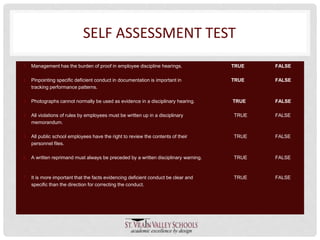
SELF ASSESSMENT TEST 
1. Management has the burden of proof in employee discipline hearings. TRUE FALSE 
2. Pinpointing specific deficient conduct in documentation is important in TRUE FALSE 
tracking performance patterns. 
3. Photographs cannot normally be used as evidence in a disciplinary hearing. TRUE FALSE 
3. All violations of rules by employees must be written up in a disciplinary TRUE FALSE 
memorandum. 
5. All public school employees have the right to review the contents of their TRUE FALSE 
personnel files. 
6. A written reprimand must always be preceded by a written disciplinary warning. TRUE FALSE 
7. It is more important that the facts evidencing deficient conduct be clear and TRUE FALSE 
specific than the direction for correcting the conduct.

Frisk Documentation Model Training

  • 1.
    FRISK DOCUMENTATION MODEL Practical Guidelines for Evaluators in Documenting Unsatisfactory Employee Performance Office of Human Resources Ella Padilla Mary Miner Dina Perfetti-Deany Damon Brown
  • 2.
    THE PURPOSE OFFRISK 1. Improve Employee Performance 2. Offer Coaching and Support 3. Document Expectations 4. Document Non-compliance 5. Provide Evidence for Disciplinary Action and Potential Remediation
  • 3.
    WHY DO WENEED TO PRESERVE A RECORD OF EMPLOYEE PERFORMANCE? • to document Employee Performance • to meet the Burden of Proof in disciplinary cases • to defend a personnel decision regarding a grievance • to support district’s defense in discrimination and civil rights complaints or unfair practice charges
  • 4.
    OTHER BENEFITS OFFRISK • It is a framework for positive behavioral change • It is aligned with Master Agreement • It supports the 7 Tests for Just Cause • It is a strategy that uses assertive communication skills • It creates clear understanding of expectations • It creates open, honest and precise communication • It is accountable and considerate
  • 5.
    WHY YOU WOULDUSE FRISK FRISK provides a concise and consistent format. FRISK helps document singular “events” that may demonstrate patterns and may become part of a permanent personnel record. FRISK can be used to support the termination process
  • 6.
    CORE PHILOSOPHY OFFRISK POSTIVE – emphasis is placed on potential of employees to change/improve their behavior/performance rather than punitive measures. CORRECTIVE – Supervisors have a responsibility to assist employees in modifying their conduct. PROGRESSIVE – By progressively increasing the severity of the communication and discipline imposed for persistent misconduct or failure to meet the established standard it is expected that employees will be given the necessary incentive to take corrective action.
  • 7.
    THE COMPONENTS OFFRISK • F – FACTS evidencing the employee’s unsatisfactory conduct. • R – RULE or authority violated by the employee’s behavior. • I – IMPACT of the employee’s unsatisfactory conduct on the workplace. • S – SUGGESTIONS to assist the employee in improving performance and directions as to the proper conduct the employee is expected to follow in the future. Theses directions are also referred to as Directives such as “Immediately you will…”. • K – KNOWLEDGE of the employee’s right to respond to corrective documentation placed in the personnel file.
  • 8.
    THE FRISK PROGRESSIVEPROCESS 1. Verbal Resolution and Coaching 2. Written Warning 3. Letter of Reprimand 4. Unsatisfactory Evaluation 5. Suspension Without Pay 6. Dismissal Page 70 -73 When determining discipline. Steps may be skipped based on severity
  • 9.
    FACTS RULES IMPACTSUGGESTIONS KNOWLEDGE FACTS: what did the employee do? • Be specific -Identify and isolate the issue -Avoid grouping multiple issues together • Be explicit -Dates, names, events, witnesses, etc. -Acknowledge previous warnings, discussions, employee admissions, etc. • Be factually accurate -CAUTION: Have specific, factual information: – Avoid general statements and conclusions
  • 10.
    FACTS RULES IMPACTSUGGESTIONS KNOWLEDGE Facts - Examples • BAD LANGUAGE: “You are frequently late to staff meetings.” • GOOD LANGUAGE: “You are frequently late to staff meetings. Between September 1 and November 1, 2012 you were late to staff meetings on September 14 (15 minutes); September 26 (5 minutes); October 10 (10 minutes); and October 22 (10 minutes).
  • 11.
    FACTS RULES IMPACTSUGGESTIONS KNOWLEDGE RULES: What should the employee have done? FIRST, DEFINE PROBLEM SECOND, TRANSLATE PROBLEM TO EXPECTED “RULE.” • The rule(s) should be a statement of specific expectation, standard practice, school or district policy. • Rules must be consistently applied to all employees. • Restating the rule is critical documentation and verifies the employee was made aware of the issue. • The “rule” is always restated as the directive that the employee is to follow in the future.
  • 12.
    FACTS RULES IMPACTSUGGESTIONS KNOWLEDGE Rules - Examples • “Your conduct violated Article 502, Section 88 of the Agreement, which requires you to be in your room 15 minutes before the bell rings.” • “Your conduct violated the memo sent by me in which the staff was directed to no longer have students line up on the west side of the building.” • “Your conduct violated Board Policy ____-----
  • 13.
    FACTS RULES IMPACTSUGGESTIONS KNOWLEDGE Rules - Examples • PROBLEM: Argumentative/Abrasive Behavior The PROBLEM with an employee who uses profanity in the presence of students denotes “poor professional judgment.” TRANSLATE the PROBLEM into a “rule.” Your conduct in front of the class lacked good judgment which requires you to refrain from using profanity in front of, or in conversations with students.
  • 14.
    FACTS RULES IMPACTSUGGESTIONS KNOWLEDGE Impact - Definition What is the impact of the employee’s conduct? • An “impact” is the consequence of the employee’s action on other individuals or the organization. • The impact is always adverse and substantiates the seriousness of the inappropriate conduct • An impact statement links the undesired behavior/event to the broader responsibilities of the employee’s position Pages 33-42 of FRISK Handbook
  • 15.
    FACTS RULES IMPACTSUGGESTIONS KNOWLEDGE Impact – Examples • Your lack of supervision of students is a violation of BOE policy JLI (attached), exposed students to possible injury, and exposed the district to possible liability. • Your conduct of sending home parent notes with errors negatively impacted the trust parents have of our school and our instructional competence. • Your sarcastic and demeaning communication with students had an adverse impact on your teaching effectiveness and relationships with students, resulting in 3 student and parent complaints this school year. Contact HR to brainstorm examples of adverse impact evidence. Include all identifiable examples to make a clear connection between conduct and negative impact.
  • 16.
    FACTS RULES IMPACTSUGGESTIONS KNOWLEDGE Suggestions / Directives – Definition What should the employee to do to improve their performance? • To demonstrate good faith and meet legal requirements, the supervisor should provide suggested strategies, resources, and timelines to help the employee meet performance expectations. • Suggestions should include a directive articulating future expectations for performance – clearly, not ambiguous. • Suggestions/Directives for improvement are always supported by a statement of consequences in the event of employee noncompliance Resources to reference: Board Policy, Master Agreement, Teacher Quality Standards, Strategic Plan, past directives
  • 17.
    FACTS RULES IMPACTSUGGESTIONS KNOWLEDGE Suggestions / Directives – Examples • Beginning immediately, you are directed to report to all recess duties on time and provide supervision for student safety. Failure to follow this directive may result in further disciplinary action. • Effective immediately and until further notice, you are required to proofread all written parent communication and get approval by a school administrator before sending home. Failure to follow this directive will result in further disciplinary action. • Effective immediately and until further notice, you are directed to discontinue all demeaning and sarcastic remarks to students. You are directed to use positive language and demonstrate good professional judgment when interacting with students. Failure to comply with these directives may result in further disciplinary action, up to and including a recommendation for termination. Resources to reference: Board Policy, Master Agreement, Teacher Quality Standards, Strategic Plan, past directives
  • 18.
    FACTS RULES IMPACTSUGGESTIONS KNOWLEDGE Knowledge – Definition • “Knowledge” is the acknowledgement of the employee’s contractual right to review any document prior to it’s placement in the district personnel file. • A knowledge disclaimer should always be included at the bottom of the document with the individual’s signature and date beneath it. Knowledge – Example “Signature indicates you have reviewed and received a copy of this document, and does not imply agreement with it’s content.” “A copy of this document will be placed in the your personnel file. A formal written response can be submitted to HR within 10 working days from the date of this document.” •Pages 58-68
  • 19.
    FACTS RULES IMPACTSUGGESTIONS KNOWLEDGE Scenario: Marion, a paraeducator, is responsible for supervising elementary students during the lunch break. On April 10, 2001, she left the campus without authorization during the lunch break, leaving the students unsupervised for approximately 10 minutes. This is the third time the principal has addressed Marion for missing a recess duty assignment. • Facts: • Rules: • Impact: • Suggestion / Directive: • Knowledge:
  • 20.
    FACTS RULES IMPACTSUGGESTIONS KNOWLEDGE Scenario: A teacher repeatedly interacts with her teammates in a disrespectful way, raising her voice and using sarcasm. On Nov. 27, 2012, this teacher became angry with her teammates in a team meeting and yelled at them, “You are so difficult to work with! This is a bunch of crap!” The principal has spoken to her about her unprofessional communication twice prior to this. • Facts: • Rules: • Impact: • Suggestion / Directive: • Knowledge:
  • 21.
    FACTS RULES IMPACTSUGGESTIONS KNOWLEDGE Scenario: “THIS IS YOUR LIFE” With a partner, talk about a situation you have in your building. What is the next step you think you should take with this employee? If you decide on a formal write-up, how would you word the situation using FRISK? • Facts: • Rules: • Impact: • Suggestion / Directive: • Knowledge:
  • 22.
    FRISK DOCUMENTATION TEMPLATES Memorandum Shared With/Approved By Concern Memorandum Principal Warning Memorandum Principal, Assistant Superintendent, HR Reprimand Memorandum Principal, Assistant Superintendent, HR Evaluation Cycle Principal, Asst Supt, HR??
  • 23.
    SEVEN TESTS FORJUST CAUSE AS DEFINED BY ARBITRATOR CARROL R. DAUGHERTY 1. Did the employer give to the employee forewarning or foreknowledge of the possible or probable disciplinary consequences of the employee’s conduct? 2. Was the employer’s rule of managerial order reasonably related to the orderly, efficient, and safe operation of the employer’s business? 3. Did the employer, before administering discipline to an employee, make an effort to discover whether the employee did in fact violate or disobey a rule or order of management? 4. Was the employer’s investigation conducted fairly and objectively? 5. At the investigation did the “judge” obtain substantial evidence or proof that the employee was guilty as charged? 6. Has the employer applied its rules, orders, and penalties even-handedly without discrimination to all employees? 7. Was the degree of discipline administered by the employer in a particular case reasonably related to (a) the seriousness of the employee’s proven offense and (b) the record of the employee in his service with the employer? The arbitrator explained that: A “no” answer to any one or more of the above questions normally signifies that just and proper cause did not exist. In other words, such a “no” means that the employer’s disciplinary decision contained one or more elements of arbitrary, capricious, unreasonable, and/or discriminatory action to such an extent that said decision constituted an abuse of managerial discretion warranting the Arbitrator to substitute his judgment for that of the employer.
  • 24.
    SELF ASSESSMENT TEST 1. Management has the burden of proof in employee discipline hearings. TRUE FALSE 2. Pinpointing specific deficient conduct in documentation is important in TRUE FALSE tracking performance patterns. 3. Photographs cannot normally be used as evidence in a disciplinary hearing. TRUE FALSE 3. All violations of rules by employees must be written up in a disciplinary TRUE FALSE memorandum. 5. All public school employees have the right to review the contents of their TRUE FALSE personnel files. 6. A written reprimand must always be preceded by a written disciplinary warning. TRUE FALSE 7. It is more important that the facts evidencing deficient conduct be clear and TRUE FALSE specific than the direction for correcting the conduct.