Analysis Frameworks for  Sustainability:   Linking Energy and the Environment Rudolf B. Husar Director, Center for Air Pollution and Trends Analysis (CAPITA)  Professor, Department of Energy, Environmental & Chemical Engineering     EECE Seminar, Friday, November 2, 2007, 11:00am,  Lopata 101, Washington University
Integrative Science and Engineering for ‘Grand Challenges’  The problems of Energy and Environment (EE) are  Grand Challenges Solutions require engineering, biological, socio-economic and other sciences A rigorous and practical integrated framework for EE is not available This is an exploration of frameworks for integrated Energy Environmental Analysis Interested in the EE integration challenge? Join us on the  wiki !
Sustainable Development (SD) A process of reconciling society’s  developmental needs  with the  environmental limits  over the long term. But,  What should be developed ,  what should be sustained? SD as an uncertain and adaptive process, “in which society's discovery of where it wants to go is intertwined with how it might try to get there”.  During the SD ‘ journey ’ toward sustainability, the pathways have to be ‘ navigated ’ adaptively Continuing the metaphors,  science  is the compass, giving the directions and  laws-regulations  are the gyroscope for staying on course  . National Academy, 1999
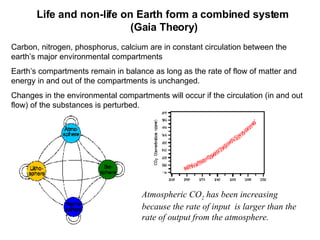
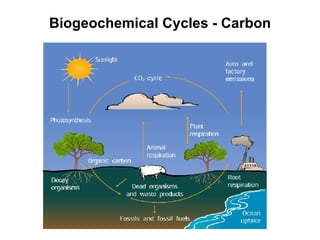
Life and non-life on Earth form a combined system  (Gaia Theory) Carbon, nitrogen, phosphorus, calcium are in constant circulation between the earth’s major environmental compartments Earth’s compartments remain in balance as long as the rate of flow of matter and energy in and out of the compartments is unchanged.  Changes in the environmental compartments will occur if the circulation (in and out flow) of the substances is perturbed. Atmospheric CO 2  has been increasing because the rate of input  is larger than the rate of output from the atmosphere.
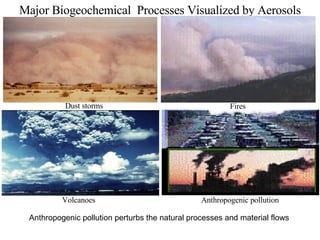
Major Biogeochemical  Processes Visualized by Aerosols Dust storms Volcanoes Anthropogenic pollution Fires Anthropogenic pollution perturbs the natural processes and material flows
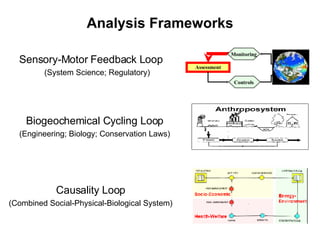
Analysis Frameworks Sensory-Motor Feedback Loop (System Science; Regulatory) Causality Loop (Combined Social-Physical-Biological System) Biogeochemical Cycling Loop (Engineering; Biology; Conservation Laws) Assessment Controls  Monitoring
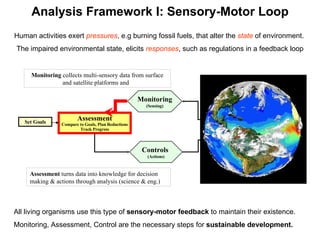
Analysis Framework I: Sensory-Motor Loop Assessment Compare to Goals, Plan Reductions Track Progress Controls  (Actions) Monitoring (Sensing) Set Goals Assessment  turns data into knowledge for decision making & actions through analysis (science & eng.) Monitoring  collects multi-sensory data from surface and satellite platforms and  Human activities exert  pressures , e.g burning fossil fuels, that alter the  state  of environment.  The impaired environmental state, elicits  responses , such as regulations in a feedback loop All living organisms use this type of  sensory-motor feedback  to maintain their existence. Monitoring, Assessment, Control are the necessary steps for  sustainable development.
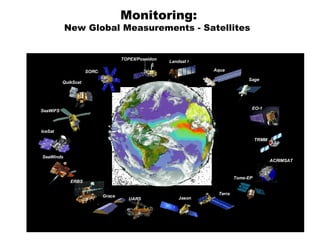
Monitoring: New Global Measurements - Satellites  ERBS Terra Aqua Grace IceSat QuikScat Sage SeaWinds TRMM Toms-EP UARS Jason Landsat  7 SORCE SeaWiFS ACRIMSAT TOPEX/Poseidon EO-1
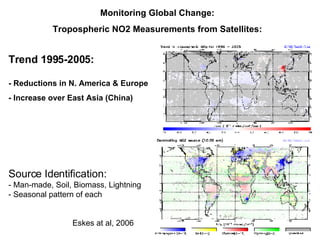
Eskes at al, 2006 Source Identification: - Man-made, Soil, Biomass, Lightning - Seasonal pattern of each Trend 1995-2005: - Reductions in N. America & Europe  - Increase over East Asia (China) Monitoring Global Change: Tropospheric NO2 Measurements from Satellites:
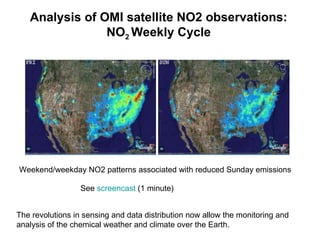
Analysis of OMI satellite NO2 observations: NO 2  Weekly Cycle Weekend/weekday NO2 patterns associated with reduced Sunday emissions See  screencast  (1 minute)  The revolutions in sensing and data distribution now allow the monitoring and analysis of the chemical weather and climate over the Earth.
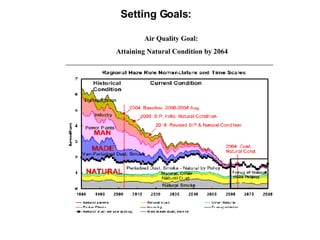
Setting Goals: Air Quality Goal:  Attaining Natural Condition by 2064
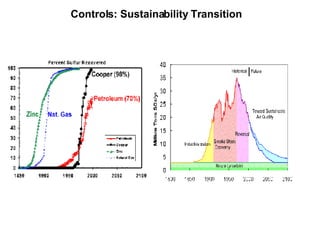
Controls: Sustainability Transition
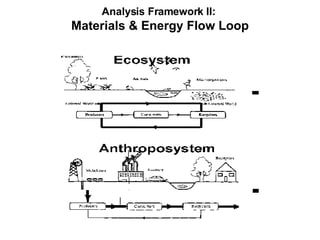
Analysis Framework II:  Materials & Energy Flow Loop
Biogeochemical Cycles - Carbon
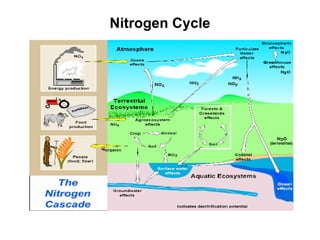
Nitrogen Cycle
 
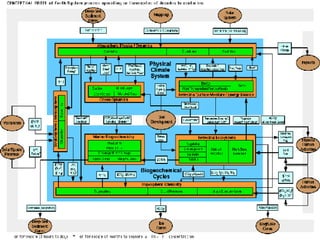
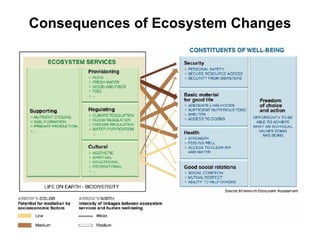
Consequences of Ecosystem Changes
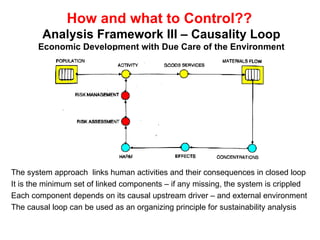
How and what to Control??  Analysis Framework III – Causality Loop Economic Development with Due Care of the Environment The system approach  links human activities and their consequences in closed loop It is the minimum set of linked components – if any missing, the system is crippled Each component depends on its causal upstream driver – and external environment The causal loop can be used as an organizing principle for sustainability analysis
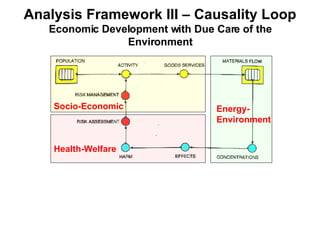
Analysis Framework III – Causality Loop Economic Development with Due Care of the Environment Health-Welfare Energy-Environment Socio-Economic
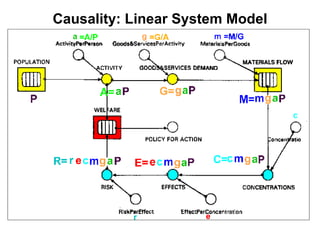
Causality: Linear System Model
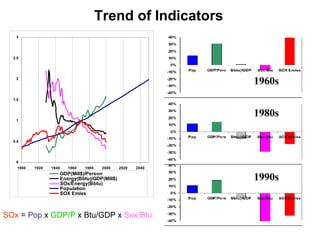
Trend of Indicators SOx  =  Pop  x  GDP/P  x Btu/GDP x  Sox/Btu 1960s 1980s 1990s
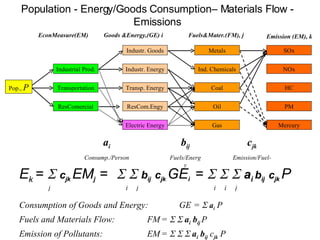
Population - Energy/Goods Consumption– Materials Flow - Emissions E k  =     c jk  EM j  =         b ij   c jk  GE i  =           a i  b ij   c jk  P Industr. Energy Transp. Energy ResCom.Engy Coal Oil Gas Electric Energy SOx NOx HC PM Goods &Energy,(GE) i Fuels&Mater.(FM), j Emission (EM), k Ind. Chemicals Industr. Goods Pop.,  P Metals Mercury a i Consump./Person b ij Fuels/Energy c jk Emission/Fuel- j j i i i j Consumption of Goods and Energy: GE   =     a i  P  Fuels and Materials Flow: FM   =        a i   b ij  P  Emission of Pollutants: EM   =           a i   b ij  c jk  P Industrial Prod. Transportation ResComercial EconMeasure(EM)
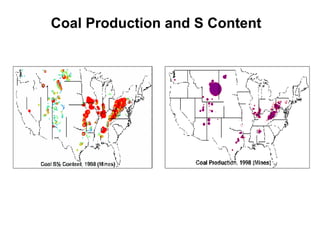
Coal Production and S Content
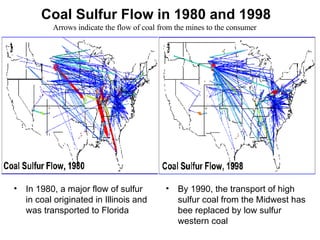
Coal Sulfur Flow in 1980 and 1998 In 1980, a major flow of sulfur in coal originated in Illinois and was transported to Florida Arrows indicate the flow of coal from the mines to the consumer By 1990, the transport of high sulfur coal from the Midwest has bee replaced by low sulfur western coal
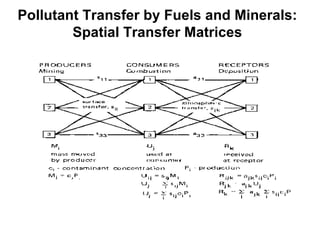
Pollutant Transfer by Fuels and Minerals: Spatial Transfer Matrices
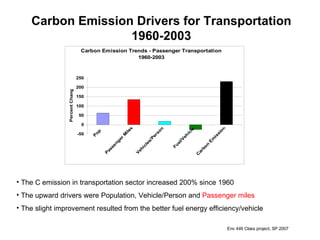
Carbon Emission Drivers for Transportation 1960-2003 Env 449 Class project, SP 2007 The C emission in transportation sector increased 200% since 1960 The upward drivers were Population, Vehicle/Person and  Passenger miles The slight improvement resulted from the better fuel energy efficiency/vehicle
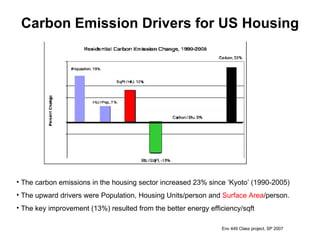
Carbon Emission Drivers for US Housing The carbon emissions in the housing sector increased 23% since ‘Kyoto’ (1990-2005) The upward drivers were Population, Housing Units/person and  Surface Area /person.  The key improvement (13%) resulted from the better energy efficiency/sqft Env 449 Class project, SP 2007
Summary Frameworks for Energy-Environment Integration: Sensory-Motor Feedback Loop (System Science) Biogeochemical Cycling Loop (Materials Balance) Causality Loop (Socio-economic, Physical, Heatlh/Welfare Sciences) Opportunities: There is a sensing revolution for monitoring energy-environmental systems The web facilitates accessing and metabolizing the new observations  There is a more collaborative culture for faster, adoptive learning  Key Challenges: Augmenting reductionist science with integrative systems science Enhancing information exchange and synergy between disciplines Inherent structural and dynamic complexity of environmental systems

Energy-Environment Integration Framework

  • 1.
    Analysis Frameworks for Sustainability: Linking Energy and the Environment Rudolf B. Husar Director, Center for Air Pollution and Trends Analysis (CAPITA)  Professor, Department of Energy, Environmental & Chemical Engineering   EECE Seminar, Friday, November 2, 2007, 11:00am, Lopata 101, Washington University
  • 2.
    Integrative Science andEngineering for ‘Grand Challenges’ The problems of Energy and Environment (EE) are Grand Challenges Solutions require engineering, biological, socio-economic and other sciences A rigorous and practical integrated framework for EE is not available This is an exploration of frameworks for integrated Energy Environmental Analysis Interested in the EE integration challenge? Join us on the wiki !
  • 3.
    Sustainable Development (SD)A process of reconciling society’s developmental needs with the environmental limits over the long term. But, What should be developed , what should be sustained? SD as an uncertain and adaptive process, “in which society's discovery of where it wants to go is intertwined with how it might try to get there”. During the SD ‘ journey ’ toward sustainability, the pathways have to be ‘ navigated ’ adaptively Continuing the metaphors, science is the compass, giving the directions and laws-regulations are the gyroscope for staying on course . National Academy, 1999
  • 4.
    Life and non-lifeon Earth form a combined system (Gaia Theory) Carbon, nitrogen, phosphorus, calcium are in constant circulation between the earth’s major environmental compartments Earth’s compartments remain in balance as long as the rate of flow of matter and energy in and out of the compartments is unchanged. Changes in the environmental compartments will occur if the circulation (in and out flow) of the substances is perturbed. Atmospheric CO 2 has been increasing because the rate of input is larger than the rate of output from the atmosphere.
  • 5.
    Major Biogeochemical Processes Visualized by Aerosols Dust storms Volcanoes Anthropogenic pollution Fires Anthropogenic pollution perturbs the natural processes and material flows
  • 6.
    Analysis Frameworks Sensory-MotorFeedback Loop (System Science; Regulatory) Causality Loop (Combined Social-Physical-Biological System) Biogeochemical Cycling Loop (Engineering; Biology; Conservation Laws) Assessment Controls Monitoring
  • 7.
    Analysis Framework I:Sensory-Motor Loop Assessment Compare to Goals, Plan Reductions Track Progress Controls (Actions) Monitoring (Sensing) Set Goals Assessment turns data into knowledge for decision making & actions through analysis (science & eng.) Monitoring collects multi-sensory data from surface and satellite platforms and Human activities exert pressures , e.g burning fossil fuels, that alter the state of environment. The impaired environmental state, elicits responses , such as regulations in a feedback loop All living organisms use this type of sensory-motor feedback to maintain their existence. Monitoring, Assessment, Control are the necessary steps for sustainable development.
  • 8.
    Monitoring: New GlobalMeasurements - Satellites ERBS Terra Aqua Grace IceSat QuikScat Sage SeaWinds TRMM Toms-EP UARS Jason Landsat 7 SORCE SeaWiFS ACRIMSAT TOPEX/Poseidon EO-1
  • 9.
    Eskes at al,2006 Source Identification: - Man-made, Soil, Biomass, Lightning - Seasonal pattern of each Trend 1995-2005: - Reductions in N. America & Europe - Increase over East Asia (China) Monitoring Global Change: Tropospheric NO2 Measurements from Satellites:
  • 10.
    Analysis of OMIsatellite NO2 observations: NO 2 Weekly Cycle Weekend/weekday NO2 patterns associated with reduced Sunday emissions See screencast (1 minute) The revolutions in sensing and data distribution now allow the monitoring and analysis of the chemical weather and climate over the Earth.
  • 11.
    Setting Goals: AirQuality Goal: Attaining Natural Condition by 2064
  • 12.
  • 13.
    Analysis Framework II: Materials & Energy Flow Loop
  • 14.
  • 15.
  • 16.
  • 17.
  • 18.
    How and whatto Control?? Analysis Framework III – Causality Loop Economic Development with Due Care of the Environment The system approach links human activities and their consequences in closed loop It is the minimum set of linked components – if any missing, the system is crippled Each component depends on its causal upstream driver – and external environment The causal loop can be used as an organizing principle for sustainability analysis
  • 19.
    Analysis Framework III– Causality Loop Economic Development with Due Care of the Environment Health-Welfare Energy-Environment Socio-Economic
  • 20.
  • 21.
    Trend of IndicatorsSOx = Pop x GDP/P x Btu/GDP x Sox/Btu 1960s 1980s 1990s
  • 22.
    Population - Energy/GoodsConsumption– Materials Flow - Emissions E k =  c jk EM j =   b ij c jk GE i =    a i b ij c jk P Industr. Energy Transp. Energy ResCom.Engy Coal Oil Gas Electric Energy SOx NOx HC PM Goods &Energy,(GE) i Fuels&Mater.(FM), j Emission (EM), k Ind. Chemicals Industr. Goods Pop., P Metals Mercury a i Consump./Person b ij Fuels/Energy c jk Emission/Fuel- j j i i i j Consumption of Goods and Energy: GE =  a i P Fuels and Materials Flow: FM =   a i b ij P Emission of Pollutants: EM =    a i b ij c jk P Industrial Prod. Transportation ResComercial EconMeasure(EM)
  • 23.
  • 24.
    Coal Sulfur Flowin 1980 and 1998 In 1980, a major flow of sulfur in coal originated in Illinois and was transported to Florida Arrows indicate the flow of coal from the mines to the consumer By 1990, the transport of high sulfur coal from the Midwest has bee replaced by low sulfur western coal
  • 25.
    Pollutant Transfer byFuels and Minerals: Spatial Transfer Matrices
  • 26.
    Carbon Emission Driversfor Transportation 1960-2003 Env 449 Class project, SP 2007 The C emission in transportation sector increased 200% since 1960 The upward drivers were Population, Vehicle/Person and Passenger miles The slight improvement resulted from the better fuel energy efficiency/vehicle
  • 27.
    Carbon Emission Driversfor US Housing The carbon emissions in the housing sector increased 23% since ‘Kyoto’ (1990-2005) The upward drivers were Population, Housing Units/person and Surface Area /person. The key improvement (13%) resulted from the better energy efficiency/sqft Env 449 Class project, SP 2007
  • 28.
    Summary Frameworks forEnergy-Environment Integration: Sensory-Motor Feedback Loop (System Science) Biogeochemical Cycling Loop (Materials Balance) Causality Loop (Socio-economic, Physical, Heatlh/Welfare Sciences) Opportunities: There is a sensing revolution for monitoring energy-environmental systems The web facilitates accessing and metabolizing the new observations There is a more collaborative culture for faster, adoptive learning Key Challenges: Augmenting reductionist science with integrative systems science Enhancing information exchange and synergy between disciplines Inherent structural and dynamic complexity of environmental systems