Energy Storage beyond
Li-ion
Dr Timothy Hughes, Principal Scientist
Siemens Corporate Technology
siemens.tld/keywordUnrestricted © Siemens AG 2016
Unrestricted © Siemens AG 2016
15.11.2016Page 2 T Hughes / CT REE ENS
Contents
• Overall Energy Landscape 3
• Li-ion roadmap 7
• Advanced Flow Batteries 12
• Power2Chemicals 16
Unrestricted © Siemens AG 2016
15.11.2016Page 3 T Hughes / CT REE ENS
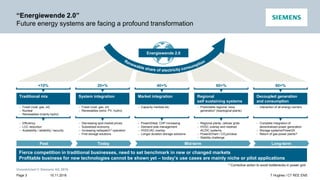
“Energiewende 2.0”
Future energy systems are facing a profound transformation
Past Today Mid-term Long-term
<10% 20+% 40+% 60+% 80+%
– Efficiency
– LCC reduction
– Availability / reliability / security
– Decreasing spot market prices
– Subsidized economy
– Increasing redispatch1) operation
– First storage solutions
– Power2Heat, CHP increasing
– Demand side management
– HVDC/AC overlay
– Longer duration storage solutions
– Regional plants, cellular grids
– HVDC overlay and meshed
AC/DC systems
– Power2Chem / CO2toValue
– Stability challenge
– Complete integration of
decentralized power generation
– Storage systems/Power2X
– Return of gas power plants?
– Fossil (coal, gas, oil)
– Nuclear
– Renewables (mainly hydro)
– Fossil (coal, gas, oil)
– Renewables (wind, PV, hydro)
– Capacity markets etc. – Predictable regional “area
generation” (topological plants)
– Interaction of all energy carriers
Traditional mix System integration Market integration Regional
self sustaining systems
Decoupled generation
and consumption
Fierce competition in traditional businesses, need to set benchmark in new or changed markets
Profitable business for new technologies cannot be shown yet – today’s use cases are mainly niche or pilot applications
Energiewende 2.0
1) Corrective action to avoid bottlenecks in power grid
Unrestricted © Siemens AG 2016
15.11.2016Page 4 T Hughes / CT REE ENS
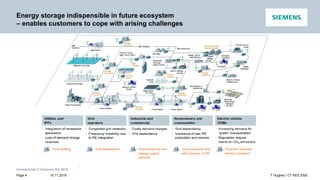
Energy storage indispensible in future ecosystem
– enables customers to cope with arising challenges
Unrestricted © Siemens AG 2016
15.11.2016Page 5 T Hughes / CT REE ENS
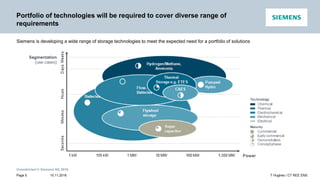
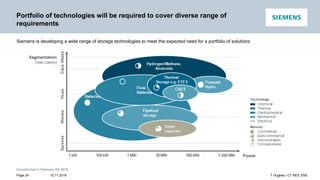
Portfolio of technologies will be required to cover diverse range of
requirements
Siemens is developing a wide range of storage technologies to meet the expected need for a portfolio of solutions
Unrestricted © Siemens AG 2016
15.11.2016Page 6 T Hughes / CT REE ENS
Contents
• Overall Energy Landscape 3
• Li-ion roadmap 8
• Advanced Flow Batteries 19
• Power2Chemicals 22
Unrestricted © Siemens AG 2016
15.11.2016Page 7 T Hughes / CT REE ENS
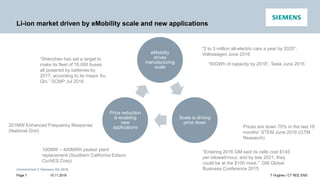
Li-ion market driven by eMobility scale and new applications
eMobility
drives
manufacturing
scale
Scale is driving
price down
Price reduction
is enabling
new
applications
“2 to 3 million all-electric cars a year by 2025”.
Volkswagen June 2016
“50GWh of capacity by 2018”. Tesla June 2016
“Shenzhen has set a target to
make its fleet of 16,000 buses
all powered by batteries by
2017, according to its mayor Xu
Qin.” SCMP Jul 2016
Prices are down 70% in the last 18
months” STEM June 2016 (GTM
Research)
“Entering 2016 GM said its cells cost $145
per kilowatt-hour, and by late 2021, they
could be at the $100 mark.” GM Global
Business Conference 2015
100MW – 400MWh peaker plant
replacement (Southern California Edison
Co/AES Corp)
201MW Enhanced Frequency Response
(National Grid)
Unrestricted © Siemens AG 2016
15.11.2016Page 8 T Hughes / CT REE ENS
Li+
Li
Metal
Porous CarbonOrganic
Electrolyte
2Li+ + S + 2e- Li2S Li2S
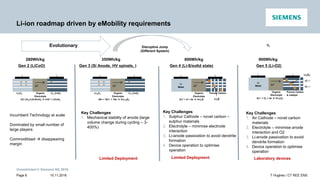
Li-ion roadmap driven by eMobility requirements
Gen 2 (LiCoO) Gen 3 (Si Anode, HV spinels, ) Gen 4 (Li-S/solid state) Gen 5 (Li-O2)
Evolutionary Disruptive Jump
(Different System)
Incumbent Technology at scale
Dominated by small number of
large players
Commoditised  disappearing
margin
Key Challenges
1. Mechanical stability of anode (large
volume change during cycling – 3-
400%)
Key Challenges
1. Sulphur Cathode – novel carbon –
sulphur materials
2. Electrolyte – minimise electrode
interaction
3. Li-anode passivation to avoid dendrite
formation
4. Device operation to optimise
operation
Key Challenges
1. Air Cathode – novel carbon
materials
2. Electrolyte – minimise anode
interaction and O2
3. Li-anode passivation to avoid
dendrite formation
4. Device operation to optimise
operation
Limited Deployment Laboratory devices
280Wh/kg 600Wh/kg350Wh/kg 900Wh/kg
Li+
LixC6 Li1-xCoO2Organic
Electrolyte
3/2 LiC6+Li0.5CoO2 3C + LiCoO2
Limited Deployment
Li+
Li15C4 Li1-xCoO2Organic
Electrolyte
4Si + 15Li+ + 15e- Li15Si4
Li+
Li
Metal
Porous Carbon
& catalyst
Organic
Electrolyte
2Li+ + O2 + 2e- Li2O2
Li2O2
O2
Unrestricted © Siemens AG 2016
15.11.2016Page 9 T Hughes / CT REE ENS
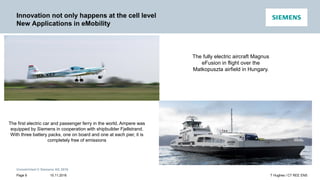
Innovation not only happens at the cell level
New Applications in eMobility
The fully electric aircraft Magnus
eFusion in flight over the
Matkopuszta airfield in Hungary.
The first electric car and passenger ferry in the world, Ampere was
equipped by Siemens in cooperation with shipbuilder Fjellstrand.
With three battery packs, one on board and one at each pier, it is
completely free of emissions
Unrestricted © Siemens AG 2016
15.11.2016Page 10 T Hughes / CT REE ENS
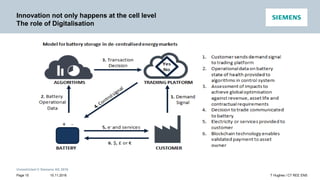
Innovation not only happens at the cell level
The role of Digitalisation
Unrestricted © Siemens AG 2016
15.11.2016Page 11 T Hughes / CT REE ENS
Contents
• Overall Energy Landscape 3
• Li-ion roadmap 8
• Advanced Flow Batteries 19
• Power2Chemicals 22
Unrestricted © Siemens AG 2016
15.11.2016Page 12 T Hughes / CT REE ENS
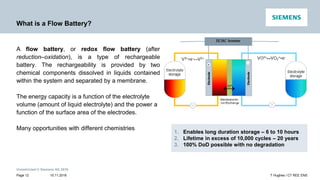
What is a Flow Battery?
A flow battery, or redox flow battery (after
reduction–oxidation), is a type of rechargeable
battery. The rechargeability is provided by two
chemical components dissolved in liquids contained
within the system and separated by a membrane.
The energy capacity is a function of the electrolyte
volume (amount of liquid electrolyte) and the power a
function of the surface area of the electrodes.
Many opportunities with different chemistries
1. Enables long duration storage – 6 to 10 hours
2. Lifetime in excess of 10,000 cycles – 20 years
3. 100% DoD possible with no degradation
Unrestricted © Siemens AG 2016
15.11.2016Page 13 T Hughes / CT REE ENS
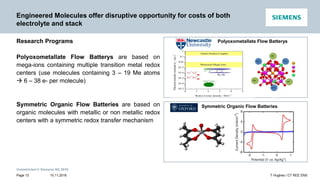
Engineered Molecules offer disruptive opportunity for costs of both
electrolyte and stack
Research Programs
Polyoxometallate Flow Batterys are based on
mega-ions containing multiple transition metal redox
centers (use molecules containing 3 – 19 Me atoms
 6 – 38 e- per molecule)
Symmetric Organic Flow Batteries are based on
organic molecules with metallic or non metallic redox
centers with a symmetric redox transfer mechanism
Polyoxometallate Flow Batterys
Symmetric Organic Flow Batteries
Unrestricted © Siemens AG 2016
15.11.2016Page 14 T Hughes / CT REE ENS
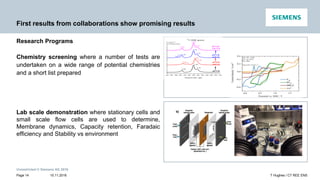
First results from collaborations show promising results
Research Programs
Chemistry screening where a number of tests are
undertaken on a wide range of potential chemistries
and a short list prepared
Lab scale demonstration where stationary cells and
small scale flow cells are used to determine,
Membrane dynamics, Capacity retention, Faradaic
efficiency and Stability vs environment
Unrestricted © Siemens AG 2016
15.11.2016Page 15 T Hughes / CT REE ENS
Contents
• Overall Energy Landscape 3
• Li-ion roadmap 8
• Advanced Flow Batteries 19
• Power2Chemicals 22
Unrestricted © Siemens AG 2016
15.11.2016Page 16 T Hughes / CT REE ENS
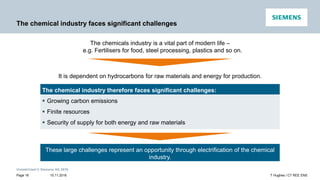
The chemical industry faces significant challenges
 Growing carbon emissions
 Finite resources
 Security of supply for both energy and raw materials
The chemical industry therefore faces significant challenges:
These large challenges represent an opportunity through electrification of the chemical
industry.
It is dependent on hydrocarbons for raw materials and energy for production.
The chemicals industry is a vital part of modern life –
e.g. Fertilisers for food, steel processing, plastics and so on.
Unrestricted © Siemens AG 2016
15.11.2016Page 17 T Hughes / CT REE ENS
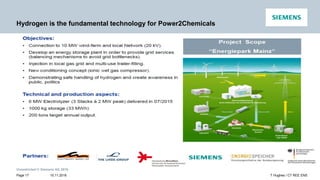
Hydrogen is the fundamental technology for Power2Chemicals
Unrestricted © Siemens AG 2016
15.11.2016Page 18 T Hughes / CT REE ENS
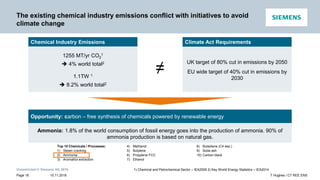
The existing chemical industry emissions conflict with initiatives to avoid
climate change
1) Chemical and Petrochemical Sector – IEA2009 2) Key World Energy Statistics – IEA2014
Chemical Industry Emissions
1255 MT/yr CO2
1
 4% world total2
1.1TW 1
 8.2% world total2
UK target of 80% cut in emissions by 2050
EU wide target of 40% cut in emissions by
2030
Climate Act Requirements
≠
Top 10 Chemicals / Processes:
1) Steam cracking
2) Ammonia
3) Aromatics extraction
4) Methanol
5) Butylene
6) Propylene FCC
7) Ethanol
8) Butadiene (C4 sep.)
9) Soda ash
10) Carbon black
Ammonia: 1.8% of the world consumption of fossil energy goes into the production of ammonia. 90% of
ammonia production is based on natural gas.
Opportunity: carbon – free synthesis of chemicals powered by renewable energy
Unrestricted © Siemens AG 2016
15.11.2016Page 19 T Hughes / CT REE ENS
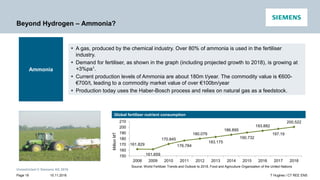
Beyond Hydrogen – Ammonia?
Source: World Fertilizer Trends and Outlook to 2018, Food and Agriculture Organization of the United Nations
Global fertilizer nutrient consumption
161.829
161.659
170.845
176.784
180.079
183.175
186.895
190.732
193.882
197.19
200.522
150
160
170
180
190
200
210
2008 2009 2010 2011 2012 2013 2014 2015 2016 2017 2018
MillionMT
 A gas, produced by the chemical industry. Over 80% of ammonia is used in the fertiliser
industry.
 Demand for fertiliser, as shown in the graph (including projected growth to 2018), is growing at
+3%pa1.
 Current production levels of Ammonia are about 180m t/year. The commodity value is €600-
€700/t, leading to a commodity market value of over €100bn/year
 Production today uses the Haber-Bosch process and relies on natural gas as a feedstock.
Ammonia
Unrestricted © Siemens AG 2016
15.11.2016Page 20 T Hughes / CT REE ENS
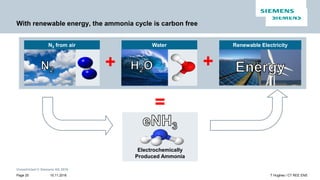
With renewable energy, the ammonia cycle is carbon free
Electrochemically
Produced Ammonia
++
WaterN2 from air Renewable Electricity
=
Unrestricted © Siemens AG 2016
15.11.2016Page 21 T Hughes / CT REE ENS
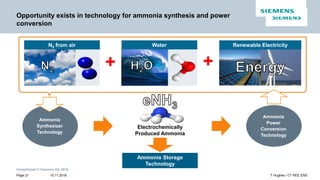
Opportunity exists in technology for ammonia synthesis and power
conversion
Ammonia
Synthesizer
Technology
Ammonia
Power
Conversion
Technology
Ammonia Storage
Technology
Electrochemically
Produced Ammonia
++
WaterN2 from air Renewable Electricity
Unrestricted © Siemens AG 2016
15.11.2016Page 22 T Hughes / CT REE ENS
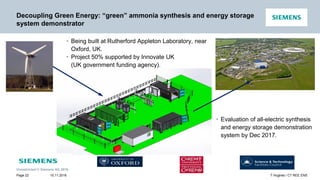
• Being built at Rutherford Appleton Laboratory, near
Oxford, UK.
• Project 50% supported by Innovate UK
(UK government funding agency).
Decoupling Green Energy: “green” ammonia synthesis and energy storage
system demonstrator
• Evaluation of all-electric synthesis
and energy storage demonstration
system by Dec 2017.
Unrestricted © Siemens AG 2016
15.11.2016Page 23 T Hughes / CT REE ENS
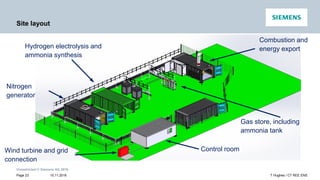
Site layout
Nitrogen
generator
Hydrogen electrolysis and
ammonia synthesis
Combustion and
energy export
Gas store, including
ammonia tank
Control roomWind turbine and grid
connection
Unrestricted © Siemens AG 2016
15.11.2016Page 24 T Hughes / CT REE ENS
Portfolio of technologies will be required to cover diverse range of
requirements
Siemens is developing a wide range of storage technologies to meet the expected need for a portfolio of solutions
Unrestricted © Siemens AG 2016
15.11.2016Page 25 T Hughes / CT REE ENS
Contact
Dr Tim Hughes
Principal Scientist Energy Storage
Corporate Technology, CT REE ENS
Rutherford Appleton Laboratory
Oxford OX11 0QX, United Kingdom
Tel.: +44 1235 446903
Mobil: +44 7808 825686
mailto:timothy.hughes@siemens.com
siemens.com

Energy Storage Innovation – Li-ion and beyond

  • 1.
    Energy Storage beyond Li-ion DrTimothy Hughes, Principal Scientist Siemens Corporate Technology siemens.tld/keywordUnrestricted © Siemens AG 2016
  • 2.
    Unrestricted © SiemensAG 2016 15.11.2016Page 2 T Hughes / CT REE ENS Contents • Overall Energy Landscape 3 • Li-ion roadmap 7 • Advanced Flow Batteries 12 • Power2Chemicals 16
  • 3.
    Unrestricted © SiemensAG 2016 15.11.2016Page 3 T Hughes / CT REE ENS “Energiewende 2.0” Future energy systems are facing a profound transformation Past Today Mid-term Long-term <10% 20+% 40+% 60+% 80+% – Efficiency – LCC reduction – Availability / reliability / security – Decreasing spot market prices – Subsidized economy – Increasing redispatch1) operation – First storage solutions – Power2Heat, CHP increasing – Demand side management – HVDC/AC overlay – Longer duration storage solutions – Regional plants, cellular grids – HVDC overlay and meshed AC/DC systems – Power2Chem / CO2toValue – Stability challenge – Complete integration of decentralized power generation – Storage systems/Power2X – Return of gas power plants? – Fossil (coal, gas, oil) – Nuclear – Renewables (mainly hydro) – Fossil (coal, gas, oil) – Renewables (wind, PV, hydro) – Capacity markets etc. – Predictable regional “area generation” (topological plants) – Interaction of all energy carriers Traditional mix System integration Market integration Regional self sustaining systems Decoupled generation and consumption Fierce competition in traditional businesses, need to set benchmark in new or changed markets Profitable business for new technologies cannot be shown yet – today’s use cases are mainly niche or pilot applications Energiewende 2.0 1) Corrective action to avoid bottlenecks in power grid
  • 4.
    Unrestricted © SiemensAG 2016 15.11.2016Page 4 T Hughes / CT REE ENS Energy storage indispensible in future ecosystem – enables customers to cope with arising challenges
  • 5.
    Unrestricted © SiemensAG 2016 15.11.2016Page 5 T Hughes / CT REE ENS Portfolio of technologies will be required to cover diverse range of requirements Siemens is developing a wide range of storage technologies to meet the expected need for a portfolio of solutions
  • 6.
    Unrestricted © SiemensAG 2016 15.11.2016Page 6 T Hughes / CT REE ENS Contents • Overall Energy Landscape 3 • Li-ion roadmap 8 • Advanced Flow Batteries 19 • Power2Chemicals 22
  • 7.
    Unrestricted © SiemensAG 2016 15.11.2016Page 7 T Hughes / CT REE ENS Li-ion market driven by eMobility scale and new applications eMobility drives manufacturing scale Scale is driving price down Price reduction is enabling new applications “2 to 3 million all-electric cars a year by 2025”. Volkswagen June 2016 “50GWh of capacity by 2018”. Tesla June 2016 “Shenzhen has set a target to make its fleet of 16,000 buses all powered by batteries by 2017, according to its mayor Xu Qin.” SCMP Jul 2016 Prices are down 70% in the last 18 months” STEM June 2016 (GTM Research) “Entering 2016 GM said its cells cost $145 per kilowatt-hour, and by late 2021, they could be at the $100 mark.” GM Global Business Conference 2015 100MW – 400MWh peaker plant replacement (Southern California Edison Co/AES Corp) 201MW Enhanced Frequency Response (National Grid)
  • 8.
    Unrestricted © SiemensAG 2016 15.11.2016Page 8 T Hughes / CT REE ENS Li+ Li Metal Porous CarbonOrganic Electrolyte 2Li+ + S + 2e- Li2S Li2S Li-ion roadmap driven by eMobility requirements Gen 2 (LiCoO) Gen 3 (Si Anode, HV spinels, ) Gen 4 (Li-S/solid state) Gen 5 (Li-O2) Evolutionary Disruptive Jump (Different System) Incumbent Technology at scale Dominated by small number of large players Commoditised  disappearing margin Key Challenges 1. Mechanical stability of anode (large volume change during cycling – 3- 400%) Key Challenges 1. Sulphur Cathode – novel carbon – sulphur materials 2. Electrolyte – minimise electrode interaction 3. Li-anode passivation to avoid dendrite formation 4. Device operation to optimise operation Key Challenges 1. Air Cathode – novel carbon materials 2. Electrolyte – minimise anode interaction and O2 3. Li-anode passivation to avoid dendrite formation 4. Device operation to optimise operation Limited Deployment Laboratory devices 280Wh/kg 600Wh/kg350Wh/kg 900Wh/kg Li+ LixC6 Li1-xCoO2Organic Electrolyte 3/2 LiC6+Li0.5CoO2 3C + LiCoO2 Limited Deployment Li+ Li15C4 Li1-xCoO2Organic Electrolyte 4Si + 15Li+ + 15e- Li15Si4 Li+ Li Metal Porous Carbon & catalyst Organic Electrolyte 2Li+ + O2 + 2e- Li2O2 Li2O2 O2
  • 9.
    Unrestricted © SiemensAG 2016 15.11.2016Page 9 T Hughes / CT REE ENS Innovation not only happens at the cell level New Applications in eMobility The fully electric aircraft Magnus eFusion in flight over the Matkopuszta airfield in Hungary. The first electric car and passenger ferry in the world, Ampere was equipped by Siemens in cooperation with shipbuilder Fjellstrand. With three battery packs, one on board and one at each pier, it is completely free of emissions
  • 10.
    Unrestricted © SiemensAG 2016 15.11.2016Page 10 T Hughes / CT REE ENS Innovation not only happens at the cell level The role of Digitalisation
  • 11.
    Unrestricted © SiemensAG 2016 15.11.2016Page 11 T Hughes / CT REE ENS Contents • Overall Energy Landscape 3 • Li-ion roadmap 8 • Advanced Flow Batteries 19 • Power2Chemicals 22
  • 12.
    Unrestricted © SiemensAG 2016 15.11.2016Page 12 T Hughes / CT REE ENS What is a Flow Battery? A flow battery, or redox flow battery (after reduction–oxidation), is a type of rechargeable battery. The rechargeability is provided by two chemical components dissolved in liquids contained within the system and separated by a membrane. The energy capacity is a function of the electrolyte volume (amount of liquid electrolyte) and the power a function of the surface area of the electrodes. Many opportunities with different chemistries 1. Enables long duration storage – 6 to 10 hours 2. Lifetime in excess of 10,000 cycles – 20 years 3. 100% DoD possible with no degradation
  • 13.
    Unrestricted © SiemensAG 2016 15.11.2016Page 13 T Hughes / CT REE ENS Engineered Molecules offer disruptive opportunity for costs of both electrolyte and stack Research Programs Polyoxometallate Flow Batterys are based on mega-ions containing multiple transition metal redox centers (use molecules containing 3 – 19 Me atoms  6 – 38 e- per molecule) Symmetric Organic Flow Batteries are based on organic molecules with metallic or non metallic redox centers with a symmetric redox transfer mechanism Polyoxometallate Flow Batterys Symmetric Organic Flow Batteries
  • 14.
    Unrestricted © SiemensAG 2016 15.11.2016Page 14 T Hughes / CT REE ENS First results from collaborations show promising results Research Programs Chemistry screening where a number of tests are undertaken on a wide range of potential chemistries and a short list prepared Lab scale demonstration where stationary cells and small scale flow cells are used to determine, Membrane dynamics, Capacity retention, Faradaic efficiency and Stability vs environment
  • 15.
    Unrestricted © SiemensAG 2016 15.11.2016Page 15 T Hughes / CT REE ENS Contents • Overall Energy Landscape 3 • Li-ion roadmap 8 • Advanced Flow Batteries 19 • Power2Chemicals 22
  • 16.
    Unrestricted © SiemensAG 2016 15.11.2016Page 16 T Hughes / CT REE ENS The chemical industry faces significant challenges  Growing carbon emissions  Finite resources  Security of supply for both energy and raw materials The chemical industry therefore faces significant challenges: These large challenges represent an opportunity through electrification of the chemical industry. It is dependent on hydrocarbons for raw materials and energy for production. The chemicals industry is a vital part of modern life – e.g. Fertilisers for food, steel processing, plastics and so on.
  • 17.
    Unrestricted © SiemensAG 2016 15.11.2016Page 17 T Hughes / CT REE ENS Hydrogen is the fundamental technology for Power2Chemicals
  • 18.
    Unrestricted © SiemensAG 2016 15.11.2016Page 18 T Hughes / CT REE ENS The existing chemical industry emissions conflict with initiatives to avoid climate change 1) Chemical and Petrochemical Sector – IEA2009 2) Key World Energy Statistics – IEA2014 Chemical Industry Emissions 1255 MT/yr CO2 1  4% world total2 1.1TW 1  8.2% world total2 UK target of 80% cut in emissions by 2050 EU wide target of 40% cut in emissions by 2030 Climate Act Requirements ≠ Top 10 Chemicals / Processes: 1) Steam cracking 2) Ammonia 3) Aromatics extraction 4) Methanol 5) Butylene 6) Propylene FCC 7) Ethanol 8) Butadiene (C4 sep.) 9) Soda ash 10) Carbon black Ammonia: 1.8% of the world consumption of fossil energy goes into the production of ammonia. 90% of ammonia production is based on natural gas. Opportunity: carbon – free synthesis of chemicals powered by renewable energy
  • 19.
    Unrestricted © SiemensAG 2016 15.11.2016Page 19 T Hughes / CT REE ENS Beyond Hydrogen – Ammonia? Source: World Fertilizer Trends and Outlook to 2018, Food and Agriculture Organization of the United Nations Global fertilizer nutrient consumption 161.829 161.659 170.845 176.784 180.079 183.175 186.895 190.732 193.882 197.19 200.522 150 160 170 180 190 200 210 2008 2009 2010 2011 2012 2013 2014 2015 2016 2017 2018 MillionMT  A gas, produced by the chemical industry. Over 80% of ammonia is used in the fertiliser industry.  Demand for fertiliser, as shown in the graph (including projected growth to 2018), is growing at +3%pa1.  Current production levels of Ammonia are about 180m t/year. The commodity value is €600- €700/t, leading to a commodity market value of over €100bn/year  Production today uses the Haber-Bosch process and relies on natural gas as a feedstock. Ammonia
  • 20.
    Unrestricted © SiemensAG 2016 15.11.2016Page 20 T Hughes / CT REE ENS With renewable energy, the ammonia cycle is carbon free Electrochemically Produced Ammonia ++ WaterN2 from air Renewable Electricity =
  • 21.
    Unrestricted © SiemensAG 2016 15.11.2016Page 21 T Hughes / CT REE ENS Opportunity exists in technology for ammonia synthesis and power conversion Ammonia Synthesizer Technology Ammonia Power Conversion Technology Ammonia Storage Technology Electrochemically Produced Ammonia ++ WaterN2 from air Renewable Electricity
  • 22.
    Unrestricted © SiemensAG 2016 15.11.2016Page 22 T Hughes / CT REE ENS • Being built at Rutherford Appleton Laboratory, near Oxford, UK. • Project 50% supported by Innovate UK (UK government funding agency). Decoupling Green Energy: “green” ammonia synthesis and energy storage system demonstrator • Evaluation of all-electric synthesis and energy storage demonstration system by Dec 2017.
  • 23.
    Unrestricted © SiemensAG 2016 15.11.2016Page 23 T Hughes / CT REE ENS Site layout Nitrogen generator Hydrogen electrolysis and ammonia synthesis Combustion and energy export Gas store, including ammonia tank Control roomWind turbine and grid connection
  • 24.
    Unrestricted © SiemensAG 2016 15.11.2016Page 24 T Hughes / CT REE ENS Portfolio of technologies will be required to cover diverse range of requirements Siemens is developing a wide range of storage technologies to meet the expected need for a portfolio of solutions
  • 25.
    Unrestricted © SiemensAG 2016 15.11.2016Page 25 T Hughes / CT REE ENS Contact Dr Tim Hughes Principal Scientist Energy Storage Corporate Technology, CT REE ENS Rutherford Appleton Laboratory Oxford OX11 0QX, United Kingdom Tel.: +44 1235 446903 Mobil: +44 7808 825686 mailto:timothy.hughes@siemens.com siemens.com