Environmental Auditing for
Climate Change Action
Nigel Leehane
Independent environmental management and sustainability consultant
IEMA Principal Environmental Auditor
Chair of ISO and BSI Environmental Auditing sub-committees
iema.net
How can environmental auditing
support climate change action?
Challenges for environmental
auditors –
IEMA’s Future Challenges Study
iema.netiema.net
Environmental auditing scenarios
• Many scenarios where environmental auditing can be
applied and add value
• Internal and external audits of environmental management systems
with climate change actions
• And for energy management systems and integrated systems
• For public reporting of GHG emissions
• For legal compliance, e.g. for ESOS
iema.netiema.net
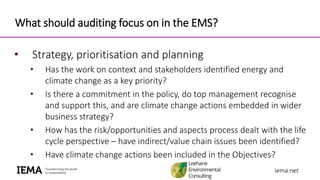
What should auditing focus on in the EMS?
• Strategy, prioritisation and planning
• Has the work on context and stakeholders identified energy and
climate change as a key priority?
• Is there a commitment in the policy, do top management recognise
and support this, and are climate change actions embedded in wider
business strategy?
• How has the risk/opportunities and aspects process dealt with the life
cycle perspective – have indirect/value chain issues been identified?
• Have climate change actions been included in the Objectives?
iema.netiema.net
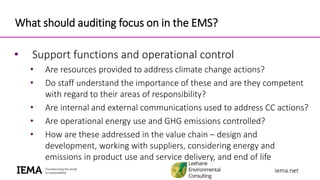
What should auditing focus on in the EMS?
• Support functions and operational control
• Are resources provided to address climate change actions?
• Do staff understand the importance of these and are they competent
with regard to their areas of responsibility?
• Are internal and external communications used to address CC actions?
• Are operational energy use and GHG emissions controlled?
• How are these addressed in the value chain – design and
development, working with suppliers, considering energy and
emissions in product use and service delivery, and end of life
iema.netiema.net
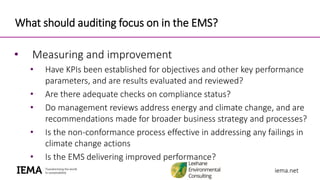
What should auditing focus on in the EMS?
• Measuring and improvement
• Have KPIs been established for objectives and other key performance
parameters, and are results evaluated and reviewed?
• Are there adequate checks on compliance status?
• Do management reviews address energy and climate change, and are
recommendations made for broader business strategy and processes?
• Is the non-conformance process effective in addressing any failings in
climate change actions
• Is the EMS delivering improved performance?
iema.netiema.net
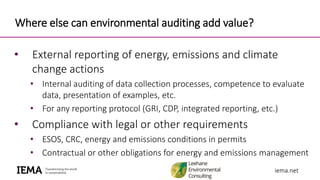
Where else can environmental auditing add value?
• External reporting of energy, emissions and climate
change actions
• Internal auditing of data collection processes, competence to evaluate
data, presentation of examples, etc.
• For any reporting protocol (GRI, CDP, integrated reporting, etc.)
• Compliance with legal or other requirements
• ESOS, CRC, energy and emissions conditions in permits
• Contractual or other obligations for energy and emissions management
iema.netiema.net
IEMA’s Future Challenges for Environmental Auditing Study
• Respondents, mostly auditors raised concerns including:
• Competence and resourcing implications of integrated auditing
• Increasing numbers of standards requiring auditing
• Emerging audit topics including social, ethical and human rights issues
• Greater emphasis on supply chain auditing
• Concerns regarding perceived value of audits
• Lack of accessible guidance and networking/mentoring opportunities
• Many others!
iema.netiema.net
IEMA’s Future Challenges for Environmental Auditing Study
• Auditors’ wider concerns include:
• Lack of competence, to tackle some of these issues, and particularly
with regard to external auditor competence (discipline and sector)
• Lack of resources and support for auditing
• Need for auditors to improve soft skills, not just technical knowledge
• Insufficient collaboration between professional bodies
• Need access to guidance and audit tools, and networking with peers
• Refresher training needed
iema.netiema.net
Conclusions
• Firstly, IEMA has formed a working group to review and respond to
auditors’ expressed needs
• Improved auditor competence and capability is essential to
achieve good audit outcomes and add value
• This should raise the profile of auditing - an essential business tool
• This will benefit all areas of environmental performance, including
where environmental auditing can support the development and
achievement of climate change actions

Environmental Management Systems & Auditing for climate change action (Nigel Leehane)

  • 1.
    Environmental Auditing for ClimateChange Action Nigel Leehane Independent environmental management and sustainability consultant IEMA Principal Environmental Auditor Chair of ISO and BSI Environmental Auditing sub-committees
  • 2.
    iema.net How can environmentalauditing support climate change action? Challenges for environmental auditors – IEMA’s Future Challenges Study
  • 3.
    iema.netiema.net Environmental auditing scenarios •Many scenarios where environmental auditing can be applied and add value • Internal and external audits of environmental management systems with climate change actions • And for energy management systems and integrated systems • For public reporting of GHG emissions • For legal compliance, e.g. for ESOS
  • 4.
    iema.netiema.net What should auditingfocus on in the EMS? • Strategy, prioritisation and planning • Has the work on context and stakeholders identified energy and climate change as a key priority? • Is there a commitment in the policy, do top management recognise and support this, and are climate change actions embedded in wider business strategy? • How has the risk/opportunities and aspects process dealt with the life cycle perspective – have indirect/value chain issues been identified? • Have climate change actions been included in the Objectives?
  • 5.
    iema.netiema.net What should auditingfocus on in the EMS? • Support functions and operational control • Are resources provided to address climate change actions? • Do staff understand the importance of these and are they competent with regard to their areas of responsibility? • Are internal and external communications used to address CC actions? • Are operational energy use and GHG emissions controlled? • How are these addressed in the value chain – design and development, working with suppliers, considering energy and emissions in product use and service delivery, and end of life
  • 6.
    iema.netiema.net What should auditingfocus on in the EMS? • Measuring and improvement • Have KPIs been established for objectives and other key performance parameters, and are results evaluated and reviewed? • Are there adequate checks on compliance status? • Do management reviews address energy and climate change, and are recommendations made for broader business strategy and processes? • Is the non-conformance process effective in addressing any failings in climate change actions • Is the EMS delivering improved performance?
  • 7.
    iema.netiema.net Where else canenvironmental auditing add value? • External reporting of energy, emissions and climate change actions • Internal auditing of data collection processes, competence to evaluate data, presentation of examples, etc. • For any reporting protocol (GRI, CDP, integrated reporting, etc.) • Compliance with legal or other requirements • ESOS, CRC, energy and emissions conditions in permits • Contractual or other obligations for energy and emissions management
  • 8.
    iema.netiema.net IEMA’s Future Challengesfor Environmental Auditing Study • Respondents, mostly auditors raised concerns including: • Competence and resourcing implications of integrated auditing • Increasing numbers of standards requiring auditing • Emerging audit topics including social, ethical and human rights issues • Greater emphasis on supply chain auditing • Concerns regarding perceived value of audits • Lack of accessible guidance and networking/mentoring opportunities • Many others!
  • 9.
    iema.netiema.net IEMA’s Future Challengesfor Environmental Auditing Study • Auditors’ wider concerns include: • Lack of competence, to tackle some of these issues, and particularly with regard to external auditor competence (discipline and sector) • Lack of resources and support for auditing • Need for auditors to improve soft skills, not just technical knowledge • Insufficient collaboration between professional bodies • Need access to guidance and audit tools, and networking with peers • Refresher training needed
  • 10.
    iema.netiema.net Conclusions • Firstly, IEMAhas formed a working group to review and respond to auditors’ expressed needs • Improved auditor competence and capability is essential to achieve good audit outcomes and add value • This should raise the profile of auditing - an essential business tool • This will benefit all areas of environmental performance, including where environmental auditing can support the development and achievement of climate change actions