ENERGY SECTOR OF
PAKISTAN
By Dr. Ali Kashif
2012.01.11
rajaalikashif@gmail.com
Korea Southern Power Co. Ltd.
Outline
 Energy Sector of Pakistan
 Facts and Figures of 2006, 07, 08
 Energy Crisis
 Solutions
 Feasibility for Wind Energy in Pakistan
Korea Southern Power Co. Ltd.
Energy Sector
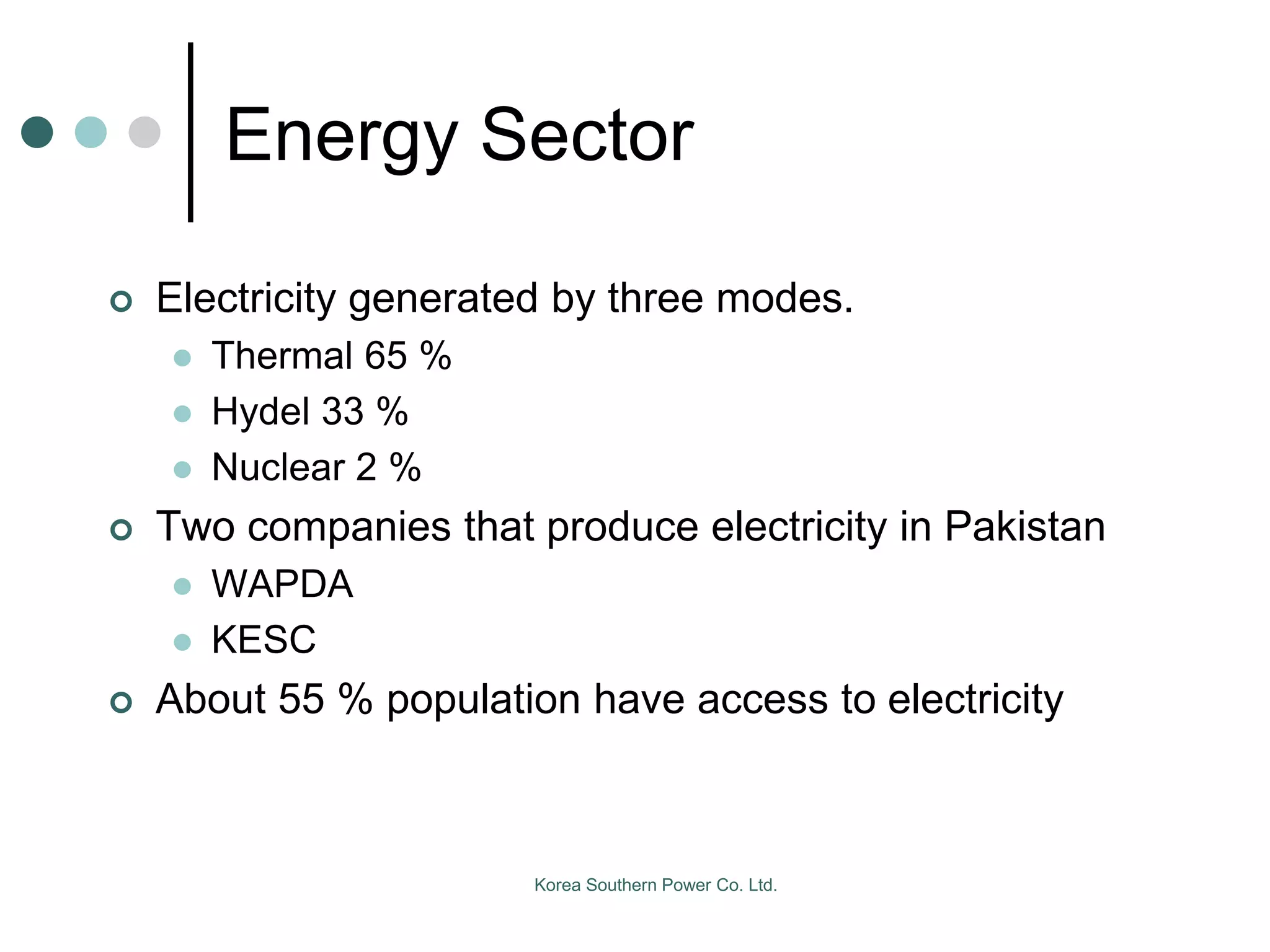
 Electricity generated by three modes.
 Thermal 65 %
 Hydel 33 %
 Nuclear 2 %
 Two companies that produce electricity in Pakistan
 WAPDA
 KESC
 About 55 % population have access to electricity
Korea Southern Power Co. Ltd.
 Energy Crisis in Pakistan
Korea Southern Power Co. Ltd.
 Energy Crisis in Pakistan
Korea Southern Power Co. Ltd.
 Energy Crisis in Pakistan
Korea Southern Power Co. Ltd.
 Energy Crisis in Pakistan
Korea Southern Power Co. Ltd.
 Energy Crisis in Pakistan
Korea Southern Power Co. Ltd.
 Energy Crisis in Pakistan
Korea Southern Power Co. Ltd.
 Energy Crisis in Pakistan
Korea Southern Power Co. Ltd.
 Energy Crisis in Pakistan
Korea Southern Power Co. Ltd.
 Energy Crisis in Pakistan
Korea Southern Power Co. Ltd.
 Energy Crisis in Pakistan
Korea Southern Power Co. Ltd.
 Energy Crisis in Pakistan
Korea Southern Power Co. Ltd.
 Energy Crisis in Pakistan
Korea Southern Power Co. Ltd.
 Energy Crisis in Pakistan
Korea Southern Power Co. Ltd.
Proposed Solutions
 Improve Existing Plants
 Hydel Power Plants
 Construction of Small Dams
 Underground electrical wiring
 New energy resources
Korea Southern Power Co. Ltd.
 Energy Crisis in Pakistan
Korea Southern Power Co. Ltd.
 Energy Crisis in Pakistan
Korea Southern Power Co. Ltd.
 Energy Crisis in Pakistan
Korea Southern Power Co. Ltd.
Current Situation
 The share of gas consumption stood at 43.7 per cent,
followed by oil at 29 per cent, electricity at 15.3 per
cent, coal at 10.4 per cent and LPG at 1.5 per cent
 In last three years, electricity shortage in country have
raised from 4 hours to about 18 hours.
 About 150 billion Rs bill of electric companies are
unpaid.
 39 billion from Sindh
 36 billions from KESC
 9 billions from Punjab, etc
Korea Southern Power Co. Ltd.
National Costs of Load Shedding
Cost to the Industrial Sector Rs 157 billion
Cost to the other sectors of industrial
loss of Value Added Rs 53 billion
Total cost of industrial load shedding
to the economy Rs 219 billion
Cost as percentage of GDP 2 %
Loss of employment in the economy 400,000
Loss of exports Rs 75 billion
(equivalent to US $ 1 billion)
Source: IPP estimates listed in Beacon House National University publication: State of the
Economy – Emerging from Crisis 2008
Korea Southern Power Co. Ltd.
ECONOMIC IMPACT DUE TO ENERGY DEFICIT
For firms with self generation
Additional cost of Power self Generation Rs 32 billion
Value Added Loss Rs 42 billion
Total Cost Rs 74 billion
For firms without self generation
Additional cost of Power self Generation Rs 6 billion
Value Added Loss Rs 77 billion
Total Cost Rs 83 billion
Overall Cost to the Industrial Sector Rs 157 billion
Cost as % of Industrial value added 9%
Percentage loss of Production 7%
Loss of industrial Employment 300,000 workers
Source: IPP estimates listed in Beacon House National University publication: State of the Economy – Emerging from Crisis 2008
Korea Southern Power Co. Ltd.
Current Status
 Alternative Energy Development Board (AEDB), to
pursue the path of renewable energy, is focusing on
wind and solar sources as viable alternatives.
 Pakistan has a potential to produce wind energy ranging
from 10000 MW to 50000 MW
 A project in its first phase has been installed in Jhimpir,
through a Turkish company, and 50 MW will be installed
shortly
 Zorlu Energy Pakistan has almost completed foundation
work for five turbines in Jhimpir.
 Each capable of producing 1.2 megawatts of electricity.
Korea Southern Power Co. Ltd.
 In recent years, the government has completed several
projects to demonstrate that wind energy is viable in the
country.
 In Mirpur Sakro, 85 micro turbines have been installed to
power 356 homes.
 In Kund Malir, 40 turbines have been installed, which power
111 homes.
 The Alternative Energy Development Board (AEDB) has also
acquired 18,000 acres for the installation of more wind
turbines.
Korea Southern Power Co. Ltd.
Current Requirement
 Pakistan requires 15,000 to 20000MW electricity
per day to meet growing needs
 11,000 MW per day,
 shortfall of about 4000 to 9000 MW
 In value-added export sector alone, Pakistan is losing $10
billion every year due to power shortage.
 Gross wind power potential of Sindh coastal area is
43000 MW with exploitable generation of about
11000MW
 By setting up wind farms, more wind power plants
can be built immediately in Jhampir, Gharo, Keti
Bandar and Bin Qasim Karachi.Korea Southern Power Co. Ltd.
Feasibility (1/4)
 Over the last thirty years, Asia has become a major player
on the global scene.
 Electricity demand is expected to increase 8% every year
until 2015.
 Todays need: Electricity will increasingly have to come
from renewable sources such as wind and solar.
 Pakistan is in a good position to exploit these because it has
abundant wind and sun.
 Pakistan is fortunate to have high wind speeds near major
centers.
 Near Islamabad, the wind speed is anywhere from 6.2 to 7.4
metres per second (between 13.8 and 16.5 miles per hour).
 Near Karachi, the range is between 6.2 and 6.9 (between
13.8 and 15.4 miles per hour).
Korea Southern Power Co. Ltd.
Feasibility (2/4)
 In Balochistan and Sindh provinces, sufficient wind exists to
power every coastal village in the country.
 There also exists a corridor between Gharo and Keti Bandar
that alone could produce between 40,000 and 50,000
megawatts of electricity.
 Given this surplus potential, Pakistan has much to offer Asia
with regards to wind energy.
Korea Southern Power Co. Ltd.
Feasibility (3/4)
 Pakistan is also fortunate that in neighboring India, the
company Suzlon manufactures wind turbines, thus
decreasing transportation costs.
 Its turbines start to turn at a speed of 3 meters per second.
 Vestas, which is one of the world’s largest wind turbine
manufacturers, has wind turbines that start turning at a
speed of 4 metres per second.
Korea Southern Power Co. Ltd.
Feasibility (4/4)
 Sindh coastal areas have greater wind power potential
than Balochistan coastal areas.
 Potential areas cover 9700 square kilometers in Sindh.
 The gross wind power potential of this area is 43000 MW
and keeping in view the area utilisation constraints, the
exploitable electric power generation potential of this area
is estimated to be about 11000MW.
Korea Southern Power Co. Ltd.
Considerations
 Within towns and cities, wind speeds can often change
quickly due to the presence of buildings and other
structures, which can damage wind turbines.
 In addition, many people do not wish for turbines to be
sited near cities because of noise, though these
problems are often exaggerated.
Korea Southern Power Co. Ltd.

Energy sector in pakistan

  • 1.
    ENERGY SECTOR OF PAKISTAN ByDr. Ali Kashif 2012.01.11 rajaalikashif@gmail.com Korea Southern Power Co. Ltd.
  • 2.
    Outline  Energy Sectorof Pakistan  Facts and Figures of 2006, 07, 08  Energy Crisis  Solutions  Feasibility for Wind Energy in Pakistan Korea Southern Power Co. Ltd.
  • 3.
    Energy Sector  Electricitygenerated by three modes.  Thermal 65 %  Hydel 33 %  Nuclear 2 %  Two companies that produce electricity in Pakistan  WAPDA  KESC  About 55 % population have access to electricity Korea Southern Power Co. Ltd.
  • 4.
     Energy Crisisin Pakistan Korea Southern Power Co. Ltd.
  • 5.
     Energy Crisisin Pakistan Korea Southern Power Co. Ltd.
  • 6.
     Energy Crisisin Pakistan Korea Southern Power Co. Ltd.
  • 7.
     Energy Crisisin Pakistan Korea Southern Power Co. Ltd.
  • 8.
     Energy Crisisin Pakistan Korea Southern Power Co. Ltd.
  • 9.
     Energy Crisisin Pakistan Korea Southern Power Co. Ltd.
  • 10.
     Energy Crisisin Pakistan Korea Southern Power Co. Ltd.
  • 11.
     Energy Crisisin Pakistan Korea Southern Power Co. Ltd.
  • 12.
     Energy Crisisin Pakistan Korea Southern Power Co. Ltd.
  • 13.
  • 14.
     Energy Crisisin Pakistan Korea Southern Power Co. Ltd.
  • 15.
     Energy Crisisin Pakistan Korea Southern Power Co. Ltd.
  • 16.
     Energy Crisisin Pakistan Korea Southern Power Co. Ltd.
  • 17.
     Energy Crisisin Pakistan Korea Southern Power Co. Ltd.
  • 18.
    Proposed Solutions  ImproveExisting Plants  Hydel Power Plants  Construction of Small Dams  Underground electrical wiring  New energy resources Korea Southern Power Co. Ltd.
  • 19.
     Energy Crisisin Pakistan Korea Southern Power Co. Ltd.
  • 20.
     Energy Crisisin Pakistan Korea Southern Power Co. Ltd.
  • 21.
     Energy Crisisin Pakistan Korea Southern Power Co. Ltd.
  • 22.
    Current Situation  Theshare of gas consumption stood at 43.7 per cent, followed by oil at 29 per cent, electricity at 15.3 per cent, coal at 10.4 per cent and LPG at 1.5 per cent  In last three years, electricity shortage in country have raised from 4 hours to about 18 hours.  About 150 billion Rs bill of electric companies are unpaid.  39 billion from Sindh  36 billions from KESC  9 billions from Punjab, etc Korea Southern Power Co. Ltd.
  • 23.
    National Costs ofLoad Shedding Cost to the Industrial Sector Rs 157 billion Cost to the other sectors of industrial loss of Value Added Rs 53 billion Total cost of industrial load shedding to the economy Rs 219 billion Cost as percentage of GDP 2 % Loss of employment in the economy 400,000 Loss of exports Rs 75 billion (equivalent to US $ 1 billion) Source: IPP estimates listed in Beacon House National University publication: State of the Economy – Emerging from Crisis 2008 Korea Southern Power Co. Ltd.
  • 24.
    ECONOMIC IMPACT DUETO ENERGY DEFICIT For firms with self generation Additional cost of Power self Generation Rs 32 billion Value Added Loss Rs 42 billion Total Cost Rs 74 billion For firms without self generation Additional cost of Power self Generation Rs 6 billion Value Added Loss Rs 77 billion Total Cost Rs 83 billion Overall Cost to the Industrial Sector Rs 157 billion Cost as % of Industrial value added 9% Percentage loss of Production 7% Loss of industrial Employment 300,000 workers Source: IPP estimates listed in Beacon House National University publication: State of the Economy – Emerging from Crisis 2008 Korea Southern Power Co. Ltd.
  • 25.
    Current Status  AlternativeEnergy Development Board (AEDB), to pursue the path of renewable energy, is focusing on wind and solar sources as viable alternatives.  Pakistan has a potential to produce wind energy ranging from 10000 MW to 50000 MW  A project in its first phase has been installed in Jhimpir, through a Turkish company, and 50 MW will be installed shortly  Zorlu Energy Pakistan has almost completed foundation work for five turbines in Jhimpir.  Each capable of producing 1.2 megawatts of electricity. Korea Southern Power Co. Ltd.
  • 26.
     In recentyears, the government has completed several projects to demonstrate that wind energy is viable in the country.  In Mirpur Sakro, 85 micro turbines have been installed to power 356 homes.  In Kund Malir, 40 turbines have been installed, which power 111 homes.  The Alternative Energy Development Board (AEDB) has also acquired 18,000 acres for the installation of more wind turbines. Korea Southern Power Co. Ltd.
  • 27.
    Current Requirement  Pakistanrequires 15,000 to 20000MW electricity per day to meet growing needs  11,000 MW per day,  shortfall of about 4000 to 9000 MW  In value-added export sector alone, Pakistan is losing $10 billion every year due to power shortage.  Gross wind power potential of Sindh coastal area is 43000 MW with exploitable generation of about 11000MW  By setting up wind farms, more wind power plants can be built immediately in Jhampir, Gharo, Keti Bandar and Bin Qasim Karachi.Korea Southern Power Co. Ltd.
  • 28.
    Feasibility (1/4)  Overthe last thirty years, Asia has become a major player on the global scene.  Electricity demand is expected to increase 8% every year until 2015.  Todays need: Electricity will increasingly have to come from renewable sources such as wind and solar.  Pakistan is in a good position to exploit these because it has abundant wind and sun.  Pakistan is fortunate to have high wind speeds near major centers.  Near Islamabad, the wind speed is anywhere from 6.2 to 7.4 metres per second (between 13.8 and 16.5 miles per hour).  Near Karachi, the range is between 6.2 and 6.9 (between 13.8 and 15.4 miles per hour). Korea Southern Power Co. Ltd.
  • 29.
    Feasibility (2/4)  InBalochistan and Sindh provinces, sufficient wind exists to power every coastal village in the country.  There also exists a corridor between Gharo and Keti Bandar that alone could produce between 40,000 and 50,000 megawatts of electricity.  Given this surplus potential, Pakistan has much to offer Asia with regards to wind energy. Korea Southern Power Co. Ltd.
  • 30.
    Feasibility (3/4)  Pakistanis also fortunate that in neighboring India, the company Suzlon manufactures wind turbines, thus decreasing transportation costs.  Its turbines start to turn at a speed of 3 meters per second.  Vestas, which is one of the world’s largest wind turbine manufacturers, has wind turbines that start turning at a speed of 4 metres per second. Korea Southern Power Co. Ltd.
  • 31.
    Feasibility (4/4)  Sindhcoastal areas have greater wind power potential than Balochistan coastal areas.  Potential areas cover 9700 square kilometers in Sindh.  The gross wind power potential of this area is 43000 MW and keeping in view the area utilisation constraints, the exploitable electric power generation potential of this area is estimated to be about 11000MW. Korea Southern Power Co. Ltd.
  • 32.
    Considerations  Within townsand cities, wind speeds can often change quickly due to the presence of buildings and other structures, which can damage wind turbines.  In addition, many people do not wish for turbines to be sited near cities because of noise, though these problems are often exaggerated. Korea Southern Power Co. Ltd.