HEAT RECOVERY VENTILATION (HRV)
1
OVERVIEW
• Introduction
• Types of mechanical ventilation
• Heat recovery ventilation(HRV)
• Why HRV’s?
• Components of HRV
• Working
• Advantages of HRV
2
OVERVIEW(Cont..)
• Disadvantages of HRV
• Operating a HRV
• HRV maintenance
• Similar to HRV’s
• ERV’s vs HRV’s
• Conclusion
3
INTRODUCTION
4
Ventilating is the process of replacing air in any space
to provide high indoor air quality
Methods - mechanical/forced and natural types
Windows serve as a fine strategy for natural
ventilation in mild climatic conditions. But natural
ventilation depends on local conditions & wind
shading, which are beyond human control
INTRODUCTION( Contd...)
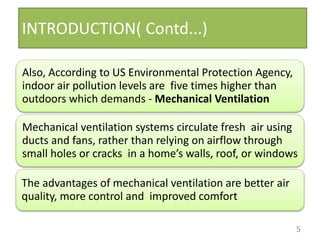
Also, According to US Environmental Protection Agency,
indoor air pollution levels are five times higher than
outdoors which demands - Mechanical Ventilation
Mechanical ventilation systems circulate fresh air using
ducts and fans, rather than relying on airflow through
small holes or cracks in a home’s walls, roof, or windows
The advantages of mechanical ventilation are better air
quality, more control and improved comfort
5
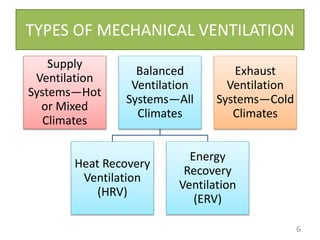
TYPES OF MECHANICAL VENTILATION
Supply
Ventilation
Systems—Hot
or Mixed
Climates
Balanced
Ventilation
Systems—All
Climates
Heat Recovery
Ventilation
(HRV)
Energy
Recovery
Ventilation
(ERV)
Exhaust
Ventilation
Systems—Cold
Climates
6
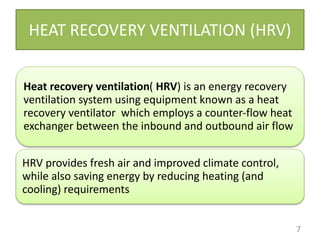
HEAT RECOVERY VENTILATION (HRV)
Heat recovery ventilation( HRV) is an energy recovery
ventilation system using equipment known as a heat
recovery ventilator which employs a counter-flow heat
exchanger between the inbound and outbound air flow
HRV provides fresh air and improved climate control,
while also saving energy by reducing heating (and
cooling) requirements
7
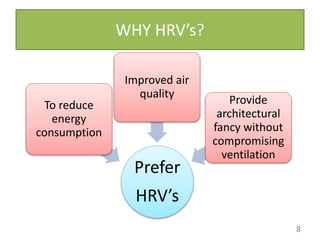
WHY HRV’s?
Prefer
HRV’s
To reduce
energy
consumption
Improved air
quality
Provide
architectural
fancy without
compromising
ventilation
8
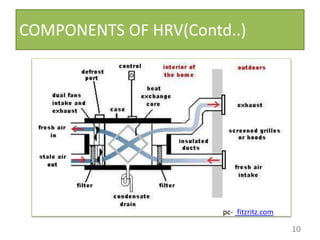
COMPONENTS OF HRV
 Fans
 Filters
 Defrost mechanisms or Pre-heater
 Operating controls
 Ducts
 Heat exchange core
9
COMPONENTS OF HRV(Contd..)
10
fitzritz.compc-
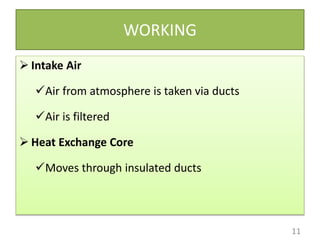
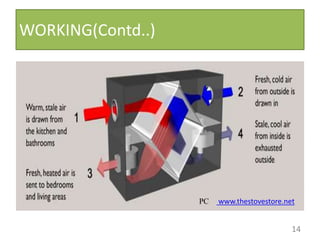
WORKING
 Intake Air
Air from atmosphere is taken via ducts
Air is filtered
 Heat Exchange Core
Moves through insulated ducts
11
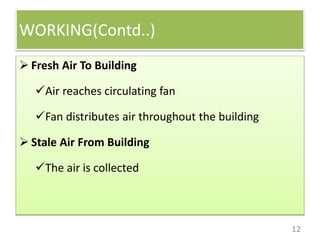
WORKING(Contd..)
 Fresh Air To Building
Air reaches circulating fan
Fan distributes air throughout the building
 Stale Air From Building
The air is collected
12
WORKING(Contd.…)
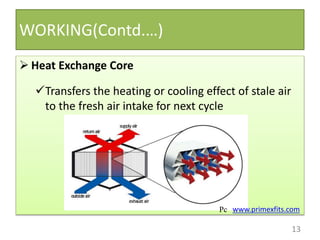
 Heat Exchange Core
Transfers the heating or cooling effect of stale air
to the fresh air intake for next cycle
13
www.primexfits.comPc
WORKING(Contd..)
14
www.thestovestore.netPC
ADVANTAGES OF HRV
Continuous supply of fresh air
Energy efficient ventilation
Condensation elimination
Comfort
15
ADVANTAGES OF HRV(Contd..)
16
• 1) Continuous Supply of Fresh Air
– Filtered fresh air is circulated throughout day and
night
– Most people spend over 80% of their time
indoors, 50% of all illnesses are either caused by,
or aggravated by poor indoor air quality
– The HRV System continuously removes stale moist
air creating a healthy environment
ADVANTAGES OF HRV(Contd..)
17
• 2) Energy Efficient Ventilation
– A HRV systems save money and reduce energy for
heating by re-using heat that is lost via standard
extract systems
– A HRV is designed to operate continuously at low
rate to minimize electrical energy consumption
ADVANTAGES OF HRV(Contd..)
18
• 3) Condensation Elimination
– Water vapour will be removed as it is produced
– As a result there is no moisture condensation
which causes rot, damp, condensation or mould
growth
– No fungal growth in bathrooms
ADVANTAGES OF HRV(Contd..)
19
• 4) Comfort
– Comfort levels are superior in a house fitted with
a Heat Recovery Ventilation system
– Irrespective of weather conditions, draught free
balanced ventilation is provided all the time
– Extra security when windows are closed
DISADVANTAGES OF HRV
20
Needs regular maintenance
Filters need cleaning or replacing every 6–12 months.
High installation cost
Not much beneficial in hot weather conditions
OPERATING A HRV
21
• Controls
– Allows user to adjust the rate of ventilation and
humidity level to certain extend
– Depending upon models & installation, controls
may be located on HRV itself or in rooms
– Pollutant sensors are also installed
– Can turned off HRV, when required
HRV MAINTENANCE
22
Clean or replace air filters
Clean the heat-exchange core
Inspect ductwork
Arrange for annual servicing
Clean the condensate drain and pan
SIMILAR TO HRV’s
23
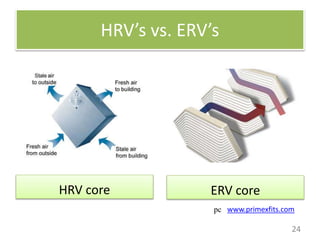
An alternative system called energy recovery ventilation
(ERV) works in a similar way as heat recovery ventilators
Transfers moisture from the outgoing airstream to the
incoming air
It’s the disadvantage of ERV, which are covered up by
the HRV’s
HRV’s vs. ERV’s
HRV core ERV core
24
www.primexfits.compc
CONCLUSION
Provides fresh air and improved climate control
Most efficient in saving energy
All buildings require source of fresh air, the need for
HRVs has become obvious
The best technology currently available for reducing
radon levels
25
REFERENCES
• Solutions for Energy Efficient and Sustainable Heating of Ventilation Air: A Review
A. Žandeckis*, K. Kļaviņa, M. Dzikēvičs, V. Kirsanovs and G. Žogla,Journal of
Engineering Science and Technology Review 8 (3) (2015) 98-111
• Akbari K., Oman R.(2013).”Impacts of Heat Recovery Ventilators on Energy Savings
and Indoor Radon in a Swedish Detached House.”WSEAS Transactions on
Environment & Development, 9(1),2224-3496.
• Natural Resources Canada’s Office of Energy Efficiency(2012), “Heat recovery
ventilators”,HTTP://WWW.HOUSING.YK.CA/PDF/HRV.PDF
• Akbari et.al (2013) "Impacts of heat recovery ventilators on energy savings and
indoor radon level", Management of Environmental Quality: An International
Journal, Issue 5,Volume 24, Page 682 – 694
• Juha Jokisalo , Jarek Kurnitski , Mika Vuolle , Antti Torkki(2003) ”Performance of
Balanced Ventilation with Heat Recovery in Residential Buildings in a Cold
Climate”The International Journal of Ventilation,2(4) 223 -236
26
• Ambrose Dodoo, Lief Gustavasson, Roger Sathre (2011) “Primary energy
implications of ventilation heat recovery in residential buildings” Energy and
Buildings, 43(7) 1566 – 1572
• Efficiency “International journal of ventilation 6 Olli Seppanen (2008)” Ventilation
Srtategies for Good Indoor Air Quality and Energy(4)297-306
• P.Wargocki(2013) “The Effects of ventilation in homes on health” International
journal of ventilation 12(2)101-118
27
28

HEAT RECOVERY VENTILATORS

  • 1.
  • 2.
    OVERVIEW • Introduction • Typesof mechanical ventilation • Heat recovery ventilation(HRV) • Why HRV’s? • Components of HRV • Working • Advantages of HRV 2
  • 3.
    OVERVIEW(Cont..) • Disadvantages ofHRV • Operating a HRV • HRV maintenance • Similar to HRV’s • ERV’s vs HRV’s • Conclusion 3
  • 4.
    INTRODUCTION 4 Ventilating is theprocess of replacing air in any space to provide high indoor air quality Methods - mechanical/forced and natural types Windows serve as a fine strategy for natural ventilation in mild climatic conditions. But natural ventilation depends on local conditions & wind shading, which are beyond human control
  • 5.
    INTRODUCTION( Contd...) Also, Accordingto US Environmental Protection Agency, indoor air pollution levels are five times higher than outdoors which demands - Mechanical Ventilation Mechanical ventilation systems circulate fresh air using ducts and fans, rather than relying on airflow through small holes or cracks in a home’s walls, roof, or windows The advantages of mechanical ventilation are better air quality, more control and improved comfort 5
  • 6.
    TYPES OF MECHANICALVENTILATION Supply Ventilation Systems—Hot or Mixed Climates Balanced Ventilation Systems—All Climates Heat Recovery Ventilation (HRV) Energy Recovery Ventilation (ERV) Exhaust Ventilation Systems—Cold Climates 6
  • 7.
    HEAT RECOVERY VENTILATION(HRV) Heat recovery ventilation( HRV) is an energy recovery ventilation system using equipment known as a heat recovery ventilator which employs a counter-flow heat exchanger between the inbound and outbound air flow HRV provides fresh air and improved climate control, while also saving energy by reducing heating (and cooling) requirements 7
  • 8.
    WHY HRV’s? Prefer HRV’s To reduce energy consumption Improvedair quality Provide architectural fancy without compromising ventilation 8
  • 9.
    COMPONENTS OF HRV Fans  Filters  Defrost mechanisms or Pre-heater  Operating controls  Ducts  Heat exchange core 9
  • 10.
  • 11.
    WORKING  Intake Air Airfrom atmosphere is taken via ducts Air is filtered  Heat Exchange Core Moves through insulated ducts 11
  • 12.
    WORKING(Contd..)  Fresh AirTo Building Air reaches circulating fan Fan distributes air throughout the building  Stale Air From Building The air is collected 12
  • 13.
    WORKING(Contd.…)  Heat ExchangeCore Transfers the heating or cooling effect of stale air to the fresh air intake for next cycle 13 www.primexfits.comPc
  • 14.
  • 15.
    ADVANTAGES OF HRV Continuoussupply of fresh air Energy efficient ventilation Condensation elimination Comfort 15
  • 16.
    ADVANTAGES OF HRV(Contd..) 16 •1) Continuous Supply of Fresh Air – Filtered fresh air is circulated throughout day and night – Most people spend over 80% of their time indoors, 50% of all illnesses are either caused by, or aggravated by poor indoor air quality – The HRV System continuously removes stale moist air creating a healthy environment
  • 17.
    ADVANTAGES OF HRV(Contd..) 17 •2) Energy Efficient Ventilation – A HRV systems save money and reduce energy for heating by re-using heat that is lost via standard extract systems – A HRV is designed to operate continuously at low rate to minimize electrical energy consumption
  • 18.
    ADVANTAGES OF HRV(Contd..) 18 •3) Condensation Elimination – Water vapour will be removed as it is produced – As a result there is no moisture condensation which causes rot, damp, condensation or mould growth – No fungal growth in bathrooms
  • 19.
    ADVANTAGES OF HRV(Contd..) 19 •4) Comfort – Comfort levels are superior in a house fitted with a Heat Recovery Ventilation system – Irrespective of weather conditions, draught free balanced ventilation is provided all the time – Extra security when windows are closed
  • 20.
    DISADVANTAGES OF HRV 20 Needsregular maintenance Filters need cleaning or replacing every 6–12 months. High installation cost Not much beneficial in hot weather conditions
  • 21.
    OPERATING A HRV 21 •Controls – Allows user to adjust the rate of ventilation and humidity level to certain extend – Depending upon models & installation, controls may be located on HRV itself or in rooms – Pollutant sensors are also installed – Can turned off HRV, when required
  • 22.
    HRV MAINTENANCE 22 Clean orreplace air filters Clean the heat-exchange core Inspect ductwork Arrange for annual servicing Clean the condensate drain and pan
  • 23.
    SIMILAR TO HRV’s 23 Analternative system called energy recovery ventilation (ERV) works in a similar way as heat recovery ventilators Transfers moisture from the outgoing airstream to the incoming air It’s the disadvantage of ERV, which are covered up by the HRV’s
  • 24.
    HRV’s vs. ERV’s HRVcore ERV core 24 www.primexfits.compc
  • 25.
    CONCLUSION Provides fresh airand improved climate control Most efficient in saving energy All buildings require source of fresh air, the need for HRVs has become obvious The best technology currently available for reducing radon levels 25
  • 26.
    REFERENCES • Solutions forEnergy Efficient and Sustainable Heating of Ventilation Air: A Review A. Žandeckis*, K. Kļaviņa, M. Dzikēvičs, V. Kirsanovs and G. Žogla,Journal of Engineering Science and Technology Review 8 (3) (2015) 98-111 • Akbari K., Oman R.(2013).”Impacts of Heat Recovery Ventilators on Energy Savings and Indoor Radon in a Swedish Detached House.”WSEAS Transactions on Environment & Development, 9(1),2224-3496. • Natural Resources Canada’s Office of Energy Efficiency(2012), “Heat recovery ventilators”,HTTP://WWW.HOUSING.YK.CA/PDF/HRV.PDF • Akbari et.al (2013) "Impacts of heat recovery ventilators on energy savings and indoor radon level", Management of Environmental Quality: An International Journal, Issue 5,Volume 24, Page 682 – 694 • Juha Jokisalo , Jarek Kurnitski , Mika Vuolle , Antti Torkki(2003) ”Performance of Balanced Ventilation with Heat Recovery in Residential Buildings in a Cold Climate”The International Journal of Ventilation,2(4) 223 -236 26
  • 27.
    • Ambrose Dodoo,Lief Gustavasson, Roger Sathre (2011) “Primary energy implications of ventilation heat recovery in residential buildings” Energy and Buildings, 43(7) 1566 – 1572 • Efficiency “International journal of ventilation 6 Olli Seppanen (2008)” Ventilation Srtategies for Good Indoor Air Quality and Energy(4)297-306 • P.Wargocki(2013) “The Effects of ventilation in homes on health” International journal of ventilation 12(2)101-118 27
  • 28.