2011 MIDWEST REGIONAL
BUILDING ENERGY CODES
     CONFERENCE
    October 5-6, 2011
       Chicago, IL
Purpose
• Establish a regionally coordinated effort
  on behalf of adoption, enforcement and
  evaluation of building energy codes
• Increase knowledge and information
  sharing of Midwest energy code activity
• Get to know each other
MEEA’s Role in the Midwest
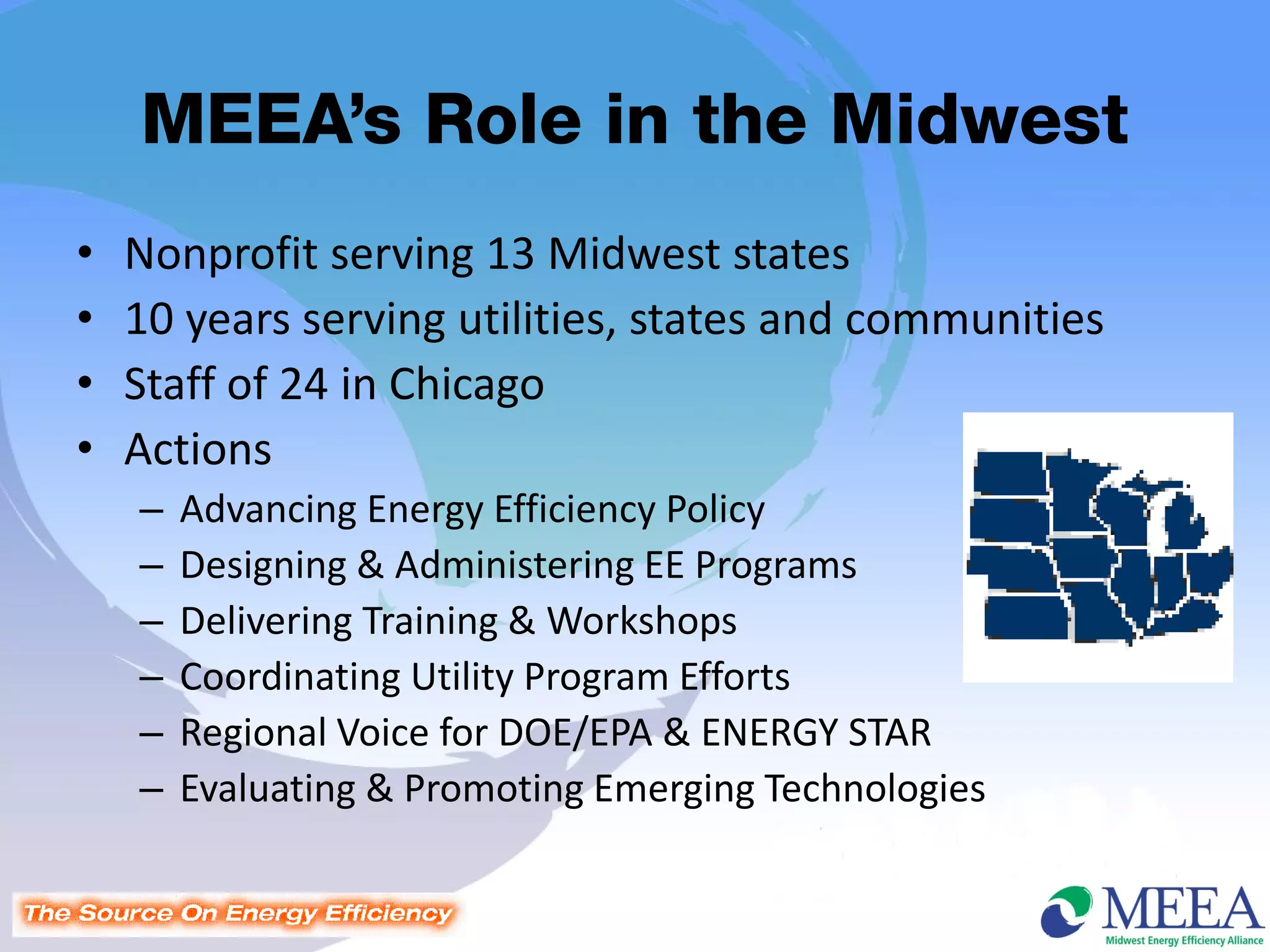
•   Nonprofit serving 13 Midwest states
•   10 years serving utilities, states and communities
•   Staff of 24 in Chicago
•   Actions
    –   Advancing Energy Efficiency Policy
    –   Designing & Administering EE Programs
    –   Delivering Training & Workshops
    –   Coordinating Utility Program Efforts
    –   Regional Voice for DOE/EPA & ENERGY STAR
    –   Evaluating & Promoting Emerging Technologies
Agenda
•   State Updates
•   2012 IECC / ASHRAE 90.1-2010
•   Utility Programs and Energy Codes
•   Compliance Evaluation Pilot Studies
•   3rd Party Enforcement
Structure
• Quick Introduction to Subject
• Panel Discussion
• Q&A / Open Commentary
Norms
• No one here is the Smartest Person in the
  Room.
• Respect the knowledge and
  understanding of others.
• Discussions must be civil (especially when
  there is disagreement).
• Statements should be brief, on topic and
  to the point (and no commandeering of
  discussion for your pet topic).
2012 IECC /
ASHRAE 90.1-2010
2012 IECC/ASHRAE 90.1-2010
• 30% more energy efficient than 2006
  IECC
• 25% more energy efficient than 90.1-2004
• Overwhelming support of code officials at
  ICC Final Action Hearings
• Non-residential amendments had broad
  support
Brief History/Background
• RESIDENTIAL
  – End -point of work on 30% Solution
  – Whole house approach to energy code.
• NON RESIDENTIAL
  – Suite of amendments originally based on
    requirements of Core Performance Guide (CPG)
  – State of Massachusetts adopted a stretch code
    based on CPG
  – AIA, New Buildings Institute, and DOE collaborated
    on set of amendments based on MA stretch code
  – NBI Analysis indicates that amendments improve the
    energy efficiency of Chapter 5 by 20-30% over 2006
    IECC.
Key New Features - Residential
• Whole house continuous ventilation
• Restrictions on pipe length
• No cavity insulation in Climate Zones 6 &
  7 for prescriptive path
• Blower door test required
• Strengthening of existing requirements
• 2012 IRC exactly the same as 2012 IECC
Key New Features - Non-Residential

•   Increased focus on daylighting
•   Commissioning
•   Lighting controls
•   HVAC – 3 Approaches (includes
    renewables)
Midwest Activity
•   Illinois
•   Minnesota
•   Kansas City, MO
•   Overland Park, KS
UTILITY PROGRAMS AND
    ENERGY CODES
Rationale
• Code compliance tends to be low.
• Utilities face increasing energy efficiency
  requirements; up to 2.0% of energy sales as early
  as 2015; code related programs can help utilities
  meet these goals.
• Code compliance realizes energy potential of
  policy.
• Utilities can bring resources and expertise to the
  issue (through programs).
• Significant regional potential savings; up to 123
  trillion Btu annually by 2020 or the equivalent of
  the energy use of 1,000,000 households
Anti-Rationale
• Utilities may hesitate to support improving
  the energy efficiency of energy codes
  – Increasing the energy efficiency of the energy
    code reduces the amount of energy savings
    utilities can claim

• How can utilities get credit for energy
  savings from code programs?
Basic Framework
• Know relevant state statutory and regulatory
  requirements.
• Know the various stakeholders involved.
• Focus on compliance enhancement (and to a lesser
  extent stretch codes).
• Work out appropriate activities (actions that will result
  in measurable energy savings).
• Develop methodology for measuring energy savings
  (pay attention to difference between natural gas and
  electricity).
• Attribution (not all energy savings due to increased
  compliance will come directly from utility actions).
• Allocation (multiple utilities within state)
How Does A Codes Program
           Differ
• Codes are adopted and enforced by
  governmental agencies
• Multiple organizations (stakeholders) are
  interested and willing to participate
• Codes affect all new buildings
• “Customers” cannot choose to participate or
  not participate
• Utility actions affect adoption not behavior
• Utility acquisition programs interact with
  codes
UTILITY PROGRAMS AND ENERGY CODES

CASE STUDIES: MASSACHUSETTS
       AND CALIFORNIA
Massachusetts
• 2010: All 8 Program Administrators (PAs) took a joint
  decision towards a state-wide residential &
  commercial C&S initiative
• Why?
   – Have in-house expertise to assist state with advancing
     C&S
   – Need to meet aggressive state mandated energy savings
     goals through innovative and new program initiatives
   – Capture market missed by incentive programs &
     overcome split incentives for building owners/tenants
   – Proven through California: cost effective program with
     large energy savings potential
• Barriers: regulatory barriers, complex energy savings
  attribution
Massachusetts - Work in 2010-2011

• Began discussions with the state on possible
  initiatives that PAs can pursue through C&S
  program
• Hired a consultant team to assist PAs in program
  planning, energy saving estimates, attribution
  methodology, etc.
• Initiated research studies to:
  – Identification of stakeholders and coordinate
    communication
  – Confirm energy savings potential through C&S
  – Complete Code compliance baseline studies
  – Design attribution methodology to energy savings
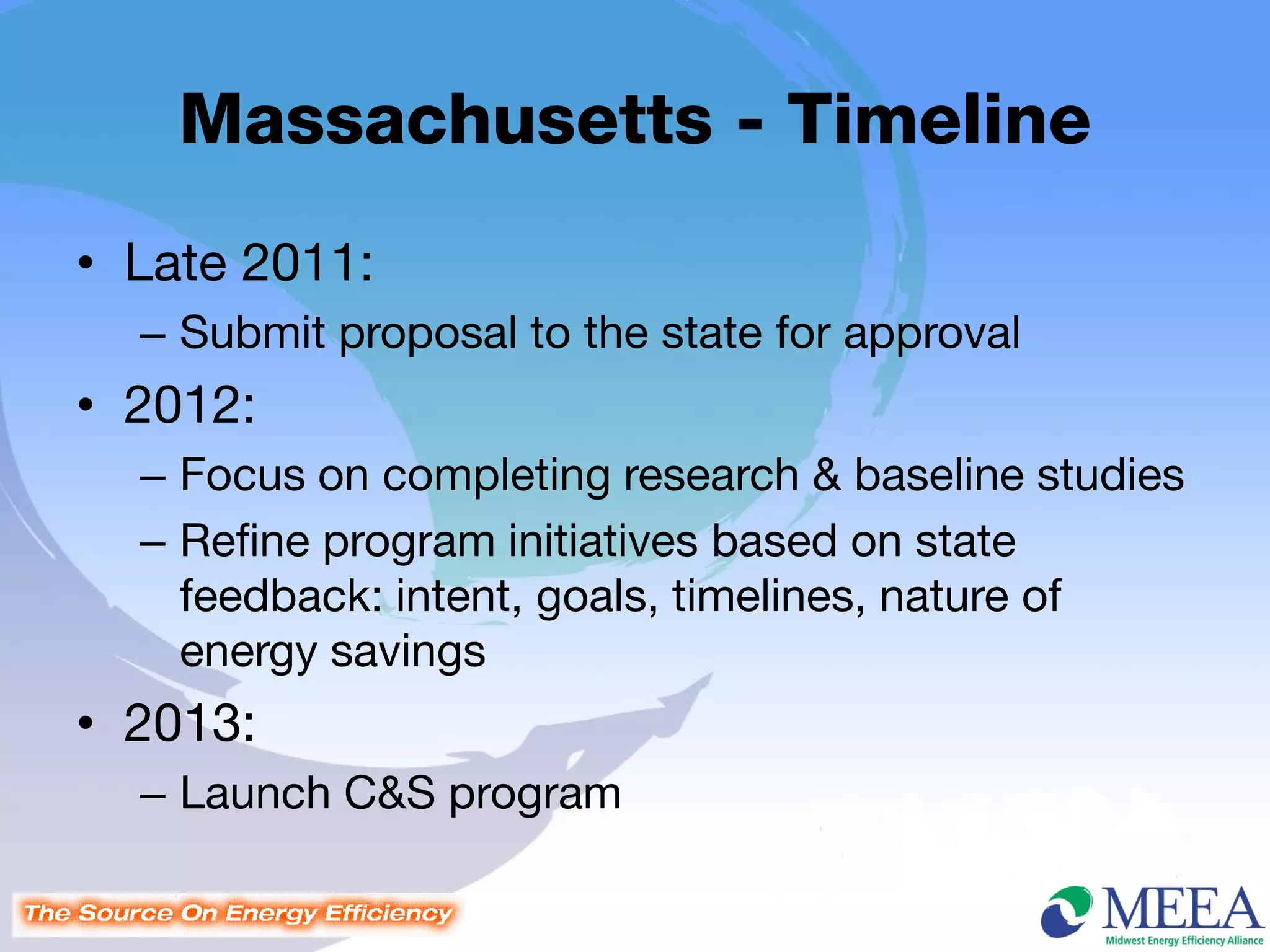
Massachusetts - Timeline
• Late 2011:
  – Submit proposal to the state for approval
• 2012:
  – Focus on completing research & baseline studies
  – Refine program initiatives based on state
    feedback: intent, goals, timelines, nature of
    energy savings
• 2013:
  – Launch C&S program
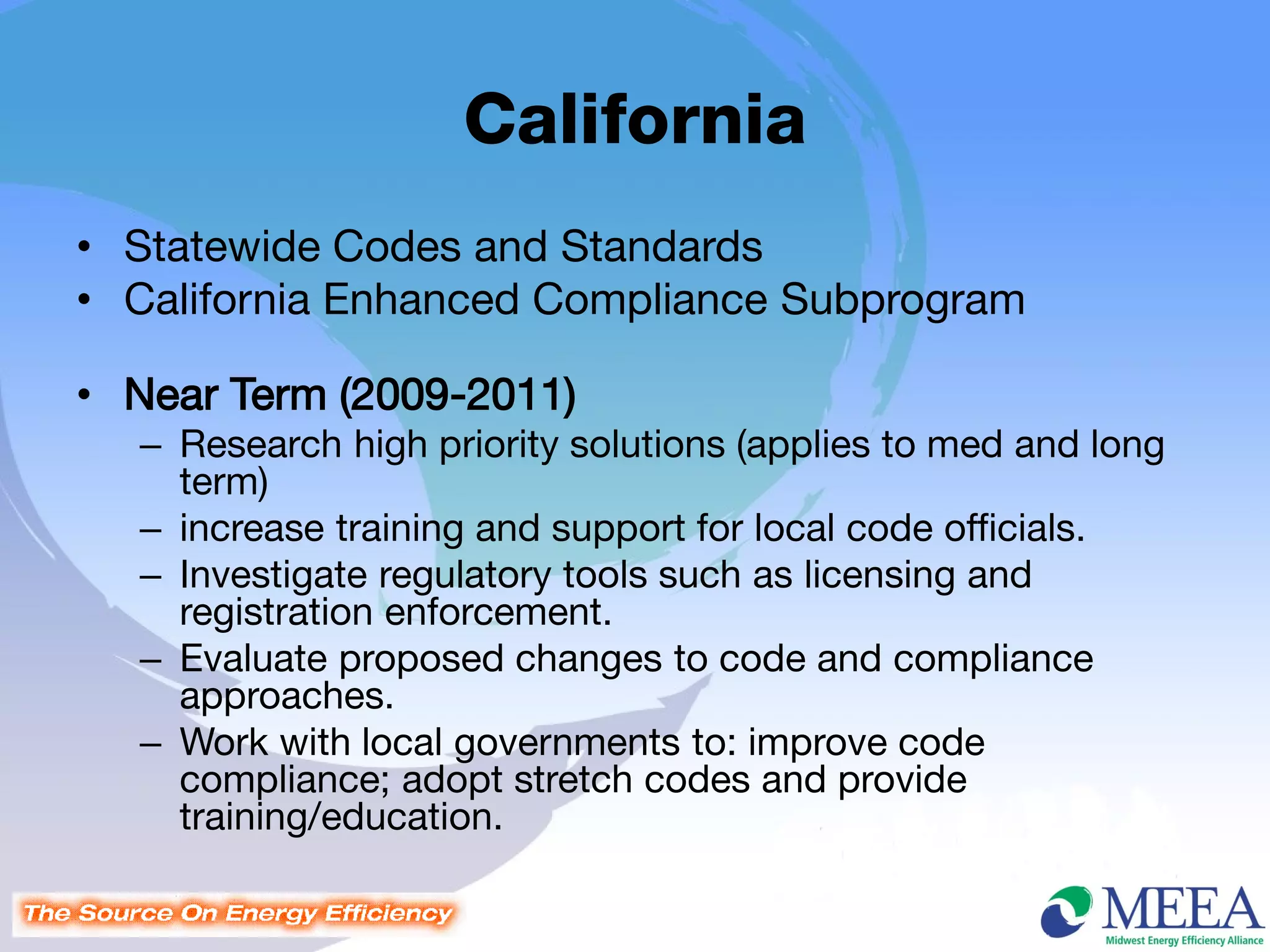
California
• Statewide Codes and Standards
• California Enhanced Compliance Subprogram

• Near Term (2009-2011)
  – Research high priority solutions (applies to med and long
    term)
  – increase training and support for local code officials.
  – Investigate regulatory tools such as licensing and
    registration enforcement.
  – Evaluate proposed changes to code and compliance
    approaches.
  – Work with local governments to: improve code
    compliance; adopt stretch codes and provide
    training/education.
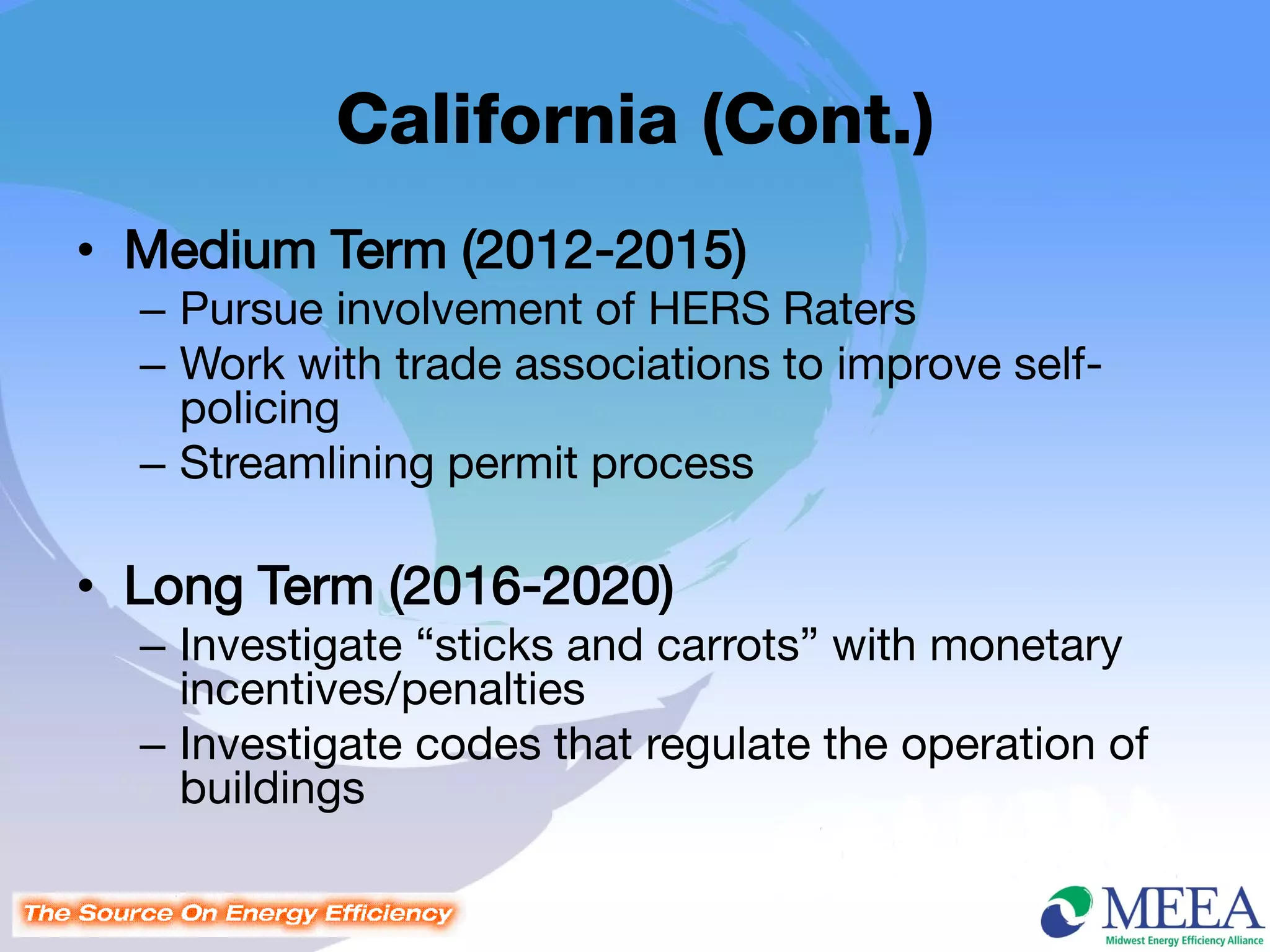
California (Cont.)
• Medium Term (2012-2015)
  – Pursue involvement of HERS Raters
  – Work with trade associations to improve self-
    policing
  – Streamlining permit process

• Long Term (2016-2020)
  – Investigate “sticks and carrots” with monetary
    incentives/penalties
  – Investigate codes that regulate the operation of
    buildings
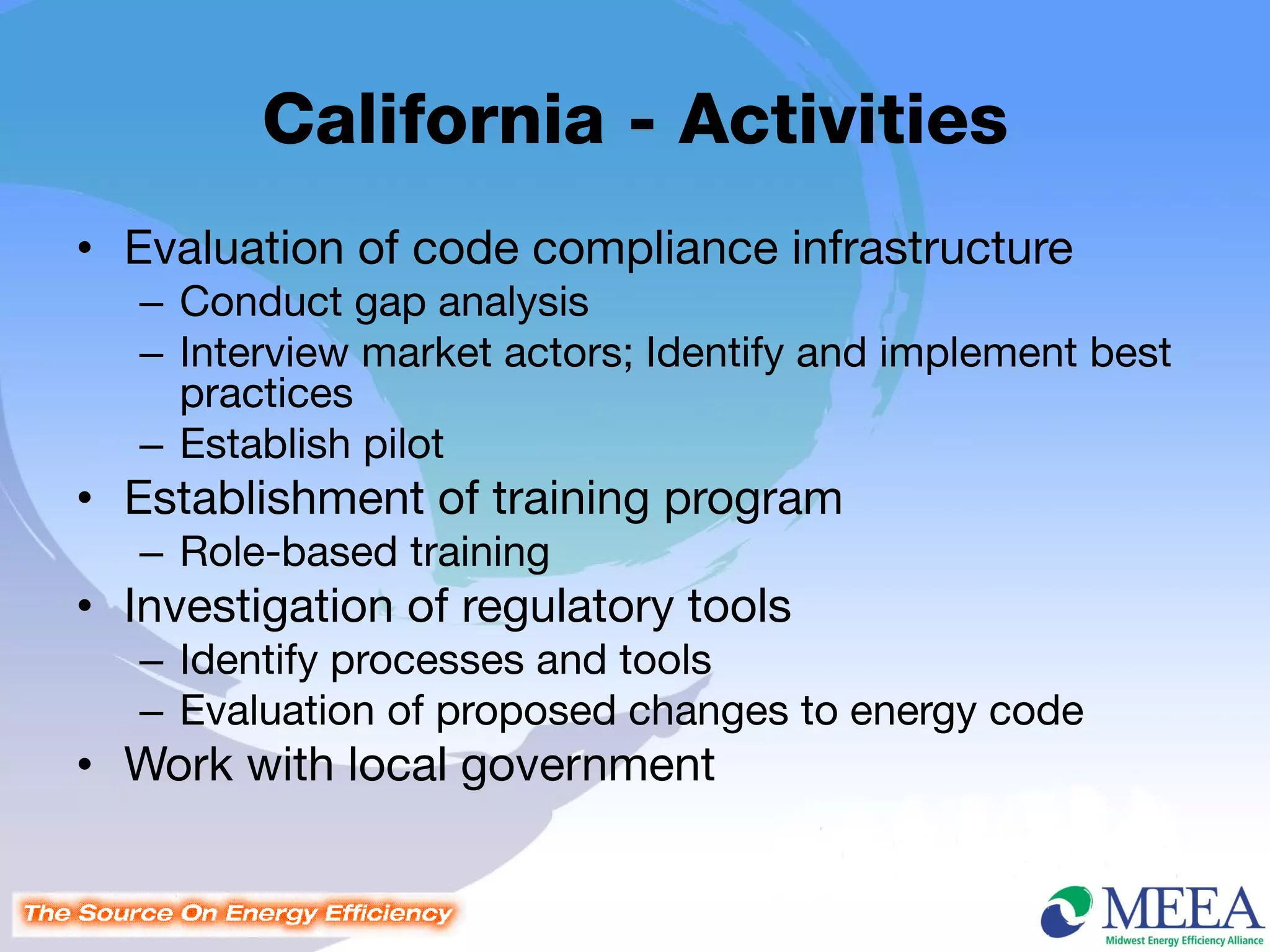
California - Activities
• Evaluation of code compliance infrastructure
   – Conduct gap analysis
   – Interview market actors; Identify and implement best
     practices
   – Establish pilot
• Establishment of training program
   – Role-based training
• Investigation of regulatory tools
   – Identify processes and tools
   – Evaluation of proposed changes to energy code
• Work with local government
Utility Programs - Final Thoughts

• Although framework is beginning to get
  established, many details remain to be
  worked out.

• Work is ongoing to:
  – Clarify and expand types of utility activities in
    support of energy codes (move beyond training).
  – Establish measurement and attribution protocols.
  – Clarify/address statutory and regulatory hurdles.
  – Outreach to diverse stakeholders.
COMPLIANCE EVALUATION
   PILOT STUDIES
Compliance Evaluation Pilot
           Studies
• Recovery Act Requirement for States
  Receiving Funding Related to Energy
  Codes
• Establish Plan for 90% Compliance with
  2009 IECC/90.1-2007 by 2017
• Need to Develop Protocol to Provide
  Consistent Measurement Across States
• Save States from Having to Develop
  Individually
Questions of Methodology
• Random Sample of 44 buildings
  (residential and non-residential)
• Follow Protocol Developed by Pacific
  Northwest National Laboratory (Show
  Link)
• How Long Does it Take?
• How Much Does it Cost?
• Roadblocks?
• Biases in Sample?
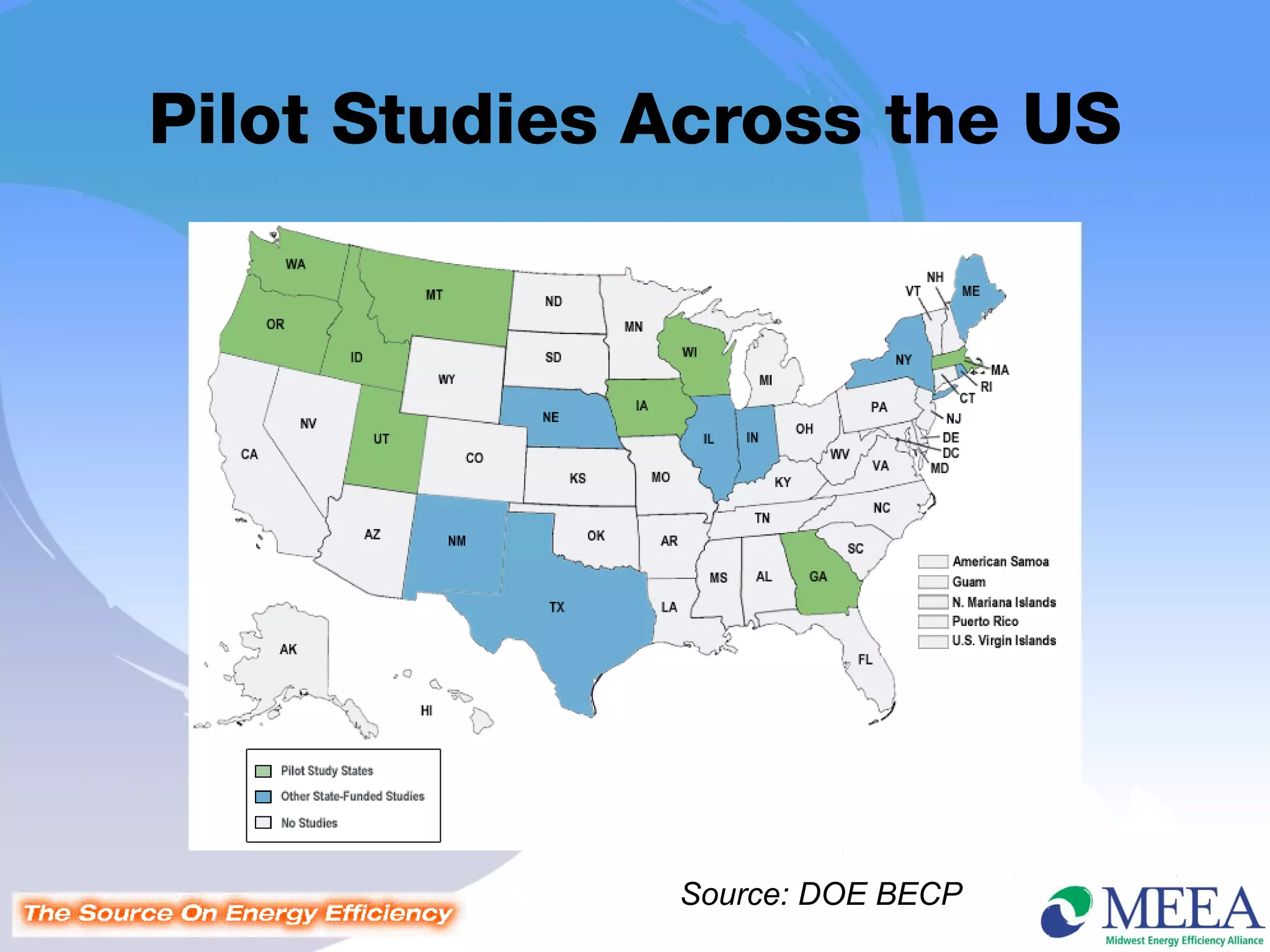
Pilot Studies Across the US


              Source: DOE BECP
3RD PARTY ENFORCEMENT
Issues and Questions
• Alleviate issue of lack of resources & add
  new sources of expertise
• Increasing complexity of code (takes longer
  to learn and enforce)
• Successes in past (Washington State/Fairfax
  County VA)
• How to revive effort?
• Use of HERS Professionals
• Wisconsin experience
Contact Info
    Isaac Elnecave, Senior Policy Manager
                 ielnecave@mwalliance.org

     Midwest Energy Efficiency Alliance (MEEA)
              www.mwalliance.org


                  More information & resources
http://www.mwalliance.org/policy/midwest-regional-energy-codes-conference

2011 Midwest Regional Building Energy Codes Conference

  • 1.
    2011 MIDWEST REGIONAL BUILDINGENERGY CODES CONFERENCE October 5-6, 2011 Chicago, IL
  • 2.
    Purpose • Establish aregionally coordinated effort on behalf of adoption, enforcement and evaluation of building energy codes • Increase knowledge and information sharing of Midwest energy code activity • Get to know each other
  • 3.
    MEEA’s Role inthe Midwest • Nonprofit serving 13 Midwest states • 10 years serving utilities, states and communities • Staff of 24 in Chicago • Actions – Advancing Energy Efficiency Policy – Designing & Administering EE Programs – Delivering Training & Workshops – Coordinating Utility Program Efforts – Regional Voice for DOE/EPA & ENERGY STAR – Evaluating & Promoting Emerging Technologies
  • 4.
    Agenda • State Updates • 2012 IECC / ASHRAE 90.1-2010 • Utility Programs and Energy Codes • Compliance Evaluation Pilot Studies • 3rd Party Enforcement
  • 5.
    Structure • Quick Introductionto Subject • Panel Discussion • Q&A / Open Commentary
  • 6.
    Norms • No onehere is the Smartest Person in the Room. • Respect the knowledge and understanding of others. • Discussions must be civil (especially when there is disagreement). • Statements should be brief, on topic and to the point (and no commandeering of discussion for your pet topic).
  • 7.
  • 8.
    2012 IECC/ASHRAE 90.1-2010 •30% more energy efficient than 2006 IECC • 25% more energy efficient than 90.1-2004 • Overwhelming support of code officials at ICC Final Action Hearings • Non-residential amendments had broad support
  • 9.
    Brief History/Background • RESIDENTIAL – End -point of work on 30% Solution – Whole house approach to energy code. • NON RESIDENTIAL – Suite of amendments originally based on requirements of Core Performance Guide (CPG) – State of Massachusetts adopted a stretch code based on CPG – AIA, New Buildings Institute, and DOE collaborated on set of amendments based on MA stretch code – NBI Analysis indicates that amendments improve the energy efficiency of Chapter 5 by 20-30% over 2006 IECC.
  • 10.
    Key New Features- Residential • Whole house continuous ventilation • Restrictions on pipe length • No cavity insulation in Climate Zones 6 & 7 for prescriptive path • Blower door test required • Strengthening of existing requirements • 2012 IRC exactly the same as 2012 IECC
  • 11.
    Key New Features- Non-Residential • Increased focus on daylighting • Commissioning • Lighting controls • HVAC – 3 Approaches (includes renewables)
  • 12.
    Midwest Activity • Illinois • Minnesota • Kansas City, MO • Overland Park, KS
  • 13.
  • 14.
    Rationale • Code compliancetends to be low. • Utilities face increasing energy efficiency requirements; up to 2.0% of energy sales as early as 2015; code related programs can help utilities meet these goals. • Code compliance realizes energy potential of policy. • Utilities can bring resources and expertise to the issue (through programs). • Significant regional potential savings; up to 123 trillion Btu annually by 2020 or the equivalent of the energy use of 1,000,000 households
  • 15.
    Anti-Rationale • Utilities mayhesitate to support improving the energy efficiency of energy codes – Increasing the energy efficiency of the energy code reduces the amount of energy savings utilities can claim • How can utilities get credit for energy savings from code programs?
  • 16.
    Basic Framework • Knowrelevant state statutory and regulatory requirements. • Know the various stakeholders involved. • Focus on compliance enhancement (and to a lesser extent stretch codes). • Work out appropriate activities (actions that will result in measurable energy savings). • Develop methodology for measuring energy savings (pay attention to difference between natural gas and electricity). • Attribution (not all energy savings due to increased compliance will come directly from utility actions). • Allocation (multiple utilities within state)
  • 17.
    How Does ACodes Program Differ • Codes are adopted and enforced by governmental agencies • Multiple organizations (stakeholders) are interested and willing to participate • Codes affect all new buildings • “Customers” cannot choose to participate or not participate • Utility actions affect adoption not behavior • Utility acquisition programs interact with codes
  • 18.
    UTILITY PROGRAMS ANDENERGY CODES CASE STUDIES: MASSACHUSETTS AND CALIFORNIA
  • 19.
    Massachusetts • 2010: All8 Program Administrators (PAs) took a joint decision towards a state-wide residential & commercial C&S initiative • Why? – Have in-house expertise to assist state with advancing C&S – Need to meet aggressive state mandated energy savings goals through innovative and new program initiatives – Capture market missed by incentive programs & overcome split incentives for building owners/tenants – Proven through California: cost effective program with large energy savings potential • Barriers: regulatory barriers, complex energy savings attribution
  • 20.
    Massachusetts - Workin 2010-2011 • Began discussions with the state on possible initiatives that PAs can pursue through C&S program • Hired a consultant team to assist PAs in program planning, energy saving estimates, attribution methodology, etc. • Initiated research studies to: – Identification of stakeholders and coordinate communication – Confirm energy savings potential through C&S – Complete Code compliance baseline studies – Design attribution methodology to energy savings
  • 21.
    Massachusetts - Timeline •Late 2011: – Submit proposal to the state for approval • 2012: – Focus on completing research & baseline studies – Refine program initiatives based on state feedback: intent, goals, timelines, nature of energy savings • 2013: – Launch C&S program
  • 22.
    California • Statewide Codesand Standards • California Enhanced Compliance Subprogram • Near Term (2009-2011) – Research high priority solutions (applies to med and long term) – increase training and support for local code officials. – Investigate regulatory tools such as licensing and registration enforcement. – Evaluate proposed changes to code and compliance approaches. – Work with local governments to: improve code compliance; adopt stretch codes and provide training/education.
  • 23.
    California (Cont.) • MediumTerm (2012-2015) – Pursue involvement of HERS Raters – Work with trade associations to improve self- policing – Streamlining permit process • Long Term (2016-2020) – Investigate “sticks and carrots” with monetary incentives/penalties – Investigate codes that regulate the operation of buildings
  • 24.
    California - Activities •Evaluation of code compliance infrastructure – Conduct gap analysis – Interview market actors; Identify and implement best practices – Establish pilot • Establishment of training program – Role-based training • Investigation of regulatory tools – Identify processes and tools – Evaluation of proposed changes to energy code • Work with local government
  • 25.
    Utility Programs -Final Thoughts • Although framework is beginning to get established, many details remain to be worked out. • Work is ongoing to: – Clarify and expand types of utility activities in support of energy codes (move beyond training). – Establish measurement and attribution protocols. – Clarify/address statutory and regulatory hurdles. – Outreach to diverse stakeholders.
  • 26.
  • 27.
    Compliance Evaluation Pilot Studies • Recovery Act Requirement for States Receiving Funding Related to Energy Codes • Establish Plan for 90% Compliance with 2009 IECC/90.1-2007 by 2017 • Need to Develop Protocol to Provide Consistent Measurement Across States • Save States from Having to Develop Individually
  • 28.
    Questions of Methodology •Random Sample of 44 buildings (residential and non-residential) • Follow Protocol Developed by Pacific Northwest National Laboratory (Show Link) • How Long Does it Take? • How Much Does it Cost? • Roadblocks? • Biases in Sample?
  • 29.
    Pilot Studies Acrossthe US Source: DOE BECP
  • 30.
  • 31.
    Issues and Questions •Alleviate issue of lack of resources & add new sources of expertise • Increasing complexity of code (takes longer to learn and enforce) • Successes in past (Washington State/Fairfax County VA) • How to revive effort? • Use of HERS Professionals • Wisconsin experience
  • 32.
    Contact Info Isaac Elnecave, Senior Policy Manager ielnecave@mwalliance.org Midwest Energy Efficiency Alliance (MEEA) www.mwalliance.org More information & resources http://www.mwalliance.org/policy/midwest-regional-energy-codes-conference