An example of what it means to let a lightbulb of 100 W emit
light continuously for 1 year
 We assume electricity generation is by a coal power
plant. The energy density of coal is roughly 6.7 kWh/kg
(kWh = kilowatt-hour) . This corresponds to 0.765 Wy
(Watt-year. Conversion of coal to electricity has an
efficiency of 40%. So, 1 kg coal can generate 0.4 x 0.765
= 0.306 W for 1 year. Inversely, to generate 100 W for 1
year, we need 326 kg of coal. [79]
(Note that 100 Wy = 876 kWh)
 How much CO2 is emitted during that time?
 CO2 emission from coal = 2.3 kg/kg coal
(anthracite)
 So, 326 kg coal emits 750 kg CO2 in the atmosphere
From EIA
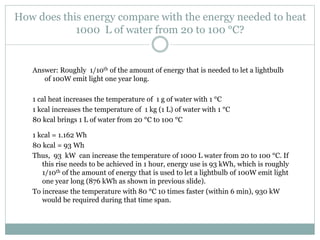
How does this energy compare with the energy needed to heat
1000 L of water from 20 to 100 °C?
Answer: Roughly 1/10th of the amount of energy that is needed to let a lightbulb
of 100W emit light one year long.
1 cal heat increases the temperature of 1 g of water with 1 °C
1 kcal increases the temperature of 1 kg (1 L) of water with 1 °C
80 kcal brings 1 L of water from 20 °C to 100 °C
1 kcal = 1.162 Wh
80 kcal = 93 Wh
Thus, 93 kW can increase the temperature of 1000 L water from 20 to 100 °C. If
this rise needs to be achieved in 1 hour, energy use is 93 kWh, which is roughly
1/10th of the amount of energy that is used to let a lightbulb of 100W emit light
one year long (876 kWh as shown in previous slide).
To increase the temperature with 80 °C 10 times faster (within 6 min), 930 kW
would be required during that time span.
Household energy consumption
 Space heating and cooling makes 40-60 % of the average residential energy needs, followed by
lighting and other appliances and water heating.
Source UK
Source US: EIA
0
10
20
30
40
50
60
70
Space
heating/cooling
Lighting &
household
machinery
Lighting Water heating Cooking
%
Household energy consumption
U.K. U.S.
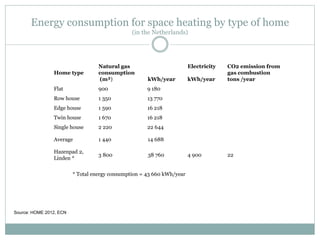
Energy consumption for space heating by type of home
(in the Netherlands)
Home type
Natural gas
consumption
(m³) kWh/year
Electricity
kWh/year
CO2 emission from
gas combustion
tons /year
Flat 900 9 180
Row house 1 350 13 770
Edge house 1 590 16 218
Twin house 1 670 16 218
Single house 2 220 22 644
Average 1 440 14 688
Hazenpad 2,
Linden *
3 800 38 760 4 900 22
* Total energy consumption = 43 660 kWh/year
Source: HOME 2012, ECN
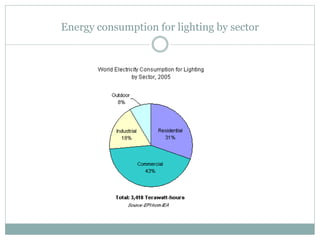
Energy consumption for lighting by sector
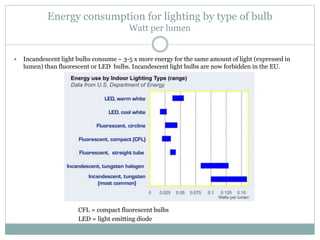
Energy consumption for lighting by type of bulb
Watt per lumen
 Incandescent light bulbs consume ~ 3-5 x more energy for the same amount of light (expressed in
lumen) than fluorescent or LED bulbs. Incandescent light bulbs are now forbidden in the EU.
CFL = compact fluorescent bulbs
LED = light emitting diode
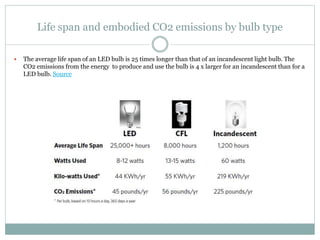
Life span and embodied CO2 emissions by bulb type
 The average life span of an LED bulb is 25 times longer than that of an incandescent light bulb. The
CO2 emissions from the energy to produce and use the bulb is 4 x larger for an incandescent than for a
LED bulb. Source
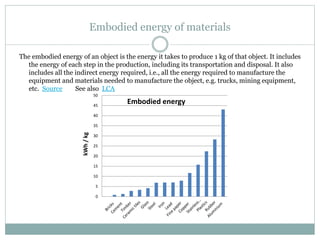
Embodied energy of materials
The embodied energy of an object is the energy it takes to produce 1 kg of that object. It includes
the energy of each step in the production, including its transportation and disposal. It also
includes all the indirect energy required, i.e., all the energy required to manufacture the
equipment and materials needed to manufacture the object, e.g. trucks, mining equipment,
etc. Source See also LCA
0
5
10
15
20
25
30
35
40
45
50
kWh/kg
Embodied energy
Embodied energy of a car
 Treloar, et al. have estimated the embodied energy in an average automobile in Australia as
270 GJ (gigajoules) (= 75 000 kWh) with a life span of 15 years for the car. Note that the
CO2 emission to make a car = 16 tons (0.27 kg/kWh). For all cars in the world (~1
billion) that would be 16 gigatons [Ref]erence] .
 A similar calculation is based on the Toyota Prius, an energy efficient car on the road.
Embodied energy is 165 GJ, half of which is in steel and aluminium. This is 40 % lower
than the average Australian car (from: click here).
1 GJ= 31.71 x 10⁻¹² TWy = 277 780 x 10-12 TWh = 277 780 x 10-3 kWh = 278 kWh 1MJ = 0.278 kWh
From wattzon.com
Effective energy for driving a car
 How does that embodied energy of a car compare to the energy used for driving the car
(only in terms of gasoline consumption)?
 Energy density of gasoline is 9.6 kWh/L
 Assuming the car uses 8 L gasoline per 100 km and the car travels 20 000 km/year,
1600 L gasoline is consumed/year
 This corresponds to 15 360 kWh/year and 2.9 tons CO2 emission.
 Thus, roughly 5 x more energy is used to make a car than to drive that car over
a distance of half the cicumference of the Earth.
 Note that there are ~1 billion cars in the world, that the average time a car is on the
road is 1 hour/day and that the number of passengers is 1.6/car. It is clear that
individualized transportation in developed countries is economically extremely
inefficient. The main reason of why people live with these figures is the easyness and
freedom in mobility.
 Driving a conventional car is also thermodynamically less efficient than an electric
transportation vehicle, since energy conversion efficiency of an internal combustion
motor is 10-50 % vs 40-90 % for an electric motor.
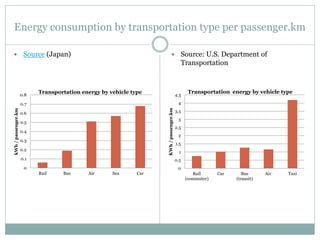
Energy consumption by transportation type per passenger.km
 Source (Japan)  Source: U.S. Department of
Transportation
0
0.5
1
1.5
2
2.5
3
3.5
4
4.5
Rail
(commuter)
Car Bus
(transit)
Air Taxi
KWh/passenger.km
Transportation energy by vehicle type
0
0.1
0.2
0.3
0.4
0.5
0.6
0.7
0.8
Rail Bus Air Sea Car
kWh/passenger.km
Transportation energy by vehicle type
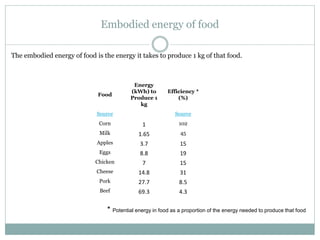
Embodied energy of food
Food
Energy
(kWh) to
Produce 1
kg
Efficiency *
(%)
Source Source
Corn 1 102
Milk 1.65 45
Apples 3.7 15
Eggs 8.8 19
Chicken 7 15
Cheese 14.8 31
Pork 27.7 8.5
Beef 69.3 4.3
* Potential energy in food as a proportion of the energy needed to produce that food
The embodied energy of food is the energy it takes to produce 1 kg of that food.

Energy in everyday life

  • 1.
    An example ofwhat it means to let a lightbulb of 100 W emit light continuously for 1 year  We assume electricity generation is by a coal power plant. The energy density of coal is roughly 6.7 kWh/kg (kWh = kilowatt-hour) . This corresponds to 0.765 Wy (Watt-year. Conversion of coal to electricity has an efficiency of 40%. So, 1 kg coal can generate 0.4 x 0.765 = 0.306 W for 1 year. Inversely, to generate 100 W for 1 year, we need 326 kg of coal. [79] (Note that 100 Wy = 876 kWh)  How much CO2 is emitted during that time?  CO2 emission from coal = 2.3 kg/kg coal (anthracite)  So, 326 kg coal emits 750 kg CO2 in the atmosphere From EIA
  • 2.
    How does thisenergy compare with the energy needed to heat 1000 L of water from 20 to 100 °C? Answer: Roughly 1/10th of the amount of energy that is needed to let a lightbulb of 100W emit light one year long. 1 cal heat increases the temperature of 1 g of water with 1 °C 1 kcal increases the temperature of 1 kg (1 L) of water with 1 °C 80 kcal brings 1 L of water from 20 °C to 100 °C 1 kcal = 1.162 Wh 80 kcal = 93 Wh Thus, 93 kW can increase the temperature of 1000 L water from 20 to 100 °C. If this rise needs to be achieved in 1 hour, energy use is 93 kWh, which is roughly 1/10th of the amount of energy that is used to let a lightbulb of 100W emit light one year long (876 kWh as shown in previous slide). To increase the temperature with 80 °C 10 times faster (within 6 min), 930 kW would be required during that time span.
  • 3.
    Household energy consumption Space heating and cooling makes 40-60 % of the average residential energy needs, followed by lighting and other appliances and water heating. Source UK Source US: EIA 0 10 20 30 40 50 60 70 Space heating/cooling Lighting & household machinery Lighting Water heating Cooking % Household energy consumption U.K. U.S.
  • 4.
    Energy consumption forspace heating by type of home (in the Netherlands) Home type Natural gas consumption (m³) kWh/year Electricity kWh/year CO2 emission from gas combustion tons /year Flat 900 9 180 Row house 1 350 13 770 Edge house 1 590 16 218 Twin house 1 670 16 218 Single house 2 220 22 644 Average 1 440 14 688 Hazenpad 2, Linden * 3 800 38 760 4 900 22 * Total energy consumption = 43 660 kWh/year Source: HOME 2012, ECN
  • 5.
    Energy consumption forlighting by sector
  • 6.
    Energy consumption forlighting by type of bulb Watt per lumen  Incandescent light bulbs consume ~ 3-5 x more energy for the same amount of light (expressed in lumen) than fluorescent or LED bulbs. Incandescent light bulbs are now forbidden in the EU. CFL = compact fluorescent bulbs LED = light emitting diode
  • 7.
    Life span andembodied CO2 emissions by bulb type  The average life span of an LED bulb is 25 times longer than that of an incandescent light bulb. The CO2 emissions from the energy to produce and use the bulb is 4 x larger for an incandescent than for a LED bulb. Source
  • 8.
    Embodied energy ofmaterials The embodied energy of an object is the energy it takes to produce 1 kg of that object. It includes the energy of each step in the production, including its transportation and disposal. It also includes all the indirect energy required, i.e., all the energy required to manufacture the equipment and materials needed to manufacture the object, e.g. trucks, mining equipment, etc. Source See also LCA 0 5 10 15 20 25 30 35 40 45 50 kWh/kg Embodied energy
  • 9.
    Embodied energy ofa car  Treloar, et al. have estimated the embodied energy in an average automobile in Australia as 270 GJ (gigajoules) (= 75 000 kWh) with a life span of 15 years for the car. Note that the CO2 emission to make a car = 16 tons (0.27 kg/kWh). For all cars in the world (~1 billion) that would be 16 gigatons [Ref]erence] .  A similar calculation is based on the Toyota Prius, an energy efficient car on the road. Embodied energy is 165 GJ, half of which is in steel and aluminium. This is 40 % lower than the average Australian car (from: click here). 1 GJ= 31.71 x 10⁻¹² TWy = 277 780 x 10-12 TWh = 277 780 x 10-3 kWh = 278 kWh 1MJ = 0.278 kWh From wattzon.com
  • 10.
    Effective energy fordriving a car  How does that embodied energy of a car compare to the energy used for driving the car (only in terms of gasoline consumption)?  Energy density of gasoline is 9.6 kWh/L  Assuming the car uses 8 L gasoline per 100 km and the car travels 20 000 km/year, 1600 L gasoline is consumed/year  This corresponds to 15 360 kWh/year and 2.9 tons CO2 emission.  Thus, roughly 5 x more energy is used to make a car than to drive that car over a distance of half the cicumference of the Earth.  Note that there are ~1 billion cars in the world, that the average time a car is on the road is 1 hour/day and that the number of passengers is 1.6/car. It is clear that individualized transportation in developed countries is economically extremely inefficient. The main reason of why people live with these figures is the easyness and freedom in mobility.  Driving a conventional car is also thermodynamically less efficient than an electric transportation vehicle, since energy conversion efficiency of an internal combustion motor is 10-50 % vs 40-90 % for an electric motor.
  • 11.
    Energy consumption bytransportation type per passenger.km  Source (Japan)  Source: U.S. Department of Transportation 0 0.5 1 1.5 2 2.5 3 3.5 4 4.5 Rail (commuter) Car Bus (transit) Air Taxi KWh/passenger.km Transportation energy by vehicle type 0 0.1 0.2 0.3 0.4 0.5 0.6 0.7 0.8 Rail Bus Air Sea Car kWh/passenger.km Transportation energy by vehicle type
  • 12.
    Embodied energy offood Food Energy (kWh) to Produce 1 kg Efficiency * (%) Source Source Corn 1 102 Milk 1.65 45 Apples 3.7 15 Eggs 8.8 19 Chicken 7 15 Cheese 14.8 31 Pork 27.7 8.5 Beef 69.3 4.3 * Potential energy in food as a proportion of the energy needed to produce that food The embodied energy of food is the energy it takes to produce 1 kg of that food.