
INTRODUCTION
ISO 50001
ENERGY MANAGEMENT
SYSTEM (EMS)
PART 1
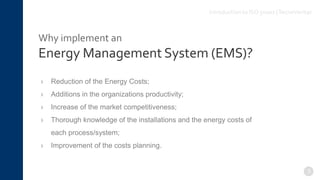
Why implement an
Energy Management System (EMS)?
› Reduction of the Energy Costs;
› Additions in the organizations productivity;
› Increase of the market competitiveness;
› Thorough knowledge of the installations and the energy costs of
each process/system;
› Improvement of the costs planning.
Introduction to ISO 50001 |TecnoVeritas
3
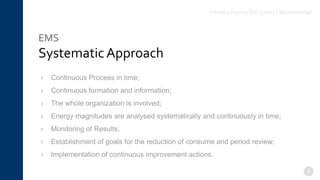
EMS
Systematic Approach
4
› Continuous Process in time;
› Continuous formation and information;
› The whole organization is involved;
› Energy magnitudes are analysed systematically and continuously in time;
› Monitoring of Results;
› Establishment of goals for the reduction of consume and period review;
› Implementation of continuous improvement actions.
Introduction to ISO 50001 |TecnoVeritas
Aspects to take in consideration in the
Implementation of an EMS
5
› The process must be planned;
› The implementation time takes one to three years;
› The process consumes time and attention by the organization;
› In large organizations it must begin with the establishment of procedures
and then measures;
› The dimension and complexity of an EMS should be such that gains
become higher than the costs.
Introduction to ISO 50001 |TecnoVeritas
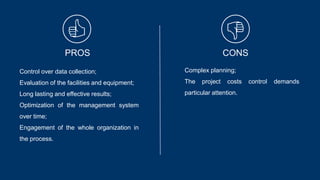
PROS CONS
Control over data collection;
Evaluation of the facilities and equipment;
Long lasting and effective results;
Optimization of the management system
over time;
Engagement of the whole organization in
the process.
Complex planning;
The project costs control demands
particular attention.
ISO 50001
PART 2
ISO 50001
What does it consist of?
It is a voluntary international rule.
It gives requirements for the implementation of an EMS to organizations.
Applicable to small and big organizations, public and private, industry and services.
It is estimated that it can influence up to 60% of global energy use.
8
Introduction to ISO 50001 |TecnoVeritas
ISO 50001
What does it intend to?
› It assists the organizations to do a better use of the consumed energy;
› It promotes the transparency and the communication about management
and energy resources;
› It assists in the evaluation of facilities and new energy-efficient
technologies;
9
Continues on the next slide.
Introduction to ISO 50001 |TecnoVeritas
ISO 50001
What does it intend to?
› Promotes the best energy management practices;
› Promotes the energy efficiency throughout the supply chain;
› Promotes the reduction of greenhouse gases emissions;
› Allows the integration with other organizational management system
(environment, health, security or quality).
10
Introduction to ISO 50001 |TecnoVeritas
ISO 50001
How does it work?
› Develops a policy for the most efficient use of energy;
› Establish targets and goals and measure results;
› Gathers data to better understand and make decisions about energy use and
consume;
› Analyse the policy efficiency;
› Continuously improves the energy management;
› Does not define specific criteria about energy performance.
11
Introduction to ISO 50001 |TecnoVeritas
ISO 50001
How do you certify?
The certification is not a requirement of the standard.
The certification can be performed by:
› Independent authority;
› Consumers Organizations;
› Self-declaration of conformit.
12
Introduction to ISO 50001 |TecnoVeritas
ISO 50001
How is it implemented?
It can be implemented independently or integrated with other management systems:
› Quality (ISO 9001);
› Environment (ISO 14001);
› Security and health at work;
› Social Responsibility;
› Risk Management.
It follows the Plan-Do-Check-Act methodology to ensure the continuous improvement
of the EMS.
13
Introduction to ISO 50001 |TecnoVeritas
www.tecnoveritas.net
E. info@tecnoveritas.net T. +351 261 819 819
Av. Dr. Francisco Sá Carneiro, NEM-Núcleo Empresarial de Mafra – PAV. 36-A
2640-486 Mafra Portugal

ISO 50001 & Energy Management System (EMS)

  • 1.
  • 2.
  • 3.
    Why implement an EnergyManagement System (EMS)? › Reduction of the Energy Costs; › Additions in the organizations productivity; › Increase of the market competitiveness; › Thorough knowledge of the installations and the energy costs of each process/system; › Improvement of the costs planning. Introduction to ISO 50001 |TecnoVeritas 3
  • 4.
    EMS Systematic Approach 4 › ContinuousProcess in time; › Continuous formation and information; › The whole organization is involved; › Energy magnitudes are analysed systematically and continuously in time; › Monitoring of Results; › Establishment of goals for the reduction of consume and period review; › Implementation of continuous improvement actions. Introduction to ISO 50001 |TecnoVeritas
  • 5.
    Aspects to takein consideration in the Implementation of an EMS 5 › The process must be planned; › The implementation time takes one to three years; › The process consumes time and attention by the organization; › In large organizations it must begin with the establishment of procedures and then measures; › The dimension and complexity of an EMS should be such that gains become higher than the costs. Introduction to ISO 50001 |TecnoVeritas
  • 6.
    PROS CONS Control overdata collection; Evaluation of the facilities and equipment; Long lasting and effective results; Optimization of the management system over time; Engagement of the whole organization in the process. Complex planning; The project costs control demands particular attention.
  • 7.
  • 8.
    ISO 50001 What doesit consist of? It is a voluntary international rule. It gives requirements for the implementation of an EMS to organizations. Applicable to small and big organizations, public and private, industry and services. It is estimated that it can influence up to 60% of global energy use. 8 Introduction to ISO 50001 |TecnoVeritas
  • 9.
    ISO 50001 What doesit intend to? › It assists the organizations to do a better use of the consumed energy; › It promotes the transparency and the communication about management and energy resources; › It assists in the evaluation of facilities and new energy-efficient technologies; 9 Continues on the next slide. Introduction to ISO 50001 |TecnoVeritas
  • 10.
    ISO 50001 What doesit intend to? › Promotes the best energy management practices; › Promotes the energy efficiency throughout the supply chain; › Promotes the reduction of greenhouse gases emissions; › Allows the integration with other organizational management system (environment, health, security or quality). 10 Introduction to ISO 50001 |TecnoVeritas
  • 11.
    ISO 50001 How doesit work? › Develops a policy for the most efficient use of energy; › Establish targets and goals and measure results; › Gathers data to better understand and make decisions about energy use and consume; › Analyse the policy efficiency; › Continuously improves the energy management; › Does not define specific criteria about energy performance. 11 Introduction to ISO 50001 |TecnoVeritas
  • 12.
    ISO 50001 How doyou certify? The certification is not a requirement of the standard. The certification can be performed by: › Independent authority; › Consumers Organizations; › Self-declaration of conformit. 12 Introduction to ISO 50001 |TecnoVeritas
  • 13.
    ISO 50001 How isit implemented? It can be implemented independently or integrated with other management systems: › Quality (ISO 9001); › Environment (ISO 14001); › Security and health at work; › Social Responsibility; › Risk Management. It follows the Plan-Do-Check-Act methodology to ensure the continuous improvement of the EMS. 13 Introduction to ISO 50001 |TecnoVeritas
  • 14.
    www.tecnoveritas.net E. info@tecnoveritas.net T.+351 261 819 819 Av. Dr. Francisco Sá Carneiro, NEM-Núcleo Empresarial de Mafra – PAV. 36-A 2640-486 Mafra Portugal

Editor's Notes