Innovative Financing
                   for a Greener Economy


              Financing the Green Economy:
     Global trends and best practices in green finance
                      May 11, 2010


             World Exchange Plaza. P.O. Box 81119. Ottawa. Ontario. K1P 1B1. Canada
Tel.: 1.613.742.7829 fax: 1.613.742.7099 www.g-capitaladvisors.com info@g-capitaladvisors.com
2


Outline of Talk
1. Opportunities in the Green Economy

2. Challenges for Financing Green Projects

3. Best Practice Solutions for Financing Green
   Projects

4. Role of National EXIMs and Development Finance
   Institutions

5. GCA Overview
3


OPPORTUNITIES IN THE
GREEN ECONOMY
4
Opportunities in the Green
Economy
 Renewable energy can be defined by what it is
  not: not fossil fuels, nor making fossil fuels more
  efficient
 Energy conservation are measures which reduce
  existing energy demand by introducing greater
  efficiency
 Countries need to have a national energy
  strategy which defines role of renewable energy
  in meeting the energy demand
 The estimation of renewable energy demand:
      Households
      Industry
      Transportation
      Municipalities
5
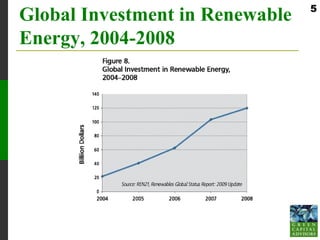
Global Investment in Renewable
Energy, 2004-2008
6


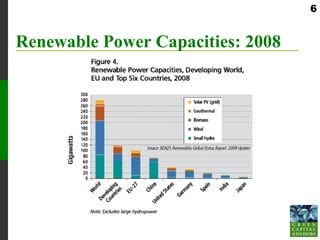
Renewable Power Capacities: 2008
7
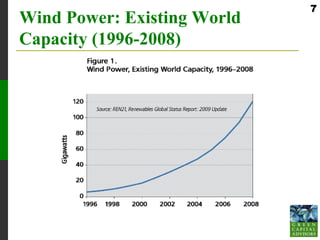
Wind Power: Existing World
Capacity (1996-2008)
8
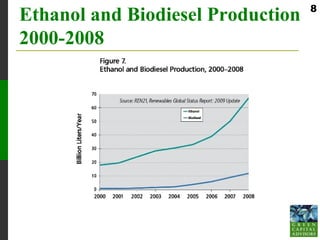
Ethanol and Biodiesel Production
2000-2008
9
Trade-off between renewable and
conventional energy sources
 Price
   As long as fossil fuel supply does not reflect the full cost
    of negative externalities, the price of renewal energy
    sources compared to conventional sources is not as
    attractive
 Technology risk
   Many of the technologies are fairly new and therefore
    have a limited track record of reliability


 Incentives help increase the uptake of
  renewable energy technologies, or
 Disincentives for fossil fuels can make the
  choice of renewables more favourable
10
Creating incentives for renewable
energy in the international context
 Industrialized nations have pledged $30bn in
  climate financing to emerging markets to
  promote climate friendly projects for both climate
  mitigation and climate adaptation

 The Kyoto framework was designed to incentivize
  the choice for renewable energy in emerging
  markets through the CDM mechanisms
   CDM projects can be at all levels: households, industry,
    transportation and municipalities
11
RE and EE projects can generate
an additional revenue stream
 While all energy projects are designed to
  generate power, renewable energy projects
  also can produce carbon credits.
 Carbon credits can be sold for hard currency
  to industrialized countries to meet their GHG
  reduction targets.
 One of Kyoto’s major innovations is the
  notion of “carbon credits” as an
  internationally tradable commodity.
12


CHALLENGES FOR FINANCING
THE GREEN ECONOMY
13

Barriers to RE/EE Investment
 Distorted prices
    Subsidies and externalities
    Absence of long-term price signal (esp. for carbon)

 Lack of predictable policy framework
 Shortage of long-term capital
 Risk (real and perceived):
    Country and political risk
    Regulatory risk
    Technology risk
    Resource risk
    Familiarity with technology

 Knowledge and institutional capacity
 Intrinsic barriers
14
The Challenge is to Mobilize
Investment
 Reducing barriers to economically viable
  investments
 Financing incremental investment cost
     Internalizing externalities
     Mitigating risk (low-carbon projects riskier than BAU)
     Buying down incremental costs
     Mobilizing funding for adaptation
15
Major investment in renewable
energy technologies
 Existing technologies can enable substantial
  reductions at reasonable cost, but need to
  mobilize funding by:
    Removing barriers & improving policy environment
    Internalizing external costs & reducing fossil fuel
     subsidies
    Buying down incremental cost
 Funding for mitigation, adaptation, resilience only
  covers a fraction of the need, so:
    Need to leverage existing financial and policy
     instruments
    Need to assign a clear and adequate price to carbon
16


Financing Households
 Incentives via schemes to provide grants or
  interest free loans, e.g. solar water heaters.
 Need to ensure that subsidy is distributed
  efficiently via existing channels to ensure
  efficiency.
 Difficult to capture carbon credits given the very
  small size of individual projects but can be done
  on programmatic basis.
17


Financing Industry
 SMEs already face challenges in accessing capital
  – both equity and debt.
 Incentivizing SMEs to choose renewable energy
  or energy efficiency is similar to schemes for
  households but possibility exists that surplus
  power can be generated.
 Large companies can benefit from a favourable
  feed-in tariff scheme for surplus power to go back
  into grid.
18


Financing Transportation
 Developed countries are focusing on petrol
  alternatives, such as biofuels
 Emission standards are imposed
 “Greener” mass transit such as light rail
19


Financing Municipalities
 While municipalities are not typically responsible for
  large amounts of GHG emissions compared to
  industry, they have an important role in GHG
  reduction initiatives.
 For example, all municipalities have landfills sites, and
  these are high profile sources of GHGs. They also
  have significant potential for generation of carbon
  credits when gas capture projects are installed.
 Any one municipality on its own may have limited
  financial and technical capacity to monetize carbon
  credits from such activities, but a regional or national
  effort can create economies of scale.
20


The Opportunity
  Carbon credits can enhance a project’s
   commercial viability and investor returns.

  Carbon credits continue to rise in value, and
   future demand for credits is expected to far
   exceed supply.
21
Challenges in Unlocking Carbon
Credit potential
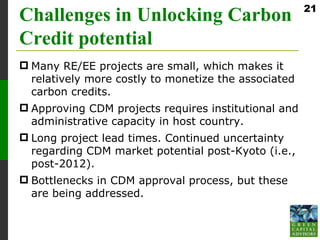
 Many RE/EE projects are small, which makes it
  relatively more costly to monetize the associated
  carbon credits.
 Approving CDM projects requires institutional and
  administrative capacity in host country.
 Long project lead times. Continued uncertainty
  regarding CDM market potential post-Kyoto (i.e.,
  post-2012).
 Bottlenecks in CDM approval process, but these
  are being addressed.
22
Challenges in Unlocking Carbon
Credit potential
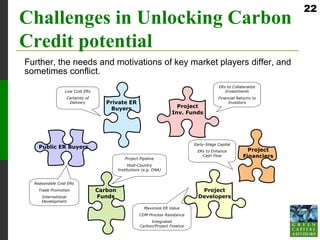
Further, the needs and motivations of key market players differ, and
sometimes conflict.
                                                                                             ERs to Collateralize
                 Low Cost ERs                                                                   Investments
                     Certainty of                                                            Financial Returns to
                      Delivery         Private ER                                                 Investors
                                        Buyers                            Project
                                                                        Inv. Funds


                                                                                 Early-Stage Capital
    Public ER Buyers
                                                                                  ERs to Enhance            Project
                                                Project Pipeline
                                                                                    Cash Flow             Financiers
                                                  Host-Country
                                             Institutions (e.g. DNA)


  Reasonable Cost ERs
   Trade Promotion                  Carbon                                          Project
     International                  Funds                                          Developers
     Development
                                                          Maximize ER Value
                                                        CDM Process Assistance
                                                             Integrated
                                                        Carbon/Project Finance
23
Challenges in Unlocking Carbon
Credit potential
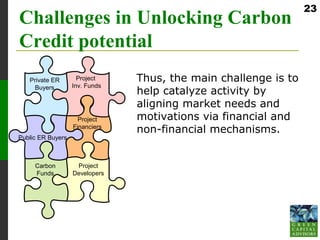
   Private ER        Project    Thus, the main challenge is to
                   Inv. Funds
    Buyers
                                help catalyze activity by
                                aligning market needs and
                     Project    motivations via financial and
                   Financiers
                                non-financial mechanisms.
Public ER Buyers


     Carbon         Project
     Funds         Developers
24


BEST PRACTICE SOLUTIONS
FOR FINANCING THE GREEN
ECONOMY
25


Some solutions
 Bundling of Projects: bundle small scale CDM
  projects to make them cost-effective.
 Sellers’ Pool: develop a sellers’ pool for CDM
  projects.
 Use of Guarantees: to take political, regulatory
  and/or legal risks.
 Carbon Forfaiting: develop a mechanism which
  provides up-front financing for “discounted”
  future carbon credits.
 “Green Taxes”: develop a premium tariff for RE
  projects; or a carbon tax on GHG-intensive
  activities.
26


Bundling of Projects
 Single project developers trying to sell their CERs
  into the market often do not benefit from the
  best price available on the market as they
  negotiate with an intermediary or a buyer
  directly.
 For individual small scale developers or owners of
  CERs with only a few CERs to sell, they have little
  or no market power, so a program of bundling
  could be very useful, especially in the context of
  a seller’s pool/fund.
27


Seller’s Pool
 The carbon market has been very demand-
  driven: carbon credit buyers have actively sought
  sources of credits to meet their obligations.
 So-called “sellers pool” concept is designed to
  address this market imbalance by pooling carbon
  credits generated from a number of smaller
  projects and then auctioning the pool.
28


Use of guarantees
 In addition to the normal technical and project
  risks, there are risks that carbon credits will not
  be delivered because of political issues in the
  approval via the host country’s DNA.
 A scheme to assume the risks and/or help the
  project developer work with the national DNA
  could be of value.
 Help with bankability check for projects prior to
  launching the CDM Executive Board approval
  process.
29


Carbon Forfaiting
 The seller’s pool/fund could offer project developers up-front
  financing against their future expected carbon credits, by
  “discounting” the related carbon credit cash flow stream.
 The concept of carbon forfaiting builds upon the well-established
  financial instrument used in trade finance.
 Trade forfaiting is an export finance mechanism, involving the
  purchase (usually without recourse to the exporter in the event
  of payment default or difficulties) of promissory notes or bills of
  exchange.
 The forfaiter buys at a discount, which partly reflects the funding
  costs that accrue before the due payment dates, and partly the
  perceived risk of the guaranteeing (avalising) bank and its home
  country.
 In Canada, Green Municipal Corp. has adapted this concept to
  the revenue stream from the generation of carbon credits. It
  has provided “carbon forfaiting” by offering municipalities up-
  front discounted payments for the rights to future carbon credits
30


Taxes
 Applying a “Green Tax” on certain GHG emission-
  intensive activities (i.e. power/fuel) could also provide
  incentives for individuals to contribute to climate
  change mitigation.
    Revenues from such taxes could be allocated towards
     financing GHG reduction projects which otherwise would not
     have been viable under CDM alone.
31


THE ROLE OF EXIMS AND
DFIS
32
Possible Future Roles for
DFIs and EXIMs
 Establishment of a carbon sellers pool.
 Help mitigate risks associated with ER creation and
  delivery to end buyers.
 Develop mechanisms to promote or facilitate CDM
  projects with high socio-economic value.
 Explore opportunities for national or regional
  “clearing house” project assessment and prioritization
  to promote private sector involvement.
 Expand role and risk capacity of rural and community
  development banks to leverage financing sources.
 Pursue more creative roles for ODA to help catalyze
  worthy CDM projects or initiatives.
33


GREEN CAPITAL ADVISORS
34


Green Capital Advisors Ltd.
 GCA specializes in advisory services relating to the financing for
  sustainable investment and development.
 We have three product lines: Policy, Programme and Project.
 Extensive work globally with stakeholders in the areas of
  environment and carbon finance:
     Integrated CDM and EU-ETS Strategy for Malta
     World Bank Carbon Finance Business on a carbon delivery guarantee
     World Energy Council on financing renewables in developing countries
     Policy work for Environment Canada, Natural Resources Canada,
      Industry Canada, Canada’s CDM-JI office
     Review of Green Municipal Fund’s innovative financing instruments
     Member of task force on Financing the Development Dividend
     Project advisory – bioproducts, bioenergy, water purification, wind
      energy
 GCA is an affiliate of International Financial Consulting Ltd., a
  leading provider of advisory services to multilateral, public,
  and private sector clients.

Smallridge speaker, plenary 2

  • 1.
    Innovative Financing for a Greener Economy Financing the Green Economy: Global trends and best practices in green finance May 11, 2010 World Exchange Plaza. P.O. Box 81119. Ottawa. Ontario. K1P 1B1. Canada Tel.: 1.613.742.7829 fax: 1.613.742.7099 www.g-capitaladvisors.com info@g-capitaladvisors.com
  • 2.
    2 Outline of Talk 1.Opportunities in the Green Economy 2. Challenges for Financing Green Projects 3. Best Practice Solutions for Financing Green Projects 4. Role of National EXIMs and Development Finance Institutions 5. GCA Overview
  • 3.
  • 4.
    4 Opportunities in theGreen Economy  Renewable energy can be defined by what it is not: not fossil fuels, nor making fossil fuels more efficient  Energy conservation are measures which reduce existing energy demand by introducing greater efficiency  Countries need to have a national energy strategy which defines role of renewable energy in meeting the energy demand  The estimation of renewable energy demand:  Households  Industry  Transportation  Municipalities
  • 5.
    5 Global Investment inRenewable Energy, 2004-2008
  • 6.
  • 7.
    7 Wind Power: ExistingWorld Capacity (1996-2008)
  • 8.
    8 Ethanol and BiodieselProduction 2000-2008
  • 9.
    9 Trade-off between renewableand conventional energy sources  Price  As long as fossil fuel supply does not reflect the full cost of negative externalities, the price of renewal energy sources compared to conventional sources is not as attractive  Technology risk  Many of the technologies are fairly new and therefore have a limited track record of reliability  Incentives help increase the uptake of renewable energy technologies, or  Disincentives for fossil fuels can make the choice of renewables more favourable
  • 10.
    10 Creating incentives forrenewable energy in the international context  Industrialized nations have pledged $30bn in climate financing to emerging markets to promote climate friendly projects for both climate mitigation and climate adaptation  The Kyoto framework was designed to incentivize the choice for renewable energy in emerging markets through the CDM mechanisms  CDM projects can be at all levels: households, industry, transportation and municipalities
  • 11.
    11 RE and EEprojects can generate an additional revenue stream  While all energy projects are designed to generate power, renewable energy projects also can produce carbon credits.  Carbon credits can be sold for hard currency to industrialized countries to meet their GHG reduction targets.  One of Kyoto’s major innovations is the notion of “carbon credits” as an internationally tradable commodity.
  • 12.
  • 13.
    13 Barriers to RE/EEInvestment  Distorted prices  Subsidies and externalities  Absence of long-term price signal (esp. for carbon)  Lack of predictable policy framework  Shortage of long-term capital  Risk (real and perceived):  Country and political risk  Regulatory risk  Technology risk  Resource risk  Familiarity with technology  Knowledge and institutional capacity  Intrinsic barriers
  • 14.
    14 The Challenge isto Mobilize Investment  Reducing barriers to economically viable investments  Financing incremental investment cost  Internalizing externalities  Mitigating risk (low-carbon projects riskier than BAU)  Buying down incremental costs  Mobilizing funding for adaptation
  • 15.
    15 Major investment inrenewable energy technologies  Existing technologies can enable substantial reductions at reasonable cost, but need to mobilize funding by:  Removing barriers & improving policy environment  Internalizing external costs & reducing fossil fuel subsidies  Buying down incremental cost  Funding for mitigation, adaptation, resilience only covers a fraction of the need, so:  Need to leverage existing financial and policy instruments  Need to assign a clear and adequate price to carbon
  • 16.
    16 Financing Households  Incentivesvia schemes to provide grants or interest free loans, e.g. solar water heaters.  Need to ensure that subsidy is distributed efficiently via existing channels to ensure efficiency.  Difficult to capture carbon credits given the very small size of individual projects but can be done on programmatic basis.
  • 17.
    17 Financing Industry  SMEsalready face challenges in accessing capital – both equity and debt.  Incentivizing SMEs to choose renewable energy or energy efficiency is similar to schemes for households but possibility exists that surplus power can be generated.  Large companies can benefit from a favourable feed-in tariff scheme for surplus power to go back into grid.
  • 18.
    18 Financing Transportation  Developedcountries are focusing on petrol alternatives, such as biofuels  Emission standards are imposed  “Greener” mass transit such as light rail
  • 19.
    19 Financing Municipalities  Whilemunicipalities are not typically responsible for large amounts of GHG emissions compared to industry, they have an important role in GHG reduction initiatives.  For example, all municipalities have landfills sites, and these are high profile sources of GHGs. They also have significant potential for generation of carbon credits when gas capture projects are installed.  Any one municipality on its own may have limited financial and technical capacity to monetize carbon credits from such activities, but a regional or national effort can create economies of scale.
  • 20.
    20 The Opportunity Carbon credits can enhance a project’s commercial viability and investor returns.  Carbon credits continue to rise in value, and future demand for credits is expected to far exceed supply.
  • 21.
    21 Challenges in UnlockingCarbon Credit potential  Many RE/EE projects are small, which makes it relatively more costly to monetize the associated carbon credits.  Approving CDM projects requires institutional and administrative capacity in host country.  Long project lead times. Continued uncertainty regarding CDM market potential post-Kyoto (i.e., post-2012).  Bottlenecks in CDM approval process, but these are being addressed.
  • 22.
    22 Challenges in UnlockingCarbon Credit potential Further, the needs and motivations of key market players differ, and sometimes conflict. ERs to Collateralize Low Cost ERs Investments Certainty of Financial Returns to Delivery Private ER Investors Buyers Project Inv. Funds Early-Stage Capital Public ER Buyers ERs to Enhance Project Project Pipeline Cash Flow Financiers Host-Country Institutions (e.g. DNA) Reasonable Cost ERs Trade Promotion Carbon Project International Funds Developers Development Maximize ER Value CDM Process Assistance Integrated Carbon/Project Finance
  • 23.
    23 Challenges in UnlockingCarbon Credit potential Private ER Project Thus, the main challenge is to Inv. Funds Buyers help catalyze activity by aligning market needs and Project motivations via financial and Financiers non-financial mechanisms. Public ER Buyers Carbon Project Funds Developers
  • 24.
    24 BEST PRACTICE SOLUTIONS FORFINANCING THE GREEN ECONOMY
  • 25.
    25 Some solutions  Bundlingof Projects: bundle small scale CDM projects to make them cost-effective.  Sellers’ Pool: develop a sellers’ pool for CDM projects.  Use of Guarantees: to take political, regulatory and/or legal risks.  Carbon Forfaiting: develop a mechanism which provides up-front financing for “discounted” future carbon credits.  “Green Taxes”: develop a premium tariff for RE projects; or a carbon tax on GHG-intensive activities.

  • 26.
    26 Bundling of Projects Single project developers trying to sell their CERs into the market often do not benefit from the best price available on the market as they negotiate with an intermediary or a buyer directly.  For individual small scale developers or owners of CERs with only a few CERs to sell, they have little or no market power, so a program of bundling could be very useful, especially in the context of a seller’s pool/fund.
  • 27.
    27 Seller’s Pool  Thecarbon market has been very demand- driven: carbon credit buyers have actively sought sources of credits to meet their obligations.  So-called “sellers pool” concept is designed to address this market imbalance by pooling carbon credits generated from a number of smaller projects and then auctioning the pool.
  • 28.
    28 Use of guarantees In addition to the normal technical and project risks, there are risks that carbon credits will not be delivered because of political issues in the approval via the host country’s DNA.  A scheme to assume the risks and/or help the project developer work with the national DNA could be of value.  Help with bankability check for projects prior to launching the CDM Executive Board approval process.
  • 29.
    29 Carbon Forfaiting  Theseller’s pool/fund could offer project developers up-front financing against their future expected carbon credits, by “discounting” the related carbon credit cash flow stream.  The concept of carbon forfaiting builds upon the well-established financial instrument used in trade finance.  Trade forfaiting is an export finance mechanism, involving the purchase (usually without recourse to the exporter in the event of payment default or difficulties) of promissory notes or bills of exchange.  The forfaiter buys at a discount, which partly reflects the funding costs that accrue before the due payment dates, and partly the perceived risk of the guaranteeing (avalising) bank and its home country.  In Canada, Green Municipal Corp. has adapted this concept to the revenue stream from the generation of carbon credits. It has provided “carbon forfaiting” by offering municipalities up- front discounted payments for the rights to future carbon credits
  • 30.
    30 Taxes  Applying a“Green Tax” on certain GHG emission- intensive activities (i.e. power/fuel) could also provide incentives for individuals to contribute to climate change mitigation.  Revenues from such taxes could be allocated towards financing GHG reduction projects which otherwise would not have been viable under CDM alone.
  • 31.
    31 THE ROLE OFEXIMS AND DFIS
  • 32.
    32 Possible Future Rolesfor DFIs and EXIMs  Establishment of a carbon sellers pool.  Help mitigate risks associated with ER creation and delivery to end buyers.  Develop mechanisms to promote or facilitate CDM projects with high socio-economic value.  Explore opportunities for national or regional “clearing house” project assessment and prioritization to promote private sector involvement.  Expand role and risk capacity of rural and community development banks to leverage financing sources.  Pursue more creative roles for ODA to help catalyze worthy CDM projects or initiatives.
  • 33.
  • 34.
    34 Green Capital AdvisorsLtd.  GCA specializes in advisory services relating to the financing for sustainable investment and development.  We have three product lines: Policy, Programme and Project.  Extensive work globally with stakeholders in the areas of environment and carbon finance:  Integrated CDM and EU-ETS Strategy for Malta  World Bank Carbon Finance Business on a carbon delivery guarantee  World Energy Council on financing renewables in developing countries  Policy work for Environment Canada, Natural Resources Canada, Industry Canada, Canada’s CDM-JI office  Review of Green Municipal Fund’s innovative financing instruments  Member of task force on Financing the Development Dividend  Project advisory – bioproducts, bioenergy, water purification, wind energy  GCA is an affiliate of International Financial Consulting Ltd., a leading provider of advisory services to multilateral, public, and private sector clients.