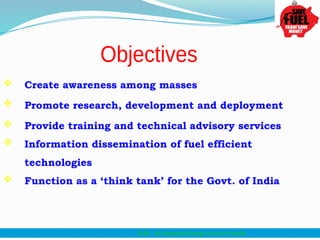
Create awarenessamong masses
Promote research, development and deployment
Provide training and technical advisory services
Information dissemination of fuel efficient
technologies
Function as a ‘think tank’ for the Govt. of India
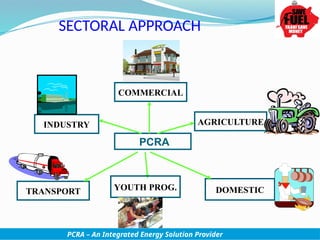
PCRA – An Integrated Energy Solution Provider
3.
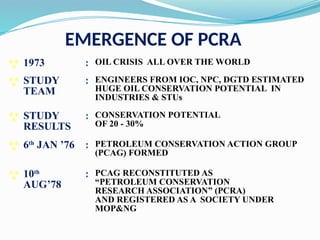
EMERGENCE OF PCRA
1973 : OIL CRISIS ALL OVER THE WORLD
STUDY
TEAM
: ENGINEERS FROM IOC, NPC, DGTD ESTIMATED
HUGE OIL CONSERVATION POTENTIAL IN
INDUSTRIES & STUs
STUDY
RESULTS
: CONSERVATION POTENTIAL
OF 20 - 30%
6th
JAN ’76 : PETROLEUM CONSERVATION ACTION GROUP
(PCAG) FORMED
10th
AUG’78
: PCAG RECONSTITUTED AS
“PETROLEUM CONSERVATION
RESEARCH ASSOCIATION” (PCRA)
AND REGISTERED AS A SOCIETY UNDER
MOP&NG
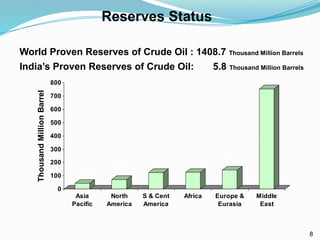
Reserves Status
World ProvenReserves of Crude Oil : 1408.7 Thousand Million Barrels
India’s Proven Reserves of Crude Oil: 5.8 Thousand Million Barrels
42
70.9
123.2 125.6
142.2
754.1
0
100
200
300
400
500
600
700
800
Thousand
Million
Barrel
Asia
Pacific
North
America
S & Cent
America
Africa Europe &
Eurasia
Middle
East
8
9.
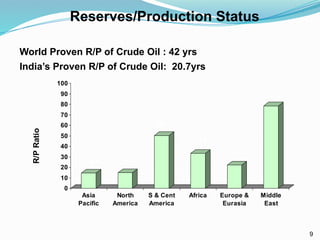
Reserves/Production Status
World ProvenR/P of Crude Oil : 42 yrs
India’s Proven R/P of Crude Oil: 20.7yrs
14.5 14.8
50.3
33.4
22.1
78.6
0
10
20
30
40
50
60
70
80
90
100
R/P
Ratio
Asia
Pacific
North
America
S & Cent
America
Africa Europe &
Eurasia
Middle
East
9
10.
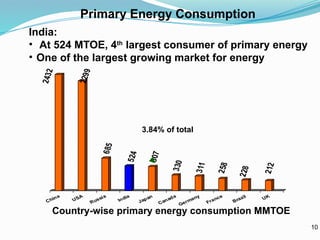
Primary Energy Consumption
Country-wiseprimary energy consumption MMTOE
India:
• At 524 MTOE, 4th
largest consumer of primary energy
• One of the largest growing market for energy
3.84% of total
10
11.
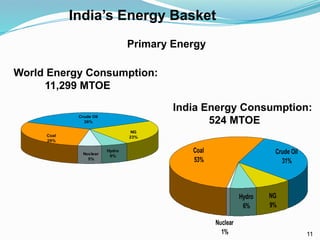
India’s Energy Basket
IndiaEnergy Consumption:
524 MTOE
Nuclear
1%
Crude Oil
31%
NG
9%
Hydro
6%
Coal
53%
Nuclear
5%
Hydro
6%
NG
23%
Crude Oil
36%
Coal
29%
World Energy Consumption:
11,299 MTOE
Primary Energy
11
12.
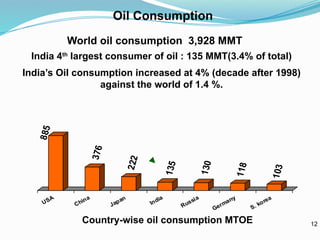
Oil Consumption
India 4th
largestconsumer of oil : 135 MMT(3.4% of total)
India’s Oil consumption increased at 4% (decade after 1998)
against the world of 1.4 %.
World oil consumption 3,928 MMT
Country-wise oil consumption MTOE 12
Why energy efficiency?II
India is also highly dependent on imported oil to
meet the energy demand, which raises the question
of energy security of the nation.
Immense potential exists in this aspect of energy
efficiency, particularly in the use of pumps, heating,
ventilation, air conditioning and lighting areas
15.
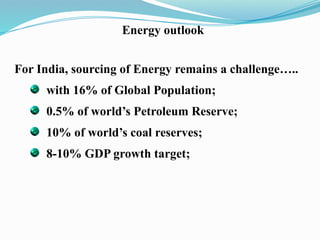
Energy outlook
For India,sourcing of Energy remains a challenge…..
with 16% of Global Population;
0.5% of world’s Petroleum Reserve;
10% of world’s coal reserves;
8-10% GDP growth target;
16.
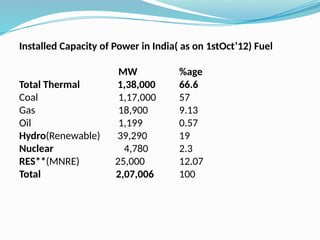
Installed Capacity ofPower in India( as on 1stOct’12) Fuel
MW %age
Total Thermal 1,38,000 66.6
Coal 1,17,000 57
Gas 18,900 9.13
Oil 1,199 0.57
Hydro(Renewable) 39,290 19
Nuclear 4,780 2.3
RES**(MNRE) 25,000 12.07
Total 2,07,006 100
17.
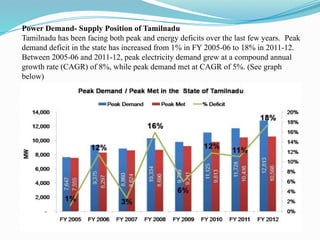
Power Demand- SupplyPosition of Tamilnadu
Tamilnadu has been facing both peak and energy deficits over the last few years. Peak
demand deficit in the state has increased from 1% in FY 2005-06 to 18% in 2011-12.
Between 2005-06 and 2011-12, peak electricity demand grew at a compound annual
growth rate (CAGR) of 8%, while peak demand met at CAGR of 5%. (See graph
below)
18.
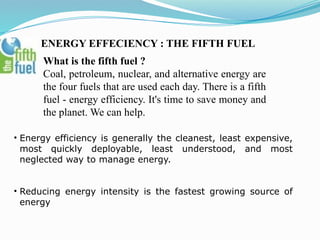
ENERGY EFFECIENCY :THE FIFTH FUEL
What is the fifth fuel ?
Coal, petroleum, nuclear, and alternative energy are
the four fuels that are used each day. There is a fifth
fuel - energy efficiency. It's time to save money and
the planet. We can help.
• Energy efficiency is generally the cleanest, least expensive,
most quickly deployable, least understood, and most
neglected way to manage energy.
• Reducing energy intensity is the fastest growing source of
energy
19.
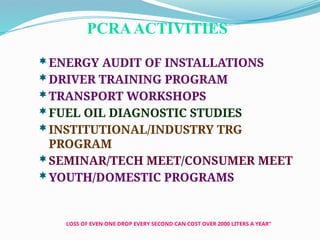
LOSS OF EVENONE DROP EVERY SECOND CAN COST OVER 2000 LITERS A YEAR”
PCRAACTIVITIES
ENERGY AUDIT OF INSTALLATIONS
DRIVER TRAINING PROGRAM
TRANSPORT WORKSHOPS
FUEL OIL DIAGNOSTIC STUDIES
INSTITUTIONAL/INDUSTRY TRG
PROGRAM
SEMINAR/TECH MEET/CONSUMER MEET
YOUTH/DOMESTIC PROGRAMS
20.
SAVE ENERGY!!
• ENERGYRESOURCES ARE LIMITED
• ENERGY DEMAND KEEP INCREASING
• ENERGY PRICES ARE GOING UP
• DUE TO GLOBAL COMPETITION WITH FALLING PRICES,
THE INDUSTRY COMPELLED TO CUT COSTS
• REDUCES GREEN HOUSE GAS EMISSIONS
• INVESTMENTS IN ENERGY CONSERVATION PROVIDE
MOST ATTACTIVE RETURNS
• IMPROVES OVERALL BUSINESS PROFITABILITY
21.
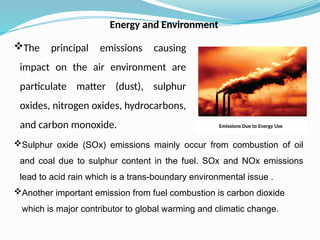
Emissions Due toEnergy Use
Energy and Environment
The principal emissions causing
impact on the air environment are
particulate matter (dust), sulphur
oxides, nitrogen oxides, hydrocarbons,
and carbon monoxide.
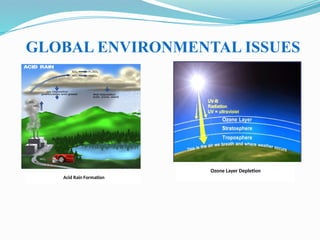
Sulphur oxide (SOx) emissions mainly occur from combustion of oil
and coal due to sulphur content in the fuel. SOx and NOx emissions
lead to acid rain which is a trans-boundary environmental issue .
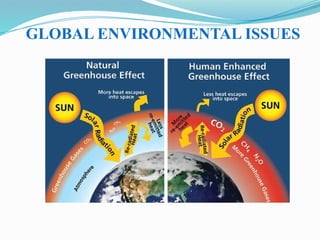
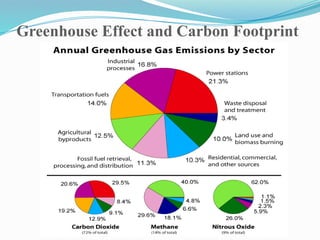
Another important emission from fuel combustion is carbon dioxide
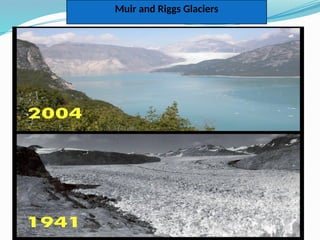
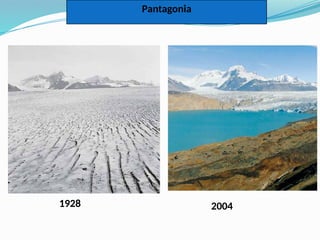
which is major contributor to global warming and climatic change.
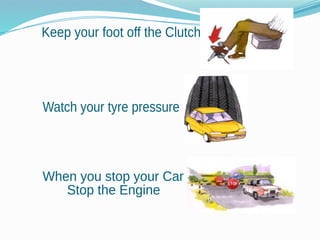
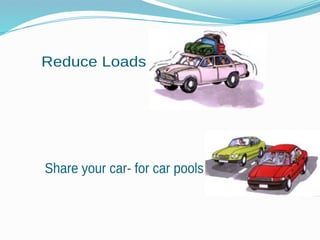
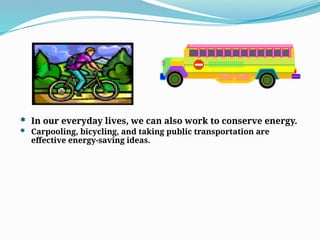
In oureveryday lives, we can also work to conserve energy.
Carpooling, bicycling, and taking public transportation are
effective energy-saving ideas.
41.
Lighting
Turn offthe lights when not in use
Take advantage of daylight by using light-colored,
loose-weave curtains on your windows to allow daylight
to penetrate the room, use with lighter colors on wall
that reflect daylight.
De-dust lighting fixtures to maintain illumination.
Compact Fluorescent Bulbs (CFL) are four times more
energy efficient than incandescent bulbs and provide
the same for lighting.
Use electronic chokes in place of conventional copper
chokes.
Electronic Devices
Switch Offthe power when TV and
Audio Systems are not in use.
Idle / Standby operation leads to a
power loss of 10 watts /device.
44.
Air Conditioners
Prefer airconditioners having automatic
temperature cut off.
Keep regulators at 25o
C position.
Operate the ceiling fan in conjunction with your
window air conditioner to spread the cooled air
more effectively throughout the room and
operate the air conditioner at higher
temperature.
Seal the doors and windows properly.
Leave enough space between your air
conditioner and the walls to allow better air
circulation.
A roof garden can reduce the load on Air
45.
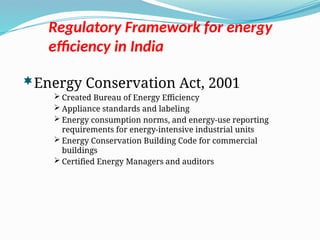
Regulatory Framework forenergy
efficiency in India
Energy Conservation Act, 2001
Created Bureau of Energy Efficiency
Appliance standards and labeling
Energy consumption norms, and energy-use reporting
requirements for energy-intensive industrial units
Energy Conservation Building Code for commercial
buildings
Certified Energy Managers and auditors
46.
Information helps consumer
decisions
STARRATING
FOR
BUILDIN
GS
Energy Performance Index:
Category of Building :
Type :
Climatic Zone :
Connected Load :
Build up Area :
Name of the Building :
kWh/ sq m/ year
47.
Why we shouldsave energy
By saving energy you're helping to save the
world's energy resources like gas, oil and
water and you're also saving money on your
utility bills.
Best of all, by using energy wisely we can cut
down on pollutants in the air and water,
making a better environment for everyone.
49.
•Energy consumption isan indicator of any
country’s prosperity
•Conservation doesn’t mean – “ No use of
energy” rather it indicates – “ Efficient
utilization of Energy”
•One unit of energy saved at end-use is
equivalent to Four units of Energy at
upstream end
PCRA – An Integrated Energy Solution Provider
PCRA – AnIntegrated Energy Solution Provider
Thank you for
your attention.
For Further details , please contact
S. Jeevanraj
Associate Faculty
Petroleum Conservation Research
Association
Ph: +91-9944005799 ; 8608056755
Websites : www.pcra.org