


LEDS LIGHTBULBS IN BUILDINGS
“SAVE ELECTRICITY, PAY LESS”
By: Akhtar Zeb
Email: akhtarzeb88@gmail.com
1
CONTENTS
 Objectives
 Lighting electricity consumption in buildings
 Electrical consumption before retrofitting- A
case study of dormitory section in IMOP building
 LEDs light bulb
 After retrofitting
 Results
 Conclusions
2
OBJECTIVES
 To highlight current lighting electricity
consumption in buildings
 To decrease electricity consumption in buildings
 To estimate the required investment
 To calculate the Payback period
 To calculate monthly electricity saving using
LEDs light bulbs
3
LIGHTING IN BUILDINGS – ELECTRICAL
CONSUMPTION
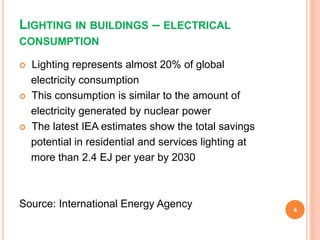
 Lighting represents almost 20% of global
electricity consumption
 This consumption is similar to the amount of
electricity generated by nuclear power
 The latest IEA estimates show the total savings
potential in residential and services lighting at
more than 2.4 EJ per year by 2030
Source: International Energy Agency 4
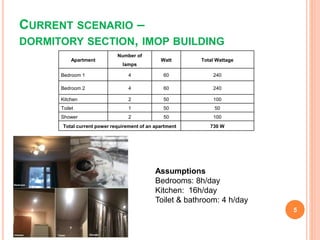
CURRENT SCENARIO –
DORMITORY SECTION, IMOP BUILDING
Apartment
Number of
lamps
Watt Total Wattage
Bedroom 1 4 60 240
Bedroom 2 4 60 240
Kitchen 2 50 100
Toilet 1 50 50
Shower 2 50 100
Total current power requirement of an apartment 730 W
Assumptions
Bedrooms: 8h/day
Kitchen: 16h/day
Toilet & bathroom: 4 h/day
5
Current electricity consumption and monthly &
annual bill of an apartment
 Electricity consumption per day: 6.04 KWh
 Total consumption per month: 181.2 KWh
 Monthly electricity bill: 543.6 rubles (1 KWh = 3
ruble)
 Annual electricity bill: 6523.2 rubles
6
LEDS LIGHTS
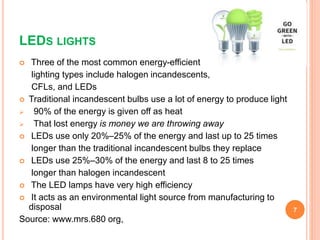
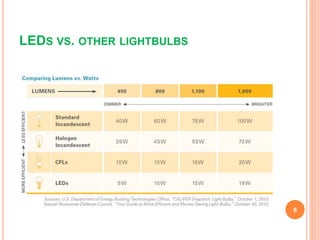
 Three of the most common energy-efficient
lighting types include halogen incandescents,
CFLs, and LEDs
 Traditional incandescent bulbs use a lot of energy to produce light
 90% of the energy is given off as heat
 That lost energy is money we are throwing away
 LEDs use only 20%–25% of the energy and last up to 25 times
longer than the traditional incandescent bulbs they replace
 LEDs use 25%–30% of the energy and last 8 to 25 times
longer than halogen incandescent
 The LED lamps have very high efficiency
 It acts as an environmental light source from manufacturing to
disposal
Source: www.mrs.680 org,
7
LEDS VS. OTHER LIGHTBULBS
8
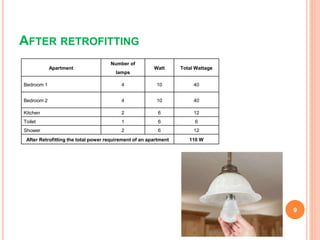
AFTER RETROFITTING
Apartment
Number of
lamps
Watt Total Wattage
Bedroom 1 4 10 40
Bedroom 2 4 10 40
Kitchen 2 6 12
Toilet 1 6 6
Shower 2 6 12
After Retrofitting the total power requirement of an apartment 110 W
9
After retrofitting, electricity consumption and
monthly bill of an apartment
 Electricity consumption per day: 0.904 KWh
 Total consumption per month: 27.12 KWh
 Monthly electricity bill: 81.36 rubles (1 KWh = 3
ruble)
 Annual electricity bill: 976.32 rubles
10
RESULTS – FOR 100 APARTMENTS
 Total investment for changing lamps: 273,000
ruble (1 bulb, 210 ruble; 1300*210= 273,000)
 Annual Economy by reducing electricity bill:
6523.2*100 - 976.32*100 = 554,688 ruble
 Payback period: 273,000/554,700 = 0.49 years =
6 months
 Amount of electricity saving per month: 181.2*100
- 27.12*100 = 154* 100 = 15,408 KWh
11
CONCLUSIONS
Replacing the present traditional lights by LED
lights in our buildings would result in;
 lower electricity bills
 energy conservation
Furthermore,
 the process is quite feasible and economically
viable.
12
THANK YOU
13

Electricity saving in Buildings using LEDs Lightbulbs

  • 1.
    LEDS LIGHTBULBS INBUILDINGS “SAVE ELECTRICITY, PAY LESS” By: Akhtar Zeb Email: akhtarzeb88@gmail.com 1
  • 2.
    CONTENTS  Objectives  Lightingelectricity consumption in buildings  Electrical consumption before retrofitting- A case study of dormitory section in IMOP building  LEDs light bulb  After retrofitting  Results  Conclusions 2
  • 3.
    OBJECTIVES  To highlightcurrent lighting electricity consumption in buildings  To decrease electricity consumption in buildings  To estimate the required investment  To calculate the Payback period  To calculate monthly electricity saving using LEDs light bulbs 3
  • 4.
    LIGHTING IN BUILDINGS– ELECTRICAL CONSUMPTION  Lighting represents almost 20% of global electricity consumption  This consumption is similar to the amount of electricity generated by nuclear power  The latest IEA estimates show the total savings potential in residential and services lighting at more than 2.4 EJ per year by 2030 Source: International Energy Agency 4
  • 5.
    CURRENT SCENARIO – DORMITORYSECTION, IMOP BUILDING Apartment Number of lamps Watt Total Wattage Bedroom 1 4 60 240 Bedroom 2 4 60 240 Kitchen 2 50 100 Toilet 1 50 50 Shower 2 50 100 Total current power requirement of an apartment 730 W Assumptions Bedrooms: 8h/day Kitchen: 16h/day Toilet & bathroom: 4 h/day 5
  • 6.
    Current electricity consumptionand monthly & annual bill of an apartment  Electricity consumption per day: 6.04 KWh  Total consumption per month: 181.2 KWh  Monthly electricity bill: 543.6 rubles (1 KWh = 3 ruble)  Annual electricity bill: 6523.2 rubles 6
  • 7.
    LEDS LIGHTS  Threeof the most common energy-efficient lighting types include halogen incandescents, CFLs, and LEDs  Traditional incandescent bulbs use a lot of energy to produce light  90% of the energy is given off as heat  That lost energy is money we are throwing away  LEDs use only 20%–25% of the energy and last up to 25 times longer than the traditional incandescent bulbs they replace  LEDs use 25%–30% of the energy and last 8 to 25 times longer than halogen incandescent  The LED lamps have very high efficiency  It acts as an environmental light source from manufacturing to disposal Source: www.mrs.680 org, 7
  • 8.
    LEDS VS. OTHERLIGHTBULBS 8
  • 9.
    AFTER RETROFITTING Apartment Number of lamps WattTotal Wattage Bedroom 1 4 10 40 Bedroom 2 4 10 40 Kitchen 2 6 12 Toilet 1 6 6 Shower 2 6 12 After Retrofitting the total power requirement of an apartment 110 W 9
  • 10.
    After retrofitting, electricityconsumption and monthly bill of an apartment  Electricity consumption per day: 0.904 KWh  Total consumption per month: 27.12 KWh  Monthly electricity bill: 81.36 rubles (1 KWh = 3 ruble)  Annual electricity bill: 976.32 rubles 10
  • 11.
    RESULTS – FOR100 APARTMENTS  Total investment for changing lamps: 273,000 ruble (1 bulb, 210 ruble; 1300*210= 273,000)  Annual Economy by reducing electricity bill: 6523.2*100 - 976.32*100 = 554,688 ruble  Payback period: 273,000/554,700 = 0.49 years = 6 months  Amount of electricity saving per month: 181.2*100 - 27.12*100 = 154* 100 = 15,408 KWh 11
  • 12.
    CONCLUSIONS Replacing the presenttraditional lights by LED lights in our buildings would result in;  lower electricity bills  energy conservation Furthermore,  the process is quite feasible and economically viable. 12
  • 13.