endotracheal intubation/anesthesiology/184-244 1
endotracheal intubation/anesthesiology/184-244 2
endotracheal intubation/anesthesiology/184-244 3
Indication for endotracheal
intubation
1) For supporting ventilation in patient with some pathologic disease
- Upper airway obstruction
- Respiratory failure
- Loss of consciousness
endotracheal intubation/anesthesiology/184-244 4
2) For supporting ventilation during general anesthesia
- Type of surgery
1.operative site near the airway
2. Abdominal or thoracic surgery
3.Prone or lateral position
4.Long period of surgery
- Patient has risk of pulmonary aspiration
- Difficult mask ventilation
endotracheal intubation/anesthesiology/184-244 5
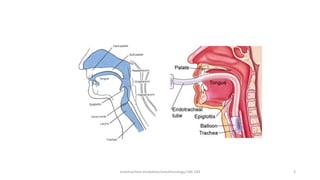
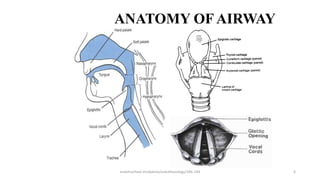
ANATOMY OF AIRWAY
endotracheal intubation/anesthesiology/184-244 6
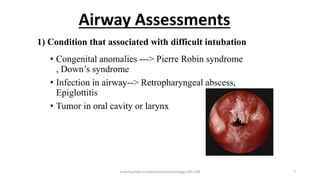
Airway Assessments
• Congenital anomalies ---> Pierre Robin syndrome
, Down’s syndrome
• Infection in airway--> Retropharyngeal abscess,
Epiglottitis
• Tumor in oral cavity or larynx
1) Condition that associated with difficult intubation
endotracheal intubation/anesthesiology/184-244 7
Airway Assessment
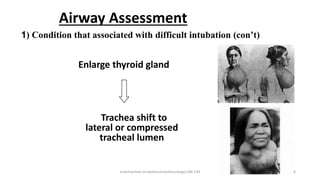
Enlarge thyroid gland
Trachea shift to
lateral or compressed
tracheal lumen
1) Condition that associated with difficult intubation (con’t)
endotracheal intubation/anesthesiology/184-244 8
Airway Assessment
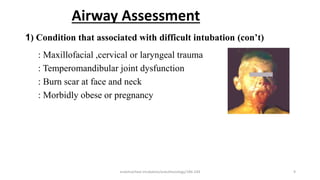
: Maxillofacial ,cervical or laryngeal trauma
: Temperomandibular joint dysfunction
: Burn scar at face and neck
: Morbidly obese or pregnancy
1) Condition that associated with difficult intubation (con’t)
endotracheal intubation/anesthesiology/184-244 9
Airway Assessment
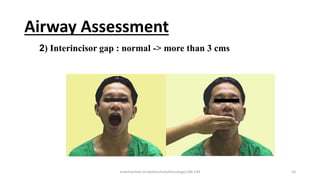
2) Interincisor gap : normal -> more than 3 cms
endotracheal intubation/anesthesiology/184-244 10
Airway Assessment
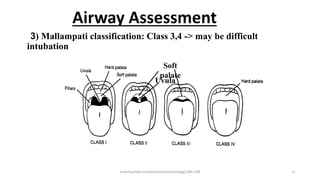
3) Mallampati classification: Class 3,4 -> may be difficult
intubation
Soft
palate
Uvula
endotracheal intubation/anesthesiology/184-244 11
Airway Assessment
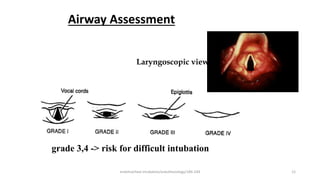
grade 3,4 -> risk for difficult intubation
Laryngoscopic view
endotracheal intubation/anesthesiology/184-244 12
Airway Assessment
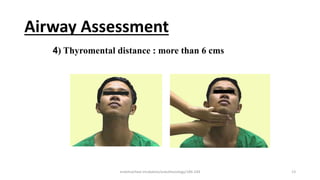
4) Thyromental distance : more than 6 cms
endotracheal intubation/anesthesiology/184-244 13
Airway Assessment
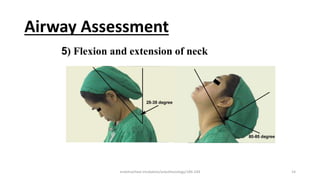
5) Flexion and extension of neck
endotracheal intubation/anesthesiology/184-244 14
Airway Assessment
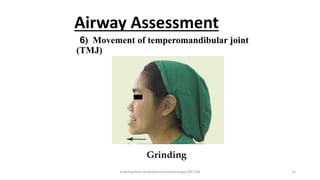
6) Movement of temperomandibular joint
(TMJ)
Grinding
endotracheal intubation/anesthesiology/184-244 15
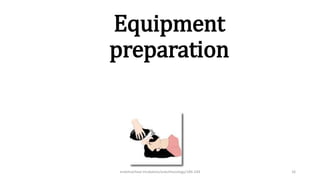
Equipment
preparation
endotracheal intubation/anesthesiology/184-244 16
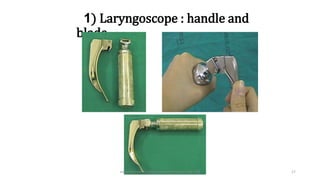
1) Laryngoscope : handle and
blade
endotracheal intubation/anesthesiology/184-244 17
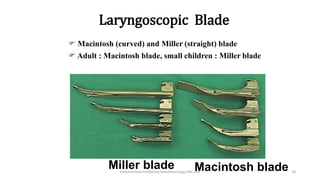
Laryngoscopic Blade
 Macintosh (curved) and Miller (straight) blade
 Adult : Macintosh blade, small children : Miller blade
Miller blade Macintosh blade
endotracheal intubation/anesthesiology/184-244 18
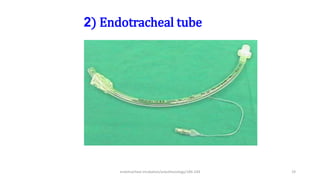
2) Endotracheal tube
endotracheal intubation/anesthesiology/184-244 19
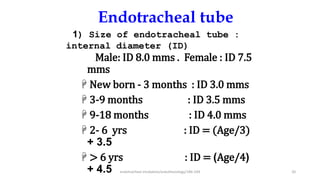
Endotracheal tube
Male: ID 8.0 mms . Female : ID 7.5
mms
 New born - 3 months : ID 3.0 mms
 3-9 months : ID 3.5 mms
 9-18 months : ID 4.0 mms
 2- 6 yrs : ID = (Age/3)
+ 3.5
 > 6 yrs : ID = (Age/4)
+ 4.5
1) Size of endotracheal tube :
internal diameter (ID)
endotracheal intubation/anesthesiology/184-244 20
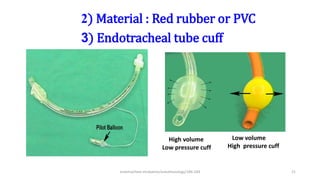
High volume
Low pressure cuff
Low volume
High pressure cuff
2) Material : Red rubber or PVC
3) Endotracheal tube cuff
endotracheal intubation/anesthesiology/184-244 21
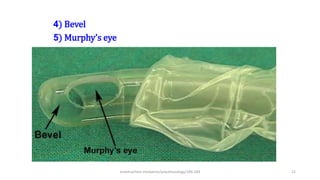
4) Bevel
5) Murphy’s eye
endotracheal intubation/anesthesiology/184-244 22
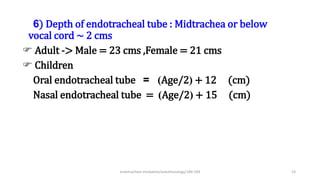
6) Depth of endotracheal tube : Midtrachea or below
vocal cord ~ 2 cms
 Adult -> Male = 23 cms ,Female = 21 cms
 Children
Oral endotracheal tube = (Age/2) + 12 (cm)
Nasal endotracheal tube = (Age/2) + 15 (cm)
endotracheal intubation/anesthesiology/184-244 23
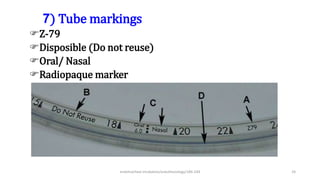
7) Tube markings
Z-79
Disposible (Do not reuse)
Oral/ Nasal
Radiopaque marker
endotracheal intubation/anesthesiology/184-244 24
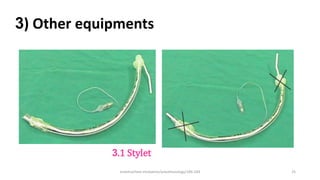
3) Other equipments
3.1 Stylet
endotracheal intubation/anesthesiology/184-244 25
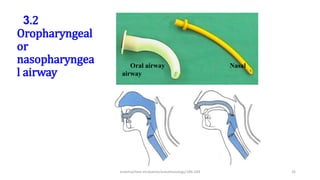
3.2
Oropharyngeal
or
nasopharyngea
l airway
Oral airway Nasal
airway
endotracheal intubation/anesthesiology/184-244 26
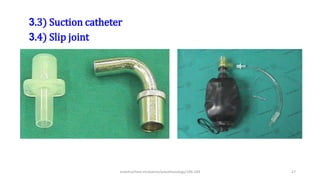
3.3) Suction catheter
3.4) Slip joint
endotracheal intubation/anesthesiology/184-244 27
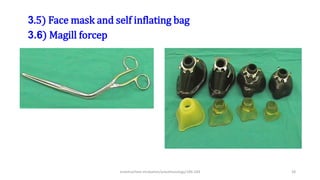
3.5) Face mask and self inflating bag
3.6) Magill forcep
endotracheal intubation/anesthesiology/184-244 28
3.7) Syringe
3.8) Lubricating jelly
3.9) Plaster for strap endotracheal tube
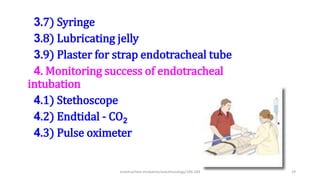
4. Monitoring success of endotracheal
intubation
4.1) Stethoscope
4.2) Endtidal - CO2
4.3) Pulse oximeter
endotracheal intubation/anesthesiology/184-244 29
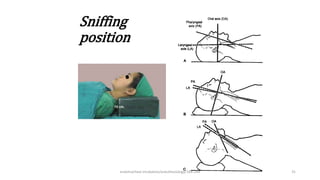
Sniffing position
Flexion at lower cervical spine
Extension at atlanto-occipital
joint
endotracheal intubation/anesthesiology/184-244 30
Sniffing
position
endotracheal intubation/anesthesiology/184-244 31
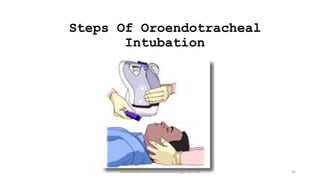
Steps Of Oroendotracheal
Intubation
endotracheal intubation/anesthesiology/184-244 32
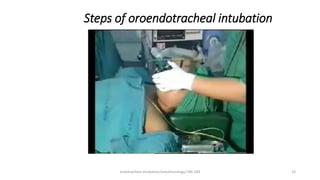
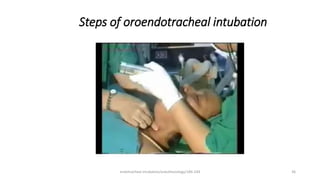
Steps of oroendotracheal intubation
endotracheal intubation/anesthesiology/184-244 33
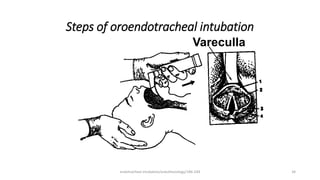
Steps of oroendotracheal intubation
Vareculla
endotracheal intubation/anesthesiology/184-244 34
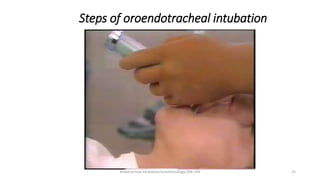
Steps of oroendotracheal intubation
endotracheal intubation/anesthesiology/184-244 35
Steps of oroendotracheal intubation
endotracheal intubation/anesthesiology/184-244 36
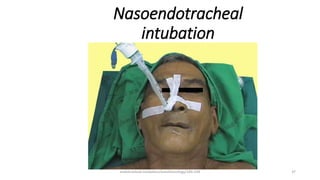
Nasoendotracheal
intubation
endotracheal intubation/anesthesiology/184-244 37
Nasoendotracheal
intubation
 Advantage
1) Comfortable for prolong intubation in postoperative
period
2) Suitable for oral surgery : tonsillectomy , mandible
surgery
3) For blind nasal intubation
4) Can take oral feeding
5) Resist for kinking and difficult to accidental extubation
endotracheal intubation/anesthesiology/184-244 38
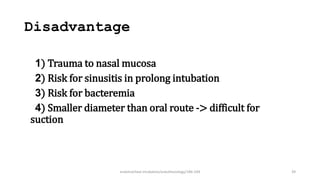
Disadvantage
1) Trauma to nasal mucosa
2) Risk for sinusitis in prolong intubation
3) Risk for bacteremia
4) Smaller diameter than oral route -> difficult for
suction
endotracheal intubation/anesthesiology/184-244 39
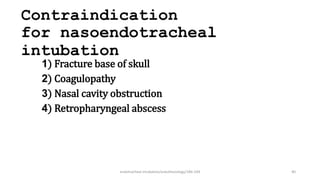
Contraindication
for nasoendotracheal
intubation
1) Fracture base of skull
2) Coagulopathy
3) Nasal cavity obstruction
4) Retropharyngeal abscess
endotracheal intubation/anesthesiology/184-244 40
Complication of
endotracheal intubation
1) During intubation
: Trauma to lip, tongue or teeth
: Hypertension and tachycardia or arrhythmia
: Pulmonary aspiration
: Laryngospasm
: Bronchospasm
endotracheal intubation/anesthesiology/184-244 41
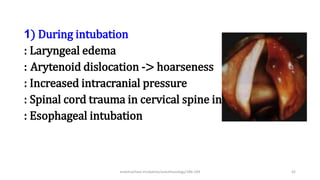
1) During intubation
: Laryngeal edema
: Arytenoid dislocation -> hoarseness
: Increased intracranial pressure
: Spinal cord trauma in cervical spine injury
: Esophageal intubation
endotracheal intubation/anesthesiology/184-244 42
2) During remained intubation
: Obstruction from klinking , secretion or
overinflation of cuff
: Accidental extubation or endobronchial intubation
: Disconnection from breathing circuit
endotracheal intubation/anesthesiology/184-244 43
2) During remained intubation
•: Pulmonary aspiration
•: Lib or nasal ulcer in case with prolong period of
intubation
•: Sinusitis or otitis in case with prolong nasoendotracheal
intubation
endotracheal intubation/anesthesiology/184-244 44
3) During extubation
 Laryngospasm
 Pulmonary aspiration
 Edema of upper airway
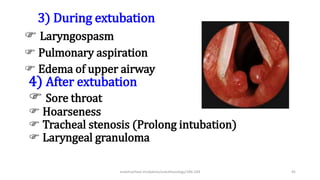
4) After extubation
 Sore throat
 Hoarseness
 Tracheal stenosis (Prolong intubation)
 Laryngeal granuloma
endotracheal intubation/anesthesiology/184-244 45

ENDOTRACHEAL INTUBATION PowerPoint.pptx