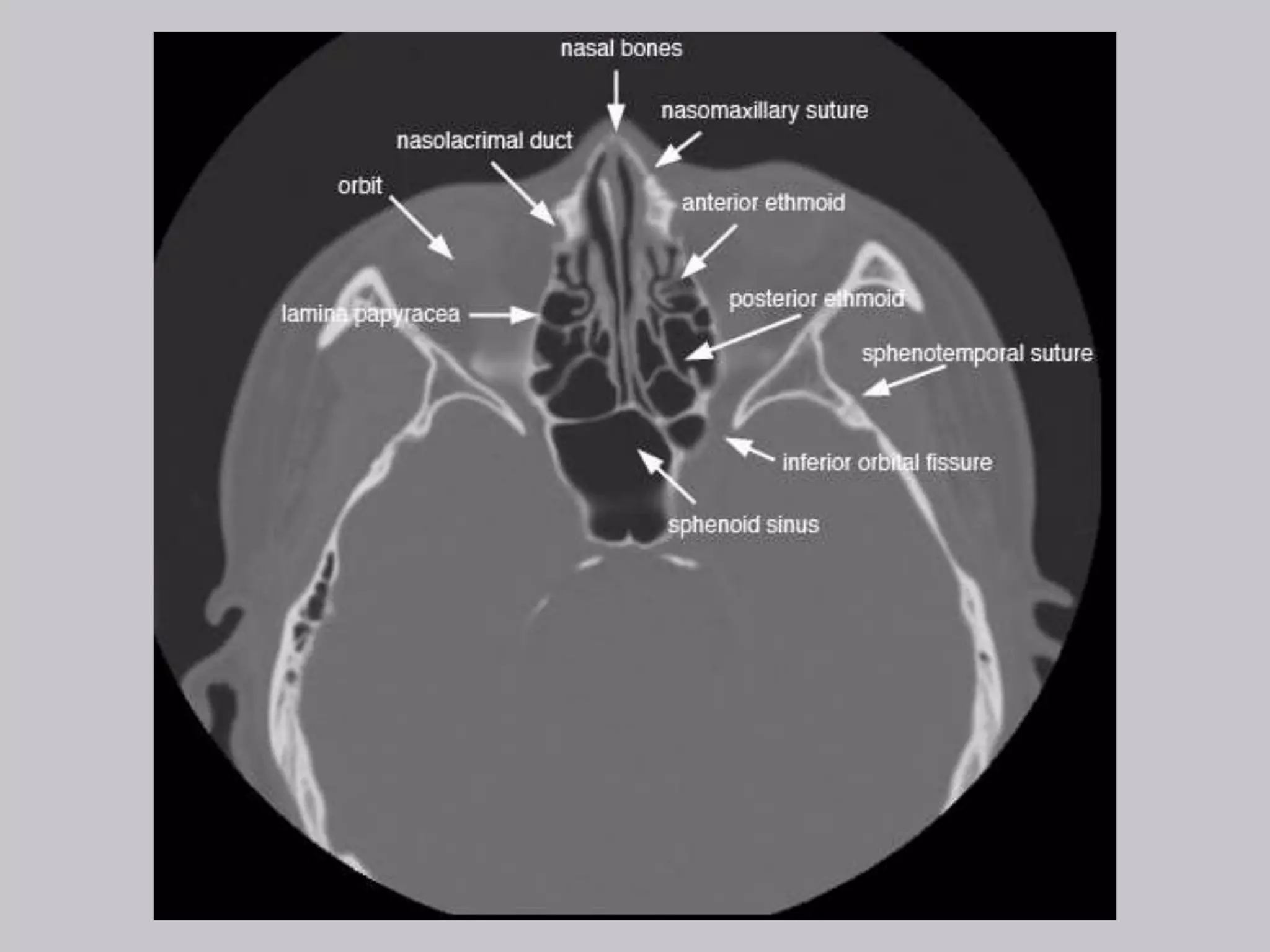
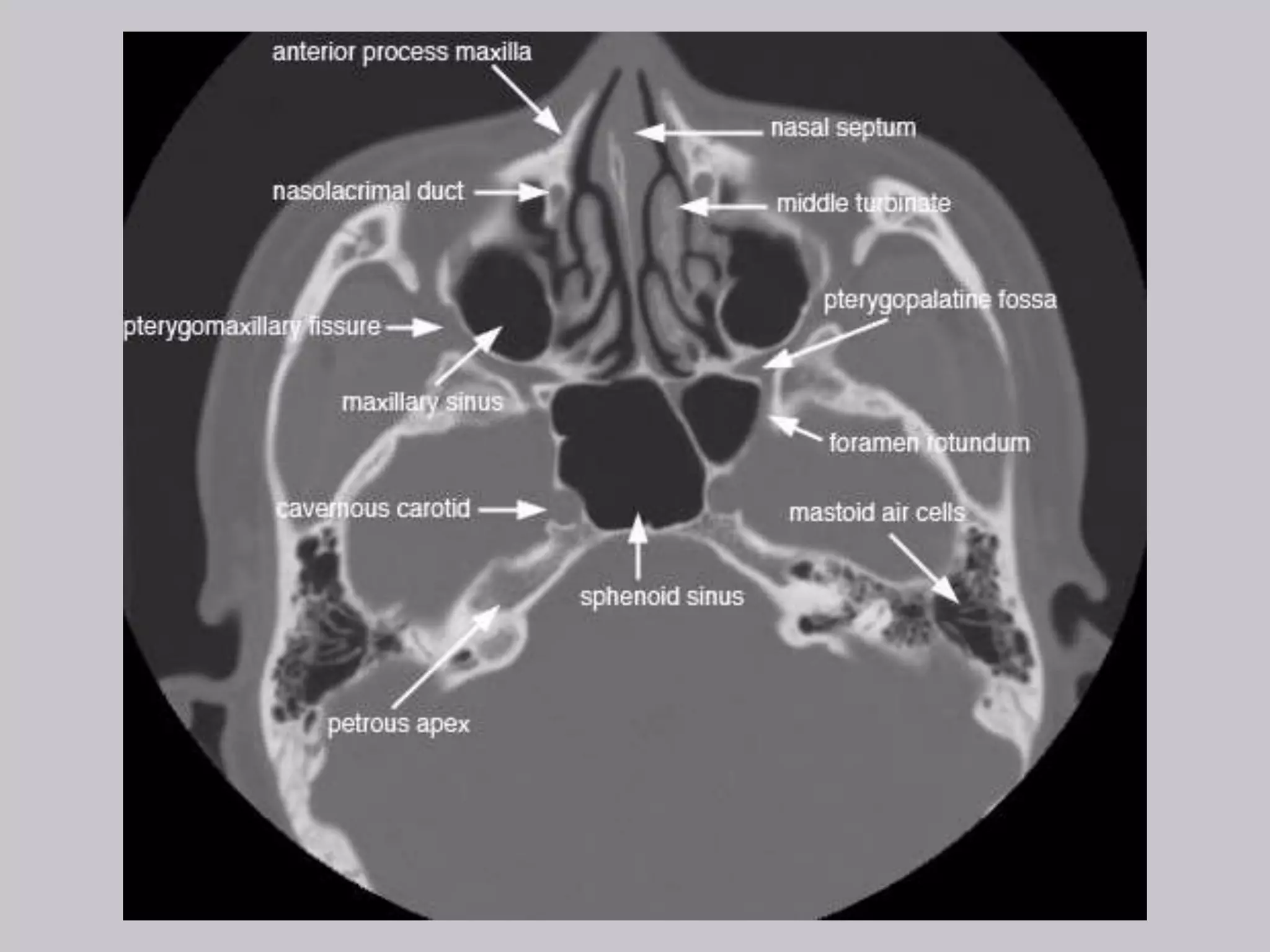
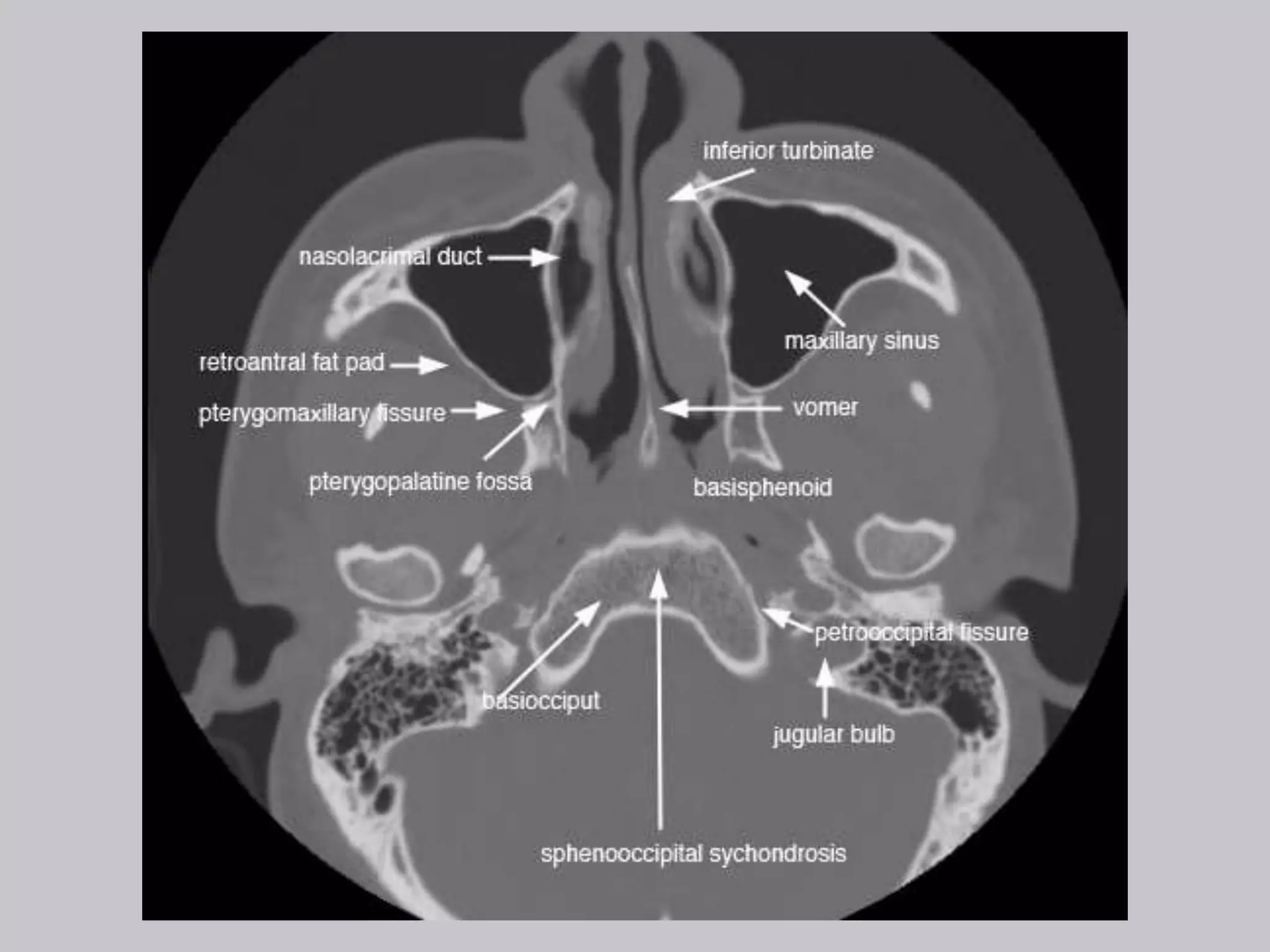
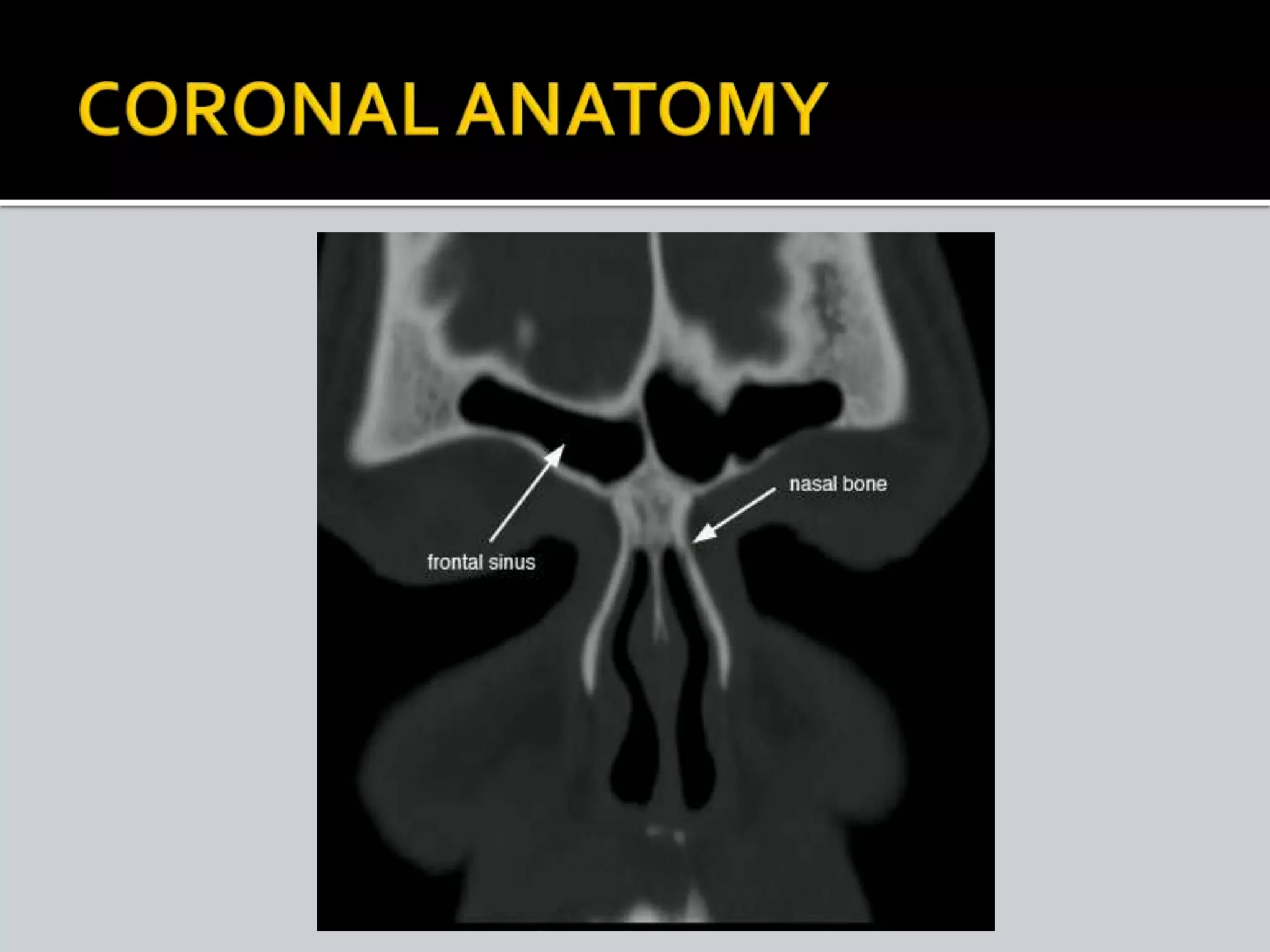
PRESENTER --- SARBESH TIWARI
 Paranasal sinuses are air containing cavities in certain bones of 
skull. 
 Clinically, Divided into two groups: 
1. Anterior group. This includes maxillary, frontal , 
anterior and middle ethmoidal air cells. They all open in the 
middle meatus. 
2. Posterior groups. This includes posterior ethmoidal 
sinuses which open in the superior meatus, and the sphenoid 
sinus which open in sphenoethmoidal recess. 
Disease of ear, nose & throat 4th edition – PL Dhingra
 Paranasal sinuses develop as out-pouchings from the 
mucous membrane of lateral wall of nose. 
 At birth, only the maxillary and ethmoidal sinuses are present 
and are large enough to be clinically significant. 
 Growth of sinuses continues during childhood and early adult 
life. 
 Radiologically, maxillary sinuses can be identified at 4-5 
months, ethmoids at 1 year, frontals at 6 years and sphenoids 
at 4 years of age.
Disease of ear, nose & throat 4th edition – PL Dhingra
Function Histology 
 They lighten the Facial skeleton 
 Air-conditioning of the inspired 
air by providing large surface 
area over which the air is 
humidified and warmed. 
 To provide resonance to voice. 
 They are lined by 
Psuedostratified columnar 
epithelium studded with 
mucus and serous glands.
 Also known as antrum of Highmore 
(1651). 
 Largest paranasal sinus occupying the 
maxilla. 
 Pyramidal in shape with base toward the 
lateral wall of nose and apex directed 
laterally into the zygomatic process. 
 Capacity of 15 ml (average).
 Anterior wall – facial surface of maxilla and related to the soft 
tissue of the cheek. 
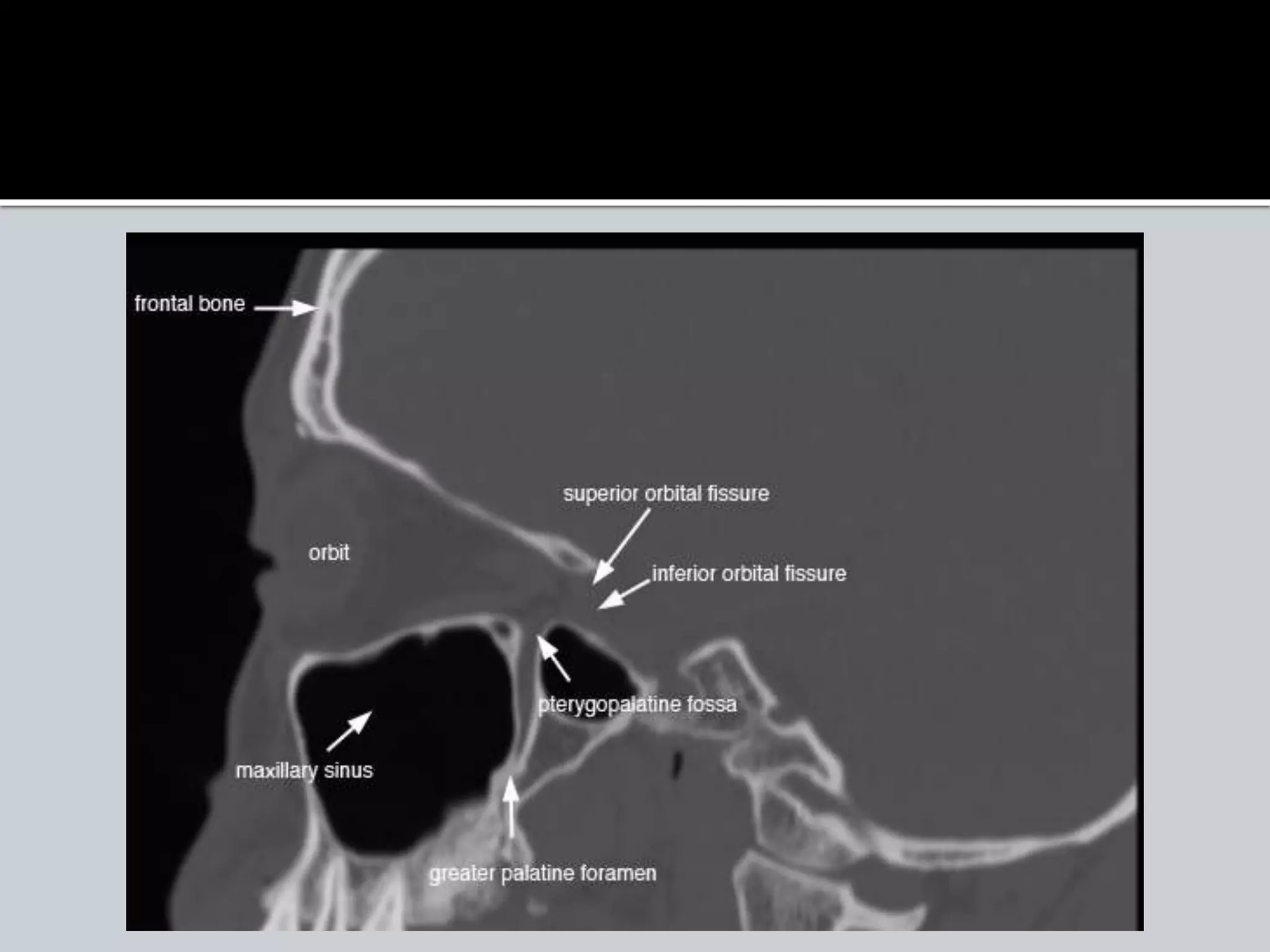
 Posterior wall – infratemporal and pterygopalatine fossae. 
 Medial wall – middle and inferior turbinate 
 Floor – alevolar and palatine process of maxilla. Related to all 
the molar tooth and sometimes the premolar teeth. 
 Roof – Formed by the floor of the orbit. Traversed by 
infraorbital nerve and vessels.
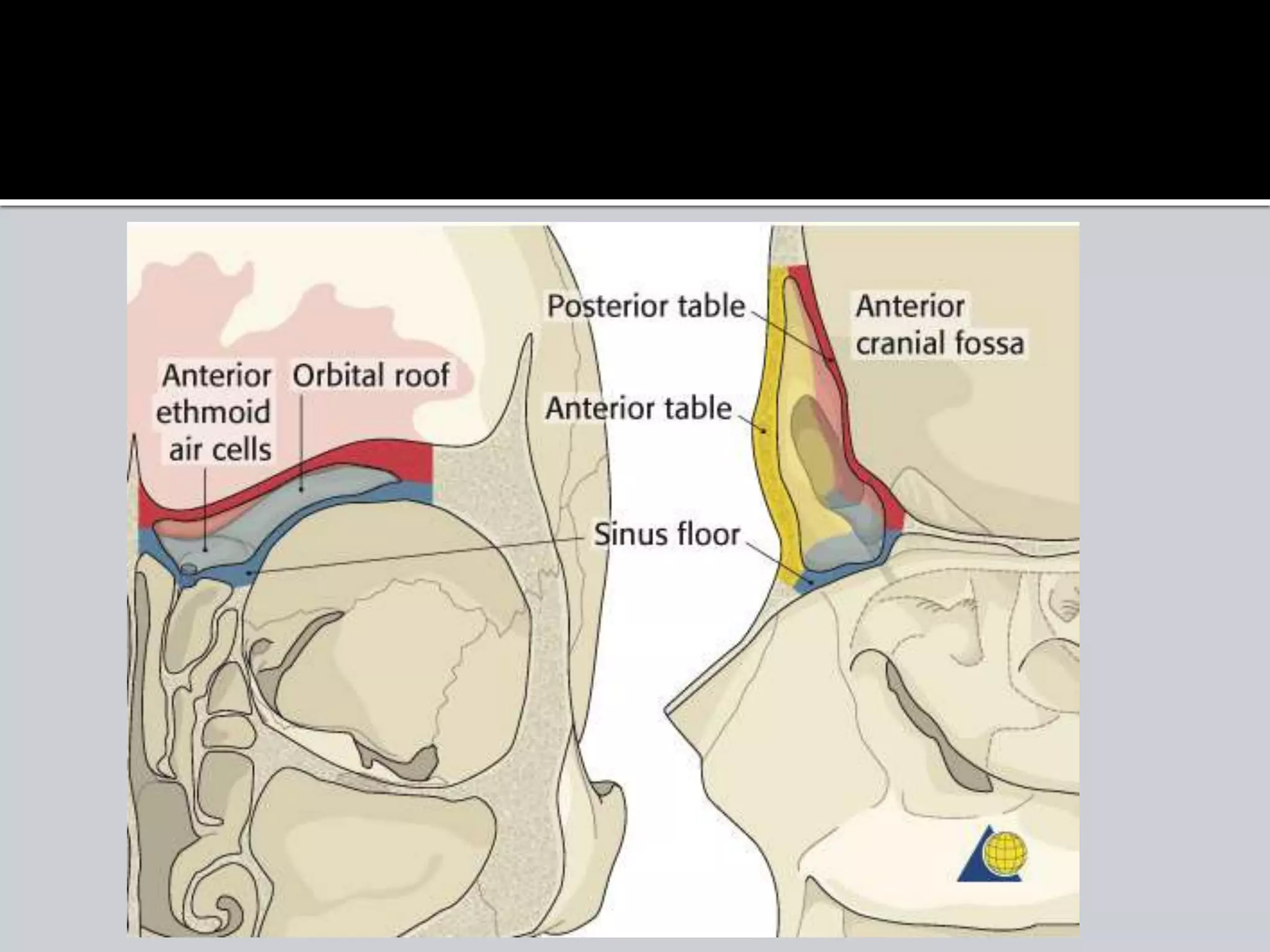
 Paired sinuses situated deep to the inner and outer table of 
frontal bone. 
 It drains through the frontal recess to the middle 
meatus via the ostiomeatal complex. 
 Frontal sinus may be absent on one or both sides or it may 
be very large extending into orbital plate in the roof of the 
orbit.
 Anterior wall -- The skin over the forehead. 
 Inferior wall -- The orbit and its contents. 
 Posterior wall -- The meninges and frontal lobe of the brain. 
 The frontal recess, the drainage pathway of the frontal sinus, 
is situated at its floor and usually drains into the middle 
meatus (62%) or into the ethmoid infundibilum (38%).
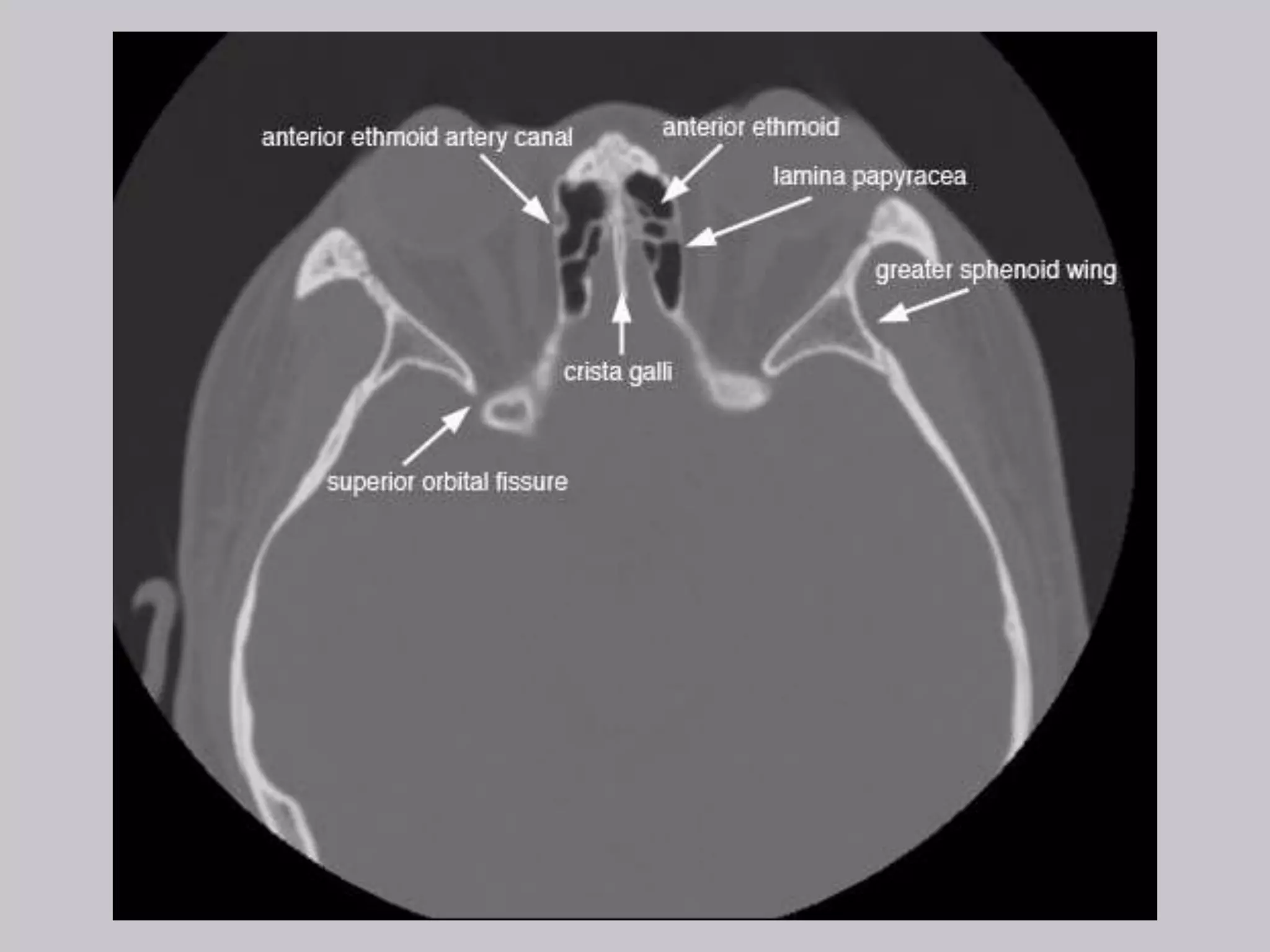
 Ethmoidal sinuses are thin-walled air cavities in the lateral masses of 
ethmoid bone. 
 Clinically, ethmoidal cells are divided into :- 
1. Anterior ethmoidal air cells – Up to 11 anterior ethmoidal air cells 
drain into either the ethmoidal infundibulum or the frontonasal duct. 
2. Bullar cells ( middle ethmoidal air cells) -- usually less than three 
middle ethmoidal air cells. Opens in ethmoidal infundibulum. 
3. Posterior group :- Up to seven posterior ethmoidal air cells usually 
drain by a single orifice into the superior meatus.
 Roof -- Anterior cranial fossa. Meninges of the brain form 
important relation here. 
 Floor – maxillary sinus and hiatus semilunaris. 
 Lateral wall – lamina papyracea of the orbit. 
 Medially - nasal cavity & medial plate of ethmoid. 
 Optic nerve forms close relationship with the posterior ethmoidal 
cells and is at risk during ethmoid surgery.
 It occupies the body of sphenoid. 
 The two, right and left sinuses, are rarely symmetrical and are 
separated by a thin bony septum. 
 Ostium of the sphenoid sinus is situated in the upper part of 
its anterior wall and drains into sphenoethmoidal recess. 
 Average size – 2 x 2 x 2 cm.
According to Congdon , sphenoid 
pneumatization can be as follows 
A. Conchal – 5 % 
B. Presellar – 23 % 
C. Post-sellar – 67%
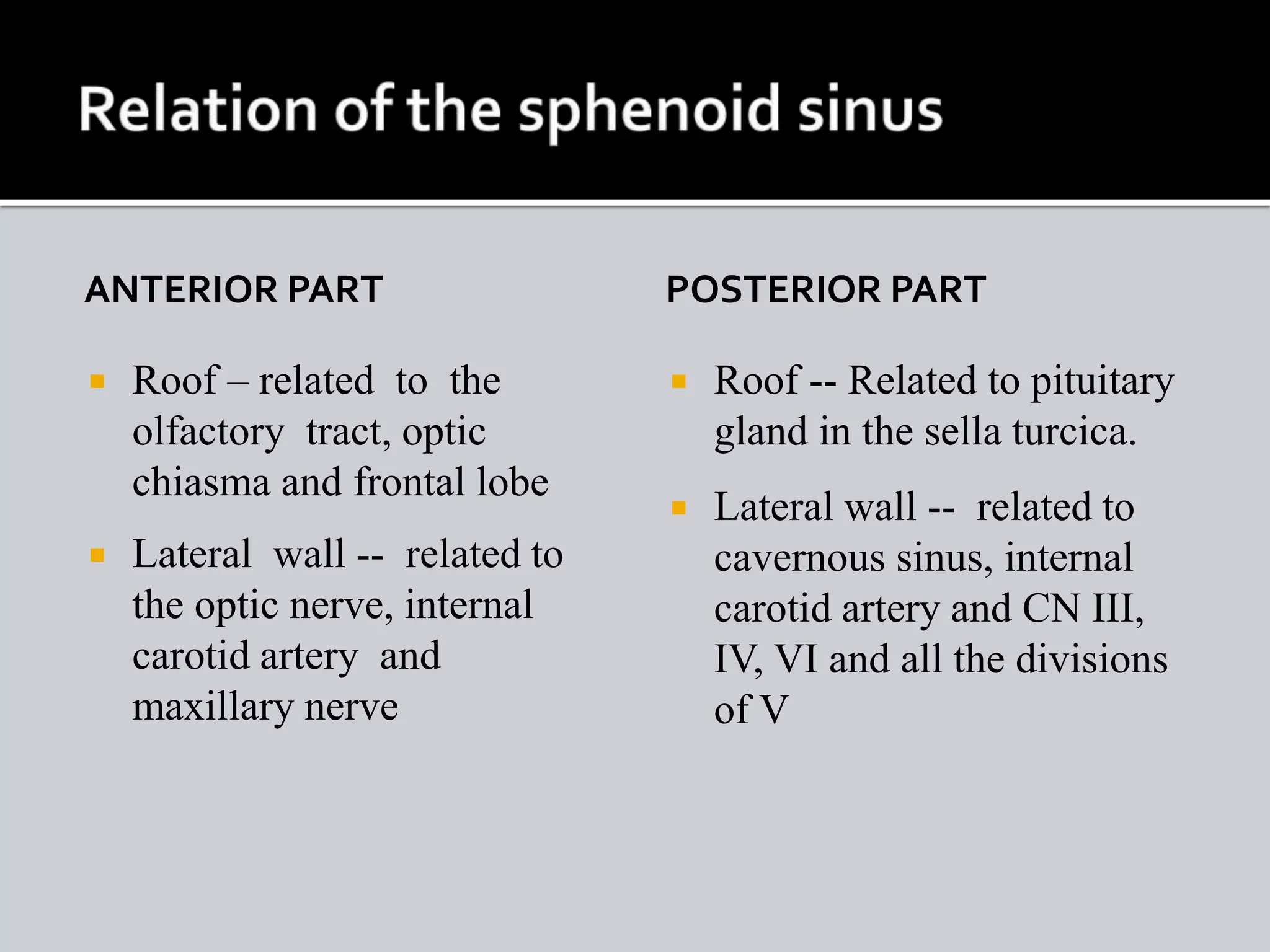
ANTERIOR PART 
 Roof – related to the 
olfactory tract, optic 
chiasma and frontal lobe 
 Lateral wall -- related to 
the optic nerve, internal 
carotid artery and 
maxillary nerve 
POSTERIOR PART 
 Roof -- Related to pituitary 
gland in the sella turcica. 
 Lateral wall -- related to 
cavernous sinus, internal 
carotid artery and CN III, 
IV, VI and all the divisions 
of V
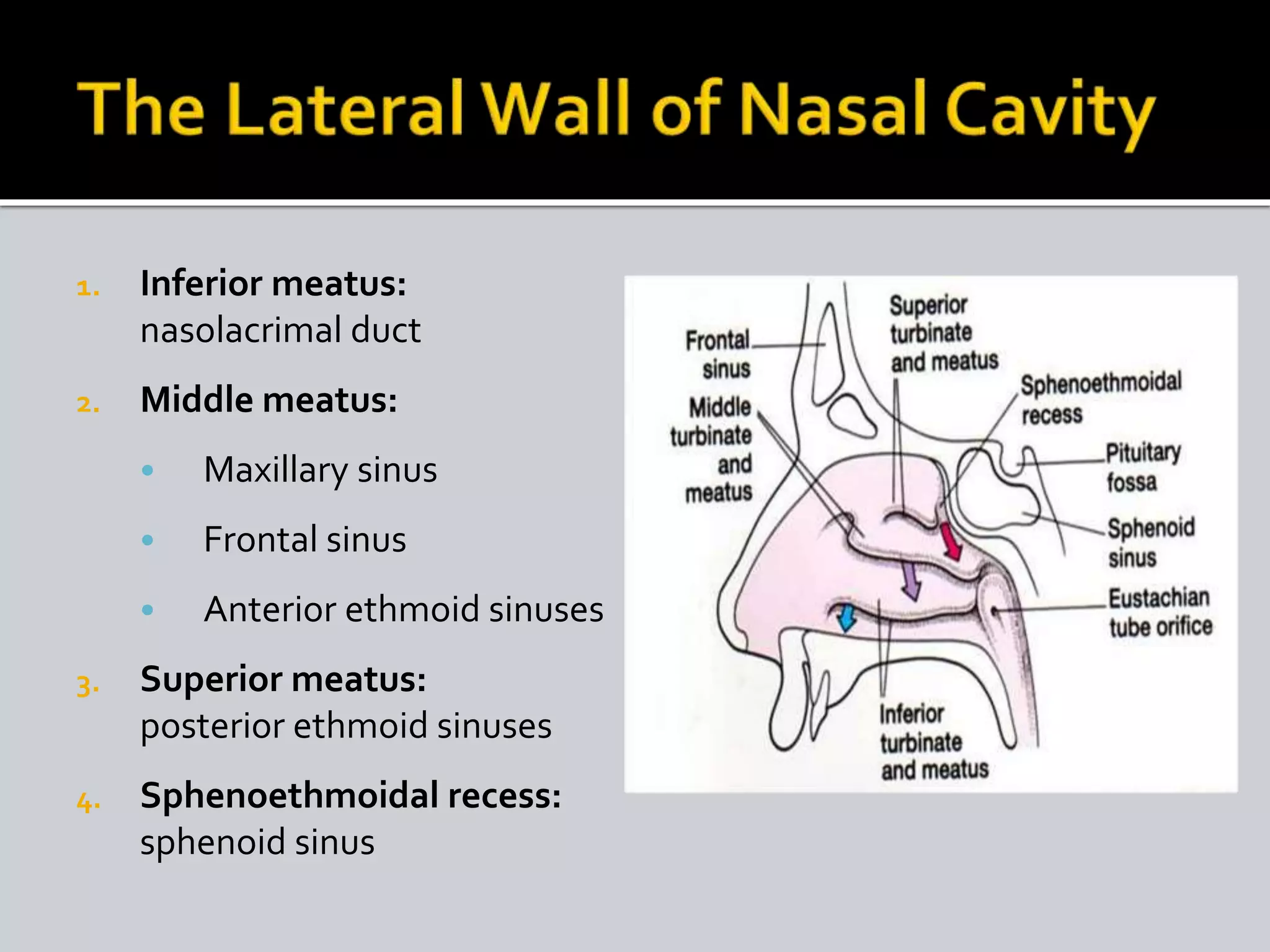
Marked by 3 projections: 
 Superior concha 
 Middle concha 
 Inferior concha 
 The space below each 
concha is called a meatus.
1. Inferior meatus: 
nasolacrimal duct 
2. Middle meatus: 
• Maxillary sinus 
• Frontal sinus 
• Anterior ethmoid sinuses 
3. Superior meatus: 
posterior ethmoid sinuses 
4. Sphenoethmoidal recess: 
sphenoid sinus
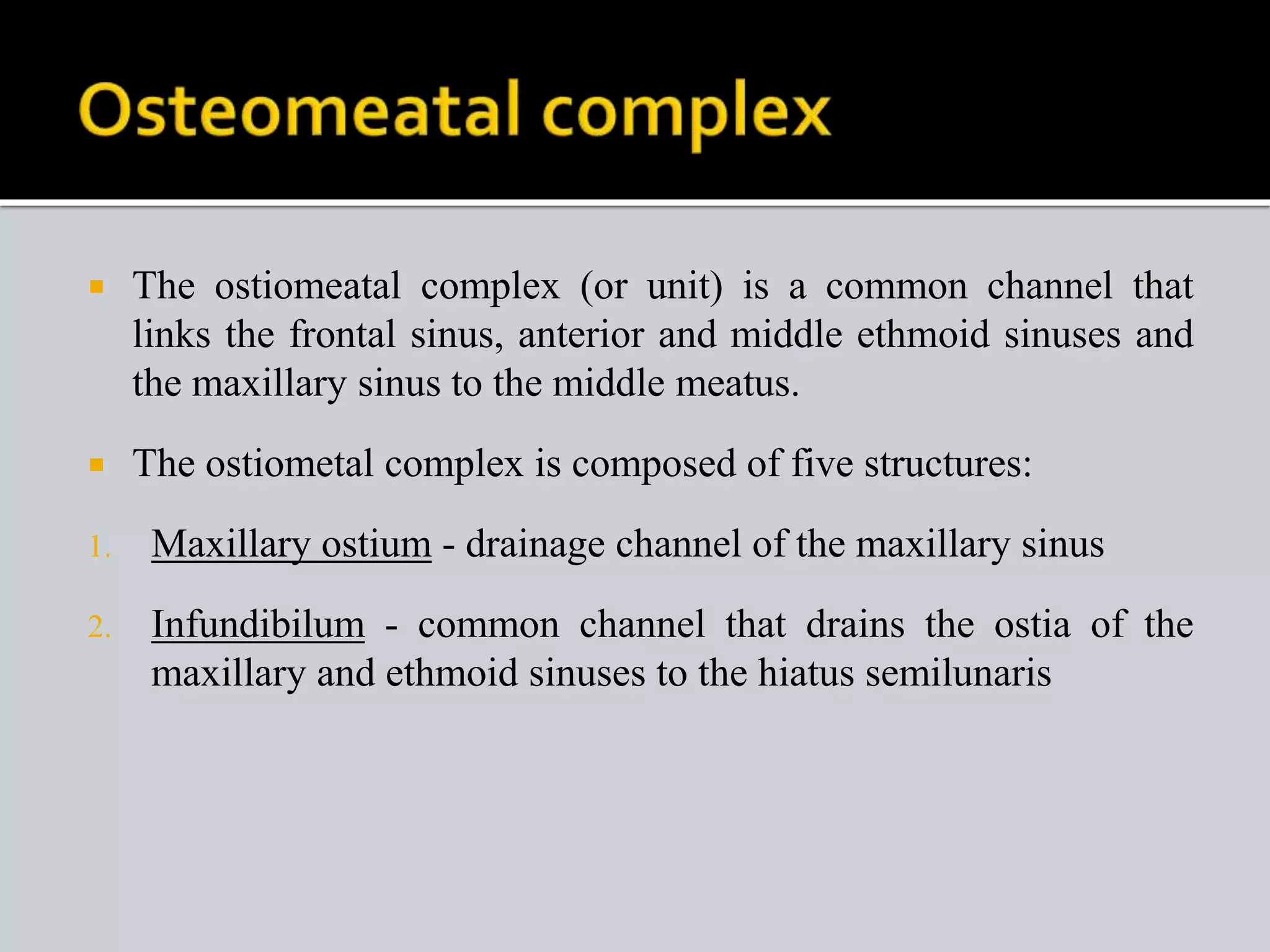
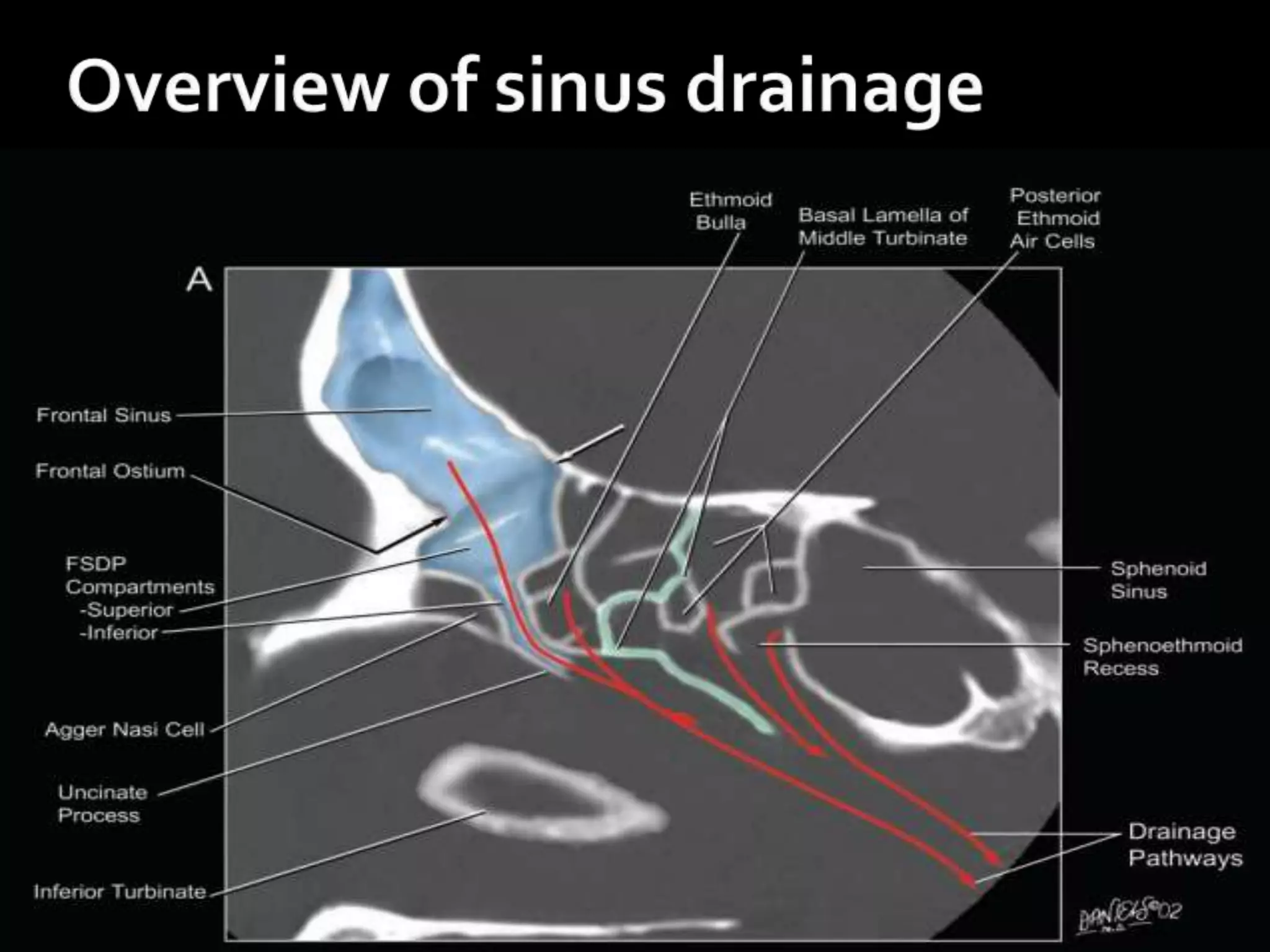
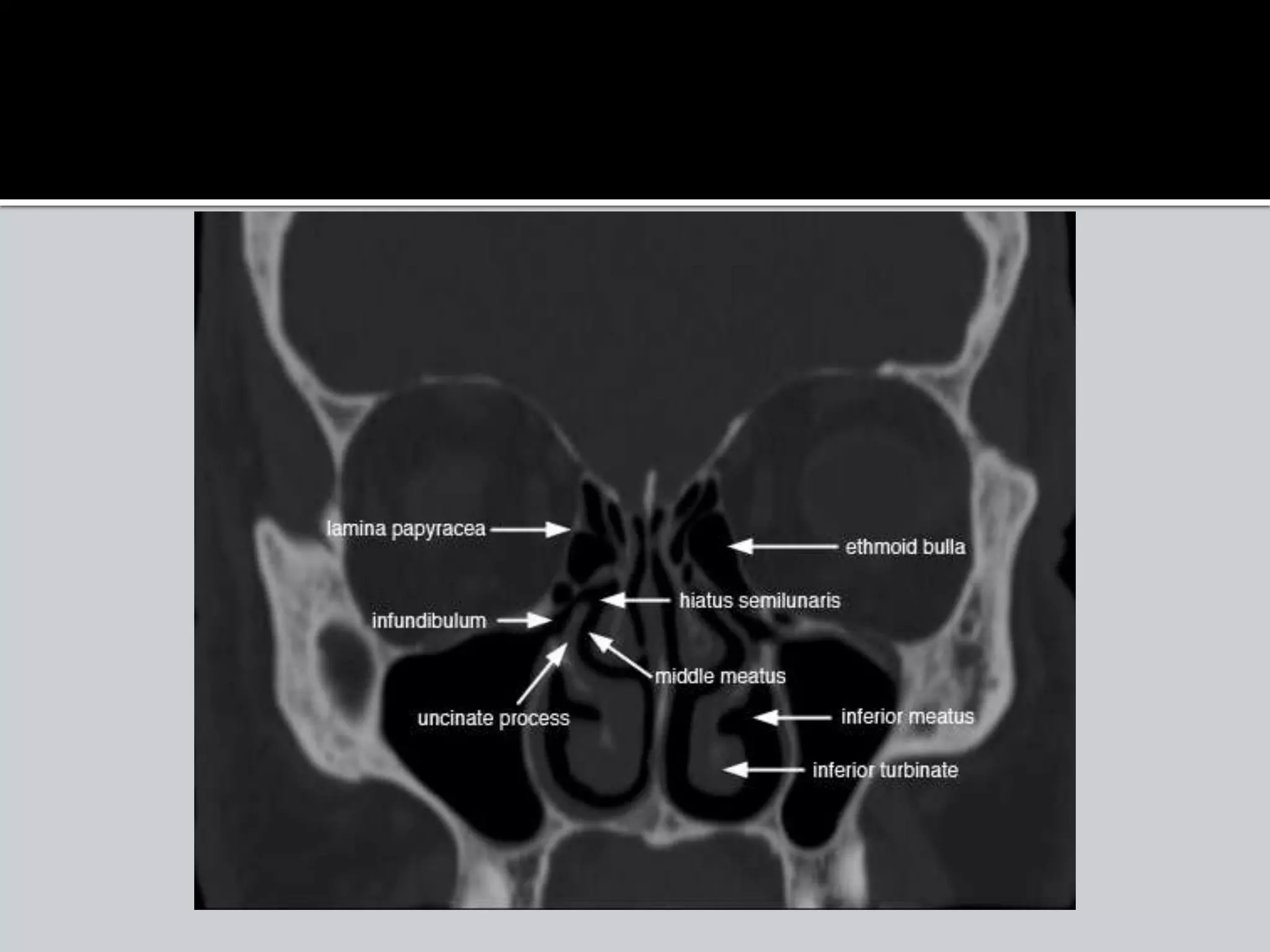
 The ostiomeatal complex (or unit) is a common channel that 
links the frontal sinus, anterior and middle ethmoid sinuses and 
the maxillary sinus to the middle meatus. 
 The ostiometal complex is composed of five structures: 
1. Maxillary ostium - drainage channel of the maxillary sinus 
2. Infundibilum - common channel that drains the ostia of the 
maxillary and ethmoid sinuses to the hiatus semilunaris
 Ethmoidal bulla - usually a single air cell that projects 
inferomedially over the hiatus semilunaris 
 Uncinate process - hook-like process that arises from the 
posteromedial aspect of the nasolacrimal duct and forms the 
anterior boundary of the hiatus semilunaris 
 Hiatus semilunaris - final drainage passage; a region between the 
ethmoidal bulla superiorly and free-edge of the uncinate process
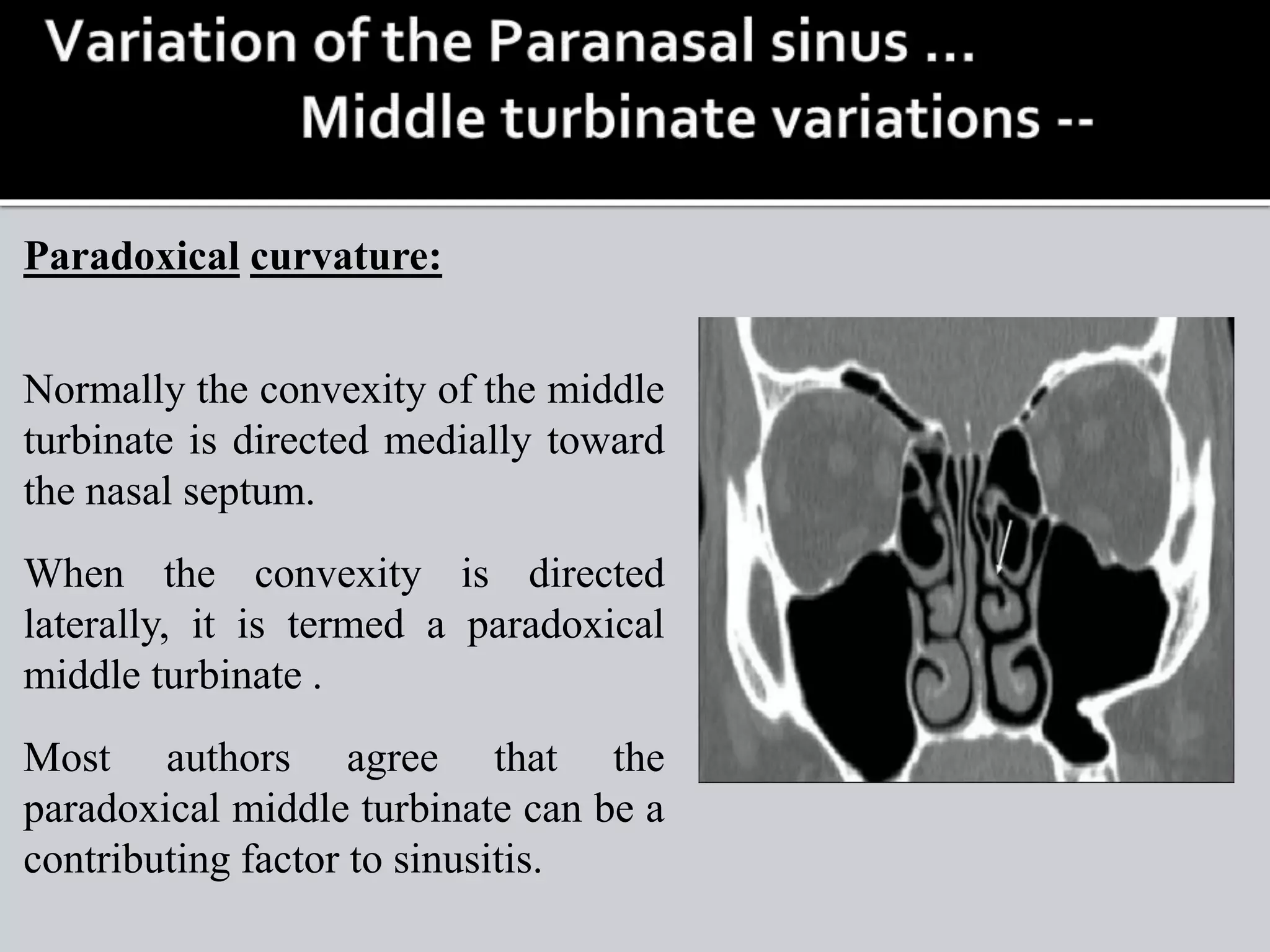
Paradoxical curvature: 
Normally the convexity of the middle 
turbinate is directed medially toward 
the nasal septum. 
When the convexity is directed 
laterally, it is termed a paradoxical 
middle turbinate . 
Most authors agree that the 
paradoxical middle turbinate can be a 
contributing factor to sinusitis.
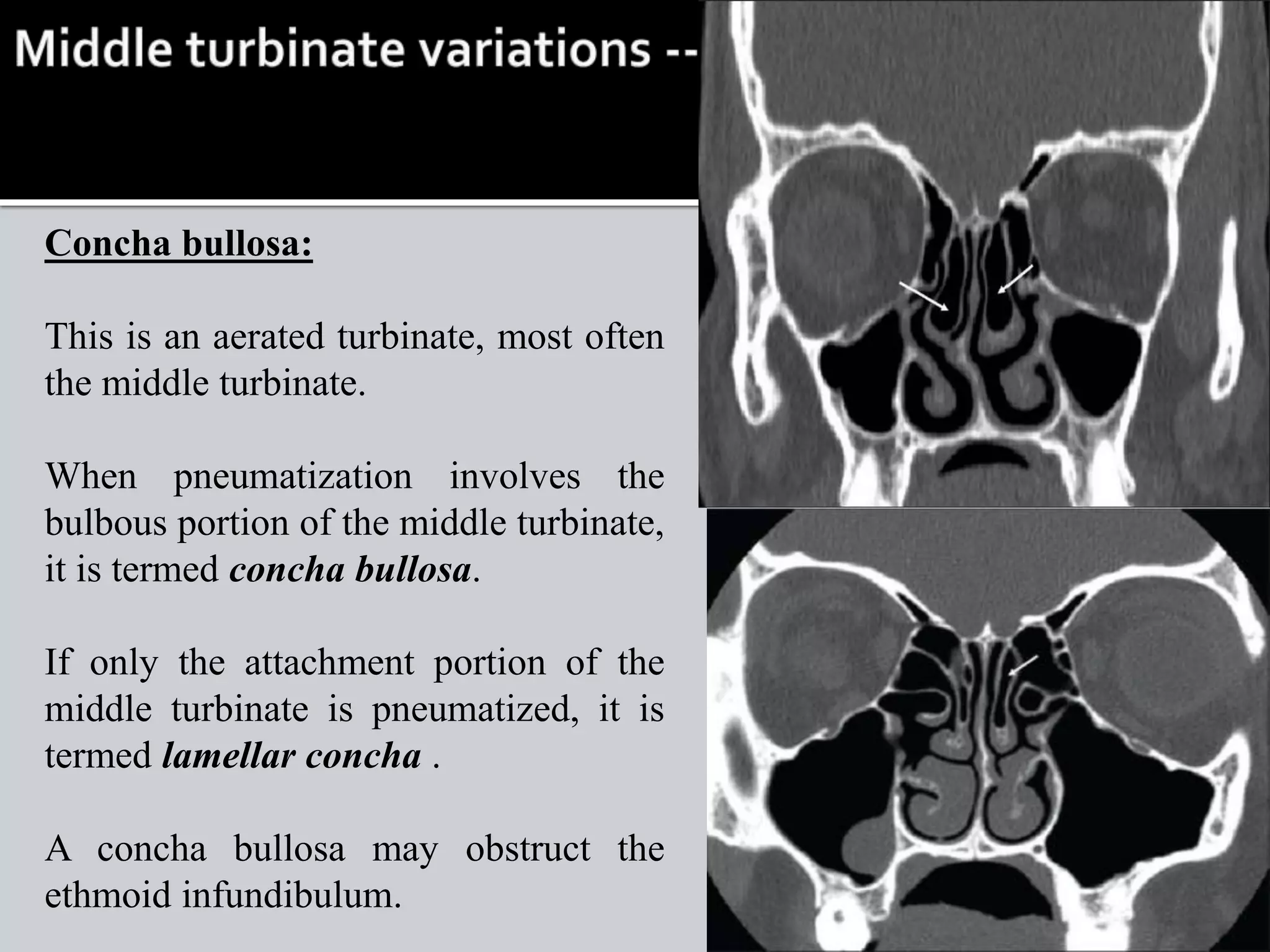
Concha bullosa: 
This is an aerated turbinate, most often 
the middle turbinate. 
When pneumatization involves the 
bulbous portion of the middle turbinate, 
it is termed concha bullosa. 
If only the attachment portion of the 
middle turbinate is pneumatized, it is 
termed lamellar concha . 
A concha bullosa may obstruct the 
ethmoid infundibulum.
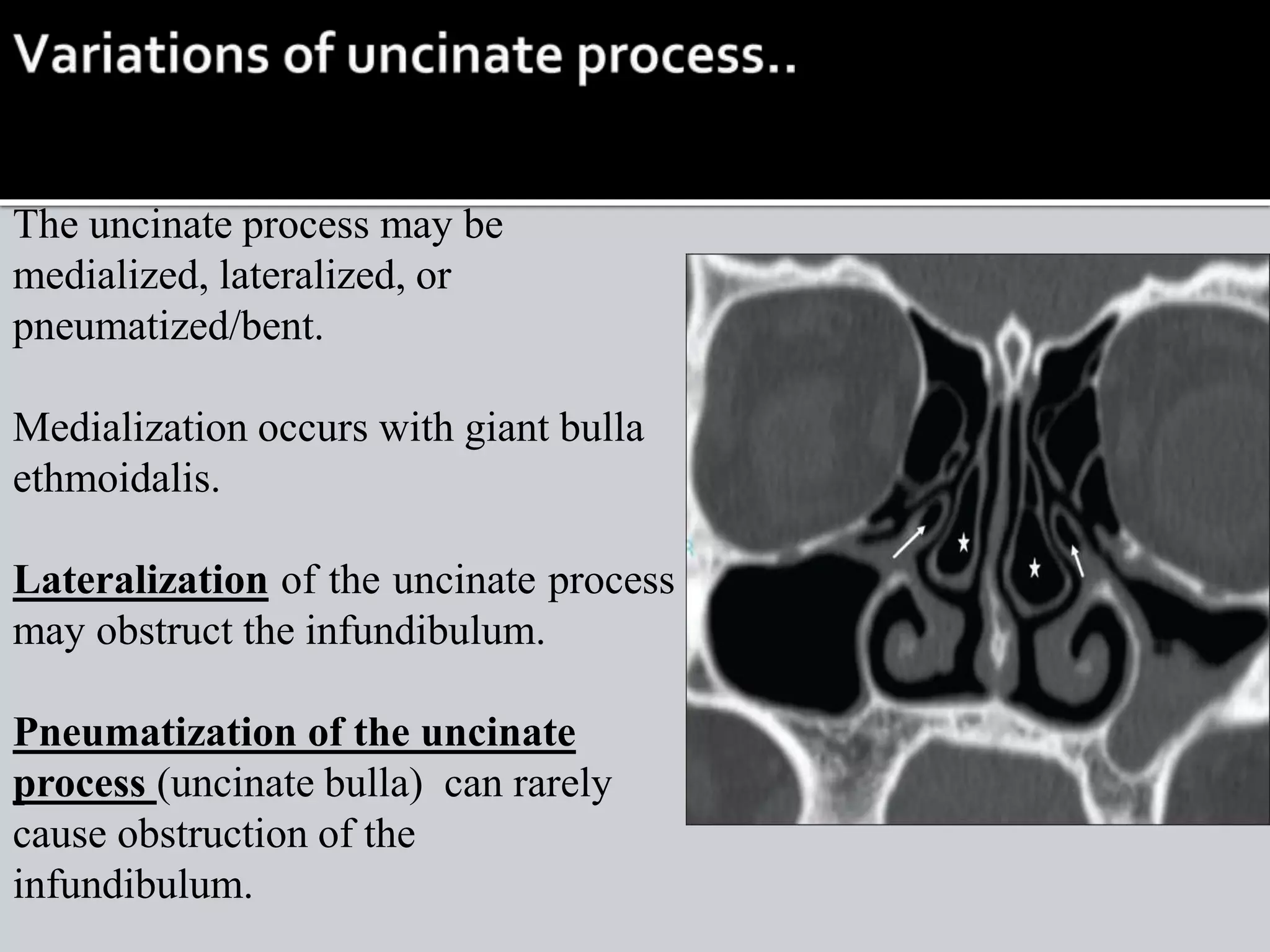
The uncinate process may be 
medialized, lateralized, or 
pneumatized/bent. 
Medialization occurs with giant bulla 
ethmoidalis. 
Lateralization of the uncinate process 
may obstruct the infundibulum. 
Pneumatization of the uncinate 
process (uncinate bulla) can rarely 
cause obstruction of the 
infundibulum.
 They are the most anterior 
ethmoidal air cells. 
 It lies anterior, lateral, and inferior 
to the frontal recess. 
 Its size may directly influence the 
patency of the frontal recess and 
the anterior middle meatus.
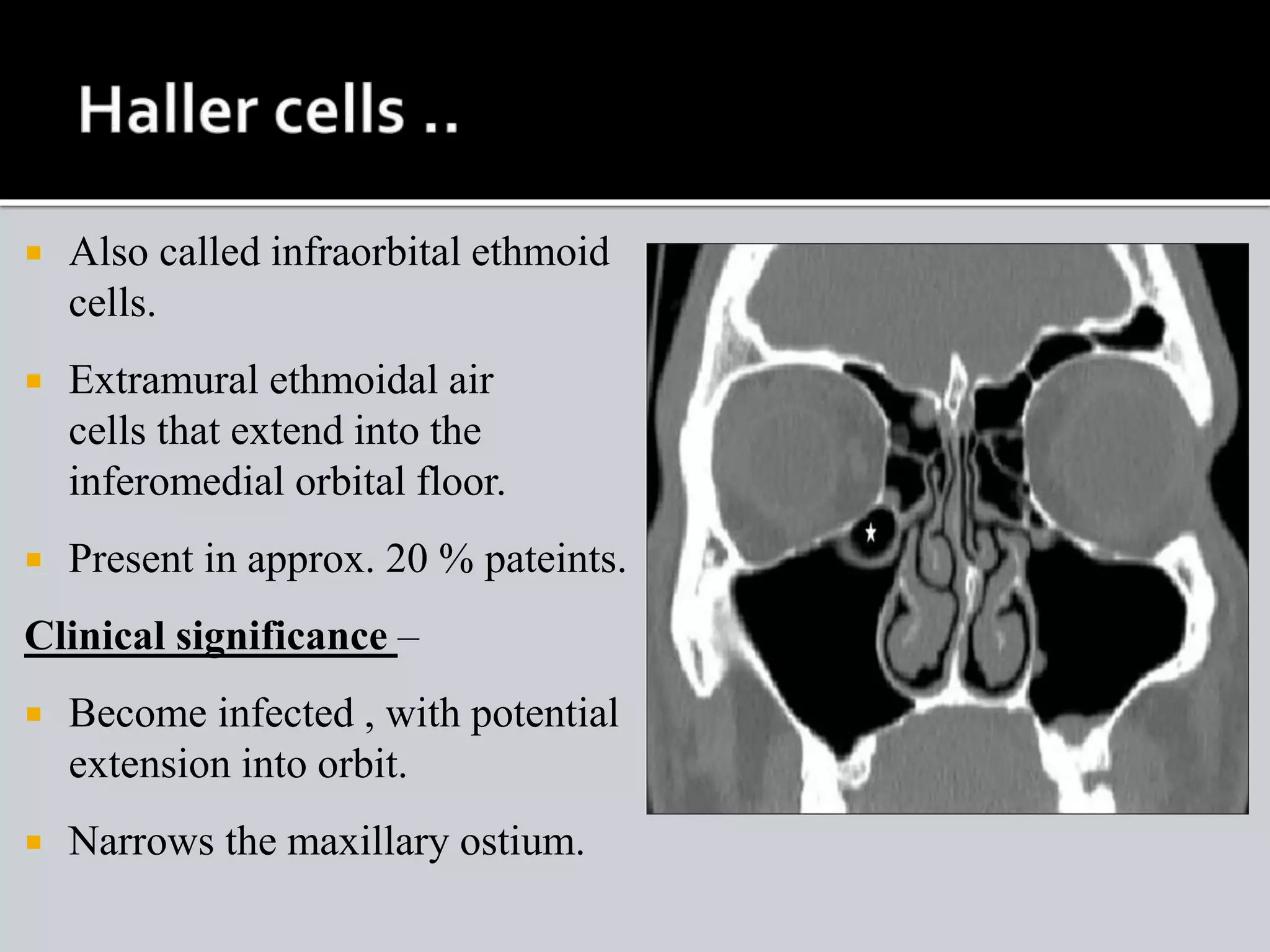
 Also called infraorbital ethmoid 
cells. 
 Extramural ethmoidal air 
cells that extend into the 
inferomedial orbital floor. 
 Present in approx. 20 % pateints. 
Clinical significance – 
 Become infected , with potential 
extension into orbit. 
 Narrows the maxillary ostium.
 These are posterior ethmoidal cells 
extending into the sphenoid 
bone ,either adjacent to or 
impinging upon the optic nerve. 
 When these Onodi cells abut or 
surround the optic nerve, the nerve 
is at risk when surgical excision of 
these cells is performed. 
 It is also a potential cause of 
incomplete sphenoidectomy.
The ethmoid roof is of critical importance for two reasons. 
 First, it is most vulnerable to iatrogenic cerebrospinal fluid leaks. 
 Second, the anterior ethmoid artery is vulnerable to injury. 
The depth of the olfactory fossa is determined by the height of the lateral 
lamella of the cribriform plate. 
In 1962, Keros had classified the depth of the olfactory fossa into three types, 
that is, 
Keros type I: <3 mm , type II: 4-7 mm ,and type III: 8-16 mm 
Kero type III is most vulnerable to iatrogenic injury.
Coronal CT scan shows that the ethmoid 
roofs are almost in the same plane as the 
cribriform plate (double arrow) - Keros 
type I 
Coronal CT reveals the olfactory fossae 
are deeper and the lateral lamellae are 
longer (double arrow) - Keros type II 
Coronal CT shows that the olfactory 
fossae are very deep (double arrow) - 
Keros type III
 Agenesis of sphenoid sinus
Pneumatization of the anterior clinoid process (bent up arrow) and bilateral 
pterygoid processes (star), with protrusion and partial dehiscence of bilateral vidian 
nerves (arrow).
Pneumatized bilateral greater wing of sphenoid (star), with protrusion of maxillary nerve 
bilaterally (arrow). The left maxillary nerve is dehiscent. Note also the protuberant vidian 
nerves bilaterally (downward curved arrow)
 The bulla ethmoidalis is a 
prominent anterior ethmoid air 
cell. 
 A degree of pneumatisation may 
vary, and failure to pneumatise is 
termed torus ethmoidalis. 
 A 'giant bulla' may fill the entire 
middle meatus and force its way 
between the uncinate process 
and the middle turbinate.
 The crista galli is normally bony. 
 When aerated, it may 
communicate with the frontal 
recess, causing obstruction of the 
ostium and thus lead to chronic 
sinusitis and mucocele 
formation.
1. Uma Devi Murali Appavoo Reddy, Bhawna Dev. Pictorial essay: Anatomical variations 
of paranasal sinuses on multidetector computed tomography-How does it help FESS 
surgeons? Indian journal of radiology & imaging 2012, vol -22 pg 317- 324. 
2. Ashok K Gupta et.al. Anatomy and its variation for endoscopy sinus surgery . Clin 
rhinol An Int J 2012; 5(2)55-62. 
3. Multiplanar Sinus CT: A Systematic Approach to Imaging Before Functional 
Endoscopic Sinus Surgery Jenny K. Hoang, James D. Eastwood, Christopher L. Tebbit, 
and Christine M. Glastonbury American Journal of Roentgenology 2010 194:6, W527- 
W536 
4. Laurie A. Loevner et al. Imaging of neoplasms of the paranasal sinuses, Neuroimag 
Clin N Am 14 (2004) 625 – 646 
5. David L. Daniels et.al. The Frontal Sinus Drainage Pathway and Related Structures, 
AJNR: 24, August 2003. 
6. Disease of Ear, Nose & Throat . P.L Dhingra 4th edition. 
7. Interactive Atlas. http://uwmsk.org/sinusanatomy2/axial/axial.html.
Thank you..

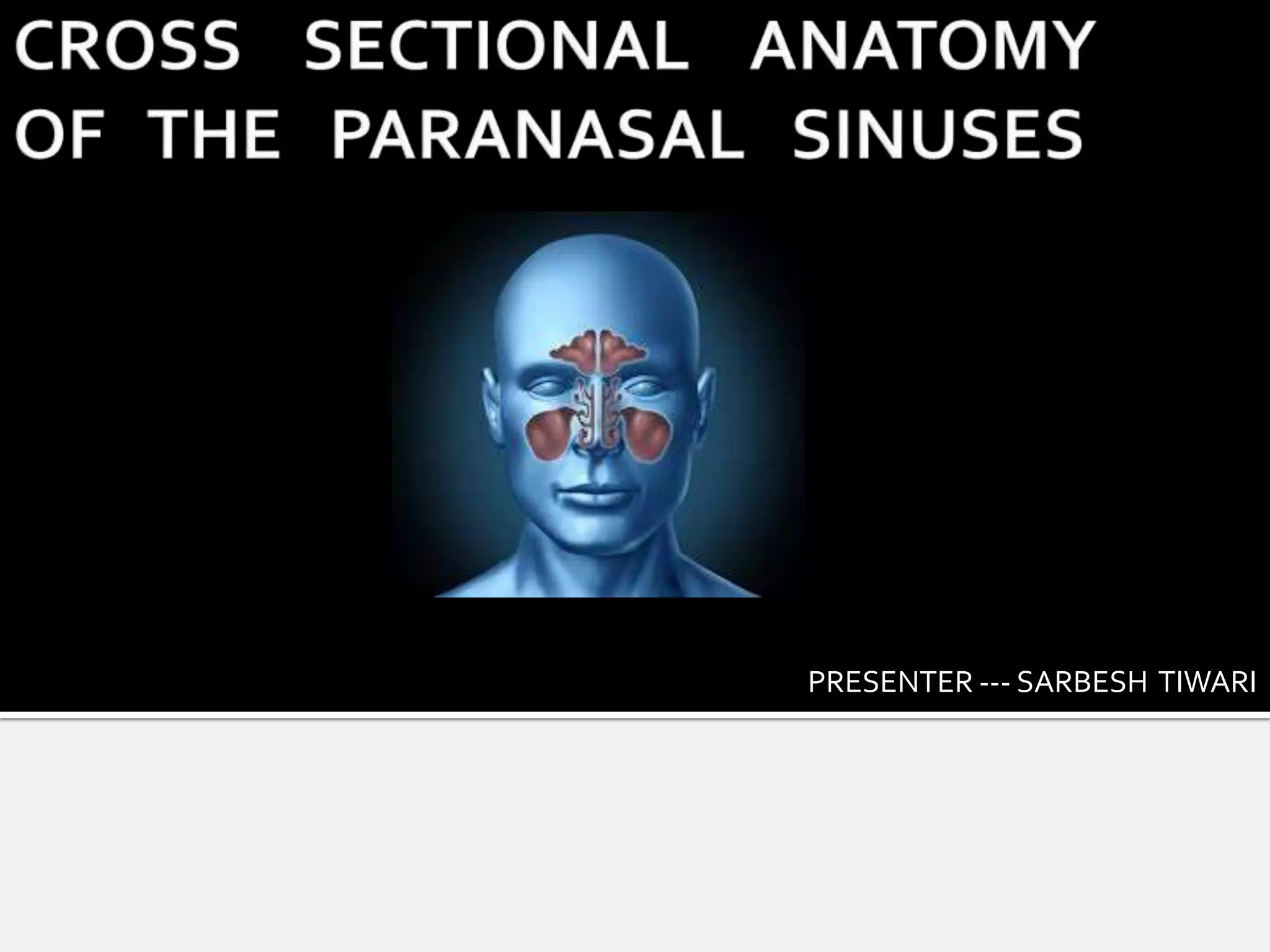
Cross Sectional Anatomy of Paranasal sinus

  • 1.
  • 2.
     Paranasal sinusesare air containing cavities in certain bones of skull.  Clinically, Divided into two groups: 1. Anterior group. This includes maxillary, frontal , anterior and middle ethmoidal air cells. They all open in the middle meatus. 2. Posterior groups. This includes posterior ethmoidal sinuses which open in the superior meatus, and the sphenoid sinus which open in sphenoethmoidal recess. Disease of ear, nose & throat 4th edition – PL Dhingra
  • 3.
     Paranasal sinusesdevelop as out-pouchings from the mucous membrane of lateral wall of nose.  At birth, only the maxillary and ethmoidal sinuses are present and are large enough to be clinically significant.  Growth of sinuses continues during childhood and early adult life.  Radiologically, maxillary sinuses can be identified at 4-5 months, ethmoids at 1 year, frontals at 6 years and sphenoids at 4 years of age.
  • 4.
    Disease of ear,nose & throat 4th edition – PL Dhingra
  • 5.
    Function Histology They lighten the Facial skeleton  Air-conditioning of the inspired air by providing large surface area over which the air is humidified and warmed.  To provide resonance to voice.  They are lined by Psuedostratified columnar epithelium studded with mucus and serous glands.
  • 6.
     Also knownas antrum of Highmore (1651).  Largest paranasal sinus occupying the maxilla.  Pyramidal in shape with base toward the lateral wall of nose and apex directed laterally into the zygomatic process.  Capacity of 15 ml (average).
  • 7.
     Anterior wall– facial surface of maxilla and related to the soft tissue of the cheek.  Posterior wall – infratemporal and pterygopalatine fossae.  Medial wall – middle and inferior turbinate  Floor – alevolar and palatine process of maxilla. Related to all the molar tooth and sometimes the premolar teeth.  Roof – Formed by the floor of the orbit. Traversed by infraorbital nerve and vessels.
  • 9.
     Paired sinusessituated deep to the inner and outer table of frontal bone.  It drains through the frontal recess to the middle meatus via the ostiomeatal complex.  Frontal sinus may be absent on one or both sides or it may be very large extending into orbital plate in the roof of the orbit.
  • 10.
     Anterior wall-- The skin over the forehead.  Inferior wall -- The orbit and its contents.  Posterior wall -- The meninges and frontal lobe of the brain.  The frontal recess, the drainage pathway of the frontal sinus, is situated at its floor and usually drains into the middle meatus (62%) or into the ethmoid infundibilum (38%).
  • 12.
     Ethmoidal sinusesare thin-walled air cavities in the lateral masses of ethmoid bone.  Clinically, ethmoidal cells are divided into :- 1. Anterior ethmoidal air cells – Up to 11 anterior ethmoidal air cells drain into either the ethmoidal infundibulum or the frontonasal duct. 2. Bullar cells ( middle ethmoidal air cells) -- usually less than three middle ethmoidal air cells. Opens in ethmoidal infundibulum. 3. Posterior group :- Up to seven posterior ethmoidal air cells usually drain by a single orifice into the superior meatus.
  • 13.
     Roof --Anterior cranial fossa. Meninges of the brain form important relation here.  Floor – maxillary sinus and hiatus semilunaris.  Lateral wall – lamina papyracea of the orbit.  Medially - nasal cavity & medial plate of ethmoid.  Optic nerve forms close relationship with the posterior ethmoidal cells and is at risk during ethmoid surgery.
  • 14.
     It occupiesthe body of sphenoid.  The two, right and left sinuses, are rarely symmetrical and are separated by a thin bony septum.  Ostium of the sphenoid sinus is situated in the upper part of its anterior wall and drains into sphenoethmoidal recess.  Average size – 2 x 2 x 2 cm.
  • 15.
    According to Congdon, sphenoid pneumatization can be as follows A. Conchal – 5 % B. Presellar – 23 % C. Post-sellar – 67%
  • 16.
    ANTERIOR PART Roof – related to the olfactory tract, optic chiasma and frontal lobe  Lateral wall -- related to the optic nerve, internal carotid artery and maxillary nerve POSTERIOR PART  Roof -- Related to pituitary gland in the sella turcica.  Lateral wall -- related to cavernous sinus, internal carotid artery and CN III, IV, VI and all the divisions of V
  • 18.
    Marked by 3projections:  Superior concha  Middle concha  Inferior concha  The space below each concha is called a meatus.
  • 19.
    1. Inferior meatus: nasolacrimal duct 2. Middle meatus: • Maxillary sinus • Frontal sinus • Anterior ethmoid sinuses 3. Superior meatus: posterior ethmoid sinuses 4. Sphenoethmoidal recess: sphenoid sinus
  • 20.
     The ostiomeatalcomplex (or unit) is a common channel that links the frontal sinus, anterior and middle ethmoid sinuses and the maxillary sinus to the middle meatus.  The ostiometal complex is composed of five structures: 1. Maxillary ostium - drainage channel of the maxillary sinus 2. Infundibilum - common channel that drains the ostia of the maxillary and ethmoid sinuses to the hiatus semilunaris
  • 21.
     Ethmoidal bulla- usually a single air cell that projects inferomedially over the hiatus semilunaris  Uncinate process - hook-like process that arises from the posteromedial aspect of the nasolacrimal duct and forms the anterior boundary of the hiatus semilunaris  Hiatus semilunaris - final drainage passage; a region between the ethmoidal bulla superiorly and free-edge of the uncinate process
  • 45.
    Paradoxical curvature: Normallythe convexity of the middle turbinate is directed medially toward the nasal septum. When the convexity is directed laterally, it is termed a paradoxical middle turbinate . Most authors agree that the paradoxical middle turbinate can be a contributing factor to sinusitis.
  • 46.
    Concha bullosa: Thisis an aerated turbinate, most often the middle turbinate. When pneumatization involves the bulbous portion of the middle turbinate, it is termed concha bullosa. If only the attachment portion of the middle turbinate is pneumatized, it is termed lamellar concha . A concha bullosa may obstruct the ethmoid infundibulum.
  • 47.
    The uncinate processmay be medialized, lateralized, or pneumatized/bent. Medialization occurs with giant bulla ethmoidalis. Lateralization of the uncinate process may obstruct the infundibulum. Pneumatization of the uncinate process (uncinate bulla) can rarely cause obstruction of the infundibulum.
  • 48.
     They arethe most anterior ethmoidal air cells.  It lies anterior, lateral, and inferior to the frontal recess.  Its size may directly influence the patency of the frontal recess and the anterior middle meatus.
  • 49.
     Also calledinfraorbital ethmoid cells.  Extramural ethmoidal air cells that extend into the inferomedial orbital floor.  Present in approx. 20 % pateints. Clinical significance –  Become infected , with potential extension into orbit.  Narrows the maxillary ostium.
  • 50.
     These areposterior ethmoidal cells extending into the sphenoid bone ,either adjacent to or impinging upon the optic nerve.  When these Onodi cells abut or surround the optic nerve, the nerve is at risk when surgical excision of these cells is performed.  It is also a potential cause of incomplete sphenoidectomy.
  • 51.
    The ethmoid roofis of critical importance for two reasons.  First, it is most vulnerable to iatrogenic cerebrospinal fluid leaks.  Second, the anterior ethmoid artery is vulnerable to injury. The depth of the olfactory fossa is determined by the height of the lateral lamella of the cribriform plate. In 1962, Keros had classified the depth of the olfactory fossa into three types, that is, Keros type I: <3 mm , type II: 4-7 mm ,and type III: 8-16 mm Kero type III is most vulnerable to iatrogenic injury.
  • 52.
    Coronal CT scanshows that the ethmoid roofs are almost in the same plane as the cribriform plate (double arrow) - Keros type I Coronal CT reveals the olfactory fossae are deeper and the lateral lamellae are longer (double arrow) - Keros type II Coronal CT shows that the olfactory fossae are very deep (double arrow) - Keros type III
  • 53.
     Agenesis ofsphenoid sinus
  • 54.
    Pneumatization of theanterior clinoid process (bent up arrow) and bilateral pterygoid processes (star), with protrusion and partial dehiscence of bilateral vidian nerves (arrow).
  • 55.
    Pneumatized bilateral greaterwing of sphenoid (star), with protrusion of maxillary nerve bilaterally (arrow). The left maxillary nerve is dehiscent. Note also the protuberant vidian nerves bilaterally (downward curved arrow)
  • 56.
     The bullaethmoidalis is a prominent anterior ethmoid air cell.  A degree of pneumatisation may vary, and failure to pneumatise is termed torus ethmoidalis.  A 'giant bulla' may fill the entire middle meatus and force its way between the uncinate process and the middle turbinate.
  • 57.
     The cristagalli is normally bony.  When aerated, it may communicate with the frontal recess, causing obstruction of the ostium and thus lead to chronic sinusitis and mucocele formation.
  • 60.
    1. Uma DeviMurali Appavoo Reddy, Bhawna Dev. Pictorial essay: Anatomical variations of paranasal sinuses on multidetector computed tomography-How does it help FESS surgeons? Indian journal of radiology & imaging 2012, vol -22 pg 317- 324. 2. Ashok K Gupta et.al. Anatomy and its variation for endoscopy sinus surgery . Clin rhinol An Int J 2012; 5(2)55-62. 3. Multiplanar Sinus CT: A Systematic Approach to Imaging Before Functional Endoscopic Sinus Surgery Jenny K. Hoang, James D. Eastwood, Christopher L. Tebbit, and Christine M. Glastonbury American Journal of Roentgenology 2010 194:6, W527- W536 4. Laurie A. Loevner et al. Imaging of neoplasms of the paranasal sinuses, Neuroimag Clin N Am 14 (2004) 625 – 646 5. David L. Daniels et.al. The Frontal Sinus Drainage Pathway and Related Structures, AJNR: 24, August 2003. 6. Disease of Ear, Nose & Throat . P.L Dhingra 4th edition. 7. Interactive Atlas. http://uwmsk.org/sinusanatomy2/axial/axial.html.
  • 61.

Editor's Notes

  • #7 Nathaniel highmore.. Trinity college oxford.
  • #9 The PPF is a pyramidal space located inferior to the orbital apex and posterior to the maxillary sinus. Laterally, it communicates with the infratemporal fossa via the pterygomaxillary fissure. It also connects with the nasal cavity medially via the sphenopalatine foramen, the orbit via the inferior orbital fissure, and intracranial space via the foramen rotundum.
  • #23 Figure 1 (A, B): (A) Coronal CT scan shows the osteomeatal complex which comprises of - infundibulum (dotted line), hiatus semilunaris (asterisk), maxillary ostium (arrow) and Ethmoidal bulla (EB). MT-middle turbinate, LP-lamina papyracea. (B) Coronal CT images reveals a prominent agger nasi cell (A) inferior and lateral to the nasofrontal recess (solid curved line). The medial relationship of the recess is formed by the middle turbinate (MT)
  • #26 Intersinus septum.
  • #49 Closeness to frontal recess make them excellent surgical landmarks – often opened to view nasofrontal duct
  • #50 Can cause recurrent maxillary sinusitis.
  • #51 Bilateral aerated cavities lateral to the optic canal, extending into the anterior clinoid processes. 
  • #60 A, Coronal CT image obtained before FESS shows complete opacification of right maxillary sinus and partial opacification of right ethmoidal sinus. Right ostiomeatal complex is obstructed. Large opacified right concha bullosa (asterisk) and small unopacified left concha bullosa (white arrow) are evident. Left ethmoidal bulla (black arrow) is large and abuts left uncinate process. Nasal septum is deviated to right with right nasal spur (arrowhead). B, Coronal CT image obtained 2 months after FESS shows resolution of mucosal disease of right sinus. Signs of surgery are septoplasty (arrowhead), bilateral uncinectomy, and bilateral maxillary sinusotomies (asterisks). Resection of right concha bullosa (white arrow) and bilateral ethmoidectomy (black arrows) also have been performed.