Anatomy of the nose
Dr. Mohamed Abdelmohsen Alnemr
Associate Professor of ORL, Head and Neck Surgery, Zagazig University.
Fellowship of Head and Neck Surgery, Pavia University, Italy.
Fellowship of Head and Neck Surgical Oncology, UMC Utrecht, Netherlands.
Nose
(A) External Nose :
- The upper 1/3 of external nose is bony(2 nasal bones joined in the midline). The lower
2/3 is cartilaginous.
- The midline dorsum (the bridge) starts at the root and ends down at the tip. The
columella connects the nasal tip to the upper lip separating the 2 nostrils.
- Ala nasi forming the lateral sides of the nostrils.
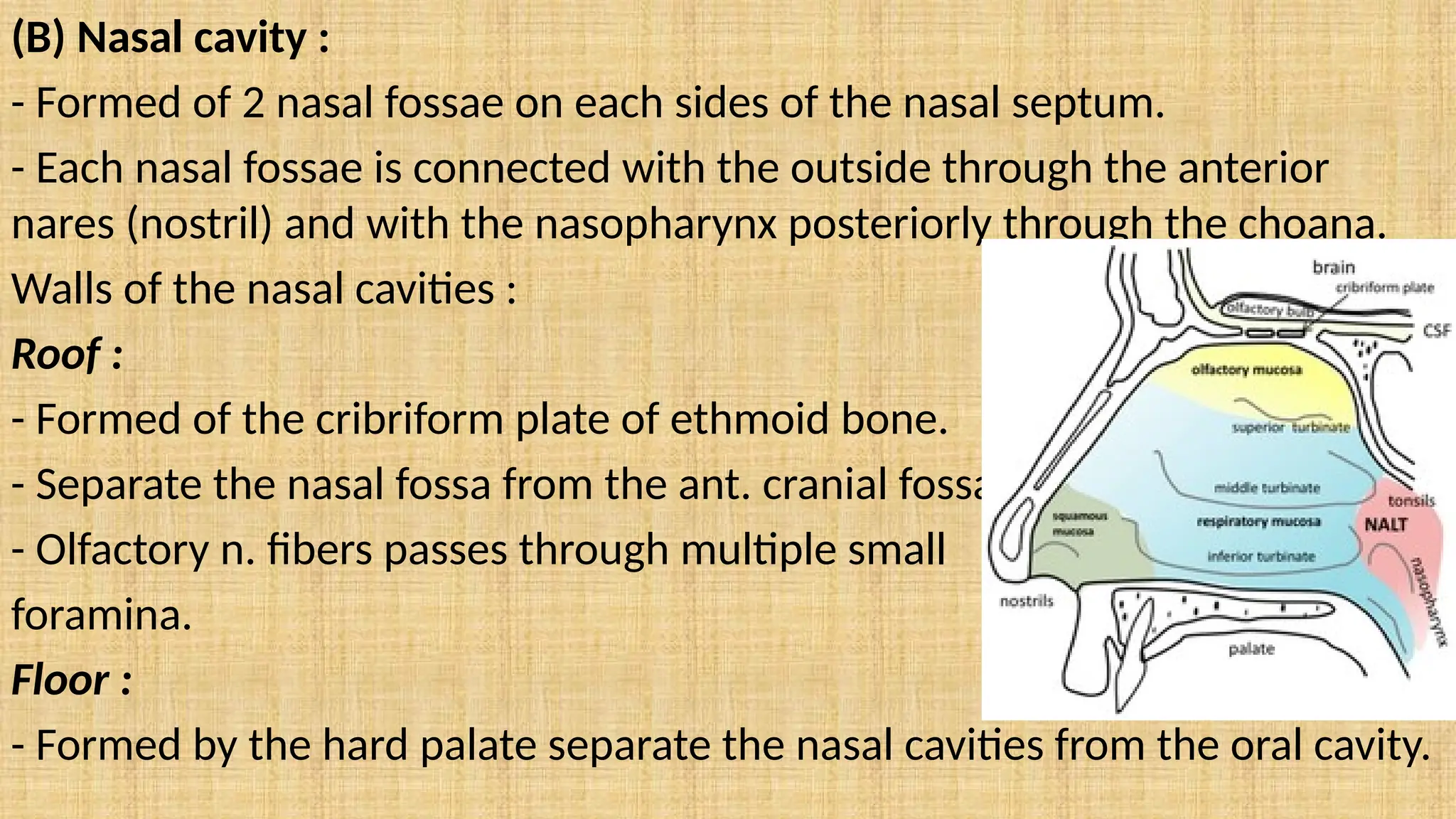
(B) Nasal cavity :
- Formed of 2 nasal fossae on each sides of the nasal septum.
- Each nasal fossae is connected with the outside through the anterior
nares (nostril) and with the nasopharynx posteriorly through the choana.
Walls of the nasal cavities :
Roof :
- Formed of the cribriform plate of ethmoid bone.
- Separate the nasal fossa from the ant. cranial fossa.
- Olfactory n. fibers passes through multiple small
foramina.
Floor :
- Formed by the hard palate separate the nasal cavities from the oral cavity.
Medial wall : formed by the nasal septum which consists of :
 Quadrilateral cartilage, anteroinferiorly.
 Perpendicular plate of ethmoid, superiorly.
 Vomer bone, posteroinferiorly.
 Maxillary crest and spine, inferiorly.
Lateral wall : formed mainly by medial wall of maxilla
and characterized by presence of :
• 3 bony projections called conchae or turbinates
(superior, middle and inferior).
• 3 meati, named after the turbinates and each
meatus lies below the corresponding turbinate.
• Spheno-ethmoidal recess lies above the superior
turbinate and receives the ostium of the sphenoid
sinus.
• Superior meatus: ostia of posterior ethmoidal cells.
• Middle meatus receives the ostia of the frontal,
anterior ethmoidal and maxillary sinuses in an area
called ostiomeatal complex.
• Inferior meatus receives the nasal opening of the
nasolacrimal duct.
Lining mucosa of the nasal cavity :
1- The vestibule :
- Dilated anterior part.
- Lined with skin (stratified squamous epith. which has stiff hairs (vibrissae) and
sebaceous glands.
2- Olfactory area : (upper 1/3 of the nasal cavity i.e the area at and above superior
turbinate and corresponding part of the nasal septum) lined by olfactory mucous
membrane with bipolar nerve cells.
3- Respiratory area : (rest of the nasal cavity and paranasal sinuses).
- Lined by pseudostratified ciliated columnar epith. containing mucous and serous
glands.
- The secretions of these glands form a continuous layer over the cilia (called the
mucous blanket).
- The cilia drive this mucous blanket continuously backwards to the pharynx to be
swallowed.
Blood supply of the nose
(A) Arterial supply :
 The nose is supplied by branches from the
internal carotid artery (above the middle
turbinate) and branches from the external
carotid artery (below the middle turbinate) :
- Anterior and posterior ethmoidal arteries of
the ophthalmic artery of internal carotid artery.
- Sphenopalatine and greater palatine arteries
of maxillary artery of external carotid artery.
- Superior labial artery of the facial artery of
external carotid artery.
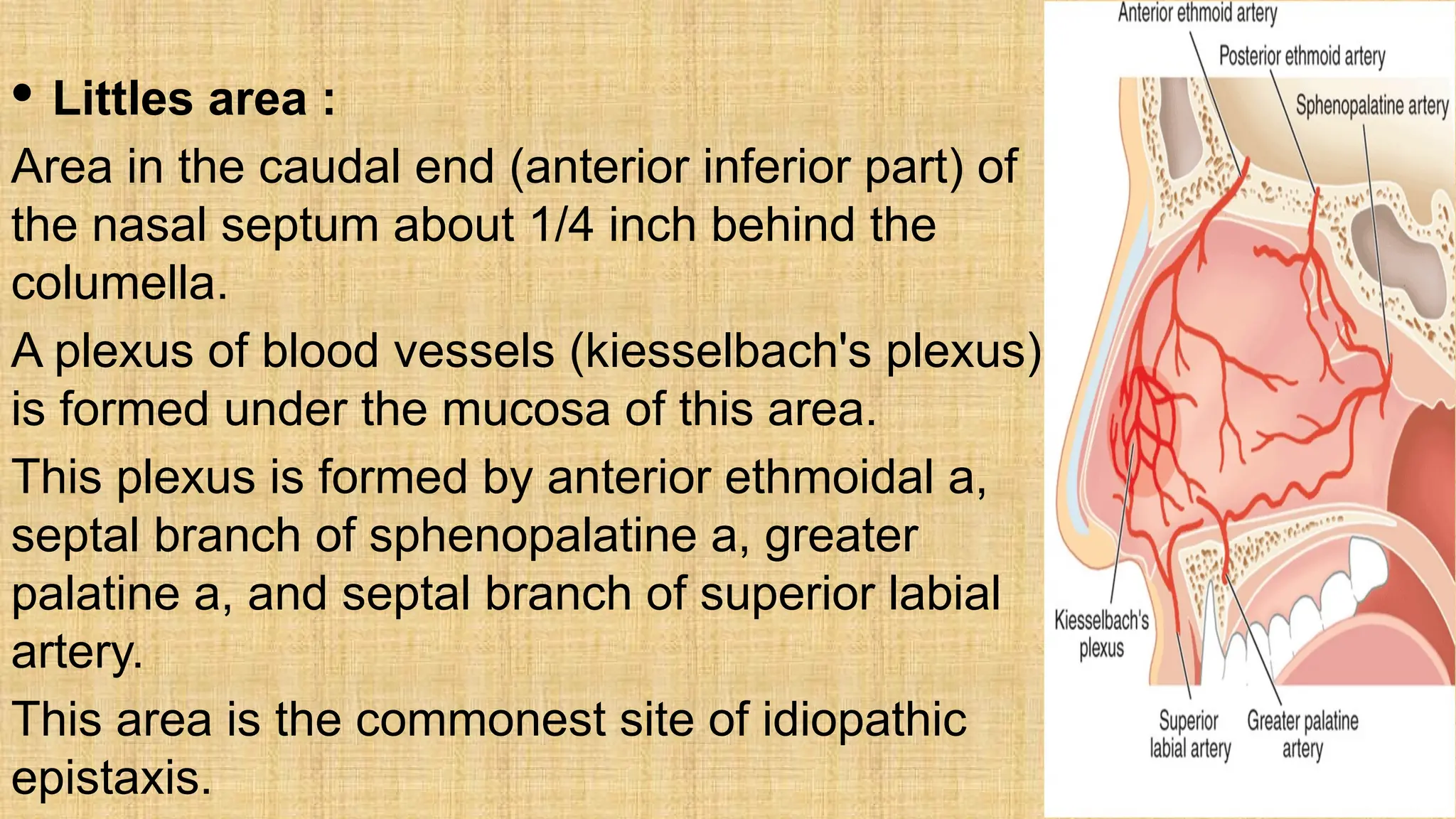
· Littles area :
Area in the caudal end (anterior inferior part) of
the nasal septum about 1/4 inch behind the
columella.
A plexus of blood vessels (kiesselbach's plexus)
is formed under the mucosa of this area.
This plexus is formed by anterior ethmoidal a,
septal branch of sphenopalatine a, greater
palatine a, and septal branch of superior labial
artery.
This area is the commonest site of idiopathic
epistaxis.
(B) Venous drainage :
1- Anterior and posterior ethmoidal veins → ophthalmic vein.
2- Sphenopalatine and greater palatine veins → ptyregoid venous
plexus.
3- Angular vein → facial vein.
N.B : Ophthalmic vein and ptyregoid plexus connected to the cavernous
sinus, so nasal infection may cause cavernous sinus thrombosis, so the
triangle drained by these veins extending from the root of the nose to
the corners of the mouth called the dangerous area of the face.
Nerve supply :
1- Sensory : Trigeminal N. (ophthalmic and maxillary branches).
2- Olfaction : olfactory (1st cranial) nerve carries smell sensation to the
higher centre.
3- Autonomic nerve supply :
a- Sup. Cervical ganglion → Deep petrosal nerve (sympathetic)
vasoconstriction and diminish secretion → increase nasal patency.
b- Facial nerve → Greater superficial petrosal nerve (Parasympathetic)
vasodilation and increase secretion → nasal obstruction.
c- Deep petrosal nerve + Greater superficial petrosal nerve → Vidian
nerve → Sphenopalatine ganglion → Nasal mucosa (blood vessels,
mucous and serous glands).
ANATOMY OF THE PARANASAL SINUS
• These are air spaces
within the skull bones, 4
on each side continue
with that of the nose
through their ostia.
According to their relation
to the middle turbinate,
the paranasal sinus are
classified into :
A- Anterior group :
Formed of the frontal sinus, anterior
ethmoidal air cells and maxillary sinus.
 They drain below the middle
turbinate i.e. into the middle meatus.
The frontal sinus drains into the
antero- suprior part of the middle
meatus, the anterior ethmoidal air cells
drain into the middle part of the middle
meatus and the maxillary sinus drains
into the postero- inferior part of the
middle meatus.
B- Posterior group :
 Formed of the posterior ethmoidal air cells and sphenoidal sinuses.
 They drain above the middle turbinate.
 The posterior ethmoidal air cells drain into the superior meatus and
the sphenoidal sinus drains into the spheno-ethmoidal recess.
Frontal sinus
- Not present at birth and starts to appear 2-4 years.
- Lies within the frontal bone.
- Intrasinus septum is usually present.
- Related anteriorly to the forehead, posteriorly to the anterior cranial
fossa and inferiorly to the nose and orbit.
- Drains through fronto-nasal duct into the middle meatus.
Maxillary sinus
 Lies within the maxilla.
 The largest sinus (15 ml).
 Ostium drains in the middle meatus, ostium is high leading
to difficult drainage (drainage depends on ciliary movement).
Ethmoidal sinus
 7-15 thin-walled cavities appear at 4th month of fetal
development and reach full size in adolescence.
 Roof : Anterior cranial fossa.
 Floor : Maxillary sinus.
 Posteriorly : Sphenoid sinus.
 Medially : Middle turbinate.
 Laterally : Orbit, separated from it by thin plate of bone
(lamina papyracea).
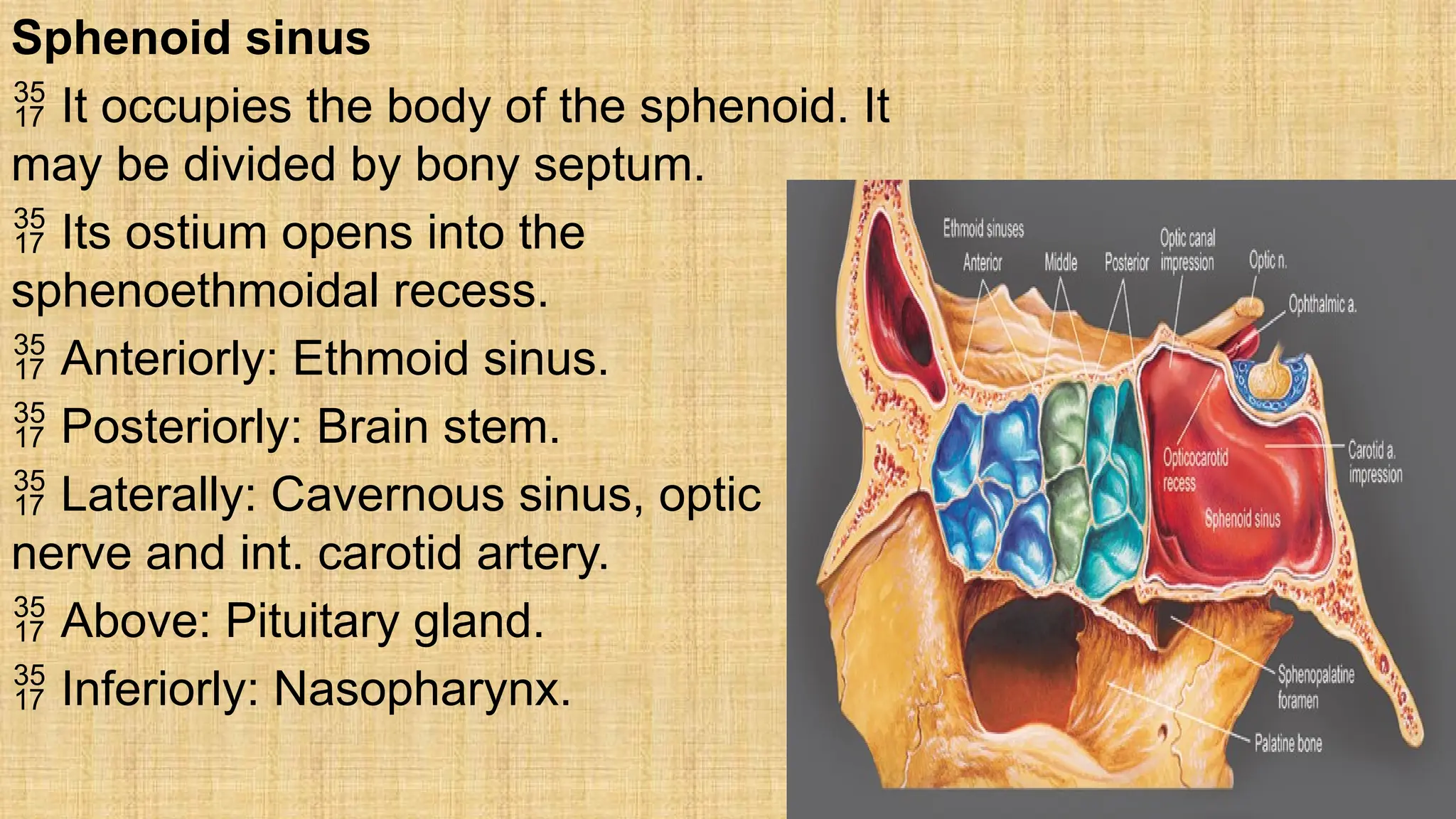
Sphenoid sinus
 It occupies the body of the sphenoid. It
may be divided by bony septum.
 Its ostium opens into the
sphenoethmoidal recess.
 Anteriorly: Ethmoid sinus.
 Posteriorly: Brain stem.
 Laterally: Cavernous sinus, optic
nerve and int. carotid artery.
 Above: Pituitary gland.
 Inferiorly: Nasopharynx.
Nasal examination
• (1) External examination :
• - Inspection : swelling, deformity, scars, ulcers.
• Palpation : For tenderness, swelling or crepitus (fracture).
• a- Digital palpation for :
• - External nose.
• - Paranasal sinuses.
• - Post nasal space (avoided if nasopharyngeal fibroma is suspected as it
may cause severe bleeding).
• b- Probing for intranasal swelling to demonstrate the consistency, mobility
and site of attachment). The grating sensation felt on probing rhinolith is
characteristic.
• (2) Examination of nasal cavity :
• - Anterior rhinoscopy :
• a- For children : Turn tip of the nose, by the examiner's thumb
upwards and backwards to see vestibule and ant. part of the
nasal cavity.
• b- For adult : By using a nasal speculum to see :
• - Floor of the nasal cavity.
• - Middle turbinate and meatus.
• - Inferior turbinate and meatus.
• - Nasal septum.
• - Superior turbinate and meatus can not be ssen.
Thanks

anatomy, examination of the nose for undergraduates.pptx

  • 1.
    Anatomy of thenose Dr. Mohamed Abdelmohsen Alnemr Associate Professor of ORL, Head and Neck Surgery, Zagazig University. Fellowship of Head and Neck Surgery, Pavia University, Italy. Fellowship of Head and Neck Surgical Oncology, UMC Utrecht, Netherlands.
  • 2.
    Nose (A) External Nose: - The upper 1/3 of external nose is bony(2 nasal bones joined in the midline). The lower 2/3 is cartilaginous. - The midline dorsum (the bridge) starts at the root and ends down at the tip. The columella connects the nasal tip to the upper lip separating the 2 nostrils. - Ala nasi forming the lateral sides of the nostrils.
  • 3.
    (B) Nasal cavity: - Formed of 2 nasal fossae on each sides of the nasal septum. - Each nasal fossae is connected with the outside through the anterior nares (nostril) and with the nasopharynx posteriorly through the choana. Walls of the nasal cavities : Roof : - Formed of the cribriform plate of ethmoid bone. - Separate the nasal fossa from the ant. cranial fossa. - Olfactory n. fibers passes through multiple small foramina. Floor : - Formed by the hard palate separate the nasal cavities from the oral cavity.
  • 4.
    Medial wall :formed by the nasal septum which consists of :  Quadrilateral cartilage, anteroinferiorly.  Perpendicular plate of ethmoid, superiorly.  Vomer bone, posteroinferiorly.  Maxillary crest and spine, inferiorly.
  • 5.
    Lateral wall :formed mainly by medial wall of maxilla and characterized by presence of : • 3 bony projections called conchae or turbinates (superior, middle and inferior). • 3 meati, named after the turbinates and each meatus lies below the corresponding turbinate. • Spheno-ethmoidal recess lies above the superior turbinate and receives the ostium of the sphenoid sinus. • Superior meatus: ostia of posterior ethmoidal cells. • Middle meatus receives the ostia of the frontal, anterior ethmoidal and maxillary sinuses in an area called ostiomeatal complex. • Inferior meatus receives the nasal opening of the nasolacrimal duct.
  • 6.
    Lining mucosa ofthe nasal cavity : 1- The vestibule : - Dilated anterior part. - Lined with skin (stratified squamous epith. which has stiff hairs (vibrissae) and sebaceous glands. 2- Olfactory area : (upper 1/3 of the nasal cavity i.e the area at and above superior turbinate and corresponding part of the nasal septum) lined by olfactory mucous membrane with bipolar nerve cells. 3- Respiratory area : (rest of the nasal cavity and paranasal sinuses). - Lined by pseudostratified ciliated columnar epith. containing mucous and serous glands. - The secretions of these glands form a continuous layer over the cilia (called the mucous blanket). - The cilia drive this mucous blanket continuously backwards to the pharynx to be swallowed.
  • 7.
    Blood supply ofthe nose (A) Arterial supply :  The nose is supplied by branches from the internal carotid artery (above the middle turbinate) and branches from the external carotid artery (below the middle turbinate) : - Anterior and posterior ethmoidal arteries of the ophthalmic artery of internal carotid artery. - Sphenopalatine and greater palatine arteries of maxillary artery of external carotid artery. - Superior labial artery of the facial artery of external carotid artery.
  • 8.
    · Littles area: Area in the caudal end (anterior inferior part) of the nasal septum about 1/4 inch behind the columella. A plexus of blood vessels (kiesselbach's plexus) is formed under the mucosa of this area. This plexus is formed by anterior ethmoidal a, septal branch of sphenopalatine a, greater palatine a, and septal branch of superior labial artery. This area is the commonest site of idiopathic epistaxis.
  • 9.
    (B) Venous drainage: 1- Anterior and posterior ethmoidal veins → ophthalmic vein. 2- Sphenopalatine and greater palatine veins → ptyregoid venous plexus. 3- Angular vein → facial vein. N.B : Ophthalmic vein and ptyregoid plexus connected to the cavernous sinus, so nasal infection may cause cavernous sinus thrombosis, so the triangle drained by these veins extending from the root of the nose to the corners of the mouth called the dangerous area of the face.
  • 10.
    Nerve supply : 1-Sensory : Trigeminal N. (ophthalmic and maxillary branches). 2- Olfaction : olfactory (1st cranial) nerve carries smell sensation to the higher centre. 3- Autonomic nerve supply : a- Sup. Cervical ganglion → Deep petrosal nerve (sympathetic) vasoconstriction and diminish secretion → increase nasal patency. b- Facial nerve → Greater superficial petrosal nerve (Parasympathetic) vasodilation and increase secretion → nasal obstruction. c- Deep petrosal nerve + Greater superficial petrosal nerve → Vidian nerve → Sphenopalatine ganglion → Nasal mucosa (blood vessels, mucous and serous glands).
  • 11.
    ANATOMY OF THEPARANASAL SINUS • These are air spaces within the skull bones, 4 on each side continue with that of the nose through their ostia. According to their relation to the middle turbinate, the paranasal sinus are classified into :
  • 12.
    A- Anterior group: Formed of the frontal sinus, anterior ethmoidal air cells and maxillary sinus.  They drain below the middle turbinate i.e. into the middle meatus. The frontal sinus drains into the antero- suprior part of the middle meatus, the anterior ethmoidal air cells drain into the middle part of the middle meatus and the maxillary sinus drains into the postero- inferior part of the middle meatus.
  • 13.
    B- Posterior group:  Formed of the posterior ethmoidal air cells and sphenoidal sinuses.  They drain above the middle turbinate.  The posterior ethmoidal air cells drain into the superior meatus and the sphenoidal sinus drains into the spheno-ethmoidal recess. Frontal sinus - Not present at birth and starts to appear 2-4 years. - Lies within the frontal bone. - Intrasinus septum is usually present. - Related anteriorly to the forehead, posteriorly to the anterior cranial fossa and inferiorly to the nose and orbit. - Drains through fronto-nasal duct into the middle meatus.
  • 14.
    Maxillary sinus  Lieswithin the maxilla.  The largest sinus (15 ml).  Ostium drains in the middle meatus, ostium is high leading to difficult drainage (drainage depends on ciliary movement). Ethmoidal sinus  7-15 thin-walled cavities appear at 4th month of fetal development and reach full size in adolescence.  Roof : Anterior cranial fossa.  Floor : Maxillary sinus.  Posteriorly : Sphenoid sinus.  Medially : Middle turbinate.  Laterally : Orbit, separated from it by thin plate of bone (lamina papyracea).
  • 15.
    Sphenoid sinus  Itoccupies the body of the sphenoid. It may be divided by bony septum.  Its ostium opens into the sphenoethmoidal recess.  Anteriorly: Ethmoid sinus.  Posteriorly: Brain stem.  Laterally: Cavernous sinus, optic nerve and int. carotid artery.  Above: Pituitary gland.  Inferiorly: Nasopharynx.
  • 16.
    Nasal examination • (1)External examination : • - Inspection : swelling, deformity, scars, ulcers. • Palpation : For tenderness, swelling or crepitus (fracture). • a- Digital palpation for : • - External nose. • - Paranasal sinuses. • - Post nasal space (avoided if nasopharyngeal fibroma is suspected as it may cause severe bleeding). • b- Probing for intranasal swelling to demonstrate the consistency, mobility and site of attachment). The grating sensation felt on probing rhinolith is characteristic.
  • 17.
    • (2) Examinationof nasal cavity : • - Anterior rhinoscopy : • a- For children : Turn tip of the nose, by the examiner's thumb upwards and backwards to see vestibule and ant. part of the nasal cavity. • b- For adult : By using a nasal speculum to see : • - Floor of the nasal cavity. • - Middle turbinate and meatus. • - Inferior turbinate and meatus. • - Nasal septum. • - Superior turbinate and meatus can not be ssen.
  • 18.