Endometriosis
Dr.Chaduvula Suresh Babu
Professor
Department of Obstetrics &
Gynaecology
GIMSR, Visakhapatnam, AP
Definition
• Ectopic presence of endometrial tissue
outside the uterine cavity.
• Endometrial tissue includes glands and
stroma.
• First described in 1860 - Rokitansky.
• The ectopic tissue will induce chronic
inflammatory reaction.
Types by Sampson
• Endometrial tissues outside the uterine
cavity – endometriosis externa
• Endometrial tissue in the myometrium –
endometriosis interna or Adenomyosis
Prevalence
• 6-10 %
• Mean age - 25-40 years
Etiology / Histogenesis / Pathogenesis
• 1. Retrograde Menstruation and direct
implantation by SAMPSON
• 2. Coelomic metaplasia theory - Meyer &
Ivanoff
• 3. Vascular dissemination
• 4. Lymphatic spread - Halbans
• 5. Immunological defect
• 6. Direct transplantation
Etiology
• 7. Genetic factors
• 8. Environmental factors – cosmetics, nail
polishes, plastics, toxic chemicals
• 9. Induction theory
• 10. Circulating stem cells
Pathology
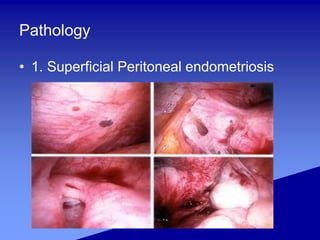
• 1. Superficial Peritoneal endometriosis
Pathology
• 2. Deep infiltrating Endometriosis [ DIE ]
Pathology
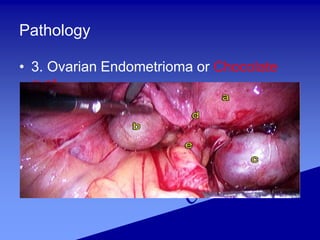
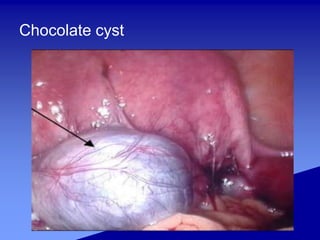
• 3. Ovarian Endometrioma or Chocolate
cyst
Sites
• 1. Ovary
• 2. Pelvic peritoneum – Anterior and
Posterior culdesac
• 3. Uterosacral ligaments
• 4. Posterior surface of uterus
• 5. Posterior leaf of broad ligament
• 6. Others – appendix, caecum, sigmoid,
scars, bladder, lungs, nose etc.,
Risk Factors
• 1. Age – 25-35 years
• 2. Delayed child bearing
• 3. Shorter lactation
• 4. Early menache
• 5. Frequent cycles
• 6. Late menopause
• 7.Low BMI
Risk Factors
• 8. Mullerian duct anomalies
• 9. Genetic factor
• 10. Past history of Asthma, allergies
Protecting factors
• 1. Smoking
• 2. Exrecise
• 3. Oral contraceptives
Clinical features
• A progressive disease with variable
symptoms
• 1. Pelvic pain
• 2. Infertility
• 3. Pelvic mass
Symptoms
• 1. Triple dysmenorrhoea – spasmodic,
congestive and progressive types
• 2. chronic pelvic pain
• 3. Deep dyspareunia
• 4. Infertility
• 5. Menstrual disturbances – heavy and or
irregular bleeding
Symptoms
• 6. Low backache
• 7. Perimenstrual discomfort
• 8. Others – Cyclical hematuria,
hematemsis, epistaxis, scar bleeding or
swelling
• 10. Dyschezia
Signs
• Fixed retroverted uterus
• Lack of mobility
• Adnexal mass
• Local tenderness
• Nodules in POD or over uterosacral
ligaments
• Rarely normal findings
Differential diagnosis
• Chronic PID
• Adenomyosis
• Ovarian tumor
• Irritable bowel syndrome
• Pelvic congestion syndrome
Investigations
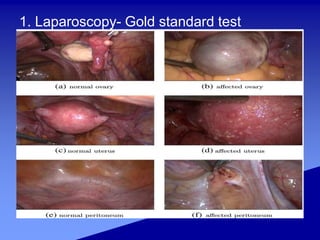
1. Laparoscopy- Gold standard test
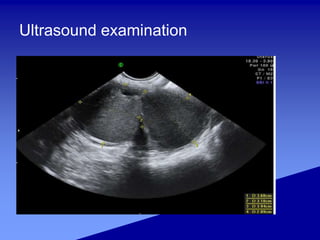
Ultrasound examination
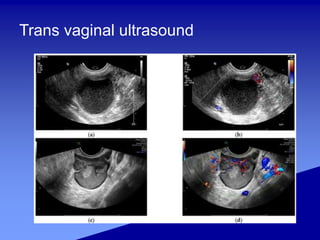
Trans vaginal ultrasound
3. CA 125
• Not a real diagnostic test
• Does not correlate with symptoms
• Non specific
• It is also raised in Pregnancy, PID, Fibroid,
Cancer ovary etc.,
Other investigations
• 4. MRI
• 5. CT Scan
• 6. Histology of tissue
Laparoscopic appearence
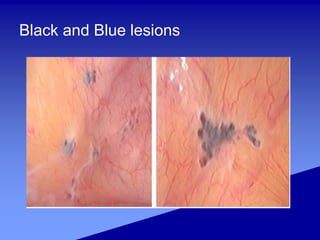
• Powder Burn or Gun Shot lesions
• Black dark brown or bluish puckered
lesion
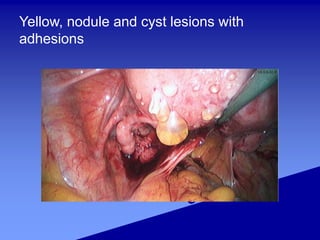
• Nodules or cysts
• Fibrosis
• Red lesions
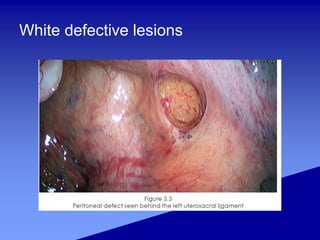
• White lesions
Black and Blue lesions
White defective lesions
Yellow, nodule and cyst lesions with
adhesions
Chocolate cyst
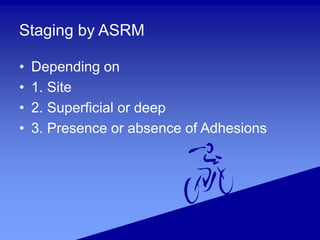
Staging by ASRM
• Depending on
• 1. Site
• 2. Superficial or deep
• 3. Presence or absence of Adhesions
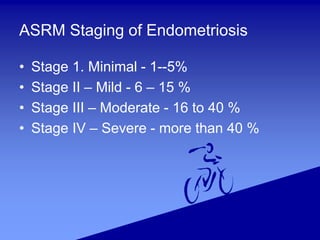
ASRM Staging of Endometriosis
• Stage 1. Minimal - 1--5%
• Stage II – Mild - 6 – 15 %
• Stage III – Moderate - 16 to 40 %
• Stage IV – Severe - more than 40 %
Treatment
• Expectant
• Medical
• Surgical – Conservative or Radical
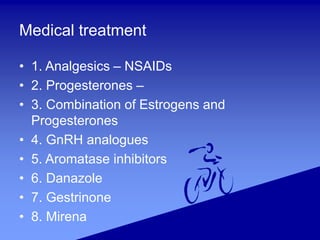
Medical treatment
• 1. Analgesics – NSAIDs
• 2. Progesterones –
• 3. Combination of Estrogens and
Progesterones
• 4. GnRH analogues
• 5. Aromatase inhibitors
• 6. Danazole
• 7. Gestrinone
• 8. Mirena
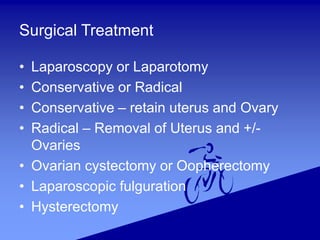
Surgical Treatment
• Laparoscopy or Laparotomy
• Conservative or Radical
• Conservative – retain uterus and Ovary
• Radical – Removal of Uterus and +/-
Ovaries
• Ovarian cystectomy or Oopherectomy
• Laparoscopic fulguration
• Hysterectomy
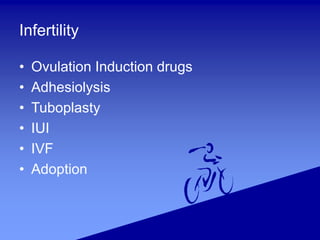
Infertility
• Ovulation Induction drugs
• Adhesiolysis
• Tuboplasty
• IUI
• IVF
• Adoption
Lap Cystectomy
Thank You All

Endometriosis.pptx