GEOLOGICAL
PROCESSES/
fORCES THAT SHAPE
THE EARTH
EARTH SCIENCE
Aries Mandy G. Flores
DIASTROPISM
EARTH PROCESSES
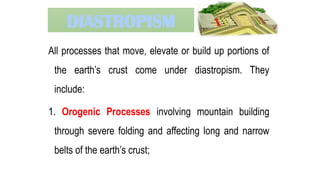
All processes that move, elevate or build up portions of
the earth’s crust come under diastropism. They
include:
1. Orogenic Processes involving mountain building
through severe folding and affecting long and narrow
belts of the earth’s crust;
DIASTROPISM
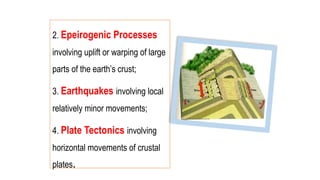
2. Epeirogenic Processes
involving uplift or warping of large
parts of the earth’s crust;
3. Earthquakes involving local
relatively minor movements;
4. Plate Tectonics involving
horizontal movements of crustal
plates.
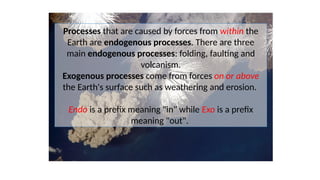
Processes that are caused by forces from within the
Earth are endogenous processes. There are three
main endogenous processes: folding, faulting and
volcanism.
Exogenous processes come from forces on or above
the Earth's surface such as weathering and erosion.
Endo is a prefix meaning "in" while Exo is a prefix
meaning "out".
WEATHERING
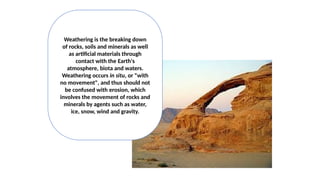
Weathering is the breaking down
of rocks, soils and minerals as well
as artificial materials through
contact with the Earth's
atmosphere, biota and waters.
Weathering occurs in situ, or "with
no movement", and thus should not
be confused with erosion, which
involves the movement of rocks and
minerals by agents such as water,
ice, snow, wind and gravity.
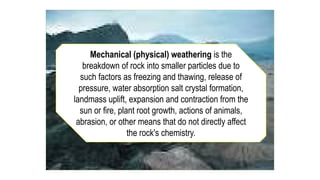
Mechanical (physical) weathering is the
breakdown of rock into smaller particles due to
such factors as freezing and thawing, release of
pressure, water absorption salt crystal formation,
landmass uplift, expansion and contraction from the
sun or fire, plant root growth, actions of animals,
abrasion, or other means that do not directly affect
the rock's chemistry.
Chemical weathering is the dissolution, carbonation, oxidation, or
hydrolysis of rock and mineral by chemical means only, mostly from
reactions with water or the acids contained in rainwater. Other materials
are formed in the process. Warm, tropical climates are ideal environments
for chemical weathering to take place as the chemical reactions are
quickened by the bountiful rain and warm temperatures.
Biological Weathering
Biological weathering would include the
effect of animals and plants on the
landscape. This is more than roots
digging in and wedging rocks.
Biological weathering is the actual
molecular breakdown of minerals.
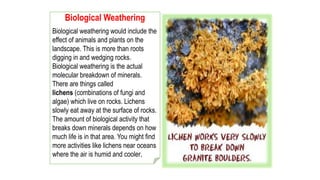
There are things called
lichens (combinations of fungi and
algae) which live on rocks. Lichens
slowly eat away at the surface of rocks.
The amount of biological activity that
breaks down minerals depends on how
much life is in that area. You might find
more activities like lichens near oceans
where the air is humid and cooler.
EROSION
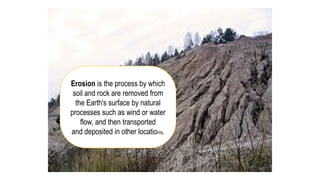
Erosion is the process by which
soil and rock are removed from
the Earth's surface by natural
processes such as wind or water
flow, and then transported
and deposited in other locations.
Water Erosion
Water is the most important erosional agent and erodes most commonly as
running water in streams. However, water in all its forms is erosional. Raindrops
(especially in dry environments) create splash erosion that moves tiny particles
of soil. Water collecting on the surface of the soil collects as it moves towards
tiny rivulets and streams and creates sheet erosion.
Wind Erosion
Erosion by wind is known as aeolian (or eolian) erosion (named after
Aeolus, the Greek god of winds) and occurs almost always in deserts.
Aeolian erosion of sand in the desert is partially responsible for the
formation of sand dunes. The power of the wind erodes rock and sand.
Glaciers can perform to erosive functions - they pluck and abrade.
Plucking takes place by water entering cracks under the glacier, freezing,
and breaking off pieces of rock that are then transported by the glacier.
Abrasion cuts into the rock under the glacier, scooping rock up like a
bulldozer and smoothing and polishing the rock surface.
ICE EROSION
Wave Erosion
Waves in oceans and other large bodies of water produce coastal erosion. The
power of oceanic waves is awesome, large storm waves can produce 2000 pounds
of pressure per square foot. The pure energy of waves along with the chemical
content of the water is what erodes the rock of the coastline. Erosion of sand is
much easier for the waves and sometimes, there's an annual cycle where sand is
removed from a beach during one season, only to be returned by waves in another.
VOLCANISM
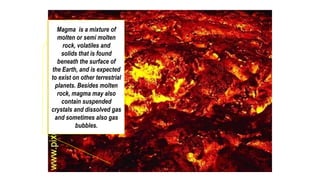
Magma is a mixture of
molten or semi molten
rock, volatiles and
solids that is found
beneath the surface of
the Earth, and is expected
to exist on other terrestrial
planets. Besides molten
rock, magma may also
contain suspended
crystals and dissolved gas
and sometimes also gas
bubbles.
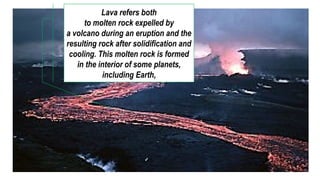
Lava refers both
to molten rock expelled by
a volcano during an eruption and the
resulting rock after solidification and
cooling. This molten rock is formed
in the interior of some planets,
including Earth,
EARTHQUAKE
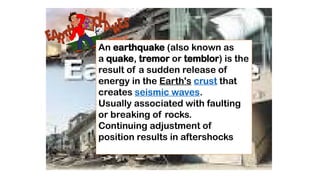
An earthquake (also known as
a quake, tremor or temblor) is the
result of a sudden release of
energy in the Earth's crust that
creates seismic waves.
Usually associated with faulting
or breaking of rocks.
Continuing adjustment of
position results in aftershocks
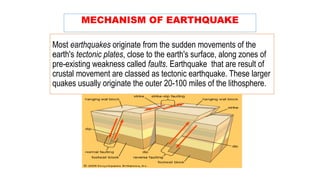
Most earthquakes originate from the sudden movements of the
earth's tectonic plates, close to the earth's surface, along zones of
pre-existing weakness called faults. Earthquake that are result of
crustal movement are classed as tectonic earthquake. These larger
quakes usually originate the outer 20-100 miles of the lithosphere.
MECHANISM OF EARTHQUAKE
Philippines as an Earthquake Country
The Philippines lies within
the Pacific Ring of Fire, which
causes the country to have
frequent seismic and volcanic
activity. Much larger numbers
of earthquakes of smaller
magnitude occur very
regularly due to the meeting
of major tectonic plates in the
region.

GEOLOGICAL PROCESSES/FORCES THAT SHAPE EARTH Ppt.pptx

  • 1.
    GEOLOGICAL PROCESSES/ fORCES THAT SHAPE THEEARTH EARTH SCIENCE Aries Mandy G. Flores
  • 2.
  • 3.
    All processes thatmove, elevate or build up portions of the earth’s crust come under diastropism. They include: 1. Orogenic Processes involving mountain building through severe folding and affecting long and narrow belts of the earth’s crust; DIASTROPISM
  • 4.
    2. Epeirogenic Processes involvinguplift or warping of large parts of the earth’s crust; 3. Earthquakes involving local relatively minor movements; 4. Plate Tectonics involving horizontal movements of crustal plates.
  • 5.
    Processes that arecaused by forces from within the Earth are endogenous processes. There are three main endogenous processes: folding, faulting and volcanism. Exogenous processes come from forces on or above the Earth's surface such as weathering and erosion. Endo is a prefix meaning "in" while Exo is a prefix meaning "out".
  • 6.
  • 7.
    Weathering is thebreaking down of rocks, soils and minerals as well as artificial materials through contact with the Earth's atmosphere, biota and waters. Weathering occurs in situ, or "with no movement", and thus should not be confused with erosion, which involves the movement of rocks and minerals by agents such as water, ice, snow, wind and gravity.
  • 8.
    Mechanical (physical) weatheringis the breakdown of rock into smaller particles due to such factors as freezing and thawing, release of pressure, water absorption salt crystal formation, landmass uplift, expansion and contraction from the sun or fire, plant root growth, actions of animals, abrasion, or other means that do not directly affect the rock's chemistry.
  • 9.
    Chemical weathering isthe dissolution, carbonation, oxidation, or hydrolysis of rock and mineral by chemical means only, mostly from reactions with water or the acids contained in rainwater. Other materials are formed in the process. Warm, tropical climates are ideal environments for chemical weathering to take place as the chemical reactions are quickened by the bountiful rain and warm temperatures.
  • 10.
    Biological Weathering Biological weatheringwould include the effect of animals and plants on the landscape. This is more than roots digging in and wedging rocks. Biological weathering is the actual molecular breakdown of minerals. There are things called lichens (combinations of fungi and algae) which live on rocks. Lichens slowly eat away at the surface of rocks. The amount of biological activity that breaks down minerals depends on how much life is in that area. You might find more activities like lichens near oceans where the air is humid and cooler.
  • 11.
  • 12.
    Erosion is theprocess by which soil and rock are removed from the Earth's surface by natural processes such as wind or water flow, and then transported and deposited in other locations.
  • 13.
    Water Erosion Water isthe most important erosional agent and erodes most commonly as running water in streams. However, water in all its forms is erosional. Raindrops (especially in dry environments) create splash erosion that moves tiny particles of soil. Water collecting on the surface of the soil collects as it moves towards tiny rivulets and streams and creates sheet erosion.
  • 14.
    Wind Erosion Erosion bywind is known as aeolian (or eolian) erosion (named after Aeolus, the Greek god of winds) and occurs almost always in deserts. Aeolian erosion of sand in the desert is partially responsible for the formation of sand dunes. The power of the wind erodes rock and sand.
  • 15.
    Glaciers can performto erosive functions - they pluck and abrade. Plucking takes place by water entering cracks under the glacier, freezing, and breaking off pieces of rock that are then transported by the glacier. Abrasion cuts into the rock under the glacier, scooping rock up like a bulldozer and smoothing and polishing the rock surface. ICE EROSION
  • 16.
    Wave Erosion Waves inoceans and other large bodies of water produce coastal erosion. The power of oceanic waves is awesome, large storm waves can produce 2000 pounds of pressure per square foot. The pure energy of waves along with the chemical content of the water is what erodes the rock of the coastline. Erosion of sand is much easier for the waves and sometimes, there's an annual cycle where sand is removed from a beach during one season, only to be returned by waves in another.
  • 17.
  • 18.
    Magma is amixture of molten or semi molten rock, volatiles and solids that is found beneath the surface of the Earth, and is expected to exist on other terrestrial planets. Besides molten rock, magma may also contain suspended crystals and dissolved gas and sometimes also gas bubbles.
  • 19.
    Lava refers both tomolten rock expelled by a volcano during an eruption and the resulting rock after solidification and cooling. This molten rock is formed in the interior of some planets, including Earth,
  • 20.
  • 21.
    An earthquake (alsoknown as a quake, tremor or temblor) is the result of a sudden release of energy in the Earth's crust that creates seismic waves. Usually associated with faulting or breaking of rocks. Continuing adjustment of position results in aftershocks
  • 22.
    Most earthquakes originatefrom the sudden movements of the earth's tectonic plates, close to the earth's surface, along zones of pre-existing weakness called faults. Earthquake that are result of crustal movement are classed as tectonic earthquake. These larger quakes usually originate the outer 20-100 miles of the lithosphere. MECHANISM OF EARTHQUAKE
  • 23.
    Philippines as anEarthquake Country The Philippines lies within the Pacific Ring of Fire, which causes the country to have frequent seismic and volcanic activity. Much larger numbers of earthquakes of smaller magnitude occur very regularly due to the meeting of major tectonic plates in the region.