Enantiomer
What is an Enantiomer?
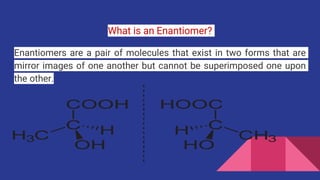
Enantiomers are a pair of molecules that exist in two forms that are
mirror images of one another but cannot be superimposed one upon
the other.
What is an Enantiomer?
Enantiomers are in every other respect chemically identical. A pair of
enantiomers is distinguished by the direction in which when dissolved in solution
they rotate polarized light, either dextro (d or +) or levo (l or -) rotatory; hence the
term optical isomers. When two enantiomers are present in equal proportions
they are collectively referred to as a racemic mixture, a mixture that does not
rotate polarized light because the optical activity of each enantiomer is cancelled
by the other.
Enantiomers vs Chiral
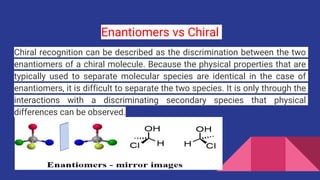
Chiral recognition can be described as the discrimination between the two
enantiomers of a chiral molecule. Because the physical properties that are
typically used to separate molecular species are identical in the case of
enantiomers, it is difficult to separate the two species. It is only through the
interactions with a discriminating secondary species that physical
differences can be observed.
Enantiomers vs Chiral
● The structural basis of enantiomerism is called chirality.
● Enantiomers are a pair of molecules that exist in two forms that are mirror
images of one another but cannot be superimposed one upon the other.
● Enantiomers are in every other respect chemically identical. A pair of
enantiomers is distinguished by the direction in which when dissolved in
solution they rotate polarized light either dextro (d or +) or levo (l or -) rotatory,
hence the term optical isomers.
● When two enantiomers are present in equal proportions they are collectively
referred to as a racemic mixture that does not rotate polarized light because the
optical activity of each enantiomer is cancelled by the other.
Structure of Enantiomers
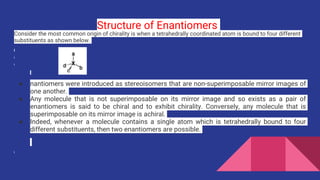
Consider the most common origin of chirality is when a tetrahedrally coordinated atom is bound to four different
substituents as shown below.
● nantiomers were introduced as stereoisomers that are non-superimposable mirror images of
one another.
● Any molecule that is not superimposable on its mirror image and so exists as a pair of
enantiomers is said to be chiral and to exhibit chirality. Conversely, any molecule that is
superimposable on its mirror image is achiral.
● Indeed, whenever a molecule contains a single atom which is tetrahedrally bound to four
different substituents, then two enantiomers are possible.
Structure of Enantiomers
● It is however important that the four substituents are different to one another
as if any two of them are identical then the structure would become
superimposable on its mirror image and so achiral. The atom connected to
four different atoms is best referred to as a stereogenic centre or simply a
stereocenter.
● A widely used although somewhat misleading alternative name for a
stereocenter is a localized around the central atom, whereas chirality is a
property of the molecule as a whole that cannot be localized around one
atom or a group of atoms.
● The presence of a stereocenter is not a requirement for a molecule to exhibit
chirality; it is simply the most common cause of chirality.
Properties of Enantiomers
● Enantiomers generally have identical physical properties such as melting point,
boiling point, infrared absorptions and NMR spectra.
● It is important to realize however, that whilst the melting point etc of one
enantiomer will be identical to that of the other enantiomer, the melting point of
a mixture of the two enantiomers may be different.
● This is because the intermolecular interactions between opposite enantiomers
that are between the R and S enantiomers may be -different to those between
like enantiomers that are between two molecules both of R or both of S
stereochemistry.
Properties of Enantiomers
● The one class of physical techniques that can distinguish between the two
enantiomers of a compound are chiroptical techniques, the most common of
which is optical rotation.
● The chiroptical properties of a molecule are determined not just by the bond
lengths and angles but also by the sign and magnitude of the torsional angles,
the sign of the torsional angles being the one difference between enantiomers

Enantiomer

  • 1.
  • 2.
    What is anEnantiomer? Enantiomers are a pair of molecules that exist in two forms that are mirror images of one another but cannot be superimposed one upon the other.
  • 3.
    What is anEnantiomer? Enantiomers are in every other respect chemically identical. A pair of enantiomers is distinguished by the direction in which when dissolved in solution they rotate polarized light, either dextro (d or +) or levo (l or -) rotatory; hence the term optical isomers. When two enantiomers are present in equal proportions they are collectively referred to as a racemic mixture, a mixture that does not rotate polarized light because the optical activity of each enantiomer is cancelled by the other.
  • 4.
    Enantiomers vs Chiral Chiralrecognition can be described as the discrimination between the two enantiomers of a chiral molecule. Because the physical properties that are typically used to separate molecular species are identical in the case of enantiomers, it is difficult to separate the two species. It is only through the interactions with a discriminating secondary species that physical differences can be observed.
  • 5.
    Enantiomers vs Chiral ●The structural basis of enantiomerism is called chirality. ● Enantiomers are a pair of molecules that exist in two forms that are mirror images of one another but cannot be superimposed one upon the other. ● Enantiomers are in every other respect chemically identical. A pair of enantiomers is distinguished by the direction in which when dissolved in solution they rotate polarized light either dextro (d or +) or levo (l or -) rotatory, hence the term optical isomers. ● When two enantiomers are present in equal proportions they are collectively referred to as a racemic mixture that does not rotate polarized light because the optical activity of each enantiomer is cancelled by the other.
  • 6.
    Structure of Enantiomers Considerthe most common origin of chirality is when a tetrahedrally coordinated atom is bound to four different substituents as shown below. ● nantiomers were introduced as stereoisomers that are non-superimposable mirror images of one another. ● Any molecule that is not superimposable on its mirror image and so exists as a pair of enantiomers is said to be chiral and to exhibit chirality. Conversely, any molecule that is superimposable on its mirror image is achiral. ● Indeed, whenever a molecule contains a single atom which is tetrahedrally bound to four different substituents, then two enantiomers are possible.
  • 7.
    Structure of Enantiomers ●It is however important that the four substituents are different to one another as if any two of them are identical then the structure would become superimposable on its mirror image and so achiral. The atom connected to four different atoms is best referred to as a stereogenic centre or simply a stereocenter. ● A widely used although somewhat misleading alternative name for a stereocenter is a localized around the central atom, whereas chirality is a property of the molecule as a whole that cannot be localized around one atom or a group of atoms. ● The presence of a stereocenter is not a requirement for a molecule to exhibit chirality; it is simply the most common cause of chirality.
  • 8.
    Properties of Enantiomers ●Enantiomers generally have identical physical properties such as melting point, boiling point, infrared absorptions and NMR spectra. ● It is important to realize however, that whilst the melting point etc of one enantiomer will be identical to that of the other enantiomer, the melting point of a mixture of the two enantiomers may be different. ● This is because the intermolecular interactions between opposite enantiomers that are between the R and S enantiomers may be -different to those between like enantiomers that are between two molecules both of R or both of S stereochemistry.
  • 9.
    Properties of Enantiomers ●The one class of physical techniques that can distinguish between the two enantiomers of a compound are chiroptical techniques, the most common of which is optical rotation. ● The chiroptical properties of a molecule are determined not just by the bond lengths and angles but also by the sign and magnitude of the torsional angles, the sign of the torsional angles being the one difference between enantiomers