Copyright 2011 Digital Enterprise Research Institute. All rights reserved.
Digital Enterprise Research Institute www.deri.ie
Enabling Networked Knowledge
Enabling reuse
of arguments and opinions
in open collaboration systems
Jodi Schneider
Tuesday 1 October 2013
1
Ph.D. viva
Galway, Ireland
How can we make sense of disagreement?
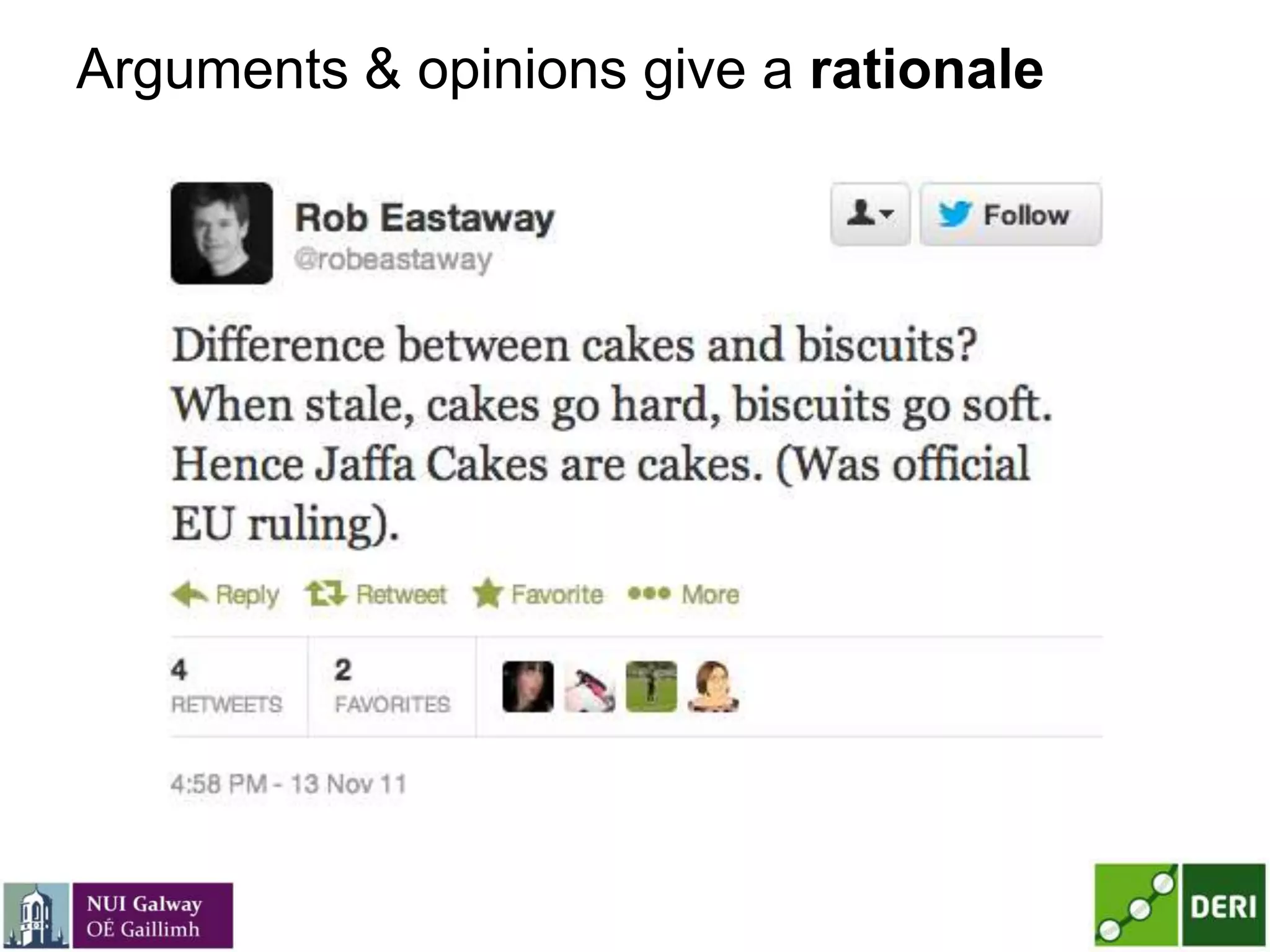
Arguments & opinions give a rationale
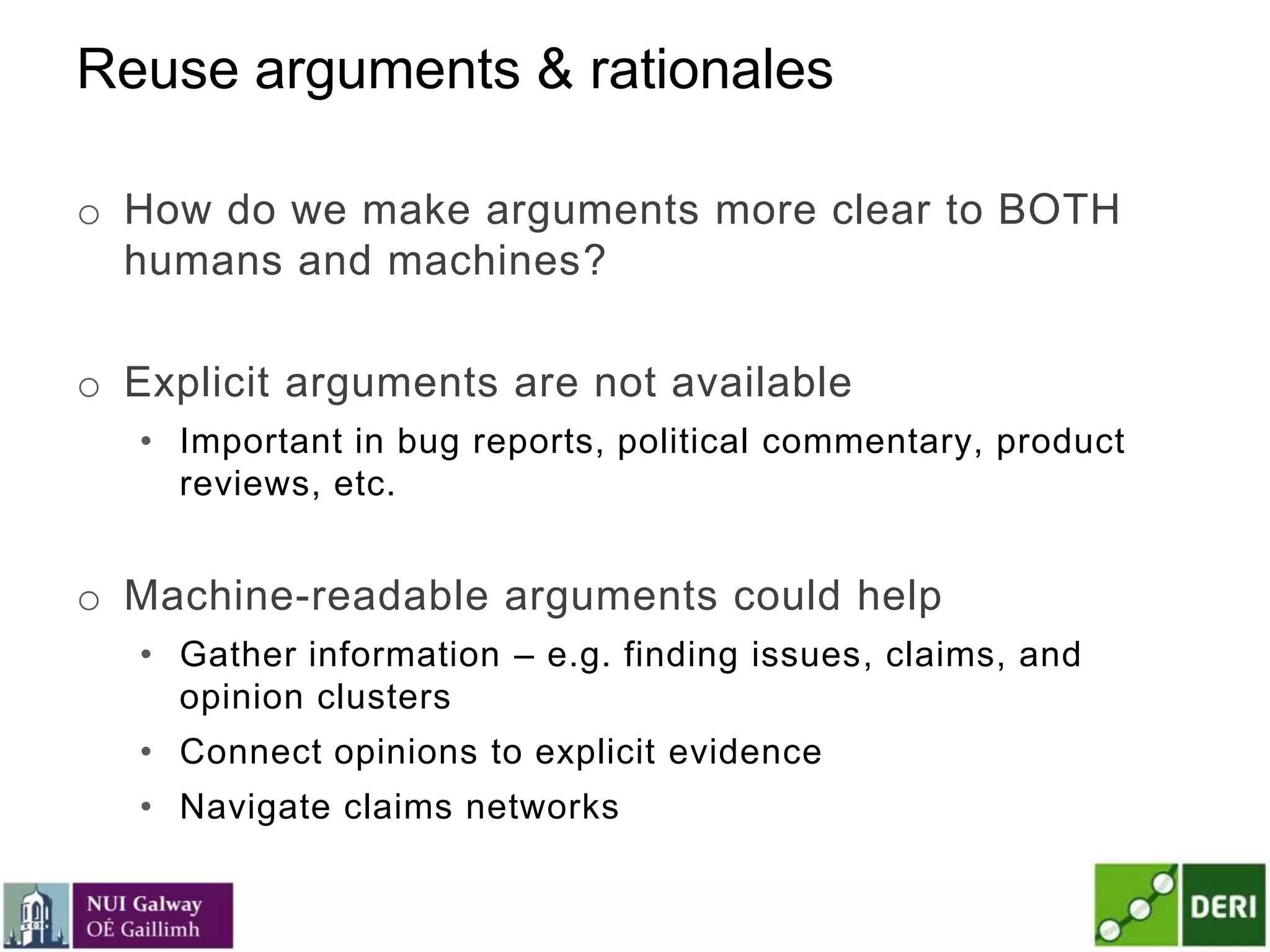
Reuse arguments & rationales
o How do we make arguments more clear to BOTH
humans and machines?
o Explicit arguments are not available
• Important in bug reports, political commentary, product
reviews, etc.
o Machine-readable arguments could help
• Gather information – e.g. finding issues, claims, and
opinion clusters
• Connect opinions to explicit evidence
• Navigate claims networks
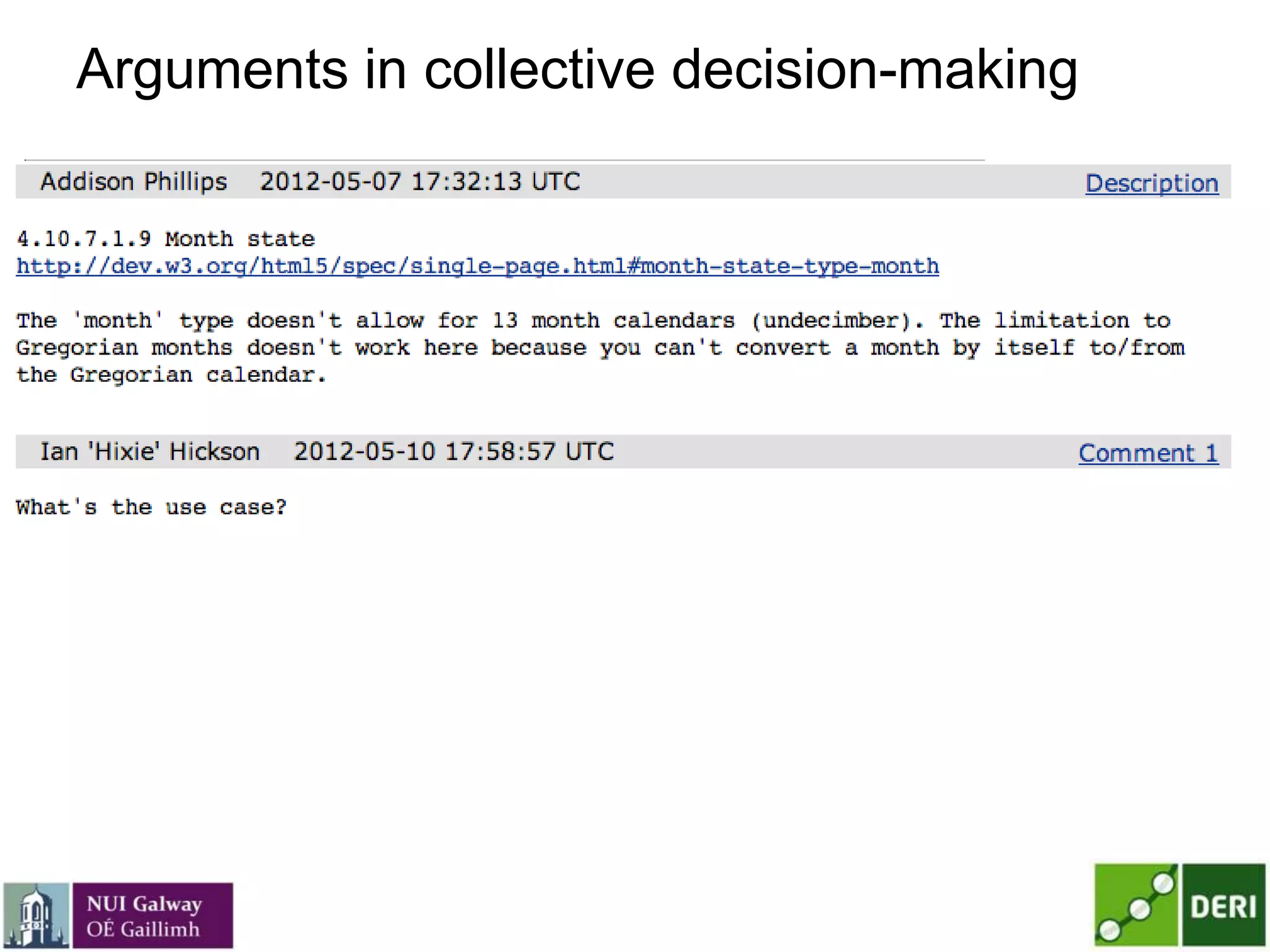
Arguments in collective decision-making
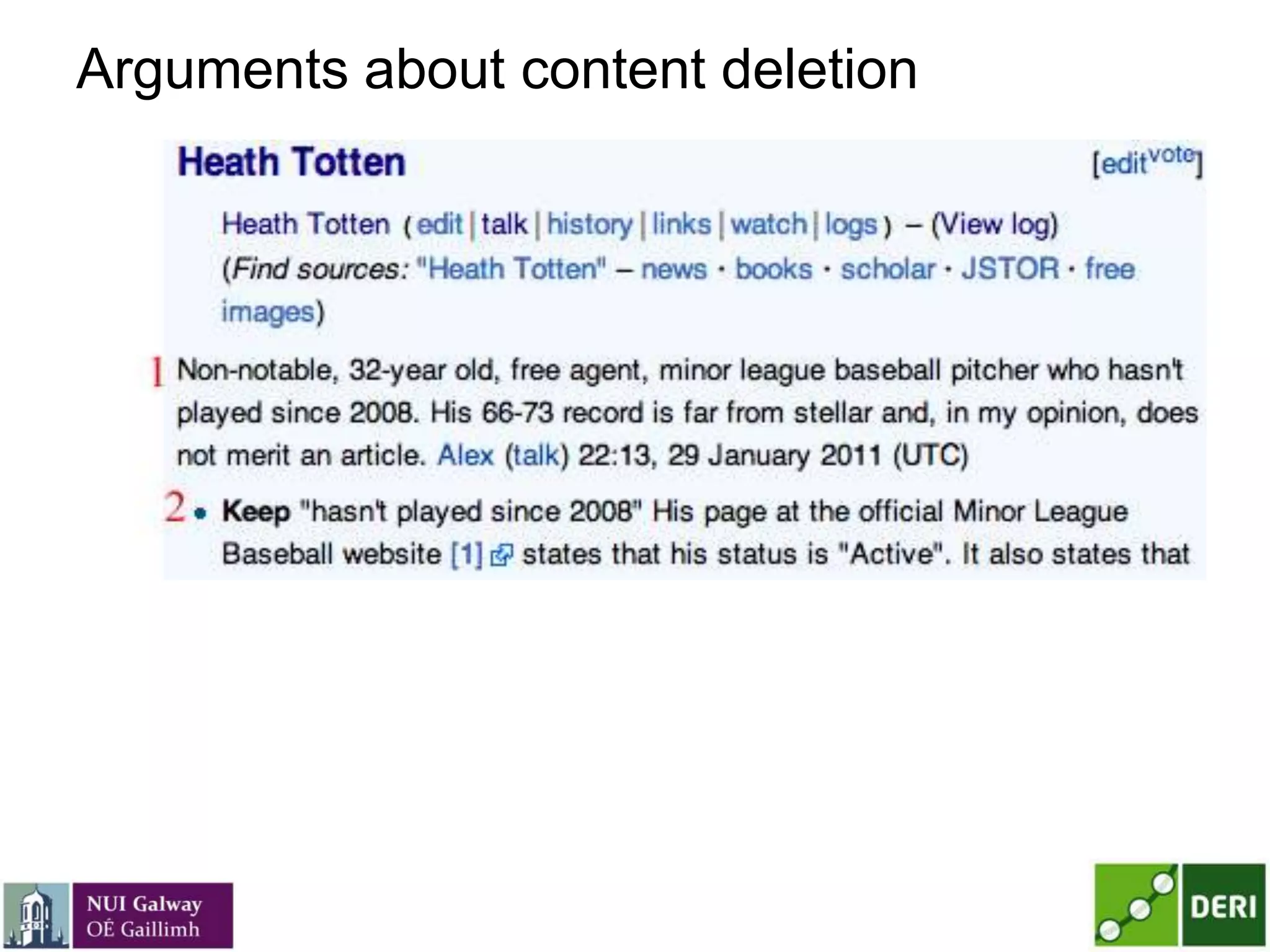
Arguments about content deletion
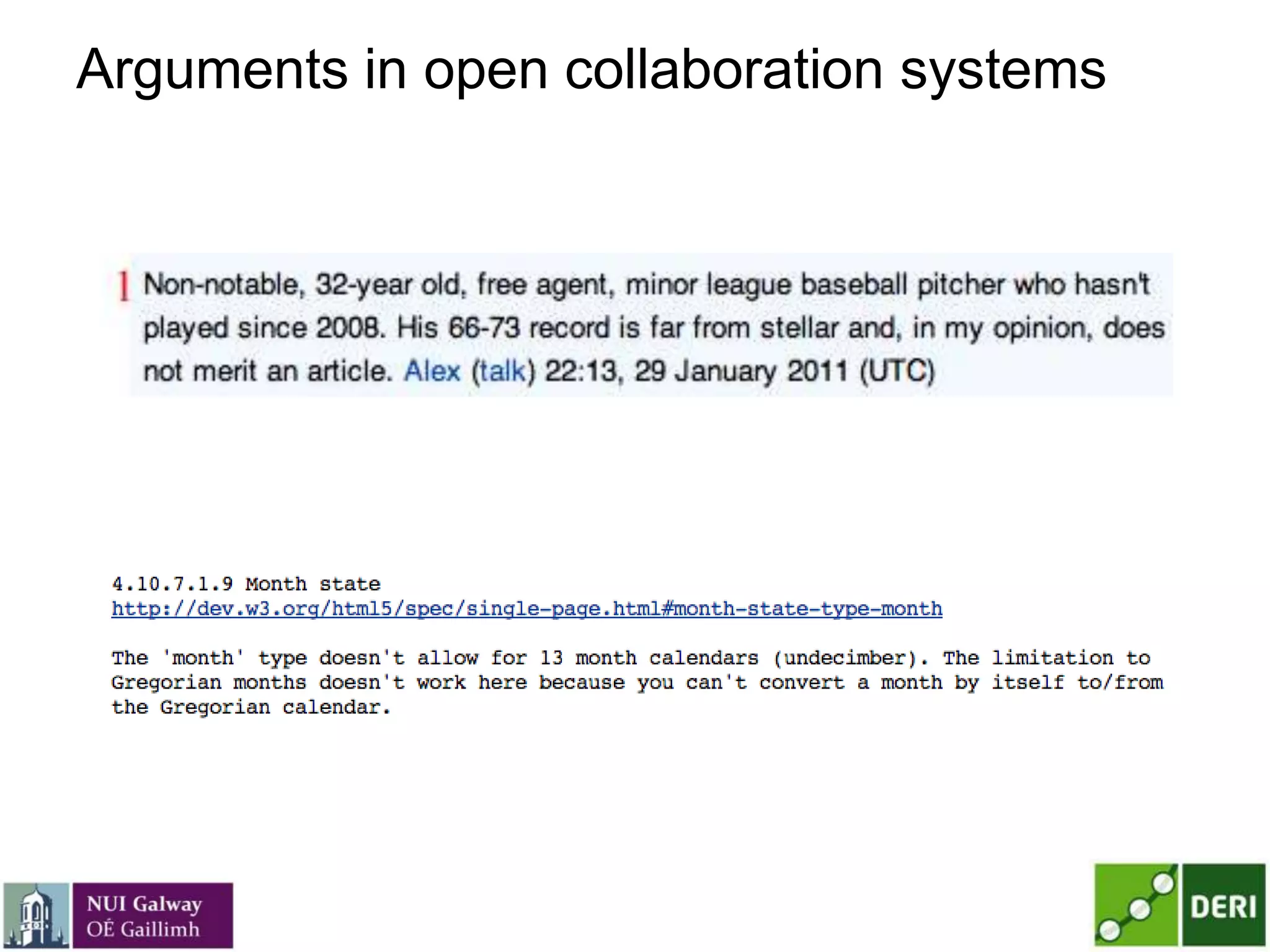
Arguments in open collaboration systems
Open collaboration systems
―people form ties with others & create things together‖
(Forte and Lampe 2013)
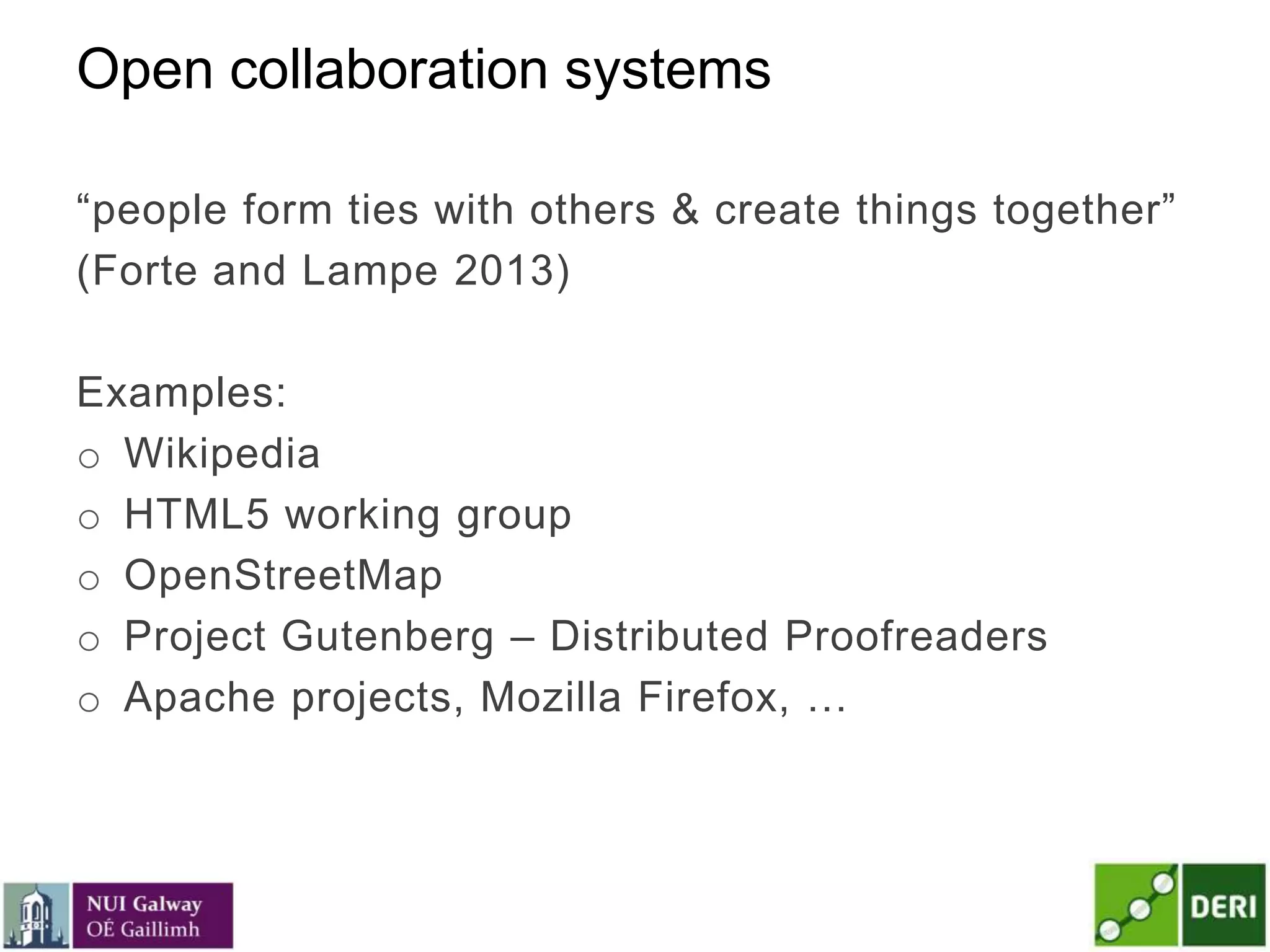
Open collaboration systems
―people form ties with others & create things together‖
(Forte and Lampe 2013)
Examples:
o Wikipedia
o HTML5 working group
o OpenStreetMap
o Project Gutenberg – Distributed Proofreaders
o Apache projects, Mozilla Firefox, …
How do we enable the reuse of
arguments and opinions
in open collaboration systems?
Use case: deletion in Wikipedia
o 1 in 4 new Wikipedia articles is deleted – within
minutes or hours
o Demotivating!
• 1 in 3 newcomers start by writing a new article
• 7X less likely to stay if their article is deleted!
o Can we support editor retention?
Source: http://enwp.org/Wikipedia:Wikipedia_Signpost/2011-04-04/Editor_retention
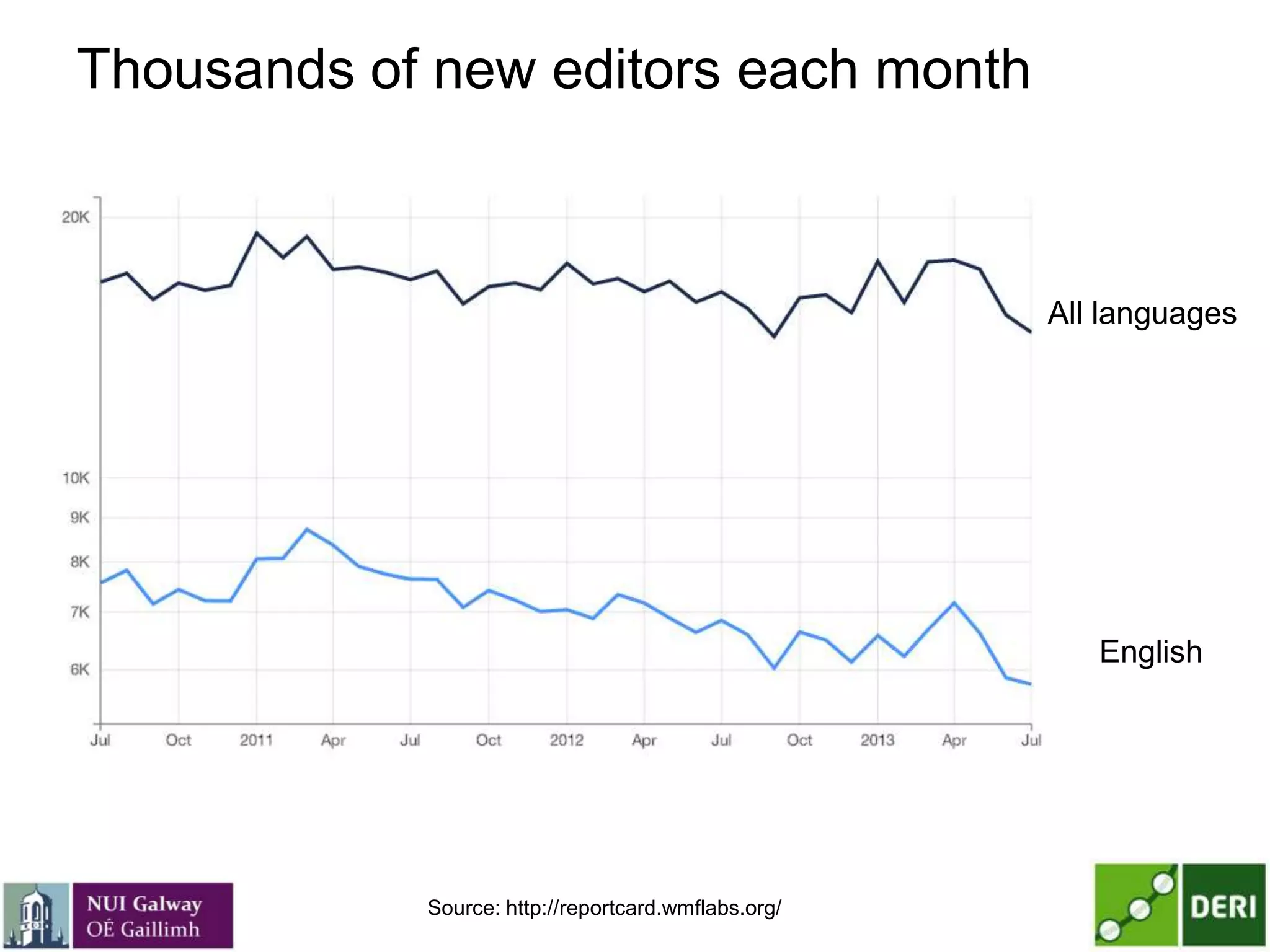
Thousands of new editors each month
Source: http://reportcard.wmflabs.org/
English
All languages
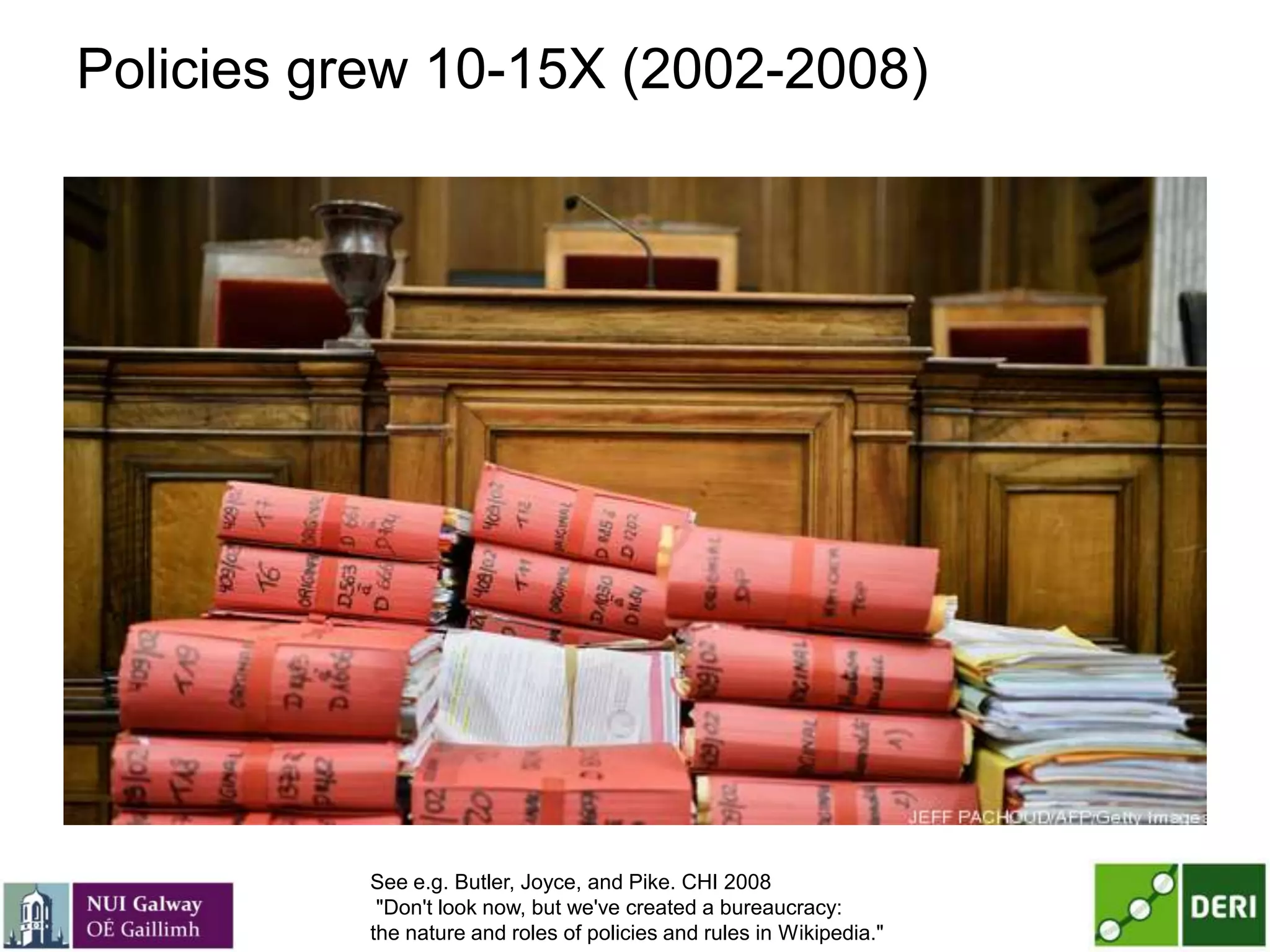
Policies grew 10-15X (2002-2008)
See e.g. Butler, Joyce, and Pike. CHI 2008
"Don't look now, but we've created a bureaucracy:
the nature and roles of policies and rules in Wikipedia."
Supporting open collaboration systems
o Can we support editor retention?
o Make criteria explicit to:
• Explain community expectations (how to be convincing)
• Support making & auditing decisions
Research Questions
How do we enable
the reuse of arguments and opinions
on the World Wide Web?
o RQ1: What are the opportunities and
requirements for providing argumentation support?
o RQ2: Which arguments are used in open
collaboration systems?
o RQ3: How can we structure and display opinions
and arguments to support their use and reuse?
How do we enable
the reuse of arguments and opinions
on the World Wide Web?
o RQ1: What are the opportunities and requirements
for providing argumentation support?
o RQ2: Which arguments are used in open
collaboration systems?
o RQ3: How can we structure and display opinions
and arguments to support their use and reuse?
How do we enable
the reuse of arguments and opinions
on the World Wide Web?
o RQ1: What are the opportunities and requirements
for providing argumentation support?
o RQ2: Which arguments are used in open
collaboration systems?
o RQ3: How can we structure and display opinions
and arguments to support their use and reuse?
How do we enable
the reuse of arguments and opinions
on the World Wide Web?
o RQ1: What are the opportunities and requirements
for providing argumentation support?
Netnography
o RQ2: Which arguments are used in open
collaboration systems?
Iterative Annotation
o RQ3: How can we structure and display opinions
and arguments to support their use and reuse?
Semantic Web Systems Development
RQ1: What are the opportunities and
requirements for providing
argumentation support?
Methodology: Netnography
Kozinets, Robert V.
Netnography: Doing ethnographic research online.
Sage Publications, 2010.
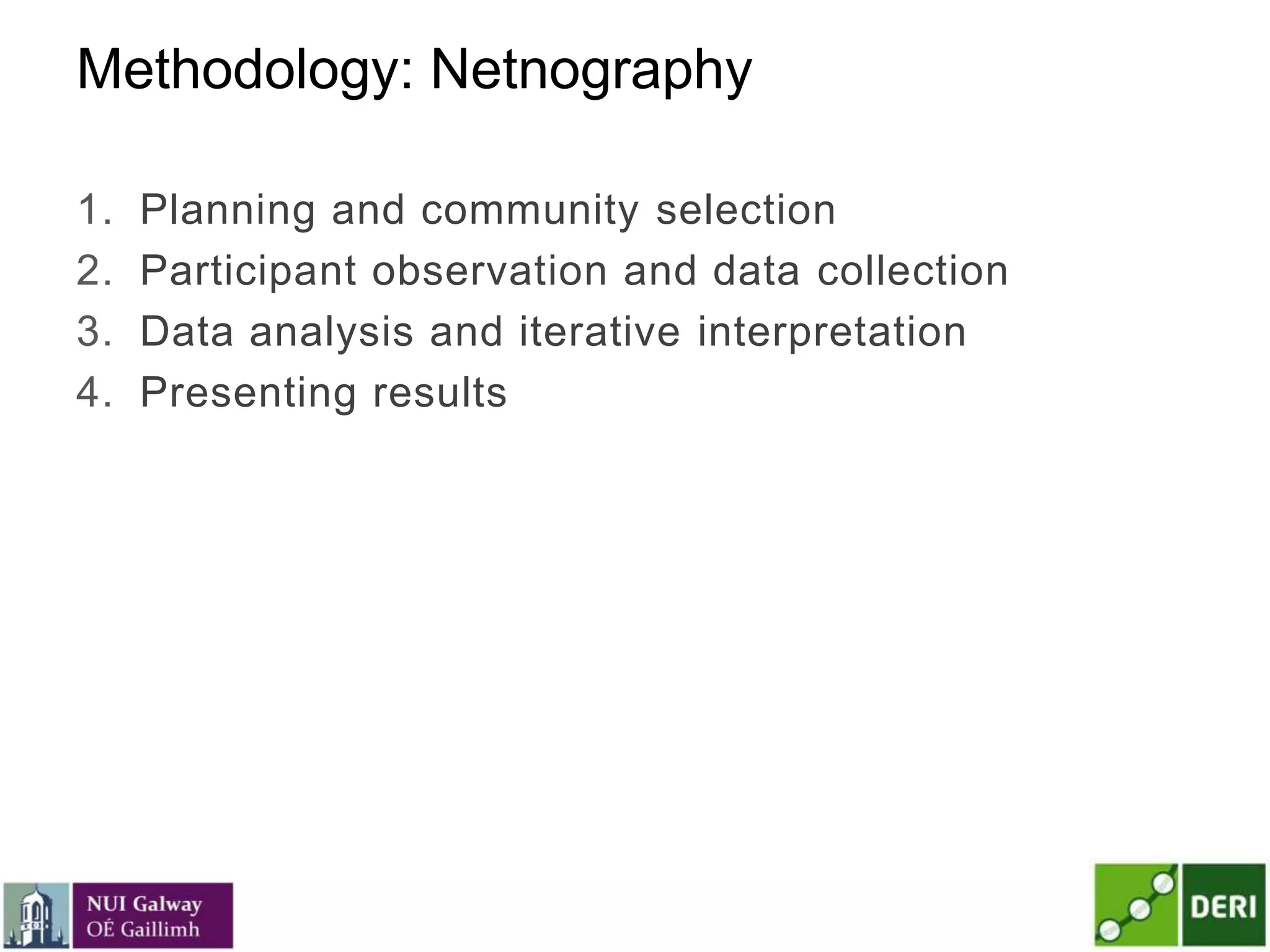
Methodology: Netnography
1. Planning and community selection
2. Participant observation and data collection
3. Data analysis and iterative interpretation
4. Presenting results
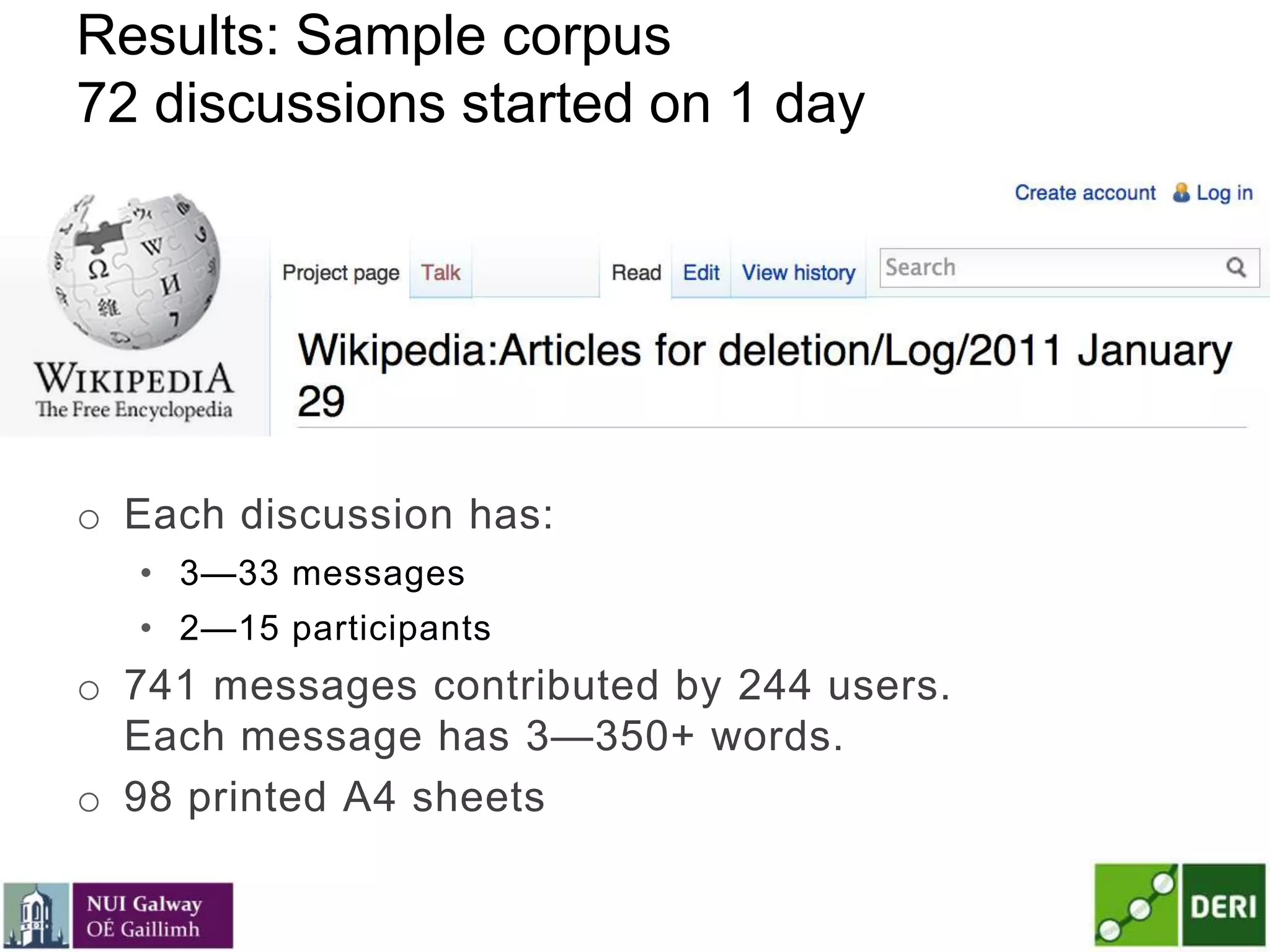
Results: Sample corpus
72 discussions started on 1 day
o Each discussion has:
• 3—33 messages
• 2—15 participants
o 741 messages contributed by 244 users.
Each message has 3—350+ words.
o 98 printed A4 sheets
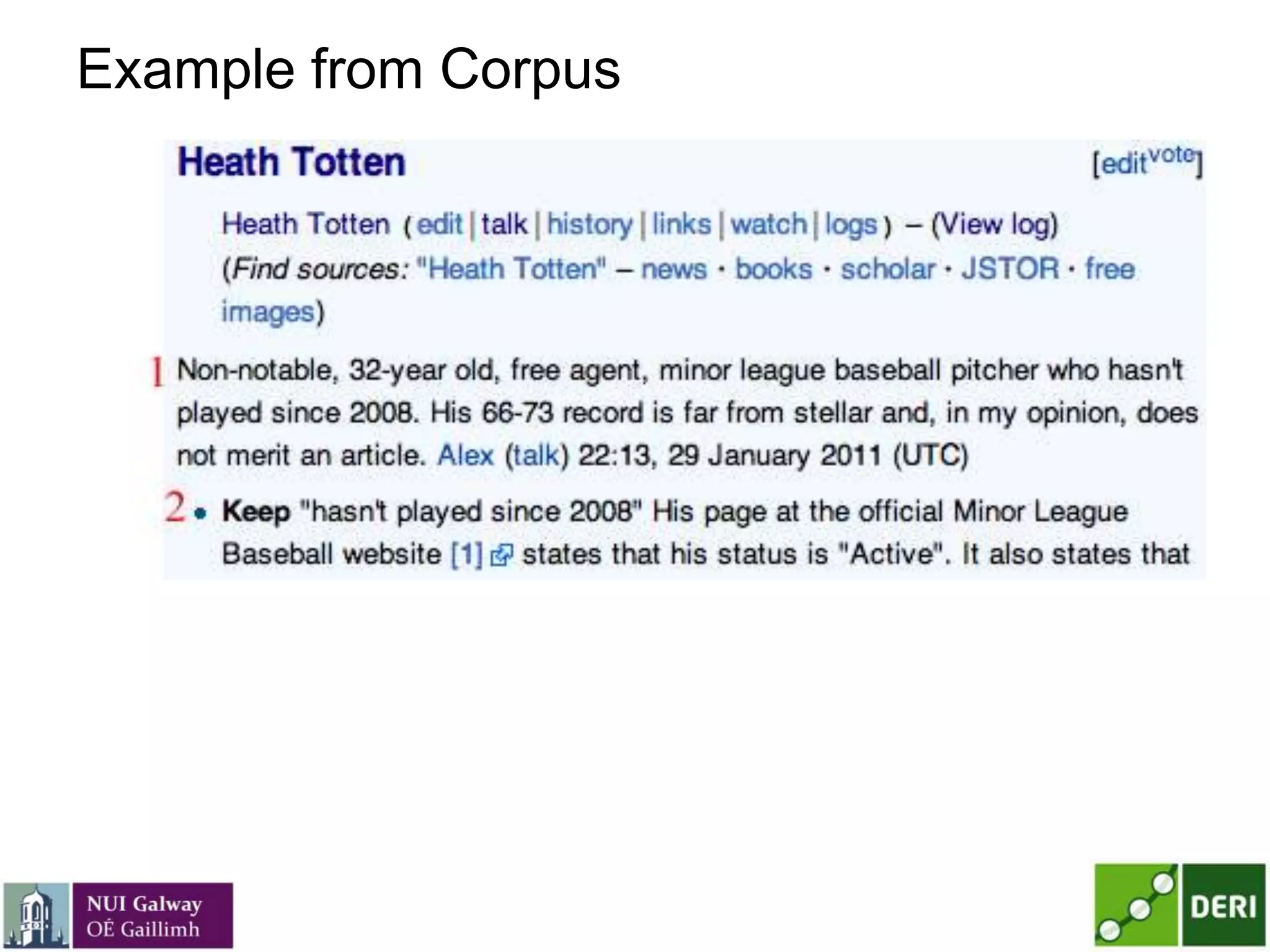
Example from Corpus
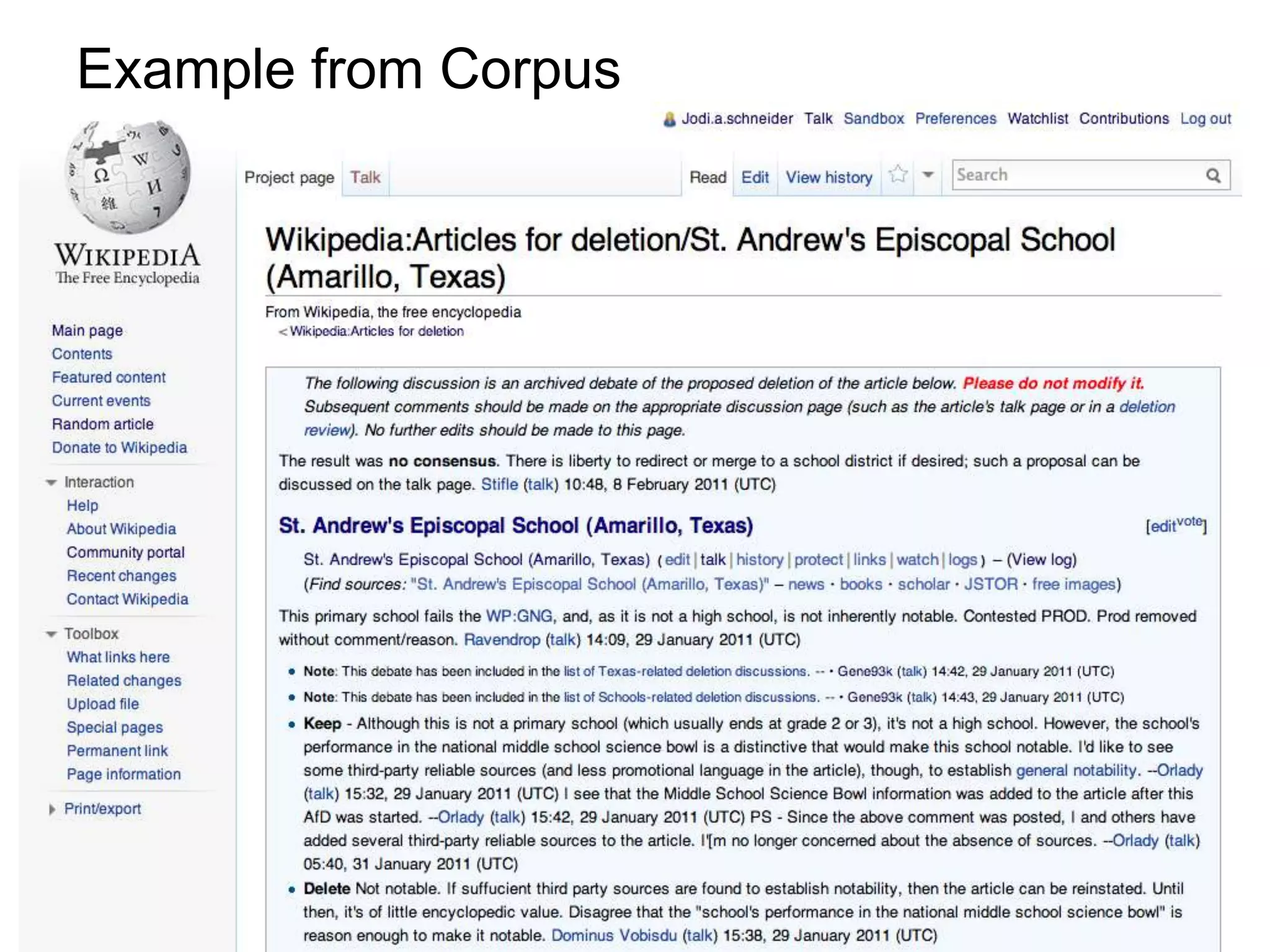
Example from Corpus
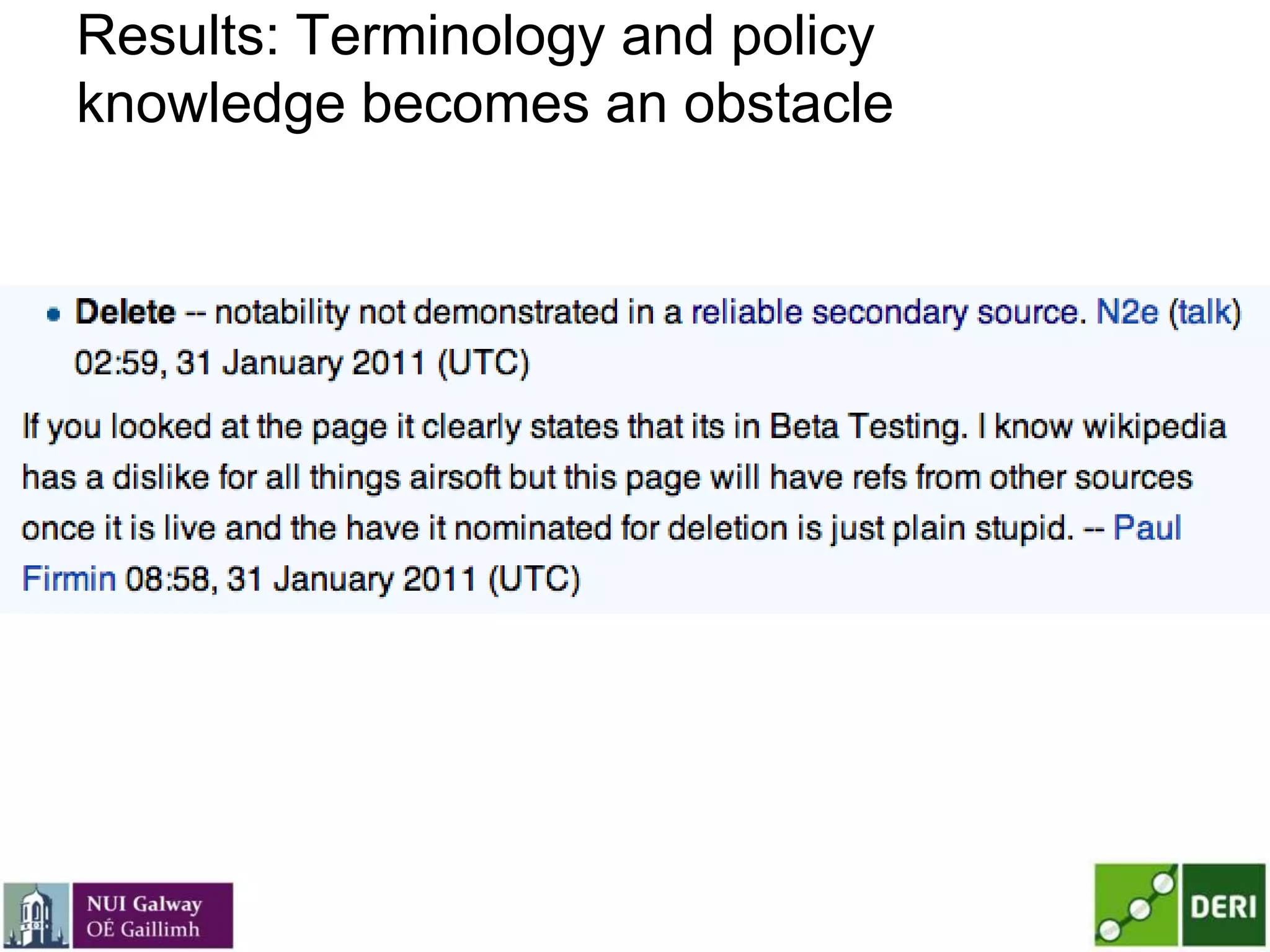
Results: Terminology and policy
knowledge becomes an obstacle
Results: Important tasks
for consensus discussions
1. Determine one’s personal position
2. Express one’s personal position in accordance with
community norms
3. Determine the consensus
RQ2: Which arguments are used in
open collaboration systems?
Methods
o Use corpus of 72 discussions
o Two types of annotation: 2 argumentation theories
o Iterative annotation for each theory
• Multiple annotators
• Refine to get good inter-annotator agreement
• 4 rounds of annotation
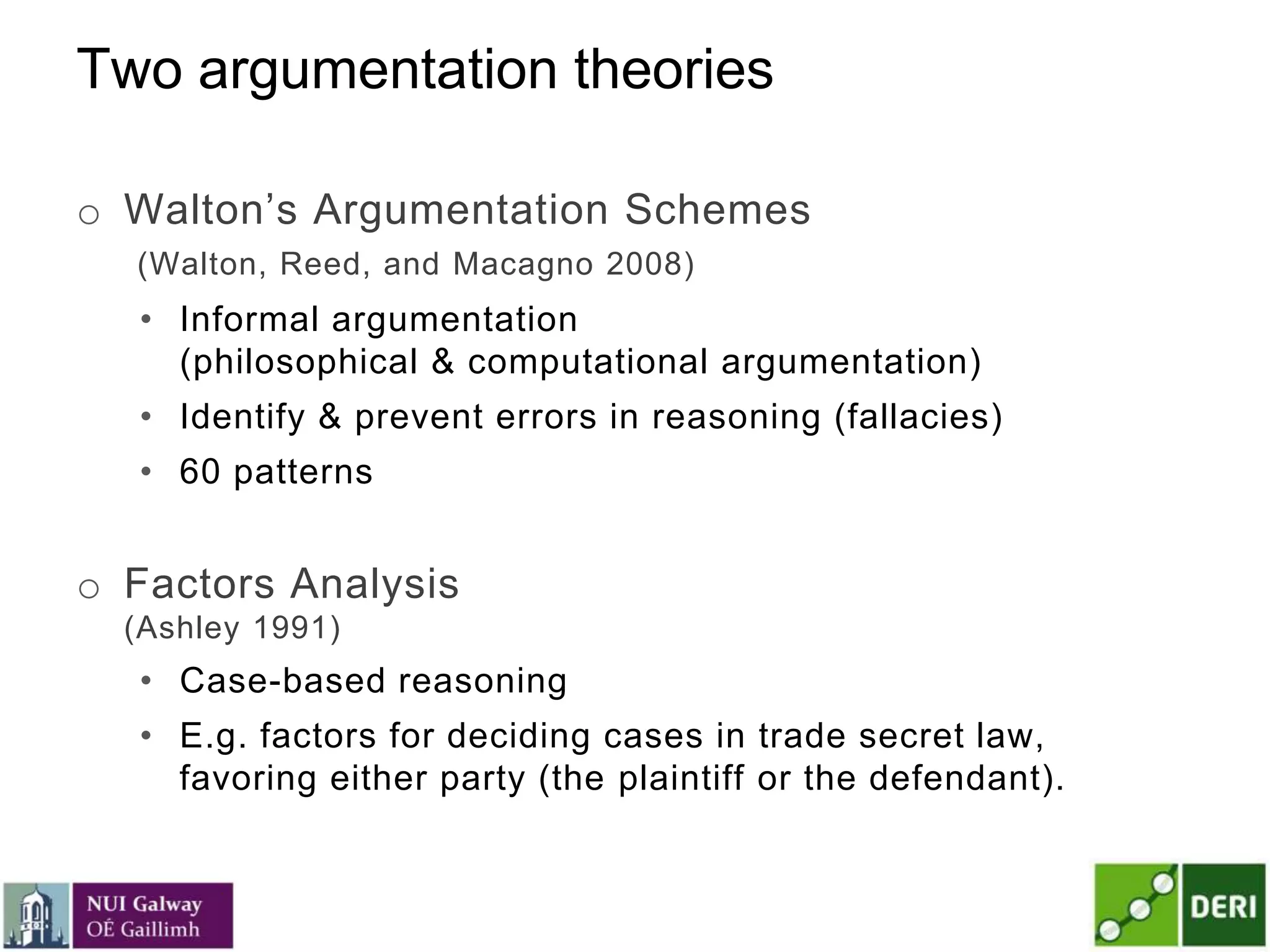
Two argumentation theories
o Walton’s Argumentation Schemes
(Walton, Reed, and Macagno 2008)
• Informal argumentation
(philosophical & computational argumentation)
• Identify & prevent errors in reasoning (fallacies)
• 60 patterns
o Factors Analysis
(Ashley 1991)
• Case-based reasoning
• E.g. factors for deciding cases in trade secret law,
favoring either party (the plaintiff or the defendant).
Walton’s Argumentation Schemes
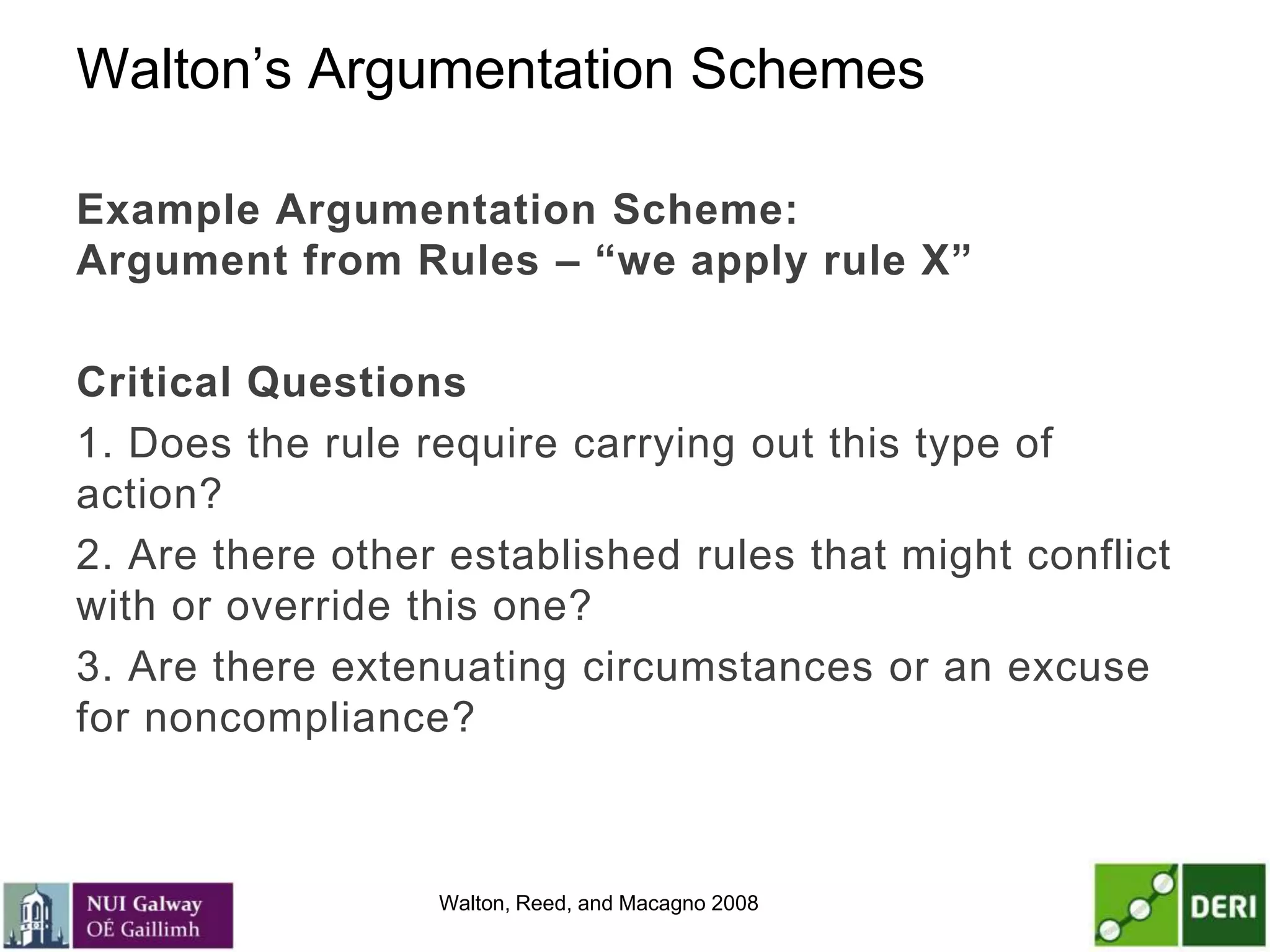
Example Argumentation Scheme:
Argument from Rules – “we apply rule X”
Critical Questions
1. Does the rule require carrying out this type of
action?
2. Are there other established rules that might conflict
with or override this one?
3. Are there extenuating circumstances or an excuse
for noncompliance?
Walton, Reed, and Macagno 2008
Walton’s Argumentation Schemes
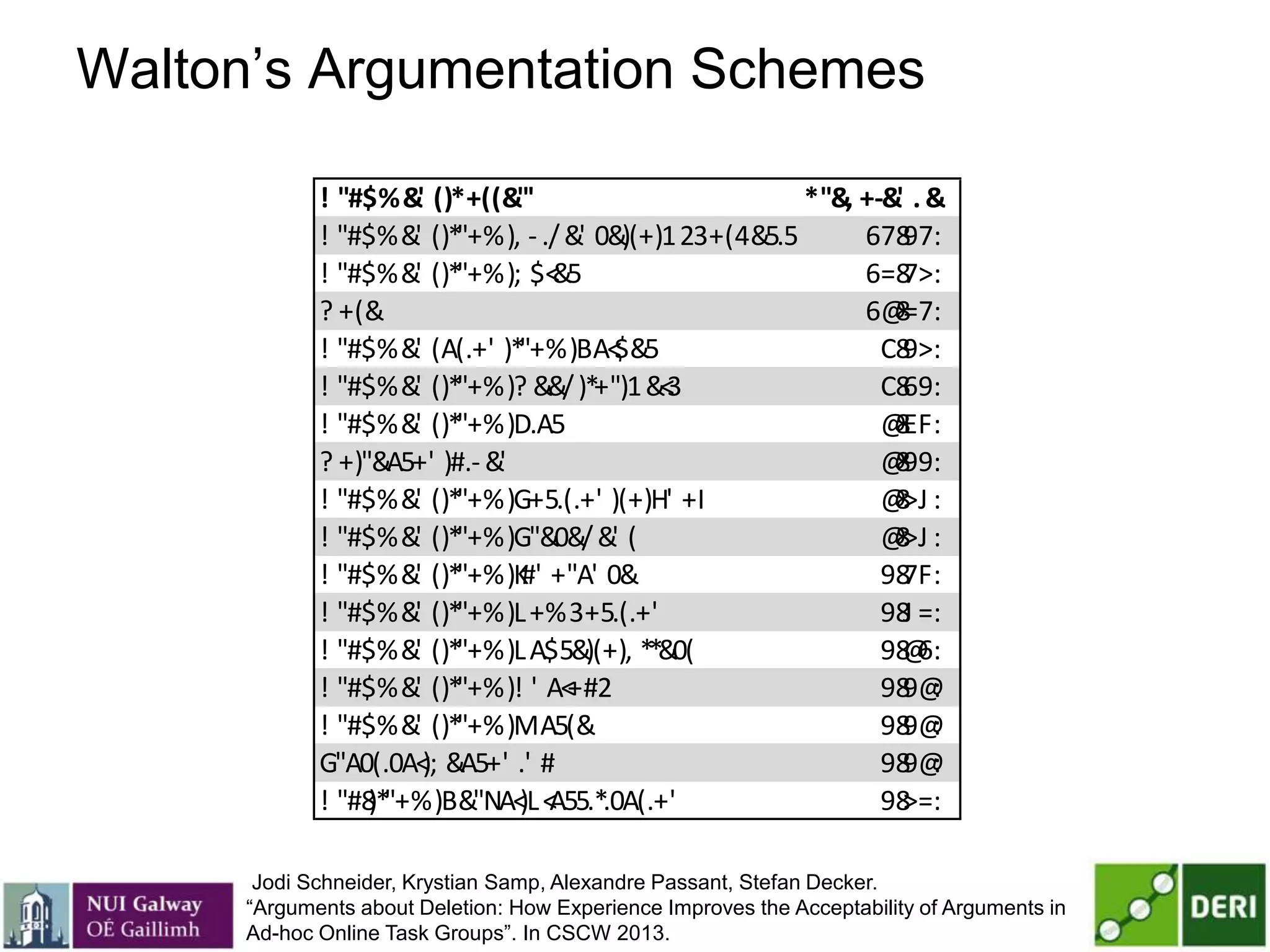
Jodi Schneider, Krystian Samp, Alexandre Passant, Stefan Decker.
―Arguments about Deletion: How Experience Improves the Acceptability of Arguments in
Ad-hoc Online Task Groups‖. In CSCW 2013.
! "#$%&' ()*+((&"' *"&, +-&' . &
! "#$%&' ()*"+%), -./&' 0&)(+)123+(4&5.5 67897:
! "#$%&' ()*"+%); $<&5 6=87>:
? +(& 6@8=7:
! "#$%&' (A(.+' )*"+%)BA<$&5 C89>:
! "#$%&' ()*"+%)? &&/)*+")1&<3 C869:
! "#$%&' ()*"+%)D.A5 @8EF:
? +)"&A5+' )#.- &' @899:
! "#$%&' ()*"+%)G+5.(.+' )(+)H' +I @8>J :
! "#$%&' ()*"+%)G"&0&/&' ( @8>J :
! "#$%&' ()*"+%)K#' +"A' 0& 987F:
! "#$%&' ()*"+%)L+%3+5.(.+' 98J =:
! "#$%&' ()*"+%)LA$5&)(+), **&0( 98@6:
! "#$%&' ()*"+%)! ' A<+#2 989@:
! "#$%&' ()*"+%)MA5(& 989@:
G"A0(.0A<); &A5+' .' # 989@:
! "#8)*"+%)B&"NA<)L<A55.*.0A(.+' 98>=:
Factors Analysis
Factors determined
by iterative annotation
Factors Analysis
Factors determined
by iterative annotation
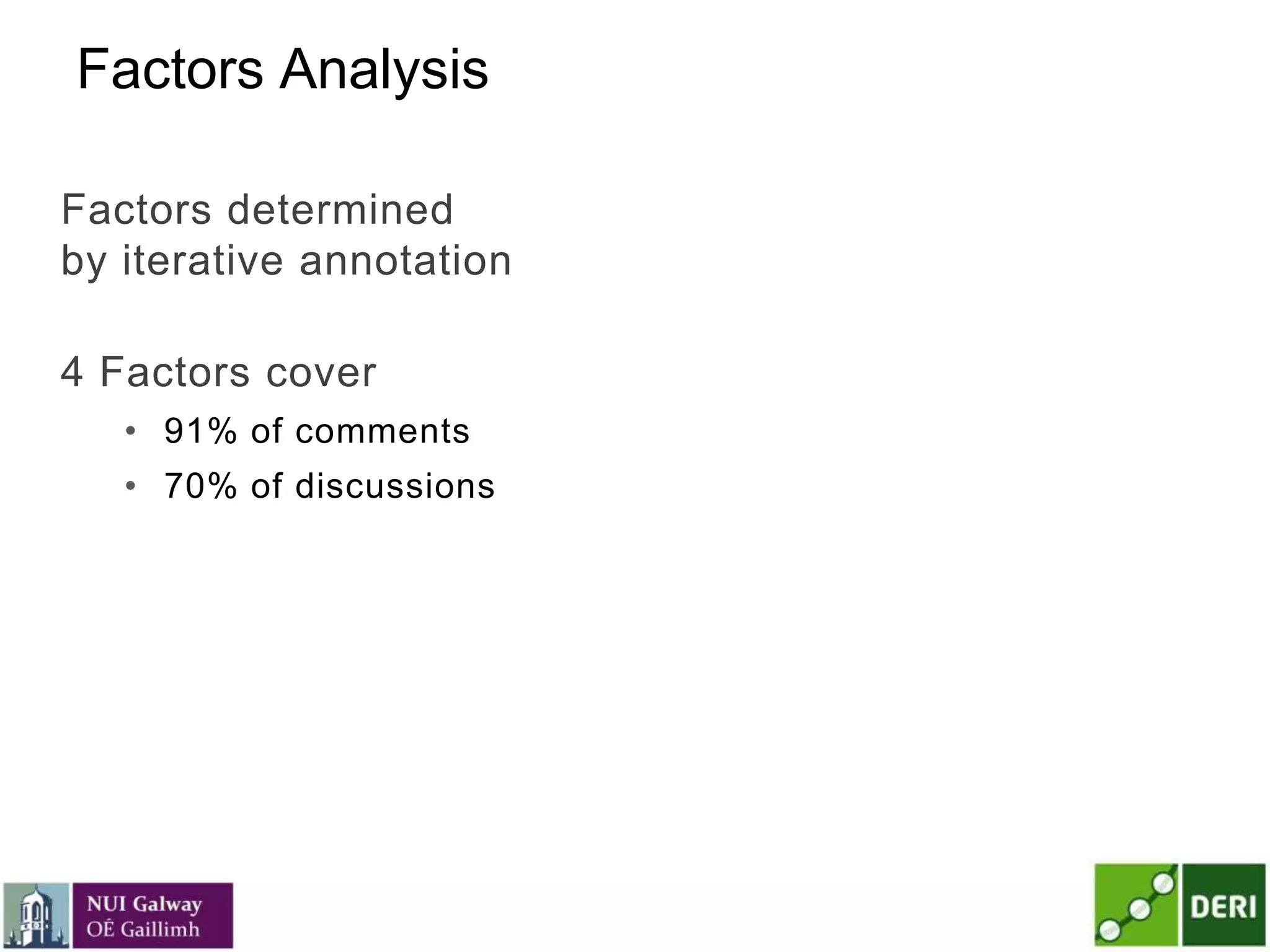
4 Factors cover
• 91% of comments
• 70% of discussions
Factors Analysis
Factors determined
by iterative annotation
4 Factors cover
• 91% of comments
• 70% of discussions
―Other‖ as 5th catchall
Factors Analysis
Factors determined
by iterative annotation
4 Factors cover
• 91% of comments
• 70% of discussions
―Other‖ as 5th catchall
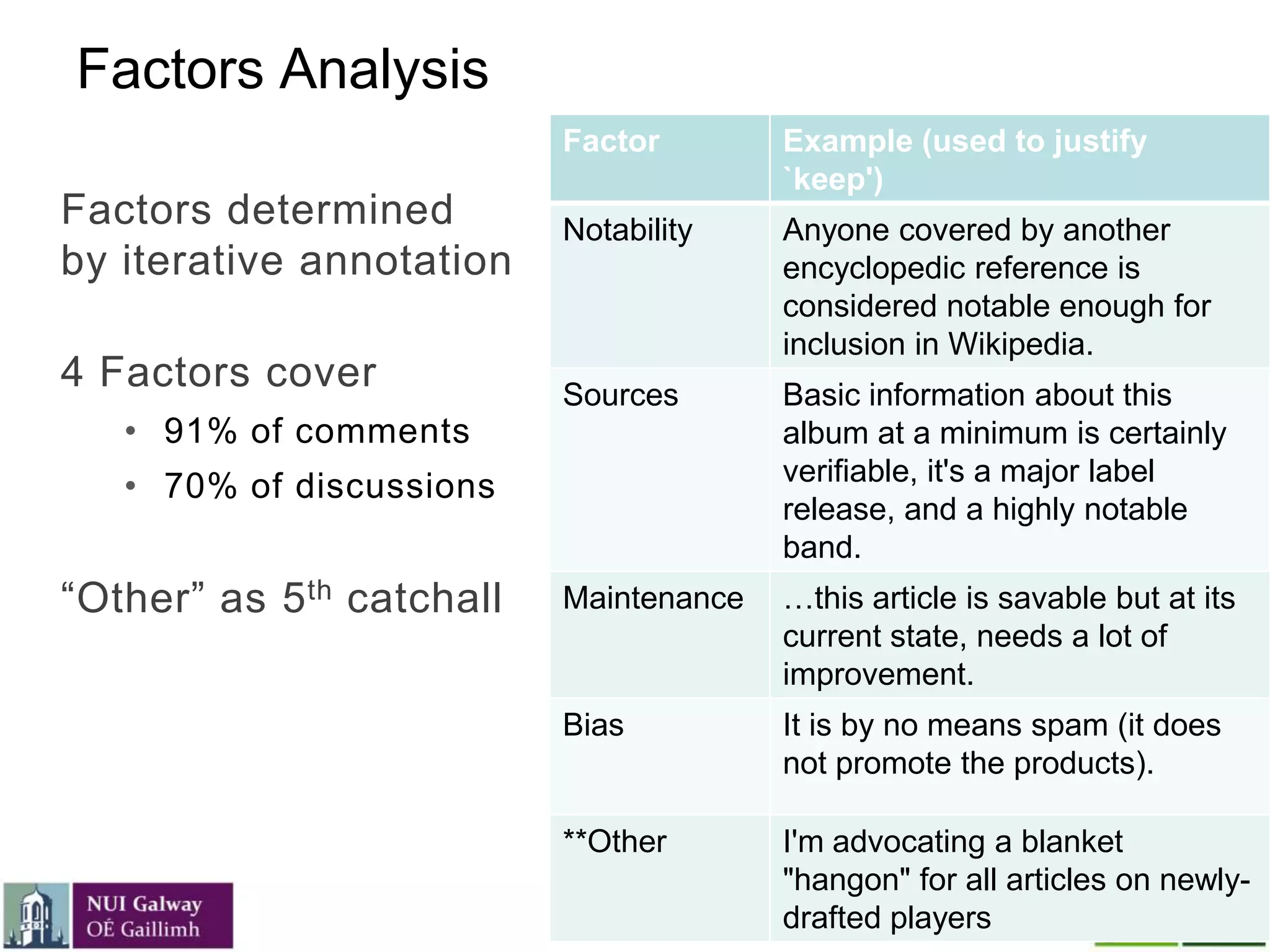
Factor Example (used to justify
`keep')
Notability Anyone covered by another
encyclopedic reference is
considered notable enough for
inclusion in Wikipedia.
Sources Basic information about this
album at a minimum is certainly
verifiable, it's a major label
release, and a highly notable
band.
Maintenance …this article is savable but at its
current state, needs a lot of
improvement.
Bias It is by no means spam (it does
not promote the products).
**Other I'm advocating a blanket
"hangon" for all articles on newly-
drafted players
RQ3: How can we structure and
display opinions and arguments to
support their use and reuse?
Methodology
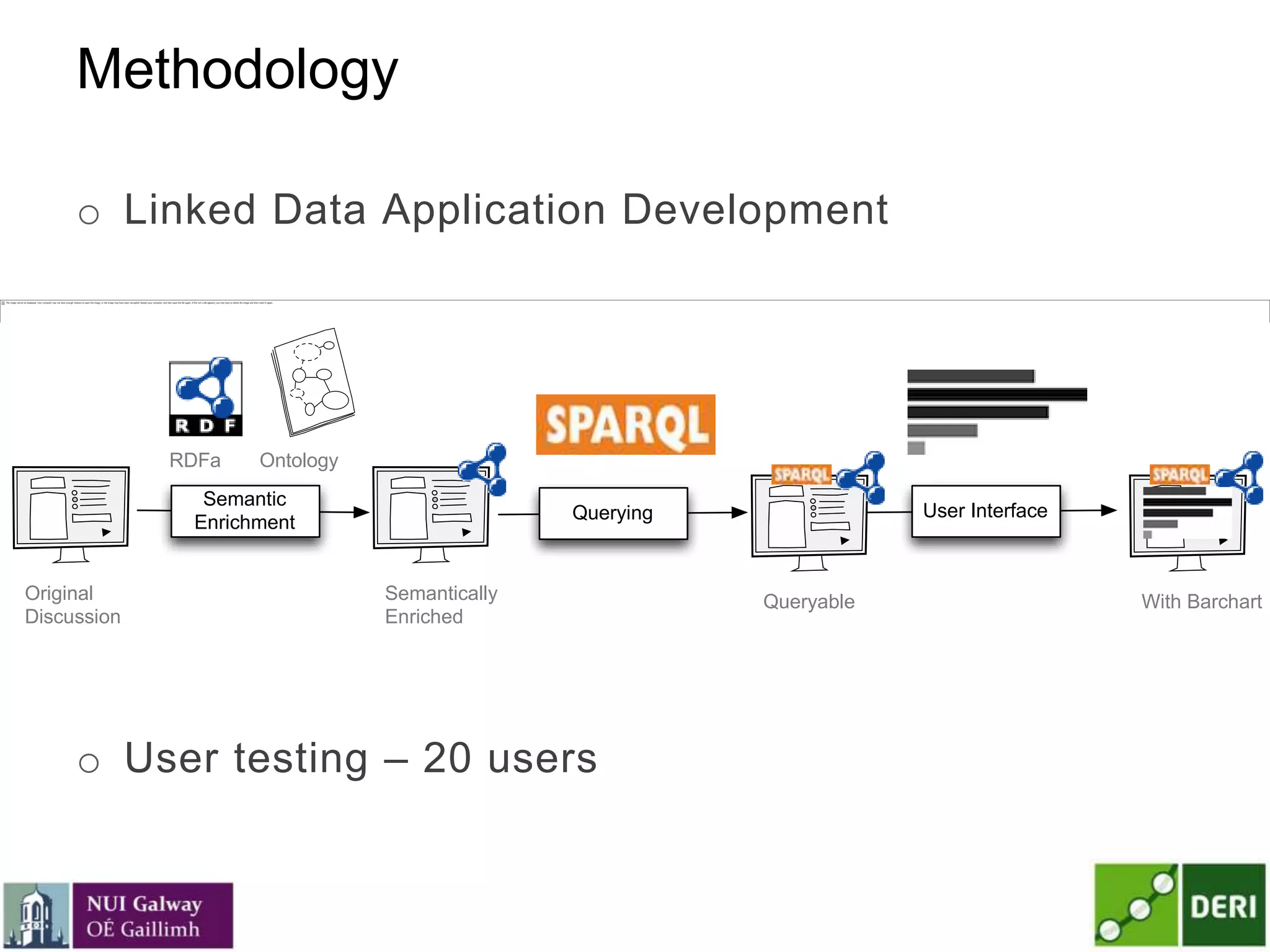
o Linked Data Application Development
o User testing – 20 users
Original
Discussion
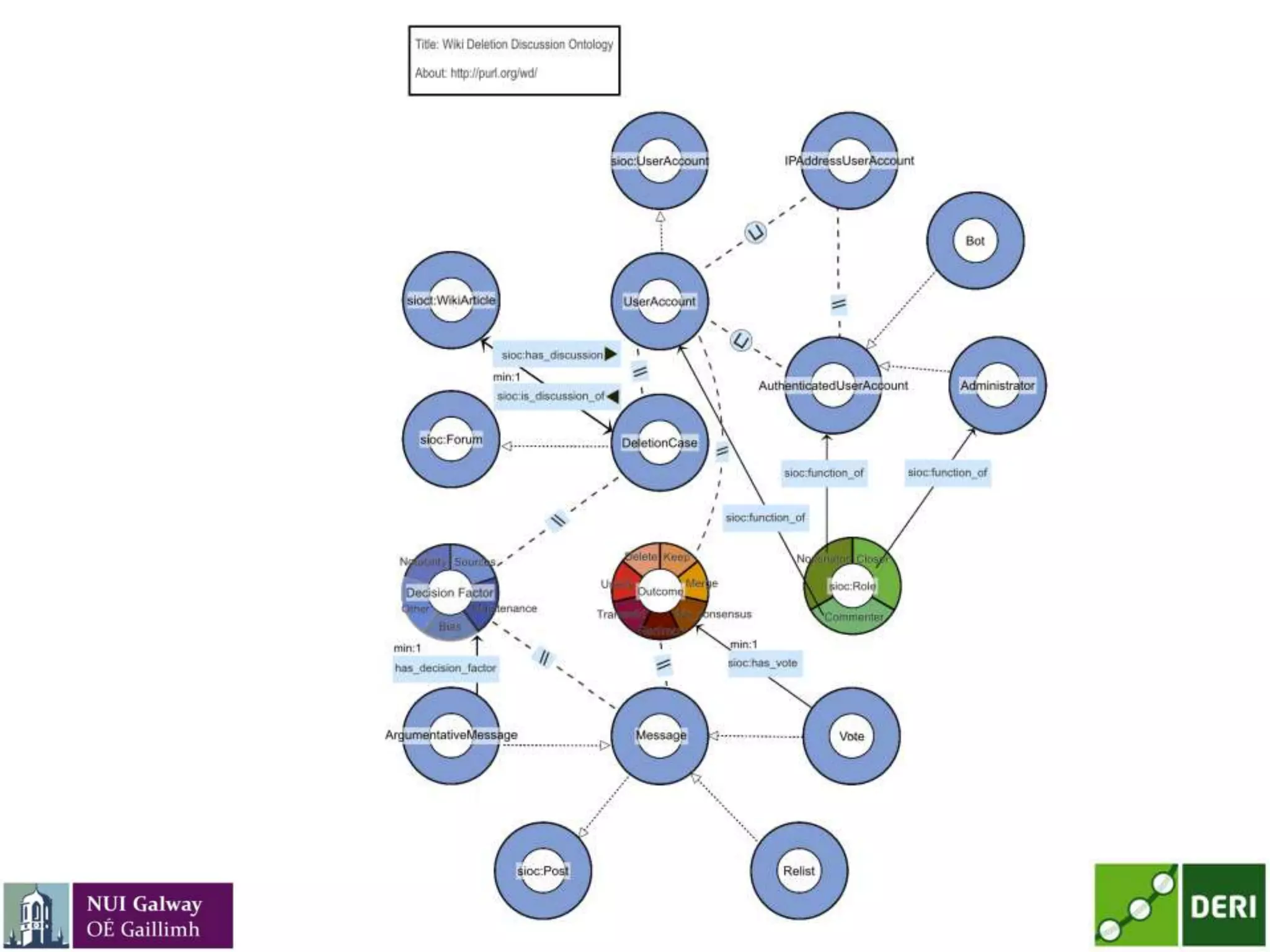
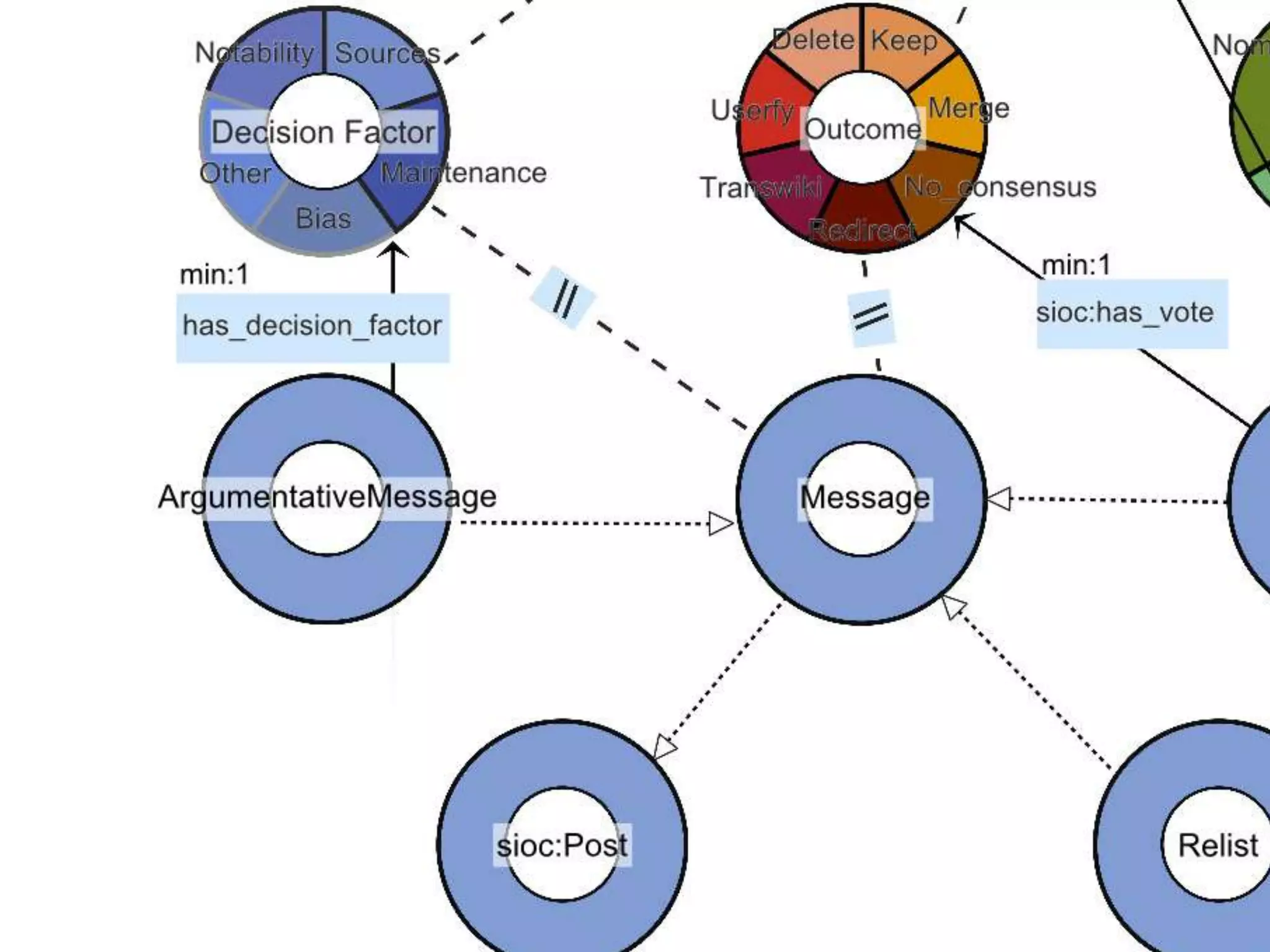
Ontology
Semantic
Enrichment
Semantically
Enriched
RDFa
Querying
Queryable
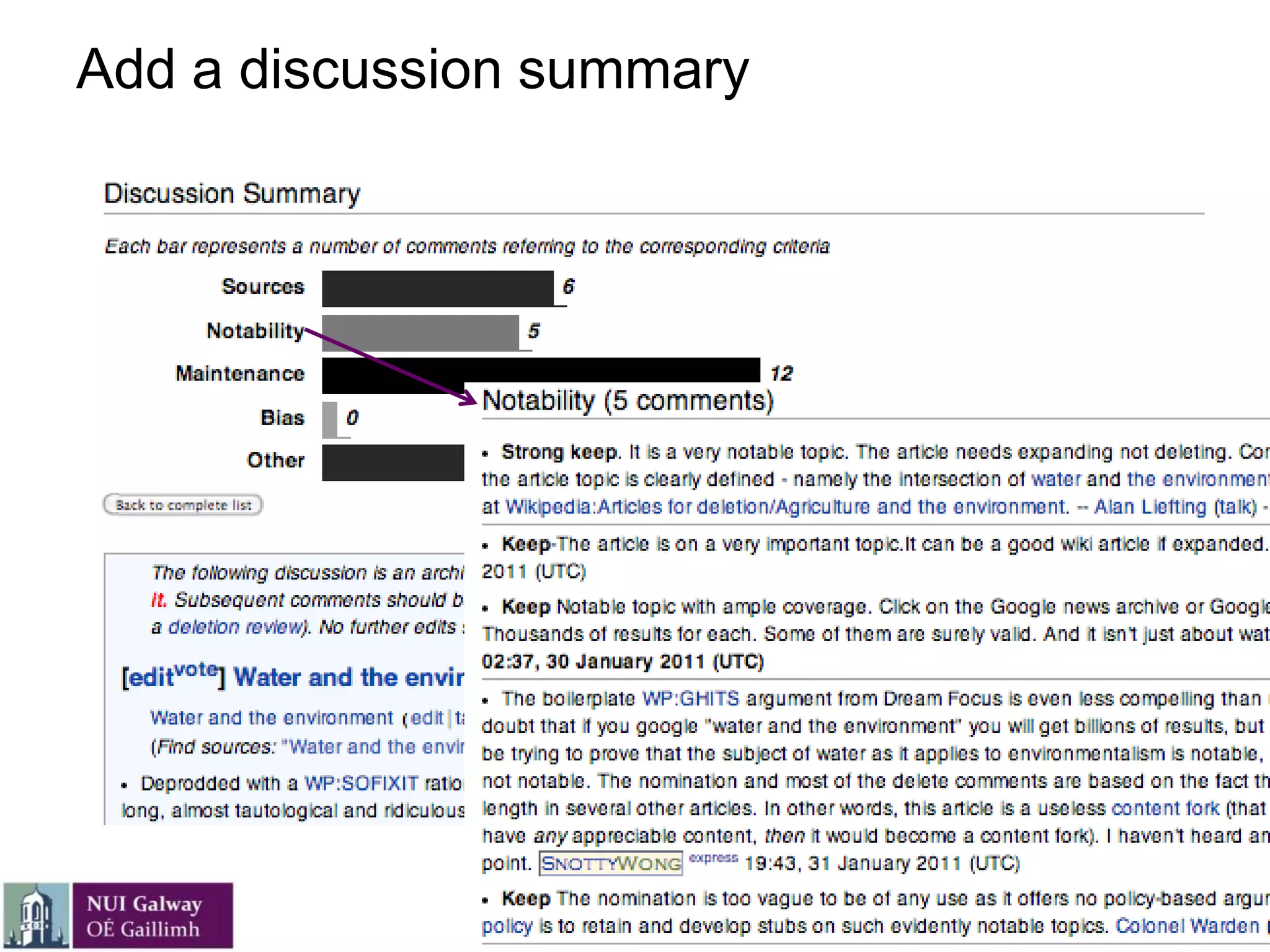
User Interface
With Barchart
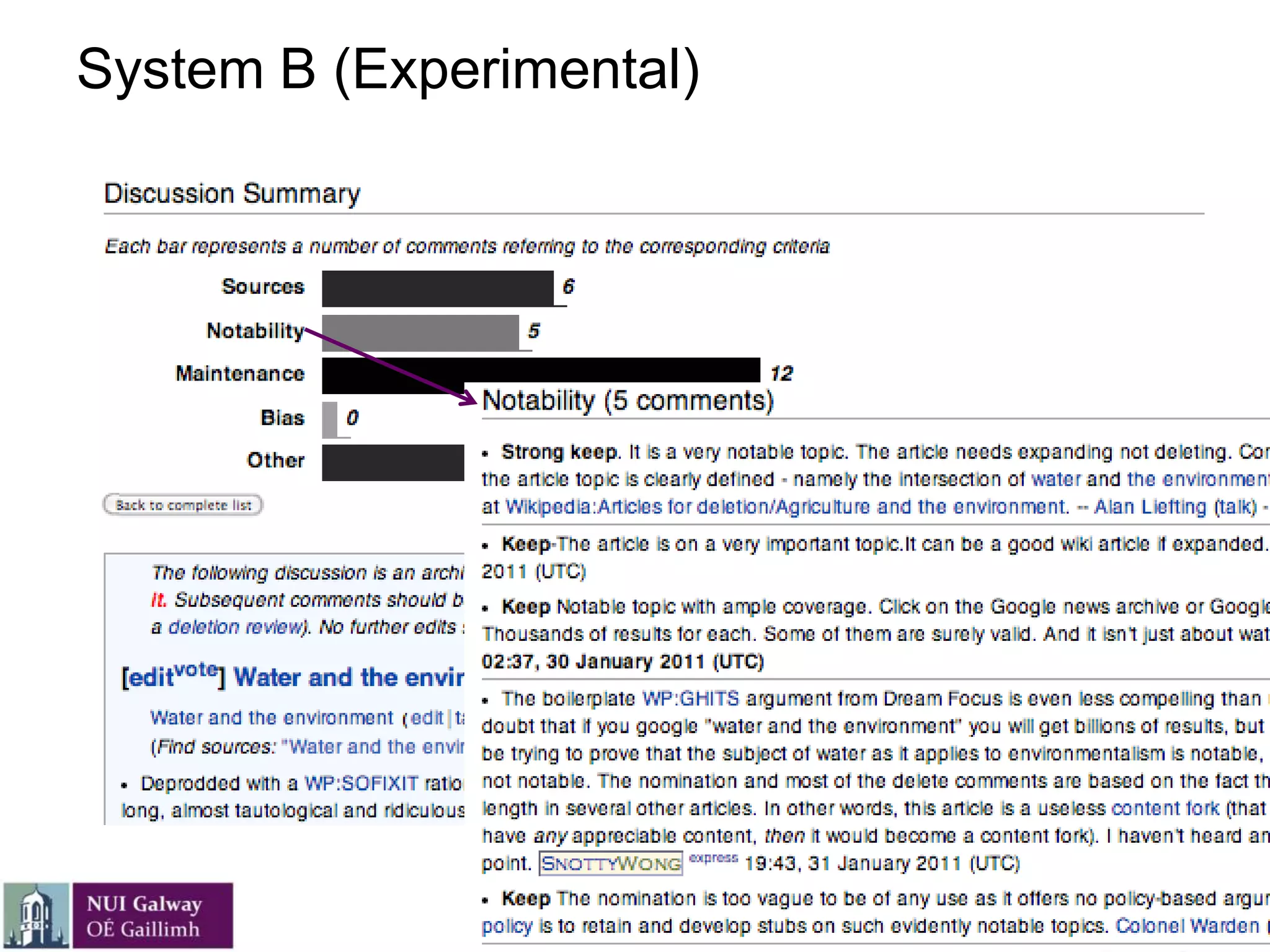
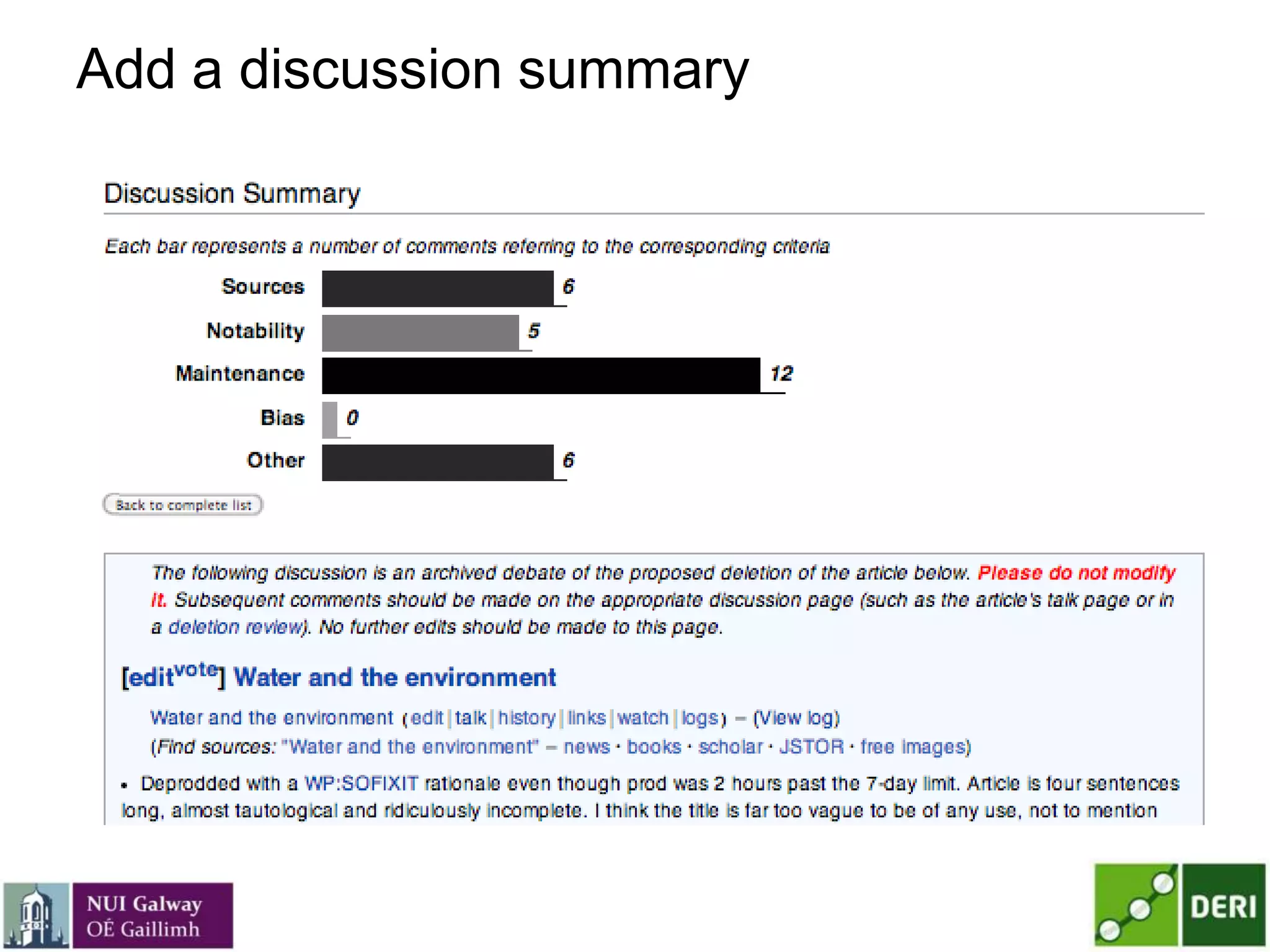
Add a discussion summary
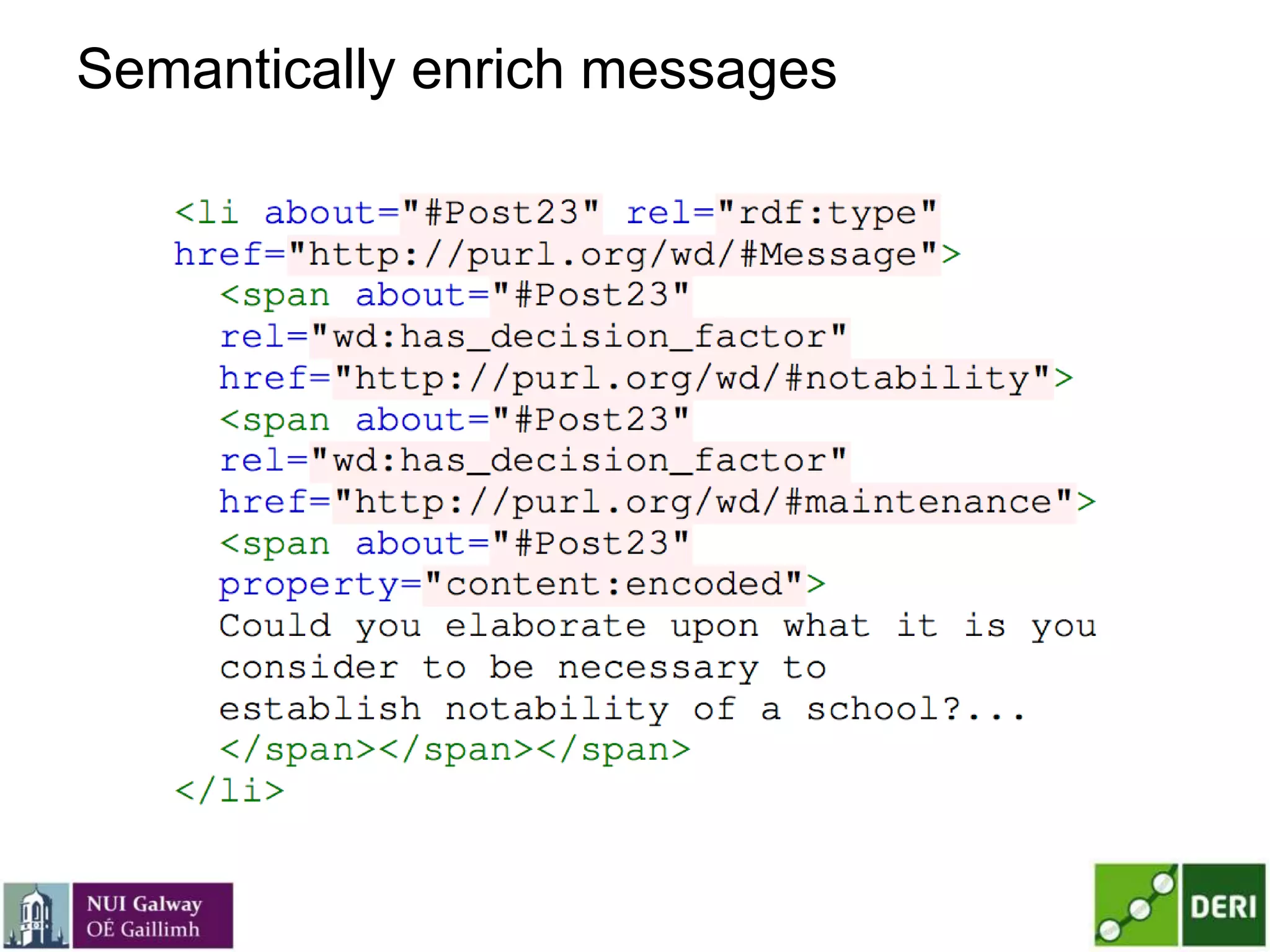
Semantically enrich messages
Use semantic structure
Implementation based on Jodi Schneider and Krystian Samp
“Alternative Interfaces for Deletion Discussions in Wikipedia: Some
Proposals Using Decision Factors. [Demo]” In WikiSym2012.
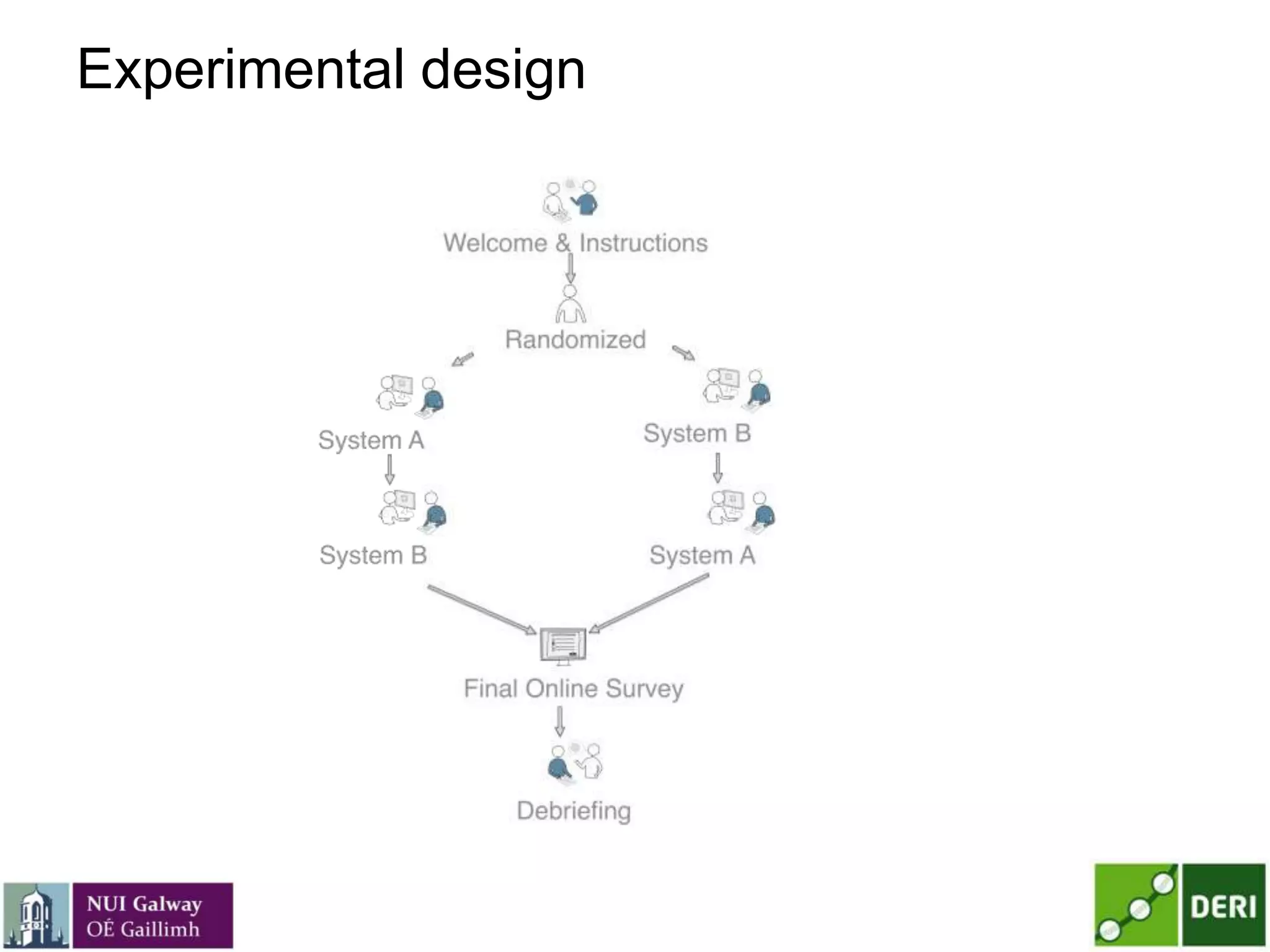
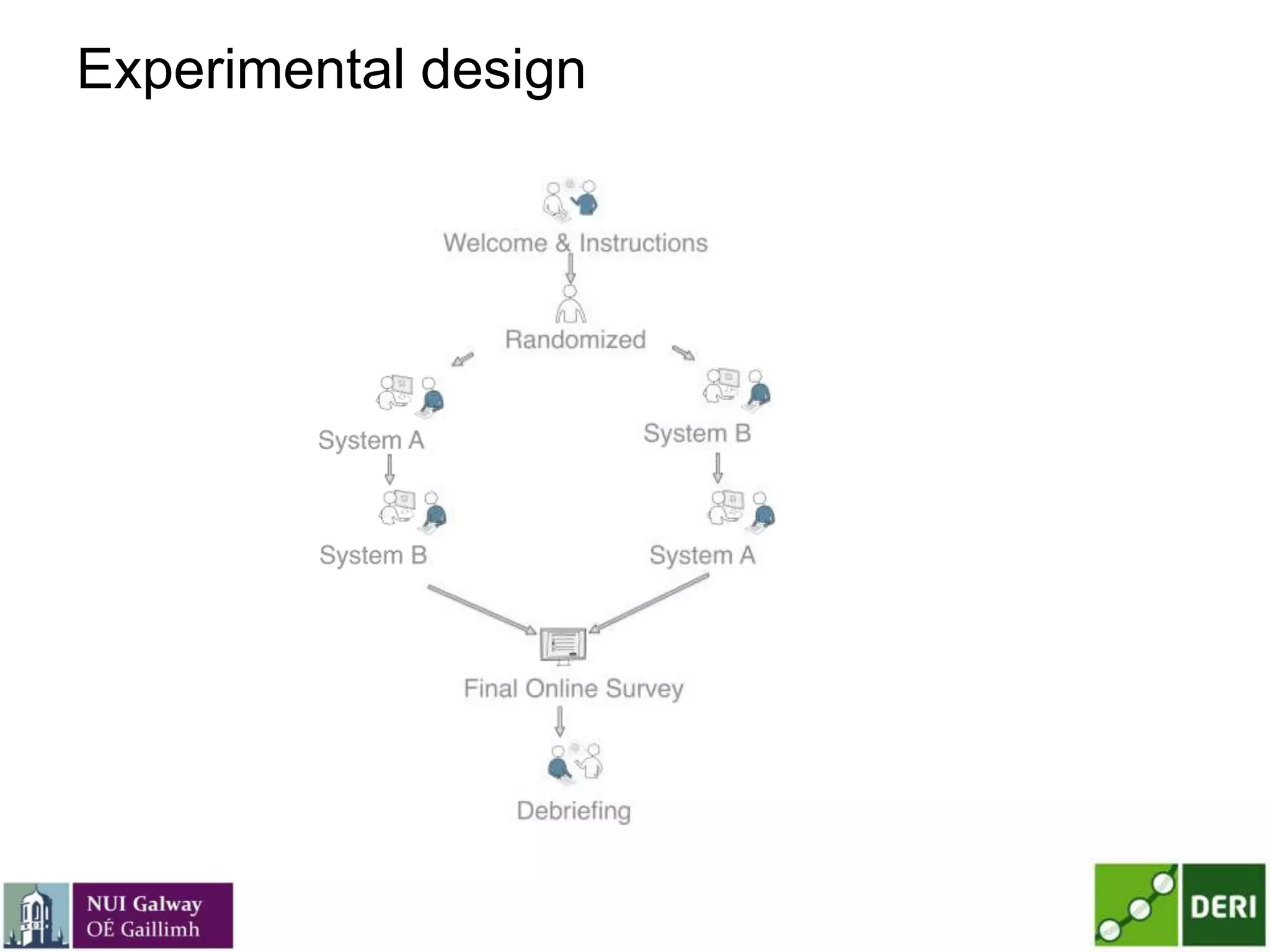
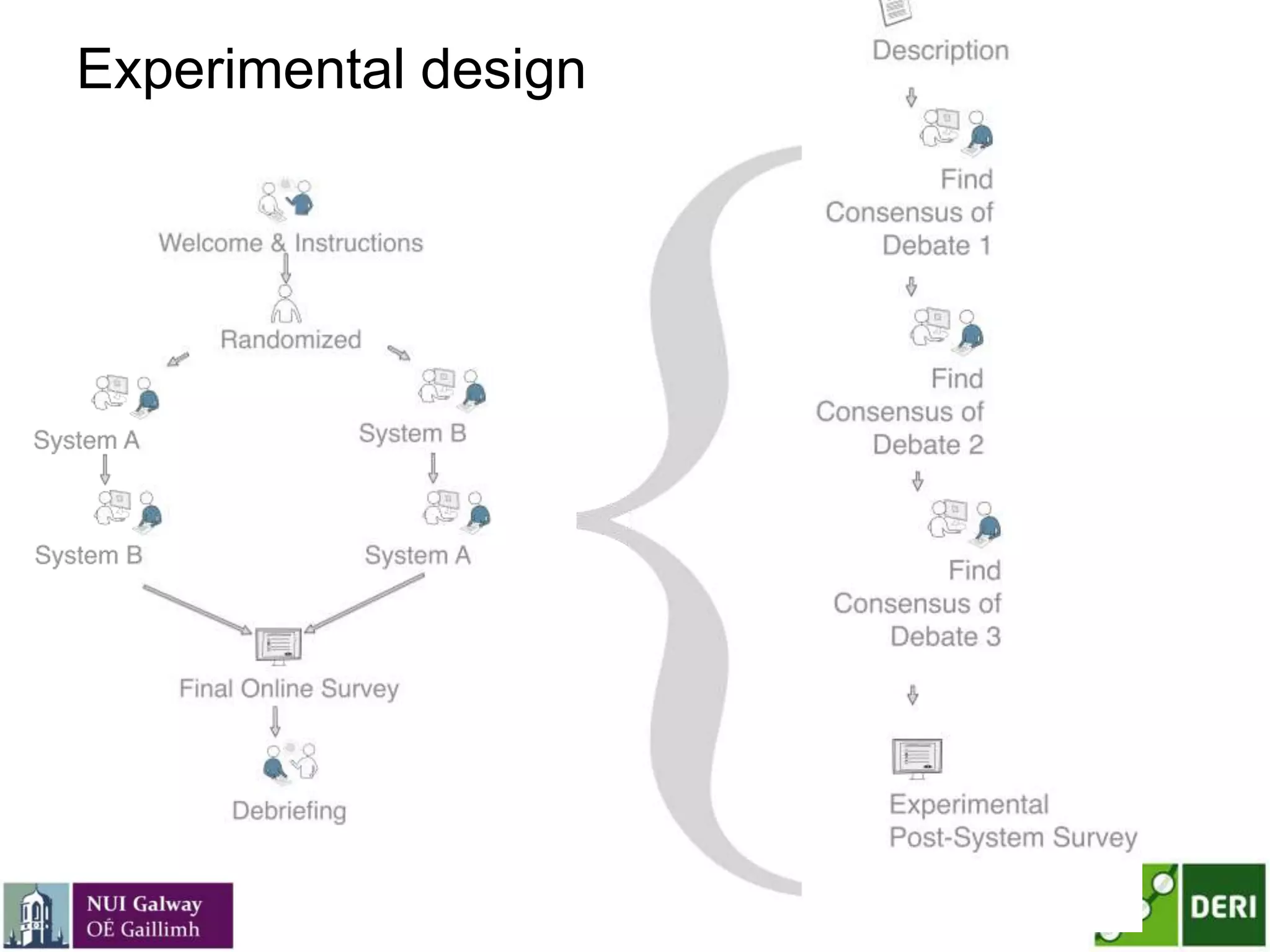
Experimental design
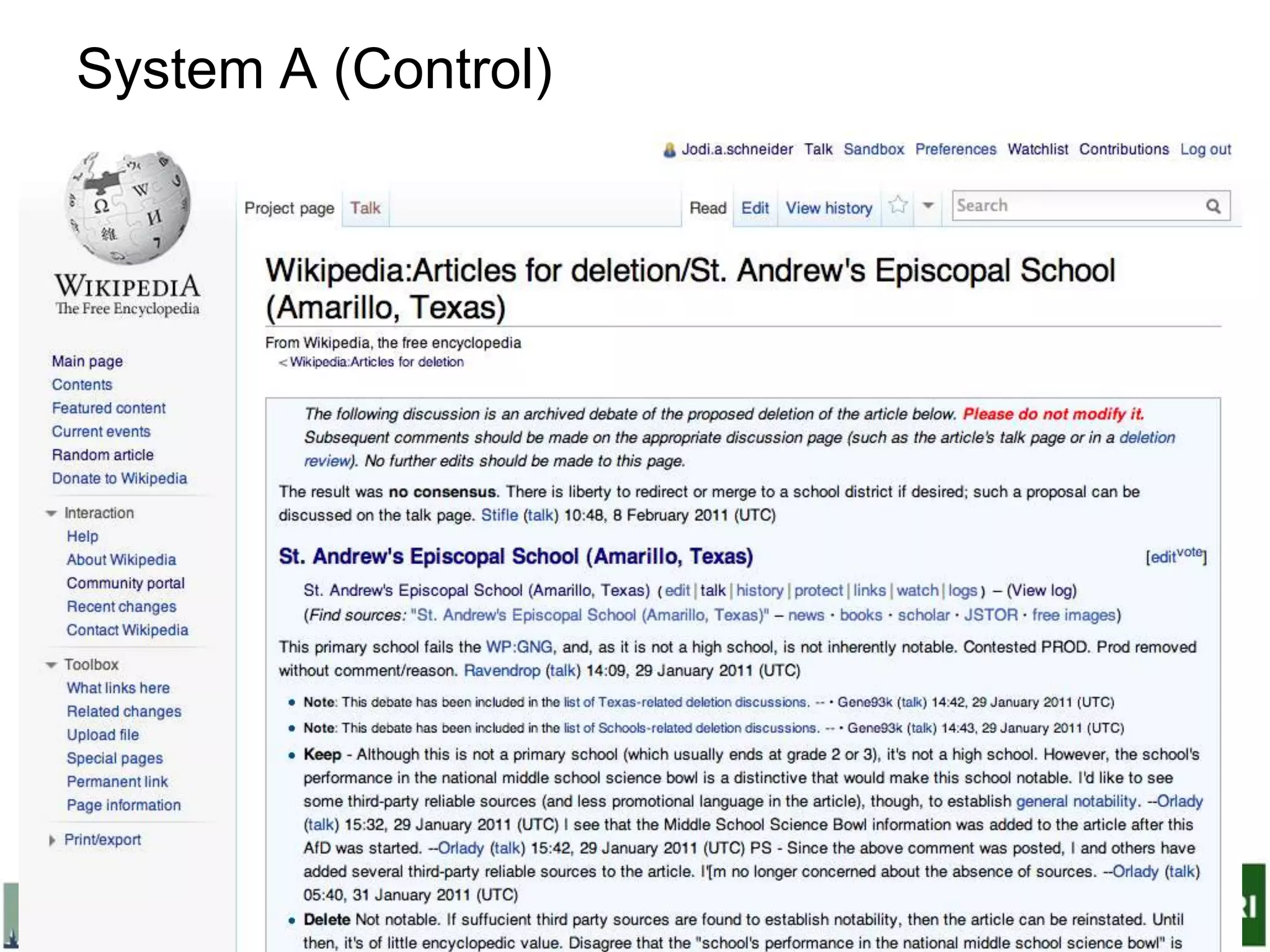
System A (Control)
System B (Experimental)
Experimental design
Experimental design
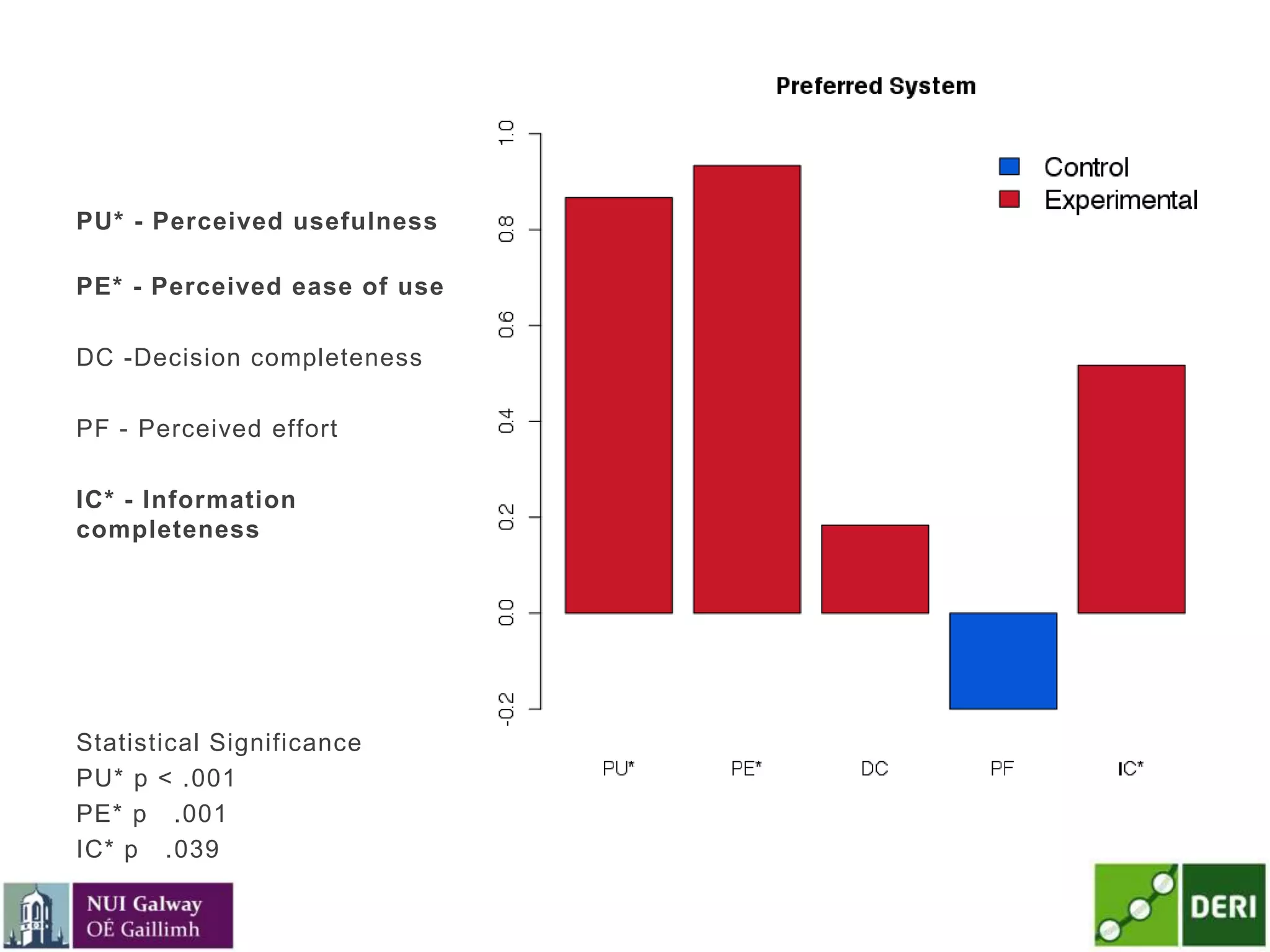
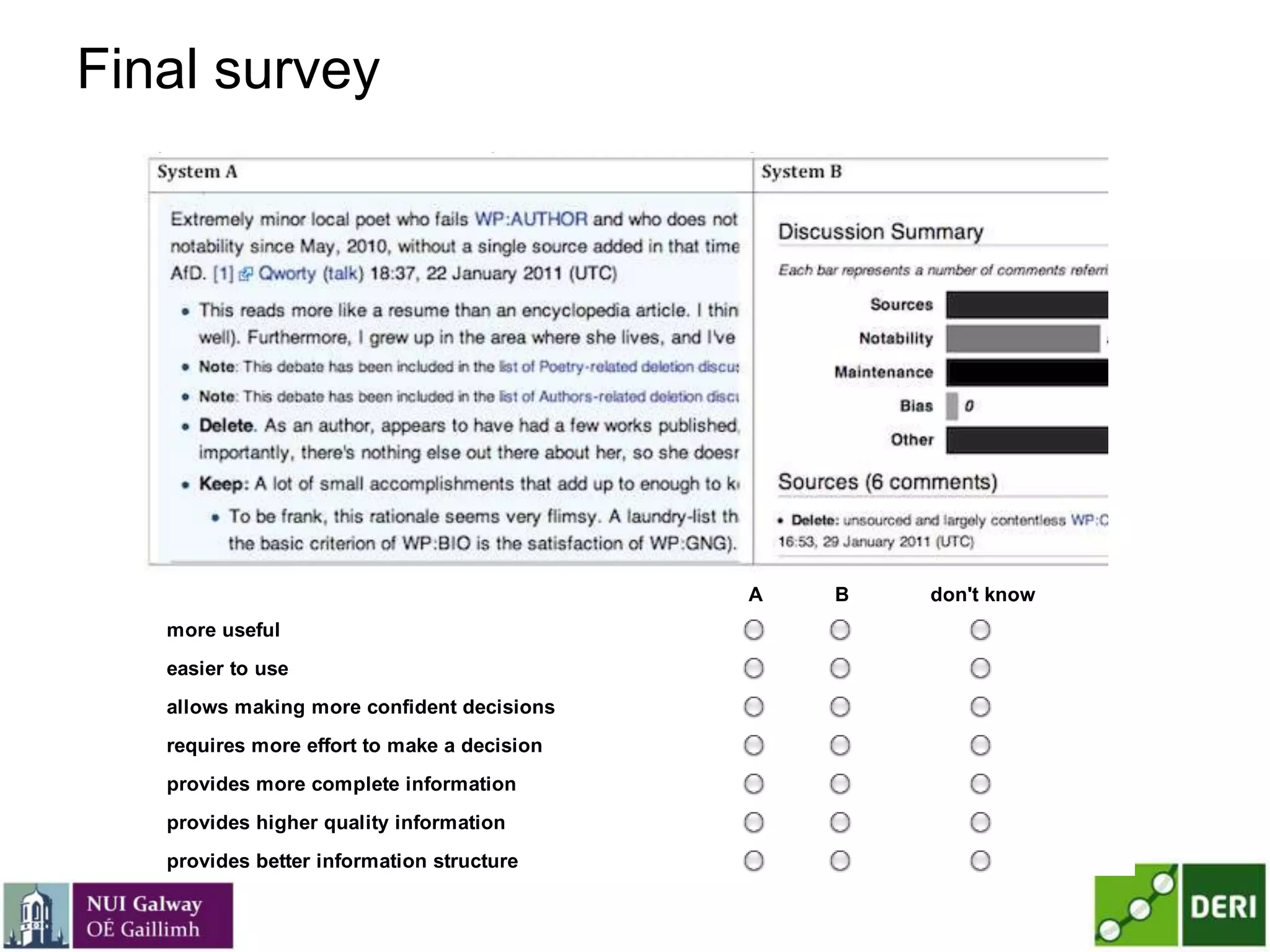
PU* - Perceived usefulness
PE* - Perceived ease of use
DC -Decision completeness
PF - Perceived effort
IC* - Information
completeness
Statistical Significance
PU* p < .001
PE* p .001
IC* p .039
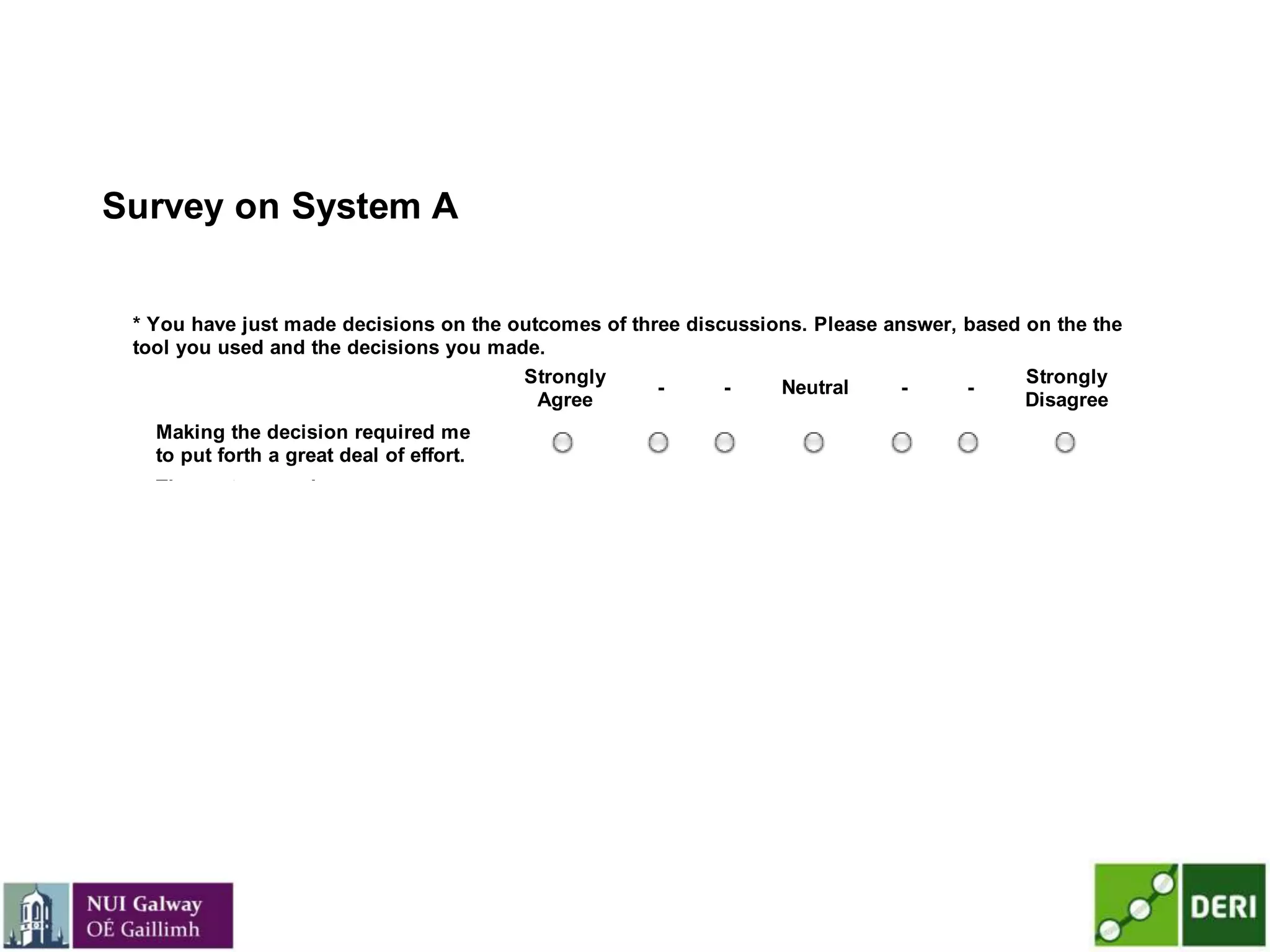
Final survey
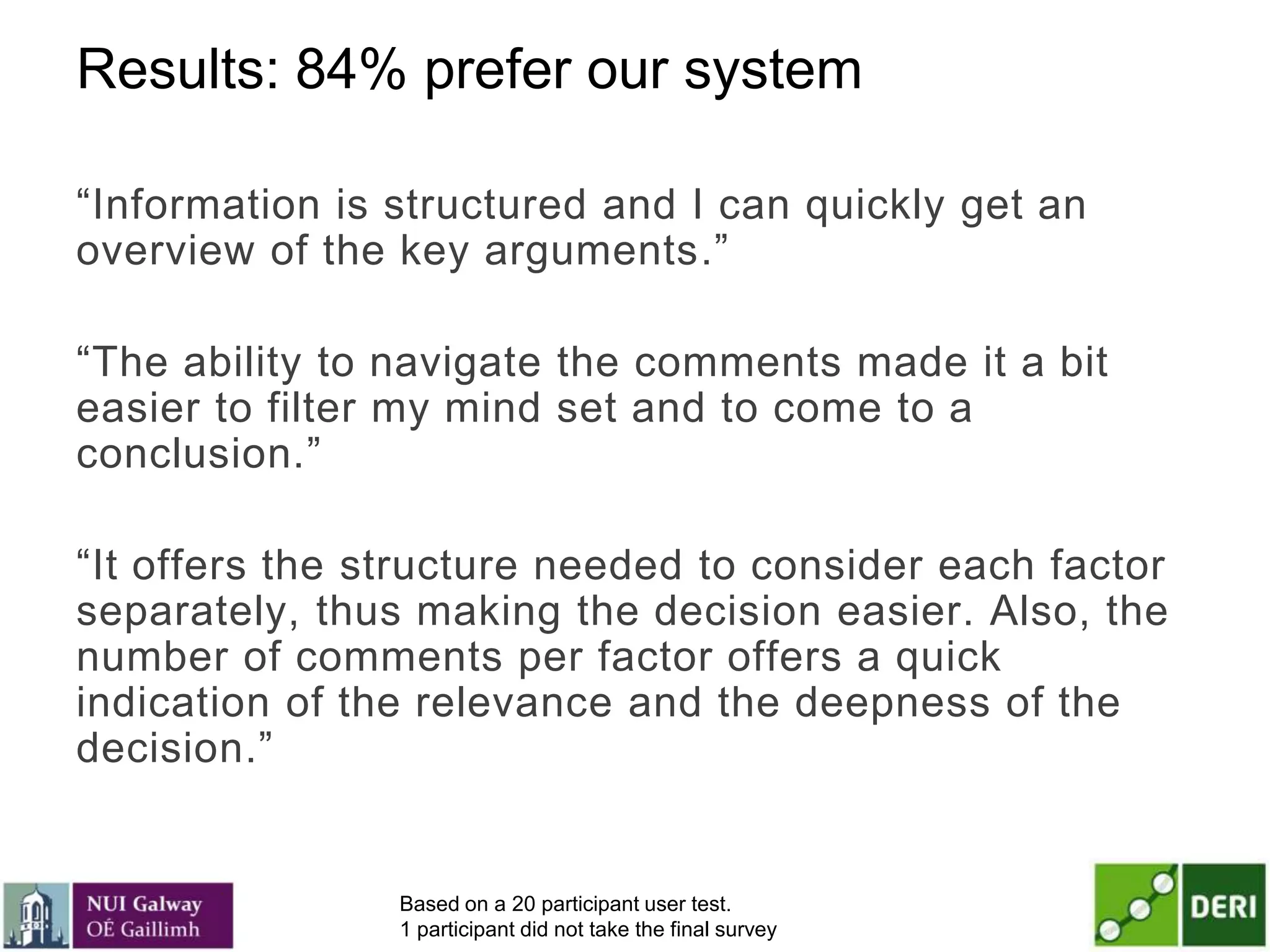
Results: 84% prefer our system
―Information is structured and I can quickly get an
overview of the key arguments.‖
―The ability to navigate the comments made it a bit
easier to filter my mind set and to come to a
conclusion.‖
―It offers the structure needed to consider each factor
separately, thus making the decision easier. Also, the
number of comments per factor offers a quick
indication of the relevance and the deepness of the
decision.‖
Based on a 20 participant user test.
1 participant did not take the final survey
Overall contributions
o A procedure for providing argumentation support
o A demonstration of this procedure, including
• A requirements analysis
• A categorization of the most common arguments used
according to two theories
o Walton’s argumentation schemes
o Factors-dimensions theory
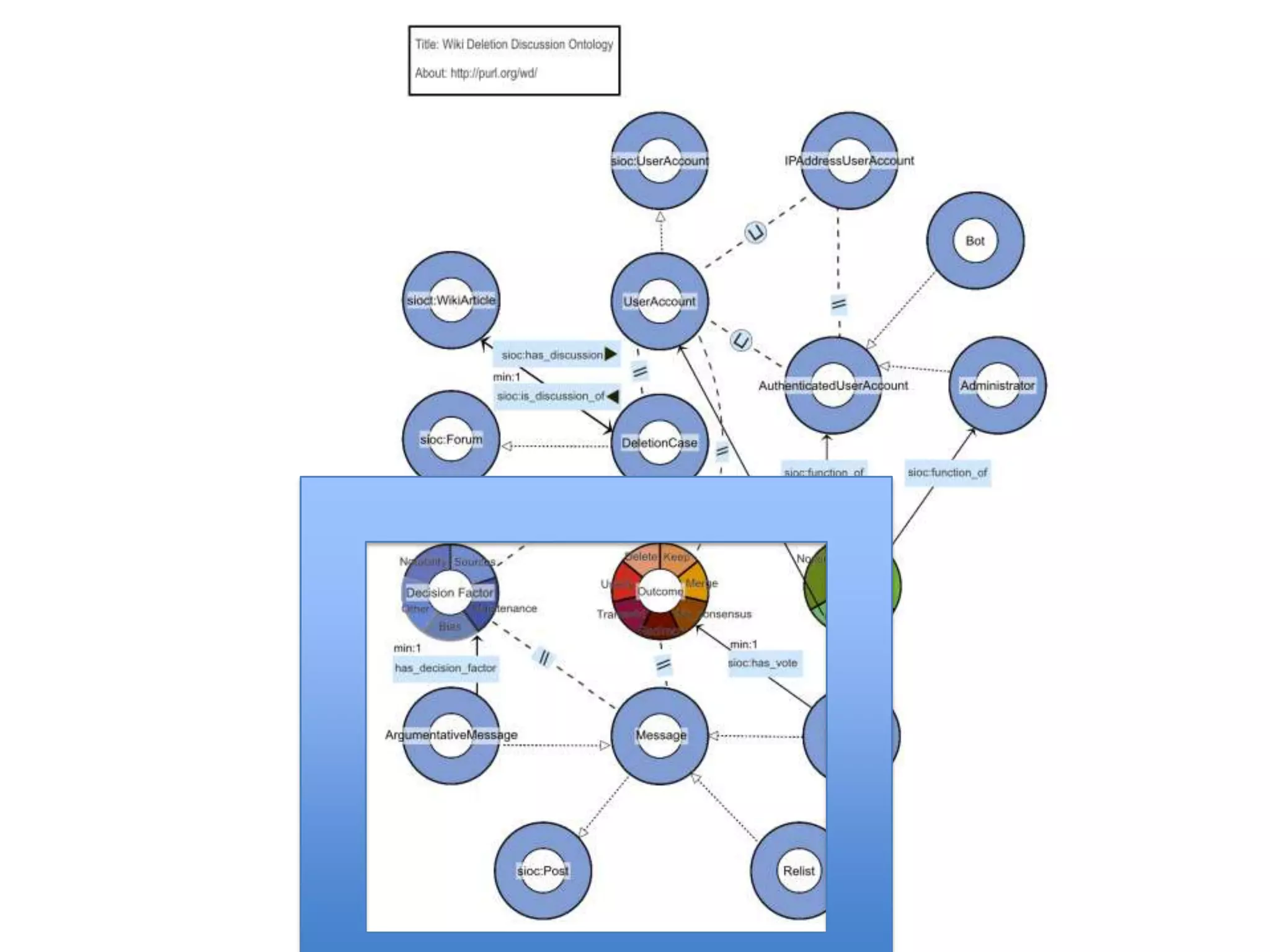
• An ontology for argumentation in Wikipedia deletion
discussions.
• An argumentation visualization system that structures
arguments with decision factors.
Main papers used in the thesis
o Jodi Schneider, Krystian Samp, Alexandre Passant, and
Stefan Decker. ―Arguments about Deletion: How Experience
Improves the Acceptability of Arguments in Ad-hoc Online
Task Groups‖. In CSCW 2013.
o Jodi Schneider, Tudor Groza, Alexandre Passant, ―A Review
of Argumentation for the Social Semantic Web.‖ Semantic
Web – Interoperability, Usability, Applicability, 2013, 4(2),
159-218.
o Jodi Schneider and Krystian Samp. ―Alternative Interfaces for
Deletion Discussions in Wikipedia: Some Proposals Using
Decision Factors. [Demo]‖ In WikiSym2012.
o Jodi Schneider, Alexandre Passant, and Stefan Decker.
―Deletion Discussions in Wikipedia: Decision Factors and
Outcomes.‖ In WikiSym2012.
Summary
o We need better ways of structuring arguments
on the Web.
o Arguments vary across Social Media.
o Different theories of argumentation stress different
aspects.
o Factors analysis is useful for providing a brief
summary of discussions. This can help find
consensus.

Enabling reuse of arguments and opinions in open collaboration systems PhD viva 2013 10-01

  • 1.
    Copyright 2011 DigitalEnterprise Research Institute. All rights reserved. Digital Enterprise Research Institute www.deri.ie Enabling Networked Knowledge Enabling reuse of arguments and opinions in open collaboration systems Jodi Schneider Tuesday 1 October 2013 1 Ph.D. viva Galway, Ireland
  • 2.
    How can wemake sense of disagreement?
  • 3.
    Arguments & opinionsgive a rationale
  • 4.
    Reuse arguments &rationales o How do we make arguments more clear to BOTH humans and machines? o Explicit arguments are not available • Important in bug reports, political commentary, product reviews, etc. o Machine-readable arguments could help • Gather information – e.g. finding issues, claims, and opinion clusters • Connect opinions to explicit evidence • Navigate claims networks
  • 5.
    Arguments in collectivedecision-making
  • 6.
  • 7.
    Arguments in opencollaboration systems
  • 8.
    Open collaboration systems ―peopleform ties with others & create things together‖ (Forte and Lampe 2013)
  • 9.
    Open collaboration systems ―peopleform ties with others & create things together‖ (Forte and Lampe 2013) Examples: o Wikipedia o HTML5 working group o OpenStreetMap o Project Gutenberg – Distributed Proofreaders o Apache projects, Mozilla Firefox, …
  • 10.
    How do weenable the reuse of arguments and opinions in open collaboration systems?
  • 11.
    Use case: deletionin Wikipedia o 1 in 4 new Wikipedia articles is deleted – within minutes or hours o Demotivating! • 1 in 3 newcomers start by writing a new article • 7X less likely to stay if their article is deleted! o Can we support editor retention? Source: http://enwp.org/Wikipedia:Wikipedia_Signpost/2011-04-04/Editor_retention
  • 12.
    Thousands of neweditors each month Source: http://reportcard.wmflabs.org/ English All languages
  • 13.
    Policies grew 10-15X(2002-2008) See e.g. Butler, Joyce, and Pike. CHI 2008 "Don't look now, but we've created a bureaucracy: the nature and roles of policies and rules in Wikipedia."
  • 14.
    Supporting open collaborationsystems o Can we support editor retention? o Make criteria explicit to: • Explain community expectations (how to be convincing) • Support making & auditing decisions
  • 15.
  • 16.
    How do weenable the reuse of arguments and opinions on the World Wide Web? o RQ1: What are the opportunities and requirements for providing argumentation support? o RQ2: Which arguments are used in open collaboration systems? o RQ3: How can we structure and display opinions and arguments to support their use and reuse?
  • 17.
    How do weenable the reuse of arguments and opinions on the World Wide Web? o RQ1: What are the opportunities and requirements for providing argumentation support? o RQ2: Which arguments are used in open collaboration systems? o RQ3: How can we structure and display opinions and arguments to support their use and reuse?
  • 18.
    How do weenable the reuse of arguments and opinions on the World Wide Web? o RQ1: What are the opportunities and requirements for providing argumentation support? o RQ2: Which arguments are used in open collaboration systems? o RQ3: How can we structure and display opinions and arguments to support their use and reuse?
  • 19.
    How do weenable the reuse of arguments and opinions on the World Wide Web? o RQ1: What are the opportunities and requirements for providing argumentation support? Netnography o RQ2: Which arguments are used in open collaboration systems? Iterative Annotation o RQ3: How can we structure and display opinions and arguments to support their use and reuse? Semantic Web Systems Development
  • 20.
    RQ1: What arethe opportunities and requirements for providing argumentation support?
  • 21.
    Methodology: Netnography Kozinets, RobertV. Netnography: Doing ethnographic research online. Sage Publications, 2010.
  • 22.
    Methodology: Netnography 1. Planningand community selection 2. Participant observation and data collection 3. Data analysis and iterative interpretation 4. Presenting results
  • 23.
    Results: Sample corpus 72discussions started on 1 day o Each discussion has: • 3—33 messages • 2—15 participants o 741 messages contributed by 244 users. Each message has 3—350+ words. o 98 printed A4 sheets
  • 24.
  • 25.
  • 26.
    Results: Terminology andpolicy knowledge becomes an obstacle
  • 27.
    Results: Important tasks forconsensus discussions 1. Determine one’s personal position 2. Express one’s personal position in accordance with community norms 3. Determine the consensus
  • 28.
    RQ2: Which argumentsare used in open collaboration systems?
  • 29.
    Methods o Use corpusof 72 discussions o Two types of annotation: 2 argumentation theories o Iterative annotation for each theory • Multiple annotators • Refine to get good inter-annotator agreement • 4 rounds of annotation
  • 30.
    Two argumentation theories oWalton’s Argumentation Schemes (Walton, Reed, and Macagno 2008) • Informal argumentation (philosophical & computational argumentation) • Identify & prevent errors in reasoning (fallacies) • 60 patterns o Factors Analysis (Ashley 1991) • Case-based reasoning • E.g. factors for deciding cases in trade secret law, favoring either party (the plaintiff or the defendant).
  • 31.
    Walton’s Argumentation Schemes ExampleArgumentation Scheme: Argument from Rules – “we apply rule X” Critical Questions 1. Does the rule require carrying out this type of action? 2. Are there other established rules that might conflict with or override this one? 3. Are there extenuating circumstances or an excuse for noncompliance? Walton, Reed, and Macagno 2008
  • 32.
    Walton’s Argumentation Schemes JodiSchneider, Krystian Samp, Alexandre Passant, Stefan Decker. ―Arguments about Deletion: How Experience Improves the Acceptability of Arguments in Ad-hoc Online Task Groups‖. In CSCW 2013. ! "#$%&' ()*+((&"' *"&, +-&' . & ! "#$%&' ()*"+%), -./&' 0&)(+)123+(4&5.5 67897: ! "#$%&' ()*"+%); $<&5 6=87>: ? +(& 6@8=7: ! "#$%&' (A(.+' )*"+%)BA<$&5 C89>: ! "#$%&' ()*"+%)? &&/)*+")1&<3 C869: ! "#$%&' ()*"+%)D.A5 @8EF: ? +)"&A5+' )#.- &' @899: ! "#$%&' ()*"+%)G+5.(.+' )(+)H' +I @8>J : ! "#$%&' ()*"+%)G"&0&/&' ( @8>J : ! "#$%&' ()*"+%)K#' +"A' 0& 987F: ! "#$%&' ()*"+%)L+%3+5.(.+' 98J =: ! "#$%&' ()*"+%)LA$5&)(+), **&0( 98@6: ! "#$%&' ()*"+%)! ' A<+#2 989@: ! "#$%&' ()*"+%)MA5(& 989@: G"A0(.0A<); &A5+' .' # 989@: ! "#8)*"+%)B&"NA<)L<A55.*.0A(.+' 98>=:
  • 33.
  • 34.
    Factors Analysis Factors determined byiterative annotation 4 Factors cover • 91% of comments • 70% of discussions
  • 35.
    Factors Analysis Factors determined byiterative annotation 4 Factors cover • 91% of comments • 70% of discussions ―Other‖ as 5th catchall
  • 36.
    Factors Analysis Factors determined byiterative annotation 4 Factors cover • 91% of comments • 70% of discussions ―Other‖ as 5th catchall Factor Example (used to justify `keep') Notability Anyone covered by another encyclopedic reference is considered notable enough for inclusion in Wikipedia. Sources Basic information about this album at a minimum is certainly verifiable, it's a major label release, and a highly notable band. Maintenance …this article is savable but at its current state, needs a lot of improvement. Bias It is by no means spam (it does not promote the products). **Other I'm advocating a blanket "hangon" for all articles on newly- drafted players
  • 37.
    RQ3: How canwe structure and display opinions and arguments to support their use and reuse?
  • 38.
    Methodology o Linked DataApplication Development o User testing – 20 users Original Discussion Ontology Semantic Enrichment Semantically Enriched RDFa Querying Queryable User Interface With Barchart
  • 39.
  • 40.
  • 44.
  • 45.
    Use semantic structure Implementationbased on Jodi Schneider and Krystian Samp “Alternative Interfaces for Deletion Discussions in Wikipedia: Some Proposals Using Decision Factors. [Demo]” In WikiSym2012.
  • 46.
  • 47.
  • 48.
  • 49.
  • 50.
  • 52.
    PU* - Perceivedusefulness PE* - Perceived ease of use DC -Decision completeness PF - Perceived effort IC* - Information completeness Statistical Significance PU* p < .001 PE* p .001 IC* p .039
  • 53.
  • 54.
    Results: 84% preferour system ―Information is structured and I can quickly get an overview of the key arguments.‖ ―The ability to navigate the comments made it a bit easier to filter my mind set and to come to a conclusion.‖ ―It offers the structure needed to consider each factor separately, thus making the decision easier. Also, the number of comments per factor offers a quick indication of the relevance and the deepness of the decision.‖ Based on a 20 participant user test. 1 participant did not take the final survey
  • 55.
    Overall contributions o Aprocedure for providing argumentation support o A demonstration of this procedure, including • A requirements analysis • A categorization of the most common arguments used according to two theories o Walton’s argumentation schemes o Factors-dimensions theory • An ontology for argumentation in Wikipedia deletion discussions. • An argumentation visualization system that structures arguments with decision factors.
  • 56.
    Main papers usedin the thesis o Jodi Schneider, Krystian Samp, Alexandre Passant, and Stefan Decker. ―Arguments about Deletion: How Experience Improves the Acceptability of Arguments in Ad-hoc Online Task Groups‖. In CSCW 2013. o Jodi Schneider, Tudor Groza, Alexandre Passant, ―A Review of Argumentation for the Social Semantic Web.‖ Semantic Web – Interoperability, Usability, Applicability, 2013, 4(2), 159-218. o Jodi Schneider and Krystian Samp. ―Alternative Interfaces for Deletion Discussions in Wikipedia: Some Proposals Using Decision Factors. [Demo]‖ In WikiSym2012. o Jodi Schneider, Alexandre Passant, and Stefan Decker. ―Deletion Discussions in Wikipedia: Decision Factors and Outcomes.‖ In WikiSym2012.
  • 58.
    Summary o We needbetter ways of structuring arguments on the Web. o Arguments vary across Social Media. o Different theories of argumentation stress different aspects. o Factors analysis is useful for providing a brief summary of discussions. This can help find consensus.

Editor's Notes

  • #3 Arguments are everywhere – we would like to reuse argumentsincluding on the Web.From http://www.sendareview.com/The Web is full of opinions &amp; commentary.A lot of it disagrees.How do we learn from other people, when they disagree?
  • #12 1“only 0.6 percent of those whose articles are met with deletion stayed editing, compared to 4.4 percent of the users whose articles remained”, http://enwp.org/Wikipedia:Wikipedia_ Signpost/2011-04-04/Editor_retentionOriginal stats from Mr.Z-man: http://en.wikipedia.org/wiki/User:Mr.Z-man/newusers
  • #13 ***Get just blue figures***
  • #14 Image from http://breakingenergy.com/2013/04/08/energy-legal-work-takes-the-number-two-spot-growth-forecast/***Picture conveying social norms/policies – e.g. growth over time from Butler (if there’s some image of that)
  • #22 Image from http://kozinets.net/archives/509
  • #24 Technically started or relistedCorpus is https://en.wikipedia.org/wiki/Wikipedia:Articles_for_deletion/Log/2011_January_29
  • #31 Categories (Walton’s argumentation schemes) vs. process (factors analysis)
  • #32 Major Premise: If carrying out types of actions including A is the established rule for x, then (unless the case is an exception), a must carry out A.Minor Premise: Carrying out types of actions including A is the established rule for a.Conclusion: Therefore, a must carry out A.
  • #33 Earlier in CSCW: Jodi Schneider, KrystianSamp, Alexandre Passant, Stefan Decker. “Arguments about Deletion: How Experience Improves the Acceptability of Arguments in Ad-hoc Online Task Groups”. In Computer Supported Cooperative Work and Social Computing (CSCW). San Antonio, TX, February 23-27, 2013.Used as categoriesInitial annotation60 categories (each Walton argumentation scheme)all arguments in each messageRound 415 most common argumentation schemesmain argument in each messageGood inter-annotator agreement for hard task:54% agreement (compared to 12% chance) among 2 annotators
  • #55 20 novice participants used both systems“The ability to navigate the comments made it a bit easier to filter my mind set and to come to a conclusion.”“summarise and, at the same time, evaluate which factor should be considered determinant for the final decision”
  • #58 **go out with a bang**