6th International Conference on e-Participation, 
ePart2014 
Sept 1-3, 2014 
Trinity Collage, Dublin, Ireland 
New Ways of Deliberating Online: 
An Empirical Comparison of Network and 
Threaded Interfaces for Online Discussion 
Anna De Liddo & Simon Buckingham Shum 
Knowledge Media Institute 
The Open University, UK
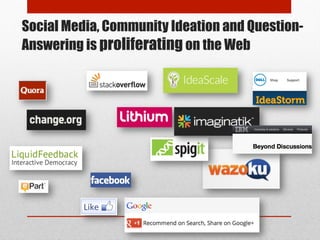
Social Media, Community Ideation and Question- 
Answering is proliferating on the Web
Setting the Problem 
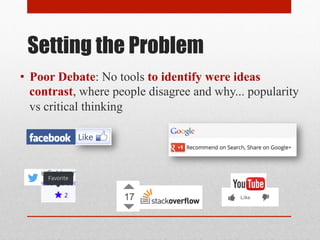
• Poor Debate: No tools to identify were ideas 
contrast, where people disagree and why... popularity 
vs critical thinking
Setting the Problem 
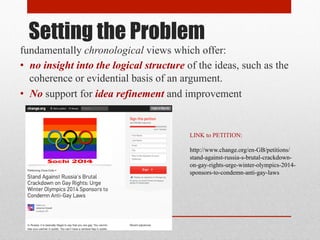
fundamentally chronological views which offer: 
• no insight into the logical structure of the ideas, such as the 
coherence or evidential basis of an argument. 
• No support for idea refinement and improvement 
LINK to PETITION: 
http://www.change.org/en-GB/petitions/ 
stand-against-russia-s-brutal-crackdown-on- 
gay-rights-urge-winter-olympics-2014- 
sponsors-to-condemn-anti-gay-laws
Setting the Problem 
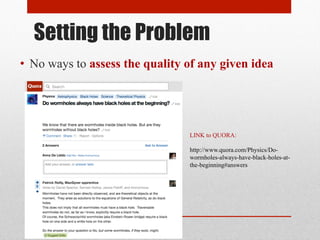
• No ways to assess the quality of any given idea 
LINK to QUORA: 
http://www.quora.com/Physics/Do-wormholes- 
always-have-black-holes-at-the- 
beginning#answers
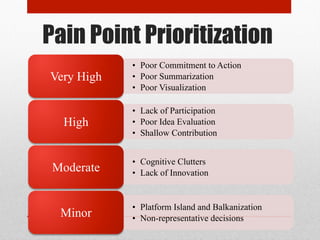
Pain Point Prioritization 
• Poor Commitment to Action 
• Poor Summarization 
• Poor Visualization 
Very High 
• Lack of Participation 
• Poor Idea Evaluation 
• Shallow Contribution 
High 
• Cognitive Clutters 
Moderate • Lack of Innovation 
• Platform Island and Balkanization 
Minor • Non-representative decisions
Setting the Problem 
This hampers both: 
• quality of users’ participation and 
• The quality of proposed ideas 
• effective assessment of the state of the debate.
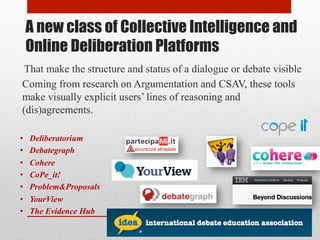
A new class of Collective Intelligence and 
Online Deliberation Platforms 
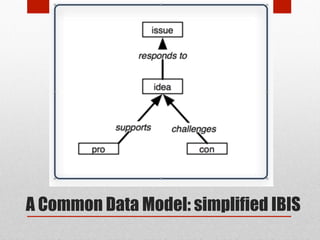
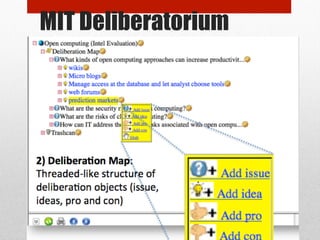
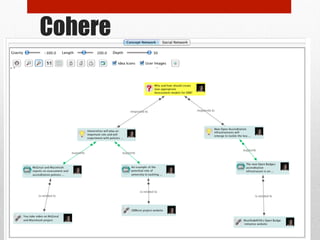
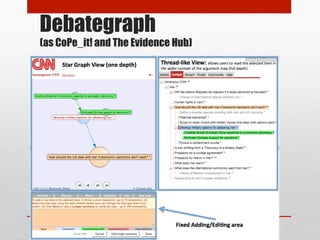
That make the structure and status of a dialogue or debate visible 
Coming from research on Argumentation and CSAV, these tools 
make visually explicit users’ lines of reasoning and 
(dis)agreements. 
• Deliberatorium 
• Debategraph 
• Cohere 
• CoPe_it! 
• Problem&Proposals 
• YourView 
• The Evidence Hub
A Common Data Model: simplified IBIS
MIT Deliberatorium
Cohere
Debategraph 
(as CoPe_it! and The Evidence Hub) 
!
• No systematic evaluation of the merits or otherwise of 
network vs. threaded interfaces. 
• the bigger the number of participants to the discussion, 
and the higher the complexity of the discourse ontology, 
the more clumsy and less usable graph visualizations 
become 
• resistance to the use of graph visualization of arguments 
in certain domains of application. 
• It therefore remains unclear what are the advantages and 
affordances of different graphical representation of 
arguments to support online discussion 
Motivation
• the focus of the study is on reading and searching the 
online deliberation platforms 
RQ: 
• Does an interactive, self-organizing network 
visualization of arguments provide advantages over a 
more conventional threaded interface for reading and 
search? 
Research Question
• exploratory user study to observe users’ performance under 
three information-seeking tasks, and 
• compare their performances using two different user 
interfaces for arguments visualization (threaded vs network 
visualization of arguments) 
• A grounded theory analysis of the experimentation’s video to 
show how different graphical interfaces for the 
representation of arguments affect the way in which users 
read and understand the online discourse. 
The Study
• 10 subjects (two groups of 5) 
• members of different Open University departments 
• with widely mixed IT expertise 
• randomly allocated to the two different groups 
• IT expert/non expert ratio in each group was 
approximately the same. 
• median age 40 (with range from 32 to 48) 
• native or near-native English speakers 
Participants
http://evidence-hub.net/ 
• The Evidence Hub is a collective intelligence and online 
deliberation tool to support argumentative knowledge 
construction by crowdsourcing contributions of: 
issues, potential solutions, research claims and the related 
evidence in favor or against those 
The Online Environment: 
The Evidence Hub
• two different versions of the evidence Hub 
• different user interfaces for arguments visualization 
• same database to make sure that participants in the two 
groups would receive exactly the same quantity and type 
of information 
Study Conditions
http://evidence-hub.net/ 
The Linear-threaded Interface 
for Arguments Visualization
http://evidence-hub.net/ 
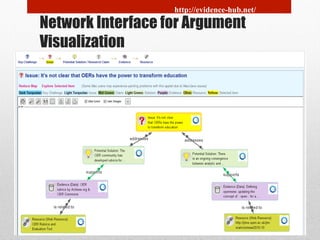
Network Interface for Argument 
Visualization
• Identifying solutions to an issue (Task1) 
• Identifying synergies between solutions (Task 2) 
• Identifying contrasts in the wider debate (Task 3) 
Tasks
Metrics used to compare user’s performance 
across these three tasks: 
• Task Accomplishment; 
• Data Model Interpretation and 
• Emotional Reactions to 
Emerging metrics
Task accomplishment 
Main reason of task failure is task understanding 
Accomplished by incorrect” mostly in the linear interface group 
• the linear structure of the interface does not help to interconnect 
and compare content 
• users focused more on the content rather than on the 
argumentation process 
• lead to digressions and incorrect responses. 
“Accomplished easily” mostly in the network visualization 
interface group. This is mainly due to the 
• visual hints provided by the network representation. 
• links labels and colors particularly predominant in determining 
success. 
• less attention paid to the iconography of the nodes. 
• connections density very effective to provide answer to the task.
Data Model Interpretation 
• DMI was better supported by network visualization of 
arguments. 
• Category misinterpretation and uncertainty in data model 
interpretation tend to occur more frequently in Group1 than in 
Group2, 
• network visualization of arguments support a complete and 
correct understanding of both categories and data model. 
• learn by example mechanisms: exploration of a new argument 
map they reinforce their understanding of the data model
Emotional Reactions 
• a general sense of surprise and positivity toward the network 
visualization is recorded, which easily sparks into likeness and even 
excitement This also increase users confidence with the tool (“I feel 
confident, I’m pretty sure this is the answer”-P7). 
• main objects of surprise due to the self-arranging graph (“it is like a 
jelly, it is so fantastic!”-P7; “it is all shifting! It is interesting… I quite 
like that!”-P8). 
• emotional reactions to the linear interface regards general skepticism 
which can also decay into confusion and feeling lost (“I think I am 
lost”-P1; I am now burnign.. because I haven't worked out how to do it” 
”that is the all page I am looking at…ohhh ok I give up!”-P5). 
• The main reason the need of “too many clicks” to seek information and 
frequent “change of context” which often provokes disorientation.
Conclusions 
• Linear interfaces perform worse especially when the 
information is nested into more articulated 
argumentation chains (Task 2). 
• Network-like representation and the visual hints such as 
network structure, iconography and links’ labels and 
colors facilitate the identification of argumentation 
chains, thus supporting indirect connection and higher-level 
inferences of how the content connects.
Conclusions 
• Data model interpretation is also improved by 
argument visualization. Notably, exposing the data model 
in form of argument maps appears to enable a learning by 
example mechanism, whereby users reinforce their 
understanding of the data as they navigate through the user 
interface. 
• Effectiveness of network visualization of arguments and 
the positive impact it has on arguments reading and 
comprehension increases as information complexity 
increases: the bigger the discussion, the better network 
visualizations performs compared to linear-threaded 
visualizations.
Conclusion 
• There is an element of fun and excitement associated to 
dynamic network visualization of arguments. 
• Network visualization of arguments augment online discussion 
by providing a layer of structure that helps to improve human 
comprehension of the argumentation structure behind the 
online discourse. 
• These findings open new avenues for combining social media 
discourse with advanced network visualizations of discourse 
elements (issues, solutions and arguments) to both improve 
users’ engagement, sensemaking and appreciation of large-scale 
online deliberation processes.
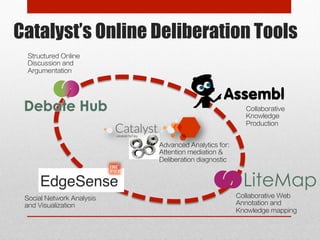
Catalyst’s Online Deliberation Tools 
Collaborative 
Knowledge 
Production 
Collaborative Web 
Annotation and 
Knowledge mapping 
Structured Online 
Discussion and 
Argumentation 
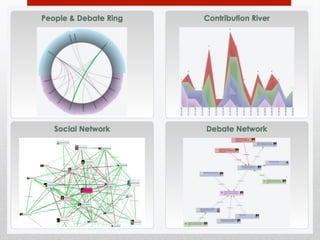
Social Network Analysis 
and Visualization 
Advanced Analytics for: 
Attention mediation & 
Deliberation diagnostic
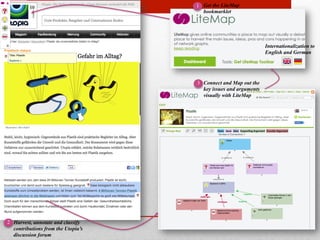
Collaborative Web Annotation and 
Knowledge mapping 
http://litemap.open.ac.uk
Internationalization to 
English and German 
Get the LiteMap 
bookmarklet 
Connect and Map out the 
key issues and arguments 
visually with LiteMap 
Harvest, annotate and classify 
contributions from the Utopia’s 
discussion forum 
1 
2 
3
Structured Online Discussion and 
Argumentation 
debatehub.net
Follow us on Twitter 
@CATALYST_FP7 
Watch the Demos on Youtube 
CATALYST FP7 
Get involved
Tools: evidence-hub.net, debatehub.net, litemap.open.ac.uk 
Dr. Anna De Liddo 
Research Fellow in Collective Intelligence Infrastructures 
KMi, Open University, UK 
Thanks for your time! 
email: 
anna.deliddo@open.ac.uk 
Twitter: Anna_De_Liddo 
HomePage: 
http://kmi.open.ac.uk/people/member/anna-de-liddo 
Evidence Hub Website: 
http://evidence-hub.net/ 
Projects: 
Catalyst: http://catalyst-fp7.eu/ 
EDV – Election Debate Visualizations: http://edv-project.net/

DeLiddo&BuckinghamShum-e-Part2014

  • 1.
    6th International Conferenceon e-Participation, ePart2014 Sept 1-3, 2014 Trinity Collage, Dublin, Ireland New Ways of Deliberating Online: An Empirical Comparison of Network and Threaded Interfaces for Online Discussion Anna De Liddo & Simon Buckingham Shum Knowledge Media Institute The Open University, UK
  • 2.
    Social Media, CommunityIdeation and Question- Answering is proliferating on the Web
  • 3.
    Setting the Problem • Poor Debate: No tools to identify were ideas contrast, where people disagree and why... popularity vs critical thinking
  • 4.
    Setting the Problem fundamentally chronological views which offer: • no insight into the logical structure of the ideas, such as the coherence or evidential basis of an argument. • No support for idea refinement and improvement LINK to PETITION: http://www.change.org/en-GB/petitions/ stand-against-russia-s-brutal-crackdown-on- gay-rights-urge-winter-olympics-2014- sponsors-to-condemn-anti-gay-laws
  • 5.
    Setting the Problem • No ways to assess the quality of any given idea LINK to QUORA: http://www.quora.com/Physics/Do-wormholes- always-have-black-holes-at-the- beginning#answers
  • 6.
    Pain Point Prioritization • Poor Commitment to Action • Poor Summarization • Poor Visualization Very High • Lack of Participation • Poor Idea Evaluation • Shallow Contribution High • Cognitive Clutters Moderate • Lack of Innovation • Platform Island and Balkanization Minor • Non-representative decisions
  • 7.
    Setting the Problem This hampers both: • quality of users’ participation and • The quality of proposed ideas • effective assessment of the state of the debate.
  • 8.
    A new classof Collective Intelligence and Online Deliberation Platforms That make the structure and status of a dialogue or debate visible Coming from research on Argumentation and CSAV, these tools make visually explicit users’ lines of reasoning and (dis)agreements. • Deliberatorium • Debategraph • Cohere • CoPe_it! • Problem&Proposals • YourView • The Evidence Hub
  • 9.
    A Common DataModel: simplified IBIS
  • 10.
  • 11.
  • 12.
    Debategraph (as CoPe_it!and The Evidence Hub) !
  • 13.
    • No systematicevaluation of the merits or otherwise of network vs. threaded interfaces. • the bigger the number of participants to the discussion, and the higher the complexity of the discourse ontology, the more clumsy and less usable graph visualizations become • resistance to the use of graph visualization of arguments in certain domains of application. • It therefore remains unclear what are the advantages and affordances of different graphical representation of arguments to support online discussion Motivation
  • 14.
    • the focusof the study is on reading and searching the online deliberation platforms RQ: • Does an interactive, self-organizing network visualization of arguments provide advantages over a more conventional threaded interface for reading and search? Research Question
  • 15.
    • exploratory userstudy to observe users’ performance under three information-seeking tasks, and • compare their performances using two different user interfaces for arguments visualization (threaded vs network visualization of arguments) • A grounded theory analysis of the experimentation’s video to show how different graphical interfaces for the representation of arguments affect the way in which users read and understand the online discourse. The Study
  • 16.
    • 10 subjects(two groups of 5) • members of different Open University departments • with widely mixed IT expertise • randomly allocated to the two different groups • IT expert/non expert ratio in each group was approximately the same. • median age 40 (with range from 32 to 48) • native or near-native English speakers Participants
  • 17.
    http://evidence-hub.net/ • TheEvidence Hub is a collective intelligence and online deliberation tool to support argumentative knowledge construction by crowdsourcing contributions of: issues, potential solutions, research claims and the related evidence in favor or against those The Online Environment: The Evidence Hub
  • 18.
    • two differentversions of the evidence Hub • different user interfaces for arguments visualization • same database to make sure that participants in the two groups would receive exactly the same quantity and type of information Study Conditions
  • 19.
    http://evidence-hub.net/ The Linear-threadedInterface for Arguments Visualization
  • 20.
  • 21.
    • Identifying solutionsto an issue (Task1) • Identifying synergies between solutions (Task 2) • Identifying contrasts in the wider debate (Task 3) Tasks
  • 22.
    Metrics used tocompare user’s performance across these three tasks: • Task Accomplishment; • Data Model Interpretation and • Emotional Reactions to Emerging metrics
  • 23.
    Task accomplishment Mainreason of task failure is task understanding Accomplished by incorrect” mostly in the linear interface group • the linear structure of the interface does not help to interconnect and compare content • users focused more on the content rather than on the argumentation process • lead to digressions and incorrect responses. “Accomplished easily” mostly in the network visualization interface group. This is mainly due to the • visual hints provided by the network representation. • links labels and colors particularly predominant in determining success. • less attention paid to the iconography of the nodes. • connections density very effective to provide answer to the task.
  • 24.
    Data Model Interpretation • DMI was better supported by network visualization of arguments. • Category misinterpretation and uncertainty in data model interpretation tend to occur more frequently in Group1 than in Group2, • network visualization of arguments support a complete and correct understanding of both categories and data model. • learn by example mechanisms: exploration of a new argument map they reinforce their understanding of the data model
  • 25.
    Emotional Reactions •a general sense of surprise and positivity toward the network visualization is recorded, which easily sparks into likeness and even excitement This also increase users confidence with the tool (“I feel confident, I’m pretty sure this is the answer”-P7). • main objects of surprise due to the self-arranging graph (“it is like a jelly, it is so fantastic!”-P7; “it is all shifting! It is interesting… I quite like that!”-P8). • emotional reactions to the linear interface regards general skepticism which can also decay into confusion and feeling lost (“I think I am lost”-P1; I am now burnign.. because I haven't worked out how to do it” ”that is the all page I am looking at…ohhh ok I give up!”-P5). • The main reason the need of “too many clicks” to seek information and frequent “change of context” which often provokes disorientation.
  • 26.
    Conclusions • Linearinterfaces perform worse especially when the information is nested into more articulated argumentation chains (Task 2). • Network-like representation and the visual hints such as network structure, iconography and links’ labels and colors facilitate the identification of argumentation chains, thus supporting indirect connection and higher-level inferences of how the content connects.
  • 27.
    Conclusions • Datamodel interpretation is also improved by argument visualization. Notably, exposing the data model in form of argument maps appears to enable a learning by example mechanism, whereby users reinforce their understanding of the data as they navigate through the user interface. • Effectiveness of network visualization of arguments and the positive impact it has on arguments reading and comprehension increases as information complexity increases: the bigger the discussion, the better network visualizations performs compared to linear-threaded visualizations.
  • 28.
    Conclusion • Thereis an element of fun and excitement associated to dynamic network visualization of arguments. • Network visualization of arguments augment online discussion by providing a layer of structure that helps to improve human comprehension of the argumentation structure behind the online discourse. • These findings open new avenues for combining social media discourse with advanced network visualizations of discourse elements (issues, solutions and arguments) to both improve users’ engagement, sensemaking and appreciation of large-scale online deliberation processes.
  • 29.
    Catalyst’s Online DeliberationTools Collaborative Knowledge Production Collaborative Web Annotation and Knowledge mapping Structured Online Discussion and Argumentation Social Network Analysis and Visualization Advanced Analytics for: Attention mediation & Deliberation diagnostic
  • 30.
    Collaborative Web Annotationand Knowledge mapping http://litemap.open.ac.uk
  • 31.
    Internationalization to Englishand German Get the LiteMap bookmarklet Connect and Map out the key issues and arguments visually with LiteMap Harvest, annotate and classify contributions from the Utopia’s discussion forum 1 2 3
  • 32.
    Structured Online Discussionand Argumentation debatehub.net
  • 35.
    Follow us onTwitter @CATALYST_FP7 Watch the Demos on Youtube CATALYST FP7 Get involved
  • 36.
    Tools: evidence-hub.net, debatehub.net,litemap.open.ac.uk Dr. Anna De Liddo Research Fellow in Collective Intelligence Infrastructures KMi, Open University, UK Thanks for your time! email: anna.deliddo@open.ac.uk Twitter: Anna_De_Liddo HomePage: http://kmi.open.ac.uk/people/member/anna-de-liddo Evidence Hub Website: http://evidence-hub.net/ Projects: Catalyst: http://catalyst-fp7.eu/ EDV – Election Debate Visualizations: http://edv-project.net/