Entrepreneurship,  “Experience Economy”  and Economic Development  of Frederikshavn First Year Presentation L. Carlos Freire Dept. of Development and Planning June 3 rd  2009
“ There are some sorts of industry,  even of the lowest kind, which can be carried  on nowhere but in a great town”  Adam Smith (1776) “ Could it be possible, that one of the highest industries, could be better carried on  in a provincial town?”  Freire (2008) N=  Not shown
Agenda Background  Geographic area of analysis What’s going on in Frederikshavn? Problem formulation & Methodology Theories ” Experience Economy” overview Entrepreneurship  Local Development  Innovation System  Pilot Study: Lysfestival i Frederikshavn Plan  Courses & External Collaboration  Milestones & Papers Final remarks N
Final Goals  For Frederikshavn Analyze the entrepreneurial dynamics in the Experience Economy  Suggest effective economic policies
Project specification Original name:   “ Entrepreneurskab, oplevelsesøkonomi og regional udvikling” Timeline:   Spring 2008 – Spring 2011 Funded by: N
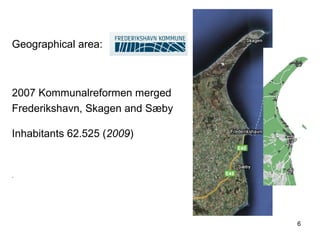
Geographical area: 2007 Kommunalreformen merged Frederikshavn, Skagen and Sæby    Inhabitants 62.525 ( 2009 ) .
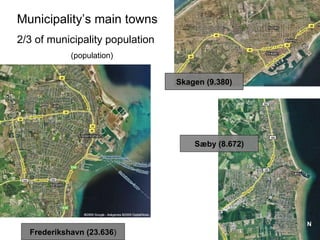
Municipality’s main towns 2/3 of municipality population (population) Frederikshavn (23.636 ) Skagen (9.380) Sæby   (8.672) N
Problems of the Municipality Periphery  Frederikshavn city “boomed” when the train arrived there in 1871. The industrial era is bygone. Population decreasing since the 1980’s 1999 shipyards closed Duty-free ferries were banned  (tourism decreased)
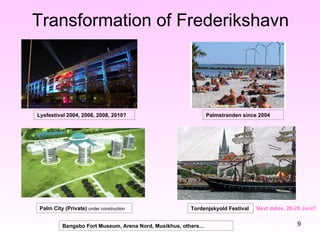
Transformation of Frederikshavn Tordenjskyold Festival Bangsbo Fort Museum, Arena Nord, Musikhus, others… Palmstranden since 2004 Lysfestival 2004, 2006, 2008, 2010? Palm City (Private)  under construction Next dates, 26-28 Juni!!
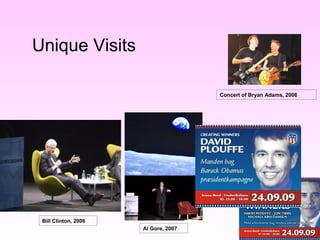
Bill Clinton, 2006 Al Gore, 2007 Concert of Bryan Adams, 2006 Unique Visits
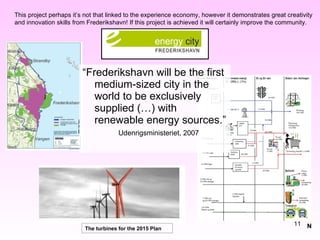
“ Frederikshavn will be the first medium-sized city in the world to be exclusively supplied (…) with renewable energy sources.”  Udenrigsministeriet, 2007 The turbines for the 2015 Plan This project perhaps it’s not that linked to the experience economy, however it demonstrates great creativity and innovation skills from Frederikshavn! If this project is achieved it will certainly improve the community. N
What’s going on  in Frederikshavn?
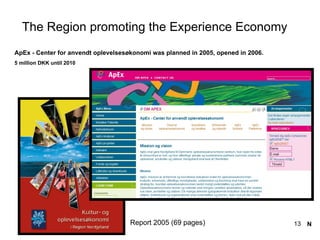
Report 2005 (69 pages) The Region promoting the Experience Economy ApEx - Center for anvendt oplevelsesøkonomi was planned in 2005, opened in 2006.   5 million DKK until 2010 N
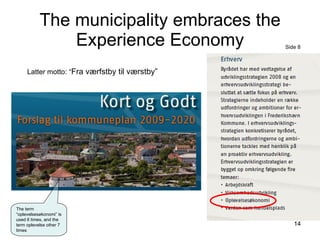
The municipality embraces the Experience Economy Side 8 The term “oplevelsesøkonomi” is used 6 times, and the term oplevelse other 7 times Latter motto: “ Fra værfstby til værstby”
Academics commend the  “experience economy” in Frederikshavn “ Small cities and peripheral places face economic stagnation: Traditional workplaces close, firms relocate to low wage countries, (and) citizens move to bigger cities ” (Lorentzen, 2007). However “ in several smaller Danish towns the  experience economy  has become key to survival. One example is Frederikshavn (… ) within only a five year period Frederikshavn has been able to brand itself into the minds of most Scandinavians as an attractive and pleasant place to live and to visit. (…) Research is needed to explain this transformation .” (Lorentzen, 2008)  “ Triggered in 1999 by a sudden local economic crisis, Frederikshavn entered a process that reinvented its ‘mental frame’ and transformed not only its urban development, but also its identity, image, and governance towards an  experience economic  and entrepreneurial profile.” (Therkildsen et al. 2009) They’re from my Department. In total in AAU there are 14 groups who work or have worked with some aspects of the “experience economy”. Source:  http://www.excite.aau.dk/ N Both published at Journal of European Planning Studies June 2009
Problem formulation 1. Does the “experience economy” bring new entrepreneurial dynamics that could affect Frederikshavn’s development?   Who are the entrepreneurs in the experience economy?  How are they different from other industries (or places)?  How do they work? Networks and resources  How can the experience economy be measured?  What is the outcome of applying the experience economy?  2.  How can the municipality of Frederikshavn implement/adapt the “experience economy” in its economic policy making? In case it is beneficial, how can a municipal government support the experience economy?  If the experience economy has mixed or negative results, how could they reorient their strategy?
Methodology Case Study  (Yin, 1972; Flyvbjerg, 2006) My project is in an interdisciplinary field, with multifaceted problems.
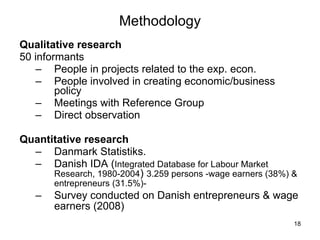
Methodology Qualitative research 50 informants People in projects related to the exp. econ. People involved in creating economic/business policy Meetings with Reference Group Direct observation Quantitative research Danmark Statistiks.  Danish IDA ( Integrated Database for Labour Market Research, 1980-2004 )  3.259 persons -wage earners (38%) & entrepreneurs (31.5%)-   Survey conducted on Danish entrepreneurs & wage earners (2008)
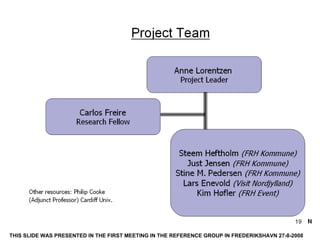
Project Team THIS SLIDE WAS PRESENTED IN THE FIRST MEETING IN THE REFERENCE GROUP IN FREDERIKSHAVN 27-8-2008 N
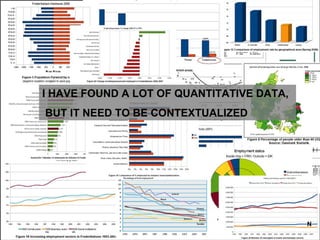
I HAVE FOUND A LOT OF QUANTITATIVE DATA, BUT IT NEED TO BE CONTEXTUALIZED N
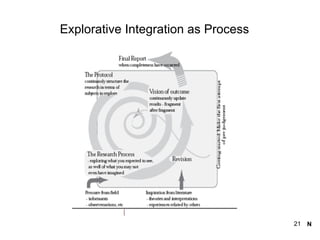
Explorative Integration as Process N
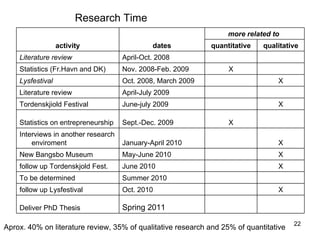
Aprox. 40% on literature review, 35% of qualitative research and 25% of quantitative   Research Time Spring 2011 Deliver PhD Thesis X   Oct. 2010 follow up Lysfestival      Summer 2010 To be determined X   June 2010 follow up Tordenskjold Fest. X   May-June 2010 New Bangsbo Museum X   January-April 2010 Interviews in another research enviroment   X Sept.-Dec. 2009 Statistics on entrepreneurship X   June-july 2009 Tordenskjiold Festival     April-July 2009 Literature review X   Oct. 2008, March 2009 Lysfestival   X Nov. 2008-Feb. 2009 Statistics (Fr.Havn and DK)     April-Oct. 2008 Literature review qualitative quantitative more related to  dates activity
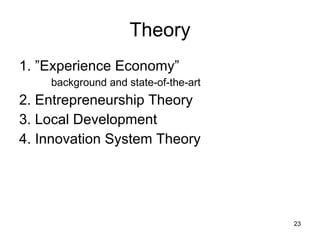
Theory 1. ”Experience Economy”  background and state-of-the-art 2. Entrepreneurship Theory 3. Local Development 4. Innovation System Theory
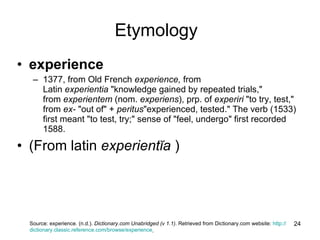
experience     1377, from Old French  experience,  from Latin  experientia  "knowledge gained by repeated trials," from  experientem  (nom.  experiens ), prp. of  experiri  "to try, test," from  ex-  "out of" +  peritus "experienced, tested." The verb (1533) first meant "to test, try;" sense of "feel, undergo" first recorded 1588. (From latin  experientĭa  )  Source:  experience. (n.d.).  Dictionary.com Unabridged (v 1.1) . Retrieved from Dictionary.com website:  http:// dictionary.classic.reference.com / browse / experience   Etymology
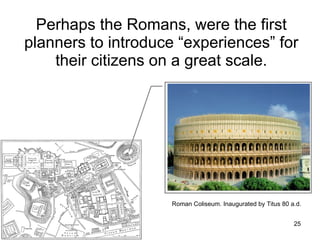
Perhaps the Romans, were the first planners to introduce “experiences” for their citizens on a great scale. Roman Coliseum. I naugurated  by Titus 80 a.d.
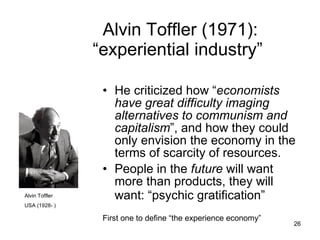
Alvin Toffler (1971):  “experiential industry” He criticized how “ economists have great difficulty imaging alternatives to communism and capitalism ”, and how they could only envision the economy in the terms of scarcity of resources. People in the  future  will want more than products, they will want: “psychic gratification”   First one to define “the experience economy” Alvin Toffler USA (1928- )
Related ”fields” to the idea  of the experience economy Marketing :  “Emotional experiences linked to products and services”  (Holbrook & Hirschman, 1982) Society :  The Experience Society  (C. Köck, 1990; G. Schulze, 1992)   Die Erlebnisgesellschaft  The Dream Society  (R. Jensen, 1999) Economic Geography :  “Urban entrepreneurialism”  (D. Harvey, 1989);   The Cultural Economy  (A. Scott 1997);  The Creative Class  (R. Florida 2004) Planning :  Fantasy city (1998), The city as an entertainment machine (2004), Experiencescapes (O’Dell, 2005), The event city (Metz, 2007), Fun city (Marling & Zerlang, 2007)
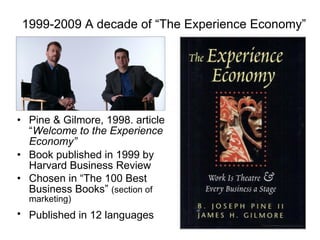
Pine & Gilmore, 1998. article “ Welcome to the Experience Economy”   Book published in 1999 by Harvard Business Review Chosen in “The 100 Best Business Books”  (section of marketing) Published in 12 languages   1999-2009 A decade of “The Experience Economy”
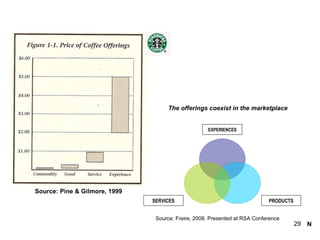
Source: Pine & Gilmore, 1999 The offerings coexist in the marketplace Source: Freire, 2008. Presented at RSA Conference N EXPERIENCES PRODUCTS SERVICES
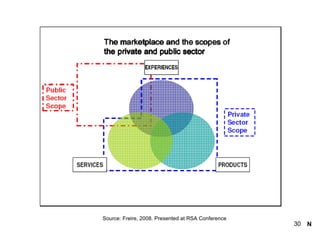
Source: Freire, 2008. Presented at RSA Conference N
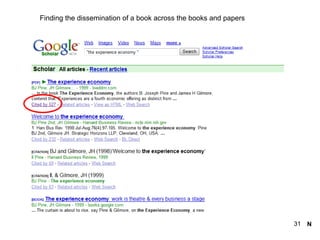
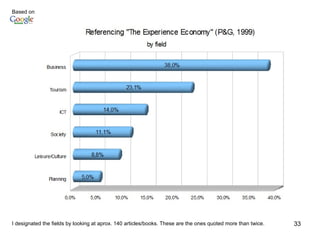
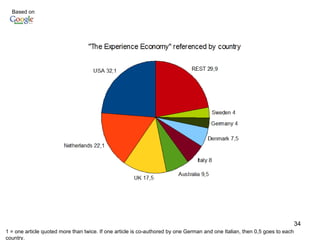
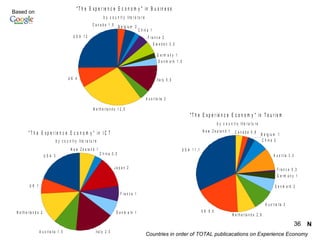
N Finding the dissemination of a book across the books and papers
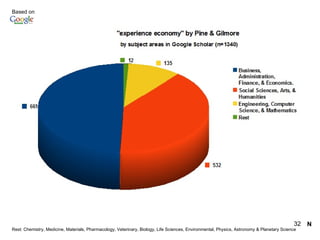
Rest: Chemistry, Medicine, Materials, Pharmacology, Veterinary, Biology, Life Sciences, Environmental, Physics, Astronomy & Planetary Science Based on  N
I designated the fields by looking at aprox. 140 articles/books. These are the ones quoted more than twice.  Based on
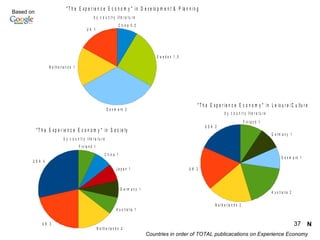
1 = one article quoted more than twice. If one article is co-authored by one German and one Italian, then 0,5 goes to each country. Based on
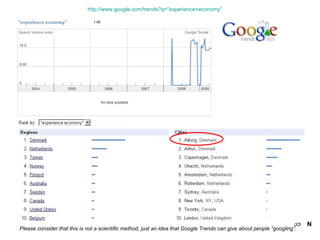
Please consider that this is not a scientific method, just an idea that Google Trends can give about people ”googling”.  http:// www.google.com / trends?q =" experience + economy "   N
Based on  Countries in order of TOTAL publicacations on Experience Economy N
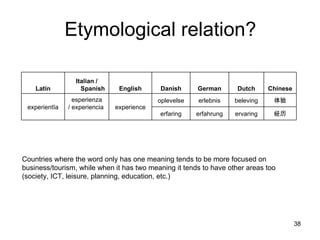
Etymol ogical relation? Countries where the word only has one meaning tends to be more focused on business/tourism, while when it has two meaning it tends to have other areas too (society, ICT, leisure, planning, education, etc.)  经历 ervaring erfahrung erfaring 体验 beleving erlebnis oplevelse experience esperienza / experiencia  experientĭa Chinese Dutch German Danish English Italian / Spanish Latin
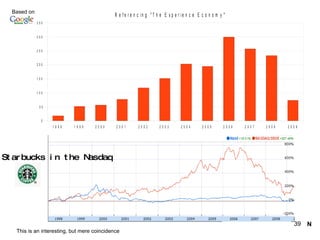
Based on  N This is an interesting, but mere coincidence Starbucks in the Nasdaq
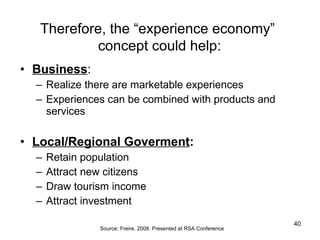
Business :  Realize there are marketable experiences  Experiences can be combined with products and services Local/Regional Goverment : Retain population Attract new citizens  Draw tourism income Attract investment Therefore, the “experience economy”  concept could help : Source: Freire, 2008. Presented at RSA Conference
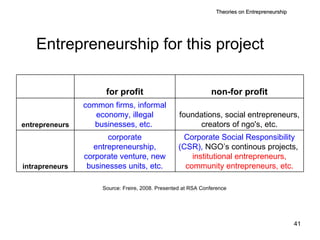
Entrepreneurship for this project Source: Freire, 2008. Presented at RSA Conference Theories on Entrepreneurship Corporate Social Responsibility (CSR),  NGO’s continous projects,  institutional entrepreneurs, community entrepreneurs, etc. corporate entrepreneurship, corporate venture, new businesses units, etc. intrapreneurs foundations, social entrepreneurs, creators of ngo's, etc. common firms, informal economy, illegal businesses, etc.  entrepreneurs non-for profit for profit  
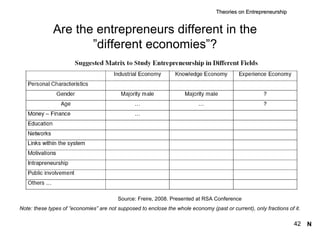
Note: these types of ”economies” are not supposed to enclose the whole economy (past or current), only fractions of it . Are the entrepreneurs different in the ”different economies”? Source: Freire, 2008. Presented at RSA Conference Theories on Entrepreneurship N
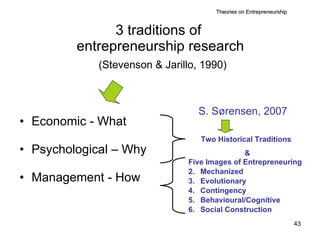
3 traditions of  entrepreneurship research   (Stevenson & Jarillo, 1990) Economic - What  Psychological – Why  Management - How S. Sørensen, 2007 Two Historical Traditions & Five Images of Entrepreneuring Mechanized Evolutionary Contingency Behavioural/Cognitive Social Construction Theories on Entrepreneurship
Five Images of Entrepreneuring (S. Sørensen, 2007) Mechanized Evolutionary Contingency Behavioural/Cognitive Social Construction Contingency : I ndividual and social aspects, without disregarding the socioeconomic environment. It sees the entrepreneurial process as an open system Theories on Entrepreneurship N
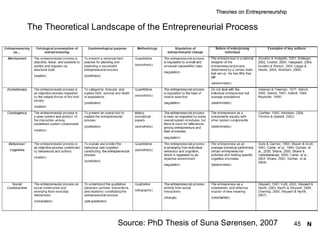
The Theoretical Landscape of the Entrepreneurial Process Source: PhD Thesis of Suna Sørensen, 2007 Theories on Entrepreneurship N
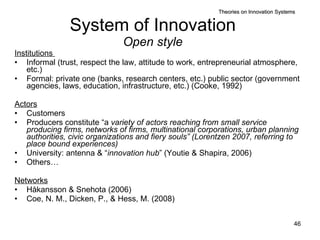
System of Innovation Open style Institutions  Informal (trust, respect the law, attitude to work, entrepreneurial atmosphere, etc.)  Formal: pri vate one (banks, research centers, etc.) public sector (government agencies, laws, education, infrastructure, etc.) (Cooke, 1992) Actors Customers Producers constitute “a  variety of actors reaching from small service producing firms, networks of firms, multinational corporations, urban planning authorities, civic organizations and fiery souls” (Lorentzen 2007, referring to place bound experiences) University: antenna & “ innovation hub ” (Youtie & Shapira, 2006) Others… Networks Håkansson & Snehota (2006) Coe, N. M., Dicken, P., & Hess, M. (2008) Theories on Innovation Systems
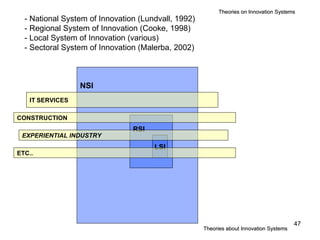
NSI RSI LSI IT   SERVICES CONSTRUCTION EXPERIENTIAL INDUSTRY - National System of Innovation (Lundvall, 1992) - Regional System of Innovation (Cooke, 1998)  - Local System of Innovation (various) - Sectoral System of Innovation (Malerba, 2002)   Theories about Innovation Systems ETC.. Theories on Innovation Systems
Main limitations of I.S. for my project Municipality of Frederikshavn quite small Lack of attention to individual entrepreneur However… Useful device to understand economic evolution/development.   Theories about Innovation Systems Theories on Innovation Systems N
Theories on Local Development Books in order of importance for my project  Julien, P.A. (2007) “A Theory of Local Entrepreneurship in the Knowledge Economy”. London.  Edward Elgar. Pike et al. (2006) Local and Regional Development. London Routledge Fischer and Nijkamp (2009) “Entrepreneurship and regional development” on Handbook of Regional Growth and Development Theories. Oxford.  Edward Elgar Harper, D. (2007) “Foundations of entrepreneurship and economic development.” London: Routledge.  Bingham and Mier (1997) Dilemmas of Urban Economic Development. Thousand Oaks. USA Hart, D. (2003) “The emergence of entrepreneurship policy.” Cambridge University Press. USA Blakely, E. (1994) “Planning Local Economic Development”. Sage Acs, Z. (2008). “Entrepreneurship, growth and public policy prelude to a knowledge spillover theory of entrepreneurship”.  Elgar. And others… N
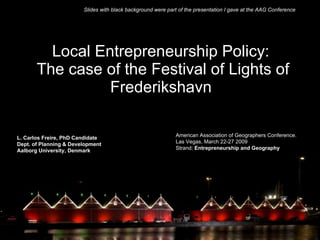
Local Entrepreneurship Policy:  The case of the Festival of Lights of Frederikshavn   L. Carlos Freire, PhD Candidate Dept. of Planning & Development Aalborg University, Denmark American Association of Geographers Conference.  Las Vegas, March 22-27 2009 Strand:  Entrepreneurship and Geography Slides with black background were part of the presentation I gave at the AAG Conference
Festival of Lights. Sources I WRITTEN: Website of the  Light Vision Innovation Center   (organization)  http:// www.lightvisions.dk /   Kommune 25 page report about the 2006 Report.  (English) 10 page report, evaluating the 2008 Lysfestival, from the Managing Director  (English) A powerpoint presentation made by the 2008 Managing Director.  (English) Articles from Anne Lorentzen  (English and Danish)   Students: Master Thesis, and bachelor projects of I20.  (Danish) 5 articles from Nordjyske.dk about the 2006 and 2008 festival  (Danish) Critical report from a citizen in his website about the festival  http://www.gydum.com/side14.html 9.  Other smaller texts in websites This slide was not shown at the AAG conference
Festival of Lights. Sources II VISITS AND INTERVIEWS October 2008 Light Festival.  During the night. Talked to Business people, some artists, Danes and foreign citizens.  International Conference . Informal interviews with I. Cronhammer (local artist) and light designers: K. Mende (Japan) and M. Ridler (UK).  January 2009 Meeting of Light Vision Innovation Center.   8 participants  March 2009 – Interviews with: Jesse Lilley - Managing Director of the 2008 festival.  Bente Jochumsen and Tove Varmløse – Originators of idea. Actively involved in all the festivals. Employees at Fr.Havn Kommune. Søren Tjønneland  – Managing director of Roblon. Light factory. Keld Gyldem – Active citizen critical of the 2008 festival. Run a small photographic exhibition about the lysfestival at the local library.  Heide Burghermeters – Electrical teacher at EUC Nord. Participant.   This slide was not shown at the AAG conference
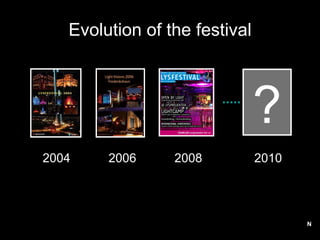
Evolution of the festival 2004  2006  2008  2010 ? N
Entrepreneurship Policy   (Local level) Limited maneuver on taxation, regulation, etc. Main Possibilities : Provide info / advice Incubators, tech parks  (effective?: S&G 1999, Florida 2003) Develop rich networks  (incl. public, private, education)  Help local products to stand out. Local annual festivals. Sources: Hart et al 2004, Holtz-Eakin et al. 2004, Mourdoukuotas & Papadimitriou, 2002 and Julien 2007   For Frederikshavn
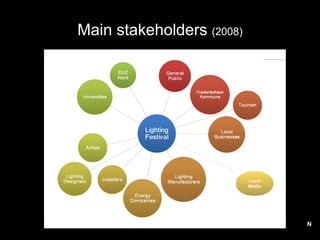
Main stakeholders  (2008) N Local  Media
The impact of local festivals… “ can extend far beyond the economic repercussions of tourist inflows, if they help create a sense of belonging and pride among local residents, thus fostering the sharing of local resources and local purchases, and even helping keep much needed workers in the area instead of migration to the cities”  Julien, 2007 N
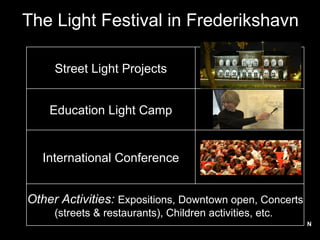
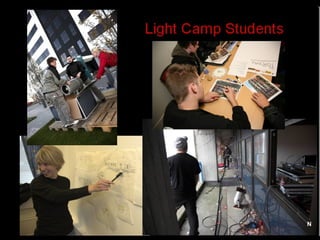
The Light Festival in Frederikshavn N Other Activities:   Expositions, Downtown open, Concerts (streets & restaurants), Children activities, etc.  International Conference Education Light Camp Street Light Projects
N
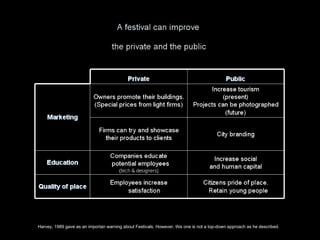
A festival can improve  the private and the public   Harvey, 1989 gave as an importan warning about Festivals. However, this one is not a top-down approach as he described.
Next four slides Paper Plan and Milestones Teaching PhD Courses  External Collaboration
Paper plan This slide has been deleted for the internet version.
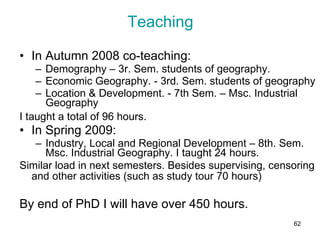
Teaching In Autumn 2008 co-teaching:  Demography – 3r. Sem. students of geography.  Economic Geography. - 3rd. Sem. students of geography  Location & Development. - 7th Sem. – Msc. Industrial Geography I taught a total of 96 hours.   In Spring 2009: Industry, Local and Regional Development – 8th. Sem. Msc. Industrial Geography. I taught 24 hours.  Similar load in next semesters. Besides supervising, censoring and other activities (such as study tour 70 hours)   By end of PhD I will have over 450 hours.
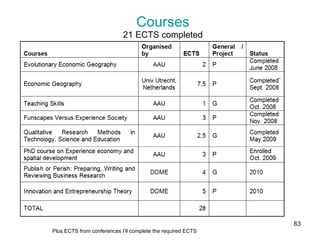
Courses 21 ECTS completed Plus ECTS from conferences I’ll complete the required ECTS
External collaboration   Spring 2010? This slide has been deleted for the internet version.
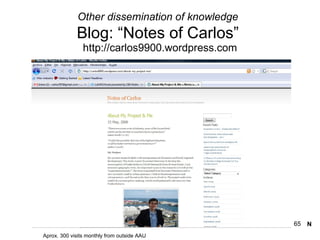
Other dissemination of knowledge   Blog: “Notes of Carlos”  http://carlos9900.wordpress.com N Aprox. 300 visits monthly from outside AAU
Final remarks The concept of the experience economy has evolved from business strategy to economic development It has flourished in Denmark, for three reasons: income per capita of the citizens, for the timing 1999 (destruction of old industry/political changes and bold publications), and perhaps because of the word experience/“oplevelses”.   Lack of research on the effect of the experience economy in the real economy. I aim to explore the entrepreneurial dynamics and find potential effective policy.

1 Year PhD Presentation

  • 1.
    Entrepreneurship, “ExperienceEconomy” and Economic Development of Frederikshavn First Year Presentation L. Carlos Freire Dept. of Development and Planning June 3 rd 2009
  • 2.
    “ There aresome sorts of industry, even of the lowest kind, which can be carried on nowhere but in a great town” Adam Smith (1776) “ Could it be possible, that one of the highest industries, could be better carried on in a provincial town?” Freire (2008) N= Not shown
  • 3.
    Agenda Background Geographic area of analysis What’s going on in Frederikshavn? Problem formulation & Methodology Theories ” Experience Economy” overview Entrepreneurship Local Development Innovation System Pilot Study: Lysfestival i Frederikshavn Plan Courses & External Collaboration Milestones & Papers Final remarks N
  • 4.
    Final Goals For Frederikshavn Analyze the entrepreneurial dynamics in the Experience Economy Suggest effective economic policies
  • 5.
    Project specification Originalname: “ Entrepreneurskab, oplevelsesøkonomi og regional udvikling” Timeline: Spring 2008 – Spring 2011 Funded by: N
  • 6.
    Geographical area: 2007 Kommunalreformenmerged Frederikshavn, Skagen and Sæby  Inhabitants 62.525 ( 2009 ) .
  • 7.
    Municipality’s main towns2/3 of municipality population (population) Frederikshavn (23.636 ) Skagen (9.380) Sæby (8.672) N
  • 8.
    Problems of theMunicipality Periphery Frederikshavn city “boomed” when the train arrived there in 1871. The industrial era is bygone. Population decreasing since the 1980’s 1999 shipyards closed Duty-free ferries were banned (tourism decreased)
  • 9.
    Transformation of FrederikshavnTordenjskyold Festival Bangsbo Fort Museum, Arena Nord, Musikhus, others… Palmstranden since 2004 Lysfestival 2004, 2006, 2008, 2010? Palm City (Private) under construction Next dates, 26-28 Juni!!
  • 10.
    Bill Clinton, 2006Al Gore, 2007 Concert of Bryan Adams, 2006 Unique Visits
  • 11.
    “ Frederikshavn willbe the first medium-sized city in the world to be exclusively supplied (…) with renewable energy sources.” Udenrigsministeriet, 2007 The turbines for the 2015 Plan This project perhaps it’s not that linked to the experience economy, however it demonstrates great creativity and innovation skills from Frederikshavn! If this project is achieved it will certainly improve the community. N
  • 12.
    What’s going on in Frederikshavn?
  • 13.
    Report 2005 (69pages) The Region promoting the Experience Economy ApEx - Center for anvendt oplevelsesøkonomi was planned in 2005, opened in 2006. 5 million DKK until 2010 N
  • 14.
    The municipality embracesthe Experience Economy Side 8 The term “oplevelsesøkonomi” is used 6 times, and the term oplevelse other 7 times Latter motto: “ Fra værfstby til værstby”
  • 15.
    Academics commend the “experience economy” in Frederikshavn “ Small cities and peripheral places face economic stagnation: Traditional workplaces close, firms relocate to low wage countries, (and) citizens move to bigger cities ” (Lorentzen, 2007). However “ in several smaller Danish towns the experience economy has become key to survival. One example is Frederikshavn (… ) within only a five year period Frederikshavn has been able to brand itself into the minds of most Scandinavians as an attractive and pleasant place to live and to visit. (…) Research is needed to explain this transformation .” (Lorentzen, 2008)  “ Triggered in 1999 by a sudden local economic crisis, Frederikshavn entered a process that reinvented its ‘mental frame’ and transformed not only its urban development, but also its identity, image, and governance towards an experience economic and entrepreneurial profile.” (Therkildsen et al. 2009) They’re from my Department. In total in AAU there are 14 groups who work or have worked with some aspects of the “experience economy”. Source: http://www.excite.aau.dk/ N Both published at Journal of European Planning Studies June 2009
  • 16.
    Problem formulation 1.Does the “experience economy” bring new entrepreneurial dynamics that could affect Frederikshavn’s development? Who are the entrepreneurs in the experience economy? How are they different from other industries (or places)? How do they work? Networks and resources How can the experience economy be measured? What is the outcome of applying the experience economy? 2. How can the municipality of Frederikshavn implement/adapt the “experience economy” in its economic policy making? In case it is beneficial, how can a municipal government support the experience economy? If the experience economy has mixed or negative results, how could they reorient their strategy?
  • 17.
    Methodology Case Study (Yin, 1972; Flyvbjerg, 2006) My project is in an interdisciplinary field, with multifaceted problems.
  • 18.
    Methodology Qualitative research50 informants People in projects related to the exp. econ. People involved in creating economic/business policy Meetings with Reference Group Direct observation Quantitative research Danmark Statistiks. Danish IDA ( Integrated Database for Labour Market Research, 1980-2004 ) 3.259 persons -wage earners (38%) & entrepreneurs (31.5%)- Survey conducted on Danish entrepreneurs & wage earners (2008)
  • 19.
    Project Team THISSLIDE WAS PRESENTED IN THE FIRST MEETING IN THE REFERENCE GROUP IN FREDERIKSHAVN 27-8-2008 N
  • 20.
    I HAVE FOUNDA LOT OF QUANTITATIVE DATA, BUT IT NEED TO BE CONTEXTUALIZED N
  • 21.
  • 22.
    Aprox. 40% onliterature review, 35% of qualitative research and 25% of quantitative Research Time Spring 2011 Deliver PhD Thesis X   Oct. 2010 follow up Lysfestival     Summer 2010 To be determined X   June 2010 follow up Tordenskjold Fest. X   May-June 2010 New Bangsbo Museum X   January-April 2010 Interviews in another research enviroment   X Sept.-Dec. 2009 Statistics on entrepreneurship X   June-july 2009 Tordenskjiold Festival     April-July 2009 Literature review X   Oct. 2008, March 2009 Lysfestival   X Nov. 2008-Feb. 2009 Statistics (Fr.Havn and DK)     April-Oct. 2008 Literature review qualitative quantitative more related to dates activity
  • 23.
    Theory 1. ”ExperienceEconomy” background and state-of-the-art 2. Entrepreneurship Theory 3. Local Development 4. Innovation System Theory
  • 24.
    experience   1377, from Old French  experience,  from Latin  experientia  "knowledge gained by repeated trials," from  experientem  (nom.  experiens ), prp. of  experiri  "to try, test," from  ex-  "out of" +  peritus "experienced, tested." The verb (1533) first meant "to test, try;" sense of "feel, undergo" first recorded 1588. (From latin  experientĭa ) Source: experience. (n.d.). Dictionary.com Unabridged (v 1.1) . Retrieved from Dictionary.com website: http:// dictionary.classic.reference.com / browse / experience Etymology
  • 25.
    Perhaps the Romans,were the first planners to introduce “experiences” for their citizens on a great scale. Roman Coliseum. I naugurated by Titus 80 a.d.
  • 26.
    Alvin Toffler (1971): “experiential industry” He criticized how “ economists have great difficulty imaging alternatives to communism and capitalism ”, and how they could only envision the economy in the terms of scarcity of resources. People in the future will want more than products, they will want: “psychic gratification” First one to define “the experience economy” Alvin Toffler USA (1928- )
  • 27.
    Related ”fields” tothe idea of the experience economy Marketing : “Emotional experiences linked to products and services” (Holbrook & Hirschman, 1982) Society : The Experience Society (C. Köck, 1990; G. Schulze, 1992) Die Erlebnisgesellschaft The Dream Society (R. Jensen, 1999) Economic Geography : “Urban entrepreneurialism” (D. Harvey, 1989); The Cultural Economy (A. Scott 1997); The Creative Class (R. Florida 2004) Planning : Fantasy city (1998), The city as an entertainment machine (2004), Experiencescapes (O’Dell, 2005), The event city (Metz, 2007), Fun city (Marling & Zerlang, 2007)
  • 28.
    Pine & Gilmore,1998. article “ Welcome to the Experience Economy” Book published in 1999 by Harvard Business Review Chosen in “The 100 Best Business Books” (section of marketing) Published in 12 languages 1999-2009 A decade of “The Experience Economy”
  • 29.
    Source: Pine &Gilmore, 1999 The offerings coexist in the marketplace Source: Freire, 2008. Presented at RSA Conference N EXPERIENCES PRODUCTS SERVICES
  • 30.
    Source: Freire, 2008.Presented at RSA Conference N
  • 31.
    N Finding thedissemination of a book across the books and papers
  • 32.
    Rest: Chemistry, Medicine,Materials, Pharmacology, Veterinary, Biology, Life Sciences, Environmental, Physics, Astronomy & Planetary Science Based on N
  • 33.
    I designated thefields by looking at aprox. 140 articles/books. These are the ones quoted more than twice. Based on
  • 34.
    1 = onearticle quoted more than twice. If one article is co-authored by one German and one Italian, then 0,5 goes to each country. Based on
  • 35.
    Please consider thatthis is not a scientific method, just an idea that Google Trends can give about people ”googling”. http:// www.google.com / trends?q =" experience + economy " N
  • 36.
    Based on Countries in order of TOTAL publicacations on Experience Economy N
  • 37.
    Based on Countries in order of TOTAL publicacations on Experience Economy N
  • 38.
    Etymol ogical relation?Countries where the word only has one meaning tends to be more focused on business/tourism, while when it has two meaning it tends to have other areas too (society, ICT, leisure, planning, education, etc.) 经历 ervaring erfahrung erfaring 体验 beleving erlebnis oplevelse experience esperienza / experiencia experientĭa Chinese Dutch German Danish English Italian / Spanish Latin
  • 39.
    Based on N This is an interesting, but mere coincidence Starbucks in the Nasdaq
  • 40.
    Business : Realize there are marketable experiences Experiences can be combined with products and services Local/Regional Goverment : Retain population Attract new citizens Draw tourism income Attract investment Therefore, the “experience economy” concept could help : Source: Freire, 2008. Presented at RSA Conference
  • 41.
    Entrepreneurship for thisproject Source: Freire, 2008. Presented at RSA Conference Theories on Entrepreneurship Corporate Social Responsibility (CSR), NGO’s continous projects, institutional entrepreneurs, community entrepreneurs, etc. corporate entrepreneurship, corporate venture, new businesses units, etc. intrapreneurs foundations, social entrepreneurs, creators of ngo's, etc. common firms, informal economy, illegal businesses, etc. entrepreneurs non-for profit for profit  
  • 42.
    Note: these typesof ”economies” are not supposed to enclose the whole economy (past or current), only fractions of it . Are the entrepreneurs different in the ”different economies”? Source: Freire, 2008. Presented at RSA Conference Theories on Entrepreneurship N
  • 43.
    3 traditions of entrepreneurship research (Stevenson & Jarillo, 1990) Economic - What Psychological – Why Management - How S. Sørensen, 2007 Two Historical Traditions & Five Images of Entrepreneuring Mechanized Evolutionary Contingency Behavioural/Cognitive Social Construction Theories on Entrepreneurship
  • 44.
    Five Images ofEntrepreneuring (S. Sørensen, 2007) Mechanized Evolutionary Contingency Behavioural/Cognitive Social Construction Contingency : I ndividual and social aspects, without disregarding the socioeconomic environment. It sees the entrepreneurial process as an open system Theories on Entrepreneurship N
  • 45.
    The Theoretical Landscapeof the Entrepreneurial Process Source: PhD Thesis of Suna Sørensen, 2007 Theories on Entrepreneurship N
  • 46.
    System of InnovationOpen style Institutions Informal (trust, respect the law, attitude to work, entrepreneurial atmosphere, etc.) Formal: pri vate one (banks, research centers, etc.) public sector (government agencies, laws, education, infrastructure, etc.) (Cooke, 1992) Actors Customers Producers constitute “a variety of actors reaching from small service producing firms, networks of firms, multinational corporations, urban planning authorities, civic organizations and fiery souls” (Lorentzen 2007, referring to place bound experiences) University: antenna & “ innovation hub ” (Youtie & Shapira, 2006) Others… Networks Håkansson & Snehota (2006) Coe, N. M., Dicken, P., & Hess, M. (2008) Theories on Innovation Systems
  • 47.
    NSI RSI LSIIT SERVICES CONSTRUCTION EXPERIENTIAL INDUSTRY - National System of Innovation (Lundvall, 1992) - Regional System of Innovation (Cooke, 1998) - Local System of Innovation (various) - Sectoral System of Innovation (Malerba, 2002) Theories about Innovation Systems ETC.. Theories on Innovation Systems
  • 48.
    Main limitations ofI.S. for my project Municipality of Frederikshavn quite small Lack of attention to individual entrepreneur However… Useful device to understand economic evolution/development. Theories about Innovation Systems Theories on Innovation Systems N
  • 49.
    Theories on LocalDevelopment Books in order of importance for my project Julien, P.A. (2007) “A Theory of Local Entrepreneurship in the Knowledge Economy”. London. Edward Elgar. Pike et al. (2006) Local and Regional Development. London Routledge Fischer and Nijkamp (2009) “Entrepreneurship and regional development” on Handbook of Regional Growth and Development Theories. Oxford. Edward Elgar Harper, D. (2007) “Foundations of entrepreneurship and economic development.” London: Routledge. Bingham and Mier (1997) Dilemmas of Urban Economic Development. Thousand Oaks. USA Hart, D. (2003) “The emergence of entrepreneurship policy.” Cambridge University Press. USA Blakely, E. (1994) “Planning Local Economic Development”. Sage Acs, Z. (2008). “Entrepreneurship, growth and public policy prelude to a knowledge spillover theory of entrepreneurship”. Elgar. And others… N
  • 50.
    Local Entrepreneurship Policy: The case of the Festival of Lights of Frederikshavn L. Carlos Freire, PhD Candidate Dept. of Planning & Development Aalborg University, Denmark American Association of Geographers Conference. Las Vegas, March 22-27 2009 Strand: Entrepreneurship and Geography Slides with black background were part of the presentation I gave at the AAG Conference
  • 51.
    Festival of Lights.Sources I WRITTEN: Website of the Light Vision Innovation Center (organization) http:// www.lightvisions.dk / Kommune 25 page report about the 2006 Report. (English) 10 page report, evaluating the 2008 Lysfestival, from the Managing Director (English) A powerpoint presentation made by the 2008 Managing Director. (English) Articles from Anne Lorentzen (English and Danish) Students: Master Thesis, and bachelor projects of I20. (Danish) 5 articles from Nordjyske.dk about the 2006 and 2008 festival (Danish) Critical report from a citizen in his website about the festival http://www.gydum.com/side14.html 9. Other smaller texts in websites This slide was not shown at the AAG conference
  • 52.
    Festival of Lights.Sources II VISITS AND INTERVIEWS October 2008 Light Festival. During the night. Talked to Business people, some artists, Danes and foreign citizens. International Conference . Informal interviews with I. Cronhammer (local artist) and light designers: K. Mende (Japan) and M. Ridler (UK). January 2009 Meeting of Light Vision Innovation Center. 8 participants March 2009 – Interviews with: Jesse Lilley - Managing Director of the 2008 festival. Bente Jochumsen and Tove Varmløse – Originators of idea. Actively involved in all the festivals. Employees at Fr.Havn Kommune. Søren Tjønneland – Managing director of Roblon. Light factory. Keld Gyldem – Active citizen critical of the 2008 festival. Run a small photographic exhibition about the lysfestival at the local library. Heide Burghermeters – Electrical teacher at EUC Nord. Participant. This slide was not shown at the AAG conference
  • 53.
    Evolution of thefestival 2004 2006 2008 2010 ? N
  • 54.
    Entrepreneurship Policy (Local level) Limited maneuver on taxation, regulation, etc. Main Possibilities : Provide info / advice Incubators, tech parks (effective?: S&G 1999, Florida 2003) Develop rich networks (incl. public, private, education) Help local products to stand out. Local annual festivals. Sources: Hart et al 2004, Holtz-Eakin et al. 2004, Mourdoukuotas & Papadimitriou, 2002 and Julien 2007 For Frederikshavn
  • 55.
    Main stakeholders (2008) N Local Media
  • 56.
    The impact oflocal festivals… “ can extend far beyond the economic repercussions of tourist inflows, if they help create a sense of belonging and pride among local residents, thus fostering the sharing of local resources and local purchases, and even helping keep much needed workers in the area instead of migration to the cities” Julien, 2007 N
  • 57.
    The Light Festivalin Frederikshavn N Other Activities: Expositions, Downtown open, Concerts (streets & restaurants), Children activities, etc. International Conference Education Light Camp Street Light Projects
  • 58.
  • 59.
    A festival canimprove the private and the public Harvey, 1989 gave as an importan warning about Festivals. However, this one is not a top-down approach as he described.
  • 60.
    Next four slidesPaper Plan and Milestones Teaching PhD Courses External Collaboration
  • 61.
    Paper plan Thisslide has been deleted for the internet version.
  • 62.
    Teaching In Autumn2008 co-teaching: Demography – 3r. Sem. students of geography. Economic Geography. - 3rd. Sem. students of geography Location & Development. - 7th Sem. – Msc. Industrial Geography I taught a total of 96 hours. In Spring 2009: Industry, Local and Regional Development – 8th. Sem. Msc. Industrial Geography. I taught 24 hours. Similar load in next semesters. Besides supervising, censoring and other activities (such as study tour 70 hours) By end of PhD I will have over 450 hours.
  • 63.
    Courses 21 ECTScompleted Plus ECTS from conferences I’ll complete the required ECTS
  • 64.
    External collaboration Spring 2010? This slide has been deleted for the internet version.
  • 65.
    Other dissemination ofknowledge Blog: “Notes of Carlos” http://carlos9900.wordpress.com N Aprox. 300 visits monthly from outside AAU
  • 66.
    Final remarks Theconcept of the experience economy has evolved from business strategy to economic development It has flourished in Denmark, for three reasons: income per capita of the citizens, for the timing 1999 (destruction of old industry/political changes and bold publications), and perhaps because of the word experience/“oplevelses”. Lack of research on the effect of the experience economy in the real economy. I aim to explore the entrepreneurial dynamics and find potential effective policy.

Editor's Notes

  • #3 232 years later
  • #60 The civil society should also benefit from an enhanced after-dark environment and new night-time image of the town.