© Melissa Caraballo 2013
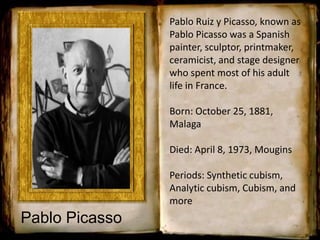
Pablo Ruiz y Picasso, known as
Pablo Picasso was a Spanish
painter, sculptor, printmaker,
ceramicist, and stage designer
who spent most of his adult
life in France.
Born: October 25, 1881,
Malaga
Died: April 8, 1973, Mougins
Periods: Synthetic cubism,
Analytic cubism, Cubism, and
more
Pablo Picasso
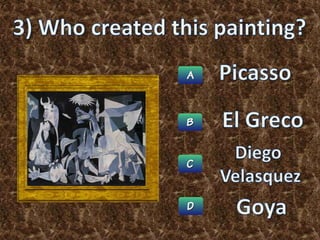
Guernica
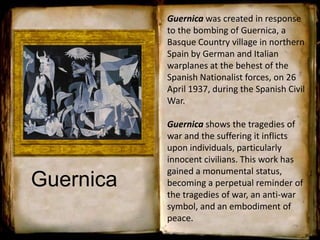
Guernica was created in response
to the bombing of Guernica, a
Basque Country village in northern
Spain by German and Italian
warplanes at the behest of the
Spanish Nationalist forces, on 26
April 1937, during the Spanish Civil
War.
Guernica shows the tragedies of
war and the suffering it inflicts
upon individuals, particularly
innocent civilians. This work has
gained a monumental status,
becoming a perpetual reminder of
the tragedies of war, an anti-war
symbol, and an embodiment of
peace.
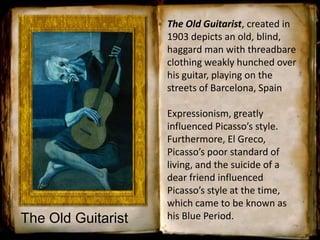
The Old Guitarist, created in
1903 depicts an old, blind,
haggard man with threadbare
clothing weakly hunched over
his guitar, playing on the
streets of Barcelona, Spain
Expressionism, greatly
influenced Picasso’s style.
Furthermore, El Greco,
Picasso’s poor standard of
living, and the suicide of a
dear friend influenced
Picasso’s style at the time,
which came to be known as
his Blue Period.The Old Guitarist
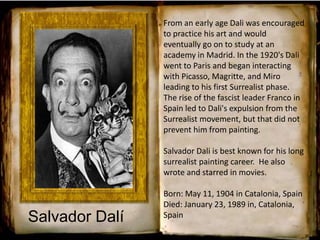
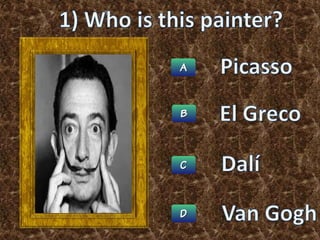
From an early age Dali was encouraged
to practice his art and would
eventually go on to study at an
academy in Madrid. In the 1920's Dali
went to Paris and began interacting
with Picasso, Magritte, and Miro
leading to his first Surrealist phase.
The rise of the fascist leader Franco in
Spain led to Dali's expulsion from the
Surrealist movement, but that did not
prevent him from painting.
Salvador Dali is best known for his long
surrealist painting career. He also
wrote and starred in movies.
Born: May 11, 1904 in Catalonia, Spain
Died: January 23, 1989 in, Catalonia,
SpainSalvador Dalí
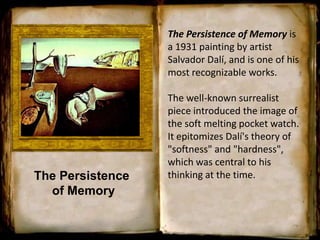
The Persistence
of Memory
The Persistence of Memory is
a 1931 painting by artist
Salvador Dalí, and is one of his
most recognizable works.
The well-known surrealist
piece introduced the image of
the soft melting pocket watch.
It epitomizes Dalí's theory of
"softness" and "hardness",
which was central to his
thinking at the time.
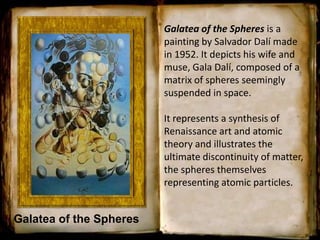
Galatea of the Spheres
Galatea of the Spheres is a
painting by Salvador Dalí made
in 1952. It depicts his wife and
muse, Gala Dalí, composed of a
matrix of spheres seemingly
suspended in space.
It represents a synthesis of
Renaissance art and atomic
theory and illustrates the
ultimate discontinuity of matter,
the spheres themselves
representing atomic particles.
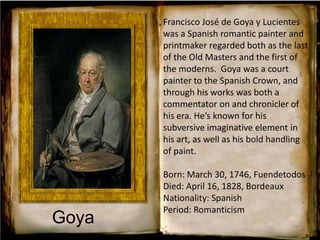
Francisco José de Goya y Lucientes
was a Spanish romantic painter and
printmaker regarded both as the last
of the Old Masters and the first of
the moderns. Goya was a court
painter to the Spanish Crown, and
through his works was both a
commentator on and chronicler of
his era. He’s known for his
subversive imaginative element in
his art, as well as his bold handling
of paint.
Born: March 30, 1746, Fuendetodos
Died: April 16, 1828, Bordeaux
Nationality: Spanish
Period: Romanticism
Goya
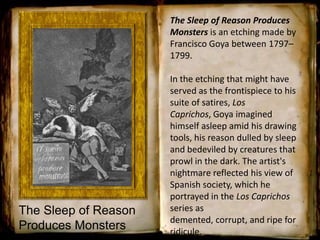
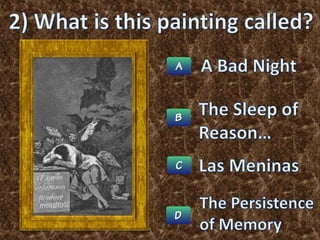
The Sleep of Reason
Produces Monsters
The Sleep of Reason Produces
Monsters is an etching made by
Francisco Goya between 1797–
1799.
In the etching that might have
served as the frontispiece to his
suite of satires, Los
Caprichos, Goya imagined
himself asleep amid his drawing
tools, his reason dulled by sleep
and bedeviled by creatures that
prowl in the dark. The artist's
nightmare reflected his view of
Spanish society, which he
portrayed in the Los Caprichos
series as
demented, corrupt, and ripe for
ridicule.
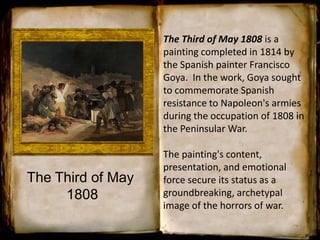
The Third of May
1808
The Third of May 1808 is a
painting completed in 1814 by
the Spanish painter Francisco
Goya. In the work, Goya sought
to commemorate Spanish
resistance to Napoleon's armies
during the occupation of 1808 in
the Peninsular War.
The painting's content,
presentation, and emotional
force secure its status as a
groundbreaking, archetypal
image of the horrors of war.
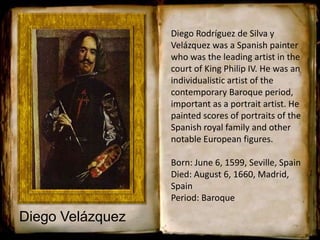
Diego Velázquez
Diego Rodríguez de Silva y
Velázquez was a Spanish painter
who was the leading artist in the
court of King Philip IV. He was an
individualistic artist of the
contemporary Baroque period,
important as a portrait artist. He
painted scores of portraits of the
Spanish royal family and other
notable European figures.
Born: June 6, 1599, Seville, Spain
Died: August 6, 1660, Madrid,
Spain
Period: Baroque
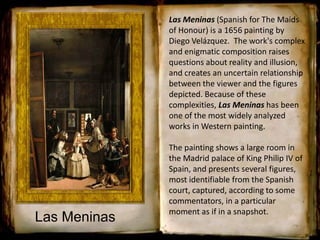
Las Meninas (Spanish for The Maids
of Honour) is a 1656 painting by
Diego Velázquez. The work's complex
and enigmatic composition raises
questions about reality and illusion,
and creates an uncertain relationship
between the viewer and the figures
depicted. Because of these
complexities, Las Meninas has been
one of the most widely analyzed
works in Western painting.
The painting shows a large room in
the Madrid palace of King Philip IV of
Spain, and presents several figures,
most identifiable from the Spanish
court, captured, according to some
commentators, in a particular
moment as if in a snapshot.
Las Meninas
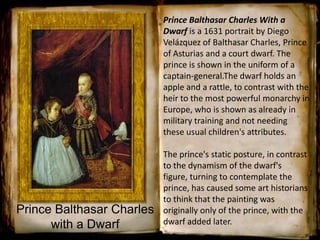
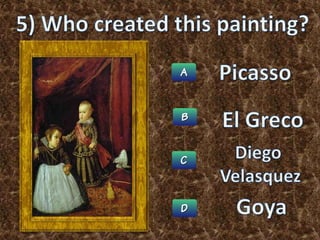
Prince Balthasar Charles With a
Dwarf is a 1631 portrait by Diego
Velázquez of Balthasar Charles, Prince
of Asturias and a court dwarf. The
prince is shown in the uniform of a
captain-general.The dwarf holds an
apple and a rattle, to contrast with the
heir to the most powerful monarchy in
Europe, who is shown as already in
military training and not needing
these usual children's attributes.
The prince's static posture, in contrast
to the dynamism of the dwarf's
figure, turning to contemplate the
prince, has caused some art historians
to think that the painting was
originally only of the prince, with the
dwarf added later.
Prince Balthasar Charles
with a Dwarf
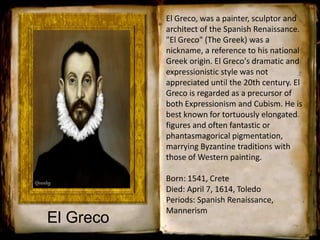
El Greco
El Greco, was a painter, sculptor and
architect of the Spanish Renaissance.
"El Greco" (The Greek) was a
nickname, a reference to his national
Greek origin. El Greco's dramatic and
expressionistic style was not
appreciated until the 20th century. El
Greco is regarded as a precursor of
both Expressionism and Cubism. He is
best known for tortuously elongated
figures and often fantastic or
phantasmagorical pigmentation,
marrying Byzantine traditions with
those of Western painting.
Born: 1541, Crete
Died: April 7, 1614, Toledo
Periods: Spanish Renaissance,
Mannerism
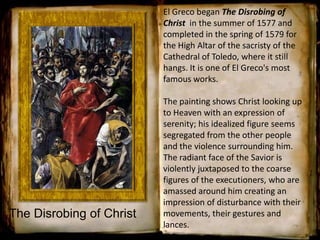
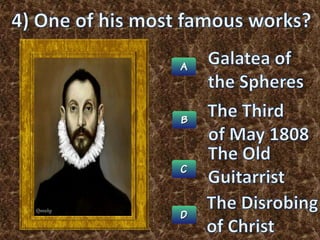
El Greco began The Disrobing of
Christ in the summer of 1577 and
completed in the spring of 1579 for
the High Altar of the sacristy of the
Cathedral of Toledo, where it still
hangs. It is one of El Greco's most
famous works.
The painting shows Christ looking up
to Heaven with an expression of
serenity; his idealized figure seems
segregated from the other people
and the violence surrounding him.
The radiant face of the Savior is
violently juxtaposed to the coarse
figures of the executioners, who are
amassed around him creating an
impression of disturbance with their
movements, their gestures and
lances.
The Disrobing of Christ
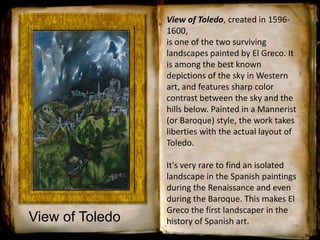
View of Toledo
View of Toledo, created in 1596-
1600,
is one of the two surviving
landscapes painted by El Greco. It
is among the best known
depictions of the sky in Western
art, and features sharp color
contrast between the sky and the
hills below. Painted in a Mannerist
(or Baroque) style, the work takes
liberties with the actual layout of
Toledo.
It's very rare to find an isolated
landscape in the Spanish paintings
during the Renaissance and even
during the Baroque. This makes El
Greco the first landscaper in the
history of Spanish art.
Emse3122presentation

Emse3122presentation

  • 1.
  • 2.
    Pablo Ruiz yPicasso, known as Pablo Picasso was a Spanish painter, sculptor, printmaker, ceramicist, and stage designer who spent most of his adult life in France. Born: October 25, 1881, Malaga Died: April 8, 1973, Mougins Periods: Synthetic cubism, Analytic cubism, Cubism, and more Pablo Picasso
  • 3.
    Guernica Guernica was createdin response to the bombing of Guernica, a Basque Country village in northern Spain by German and Italian warplanes at the behest of the Spanish Nationalist forces, on 26 April 1937, during the Spanish Civil War. Guernica shows the tragedies of war and the suffering it inflicts upon individuals, particularly innocent civilians. This work has gained a monumental status, becoming a perpetual reminder of the tragedies of war, an anti-war symbol, and an embodiment of peace.
  • 4.
    The Old Guitarist,created in 1903 depicts an old, blind, haggard man with threadbare clothing weakly hunched over his guitar, playing on the streets of Barcelona, Spain Expressionism, greatly influenced Picasso’s style. Furthermore, El Greco, Picasso’s poor standard of living, and the suicide of a dear friend influenced Picasso’s style at the time, which came to be known as his Blue Period.The Old Guitarist
  • 5.
    From an earlyage Dali was encouraged to practice his art and would eventually go on to study at an academy in Madrid. In the 1920's Dali went to Paris and began interacting with Picasso, Magritte, and Miro leading to his first Surrealist phase. The rise of the fascist leader Franco in Spain led to Dali's expulsion from the Surrealist movement, but that did not prevent him from painting. Salvador Dali is best known for his long surrealist painting career. He also wrote and starred in movies. Born: May 11, 1904 in Catalonia, Spain Died: January 23, 1989 in, Catalonia, SpainSalvador Dalí
  • 6.
    The Persistence of Memory ThePersistence of Memory is a 1931 painting by artist Salvador Dalí, and is one of his most recognizable works. The well-known surrealist piece introduced the image of the soft melting pocket watch. It epitomizes Dalí's theory of "softness" and "hardness", which was central to his thinking at the time.
  • 7.
    Galatea of theSpheres Galatea of the Spheres is a painting by Salvador Dalí made in 1952. It depicts his wife and muse, Gala Dalí, composed of a matrix of spheres seemingly suspended in space. It represents a synthesis of Renaissance art and atomic theory and illustrates the ultimate discontinuity of matter, the spheres themselves representing atomic particles.
  • 8.
    Francisco José deGoya y Lucientes was a Spanish romantic painter and printmaker regarded both as the last of the Old Masters and the first of the moderns. Goya was a court painter to the Spanish Crown, and through his works was both a commentator on and chronicler of his era. He’s known for his subversive imaginative element in his art, as well as his bold handling of paint. Born: March 30, 1746, Fuendetodos Died: April 16, 1828, Bordeaux Nationality: Spanish Period: Romanticism Goya
  • 9.
    The Sleep ofReason Produces Monsters The Sleep of Reason Produces Monsters is an etching made by Francisco Goya between 1797– 1799. In the etching that might have served as the frontispiece to his suite of satires, Los Caprichos, Goya imagined himself asleep amid his drawing tools, his reason dulled by sleep and bedeviled by creatures that prowl in the dark. The artist's nightmare reflected his view of Spanish society, which he portrayed in the Los Caprichos series as demented, corrupt, and ripe for ridicule.
  • 10.
    The Third ofMay 1808 The Third of May 1808 is a painting completed in 1814 by the Spanish painter Francisco Goya. In the work, Goya sought to commemorate Spanish resistance to Napoleon's armies during the occupation of 1808 in the Peninsular War. The painting's content, presentation, and emotional force secure its status as a groundbreaking, archetypal image of the horrors of war.
  • 11.
    Diego Velázquez Diego Rodríguezde Silva y Velázquez was a Spanish painter who was the leading artist in the court of King Philip IV. He was an individualistic artist of the contemporary Baroque period, important as a portrait artist. He painted scores of portraits of the Spanish royal family and other notable European figures. Born: June 6, 1599, Seville, Spain Died: August 6, 1660, Madrid, Spain Period: Baroque
  • 12.
    Las Meninas (Spanishfor The Maids of Honour) is a 1656 painting by Diego Velázquez. The work's complex and enigmatic composition raises questions about reality and illusion, and creates an uncertain relationship between the viewer and the figures depicted. Because of these complexities, Las Meninas has been one of the most widely analyzed works in Western painting. The painting shows a large room in the Madrid palace of King Philip IV of Spain, and presents several figures, most identifiable from the Spanish court, captured, according to some commentators, in a particular moment as if in a snapshot. Las Meninas
  • 13.
    Prince Balthasar CharlesWith a Dwarf is a 1631 portrait by Diego Velázquez of Balthasar Charles, Prince of Asturias and a court dwarf. The prince is shown in the uniform of a captain-general.The dwarf holds an apple and a rattle, to contrast with the heir to the most powerful monarchy in Europe, who is shown as already in military training and not needing these usual children's attributes. The prince's static posture, in contrast to the dynamism of the dwarf's figure, turning to contemplate the prince, has caused some art historians to think that the painting was originally only of the prince, with the dwarf added later. Prince Balthasar Charles with a Dwarf
  • 14.
    El Greco El Greco,was a painter, sculptor and architect of the Spanish Renaissance. "El Greco" (The Greek) was a nickname, a reference to his national Greek origin. El Greco's dramatic and expressionistic style was not appreciated until the 20th century. El Greco is regarded as a precursor of both Expressionism and Cubism. He is best known for tortuously elongated figures and often fantastic or phantasmagorical pigmentation, marrying Byzantine traditions with those of Western painting. Born: 1541, Crete Died: April 7, 1614, Toledo Periods: Spanish Renaissance, Mannerism
  • 15.
    El Greco beganThe Disrobing of Christ in the summer of 1577 and completed in the spring of 1579 for the High Altar of the sacristy of the Cathedral of Toledo, where it still hangs. It is one of El Greco's most famous works. The painting shows Christ looking up to Heaven with an expression of serenity; his idealized figure seems segregated from the other people and the violence surrounding him. The radiant face of the Savior is violently juxtaposed to the coarse figures of the executioners, who are amassed around him creating an impression of disturbance with their movements, their gestures and lances. The Disrobing of Christ
  • 16.
    View of Toledo Viewof Toledo, created in 1596- 1600, is one of the two surviving landscapes painted by El Greco. It is among the best known depictions of the sky in Western art, and features sharp color contrast between the sky and the hills below. Painted in a Mannerist (or Baroque) style, the work takes liberties with the actual layout of Toledo. It's very rare to find an isolated landscape in the Spanish paintings during the Renaissance and even during the Baroque. This makes El Greco the first landscaper in the history of Spanish art.